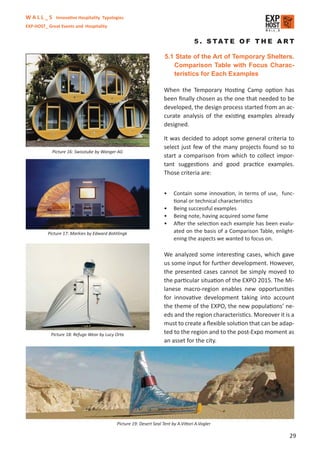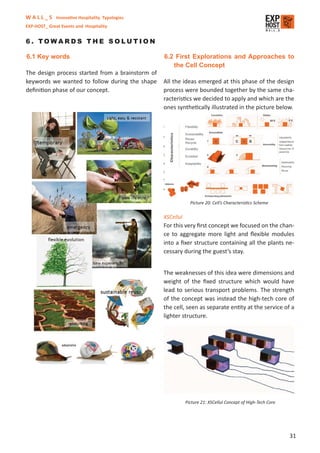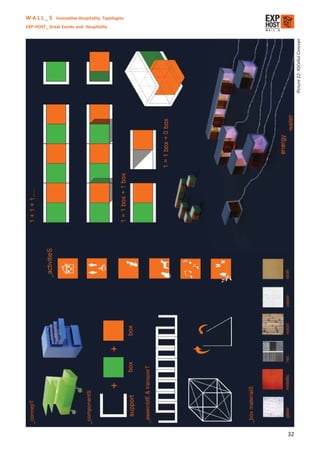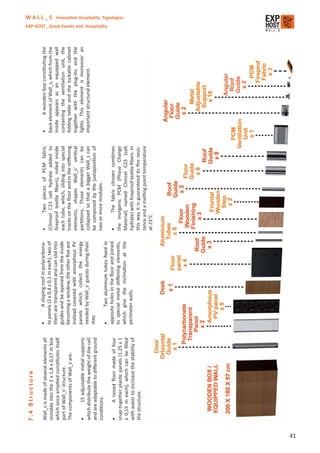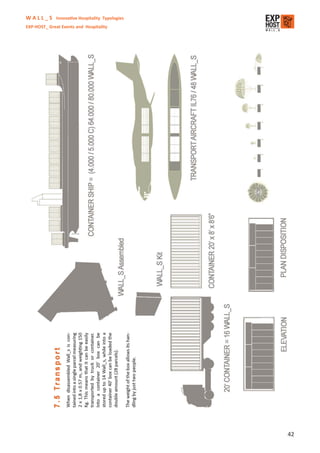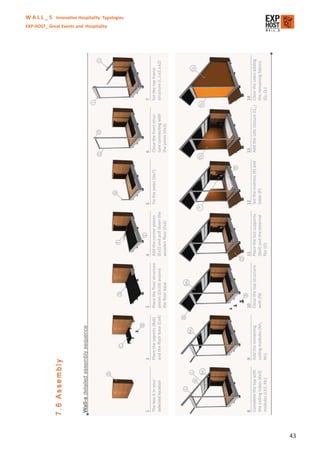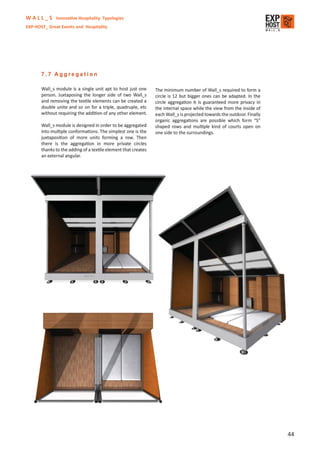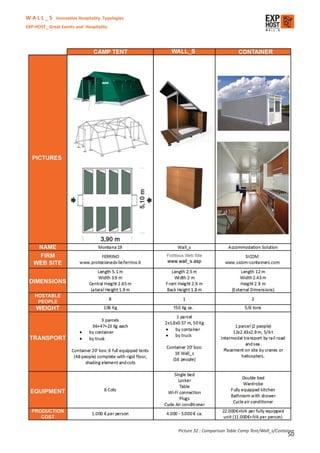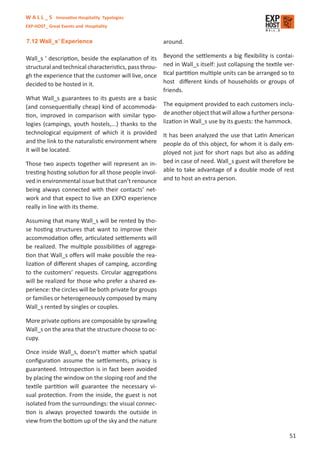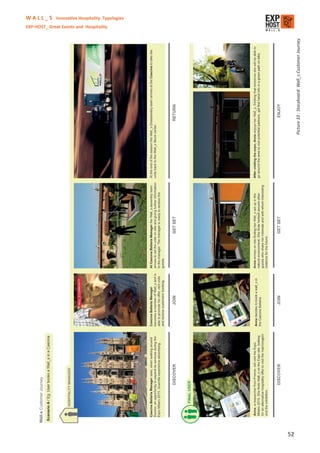
Innovative Hospitality Typologies
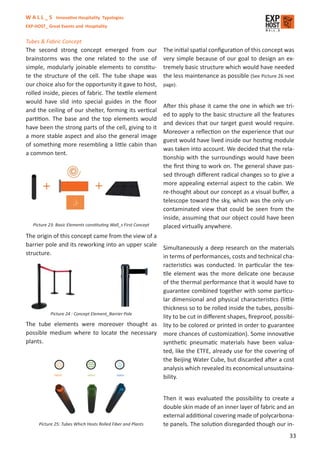
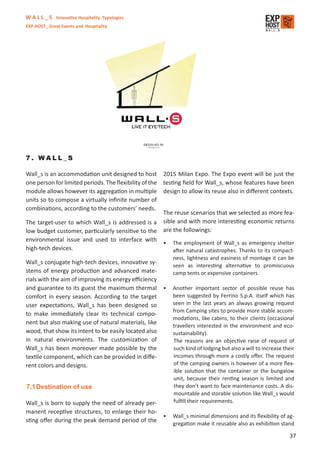
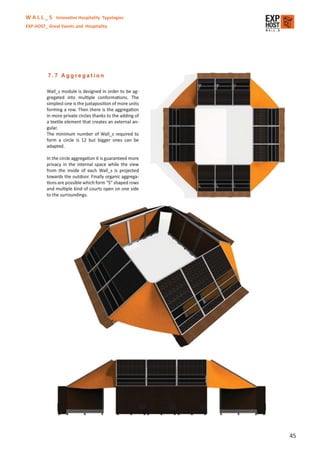
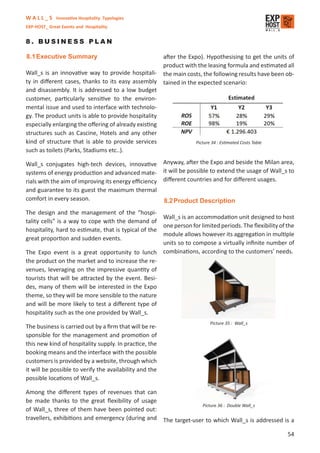
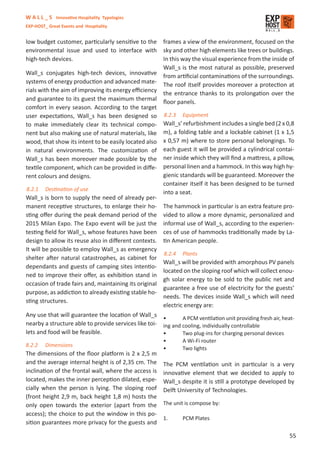
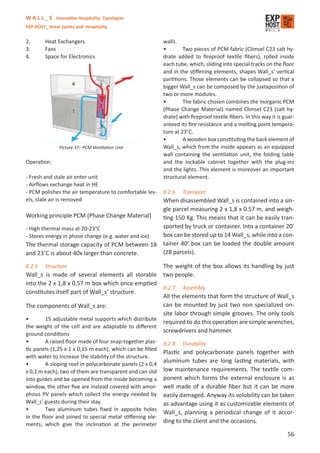
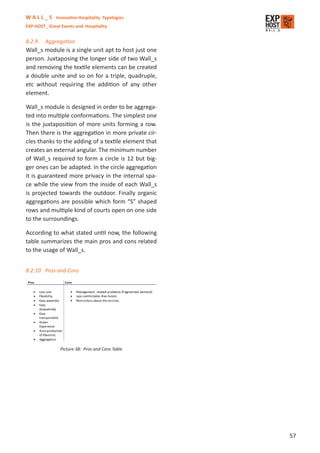
WALL_S


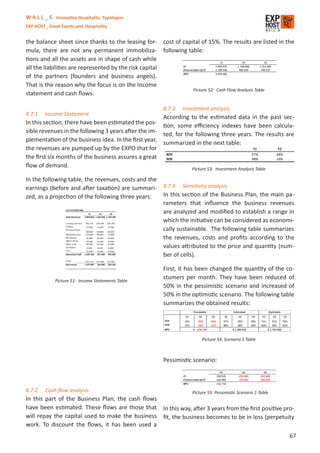
                                    Ana Victoria Faría Delfino

                                    Martina Gallia

                                    Yanina Guerzovich

                                    Vincenzo Mongiello

                                    Louena Shtrepi

                                    Principal Tutor:
                                    Corinna Morandi
Ana Victoria Faría Delfino

Martina Gallia

Yanina Guerzovich

Vincenzo Mongiello

Louena Shtrepi
W A L L _ S Innovative Hospitality Typologies
EXP-HOST_ Great Events and Hospitality


                                                                          M U LT I D I S C I P L I NA RY
                                                                       PROJECT FINAL REPORT


                                                    E X P - H O S T _ Great events and hospitality
                                                            Milan Expo 2015 and Turin Italia 150:
                                                 new concepts and formats for new populations

                                                     WALL_S          Innovative Hospitality Typologies

                                         Ana Victoria Faria Delfino, Architecture (Construction) , Politecnico di Torino


                                                                              (signature)________________________

                                                                    Martina Gallia, Architecture, Politecnico di Torino


                                                                              (signature)________________________

                                            Yanina Guerzovich, Product-Service System Design, Politecnico di Milano


                                                                              (signature)________________________

                Vincenzo Mongiello, Management, Economics and Industrial Engineering, Politecnico di Milano


                                                                              (signature)________________________

                                                    Louena Shtrepi, Architecture (Construction), Politecnico di Torino


                                                                              (signature)________________________


                                                                                            Principal Academic Tutor:

                                         Corinna Morandi, Dept. of Architecture and Planning, Politecnico di Milano


                                                          (signature)________________________________________

                                                                                         Other Academic Tutors:
                                       Flavio Boscacci, Dept. of Architecture and Planning, Politecnico di Milano
                    Alberto De Marco, Dept. of Production System and Business Economy, Politecnico di Milano
                                        Fabrizio Leoni, Dept. of Architecture and Planning, Politecnico di Milano
                   Francesco Prizzon, Dept. of Building Engineering and Territorial Systems, Politecnico di Torino
                                           Paola Pucci, Dept. of Architecture and Planning, Politecnico di Milano
                                      Andrea Rolando, Dept. of Architecture and Planning, Politecnico di Milano
                                          Luca Tamini, Dept. of Architecture and Planning, Politecnico di Milano
                                           Cino Zucchi, Dept. of Architecture and Planning, Politecnico di Milano

                                                                                              External Tutor(s):
                                Maria Teresa Broggini Moretto, Comune di Milano – Direzione Attività Produttive
                                                                                   Leonardo Cavalli, One-Works
                                                              Elena Milanesi, Assolombarda – Settore Territorio
                                                                                 Giorgio Rabajoli, Ferrino S.p.A.
                                                                                                                     4
W A L L _ S Innovative Hospitality Typologies
EXP-HOST_ Great Events and Hospitality


INDEX


1.EXECUTIVE SUMMARY                                                               8

2. INTRODUCTION
2.1 General description of the problem of hospitality
    during great events – Milan 2015 EXPO as a case study                         9

2.2      Quotations of interesting examples of hospitality or problems            10
         noticed during previous great events
2.2.1    Hannover 2000                                                            10
2.2.2    Zaragoza 2008                                                            11
2.2.3    Turin events: Torino 2006 and Torino 2011

2.3      Shanghai 2010, test on the field of failures and good practice examples   13

2.4      Why is it better to face the hospitality with temporary
         structures and not with new massive buildings                            16

2.5      What do we intend as “Temporariness” and “Hospitality”                   17

3. USERS’ REQUIREMENTS
3.1 Milano Expo 2015 and its receptivity                                          18

3.2      Data (visitors, site plan)                                               19

3.3      Stakeholders                                                             20


4. DESIGN PROCESS
4.1 First ideas on possible solutions: Annexes, Pay per Sleep,
    First booking, Temporary Hosting Camps                                        22

4.2      Places Where to Locate our Hospitality Offer                             24

4.3      Different Definitions of Temporariness
         Related to Accommodation Solutions                                       25

4.4      Stakeholders present in Disaster Response
         (a possible scenario where to use the hosting units)                     26

4.5      A reflection on the Creative Dynamics of our Design Process               27


                                                                                       5
W A L L _ S Innovative Hospitality Typologies
EXP-HOST_ Great Events and Hospitality


5 . S TAT E O F T H E A R T
5.1   State of the Art of Temporary Shelters
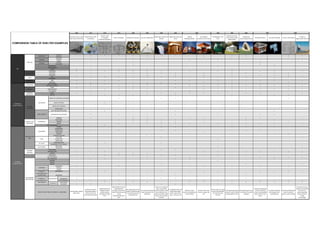
      Comparison Table with Focus Characteristics for Each Examples          29


6. TOWARDS THE SOLUTION
6.1 Key words                                                                31

6.2      First Explorations and Approaches to the Cell Concept               31

7. WALL_S
7.1 Destination of use                                                       37

7.2      Dimensions                                                          39

7.3      Equipment                                                           40

7.4      Structure                                                           41

7.5      Transport                                                           42

7.6      Assembly                                                            43

7.7      Aggregation                                                         44

7.8      Plants                                                              46

7.9      Durability                                                          46

7.10     PCM
7.10.1. Classification of PCM                                                 47
7.10.2. PCMs’ Properties                                                     48
7.10.3. Thermal Storage Unit and Air Exchanger Applications                  48

7.11     Comparison between Wall_s and
         Already Existing Solution in the Temporary Shelters’ Market Share   49

7.12 Wall_s Experience                                                       51


8. BUSINESS PLAN
8.1 Executive Summary                                                        54

8.2      Product Description                                                 54
8.2.1    Destination of use                                                  55
8.2.2    Dimensions                                                          55

                                                                                  6
W A L L _ S Innovative Hospitality Typologies
EXP-HOST_ Great Events and Hospitality


8.2.3    Equipment                              55
8.2.4    Plants                                 55
8.2.5    Structure                              56
8.2.6    Transport                              56
8.2.7    Assembly                               56
8.2.8    Durability                             56
8.2.9    Aggregation                            57
8.2.10   Pros and Cons                          57

8.3      Strategic Plan                         58
8.3.1    Mission                                58
8.3.2    Objectives                             58
8.3.3    Business Analysis                      58
8.3.4    Strength & Weaknesses                  58
8.3.5    Opportunities and Threats              58
8.3.6    Strategy                               59
8.3.7    Positioning (Brand)                    60
8.3.8    Location                               60

8.4      Marketing Plan                         60
8.4.1    Expo Visitors                          60
8.4.2    Travellers (Afetr Expo)                61
8.4.3    Temporary Exhibitions                  61
8.4.4    Disasters                              61

8.5      Market strategy                        61
8.5.1    Product                                61
8.5.2    Promotion & Places                     61
8.5.3    Price                                  64

8.6      Operating and Organization Plan        64

8.7      Financial Plan                         65
8.7.1    Income Statement                       67
8.7.2    Cash Flow Analysis                     67
8.7.3    Investment Analysis                    67
8.7.4    Sensitivity Analysis                   67

9. CONCLUSIONS                                  71

REFERENCES                                      73


                                                     7
W A L L _ S Innovative Hospitality Typologies
EXP-HOST_ Great Events and Hospitality


                                                       1. EXECUTIVE SUMMARY

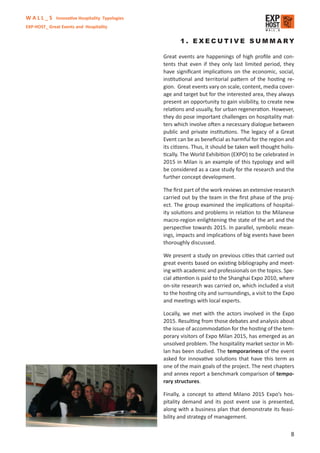
                                                Great events are happenings of high profile and con-
                                                tents that even if they only last limited period, they
                                                have significant implications on the economic, social,
                                                institutional and territorial pattern of the hosting re-
                                                gion. Great events vary on scale, content, media cover-
                                                age and target but for the interested area, they always
                                                present an opportunity to gain visibility, to create new
                                                relations and usually, for urban regeneration. However,
                                                they do pose important challenges on hospitality mat-
                                                ters which involve often a necessary dialogue between
                                                public and private institutions. The legacy of a Great
                                                Event can be as beneficial as harmful for the region and
                                                its citizens. Thus, it should be taken well thought holis-
                                                tically. The World Exhibition (EXPO) to be celebrated in
                                                2015 in Milan is an example of this typology and will
                                                be considered as a case study for the research and the
                                                further concept development.

                                                The first part of the work reviews an extensive research
                                                carried out by the team in the first phase of the proj-
                                                ect. The group examined the implications of hospital-
                                                ity solutions and problems in relation to the Milanese
                                                macro-region enlightening the state of the art and the
                                                perspective towards 2015. In parallel, symbolic mean-
                                                ings, impacts and implications of big events have been
                                                thoroughly discussed.

                                                We present a study on previous cities that carried out
                                                great events based on existing bibliography and meet-
                                                ing with academic and professionals on the topics. Spe-
                                                cial attention is paid to the Shanghai Expo 2010, where
                                                on-site research was carried on, which included a visit
                                                to the hosting city and surroundings, a visit to the Expo
                                                and meetings with local experts.

                                                Locally, we met with the actors involved in the Expo
                                                2015. Resulting from those debates and analysis about
                                                the issue of accommodation for the hosting of the tem-
                                                porary visitors of Expo Milan 2015, has emerged as an
                                                unsolved problem. The hospitality market sector in Mi-
                                                lan has been studied. The temporariness of the event
                                                asked for innovative solutions that have this term as
                                                one of the main goals of the project. The next chapters
                                                and annex report a benchmark comparison of tempo-
                                                rary structures.

                                                Finally, a concept to attend Milano 2015 Expo’s hos-
                                                pitality demand and its post event use is presented,
                                                along with a business plan that demonstrate its feasi-
                                                bility and strategy of management.

                                                                                                        8
W A L L _ S Innovative Hospitality Typologies
EXP-HOST_ Great Events and Hospitality


2. INTRODUCTION

2.1 General description of the problem of cs and management of the increasing demand of
     hospitality during great events – Milan goods and, receptivity in terms of accommodation
     2015 EXPO as a case study                         and other serv ices like restaurants and informa-
                                                       tion. Preparing the city for a Great Event means
In 2015 Milan will be part of a long history of World to find solutions to reduce the gap between the
Exhibitions as the hosting city of the EXPO. Since the existing and forecasted offer and demand. This is a
1851 Great Exhibition at London’s Crystal Palace, very complex matter.
World Expositions have been a platform to display
historical experience and the best global practices.
“A world Fair or Expo is a infrequently occurring Looking at the strategies taken in Hanover 2000,
celebration that typically showcases the latest or Zaragoza 2008 and Shanghai 2010 allowed us to
future advances in arts, culture and technology”* . understand how these cities approached these
They foster the exchange of innovative ideas that themes, and in particular hospitality offer and de-
seek to tackle the problems facing mankind in the mand. However, to propose solutions to reach the
future. Expo-sites have left incredible infrastruc- needs of the coming visitors and to avoid the over-
tures in the city such as the Tour Eiffel as well as load, a clear idea about the demand is necessary.
                                                                                                        **
redeveloped areas such as the La Cartuja Leisure Even if the focus of this research is not that one
Park created after Seville, 1992. Another recent , it is important to remark that the forecasted vi-
example is multifunctional urbanized area of the sitors for the Milanese Expo have decreased by
Puxi Section of the 2010 Shanghai Expo, which is 10 million during the development of the project.
a promising heritage for the city. Most Expos have Another important element is that the origin of
shown positive effects. For instance, they create the expected visitors and their interests. Thus, we
new investments and temporary employment to should underline the current offer of the hosting
build infrastructure as was seen in the past (Anda- region as well as its opportunities for the future.
lusia, 1992) and nowadays with the enlargement of Nowadays, Milan lacks a clear strategy in terms
the transportation system and belted parks in the of hospitality and self-promotion as a tourist de-
Milanese macro-region. Another important impact stination compared for instance with other major
is the creation of networks based on new cultural, node cities such as Berlin in Germany or Rome in
scientific and technological exchanges and confe- Italy. The EXPO brings a great opportunity to build
rences which bring new commercial opportunities a renovated image of the city and its macro-region
for both hosts and visitors. Furthermore, an Expo in the international context. Valuable legacy of the
region, usually situated on 1.5 million m2, provides event could promote the territory in several areas
an excellent opportunity to expand its possibilities as sustainable pole for tourism, business and re-
for tourism and self-promotion during the opera- search.
tional period (6 months) and after.
                                                                        The EXPO*** preparation and event is controlled
A hosting city must deal with several critical issues                   by the BIE. However, the main issues about the re-
liked to the overload of the existing hospitality                       gional development are decided by the local pu-
infrastructure. This means potential problems in
                                                                        **       The team A had approach this topic, feeding our path
terms of accessibility and transportation, logisti-
                                                                        with useful and updated information on the visitors profile.
                                                                        ***      Regulations and further information on Expos can be
*        Goldblatt, J. Nelson, K.S. (2001), The International Dictio-   found on the Bureau Interanal des Expositions BIE website as well
nary of Event Management, John Wiley & Sons, New York, p. 279.          as in the 2015 Milano Expo website.

                                                                                                                                        9
W A L L _ S Innovative Hospitality Typologies
EXP-HOST_ Great Events and Hospitality


blic administrators. Thus they must be considered      for the future event of Turin 2011.
as a key stakeholder in any project which involves
the coming World Exhibition. As highlighted by the
Municipality of Milan in the meetings, Expo should
be an opportunity for further development for the
city. It should be a vehicle to accelerate the crea-
tion of new relations with the visitors and territo-
rial transformations, increasing the region’s value.


In this context, some first general questions were
raised in the group: Which are the possible pro-
blems to solve in general? Who owns the pro-
blem? To whom is the problem-solution relevant?
In which stakeholder/s are we going to focus on?
What can technology do for the problem in a cre-
ative and innovative way? From a multidisciplina-
ry view, how can we approach the problem? And,
some possible problems to solve in general came
out: explore innovative typologies of hospitality
of new populations; develop a sustainable solu-
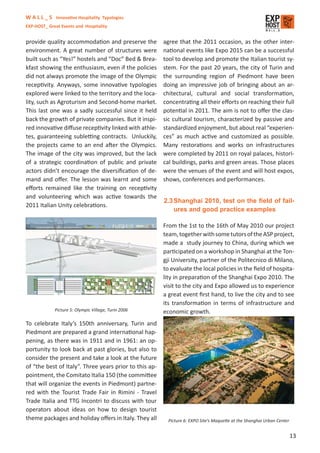
                                                          Picture 1: Prevvous EXPO and Turin Events’ Logos
tion; develop a solution thinking of the impact and
opportunities: Before - During - After the Expo; A special chapter will be dedicated to Shanghai
develop a solution that will be beneficial for the 2010 Expo, which we visited, getting a real idea of
community afterwards; find a fast and feasible so- the life in a hosting city and the exhibition.
lution of business model that will be ready for the
event.
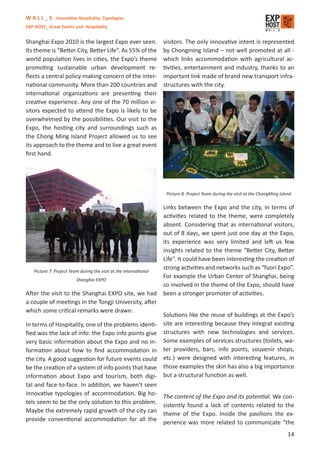
                                                       2.2.1   Hannover 2000
                                                       In order to remain true to its own urban develop-
2.2 Quotations of interesting examples of              ment, a completely new-generation district called
    hospitality or problems noticed during             Kronsberg was build. It aimed to serve the Expo
    previous great events                              needs for hospitality as well as the existing se-
                                                       rious housing shortage in Hannover at the time.
Past EXPOs provide a good resource of both good        The Kronsberg district is an example of forward
practices and failures during the great event. Mo-     planning and building which represents the 2000
reover they allow us to see their post-effect over      Expo theme “Humankind – Nature – Technology”.
time. This chapter gives an overview of interesting    It was strategically located along the new tramli-
examples, strengths and weaknesses of hospita-         ne which links the city centre with the Expo-site.
lity, successful and unsuccessful solutions of past    The development followed the regional planning
World Exhibitions. Over the traditional hosting        principle, expanding along the local public railway
structures like hotels, “Bed and Breakfast”, tou-      concentrating at the stations. Thus, it has a com-
ristic residences, hostels etc., we went through       pact structure and high building density organized
examples of great sustainable constructions of         in a grid layout. In terms of sustainability, it has
entire residential districts like those in Hannover    exceptionally high ecological standards, offering
2000 and Zaragoza 2008, innovative service sy-         semi-natural open spaces and above-average qua-
stems like those promoted in Zaragoza 2008,and         lity accommodation. Due to the forecasted over-

                                                                                                        10
W A L L _ S Innovative Hospitality Typologies
EXP-HOST_ Great Events and Hospitality


load of visitors which will create a discomfort in       and standardized system where citizens made their
the population, the building of new apartments           homes available to accommodate visitors. It provi-
was appropriate. The projects were funded by a           ded an additional and alternative offer. To manage,
wide range of public and private institutions, in-       control and market the service, selecting suitable
cluding the government and a great participation         housings, building relationships and training ow-
of the State of Lower Saxony. The Expo staff and          ners and managing the booking service, EXPOA-
exhibitors were hosted in about 2.500 apartments.        GUA picked a responsible company. 3100 unites
Being one of the largest and most advanced pro-          with the minimum number of room and location
grams in Europe by the end of 2000 these tempo-          followed the program’s requirements. Two servi-
rary housing facilities were available for rent again.   ces were offered. One, named “shared hosting”,
Nowadays, Kronsberg is home of 6600 people with          where the owner shares his house with the visi-
3000 residences and near-by work placements.             tors and a second one, called “lodging attended”
The architectural style was designed by over forty       where the owner offers the use of the house and
architectural and planning studios. Today, it is not     facilities. In both cases, the owner was responsible
only linked to the city by public transportation but     of providing assistance, cleaning and maintenan-
it stimulates other services like car-sharing, pede-     ce. Plus, after the event the houses had to be re-
strian and bike riding. Furthermore, to reduce the       turned to the owners.
CO2 emissions it encourages sustainable building
measures for heating, water and electricity use as
well as the design of more open public spaces.


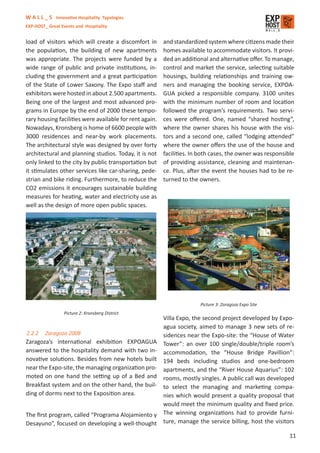
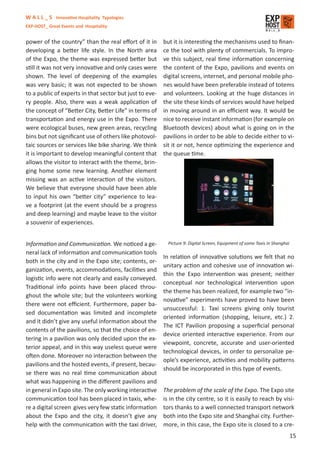
                                                                       Picture 3: Zaragoza Expo Site
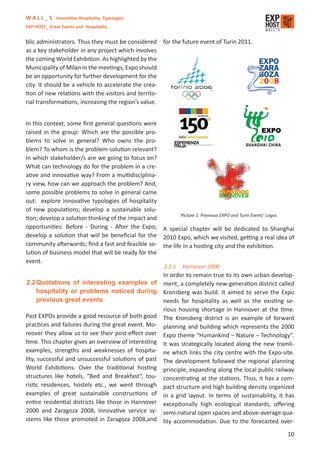
                 Picture 2: Kronsberg District
                                                   Villa Expo, the second project developed by Expo-
                                                   agua society, aimed to manage 3 new sets of re-
2.2.2 Zaragoza 2008                                sidences near the Expo-site: the “House of Water
Zaragoza’s international exhibition EXPOAGUA Tower”: an over 100 single/double/triple room’s
answered to the hospitality demand with two in- accommodation, the “House Bridge Pavillion”:
novative solutions. Besides from new hotels built 194 beds including studios and one-bedroom
near the Expo-site, the managing organization pro- apartments, and the “River House Aquarius”: 102
moted on one hand the setting up of a Bed and rooms, mostly singles. A public call was developed
Breakfast system and on the other hand, the buil- to select the managing and marketing compa-
ding of dorms next to the Exposition area.         nies which would present a quality proposal that
                                                   would meet the minimum quality and fixed price.
The first program, called “Programa Alojamiento y The winning organizations had to provide furni-
Desayuno”, focused on developing a well-thought ture, manage the service billing, host the visitors
                                                                                                           11
W A L L _ S Innovative Hospitality Typologies
EXP-HOST_ Great Events and Hospitality


and train the staff. This program as well as the first shbasins, toilets, laundry rooms, etc, one contai-
one followed a Quality Plan which included mini- ning fourteen double rooms, and the last for en-
mum requirements, rules and fixed prices (e.g. 60 trance, reception, supermarket, Internet access,
euro per day for a double room in the B&B and 75 sick bay, etc, together with other minor uses. Ar-
euro in Expo Villa). This temporary management chitecturally, the renovated buildings maintained
was agreed taking into account that they will have their appearance as faithfully as possible, so as not
to return the running facilities after the Expo was to alter the style of the property drastically. Inte-
over. Following the Expo, the buildings were used riors were kept the same criterion and philosophy,
as student dormitories or were sold to special ca- but with adaptations for the proposed use.
tegories of citizens.

                                                    Two general criteria were fundamental for the
To complement the Expo Accommodation Net- new buildings: creating a space between the exi-
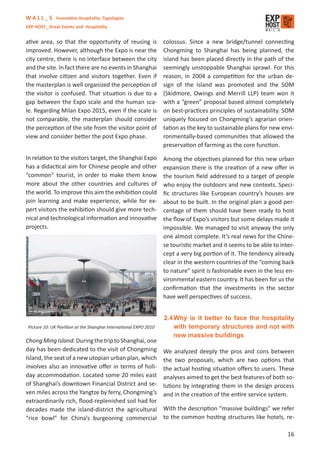
work, Zaragoza City Council offers alternatives sting buildings and the new ones while achieving a
such as El Canal Campsite, located in the Ecocity, harmonious blend between the architecture of the
Valdespartera, 4 km from the Expo site. The con- two areas. Brise-soleil, use of light and shade, use
dition for building was that the ground could be of compatible materials, blurring of the boundary
used for various alternatives. The camping spaces between interior and exterior, compatibility with
have a flexible layout so that they can be used in other uses, versatility, cleaning and maintenance
an ordered or dispersed way. The green and spor- provisions, etc. amongst other things, are aspects
ting areas together with the camping facilities can that have been taken into account for its con-
be used in different ways, adapting to diverse si- struction. Besides the accommodation, it works
tuations.                                           as a campsite with a large surface area and servi-
                                                    ce infrastructure that includes roadways and car
                                                    parking. Environmentally, the accommodation was
                                                    equipped with a solar energy system, a high-per-
                                                    formance solar water heater located on the roof
                                                    and a hydraulic unit. Additionally, new buildings
                                                    also featured louvred facades to control light and
                                                    heat, and to provide good ventilation in the sum-
                                                    mer. These simple but carefully thought environ-
                                                    mental solutions included also recycling and reu-
                                                    sing materials, integrating them with nature.
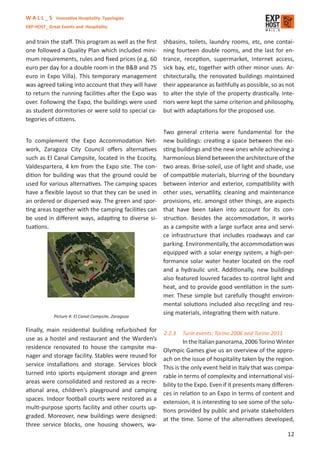
             Picture 4: El Canal Campsite, Zaragoza

Finally, main residential building refurbished for    2.2.3   Turin events: Torino 2006 and Torino 2011
use as a hostel and restaurant and the Warden’s
                                                               In the Italian panorama, 2006 Torino Winter
residence renovated to house the campsite ma-
                                                      Olympic Games give us an overview of the appro-
nager and storage facility. Stables were reused for
                                                      ach on the issue of hospitality taken by the region.
service installations and storage. Services block
                                                      This is the only event held in Italy that was compa-
turned into sports equipment storage and green
                                                      rable in terms of complexity and international visi-
areas were consolidated and restored as a recre-
                                                      bility to the Expo. Even if it presents many differen-
ational area, children’s playground and camping
                                                      ces in relation to an Expo in terms of content and
spaces. Indoor football courts were restored as a
                                                      extension, it is interesting to see some of the solu-
multi-purpose sports facility and other courts up-
                                                      tions provided by public and private stakeholders
graded. Moreover, new buildings were designed:
                                                      at the time. Some of the alternatives developed,
three service blocks, one housing showers, wa-
                                                                                                          12
W A L L _ S Innovative Hospitality Typologies
EXP-HOST_ Great Events and Hospitality


provide quality accommodation and preserve the          agree that the 2011 occasion, as the other inter-
environment. A great number of structures were          national events like Expo 2015 can be a successful
built such as “Yes!” hostels and “Doc” Bed & Brea-      tool to develop and promote the Italian tourist sy-
kfast showing the enthusiasm, even if the policies      stem. For the past 20 years, the city of Turin and
did not always promote the image of the Olympic         the surrounding region of Piedmont have been
receptivity. Anyways, some innovative typologies        doing an impressive job of bringing about an ar-
explored were linked to the territory and the loca-     chitectural, cultural and social transformation,
lity, such as Agroturism and Second-home market.        concentrating all their efforts on reaching their full
This last one was a sadly successful since it held      potential in 2011. The aim is not to offer the clas-
back the growth of private companies. But it inspi-     sic cultural tourism, characterized by passive and
red innovative diffuse receptivity linked with athle-    standardized enjoyment, but about real “experien-
tes, guaranteeing subletting contracts. Unluckily,      ces” as much active and customized as possible.
the projects came to an end after the Olympics.         Many restorations and works on infrastructures
The image of the city was improved, but the lack        were completed by 2011 on royal palaces, histori-
of a strategic coordination of public and private       cal buildings, parks and green areas. Those places
actors didn’t encourage the diversification of de-       were the venues of the event and will host expos,
mand and offer. The lesson was learnt and some           shows, conferences and performances.
efforts remained like the training on receptivity
and volunteering which was active towards the
                                                        2.3 Shanghai 2010, test on the field of fail-
2011 Italian Unity celebrations.
                                                            ures and good practice examples

                                                        From the 1st to the 16th of May 2010 our project
                                                        team, together with some tutors of the ASP project,
                                                        made a study journey to China, during which we
                                                        participated on a workshop in Shanghai at the Ton-
                                                        gji University, partner of the Politecnico di Milano,
                                                        to evaluate the local policies in the field of hospita-
                                                        lity in preparation of the Shanghai Expo 2010. The
                                                        visit to the city and Expo allowed us to experience
                                                        a great event first hand, to live the city and to see
                                                        its transformation in terms of infrastructure and
             Picture 5: Olympic Village, Turin 2006     economic growth.
To celebrate Italy’s 150th anniversary, Turin and
Piedmont are prepared a grand international hap-
pening, as there was in 1911 and in 1961: an op-
portunity to look back at past glories, but also to
consider the present and take a look at the future
of “the best of Italy”. Three years prior to this ap-
pointment, the Comitato Italia 150 (the committee
that will organize the events in Piedmont) partne-
red with the Tourist Trade Fair in Rimini - Travel
Trade Italia and TTG Incontri to discuss with tour
operators about ideas on how to design tourist
theme packages and holiday offers in Italy. They all       Picture 6: EXPO Site’s Maquette at the Shanghai Urban Center


                                                                                                                         13
W A L L _ S Innovative Hospitality Typologies
EXP-HOST_ Great Events and Hospitality


Shanghai Expo 2010 is the largest Expo ever seen.                  visitors. The only innovative intent is represented
Its theme is “Better City, Better Life”. As 55% of the             by Chongming Island – not well promoted at all -
world population lives in cities, the Expo’s theme                 which links accommodation with agricultural ac-
promoting sustainable urban development re-                        tivities, entertainment and industry, thanks to an
flects a central policy-making concern of the inter-                important link made of brand new transport infra-
national community. More than 200 countries and                    structures with the city.
international organizations are presenting their
creative experience. Any one of the 70 million vi-
sitors expected to attend the Expo is likely to be
overwhelmed by the possibilities. Our visit to the
Expo, the hosting city and surroundings such as
the Chong Ming Island Project allowed us to see
its approach to the theme and to live a great event
first hand.


                                                                    Picture 8: Project Team during the visit at the ChongMing Island

                                                                   Links between the Expo and the city, in terms of
                                                                   activities related to the theme, were completely
                                                                   absent. Considering that as international visitors,
                                                                   out of 8 days, we spent just one day at the Expo,
                                                                   its experience was very limited and left us few
                                                                   insights related to the theme “Better City, Better
                                                                   Life”. It could have been interesting the creation of
                                                                   strong activities and networks such as “fuori Expo”.
   Picture 7: Project Team during the visit at the International
                                                                   For example the Urban Center of Shanghai, being
                         Shanghai EXPO
                                                                   so involved in the theme of the Expo, should have
After the visit to the Shanghai EXPO site, we had                  been a stronger promoter of activities.
a couple of meetings in the Tongji University, after
which some critical remarks were drawn:
                                                                   Solutions like the reuse of buildings at the Expo’s
In terms of Hospitality, one of the problems identi-               site are interesting because they integrat existing
fied was the lack of info: the Expo info points give                structures with new technologies and services.
very basic information about the Expo and no in-                   Some examples of services structures (toilets, wa-
formation about how to find accommodation in                        ter providers, bars, info points, souvenir shops,
the city. A good suggestion for future events could                etc.) were designed with interesting features, in
be the creation of a system of info points that have               those examples the skin has also a big importance
information about Expo and tourism, both digi-                     but a structural function as well.
tal and face-to-face. In addition, we haven’t seen
innovative typologies of accommodation. Big ho-
                                                     The content of the Expo and its potential. We con-
tels seem to be the only solution to this problem.
                                                     sistently found a lack of contents related to the
Maybe the extremely rapid growth of the city can
                                                     theme of the Expo. Inside the pavilions the ex-
provide conventional accommodation for all the
                                                     perience was more related to communicate “the
                                                                                                                                  14
W A L L _ S Innovative Hospitality Typologies
EXP-HOST_ Great Events and Hospitality


power of the country” than the real effort of it in       but it is interesting the mechanisms used to finan-
developing a better life style. In the North area        ce the tool with plenty of commercials. To impro-
of the Expo, the theme was expressed better but          ve this subject, real time information concerning
still it was not very innovative and only cases were     the content of the Expo, pavilions and events on
shown. The level of deepening of the examples            digital screens, internet, and personal mobile pho-
was very basic; it was not expected to be shown          nes would have been preferable instead of totems
to a public of experts in that sector but just to eve-   and volunteers. Looking at the huge distances in
ry people. Also, there was a weak application of         the site these kinds of services would have helped
the concept of “Better City, Better Life” in terms of    in moving around in an efficient way. It would be
transportation and energy use in the Expo. There         nice to receive instant information (for example on
were ecological buses, new green areas, recycling        Bluetooth devices) about what is going on in the
bins but not significant use of others like photovol-     pavilions in order to be able to decide either to vi-
taic sources or services like bike sharing. We think     sit it or not, hence optimizing the experience and
it is important to develop meaningful content that       the queue time.
allows the visitor to interact with the theme, brin-
ging home some new learning. Another element
missing was an active interaction of the visitors.
We believe that everyone should have been able
to input his own “better city” experience to lea-
ve a footprint (at the event should be a progress
and deep learning) and maybe leave to the visitor
a souvenir of experiences.


Information and Communication. We noticed a ge-            Picture 9: Digital Screen, Equipment of some Taxis in Shanghai
neral lack of information and communication tools
                                                         In relation of innovative solutions we felt that no
both in the city and in the Expo site; contents, or-
                                                         unitary action and cohesive use of innovation wi-
ganization, events, accommodations, facilities and
                                                         thin the Expo intervention was present; neither
logistic info were not clearly and easily conveyed.
                                                         conceptual nor technological intervention upon
Traditional info points have been placed throu-
                                                         the theme has been realized, for example two “in-
ghout the whole site; but the volunteers working
                                                         novative” experiments have proved to have been
there were not efficient. Furthermore, paper ba-
                                                         unsuccessful: 1. Taxi screens giving only tourist
sed documentation was limited and incomplete
                                                         oriented information (shopping, leisure, etc.) 2.
and it didn’t give any useful information about the
                                                         The ICT Pavilion proposing a superficial personal
contents of the pavilions, so that the choice of en-
                                                         device oriented interactive experience. From our
tering in a pavilion was only decided upon the ex-
                                                         viewpoint, concrete, accurate and user-oriented
terior appeal, and in this way useless queue were
                                                         technological devices, in order to personalize pe-
often done. Moreover no interaction between the
                                                         ople’s experience, activities and mobility patterns
pavilions and the hosted events, if present, becau-
                                                         should be incorporated in this type of events.
se there was no real time communication about
what was happening in the different pavilions and
in general in Expo site. The only working interactive    The problem of the scale of the Expo. The Expo site
communication tool has been placed in taxis, whe-        is in the city centre, so it is easily to reach by visi-
re a digital screen gives very few static information    tors thanks to a well connected transport network
about the Expo and the city, it doesn’t give any         both into the Expo site and Shanghai city. Further-
help with the communication with the taxi driver,        more, in this case, the Expo site is closed to a cre-
                                                                                                                            15
W A L L _ S Innovative Hospitality Typologies
EXP-HOST_ Great Events and Hospitality


ative area, so that the opportunity of reusing is                   colossus. Since a new bridge/tunnel connecting
improved. However, although the Expo is near the                    Chongming to Shanghai has being planned, the
city centre, there is no interface between the city                 island has been placed directly in the path of the
and the site. In fact there are no events in Shanghai               seemingly unstoppable Shanghai sprawl. For this
that involve citizen and visitors together. Even if                 reason, in 2004 a competition for the urban de-
the masterplan is well organized the perception of                  sign of the island was promoted and the SOM
the visitor is confused. That situation is due to a                 (Skidmore, Owings and Merrill LLP) team won it
gap between the Expo scale and the human sca-                       with a “green” proposal based almost completely
le. Regarding Milan Expo 2015, even if the scale is                 on best-practices principles of sustainability. SOM
not comparable, the masterplan should consider                      uniquely focused on Chongming’s agrarian orien-
the perception of the site from the visitor point of                tation as the key to sustainable plans for new envi-
view and consider better the post Expo phase.                       ronmentally-based communities that allowed the
                                                                    preservation of farming as the core function.

In relation to the visitors target, the Shanghai Expo               Among the objectives planned for this new urban
has a didactical aim for Chinese people and other                   expansion there is the creation of a new offer in
“common” tourist, in order to make them know                        the tourism field addressed to a target of people
more about the other countries and cultures of                      who enjoy the outdoors and new contexts. Speci-
the world. To improve this aim the exhibition could                 fic structures like European country’s houses are
join learning and make experience, while for ex-                    about to be built. In the original plan a good per-
pert visitors the exhibition should give more tech-                 centage of them should have been ready to host
nical and technological information and innovative                  the flow of Expo’s visitors but some delays made it
projects.                                                           impossible. We managed to visit anyway the only
                                                                    one almost complete. It’s real news for the Chine-
                                                                    se touristic market and it seems to be able to inter-
                                                                    cept a very big portion of it. The tendency already
                                                                    clear in the western countries of the “coming back
                                                                    to nature” spirit is fashionable even in the less en-
                                                                    vironmental eastern country. It has been for us the
                                                                    confirmation that the investments in the sector
                                                                    have well perspectives of success.


                                                                    2.4 Why is it better to face the hospitality
 Picture 10: UK Pavillion at the Shanghai International EXPO 2010       with temporary structures and not with
                                                                        new massive buildings
Chong Ming Island: During the trip to Shanghai, one
day has been dedicated to the visit of Chongming                    We analyzed deeply the pros and cons between
Island, the seat of a new utopian urban plan, which                 the two proposals, which are two options that
involves also an innovative offer in terms of holi-                  the actual hosting situation offers to users. These
day accommodation. Located some 20 miles east                       analyses aimed to get the best features of both so-
of Shanghai’s downtown Financial District and se-                   lutions by integrating them in the design process
ven miles across the Yangtze by ferry, Chongming’s                  and in the creation of the entire service system.
extraordinarily rich, flood-replenished soil had for
decades made the island-district the agricultural                   With the description “massive buildings” we refer
“rice bowl” for China’s burgeoning commercial                       to the common hosting structures like hotels, re-

                                                                                                                      16
W A L L _ S Innovative Hospitality Typologies
EXP-HOST_ Great Events and Hospitality


sidences which are located inside buildings as we       invitation and is happy to get in a deep relation-
usually are used to think about. The pros of these      ship with him/her. The hosting place is a physical,
structures are those of durability of construction      social and cultural context that is generated by the
materials through time, static and permanent po-        host and that may be enriched by the guest. Public
sition on the urban territory which is seen as a kind   spaces in this perspective recover the role of phy-
of guaranty to people who think about hotels as         sical and symbolic meeting place between guests
a temporary home, the costs of construction and         and hosts: beautiful places, expression of the lo-
material transportation is done once while buil-        cal historical and cultural values, but also places
ding the project, but there are also some cons like     for relaxation, entertainment and for events. Ho-
the stability of the offer to the increasing demand      sting during great events is a temporary action but
of hosting, so presented as a limited capacity of       should be thought as an opportunity for further
accommodation and on the contrary to a low de-          development. Thus, we think temporariness not as
mand the offer is high and so these structures be-       an isolated provisory moment for the city but as an
come useless and the maintenance costs raise up.        explosion that could leave meaningful blueprints.
Now days, when green and recreation areas are           We approach the design for temporary hospitality
few and very important and very required places         as regenerative solutions that valorizes the hosting
that give value to the territory, it becomes impor-     places (i.e. the local existing resources), offers the
tant not to occupy them with impacting structures       residents new opportunities (i.e. new services for
of concrete or other common construction mate-          the residents and for the guests), promotes new,
rials. In order to go through all these existing ne-    deep forms of intercultural relationships like bet-
gative aspects we saw in the temporary structures       ter understanding of the place and people, on the
the flexibility due to the management and design         guests’ side, and more open and cosmopolitan
process; the synchronized system offer-demand;           ideas, on the hosts’ side. Contemporary cities that
the fair impacting aspects on the urban and ru-         want to remain attractive in the global competition
ral areas; the low maintenance costs in terms of        and play a welcoming role internationally have to
storage, transport and assemblage; and, the most        equip themselves in response to the new tourism
interesting aspect that this solution allows was        behaviors and demands. The goal of welcoming
the experiencing of new accommodation forms by          cities should be: to include the heterogeneous,
camping near unusual contexts like city centers,        individual demands rather than select and foca-
rural houses, parks etc. It also offers a new way of     lize just on one specific (high) target; to develop
optimizing the relation of the user in approaching      new solutions that are economically accessible,
the city and its activities. The temporariness of the   to find ways of integrating local communities and
hosting structures becomes coherent to the tem-         foreigners rather than keeping them in two diffe-
porariness of the event itself allowing to the ho-      rent environments without contact and sharing
sting cities to enlarge their accommodation capa-       of experiences; to spread the tourist flows over
city without risking to build great structures which    the territory rather than limiting them to the city
would be empty and useless structures once the          centers. Accommodation strategies in welcoming
event finishes.                                          cities have to offer a system of solutions that is:
                                                        highly differentiating and able to answer to the in-
                                                        creasingly heterogeneous demand; “flexible”, able
2.5 What do we intend as “Temporariness”
                                                        to adapt with the changing flows of arrivals during
    and “Hospitality”
                                                        the whole year; “inclusive” and “disseminated”,
                                                        able to connect visitors of different ages and from
For us ideally, a host is an actor living in a place in
                                                        different backgrounds and link them to the local
which he/she is happy (and proud) to invite some-
                                                        community and to different local realities.
body else. A guest is an actor that accepts the host’s
                                                                                                           17
W A L L _ S Innovative Hospitality Typologies
EXP-HOST_ Great Events and Hospitality


3. USERS’ REQUIREMENTS

In order to elaborate an adequate problem setting     landscape and environmental interest. Moreover,
from the general topic proposed “EXP-HOST: Great      the region is promoting new environmental and
events and hospitality. Milan Expo 2015 and Tu-       landscape paths strictly linked with national and
rin Italia 150: new concepts and formats for new      international initiatives that will bring new touri-
populations”, great events experienced have been      stic attractiveness to the area.
studied through dedicated bibliography, web in-
formation and on-site visits. The previous events
                                                      The Milan Expo will not occur in an isolated man-
information as well as the meetings with academic
                                                      ner. Its program of events will integrate seamlessly
and external tutors who follow the project allowed
                                                      into the overall national program of events in Italy.
us to understand their approach to hospitality, the
                                                      The country is already planning a great number of
legacies and its main impacts on the city and eco-
                                                      activities of international scope during the Expo
nomy. After the problem setting phase, the rese-
                                                      period that will exert a strong draw both for Italians
arch was focused on the selected specific theme:
                                                      and for visitors from abroad. The Expo will offer ex-
the design of innovative hospitality structures for
                                                      cellent opportunities for partners hips with other
Milan Expo 2015. We decided to narrow the project
                                                      Italian cities or sister events that will catalyze the
to Milan Expo 2015 because we think it presents
                                                      interest of millions of potential visitors. Examples
larger unsolved issues to absorb the demand on
                                                      range from food events in Rome to Music and Li-
hospitality. Thus we aim to propose a system that
                                                      terature events in Umbria, in the period from May
could be adapted to smaller events such as Turin
                                                      to October.
Italia 150 but we find that Milan Expo 2015 would
be a better context, due to the resources and time-
frame, to explore new concepts.                      Other important projects are being developed for
                                                     the great event, which include the revalorization of
                                                     existing areas and the building of new infrastruc-
3.1 Milano Expo 2015 and its receptivity
                                                     ture. An interesting example is this project, loca-
                                                     ted away from the main Expo site, is based on the
The Expo provides important opportunities for
                                                     idea of creating a post-Expo learning park, where
the city and region. Its urban region has 9 millions
                                                     users will be able to pick up appealing information
of inhabitants and economy devoted to services
                                                     about water and nutrition. Water as a primary ele-
and knowledge with an interconnected net of ex-
                                                     ment of the life and food cycle is the topic that will
cellences. The exceptionality of the functions al-
                                                     be developed along this route. A vast network of
ready active in the area create a great source of
                                                     green areas (around 800 hectares) will be created
attractiveness in different sectors such as busines-
                                                     along and around a trail of around 20 km, which
ses and fairs, health and research, creativity and
                                                     can be covered on foot, by bicycle, by low-energy
innovation and, education and culture. Today the
                                                     vehicle, on horseback (in some stretches in green
touristic system is focused on the business sector,
                                                     areas) or by boat (along the Naviglio Grande). A
leaving with no answer big segments of demand
                                                     second project called the “Land Way” consists of
and bringing in action only a minimal part of the
                                                     a visitor and theme trail which connects a num-
potential positive synergies with the territories.
                                                     ber of locations and buildings of special note, and
Thus, the Expo with its theme “Feeding the pla-
                                                     which leads from the Darsena (the docks on the Po
net, energy for life” brings significant opportuni-
                                                     river) to the future Expo-site, a symbol of tomor-
ties to promote the territory attractiveness and a
                                                     row’s Milan.
sustainable form of tourism through the growth
of a hospitality offer linked with the places with a

                                                                                                         18
W A L L _ S Innovative Hospitality Typologies
EXP-HOST_ Great Events and Hospitality


Milan maintains a very widespread and far-rea-           we think that a competitive, touristic and syner-
ching network of international relations whose           gic strategy is necessary and innovative receptivity
complexity defies exhaustive description. Milan           models have to be developed.
is interconnected with the rest of the world via a
quantity of active relations that cannot possibly be
                                                         3.2 Data (visitors, site plan)
listed in their entirety. However, we shall cite some
of the best known. La Scala theatre is a world re-
                                                         The Exposition, which will cover a total area of ap-
ference point and symbol of lyric opera. Milan’s
                                                         proximately 210 hectares, of which 110 hectares
two powerhouse football teams, Inter and Milan
                                                         shall be for Exposition areas and other activities,
are always a force to be reckoned with at any in-
                                                         will be located on a stretch of land adjacent to the
ternational soccer event. Leonardo da Vinci’s Last
                                                         new fairground complex in Rho Pero. The event
Supper is a primary destination for myriads of tou-
                                                         will open on May, 1st 2015 and close definitely on
rists from all over the world. Milan is also enga-
                                                         October, 31st 2015. One or more visiting days will
ged in flourishing international business relations
                                                         be organized before the official opening date, for
via its outstanding and universally recognized
                                                         special categories of guests such as press repre-
fashion houses. Its public institutions, such as the
                                                         sentatives.
Milan Trade Fair and the Chamber of Commerce,
are very active in developing international trade        According to BIE** estimates, the number of exhi-
relations. Fiera di Milano has established 43 fo-        bitors requesting to participate in Expo 2015 Milan
reign offices, which maintain stable relations with        will fall into the range of 175 to 190. The above
64 different countries around the world. Through          total includes at least 120 guest countries, the Ita-
its Promos network in 17 different countries, the         lian Government, 20 Italian Regions and national
Milan Chamber of Commerce implemented more               organizations, 10 international organizations, and
than 100 internationalisation initiatives.               25 corporate exhibitors, for a total of 175 partici-
                                                         pants.
According to Istat* , in Lombardy, tourist come in
first place for Business travels, second for 1 to 3       As a general quantitative reference, we take into
days trips and just then the region is recognized        account the information in the Dossier from BIE of
as an attractive pole for leisure activities with an     the expected demand for the Expo 2015 (29 mil-
over 4-day stay. Milan offers in terms of hospitality     lion visitors), updating it with the last news on the
around 1000 receptivity structures including ho-         expected demand. Focusing on our target defined
tels, Bed and Breakfast, Renting Housing, Hostels        as “new populations” we will use as a reference
and Farm Accommodation, which represent a very           the research done by the Team A about the visi-
small part of the total. In Lombardy, 4 to 5 stars ho-   tors’ profile and forecast. From our focused rese-
tels represent 54 per cent of the offer (Rome 48%),       arch, we have found that these “new populations”
while 1 to 2 stars hotels represent just 8% of the       are interested in non-traditional accommodation
total accommodation (Rome 15%).                          such as camping or couch surfing in cities like Milan
                                                         mainly because they seek a different experience.
Summing up, there is a significant gap between            Other reasons expressed are related to the lower
demand and supply. In the urban regions most             cost, to way to socialize and meet new people and
of the touristic structures are not adequate both        an enjoyment of the outdoors and new contexts.
from a qualitative and quantitative point of view
for all targets. Moreover, there is a lack of abili- Observations
ty in answering to new populations’ needs. Thus, This chapter has pointed out the existence of an


*        www.istat.it                                    **     Bureau International des Expositions

                                                                                                            19
W A L L _ S Innovative Hospitality Typologies
EXP-HOST_ Great Events and Hospitality


unsolved demand of a new kind of accommoda-              • Chamber of Commerce of Milan and Turin
tion to host the emergency situation of Expo 2015        Private Companies:
visitors in the macro-region Milan-Turin that till       • Oneworks (private construction company) has
                                                             been seen as a potential developer of the solution
today isn’t answered. The request is bounded to
                                                             proposed and is therefore interested in its feasibil-
“new populations” who are looking for an alterna-            ity in technical and economical terms.
tive solution to their needs: experience, engage-
ment and networking. Expo 2015 is an opportunity         Public/Private Partnerships:
for the city to promote its image of host-city in a      • Assolombarda (institution gathering industry and
meaningful way that will leave a trace for future           entrepreneurship organizations in the territory)
development. Thus it must build up an accommo-              has the aim of increasing the economical, social
                                                            and cultural value of the macro-region to attract
dation system to satisfy the demand of its tempo-
                                                            new investments.
rary citizens but giving an answer to the after-Expo     • Investors
scenario. In the present work, an innovative an-
swer to such question is proposed; sketching out         Developers and Consultants:
the main characteristics of an innovative typology       • Boston Consulting Group, Accenture, Mc Kinsey.
that could be added to existing resources of the            They would confirm the effectiveness of the busi-
macro-region to expand their hospitality offer but           ness plan proposed and therefore the return on
                                                            the investment.
also that could be a flexible asset for the region for
future needs.                                            Users
                                                         • Macro-region citizens, who have been considered
                                                            the true owners of the output, especially in its
3.3 Stakeholders
                                                            post-event phase. For them it is necessary to cal-
                                                            culate the after event legacy so to maximize its op-
Since the first meetings we were asked to identi-            portunities and reduce the costs
fy the stakeholders of our project, some of them         • Visitors, who are the temporary owners of the out-
were already involved in our meetings as external           put of the project; they have expectations regard-
tutors and started contributing on the definition            ing their Expo experience that need to be fulfilled
of the project since the beginning, it was therefo-         through a particular (customized/ personalized)
re just during the 2010 ASP Winter School, leaded           product-service systems.
by Professor Bruno Dente, that we made a more
                                                    Together with that it was listed also a series of
refined analysis about that. The actors that at that
                                                    practices, useful to improve the Expo positive ef-
stage we had identified as involved in our project
                                                    fects also in long term perspective:
are the followings:

Government:                                              Public Policies to encourage Territorial Develop-
•       Ministry of Tourism, which will have to pro-     ment:
mote the Milan macro-region, spread information          Territorial Promotion: Valorization of Milan territo-
about the event and the macro-region opportuni-          ry
ties, especially in terms of accommodation.
                                                         Transportation: Encourage public transport, inte-
Local Administration:                                    grate public/private transport, develop ecological
• Municipality of Milan (governmental institution in     means of transport (bike sharing, car pooling, taxi
    the region) which will have to deal with the loca-   sharing).
    tion of the solution according with the Urban Plan
    laws, will have to promote the Milan macro-region    Guarantee a Certain Level of Demand: Strong mar-
    and optimize the already existing resources on the   keting commitment with effective advertising.
    territory.
                                                                                                               20
W A L L _ S Innovative Hospitality Typologies
EXP-HOST_ Great Events and Hospitality


Security: Provide more forces to face the possible about the definition of new populations to which
risks incresed by the flow of visitors in the city.  address our proposal. The requests of this target
                                                    had emerged from the questionnaire sent to the
Economical incentives: Encourage in an economi- selected sample of respondents***
                                                                                    .
cal point of view the different iniciatives proposed
by the private investors.

Some of the stakeholders listed have shown during
the further development of the project an increa-
sing active participation and interest.

Dr. Maria Teresa Broggini (Municipality of Milan)
raised up the possibility of the creation of a society
of services for the management of the hospitality
solution which, she stressed, couldn’t be done by
the Municipality itself by just financing it; moreo-
ver she approved our idea of a link between the
existing Cascine’s network and the new hospitali-
ty structures, and encouraging us to deepen that
path she put us in contact with people working in
the census of all the existing structures.

Assolombarda as well has always been very care-
ful in noticing the feasibility of our project and has
pointed up to us the importance of some steps of
the business plan.

EXPO2015 S.p.A., the institution in charge of the
development of the Expo site, was moreover con-
sulted when it was under discussion the potential
location of our interventions. The meeting was
useful to have a better understanding of the Expo-
site in its extended urban planning and approach.

Together with them, other external tutors were in-
terviewed according with the new aspects arisen
by the deepening of the project. It is the case of
the firm Ferrino with which we get in touch du-
ring the design phase, when we start facing some
technical problems. Thanks to the meeting with
Dr. Rabajoli (Ferrino S.p.A.), who gave us the con-
solidated experience of who works in the field, we
solved important doubts. The visit to the 50° Salo-
ne Nautico in Genoa helped us as well about parti-
cular technical solutions.

For what concerns our users we decided to adopt          ***       A broader explanation of the target was done by Team A
the results of the research conducted by Team A          and is further developed under the title “Target”

                                                                                                                      21
W A L L _ S Innovative Hospitality Typologies
EXP-HOST_ Great Events and Hospitality


                                                               4. DESIGN PROCESS

                                                4.1 First ideas on possible solutions: An-
                                                    nexes, Pay per Sleep, First booking,
                                                    Temporary Hosting Camps

                                                Objectives assigned to the team

                                                The project explores a topic which will be in the
                                                agenda of public actors and at the same time at
                                                the attention of private developers in the next ye-
                                                ars. The Milan Expo 2015 event will attract millions
                                                of people (20 millions are expected according to
                                                the official documents of the Expo board) and the
                                                impact on public policies - on one side - and on
                                                real estate sector strategies- on the other side -
                                                will be very strong. In 2011 Torino (together with
                                                Milano, Firenze, Roma) will host the celebrations
                                                for the 150th anniversary of the Unity of Italy. The-
                                                se events will be characterized by important urban
                                                transformation and by exceptional incoming of vi-
                                                sitors.


                                                Our object of study, the theme of Innovative ho-
                                                spitality typologies, has been introduced in the
                                                Project program raising the following questions:
                                                how can we experiment innovative formats of
                                                structures for hospitality, which allow to better
                                                match the demand of different people attracted
                                                by great events, especially non-traditional “popu-
                                                lations”? Can we think about new typologies of
                                                physical structures, integrating different functions
                                                and activities, with characters of flexibility, possibi-
                                                lity of re-use according to the changing demand?


                                                From the starting point to the different phases of
                                                the problem setting of the project we were fasci-
                                                nated by key words like flexibility, innovation, ho-
                                                spitality, sustainability in relation to the architec-
                                                tural and business aspects of the project. In the
                                                contemporary city community dynamics are very
                                                strong, with difficult effects to forecast on traffic
                                                and mobility services and on tourism services. We
                                                were as well intrigued to understand which new,
                                                non traditional actors could be included in an in-
                                                                                                    22
W A L L _ S Innovative Hospitality Typologies
EXP-HOST_ Great Events and Hospitality


novative pattern of profit and non-profit entrepre-
neurship to realize innovative typologies. This kind
of project may be faced as a typical innovation
process: the focus is on the actors that may help
us to design something new and not only on the
final users.

The present Milanese region does not provide a
hospitality option to “new populations” in order to
host the visitors during Expo Milan 2015. Moreo-
ver we understood that there is a need for true su-
stainable solutions in terms of absorbing the peak                 Picture 11: System Map_Cell Management
demand in great events thinking in the future of
the investments done. We see that, it is an oppor-
tunity for the city to improve its offer. We aim to
develop a long-term strategy for re-using the ho-
sting structures built up for the event, promoting
a sustainable paradigm of receptivity based on exi-
sting resources, building a legacy in terms of cul-
tural exchange among young people, citizens and
foreigners, connecting new stakeholders.

First possible outputs related to the specific theme
of our ASP project
                                                                      Picture 12: System Map_Cell Re-use
•   Meta-projects of innovative hospitality structures
•   Repertoires of innovative formats
•   Site specific projects in Milan and Turin and in their
    metropolitan areas
•   Low budget innovative and non-traditional hospi-
    tality proposals for specific targets of users
•   Innovative models of hospitality structures man-
    agement

Starting from this first attempt of explaining the
theme of hospitality and temporariness, we came
up with different scenarios as possible approaches
to the issue of hosting the temporary Milan Expo
                                                                    Picture 13: Overelevation - Annexes Concept
visitors but also thinking on the future implications
for the city.
                                                            Chain Reservation
We brainstorm about innovative hospitality solu-
tions thinking about the impact and opportunities:
Before-During-After Expo scenarios. We came out
with different proposals of architectural configura-
tions and services :
                                                                      Picture 14: Chain Reservation Concept
•   Annexes, Over-Elevations, Attached Spaces. Use the

                                                                                                                  23
W A L L _ S Innovative Hospitality Typologies
EXP-HOST_ Great Events and Hospitality


    top of the buildings to set either fixed of temporary      ry Hosting Camps.
    hospitality structures, according with the “Piano
    Casa” new prescriptions, which attract particular         4.2 Places Where to Locate our Hospitality
    targets of visitors and make the locations part of a          Offer
    circuit of interest for the callers.
                                                              Some areas have been found that could be promi-
•   Pay per Sleep Service. Basic accommodation to give
                                                              sing for the location of the proposed accommoda-
    accommodation on the move paying just for the
    usage time for short time visitors.                       tion solutions during the Expo. The chosen areas
                                                              are interesting due to the relation with the theme,
•   Full Booking. Develop a way to manage booking us-         the possibilities to create new relations and renew
    ing strategies like last minute - low rates in order to   the image of the region looking towards new pos-
    be able to absolve the demand changes.                    sibilities in the future. Moreover, these areas are
                                                              currently developing projects on hospitality for the
•   Macro-region Chain Reservation. Development of
                                                              2015 Expo Milano and are backed by our reflection
    a chain of hotels located in the macro-region that
    gives the opportunity to have access to the differ-        on the research done together by the Team A who
    ent branches while discovering the macro-region           focus on the target and the localization. After the
    circuit-tour.                                             meeting with Dr. Maria Teresa Broggini (Munici-
                                                              pality of Milan), potential localization place were
•   Temporary Hosting Camping. Basic structures easy          suggested could be some selected farmhouses
    to assemble, for the accommodation of groups. An          out of the 58 cases* as well as the park areas as
    accommodation in between the already existing
                                                              the Green Way Lombardia or Parco della Via d’Ac-
    basic tents or the more fixed containers, both from
    the structural point of view and in terms of costs.       qua, which are part of the valorization research
    A new concept of unit that will go to compose the         projects of the Municipality of Milan. Our propo-
    emergency camps, reusable for great events or as          sed solution will act as a support to existing activi-
    first shelter for immigrants / refugees / militaries.      ties to extend the offer and give a better response
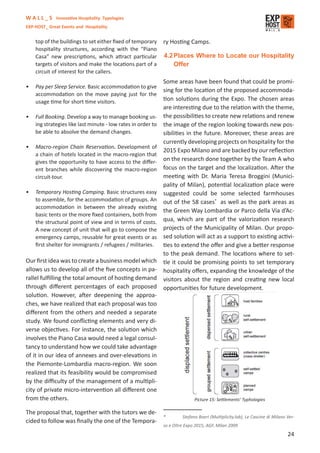
                                                              to the peak demand. The locations where to set-
Our first idea was to create a business model which            tle it could be promising points to set temporary
allows us to develop all of the five concepts in pa-           hospitality offers, expanding the knowledge of the
rallel fulfilling the total amount of hosting demand           visitors about the region and creating new local
through different percentages of each proposed                 opportunities for future development.
solution. However, after deepening the approa-
ches, we have realized that each proposal was too
different from the others and needed a separate
study. We found conflicting elements and very di-
verse objectives. For instance, the solution which
involves the Piano Casa would need a legal consul-
tancy to understand how we could take advantage
of it in our idea of annexes and over-elevations in
the Piemonte-Lombardia macro-region. We soon
realized that its feasibility would be compromised
by the difficulty of the management of a multipli-
city of private micro-intervention all different one
from the others.                                                             Picture 15: Settlements’ Typhologies

The proposal that, together with the tutors we de-
                                                              *        Stefano Boeri (Multiplicity.lab), Le Cascine di Milano Ver-
cided to follow was finally the one of the Tempora-
                                                              so e Oltre Expo 2015, AGF, Milan 2009
                                                                                                                              24
W A L L _ S Innovative Hospitality Typologies
EXP-HOST_ Great Events and Hospitality


The Expo will be a great opportunity to exploit the      Transitional shelter: shelter which provides a ha-
experiential marketing, that means to leverage on        bitable covered living space and a secure, healthy
the Expo as a window to guarantee visibility to the      living environment, with privacy and dignity, to
solution proposed and the places where it will be        those within it, during the period between a con-
located. The customers hosted in those places may        flict or natural disaster and the achievement of a
want, after their stay, to come back in the future or    durable shelter solution.
at least share their experience to a bigger network
of people.                                               Settlement: a community of covered living spa-
                                                         ces providing a healthy, secure living environment
                                                         with privacy and dignity to those groups, families,
                                                         and individuals residing within them.
4.3 Different Definitions of Temporariness
    Related to Accommodation Solutions              Shelter sector: abbreviation of the term ‘site selec-
                                                    tion, planning and shelter sector’, describing that
The term ‘transitional settlement’ (TS) has been
                                                    part of the ‘transitional settlement sector’ which
defined by a peer review process initiated by Shel-
                                                    responds to the transitional settlement and shelter
ter Project and continued by Shelter Centre. It me-
                                                    needs of refugees, within the mandate of UNHCR.
ans:
                                                    Shelter: a habitable covered living space, providing
“settlement and shelter resulting from conflict and
                                                    a secure, healthy living environment with privacy
natural disasters, ranging from emergency respon-
                                                    and dignity to those within it.Shelter system: the
se to durable solutions.”**
                                                    combination of structural shelter items and ‘shel-
The word originates from an approach which ex- ter NFIs’ (non-food items) which create shelter,
tends beyond the traditional response, with its such as tents with locally procured blankets and
limited focus on the provision of planned camps. mattresses, and possibly stoves, appropriate to a
The new approach considers the wider impacts cold climate.
of settlement and the options for settlement, em-
                                                          Provisional: that is not definitive, long-lasting, sta-
phasizing the need for a transition to durable set-
                                                          ble, to be replaced or modified.
tlement solutions and local development.
                                                          Temporary: that has limited duration, which is not
Transitional settlement: settlement and shelter
                                                          final.
resulting from conflict and natural disasters, from
emergency response to durable solutions.                  Temporary home: can be regarded as such a home
                                                          lived in temporarily for a specified period, you can
Transitional settlement sector: the field of pro-
                                                          identify it with the holiday home or the rented
viding settlement and shelter in the context of
                                                          house
conflict and natural disasters, from emergency
response to durable solutions. Aim: communi- Provisional home: is an answer to an emergency
ties, families, and individuals affected by conflict (floods, earthquakes), to an exceptional event. It’s
and natural disasters should be afforded, together an emergency home, prefabricated, built quickly
with any hosting populations, TS support to ensu- and destined to perish.
re their security, good health, privacy, and dignity,
appropriate to their needs.                               Ephemeral home: is a prototype, a model that can
                                                          be real or virtual, and retaining an image always
                                                          new. It uses perishable materials because it has to
**       Sphere Project, Humanitarian Charter and Minimum
                                                          last a short time, such as prefabricated houses and
Standards in Disaster Response, Genève 2004
                                                          demountable exhibition pavilions.

                                                                                                              25
W A L L _ S Innovative Hospitality Typologies
EXP-HOST_ Great Events and Hospitality


Transitional Home: is a dynamic evolving system,                            al, and international relations;
the transition from a conventional to a new way •                           Specialists sector effectiveness; strategic, govern-
of living.***                                                               ment, and donor relations
                                                                        •   Other sectors of response sector effectiveness, de-
                                                                            pendent on settlement options
4.4 Stakeholders present in Disaster Re- •                                  Development workers operational continuity and
    sponse (a possible scenario where to use the                            assessment, monitoring, and evaluations
      hosting units )                                                   •   Suppliers / contractors economic stability; capac-
                                                                            ity; government and international relations
                                                                        •   Media economic stability; local, national and inter-
It is useful to consider the similarities and differen-
                                                                            national relations
ces in the interests of stakeholder groups affected
by transitional settlement. This might help to de- International:
velop common operational guidelines which could • Donors, which control strategic effectiveness, local,
improve co-ordination and co-operation between           national, and international relations
different organizations in the field.                    • United Nations bodies, that lead strategic effective-
                                                                            ness; local, national, and international relations
Stakeholder groups which stake in transitional set-                     •   International non-government organizations (IN-
tlement includes:                                                           GOs), which focus on local, national and strategic
                                                                            effectiveness; impact through sector range; local,
Local:                                                                      national, and international relations with popula-
• Displaced and local populations, whose stake in                           tions, governments, donors, and the media
    transitional settlements includes: security; surviv-                •   Peace-keeping forces, which guarantee internal
    al and health; social needs, including privacy and                      and external security and stability; population mo-
    dignity; livelihoods, including economic stability;                     bility.
    natural-resource management; communal service
    infrastructure, including transport.                                In the year 2004, the United Nations High Commis-
• Community-based organizations (CBOs), which                           sioner for Refugees (UNHCR) estimated that there
    have: capacity and skills; relations with local popu-
                                                                        were 20 million refugees living worldwide . In ad-
    lation, local and national government, national and
    international aid community, and donors.                            dition, 25 million people were displaced within the
                                                                        borders of their own countries and were thus clas-
National:                                                               sified as Internally Displaced Persons (IDPs). The
• Host governments, which stakes internal and ex-                       provision of well-planned settlement solutions for
    ternal security and stability; political and economic               people who have been displaced by conflict or na-
    stability; national service infrastructure; national                tural disasters is crucially important.
    construction industry
• Police and military, which provides internal and ex-
    ternal security and stability; population mobility
• Local non-government organizations (LNGOs),
    which have capacity and skills; relations with popu-
    lations, CBOs, local and national government, in-
    ternational aid community, and donors

National and international:
• Coordinators strategic effectiveness; local, nation-


***       Daniela Cardace, Elisabetta Quaglino, Dall’esperienza di
autocostruzione ad Arcosanti alla progettazione di un modulo abi-
tativo, Master Thesis, Politecnico di Torino, Relator: Comoglio Mari-
tano N., Correlatore Aghemo C., Turin, July 2008
                                                                                                                             26
W A L L _ S Innovative Hospitality Typologies
EXP-HOST_ Great Events and Hospitality


4.5 A reflection on the Creative Dynamics We did find that, from the consulted bibliography
     of our Design Process*                        as well as from the meetings with involved actors
                                                   like Municipality of Milan, Milan has important un-
ASP projects have the characteristics of joining solved issues to absorb the demand on hospitality
different disciplines in a group to push innovative during the coming EXPO. However to set the pro-
solutions. In our case, our subgroup was formed blem more questions have to be made since we
by a manager, economics and industrial engineer, had to define the uncertain environment; e.g. the
3 architects who were drowned to, what seemed number of expected visitors went down by 10 mil-
an architectural based project: EXP-HOST, Great lion during the project development; the forecast
events and hospitality - Milan Expo 2015 and Turin of the real effect on the city of the event can only
Italia 150, and a product-service system designer. be measured by the experience itself.

Behaviorists link creativity with ability to genera-                    After a general research on past Expos and their
te new associations with different semantic areas                        solutions we brainstormed possible outcomes of
that are distant from the problem to solve. Thus,                       the project. This creative session brought many
joining different disciplines and countries as in the                    interesting elements, even if not all the mem-
ASP group provides a flourishing environment for                         bers were used to use this “not judgment” tool.
divergent thinking. However, it also poses a bigger                     We were able to freely put out ideas that did not
challenge for cooperation. Choosing from propo-                         come out from pure analytical deduction. First, the
sed tracks was one of the first social conversations                     distinct discipline’s approaches brought different
on the multidisciplinary group. It was clear that,                      ideas which allowed us to see many possibilities
in a group formed mainly by architects, there was                       for innovation. Second the interdisciplinary aspect
a preference on the track: Innovative Hospitality                       played an important role to build on each others’
Typologies. Other proposed tracks such as the Ap-                       ideas, creating innovative concepts to explore.
plying tracking technologies in urban design and
planning were less popular. After putting out our                       In this “social conversation” we probe several ways
preferences our group agreed to focus on innova-                        of defining and dealing with the problem. We used
tive hospitality structures.                                            analogies and built “possible worlds” which helped
                                                                        us to diverge and find new associations to appro-
Even if the project was outlined by the tutors, a                       ach the problem and to reduce the ambiguity of
big part of the design process was the problem                          the topic. Starting from this first attempt of explai-
setting. With mainly an architecture and design                         ning the theme, we came up with different scena-
background we were aware that the process of                            rios to approach the issue of hosting the tempora-
design, as Lanzara** explains, has characteristics                      ry Milan Expo visitors and its future implications.
that cannot be easily deducted functional analy-                        For instance, we proposed a scenario where the
sis of a complex problem. So, in the first stages                        Milanese urban context would grow with attached
of this compound process, at the core of the di-                        spaces, over-elevations of existing buildings. Ho-
scussion were the relevant problems themselves,                         wever, we decided to focus on another scenario
more than how the problems were to be solved.                           that we saw had a greater potential for the city.
                                                                        We adopted the strategy of the “as if”, focusing
*         Extract from the Paper “Creating a social Conversation”
                                                                        on the metaphor of “great events as an emergen-
by Yanina Guerzovich, presented for the 2010 Summer ASP School
                                                                        cy for the city”, since the Expo has an incredible
on The Dynamics of Creativity.
                                                                        social, economic and institutional implications for
**        Giovan Francesco Lanzara, La progettazione come indagi-
                                                                        the hosting city. So, in an iterative way, we tried
ne: modelli cognitivi e strategie d’ azione, s.l. 3:335-367: Rassegna
                                                                        to know the Expo through an emergency situation
Italiana di Sociologia, 1985, Vol. 26.
                                                                        and solution and vice versa, using our pre-analyti-

                                                                                                                           27
W A L L _ S Innovative Hospitality Typologies
EXP-HOST_ Great Events and Hospitality


cal ability of thinking metaphorically in terms of si-                 relation. Going to the Shanghai Expo allowed to
gnificant imagines of scenarios that even if simple,                    link ideas and data to sketch a solution that could
illustrated the complex relations of the city, the vi-                 expand the hospitality offer and be a flexible futu-
sitors and the event.                                                  re asset for the region. Especially in this phase, as
                                                                       Lindblom would say, we made use of scientific and
As Balducci explained, even “the given problem ordinary knowledge to question our project. The
definition is challenged”***. The different meetings academic and data input given by the professors
made us question if it was coherent to develop a at the Tongji University were as useful as experien-
solution for the Turin Event or to focus on the EXPO cing first-hand the city with its language barrier, its
and even to just use the EXPO as the opportunity infrastructure transformation and economic living
to launch the proposal but to think in innovative growth.
solutions for emergency situations in general. The
initial “metaphors and frames [were] mobilized”. In the process of “sense-making”, the meeting
Designing meant to make the right links between with the stakeholders was the added element that
cognitive resources, our acquired and background made us go back to the process of inquiry to fra-
knowledge, and our ability to act and take deci- me our decisions as they were discussed among
sions based on the interest and directions given by the different actors. It was a process of collective
the different actors.                                                   inquiry. As Lanzara explains, the problem of design
                                                                       consists in coordinating the decisions and actions
The proposals lead us to a new research on inno- of the many actors that move based on mixed in-
vative typologies. We needed to reconstruct the terests. We had to cope with our own mixed inte-
problems and build new combinations, going from rests as well as the diverse stakeholders that the
divergent moments to convergent ones to genera- EXP-HOST project involves. We had to be ready to
te new solutions. Making an extensive research of quickly change the path and reformulate the con-
the state of the art, as suggested by the tutors and cept and decide what we thought was the best
group members, was useful to understand what direction. We cooperated trying to transform the
was done to the date, clustering the existing cases problematic situation in a problem to which we
to see advantages and disadvantages. We could could propose a solution, taking the collected in-
say that “we use a method to save effort in the puts collected and re-thinking the outcome. It was
incoming work. With it we choose something, we only possible through a not linear design process.
reject something, as furiously does a pig’s face, as
it separates potential food in real food and waste” Furthermore, as Tagliagambe explains, an impor-
Carlo Emilio Gadda, Meditazione milaneseii. Ho- tant part of the design process was mastering the
wever it hindered our process of creation. Thus, as ability to “make the right questions” to the actors
C. Zucchi stated in his lecture, methods have to be involved and to ourselves (part of the auto-refle-
taken thoughtfully, using them critically knowing xive activity). This was key to “draw the right con-
what we need from them.                                                clusions” in order to “see” the real object of study
                                                                       and to understand the particularities of the case.
           As Tagliagambe explains****, experience and Seeing gave us a scheme of action to create more
theory are two aspects of a single and indivisible controllable hypothesis, Wall_s, as an approach to
                                                                       the solution, that attack a clearer network of ac-
***        Reflecting on practice or reflecting with practice? Inter-
                                                                       tors, the Expo as an opportunity and a new asso-
face, in Planning Theory & Practice. Balducci, A. and Bertolini, L. 4,
                                                                       ciation as a manager of the solution.
2007, Vol. 8.
****      S., Tagliagambe. L’albero Flessibile, la cultura della pro-
gettualità. Milano : Dunod, Masson, 1998.
                                                                                                                        28
W A L L _ S Innovative Hospitality Typologies
EXP-HOST_ Great Events and Hospitality


                                                                                     5 . S TAT E O F T H E A R T

                                                                     5.1 State of the Art of Temporary Shelters.
                                                                        Comparison Table with Focus Charac-
                                                                        teristics for Each Examples

                                                                     When the Temporary Hosting Camp option has
                                                                     been finally chosen as the one that needed to be
                                                                     developed, the design process started from an ac-
                                                                     curate analysis of the existing examples already
                                                                     designed.

                                                                     It was decided to adopt some general criteria to
                                                                     select just few of the many projects found so to
            Picture 16: Swisstube by Wanger AG
                                                                     start a comparison from which to collect impor-
                                                                     tant suggestions and good practice examples.
                                                                     Those criteria are:


                                                                     •    Contain some innovation, in terms of use, func-
                                                                          tional or technical characteristics
                                                                     •    Being successful examples
                                                                     •    Being note, having acquired some fame
                                                                     •    After the selection each example has been evalu-
          Picture 17: Markies by Edward Bohtlingk                         ated on the basis of a Comparison Table, enlight-
                                                                          ening the aspects we wanted to focus on.

                                                                     We analyzed some interesting cases, which gave
                                                                     us some input for further development. However,
                                                                     the presented cases cannot be simply moved to
                                                                     the particular situation of the EXPO 2015. The Mi-
                                                                     lanese macro-region enables new opportunities
                                                                     for innovative development taking into account
                                                                     the theme of the EXPO, the new populations’ ne-
                                                                     eds and the region characteristics. Moreover it is a
                                                                     must to create a flexible solution that can be adap-
           Picture 18: Refuge Wear by Lucy Orta                      ted to the region and to the post-Expo moment as
                                                                     an asset for the city.


                                            Picture 19: Desert Seal Tent by A.Vittori A.Vogler

                                                                                                                         29
1964                      1972                     1973                      1977                      1990                      1993                     1994                      1995                                   1996                                    1998                      2001                      2004                                   2005                                             2008

                                                                                                                                                 Ariech S., Eldar                                                                                                                                                                                                                       Daniel Ferrara, Mia
                                                                                         Sir Norman Foster_Creek    Marco Zanuso_Unità                                                                                                         Shigeru Ban_Tende per il Shigeru Ban_Paper Log                 Edward                    Sean Godsell          Dre Wapenaar_Tree                                     Stutchbury &                                                                                           A. Vittori, A.
                                                                                                                                                  S._Fiberglass          Bini D._Binishelter    Wenger AG_Swisstube      Lucy Orta_Refuge Wear                                                                                                                                         Ferrara Pelosi_Global                                Kadar Balint_Memo          N55_Micro Dwelling   L. Astorri_Casa Alveare
                                                                                         Vean House and Retreat        d’emergenza                                                                                                                     Rwanda                   House                    Bohtlingk_Markies        Architects_Future Shack           Tents                                       Pape_Cardboard House                                                                                  Vogler_Desert Seal Tent
                                                                                                                                              Octaherdral Bungalow                                                                                                                                                                                                                        Village Shelter


COMPARISON TABLE OF SHELTER EXAMPLES


                                                                    NATURAL                                                   •                         •                         •                        •                         •                        •                         •                                                    •                                                   •                         •                                                                           •                         •
                                       EMERGENCY
                                                                    ARTIFICIAL                                                •                                                                                                      •                                                                                                       •                                                   •                         •                                                                           •
                                                                    SEASONAL                                                                                                                               •
                                        TOURISM
                                                                      MOBILE                                                  •                                                                                                                                                                                   •                                                    •                                                                             •                                                                           •
                    FINAL USE                                        PRIMARY                                                                                                                               •                                                                                                                                                                                                                                         •
                                        HOUSING
                                                                   SECONDARY                                                                                                                               •                                                                                                                                                                                                                                         •                         •
                                                        DEPENDANCE                                                            •                                                                                                                                                                                                                                        •                                                                                                       •
                                                      EXHIBIT DESIGN
     USE
                                                           OTHER                                    •                                                                            •                         •                         •                                                                                                                                                           •                                                                             •
                                                        TEMPORARY                                   •                         •                         •                        •                         •                         •                        •                                                   •                                                    •                         •                                                   •                         •                                                 •
                   TIME OF USE                           PROVISORY                                                            •                                                                            •                         •                        •                         •                                                    •                                                   •                         •                                                   •                       •
                                                        EPHEMERAL                                                                                                                                                                    •                                                  •                                                    •                                                   •                                                   •                         •                       •
                                                            REAL                                    •                         •                        •                         •                         •                         •                        •                         •                         •                          •                         •                         •                         •                                                                           •                         •
                       NEED
                                                        EPHEMERAL                                                                                                                                                                                                                                                                                                                                                                                                              •
                   FLEXIBILITY:                             ONE                                     •                                                  •                         •                                                                                                      •                         •                                                    •                                                   •                         •                         •                                                 •
                    FUNCTION                              MULTIPLE                                                            •                                                                            •                         •                        •                                                                              •                                                   •                                                                                                     •
                                                       ABLE TO GROW                                 •                         •                         •                                                                            •                        •                         •                         •                                                    •                         •                                                   •
                   DIMENSIONS
                                                     NOT ABLE TO GROW                                                         •                                                  •                         •                         •                                                                            •                          •                         •                         •                         •                         •                         •                       •                         •
                                                           STABLE                                   •                                                                                                      •                                                                            •                                                                                                        •
                    MOBILITY                          TRANSPORTABLE                                                           •                        •                         •                         •                         •                        •                                                                              •                         •                         •                         •                         •                         •                       •                         •
                                                        SELF MOBILE                                                                                                                                                                                                                                               •
                   FLEXIBILITY:                            SINGLE                                   •                         •                                                                                                      •                        •                         •                         •                          •                         •                                                   •                         •                                                                           •
                   MODULARITY                             ADD UP                                                                                        •                        •                         •                                                                            •                                                                                                        •                                                                             •                       •

                                                        COMPLETELY ORGANIZED NETWORK                                                                                             •                         •                                                  •                         •                                                                                                        •                                                                                                     •


                                       BIG GROUPS               RADIAL CENTERED                                                                         •
  FUNCTIONAL
CHARACTERISTICS                                               RADIAL NOT CENTERED
                     MUTUAL
                    RELATIONS
                                                                  TETRIS EFFECT
                                                            SEMI ORGANIZED NETWORK                                            •                         •                                                  •                                                                            •                                                                                                                                                                                      •

                                      SMALL GROUPS         WIDESPREAD AND DISPERSED                                           •                                                  •                         •                         •                                                  •                                                                              •                                                                             •                         •

                                                                      RANDOM                                                  •                                                                            •                         •                                                                            •                          •                                                                             •                         •                                                                           •
                                                                    RECYCLABLE                                                                                                   •                         •                         •                        •                         •                                                                                                                                  •                                                   •
                  FLEXIBILITY:USE     SUSTAINABLE                      REUSED                                                                                                                              •                         •                        •                         •                                                    •                                                                                                                                                         •
                    EVOLUTION                                          REDUCE                                                                                                    •                                                   •                        •                         •                         •                                                    •                         •                         •                         •                         •                                                 •
                                                     NOT SUSTAINABLE                                •                         •                        •
                                                                      FLEXIBLE                                                                                                                                                                                •                         •                                                                                                        •                         •                                                   •
                                                                   PANTOGRAPH
                                                                   COMPACTING                                                 •                                                  •                                                                            •                         •                                                                                                        •                         •                         •                         •
                                       COLLAPSIBLE
                                                                    CONTAINER                                                                                                                                                                                                                                                                •
                                                                      CAPSULE                                                                                                                                                                                                                                     •                                                                                                                                                                                    •
                                                               EXTREME SOLUTION                                                                                                                                                      •
                  CONSTRUCTION                                                                                                                                                                                                                                •                                                                                                                                                                                                                                                                  •
                                                                     FIELD TENT
                      TYPE
                                          TENT                     SAILING TENT                                                                                                                                                                                                                                                                                        •
                                                                    CIRCUS TENT
                                                                 REPEATING UNITS                                                                        •                                                                                                     •
                                        SET UP KIT
                                                            ACCORDING TO THE CONTEXT
                                                                    INDIVIDUAL                                                                                                                                                                                                                                                                                         •                                                                                                                                                         •
                                      SOAP BUBBLE
                                                                    COLLECTIVE
                                                       TRADITIONAL                                                                                                                                                                                            •                         •
                    BUILDING
                                                      PREFABRICATED                                 •                         •                         •                                                                                                                                                                                    •                         •                         •                         •                         •                         •                       •                         •
                    METHODS
                                                          OTHERS                                                                                                                 •                         •                         •
                                                        SPECIALIZED                                 •                                                   •                        •                         •                                                  •                         •                                                    •                         •                                                   •
                  ON SITE LABOR
                                                     NOT SPECIALIZED                                                                                                                                                                 •                                                                            •                                                                              •                                                   •                         •                       •                         •
                                                      PILE STRUCTURE                                                          •                         •                                                                                                                               •                         •                                                                                                                                                            •
                                                         HANGING                                                                                                                                                                                                                                                                                                       •
  TECHNICAL                                               WHEELS
CHARACTERISTICS                                           PICKETS                                                                                                                                                                                             •                                                                                                                                                            •                                                                                                     •
                                                                    HORIZONTAL                      •                                                                            •                         •                                                                                                      •                          •                                                   •                                                   •                                                 •
                                        PLATFORM                      VERTICAL
                                                                       VACANT
                                        FLEXIBILITY:               INDIPENDENT                      •                         •                         •                                                  •                         •                        •                                                   •                          •                         •                                                                             •                         •                       •                         •
                                    RELATIONSHIP WITH
                                                                                                                                                                                 •                                                                                                      •                                                                                                        •                         •
                                       THE WEATHER                 DEPENDENT
                  RELATIONSHIP                                                                      •                                                                                                                                •                        •                         •                                                                                                                                  •
                                        FLEXIBILITY:
                                        F XI I ITY:     AESTHETICALLY     INTEGRATED
                  WITH THE SOIL
                                    REALTIONSHIP WITH                   NOT INTEGRATED                                        •                         •                        •                         •                                                                                                      •                          •                         •                         •                                                   •                         •                       •                         •
                                       THE CONTEXT                       INDEPENDENT                                                                    •                                                  •                         •                                                                            •                          •                                                   •                         •                         •                         •                       •                         •
                                                         TECHNICALLY
                                                                          DEPENDENT                 •                         •                                                  •                                                                            •                         •                                                                              •

                                                                                                                                                                      Light foldable structure,                                                     Structure in cardboard                                                                                                                                                                                                                                             Pneumatic structure,
                                                                                                                                              Prefabricated hall in       collapsable like a                                                         tubes, covered with                                                                                                                                                                  Central self supporting                                                     exploits local available
                                                                                                                    Container with doors                                                        Self supporting structure                                                    92 cardboard tubes with                                                        Tensile structure to hang
                                                                                                                                               fiberglass made of     package, custom frame                               Tent and thermal jacket canvas recyclable, similar                             Skeleton of steel         Container with metal                                 Self supporting folding Self supporting structure   cylinder containing      Truncated octahedron   One piece prefabricated       resources cre
                                                                                         Concrete base, capsule     horizontally sliding, 2                                                     made of cylindrical rings                                                      polyurethane liquid,                                                          to trees fully openable
                                      STRUCTURE AND TIME OF ASSEMBLY/ DISASSEMBLY                                                               sandwich panels,
                                                                                                                                                   d h        l       made of b b / l and
                                                                                                                                                                         d f bambu/clay d                                  made of polyester and to the traditional tent,
                                                                                                                                                                                                                             d f l             d        h    d       l                               sections, extensible parts
                                                                                                                                                                                                                                                                                                                       bl          frames to support the
                                                                                                                                                                                                                                                                                                                                   f                  h                               structure made of sheets in elements of recycled services and d l bl
                                                                                                                                                                                                                                                                                                                                                                                                   d f h             l        f      l d             d deployable     with triangular f
                                                                                                                                                                                                                                                                                                                                                                                                                                                                         h        l free      made of sandwich
                                                                                                                                                                                                                                                                                                                                                                                                                                                                                                 d f      d h           ating an agreeable
                                                                                                                                                                                                                                                                                                                                                                                                                                                                                                                                         bl
                                                                                              glass frame            shell structures are                                                        in laminated wood and                                                        plinths made of beer                                                             with internal wood
                                                                                                                                              tetrahedron shaped               natural                                          polyamide          easily mountable, made                                 in fabric bellows                roof                                        of polypropylene 13mm            cardboard          elastic walls for extra      standing panels     panels, custom coatings     internal climate in
                                                                                                                   extracted telescopically                                                          longitudinal axes                                                        cases + sand, pvc roof                                                                elements
                                                                                                                                                      trunk            fibers/wood/durok or                                                         of poor and recyclable                                                                                                                                                                         spaces                                                                     hostile
                                                                                                                                                                                steel.                                                                     materials                                                                                                                                                                                                                                                       surroundings.
W A L L _ S Innovative Hospitality Typologies
EXP-HOST_ Great Events and Hospitality


6. TOWARDS THE SOLUTION

6.1 Key words                                     6.2 First Explorations and Approaches to
                                                     the Cell Concept
The design process started from a brainstorm of
keywords we wanted to follow during the shape     All the ideas emerged at this phase of the design
definition phase of our concept.                   process were bounded together by the same cha-
                                                  racteristics we decided to apply and which are the
                                                  ones synthetically illustrated in the picture below.


                                                  The examples that follow are the ones through
                                                  which our final concept has passed through, each
                                                  one has been analyzed in its pros and cons ele-
                                                  ments so that in the following design phase some
                                                  elements could be maintained and others overco-
                                                  me. It will follow a short description and comment
                                                  to the ideas we produced in order to define the
                                                  definitive solution: Wall_s.

                                                               Picture 20: Cell’s Characteristics Scheme

                                                  XSCellul
                                                  For this very first concept we focused on the chan-
                                                  ce to aggregate more light and flexible modules
                                                  into a fixer structure containing all the plants ne-
                                                  cessary during the guest’s stay.


                                                  The weaknesses of this idea were dimensions and
                                                  weight of the fixed structure which would have
                                                  lead to serious transport problems. The strength
                                                  of the concept was instead the high-tech core of
                                                  the cell, seen as separate entity at the service of a
                                                  lighter structure.


                                                             Picture 21: XSCellul Concept of High-Tech Core


                                                                                                              31
W A L L _ S Innovative Hospitality Typologies
EXP-HOST_ Great Events and Hospitality


                                                     Picture 22: XSCellul Concept


                                                32
W A L L _ S Innovative Hospitality Typologies
EXP-HOST_ Great Events and Hospitality


Tubes & Fabric Concept
The second strong concept emerged from our                        The initial spatial configuration of this concept was
brainstorms was the one related to the use of                     very simple because of our goal to design an ex-
simple, modularly joinable elements to constitu-                  tremely basic structure which would have needed
te the structure of the cell. The tube shape was                  the less maintenance as possible (See Picture 26 next
our choice also for the opportunity it gave to host,              page).
rolled inside, pieces of fabric. The textile element
would have slid into special guides in the floor
                                                                  After this phase it came the one in which we tri-
and the ceiling of our shelter, forming its vertical
                                                                  ed to apply to the basic structure all the features
partition. The base and the top elements would
                                                                  and devices that our target guest would require.
have been the strong parts of the cell, giving to it
                                                                  Moreover a reflection on the experience that our
a more stable aspect and also the general image
                                                                  guest would have lived inside our hosting module
of something more resembling a little cabin than
                                                                  was taken into account. We decided that the rela-
a common tent.
                                                                  tionship with the surroundings would have been
                                                                  the first thing to work on. The general shave pas-
                                                                  sed through different radical changes so to give a
                                                                  more appealing external aspect to the cabin. We
                                                                  re-thought about our concept as a visual buffer, a
                                                                  telescope toward the sky, which was the only un-
                                                                  contaminated view that could be seen from the
                                                                  inside, assuming that our object could have been
   Picture 23: Basic Elements constituting Wall_s First Concept   placed virtually anywhere.
The origin of this concept came from the view of a
barrier pole and its reworking into an upper scale Simultaneously a deep research on the materials
structure.                                         in terms of performances, costs and technical cha-
                                                   racteristics was conducted. In particular the tex-
                                                   tile element was the more delicate one because
                                                   of the thermal performance that it would have to
                                                   guarantee combined together with some particu-
                                                   lar dimensional and physical characteristics (little
                                                   thickness so to be rolled inside the tubes, possibi-
         Picture 24 : Concept Element_Barrier Pole
                                                   lity to be cut in different shapes, fireproof, possibi-
The tube elements were moreover thought as lity to be colored or printed in order to guarantee
possible medium where to locate the necessary more chances of customization). Some innovative
plants.                                            synthetic pneumatic materials have been valua-
                                                   ted, like the ETFE, already use for the covering of
                                                   the Beijing Water Cube, but discarded after a cost
                                                   analysis which revealed its economical unsustaina-
                                                   bility.


                                                                  Then it was evaluated the possibility to create a
                                                                  double skin made of an inner layer of fabric and an
                                                                  external additional covering made of polycarbona-
      Picture 25: Tubes Which Hosts Rolled Fiber and Plants       te panels. The solution disregarded though our in-
                                                                                                                     33
W A L L _ S Innovative Hospitality Typologies
EXP-HOST_ Great Events and Hospitality


tent of compactness and didn’t guarantee enough
thermal performances so it was abandoned.

The final solution is very similar to this last one,
but contains some substantial differences repre-
sented by the addiction of a more stable element
in the back of the structure which has the double
function of box for all the pieces of which Wall_s
is formed and of an equipped wall inside the cell
itself. The textile element will be constituted by an
advanced fabric made of inorganic Phase Change
Material added to fireproof textile fibers. The last
concept foresees moreover a ventilation unit, pro-
grammable by each guest, working with innovati-
ve use of PCM’s plates. (Picture 27 next second page)
Amorphous Photovoltaic panels are moreover ad-
ded to the ceiling of the structure to enhance its
energy self sufficiency and its high tech aspect.


                                                        34
W A L L _ S Innovative Hospitality Typologies
EXP-HOST_ Great Events and Hospitality


                                                 Picture 26: Basic Cell Concept


                                                35
W A L L _ S Innovative Hospitality Typologies
EXP-HOST_ Great Events and Hospitality


                                                     Picture 27: Wall_s’ First Shape


                                                36
W A L L _ S Innovative Hospitality Typologies
EXP-HOST_ Great Events and Hospitality


7. WALL_S

Wall_s is an accommodation unit designed to host        2015 Milan Expo. The Expo event will be just the
one person for limited periods. The flexibility of the   testing field for Wall_s, whose features have been
module allows however its aggregation in multiple       design to allow its reuse also in different contexts.
units so to compose a virtually infinite number of
combinations, according to the customers’ needs.
                                                   The reuse scenarios that we selected as more fea-
The target-user to which Wall_s is addressed is a sible and with more interesting economic returns
low budget customer, particularly sensitive to the are the followings:
environmental issue and used to interface with
                                                   • The employment of Wall_s as emergency shelter
high-tech devices.                                     after natural catastrophes. Thanks to its compact-
                                                           ness, lightness and easiness of montage it can be
Wall_s conjugate high-tech devices, innovative sy-
                                                           seen as interesting alternative to promiscuous
stems of energy production and advanced mate-              camp tents or expensive containers.
rials with the aim of improving its energy efficiency
and guarantee to its guest the maximum thermal •           Another important sector of possible reuse has
comfort in every season. According to the target           been suggested by Ferrino S.p.A. itself which has
user expectations, Wall_s has been designed so             seen in the last years an always growing request
                                                           from Camping sites to provide more stable accom-
to make immediately clear its technical compo-
                                                           modations, like cabins, to their clients (occasional
nent but also making use of natural materials, like
                                                           travellers interested in the environment and eco-
wood, that show its intent to be easily located also       sustainability).
in natural environments. The customization of              The reasons are an objective raise of request of
Wall_s has been moreover made possible by the              such kind of lodging but also a will to increase their
textile component, which can be provided in diffe-          incomes through more a costly offer. The request
rent colors and designs.                                   of the camping owners is however of a more flex-
                                                           ible solution that the container or the bungalow
                                                           unit, because their renting season is limited and
7.1 Destination of use                                     they don’t want to face maintenance costs. A dis-
                                                           mountable and storable solution like Wall_s would
Wall_s is born to supply the need of already per-          fulfill their requirements.
manent receptive structures, to enlarge their ho-
                                                  •        Wall_s minimal dimensions and its flexibility of ag-
sting offer during the peak demand period of the            gregation make it reusable also as exhibition stand

                                                                                                              37
W A L L _ S Innovative Hospitality Typologies
EXP-HOST_ Great Events and Hospitality


    in occasion of trade fairs.

•   Finally, maintaining its original purpose Wall_s can
    anytime become addiction to already existing sta-
    ble hosting structures.

Any use that will guarantee the location of Wall_s
nearby a structure able to provide services like toi-
lets and food will be feasible.


                                                           38
W A L L _ S Innovative Hospitality Typologies
EXP-HOST_ Great Events and Hospitality


                                                39
W A L L _ S Innovative Hospitality Typologies
EXP-HOST_ Great Events and Hospitality


                                                40
W A L L _ S Innovative Hospitality Typologies
EXP-HOST_ Great Events and Hospitality


                                                41
W A L L _ S Innovative Hospitality Typologies
EXP-HOST_ Great Events and Hospitality


                                                42
W A L L _ S Innovative Hospitality Typologies
EXP-HOST_ Great Events and Hospitality


                                                43
W A L L _ S Innovative Hospitality Typologies
EXP-HOST_ Great Events and Hospitality


                                                44
W A L L _ S Innovative Hospitality Typologies
EXP-HOST_ Great Events and Hospitality


                                                45
W A L L _ S Innovative Hospitality Typologies
EXP-HOST_ Great Events and Hospitality


7.8 Plants                                           since the production of microcapsules (more pre-
                                                     cisely micro-encapsulated phase change materials
Wall_s will be provided with amorphous PV panels MPCM), which represented a milestone in the de-
located on the sloping roof which will collect enou- velopment of PCMs. In the 1980s the NASA under-
gh solar energy to be sold to the public net and took basic research and development into PCMs,
guarantee a free use of electricity for the guests’ entering into partnership with industry from 1988
needs. The devices inside Wall_s which will need onwards.
electric energy are:

•   A PCM ventilation unit providing fresh air, heating   Thermally adaptable spacesuits and gloves for
    and cooling, individually controllable                astronauts were developed that enabled the wea-
•   Two plug-ins for charging personal devices
                                                          rer to withstand the extreme temperatures of ou-
•   A Wi-Fi router
•   Two lights
                                                          ter space. Important patents followed in the early
                                                          1990s. In the context of building and construction,
7.9 Durability                                            the main application area is for conserving ener-
                                                          gy.
Plastic and polycarbonate panels together with
aluminum tubes are long lasting materials, with
                                                     PCMs are invariably made of paraffin and salt
low maintenance requirements. The textile com-
                                                     hydrates. Minute paraffin globules with a diameter
ponent which forms the external enclosure is as
                                                     of between 2 and 0 nm are enclosed in a sealed pla-
well made of a durable fiber but it can be more
                                                     stic sheathing. These can be integrated into typical
easily damaged. Anyway its volubility can be taken
                                                     building materials, whereby around 3 million such
as advantage using it as customizable elements of
                                                     capsules it in a single square centimeter. As PCM is
Wall_s, planning a periodical change of it accor-
                                                     able to take up energy (heat) without the medium
ding to the client and the occasions.
                                                     itself getting warm, it can absorb extremes in tem-
                                                     perature, allowing indoor areas to remain cooler
7.10 Phase Change Materials                          for longer, with the heat being retained in the PCM
                                                     and used to liquefy the paraffin. As the tempera-
Latent heat storage, also known as Phase Change ture rises, melting the waxy contents of the micro-
Material (PCM), can be used as an effective means capsule, the paraffin changes from solid to liquid.
of regulating indoor room temperatures. The good The same principles also functions in the other di-
thermal retention of PCM can be used as a passi- rection: rooms that are cooling down stay warm
ve means of evening out temperature fluctuations for longer, while the molten paraffin gradually har-
and reducing peak temperatures. It can be used dens, before losing warmth. The temperature level
both for heating as well as cooling (e.g. to protect of the materials remains constant. The amount of
against overheating).                                energy that is taken up or released is considerable
                                                     so that even a comparatively small mass has a lar-
                                                     ge thermal retention capacity, with which tempe-
The use of phase change materials is not new. In
                                                     ratures inside buildings can be regulated. During a
ancient Baghdad, rooms were kept cool with the
                                                     phase change, the warmth is retained latently for
help of a natural PCM: ice. Research into PCMs
                                                     as long as is required to change from one physical
has been undertaken for many years. In the 1940s,
                                                     state to another.
first attempts were made to use PCM in buildings
in the USA, and in 1953 the first microcapsule was
patented, also in the USA. The widespread appli- During this process, the PCM absorbs a particular
cation of the material has only become feasible amount of heat, the specific latent heat, equiva-
                                                                                                          46
W A L L _ S Innovative Hospitality Typologies
EXP-HOST_ Great Events and Hospitality


lent to the amount of energy required to melt the
paraffin. Instead of rising, the temperature of PCM
remains constant. The process functions according
to the same principle in the opposite direction –
during a phase change PCMs are able to store war-
mth as well as cold (known also as “free-cooling
principle”).


Energy is therefore stored while the material chan-
ges from one state to another, whether from solid
                                                           Picture 28 : Families of phase change heat storage materials
to liquid of from liquid to gaseous. The latent war-
mth or cold, which effectively fulfils a buffer fun-
ction, can be used for temperature regulation.


Depending upon the PCM used, to regulate a 5°C
increase in temperature, only 1 mm of phase chan-
ge material is required in comparison to 10-40mm
of concrete. The PCM has a far greater thermal
capacity: a concrete wall warms up much more
quickly whilst the temperature of a PCM remains
unchanged. PCMs are available with different
switching temperatures for different application
areas. An added advantage, particularly on-site, is
due to their small size, the globular PCM contained
in materials are practically resistant to damage.
                                                                             Picture 29 :PCM textile

In addition to conserving energy by reducing the
energy demand for heating and cooling, PCMs are
also recyclable and biologically degradable. With
regarding to the need to reduce CO2 emissions,
PCMs offer a further nanotechnology-based op-
portunity to achieve this aim. Latent heat storage
systems are already successfully used in transport
containers for sensitive materials, in outdoor clo-
thing, as a base component for creams as well as
for food wrappers*.


7.10.1. Classification of PCM
PCMs are categorized as Organic, Inorganic and
Eutectic materials. Organic materials are further

*        Sylvia Leydecker, Nano Materials in Architectu-
re, Interior Architecture and Design, Birkhauser, Berlin          Picture 30 : Heat storage system (ZAE-Bayern)
2008.
                                                                                                                          47
W A L L _ S Innovative Hospitality Typologies
EXP-HOST_ Great Events and Hospitality


described as paraffin and non-paraffin. Inorganic                 meet demand of heat recovery from the storage
compounds have a high latent heat per unit mass               system.
and volumes are low in cost in comparison to orga-
                                                          Chemical properties
nic compounds and are non-flammable.
                                                          • Complete reversible freeze/melt cycle.
                                                          • No degradation after a large number of freeze/
An eutectic is a minimum-melting composition of              melt cycle.
                                                          • No corrosiveness to the construction materials.
two or more components, each of which melts
                                                          • Non-toxic, non-flammable and non-explosive ma-
and freeze congruently forming a mixture of the              terial for safety.
component crystals during crystallization.

Among the commonly used inorganic PCMs in the 7.10.3. Thermal Storage Unit and Air Exchanger Appli-
range of 20–32°C we decided to use in Wall_s’ fa-         cations
bric vertical partition the salt hydrate named Clim- Air heating systems are frequently used in indu-
sel C23, which has a melting point temperature at strial buildings, offices, hotels etc., and are also
23°C. Being an inorganic PCM, it is fireproof so that, becoming increasingly popular for private homes.
added to fire resistant textile fibers, it will guaran-
tee this important requirement for structures that
will be necessarily placed in public places.          The form of the latent heat storage material, for
                                                      example granulate or plates, allows the material
                                                      to be placed in any conceivable container and en-
7.10.2. PCMs’ Properties                              sures a large heat transfer surface area, but low
The PCM to be used in the design of thermal sto- pressure losses. The heat storage capacity is 3 to 5
rage system should own desirable thermophysical, times higher than that of alternative thermal sto-
kinetic and chemical properties, which are recom- rage materials such as stone, gravel or sand. Con-
mended as follows                                     sequently, the latent heat storage unit is relatively
                                                      lightweight and requires limited space.
Thermophysical properties
• Melting temperature in the desired operating tem-       The PCM ventilation unit in particular is a very
   perature range.                                        innovative element that we decided to apply to
• High latent heat of fusion per unit volume so that      Wall_s.
   the required volume of the container to store a
   given amount of energy is less.                        The unit is composed by:
• High specific heat to provide additional significant      1.      PCM Plates
   sensible heat storage.                                 2.      Heat Exchangers
• High thermal conductivity of both solid and liquid      3.      Fans
   phases to assist the charging and discharging en-      4.      Space for Electronics
   ergy of the storage system.
• Small volume change on phase transformation and
   small vapour pressure at operating temperature to
   reduce the containment problem.
• Congruent melting of the phase change material
   for a constant storage capacity of the material with
   each freezing/melting cycle.

Kinetic properties
• High nucleation rate to avoid super cooling of the
    liquid phase.
• High rate of crystal growth, so that the system can                   Picture 31 : PCM Ventilation Unit

                                                                                                            48
W A L L _ S Innovative Hospitality Typologies
EXP-HOST_ Great Events and Hospitality


Operation:                                                  Dott. Rabajoli (Ferrino S.p.A.), during the meeting
• Fresh and stale air enter in the unit                     at the company, listed us which were the most
• Airflows exchange heat in the Heat Exchanger               common requests that people hosted in tents do
• PCM polishes the air temperature to comfortable
                                                            after few days spent in there:
   levels, stale air is removed.
                                                            •     More privacy (people are usually hosted in promis-
Working principle of the PCM (Phase Change Material)              cuous spaces for 7/8 people which means at least
• It has high thermal mass at 20-23°C                             2 households).
• It can store energy during its phase change (e.g.         •     Lockers where to store personal belongings.
   water and ice)**                                         •     More control on the inner thermal comfort.

7.11 Comparison between Wall_s and Al- Usually to obtain such improvement of life-condi-
    ready Existing Solution in the Tempo- tions the solution proposed is the minimum habitat
    rary Shelters’ Market Share                    container. The table though underlines that those
                                                   elements are much more expensive and have the
For a rough market analysis we compare Wall_s to important drawback that need to be transported
two categories of products, very distant from each and moved by massive or very expensive vehicles
other, but that are the most common solutions (cranes or helicopters),and in places where an
used in case of emergency.                         emergency just occurred, it is not always possible
                                                   to use such means.
The examples selected are both produced by Ita-
lian firms, located in the Piedmont area: Ferrino            All the requirements of above are instead perfect-
S.p.A. and SICOM. We choose particularly those              ly fulfilled by Wall_s, which is moreover transpor-
two products because of the contact we had with             table by simple trucks and assumes much more
the producing firms themselves and because we                affordable costs***.
thought that an analysis focused on local existing
offers would have presented more realistic and
comparable data, also in the perspective of simu-
lating the creation of a concurrent product, at first
launched in the market of this specific geographi-
cal area.


Trough the comparison emerge pros and cons of
each of the three products and it is easy to see
how Wall_s responds to a market share in betwe-
en the two examples thanks to its higher privacy
and comfort standards (if compared to the tent so-
lution) and its lower cost and easier storability (if
compared with the container solution).


** Marco  Perino, Annex 44_Integrating Environmental-
ly Responsive Elements in Buildings, State of the Art Re-   ***      Wall_s’ cost above has been deducted by a compari-
view, Vol. 2A Responsive Building Elements, IEA-ECBCS,      son analysis with already existing structures suggested by Ferrino
2005.                                                       S.p.A.

                                                                                                                           49
W A L L _ S Innovative Hospitality Typologies
EXP-HOST_ Great Events and Hospitality


                                                Picture 32 : Comparison Table Camp Tent/Wall_s/Container
                                                                                                    50
W A L L _ S Innovative Hospitality Typologies
EXP-HOST_ Great Events and Hospitality


7.12 Wall_s’ Experience                                 around.

Wall_s ‘ description, beside the explanation of its     Beyond the settlements a big flexibility is contai-
structural and technical characteristics, pass throu-   ned in Wall_s itself: just collapsing the textile ver-
gh the experience that the customer will live, once     tical partition multiple units can be arranged so to
decided to be hosted in it.                             host different kinds of households or groups of
                                                        friends.
What Wall_s guarantees to its guests are a basic
(and consequentially cheap) kind of accommoda-          The equipment provided to each customers inclu-
tion, improved in comparison with similar typo-         de another object that will allow a further persona-
logies (campings, youth hostels,...) thanks to the      lization in Wall_s use by its guests: the hammock.
technological equipment of which it is provided         It has been analyzed the use that Latin American
and the link to the naturalistic environment where      people do of this object, for whom it is daily em-
it will be located.                                     ployed not just for short naps but also as adding
Those two aspects together will represent an in-        bed in case of need. Wall_s guest will therefore be
tresting hosting solution for all those people invol-   able to take advantage of a double mode of rest
ved in environmental issue but that can’t renounce      and to host an extra person.
being always connected with their contacts’ net-
work and that expect to live an EXPO experience
really in line with its theme.

Assuming that many Wall_s will be rented by tho-
se hosting structures that want to improve their
accommodation offer, articulated settlements will
be realized. The multiple possibilities of aggrega-
tion that Wall_s offers will make possible the rea-
lization of different shapes of camping, according
to the customers’ requests. Circular aggregations
will be realized for those who prefer a shared ex-
perience: the circles will be both private for groups
or families or heterogeneously composed by many
Wall_s rented by singles or couples.

More private options are composable by sprawling
Wall_s on the area that the structure choose to oc-
cupy.

Once inside Wall_s, doesn’t matter which spatial
configuration assume the settlements, privacy is
guaranteed. Introspection is in fact been avoided
by placing the window on the sloping roof and the
textile partition will guarantee the necessary vi-
sual protection. From the inside, the guest is not
isolated from the surroundings: the visual connec-
tion is always proyected towards the outside in
view from the bottom up of the sky and the nature

                                                                                                            51
W A L L _ S Innovative Hospitality Typologies
EXP-HOST_ Great Events and Hospitality


                                                     Picture 33 : Storyboard: Wall_s Customer Journey


                                                52
W A L L _ S Innovative Hospitality Typologies
EXP-HOST_ Great Events and Hospitality


                                         BUSINESS PLAN
W A L L _ S Innovative Hospitality Typologies
EXP-HOST_ Great Events and Hospitality


8. BUSINESS PLAN

8.1 Executive Summary                                after the Expo). Hypothesising to get the units of
                                                     product with the leasing formula and estimated all
Wall_s is an innovative way to provide hospitali- the main costs, the following results have been ob-
ty in different cases, thanks to its easy assembly tained in the expected scenario:
and disassembly. It is addressed to a low budget
customer, particularly sensitive to the environ-
mental issue and used to interface with technolo-
gy. The product units is able to provide hospitality
especially enlarging the offering of already existing
structures such as Cascine, Hotels and any other
kind of structure that is able to provide services                Picture 34 : Estimated Costs Table
such as toilets (Parks, Stadiums etc..).

Wall_s conjugates high-tech devices, innovative Anyway, after the Expo and beside the Milan area,
systems of energy production and advanced mate- it will be possible to extend the usage of Wall_s to
rials with the aim of improving its energy efficiency different countries and for different usages.
and guarantee to its guest the maximum thermal
comfort in every season.                            8.2 Product Description
The design and the management of the “hospi-
                                                         Wall_s is an accommodation unit designed to host
tality cells” is a way to cope with the demand of
                                                         one person for limited periods. The flexibility of the
hospitality, hard to estimate, that is typical of the
                                                         module allows however its aggregation in multiple
great proportion and sudden events.
                                                         units so to compose a virtually infinite number of
The Expo event is a great opportunity to lunch           combinations, according to the customers’ needs.
the product on the market and to increase the re-
venues, leveraging on the impressive quantity of
tourists that will be attracted by the event. Besi-
des, many of them will be interested in the Expo
theme, so they will be more sensible to the nature
and will be more likely to test a different type of
hospitality such as the one provided by Wall_s.
                                                                           Picture 35 : Wall_s
The business is carried out by a firm that will be re-
sponsible for the management and promotion of
this new kind of hospitality supply. In practice, the
booking means and the interface with the possible
customers is provided by a website, through which
it will be possible to verify the availability and the
possible locations of Wall_s.

Among the different types of revenues that can
be made thanks to the great flexibility of usage
                                                                Picture 36 : Double Wall_s
of Wall_s, three of them have been pointed out:
travellers, exhibitions and emergency (during and The target-user to which Wall_s is addressed is a

                                                                                                           54
W A L L _ S Innovative Hospitality Typologies
EXP-HOST_ Great Events and Hospitality


low budget customer, particularly sensitive to the frames a view of the environment, focused on the
environmental issue and used to interface with sky and other high elements like trees or buildings.
high-tech devices.                                    In this way the visual experience from the inside of
                                                      Wall_s is the most natural as possible, preserved
Wall_s conjugates high-tech devices, innovative from artificial contaminations of the surroundings.
systems of energy production and advanced mate- The roof itself provides moreover a protection at
rials with the aim of improving its energy efficiency the entrance thanks to its prolongation over the
and guarantee to its guest the maximum thermal floor panels.
comfort in every season. According to the target
user expectations, Wall_s has been designed so 8.2.3 Equipment
to make immediately clear its technical compo- Wall_s’ refurbishment includes a single bed (2 x 0,8
nent but also making use of natural materials, like m), a folding table and a lockable cabinet (1 x 1,5
wood, that show its intent to be easily located also x 0,57 m) where to store personal belongings. To
in natural environments. The customization of each guest it will be provided a cylindrical contai-
Wall_s has been moreover made possible by the ner inside which they will find a mattress, a pillow,
textile component, which can be provided in diffe- personal linen and a hammock. In this way high hy-
rent colours and designs.                             gienic standards will be guaranteed. Moreover the
                                                      container itself it has been designed to be turned
8.2.1 Destination of use
                                                      into a seat.
Wall_s is born to supply the need of already per-
manent receptive structures, to enlarge their ho- The hammock in particular is an extra feature pro-
sting offer during the peak demand period of the vided to allow a more dynamic, personalized and
2015 Milan Expo. The Expo event will be just the informal use of Wall_s, according to the experien-
testing field for Wall_s, whose features have been ces of use of hammocks traditionally made by La-
design to allow its reuse also in different contexts. tin American people.
It will be possible to employ Wall_s as emergency
                                                      8.2.4 Plants
shelter after natural catastrophes, as cabinet for
                                                      Wall_s will be provided with amorphous PV panels
dependants and guests of camping sites intentio-
                                                      located on the sloping roof which will collect enou-
ned to improve their offer, as exhibition stand in
                                                      gh solar energy to be sold to the public net and
occasion of trade fairs and, maintaining its original
                                                      guarantee a free use of electricity for the guests’
purpose, as addiction to already existing stable ho-
                                                      needs. The devices inside Wall_s which will need
sting structures.
                                                      electric energy are:
Any use that will guarantee the location of Wall_s
                                                      •        A PCM ventilation unit providing fresh air, heat-
nearby a structure able to provide services like toi- ing and cooling, individually controllable
lets and food will be feasible.                       •        Two plug-ins for charging personal devices
                                                         •       A Wi-Fi router
8.2.2    Dimensions
                                                         •       Two lights
The dimensions of the floor platform is 2 x 2,5 m
and the average internal height is of 2,35 cm. The The PCM ventilation unit in particular is a very
inclination of the frontal wall, where the access is innovative element that we decided to apply to
located, makes the inner perception dilated, espe- Wall_s despite it is still a prototype developed by
cially when the person is lying. The sloping roof Delft University of Technologies.
(front height 2,9 m, back height 1,8 m) hosts the
only open towards the exterior (apart from the The unit is compose by:
access); the choice to put the window in this po-
                                                     1.     PCM Plates
sition guarantees more privacy for the guests and

                                                                                                              55
W A L L _ S Innovative Hospitality Typologies
EXP-HOST_ Great Events and Hospitality


2.       Heat Exchangers                                  walls.
3.       Fans                                             •        Two pieces of PCM fabric (Climsel C23 salt hy-
4.       Space for Electronics                            drate added to fireproof textile fibers), rolled inside
                                                          each tube, which, sliding into special tracks on the floor
                                                          and in the stiffening elements, shapes Wall_s’ vertical
                                                          partitions. Those elements can be collapsed so that a
                                                          bigger Wall_s can be composed by the juxtaposition of
                                                          two or more modules.
                                                          •        The fabric chosen combines the inorganic PCM
                                                          (Phase Change Material) named Climsel C23 (salt hy-
                                                          drate) with fireproof textile fibers. In this way it is guar-
                                                          anteed its fire resistance and a melting point tempera-
                                                          ture at 23°C.
                                                          •        A wooden box constituting the back element of
               Picture 37: PCM Ventilation Unit           Wall_s, which from the inside appears as an equipped
                                                          wall containing the ventilation unit, the folding table
Operation:                                                and the lockable cabinet together with the plug-ins
                                                          and the lights. This element is moreover an important
- Fresh and stale air enter unit                          structural element.
- Airflows exchange heat in HE
- PCM polishes the air temperature to comfortable lev-    8.2.6   Transport
els, stale air is removed                            When disassembled Wall_s is contained into a sin-
                                                     gle parcel measuring 2 x 1,8 x 0.57 m, and weigh-
Working principle PCM (Phase Change Material)        ting 150 Kg. This means that it can be easily tran-
- High thermal mass at 20-23°C                       sported by truck or container. Into a container 20’
- Stores energy in phase change (e.g. water and ice) box can be stored up to 14 Wall_s, while into a con-
The thermal storage capacity of PCM between 18 tainer 40’ box can be loaded the double amount
and 23˚C is about 40x larger than concrete.          (28 parcels).

8.2.5    Structure                                        The weight of the box allows its handling by just
Wall_s is made of several elements all storable           two people.
into the 2 x 1,8 x 0,57 m box which once emptied
                                                      8.2.7 Assembly
constitutes itself part of Wall_s’ structure.
                                                      All the elements that form the structure of Wall_s
The components of Wall_s are:                         can be mounted by just two non specialized on-
                                                      site labor through simple grooves. The only tools
•       15 adjustable metal supports which distribute
                                                      required to do this operation are simple wrenches,
the weight of the cell and are adaptable to different
                                                      screwdrivers and hammer.
ground conditions
•       A raised floor made of four snap-together plas-    8.2.8   Durability
tic panels (1,25 x 1 x 0,15 m each), which can be filled
                                                          Plastic and polycarbonate panels together with
with water to increase the stability of the structure.
•       A sloping roof in polycarbonate panels (2 x 0,4
                                                          aluminum tubes are long lasting materials, with
x 0,1 m each), two of them are transparent and can slid   low maintenance requirements. The textile com-
into guides and be opened from the inside becoming a      ponent which forms the external enclosure is as
window, the other five are instead covered with amor-      well made of a durable fiber but it can be more
phous PV panels which collect the energy needed by        easily damaged. Anyway its volubility can be taken
Wall_s’ guests during their stay.                         as advantage using it as customizable elements of
•       Two aluminum tubes fixed in apposite holes
                                                          Wall_s, planning a periodical change of it accor-
in the floor and joined to special metal stiffening ele-
ments, which give the inclination at the perimeter
                                                          ding to the client and the occasions.

                                                                                                                  56
W A L L _ S Innovative Hospitality Typologies
EXP-HOST_ Great Events and Hospitality


8.2.9    Aggregation
Wall_s module is a single unit apt to host just one
person. Juxtaposing the longer side of two Wall_s
and removing the textile elements can be created
a double unite and so on for a triple, quadruple,
etc without requiring the addition of any other
element.

Wall_s module is designed in order to be aggrega-
ted into multiple conformations. The simplest one
is the juxtaposition of more units forming a row.
Then there is the aggregation in more private cir-
cles thanks to the adding of a textile element that
creates an external angular. The minimum number
of Wall_s required to form a circle is 12 but big-
ger ones can be adapted. In the circle aggregation
it is guaranteed more privacy in the internal spa-
ce while the view from the inside of each Wall_s
is projected towards the outdoor. Finally organic
aggregations are possible which form “S” shaped
rows and multiple kind of courts open on one side
to the surroundings.

According to what stated until now, the following
table summarizes the main pros and cons related
to the usage of Wall_s.


8.2.10 Pros and Cons


                Picture 38: Pros and Cons Table


                                                      57
W A L L _ S Innovative Hospitality Typologies
EXP-HOST_ Great Events and Hospitality


8.3 Strategic Plan                                      te on a segment that is slightly different from the
                                                        previous ones, for the needs it satisfies and for the
8.3.1    Mission                                        way it does it. For this reason, there is no one di-
The design and the management of the “hospi-            rect competitor, but there are some substitutive
tality cells” is a way to cope with the demand of       products that may jeopardize its business. The cri-
hospitality, hard to estimate, that is typical of the   tical issue to understand is that wall_s is not simply
great proportion and sudden events. It is neces-        a place where to spend some time, but it is a place
sary to provide a low cost alternative to host peo-     where the customers live a completely different
ple that can’t afford or even don’t want to stay at      experience of hospitality, in direct contact with na-
hotels. Besides the attention for the single custo-     ture but without renouncing to technology.
mer, it is important to provide a structure that can
be easily reused for other intents after the end of     Said that, it is not difficult to find suppliers for this
such great events. Therefore, it becomes very im-       business, because the cell is made of simply to as-
portant assure other characteristics such as being      semble parts that are easy to produce. Besides,
easy to assemble and disassemble, transportable,        the material used to compose the furnishings and
all of these mixed with an attractive and functional    the sideways shelter is easy to find and even if it is
design.                                                 expensive for its high tech fabric, it can be reused
                                                        after dismissing the product, with a high terminal
                                                        value. It means that it is quite easy to find a sup-
8.3.2    Objectives
                                                        plier that will want to manufacture wall_s.
The mission of this vision can be divided into the
following objectives:
                                                        8.3.4   Strengths&Weaknesses
•       Enter the market with an innovative product,
                                                        Wall_s, for its nature, is easy to assemble and di-
for usages and structure
                                                        smount, so easy to move and stock. At the same
•       Provide a hospitality cell to cope with the de- time it is a high tech product since thanks to its
mand for accommodation of a specific target (low cost) components is able to guarantee an adequate at-
and related to great events (such as Expo or Olympics) mosphere and temperature to live a great hospi-
                                                        tality experience. It is possible even to leverage
•       Provide a cell that can assure possible future on the feature to auto produce electricity for the
usages: place for temporary exhibitions, enlargement
                                                        most common needs (cell phone charge, Internet,
of already existing places and shelter during disasters
                                                        etc…).
•       Take advantage of the Expo as a great “win-
                                                        On the bad side, it is not right a hotel, so it will
dow” for the product, in a such way the future demand
can be stimulated, in order to make this project more
                                                        suffer for comfort, safety respect to fix structures.
profitable                                               Besides, it is possible to locate wall_s nearby other
                                                        structures that provide utilities and hygienic servi-
8.3.3 Business analysis                                 ces. Anyway, the fabrics and the materials of which
 Wall_s aims to be the first mover of its new mar- wall_s is made up are excellent to satisfy all the
ket. Its target is to satisfy the needs of precise kin- needs and expectations of the customers hosted,
ds of customers: low cost and low budget travel- as stated before.
lers, green related experience interested people,
integrated in the city and flexible customers.
                                                        8.3.5   Opportunities&Threats
The similar markets are the ones referring to the Moreover, the business seems to be very intere-
low cost hotels such as hostels, and the one refer- sting because there are a lot of opportunities that
ring to the camping. But, wall_s wants to compe- can be exploited. Here a list of the most relevant
                                                                                                           58
W A L L _ S Innovative Hospitality Typologies
EXP-HOST_ Great Events and Hospitality


ones:                                                        8.3.6   Strategy
                                                             The firm that promotes wall_s is in charge of the
Cascine: a great possibility to explore is the possi-        purchase and of the management of the cells, both
ble market presented by the “Cascine”. The owners            during the Expo period and after it. The idea is to
are experiencing a planning period of great expan-           generate a sort of distributed centre of hospitality
sion in order to make profit by the Expo events and           throughout the territory, according to the custo-
all its consequences. Wall_S is a great way to ex-           mers needs and expectations, in terms of location,
pand the demand for hospitality in these cascine,            cell shape and possible services.
without jeopardizing their structure: in this way,
the owners can host more people in the periods               Therefore, the following phases are defined:
of peak of demand and not invest into permanent
structures that may result not economically sustai-          Expo Phase:
nable after the peaks. Similarly, this concept may
be applied to different situations such as stadiums,          In this phase, the principal target is represented by
universities and parks, private or public ones (all          the travellers, arrived in Milan for the Expo. A key
these possible businesses – to install the cells -           aspect is the proper location of wall_s in order to
need agreements between the parties, that have               integrate them with the surrounding urban textu-
been considered in the financial plan).                       re, leveraging on the idea of eco-sustainability that
                                                             is the main theme of the Expo.
Neo-nomadism: it is a new opportunity that can
be exploited, in fact there is a remarkable tenden-          Therefore the principal objective is to attract those
cy of people to meet a new life style that is not            visitors, hopefully international in order to contri-
made up of permanent assets but it aims to collect           bute to the re-evaluation of Milan as a green city,
experiences, findings, emotions, like those ones              and not just connected to the industry, finance or
provided by a hosting experience as in Wall_s.               fashion, visitors that are interested in the environ-
                                                             ment and want to live an experience in direct con-
The greatest threat for this kind of business is the
                                                             tact with nature.
market related one: after the Expo, and any kind of
similar great events, the overall demand can decli-          In this phase, a great opportunity to exploit is the
ne. The usage of Wall_s is mostly related to great           experiential marketing, that means to leverage on
events. Anyway, the usage of subassemblies and               the Expo as a window to guarantee visibility to the
the simplicity to disassemble and reuse for a wide           cells for potential customers, that may want to try
range of purposes, make this threat lighter and ea-          the cells in the future.
sily controllable.

To summarize:                                                Besides Expo:

                                                             This second phase is focused on attracting other
                                                             targets such as temporary exhibitors, occasional
                                                             travellers interested in the environment and eco-
                                                             sustainability, and finally the possible customers
                                                             coming from the usage of the cell like an emergen-
                                                             cy house. In this phase, it will be possible to esta-
                                                             blish some agreement with universities, stadiums
                                                             and other institutions that want to expand their
                                                             offering of hospitality or want to hold exhibitions
   Picture 39: Strength/Weakness/Opportunity/Threats Table   in new spaces such as the ones that are possible to
                                                                                                                59
W A L L _ S Innovative Hospitality Typologies
EXP-HOST_ Great Events and Hospitality


create thanks the union of more cells of wall_s.      gardens and refreshment or dining spaces. Besi-
                                                      des, this green path puts in connection different
The two phases are not necessary following: they      parts of Milan, from the centre to the suburbs,
may partially overlap, but a different allocation of   then flows up to regional areas, crossing the Expo
resources seems proper because the first phase         settlement.
would last just 6 months, in accordance with the
Expo period, during which a lot of marketing ex-      Therefore, it would be very favourable to locate
penditures will be done, while the second one may     some cells throughout some parks in the north of
last many years, until when the business plan re-     Milan (Parco Nord, Bosco in città etc…) taking ad-
sults economically convenient: it is clear that the   vantage of the “green way”, transports and green
main revenues are collected during the period in      environment, all aspects that contribute to live a
which the greatest flow of visitors is hosted.         completely “green” experience.


8.3.7    Positioning (Brand)                           8.4 Marketing Plan
The materials that have been used, the possibility
to easily move and re-use the cells without crea-     Wall_s can be used as a temporary structure to
ting eco-monsters, the opportunity to take advan-     host people (such as mostly during the Expo pe-
tage of cycling roots and transports have to be the   riod) and then it can be used for a great range of
key points of a marketing campaign with the aim       targets (“green trips”, exhibitions, disasters). In this
to generate a positioning in the customers’ mind,     section, the analysis focuses on the principal re-
aligned with the eco-sustainable idea, interest in    venue streams, in terms of quantities per month,
the environment and at the same time practicality     that is possible to estimate for the next future, du-
and design. The comfort and experiential side of      ring and after the Expo.
the cell is not neglected thanks to the high tech
materials and functions, provided by the compo-
                                                      8.4.1   Expo Visitors
nents used to develop a unit of Wall_S.
                                                      According to data collected, 29 millions of visitors
So the image that the potential customers should are expected to go to visit the Expo. From the ove-
build in their mind is related to a cell that is able rall visitors, 14 millions (48,3%) are from the north
to host people to live a great experience in direct Italy, and it can be deducted that they are difficult
contact with nature without renouncing to the to attract for being hosted in our cells. Just a little
comfort provided by the high tech embedded in percentage of this segment can be considered.
the cell.                                             Beside, from the overall visitors, the 30% is expec-
                                                      ted to be foreign. This is an important target to
8.3.8 Location                                        improve the image of Milan as a green city. And
The location of wall_s is an important strategic fac- finally, another profile that seems to match the
tor to consider. During the Expo phase and for all ideal customer is the “green researcher”. Accor-
those travellers interested in the green aspect, the ding to the data collected, in the following table,
proximity to the cycling roots and low impact me- the results of the different visitors quantities will
ans of transportation is crucial. It seems suitable be presented:
to find synergies in terms of location (and maybe
marketing) with projects like “Green Way Lombar-
dia” that tracks a path internally to the urban area
of Milan that is going to be settled to be complete-
                                                                 Picture 40: Green Target Visitors Table
ly cycling, very safe and fully equipped with wide

                                                                                                           60
W A L L _ S Innovative Hospitality Typologies
EXP-HOST_ Great Events and Hospitality


According to this flow of visitors, if they will stay   it can be inferred that about 1600 cells are neces-
for an average period of 4 nights in the Milan area,   sary to satisfy the estimated demand, since 1 cell
they will be 418 different people for each group of     covers about 5 square meters. The results of the
four nights, that means on average 418 cells per
month needed to host this type of visitors, during
the six months of the Expo.                                    Picture 42: Visitors-Wall_s’ Number Analysis Table

8.4.2    Travellers (After Expo)
                                                       analysis are illustrated in the following table:
To estimate this number, it has been considered
the average number of visitors that arrive in Milan,   Considering that the average duration of an exhibi-
during the “normal” periods (without great Events      tion is 10 days, it can be inferred that the average
such as the EXPO). On average the visitors are 1       need of cell per month is 200 units.
million per month, instead during the Expo they
should be almost 5 millions per month: it means        After the Expo, it can be expected an average de-
that the Expo caused and increase of 400%. Star-       mand of about 100 cells for this purpose.
ting from this data, we’ve reduced proportionally
the flows of green visitors, to estimate the number     8.4.4    Disasters
of the green travellers that may arrive in Milan all   The last quantity to analyze is the one referring to
the year along. The results of this analysis indica-   the disaster. Normally this kind of emergency are
tes that an average number of “green” visitors may     managed by the Government and the Institutions
be as following:                                       like Protezione Civile. Because of the clear difficul-
                                                       ty in the estimation of an approximate number of
                                                       this flow, it has been considered that just the 5%
                                                       of the overall annual revenue is due to this target:
                Picture 41: Green Visitors Table
                                                       emergency.


                                                       8.5 Market strategy
The numbers refer to six months.
Starting by this analysis, it can be inferred that     8.5.1    Product
about 83 cells per month may be requested, consi-      Wall_s conjugates high-tech devices, innovative
dering that each cell is suitable to host one person   systems of energy production and advanced mate-
and the average number of nights spent in Milan        rials with the aim of improving its energy efficiency
is four.                                               and guarantee to its guest the maximum thermal
                                                       comfort in every season.

8.4.3    Temporary Exhibitions                         For further information about the product, please
In order to calculate the number of the possible       read the description at the beginning of this busi-
temporary shows that may be held thanks to the         ness plan: product description.
employment of wall_s, it has been conducted an
analysis to verify how many exhibitors attend the
                                                       8.5.2    Promotion & Place
main events on per year basis, and how many of
                                                       Wall_s is an attractive product that may be used
them are oriented towards issues such as Environ-
                                                       in different ways, with the main objective to host
ment and Green themes. Among the “green rela-
                                                       people. As a consequence, the most appropriate
ted” exhibitions (refer to the table), we target at
                                                       way to promote this product is to start a marketing
about 15% of them. Calculating an average surface
                                                       campaign through the classic channels such as the
of 80 square meters needed for a single exhibition,
                                                                                                                    61
W A L L _ S Innovative Hospitality Typologies
EXP-HOST_ Great Events and Hospitality


internet and the travel agencies. Besides, another
way to promote wall_s could be introducing the
product during the main fairs held in Milan and all
over the world, possibly the ones which are rela-
ted to the Expo. In this way, the visitors can have a
look at how wall_s looks like and how practice and
comfortable it is. Besides, these stands, located in
the fairs, may be used to collect ideas and prefe-
rences about the precise locations of the cells, in
the Milan area. In this way, ahead of time, it can
be predicted which are the zones more requested
and, if among them, for example, there are some
“Cascine”, it may be presented a request to the Ca-
scina manager to place some of wall_s units.

Moreover these channels, there should be an on-
line platform, belonging to the firm in charge of
promoting wall_s that illustrates in depth how it
looks like, how it works, the prices, the possible
locations and the direct booking service. On the
website, it will be allowed to select one of the pos-
sible location where to locate wall_s, to check the
availability of cells for that precise dates and look
for alternatives. A possible rendering of the websi-
te booking area is the following.


                                                        62
W A L L _ S Innovative Hospitality Typologies
EXP-HOST_ Great Events and Hospitality


                                                63
W A L L _ S Innovative Hospitality Typologies
EXP-HOST_ Great Events and Hospitality


8.5.3    Price                                          8.6     Operating and Organization Plan
Wall_s is a cell that provides hospitality for many
people a year and has to be moved or enlarged           In this section, there will be provided information
according to the customers needs. For this reason,      about the firm, the location of the offices and wa-
it is important to fix a daily price for person, like    rehouses, together with the explanation of what
the hotels business model. For this purpose, it has     the society is precisely in charge of carrying out
been conducted a market investigation to know           this business, and what is done externally.
how much people would be willing to pay to be
                                                        First of all, the business is carried out by a firm that
hosted in a cell like wall_s. The results of the in-
                                                        will be responsible for the management and pro-
vestigation show that the respondents would be
                                                        motion of this new kind of hospitality supply.
willing to pay € 24 to be hosted in wall_s, as the
following table illustrates:                            The nature of the firm may be a “Limited Liability
                                                        Company” (Società a responsabilità limitata) be-
                                                        cause of the dimension of the business and becau-
                                                        se in this way the partners have their assets not
                                                        affected by the analysed business and it will be
                                                        possible to retain the profits in order to distribute
                 Picture 43: Prices Analysis Table
                                                        them during favourable fiscal periods. The firm will
                                                        be in charge of buying the cells by a supplier and
Other indications about the price have been de-
                                                        managing the business during and after the Expo
ducted carrying out a benchmark analysis with the
                                                        period.
“substitutive products”, that is the closest availa-
ble form of hospitality: hostels and “green” hotels.    All the activities of cells manufacturing will be car-
The investigation has been carried out through an       ried out at the plants of the principal supplier.
analysis of the prices for single room of 100 hostels
and hotels from 1 to 3 stars. The average price paid    On the other hand, all the activities of manage-
for hosting a person in a single room is: €57, as       ment and administration will be developed in hou-
shown by the following table:                           se, at the principal office in the suburbs of Milan,
                                                        where it is possible to locate even the warehouse.
                                                        In fact, it is sufficient to rent a small office where
                                                        the marketing, management and administrative
                                                        personnel can develop their tasks, not needing an
                                                        office in plain centre of Milan, since most of the
                                                        activities are to be carried out on the web or on
             Picture 44: Hotel Prices Analysis Table    the phone.

The most viable way seems to be first fixing a price      The following activities have been identified and
per day per person and then to verify in how long       developed in house:
the business is able to cover the expenditures.
                                                        •        Designing and planning: at least one engineer
Considering the results of the analysis carried out
                                                        will be responsible for the design in depth of the cell,
and the features and the characteristics of wall_s      and of its possible manufacturing process.
that on one hand are worthy of a premium price,         •        Logistics: the cells have to be transported from
but on the other hand are somehow lower com-            the supplier plants to the stocks.
pared with an hotel, it has been fixed the average       •        Assembly, Disassembly, Maintenance: It is a
price of a per day and per person hosting: €20.         task of a specialized team to move the cells, according
                                                        to the location desired by the clients (to choose on a
                                                                                                              64
W A L L _ S Innovative Hospitality Typologies
EXP-HOST_ Great Events and Hospitality


possible location map), to assembly them (at least the      sible location of the cells.
main component) and disassembly. The same team is           •        Maintenance Manager: He is the principal re-
in charge of the maintenance of the cells. They may be      sponsible of the teams that are in charge of moving the
two or three teams by geographical zones.                   cells, locating them, and provide maintenance servic-
•        Booking: Through an online platform, it will be    es.
possible to book the location and the period desired, to    •        Maintenance personnel: They are responsible
visit Milan and the Expo. This task is carried out inter-   for the transportation of the cells and for the mainte-
nally, thought a website that runs on a server. There are   nance services.
many firms that offers this kind of service: the manage-
ment of the website will be internal, but the server and    8.7 Financial Plan
the online space will be bought from a proper firm that
is specialized on these services.                           Flexibility is one of the key word of the concept on
•        Marketing and customer service: All the phas-
                                                            which is based wall_s. This aspect is well reflected
es of booking and providing information will be carried
out by internet and by phone by trained personnel.
                                                            even at the cost level, in fact it has been decided
                                                            to keep fix cost somehow low and take advantage
For what concerns the hierarchy of the professio-
                                                            of techniques such as leasing to make the initiative
nal figures involved in this project, here following
                                                            more convenient.
it is presented an organization chart and after it,
each figure will be explained:                       In this section, there will be an estimation and a
                                                    breakdown of the main costs related to the deve-
                                                    lopment of this business idea.

                                                            The personnel costs that are needed to face in or-
                                                            der to carry out the business are listed below:


                 Picture 45: Actors Dyagram


•        Project Manager: He is the principal respon-
sible for the planning, developing according to the time
                                                                         Picture 46: Personnel Costs Table
and costs estimated, and he controls the progress og
the project.
•        Marketing Manager: He is in charge of the de-      The main fix costs are related to the renting of the
sign and implementation of the marketing strategy           offices and the warehouse. The offices are rented
and of the budget allocation on the different communi-       in a special formula that lets to use some shared
cation channels.                                            space with other firms’ offices. Another cost is the
•        Supplier Manager: He is in charge of maintain-
                                                            one related to the design of the cells that will be
ing the relationship with the suppliers, expecially with
                                                            developed by the suppliers, but according to the
the one that provides up with cells.
•        Engineer: He is in charge of designing the prod-   features defined by the hired engineers. The trucks
uct and the manufacturing process of the cell. He is di-    that are needed for the maintenance team are ren-
rectly interfaced with the Supplier Manager and with        ted taking advantage of the leasing formula.
the supplier firm.
•        CRM Manager: He is responsible for the com-
munication with the possible costumers, that is, the vis-
itors and the possible Cascine (or other proper spaces)
owners. Thought his team, it will be possible to book
and to require information about availability and pos-

                                                                                                                 65
W A L L _ S Innovative Hospitality Typologies
EXP-HOST_ Great Events and Hospitality


The following table recaps the main fix costs:            the experience to be hosted in a place like wall_s
                                                         rather than in hotels. Another channel to attack is
                                                         the internet: the banners, in proper websites, are
                                                         very important to promote wall_s, and the firm’s
                                                         website should play a central role in this task.
                                                         Through the website, it should be possible to pro-
                  Picture 47: Fix Costs Table
                                                         ceed with the reservation and see all the informa-
                                                         tion about features and qualities of wall_s. Here
                                                         the marketing costs are presented:
The cost of a single cell is estimated to be between
4000 and 5000 euro. Such a great initial investment
may raise the risk of the project and will need a
greater initial financial effort. Since there is a big
terminal value of the products, that is, it is easy to
reuse all the materials used to develop a cell, it can
                                                                     Picture 49: Marketing Costs Table
be inferred that there will not big problems to find
a manufacturer willing to provide us with the cell
products since he will be able to reuse the mate-
                                                         There are even other costs that are related to this
rials if the business fails.
                                                         business: the firm should ask the municipality and
Thanks to these considerations, it has been deci-        other institutions for the permissions to settle the
ded that the most proper form to be supplied of          cells in their space: main universities, parks, sta-
the cells is the leasing formula. It means that the      diums, proper spaces. Finally, even the costs rela-
society will pay a fix amount per month for a cer-        ted to the usage of hygienic services of external
tain number of cells required. Basing on the data        structures have been considered. Here the main
of the quantity estimated about the possible cu-         costs related to these issues are summarized:
stomers and given a single leasing contract price
per cell per month of 111 € (based on the estima-
ted lifecycle of the product), the estimated costs
for the leasing contracts are:


                                                                       Picture 50: Other Costs Table


           Picture 48: Estimated Wall_s’ Costs Table
                                                         After synthesizing the main costs, it is possible to
                                                         estimate the financial need: € 1.245.700.

                                                        Since the business is new and may look risky for
These costs refer to the average demand estimated
                                                        the banks, it may be hard to collect money from
per month and consolidated on per year basis.
                                                        the financial institutions. This is the reason why
Another important centre of cost is the marketing: this business plan represents an opportunity to in-
it is important to promote wall_s through proper form eventual business angels willing to contribu-
channels such as show rooms during the most im- te to the development of this idea, together with
portant fairs, in fact during these events it is easier the partners.
to contact those people that are more comfortable
                                                        In addition, it does not seem proper to illustrate
with trips, hotels, exhibitions and may appreciate
                                                                                                          66
W A L L _ S Innovative Hospitality Typologies
EXP-HOST_ Great Events and Hospitality


the balance sheet since thanks to the leasing for- cost of capital of 15%. The results are listed in the
mula, there are not any permanent immobiliza- following table:
tions and all the assets are in shape of cash while
all the liabilities are represented by the risk capital
of the partners (founders and business angels).
That is the reason why the focus is on the Income
                                                               Picture 52: Cash Flow Analysis Table
statement and cash flows.

                                                      8.7.3   Investment analysis
8.7.1    Income Statement
                                                      According to the estimated data in the past sec-
In this section, there have been estimated the pos- tion, some efficiency indexes have been calcula-
sible revenues in the following 3 years after the im- ted, for the following three years. The results are
plementation of the business idea. In the first year, summarized in the next table:
the revenues are pumped up by the EXPO that for
the first six months of the business assures a great
flow of demand.                                                    Picture 53: Investment Analysis Table

In the following table, the revenues, costs and the
earnings (before and after taxation) are summari-     8.7.4   Sensitivity analysis
zed, as a projection of the following three years:    In this section of the Business Plan, the main pa-
                                                      rameters that influence the business revenues
                                                      are analyzed and modified to establish a range in
                                                      which the initiative can be considered as economi-
                                                      cally sustainable. The following table summarizes
                                                      the revenues, costs and profits according to the
                                                      values attributed to the price and quantity (num-
                                                      ber of cells).

                                                      First, it has been changed the quantity of the co-
             Picture 51: Income Statements Table
                                                      stumers per month. They have been reduced of
                                                      50% in the pessimistic scenario and increased of
                                                      50% in the optimistic scenario. The following table
                                                      summarizes the obtained results:


                                                                       Picture 54: Scenario 1 Table


                                                      Pessimistic scenario:


8.7.2    Cash flow analysis                                        Picture 55: Pessimistic Scenario 1 Table
In this part of the Business Plan, the cash flows
have been estimated. These flows are those that In this way, after 3 years from the first positive pro-
will repay the capital used to make the business fit, the business becomes to be in loss (perpetuity
work. To discount the flows, it has been used a
                                                                                                             67
W A L L _ S Innovative Hospitality Typologies
EXP-HOST_ Great Events and Hospitality


loss).


Optimistic scenario:


             Picture 56: Optimistic Scenario 1 Table


Second, the price of the per-night hosting has been
changed, giving the following results:


                  Picture 57: Scenario 2 Table


Pessimistic scenario:


             Picture 58: Pessimistic Scenario 2 Table


Even in this case, it is possible to notice the impact
of a price reduction up to €15. Even if in the first
year the profit is pretty positive, starting from the
second year, when a much smaller flow of costu-
mers is forecasted, there is a very light profit that
is flat in the following year, but meaning that after
3 years, the profit gained in the year one will be
eroded and it will result in a net loss after the year
4.

Optimistic scenario:


             Picture 59: Optimistic Scenario 2 Table


This is an optimistic scenario, that is hard to realize
but it lets understand the potential of this business
that may produce a € 4M profit, if exploited and
carried out in the best way.


                                                          68
W A L L _ S Innovative Hospitality Typologies
EXP-HOST_ Great Events and Hospitality


                                                Picture 60: Service System Map_Scenarios A-B-C
                                                                                           69
W A L L _ S Innovative Hospitality Typologies
EXP-HOST_ Great Events and Hospitality


                                                Picture 61: Service System Map_Scenario A
                                                                                     70
W A L L _ S Innovative Hospitality Typologies
EXP-HOST_ Great Events and Hospitality


9. CONCLUSIONS                                               The merit of this project is the one of having shaped
                                                            a complete picture that goes from the production to
The output of this project has been reached after a         the fruition, management and finally the reuse of the
quite long period of research which has been neces-         product: a good base for the implementation of the
sary both to deepen our knowledge about the hospi-          concept.
tality topic and to learn how to optimize our personal
background experiences and competences.

The result of this process is a product that conjuga-
te some important innovations on different points of
view: the more evident improvement in comparison to
the already existing products on this market share has
concerned the technical equipment and the choice to
apply to this product last generation materials; another
advancement has been done in terms of service. The
EXPO experience lived through Wall_s implies a way of
approaching the vacations that responds to the trend
of new segments of demand, still now fully satisfied in
terms of accommodation.

Wall_s has moreover been developed from its concept
to its design in detail. Wall_s’ management and the dif-
ferent scenarios of its re-use have interested the last
phase of the project that resulted in a detailed business
plan.

The Milan Expo 2015 has been used as testing field
for Wall_s’ basic use as temporal accommodation, but
other hypothesis of re-use has been drawn, which go
from the emergency shelter to the space for exhibi-
tions.

All this process has worked in consequential and always
well targeted phases thanks to a constant contribution
from our tutors and useful first hand advices from the
external tutors, who have actively followed our design
process. The experience on the field of the Internatio-
nal EXPO of Shanghai 2010, and the metings with the
Tongji professors involved in its preliminary studies has
been another fundamental contribution to the output
of the project.

The heterogeneous team has revealed its potentiality
in terms of richness of cues and effort in the adoption
of not usual means of work. Each one of the partici-
pants has had the chance to test the value of his com-
petences and the increase of its potentiality in a dyna-
mic contest.

The result of this research doesn’t have the presum-
ption to be considered completely developed: it is a
first proposal that deserves further studies to reinforce
each of the areas in which we entered.

                                                                                                                71
W A L L _ S Innovative Hospitality Typologies
EXP-HOST_ Great Events and Hospitality


                                                REFERENCES
W A L L _ S Innovative Hospitality Typologies
EXP-HOST_ Great Events and Hospitality


REFERENCES

Bibliography
                                                            [14]     Fulvio Irace, Carlos Sambricio Casa per tutti,
[1]     Balconi, Mannino, Minini, Pan , Wang, Expo          abitare la citta’ globale, Exhibition at the Triennale of
2015, towards a polycentric Milan. From Expo to             Milan, from May 23 to September 14, 2008.
EX.Points: a macroscale approach. Asp Project 3rd Cy-
cle.                                                        [15]      Fulvio Irace , Renzo Piano Building Workshop: le
                                                            città visibili, Exhibition at the Triennale of Milan, from
[2]     Marie Ange Brayer, Frédéric Migayrou and Fu-        May 22 to 16 September 16, 2007.
mio Nanjo, Archilab’s urban experiments: radical archi-
tecture, art and the city, Thames & Hudson, London          [16]    Robert Kronenburg, Portable architecture, Ar-
2005.                                                       chitectural Press, Oxford 2000.

[3]    Stefano Boeri (Multiplicity.lab), Le Cascine di      [17]     Sylvia Leydecker, Nano Materials in Architec-
Milano Verso e Oltre Expo 2015, AGF, Milan 2009             ture, Interior Architecture and Design, Birkhauser, Ber-
                                                            lin 2008.
[4]     Roberto Bologna and Carlo Terpolilli, Emergen-
za del progetto, progetto dell’emergenza: architetture      [18]    Marco Perino, Annex 44_Integrating Environ-
con-temporaneità, F. Motta, Milan 2005.                     mentally Responsive Elements in Buildings, State of the
                                                            Art Review, Vol. 2A Responsive Building Elements, IEA-
[5]      Italo Calvino, Invisible cities, translated from   ECBCS, 2005.
the Italian by William Weaver, Vintage, London, 1997
                                                            [19]    Richardson Phyllis and Dietrich Lucas, XS: big
[6]     Smith Courtenay and Topham Sean, Xtreme             ideas, small buildings, Thames & Hudson, London
houses, Prestel, Munich 2002.                               2001.

[7]      Smith Courtenay and Ferrara Annette, Xtreme        [20]   Michael Schumacher, Oliver Schaffer, Michael-
interiors, Prestel, Munich 2003.                            Marcus Vogt, Move Architecture in Motion – Dynamic
                                                            Components and Elements, Birkhauser, Basel 2010.
[8]     Luigi Cavallari, Abitare e costruire in emergen-
za. Tecnologie per l’adeguamento dell’habitat provviso-     [21]    Jennifer Siegal, More mobile: portable archi-
rio, SALA Editori, Pescara 2003.                            tecture for today, Princeton architectural press, New
                                                            York, 2008.
[9]     Claudio Claudi de Saint Mihiel, Strategie inte-
grate per la progettazione di strutture temporanee per      [22]    The Sphere Project, Humanitarian Charter and
le emergenze insediative, CLEAN edizioni, Napoli 2003.      Minimum Standards in Disaster Response, Sphere Proj-
                                                            ect, Genève 2004.
[10]    Davide Fassi, Silvia Danesi, Urban Camping
Design, Hospitality and Temporariness - Case History        [23]   Robert J. Sternberg , Handbook of Creativity,
concept and edit revised by Paola Monti.                    Cambridge University Press, Cambridge 1999.

[11]      Cherubino Gambardella, La casa mobile. No-        [24]    Silvano Tagliagambe. L’albero Flessibile, la
madismo e residenza dall’architettura al disegno indus-     cultura della progettualità. Milano : Dunod, Masson,
triale, Electa Napoli, Salerno 1995.                        1998.

[12]   Paolo Giardiello, Smallness, Abitare al minimo,      [25]   United Nations High Commissioner for Refu-
CLEAN Edizioni, Napoli 2009.                                gees, Handbook for Emergencies, UNHCR, Genève
                                                            2000.
[13]    Charlie Hailey, Camps, A Guide to 21st Century
Space, MIT Press, Cambridge 2009.


                                                                                                                   73
W A L L _ S Innovative Hospitality Typologies
EXP-HOST_ Great Events and Hospitality


Articles
                                                            Web Sites
[26]     Giovan Francesco Lanzara, La progettazione
come indagine: modelli cognitivi e strategie d’ azione,     [1]    www.pianocasa2009.com
s.l. 3:335-367: Rassegna Italiana di Sociologia, Vol. 26,   [2]    www.edilportale.com/news/piano_casa
1985.                                                       [3]    www.milanoExpo-2015.com
                                                            [4]    www.Expozaragoza2008.es
                                                            [5]    www.pim.mi.it
[27]    Teresa M. Amabile, Constance N. Hadley, and
                                                            [6]    www.100milano.com/cascine.html
Steven J. Kramer, Creativity under the gun, s.l. 8, Vol.
                                                            [7]    www.istat.it
80, Harvard Business Review, 2002.
                                                            [8]    www.cmx.gov.cn/gb/node2/node21/index.
                                                                   html
[28]    Lightweight Construction+Systems, Detail, Ar-
                                                            [9]    www.wired.com/wired/archive/15.05/feat_
chitecture review, Munchen, n. 7+8, 2006.
                                                                   popup.html
                                                            [10]   http://www.arup.com/_assets/_
Thesis
                                                                   download/8CFDEE1A-CC3E-EA1A-25FD80
                                                                   B2315B50FD.pdf
[28]    Daniela Cardace, Elisabetta Quaglino,
                                                            [11]   www. annex44.civil.aau.dk/
Dall’esperienza di autocostruzione ad Arcosanti alla
                                                            [12]   www.unhcr.org
progettazione di un modulo abitativo, Master Thesis,
                                                            [13]   www.sphereproject.org
Politecnico di Torino, Relator: Comoglio Maritano N.,
Assistant Supervisor: Aghemo C., Torino, July 2008

[29]     Irene Cerruti, Silvia Grimaldi, Una casa per
tutti: unità minima a permanenza temporanea, Master
Thesis, Politecnico di Torino, Relator: Camasso M., As-
sistant Supervisor: Aghemo C., Torino, July 2009


                                                                                                             74

Libro Innovative Hospitality ASP

  • 1.
    Innovative Hospitality Typologies WALL_S Ana Victoria Faría Delfino Martina Gallia Yanina Guerzovich Vincenzo Mongiello Louena Shtrepi Principal Tutor: Corinna Morandi
  • 2.
    Ana Victoria FaríaDelfino Martina Gallia Yanina Guerzovich Vincenzo Mongiello Louena Shtrepi
  • 3.
    W A LL _ S Innovative Hospitality Typologies EXP-HOST_ Great Events and Hospitality M U LT I D I S C I P L I NA RY PROJECT FINAL REPORT E X P - H O S T _ Great events and hospitality Milan Expo 2015 and Turin Italia 150: new concepts and formats for new populations WALL_S Innovative Hospitality Typologies Ana Victoria Faria Delfino, Architecture (Construction) , Politecnico di Torino (signature)________________________ Martina Gallia, Architecture, Politecnico di Torino (signature)________________________ Yanina Guerzovich, Product-Service System Design, Politecnico di Milano (signature)________________________ Vincenzo Mongiello, Management, Economics and Industrial Engineering, Politecnico di Milano (signature)________________________ Louena Shtrepi, Architecture (Construction), Politecnico di Torino (signature)________________________ Principal Academic Tutor: Corinna Morandi, Dept. of Architecture and Planning, Politecnico di Milano (signature)________________________________________ Other Academic Tutors: Flavio Boscacci, Dept. of Architecture and Planning, Politecnico di Milano Alberto De Marco, Dept. of Production System and Business Economy, Politecnico di Milano Fabrizio Leoni, Dept. of Architecture and Planning, Politecnico di Milano Francesco Prizzon, Dept. of Building Engineering and Territorial Systems, Politecnico di Torino Paola Pucci, Dept. of Architecture and Planning, Politecnico di Milano Andrea Rolando, Dept. of Architecture and Planning, Politecnico di Milano Luca Tamini, Dept. of Architecture and Planning, Politecnico di Milano Cino Zucchi, Dept. of Architecture and Planning, Politecnico di Milano External Tutor(s): Maria Teresa Broggini Moretto, Comune di Milano – Direzione Attività Produttive Leonardo Cavalli, One-Works Elena Milanesi, Assolombarda – Settore Territorio Giorgio Rabajoli, Ferrino S.p.A. 4
  • 4.
    W A LL _ S Innovative Hospitality Typologies EXP-HOST_ Great Events and Hospitality INDEX 1.EXECUTIVE SUMMARY 8 2. INTRODUCTION 2.1 General description of the problem of hospitality during great events – Milan 2015 EXPO as a case study 9 2.2 Quotations of interesting examples of hospitality or problems 10 noticed during previous great events 2.2.1 Hannover 2000 10 2.2.2 Zaragoza 2008 11 2.2.3 Turin events: Torino 2006 and Torino 2011 2.3 Shanghai 2010, test on the field of failures and good practice examples 13 2.4 Why is it better to face the hospitality with temporary structures and not with new massive buildings 16 2.5 What do we intend as “Temporariness” and “Hospitality” 17 3. USERS’ REQUIREMENTS 3.1 Milano Expo 2015 and its receptivity 18 3.2 Data (visitors, site plan) 19 3.3 Stakeholders 20 4. DESIGN PROCESS 4.1 First ideas on possible solutions: Annexes, Pay per Sleep, First booking, Temporary Hosting Camps 22 4.2 Places Where to Locate our Hospitality Offer 24 4.3 Different Definitions of Temporariness Related to Accommodation Solutions 25 4.4 Stakeholders present in Disaster Response (a possible scenario where to use the hosting units) 26 4.5 A reflection on the Creative Dynamics of our Design Process 27 5
  • 5.
    W A LL _ S Innovative Hospitality Typologies EXP-HOST_ Great Events and Hospitality 5 . S TAT E O F T H E A R T 5.1 State of the Art of Temporary Shelters Comparison Table with Focus Characteristics for Each Examples 29 6. TOWARDS THE SOLUTION 6.1 Key words 31 6.2 First Explorations and Approaches to the Cell Concept 31 7. WALL_S 7.1 Destination of use 37 7.2 Dimensions 39 7.3 Equipment 40 7.4 Structure 41 7.5 Transport 42 7.6 Assembly 43 7.7 Aggregation 44 7.8 Plants 46 7.9 Durability 46 7.10 PCM 7.10.1. Classification of PCM 47 7.10.2. PCMs’ Properties 48 7.10.3. Thermal Storage Unit and Air Exchanger Applications 48 7.11 Comparison between Wall_s and Already Existing Solution in the Temporary Shelters’ Market Share 49 7.12 Wall_s Experience 51 8. BUSINESS PLAN 8.1 Executive Summary 54 8.2 Product Description 54 8.2.1 Destination of use 55 8.2.2 Dimensions 55 6
  • 6.
    W A LL _ S Innovative Hospitality Typologies EXP-HOST_ Great Events and Hospitality 8.2.3 Equipment 55 8.2.4 Plants 55 8.2.5 Structure 56 8.2.6 Transport 56 8.2.7 Assembly 56 8.2.8 Durability 56 8.2.9 Aggregation 57 8.2.10 Pros and Cons 57 8.3 Strategic Plan 58 8.3.1 Mission 58 8.3.2 Objectives 58 8.3.3 Business Analysis 58 8.3.4 Strength & Weaknesses 58 8.3.5 Opportunities and Threats 58 8.3.6 Strategy 59 8.3.7 Positioning (Brand) 60 8.3.8 Location 60 8.4 Marketing Plan 60 8.4.1 Expo Visitors 60 8.4.2 Travellers (Afetr Expo) 61 8.4.3 Temporary Exhibitions 61 8.4.4 Disasters 61 8.5 Market strategy 61 8.5.1 Product 61 8.5.2 Promotion & Places 61 8.5.3 Price 64 8.6 Operating and Organization Plan 64 8.7 Financial Plan 65 8.7.1 Income Statement 67 8.7.2 Cash Flow Analysis 67 8.7.3 Investment Analysis 67 8.7.4 Sensitivity Analysis 67 9. CONCLUSIONS 71 REFERENCES 73 7
  • 7.
    W A LL _ S Innovative Hospitality Typologies EXP-HOST_ Great Events and Hospitality 1. EXECUTIVE SUMMARY Great events are happenings of high profile and con- tents that even if they only last limited period, they have significant implications on the economic, social, institutional and territorial pattern of the hosting re- gion. Great events vary on scale, content, media cover- age and target but for the interested area, they always present an opportunity to gain visibility, to create new relations and usually, for urban regeneration. However, they do pose important challenges on hospitality mat- ters which involve often a necessary dialogue between public and private institutions. The legacy of a Great Event can be as beneficial as harmful for the region and its citizens. Thus, it should be taken well thought holis- tically. The World Exhibition (EXPO) to be celebrated in 2015 in Milan is an example of this typology and will be considered as a case study for the research and the further concept development. The first part of the work reviews an extensive research carried out by the team in the first phase of the proj- ect. The group examined the implications of hospital- ity solutions and problems in relation to the Milanese macro-region enlightening the state of the art and the perspective towards 2015. In parallel, symbolic mean- ings, impacts and implications of big events have been thoroughly discussed. We present a study on previous cities that carried out great events based on existing bibliography and meet- ing with academic and professionals on the topics. Spe- cial attention is paid to the Shanghai Expo 2010, where on-site research was carried on, which included a visit to the hosting city and surroundings, a visit to the Expo and meetings with local experts. Locally, we met with the actors involved in the Expo 2015. Resulting from those debates and analysis about the issue of accommodation for the hosting of the tem- porary visitors of Expo Milan 2015, has emerged as an unsolved problem. The hospitality market sector in Mi- lan has been studied. The temporariness of the event asked for innovative solutions that have this term as one of the main goals of the project. The next chapters and annex report a benchmark comparison of tempo- rary structures. Finally, a concept to attend Milano 2015 Expo’s hos- pitality demand and its post event use is presented, along with a business plan that demonstrate its feasi- bility and strategy of management. 8
  • 8.
    W A LL _ S Innovative Hospitality Typologies EXP-HOST_ Great Events and Hospitality 2. INTRODUCTION 2.1 General description of the problem of cs and management of the increasing demand of hospitality during great events – Milan goods and, receptivity in terms of accommodation 2015 EXPO as a case study and other serv ices like restaurants and informa- tion. Preparing the city for a Great Event means In 2015 Milan will be part of a long history of World to find solutions to reduce the gap between the Exhibitions as the hosting city of the EXPO. Since the existing and forecasted offer and demand. This is a 1851 Great Exhibition at London’s Crystal Palace, very complex matter. World Expositions have been a platform to display historical experience and the best global practices. “A world Fair or Expo is a infrequently occurring Looking at the strategies taken in Hanover 2000, celebration that typically showcases the latest or Zaragoza 2008 and Shanghai 2010 allowed us to future advances in arts, culture and technology”* . understand how these cities approached these They foster the exchange of innovative ideas that themes, and in particular hospitality offer and de- seek to tackle the problems facing mankind in the mand. However, to propose solutions to reach the future. Expo-sites have left incredible infrastruc- needs of the coming visitors and to avoid the over- tures in the city such as the Tour Eiffel as well as load, a clear idea about the demand is necessary. ** redeveloped areas such as the La Cartuja Leisure Even if the focus of this research is not that one Park created after Seville, 1992. Another recent , it is important to remark that the forecasted vi- example is multifunctional urbanized area of the sitors for the Milanese Expo have decreased by Puxi Section of the 2010 Shanghai Expo, which is 10 million during the development of the project. a promising heritage for the city. Most Expos have Another important element is that the origin of shown positive effects. For instance, they create the expected visitors and their interests. Thus, we new investments and temporary employment to should underline the current offer of the hosting build infrastructure as was seen in the past (Anda- region as well as its opportunities for the future. lusia, 1992) and nowadays with the enlargement of Nowadays, Milan lacks a clear strategy in terms the transportation system and belted parks in the of hospitality and self-promotion as a tourist de- Milanese macro-region. Another important impact stination compared for instance with other major is the creation of networks based on new cultural, node cities such as Berlin in Germany or Rome in scientific and technological exchanges and confe- Italy. The EXPO brings a great opportunity to build rences which bring new commercial opportunities a renovated image of the city and its macro-region for both hosts and visitors. Furthermore, an Expo in the international context. Valuable legacy of the region, usually situated on 1.5 million m2, provides event could promote the territory in several areas an excellent opportunity to expand its possibilities as sustainable pole for tourism, business and re- for tourism and self-promotion during the opera- search. tional period (6 months) and after. The EXPO*** preparation and event is controlled A hosting city must deal with several critical issues by the BIE. However, the main issues about the re- liked to the overload of the existing hospitality gional development are decided by the local pu- infrastructure. This means potential problems in ** The team A had approach this topic, feeding our path terms of accessibility and transportation, logisti- with useful and updated information on the visitors profile. *** Regulations and further information on Expos can be * Goldblatt, J. Nelson, K.S. (2001), The International Dictio- found on the Bureau Interanal des Expositions BIE website as well nary of Event Management, John Wiley & Sons, New York, p. 279. as in the 2015 Milano Expo website. 9
  • 9.
    W A LL _ S Innovative Hospitality Typologies EXP-HOST_ Great Events and Hospitality blic administrators. Thus they must be considered for the future event of Turin 2011. as a key stakeholder in any project which involves the coming World Exhibition. As highlighted by the Municipality of Milan in the meetings, Expo should be an opportunity for further development for the city. It should be a vehicle to accelerate the crea- tion of new relations with the visitors and territo- rial transformations, increasing the region’s value. In this context, some first general questions were raised in the group: Which are the possible pro- blems to solve in general? Who owns the pro- blem? To whom is the problem-solution relevant? In which stakeholder/s are we going to focus on? What can technology do for the problem in a cre- ative and innovative way? From a multidisciplina- ry view, how can we approach the problem? And, some possible problems to solve in general came out: explore innovative typologies of hospitality of new populations; develop a sustainable solu- Picture 1: Prevvous EXPO and Turin Events’ Logos tion; develop a solution thinking of the impact and opportunities: Before - During - After the Expo; A special chapter will be dedicated to Shanghai develop a solution that will be beneficial for the 2010 Expo, which we visited, getting a real idea of community afterwards; find a fast and feasible so- the life in a hosting city and the exhibition. lution of business model that will be ready for the event. 2.2.1 Hannover 2000 In order to remain true to its own urban develop- 2.2 Quotations of interesting examples of ment, a completely new-generation district called hospitality or problems noticed during Kronsberg was build. It aimed to serve the Expo previous great events needs for hospitality as well as the existing se- rious housing shortage in Hannover at the time. Past EXPOs provide a good resource of both good The Kronsberg district is an example of forward practices and failures during the great event. Mo- planning and building which represents the 2000 reover they allow us to see their post-effect over Expo theme “Humankind – Nature – Technology”. time. This chapter gives an overview of interesting It was strategically located along the new tramli- examples, strengths and weaknesses of hospita- ne which links the city centre with the Expo-site. lity, successful and unsuccessful solutions of past The development followed the regional planning World Exhibitions. Over the traditional hosting principle, expanding along the local public railway structures like hotels, “Bed and Breakfast”, tou- concentrating at the stations. Thus, it has a com- ristic residences, hostels etc., we went through pact structure and high building density organized examples of great sustainable constructions of in a grid layout. In terms of sustainability, it has entire residential districts like those in Hannover exceptionally high ecological standards, offering 2000 and Zaragoza 2008, innovative service sy- semi-natural open spaces and above-average qua- stems like those promoted in Zaragoza 2008,and lity accommodation. Due to the forecasted over- 10
  • 10.
    W A LL _ S Innovative Hospitality Typologies EXP-HOST_ Great Events and Hospitality load of visitors which will create a discomfort in and standardized system where citizens made their the population, the building of new apartments homes available to accommodate visitors. It provi- was appropriate. The projects were funded by a ded an additional and alternative offer. To manage, wide range of public and private institutions, in- control and market the service, selecting suitable cluding the government and a great participation housings, building relationships and training ow- of the State of Lower Saxony. The Expo staff and ners and managing the booking service, EXPOA- exhibitors were hosted in about 2.500 apartments. GUA picked a responsible company. 3100 unites Being one of the largest and most advanced pro- with the minimum number of room and location grams in Europe by the end of 2000 these tempo- followed the program’s requirements. Two servi- rary housing facilities were available for rent again. ces were offered. One, named “shared hosting”, Nowadays, Kronsberg is home of 6600 people with where the owner shares his house with the visi- 3000 residences and near-by work placements. tors and a second one, called “lodging attended” The architectural style was designed by over forty where the owner offers the use of the house and architectural and planning studios. Today, it is not facilities. In both cases, the owner was responsible only linked to the city by public transportation but of providing assistance, cleaning and maintenan- it stimulates other services like car-sharing, pede- ce. Plus, after the event the houses had to be re- strian and bike riding. Furthermore, to reduce the turned to the owners. CO2 emissions it encourages sustainable building measures for heating, water and electricity use as well as the design of more open public spaces. Picture 3: Zaragoza Expo Site Picture 2: Kronsberg District Villa Expo, the second project developed by Expo- agua society, aimed to manage 3 new sets of re- 2.2.2 Zaragoza 2008 sidences near the Expo-site: the “House of Water Zaragoza’s international exhibition EXPOAGUA Tower”: an over 100 single/double/triple room’s answered to the hospitality demand with two in- accommodation, the “House Bridge Pavillion”: novative solutions. Besides from new hotels built 194 beds including studios and one-bedroom near the Expo-site, the managing organization pro- apartments, and the “River House Aquarius”: 102 moted on one hand the setting up of a Bed and rooms, mostly singles. A public call was developed Breakfast system and on the other hand, the buil- to select the managing and marketing compa- ding of dorms next to the Exposition area. nies which would present a quality proposal that would meet the minimum quality and fixed price. The first program, called “Programa Alojamiento y The winning organizations had to provide furni- Desayuno”, focused on developing a well-thought ture, manage the service billing, host the visitors 11
  • 11.
    W A LL _ S Innovative Hospitality Typologies EXP-HOST_ Great Events and Hospitality and train the staff. This program as well as the first shbasins, toilets, laundry rooms, etc, one contai- one followed a Quality Plan which included mini- ning fourteen double rooms, and the last for en- mum requirements, rules and fixed prices (e.g. 60 trance, reception, supermarket, Internet access, euro per day for a double room in the B&B and 75 sick bay, etc, together with other minor uses. Ar- euro in Expo Villa). This temporary management chitecturally, the renovated buildings maintained was agreed taking into account that they will have their appearance as faithfully as possible, so as not to return the running facilities after the Expo was to alter the style of the property drastically. Inte- over. Following the Expo, the buildings were used riors were kept the same criterion and philosophy, as student dormitories or were sold to special ca- but with adaptations for the proposed use. tegories of citizens. Two general criteria were fundamental for the To complement the Expo Accommodation Net- new buildings: creating a space between the exi- work, Zaragoza City Council offers alternatives sting buildings and the new ones while achieving a such as El Canal Campsite, located in the Ecocity, harmonious blend between the architecture of the Valdespartera, 4 km from the Expo site. The con- two areas. Brise-soleil, use of light and shade, use dition for building was that the ground could be of compatible materials, blurring of the boundary used for various alternatives. The camping spaces between interior and exterior, compatibility with have a flexible layout so that they can be used in other uses, versatility, cleaning and maintenance an ordered or dispersed way. The green and spor- provisions, etc. amongst other things, are aspects ting areas together with the camping facilities can that have been taken into account for its con- be used in different ways, adapting to diverse si- struction. Besides the accommodation, it works tuations. as a campsite with a large surface area and servi- ce infrastructure that includes roadways and car parking. Environmentally, the accommodation was equipped with a solar energy system, a high-per- formance solar water heater located on the roof and a hydraulic unit. Additionally, new buildings also featured louvred facades to control light and heat, and to provide good ventilation in the sum- mer. These simple but carefully thought environ- mental solutions included also recycling and reu- sing materials, integrating them with nature. Picture 4: El Canal Campsite, Zaragoza Finally, main residential building refurbished for 2.2.3 Turin events: Torino 2006 and Torino 2011 use as a hostel and restaurant and the Warden’s In the Italian panorama, 2006 Torino Winter residence renovated to house the campsite ma- Olympic Games give us an overview of the appro- nager and storage facility. Stables were reused for ach on the issue of hospitality taken by the region. service installations and storage. Services block This is the only event held in Italy that was compa- turned into sports equipment storage and green rable in terms of complexity and international visi- areas were consolidated and restored as a recre- bility to the Expo. Even if it presents many differen- ational area, children’s playground and camping ces in relation to an Expo in terms of content and spaces. Indoor football courts were restored as a extension, it is interesting to see some of the solu- multi-purpose sports facility and other courts up- tions provided by public and private stakeholders graded. Moreover, new buildings were designed: at the time. Some of the alternatives developed, three service blocks, one housing showers, wa- 12
  • 12.
    W A LL _ S Innovative Hospitality Typologies EXP-HOST_ Great Events and Hospitality provide quality accommodation and preserve the agree that the 2011 occasion, as the other inter- environment. A great number of structures were national events like Expo 2015 can be a successful built such as “Yes!” hostels and “Doc” Bed & Brea- tool to develop and promote the Italian tourist sy- kfast showing the enthusiasm, even if the policies stem. For the past 20 years, the city of Turin and did not always promote the image of the Olympic the surrounding region of Piedmont have been receptivity. Anyways, some innovative typologies doing an impressive job of bringing about an ar- explored were linked to the territory and the loca- chitectural, cultural and social transformation, lity, such as Agroturism and Second-home market. concentrating all their efforts on reaching their full This last one was a sadly successful since it held potential in 2011. The aim is not to offer the clas- back the growth of private companies. But it inspi- sic cultural tourism, characterized by passive and red innovative diffuse receptivity linked with athle- standardized enjoyment, but about real “experien- tes, guaranteeing subletting contracts. Unluckily, ces” as much active and customized as possible. the projects came to an end after the Olympics. Many restorations and works on infrastructures The image of the city was improved, but the lack were completed by 2011 on royal palaces, histori- of a strategic coordination of public and private cal buildings, parks and green areas. Those places actors didn’t encourage the diversification of de- were the venues of the event and will host expos, mand and offer. The lesson was learnt and some shows, conferences and performances. efforts remained like the training on receptivity and volunteering which was active towards the 2.3 Shanghai 2010, test on the field of fail- 2011 Italian Unity celebrations. ures and good practice examples From the 1st to the 16th of May 2010 our project team, together with some tutors of the ASP project, made a study journey to China, during which we participated on a workshop in Shanghai at the Ton- gji University, partner of the Politecnico di Milano, to evaluate the local policies in the field of hospita- lity in preparation of the Shanghai Expo 2010. The visit to the city and Expo allowed us to experience a great event first hand, to live the city and to see its transformation in terms of infrastructure and Picture 5: Olympic Village, Turin 2006 economic growth. To celebrate Italy’s 150th anniversary, Turin and Piedmont are prepared a grand international hap- pening, as there was in 1911 and in 1961: an op- portunity to look back at past glories, but also to consider the present and take a look at the future of “the best of Italy”. Three years prior to this ap- pointment, the Comitato Italia 150 (the committee that will organize the events in Piedmont) partne- red with the Tourist Trade Fair in Rimini - Travel Trade Italia and TTG Incontri to discuss with tour operators about ideas on how to design tourist theme packages and holiday offers in Italy. They all Picture 6: EXPO Site’s Maquette at the Shanghai Urban Center 13
  • 13.
    W A LL _ S Innovative Hospitality Typologies EXP-HOST_ Great Events and Hospitality Shanghai Expo 2010 is the largest Expo ever seen. visitors. The only innovative intent is represented Its theme is “Better City, Better Life”. As 55% of the by Chongming Island – not well promoted at all - world population lives in cities, the Expo’s theme which links accommodation with agricultural ac- promoting sustainable urban development re- tivities, entertainment and industry, thanks to an flects a central policy-making concern of the inter- important link made of brand new transport infra- national community. More than 200 countries and structures with the city. international organizations are presenting their creative experience. Any one of the 70 million vi- sitors expected to attend the Expo is likely to be overwhelmed by the possibilities. Our visit to the Expo, the hosting city and surroundings such as the Chong Ming Island Project allowed us to see its approach to the theme and to live a great event first hand. Picture 8: Project Team during the visit at the ChongMing Island Links between the Expo and the city, in terms of activities related to the theme, were completely absent. Considering that as international visitors, out of 8 days, we spent just one day at the Expo, its experience was very limited and left us few insights related to the theme “Better City, Better Life”. It could have been interesting the creation of strong activities and networks such as “fuori Expo”. Picture 7: Project Team during the visit at the International For example the Urban Center of Shanghai, being Shanghai EXPO so involved in the theme of the Expo, should have After the visit to the Shanghai EXPO site, we had been a stronger promoter of activities. a couple of meetings in the Tongji University, after which some critical remarks were drawn: Solutions like the reuse of buildings at the Expo’s In terms of Hospitality, one of the problems identi- site are interesting because they integrat existing fied was the lack of info: the Expo info points give structures with new technologies and services. very basic information about the Expo and no in- Some examples of services structures (toilets, wa- formation about how to find accommodation in ter providers, bars, info points, souvenir shops, the city. A good suggestion for future events could etc.) were designed with interesting features, in be the creation of a system of info points that have those examples the skin has also a big importance information about Expo and tourism, both digi- but a structural function as well. tal and face-to-face. In addition, we haven’t seen innovative typologies of accommodation. Big ho- The content of the Expo and its potential. We con- tels seem to be the only solution to this problem. sistently found a lack of contents related to the Maybe the extremely rapid growth of the city can theme of the Expo. Inside the pavilions the ex- provide conventional accommodation for all the perience was more related to communicate “the 14
  • 14.
    W A LL _ S Innovative Hospitality Typologies EXP-HOST_ Great Events and Hospitality power of the country” than the real effort of it in but it is interesting the mechanisms used to finan- developing a better life style. In the North area ce the tool with plenty of commercials. To impro- of the Expo, the theme was expressed better but ve this subject, real time information concerning still it was not very innovative and only cases were the content of the Expo, pavilions and events on shown. The level of deepening of the examples digital screens, internet, and personal mobile pho- was very basic; it was not expected to be shown nes would have been preferable instead of totems to a public of experts in that sector but just to eve- and volunteers. Looking at the huge distances in ry people. Also, there was a weak application of the site these kinds of services would have helped the concept of “Better City, Better Life” in terms of in moving around in an efficient way. It would be transportation and energy use in the Expo. There nice to receive instant information (for example on were ecological buses, new green areas, recycling Bluetooth devices) about what is going on in the bins but not significant use of others like photovol- pavilions in order to be able to decide either to vi- taic sources or services like bike sharing. We think sit it or not, hence optimizing the experience and it is important to develop meaningful content that the queue time. allows the visitor to interact with the theme, brin- ging home some new learning. Another element missing was an active interaction of the visitors. We believe that everyone should have been able to input his own “better city” experience to lea- ve a footprint (at the event should be a progress and deep learning) and maybe leave to the visitor a souvenir of experiences. Information and Communication. We noticed a ge- Picture 9: Digital Screen, Equipment of some Taxis in Shanghai neral lack of information and communication tools In relation of innovative solutions we felt that no both in the city and in the Expo site; contents, or- unitary action and cohesive use of innovation wi- ganization, events, accommodations, facilities and thin the Expo intervention was present; neither logistic info were not clearly and easily conveyed. conceptual nor technological intervention upon Traditional info points have been placed throu- the theme has been realized, for example two “in- ghout the whole site; but the volunteers working novative” experiments have proved to have been there were not efficient. Furthermore, paper ba- unsuccessful: 1. Taxi screens giving only tourist sed documentation was limited and incomplete oriented information (shopping, leisure, etc.) 2. and it didn’t give any useful information about the The ICT Pavilion proposing a superficial personal contents of the pavilions, so that the choice of en- device oriented interactive experience. From our tering in a pavilion was only decided upon the ex- viewpoint, concrete, accurate and user-oriented terior appeal, and in this way useless queue were technological devices, in order to personalize pe- often done. Moreover no interaction between the ople’s experience, activities and mobility patterns pavilions and the hosted events, if present, becau- should be incorporated in this type of events. se there was no real time communication about what was happening in the different pavilions and in general in Expo site. The only working interactive The problem of the scale of the Expo. The Expo site communication tool has been placed in taxis, whe- is in the city centre, so it is easily to reach by visi- re a digital screen gives very few static information tors thanks to a well connected transport network about the Expo and the city, it doesn’t give any both into the Expo site and Shanghai city. Further- help with the communication with the taxi driver, more, in this case, the Expo site is closed to a cre- 15
  • 15.
    W A LL _ S Innovative Hospitality Typologies EXP-HOST_ Great Events and Hospitality ative area, so that the opportunity of reusing is colossus. Since a new bridge/tunnel connecting improved. However, although the Expo is near the Chongming to Shanghai has being planned, the city centre, there is no interface between the city island has been placed directly in the path of the and the site. In fact there are no events in Shanghai seemingly unstoppable Shanghai sprawl. For this that involve citizen and visitors together. Even if reason, in 2004 a competition for the urban de- the masterplan is well organized the perception of sign of the island was promoted and the SOM the visitor is confused. That situation is due to a (Skidmore, Owings and Merrill LLP) team won it gap between the Expo scale and the human sca- with a “green” proposal based almost completely le. Regarding Milan Expo 2015, even if the scale is on best-practices principles of sustainability. SOM not comparable, the masterplan should consider uniquely focused on Chongming’s agrarian orien- the perception of the site from the visitor point of tation as the key to sustainable plans for new envi- view and consider better the post Expo phase. ronmentally-based communities that allowed the preservation of farming as the core function. In relation to the visitors target, the Shanghai Expo Among the objectives planned for this new urban has a didactical aim for Chinese people and other expansion there is the creation of a new offer in “common” tourist, in order to make them know the tourism field addressed to a target of people more about the other countries and cultures of who enjoy the outdoors and new contexts. Speci- the world. To improve this aim the exhibition could fic structures like European country’s houses are join learning and make experience, while for ex- about to be built. In the original plan a good per- pert visitors the exhibition should give more tech- centage of them should have been ready to host nical and technological information and innovative the flow of Expo’s visitors but some delays made it projects. impossible. We managed to visit anyway the only one almost complete. It’s real news for the Chine- se touristic market and it seems to be able to inter- cept a very big portion of it. The tendency already clear in the western countries of the “coming back to nature” spirit is fashionable even in the less en- vironmental eastern country. It has been for us the confirmation that the investments in the sector have well perspectives of success. 2.4 Why is it better to face the hospitality Picture 10: UK Pavillion at the Shanghai International EXPO 2010 with temporary structures and not with new massive buildings Chong Ming Island: During the trip to Shanghai, one day has been dedicated to the visit of Chongming We analyzed deeply the pros and cons between Island, the seat of a new utopian urban plan, which the two proposals, which are two options that involves also an innovative offer in terms of holi- the actual hosting situation offers to users. These day accommodation. Located some 20 miles east analyses aimed to get the best features of both so- of Shanghai’s downtown Financial District and se- lutions by integrating them in the design process ven miles across the Yangtze by ferry, Chongming’s and in the creation of the entire service system. extraordinarily rich, flood-replenished soil had for decades made the island-district the agricultural With the description “massive buildings” we refer “rice bowl” for China’s burgeoning commercial to the common hosting structures like hotels, re- 16
  • 16.
    W A LL _ S Innovative Hospitality Typologies EXP-HOST_ Great Events and Hospitality sidences which are located inside buildings as we invitation and is happy to get in a deep relation- usually are used to think about. The pros of these ship with him/her. The hosting place is a physical, structures are those of durability of construction social and cultural context that is generated by the materials through time, static and permanent po- host and that may be enriched by the guest. Public sition on the urban territory which is seen as a kind spaces in this perspective recover the role of phy- of guaranty to people who think about hotels as sical and symbolic meeting place between guests a temporary home, the costs of construction and and hosts: beautiful places, expression of the lo- material transportation is done once while buil- cal historical and cultural values, but also places ding the project, but there are also some cons like for relaxation, entertainment and for events. Ho- the stability of the offer to the increasing demand sting during great events is a temporary action but of hosting, so presented as a limited capacity of should be thought as an opportunity for further accommodation and on the contrary to a low de- development. Thus, we think temporariness not as mand the offer is high and so these structures be- an isolated provisory moment for the city but as an come useless and the maintenance costs raise up. explosion that could leave meaningful blueprints. Now days, when green and recreation areas are We approach the design for temporary hospitality few and very important and very required places as regenerative solutions that valorizes the hosting that give value to the territory, it becomes impor- places (i.e. the local existing resources), offers the tant not to occupy them with impacting structures residents new opportunities (i.e. new services for of concrete or other common construction mate- the residents and for the guests), promotes new, rials. In order to go through all these existing ne- deep forms of intercultural relationships like bet- gative aspects we saw in the temporary structures ter understanding of the place and people, on the the flexibility due to the management and design guests’ side, and more open and cosmopolitan process; the synchronized system offer-demand; ideas, on the hosts’ side. Contemporary cities that the fair impacting aspects on the urban and ru- want to remain attractive in the global competition ral areas; the low maintenance costs in terms of and play a welcoming role internationally have to storage, transport and assemblage; and, the most equip themselves in response to the new tourism interesting aspect that this solution allows was behaviors and demands. The goal of welcoming the experiencing of new accommodation forms by cities should be: to include the heterogeneous, camping near unusual contexts like city centers, individual demands rather than select and foca- rural houses, parks etc. It also offers a new way of lize just on one specific (high) target; to develop optimizing the relation of the user in approaching new solutions that are economically accessible, the city and its activities. The temporariness of the to find ways of integrating local communities and hosting structures becomes coherent to the tem- foreigners rather than keeping them in two diffe- porariness of the event itself allowing to the ho- rent environments without contact and sharing sting cities to enlarge their accommodation capa- of experiences; to spread the tourist flows over city without risking to build great structures which the territory rather than limiting them to the city would be empty and useless structures once the centers. Accommodation strategies in welcoming event finishes. cities have to offer a system of solutions that is: highly differentiating and able to answer to the in- creasingly heterogeneous demand; “flexible”, able 2.5 What do we intend as “Temporariness” to adapt with the changing flows of arrivals during and “Hospitality” the whole year; “inclusive” and “disseminated”, able to connect visitors of different ages and from For us ideally, a host is an actor living in a place in different backgrounds and link them to the local which he/she is happy (and proud) to invite some- community and to different local realities. body else. A guest is an actor that accepts the host’s 17
  • 17.
    W A LL _ S Innovative Hospitality Typologies EXP-HOST_ Great Events and Hospitality 3. USERS’ REQUIREMENTS In order to elaborate an adequate problem setting landscape and environmental interest. Moreover, from the general topic proposed “EXP-HOST: Great the region is promoting new environmental and events and hospitality. Milan Expo 2015 and Tu- landscape paths strictly linked with national and rin Italia 150: new concepts and formats for new international initiatives that will bring new touri- populations”, great events experienced have been stic attractiveness to the area. studied through dedicated bibliography, web in- formation and on-site visits. The previous events The Milan Expo will not occur in an isolated man- information as well as the meetings with academic ner. Its program of events will integrate seamlessly and external tutors who follow the project allowed into the overall national program of events in Italy. us to understand their approach to hospitality, the The country is already planning a great number of legacies and its main impacts on the city and eco- activities of international scope during the Expo nomy. After the problem setting phase, the rese- period that will exert a strong draw both for Italians arch was focused on the selected specific theme: and for visitors from abroad. The Expo will offer ex- the design of innovative hospitality structures for cellent opportunities for partners hips with other Milan Expo 2015. We decided to narrow the project Italian cities or sister events that will catalyze the to Milan Expo 2015 because we think it presents interest of millions of potential visitors. Examples larger unsolved issues to absorb the demand on range from food events in Rome to Music and Li- hospitality. Thus we aim to propose a system that terature events in Umbria, in the period from May could be adapted to smaller events such as Turin to October. Italia 150 but we find that Milan Expo 2015 would be a better context, due to the resources and time- frame, to explore new concepts. Other important projects are being developed for the great event, which include the revalorization of existing areas and the building of new infrastruc- 3.1 Milano Expo 2015 and its receptivity ture. An interesting example is this project, loca- ted away from the main Expo site, is based on the The Expo provides important opportunities for idea of creating a post-Expo learning park, where the city and region. Its urban region has 9 millions users will be able to pick up appealing information of inhabitants and economy devoted to services about water and nutrition. Water as a primary ele- and knowledge with an interconnected net of ex- ment of the life and food cycle is the topic that will cellences. The exceptionality of the functions al- be developed along this route. A vast network of ready active in the area create a great source of green areas (around 800 hectares) will be created attractiveness in different sectors such as busines- along and around a trail of around 20 km, which ses and fairs, health and research, creativity and can be covered on foot, by bicycle, by low-energy innovation and, education and culture. Today the vehicle, on horseback (in some stretches in green touristic system is focused on the business sector, areas) or by boat (along the Naviglio Grande). A leaving with no answer big segments of demand second project called the “Land Way” consists of and bringing in action only a minimal part of the a visitor and theme trail which connects a num- potential positive synergies with the territories. ber of locations and buildings of special note, and Thus, the Expo with its theme “Feeding the pla- which leads from the Darsena (the docks on the Po net, energy for life” brings significant opportuni- river) to the future Expo-site, a symbol of tomor- ties to promote the territory attractiveness and a row’s Milan. sustainable form of tourism through the growth of a hospitality offer linked with the places with a 18
  • 18.
    W A LL _ S Innovative Hospitality Typologies EXP-HOST_ Great Events and Hospitality Milan maintains a very widespread and far-rea- we think that a competitive, touristic and syner- ching network of international relations whose gic strategy is necessary and innovative receptivity complexity defies exhaustive description. Milan models have to be developed. is interconnected with the rest of the world via a quantity of active relations that cannot possibly be 3.2 Data (visitors, site plan) listed in their entirety. However, we shall cite some of the best known. La Scala theatre is a world re- The Exposition, which will cover a total area of ap- ference point and symbol of lyric opera. Milan’s proximately 210 hectares, of which 110 hectares two powerhouse football teams, Inter and Milan shall be for Exposition areas and other activities, are always a force to be reckoned with at any in- will be located on a stretch of land adjacent to the ternational soccer event. Leonardo da Vinci’s Last new fairground complex in Rho Pero. The event Supper is a primary destination for myriads of tou- will open on May, 1st 2015 and close definitely on rists from all over the world. Milan is also enga- October, 31st 2015. One or more visiting days will ged in flourishing international business relations be organized before the official opening date, for via its outstanding and universally recognized special categories of guests such as press repre- fashion houses. Its public institutions, such as the sentatives. Milan Trade Fair and the Chamber of Commerce, are very active in developing international trade According to BIE** estimates, the number of exhi- relations. Fiera di Milano has established 43 fo- bitors requesting to participate in Expo 2015 Milan reign offices, which maintain stable relations with will fall into the range of 175 to 190. The above 64 different countries around the world. Through total includes at least 120 guest countries, the Ita- its Promos network in 17 different countries, the lian Government, 20 Italian Regions and national Milan Chamber of Commerce implemented more organizations, 10 international organizations, and than 100 internationalisation initiatives. 25 corporate exhibitors, for a total of 175 partici- pants. According to Istat* , in Lombardy, tourist come in first place for Business travels, second for 1 to 3 As a general quantitative reference, we take into days trips and just then the region is recognized account the information in the Dossier from BIE of as an attractive pole for leisure activities with an the expected demand for the Expo 2015 (29 mil- over 4-day stay. Milan offers in terms of hospitality lion visitors), updating it with the last news on the around 1000 receptivity structures including ho- expected demand. Focusing on our target defined tels, Bed and Breakfast, Renting Housing, Hostels as “new populations” we will use as a reference and Farm Accommodation, which represent a very the research done by the Team A about the visi- small part of the total. In Lombardy, 4 to 5 stars ho- tors’ profile and forecast. From our focused rese- tels represent 54 per cent of the offer (Rome 48%), arch, we have found that these “new populations” while 1 to 2 stars hotels represent just 8% of the are interested in non-traditional accommodation total accommodation (Rome 15%). such as camping or couch surfing in cities like Milan mainly because they seek a different experience. Summing up, there is a significant gap between Other reasons expressed are related to the lower demand and supply. In the urban regions most cost, to way to socialize and meet new people and of the touristic structures are not adequate both an enjoyment of the outdoors and new contexts. from a qualitative and quantitative point of view for all targets. Moreover, there is a lack of abili- Observations ty in answering to new populations’ needs. Thus, This chapter has pointed out the existence of an * www.istat.it ** Bureau International des Expositions 19
  • 19.
    W A LL _ S Innovative Hospitality Typologies EXP-HOST_ Great Events and Hospitality unsolved demand of a new kind of accommoda- • Chamber of Commerce of Milan and Turin tion to host the emergency situation of Expo 2015 Private Companies: visitors in the macro-region Milan-Turin that till • Oneworks (private construction company) has been seen as a potential developer of the solution today isn’t answered. The request is bounded to proposed and is therefore interested in its feasibil- “new populations” who are looking for an alterna- ity in technical and economical terms. tive solution to their needs: experience, engage- ment and networking. Expo 2015 is an opportunity Public/Private Partnerships: for the city to promote its image of host-city in a • Assolombarda (institution gathering industry and meaningful way that will leave a trace for future entrepreneurship organizations in the territory) development. Thus it must build up an accommo- has the aim of increasing the economical, social and cultural value of the macro-region to attract dation system to satisfy the demand of its tempo- new investments. rary citizens but giving an answer to the after-Expo • Investors scenario. In the present work, an innovative an- swer to such question is proposed; sketching out Developers and Consultants: the main characteristics of an innovative typology • Boston Consulting Group, Accenture, Mc Kinsey. that could be added to existing resources of the They would confirm the effectiveness of the busi- macro-region to expand their hospitality offer but ness plan proposed and therefore the return on the investment. also that could be a flexible asset for the region for future needs. Users • Macro-region citizens, who have been considered the true owners of the output, especially in its 3.3 Stakeholders post-event phase. For them it is necessary to cal- culate the after event legacy so to maximize its op- Since the first meetings we were asked to identi- portunities and reduce the costs fy the stakeholders of our project, some of them • Visitors, who are the temporary owners of the out- were already involved in our meetings as external put of the project; they have expectations regard- tutors and started contributing on the definition ing their Expo experience that need to be fulfilled of the project since the beginning, it was therefo- through a particular (customized/ personalized) re just during the 2010 ASP Winter School, leaded product-service systems. by Professor Bruno Dente, that we made a more Together with that it was listed also a series of refined analysis about that. The actors that at that practices, useful to improve the Expo positive ef- stage we had identified as involved in our project fects also in long term perspective: are the followings: Government: Public Policies to encourage Territorial Develop- • Ministry of Tourism, which will have to pro- ment: mote the Milan macro-region, spread information Territorial Promotion: Valorization of Milan territo- about the event and the macro-region opportuni- ry ties, especially in terms of accommodation. Transportation: Encourage public transport, inte- Local Administration: grate public/private transport, develop ecological • Municipality of Milan (governmental institution in means of transport (bike sharing, car pooling, taxi the region) which will have to deal with the loca- sharing). tion of the solution according with the Urban Plan laws, will have to promote the Milan macro-region Guarantee a Certain Level of Demand: Strong mar- and optimize the already existing resources on the keting commitment with effective advertising. territory. 20
  • 20.
    W A LL _ S Innovative Hospitality Typologies EXP-HOST_ Great Events and Hospitality Security: Provide more forces to face the possible about the definition of new populations to which risks incresed by the flow of visitors in the city. address our proposal. The requests of this target had emerged from the questionnaire sent to the Economical incentives: Encourage in an economi- selected sample of respondents*** . cal point of view the different iniciatives proposed by the private investors. Some of the stakeholders listed have shown during the further development of the project an increa- sing active participation and interest. Dr. Maria Teresa Broggini (Municipality of Milan) raised up the possibility of the creation of a society of services for the management of the hospitality solution which, she stressed, couldn’t be done by the Municipality itself by just financing it; moreo- ver she approved our idea of a link between the existing Cascine’s network and the new hospitali- ty structures, and encouraging us to deepen that path she put us in contact with people working in the census of all the existing structures. Assolombarda as well has always been very care- ful in noticing the feasibility of our project and has pointed up to us the importance of some steps of the business plan. EXPO2015 S.p.A., the institution in charge of the development of the Expo site, was moreover con- sulted when it was under discussion the potential location of our interventions. The meeting was useful to have a better understanding of the Expo- site in its extended urban planning and approach. Together with them, other external tutors were in- terviewed according with the new aspects arisen by the deepening of the project. It is the case of the firm Ferrino with which we get in touch du- ring the design phase, when we start facing some technical problems. Thanks to the meeting with Dr. Rabajoli (Ferrino S.p.A.), who gave us the con- solidated experience of who works in the field, we solved important doubts. The visit to the 50° Salo- ne Nautico in Genoa helped us as well about parti- cular technical solutions. For what concerns our users we decided to adopt *** A broader explanation of the target was done by Team A the results of the research conducted by Team A and is further developed under the title “Target” 21
  • 21.
    W A LL _ S Innovative Hospitality Typologies EXP-HOST_ Great Events and Hospitality 4. DESIGN PROCESS 4.1 First ideas on possible solutions: An- nexes, Pay per Sleep, First booking, Temporary Hosting Camps Objectives assigned to the team The project explores a topic which will be in the agenda of public actors and at the same time at the attention of private developers in the next ye- ars. The Milan Expo 2015 event will attract millions of people (20 millions are expected according to the official documents of the Expo board) and the impact on public policies - on one side - and on real estate sector strategies- on the other side - will be very strong. In 2011 Torino (together with Milano, Firenze, Roma) will host the celebrations for the 150th anniversary of the Unity of Italy. The- se events will be characterized by important urban transformation and by exceptional incoming of vi- sitors. Our object of study, the theme of Innovative ho- spitality typologies, has been introduced in the Project program raising the following questions: how can we experiment innovative formats of structures for hospitality, which allow to better match the demand of different people attracted by great events, especially non-traditional “popu- lations”? Can we think about new typologies of physical structures, integrating different functions and activities, with characters of flexibility, possibi- lity of re-use according to the changing demand? From the starting point to the different phases of the problem setting of the project we were fasci- nated by key words like flexibility, innovation, ho- spitality, sustainability in relation to the architec- tural and business aspects of the project. In the contemporary city community dynamics are very strong, with difficult effects to forecast on traffic and mobility services and on tourism services. We were as well intrigued to understand which new, non traditional actors could be included in an in- 22
  • 22.
    W A LL _ S Innovative Hospitality Typologies EXP-HOST_ Great Events and Hospitality novative pattern of profit and non-profit entrepre- neurship to realize innovative typologies. This kind of project may be faced as a typical innovation process: the focus is on the actors that may help us to design something new and not only on the final users. The present Milanese region does not provide a hospitality option to “new populations” in order to host the visitors during Expo Milan 2015. Moreo- ver we understood that there is a need for true su- stainable solutions in terms of absorbing the peak Picture 11: System Map_Cell Management demand in great events thinking in the future of the investments done. We see that, it is an oppor- tunity for the city to improve its offer. We aim to develop a long-term strategy for re-using the ho- sting structures built up for the event, promoting a sustainable paradigm of receptivity based on exi- sting resources, building a legacy in terms of cul- tural exchange among young people, citizens and foreigners, connecting new stakeholders. First possible outputs related to the specific theme of our ASP project Picture 12: System Map_Cell Re-use • Meta-projects of innovative hospitality structures • Repertoires of innovative formats • Site specific projects in Milan and Turin and in their metropolitan areas • Low budget innovative and non-traditional hospi- tality proposals for specific targets of users • Innovative models of hospitality structures man- agement Starting from this first attempt of explaining the theme of hospitality and temporariness, we came up with different scenarios as possible approaches to the issue of hosting the temporary Milan Expo Picture 13: Overelevation - Annexes Concept visitors but also thinking on the future implications for the city. Chain Reservation We brainstorm about innovative hospitality solu- tions thinking about the impact and opportunities: Before-During-After Expo scenarios. We came out with different proposals of architectural configura- tions and services : Picture 14: Chain Reservation Concept • Annexes, Over-Elevations, Attached Spaces. Use the 23
  • 23.
    W A LL _ S Innovative Hospitality Typologies EXP-HOST_ Great Events and Hospitality top of the buildings to set either fixed of temporary ry Hosting Camps. hospitality structures, according with the “Piano Casa” new prescriptions, which attract particular 4.2 Places Where to Locate our Hospitality targets of visitors and make the locations part of a Offer circuit of interest for the callers. Some areas have been found that could be promi- • Pay per Sleep Service. Basic accommodation to give sing for the location of the proposed accommoda- accommodation on the move paying just for the usage time for short time visitors. tion solutions during the Expo. The chosen areas are interesting due to the relation with the theme, • Full Booking. Develop a way to manage booking us- the possibilities to create new relations and renew ing strategies like last minute - low rates in order to the image of the region looking towards new pos- be able to absolve the demand changes. sibilities in the future. Moreover, these areas are currently developing projects on hospitality for the • Macro-region Chain Reservation. Development of 2015 Expo Milano and are backed by our reflection a chain of hotels located in the macro-region that gives the opportunity to have access to the differ- on the research done together by the Team A who ent branches while discovering the macro-region focus on the target and the localization. After the circuit-tour. meeting with Dr. Maria Teresa Broggini (Munici- pality of Milan), potential localization place were • Temporary Hosting Camping. Basic structures easy suggested could be some selected farmhouses to assemble, for the accommodation of groups. An out of the 58 cases* as well as the park areas as accommodation in between the already existing the Green Way Lombardia or Parco della Via d’Ac- basic tents or the more fixed containers, both from the structural point of view and in terms of costs. qua, which are part of the valorization research A new concept of unit that will go to compose the projects of the Municipality of Milan. Our propo- emergency camps, reusable for great events or as sed solution will act as a support to existing activi- first shelter for immigrants / refugees / militaries. ties to extend the offer and give a better response to the peak demand. The locations where to set- Our first idea was to create a business model which tle it could be promising points to set temporary allows us to develop all of the five concepts in pa- hospitality offers, expanding the knowledge of the rallel fulfilling the total amount of hosting demand visitors about the region and creating new local through different percentages of each proposed opportunities for future development. solution. However, after deepening the approa- ches, we have realized that each proposal was too different from the others and needed a separate study. We found conflicting elements and very di- verse objectives. For instance, the solution which involves the Piano Casa would need a legal consul- tancy to understand how we could take advantage of it in our idea of annexes and over-elevations in the Piemonte-Lombardia macro-region. We soon realized that its feasibility would be compromised by the difficulty of the management of a multipli- city of private micro-intervention all different one from the others. Picture 15: Settlements’ Typhologies The proposal that, together with the tutors we de- * Stefano Boeri (Multiplicity.lab), Le Cascine di Milano Ver- cided to follow was finally the one of the Tempora- so e Oltre Expo 2015, AGF, Milan 2009 24
  • 24.
    W A LL _ S Innovative Hospitality Typologies EXP-HOST_ Great Events and Hospitality The Expo will be a great opportunity to exploit the Transitional shelter: shelter which provides a ha- experiential marketing, that means to leverage on bitable covered living space and a secure, healthy the Expo as a window to guarantee visibility to the living environment, with privacy and dignity, to solution proposed and the places where it will be those within it, during the period between a con- located. The customers hosted in those places may flict or natural disaster and the achievement of a want, after their stay, to come back in the future or durable shelter solution. at least share their experience to a bigger network of people. Settlement: a community of covered living spa- ces providing a healthy, secure living environment with privacy and dignity to those groups, families, and individuals residing within them. 4.3 Different Definitions of Temporariness Related to Accommodation Solutions Shelter sector: abbreviation of the term ‘site selec- tion, planning and shelter sector’, describing that The term ‘transitional settlement’ (TS) has been part of the ‘transitional settlement sector’ which defined by a peer review process initiated by Shel- responds to the transitional settlement and shelter ter Project and continued by Shelter Centre. It me- needs of refugees, within the mandate of UNHCR. ans: Shelter: a habitable covered living space, providing “settlement and shelter resulting from conflict and a secure, healthy living environment with privacy natural disasters, ranging from emergency respon- and dignity to those within it.Shelter system: the se to durable solutions.”** combination of structural shelter items and ‘shel- The word originates from an approach which ex- ter NFIs’ (non-food items) which create shelter, tends beyond the traditional response, with its such as tents with locally procured blankets and limited focus on the provision of planned camps. mattresses, and possibly stoves, appropriate to a The new approach considers the wider impacts cold climate. of settlement and the options for settlement, em- Provisional: that is not definitive, long-lasting, sta- phasizing the need for a transition to durable set- ble, to be replaced or modified. tlement solutions and local development. Temporary: that has limited duration, which is not Transitional settlement: settlement and shelter final. resulting from conflict and natural disasters, from emergency response to durable solutions. Temporary home: can be regarded as such a home lived in temporarily for a specified period, you can Transitional settlement sector: the field of pro- identify it with the holiday home or the rented viding settlement and shelter in the context of house conflict and natural disasters, from emergency response to durable solutions. Aim: communi- Provisional home: is an answer to an emergency ties, families, and individuals affected by conflict (floods, earthquakes), to an exceptional event. It’s and natural disasters should be afforded, together an emergency home, prefabricated, built quickly with any hosting populations, TS support to ensu- and destined to perish. re their security, good health, privacy, and dignity, appropriate to their needs. Ephemeral home: is a prototype, a model that can be real or virtual, and retaining an image always new. It uses perishable materials because it has to ** Sphere Project, Humanitarian Charter and Minimum last a short time, such as prefabricated houses and Standards in Disaster Response, Genève 2004 demountable exhibition pavilions. 25
  • 25.
    W A LL _ S Innovative Hospitality Typologies EXP-HOST_ Great Events and Hospitality Transitional Home: is a dynamic evolving system, al, and international relations; the transition from a conventional to a new way • Specialists sector effectiveness; strategic, govern- of living.*** ment, and donor relations • Other sectors of response sector effectiveness, de- pendent on settlement options 4.4 Stakeholders present in Disaster Re- • Development workers operational continuity and sponse (a possible scenario where to use the assessment, monitoring, and evaluations hosting units ) • Suppliers / contractors economic stability; capac- ity; government and international relations • Media economic stability; local, national and inter- It is useful to consider the similarities and differen- national relations ces in the interests of stakeholder groups affected by transitional settlement. This might help to de- International: velop common operational guidelines which could • Donors, which control strategic effectiveness, local, improve co-ordination and co-operation between national, and international relations different organizations in the field. • United Nations bodies, that lead strategic effective- ness; local, national, and international relations Stakeholder groups which stake in transitional set- • International non-government organizations (IN- tlement includes: GOs), which focus on local, national and strategic effectiveness; impact through sector range; local, Local: national, and international relations with popula- • Displaced and local populations, whose stake in tions, governments, donors, and the media transitional settlements includes: security; surviv- • Peace-keeping forces, which guarantee internal al and health; social needs, including privacy and and external security and stability; population mo- dignity; livelihoods, including economic stability; bility. natural-resource management; communal service infrastructure, including transport. In the year 2004, the United Nations High Commis- • Community-based organizations (CBOs), which sioner for Refugees (UNHCR) estimated that there have: capacity and skills; relations with local popu- were 20 million refugees living worldwide . In ad- lation, local and national government, national and international aid community, and donors. dition, 25 million people were displaced within the borders of their own countries and were thus clas- National: sified as Internally Displaced Persons (IDPs). The • Host governments, which stakes internal and ex- provision of well-planned settlement solutions for ternal security and stability; political and economic people who have been displaced by conflict or na- stability; national service infrastructure; national tural disasters is crucially important. construction industry • Police and military, which provides internal and ex- ternal security and stability; population mobility • Local non-government organizations (LNGOs), which have capacity and skills; relations with popu- lations, CBOs, local and national government, in- ternational aid community, and donors National and international: • Coordinators strategic effectiveness; local, nation- *** Daniela Cardace, Elisabetta Quaglino, Dall’esperienza di autocostruzione ad Arcosanti alla progettazione di un modulo abi- tativo, Master Thesis, Politecnico di Torino, Relator: Comoglio Mari- tano N., Correlatore Aghemo C., Turin, July 2008 26
  • 26.
    W A LL _ S Innovative Hospitality Typologies EXP-HOST_ Great Events and Hospitality 4.5 A reflection on the Creative Dynamics We did find that, from the consulted bibliography of our Design Process* as well as from the meetings with involved actors like Municipality of Milan, Milan has important un- ASP projects have the characteristics of joining solved issues to absorb the demand on hospitality different disciplines in a group to push innovative during the coming EXPO. However to set the pro- solutions. In our case, our subgroup was formed blem more questions have to be made since we by a manager, economics and industrial engineer, had to define the uncertain environment; e.g. the 3 architects who were drowned to, what seemed number of expected visitors went down by 10 mil- an architectural based project: EXP-HOST, Great lion during the project development; the forecast events and hospitality - Milan Expo 2015 and Turin of the real effect on the city of the event can only Italia 150, and a product-service system designer. be measured by the experience itself. Behaviorists link creativity with ability to genera- After a general research on past Expos and their te new associations with different semantic areas solutions we brainstormed possible outcomes of that are distant from the problem to solve. Thus, the project. This creative session brought many joining different disciplines and countries as in the interesting elements, even if not all the mem- ASP group provides a flourishing environment for bers were used to use this “not judgment” tool. divergent thinking. However, it also poses a bigger We were able to freely put out ideas that did not challenge for cooperation. Choosing from propo- come out from pure analytical deduction. First, the sed tracks was one of the first social conversations distinct discipline’s approaches brought different on the multidisciplinary group. It was clear that, ideas which allowed us to see many possibilities in a group formed mainly by architects, there was for innovation. Second the interdisciplinary aspect a preference on the track: Innovative Hospitality played an important role to build on each others’ Typologies. Other proposed tracks such as the Ap- ideas, creating innovative concepts to explore. plying tracking technologies in urban design and planning were less popular. After putting out our In this “social conversation” we probe several ways preferences our group agreed to focus on innova- of defining and dealing with the problem. We used tive hospitality structures. analogies and built “possible worlds” which helped us to diverge and find new associations to appro- Even if the project was outlined by the tutors, a ach the problem and to reduce the ambiguity of big part of the design process was the problem the topic. Starting from this first attempt of explai- setting. With mainly an architecture and design ning the theme, we came up with different scena- background we were aware that the process of rios to approach the issue of hosting the tempora- design, as Lanzara** explains, has characteristics ry Milan Expo visitors and its future implications. that cannot be easily deducted functional analy- For instance, we proposed a scenario where the sis of a complex problem. So, in the first stages Milanese urban context would grow with attached of this compound process, at the core of the di- spaces, over-elevations of existing buildings. Ho- scussion were the relevant problems themselves, wever, we decided to focus on another scenario more than how the problems were to be solved. that we saw had a greater potential for the city. We adopted the strategy of the “as if”, focusing * Extract from the Paper “Creating a social Conversation” on the metaphor of “great events as an emergen- by Yanina Guerzovich, presented for the 2010 Summer ASP School cy for the city”, since the Expo has an incredible on The Dynamics of Creativity. social, economic and institutional implications for ** Giovan Francesco Lanzara, La progettazione come indagi- the hosting city. So, in an iterative way, we tried ne: modelli cognitivi e strategie d’ azione, s.l. 3:335-367: Rassegna to know the Expo through an emergency situation Italiana di Sociologia, 1985, Vol. 26. and solution and vice versa, using our pre-analyti- 27
  • 27.
    W A LL _ S Innovative Hospitality Typologies EXP-HOST_ Great Events and Hospitality cal ability of thinking metaphorically in terms of si- relation. Going to the Shanghai Expo allowed to gnificant imagines of scenarios that even if simple, link ideas and data to sketch a solution that could illustrated the complex relations of the city, the vi- expand the hospitality offer and be a flexible futu- sitors and the event. re asset for the region. Especially in this phase, as Lindblom would say, we made use of scientific and As Balducci explained, even “the given problem ordinary knowledge to question our project. The definition is challenged”***. The different meetings academic and data input given by the professors made us question if it was coherent to develop a at the Tongji University were as useful as experien- solution for the Turin Event or to focus on the EXPO cing first-hand the city with its language barrier, its and even to just use the EXPO as the opportunity infrastructure transformation and economic living to launch the proposal but to think in innovative growth. solutions for emergency situations in general. The initial “metaphors and frames [were] mobilized”. In the process of “sense-making”, the meeting Designing meant to make the right links between with the stakeholders was the added element that cognitive resources, our acquired and background made us go back to the process of inquiry to fra- knowledge, and our ability to act and take deci- me our decisions as they were discussed among sions based on the interest and directions given by the different actors. It was a process of collective the different actors. inquiry. As Lanzara explains, the problem of design consists in coordinating the decisions and actions The proposals lead us to a new research on inno- of the many actors that move based on mixed in- vative typologies. We needed to reconstruct the terests. We had to cope with our own mixed inte- problems and build new combinations, going from rests as well as the diverse stakeholders that the divergent moments to convergent ones to genera- EXP-HOST project involves. We had to be ready to te new solutions. Making an extensive research of quickly change the path and reformulate the con- the state of the art, as suggested by the tutors and cept and decide what we thought was the best group members, was useful to understand what direction. We cooperated trying to transform the was done to the date, clustering the existing cases problematic situation in a problem to which we to see advantages and disadvantages. We could could propose a solution, taking the collected in- say that “we use a method to save effort in the puts collected and re-thinking the outcome. It was incoming work. With it we choose something, we only possible through a not linear design process. reject something, as furiously does a pig’s face, as it separates potential food in real food and waste” Furthermore, as Tagliagambe explains, an impor- Carlo Emilio Gadda, Meditazione milaneseii. Ho- tant part of the design process was mastering the wever it hindered our process of creation. Thus, as ability to “make the right questions” to the actors C. Zucchi stated in his lecture, methods have to be involved and to ourselves (part of the auto-refle- taken thoughtfully, using them critically knowing xive activity). This was key to “draw the right con- what we need from them. clusions” in order to “see” the real object of study and to understand the particularities of the case. As Tagliagambe explains****, experience and Seeing gave us a scheme of action to create more theory are two aspects of a single and indivisible controllable hypothesis, Wall_s, as an approach to the solution, that attack a clearer network of ac- *** Reflecting on practice or reflecting with practice? Inter- tors, the Expo as an opportunity and a new asso- face, in Planning Theory & Practice. Balducci, A. and Bertolini, L. 4, ciation as a manager of the solution. 2007, Vol. 8. **** S., Tagliagambe. L’albero Flessibile, la cultura della pro- gettualità. Milano : Dunod, Masson, 1998. 28
  • 28.
    W A LL _ S Innovative Hospitality Typologies EXP-HOST_ Great Events and Hospitality 5 . S TAT E O F T H E A R T 5.1 State of the Art of Temporary Shelters. Comparison Table with Focus Charac- teristics for Each Examples When the Temporary Hosting Camp option has been finally chosen as the one that needed to be developed, the design process started from an ac- curate analysis of the existing examples already designed. It was decided to adopt some general criteria to select just few of the many projects found so to Picture 16: Swisstube by Wanger AG start a comparison from which to collect impor- tant suggestions and good practice examples. Those criteria are: • Contain some innovation, in terms of use, func- tional or technical characteristics • Being successful examples • Being note, having acquired some fame • After the selection each example has been evalu- Picture 17: Markies by Edward Bohtlingk ated on the basis of a Comparison Table, enlight- ening the aspects we wanted to focus on. We analyzed some interesting cases, which gave us some input for further development. However, the presented cases cannot be simply moved to the particular situation of the EXPO 2015. The Mi- lanese macro-region enables new opportunities for innovative development taking into account the theme of the EXPO, the new populations’ ne- eds and the region characteristics. Moreover it is a must to create a flexible solution that can be adap- Picture 18: Refuge Wear by Lucy Orta ted to the region and to the post-Expo moment as an asset for the city. Picture 19: Desert Seal Tent by A.Vittori A.Vogler 29
  • 29.
    1964 1972 1973 1977 1990 1993 1994 1995 1996 1998 2001 2004 2005 2008 Ariech S., Eldar Daniel Ferrara, Mia Sir Norman Foster_Creek Marco Zanuso_Unità Shigeru Ban_Tende per il Shigeru Ban_Paper Log Edward Sean Godsell Dre Wapenaar_Tree Stutchbury & A. Vittori, A. S._Fiberglass Bini D._Binishelter Wenger AG_Swisstube Lucy Orta_Refuge Wear Ferrara Pelosi_Global Kadar Balint_Memo N55_Micro Dwelling L. Astorri_Casa Alveare Vean House and Retreat d’emergenza Rwanda House Bohtlingk_Markies Architects_Future Shack Tents Pape_Cardboard House Vogler_Desert Seal Tent Octaherdral Bungalow Village Shelter COMPARISON TABLE OF SHELTER EXAMPLES NATURAL • • • • • • • • • • • • EMERGENCY ARTIFICIAL • • • • • • SEASONAL • TOURISM MOBILE • • • • • FINAL USE PRIMARY • • HOUSING SECONDARY • • • DEPENDANCE • • • EXHIBIT DESIGN USE OTHER • • • • • • TEMPORARY • • • • • • • • • • • • • TIME OF USE PROVISORY • • • • • • • • • • EPHEMERAL • • • • • • • REAL • • • • • • • • • • • • • • • NEED EPHEMERAL • FLEXIBILITY: ONE • • • • • • • • • • FUNCTION MULTIPLE • • • • • • • ABLE TO GROW • • • • • • • • • • DIMENSIONS NOT ABLE TO GROW • • • • • • • • • • • • • STABLE • • • • MOBILITY TRANSPORTABLE • • • • • • • • • • • • • • SELF MOBILE • FLEXIBILITY: SINGLE • • • • • • • • • • • MODULARITY ADD UP • • • • • • • COMPLETELY ORGANIZED NETWORK • • • • • • BIG GROUPS RADIAL CENTERED • FUNCTIONAL CHARACTERISTICS RADIAL NOT CENTERED MUTUAL RELATIONS TETRIS EFFECT SEMI ORGANIZED NETWORK • • • • • SMALL GROUPS WIDESPREAD AND DISPERSED • • • • • • • • RANDOM • • • • • • • • RECYCLABLE • • • • • • • FLEXIBILITY:USE SUSTAINABLE REUSED • • • • • • EVOLUTION REDUCE • • • • • • • • • • • NOT SUSTAINABLE • • • FLEXIBLE • • • • • PANTOGRAPH COMPACTING • • • • • • • • COLLAPSIBLE CONTAINER • CAPSULE • • EXTREME SOLUTION • CONSTRUCTION • • FIELD TENT TYPE TENT SAILING TENT • CIRCUS TENT REPEATING UNITS • • SET UP KIT ACCORDING TO THE CONTEXT INDIVIDUAL • • SOAP BUBBLE COLLECTIVE TRADITIONAL • • BUILDING PREFABRICATED • • • • • • • • • • • METHODS OTHERS • • • SPECIALIZED • • • • • • • • • ON SITE LABOR NOT SPECIALIZED • • • • • • • PILE STRUCTURE • • • • • HANGING • TECHNICAL WHEELS CHARACTERISTICS PICKETS • • • HORIZONTAL • • • • • • • • PLATFORM VERTICAL VACANT FLEXIBILITY: INDIPENDENT • • • • • • • • • • • • • RELATIONSHIP WITH • • • • THE WEATHER DEPENDENT RELATIONSHIP • • • • • FLEXIBILITY: F XI I ITY: AESTHETICALLY INTEGRATED WITH THE SOIL REALTIONSHIP WITH NOT INTEGRATED • • • • • • • • • • • • THE CONTEXT INDEPENDENT • • • • • • • • • • • TECHNICALLY DEPENDENT • • • • • • Light foldable structure, Structure in cardboard Pneumatic structure, Prefabricated hall in collapsable like a tubes, covered with Central self supporting exploits local available Container with doors Self supporting structure 92 cardboard tubes with Tensile structure to hang fiberglass made of package, custom frame Tent and thermal jacket canvas recyclable, similar Skeleton of steel Container with metal Self supporting folding Self supporting structure cylinder containing Truncated octahedron One piece prefabricated resources cre Concrete base, capsule horizontally sliding, 2 made of cylindrical rings polyurethane liquid, to trees fully openable STRUCTURE AND TIME OF ASSEMBLY/ DISASSEMBLY sandwich panels, d h l made of b b / l and d f bambu/clay d made of polyester and to the traditional tent, d f l d h d l sections, extensible parts bl frames to support the f h structure made of sheets in elements of recycled services and d l bl d f h l f l d d deployable with triangular f h l free made of sandwich d f d h ating an agreeable bl glass frame shell structures are in laminated wood and plinths made of beer with internal wood tetrahedron shaped natural polyamide easily mountable, made in fabric bellows roof of polypropylene 13mm cardboard elastic walls for extra standing panels panels, custom coatings internal climate in extracted telescopically longitudinal axes cases + sand, pvc roof elements trunk fibers/wood/durok or of poor and recyclable spaces hostile steel. materials surroundings.
  • 30.
    W A LL _ S Innovative Hospitality Typologies EXP-HOST_ Great Events and Hospitality 6. TOWARDS THE SOLUTION 6.1 Key words 6.2 First Explorations and Approaches to the Cell Concept The design process started from a brainstorm of keywords we wanted to follow during the shape All the ideas emerged at this phase of the design definition phase of our concept. process were bounded together by the same cha- racteristics we decided to apply and which are the ones synthetically illustrated in the picture below. The examples that follow are the ones through which our final concept has passed through, each one has been analyzed in its pros and cons ele- ments so that in the following design phase some elements could be maintained and others overco- me. It will follow a short description and comment to the ideas we produced in order to define the definitive solution: Wall_s. Picture 20: Cell’s Characteristics Scheme XSCellul For this very first concept we focused on the chan- ce to aggregate more light and flexible modules into a fixer structure containing all the plants ne- cessary during the guest’s stay. The weaknesses of this idea were dimensions and weight of the fixed structure which would have lead to serious transport problems. The strength of the concept was instead the high-tech core of the cell, seen as separate entity at the service of a lighter structure. Picture 21: XSCellul Concept of High-Tech Core 31
  • 31.
    W A LL _ S Innovative Hospitality Typologies EXP-HOST_ Great Events and Hospitality Picture 22: XSCellul Concept 32
  • 32.
    W A LL _ S Innovative Hospitality Typologies EXP-HOST_ Great Events and Hospitality Tubes & Fabric Concept The second strong concept emerged from our The initial spatial configuration of this concept was brainstorms was the one related to the use of very simple because of our goal to design an ex- simple, modularly joinable elements to constitu- tremely basic structure which would have needed te the structure of the cell. The tube shape was the less maintenance as possible (See Picture 26 next our choice also for the opportunity it gave to host, page). rolled inside, pieces of fabric. The textile element would have slid into special guides in the floor After this phase it came the one in which we tri- and the ceiling of our shelter, forming its vertical ed to apply to the basic structure all the features partition. The base and the top elements would and devices that our target guest would require. have been the strong parts of the cell, giving to it Moreover a reflection on the experience that our a more stable aspect and also the general image guest would have lived inside our hosting module of something more resembling a little cabin than was taken into account. We decided that the rela- a common tent. tionship with the surroundings would have been the first thing to work on. The general shave pas- sed through different radical changes so to give a more appealing external aspect to the cabin. We re-thought about our concept as a visual buffer, a telescope toward the sky, which was the only un- contaminated view that could be seen from the inside, assuming that our object could have been Picture 23: Basic Elements constituting Wall_s First Concept placed virtually anywhere. The origin of this concept came from the view of a barrier pole and its reworking into an upper scale Simultaneously a deep research on the materials structure. in terms of performances, costs and technical cha- racteristics was conducted. In particular the tex- tile element was the more delicate one because of the thermal performance that it would have to guarantee combined together with some particu- lar dimensional and physical characteristics (little thickness so to be rolled inside the tubes, possibi- Picture 24 : Concept Element_Barrier Pole lity to be cut in different shapes, fireproof, possibi- The tube elements were moreover thought as lity to be colored or printed in order to guarantee possible medium where to locate the necessary more chances of customization). Some innovative plants. synthetic pneumatic materials have been valua- ted, like the ETFE, already use for the covering of the Beijing Water Cube, but discarded after a cost analysis which revealed its economical unsustaina- bility. Then it was evaluated the possibility to create a double skin made of an inner layer of fabric and an external additional covering made of polycarbona- Picture 25: Tubes Which Hosts Rolled Fiber and Plants te panels. The solution disregarded though our in- 33
  • 33.
    W A LL _ S Innovative Hospitality Typologies EXP-HOST_ Great Events and Hospitality tent of compactness and didn’t guarantee enough thermal performances so it was abandoned. The final solution is very similar to this last one, but contains some substantial differences repre- sented by the addiction of a more stable element in the back of the structure which has the double function of box for all the pieces of which Wall_s is formed and of an equipped wall inside the cell itself. The textile element will be constituted by an advanced fabric made of inorganic Phase Change Material added to fireproof textile fibers. The last concept foresees moreover a ventilation unit, pro- grammable by each guest, working with innovati- ve use of PCM’s plates. (Picture 27 next second page) Amorphous Photovoltaic panels are moreover ad- ded to the ceiling of the structure to enhance its energy self sufficiency and its high tech aspect. 34
  • 34.
    W A LL _ S Innovative Hospitality Typologies EXP-HOST_ Great Events and Hospitality Picture 26: Basic Cell Concept 35
  • 35.
    W A LL _ S Innovative Hospitality Typologies EXP-HOST_ Great Events and Hospitality Picture 27: Wall_s’ First Shape 36
  • 36.
    W A LL _ S Innovative Hospitality Typologies EXP-HOST_ Great Events and Hospitality 7. WALL_S Wall_s is an accommodation unit designed to host 2015 Milan Expo. The Expo event will be just the one person for limited periods. The flexibility of the testing field for Wall_s, whose features have been module allows however its aggregation in multiple design to allow its reuse also in different contexts. units so to compose a virtually infinite number of combinations, according to the customers’ needs. The reuse scenarios that we selected as more fea- The target-user to which Wall_s is addressed is a sible and with more interesting economic returns low budget customer, particularly sensitive to the are the followings: environmental issue and used to interface with • The employment of Wall_s as emergency shelter high-tech devices. after natural catastrophes. Thanks to its compact- ness, lightness and easiness of montage it can be Wall_s conjugate high-tech devices, innovative sy- seen as interesting alternative to promiscuous stems of energy production and advanced mate- camp tents or expensive containers. rials with the aim of improving its energy efficiency and guarantee to its guest the maximum thermal • Another important sector of possible reuse has comfort in every season. According to the target been suggested by Ferrino S.p.A. itself which has user expectations, Wall_s has been designed so seen in the last years an always growing request from Camping sites to provide more stable accom- to make immediately clear its technical compo- modations, like cabins, to their clients (occasional nent but also making use of natural materials, like travellers interested in the environment and eco- wood, that show its intent to be easily located also sustainability). in natural environments. The customization of The reasons are an objective raise of request of Wall_s has been moreover made possible by the such kind of lodging but also a will to increase their textile component, which can be provided in diffe- incomes through more a costly offer. The request rent colors and designs. of the camping owners is however of a more flex- ible solution that the container or the bungalow unit, because their renting season is limited and 7.1 Destination of use they don’t want to face maintenance costs. A dis- mountable and storable solution like Wall_s would Wall_s is born to supply the need of already per- fulfill their requirements. manent receptive structures, to enlarge their ho- • Wall_s minimal dimensions and its flexibility of ag- sting offer during the peak demand period of the gregation make it reusable also as exhibition stand 37
  • 37.
    W A LL _ S Innovative Hospitality Typologies EXP-HOST_ Great Events and Hospitality in occasion of trade fairs. • Finally, maintaining its original purpose Wall_s can anytime become addiction to already existing sta- ble hosting structures. Any use that will guarantee the location of Wall_s nearby a structure able to provide services like toi- lets and food will be feasible. 38
  • 38.
    W A LL _ S Innovative Hospitality Typologies EXP-HOST_ Great Events and Hospitality 39
  • 39.
    W A LL _ S Innovative Hospitality Typologies EXP-HOST_ Great Events and Hospitality 40
  • 40.
    W A LL _ S Innovative Hospitality Typologies EXP-HOST_ Great Events and Hospitality 41
  • 41.
    W A LL _ S Innovative Hospitality Typologies EXP-HOST_ Great Events and Hospitality 42
  • 42.
    W A LL _ S Innovative Hospitality Typologies EXP-HOST_ Great Events and Hospitality 43
  • 43.
    W A LL _ S Innovative Hospitality Typologies EXP-HOST_ Great Events and Hospitality 44
  • 44.
    W A LL _ S Innovative Hospitality Typologies EXP-HOST_ Great Events and Hospitality 45
  • 45.
    W A LL _ S Innovative Hospitality Typologies EXP-HOST_ Great Events and Hospitality 7.8 Plants since the production of microcapsules (more pre- cisely micro-encapsulated phase change materials Wall_s will be provided with amorphous PV panels MPCM), which represented a milestone in the de- located on the sloping roof which will collect enou- velopment of PCMs. In the 1980s the NASA under- gh solar energy to be sold to the public net and took basic research and development into PCMs, guarantee a free use of electricity for the guests’ entering into partnership with industry from 1988 needs. The devices inside Wall_s which will need onwards. electric energy are: • A PCM ventilation unit providing fresh air, heating Thermally adaptable spacesuits and gloves for and cooling, individually controllable astronauts were developed that enabled the wea- • Two plug-ins for charging personal devices rer to withstand the extreme temperatures of ou- • A Wi-Fi router • Two lights ter space. Important patents followed in the early 1990s. In the context of building and construction, 7.9 Durability the main application area is for conserving ener- gy. Plastic and polycarbonate panels together with aluminum tubes are long lasting materials, with PCMs are invariably made of paraffin and salt low maintenance requirements. The textile com- hydrates. Minute paraffin globules with a diameter ponent which forms the external enclosure is as of between 2 and 0 nm are enclosed in a sealed pla- well made of a durable fiber but it can be more stic sheathing. These can be integrated into typical easily damaged. Anyway its volubility can be taken building materials, whereby around 3 million such as advantage using it as customizable elements of capsules it in a single square centimeter. As PCM is Wall_s, planning a periodical change of it accor- able to take up energy (heat) without the medium ding to the client and the occasions. itself getting warm, it can absorb extremes in tem- perature, allowing indoor areas to remain cooler 7.10 Phase Change Materials for longer, with the heat being retained in the PCM and used to liquefy the paraffin. As the tempera- Latent heat storage, also known as Phase Change ture rises, melting the waxy contents of the micro- Material (PCM), can be used as an effective means capsule, the paraffin changes from solid to liquid. of regulating indoor room temperatures. The good The same principles also functions in the other di- thermal retention of PCM can be used as a passi- rection: rooms that are cooling down stay warm ve means of evening out temperature fluctuations for longer, while the molten paraffin gradually har- and reducing peak temperatures. It can be used dens, before losing warmth. The temperature level both for heating as well as cooling (e.g. to protect of the materials remains constant. The amount of against overheating). energy that is taken up or released is considerable so that even a comparatively small mass has a lar- ge thermal retention capacity, with which tempe- The use of phase change materials is not new. In ratures inside buildings can be regulated. During a ancient Baghdad, rooms were kept cool with the phase change, the warmth is retained latently for help of a natural PCM: ice. Research into PCMs as long as is required to change from one physical has been undertaken for many years. In the 1940s, state to another. first attempts were made to use PCM in buildings in the USA, and in 1953 the first microcapsule was patented, also in the USA. The widespread appli- During this process, the PCM absorbs a particular cation of the material has only become feasible amount of heat, the specific latent heat, equiva- 46
  • 46.
    W A LL _ S Innovative Hospitality Typologies EXP-HOST_ Great Events and Hospitality lent to the amount of energy required to melt the paraffin. Instead of rising, the temperature of PCM remains constant. The process functions according to the same principle in the opposite direction – during a phase change PCMs are able to store war- mth as well as cold (known also as “free-cooling principle”). Energy is therefore stored while the material chan- ges from one state to another, whether from solid Picture 28 : Families of phase change heat storage materials to liquid of from liquid to gaseous. The latent war- mth or cold, which effectively fulfils a buffer fun- ction, can be used for temperature regulation. Depending upon the PCM used, to regulate a 5°C increase in temperature, only 1 mm of phase chan- ge material is required in comparison to 10-40mm of concrete. The PCM has a far greater thermal capacity: a concrete wall warms up much more quickly whilst the temperature of a PCM remains unchanged. PCMs are available with different switching temperatures for different application areas. An added advantage, particularly on-site, is due to their small size, the globular PCM contained in materials are practically resistant to damage. Picture 29 :PCM textile In addition to conserving energy by reducing the energy demand for heating and cooling, PCMs are also recyclable and biologically degradable. With regarding to the need to reduce CO2 emissions, PCMs offer a further nanotechnology-based op- portunity to achieve this aim. Latent heat storage systems are already successfully used in transport containers for sensitive materials, in outdoor clo- thing, as a base component for creams as well as for food wrappers*. 7.10.1. Classification of PCM PCMs are categorized as Organic, Inorganic and Eutectic materials. Organic materials are further * Sylvia Leydecker, Nano Materials in Architectu- re, Interior Architecture and Design, Birkhauser, Berlin Picture 30 : Heat storage system (ZAE-Bayern) 2008. 47
  • 47.
    W A LL _ S Innovative Hospitality Typologies EXP-HOST_ Great Events and Hospitality described as paraffin and non-paraffin. Inorganic meet demand of heat recovery from the storage compounds have a high latent heat per unit mass system. and volumes are low in cost in comparison to orga- Chemical properties nic compounds and are non-flammable. • Complete reversible freeze/melt cycle. • No degradation after a large number of freeze/ An eutectic is a minimum-melting composition of melt cycle. • No corrosiveness to the construction materials. two or more components, each of which melts • Non-toxic, non-flammable and non-explosive ma- and freeze congruently forming a mixture of the terial for safety. component crystals during crystallization. Among the commonly used inorganic PCMs in the 7.10.3. Thermal Storage Unit and Air Exchanger Appli- range of 20–32°C we decided to use in Wall_s’ fa- cations bric vertical partition the salt hydrate named Clim- Air heating systems are frequently used in indu- sel C23, which has a melting point temperature at strial buildings, offices, hotels etc., and are also 23°C. Being an inorganic PCM, it is fireproof so that, becoming increasingly popular for private homes. added to fire resistant textile fibers, it will guaran- tee this important requirement for structures that will be necessarily placed in public places. The form of the latent heat storage material, for example granulate or plates, allows the material to be placed in any conceivable container and en- 7.10.2. PCMs’ Properties sures a large heat transfer surface area, but low The PCM to be used in the design of thermal sto- pressure losses. The heat storage capacity is 3 to 5 rage system should own desirable thermophysical, times higher than that of alternative thermal sto- kinetic and chemical properties, which are recom- rage materials such as stone, gravel or sand. Con- mended as follows sequently, the latent heat storage unit is relatively lightweight and requires limited space. Thermophysical properties • Melting temperature in the desired operating tem- The PCM ventilation unit in particular is a very perature range. innovative element that we decided to apply to • High latent heat of fusion per unit volume so that Wall_s. the required volume of the container to store a given amount of energy is less. The unit is composed by: • High specific heat to provide additional significant 1. PCM Plates sensible heat storage. 2. Heat Exchangers • High thermal conductivity of both solid and liquid 3. Fans phases to assist the charging and discharging en- 4. Space for Electronics ergy of the storage system. • Small volume change on phase transformation and small vapour pressure at operating temperature to reduce the containment problem. • Congruent melting of the phase change material for a constant storage capacity of the material with each freezing/melting cycle. Kinetic properties • High nucleation rate to avoid super cooling of the liquid phase. • High rate of crystal growth, so that the system can Picture 31 : PCM Ventilation Unit 48
  • 48.
    W A LL _ S Innovative Hospitality Typologies EXP-HOST_ Great Events and Hospitality Operation: Dott. Rabajoli (Ferrino S.p.A.), during the meeting • Fresh and stale air enter in the unit at the company, listed us which were the most • Airflows exchange heat in the Heat Exchanger common requests that people hosted in tents do • PCM polishes the air temperature to comfortable after few days spent in there: levels, stale air is removed. • More privacy (people are usually hosted in promis- Working principle of the PCM (Phase Change Material) cuous spaces for 7/8 people which means at least • It has high thermal mass at 20-23°C 2 households). • It can store energy during its phase change (e.g. • Lockers where to store personal belongings. water and ice)** • More control on the inner thermal comfort. 7.11 Comparison between Wall_s and Al- Usually to obtain such improvement of life-condi- ready Existing Solution in the Tempo- tions the solution proposed is the minimum habitat rary Shelters’ Market Share container. The table though underlines that those elements are much more expensive and have the For a rough market analysis we compare Wall_s to important drawback that need to be transported two categories of products, very distant from each and moved by massive or very expensive vehicles other, but that are the most common solutions (cranes or helicopters),and in places where an used in case of emergency. emergency just occurred, it is not always possible to use such means. The examples selected are both produced by Ita- lian firms, located in the Piedmont area: Ferrino All the requirements of above are instead perfect- S.p.A. and SICOM. We choose particularly those ly fulfilled by Wall_s, which is moreover transpor- two products because of the contact we had with table by simple trucks and assumes much more the producing firms themselves and because we affordable costs***. thought that an analysis focused on local existing offers would have presented more realistic and comparable data, also in the perspective of simu- lating the creation of a concurrent product, at first launched in the market of this specific geographi- cal area. Trough the comparison emerge pros and cons of each of the three products and it is easy to see how Wall_s responds to a market share in betwe- en the two examples thanks to its higher privacy and comfort standards (if compared to the tent so- lution) and its lower cost and easier storability (if compared with the container solution). ** Marco Perino, Annex 44_Integrating Environmental- ly Responsive Elements in Buildings, State of the Art Re- *** Wall_s’ cost above has been deducted by a compari- view, Vol. 2A Responsive Building Elements, IEA-ECBCS, son analysis with already existing structures suggested by Ferrino 2005. S.p.A. 49
  • 49.
    W A LL _ S Innovative Hospitality Typologies EXP-HOST_ Great Events and Hospitality Picture 32 : Comparison Table Camp Tent/Wall_s/Container 50
  • 50.
    W A LL _ S Innovative Hospitality Typologies EXP-HOST_ Great Events and Hospitality 7.12 Wall_s’ Experience around. Wall_s ‘ description, beside the explanation of its Beyond the settlements a big flexibility is contai- structural and technical characteristics, pass throu- ned in Wall_s itself: just collapsing the textile ver- gh the experience that the customer will live, once tical partition multiple units can be arranged so to decided to be hosted in it. host different kinds of households or groups of friends. What Wall_s guarantees to its guests are a basic (and consequentially cheap) kind of accommoda- The equipment provided to each customers inclu- tion, improved in comparison with similar typo- de another object that will allow a further persona- logies (campings, youth hostels,...) thanks to the lization in Wall_s use by its guests: the hammock. technological equipment of which it is provided It has been analyzed the use that Latin American and the link to the naturalistic environment where people do of this object, for whom it is daily em- it will be located. ployed not just for short naps but also as adding Those two aspects together will represent an in- bed in case of need. Wall_s guest will therefore be tresting hosting solution for all those people invol- able to take advantage of a double mode of rest ved in environmental issue but that can’t renounce and to host an extra person. being always connected with their contacts’ net- work and that expect to live an EXPO experience really in line with its theme. Assuming that many Wall_s will be rented by tho- se hosting structures that want to improve their accommodation offer, articulated settlements will be realized. The multiple possibilities of aggrega- tion that Wall_s offers will make possible the rea- lization of different shapes of camping, according to the customers’ requests. Circular aggregations will be realized for those who prefer a shared ex- perience: the circles will be both private for groups or families or heterogeneously composed by many Wall_s rented by singles or couples. More private options are composable by sprawling Wall_s on the area that the structure choose to oc- cupy. Once inside Wall_s, doesn’t matter which spatial configuration assume the settlements, privacy is guaranteed. Introspection is in fact been avoided by placing the window on the sloping roof and the textile partition will guarantee the necessary vi- sual protection. From the inside, the guest is not isolated from the surroundings: the visual connec- tion is always proyected towards the outside in view from the bottom up of the sky and the nature 51
  • 51.
    W A LL _ S Innovative Hospitality Typologies EXP-HOST_ Great Events and Hospitality Picture 33 : Storyboard: Wall_s Customer Journey 52
  • 52.
    W A LL _ S Innovative Hospitality Typologies EXP-HOST_ Great Events and Hospitality BUSINESS PLAN
  • 53.
    W A LL _ S Innovative Hospitality Typologies EXP-HOST_ Great Events and Hospitality 8. BUSINESS PLAN 8.1 Executive Summary after the Expo). Hypothesising to get the units of product with the leasing formula and estimated all Wall_s is an innovative way to provide hospitali- the main costs, the following results have been ob- ty in different cases, thanks to its easy assembly tained in the expected scenario: and disassembly. It is addressed to a low budget customer, particularly sensitive to the environ- mental issue and used to interface with technolo- gy. The product units is able to provide hospitality especially enlarging the offering of already existing structures such as Cascine, Hotels and any other kind of structure that is able to provide services Picture 34 : Estimated Costs Table such as toilets (Parks, Stadiums etc..). Wall_s conjugates high-tech devices, innovative Anyway, after the Expo and beside the Milan area, systems of energy production and advanced mate- it will be possible to extend the usage of Wall_s to rials with the aim of improving its energy efficiency different countries and for different usages. and guarantee to its guest the maximum thermal comfort in every season. 8.2 Product Description The design and the management of the “hospi- Wall_s is an accommodation unit designed to host tality cells” is a way to cope with the demand of one person for limited periods. The flexibility of the hospitality, hard to estimate, that is typical of the module allows however its aggregation in multiple great proportion and sudden events. units so to compose a virtually infinite number of The Expo event is a great opportunity to lunch combinations, according to the customers’ needs. the product on the market and to increase the re- venues, leveraging on the impressive quantity of tourists that will be attracted by the event. Besi- des, many of them will be interested in the Expo theme, so they will be more sensible to the nature and will be more likely to test a different type of hospitality such as the one provided by Wall_s. Picture 35 : Wall_s The business is carried out by a firm that will be re- sponsible for the management and promotion of this new kind of hospitality supply. In practice, the booking means and the interface with the possible customers is provided by a website, through which it will be possible to verify the availability and the possible locations of Wall_s. Among the different types of revenues that can be made thanks to the great flexibility of usage Picture 36 : Double Wall_s of Wall_s, three of them have been pointed out: travellers, exhibitions and emergency (during and The target-user to which Wall_s is addressed is a 54
  • 54.
    W A LL _ S Innovative Hospitality Typologies EXP-HOST_ Great Events and Hospitality low budget customer, particularly sensitive to the frames a view of the environment, focused on the environmental issue and used to interface with sky and other high elements like trees or buildings. high-tech devices. In this way the visual experience from the inside of Wall_s is the most natural as possible, preserved Wall_s conjugates high-tech devices, innovative from artificial contaminations of the surroundings. systems of energy production and advanced mate- The roof itself provides moreover a protection at rials with the aim of improving its energy efficiency the entrance thanks to its prolongation over the and guarantee to its guest the maximum thermal floor panels. comfort in every season. According to the target user expectations, Wall_s has been designed so 8.2.3 Equipment to make immediately clear its technical compo- Wall_s’ refurbishment includes a single bed (2 x 0,8 nent but also making use of natural materials, like m), a folding table and a lockable cabinet (1 x 1,5 wood, that show its intent to be easily located also x 0,57 m) where to store personal belongings. To in natural environments. The customization of each guest it will be provided a cylindrical contai- Wall_s has been moreover made possible by the ner inside which they will find a mattress, a pillow, textile component, which can be provided in diffe- personal linen and a hammock. In this way high hy- rent colours and designs. gienic standards will be guaranteed. Moreover the container itself it has been designed to be turned 8.2.1 Destination of use into a seat. Wall_s is born to supply the need of already per- manent receptive structures, to enlarge their ho- The hammock in particular is an extra feature pro- sting offer during the peak demand period of the vided to allow a more dynamic, personalized and 2015 Milan Expo. The Expo event will be just the informal use of Wall_s, according to the experien- testing field for Wall_s, whose features have been ces of use of hammocks traditionally made by La- design to allow its reuse also in different contexts. tin American people. It will be possible to employ Wall_s as emergency 8.2.4 Plants shelter after natural catastrophes, as cabinet for Wall_s will be provided with amorphous PV panels dependants and guests of camping sites intentio- located on the sloping roof which will collect enou- ned to improve their offer, as exhibition stand in gh solar energy to be sold to the public net and occasion of trade fairs and, maintaining its original guarantee a free use of electricity for the guests’ purpose, as addiction to already existing stable ho- needs. The devices inside Wall_s which will need sting structures. electric energy are: Any use that will guarantee the location of Wall_s • A PCM ventilation unit providing fresh air, heat- nearby a structure able to provide services like toi- ing and cooling, individually controllable lets and food will be feasible. • Two plug-ins for charging personal devices • A Wi-Fi router 8.2.2 Dimensions • Two lights The dimensions of the floor platform is 2 x 2,5 m and the average internal height is of 2,35 cm. The The PCM ventilation unit in particular is a very inclination of the frontal wall, where the access is innovative element that we decided to apply to located, makes the inner perception dilated, espe- Wall_s despite it is still a prototype developed by cially when the person is lying. The sloping roof Delft University of Technologies. (front height 2,9 m, back height 1,8 m) hosts the only open towards the exterior (apart from the The unit is compose by: access); the choice to put the window in this po- 1. PCM Plates sition guarantees more privacy for the guests and 55
  • 55.
    W A LL _ S Innovative Hospitality Typologies EXP-HOST_ Great Events and Hospitality 2. Heat Exchangers walls. 3. Fans • Two pieces of PCM fabric (Climsel C23 salt hy- 4. Space for Electronics drate added to fireproof textile fibers), rolled inside each tube, which, sliding into special tracks on the floor and in the stiffening elements, shapes Wall_s’ vertical partitions. Those elements can be collapsed so that a bigger Wall_s can be composed by the juxtaposition of two or more modules. • The fabric chosen combines the inorganic PCM (Phase Change Material) named Climsel C23 (salt hy- drate) with fireproof textile fibers. In this way it is guar- anteed its fire resistance and a melting point tempera- ture at 23°C. • A wooden box constituting the back element of Picture 37: PCM Ventilation Unit Wall_s, which from the inside appears as an equipped wall containing the ventilation unit, the folding table Operation: and the lockable cabinet together with the plug-ins and the lights. This element is moreover an important - Fresh and stale air enter unit structural element. - Airflows exchange heat in HE - PCM polishes the air temperature to comfortable lev- 8.2.6 Transport els, stale air is removed When disassembled Wall_s is contained into a sin- gle parcel measuring 2 x 1,8 x 0.57 m, and weigh- Working principle PCM (Phase Change Material) ting 150 Kg. This means that it can be easily tran- - High thermal mass at 20-23°C sported by truck or container. Into a container 20’ - Stores energy in phase change (e.g. water and ice) box can be stored up to 14 Wall_s, while into a con- The thermal storage capacity of PCM between 18 tainer 40’ box can be loaded the double amount and 23˚C is about 40x larger than concrete. (28 parcels). 8.2.5 Structure The weight of the box allows its handling by just Wall_s is made of several elements all storable two people. into the 2 x 1,8 x 0,57 m box which once emptied 8.2.7 Assembly constitutes itself part of Wall_s’ structure. All the elements that form the structure of Wall_s The components of Wall_s are: can be mounted by just two non specialized on- site labor through simple grooves. The only tools • 15 adjustable metal supports which distribute required to do this operation are simple wrenches, the weight of the cell and are adaptable to different screwdrivers and hammer. ground conditions • A raised floor made of four snap-together plas- 8.2.8 Durability tic panels (1,25 x 1 x 0,15 m each), which can be filled Plastic and polycarbonate panels together with with water to increase the stability of the structure. • A sloping roof in polycarbonate panels (2 x 0,4 aluminum tubes are long lasting materials, with x 0,1 m each), two of them are transparent and can slid low maintenance requirements. The textile com- into guides and be opened from the inside becoming a ponent which forms the external enclosure is as window, the other five are instead covered with amor- well made of a durable fiber but it can be more phous PV panels which collect the energy needed by easily damaged. Anyway its volubility can be taken Wall_s’ guests during their stay. as advantage using it as customizable elements of • Two aluminum tubes fixed in apposite holes Wall_s, planning a periodical change of it accor- in the floor and joined to special metal stiffening ele- ments, which give the inclination at the perimeter ding to the client and the occasions. 56
  • 56.
    W A LL _ S Innovative Hospitality Typologies EXP-HOST_ Great Events and Hospitality 8.2.9 Aggregation Wall_s module is a single unit apt to host just one person. Juxtaposing the longer side of two Wall_s and removing the textile elements can be created a double unite and so on for a triple, quadruple, etc without requiring the addition of any other element. Wall_s module is designed in order to be aggrega- ted into multiple conformations. The simplest one is the juxtaposition of more units forming a row. Then there is the aggregation in more private cir- cles thanks to the adding of a textile element that creates an external angular. The minimum number of Wall_s required to form a circle is 12 but big- ger ones can be adapted. In the circle aggregation it is guaranteed more privacy in the internal spa- ce while the view from the inside of each Wall_s is projected towards the outdoor. Finally organic aggregations are possible which form “S” shaped rows and multiple kind of courts open on one side to the surroundings. According to what stated until now, the following table summarizes the main pros and cons related to the usage of Wall_s. 8.2.10 Pros and Cons Picture 38: Pros and Cons Table 57
  • 57.
    W A LL _ S Innovative Hospitality Typologies EXP-HOST_ Great Events and Hospitality 8.3 Strategic Plan te on a segment that is slightly different from the previous ones, for the needs it satisfies and for the 8.3.1 Mission way it does it. For this reason, there is no one di- The design and the management of the “hospi- rect competitor, but there are some substitutive tality cells” is a way to cope with the demand of products that may jeopardize its business. The cri- hospitality, hard to estimate, that is typical of the tical issue to understand is that wall_s is not simply great proportion and sudden events. It is neces- a place where to spend some time, but it is a place sary to provide a low cost alternative to host peo- where the customers live a completely different ple that can’t afford or even don’t want to stay at experience of hospitality, in direct contact with na- hotels. Besides the attention for the single custo- ture but without renouncing to technology. mer, it is important to provide a structure that can be easily reused for other intents after the end of Said that, it is not difficult to find suppliers for this such great events. Therefore, it becomes very im- business, because the cell is made of simply to as- portant assure other characteristics such as being semble parts that are easy to produce. Besides, easy to assemble and disassemble, transportable, the material used to compose the furnishings and all of these mixed with an attractive and functional the sideways shelter is easy to find and even if it is design. expensive for its high tech fabric, it can be reused after dismissing the product, with a high terminal value. It means that it is quite easy to find a sup- 8.3.2 Objectives plier that will want to manufacture wall_s. The mission of this vision can be divided into the following objectives: 8.3.4 Strengths&Weaknesses • Enter the market with an innovative product, Wall_s, for its nature, is easy to assemble and di- for usages and structure smount, so easy to move and stock. At the same • Provide a hospitality cell to cope with the de- time it is a high tech product since thanks to its mand for accommodation of a specific target (low cost) components is able to guarantee an adequate at- and related to great events (such as Expo or Olympics) mosphere and temperature to live a great hospi- tality experience. It is possible even to leverage • Provide a cell that can assure possible future on the feature to auto produce electricity for the usages: place for temporary exhibitions, enlargement most common needs (cell phone charge, Internet, of already existing places and shelter during disasters etc…). • Take advantage of the Expo as a great “win- On the bad side, it is not right a hotel, so it will dow” for the product, in a such way the future demand can be stimulated, in order to make this project more suffer for comfort, safety respect to fix structures. profitable Besides, it is possible to locate wall_s nearby other structures that provide utilities and hygienic servi- 8.3.3 Business analysis ces. Anyway, the fabrics and the materials of which Wall_s aims to be the first mover of its new mar- wall_s is made up are excellent to satisfy all the ket. Its target is to satisfy the needs of precise kin- needs and expectations of the customers hosted, ds of customers: low cost and low budget travel- as stated before. lers, green related experience interested people, integrated in the city and flexible customers. 8.3.5 Opportunities&Threats The similar markets are the ones referring to the Moreover, the business seems to be very intere- low cost hotels such as hostels, and the one refer- sting because there are a lot of opportunities that ring to the camping. But, wall_s wants to compe- can be exploited. Here a list of the most relevant 58
  • 58.
    W A LL _ S Innovative Hospitality Typologies EXP-HOST_ Great Events and Hospitality ones: 8.3.6 Strategy The firm that promotes wall_s is in charge of the Cascine: a great possibility to explore is the possi- purchase and of the management of the cells, both ble market presented by the “Cascine”. The owners during the Expo period and after it. The idea is to are experiencing a planning period of great expan- generate a sort of distributed centre of hospitality sion in order to make profit by the Expo events and throughout the territory, according to the custo- all its consequences. Wall_S is a great way to ex- mers needs and expectations, in terms of location, pand the demand for hospitality in these cascine, cell shape and possible services. without jeopardizing their structure: in this way, the owners can host more people in the periods Therefore, the following phases are defined: of peak of demand and not invest into permanent structures that may result not economically sustai- Expo Phase: nable after the peaks. Similarly, this concept may be applied to different situations such as stadiums, In this phase, the principal target is represented by universities and parks, private or public ones (all the travellers, arrived in Milan for the Expo. A key these possible businesses – to install the cells - aspect is the proper location of wall_s in order to need agreements between the parties, that have integrate them with the surrounding urban textu- been considered in the financial plan). re, leveraging on the idea of eco-sustainability that is the main theme of the Expo. Neo-nomadism: it is a new opportunity that can be exploited, in fact there is a remarkable tenden- Therefore the principal objective is to attract those cy of people to meet a new life style that is not visitors, hopefully international in order to contri- made up of permanent assets but it aims to collect bute to the re-evaluation of Milan as a green city, experiences, findings, emotions, like those ones and not just connected to the industry, finance or provided by a hosting experience as in Wall_s. fashion, visitors that are interested in the environ- ment and want to live an experience in direct con- The greatest threat for this kind of business is the tact with nature. market related one: after the Expo, and any kind of similar great events, the overall demand can decli- In this phase, a great opportunity to exploit is the ne. The usage of Wall_s is mostly related to great experiential marketing, that means to leverage on events. Anyway, the usage of subassemblies and the Expo as a window to guarantee visibility to the the simplicity to disassemble and reuse for a wide cells for potential customers, that may want to try range of purposes, make this threat lighter and ea- the cells in the future. sily controllable. To summarize: Besides Expo: This second phase is focused on attracting other targets such as temporary exhibitors, occasional travellers interested in the environment and eco- sustainability, and finally the possible customers coming from the usage of the cell like an emergen- cy house. In this phase, it will be possible to esta- blish some agreement with universities, stadiums and other institutions that want to expand their offering of hospitality or want to hold exhibitions Picture 39: Strength/Weakness/Opportunity/Threats Table in new spaces such as the ones that are possible to 59
  • 59.
    W A LL _ S Innovative Hospitality Typologies EXP-HOST_ Great Events and Hospitality create thanks the union of more cells of wall_s. gardens and refreshment or dining spaces. Besi- des, this green path puts in connection different The two phases are not necessary following: they parts of Milan, from the centre to the suburbs, may partially overlap, but a different allocation of then flows up to regional areas, crossing the Expo resources seems proper because the first phase settlement. would last just 6 months, in accordance with the Expo period, during which a lot of marketing ex- Therefore, it would be very favourable to locate penditures will be done, while the second one may some cells throughout some parks in the north of last many years, until when the business plan re- Milan (Parco Nord, Bosco in città etc…) taking ad- sults economically convenient: it is clear that the vantage of the “green way”, transports and green main revenues are collected during the period in environment, all aspects that contribute to live a which the greatest flow of visitors is hosted. completely “green” experience. 8.3.7 Positioning (Brand) 8.4 Marketing Plan The materials that have been used, the possibility to easily move and re-use the cells without crea- Wall_s can be used as a temporary structure to ting eco-monsters, the opportunity to take advan- host people (such as mostly during the Expo pe- tage of cycling roots and transports have to be the riod) and then it can be used for a great range of key points of a marketing campaign with the aim targets (“green trips”, exhibitions, disasters). In this to generate a positioning in the customers’ mind, section, the analysis focuses on the principal re- aligned with the eco-sustainable idea, interest in venue streams, in terms of quantities per month, the environment and at the same time practicality that is possible to estimate for the next future, du- and design. The comfort and experiential side of ring and after the Expo. the cell is not neglected thanks to the high tech materials and functions, provided by the compo- 8.4.1 Expo Visitors nents used to develop a unit of Wall_S. According to data collected, 29 millions of visitors So the image that the potential customers should are expected to go to visit the Expo. From the ove- build in their mind is related to a cell that is able rall visitors, 14 millions (48,3%) are from the north to host people to live a great experience in direct Italy, and it can be deducted that they are difficult contact with nature without renouncing to the to attract for being hosted in our cells. Just a little comfort provided by the high tech embedded in percentage of this segment can be considered. the cell. Beside, from the overall visitors, the 30% is expec- ted to be foreign. This is an important target to 8.3.8 Location improve the image of Milan as a green city. And The location of wall_s is an important strategic fac- finally, another profile that seems to match the tor to consider. During the Expo phase and for all ideal customer is the “green researcher”. Accor- those travellers interested in the green aspect, the ding to the data collected, in the following table, proximity to the cycling roots and low impact me- the results of the different visitors quantities will ans of transportation is crucial. It seems suitable be presented: to find synergies in terms of location (and maybe marketing) with projects like “Green Way Lombar- dia” that tracks a path internally to the urban area of Milan that is going to be settled to be complete- Picture 40: Green Target Visitors Table ly cycling, very safe and fully equipped with wide 60
  • 60.
    W A LL _ S Innovative Hospitality Typologies EXP-HOST_ Great Events and Hospitality According to this flow of visitors, if they will stay it can be inferred that about 1600 cells are neces- for an average period of 4 nights in the Milan area, sary to satisfy the estimated demand, since 1 cell they will be 418 different people for each group of covers about 5 square meters. The results of the four nights, that means on average 418 cells per month needed to host this type of visitors, during the six months of the Expo. Picture 42: Visitors-Wall_s’ Number Analysis Table 8.4.2 Travellers (After Expo) analysis are illustrated in the following table: To estimate this number, it has been considered the average number of visitors that arrive in Milan, Considering that the average duration of an exhibi- during the “normal” periods (without great Events tion is 10 days, it can be inferred that the average such as the EXPO). On average the visitors are 1 need of cell per month is 200 units. million per month, instead during the Expo they should be almost 5 millions per month: it means After the Expo, it can be expected an average de- that the Expo caused and increase of 400%. Star- mand of about 100 cells for this purpose. ting from this data, we’ve reduced proportionally the flows of green visitors, to estimate the number 8.4.4 Disasters of the green travellers that may arrive in Milan all The last quantity to analyze is the one referring to the year along. The results of this analysis indica- the disaster. Normally this kind of emergency are tes that an average number of “green” visitors may managed by the Government and the Institutions be as following: like Protezione Civile. Because of the clear difficul- ty in the estimation of an approximate number of this flow, it has been considered that just the 5% of the overall annual revenue is due to this target: Picture 41: Green Visitors Table emergency. 8.5 Market strategy The numbers refer to six months. Starting by this analysis, it can be inferred that 8.5.1 Product about 83 cells per month may be requested, consi- Wall_s conjugates high-tech devices, innovative dering that each cell is suitable to host one person systems of energy production and advanced mate- and the average number of nights spent in Milan rials with the aim of improving its energy efficiency is four. and guarantee to its guest the maximum thermal comfort in every season. 8.4.3 Temporary Exhibitions For further information about the product, please In order to calculate the number of the possible read the description at the beginning of this busi- temporary shows that may be held thanks to the ness plan: product description. employment of wall_s, it has been conducted an analysis to verify how many exhibitors attend the 8.5.2 Promotion & Place main events on per year basis, and how many of Wall_s is an attractive product that may be used them are oriented towards issues such as Environ- in different ways, with the main objective to host ment and Green themes. Among the “green rela- people. As a consequence, the most appropriate ted” exhibitions (refer to the table), we target at way to promote this product is to start a marketing about 15% of them. Calculating an average surface campaign through the classic channels such as the of 80 square meters needed for a single exhibition, 61
  • 61.
    W A LL _ S Innovative Hospitality Typologies EXP-HOST_ Great Events and Hospitality internet and the travel agencies. Besides, another way to promote wall_s could be introducing the product during the main fairs held in Milan and all over the world, possibly the ones which are rela- ted to the Expo. In this way, the visitors can have a look at how wall_s looks like and how practice and comfortable it is. Besides, these stands, located in the fairs, may be used to collect ideas and prefe- rences about the precise locations of the cells, in the Milan area. In this way, ahead of time, it can be predicted which are the zones more requested and, if among them, for example, there are some “Cascine”, it may be presented a request to the Ca- scina manager to place some of wall_s units. Moreover these channels, there should be an on- line platform, belonging to the firm in charge of promoting wall_s that illustrates in depth how it looks like, how it works, the prices, the possible locations and the direct booking service. On the website, it will be allowed to select one of the pos- sible location where to locate wall_s, to check the availability of cells for that precise dates and look for alternatives. A possible rendering of the websi- te booking area is the following. 62
  • 62.
    W A LL _ S Innovative Hospitality Typologies EXP-HOST_ Great Events and Hospitality 63
  • 63.
    W A LL _ S Innovative Hospitality Typologies EXP-HOST_ Great Events and Hospitality 8.5.3 Price 8.6 Operating and Organization Plan Wall_s is a cell that provides hospitality for many people a year and has to be moved or enlarged In this section, there will be provided information according to the customers needs. For this reason, about the firm, the location of the offices and wa- it is important to fix a daily price for person, like rehouses, together with the explanation of what the hotels business model. For this purpose, it has the society is precisely in charge of carrying out been conducted a market investigation to know this business, and what is done externally. how much people would be willing to pay to be First of all, the business is carried out by a firm that hosted in a cell like wall_s. The results of the in- will be responsible for the management and pro- vestigation show that the respondents would be motion of this new kind of hospitality supply. willing to pay € 24 to be hosted in wall_s, as the following table illustrates: The nature of the firm may be a “Limited Liability Company” (Società a responsabilità limitata) be- cause of the dimension of the business and becau- se in this way the partners have their assets not affected by the analysed business and it will be possible to retain the profits in order to distribute Picture 43: Prices Analysis Table them during favourable fiscal periods. The firm will be in charge of buying the cells by a supplier and Other indications about the price have been de- managing the business during and after the Expo ducted carrying out a benchmark analysis with the period. “substitutive products”, that is the closest availa- ble form of hospitality: hostels and “green” hotels. All the activities of cells manufacturing will be car- The investigation has been carried out through an ried out at the plants of the principal supplier. analysis of the prices for single room of 100 hostels and hotels from 1 to 3 stars. The average price paid On the other hand, all the activities of manage- for hosting a person in a single room is: €57, as ment and administration will be developed in hou- shown by the following table: se, at the principal office in the suburbs of Milan, where it is possible to locate even the warehouse. In fact, it is sufficient to rent a small office where the marketing, management and administrative personnel can develop their tasks, not needing an office in plain centre of Milan, since most of the activities are to be carried out on the web or on Picture 44: Hotel Prices Analysis Table the phone. The most viable way seems to be first fixing a price The following activities have been identified and per day per person and then to verify in how long developed in house: the business is able to cover the expenditures. • Designing and planning: at least one engineer Considering the results of the analysis carried out will be responsible for the design in depth of the cell, and the features and the characteristics of wall_s and of its possible manufacturing process. that on one hand are worthy of a premium price, • Logistics: the cells have to be transported from but on the other hand are somehow lower com- the supplier plants to the stocks. pared with an hotel, it has been fixed the average • Assembly, Disassembly, Maintenance: It is a price of a per day and per person hosting: €20. task of a specialized team to move the cells, according to the location desired by the clients (to choose on a 64
  • 64.
    W A LL _ S Innovative Hospitality Typologies EXP-HOST_ Great Events and Hospitality possible location map), to assembly them (at least the sible location of the cells. main component) and disassembly. The same team is • Maintenance Manager: He is the principal re- in charge of the maintenance of the cells. They may be sponsible of the teams that are in charge of moving the two or three teams by geographical zones. cells, locating them, and provide maintenance servic- • Booking: Through an online platform, it will be es. possible to book the location and the period desired, to • Maintenance personnel: They are responsible visit Milan and the Expo. This task is carried out inter- for the transportation of the cells and for the mainte- nally, thought a website that runs on a server. There are nance services. many firms that offers this kind of service: the manage- ment of the website will be internal, but the server and 8.7 Financial Plan the online space will be bought from a proper firm that is specialized on these services. Flexibility is one of the key word of the concept on • Marketing and customer service: All the phas- which is based wall_s. This aspect is well reflected es of booking and providing information will be carried out by internet and by phone by trained personnel. even at the cost level, in fact it has been decided to keep fix cost somehow low and take advantage For what concerns the hierarchy of the professio- of techniques such as leasing to make the initiative nal figures involved in this project, here following more convenient. it is presented an organization chart and after it, each figure will be explained: In this section, there will be an estimation and a breakdown of the main costs related to the deve- lopment of this business idea. The personnel costs that are needed to face in or- der to carry out the business are listed below: Picture 45: Actors Dyagram • Project Manager: He is the principal respon- sible for the planning, developing according to the time Picture 46: Personnel Costs Table and costs estimated, and he controls the progress og the project. • Marketing Manager: He is in charge of the de- The main fix costs are related to the renting of the sign and implementation of the marketing strategy offices and the warehouse. The offices are rented and of the budget allocation on the different communi- in a special formula that lets to use some shared cation channels. space with other firms’ offices. Another cost is the • Supplier Manager: He is in charge of maintain- one related to the design of the cells that will be ing the relationship with the suppliers, expecially with developed by the suppliers, but according to the the one that provides up with cells. • Engineer: He is in charge of designing the prod- features defined by the hired engineers. The trucks uct and the manufacturing process of the cell. He is di- that are needed for the maintenance team are ren- rectly interfaced with the Supplier Manager and with ted taking advantage of the leasing formula. the supplier firm. • CRM Manager: He is responsible for the com- munication with the possible costumers, that is, the vis- itors and the possible Cascine (or other proper spaces) owners. Thought his team, it will be possible to book and to require information about availability and pos- 65
  • 65.
    W A LL _ S Innovative Hospitality Typologies EXP-HOST_ Great Events and Hospitality The following table recaps the main fix costs: the experience to be hosted in a place like wall_s rather than in hotels. Another channel to attack is the internet: the banners, in proper websites, are very important to promote wall_s, and the firm’s website should play a central role in this task. Through the website, it should be possible to pro- Picture 47: Fix Costs Table ceed with the reservation and see all the informa- tion about features and qualities of wall_s. Here the marketing costs are presented: The cost of a single cell is estimated to be between 4000 and 5000 euro. Such a great initial investment may raise the risk of the project and will need a greater initial financial effort. Since there is a big terminal value of the products, that is, it is easy to reuse all the materials used to develop a cell, it can Picture 49: Marketing Costs Table be inferred that there will not big problems to find a manufacturer willing to provide us with the cell products since he will be able to reuse the mate- There are even other costs that are related to this rials if the business fails. business: the firm should ask the municipality and Thanks to these considerations, it has been deci- other institutions for the permissions to settle the ded that the most proper form to be supplied of cells in their space: main universities, parks, sta- the cells is the leasing formula. It means that the diums, proper spaces. Finally, even the costs rela- society will pay a fix amount per month for a cer- ted to the usage of hygienic services of external tain number of cells required. Basing on the data structures have been considered. Here the main of the quantity estimated about the possible cu- costs related to these issues are summarized: stomers and given a single leasing contract price per cell per month of 111 € (based on the estima- ted lifecycle of the product), the estimated costs for the leasing contracts are: Picture 50: Other Costs Table Picture 48: Estimated Wall_s’ Costs Table After synthesizing the main costs, it is possible to estimate the financial need: € 1.245.700. Since the business is new and may look risky for These costs refer to the average demand estimated the banks, it may be hard to collect money from per month and consolidated on per year basis. the financial institutions. This is the reason why Another important centre of cost is the marketing: this business plan represents an opportunity to in- it is important to promote wall_s through proper form eventual business angels willing to contribu- channels such as show rooms during the most im- te to the development of this idea, together with portant fairs, in fact during these events it is easier the partners. to contact those people that are more comfortable In addition, it does not seem proper to illustrate with trips, hotels, exhibitions and may appreciate 66
  • 66.
    W A LL _ S Innovative Hospitality Typologies EXP-HOST_ Great Events and Hospitality the balance sheet since thanks to the leasing for- cost of capital of 15%. The results are listed in the mula, there are not any permanent immobiliza- following table: tions and all the assets are in shape of cash while all the liabilities are represented by the risk capital of the partners (founders and business angels). That is the reason why the focus is on the Income Picture 52: Cash Flow Analysis Table statement and cash flows. 8.7.3 Investment analysis 8.7.1 Income Statement According to the estimated data in the past sec- In this section, there have been estimated the pos- tion, some efficiency indexes have been calcula- sible revenues in the following 3 years after the im- ted, for the following three years. The results are plementation of the business idea. In the first year, summarized in the next table: the revenues are pumped up by the EXPO that for the first six months of the business assures a great flow of demand. Picture 53: Investment Analysis Table In the following table, the revenues, costs and the earnings (before and after taxation) are summari- 8.7.4 Sensitivity analysis zed, as a projection of the following three years: In this section of the Business Plan, the main pa- rameters that influence the business revenues are analyzed and modified to establish a range in which the initiative can be considered as economi- cally sustainable. The following table summarizes the revenues, costs and profits according to the values attributed to the price and quantity (num- ber of cells). First, it has been changed the quantity of the co- Picture 51: Income Statements Table stumers per month. They have been reduced of 50% in the pessimistic scenario and increased of 50% in the optimistic scenario. The following table summarizes the obtained results: Picture 54: Scenario 1 Table Pessimistic scenario: 8.7.2 Cash flow analysis Picture 55: Pessimistic Scenario 1 Table In this part of the Business Plan, the cash flows have been estimated. These flows are those that In this way, after 3 years from the first positive pro- will repay the capital used to make the business fit, the business becomes to be in loss (perpetuity work. To discount the flows, it has been used a 67
  • 67.
    W A LL _ S Innovative Hospitality Typologies EXP-HOST_ Great Events and Hospitality loss). Optimistic scenario: Picture 56: Optimistic Scenario 1 Table Second, the price of the per-night hosting has been changed, giving the following results: Picture 57: Scenario 2 Table Pessimistic scenario: Picture 58: Pessimistic Scenario 2 Table Even in this case, it is possible to notice the impact of a price reduction up to €15. Even if in the first year the profit is pretty positive, starting from the second year, when a much smaller flow of costu- mers is forecasted, there is a very light profit that is flat in the following year, but meaning that after 3 years, the profit gained in the year one will be eroded and it will result in a net loss after the year 4. Optimistic scenario: Picture 59: Optimistic Scenario 2 Table This is an optimistic scenario, that is hard to realize but it lets understand the potential of this business that may produce a € 4M profit, if exploited and carried out in the best way. 68
  • 68.
    W A LL _ S Innovative Hospitality Typologies EXP-HOST_ Great Events and Hospitality Picture 60: Service System Map_Scenarios A-B-C 69
  • 69.
    W A LL _ S Innovative Hospitality Typologies EXP-HOST_ Great Events and Hospitality Picture 61: Service System Map_Scenario A 70
  • 70.
    W A LL _ S Innovative Hospitality Typologies EXP-HOST_ Great Events and Hospitality 9. CONCLUSIONS The merit of this project is the one of having shaped a complete picture that goes from the production to The output of this project has been reached after a the fruition, management and finally the reuse of the quite long period of research which has been neces- product: a good base for the implementation of the sary both to deepen our knowledge about the hospi- concept. tality topic and to learn how to optimize our personal background experiences and competences. The result of this process is a product that conjuga- te some important innovations on different points of view: the more evident improvement in comparison to the already existing products on this market share has concerned the technical equipment and the choice to apply to this product last generation materials; another advancement has been done in terms of service. The EXPO experience lived through Wall_s implies a way of approaching the vacations that responds to the trend of new segments of demand, still now fully satisfied in terms of accommodation. Wall_s has moreover been developed from its concept to its design in detail. Wall_s’ management and the dif- ferent scenarios of its re-use have interested the last phase of the project that resulted in a detailed business plan. The Milan Expo 2015 has been used as testing field for Wall_s’ basic use as temporal accommodation, but other hypothesis of re-use has been drawn, which go from the emergency shelter to the space for exhibi- tions. All this process has worked in consequential and always well targeted phases thanks to a constant contribution from our tutors and useful first hand advices from the external tutors, who have actively followed our design process. The experience on the field of the Internatio- nal EXPO of Shanghai 2010, and the metings with the Tongji professors involved in its preliminary studies has been another fundamental contribution to the output of the project. The heterogeneous team has revealed its potentiality in terms of richness of cues and effort in the adoption of not usual means of work. Each one of the partici- pants has had the chance to test the value of his com- petences and the increase of its potentiality in a dyna- mic contest. The result of this research doesn’t have the presum- ption to be considered completely developed: it is a first proposal that deserves further studies to reinforce each of the areas in which we entered. 71
  • 71.
    W A LL _ S Innovative Hospitality Typologies EXP-HOST_ Great Events and Hospitality REFERENCES
  • 72.
    W A LL _ S Innovative Hospitality Typologies EXP-HOST_ Great Events and Hospitality REFERENCES Bibliography [14] Fulvio Irace, Carlos Sambricio Casa per tutti, [1] Balconi, Mannino, Minini, Pan , Wang, Expo abitare la citta’ globale, Exhibition at the Triennale of 2015, towards a polycentric Milan. From Expo to Milan, from May 23 to September 14, 2008. EX.Points: a macroscale approach. Asp Project 3rd Cy- cle. [15] Fulvio Irace , Renzo Piano Building Workshop: le città visibili, Exhibition at the Triennale of Milan, from [2] Marie Ange Brayer, Frédéric Migayrou and Fu- May 22 to 16 September 16, 2007. mio Nanjo, Archilab’s urban experiments: radical archi- tecture, art and the city, Thames & Hudson, London [16] Robert Kronenburg, Portable architecture, Ar- 2005. chitectural Press, Oxford 2000. [3] Stefano Boeri (Multiplicity.lab), Le Cascine di [17] Sylvia Leydecker, Nano Materials in Architec- Milano Verso e Oltre Expo 2015, AGF, Milan 2009 ture, Interior Architecture and Design, Birkhauser, Ber- lin 2008. [4] Roberto Bologna and Carlo Terpolilli, Emergen- za del progetto, progetto dell’emergenza: architetture [18] Marco Perino, Annex 44_Integrating Environ- con-temporaneità, F. Motta, Milan 2005. mentally Responsive Elements in Buildings, State of the Art Review, Vol. 2A Responsive Building Elements, IEA- [5] Italo Calvino, Invisible cities, translated from ECBCS, 2005. the Italian by William Weaver, Vintage, London, 1997 [19] Richardson Phyllis and Dietrich Lucas, XS: big [6] Smith Courtenay and Topham Sean, Xtreme ideas, small buildings, Thames & Hudson, London houses, Prestel, Munich 2002. 2001. [7] Smith Courtenay and Ferrara Annette, Xtreme [20] Michael Schumacher, Oliver Schaffer, Michael- interiors, Prestel, Munich 2003. Marcus Vogt, Move Architecture in Motion – Dynamic Components and Elements, Birkhauser, Basel 2010. [8] Luigi Cavallari, Abitare e costruire in emergen- za. Tecnologie per l’adeguamento dell’habitat provviso- [21] Jennifer Siegal, More mobile: portable archi- rio, SALA Editori, Pescara 2003. tecture for today, Princeton architectural press, New York, 2008. [9] Claudio Claudi de Saint Mihiel, Strategie inte- grate per la progettazione di strutture temporanee per [22] The Sphere Project, Humanitarian Charter and le emergenze insediative, CLEAN edizioni, Napoli 2003. Minimum Standards in Disaster Response, Sphere Proj- ect, Genève 2004. [10] Davide Fassi, Silvia Danesi, Urban Camping Design, Hospitality and Temporariness - Case History [23] Robert J. Sternberg , Handbook of Creativity, concept and edit revised by Paola Monti. Cambridge University Press, Cambridge 1999. [11] Cherubino Gambardella, La casa mobile. No- [24] Silvano Tagliagambe. L’albero Flessibile, la madismo e residenza dall’architettura al disegno indus- cultura della progettualità. Milano : Dunod, Masson, triale, Electa Napoli, Salerno 1995. 1998. [12] Paolo Giardiello, Smallness, Abitare al minimo, [25] United Nations High Commissioner for Refu- CLEAN Edizioni, Napoli 2009. gees, Handbook for Emergencies, UNHCR, Genève 2000. [13] Charlie Hailey, Camps, A Guide to 21st Century Space, MIT Press, Cambridge 2009. 73
  • 73.
    W A LL _ S Innovative Hospitality Typologies EXP-HOST_ Great Events and Hospitality Articles Web Sites [26] Giovan Francesco Lanzara, La progettazione come indagine: modelli cognitivi e strategie d’ azione, [1] www.pianocasa2009.com s.l. 3:335-367: Rassegna Italiana di Sociologia, Vol. 26, [2] www.edilportale.com/news/piano_casa 1985. [3] www.milanoExpo-2015.com [4] www.Expozaragoza2008.es [5] www.pim.mi.it [27] Teresa M. Amabile, Constance N. Hadley, and [6] www.100milano.com/cascine.html Steven J. Kramer, Creativity under the gun, s.l. 8, Vol. [7] www.istat.it 80, Harvard Business Review, 2002. [8] www.cmx.gov.cn/gb/node2/node21/index. html [28] Lightweight Construction+Systems, Detail, Ar- [9] www.wired.com/wired/archive/15.05/feat_ chitecture review, Munchen, n. 7+8, 2006. popup.html [10] http://www.arup.com/_assets/_ Thesis download/8CFDEE1A-CC3E-EA1A-25FD80 B2315B50FD.pdf [28] Daniela Cardace, Elisabetta Quaglino, [11] www. annex44.civil.aau.dk/ Dall’esperienza di autocostruzione ad Arcosanti alla [12] www.unhcr.org progettazione di un modulo abitativo, Master Thesis, [13] www.sphereproject.org Politecnico di Torino, Relator: Comoglio Maritano N., Assistant Supervisor: Aghemo C., Torino, July 2008 [29] Irene Cerruti, Silvia Grimaldi, Una casa per tutti: unità minima a permanenza temporanea, Master Thesis, Politecnico di Torino, Relator: Camasso M., As- sistant Supervisor: Aghemo C., Torino, July 2009 74