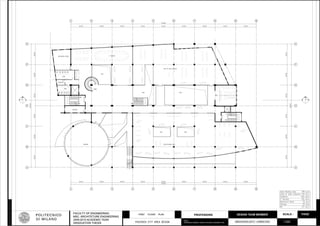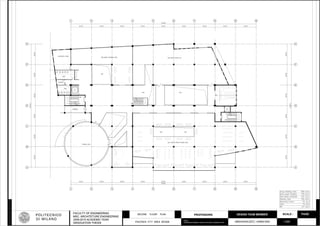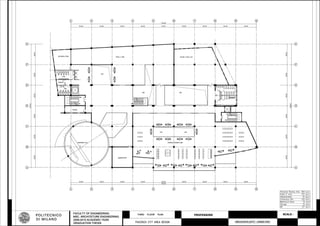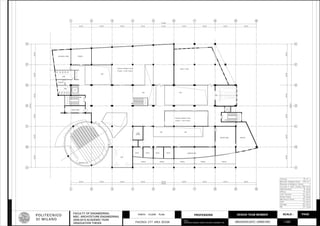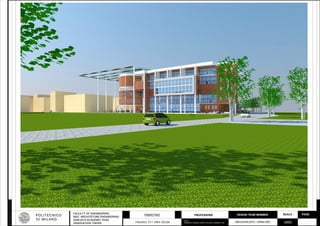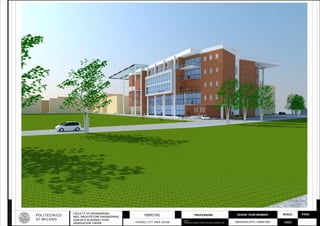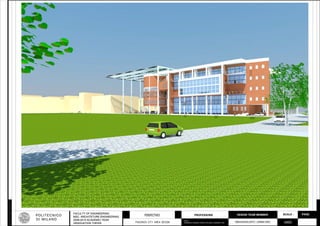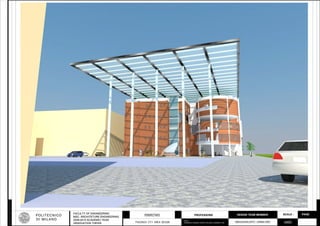

FACULTY OF ENGINEERING POLO REGIONALE DI LECCO


MASTER OF SCIENCE IN ARCHITECTURAL ENGINEERING


                 RELATORE
             PROF. MASSIMO TADI

               CO-REELATOR
             PROF. GABRIELE MASERA


             MASTER THESIS BY:
              ABDUXUKUR . ZAYIT
                   751975


            Academic year 2010/2011
ACKNOWLEDGEMENT


We would like to mention all those who contributed their efforts to write this master‘s thesis.

We thank to PROF. GABRIELE MASERA, PROF. MASSIMO TADI, PROF. DANILO
PALAZZO, and PROF. LIBERATO FERRARA for their willingness and valuable advice to
face the difficulties during the development of this thesis.


                                                                                                  i
ABSTRACT


Piacenza is a city and comune in the Emilia-Romagna region of northern Italy. It is the
capital of the province of Piacenza.

Strategically the city is at a major crossroads at the intersection of Route E35/A1
between Bologna, gateway to eastern Italy, and Milan, gateway to the Alps, and Route
E70/A21 between Brescia at the foot of the Alps and Tortona, where branches lead
to Turin in the north, a major industrial city, and Genoa, a major coastal port. Piacenza is also
at the confluence of the Trebbia, draining the northern Apennines, and the Po, the major
waterway of northern Italy, draining to the east. Piacenza right from its foundation has been
of vital interest to political powers that would control northern Italy, more than any other city
there.

Piacenza is, in fact the ideal venue for an initiative focused on architectural, urban and
environmental problems, both for the size of its scenic, landscape, artistic and monumental
wealth and for the wide range of case-studies available, as well as for its solid traditions in
the building sector.

Program was to interconnect the landscape, urban spaces and architectural design of library
integration with towards positive energy.

Urban planning was done by using the roman grid and tried to provide the facility spaces
according to integrated, interactive and interscalar architectural –urban- environmental
concept. While the Architecture design of Library we developed the brief by studying the
libraries present in Italy and abroad with respect to number of books and area.


                                                                                                i
MSc In Architectural Engineering
___________________________________________________________________________

INDEX

Acknowledgement

Abstract

1-Introduction ...................................................................................... 1
2- Urban Context ................................................................................. 4
  2.1-Italy ..................................................................................................................................5

  2.2-Emilia–Romagna ..............................................................................................................6

  2.3- Brief History of Urban Development in Piacenza ..........................................................7

     2.3.1-The reconstruction of the city ..................................................................................12

     2.3.2-The urban genetic code............................................................................................14

  2.4- Analysis about Current City of Piacenza ......................................................................15

     2.4.1- The Geographic Context ........................................................................................15

     2.4.2-Population ................................................................................................................17

     2.4.3 – The Socio- Economic System ...............................................................................30

     2.4.4- Strategic Plan ..........................................................................................................31

  2.5- Piacenza‘s network........................................................................................................36

  2.6-Physical-morphological aspects .....................................................................................47

  2.7-Local conditions, scope, borders, limits .........................................................................50

  2.8-Conclusion .....................................................................................................................55

3-Urban Design ................................................................................. 56
  3.1-Project Area ....................................................................................................................58

  3.2-Site Comparison .............................................................................................................63

  3.3-Site Analysis ..................................................................................................................64

___________________________________________________________________________
                                                                           i
MSc In Architectural Engineering
___________________________________________________________________________

  3.4-SWOT Analysis .............................................................................................................67

  3.5-Project Scope..................................................................................................................68

     3.5.1- project Objective ....................................................................................................68

     3.5.2- Master plan .............................................................................................................69

     3.5.3- Master plan Analysis ..............................................................................................73

4- Architectural Design ..................................................................... 85
  4.1- Library ...........................................................................................................................86

     4.1.1-Library in History ....................................................................................................86

     4.1.2- Classifications of Library .......................................................................................91

  4.2- Project Objective ...........................................................................................................91

  4.3- Research Example for Reference ..................................................................................95

     4.3.1-Piacenza Libraries ...................................................................................................95

     4.3.2-Biblioteca Civica, Prato ...........................................................................................98

     4.3.3-New Public library in Pontivy, France ....................................................................98

     4.3.4- Public Library Kelsterbach, Germany ..................................................................101

     4.3.5- Jaume Fuster Library, Spain .................................................................................102

     4.3.6- Surry Hills Library, Australia ...............................................................................103

  4.4-Architectural Design ....................................................................................................106

     4.5 Concept and Drawings ..............................................................................................110

5-Structural Design ......................................................................... 132
  5.1-Introduction ..................................................................................................................133

  5.2-Load Calculations ........................................................................................................135

  5.3-Slab...............................................................................................................................143

___________________________________________________________________________
                                                                          ii
MSc In Architectural Engineering
___________________________________________________________________________

  5.4-Beams ...........................................................................................................................149

  5.5-Columns .......................................................................................................................157

  5.6-Foundation ...................................................................................................................164

6- Building Physics .......................................................................... 167
  6.1-Climate .........................................................................................................................168

  6.2-Analysis for Climate ....................................................................................................174

7- Technological Design .................................................................. 181
  7.1- Towards Positive Energy ............................................................................................182

  7.2- Energy Trends .............................................................................................................183

     7.2.1- Examples of definitions for low energy building standards .................................187

     7.2.2- Passive house and equivalent concepts ................................................................188

     7.2.3- Zero energy houses/zero carbon houses ...............................................................189

     7.2.4- Energy positive Building ......................................................................................190

  7.3-Design Pathways ..........................................................................................................190

  7.4-Thermal Comfort ..........................................................................................................193

  7.5-U-Values and Glazer Diagrams ...................................................................................197

  7.6-Materials and Technology ............................................................................................204

  7.7-Modeling of building....................................................................................................212

  7.8- Heat Energy and Cooling Demand .............................................................................220

  7.9-Lighting ........................................................................................................................225

References........................................................................................ 132


___________________________________________________________________________
                                                                          iii
MSc In Architectural Engineering
___________________________________________________________________________


                                                     CHAPTER 1


                                          INTRODUCTION


___________________________________________________________________________
                                                                          1
MSc In Architectural Engineering
___________________________________________________________________________

1-INTRODUCTION

            Italy is located in Southern Europe, a peninsula extending into the central
            Mediterranean Sea, northeast of Tunisia. Its terrain is mostly rugged and
            mountainous; with some plains, coastal lowlands and a predominantly
            Mediterranean climate.

            The choice of Piacenza as seat of the International Summer School stems,
            among other things, from the analysis of its territory, an extraordinary case-
            study in terms of issues and topics related to architectural design and
            construction of public spaces in contemporary cities.

            The international Summer school competition was divided in three parts and
            we selected the first part of the competition.

            1st part was to redevelop (treatment of this complex area through a sequence
            of buildings and open spaces and connection with the historical city of
            Piacenza

            Our goal was to start with the following points and to select one building
            which is library for architectural design.

            - The relationship between the river and the city; in particular, the areas on the
            Po river bank

            - The relationship of urban spaces with architectural design.

            - The relationship between the city centers

            The common denominator is the ―ar   chitectural design of open spaces‖, which
            can be seen today as a ―m       ultidisciplinary practice‖, affecting several
            interconnected and closely related architectural scales: from landscape
            architecture to planning, from the architectural design of public spaces to
            connections architecture, from the design of architectural components to the
            study of contemporary aesthetic scenarios.

            The particular attention to environmental and open space issues is part of a
            theoretical-operational debate, focusing on the promotion of architectural
            urban and territorial contexts in terms of resources sustainability and
            environmental impact in order to consonance complementarity and impact,

___________________________________________________________________________
                                                                          2
MSc In Architectural Engineering
___________________________________________________________________________


            reach high levels of consonance, integration among the architectural-urban
            requirements and the distinctive traits of the locations.

            For architectural design, the competition did not provide any brief for
            architectural building so for our urban part we selected architectural design of
            Public library and we developed a brief while studying various libraries
            located in Italy and abroad. After that we studied different energy aspects to
            develop the technological part of library and finally we developed the project
            according to approach towards positive energy and other possible aspects of
            the project.


___________________________________________________________________________
                                                                          3
MSc In Architectural Engineering
___________________________________________________________________________


                                                     CHAPTER 2


                                       URBAN CONTEXT


___________________________________________________________________________
                                                                          4
MSc In Architectural Engineering
___________________________________________________________________________

2- URBAN CONTEXT

2.1-Italy


                        Italy, officially the Italian Republic (Italian: Repubblica
                        italiana), is a country located in south central Europe. To the
                        north it borders France, Switzerland, Austria and Slovenia
                        along the Alps. To the south it consists of the entirety of the
                        Italian Peninsula, Sicily, Sardinia, the two largest islands in the
                        Mediterranean Sea and many other smaller islands.


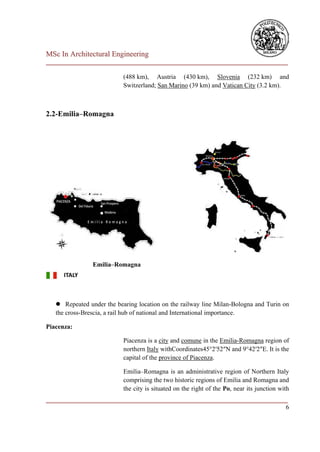
                        Global, location of Piacenza, Italy


                        The country's total area is 301,230 km², of which 294,020 km²
                        is land and 7,210 km² is water. Including the islands, Italy has a
                        coastline and border of 7,600 km on the Adriatic, Ionian,
                        Tyrrhenian seas (740 km), and borders shared with France
___________________________________________________________________________
                                                                          5
MSc In Architectural Engineering
___________________________________________________________________________

                           (488 km), Austria (430 km), Slovenia (232 km) and
                           Switzerland; San Marino (39 km) and Vatican City (3.2 km).


2.2-Emilia–Romagna


                Emilia–Romagna


    Repeated under the bearing location on the railway line Milan-Bologna and Turin on
   the cross-Brescia, a rail hub of national and International importance.

Piacenza:

                           Piacenza is a city and comune in the Emilia-Romagna region of
                           northern Italy withCoordinates45°2′52″N and 9°42′2″E. It is the
                           capital of the province of Piacenza.

                           Emilia–Romagna is an administrative region of Northern Italy
                           comprising the two historic regions of Emilia and Romagna and
                           the city is situated on the right of the Po, near its junction with
___________________________________________________________________________
                                                                          6
MSc In Architectural Engineering
___________________________________________________________________________

                        the Trebbia, in an important strategic position. Agriculture is
                        the chief industry. The cathedral is of the ninth century; it was
                        remodeled by Santa da Sambuceto and others (1122-1223) in
                        beautiful Lombard style.


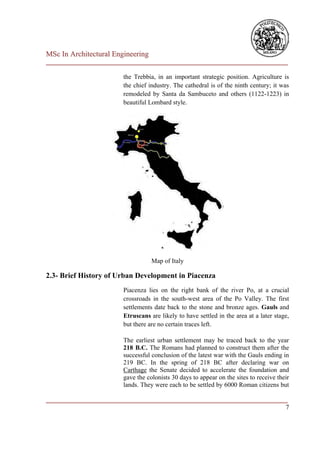
                                   Map of Italy

2.3- Brief History of Urban Development in Piacenza
                        Piacenza lies on the right bank of the river Po, at a crucial
                        crossroads in the south-west area of the Po Valley. The first
                        settlements date back to the stone and bronze ages. Gauls and
                        Etruscans are likely to have settled in the area at a later stage,
                        but there are no certain traces left.

                        The earliest urban settlement may be traced back to the year
                        218 B.C. The Romans had planned to construct them after the
                        successful conclusion of the latest war with the Gauls ending in
                        219 BC. In the spring of 218 BC after declaring war on
                        Carthage the Senate decided to accelerate the foundation and
                        gave the colonists 30 days to appear on the sites to receive their
                        lands. They were each to be settled by 6000 Roman citizens but

___________________________________________________________________________
                                                                          7
MSc In Architectural Engineering
___________________________________________________________________________

                               the cities were to receive Latin Rights 1 .that is, they were to
                               have the same legal status as the many colonies that had been
                               co-founded by Rome and towns of Latium.

                               The era of Late Antiquity in Piacenza (4th/9th centuries AD)
                               was marked by the expansion of Christianity, with the presence
                               of several martyrs. Before the year 286 AD Piacenza was not
                               overtly Christian. In that year the co-emperors of the late
                               Roman Empire resolved once again on an attempt to eradicate
                               Christianity, the senior emperor, Diocletian, relying this time
                               on the services of a subordinate emperor, Maximian. The latter
                               intended to suppress the Christians of Gaul with fire and sword.
                               He ordered the garrison of Thebes, Egypt, to join him in Gaul
                               for that purpose. It is not clear whether he knew that the entire
                               legion, having been recruited in a then intensely Christian
                               region, was Christian.


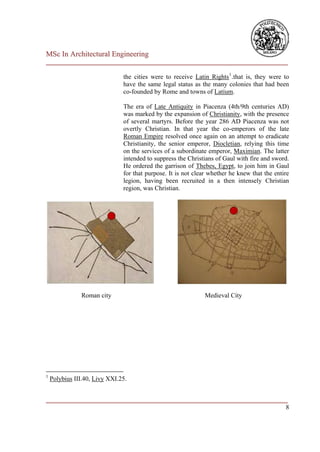
               Roman city                                     Medieval City


1
    Polybius III.40, Livy XXI.25.


___________________________________________________________________________
                                                                          8
MSc In Architectural Engineering
___________________________________________________________________________


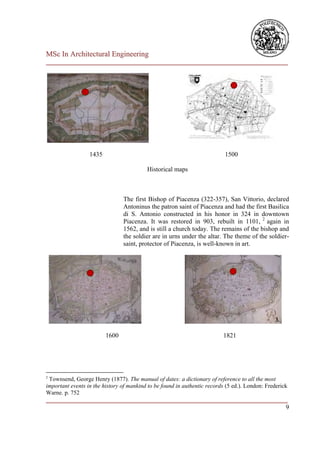
                  1435                                                     1500

                                          Historical maps


                                The first Bishop of Piacenza (322-357), San Vittorio, declared
                                Antoninus the patron saint of Piacenza and had the first Basilica
                                di S. Antonio constructed in his honor in 324 in downtown
                                Piacenza. It was restored in 903, rebuilt in 1101, 2 again in
                                1562, and is still a church today. The remains of the bishop and
                                the soldier are in urns under the altar. The theme of the soldier-
                                saint, protector of Piacenza, is well-known in art.


                         1600                                             1821


2
 Townsend, George Henry (1877). The manual of dates: a dictionary of reference to all the most
important events in the history of mankind to be found in authentic records (5 ed.). London: Frederick
Warne. p. 752
___________________________________________________________________________
                                                                          9
MSc In Architectural Engineering
___________________________________________________________________________


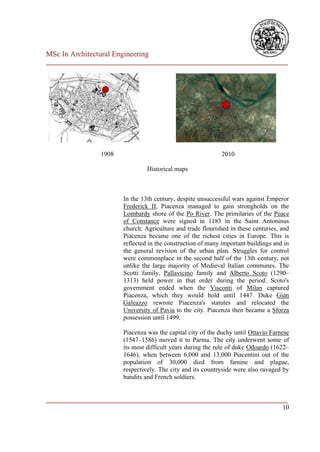
                 1908                                        2010

                                 Historical maps


                        In the 13th century, despite unsuccessful wars against Emperor
                        Frederick II, Piacenza managed to gain strongholds on the
                        Lombardy shore of the Po River. The primilaries of the Peace
                        of Constance were signed in 1183 in the Saint Antoninus
                        church. Agriculture and trade flourished in these centuries, and
                        Piacenza became one of the richest cities in Europe. This is
                        reflected in the construction of many important buildings and in
                        the general revision of the urban plan. Struggles for control
                        were commonplace in the second half of the 13th century, not
                        unlike the large majority of Medieval Italian communes. The
                        Scotti family, Pallavicino family and Alberto Scoto (1290–
                        1313) held power in that order during the period. Scoto's
                        government ended when the Visconti of Milan captured
                        Piacenza, which they would hold until 1447. Duke Gian
                        Galeazzo rewrote Piacenza's statutes and relocated the
                        University of Pavia to the city. Piacenza then became a Sforza
                        possession until 1499.

                        Piacenza was the capital city of the duchy until Ottavio Farnese
                        (1547–1586) moved it to Parma. The city underwent some of
                        its most difficult years during the rule of duke Odoardo (1622–
                        1646), when between 6,000 and 13,000 Piacentini out of the
                        population of 30,000 died from famine and plague,
                        respectively. The city and its countryside were also ravaged by
                        bandits and French soldiers.


___________________________________________________________________________
                                                                         10
MSc In Architectural Engineering
___________________________________________________________________________

                        Between 1732 and 1859, Parma and Piacenza were ruled by the
                        House of Bourbon. In the 18th century, several edifices which
                        belonged to noble families such as Scotti, Landi and Fogliani
                        were built in Piacenza.

                        In 1802, Napoleon's army annexed Piacenza to the French
                        Empire. Young Piacentini recruits were sent to fight in Russia,
                        Spain and Germany, while the city was plundered of a great
                        number of artworks which are currently exhibited in many
                        French museums.

                        The Habsburg government of Maria Luisa 1816-1847 is
                        remembered fondly as one of the best in the history of
                        Piacenza; the duchess drained many lands, built several bridges
                        across the Trebbia river and the Nure stream, and created
                        educational and artistic activities.

                        On June 1865 the first railway bridge over Po river in northern
                        Italy was inaugurated (in southern Italy a railroad bridge had
                        already been built in 1839). In 1891 the first Chamber of
                        Workers was created in Piacenza.

                        During World War II the city was heavily bombed by the
                        Allies. The important railway and road bridges across the
                        Trebbia and the Po Rivers and the railway yards were
                        destroyed. The historic centre of city itself also suffered
                        collateral damage. In 1944 the bridges over the Po became vital
                        to the supply from Austria of Field Marshal Albert Kesselring's
                        Gothic Line, which protected the withdrawal of Kesselring's
                        troops from Italy. Foremost among them were the railway and
                        road bridges at Piacenza, along with supply depots and railway
                        yards. In Operation Mallory Major, July 12–15, allied medium
                        bombers from Corsica flew 300 sorties a day, knocking out 21
                        bridges east of Piacenza, and then continued to the west for a
                        total of 90 by July 20. Fighter-bombers prevented
                        reconstruction and cut roads and rail lines. By August 4 all the
                        cities of north Italy were isolated and had suffered heavy
                        bombing, including especially Piacenza. Transport to Genoa on


___________________________________________________________________________
                                                                         11
MSc In Architectural Engineering
___________________________________________________________________________

                              the east or through Turin to the north was impossible;
                              nevertheless, Kesselring continued to supply his men.3

                              On the hills and the Apennine mountains, partisan bands were
                              active. On April 25, 1945, a General partisan insurrection by
                              the Italian resistance movement occurred and on the 29th troops
                              of Brazilian Expeditionary Force arrived at the city. In 1996
                              president Oscar Luigi Scalfaro honoured Piacenza with the
                              Gold Medal for Valour in Battle.


2.3.1-The reconstruction of the city


Towards the contemporary city, city infrastructure.


                              The two world wars affected the city and the province,
                              considering also the significant involvement of Piacenza in the
                              army. During the Second World War the city was heavily hit by
                              air raids of the Allies that they collapse the important railway
                              bridge over the Po, the railway station, hospital and arsenal as

                              well as portions of the center. Outside the city, on the hills of
                              Piacenza and over the Apennines, supporters of various groups
                              who fought the Nazi army were active.


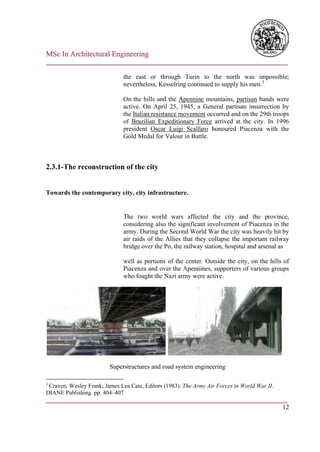
                         Superstructures and road system engineering

3
 Craven, Wesley Frank; James Lea Cate, Editors (1983). The Army Air Forces in World War II.
DIANE Publishing. pp. 404–407
___________________________________________________________________________
                                                                         12
MSc In Architectural Engineering
___________________________________________________________________________


                        In the second half of the nineteenth and early twentieth century
                        new ventures gave an important impetus to the economic and
                        industrial development, but also the modernization of farms.
                        For this agricultural vocation and also in the strong tradition
                        Sacro Cuore Milan opened Christian tradition, the Catholic
                        University of in in city the first faculty in the fifties, was the
                        Agriculture one, Piacenza in the detachment of the university.

                        The central location, the important railway junction and the
                        passage of two major highways, continue to promote the
                        economic and industrial development of Piacenza and the
                        surrounding area to this day which is developing and expanding
                        a logistics hub in the suburbs. The main aspects of
                        contemporary Piacenza to be sent to the entire chapter of
                        "transformations" dedicated to these important issues.


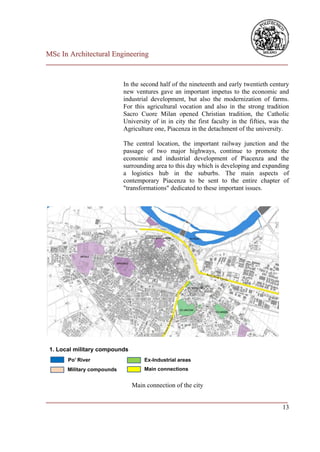
                           Main connection of the city

___________________________________________________________________________
                                                                         13
MSc In Architectural Engineering
___________________________________________________________________________

2.3.2-The urban genetic code


                        The urban biography finds its application more complex and
                        effective in drawing the biographical map. This itself is
                        generative matrix of a projected vision into the future, in which
                        we represent, through a process of abstraction, the final
                        synthesis, that of today, the life processes of the city, not only
                        the processes are vital but are able at same time to generate life.
                        From the point of view more interesting to us, and therefore to
                        the architectural, biographical map is represented expression of
                        the urban genetic code, the DNA of the city. With this
                        definition we want to emphasize the profound need to
                        understand what underlies the construction of the city and
                        fundamentally permanent elements, those elements that have
                        covered the story and are now able to turn into generators of
                        paths, elements of future projection and therefore
                        archaeological items in future.


                   Biographical map: Main Historical thresholds
___________________________________________________________________________
                                                                         14
MSc In Architectural Engineering
___________________________________________________________________________

2.4- Analysis about Current City of Piacenza

2.4.1- The Geographic Context

                           The today‘s world is a residence subject to our whole design,
                           and also the natural support is subject to human transformation.
                           The words of Leonardo Benevolo and Benno Albrecht (2002),
                           applied to the condition of Piacenza, drawing a possible overlap
                           and hybridization between the concepts of geography and
                           landscape from which the same architectural design should
                           engage for thought and discussion.

                           First on the issue of borders. Since the Piacenza is a city that its
                           borders are lived, grown and built part of his fortune in various
                           historical eras. Even today - Lombard city in the land of Emilia
                           or, looking at the other side, in Lombardy, Emilia offshoot –

                           lives in a strange and in the same time fascinating luminal
                           condition. As is relevant in our contemporary thinking in terms
                           of geographical boundaries but it‘s an open question. Because,
                           accomplices the transformation of infrastructure and the
                           exponential increase of the flows of people and goods, Piacenza
                           is interpretable not anymore as urban reality unto itself but
                           rather as a system or a network node.

                           The city, in fact, is the integrant part of the so-called
                           "megacities Po", theorized in 2000 by Eugenio Turri, one of the
                           leading Italian geographers, agglomeration that characterizes
                           the northern Italy by tying and built areas and non, with
                           different characters of settlements and materials, in a system
                           without any solution of continuity. With a Continental look, the
                           megalopolis of Po valley extends from the foothills at the foot
                           of the Alps (condensed around the city of Varese, Como,
                           Lecco, Bergamo and Brescia and then towards east to Venice),
                           finds its strategic point in Milan and then extends towards west
                           (Turin) and south, with a density that decreases as the increase
                           of agricultural land south of Lombardy Just in Piacenza the
                           shape of the conurbation bends connecting with the urban linear
                           formed around the Via Emilia, with greater concentration
                           around urban centers (Parma, Reggio, Modena) to Bologna.

                        Beyond the strictly geographical aspects, the conurbation has
                        effects on the political, economic and social systems. First,
___________________________________________________________________________
                                                                                   15
MSc In Architectural Engineering
___________________________________________________________________________

                        since the size of Po megacities place it in confrontation and
                        comparison with other similar European cities such as London
                        of Great Britain or the Dutch urban strip that links Leiden, Den
                        Haag and Rotterdam with Amsterdam, together with the
                        German region of the Ruhr. There are the flows of people and
                        goods, and thus the efficiency of infrastructure, to give strength
                        and substance to these conurbations. Even today - despite a
                        phase of strong transformations and with a strong planning
                        related to the development of road and rail networks should
                        materialize in the coming years - about 10% of Piacenza is
                        commuting, working every day in Milan. In this framework, the
                        boundaries tend to blur, or perhaps tends to change in an
                        irreversibly manner the same concept of geography, no longer a
                        mere description of the area changing, but urban science able to
                        envisage transformative scenarios. "The geography would thus
                        be to assume an operational role - writes Luigi Coccia - pre-
                        figuration of a change based on a large project of ground
                        capable of reorganizing the territory of the dispersion is not

                        through the imposition of a new abstract order, of a predefined
                        drawing dropped casually in a specific spatial context, but
                        rather through the unveiling of an existing order, an order
                        constructive detectable in the form of a specific geographical
                        territorial area." In the contemporary widespread urbanization,
                        privileged design themes are gaps between settlements and
                        infrastructure. Places where you can experiment and propose
                        not so much abstract and global settlement patterns rather than
                        new, and local, urban geographies and territorial. In the culture
                        of the urban and architectural design could cite two significant
                        moments in this sense: the 1973 with the project of Vittorio
                        Gregotti for the University of the Calabria and the 1993 with
                        the realizing of the museum square of Amsterdam from the
                        Sven-Ingvar Anderrson.

                        They both – by ways and new forms – un built areas, although
                        very different among them and in a different scale (Territorial
                        in the first, the urban in second). It constructs, in extreme
                        synthesis, innovative landscapes. The theme of construction of
                        landscape - or landscape - is set to geography more than
                        requested by the contemporary design.


___________________________________________________________________________
                                                                         16
MSc In Architectural Engineering
  ___________________________________________________________________________

                                              ―( The size of an urban place is an important factor that can
                                                 1)
                                              contribute to and detract from quality of life conditions; it
                                              therefore deserves a primary place in the formulation of
                                              national growth policy. (2) In general, the quality of urban life,
                                              as measured across non-economic dimensions, seems to decline
                                              as urban scales increase. (3) The extent to which this quality of
                                              life difference is acceptable seems to depend largely upon
                                              economic trade-offs; the economic rewards must compensate
                                              sufficiently for apparent net social, environmental, political
                                              preferential and systematic disamenities which accrue as urban
                                              scale increases; otherwise, one could expect a spontaneous
                                              reversal in migration patterns away from larger cities to occur‖
                                              Elgin et al. (1974, p. 16).

  2.4.2-Population4

                                              Foreigners enrolled in the registers of Piacenza province
                                              municipalities on 31st December 2009 were 36.153, which is
                                              the 12,6% of total residents (which are 288.011). The growth of
                                              the foreign population resident in the territory continues apace:
                                              since 2002 the average yearly increase has been 18%, the
                                              equivalent of more than 3.600 foreign residents per year.
                                              Anyway, in 2009 this growth marked a slight decrease +3.019
                                              residents, which equals +9,6% compared to the number
                                              registered at the end of the previous year.


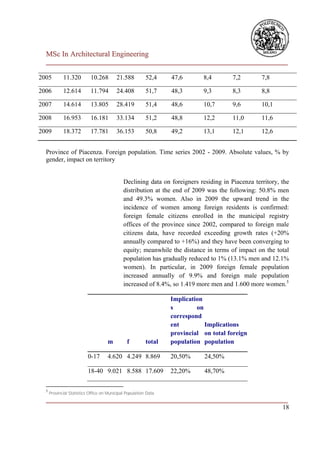
             ABSOLUTE VALUES OF
             FOREIGNERS         % BY GENDER                                  % ON TOTAL RESIDENTS

                   FEMAL                                                                 FEMALE
YEAR         MALES ES    TOTAL                            MALES FEMALES MALES            S      TOTAL

2002         6.330          5.022         11.352          55,8    44,2       4,9         3,6         4,2

2003         8.320          7.131         15.451          53,8    46,2       6,3         5,1         5,7

2004         9.969          8.767         18.736          53,2    46,8       7,5         6,2         6,8


  4
      Provincial Statistics Office on Municipal Population Data
  ___________________________________________________________________________
                                                                           17
MSc In Architectural Engineering
  ___________________________________________________________________________

2005         11.320         10.268        21.588          52,4    47,6       8,4        7,2        7,8

2006         12.614         11.794        24.408          51,7    48,3       9,3        8,3        8,8

2007         14.614         13.805        28.419          51,4    48,6       10,7       9,6        10,1

2008         16.953         16.181        33.134          51,2    48,8       12,2       11,0       11,6

2009         18.372         17.781        36.153          50,8    49,2       13,1       12,1       12,6


  Province of Piacenza. Foreign population. Time series 2002 - 2009. Absolute values, % by
  gender, impact on territory


                                              Declining data on foreigners residing in Piacenza territory, the
                                              distribution at the end of 2009 was the following: 50.8% men
                                              and 49.3% women. Also in 2009 the upward trend in the
                                              incidence of women among foreign residents is confirmed:
                                              foreign female citizens enrolled in the municipal registry
                                              offices of the province since 2002, compared to foreign male
                                              citizens data, have recorded exceeding growth rates (+20%
                                              annually compared to +16%) and they have been converging to
                                              equity; meanwhile the distance in terms of impact on the total
                                              population has gradually reduced to 1% (13.1% men and 12.1%
                                              women). In particular, in 2009 foreign female population
                                              increased annually of 9.9% and foreign male population
                                              increased of 8.4%, so 1.419 more men and 1.600 more women.5

                                                                  Implication
                                                                  s        on
                                                                  correspond
                                                                  ent         Implications
                                                                  provincial on total foreign
                                     m          f         total   population population

                           0-17      4.620 4.249 8.869            20,50%     24,50%

                           18-40 9.021 8.588 17.609               22,20%     48,70%

  5
      Provincial Statistics Office on Municipal Population Data
  ___________________________________________________________________________
                                                                           18
MSc In Architectural Engineering
___________________________________________________________________________

                       41-64 4.370 4.435 8.805                        9,10%            24,40%

                       >64       361        509          870          1,30%            2,40%

                       total     18.372 17.781 36.153                 12,60%           100,00%


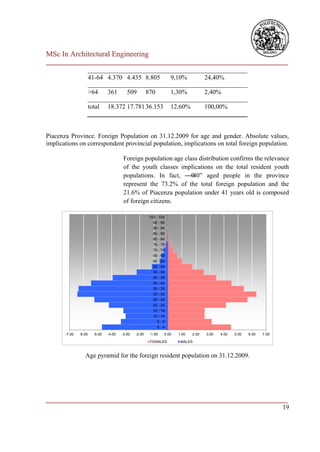
Piacenza Province. Foreign Population on 31.12.2009 for age and gender. Absolute values,
implications on correspondent provincial population, implications on total foreign population.

                                          Foreign population age class distribution confirms the relevance
                                          of the youth classes implications on the total resident youth
                                          populations. In fact, ―0  -40‖ aged people in the province
                                          represent the 73.2% of the total foreign population and the
                                          21.6% of Piacenza population under 41 years old is composed
                                          of foreign citizens.

                                                          100 - 104
                                                            95 - 99
                                                            90 - 94
                                                            85 - 89
                                                            80 - 84
                                                            75 - 79
                                                            70 - 74
                                                            65 - 69
                                                            60 - 64
                                                            55 - 59
                                                            50 - 54
                                                            45 - 49
                                                            40 - 44
                                                            35 - 39
                                                            30 - 34
                                                            25 - 29
                                                            20 - 24
                                                            15 - 19
                                                            10 - 14
                                                               5-9
                                                               0-4
       -7.00   -6.00     -5.00   -4.00   -3.00   -2.00    -1.00   0.00   1.00   2.00   3.00   4.00   5.00   6.00   7.00

                                                          FEMALES         MALES


                  Age pyramid for the foreign resident population on 31.12.2009.


___________________________________________________________________________
                                                                         19
MSc In Architectural Engineering
___________________________________________________________________________

                                               100 - 104
                                                 95 - 99
                                                 90 - 94
                                                 85 - 89
                                                 80 - 84
                                                 75 - 79
                                                 70 - 74
                                                 65 - 69
                                                 60 - 64
                                                 55 - 59
                                                 50 - 54
                                                 45 - 49
                                                 40 - 44
                                                 35 - 39
                                                 30 - 34
                                                 25 - 29
                                                 20 - 24
                                                 15 - 19
                                                 10 - 14
                                                    5-9
                                                    0-4
          -5.00    -4.00   -3.00   -2.00     -1.00     0.00   1.00     2.00      3.00   4.00   5.00

                                   Italian MALES               Italian FEMALES
                                   Foreigner MALES             Foreigner FEMALES


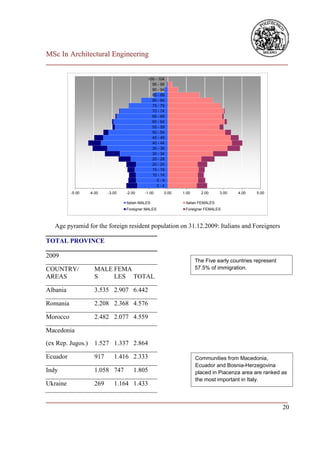
   Age pyramid for the foreign resident population on 31.12.2009: Italians and Foreigners

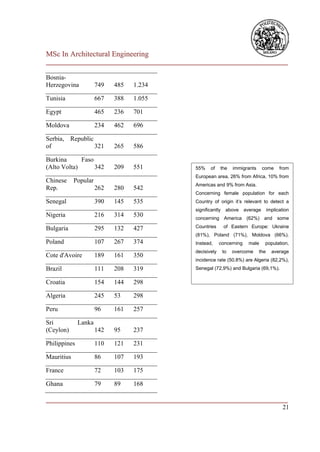
TOTAL PROVINCE

2009
                                                                     The Five early countries represent
COUNTRY/             MALE FEMA                                       57.5% of immigration.
AREAS                S    LES TOTAL

Albania              3.535 2.907 6.442

Romania              2.208 2.368 4.576

Morocco              2.482 2.077 4.559

Macedonia
(ex Rep. Jugos.)     1.527 1.337 2.864

Ecuador              917      1.416 2.333                            Communities from Macedonia,
                                                                     Ecuador and Bosnia-Herzegovina
Indy                 1.058 747         1.805                         placed in Piacenza area are ranked as
                                                                     the most important in Italy.
Ukraine              269      1.164 1.433

___________________________________________________________________________
                                                                         20
MSc In Architectural Engineering
___________________________________________________________________________

Bosnia-
Herzegovina           749   485   1.234

Tunisia               667   388   1.055

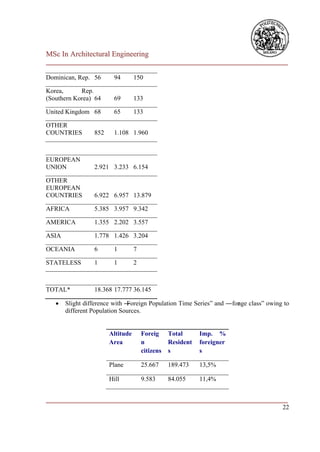
Egypt                 465   236   701

Moldova               234   462   696

Serbia, Republic
of               321        265   586

Burkina      Faso
(Alto Volta)      342       209   551         55%    of    the     immigrants     come      from
                                              European area, 26% from Africa, 10% from
Chinese     Popular
                                              Americas and 9% from Asia.
Rep.                  262   280   542
                                              Concerning female population for each
Senegal               390   145   535         Country of origin it’s relevant to detect a
                                              significantly    above    average       implication
Nigeria               216   314   530         concerning America (62%) and some

Bulgaria              295   132   427         Countries       of Eastern Europe: Ukraine
                                              (81%), Poland (71%), Moldova (66%).
Poland                107   267   374         Instead,     concerning     male     population,
                                              decisively      to   overcome     the     average
Cote d'Avoire         189   161   350
                                              incidence rate (50.8%) are Algeria (82,2%),
Brazil                111   208   319         Senegal (72,9%) and Bulgaria (69,1%).

Croatia               154   144   298

Algeria               245   53    298

Peru                  96    161   257

Sri           Lanka
(Ceylon)              142   95    237

Philippines           110   121   231

Mauritius             86    107   193

France                72    103   175

Ghana                 79    89    168

___________________________________________________________________________
                                                                         21
MSc In Architectural Engineering
___________________________________________________________________________

Dominican, Rep. 56      94        150

Korea,      Rep.
(Southern Korea) 64     69        133

United Kingdom 68       65        133

OTHER
COUNTRIES        852    1.108 1.960


EUROPEAN
UNION            2.921 3.233 6.154

OTHER
EUROPEAN
COUNTRIES        6.922 6.957 13.879

AFRICA           5.385 3.957 9.342

AMERICA          1.355 2.202 3.557

ASIA             1.778 1.426 3.204

OCEANIA          6      1         7

STATELESS        1      1         2


TOTAL*           18.368 17.777 36.145

      Slight difference with ―
                              Foreign Population Time Series‖ and ―for class‖ owing to
                                                                     age
       different Population Sources.


                       Altitude       Foreig     Total      Imp. %
                       Area           n          Resident   foreigner
                                      citizens   s          s

                       Plane          25.667     189.473    13,5%

                       Hill           9.583      84.055     11,4%


___________________________________________________________________________
                                                                         22
MSc In Architectural Engineering
___________________________________________________________________________

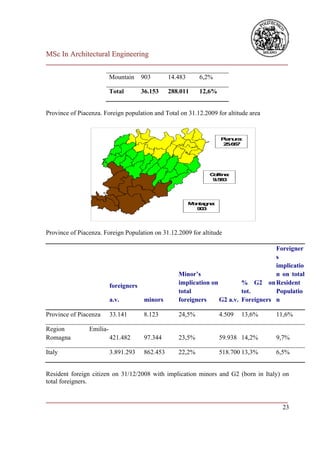
                          Mountain     903        14.483      6,2%

                          Total        36.153     288.011     12,6%


Province of Piacenza. Foreign population and Total on 31.12.2009 for altitude area


                                                                       P n r :
                                                                        ia u a
                                                                       2 .6 7
                                                                         5 6


                                                                  C llin :
                                                                   o a
                                                                   9 8
                                                                    .5 3


                                                           Mn g a
                                                            o ta n :
                                                             930


Province of Piacenza. Foreign Population on 31.12.2009 for altitude

                                                                                       Foreigner
                                                                                       s
                                                                                       implicatio
                                                     Minor’s                           n on total
                          foreigners                 implication on         % G2 on Resident
                                                     total                  tot.       Populatio
                          a.v.          minors       foreigners     G2 a.v. Foreigners n

Province of Piacenza      33.141        8.123        24,5%             4.509   13,6%   11,6%

Region          Emilia-
Romagna                   421.482       97.344       23,5%             59.938 14,2%    9,7%

Italy                     3.891.293     862.453      22,2%             518.700 13,3%   6,5%


Resident foreign citizen on 31/12/2008 with implication minors and G2 (born in Italy) on
total foreigners.

___________________________________________________________________________
                                                                         23
MSc In Architectural Engineering
___________________________________________________________________________


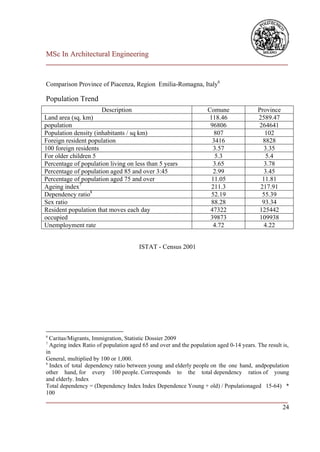
Comparison Province of Piacenza, Region Emilia-Romagna, Italy6

Population Trend
                      Description                                  Comune               Province
Land area (sq. km)                                                 118.46               2589.47
population                                                          96806                264641
Population density (inhabitants / sq km)                              807                  102
Foreign resident population                                          3416                 8828
100 foreign residents                                                3.57                  3.35
For older children 5                                                  5.3                   5.4
Percentage of population living on less than 5 years                 3.65                  3.78
Percentage of population aged 85 and over 3:45                       2.99                  3.45
Percentage of population aged 75 and over                           11.05                 11.81
Ageing index7                                                       211.3                217.91
Dependency ratio8                                                   52.19                 55.39
Sex ratio                                                           88.28                 93.34
Resident population that moves each day                             47322                125442
occupied                                                            39873                109938
Unemployment rate                                                    4.72                  4.22


                                       ISTAT - Census 2001


6
  Caritas/Migrants, Immigration, Statistic Dossier 2009
7
  Ageing index Ratio of population aged 65 and over and the population aged 0-14 years. The result is,
in
General, multiplied by 100 or 1,000.
8
  Index of total dependency ratio between young and elderly people on the one hand, andpopulation
other hand, for every 100 people. Corresponds to the total dependency ratios of young
and elderly. Index
Total dependency = (Dependency Index Index Dependence Young + old) / Populationaged 15-64) *
100
___________________________________________________________________________
                                                                         24
MSc In Architectural Engineering
___________________________________________________________________________


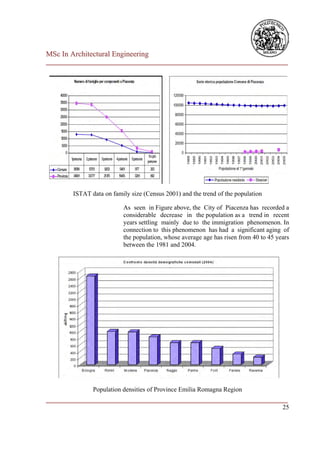
        ISTAT data on family size (Census 2001) and the trend of the population

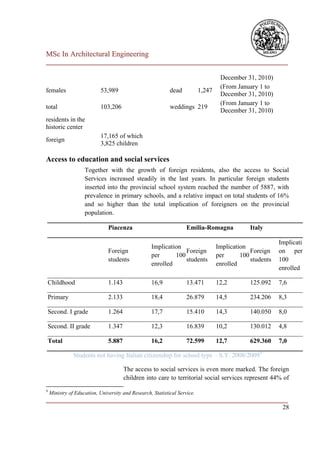
                          As seen in Figure above, the City of Piacenza has recorded a
                          considerable decrease in the population as a trend in recent
                          years settling mainly due to the immigration phenomenon. In
                          connection to this phenomenon has had a significant aging of
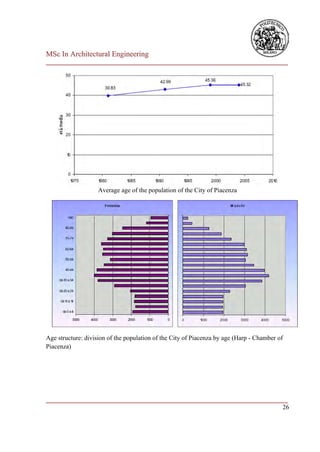
                          the population, whose average age has risen from 40 to 45 years
                          between the 1981 and 2004.


               Population densities of Province Emilia Romagna Region
___________________________________________________________________________
                                                                         25
MSc In Architectural Engineering
___________________________________________________________________________


                    Average age of the population of the City of Piacenza


Age structure: division of the population of the City of Piacenza by age (Harp - Chamber of
Piacenza)


___________________________________________________________________________
                                                                         26
MSc In Architectural Engineering
___________________________________________________________________________


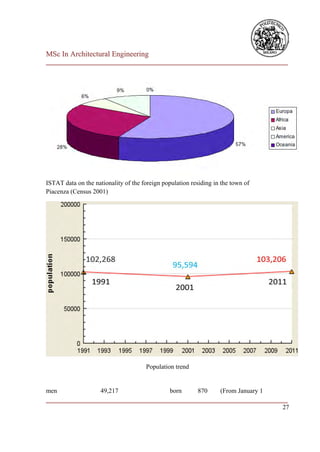
ISTAT data on the nationality of the foreign population residing in the town of
Piacenza (Census 2001)


                                      Population trend


men              49,217               born     870    (From January 1
___________________________________________________________________________
                                                                         27
MSc In Architectural Engineering
___________________________________________________________________________

                                                                                    December 31, 2010)
                                                                                    (From January 1 to
females                     53,989                          dead           1,247
                                                                                    December 31, 2010)
                                                                                    (From January 1 to
total                       103,206                         weddings 219
                                                                                    December 31, 2010)
residents in the
historic center
                            17,165 of which
foreign
                            3,825 children

Access to education and social services
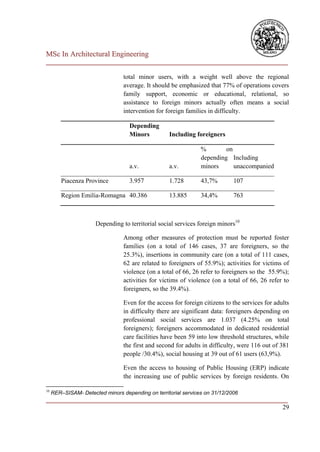
                    Together with the growth of foreign residents, also the access to Social
                    Services increased steadily in the last years. In particular foreign students
                    inserted into the provincial school system reached the number of 5887, with
                    prevalence in primary schools, and a relative impact on total students of 16%
                    and so higher than the total implication of foreigners on the provincial
                    population.

                               Piacenza                             Emilia-Romagna             Italy

                                                                                                           Implicati
                                                   Implication                     Implication
                               Foreign                          Foreign                         Foreign    on per
                                                   per      100                    per      100
                               students                         students                        students   100
                                                   enrolled                        enrolled
                                                                                                           enrolled

    Childhood                  1.143               16,9             13.471         12,2        125.092     7,6

    Primary                    2.133               18,4             26.879         14,5        234.206     8,3

    Second. I grade            1.264               17,7             15.410         14,3        140.050     8,0

    Second. II grade           1.347               12,3             16.839         10,2        130.012     4,8

    Total                      5.887               16,2             72.599         12,7        629.360     7,0

               Students not having Italian citizenship for school type – S.Y. 2008/20099

                                       The access to social services is even more marked. The foreign
                                       children into care to territorial social services represent 44% of
9
    Ministry of Education, University and Research, Statistical Service.
___________________________________________________________________________
                                                                         28
MSc In Architectural Engineering
___________________________________________________________________________

                                 total minor users, with a weight well above the regional
                                 average. It should be emphasized that 77% of operations covers
                                 family support, economic or educational, relational, so
                                 assistance to foreign minors actually often means a social
                                 intervention for foreign families in difficulty.

                                    Depending
                                    Minors         Including foreigners

                                                                %        on
                                                                depending Including
                                    a.v.           a.v.         minors      unaccompanied

         Piacenza Province          3.957          1.728        43,7%        107

         Region Emilia-Romagna 40.386              13.885       34,4%        763


                      Depending to territorial social services foreign minors10

                                 Among other measures of protection must be reported foster
                                 families (on a total of 146 cases, 37 are foreigners, so the
                                 25.3%), insertions in community care (on a total of 111 cases,
                                 62 are related to foreigners of 55.9%); activities for victims of
                                 violence (on a total of 66, 26 refer to foreigners so the 55.9%);
                                 activities for victims of violence (on a total of 66, 26 refer to
                                 foreigners, so the 39.4%).

                                 Even for the access for foreign citizens to the services for adults
                                 in difficulty there are significant data: foreigners depending on
                                 professional social services are 1.037 (4.25% on total
                                 foreigners); foreigners accommodated in dedicated residential
                                 care facilities have been 59 into low threshold structures, while
                                 the first and second for adults in difficulty, were 116 out of 381
                                 people /30.4%), social housing at 39 out of 61 users (63,9%).

                                 Even the access to housing of Public Housing (ERP) indicate
                                 the increasing use of public services by foreign residents. On

10
     RER–SISAM- Detected minors depending on territorial services on 31/12/2006
___________________________________________________________________________
                                                                         29
MSc In Architectural Engineering
___________________________________________________________________________

                        1924 ERP housing in Piacenza town inhabited by families in
                        2009, 314 are of foreigners families.

2.4.3 – The Socio- Economic System


                        Piacenza lies on the right bank of the Po River and is one of the
                        richest provinces in the Emilia Romagna Region of Northern
                        Italy. It exists at a natural crossroads between communication
                        routes and is within proximity of other bigger cities, such as
                        Milan, Bologna, and Genoa, allowing for rapid movement and a
                        high standard of living. There are 100,000 inhabitants in the
                        city and 280,000 in the province, with a steady increase in the
                        last several years due to a rise in immigration from new and
                        non-EU countries. The city and the immediate surrounding
                        municipalities are home to a majority of the 32,000 mostly
                        small- and medium-size companies in the region.

                        Quality agribusiness, advanced mechanics (machine tools,
                        robotics), and the building materials industry are the primary
                        developed sectors of production in the province. Agriculture is
                        first-rate, making use of state-of the- art technologies and a
                        highly-qualified knowledge network. This sector takes
                        advantage of the scientific contribution of the Faculty of
                        Agriculture (since 1951); other faculties that contribute to
                        development are Mechanical Engineering, Economics, Law,
                        and Education. Piacenza has a multimodal, inter connected road
                        and railway supply center that is integrated with the new
                        logistic areas through the west-east axis. The agribusiness
                        industry in Piacenza is top-notch. There are several regional
                        products, most of them with certified controlled origin branding
                        (DOC): three for salami, two for cheese (i.e., Grana Padano),
                        and twenty for wine. Although tourism is scarcely developed in
                        absolute terms, it is growing at a steady rate thanks to the
                        natural resources (the Po River and Apennine mountains and
                        valleys), and cultural attractions (medieval castles, churches,
                        and Roman heritage).

                        In general terms, the labor market is well balanced, with an
                        employment rate of 64 percent and a very low unemployment
                        rate (almost three percent before the international crisis). In
                        2008, the GNP per capita was EUR 30,050, higher than the

___________________________________________________________________________
                                                                         30
MSc In Architectural Engineering
___________________________________________________________________________

                            averages in Italy (EUR 26,300), and in other European Union
                            countries (EUR 25,100). In social terms, the area presents a rich
                            social service endowment, with excellent services for infants


                            and the elderly, an efficient school system, and well-organized
                            cultural entertainment.

                            Lastly, there is Piacenza‘s environmental assessment, which
                            scores lower than its economic and social sectors. Air pollution
                            and emissions of NOx and CO2 (respectively, 66 and 24 tons
                            per year per capita) are higher than the Italian averages (24 and
                            8 tons per year per capita, respectively). Additionally, high
                            domestic water and energy consumption make for weak
                            environmental sustainability in the area (similar to other areas
                            in northern Italy).

2.4.4- Strategic Plan

Piacenza’s First Strategic Plan


                            The Piacenza Strategic Plan began with a meeting of key
                            stakeholders in October 2000 who met (and followed a bottom-
                            up approach) to deliberate, listen, and analyze. During this
                            general stakeholders meeting (Stati Generali), draft program
                            declarations and projects were presented. In order to execute
                            the declaration, the city, province and the chamber of
                            commerce began negotiating an implementation action plan
                            through a process called Pact for Piacenza. A strategic
                            committee was established, which consisted of 32 members
                            representing the municipality of Piacenza, the province, the
                            Emilia- Romagna region, the chamber of commerce, two
                            mountain communities, other towns in the province, key
                            economic sectors, trade unions, civil society organizations
                            (social cooperation and voluntary associations), and the Church.

                        The strategic committee gathered information from
                        stakeholders‘ meeting reports and organized a list of projects
                        clustered around four strategic areas (human resources and
                        culture, infrastructures and networks, integrated development
                        resources, collective and social services), together with their
                        respective strategic goals. Ensuring the internal coherence of
___________________________________________________________________________
                                                                                    31
MSc In Architectural Engineering
___________________________________________________________________________

                        the strategic areas and the strategic goals was a key
                        consideration, as well as the relative strengths and weaknesses
                        of the territories and the local system. The four strategic areas
                        were subdivided into ten action lines, for which working teams
                        were established and tasked with the development of the
                        programs/ projects and an assessment of their feasibility. The

                        working teams consisted of       representatives from local
                        institutions and economic and social sectors. Coordination of
                        the process was in the hands of competent officials from the
                        municipality and the province.

                        Strategy papers and projects were compiled into a ―strat  egic
                        document,‖ which was signed by the parties on January 12,
                        2002. The final document, The Pact for Piacenza, outlined
                        actions and projects and grouped them into ten thematic areas:
                        human resources and culture; infrastructure and material
                        resources; networks and services; entrepreneurial development;
                        logistics and added value; highest quality food system;
                        integrated tourism; collective and social services; mountain
                        project; and local agenda 21. There were 30 priority projects
                        contained in these thematic areas – some of them were
                        implemented, some are still in progress and others were
                        integrated into the second edition of the plan.

                        After an intense and enthusiastic year following the preparation
                        of the strategic document, the first difficulties occurred during
                        the implementation phase, when the focus shifted to the
                        preparation of the feasibility studies. Local elections took place
                        in June 2002 and changed the political color of the city
                        government. The process encountered further setbacks due to a
                        similar change in the provincial administration (June 2004), and
                        the resignation of the plan coordinator, an important local
                        entrepreneur who was elected in 2003.

                        The first outcomes from the Piacenza experience demonstrate
                        that the Strategic Plan enhanced Piacenza‘s visibility both at the
                        regional and national levels. Key to this success was the active
                        role of the city, the province, and the chamber of commerce. In
                        2003, the Forum for the Public Administration awarded the
                        provincial plan, Pact for Piacenza, with an official best practice
                        acknowledgment. In 2004, a similar prize was granted to the
                        province for its territorial marketing plan, which was prepared
___________________________________________________________________________
                                                                         32
MSc In Architectural Engineering
___________________________________________________________________________

                           by one of the working teams. The discovery of areas available
                           for production development and the new logistics zones in
                           Piacenza lured external and foreign investors.

                           Another notable outcome were the new research centers (2004–
                           2005), which offer great opportunities to strengthen the
                           innovative capability of the local system, and a potential to stall
                           and reverse the migration of talented residents to Milan and
                           other economic development centers.


Piacenza’s Second Strategic Plan


                           In May 2005, a new phase, which led to the second edition of
                           the strategic plan (Piacenza 2020), was initiated. From the
                           outset, the limitations of the first strategic planning experience
                           were carefully considered. The first plan was conceived as a
                           collection of projects that were sometimes too general.
                           There was also a lack of participation from local politicians,
                           councilors, and parliamentarians, partly due to a lack of
                           knowledge and understanding. In fact, although key local
                           officials and representatives coordinated the plan since the
                           beginning, they did not fully engage their councils until the
                           signing of the first Pact for Piacenza.


                           Some local politicians felt the first plan overlapped with or
                           even surpassed the institutional mandate, as noted by experts
                           (Bobbio 2000). Paradoxically, political support for the plan
                           seemed to decrease when both local administrations (the
                           municipality and province) belonged to the same party.
                           Moreover, there were no links to higher levels of government
                           that could guarantee the flow of resources necessary to
                           implement the ambitious projects prepared by the working
                           teams. Therefore, the following projects were dropped:
                           ―Pia cenza Holding‖ (a venture capital fund project for local
                           initiatives), ―Piacenza Portal‖ (a promotion of the local web
                           site), social housing projects for vulnerable groups, and the
                           consideration for some special sectors such as planning and
                           education. Another weak element was surely the decline in the
                           initial willingness to get the projects started, and the decrease in
                           enthusiasm for sharing the Piacenza Strategic Plan objectives.
___________________________________________________________________________
                                                                         33
MSc In Architectural Engineering
___________________________________________________________________________


                        Since participation was the crucial element for the formation of
                        the agreement, a wider range of stakeholders from the
                        economic, social, environmental, and cultural sectors were
                        invited to participate in the strategic committee for preparing
                        the second edition of the plan, Piacenza 2020, including some
                        from new social areas. The promoters (province, municipality
                        and chamber of commerce) convened a public meeting with the
                        cultural, environmental and voluntary associations in order to
                        nominate their own representatives for the strategic committee.
                        Real participation in such meetings, however, turned out to be
                        always poor. Rather, the direct participation of the population at
                        large could have been implemented through the representing
                        associations that would have been able to organize open
                        meetings to discuss guidelines, strategic areas, and priority
                        actions. However, this did not happen perhaps because the
                        associations were not facilitated and supported. Finally, a
                        further weakness of the process was the absence of a structure
                        devoted to the plan, which affected support for the working
                        group sessions and, moreover, diminished the capacity to
                        evaluate and monitor the expected interventions.

                        Since May 2005, the promoters expressed their intent to re-
                        launch the strategic plan by revising the first plan. The new
                        challenge was to project a mid- to long-term timeline for the
                        whole provincial territory, and build a baseline framework that
                        set out the priorities for the next 20 years. This, it was believed,
                        would enhance coherence for policy and strategic
                        decisionmaking. To that end a new phase was entered, and
                        community consultations were organized. In soliciting inputs
                        and ideas for the future of the city, focus groups were organized
                        with a range of stakeholders and citizens, including with
                        students and teachers. The promoters provided special staff for
                        the organization and support to the committee.

                        Another key innovation was the selection of the strategic plan‘s
                        flagship projects. These were characterized by the following
                        features: medium to long term; large subjects‘ involvement
                        (likely        public-private         integration);        inter-
                        sectoriality/multidisciplinary; strategic impacts on the
                        competitiveness/ sustainability of the territorial system;
                        measurable         through       indicators;       demonstration
                        effect/exemplariness. Other ―or dinary‖ projects that do not fall
___________________________________________________________________________
                                                                         34
MSc In Architectural Engineering
___________________________________________________________________________

                                within the flagship category, such as administrative projects or
                                initiatives from single stakeholders, are however assessed for
                                their compatibility or fit with the strategic plan framework, and
                                for their ability to be integrated with the plan‘s flagship
                                projects.

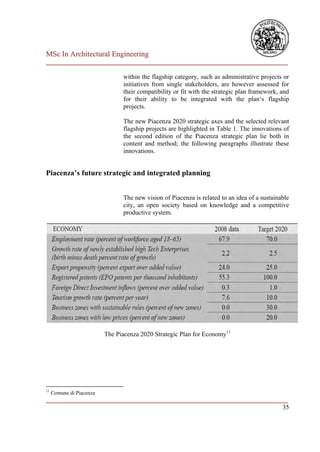
                                The new Piacenza 2020 strategic axes and the selected relevant
                                flagship projects are highlighted in Table 1. The innovations of
                                the second edition of the Piacenza strategic plan lie both in
                                content and method; the following paragraphs illustrate these
                                innovations.


Piacenza’s future strategic and integrated planning


                                The new vision of Piacenza is related to an idea of a sustainable
                                city, an open society based on knowledge and a competitive
                                productive system.


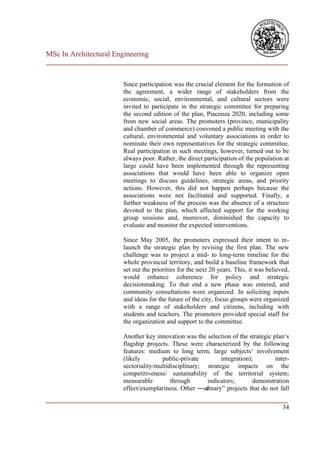
                          The Piacenza 2020 Strategic Plan for Economy11


11
     Comune di Piacenza
___________________________________________________________________________
                                                                         35
MSc In Architectural Engineering
___________________________________________________________________________


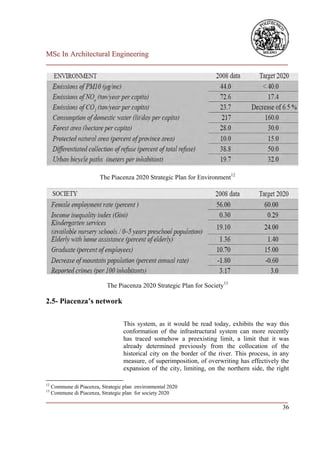
                         The Piacenza 2020 Strategic Plan for Environment12


                            The Piacenza 2020 Strategic Plan for Society13

2.5- Piacenza’s network

                                   This system, as it would be read today, exhibits the way this
                                   conformation of the infrastructural system can more recently
                                   has traced somehow a preexisting limit, a limit that it was
                                   already determined previously from the collocation of the
                                   historical city on the border of the river. This process, in any
                                   measure, of superimposition, of overwriting has effectively the
                                   expansion of the city, limiting, on the northern side, the right

12
     Commune di Piacenza, Strategic plan environmental 2020
13
     Commune di Piacenza, Strategic plan for society 2020
___________________________________________________________________________
                                                                         36
MSc In Architectural Engineering
___________________________________________________________________________

                         bank of the Po River. Another system that immediately is
                         intelligible within the city, is the system of the great dispositive
                         figures of the military establishments: the city over decades, has
                         seen its place in all around, especially behind the sixteenth
                         century walls, a series of large craft systems to military
                         functions, both of hospital type and kind of tied to military
                         forces even with large systems of buildings used for military
                         arsenal.

                         These areas, though of no great architectural merit, held today,
                         since almost totally abandoned, and a significant role to balance
                         the city, especially in the years to come. And it is precisely
                         these areas that the city is identifying new possible
                         development strategies, especially for a large recovery area to
                         convert to new features useful to the city and, above all, without
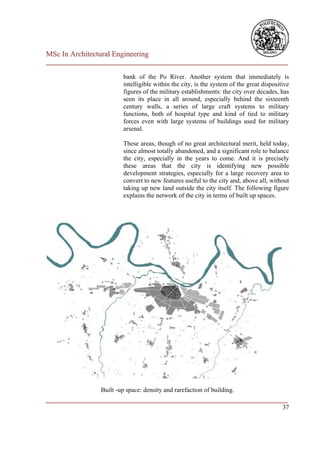
                         taking up new land outside the city itself. The following figure
                         explains the network of the city in terms of built up spaces.


                 Built -up space: density and rarefaction of building.
___________________________________________________________________________
                                                                         37
MSc In Architectural Engineering
___________________________________________________________________________


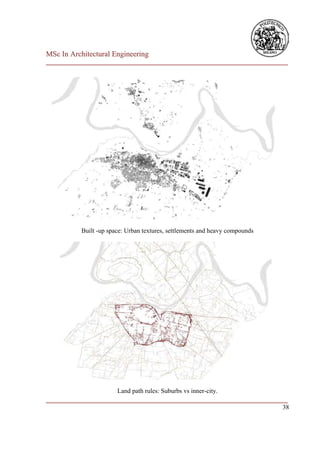
           Built -up space: Urban textures, settlements and heavy compounds


                      Land path rules: Suburbs vs inner-city.
___________________________________________________________________________
                                                                         38
MSc In Architectural Engineering
___________________________________________________________________________


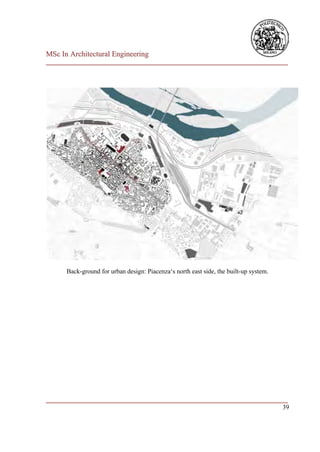
      Back-ground for urban design: Piacenza‘s north east side, the built-up system.


___________________________________________________________________________
                                                                         39
MSc In Architectural Engineering
___________________________________________________________________________


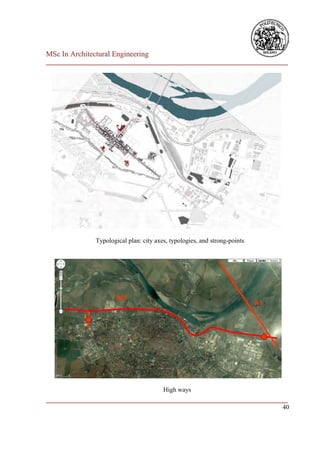
               Typological plan: city axes, typologies, and strong-points


                                         High ways
___________________________________________________________________________
                                                                         40
MSc In Architectural Engineering
___________________________________________________________________________


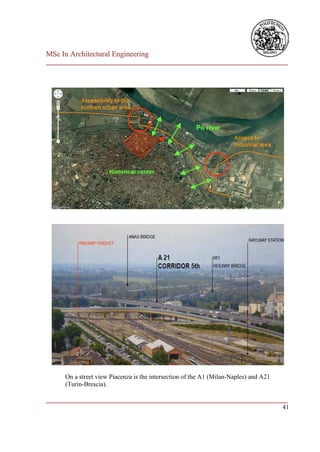
      On a street view Piacenza is the intersection of the A1 (Milan-Naples) and A21
      (Turin-Brescia).

___________________________________________________________________________
                                                                         41
MSc In Architectural Engineering
___________________________________________________________________________


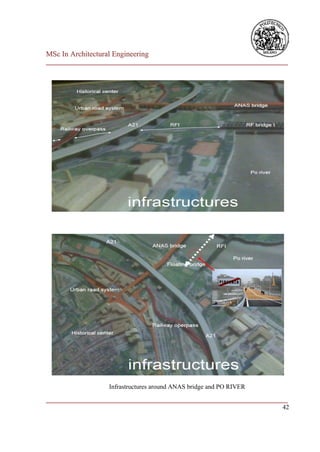
                   Infrastructures around ANAS bridge and PO RIVER

___________________________________________________________________________
                                                                         42
MSc In Architectural Engineering
___________________________________________________________________________


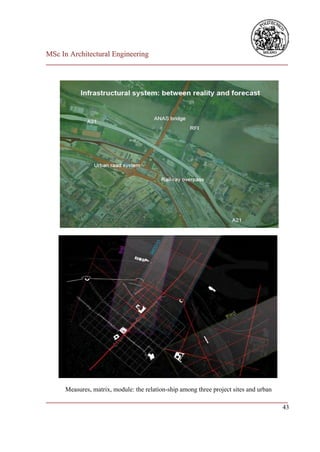
      Measures, matrix, module: the relation-ship among three project sites and urban
___________________________________________________________________________
                                                                         43
MSc In Architectural Engineering
___________________________________________________________________________

      settlement rules.


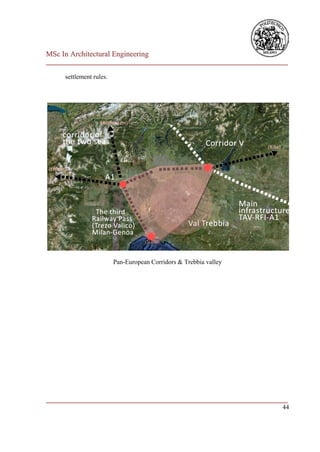
                          Pan-European Corridors & Trebbia valley


___________________________________________________________________________
                                                                         44
MSc In Architectural Engineering
___________________________________________________________________________


                                             Master plan14


14
     Piacenza City Council – Planning Office. Zoning, General-Plan, 2001.
___________________________________________________________________________
                                                                         45
MSc In Architectural Engineering
___________________________________________________________________________


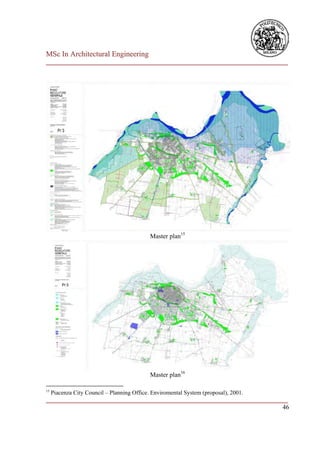
                                             Master plan15


                                             Master plan16

15
     Piacenza City Council – Planning Office. Enviromental System (proposal), 2001.
___________________________________________________________________________
                                                                         46
MSc In Architectural Engineering
___________________________________________________________________________


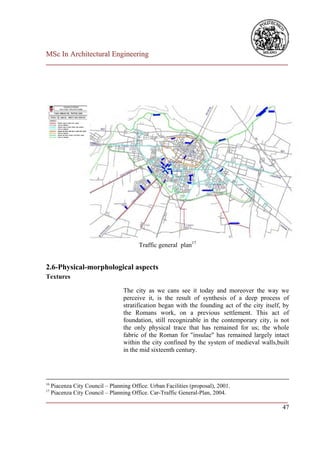
                                         Traffic general plan17


2.6-Physical-morphological aspects
Textures

                                   The city as we cans see it today and moreover the way we
                                   perceive it, is the result of synthesis of a deep process of
                                   stratification began with the founding act of the city itself, by
                                   the Romans work, on a previous settlement. This act of
                                   foundation, still recognizable in the contemporary city, is not
                                   the only physical trace that has remained for us; the whole
                                   fabric of the Roman for "insulae" has remained largely intact
                                   within the city confined by the system of medieval walls,built
                                   in the mid sixteenth century.


16
     Piacenza City Council – Planning Office. Urban Facilities (proposal), 2001.
17
     Piacenza City Council – Planning Office. Car-Traffic General-Plan, 2004.
___________________________________________________________________________
                                                                         47
MSc In Architectural Engineering
___________________________________________________________________________

                        The defensive walls, now partly converted into a national park,
                        have revealed over time, an effective containment of the
                        development of the city. Not only these boundaries, especially
                        on the right margin of the river Po, in recent decades have also
                        determined the location of infrastructure with high flow, such
                        as highway and rail.

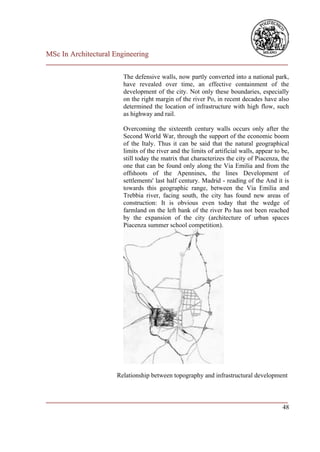
                        Overcoming the sixteenth century walls occurs only after the
                        Second World War, through the support of the economic boom
                        of the Italy. Thus it can be said that the natural geographical
                        limits of the river and the limits of artificial walls, appear to be,
                        still today the matrix that characterizes the city of Piacenza, the
                        one that can be found only along the Via Emilia and from the
                        offshoots of the Apennines, the lines Development of
                        settlements' last half century. Madrid - reading of the And it is
                        towards this geographic range, between the Via Emilia and
                        Trebbia river, facing south, the city has found new areas of
                        construction: It is obvious even today that the wedge of
                        farmland on the left bank of the river Po has not been reached
                        by the expansion of the city (architecture of urban spaces
                        Piacenza summer school competition).


                      Relationship between topography and infrastructural development


___________________________________________________________________________
                                                                         48
MSc In Architectural Engineering
___________________________________________________________________________

Elements

                        In the internal of this reading we could identify the elements
                        that characterize the whole urban implant: especially, the
                        Geography of the place, in which the conformation of the
                        ground and the exceptionality of the course of the river,
                        generate the primitive figure of the urban settlement either if its
                        placed behind of the course of the river, in the immediate
                        closeness of the two islands, the which allowed since then and
                        obviously still allow an easier and immediate ford the river
                        itself, now transformed into bridges for dedicated crossing
                        either to the vehicles and for trains.

                        Secondly, the sign of the foundation of the Cardo and the
                        Decumano, the one that refers immediately the idea of the
                        passage, the performed measure of the urban isolated (insulae)
                        is as well significance and immediately detectable at first
                        glance map showing the city of Piacenza.
                        And finally to the interior of this compact and laminated
                        system, its recognizable the location of landmarks, including
                        the cathedral, the Palazzo Farnese and the great figures
                        dispositive of military installations, that arm the urban
                        structure, stressing at the same time confirming the geography
                        of the place and its old foundation act.

Systems

                        We can overall define that the reading that today we execute for
                        the urban facts, interprets in a duplicate specific condition: from
                        one side, the historical component of the elements that are
                        followed and overlapped almost in the flow of the time,
                        intending these elements belonging to the permanence and/or to
                        the variability, just taking advantage of historical information,
                        through plans and documents; on the other hand, there is a
                        specific that resets the condition that component of the time
                        variable temporal, such as while using only the contemporary
                        world, somehow the last plan, the one that for definition is what
                        that today the city exists, which has precisely the merit of
                        representing, physically the city, but at the same time allows to
                        envisage that there was something in a past time. Use of this
                        latest plan is very necessary because some systems can identify
                        important city in the balance in this specific time. And it‘s
                        interesting to notice how the within our field of investigation,
___________________________________________________________________________
                                                                         49
MSc In Architectural Engineering
___________________________________________________________________________

                            the city of Piacenza presents some significance systems that
                            make their specificity: first of all, the system of the historical
                            infrastructure, primarily the Via Emilia, extension of the
                            Roman Decumano, that were connecting and also today links,
                            the city of Piacenza, principally with Rimini and substantially
                            with the sea Adriatic.

                            It‘s interesting to note here that Piacenza is also the crossroads
                            of passage of the Via Francigena, along which it moved over
                            the centuries multitudes of pilgrims and travelers. The armature
                            then historical infrastructure, besides having an important
                            historical fact and material culture is very significant because
                            still exists and is still on this armor that the contemporary city is
                            founded and grows.

                            To this system of the historical infrastructure, puts aside
                            another system of infrastructure, obviously of modern era, the
                            which identifies the development of city‘s more recent
                            infrastructure. It‘s noted that the railway and motorway systems
                            configure this ulterior system of the city; The one, as it
                            indicated previously, has found collocation between historical
                            city and the contemporary city, has found space to the within of
                            the interval, of a threshold inside of the city and the river.


2.7-Local conditions, scope, borders, limits

Open, closed and relational spaces

                            A great river represents a natural event that could transcend
                            every human gesture, even in the most unfortunate and
                            inappropriate. For centuries the man have had a relation of the
                            great respect and fear toward this organism that like all of the
                            great natural occurrence brought and still brings wealth,
                            fertility, movement, but also misfortune, disaster and death.

                            The modern and contemporary often forgotten these founding
                            principles, but also have misunderstood the clearances for a
                            proper relationship between nature and artifice.

                        For centuries, the limit of the walled city of Piacenza with the
                        "Arc" characteristic form stretching to the river and the
                        surrounding plain was composed of large naturalized barriers:
___________________________________________________________________________
                                                                                      50
MSc In Architectural Engineering
___________________________________________________________________________

                             moats, dikes detected and characterized a section of the very
                             complex and articulate city / river. The relationship with the
                             river was respectful and cautious.


                             The progressive industrialization of the postwar and the
                             construction of the infrastructural axes have opened the way to
                             the massive occupation of the areas of respect between the city
                             and river. Heavy industry, military areas, bridges, rail and road,
                             rail pass and have occupied almost the entire space up to touch
                             the riverbed itself.

                             Compared to these assumptions, the topic, which is based on
                             the rod principal (the thistle) takes the form of Roman
                             centuriation due exception. From Piazzale Milano hour
                             vehicular traffic circle, but the original major gate access to the
                             old town, covering an area of about 600 meters, the open space
                             is not occupied by heavy and permanent. The presence of the
                             bridges crossing into the lands of Lodi, ensures an area to
                             compliance with its critics that is free and open to the outside.
                             Taking the riverbed as point of reference, on the north east lies
                             a large floodplain that immediately after the railway bridge


Confined spaces/open natural fences /artificial, borders, limits

                             In the linear reading, strips, according to the ideal cross section
                             that from downtown to the river and from there to outdoor
                             areas, you can associate a reading for significant or points to the
                             presence of special situations.

___________________________________________________________________________
                                                                         51
MSc In Architectural Engineering
___________________________________________________________________________

                        In this area, and for the particular topic under analysis, some
                        'fence' or limit spaces are highlighted by location or area of
                        influence.

Scope of bridges

                        Between the road bridge recently collapsed and now under
                        reconstruction, and rail is possible to isolate a 'fence' with a
                        potential of the position and relations with its surroundings. Its
                        boundaries are defined by the river to the north-east from the
                        railway to the south east by the old town to the southwest and
                        the viaduct connecting Milan square and the road bridge which
                        passes through the SS No 9 (Via Emilia) Milan.

                        Inside, the highway passes entirely elevated and defines the
                        pylons, space and visual detail. In addition, the Tower Fodesta,
                        with the characteristic semicircular shape, works as a link with
                        the function bar of the nearby railway station.

                        From Palazzo Farnese to the Po

                        This macro-area is identifiable as the moment of transition
                        between the heart of the historical city and the river. Its borders
                        are the same of the river to the northeast, the axis of the
                        Risorgimento street (the cardo romano) with the street bridge to
                        south-east, the monumental complex of Palazzo Farnese with
                        the square currently used as a bus station south west axis
                        passing through the border with Nicolai barracks in the
                        northwest. Within this macro area, relate to various sub-systems
                        that are actually worthy of interest. Among these we highlight
                        the park, a former sports field, presenting the Farnese palace,
                        the citadel craft under the viaduct connecting the road bridge,
                        the sports areas next to the river banks.

                        Particular attention should be paid in this case the differences
                        between individual sub-systems height, since the gradients can
                        reach over 6 meters height.

                        Ring road on viaduct, railway line and satin ring town are so
                        many lines on which it is possible to envisage interventions on
                        the urban scale and detail.


___________________________________________________________________________
                                                                         52
MSc In Architectural Engineering
___________________________________________________________________________


Map of city xvii century


                      Palazzo Farnese (Existing Museum in Piacenza)

The bow and arrow

                        The limited field north of the railway line and south walls of the
                        ring is a particular situation 'lens' that while the general design
                        of the band walled city, is structured as a place / gateway to the
                        historic core. The axis (arrow) that holds and allows relations of
                        the around given by the viaduct connecting the bridge road,
                        continuation of the Roman Cardo. In addition to the
___________________________________________________________________________
                                                                                         53
MSc In Architectural Engineering
___________________________________________________________________________

                           characteristic given by the position in this area you can work on
                           the cross-section as it is located below the level of cities and
                           therefore relates directly with the amount of more near the river
                           banks.

Spaces and the relational elements

                           As it has been noted in the previous the road and infrastructural
                           system of the theatrical area is rather complicated and
                           characterizing. The predominant axial element is with no doubt
                           the axis of the bridge street (SS. No. 9, via Emilia) collapsed
                           during a recent alert level of the river and in the process of
                           reconstruction. The bridge, with the structure of the 8th century,
                           is set to city level of Viale Risorgimento with which it connects
                           via a viaduct over piles of masonry placed at the lowest level of
                           the bank.
                           The bridge and viaduct structures are now captured the
                           collective imagination and craftsmanship placed outside the
                           citadel walls and uses its residual spaces saturating the
                           interstices. At the river cells detach from the mainland, generate
                           currents and eddies of natural water and disappear from view in
                           poplar seats on the northeastern shore of the river itself.

                           In that position has always been a bridge, the possibility of
                           pedestrian and cycle paths as proposed in the reconstruction
                           project in progress, make it an interesting structure and by
                           'domestic' character.

                           The situation related to the highway A21 Piacenza-Brescia and
                           railway line is so different.


View of PO RIVER
___________________________________________________________________________
                                                                         54
MSc In Architectural Engineering
___________________________________________________________________________

2.8-Conclusion


                             Emilia-Romagna borders Veneto and Lombardy to the
                             northeast, Piedmont to the west, Liguria and Tuscany to the
                             southwest, Marche to the southeast, and the Adriatic Sea to the
                             east. It comprises the two historic regions of Emilia and
                             Romagna. About a half of the region is constituted by Padan
                             Plain, the largest plain of the country, crossed by the longest
                             stream of water of Italian Pensinsula, the river Po that is 652
                             km long. This region is drained by many Po tributaries. The rest
                             of Emilia-Romagna territory is split by the hill lands and part of
                             the Tuscan Apennine. Emilia-Romagna is the second richest
                             region of Italy. And in the picture below we should relationship
                             of city with main relations and monuments.

                             In Piacenza strategic plans community and military they want
                             to redevelop the area at different locations within the city like to
                             some extent enlargement of residential areas and our area is one
                             where they want to provide some open and public spaces to
                             connect that part with the rest of the city

                             Piacenza city layout based on roman grid very strongly and
                             roman grid pattern also we followed to develop the urban part
                             in next chapter.


Between the ‗historical city‘ and the river: Map of the main relations and the monuments
___________________________________________________________________________
                                                                         55
MSc In Architectural Engineering
___________________________________________________________________________


                                                     CHAPTER 3


                                          URBAN DESIGN


___________________________________________________________________________
                                                                         56
MSc In Architectural Engineering
___________________________________________________________________________

3 -URBAN DESIGN

3.1-Project Area


           Existing condition of Po river and its connection with the city (2)


           Existing condition of Po river and its connection with the city (2)
___________________________________________________________________________
                                                                         57
MSc In Architectural Engineering
___________________________________________________________________________

3.1-Project Area
                        The area for our study case is located on the northern edge of
                        the Roman cast rum, area 1 and shown in the following figure,
                        while reading of the existing conditions and the confronting
                        with the municipality‘s administration on plans and programs
                        for the future development.


                              Area 1 for Piacenza


___________________________________________________________________________
                                                                         58
MSc In Architectural Engineering
___________________________________________________________________________


                            Po river and connection


                               Interaction area
___________________________________________________________________________
                                                                         59
MSc In Architectural Engineering
___________________________________________________________________________


                        Area1 selected for urban Design


                             Infrastructural system


___________________________________________________________________________
                                                                         60
MSc In Architectural Engineering
___________________________________________________________________________


                             Infrastructural system


                          Model view of Current City


___________________________________________________________________________
                                                                         61
MSc In Architectural Engineering
___________________________________________________________________________


                          Model view of Current City


                     Area1 selected for urban Design-model


___________________________________________________________________________
                                                                         62
MSc In Architectural Engineering
___________________________________________________________________________


3.2-Site Comparison
                        Site Comparison analysis has been conducted in order to be
                        able to develop a sense of the dimensions of the project area as
                        we have 45,000 sq m. The area is compared with Wenceslas
                        Square, Prague, Czech Republic.


                    Wenceslas Square, Prague, Czech Republic


                              Total area 45,000 m²


___________________________________________________________________________
                                                                         63
MSc In Architectural Engineering
___________________________________________________________________________

3.3-Site Analysis

            Positive Aspects of Site

            •      Ability of attraction with 181 thousands of arrivals in a year with 494
            overnight stays.

            •       Tourism promotion policies.

            •       Strategic position of the city, that is at the crossroads of the most
            important Northern Italian highways (and also well linked to ports and
            airports).

            •     The presence of a well preserved natural heritage (rivers, hills,
            mountains, etc.) is an asset to attract of tourism.

            •     The territorial marketing Plan focused on the priority to start up an
            Agency for Territorial Marketing.

            •      Presence of historical area (medieval castles, churches, and Roman
            heritage).
            •      For landscape architecture due to presence of green spaces and level of
            land.


            Negative Aspects of Site

            •       The density of the infrastructure (constraint).

            •       Presence of different level of land.

            •       The risk of flood.

            •       Further development of the methodology is needed in order to address
            correctly the External costs of visual impact, but that impact cannot be
            neglected especially when considering local effects.


___________________________________________________________________________
                                                                         64
MSc In Architectural Engineering
___________________________________________________________________________


                              Open space system


                               Mobility System
___________________________________________________________________________
                                                                         65
MSc In Architectural Engineering
___________________________________________________________________________


                                   Site visit 1


                                 Site visit 2
___________________________________________________________________________
                                                                         66
MSc In Architectural Engineering
___________________________________________________________________________


3.4-SWOT Analysis

Strengths

   •   Presence of unlimited green area
   •   Good views
   •   Different level of land
   •   Presence of historical city area


Weaknesses:

   •   Between the banks of the Po river and road without adequate urban quality.
   •   Connection of river with city
   •   Lacking of pedestrians
   •   Difficulties for people to walk along the Po- river
   •   High density of infrastructure
   •   Function of the area itself


Opportunities:

   •    Develop Po river bank;
   •   Po-river can create transformation
   •   Huge potential for the city, exploitable in many ways (spaces and public places but
       also new residential areas).

   •   Relationship between city and the river
   •   Development for the public local events
   •   Development of Public Spaces
   •   Changing in government policies


Threats:

   •   In between(Po river and city) Development
   •   Transportation connections with the other part of the city
   •   Flood risks
   •   Political risks
   •   investment

___________________________________________________________________________
                                                                         67
MSc In Architectural Engineering
___________________________________________________________________________

3.5-Project Scope


3.5.1- project Objective

                           Project have different objective the first aspect concerns
                           crossings and connections and follow the main grid. Second
                           aspect concerns the quality of the grid itself. Today the
                           infrastructures and the main grid should follow the culture of
                           the city itself and developing integrity. The percolation of the
                           green and the nature within the urban texture exploits the
                           redesign of the military areas and the requalification of the
                           sports field and follow the roman grid to restructure of the
                           above said infrastructure.
                           Secondly, enhance connection between different public or
                           private spaces. Create a ―a pa ―of city.
                                                        rt    the


            Planning concept

                   Designed area created more public activity point in Piacenza, which is
            designed Library, Cultural center, Commercial and social housing integrated
            ―poi nts‖. In long term will boost Piacenza‘s social and economic integration
            with other parts of the city. Most import point is that it will give great
            opportunity to the Piacenza‘s people to enjoy landscape integrated
            environment;
                   Rich and systematic open spaces provide concept of ―enironmentv
            first‖ advanced theory;
                   Appropriate scale pedestrian, business integrated walking environment
            not only added more interesting point in the city but also emphasized
            continuity of the city;
                   Large scale open park provides a unique leisure place for the city and it
            will be a important meeting point in the city;


___________________________________________________________________________
                                                                         68
MSc In Architectural Engineering
___________________________________________________________________________

3.5.2- Master plan


                     Piacenza city pattern and description of area


                          Idea was to build a relationship between city and current project
                          area through a Roman grid as the Piacenza city is strongly
                          based on Roman grid. In Urban design we proposed one Public
                          Library and Cultural Center along with open spaces public
                          spaces and some mixed used.


___________________________________________________________________________
                                                                         69
MSc In Architectural Engineering
___________________________________________________________________________


              Concept of Master Plan (Extending existing social house)


             Concept of Master Plan ( preliminary functional distribution)
___________________________________________________________________________
                                                                           70
MSc In Architectural Engineering
___________________________________________________________________________


                                Sketches during the design…

Some sketches for this area and we built connections for the urban proposed area with the rest
of the city of Piacenza


___________________________________________________________________________
                                                                         71
MSc In Architectural Engineering
___________________________________________________________________________


                Basic idea to develop selected area - ROMAN GRID
___________________________________________________________________________
                                                                         72
MSc In Architectural Engineering
___________________________________________________________________________


___________________________________________________________________________
                                                                         73
MSc In Architectural Engineering
___________________________________________________________________________


                               Development of River Bank


The River Po’ along its banks: on the top the high-road.

                            The River Po’ on the main width

                            Before its settlement by the Romans, the area was populated by
                            other peoples; specifically, most recently to the Roman
                            settlement, the region on the right bank of the Po River

Po River

                        The Po is a river that flows either or – considering the length of
                        the Maira, a right bank tributary – eastward across northern
                        Italy, from a spring seeping from a stony hillside at Pian del Re,
                        a flat place at the head of the Val Po
___________________________________________________________________________
                                                                                        69
MSc In Architectural Engineering
___________________________________________________________________________


                    Between the ‗historical city‘ and the river:
                   Map of the main relations and the monuments
___________________________________________________________________________
                                                                         70
MSc In Architectural Engineering
___________________________________________________________________________

    The first area of intervention chosen is the city border between the bundle of the
     railway tracks and the Po River on the northern side of Piacenza municipal territory,
     along the border between Emilia and Lombardy.


                            The decision to deal with the morphological complex of the
                            city of Piacenza stems from a broader reflection on the
                            possibility to prequalify and rethink the complex relationship
                            between city centers, infrastructural systems and landscapes
                            Dynamic of the urban development landscapes, based on a
                            rejoining of structural elements that shape urban systems. The
                            designing occasion concerns at the opportunity to relate the
                            irreversible transformation of the systems in relation, the city's
                            contemporary new scale, with the enhancement of historical
                            textiles, infrastructure systems and natural or urban landscapes.

                            The central location, the important railway junction and the
                            passage of two major highways, continue to promote the
                            economic and industrial development of Piacenza and the
                            surrounding area to this day which is developing and expanding
                            a logistics hub in the suburbs. The main aspects of
                            contemporary Piacenza to be sent to the entire chapter of
                            "transformations" dedicated to these important issues.

                            Spaces for use by sports clubs, parking lots, paths

                            A landscape and here lays the paradox of the urban condition of
                            Piacenza – a city on the river with no river - almost detached
                            from the city, without connections and even with less chance of
                            enjoyment and use.

                            The future changes aim precisely on the usability of the river
                            related recreational and areas of relevance of Po as part of the
                            ecological network of supra-regional status and that area to
                            compensate for environmental impacts and the strong human
                            presence.

                            The ability to regenerate the city and prequalifying will be
                            evaluated in the next few years based on activation and
                            development of a real and exact river park because of
                            connections with the urban green space, pedestrian and cycle
                            routes but also innovative features related to tourism.

                            In this context of great changes - put more new features, such
                            as containers and spaces for youth and leisure facilities as well
___________________________________________________________________________
                                                                         71
MSc In Architectural Engineering
___________________________________________________________________________

                        as cultural exhibitions, executive, hotel, residential and special
                        types of service.

                        Today Piacenza has a unique opportunity for a sort of urban
                        addition, the recapture of large areas for years excluded from
                        the dynamics of development, linked by some to its other long-
                        river to the historic city, where work by integrating different
                        scales of project architectural details within the landscape of
                        public spaces.

                        These make perceptible through a sort of greenway a sequence
                        of "places" that Recount the economic and cultural history of
                        Piacenza and the "great river".

                        Several projects can help to structure the proposed park: the
                        redevelopment of the marina and the promotion of lpleasure
                        boating navigation, the project of bicycle track, but also the
                        possibility of Reuse of old Enel as the Modern Art Museum of
                        Polo and Dynamic of the urban development


                       Connection of River Selected area

___________________________________________________________________________
                                                                         72
MSc In Architectural Engineering
___________________________________________________________________________

3.5.3- Master plan Analysis


                        Concept of Master Plan

                        For the urban design part our idea was to follow the roman grid
                        which is very strong point from the history point of view and
                        also it was the pivot point to connect the redevelopment area
                        with the city center…


___________________________________________________________________________
                                                                         73
MSc In Architectural Engineering
___________________________________________________________________________


                     Distribution of Private and Public Spaces


                   Main Axis for the proposed design urban Area


___________________________________________________________________________
                                                                         74
MSc In Architectural Engineering
___________________________________________________________________________


                   Main Axis for the proposed design urban Area


                       Distribution of the provided facilities

___________________________________________________________________________
                                                                         75
MSc In Architectural Engineering
___________________________________________________________________________


                      Distribution of the provided facilities


                            Sketches of street views

___________________________________________________________________________
                                                                         76
MSc In Architectural Engineering
___________________________________________________________________________


                           Connection between urban Corridors


                                                      OPEN PARK

                                                    The environment of an urban open
                                                    space significantly influences how
                                                    that space is perceived and used.
                                                    Some green spaces maintain a natural
                                                    environment with a native and self-
                                                    sustaining ecosystem. Depending on
                                                    factors such as the location of the city
                                                    and the location of the space within
                                                    the city as in Piacenza site area we
                                                    have a grassy field as natural open
space to maintain the natural environment and also provide the connection of the building
with nature.


___________________________________________________________________________
                                                                         77
MSc In Architectural Engineering
___________________________________________________________________________

                             In land use planning, urban open space is open space areas for
                             ―par ―green spaces‖, and other open areas. The landscape of
                                  ks‖,
                             urban open spaces can range from playing fields to highly
                             maintained environments to relatively natural landscapes. They
                             are open to public access and defined as urban open space in
                             land use planning.


Open green spaces have the following impacts improving on site and adjoining land values;
creating a use out of otherwise low value land; chance to generate income; enhancing
                                                maintenance and security solutions for
                                                problem sites; providing temporary uses
                                                for land until alternative investment
                                                solutions become viable; attracting
                                                alternative funding options; promoting
                                                economic regeneration;

                                                  promoting health and well-being;
providing space for exercise and play, education, art and cultural activities as well as food
growing; and promoting community cohesion and pride in the place making value of spaces;

landscape creation; habitat creation; enhancing
wildlife corridors; and helping to manage carbon
emissions and to manage the effects of climate
change, including providing space for surface
water management; micro-climate management
(for example providing cool spaces in built up
urban areas); and carbon sequestration.


                                        Climate change mitigation and adaptation;
                                        resilience; carbon sequestration; bio fuels; reduction
                                        of urban temperature.

                                        Recovery from stress; reduction of obesity;
                                        improved recovery times; physical benefits; reduced
                                        pressure on health services.


___________________________________________________________________________
                                                                         78
MSc In Architectural Engineering
___________________________________________________________________________


                        Images shown above describes the ideas to use for open green
                        space for the public to provide possible way for relaxation and
                        some activities that help the community of Piacenza in long
                        run.

                        Main idea was to provide all sort of function in this open green
                        space and also the connection with the building of library while
                        studying providing a green corridor.


___________________________________________________________________________
                                                                         79
MSc In Architectural Engineering
     ___________________________________________________________________________

     Detailed Area allocation for Urban


                             Functional Character of the spaces in Urban


                                               T.
                     Area      Ground      Architecture    F. Area                     Architectural
    Usage/Character (Sq m)    Floor area      Area          Ratio     Underground        Height
A       Library      4490        3319        19914           4.4          yes            22.50m
B   Cultural Center  2438        1951         7804           3.2          yes            18.00m
C    Commercial     16147       12468        49872           3.1          no              varies
D     Residential    4825        3522        21132           4.4          no             15.00m
E    Public space   14282
F     Mixed use      7972        5709          22836         2.9           yes            Varies
         Total      50154       26969         121558         3.6


     In this we presented the detailed area allocation for different functions like open soaces
     residential, public spaces in the urban design for selected area.


      ___________________________________________________________________________
                                                                               80
MSc In Architectural Engineering
___________________________________________________________________________


                     Model view of the designed area and city


___________________________________________________________________________
                                                                         81
MSc In Architectural Engineering
___________________________________________________________________________


                     Model view of the designed area and city


___________________________________________________________________________
                                                                         82
MSc In Architectural Engineering
___________________________________________________________________________


                        Physical Model of Urban Design


___________________________________________________________________________
                                                                         83
MSc In Architectural Engineering
___________________________________________________________________________


                        Physical Model of Urban Design


___________________________________________________________________________
                                                                         84
MSc In Architectural Engineering
___________________________________________________________________________


                                                      CHAPTER 4


                          ARCHITECTURAL DESIGN


___________________________________________________________________________
                                                                         85
MSc In Architectural Engineering
___________________________________________________________________________

4- ARCHITECTURAL DESIGN

4.1- Library
                            Library is a collection of information, resources, sources and
                            services, organized for people use, and maintained by a public
                            body, an institution, or a private individual. In the more
                            traditional sense, it means a collection of books. In means
                            collection of books which helps for people for all ages.


4.1.1-Library in History
                            The first libraries were only partly libraries, being composed
                            for the most part of unpublished records, which are usually
                            viewed as archives, not libraries. Archaeological findings from
                            the ancient city-states of Sumer have revealed temple rooms
                            full of clay tablets in cuneiform script. These archives were
                            made up almost completely of the records of commercial
                            transactions or inventories, with only a few documents
                            touching theological matters, historical records or legends.
                            Things were much the same in the government and temple
                            records on papyrus of Ancient Egypt. The first ones appeared
                            some time near the 5th century BC. The celebrated book
                            collectors of Hellenistic Antiquity were listed in the late second
                            century in Deipnosophistae. Libraries were filled with
                            parchment scrolls as at Pergamum and on papyrus scrolls as at
                            Alexandria: export of prepared writing materials was a staple of
                            commerce. There were a few institutional or royal libraries like
                            the Library of Alexandria which were open to an educated
                            public, but on the whole collections were private.


                        In the West, the first public libraries were established under the
                        Roman Empire as each succeeding emperor strove to open one
                        or many which outshone that of his predecessor. Unlike the
                        Greek libraries, readers had direct access to the scrolls, which
                        were kept on shelves built into the walls of a large room.
                        Reading or copying was normally done in the room itself. The
                        surviving records give only a few instances of lending features.
                        As a rule Roman public libraries were bilingual: they had a
___________________________________________________________________________
                                                                                        86
MSc In Architectural Engineering
___________________________________________________________________________

                        Latin room and a Greek room. Most of the large Roman baths
                        were also cultural centers, built from the start with a library,
                        with the usual two room arrangement for Greek and Latin texts.


                        In the Early Middle Ages, after the fall of the Western Roman
                        Empire and before the rise of the large Western Christian
                        monastery libraries beginning at Montecassino, libraries were
                        found in scattered places in the Christian Middle East. Upon
                        the rise of Islam, libraries in newly Islamic lands knew a brief
                        period of expansion in the Middle East, North Africa, Sicily
                        and Spain. Like the Christian libraries, they mostly contained
                        books which were made of paper, and took a codex or modern
                        form instead of scrolls; they could be found in mosques, private
                        homes, and universities. In Aleppo, for example the largest and
                        probably the oldest mosque library, the Sufiya, located at the
                        city's Grand Umayyad Mosque, contained a large book
                        collection of which 10 000 volumes were reportedly
                        bequeathed by the city's most famous ruler, Prince Sayf al-
                        Dawla. [6] Some mosques sponsored public libraries. Ibn al-
                        Nadim's bibliography Fihrist demonstrates the devotion of
                        medieval Muslim scholars to books and reliable sources; it
                        contains a description of thousands of books circulating in the
                        Islamic world circa 1000, including an entire section for books
                        about the doctrines of other religions. Unfortunately, modern
                        Islamic libraries for the most part do not hold these antique
                        books; many were lost, destroyed by Mongols, or removed to
                        European libraries and museums during the colonial period.


___________________________________________________________________________
                                                                         87
MSc In Architectural Engineering
___________________________________________________________________________


                        By the 8th century first Iranians and then Arabs had imported
                        the craft of paper making from China, with a mill already at
                        work in Baghdad in 794. By the 9th century completely public
                        libraries started to appear in many Islamic cities. They were
                        called "halls of Science" or dar al-'ilm. Medieval library design
                        reflected the fact that these manuscripts--created via the labor-
                        intensive process of hand copying--were valuable possessions.
                        Library architecture developed in response to the need for
                        security. Librarians often chained books to lecterns, armaria
                        (wooden chests), or shelves, in well-lit rooms. Despite this
                        protectiveness, many libraries were willing to lend their books
                        if provided with security deposits (usually money or a book of
                        equal value). The early libraries located in monastic cloisters
                        and associated with scriptoria were collections of lecterns with
                        books chained to them. Book presses came to be arranged in
                        carrels (perpendicular to the walls and therefore to the
                        windows) in order to maximize lighting, with low bookcases in
                        front of the windows. This stall system (fixed bookcases
                        perpendicular to exterior walls pierced by closely spaced
                        windows) was characteristic of English institutional libraries. In
                        Continental libraries, bookcases were arranged parallel to and
                        against the walls. This wall system was first introduced on a
                        large scale in Spain's El Escorial.


___________________________________________________________________________
                                                                         88
MSc In Architectural Engineering
___________________________________________________________________________


                        During the Renaissance, its people began to look to the Greek
                        and Roman artistic and literary classics for Inspiration. Many
                        aristocrats of the period were dedicated to developing their
                        private libraries. Cosimo de Medici of the famous Florentine
                        family established his own collection, which formed the basis
                        of the Laurentian Library. Also in Italy, the Vatican Library
                        opened in the 1400s. Accompanying the growth of universities
                        was the development of university libraries, which, in some
                        cases, were founded on the basis of a personal donation. For
                        example, Humphrey, Duke of Gloucester, donated his large
                        collection to Oxford University in the early 1400s. Gutenberg's
                        movable type innovation in the 1400s revolutionized
                        bookmaking. Printed books replaced handwritten manuscripts
                        and were placed on open shelves.


                        Throughout the 1600s and 1700s, libraries surged in popularity.
                        They grew as universities developed and as national, state-
                        supported collections began to appear. Many of these became
                        national libraries. In Britain, Sir Thomas Bodley rebuilt

___________________________________________________________________________
                                                                         89
MSc In Architectural Engineering
___________________________________________________________________________

                        Humphrey's library at Oxford in the late 1500s. It was renamed
                        the Bodlean Library and today ranks as the second largest in
                        the country. The largest, of course, is the British Library,
                        founded in 1759 as part of the British Museum. The earliest
                        public library in the UK was associated with London's Guild
                        Hall in 1425. Once Parliament passed the Public Library Act in
                        1850, libraries began to spread throughout the nation. In
                        France, the national library in Paris known as Bibliotheque
                        Nationale de France began in 1367 as the Royal Library of
                        Charles V. Building on its Roman heritage, Italy boasted
                        several renowned libraries, including Laurentian Library in
                        Florence, Vatican Library in Vatican City, Ambrosian Library
                        in Milan and National Central Library in Florence, based on
                        the collection of Antonio Magliabechi, a scholar of the 1600s
                        and 1700s. Three libraries form the national repository for
                        Germany. The first, the German State Library in Berlin, was
                        founded in 1661 by Friedrich Wilhelm. The second and third
                        followed much later: the German Library in Leipzig, founded
                        in 1912 and the German Library in Frankfurt, founded in 1946.


___________________________________________________________________________
                                                                         90
MSc In Architectural Engineering
___________________________________________________________________________

4.1.2- Classifications of Library
Type of library is following

              General Libraries
              Academic Libraries
              Technical Libraries
              Legal Libraries
              Medical Libraries

                               Academic, technical, legal, and medical libraries feature
                               specialized content regarding a unique program. Requirements
                               and design criterion for academic, technical, legal, and medical
                               libraries are different from each other.

                               General libraries are centralized facilities for people that serve
                               the whole community and its population. General libraries are
                               the most common type of library facilities and cultural
                               programs. These facilities and types offer information,
                               materials, collections, and services similar to general public
                               libraries found in most public communities.

4.2- Project Objective

Circulation Overall
                               The main public service point is the circulation desk or loans
                               desk, usually found near the main entrance of a library. It
                               provides lending services and facilities for return of loaned
                               items. Renewal of materials and payment of fines are also
                               handled at the circulation desk and also to manage the overall
                               circulation of people in the proposed building.

Meeting place for citizen
                               Library will be a meeting place for peoples and integrated
                               design of library with urban context and nature will bring
                               peoples close to books.

Resource center for all ages
                               Library will be positively welcoming through good design, and
                               through the support, guidance and training, which might be

___________________________________________________________________________
                                                                         91
MSc In Architectural Engineering
___________________________________________________________________________

                                   required to assist the entire community for all ages in making
                                   the most of the opportunities and information available.―‗ Even
                                   the most misfitting child who‘s chanced upon the library‘s
                                   worth, Sits with the genius of the Earth and turns the key to the
                                   whole world‖18


Climate adaptive building and energy adaptive building


                                   Library will be designed to be energy efficient by means of
                                   proper use of skin and sky.

Public transportation net system


                                   Library will be designed in such a way to provide a proper
                                   connection among facilities, nature, people and urban context.

Opportunity for a better evaluation growth


                                   Library development will be innovative provision for all
                                   members of the community, including children and young
                                   people. Visitors will be inspired by worlds of imagination and
                                   information opened up by a range of resources and events and
                                   activities across the year for better growth.


Lighting
                                   Natural light envelops buildings, so architecture of building
                                   selects a part of it and brings it in the interior, through
                                   windows; skylight, Lighting and openness should be used as
                                   concept for architectural and technological simultaneously


Urban Context
18
     Ted Hughes, 1997 ―
                      Frameworks for the Future‖)
___________________________________________________________________________
                                                                         92
MSc In Architectural Engineering
___________________________________________________________________________

                           Architectural library should be in integrity with urban context
                           of city Piacenza as different objective the first aspect concerns
                           crossings and connections and follow the main grid. Second
                           aspect concerns the quality of the grid itself. Today the
                           infrastructures and the main grid should follow the culture of
                           the city itself and developing integrity

Skin
                           Selecting the walls, structure, and enclosure in such a way so it
                           is compatible with architectural, energy sources available and
                           urban context of city.

Connections


            Objective should follow the following connection with respect to urban
            context

            Surrounding area, connection of Cultural centre with Open Park and spaces

            Person connection to the book

            Light and visual connections throughout the building

            Connection of nature, sun, sky, light, people, nature, Space

            Libaray should provide also connection of people with proposed facilities and
            architectural context

            Meeting place for citizens

            Learning resource centre for all ages

            Climate adaptive building

            Fully integrated public library

            Research centre for students and researchers

            Public transportation net system connection
___________________________________________________________________________
                                                                         93
MSc In Architectural Engineering
___________________________________________________________________________


                        Different Connection for library


___________________________________________________________________________
                                                                         94
MSc In Architectural Engineering
___________________________________________________________________________


                       Library Connection for People and Nature


4.3- Research Example for Reference
                          The following Examples are studied to understand the
                          requirement for dimension and Proper knowledge of
                          relationship inside library.

4.3.1-Piacenza Libraries
                        From Piacenza city we studied four Libraries, First one is
                        Biblioteca Passerini Landi an old library in 1985 it contains
                        100,000 books after 1998 they added modern section with
                        250,000 books. This main Library consists of Reference
                        section, Newspaper and Magazines, hall of Science and arts,
                        conference hall and computer hall which is added in 1998.
                        Second Library is Dante with volume 11,000, two reading
___________________________________________________________________________
                                                                                   95
MSc In Architectural Engineering
___________________________________________________________________________

                        room with 34 seats and contains General Knowledge, Fiction
                        and Biography section. Third one is Farnese with volume
                        5000, 35 seats and contains General knowledge, local section
                        and kids section. Fourth one is Childern giana Anguissola,
                        1997 contains two reading room with 50 seats and separate
                        room for parents.


                       Biblioteca Passerini Landi,Piacenza.


                                 Dante,Piacenza


___________________________________________________________________________
                                                                         96
MSc In Architectural Engineering
___________________________________________________________________________


                               Farnese, Piacenza


                       Childern giana Anguissola,Piacenza


___________________________________________________________________________
                                                                         97
MSc In Architectural Engineering
___________________________________________________________________________

4.3.2-Biblioteca Civica, Prato19
                   5,300 square meters of total area

                   3,200 sqm of public services

                   4,250 square meters of outdoor space: Square of Culture, Central Court and
                   Court of Sculptures

                   250,000 total volumes

                   Free access to 120,000 documents

                   17,000 books for children and young

                   46,000 books in foreign languages (including the Historical Library of the
                   French Institute of Florence)

                   3500 DVD and VHS

                   2,500 music CDs and DVDs

                   600 newspapers and magazines by subscription

                   560 between chairs, places to read and study, even for children and young

                   100 PC stations

                   3-point self check

                   CLASSROOM COURSES

                   MEETING ROOM: 100 people


4.3.3-New Public library in Pontivy, France20
                                  The Library has two open ends, pointing in two opposite
                                  directions: West towards the city and East towards the canal.
                                  The facade is facing the street and the pedestrians. The Library
                                  has two open ends, pointing in two opposite directions: West
                                  towards the city and East towards the canal. The facade is

19
     Comune di Prato
20
     http://www.architizer.com
___________________________________________________________________________
                                                                         98
MSc In Architectural Engineering
___________________________________________________________________________

                        facing the street and the pedestrians.The platform view is the
                        key point of the project: a calm and unchanging landscape,
                        encouraging rest and concentration.


                        The reading rooms are two light open spaces, offering a view
                        on the canal. The daylight goes intensely through the building
                        but is filtrated and controlled. It animates the space with light
                        and                        shadow                       effects.
                        The closed rooms ‗exposition et conte‘, are unusual volumes
                        made of white concrete, round and smooth, like pebbles: they
                        are the icon of the new library. They are refuges where the
                        visitor's will forget the noise and will be able to enter an
                        imaginary                                                 world.
                        The structure is made of multiple metal porticos with pressure
                        points on the outside of the building: this layout enables the
                        inside spaces to be free of any heavy or bulky construction.
                        At the same time, the porticos give rhythm to the space with a
                        series of full and empty volumes.

                        They wrap the building to offer the readers a unique space
                        protected from disturbance while bringing the library a
                        harmonious and calm atmosphere. The façade, entirely made of
                        glass, is not a limit anymore, it is a filter.

                        Natural ventilation renews the air and helps the building remain
                        cool in the summertime.


___________________________________________________________________________
                                                                         99
MSc In Architectural Engineering
___________________________________________________________________________


                      New Public library in Pontivy, France


                      New Public library in Pontivy, France


___________________________________________________________________________
                                                                        100
MSc In Architectural Engineering
___________________________________________________________________________

4.3.4- Public Library Kelsterbach, Germany21
                                  The new building for the town and school library is both an
                                  extension of the school built in 1970 as well as a public library
                                  for the citizens of Kelsterbach. While solid parts of the building
                                  take over characteristics of the existing school in terms of
                                  material and proportion, a roof in form of a butterfly represents
                                  the new public library. The solid structure incorporates
                                  facilities such as emergency stairs, toilets, storage,
                                  administration, and the reception. The open, light flooded
                                  spaces comprise book shelves and reading areas. Ground floor
                                  and first floor are visually connected by open spaces and open
                                  up to the outer space between school and library designed by
                                  Bernd Mueller completed in 2003.


                                 Public Library Kelsterbach, Germany


21
     http://www.architizer.com
___________________________________________________________________________
                                                                        101
MSc In Architectural Engineering
___________________________________________________________________________


                        Natural Lighting In Public Library Kelsterbach, Germany


4.3.5- Jaume Fuster Library, Spain22
                                      It is situated in the Plaza Lesseps, in the north end of
                                      Barcelona's Gracia district, in the places of the city whose
                                      landscape has suffered more attacks and more serious offenses
                                      over their recent history, Spain. The volumetric overall library
                                      from their upper decks and that highlights one of the important
                                      purposes of the project, as is to highlight the boundary between
                                      mountain and city that takes the place Lesseps, generates an
                                      element that is repeated throughout the inside the building. In
                                      the library resulted in staggering the cross section is
                                      accompanied by a tilt of the decks in the longitudinal direction.
                                      The covers of the successive strips are bonded in a seesaw
                                      motion, which turns on itself and attaches to the new building
                                      unique status.

                                      The windows of the Biblioteca Jaume Fuster largely complies
                                      with the essential requirements for a stay that is comfortable to
                                      users once they are part of the design of the building, without
                                      neglecting the required compliance. They overlook meaning
                                      both to the outside and inside, shelter with his noisy
22
     http://en.wikiarquitectura.com
___________________________________________________________________________
                                                                        102
MSc In Architectural Engineering
___________________________________________________________________________

                                    environment protection from the Plaza Lesseps while providing
                                    natural light to the reader, design, forming a prominent part of
                                    the design of the facade and reasonable durability due to
                                    material chosen for them.


                                       Jaume Fuster Library, Spain

4.3.6- Surry Hills Library, Australia23


                                    The project has been characterized from the very preliminary
                                    studies by four formal features. On the southern edge, the
                                    Collins Street road closure was converted to a modest public
                                    park with a raised grass platform. This new space extended the
                                    function of the building and reasserted itself as a public place.

                                    The tapered glass atrium evolved in response to the ambitious
                                    sustainability objectives of the project, and equally to the sense
                                    of layered transparency and the project‘s inspirational quality.
                                    The series of glass prisms creates an open, transparent façade,
                                    akin to an open dolls house, and addresses the new open space

23
     24 Ore Arketipo (Energy) April 2011
___________________________________________________________________________
                                                                        103
MSc In Architectural Engineering
___________________________________________________________________________

                        so that all the different activities of the centre are visible and
                        displayed, encouraging participation.

                        The timber ‗U‘ form embraces the prismatic environmental
                        atrium and orient both towards the south and the new little
                        park. The ‗solid‘ sections of this timber form are made of
                        automated louvre systems that filter and control sunlight and
                        view. This warm timber form is lifted above the ground to
                        create transparency and accessibility.

                        The foyer space is a lower transitional form that mediates the
                        scale of the building against the adjacent shops while creating a
                        welcoming, transparent entry. Suspended cloud-like roof
                        profiles bring daylight into this space and extend out above the
                        street to mark the entrance.


                          Surry Hills Library, Australia


___________________________________________________________________________
                                                                        104
MSc In Architectural Engineering
___________________________________________________________________________


                     Façade of Surry Hills Library, Australia


___________________________________________________________________________
                                                                        105
MSc In Architectural Engineering
___________________________________________________________________________

4.4-Architectural Design
                              The library criteria/Brief we defined is based on the study of
                              various Libraries located in local and abroad as we explained
                              our case studies above. Piacenza Public Library is designed for
                              350,000 numbers of books and case studies are also based on
                              same number of books and energy perspective of this project.
                              And brief we selected from one Chinese library which is also
                              proposed to design for the same area and number of books .

Reception                                                                 156 m2

Lockers 70 Reception 36 Consulting 50

Quick Access                                                               350

Adult and Young Peoples’ Reading                                          3300

Open reading area 880 m2 (180 shelves);
half open reading area 520(70 shelves); audio & video
collection 520 m2 (personal reading 200 m2, archives, group
 reading 100 (including 15 controlling, 10 devices); rest area 60)
microfilm reading room 300 m2 (100 archives) should have
lending area; New books exhibition 130 m2; news paper and
magazine 520 m2 (70 shelves); Business Intelligence Library Included
 in Adult Lending 430 m2;

Children’s Library                                                          450

(Need separate entrance, also close to
The outside Children‘s activity area)

Non-public Space                                                            620

(Offices staff, IT- services area, Rest room, storage)
IT – services 150 m2; reference section 50 m2; Storage 40 m2;
Fire controlling room 50; Mechanical room: 50 m2;
 Internal services area: meeting room 70 m2;
 Office 25x4= 100 m2; Storage 40 m2; mechanical room 30 m2;
Administration 40;

Circulation, Services and ancillaries                                     1140

(Including stairs and elevator)

___________________________________________________________________________
                                                                        106
MSc In Architectural Engineering
___________________________________________________________________________

Public IT services:                                                      1000

Public Service:                                                           460

Café 280; Bookshop 180 m2;

Internal services area:                                                   521

Meeting room 70 m2; photograph 50 m2, copy 50 m2, scan 50 m2;
Office 25x4= 100 m2; Storage 40 m2; mechanical room 60 m2;
Administration 76 m2; WC 25 m2

Conference hall and Exhibition Spaces                                     756

Conference hall 360 m2; foyer 80 m2; rest room; administration 50 m2;
Guest room 36 m2; (should have WC and should have independent entrance)
Exhibition 200 m2;

WC                                                                          120

Gross Floor Area                                                           8,873


                          The principle operational spaces of the library are likely to be
                          arranged on 5 floors above ground level.

                          The floor-to-floor height of the library floors should be
                          approximately 4.5 M and the height of the conference hall
                          6.600 M,underground parking 5.0M.
                          This is to facilitate provision of passive environmental
                          measures. A large volume per m2 will significantly reduce the
                          need for energy intensive mechanical ventilation and cooling.

                          In addition, it is anticipated that undercroft space would be
                          used for service deliveries, operational car parking, parking for
                          disabled users, heating plant, equipment, refuse storage and
                          collection.
                          The project is intended to provide services for the whole
                          Piacenza community and as such will become a destination
                          both for students and resident settled in Piacenza‘s people as a
                          whole.
                          One of the most important objectives is to promote a Library
                          which is designed to the highest standard and which is a
                          catalyst for further city renaissance.

___________________________________________________________________________
                                                                        107
MSc In Architectural Engineering
___________________________________________________________________________

                            The proposed Library directly addresses a wide range of
                            regional and urban development plan policies. Given its
                            scale and character, it will in particular provide a major impetus
                            for urban development in area as well as underpinning the
                            needs of military area for the development of urban planning.

Project Objectives

                            The objectives identified for this project vary in focus from the
                            impact on individuals and communities. What they all share is
                            an understanding that this development has the capacity to be
                            transformational.

                            The project proposed is a ground-breaking partnership
                            development to create a fully integrated public library,
                            including specialist provision for children and young people
                            and business users, which would be completely new and highly
                            innovative.

• Raise aspirations and reach new people

                            At the heart of this development will be innovative provision
                            for all members of the community, including children and
                            young people. Visitors will be inspired by worlds of
                            imagination and information opened up by a range of resources
                            and events and activities across the year. The distinctive
                            identity and needs of young people will be recognized and the
                            new Library will provide relevant and attractive materials for
                            them.

• Offer easy and supported access to learning opportunities and resources for all ages.

• Ensure

                            The best design creates buildings that are loved and a source of
                            pride for the community.
                            Landmark buildings can contribute to regeneration by creating
                            a destination for visitors and a natural meeting place for
                            citizens. The project seeks to achieve both of these objectives,
                            within a building that is able to respond to changes in service
                            need and technological development.

                            Any building should be of contemporary design and provide a
                            landmark presence in order to give the project a strong visual

___________________________________________________________________________
                                                                        108
MSc In Architectural Engineering
___________________________________________________________________________

                            identity, high quality architectural design and responsiveness to
                            environmental issues.

• Create a facility and services that are positively welcoming for everyone

                            We know that public buildings can sometimes be daunting. The
                            Piacenza‘s Library will be positively welcoming through good
                            physical design, and through the support, guidance and
                            training, which might be required to assist the entire
                            community in making the most of the opportunities and
                            information available.

• To improve the quality of life for individuals and communities

                            By bringing the University and public library together, along
                            with the history centre and customer service centre, we will be
                            creating a completely new way of providing these services:
                            they will be re-defined. This will contribute to the well-being of
                            the whole community through open access to integrated
                            information and cultural resources, with exhibitions, meeting
                            rooms, social space, quiet reflective areas, all within a building
                            alive with innovative technology for creation, motivation and
                            learning.

• Innovation in service delivery and development in environmental sustainability

                            The New Library and History Centre will develop new models
                            of complementary and innovative service while fully meeting
                            regulatory Standards and frameworks.


                            The flagship nature of the development in environmental
                            sustainability and the innovative approach towards high energy
                            efficient buildings will encourage others to equal, and perhaps
                            exceed, our performance.

• To enhance regional identity by developing pride in local history and current
achievements

                            This has two aspects: to connect with shared past, and celebrate
                            contemporary achievements.
                            The centre will therefore enrich the community experience of
                            history and heritage, while at the same time, finding ways of
                            showcasing contemporary regional skills and produce.

___________________________________________________________________________
                                                                        109
MSc In Architectural Engineering
___________________________________________________________________________

• Site Capacity and Usage

                             The space requirement of the direct service facilities to be
                             delivered by the Piacenza‘s Library is 10,480 M2. However, to
                             create a facility which offers higher levels of service to the
                             public and meets public expectations of a modern library as a
                             ―des tination‖ building, it is proposed to include additional
                             elements.


These include:

• Operational and disabled car parking provision
• Cafés facilities
• Complementary retail provision (this might include uses such as bookshops, or a toyshop
related to the Children‘s Library)
• A commercial element which must be complementary to the library‘s services.

                             The site is unique for the opportunities it offers to establish a
                             high degree of connectivity to existing and proposed city
                             infrastructure.
                             The starting point in assessing site capacity is the need to
                             arrange public spaces in a way which is both easily understood
                             by users and efficient to manage. To satisfy these needs, the
                             number of floors in public use should be supposed to a
                             maximum of three. This requirement translates into a ground
                             floor (footprint) of between 3,000 and 4,000 M2. Providing that
                             the operational requirement for 10,480 M2 of usable floor
                             space is met, the overall volume and height developed from
                             that footprint can vary.

4.5 Concept and Drawings
                             The concept for Piacenza library is to create a learning and
                             information centre of excellence to promote long life learning,
                             engendering social inclusion and raising inspiration for the
                             whole community.

                             The connections of the building with two green spaces, one is
                             on east connected to the building through façade and the other
                             one is strongly connected with the building itself.


___________________________________________________________________________
                                                                        110
MSc In Architectural Engineering
___________________________________________________________________________


                          Location of Library on master plan


             Initial concept of the library and analysis of surrounding area

___________________________________________________________________________
                                                                        111
MSc In Architectural Engineering
___________________________________________________________________________


___________________________________________________________________________
                                                                        112
MSc In Architectural Engineering
___________________________________________________________________________


                                                      CHAPTER 5


                                   STRUCTURAL DESIGN


___________________________________________________________________________
                                                                        132
MSc In Architectural Engineering
___________________________________________________________________________

5-STRUCTURAL DESIGN

5.1-Introduction
                        Structure is a system formed from the interconnection structural
                        members or the shape or form that prevents buildings from
                        being collapse. A structure supports the building by using a
                        arrangement of Elements known as Structure. There are two
                        important steps for the design of a building, (I) Structural
                        Analysis and (II) Structural Design. Forces acting on different
                        parts of the structure that can be determined through structural
                        analysis. Bending Moments and shear forces are considered as
                        the most common forces which are calculated.


                        The requirement to move towards Positive Energy development
                        was the most important challenge of this project. The selection
                        of proper construction material and techniques are always
                        playing the major role in achieving such a goal in a
                        construction projects. Reinforced Concrete is a strong durable
                        building material that can be formed into many varied shapes
                        and sizes ranging from a simple rectangular column, to a
                        slender curved dome or shell. Its utility and versatility are
                        achieved by combining the best features of steel and concrete.


                    Differing Properties of Concrete and steel
___________________________________________________________________________
                                                                        133
MSc In Architectural Engineering
___________________________________________________________________________

                        It can be seen from the list that the materials are more or less
                        complementary. Thus, when they are combined, the steel is
                        able to provide the tensile strength and probably some of the
                        shear while the concrete, strong in compression, protects the
                        steel to give durability and fire resistance.

                        The behavior of a simply supported beam subjected to bending
                        and shows the position of steel reinforcement to resist the
                        tensile force, while the compression forces in the top of the
                        beam are carried by the concrete as shown in below figure.


                                Composite action

                        Wherever tension occurs it is likely that cracking of the
                        concrete will take place. This cracking, however, does not
                        detract from the safety of the structure provided there is good
                        reinforcement bonding to ensure that the cracks are restrained
                        from opening so that the embedded steel continues to be
                        protected from corrosion.

                        Limit state design of a Building Structure must ensure that
                        under the worst loadings the structure is safe, and during
                        normal working conditions the deformation of the members
                        does not detract from the appearance, durability or performance
                        of the structure.

                        The limit state method which multiplies the working loads by
                        partial factors of safety and also divides the material‘s ultimate

___________________________________________________________________________
                                                                        134
MSc In Architectural Engineering
    ___________________________________________________________________________

                                   strengths by further partial factor of safety. Limit state method
                                   is now widely adopted across the Europe and many other parts


                                   of the world. The flexibility is particularly important if full
                                   benefits are to be obtained from development of improved
                                   concrete and steel properties.

                   a-      Ultimate Limit State, the structure must be able to withstand an
                   adequate factor of safety against collapse, the loads for which it is designed to
                   ensure the safety of the building occupants and/or the safety of the structure
                   itself.

                   b-      Serviceability limit states, the efficiency of any part of the structure
                   must not be adversely affected by deflection, local damage due to cracking
                   and spalling must not affect appearance and efficiency of the structure,
                   durability is considered in terms of proposed life of the structure and its
                   condition of building exposure.

                   NOTE: The Eurocodes were published as European Prestandards. The
                   following European Standards which are published or in preparation
                   are cited in normative clauses :

                   EN 1991 Eurocode 1 : Actions on structures
                   EN 1992 Eurocode 2 : Design of concrete structures
                   EN 1993 Eurocode 3 : Design of steel structures
                   EN 1994 Eurocode 4 : Design of composite steel and concrete
                   structures


    5.2-Load Calculations

    Dead Load
                                   The following tables describes the weight calculation for
                                   different sections

                    Description                           Thickness       Specific Weight      Weight
Plaster board                                               0.01               4.42             0.05
Mineral Wool Insulation                                     0.05               0.09             0.00
Air gap                                                     0.10                 0              0.00
Concrete                                                    0.10               23.5             2.35
Insulation, expanded polysterene                            0.04               0.13             0.01
    ___________________________________________________________________________
                                                                            135
MSc In Architectural Engineering
   ___________________________________________________________________________

DAKU FSD 30         mm80                                      0.08                       0.43
soil                                                          0.09          9.8          0.83
                                                                                         3.68


                                             Green Roof

                    Description                           Thickness   Specific Weight   Weight
                   Plaster board                            0.025           1.6          0.04
         knauf earthwool Reinforced slab                    0.075           1.4         0.105
                 Supporting steel                             0.3          8.68         2.604
                suspended ceiling                            0.06           3.4         0.204
                                                                                        2.953


                                             Floor details

                      Description                         Thickness   Specific Weight   Weight
    laminated glass sheet and structural silicone
stainless steel clamps to connect façade glass sheet          0.04          24           0.96
                  stainless steel pole                        0.06          24           1.44
                                                                                          2.4


                                           Wall Transparent

                     Description                          Thickness   Specific Weight   Weight
12.5mm plasterboard                                         0.013           6.3          0.08
12.5mm plasterboard with vapour barrier                     0.014          13.33         0.18
12.5mm plasterboard                                         0.013           6.3          0.08
INSULATION, GLASS MINERAL WOOL                              0.080           0.3          0.02
WOOD FIBER INSULATION                                       0.100           1.6          0.16
INSULATION, GLASS MINERAL WOOL                              0.080           0.3          0.02
DU'PONT TYVEK CONCRETE PANEL (12.5mm)                       0.013            23          0.30
Rigid insulation, polystyrene                               0.050           0.3          0.02
Render finish with steel mesh                               0.005           9.8          0.05
                                                                                         0.91


                                       Vertical wall Enclosure


   ___________________________________________________________________________
                                                                           136
MSc In Architectural Engineering
___________________________________________________________________________

Live Load
                            Live loads are a result of the occupancy of a structure. In other
                            words, it varies with how the building is to be used.
                            The imposed load for floors in Public buildings is [EN 1991-1-
                            1 §6.3.1.2, Tables 6.1 e 6.2, in accordance with National
                            Annex]

                                                                                 3.00 kN/m2

Wind Load Calculation


                            The wind load calculations have been conducted according to
                            EN-1991-1-4, which deals with the determination of natural
                            wind actions for the structural design of buildings and civil
                            engineering works. The code is applicable to buildings and civil
                            engineering works with heights up to 200 m, thus for the
                            buildings under the scope of this study, wind actions can be
                            determined according to this part of the Eurocode.

            vb = cdir ⋅ cseason ⋅ vb,0

            where;

            vb is the basic wind velocity, defined as a function of wind direction and time
            of year at
            10 m above ground of terrain category II

            vb,0 is the fundamental value of the basic wind velocity which is 25 m /s

            cdir is the directional factor

            cseason is the season factor

            The value for cdir and cseason recommended by EN 1991-1-4 is 1.

Calculation of the Mean Wind Velocity, vm (z)

            vm (z) = cr (z) ⋅co (z) ⋅vb

            Where;

            cr (z) is the roughness factor,

___________________________________________________________________________
                                                                        137
MSc In Architectural Engineering
___________________________________________________________________________


              co (z) is the orography factor, taken as 1,0 unless otherwise specified.

              cr (z) = kr⋅ ln (z / z0) for zmin< z < zmax

              cr (z) = cr (zmin) for z < zmin

              Where;

              z0 is the roughness length


              kr is the terrain factor depending on the roughness length z0

              kr = 0,19 ⋅ (z0 / z0,II) 0,07

              where;
              z0,II= 0,05 m (the value for terrain category II given in Table 4.1 of EN 1991-
              1-4)
              zmin is the minimum height defined in the same Table 4.1
              zmax is to be taken as 200 m, unless otherwise specified in the National
              Annex
              z0, zmin depend on the terrain category. Table 4.1 of EN 1991-1-4 also
              provides the
              recommended values for z0, zmin depending on five representative terrain
              categories.


Description of Terrain Categories and Terrain parameters, Source: EN 1991-1-4

              z0 = 0,05 m

___________________________________________________________________________
                                                                        138
MSc In Architectural Engineering
___________________________________________________________________________

            zmin = 2 m

            kr = 0,19 ⋅ (0,05 / 0,05) 0,07 = 0,19

            Since the minimum level of the building is 4.5 m high, it can be concluded
            that
            zmin< zi < zmax , for all i

            Where; i stand for the number of the levels.


Calculation of Wind Turbulence, Iv (z)

            Iv (z) = σv / vm (z) for zmin< z < zmax

            Iv (z) = Iv (zmin) for z < zmin

            σv = kr⋅ vb⋅ kl


            Where;
            kr is the terrain factor calculated above,

            vb is the basic wind velocity calculated above,

            kl is the turbulence factor, which is recommended to be taken as 1,0 by EN
            1991-1-4.

Calculation of Peak Velocity Pressure, qp (z)

            qp (z) = [1 + 7 ⋅ Iv (z)] ⋅ ½ ⋅⋅ v2
            m (z)

            Where;
            is the air density which depends on the altitude, temperature and barometric
            pressure to be expected in the region during wind storms. The recommended
            value is 1.25 kg/m3 in EN 1991-1-4.


Determination of Pressure Coefficient, cpe

                              The peak velocity pressure is calculated for some reference
                              heights and these reference heights, ze, for windward walls of

___________________________________________________________________________
                                                                        139
MSc In Architectural Engineering
___________________________________________________________________________

                                rectangular plan buildings depend on the aspect ratio h/b and
                                are always the upper heights of the different parts of the walls.
                                A building, whose height h is less than b should be considered
                                to be one part. In the project column parts at each floor
                                assumed as a single column and the peak velocity pressure at
                                the upper point of the column part is assigned to the rest of this
                                column part. In this case the reference height for each column
                                part is equal to height of that column part because h is always
                                smaller than the b dimension. For instance, the wind load
                                applied to the column part along the fourth floor is the equally
                                distributed peak velocity pressure calculated for 22.5 m.

                                The pressure coefficients for vertical walls and flat roof vary
                                through the wall and roof surface. This variation depends on
                                the geometry of the structure. The zones for different
                                coefficients are defined in EN 1991-1-4 as follows;


      External pressure coefficient for walls. Source: EN 1991-1-4— Recommended
   values of external pressure coefficients for vertical walls of rectangular plan buildings

                               Height        Iv(z)     Vm (Z)     q p (Z)    q p (Z)
                                 m                      m/s        N/m2      Kn/m2
               Ground
                 Floor           4.5         0.24       19.814     657.6     0.6576
               ist floor          9         0.207       22.934    805.06    0.80506
              2nd floor         13.5        0.192       24.802     901.2     0.9012
              3rd floor          18         0.182       26.139     971.1     0.9711
              4th floor         22.5        0.175       27.181    1027.4     1.0274


                           Peak Velocity Pressure, qp(z), for each floor


___________________________________________________________________________
                                                                        140
MSc In Architectural Engineering
___________________________________________________________________________

Snow Load

                           Snow load calculation was conducted according to Eurocode;
                           in addition Italian code Norme Tecniche per le Costruzioni was
                           also used for establishing values in regard to local conditions.

                           The code lists the cities classified as included in Zone - I as
                           follows; in addition the characteristic value of snow load on the
                           ground is provided according to altitude;

            qsk = 1,50 kN/m2 as ≤ 200 m
            qsk = 1,35 [1 + (as/602)2] kN/m2 as > 200 m

            The altitude of the site is 138 m. accordingly the characteristic value of snow
            load on the ground at the relevant site is taken as;

            sk = 1,50 kN/m2
                                              s =i ⋅ Ce⋅ Ct⋅ sk

            i is the snow load shape coefficient,

            sk is the characteristic value of snow load on the ground,

            Ce is the exposure coefficient,


            Ct is the thermal coefficient.

            Ce should be taken as 1,0 unless otherwise specified for different
            topographies.

            In regard to the thermal coefficient Ct, EN 1991-1-3 states that the thermal
            coefficient Ct should be used to account for the reduction of snow loads on
            roofs with high thermal transmittance (> 1 W/m2K). For all other cases: Ct=
            1,0. The U value of the roof is 0.08 W/m2K in the project. Accordingly the
            thermal coefficient is taken as 1.0.

            Snow load on the ground

            sk = 1,50 kN/m2 (according to Norme Tecniche per le Costruzioni)

            The snow load shape coefficient

            i = 0,8

___________________________________________________________________________
                                                                        141
MSc In Architectural Engineering
___________________________________________________________________________

            Exposure coefficient:
            Ce = 1
            Thermal coefficient
            Ct = 1
            s =i ⋅ Ce⋅ Ct⋅ sk
            s = 0,8 x 1 x 1x 1,50 = 1,2 kN/m2

Building
                          The building floor height is 4.5 and total height of the building
                          is 22.5m.In building we provided two shear walls opposite
                          direction to each other and here we provided the structure of
                          the building and applied load combinations.

COMBO1
1.35DL+1.35SDL
COMBO2
1.35DL+1.35SDL+1.5LL
COMBO3
1.35DL+1.35LL+1.35SDL+1.35WLX
COMBO4
1.35DL+1.35LL+1.35SDL+(-1.35)WLX
COMBO5
1.35DL+1.35LL+1.35SDL+1.35WLY
COMBO6
1.35DL+1.35LL+1.35SDL+(-1.35)WLY


___________________________________________________________________________
                                                                        142
MSc In Architectural Engineering
___________________________________________________________________________


                               3D model of the Building

5.3-Slab
                         Ribbed slab is considered to design. Ribbed slabs are made up
                         of wide band beams running between columns with equal depth
                         narrow ribs spanning the orthogonal direction and the slab is
                         formed by two identical spans, each 8.4 m long

            Benefits
                 Flexible
                 Relatively light, therefore less foundation costs and longer spans are
            economic
                 Speed of construction
                 Fairly slim floor depths
                 Robustness
                 Excellent vibration control
                 Thermal mass
                 Good for services integration
                 Durable finishes
                 Fire resistance


___________________________________________________________________________
                                                                        143
MSc In Architectural Engineering
___________________________________________________________________________


                                  Load combination 1


                                  Load combination 2

            In order to determine the cover the prescriptions in EN 1992-1-1 §4.4.1 apply.

            The nominal cover is defined as a minimum cover, cmin, plus an allowance in
            design for deviation, cdev [Expression 4.1-EC2]

                                           cnom = cmin + cdev

            where [Expression 4.2-EC2]

                      cmin = max (cmin,b; cmin,dur +c - cdur,st - cdur,add; 10 mm)

            where cmin,b =  = 14 mm

            cmin,dur = 10 mm [§ 4.4.1.2(5)-EC2 and Table 4.4 N-EC2 for exposure class X0
            (no risk of corrosion) and structural class S4, being used concrete of strength
            class C25/30]

            c, = 0 (recommended value) [§4.4.1.2(6)-EC2]


___________________________________________________________________________
                                                                        144
MSc In Architectural Engineering
___________________________________________________________________________

            cdur,st = cdur,add = 0, since no stainless steel bar or other special measures will
            be taken [§4.4.1.2(7-8)-EC2].

            In the end the minimum concrete cover is:


                              cmin = max (14mm, 10mm, 10mm) = 14 mm

            Assuming cdev = 10 mm, as recommended by EC2 [§4.4.1.3], the nominal
            concrete cover is:

                                          cnom = 14+10 = 24 mm

            and the effective depth of the slab is:

                                d = h – c - /2 = 240-24-14/2 = 209 mm.


REINFORCEMENT

                            The longitudinal reinforcing bars will be pre-dimensioned
                            using the same formulas that will be used for further
                            verifications.

            The following assumptions are then made:

            -      only tension reinforcement is considered
            -      plane sections remain plane
            -      the strain in bonded reinforcement is the same as the surrounding
            concrete
            -      the tensile strength of the concrete is ignored
            -      a rectangular stress distribution is assumed for the concrete in
            compression [EC2 –                                                     –


___________________________________________________________________________
                                                                        145
MSc In Architectural Engineering
___________________________________________________________________________

            Expression 3.19] and the factor is equal to 1,0 [EC2 – Expression 3.21] for a
            concrete strength class C25/30.
            -       An elastic-perfectly plastic stress/strain relationship is assumed for
            reinforcing bars without the need to check the strain limit [EC2 – 3.2.7(2)b]

            The rotational equilibrium about the barycentre of the tension reinforcement is

                                        0,8 b x fcd  d  0, 4 x   M Ed


            The geometry of the section is known, as well as the materials and the design
            moment. The only unknown of the previous equation then is the position of
            the neutral axis, x.

            The translational equilibrium, under the hypothesis of yielded tension
            reinforcement, is

                                           0,8 b x fcd  As f yd  0

            and the required reinforcement area is

                                                        0,8 b x f cd
                                                 As 
                                                            f yd

            The hypothesis of yielded steel is verified if

                                        x    cu        3,5
                                                             0, 641
                                        d cu   yd 3,5  1,96

            The so determined reinforcement needs to be not less than the minimum
            recommended [EC2 – 9.2.1.1, Expression 9.1N]

                                                               f ctm
                                            As ,min  0, 26          bt d
                                                               f yk

                                                                                            As
                 MEd           b                         As,req             bt   As,min
      Section                              x/d                                            [mm2]
                [kNm]        [mm]                       [mm2]          [mm] [mm2]
                                                                                          n° 


___________________________________________________________________________
                                                                        146
MSc In Architectural Engineering
___________________________________________________________________________

      Positive   102.6         200         0,078         840            800   314   1080

      negative    25,6        1000          .488         355        1000      251   452

      negative   82.35        1000          .11          780        1000      341   616

                                     Area Reinforcement

Bending Ultimate Limit State verification


                            The section is rectangular with width b = 1000 mm and
                            effective depth d = 209 mm The working hypothesis is that the
                            concrete in compression reaches its maximum strain, cu, and
                            the steel is yielded.

                          x     cu 2           0, 0035
                                                          0, 641
                          d cu 2   syd 0, 0035  0, 00196

             Translational equilibrium

                    b x f cd  As f yd  0,8 b x f cd  As f yd  0


             = .567 = OK
             Rotational equilibrium (about the barycentre of the compressions)


             = 82.85 KN m      OK


Shear Ultimate Limit State verification
             For cross-sections in the zones of negative moment near the end supports, the
             shear resistance is assumed to be

                                                     Asl   452
             Asl  2  2 12  452 mm2  l                       0, 0108
                                                     b d 200  209

___________________________________________________________________________
                                                                        147
MSc In Architectural Engineering
___________________________________________________________________________

                                    0.18        200                 
                          VRd,c =           1       1.08  251/3   200  209  29.8 kN
                                     1.5         209 
                                            
                                                                     
                                                                       

              The shear resistance needs to be calculated with appropriate formulas for
              members requiring shear reinforcement [EC2 – 6.2.3 and EC2 – Expression
              6.13] where the entire applied shear is supported by a truss system only.


              Near the end supports, for x = 0,35+0,56/2 = 0,63 m from the support the
              applied shear is

                                                        VEd = 31 kN

              Assuming 1+112 as inclined reinforcement the shear resistance is

                         Asw                                   226                            2
              VRd ,s        z f ywd  cot   cot   sin       0,9  209  391 1  2      57, 4 kN  VEd
                         x                                    560                           2


              Near the continuity support, for x = 0,88 m from the continuity support the
              applied shear is

                                                        VEd =38,3 kN

              Assuming 1+114 as bent-up bars the shear resistance is


                         Asw                                   308                            2
              VRd ,s        z f ywd  cot   cot   sin       0,9  209  391 1  2      85,8 kN  VEd
                         x                                    560                           2

              The resistance of the compression struts needs also to be verified [EC2 –
              Expression 6.14].

                                                                         cot   cot 
                                           VRd ,max  cw bw z 1 f cd
                                                                          1  cot 2 

              where 1    0, 7 1  fck 250   0, 63 is a strength reduction factor for
            concrete cracked in shear [EC2 – Expression 6.6N and National Annex]. In the
            end the resistance of the compression chord is
___________________________________________________________________________
                                                                                    148
MSc In Architectural Engineering
___________________________________________________________________________

                                                        2 1
            VRd ,max  200  0,9  209  0, 63 14, 2         201,9 kN  VEd
                                                        1 4


                                 Reinforcement arrangement

5.4-Beams


                                      Load combination 1


___________________________________________________________________________
                                                                        149
MSc In Architectural Engineering
___________________________________________________________________________


                             Load combination 2


                             Load combination 3


                             Load combination 4

___________________________________________________________________________
                                                                        150
MSc In Architectural Engineering
___________________________________________________________________________


                                      Load combination 5

                           Section                position (m)   MEd (kNm)

                              A                      x=0            -287

                              B                     x = 1.65        17.38

                              C                     x = 4.12        -142.4

                              D                     x = 6.59         3.31

                              E                     x = 8.4         -286


                       Sections and corresponding bending moment

                             The pre-dimensioning of longitudinal reinforcement is carried
                             out through the same expressions used for verifications as well
                             as was previously done for slabs and the same assumptions on
                             the behavior of the materials are made.


            The rotational equilibrium gives the position of the neutral axis, x.

            0,8 b x fcd  d  0, 4 x   M Ed
            Whereas through the translational equilibrium the required reinforcement area
            can be evaluated.

___________________________________________________________________________
                                                                        151
MSc In Architectural Engineering
___________________________________________________________________________

                                                     0,8 b x f cd
                                              As 
                                                         f yd

            The following limit for the depth of the neutral axis applies.

                                       x    cu        3,5
                                                            0, 641
                                       d cu   yd 3,5  1,96

            The so determined reinforcement needs to be not less than the minimum
            recommended [EC2 – 9.2.1.1, Expression 9.1N]

                                                             f ctm
                                           As ,min  0, 26         bt d
                                                             f yk


            The effective depth of the section, d, to be used in the previous formulas can
            be calculated after the evaluation of the concrete cover, similarly to what
            previously done for slabs.

            According to EC2 – 4.4.1 the nominal concrete cover follows from [EC2 –
            Expression 4.1 and 4.2]

                                            cnom = cmin + cdev

                       cmin = max (cmin,b; cmin,dur +c - cdur,st - cdur,add; 10 mm)

            Transversal shear reinforcement (stirrups):

            cmin,b =  = 8 mm

            cmin,dur = 10 mm [EC2 – 4.4.1.2(5) EC2 – Table 4.4N for exposure class X0
            (no risk of corrosion) and structural class S4, being used concrete of strength
            class C25/30]

            c, = 0 (recommended value) [EC2 – 4.4.1.2(6)]

            cdur,st = cdur,add = 0 [EC2 – 4.4.1.2(7) and (8)]

            cmin = max (8mm, 10mm, 10mm) = 10 mm


___________________________________________________________________________
                                                                        152
MSc In Architectural Engineering
___________________________________________________________________________

            Assuming cdev = 10 mm, as recommend [EC2 – 4.4.1.3]

            cnom transv = 10+10 = 20 mm

            Longitudinal reinforcement

            cmin,b =  = 16 mm

            cmin,dur = 10 mm [EC2 – 4.4.1.2(5) EC2 – Table 4.4N for exposure class X0
            (no risk of corrosion) and structural class S4, being used concrete of strength
            class C25/30]

            c, = 0 (recommended value) [EC2 – 4.4.1.2(6)]

            cdur,st = cdur,add = 0 [EC2 – 4.4.1.2(7) and (8)]

            cmin = max (16mm, 10mm, 10mm) = 16 mm

            Assuming cdev = 10 mm, as recommend [EC2 – 4.4.1.3]

            cnom long = 16+10 = 26 mm

            From the previous calculations, it appears that the concrete cover for stirrups
            is dominant. As a matter of fact, assuming cnom transv = 20 mm, the longitudinal
            reinforcement cover is clong = 28 mm > cnom long).

            The effective depth of the section in the end is d = h – cnom trasv - strasv - slong
            /2 = 540-20-8-16/2 = 504 mm

                   MEd       b        x             As,req    bt
                                                               Asmin              As
        Section                             x/d                    2
                  (kNm) (mm) (mm)                  (mm2) (mm) (mm )             (mm2)

           A       -287     400     133    0,264 1546        1200      909       1633

           B      17.38    1200      36    0,071 1255        400       303        314

           C      -142.4    400     133    0,264 1546        1200      909       1080

           D       3.31    1200       9    0,018     314     400       303        314

           E       -286     400      30    0,060     349     1200      909       1633


                     Pre-dimensioning of longitudinal reinforcement
___________________________________________________________________________
                                                                        153
MSc In Architectural Engineering
___________________________________________________________________________

Bending Ultimate Limit State verification


                             The same assumptions on the behavior of the structural
                             member as the previous chapter apply.

             Assuming yielded steel and a rectangular stress block for concrete the
             translational equilibrium is

                                             0.8 b x fcd = As fyd

             The neutral axis then is

                                                        As f yd
                                                  x
                                                       0,8 b f cd

             Through the rotational equilibrium about the bar centre either of the
             compressions or tensions, the resisting moment can be easily determined.

                             MRd = As fyd (d-0.4x) = 0.8 bxfcd (d-0.4x)  MEd

  Sez.   As (mm2)   b (mm)     x (mm)            MRd (kNm) MEd (kNm)         MRd/MEd

   A      1633        400        141       0.28         318         287           1.11

   S       314       1200         41       0.08          31         17.38         1.78

   B      1080        400        141       0.28         189         142.4         1.33

   D       314       1200         12       0.02          11         3.31          3.32

   C      1633        400         89       0.18         318         286           1.11


                        Ultimate Limit State verification Bending

Shear Ultimate Limit State verification
             The transversal reinforcement ratio needs to comply with the following limit
             [EC2 – 9.2.2(5) and Expression 9.5N]

                                           A sw         f ck
                                   sw =         0.08       = 0,0009
                                           bw s        f yk

___________________________________________________________________________
                                                                        154
MSc In Architectural Engineering
___________________________________________________________________________

            Where appropriate numeric value for concrete and steel strengths have been
            adopted (C25/30, B450C).

            The maximum longitudinal spacing between stirrups is [EC2 – 9.2.2(6) and
            Expression 9.6N]


                                sl ,max  0, 75 d 1  cot    0, 75  504  378 mm

            Whereas the transverse spacing of the legs of stirrups needs not to exceed the
            value [EC2 – 9.2.2(8) and Expression 9.8N]

                               st ,max  0, 75 d   0, 75  504  378 mm   600 mm

            Assuming stirrups 8/250 mm with two legs it is

                                                     100
                                           sw =             = 0,001 > swmin
                                                   400  250

            The corresponding value of the shear resistance then is [EC2 – Expression 6.8]


                                          A sw                       100
                       VRd,s = 0.9 d           fywd ctg  = 0.9·500·     391·2= 140.8 kN
                                           s                         250

            Where ctg = 2 has been assumed.

            According to EC2 – Expression 6.9

                                          cot   cot                                     2
            VRd ,max  cw bw z 1 f cd            2
                                                         400  0,9  500  0,63 14, 2        644,1 kN  VEd
                                           1  cot                                       1 4
                                                          OK

            Where 1    0, 7 1  fck 250   0, 63 [EC2 – Expression 6.6N – National
            Annex].

Serviceability Limit States
            The translational equilibrium equation is

                                            1
                                              c b x + ‘s A‘s – As s = 0
                                            2

___________________________________________________________________________
                                                                        155
MSc In Architectural Engineering
___________________________________________________________________________

            Assuming an elastic behavior for both concrete and steel ( = E ) and plane
            diagram of strains

                                                               d-x
                                              σs   e c
                                                                x

                                                               x - d'
                                              σ' s   e  c
                                                                 x


            where the coefficient e = Es/Ec is assumed equal to 15.

                                x2
                            b        e (A s  A's ) x -  e (A s d  A's d' )  0
                                2

            The position of the neutral axis, x, can be obtained from the previous equation
            (null static moment of the homogenized cross-section).

            Through the rotational equilibrium about the bar yc entre of the tensions, the
            maximum compression in concrete can be calculated and compared to the
            allowable value c,adm = 0.6 fck = 15 MPa [EC2 – 7.2(3)]


                                            1         x
                                              c b x  d -  = M
                                            2         3

                                                     2M
                                           c =              < c,adm
                                                      x
                                                  bx  d - 
                                                      3

            The stress in the reinforcement can be easily obtained from the previous
            formula

                                                         d-x
                                           σs   e c       < s,adm
                                                          x

                          MEd         As           b         c
             Section                                                    < 0,6 fck
                        (kNm)       (mm2)         (mm)    (N/mm2)

                 A        194        1633         400          11,3       OK

___________________________________________________________________________
                                                                        156
MSc In Architectural Engineering
___________________________________________________________________________

                S      23.5      314     1200       1.87    OK

                B      176       1080    400        7.8     OK

               D       14.5      314     1200        2      OK

                C      194       1633    400        11.3    OK

                        Serviceability Limit States check


                              Reinforced Arrangement

5.5-Columns


                               Load Combination 1


___________________________________________________________________________
                                                                        157
MSc In Architectural Engineering
___________________________________________________________________________


                             Load Combination 2


                             Load Combination 3


                             Load Combination 4

___________________________________________________________________________
                                                                        158
MSc In Architectural Engineering
___________________________________________________________________________


                                  Load Combination 5


             For the calculation of columns only, a reduction factor can be applied to
             variable loads [EC1-1 – 6.3.1.2(10) – National Annex]
                                              5     A
                                          A   0  0  1, 0
                                              7      A
             Where:           0 = 0.7
             A0 = 12 m2
             A is the influence area of the column considered

             For column: A  0.95.

             For the ULS combination of actions, a single multiplicative factor will be
             referred to, as a simplification: F* is obtained as weighted mean of the
             coefficients G = 1.35 and Q = 1.5, respectively concerning permanent actions
             and variable actions.


                  N (kN) NEd = F* N Ac0 = N Ed (mm2)            bxh           Ac
     Column      N =  Fkj  (kN)           f cd                  (mm)        (mm2)
                  498.26   697.5          30688
     4th floor                                                  400 x 400    160000
                  512.85       716.8            64563
     3rd floor                                                  400 x 400    160000

    2nd floor     998.44       1398             98438           400 x 400    160000
___________________________________________________________________________
                                                                        159
MSc In Architectural Engineering
___________________________________________________________________________

                     1994.03        2792             132313
     1st floor                                                      400 x 400     160000

     Ground          2487.62        3482             166188         500 x 500     250000
                     2980.21        4172             200063
    Bassement                                                       600 x 600     360000


                                     Concrete Area columns

                 The design axial load is modified in order to take into account the self-weight
                 of the column at each floor.


                    N (kN)     NEd = F* N Ac0 = N Ed (mm2)           bxh           Ac
    Column         N =  Fkj      (kN)           f cd                 (mm)        (mm2)
    4th floor       498.26         765          31593               400 x 400     160000
                    512.85          834              66373
    3rd floor                                                       400 x 400     160000

    2nd floor       998.44          1400             101153         400 x 400     160000
                    1994.03         3840             136235
    1st floor                                                       400 x 400     160000

     Ground         2487.62         3582             171317         500 x 500     250000
                    2980.21         4860             206700
    Basement                                                        600 x 600     360000


                                    Modified design axial load

                 It is then necessary to dimension the longitudinal reinforcement. According to
                 EC2 the following limits apply:

                 -       technological limit: at least one bar needs to be placed at each corner
                 of a polygonal column, whose diameter needs to be not less than 12 mm [EC2
                 – 9.5.2(4) and 9.5.2(1) – National Annex]
                 -       geometrical limit: As  0.003 Ac [EC2 – 9.5.2(2) – National Annex]
                 -       static limit: As  0.10 NEd/fyd [EC2 – 9.5.2(2)]


                                                2
                                                    As min (mm2)     As
                        Column       Ac (mm )        s = 0.3%     (mm2)
                        4th floor     160000             480        480

___________________________________________________________________________
                                                                        160
MSc In Architectural Engineering
___________________________________________________________________________

                      3rd floor      160000            480          480
                      2nd floor      160000            480          480
                       1stfloor      160000            480          480
                       Ground        250000            750          750
                      Basement       360000           1080         1080


                          Dimension of longitudinal reinforcement

              Both Ultimate Limit States and Serviceability Limit States verifications can
              then be performed.

              The translational equilibrium of the cross-section for SLS is

                                               N = c Ac + s As

              Under the hypothesis of plane sections (Eulero-Bernoulli), same strain in steel
              and surrounding concrete (c = s) and elastic materials, it is s = e c, where
              the ratio between the modulus of elasticity e is assumed equal to 15 in order
              to take into account the time-dependent behaviour of concrete.

                                          N = c (Ac + e As) = c Aie
              Obviously it needs to be

                      N
              c =         c adm = 0.6 fck = 15 N/mm2
                     A ie


                Ac            As           Aie          N           c
  Column                                                                         check
              (mm2)         (mm2)        (mm2)        (kN)       (N/mm2)
  4th floor   160000         480         166780      498.26        2.99            Ok
                                         166780      512.85        3.08
 3rd floor    160000         480                                                   Ok

 2nd floor    160000         480         166780      998.44        5.99            Ok
                                         169240      1994.03       11.78
  1st floor   160000         480                                                   Ok

  Ground      250000         750         263860      2487.62       9.43            Ok
                                         378480      2980.21       7.87
 Basement     360000         1080                                                  Ok

                                    Limit States verifications

___________________________________________________________________________
                                                                        161
MSc In Architectural Engineering
___________________________________________________________________________


            In Euro code 2 some prescriptions on transversal reinforcement are outlined.
            The minimum diameter of transversal bars needs to be not less than ¼ of the
            longitudinal diameter and however not less than 6 mm.

            The spacing of the transverse reinforcement along the column needs not to
            exceed the following limits:

            -       20 times the longitudinal bar size
            (20 ∙ 12 = 240 mm; 20 ∙ 14 = 280 mm)
            -       The smaller dimension of the column (at most, 300 mm)
            -       400 mm
            In those sections within a distance equal to the larger dimension of the column
            cross-section above and below beams and slabs the previous limits are reduced
            by a factor 0,6 (0,6 ∙ 240 = 144 mm).

            Stirrups 8/200 will be provided along all the columns, whereas at the bottom
            and the top of the columns for a distance equal to 500 mm stirrups 8/125 will
            be provided.


___________________________________________________________________________
                                                                        162
MSc In Architectural Engineering
___________________________________________________________________________


                          Reinforcement Arrangement

___________________________________________________________________________
                                                                        163
MSc In Architectural Engineering
___________________________________________________________________________

5.6-Foundation

            The axial load at the bottom of the column considered is 1800 KN.

            Assuming a rectangular plinth, whose dimensions are (a x b x h) = 3.4x3.2x0.8
            m the self-weight due to the foundation is

                             Gplinth = (3.4·3.2·0.8) m3·25 kN/m3 = 217.6 kN

            Assuming a gravel soil with internal friction angle equal to  = 35° and
            density  = 18 kN/m3, the bearing capacity of the soil is given by the Terzaghi
            formula, where the pressure due to the lateral soil is not considered.

                                       Rd,terreno = (s N  b/2)/ R

            where s = 1-0.4 b/a

                                                      
                                   N = 2 [etg tg2    +1] tg
                                                    4 2

            The verification implies that Rd,terreno,d> Ed, where Ed is the design pressure
            on the soil due to loads and foundation self-weight.

            According to Euro code 7 and Euro code 0 the following values for
            combination coefficients apply, where F refers to actions, M refers to
            geotechnical parameters and R refers to the soil resistance after the previous
            calculations

            F = G = 1.0 for permanent loads

            F = G = 1.3 for variable loads


            A single value can be used averaging the previous coefficients: F = 1.13

            M =  = 1.25 for the internal friction angle and to be applied to the tangent of
            the angle 

            M =  = 1.0 for the soil density

            R = 1.4


___________________________________________________________________________
                                                                        164
MSc In Architectural Engineering
___________________________________________________________________________

                  NEd = 1.13 N + 1.0 Gplinto = (1.13·1800 + 1.0·217.6) kN = 2252 kN

                          Ed,terreno = NEd/ab = 2252/(3400·3200) = 0.21 N/mm2

                                        sg = 0.624

                                 tg = tg 35°/1.25 = 0.56

                                       Ng = 20.06

      Rd,terreno = [0.624·20.06·18kN/m3·3200mm/2]/1.4 = 0.257 N/mm2 > Ed,terreno

Plinth Verification


                            The reinforcement of the plinth is dimensioned in accordance
                            with the schemes Coefficient to be applied to the combination
                            of actions are taken in accordance with EC7 and EC0

            a direction

            da = 750 mm

                   ca = a‘/4 = 100 mm

                   la = (a-a‘)/4 + ca = (3400-400)/4 + 100 = 850 mm

                   a = la/da = 850/750 = 1.13

                   PEd,sa = (a-a‘)/a NEd = (3400-400)/3400·1.4·1800.19 kN = 2253 kN

                   Asa,min = PEd,a a/2fyd = 2253·1.13/(2·391) = 3255 mm2

            Assuming 1320 (20/250) the reinforcement area is Asa = 4082 mm2 and
            the resistance is

            PRd,s = 2Asa fyd a = 2·4082·391·1.13 = 3511.3 kN > PEd,sa   OK


            b direction

            db = 730 mm

            cb = b‘/4 = 125 mm

            lb = (b-b‘)/4 + cb = (3200-500)/4 + 125 = 800 mm

___________________________________________________________________________
                                                                        165
MSc In Architectural Engineering
___________________________________________________________________________

                    b = lb/db = 800/730 = 1.10


                    PEd,sb = (b-b‘)/b NEd = (3200-500)/3200·1.4·1800.19 kN = 2447kN

                    Asb,min = PEd,b b/2fyd = 2447·1.10/(2·391) = 3442 mm2

            Assuming 1420 (14/250) the reinforcement area is Asb = 4396 mm2 and
            the resistance is

                    PRd,s = 2Asb fyd a = 2·4396·391·1.10 = 3884.6 kN > PEd,sb         OK


            The compression struts verification can be performed as follows.

                              a ' b'                       400  500
            PEd,c = NEd(1-           ) = 1.4·2088.19· [1-             ] = 1.4·1800·0.982 = 2475
                               ab                         3400  3200
            kN

                              d a b ' db a '                 750  500 730  400
            PRd,c = 2·0.4 [          +       ] fcd = 2·0.4·[           +           ] ·14.2 = 3371.9
                              1  a 1  b                  1  1.13 2 1  1.10 2
                                   2      2


            kN > PEd,c    OK


                                 Reinforcement Arrangement
___________________________________________________________________________
                                                                        166
MSc In Architectural Engineering
___________________________________________________________________________


                                                      CHAPTER 6


                                     BUILDING PHYSICS


___________________________________________________________________________
                                                                        167
MSc In Architectural Engineering
___________________________________________________________________________

6- BUILDING PHYSICS
                            Library design should provide a system that strives to balance
                            between environmental responsibility, resource efficiency,
                            occupant comfort with nature and with books and community
                            integrity with the library. Concept for development of Library
                            project is to make a climate responsive, user friendly and
                            energy efficient building in such a way to achieve our goal
                            towards positive energy. To make our project more sustainable
                            and energy efficient we choose some latest technology and
                            material which can give more strength and meaning to project.
                            The goal of project can be achieve by choosing an urban
                            integrity, glazed system, technology to maintain comfort
                            lighting with latest Photovoltaic panel, solar panel for
                            providing energy for the Library.


6.1-Climate
              The following parameters related to the climate were studied:

              Average temperature-                 24.7C
              Average maximum temperature-         31.2
              Minimum temperatures average- -      1.8
              Relative humidity-                   55% to 82%
              Atmospheric pressure-                1006 to 1013 (Hpa)
              Prevailing winds-                    East
              Average speed-                       4.3 to 8.5%
              Days with fog-                       Average 32 days per year
              Days of rain-                        Spring and Autumn
              Precipitation-                       6.4 to 167.4 mm
              Global radiation-                    165 (W/mq)

                            The Municipality of Piacenza is located in the
                            floodplain emerged from the sea following the Regression of
                            water toward the Adriatic coast. The land is to be ascribed to
                            the Holocene (from 15 000
                            to 4 thousand years ago), that the post-
                            glacial alluvial formations. Piacenza is situated in the western
                            part of the Emilia Romagna region and is bordered to the north
                            the Po River which divides the town of St. Rocco
                            al Porto (Milan), to the south with the municipalities
                            of Podenzano Gossolengo and, on the west by the river that
                            separates Trebbia Rottofreno and the municipalities of Caledon,
___________________________________________________________________________
                                                                        168
MSc In Architectural Engineering
___________________________________________________________________________

                                to the east with the towns of Pontefract and S. George. The
                                geographic coordinates ofPiacenza city are:
                                latitude North 45 ° 4 '51'' longitude East 9 ° 41' 1''. The total

                                area is 118.46 km2, the height above sea level in the Town
                                Hall is 61 meters. The climate of Piacenza is
                                padanocontinentale, with rainfall in spring and autumn,
                                sometime in the summer, with a fog average of 32 days a
                                year. The following are the main climatic data of Piacenza.24


Temperature
                                To understand the climatic context of a specific area,
                                temperature is one of the most important and the most easily
                                recorded one. The encyclopedic definition for temperature is as
                                follows: ―Temperature is the measure of the average kinetic
                                energy of the particles in a substance, which is related to how
                                hot or cold that substance is.‖ (Wikipedia) The unit for
                                measurement of temperature in our study will be Celsius.


                                           Temperature

24
     Alberoni Observatory, Air Force and APAT
___________________________________________________________________________
                                                                        169
MSc In Architectural Engineering
___________________________________________________________________________


            Minimum and maximum temperatures in the town of Piacenza


___________________________________________________________________________
                                                                        170
MSc In Architectural Engineering
___________________________________________________________________________


   Anomaly in the average temperature - comparison with 2003 year period 1961-1990


           Average temperature in the town of Piacenza - Period 1961-2004


___________________________________________________________________________
                                                                        171
MSc In Architectural Engineering
___________________________________________________________________________


Wind


                        In general, ―wind is the flow of gases on a large scale‖ and it is
                        caused by difference in pressure between two locations. If a
                        difference in pressure exists, the air tends to move from higher
                        to lower pressure. Besides, the rotation of the Earth also causes
                        a deflection in the movement of air. In meteorology winds are
                        referred to according to their strength, and the direction the
                        wind is blowing from (Wikipedia).


                               Average wind speed

Rain Water

                        Rain is liquid precipitation, as opposed to non-liquid kinds of
                        precipitation such as snow, hail and sleet. Rain requires the
                        presence of a thick layer of the atmosphere to have
                        temperatures above the melting point of water near and above
                        the Earth's surface. On Earth, it is the condensation of
                        atmospheric water vapor into drops of water heavy enough to
                        fall, often making it to the surface. Two processes, possibly
                        acting together, can lead to air becoming saturated leading to

___________________________________________________________________________
                                                                        172
MSc In Architectural Engineering
___________________________________________________________________________

                        rainfall: cooling the air or adding water vapor to the
                        air. Virga is precipitation that begins falling to the earth but
                        evaporates before reaching the surface; it is one of the ways air
                        can become saturated. Precipitation forms via collision with
                        other rain drops or ice crystals within a cloud. Rain drops range
                        in size from oblate, pancake-like shapes for larger drops, to
                        small spheres for smaller drops (Wikipedia).


                                   Days of rain

Precipitation
                        Precipitation is defined as ―any  product of the condensation of
                        atmospheric water vapor‖ that falls down on Earth. Moisture
                        form the Earth‟s surface evaporates and forms the clouds.
                        Then, it condenses and returns to the Earth‟s surface in the
                        form of droplets. This cycle is repeated continuously.


___________________________________________________________________________
                                                                        173
MSc In Architectural Engineering
___________________________________________________________________________


                      Average temperature and precipitation

6.2-Analysis for Climate

Weather Data

                        The weather data file used for climate analysis of Piacenza city
                        is ―I
                            TA-Piacenza 160840-IGDG epw‖ and software we used is
                        climate consultant.


___________________________________________________________________________
                                                                        174
MSc In Architectural Engineering
___________________________________________________________________________

Comfort Model

                        The comfort model used for analysis is ―As     hrae handbook
                        Fundamental comfort model,2005‖ states For people dressed in
                        normal winter clothes, Effective Temperatures of 68°F (20°C)
                        to 74°F (23.3°C) (measured at 50% relative humidity), which
                        means the temperatures decrease slightly as humidity rises. The
                        upper humidity limit is 64°F (17.8°C) Wet Bulb and a lower
                        Dew Point of 36F (2.2°C). If people are dressed in light
                        weight summer clothes then this comfort zone shifts 5°F
                        (2.8°C) warmer.

Analysis


                      Criteria for analysis (empirical units)


___________________________________________________________________________
                                                                        175
MSc In Architectural Engineering
___________________________________________________________________________


                             Temperature Range


                           Monthly Diurnal Analysis
___________________________________________________________________________
                                                                        176
MSc In Architectural Engineering
___________________________________________________________________________


                               Radiation Range


                            Wind Velocity Range


___________________________________________________________________________
                                                                        177
MSc In Architectural Engineering
___________________________________________________________________________


                          Ground Temperature Range


                              Sun Shading Chart


___________________________________________________________________________
                                                                        178
MSc In Architectural Engineering
___________________________________________________________________________


                                   Sun Chart


                            Relative Humidity 3D

___________________________________________________________________________
                                                                        179
MSc In Architectural Engineering
___________________________________________________________________________


                                 Psychometric chart

The following chart shows the average wind speeds for Piacenza. Prevailing winds in
Piacenza come from the east.


                                 Wind Wheel
___________________________________________________________________________
                                                                        180
MSc In Architectural Engineering
___________________________________________________________________________


                                                      CHAPTER 7


                          TECHNOLOGICAL DESIGN


___________________________________________________________________________
                                                                        181
MSc In Architectural Engineering
___________________________________________________________________________

7- TECHNOLOGICAL DESIGN

7.1- Towards Positive Energy
                              A Towards Positive Energy (TPE) is a building with greatly
                              reduced energy needs through efficiency gains such that the
                              balance of energy needs can be supplied with renewable
                              technologies. We use current generation low-energy buildings
                              to explore the concept of Positive energy: what it means, why a
                              clear and measurable definition is needed, and how we had
                              progressed toward the TPE goal.

                              Concept is the idea that buildings can meet all their energy
                              requirements from low-cost, locally available, nonpolluting,
                              renewable sources. At the strictest level, a ZEB generates
                              enough renewable energy on site to equal or exceed its annual
                              energy use.

Generally Insulation and glazing are two key areas where heat loss is greatest:

                      Nearly 50% of all heat lost in the average home is through the loft
               space and walls.
                      More heat is lost through walls than any other route - approximately 33
               per cent in an uninsulated building.
                      Around 20% of the heat in the average building is lost through
               ventilation and draughts,
                      Around 20% of heat lost from a building is through poorly insulated
               window frames and single glazing.

Thinking towards Positive Energy and technology are

               Why do we need to redefine the common concept of construction industry?

               Why do we need to rethink of green Construction?

               What are people expectations in the future?

               Is there a symbiotic relationship between material, function and aesthetic?

               Which technologies will move into future?


___________________________________________________________________________
                                                                        182
MSc In Architectural Engineering
___________________________________________________________________________

7.2- Energy Trends
                        Building has no global definition for low-energy buildings, but
                        it generally indicates a building that has a better energy
                        performance than the standard alternative/energy efficiency
                        requirements in building codes.

                         Low-energy buildings typically use high levels of insulation,
                        energy efficient windows, low levels of air infiltration and heat
                        recovery ventilation to lower heating and cooling energy. They
                        may also use passive solar building design techniques or active
                        solar technologies. In fact, low energy buildings are known
                        under different names across Europe. A survey carried out in
                        2008 by the Concerted Action supporting EPBD identified 17
                        different terms in use to describe such buildings used across
                        Europe, among which the terms low energy house, high-
                        performance house, passive house/Passivhaus, zero carbon
                        house, zero energy house, energy savings house, energy
                        positive house, 3-litre house etc. In the relevant literature
                        additional terms such as ultra-low energy house can be found.
                        Finally, concepts that take into account more parameters than
                        energy demand again use special terms such as eco-building or
                        green building.

                        Variations exist not only as regards the terms chosen, but also
                        what energy use is included in the definition. Ideally, the
                        minimum performance requirements should take into account
                        all types of energy use that is demand for space heating
                        (cooling), water heating, air conditioning as well as
                        consumption of electricity. This is often not the case. On the
                        contrary, the definition may cover only space heating ignoring
                        all electricity demand that may cover most heating needs for
                        instance in office buildings.


                        The following illustration on selected low energy performance
                        standards shows the different scopes and calculation methods:


___________________________________________________________________________
                                                                        183
MSc In Architectural Engineering
___________________________________________________________________________


Different scopes, calculation methods and norms for low energy and passive houses in
selected countries (Source: Thomsen/Wittchen, European national strategies to move towards
very low energy buildings, SBI (DanishBuilding Research Institute) 2008.

                            At present, seven EU MS have defined for themselves when a
                            building is a low energy building (AT, CZ, DK, UK, FI, FR
                            and DE, BE (Flanders), a few more (LUX, RO, SK, SE) plan to
                            do so. Definitions typically target new buildings, but in some
                            cases (AT, CZ, DK, DE, LUX) also cover existing buildings
                            and apply in almost all cases to both residential and
                            nonresidential buildings. Typically the required decrease in
                            energy consumption will range from 30 to 50 % of what is
                            defined for standard technology for new buildings. That would
                            generally correspond to an annual energy demand of 40- 60
                            kWh/m² in Central European countries. In some countries such
                            as France or Switzerland, labels have been introduced
                            (MINERGIE in Switzerland, Effinergie in France) that help
                            consumers identifying nationally standardised low energy
                            buildings.


___________________________________________________________________________
                                                                        184
MSc In Architectural Engineering
___________________________________________________________________________

                            In Italy, The 2005 renewable energy electricity gross
                            production represented 16,4 % of the tota gross production,

                            15,1 % of the total electricity demand (net consumption +
                            network losses = 330,4 TWh), and 14,1% of the gross inland
                            consumption (352,8 TWh). This last percentage rises to 17,3%
                            if we consider the importation of electricity from renewable
                            energy sources certified through the Guarantee of Origin.


Renewable Energy gross production trend (1994-2005) – source and elaboration: GSE


___________________________________________________________________________
                                                                        185
MSc In Architectural Engineering
___________________________________________________________________________


Comparison between total and renewable energy electricity gross productions (1994-2005) –
source and elaboration: GSE


___________________________________________________________________________
                                                                        186
MSc In Architectural Engineering
___________________________________________________________________________

7.2.1- Examples of definitions for low energy building standards
Austria
       · Low energy building = annual heating energy consumption below 60-40 KWh/m²
       gross area 30 % above standard performance)

      · Passive building = Feist passive house standard (15 kWh/m² per useful area
      (Styria) and per heated area (Tyrol)
Belgium
(Flanders)
      · Low Energy Class 1 for houses: 40 % lower than standard levels, 30 % lower for
      office and school buildings

       · Very low Energy class: 60 % reduction for houses, 45 % for schools and office
       Buildings

Czech Republic
      · Low energy class: 51 – 97 kWh/m2 p.a.

       · Very low energy class: below 51 kWh/m² p.a., also passive house standard of 15
       kWh/m2 is used

Denmark
     · Low Energy Class 1 = calculated energy performance is 50% lower than the
     minimum requirement for new buildings

       · Low Energy Class 2 = calculated energy performance is 25% lower than the
       minimum requirement for new buildings (i.e. for residential buildings = 70 +
       2200/A kWh/m² per year where A is the heated gross floor area, and for other
       buildings = 95+2200/A kWh/m² per year (includes electricity for buildingintegrated
       lighting)
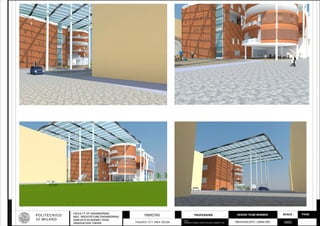
Finland

· Low energy standard: 40 % better than standard buildings

France
      · New dwellings: the average annual requirement for heating, cooling, ventilation,
      hot water and lighting must be lower than 50 kWh/m² (in primary energy). This
      ranges from 40 kWh/m² to 65 kWh/m² depending on the climatic area and altitude.

       · Other buildings: the average annual requirement for heating, cooling, ventilation,
       hot water and lighting must be 50% lower than current Building Regulation

       requirements for new buildings
___________________________________________________________________________
                                                                        187
MSc In Architectural Engineering
___________________________________________________________________________


       · For renovation: 80 kWh/m² as of 2009

Germany
     · Residential Low Energy Building requirements = kfW60 (60kWh/(m²•a) or
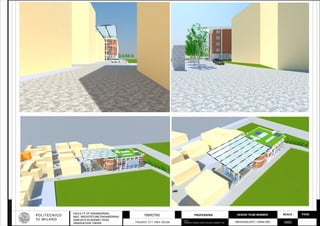
     KfW40 (40 kWh/(m²•a)) maximum energy consumption

       · Passive House = KfW-40 buildings with an annual heat demand lower than 15
       kWh/m² and total consumption lower than 120 kWh/m²

England &
Wales
      Graduated minimum requirements over time:
      · 2010 level 3 (25% better than current regulations),

       · 2013 level 4 (44% better than current regulations and almost similar to
       PassivHaus)

       · 2016 level 5 (zero carbon for heating and lighting),

       · 2016 level 6 (zero carbon for all uses and appliances

Source: SBI (Danish Building Institute), European Strategies to move towards very low
energy buildings, 2008.

                              Given the varying climatic and regulatory conditions across
                              Europe, it is difficult to define exactly the concept of low
                              energy building for the entire EU. National standards and
                              methodologies vary so that 'low energy' developments in one
                              country may not meet 'normal practice' in another. For example
                              in the US, the Energy Star label indicates buildings that use
                              only 15% less energy than what regulations define.


7.2.2- Passive house and equivalent concepts
                              The definitions for passive houses are even more
                              heterogeneous, as in this case what is understood by the term
                              differs from Central/ Northern Europe (Germany, Austria,
                              Sweden etc.) to southern Europe (e.g. Spain, Italy, Portugal,
                              Greece). In southern Europe it means that a house has been
                              constructed in line with generic Passive Design, i.e. using
                              passive technologies.


___________________________________________________________________________
                                                                        188
MSc In Architectural Engineering
___________________________________________________________________________

                             In central Europe, the term Passive House refers to a certain
                             standardized type of low energy buildings as developed in
                             Germany. It is a special type of a low energy building for
                             which thermal comfort can be achieved solely by post-heating
                             or post-cooling of the fresh air mass without a need for a
                             conventional heating system. Passive house technologies

                             typically include passive solar gain (also through south
                             orientation), super glazing (U-value 0.75 W/(m²K), airtight
                             building envelope, thermal bridge free construction. 25 This
                             reduces annual demand for space heating to 15 kWh/(m²a)
                             which means that they roughly use 85% less overall energy
                             with the limit for total primary energy use being 120kWh/m²
                             p.a.. In Switzerland a similar standard as the one in Germany,
                             MINERGIE®-P is used. In the United States, a house built to
                             the Passive House standard uses between 75 and 95% less
                             energy for space heating and cooling than current new
                             buildings that meet today's US energy efficiency codes.26 The
                             Passive-on project has based a more general definition on the
                             above mentioned standards and indicates that a passive house
                             or equivalent requires combined heating and cooling demand
                             between 15 – 20 kWh/ (m²,a).

7.2.3- Zero energy houses/zero carbon houses
                             The specificity of a zero energy house/zero carbon house is
                             that the remaining energy needs are entirely covered with
                             renewable

                             sources/carbon free energy sources. A house with zero net
                             energy consumption annually can be autonomous from the
                             energy grid supply, but in practice that means that in some
                             period‘s power is gained from the grid and in other periods
                             power is returned to grid (renewable energy sources are often
                             seasonal).

25
     http://www.cepheus.de
26
   The application of the standard Passive House concept has some limitations for Southern
climates where the problem of household energy use is one not only of providing warm
houses in winter, but also, and in some cases more importantly, of providing cool houses in
summer. In these regions, the definition of the Passivhaus Standard as applied in Central
Europe needs to be modified as to take into account cooling loads and other end uses within
the home. Passive-on, a Project funded by Intelligent Energy for Europe SAVE programme
applied passive house standards in southern countries, for more information:
http://www.passive-on.org
___________________________________________________________________________
                                                                                       189
MSc In Architectural Engineering
___________________________________________________________________________

                            In the US, various definitions of zero energy buildings are
                            used. 27 Japan is in the process of fixing the definition and
                            preparing their zero energy policies in the coming months.

7.2.4- Energy positive Building
                            An energy positive building (also: plus energy) is one that on
                            average over the year produces more energy from renewable
                            energy sources than it imports from external sources. This is
                            achieved using combination of small power generators and
                            low-energy building techniques such as passive solar building
                            design, insulation and careful site selection and placement.


7.3-Design Pathways

Thermal envelope

                             Thermal envelope is exceptionally energy efficient, including
                             the insulation system, window and door selections, and
                             extensive measures to control air leakage. Selection of
                             appropriate foundation thermal protection is also vital which
                             leads to minimizing energy waste.


Sustainable site (Facilitate access to renewable energy)

                            Sustainable site considerations taken into account including
                            orientation, local vegetation, proximity to adjacent structures,
                            distances to water bodies and roadways.

Architectural design

                            Architectural design must be responsive to the local climate to
                            maximize the benefits of passive solar heating, natural gains-
                            avoidance, cooling strategies.


27
  For more info: Zero energy buildings: A critical look at the definition. To be found on:
www.nrel.gov/docs/fy06osti/39833.pdf
___________________________________________________________________________
                                                                                      190
MSc In Architectural Engineering
___________________________________________________________________________

Exterior

                        Exterior means colors of building surfaces need to be ―
                                                                              tuned‖
                        to the climate, reducing solar driven loads.


Electric demand

                        Electric demand reduced to micro-load levels by incorporating
                        super-efficient and right sized appliances, mechanical systems,
                        plug-loads.


Water consumption

                        Water consumption reduced to the absolute minimum while
                        maintaining high levels of consumer satisfaction; particularly
                        the hot water service system.


___________________________________________________________________________
                                                                        191
MSc In Architectural Engineering
___________________________________________________________________________


                    Basic flow chart of towards positive energy


___________________________________________________________________________
                                                                        192
MSc In Architectural Engineering
___________________________________________________________________________

7.4-Thermal Comfort


     ―Good tem
             perature is the one you don‘t notice at all‖


                           Our thermal comfort defines not only our well-being but our
                           physical and intellectual performance


___________________________________________________________________________
                                                                        193
MSc In Architectural Engineering
___________________________________________________________________________


                     Environmentally compatible use of resources


Thermal insulation
                          The quantity of heat flowing through a wall by conduction
                          (from higher to lower T‘s) is proportional to the
                          thermalconductivity U of the component


                          With U depending on the physical characteristics of the layers
                          making up the wall.

                          The heat flow through solid materials can be written as follows
                          – including both conduction and convection (heat lost to air):


___________________________________________________________________________
                                                                        194
MSc In Architectural Engineering
___________________________________________________________________________


For a homogeneous wall, one gets then:


If the wall is multi-layer:


Where the sum regards all of the layers


Temperature profile in a multi-layer wall (steady state).


___________________________________________________________________________
                                                                        195
MSc In Architectural Engineering
___________________________________________________________________________


___________________________________________________________________________
                                                                        196
MSc In Architectural Engineering
         ___________________________________________________________________________

         Natural ventilation

                                      Natural ventilation satisfies a primary objective when it comes
                                      to bioclimatic designs: reducing demand in air conditioning
                                      thus limiting energy consumption required to power
                                      installations, particularly in warm weather.

                                      In fact, natural ventilation enables a building's overnight
                                      cooling. Once the sources of pollution have been reduced and
                                      the hot and fouled air evacuated from the building, overnight
                                      cooling enhances the occupants‘ respiratory, olfactory and
                                      thermal comfort.

         7.5-U-Values and Glazer Diagrams

         U-Values

        No                      Material             s     λ         s/λ                    k=λ/s
                                                    [m] [W/mK] [m²K/W]                     [W/m²K]
                     1 Plaster board                0.01   0.16                     0.08      13.33
                     2 Mineral Wool Insulation      0.05   0.04                     1.43       0.70
                     3 Air gap                      0.10   0.22                     0.45       2.22
                     4 Concrete                     0.10   0.42                     0.24       4.20
                       Insulation, expanded
                     5 polysterene                   0.04      0.03                 1.33       0.75
                     6 DAKU FSD 30          mm80     0.08      0.55                 0.15       6.88
                     7 soil                          0.09      0.15                 0.57       1.76
                                                            sum                    4.238
He [W/m²K]                                             25
Hi [W/m²K]                                              8
Outside
temperature°C                                          -5        S= Σs=                        4.24
Inside temperature
°
C                                                      20       R= 1/He+1/Hi+Σs/λ=                      4.403
Temperature
difference                                             25
Outside relative
humidity (%)                                           80                       U=1/R=        0.227 [W/m²K]
Inside relative
humidity (%)                                           50


                                    U value Calculation of roof
         ___________________________________________________________________________
                                                                                 197
MSc In Architectural Engineering
     ___________________________________________________________________________

       No                          Material                     s       λ               s/λ             k=λ/s
                                                              [m]     [W/mK]     [m²K/W]               [W/m²K]
        1            12.5mm plasterboard                      0.013    0.16            0.078           12.800
                     12.5mm plasterboard with vapour
        2            barrier                                  0.014    0.16            0.084           11.852
        3            12.5mm plasterboard                      0.013    0.16            0.078           12.800
                     INSULATION, GLASS MINERAL
        4            WOOL                                     0.080    0.032           2.500            0.400
        5            WOOD FIBER INSULATION                    0.100    0.035           2.857            0.350
                     INSULATION, GLASS MINERAL
        6            WOOL                                     0.080    0.032           2.500            0.400
                     DU'PONT TYVEK CONCRETE
        7            PANEL (12.5mm)                           0.013    0.16            0.081           12.308
        8            Rigid insulation, polystyrene            0.050    0.03            1.667            0.600
        9            Render finish with steel mesh            0.005    0.47            0.011           94.000
                                                                      sum                      9.856
He [W/m²K]                                                     25           S=   Σs=                     9.856
Hi [W/m²K]                                                     8            R=   1/He+1/Hi+Σs/λ=                   10.021
Outside
temperature°C                                                  -5
Inside temperature
°
C                                                              20                          U=1/R=       0.0998   [W/m²K]
Temperature
difference                                                     25

                                 U value Calculation of Wall vertical Enclosure

                                                        λ               S                 R
       Sr.
                                                     (w/m.k)           (m)             (m2.k/W)
                laminated glass sheet and
        1                                                                               3.030
                structural silicone

                stainless steel clamps to
        2                                              12              0.04        0.003333333
                connect façade glass sheet
        3       stainless steel pole                   12              0.06             0.005
                                                                       0.10             3.038              ∑S/λ
                U=1/( 1/he+∑
                                                                                        For Vertical member
                S/λ+1/hi+1/C)
                               U=                      0.31                                     1/hi             0.13
                                                                                                1/he             0.04

                                     U value Calculation of Wall Transparent
     ___________________________________________________________________________
                                                                             198
MSc In Architectural Engineering
___________________________________________________________________________

Condensation Risk

                               A Section separates two environments with different
                               concentrations of water vapour, a vapour flow will start
                               between the two (higher to lower concentration). The highest
                               partial vapour pressure Pv is generally to be found where
                               temperature is higher. If at some point of the wall, Pv reaches
                               the saturation value Ps, condensation occurs. As a rule,
                               condensation does not occur in single-layer, homogeneous
                               walls, while it is very likely if the inner layers are insulating
                               and with small resistance to the passage of vapour.

Condensation should be avoided because:

        • It decreases the durability of materials;
        • If it happens in insulating materials, it makes them ineffective (condensed water fills
the air gaps).

Two ways to avoid condensation:


        • Raising the saturation value Ps: this happens if the inner surface temperature is
higher, that is, working on the insulation level;
        • Lowering the partial pressure Pv: this can be obtained inserting in the wall -towards
        the warm environment - a layer with high resistance to vapor flow (vapor barrier -
        polyethylene or aluminum sheet).


Glazer diagram

                               Glaser diagram representing Pv and Ps can be traced to assess
                               the risk of condensation. Condensation is tolerated if materials
                               are not deteriorated by condensed water, and if this can
                               evaporate completely during the warm season.
For Temperature Distribution
                                     Ti= Ti-1– (ΔT/Ki) U

       where:

       ΔT = Difference in Temperature between the two sides of the Section (T int - T ext);
       Tint = Internal temperature, 20 C
       Text = external Temperature -5 C
___________________________________________________________________________
                                                                        199
MSc In Architectural Engineering
___________________________________________________________________________

         Ki = λ/s is the thermal Conductivity of the i-th layer;
         U= Thermal conductivity of whole section(W/m2 K)

To calculate the internal Surface temperature

                                      Φ=US∆T
     Φ= Heat Flux(W)
     U= Thermal conductivity of whole section(W/m2 K)
     S= Total thickness of Section(m)

                                      Tpi= Ti – (Φ/S)(1/hi)

    Tpi = Internal Surface Temperature©
    Ti= Internal ambient temperature©
    S= Total thickness of Section(m)
    hi= Internal Convective co-efficient
                                 For Pressure Distribution

                                The risk of condensation can be assessed by tracing the Glaser
                                diagram: in every point, Pv curve should remain below Ps
                                curve. If the distribution of temperatures through the wall is
                                known, saturation pressure can be determined by specific
                                charts, while partial vapor pressure can be calculated from:
                                      Pi= Pi-1– (ΔP/ρtot) ρi

         where:


         ΔP = Difference in vapor pressure between the two sides of the section (P int - P ext);
         Pint = Internal Pressure at 20 C Temp & 50% Rh(Calculated through Psychometric
chart)
         Pext = external Pressure at -5 C Temp & 80% Rh(Calculated through Psychometric
chart)
        ρi = sj/δj is the resistance to vapor diffusion of the i-th layer;
        δj is vapour permeability of the i-th layer (from code UNI 10351 or DIN 4108);
        ρtot is the resistance (diffusivity) to vapour diffusion of the whole wall and is
calculated as:
                                                  ρtot = Σρj


___________________________________________________________________________
                                                                        200
MSc In Architectural Engineering
     ___________________________________________________________________________


     In multi-layer walls, the inner the insulation, the higher the risk of condensation.

     Example A
     –A vapour barrier is always recommended.
     Example B

     –Quantity of condensed water should be assessed, as a vapour barrier might not be necessary.
     Example C

     –External wall insulation: the external finish should be permeable to vapour. Condensation is
     very unlikely.


No            Material              T       δ*10-12     ρ=s/δ            Ps         Pv      cum.s cum.s

                                                           [*10-
                                          [Kg/mspa]     12 2            [Pa]       [Pa]      [m]     [cm]
                                                          m spa/kg]

 1 Ti                             20.00                              2339.00 1168.60         0.00    0.00
 2 Plaster board                  19.57        20.00            0.00 2339.00 1168.60         0.01    1.20
   Mineral Wool
 3 Insulation                     11.46       150.00            0.00 1966.28 1005.62         0.06    6.20
 4 Air gap                         8.90       193.00            0.00 1759.21 915.07          0.16   16.20
 5 Concrete                        7.55       200.00            0.00 1437.34 774.33          0.26   26.20
 6 Insulation, expanded  -0.02    200.00       0.00 1126.74 638.51     0.30 30.20
  ___________________________________________________________________________
                                                                           201
MSc In Architectural Engineering
      ___________________________________________________________________________

       polysterene
       DAKU FSD 30
     7 mm80                    -0.85           200.00            0.00 1002.50           584.18     0.38    38.20
     8 soil                    -4.06           150.00            0.00 754.02            475.53     0.47    46.70
     9 Te                      -5.00                                   402.00           321.60     0.47    46.70
                                                ρtot=           0.003

                               Glasier Diagram Calculation of Green roof


No             Material                 T         δ*10-12       ρ=s/δ            Ps         Pv      cum.s cum.s

                                                                      [*10-
                                                [Kg/mspa]       12               [Pa]       [Pa]     [m]      [cm]
                                                                     m2spa/kg]

 1 Ti                                  20                                      2339.0 1168.6         0.00        0
 2 12.5mm plasterboard              19.81                 20             0.001 2339.0 1168.6         0.01     1.25
   12.5mm plasterboard with
 3 vapour barrier                   19.59                  5             0.003 2299.7 1151.4         0.03      2.6
 4 12.5mm plasterboard              19.40                 20             0.001 2129.9 1077.2         0.04     3.85
   INSULATION, GLASS
 5 MINERAL WOOL                     13.16                150             0.001 2090.6 1060.0         0.12    11.85
 6 WOOD FIBER INSULATION             6.04                150             0.001 2057.1 1045.3         0.22    21.85
   INSULATION, GLASS
 7 MINERAL WOOL                        -0.20             150             0.001 2015.2 1027.0         0.30    29.85
   DU'PONT TYVEK
 8 CONCRETE PANEL (12.5mm)             -0.40             150             0.000 1981.6 1012.3         0.31    31.15
 9 Rigid insulation, polystyrene       -4.56               2             0.025 1976.2 1009.9         0.36    36.15
10 Render finish with steel mesh       -4.59             150             0.000 404.1 322.5           0.37    36.65
11 Te                                     -5                                    402.0 321.6          0.37    36.65
                                                        ρtot=            0.031

                          Glasier Diagram Calculation of wall vertical Enclosure


      ___________________________________________________________________________
                                                                              202
MSc In Architectural Engineering
___________________________________________________________________________


 2500.00


 2000.00


 1500.00

                                                                                       Ps

 1000.00                                                                               Pv


  500.00


    0.00
            0.00    1.20     6.20      16.20   26.20   30.20   38.20   46.70   46.70


                                      Glasier Diagram of Green roof

   2500.0


   2000.0


   1500.0

                                                                                       Ps
   1000.0                                                                              Pv


    500.0


      0.0
              0    1.25    2.6     3.85 11.85 21.85 29.85 31.15 36.15 36.65 36.65


                                 Glasier Diagram of wall vertical Enclosure


___________________________________________________________________________
                                                                        203
MSc In Architectural Engineering
___________________________________________________________________________

7.6-Materials and Technology

Green Roof and building


                           The use of the roofs of buildings as green roofs is one of the
                           main strategies used in bio-architecture to limit the
                           environmental impact of the construction.

                           Green roof gardens have very ancient origins, the hanging
                           gardens of Babylonia built by King Nabucodonosor being one
                           of the best known examples. In fact, they are recommended by
                           all the associations who promote sustainable building, both
                           because they contribute to the reduction of the building‘s
                           energy requirements and therefore the reduction of CO2
                           emissions, and because they lead to many other economic and
                           ecological advantages:

            • they temporarily absorb stormwater and release it again slowly hence
            preventing floods due to the sewer network overflowing and slow down
            overloading of the network when new urban settlements are built.

            • they filter urban pollution and reduce carbon dioxide

            • they filter polluted stormwater

            • they cool the air by evapotranspiration of water vapour

            • they reduce wind speed

            • they promote the settlement of animal ecosystems

            • they reduce the transmission of noise inside the building

            • they reduce the effects of ―ur heat islands‖
                                           ban

            • they increase the heat inertia of the roof

            • they increase the heat resistance of the roof

            • they protect the waterproof covering and increase its lifetime

            • they are a tool of new architectural expression


___________________________________________________________________________
                                                                        204
MSc In Architectural Engineering
___________________________________________________________________________

                        Roof can collect rain water and later using for the purpose of
                        toilets and green area.


                              Rain Water collection

Façade
                        Transparency became an architectural theme at many levels,
                        allowing an inviting and welcoming building that is accessible
                        and open to public view. At the same time it was important that
                        the building was not merely ‗transparent‘, or only expose what
                        is accommodated within, but that it represented and embodied
                        the values of the community. Accessibility, openness,
                        transparency and sustainability were key values as was a
                        general sense of aspiration.

                        Use of terracotta tiles:

                        A significant evolution of traditional brick cladding is the rain
                        screen cladding in terracotta tiles. These claddings are available
                        in a wide range of finishing, color and dimension.

                         The Earth produces clay and with a simple process of firing, it
                        is reduced to a hard, resistant material, with a grainy feel, plus
                        color and strength which have allowed a long established and
                        intense relationship between man and life
___________________________________________________________________________
                                                                        205
MSc In Architectural Engineering
___________________________________________________________________________


                        Terracotta tile has been developed from a material used for
                        horizontal floor tiling, to one that can also be used on vertical
                        surfaces. We have also added to the tiles a particular finishing
                        surface, which while maintaining the link to its natural
                        terracotta origins, also allows for different shaping, surface
                        treatments and variations of color.
                        Water entering the rain screen is drained at every horizontal
                        joint. Air quickly enters the rain screen through the vertical and
                        horizontal joints – providing full ventilation and instant
                        pressure equalization.


                        Assembly on sub structure

___________________________________________________________________________
                                                                        206
MSc In Architectural Engineering
___________________________________________________________________________


               Support system that allows for local Substitution of tiles


                  Solar shading for Glazed parts through Terracotta


___________________________________________________________________________
                                                                        207
MSc In Architectural Engineering
___________________________________________________________________________


              Terracotta also as solar shading in front of glazed parts


                         Façade elements (extruded ceramics) create a catalogue of
                         cladding components playing between opaque and transparent
                         elements.


___________________________________________________________________________
                                                                        208
MSc In Architectural Engineering
___________________________________________________________________________

Energy

                        Nowadays, buildings have to meet a number of requirements
                        before being constructed. The requirements that significantly
                        can influence the design and thus the ‗quality‘ of ZEBs are (1)
                        energy efficiency requirements and (2) indoor climate
                        requirements and in the case of grid connected ZEBs (3)
                        building–grid interaction requirements.


                  Overview of possible renewable supply options


___________________________________________________________________________
                                                                        209
MSc In Architectural Engineering
___________________________________________________________________________

Photovoltaic Panels


            PV Panels


                         Photovoltaic is commonly known as pv solar panels which
                         produce electricity from daylight through a process called
                         photovoltaic streaming. "Photo" refers to light and "voltaic" to
                         electricity. Photons are converted to electrons and streamed
                         into your power supply and any surplus energy produced can be
                         sold. Photons can penetrate clouds allowing the system to
                         generate even on overcast days.


         PV Panels Circuit Review

___________________________________________________________________________
                                                                        210
MSc In Architectural Engineering
___________________________________________________________________________

Heat Exchanger


                        A ground loop is a heat exchanger that either extracts or adds
                        heat to the ground. The ground itself is not a perfect heat
                        sink/source because the energy added to the ground by the loop
                        can change its temperature over time. The principles of this
                        interaction are common in all loop types and will be discussed
                        here. Geothermal systems come in several different
                        configurations, each with its own strengths and weaknesses.
                        These are discussed below

Horizontal Loop
                        A horizontal loop runs piping parallel and close to the surface.
                        The undisturbed ground temperature often changes seasonally
                        depending upon where the loops are installed. Horizontal
                        loops are easier to install but require significantly more area
                        (approximately 2500 ft²/ton) than other loop types.


                     Horizontal loop


___________________________________________________________________________
                                                                        211
MSc In Architectural Engineering
___________________________________________________________________________

Vertical Loop


                        Vertical loops run perpendicular to the surface and the holes
                        can be several hundred feet deep. At these depths, the
                        undisturbed ground temperature does not change throughout
                        the year. Vertical loops only require approximately 250 to 300
                        ft²/ton


                      Vertical Loop


7.7-Modeling of building
                        Energy consumed in-buildings accounts for 40% of the energy
                        used worldwide, and it has become a widely accepted fact that
                        measures and changes in the building modus operandi can yield
                        substantial savings in energy. Moreover buildings nowadays
                        are increasingly expected to meet higher and potentially more
                        complex levels of performance. They should be sustainable, use
                        zero-net energy, be healthy and comfortable, grid-friendly, yet
                        economical to build and maintain. Zero-energy or even
                        positive-energy buildings are becoming a high priority for
                        multi-disciplinary researchers related to building engineering

___________________________________________________________________________
                                                                        212
MSc In Architectural Engineering
___________________________________________________________________________

                        and physics and have been recently discussed by energy policy
                        experts: as on April 23, 2009 the EU Parliament has requested
                        that by 2019 all new buildings to conform to zero-energy and
                        emission standards (European Parliament, 2009).


                        Buildings are complex systems and detailed simulation is
                        needed to take into account the actual climate data, geometries,
                        building physics, HVAC-systems, energy-generation systems,
                        natural ventilation, user behavior (occupancy, internal gains,
                        manual shading), etc. towards a zero or positive energy
                        approach. Moving from regular to high-performance buildings
                        requires a departure from perceived notions on building design

                        and operation and necessitates the inclusion of more
                        sophisticated methods and tools in the design and
                        implementation phases. In current practice, buildings and their
                        energy performance are estimated based on calculations using
                        simplified physical models and taking a largely static view of
                        the building and its operation. This oftentimes leads to
                        significant deviations regarding performance between the
                        design calculations and the actual building operations
                        (Degelman, 1999; Crawley, 2003).

                        Energy efficiency measures (e.g. insulation, low-emissivity
                        windows, active and passive cooling systems, thermal mass,
                        etc.) are extensively studied in the literature and the effects of
                        their usage are relatively well understood. Their use is
                        encouraged by codes, certification and best-practice
                        recommendations and the application of such measures yield
                        tangible benefits in improving energy requirements while
                        maintaining end-user comfort at acceptable levels. Still the
                        complex interplay between the various design parameters
                        precludes empiricism or simplistic models as the parameters
                        neglected in such approaches are important with respect to the
                        application of the efficiency measures. For example, the
                        inclusion of a thermal mass combined with a natural ventilation
                        strategy can yield significant and undisputable energy savings.

                        A misuse though of such a practice, e.g. neglecting to open
                        windows at night during hot summer days can have
                        catastrophic results both with respect to thermal comfort and
                        energy efficiency yielding exactly the opposite compared to the
                        intended results, i.e. increased discomfort and cooling load. It is
                        therefore necessary to be able to a priori ascertain performance
___________________________________________________________________________
                                                                        213
MSc In Architectural Engineering
___________________________________________________________________________

                        characteristics and achieving this requires detailed modeling
                        and simulation tools that yield meaningful representations of
                        the building and all its subsystems, and are capable of
                        predicting with sufficient accuracy energy requirements and
                        system response.


                        A basic modeling assumption used by most building-simulation
                        software is the multi-zonal paradigm: dividing the building into
                        regions (zones), each with a temperature and humidity variable,
                        assumed to be spatially constant. The evolution in time of the
                        zonal parameters is evaluated from the solution of a system of
                        algebraic and ordinary differential equations (essentially the
                        energy conservation equation on each zone is used to compute
                        the temperature variation, and mass conservation is used to
                        determine the humidity variables).


                        Open and noncommercial modeling languages for the
                        description of physical systems, like Modelica, can also be used
                        for building simulation (Fritzson, 2004; Tiller, 2001; Haase et
                        al., 2006). The open and noncommercial character of the
                        language with capabilities of equationbased, acausal modeling,
                        object-orientation, multiple inheritances and multi-physics
                        modeling, guarantee a transparent simulation standard for the
                        development of such models. A component library for
                        building-simulation purposes containing models for thermal
                        room performance, occupants‘ behavior, and weather model
                        has been developed and used for building-simulation purposes
                        (Matthes, 2006; Haase, 2007).


___________________________________________________________________________
                                                                        214
MSc In Architectural Engineering
___________________________________________________________________________


The components of Zero Energy or Positive Energy architecture during real-time operation.


Future Infrastructure and networking


                             Sensors, actuators and interfaces are essential components for
                             the successful implementation and real-time operation of
                             NZEBs or PEBs. The evolution of the specific components was
                             quite rapid the last decades leading to the intelligent buildings‘
                             concept derived from artificial intelligence and information
                             technology. So far the intelligent building systems are
                             supported by either building automation technologies such as
                             Profibus (www.Profibus. org) (Yao et al., 1999), BACNETe
                             www.bacnet.org

___________________________________________________________________________
                                                                        215
MSc In Architectural Engineering
___________________________________________________________________________

                           (Rodenhiser, 2008; Bushby, 1997) or home automation
                           protocols like X10e, EIBe, and LonWorks or wireless networks
                           such as ZigBee. The main features of the above protocols are
                           tabulated in Figure.


                         Protocols used in-building automation.


                           Wireless media in the building sector have the following
                           benefits compared to previous wiring communication
                           techniques:


            _ Ease of installation.


            _ Reduction of labor costs.


            _ Mobility and portability.


            _ Minimum interference with occupants.


___________________________________________________________________________
                                                                        216
MSc In Architectural Engineering
___________________________________________________________________________


      The monitoring and infrastructure of a Zero Energy or Positive Energy system.

                           To meet future requirements for PEB/NZEB sector,
                           interoperable and low-cost wireless communication systems
                           that will be able to operate to generic PEBs should be
                           developed and deployed. Such systems may be based on a low
                           power solution to wireless robust real-time connection for
                           reaching long distances in a building by using mesh
                           networking. Moreover possible combination of wireless
                           devices (forsensing and actuation through dedicated interfaces),
                           of synchronized (or non-synchronized) coordination of these
                           devices and cabled ones may improve the usability, comfort
                           and eventually effectiveness either in the process monitoring
                           and control procedure or in the user interaction procedure.

                           The other benefit of possible combinations is the flexibility,
                           durability and ease of deployment of wireless sensing and
                           actuation networks allowing for fast installation and transparent
                           operation at lower cost, even for long time if the devices have a
                           very low-power consumption.


___________________________________________________________________________
                                                                        217
MSc In Architectural Engineering
___________________________________________________________________________


Cost efficiency
                        Regarding cost efficiency a series of performance indicators are
                        included in the literature for both low energy as well as zero-
                        energy dwellings (Parker, 2009; Kolokotsa et al., 2009b)
                        including direct costs and initial investment costs, annual
                        ongoing charges, Net Present Value (NPV), Internal Rate of
                        Return (IRR), Life Cycle Cost, etc. The role of Payback Period
                        (PP) in the cost efficiency.

Performance indicator                     Description


GCEI                                      The Generation–Consumption Effectiveness
                                          Index (GCEI) is an objective and quantitative
                                          indicator to compare the effect

                                          different decision strategies have on system
                                          performance. To measure system
                                          performance a relevant metric is selected
                                          like, for

                                          example, the Net Expected Benefit, which is
                                          a monetary equivalent on the effects of a
                                          particular decision strategy. The BO&C

                                          system takes decisions with the goal of
                                          maximizing the selected metric and, as would
                                          be expected, different metrics can yield

                                          different decisions. For the computation of
                                          the GCEI index the ―no   -control‖ case can
                                          used as the base, and is effectively the

                                          decision-strategies used before the
                                          implementation of a decision-system like
                                          BO&C. Since the renewable-energy
                                          generation


___________________________________________________________________________
                                                                        218
MSc In Architectural Engineering
___________________________________________________________________________

                                      pattern is not a priori known, it is hard for a
                                      system to take optimal decisions. The optimal
                                      decision strategy can be computed a

                                      posteriori for the calculation of the GCEI.
                                      The GCEI takes values less than one, and for
                                      a particular decision strategy a value of

                                      0.8 (80%) indicates that we are getting a
                                      performance improvement (as measured in
                                      the selected metric) that is 80% of the

                                      performance that would be obtained had we
                                      taken all the correct decisions


CI1                                   Thermal comfort objectives that are related to
                                      quantities measured directly from the
                                      installed sensors. These quantities include

                                      temperature, humidity, illuminance and CO2
                                      levels. For all of these quantities, minimum
                                      and maximum allowable values should

                                      be defined in cooperation with the buildings‘
                                      operators and end-users following, e.g.
                                      CEN‘s standard EN 15251 (CEN, 2006a).

                                      This standard specifies how design criteria
                                      can be established and used for dimensioning
                                      of systems and how to establish and

                                      define the main parameters to be used as
                                      input for building energy calculation and long
                                      term evaluation of the indoor environment.
                                      The index CI1 takes the value ―Pass‖ when
                                      the respective sensor measurements do not
                                      violate any of these minimum

                                      and maximum values throughout the overall
                                      demonstration period (except for the time-

___________________________________________________________________________
                                                                        219
MSc In Architectural Engineering
___________________________________________________________________________

                                        intervals where buildings are notoccupied)


CI2                                     Using user interfaces the end-users can
                                        communicate their thermal comfort
                                        preferences to the system. The answers
                                        should be

                                        recorded on a daily basis via electronic
                                        questionnaires available on the building‘s
                                        intranet. The end-users will be asked to rate
                                        their

                                        subjective feeling of e.g. thermal comfort on
                                        a 7-point scale (_3: too cold . . . 0:
                                        satisfactory . . . 3: too warm) and if the
                                        average

                                        value of responses is between _1 and 1, then
                                        the index CI2, takes the value ―Pass‖


PP                                      BO&C Payback Period: The period required
                                        to amortize BO&C implementation and
                                        operational costs (for all energy-generation

                                        elements, sensors, control devices) from cost-
                                        savings due to reduced energy consumption


                       Performance indicators NZEB/PEB

7.8- Heat Energy and Cooling Demand


                        Heat Energy and Cooling demand are calculated by using
                        Software Casanova. Casanova calculation is made separately
                        for two different models, Summer & Winter model.


___________________________________________________________________________
                                                                        220
MSc In Architectural Engineering
___________________________________________________________________________

For winter, ventilation system is designed as 0.5 1/h Mechanical and 0.10 1/h as Natural
ventilation. Shading is considered as 50% in winter.


For summer, ventilation system is designed as 0.5 1/h as Natural ventilation. Shading is
considered as 50% in summer.

Building data for Winter


  Mean U value:                          0.32 W/(m² K)
  Specific transmission losses:          3532.8 W/K
  Specific ventilation losses:           7705.6 W/K
  Sum specific losses:                   11238.4 W/K
  Thermal inertia:                       84.0 hours
  Maximum heating load:                  346.0 kW
  Maximum specific heating load:         36.0 W/m²
  Maximum cooling load:                  469.4 kW
  Maximum specific cooling load:         48.9 W/m²
  Limit temperature for heating:         17.5°C

              Heat energy demand
                  in kWh/m²
  __________________________________

  January         9.3
  February        6.4
  March           2.6
  April           0.5
  October         0.4
  November        5.7
  December        9.4
  __________________________________

  Yearly sum       34.3


___________________________________________________________________________
                                                                        221
MSc In Architectural Engineering
___________________________________________________________________________


                        Energy Flow Diagram for heating


___________________________________________________________________________
                                                                        222
MSc In Architectural Engineering
___________________________________________________________________________

Building data for Summer

  Mean U value:                             0.32 W/(m² K)
  Specific transmission losses:             3532.8 W/K
  Specific ventilation losses:              11008.0 W/K
  Sum specific losses:                      14540.8 W/K
  Thermal inertia:                          64.9 hours
  Maximum heating load:                     456.8 kW
  Maximum specific heating load:            47.6 W/m²
  Maximum cooling load:                     458.8 kW
  Maximum specific cooling load:            47.8 W/m²
  Limit temperature for heating:             18.1°C


                  Cooling demand
                  in kWh/m²
  _____________________________

  April           0.1
  May             1.1
  June            2.2
  July            4.9
  August          4.2
  September       1.8
  October         0.3
  _____________________________

  Yearly sum       14.6


Cooling balance


Cooling demand and overheating
                  Cooling demand  Cooling demand   Mean            Cooling degree
                  specific        absolute         overheating     hours
                  in kWh/m²       in kWh           in hours/day    in Kh
  ______________________________________________________________________________
   April          0.1             693              0.0             0.0
  May             1.1             10674            8.2             452.1
  June            2.2             21179            11.4            1010.6
  July            4.9             47344            20.1            2949.2
  August         4.2              40422            19.6            2687.1
  September      1.8              16929            11.8            885.9
  October         0.3             3109             1.8             41.5
    ______________________________________________________________________________

  Yearly sum       14.6            140349                          8026.5


___________________________________________________________________________
                                                                        223
MSc In Architectural Engineering
___________________________________________________________________________


                        Energy Flow Diagram for heating


___________________________________________________________________________
                                                                        224
MSc In Architectural Engineering
___________________________________________________________________________

7.9-Lighting


                          ―Dayli is a gift of Nature. As civilized man learns to use
                                  ght
                          artificial light, which frees him from the total dependence on
                          daylight, he also learns to appreciate the value of daylight and
                          its special qualities‖                {Hopkinson 1966}


                          Daylight is probably the most wasted resource in building
                          servicing. With good geometry and controls, huge amounts of
                          CO2 emission due to artificial lighting could be avoided.
                          Daylight, and its source, are a powerful link with nature and the
                          forces which formed us. The windows of the building, that
                          facilitate this link, are of vital importance.


  Child‘s reading Area: Avg. DF value: 16.21%


___________________________________________________________________________
                                                                        225
MSc In Architectural Engineering
___________________________________________________________________________


             New Book Exhibition & news paper: Avg.DF Value. 13.28%


___________________________________________________________________________
                                                                        226
MSc In Architectural Engineering
___________________________________________________________________________


                    Audio & Video Collection: Avg.DF Value. 10.46%


                        Open Reading Area: Avg.DF Value. 18.70%

The shadow analysis is done on 21st of December. For the shadow analysis t time and date is
selected intentionally and following figures shows the shadow of the selected site.


___________________________________________________________________________
                                                                        227
MSc In Architectural Engineering
___________________________________________________________________________


                     Shadow view 2PM on 21st of December


                           10AM                            11AM


___________________________________________________________________________
                                                                        228
MSc In Architectural Engineering
___________________________________________________________________________


                         12PM                            1PM


                          2PM                           3PM


                          4PM                               5PM
___________________________________________________________________________
                                                                        229
MSc In Architectural Engineering
___________________________________________________________________________


___________________________________________________________________________
                                                                        132
MSc In Architectural Engineering
___________________________________________________________________________

References

A roadmap towards intelligent net zero- and positive-energy buildings by D. Kolokotsa, D.
Rovas ,E. Kosmatopoulos and K. Kalaitzakis

Zero Energy Building – A review of definitions and calculation methodologies A.J. Marszala,
P. Heiselberg, J.S. Bourrelle , E. Musallc, K. Voss, I. Sartori and A. Napolitano.


Mediterranean and National Strategies for Sustainable Development Priority Field of Action
2: Energy and Climate Change Energy Efficiency and Renewable Energy Italy - National
study.

Architettura della biblioteca. Linee guida di programmazione e progettazione by Muscogiuri
Marco 2004, 477 p., ill., brossura, 2 ed.


Masera, Gabriele. Lecture series – Thermal comfort. Politecnico di Milano, 2010.

Masera, Gabriele. Lecture series – Visual comfort. Politecnico di Milano, 2010.

Massimo Tadi. Lecture series – Architectural Design. Politecnico di Milano, 2009-2010.

Palazzo, Danilo. Urban Design, un processo per la progettazione urbana. 2008.

Rapisarda, Giuseppe. Building Services System Design Lecture series. Politecnico di

Milano, 2011.


___________________________________________________________________________
                                                                        132
MSc In Architectural Engineering
___________________________________________________________________________


Web Search:


http://www.imaa.cnr.it/

http://www.energies-renouvelables.org/observ-er/sig/eufores/sig.asp

http://dgerm.sviluppoeconomico.gov.it/dgerm/ben/ben_2007.pdf

http://ec.europa.eu/energy/res/legislation/biofuels_members_states_en.htm

http://ec.europa.eu/energy/res/legislation/electricity_member_states_en.htm

http://ec.europa.eu/energy/energy_policy/facts_en.htm

http://haitipassivecooling.tumblr.com/


___________________________________________________________________________
                                                                        133

Master thesis 2011.12.21

  • 1.
    FACULTY OF ENGINEERINGPOLO REGIONALE DI LECCO MASTER OF SCIENCE IN ARCHITECTURAL ENGINEERING RELATORE PROF. MASSIMO TADI CO-REELATOR PROF. GABRIELE MASERA MASTER THESIS BY: ABDUXUKUR . ZAYIT 751975 Academic year 2010/2011
  • 2.
    ACKNOWLEDGEMENT We would liketo mention all those who contributed their efforts to write this master‘s thesis. We thank to PROF. GABRIELE MASERA, PROF. MASSIMO TADI, PROF. DANILO PALAZZO, and PROF. LIBERATO FERRARA for their willingness and valuable advice to face the difficulties during the development of this thesis. i
  • 3.
    ABSTRACT Piacenza is acity and comune in the Emilia-Romagna region of northern Italy. It is the capital of the province of Piacenza. Strategically the city is at a major crossroads at the intersection of Route E35/A1 between Bologna, gateway to eastern Italy, and Milan, gateway to the Alps, and Route E70/A21 between Brescia at the foot of the Alps and Tortona, where branches lead to Turin in the north, a major industrial city, and Genoa, a major coastal port. Piacenza is also at the confluence of the Trebbia, draining the northern Apennines, and the Po, the major waterway of northern Italy, draining to the east. Piacenza right from its foundation has been of vital interest to political powers that would control northern Italy, more than any other city there. Piacenza is, in fact the ideal venue for an initiative focused on architectural, urban and environmental problems, both for the size of its scenic, landscape, artistic and monumental wealth and for the wide range of case-studies available, as well as for its solid traditions in the building sector. Program was to interconnect the landscape, urban spaces and architectural design of library integration with towards positive energy. Urban planning was done by using the roman grid and tried to provide the facility spaces according to integrated, interactive and interscalar architectural –urban- environmental concept. While the Architecture design of Library we developed the brief by studying the libraries present in Italy and abroad with respect to number of books and area. i
  • 4.
    MSc In ArchitecturalEngineering ___________________________________________________________________________ INDEX Acknowledgement Abstract 1-Introduction ...................................................................................... 1 2- Urban Context ................................................................................. 4 2.1-Italy ..................................................................................................................................5 2.2-Emilia–Romagna ..............................................................................................................6 2.3- Brief History of Urban Development in Piacenza ..........................................................7 2.3.1-The reconstruction of the city ..................................................................................12 2.3.2-The urban genetic code............................................................................................14 2.4- Analysis about Current City of Piacenza ......................................................................15 2.4.1- The Geographic Context ........................................................................................15 2.4.2-Population ................................................................................................................17 2.4.3 – The Socio- Economic System ...............................................................................30 2.4.4- Strategic Plan ..........................................................................................................31 2.5- Piacenza‘s network........................................................................................................36 2.6-Physical-morphological aspects .....................................................................................47 2.7-Local conditions, scope, borders, limits .........................................................................50 2.8-Conclusion .....................................................................................................................55 3-Urban Design ................................................................................. 56 3.1-Project Area ....................................................................................................................58 3.2-Site Comparison .............................................................................................................63 3.3-Site Analysis ..................................................................................................................64 ___________________________________________________________________________ i
  • 5.
    MSc In ArchitecturalEngineering ___________________________________________________________________________ 3.4-SWOT Analysis .............................................................................................................67 3.5-Project Scope..................................................................................................................68 3.5.1- project Objective ....................................................................................................68 3.5.2- Master plan .............................................................................................................69 3.5.3- Master plan Analysis ..............................................................................................73 4- Architectural Design ..................................................................... 85 4.1- Library ...........................................................................................................................86 4.1.1-Library in History ....................................................................................................86 4.1.2- Classifications of Library .......................................................................................91 4.2- Project Objective ...........................................................................................................91 4.3- Research Example for Reference ..................................................................................95 4.3.1-Piacenza Libraries ...................................................................................................95 4.3.2-Biblioteca Civica, Prato ...........................................................................................98 4.3.3-New Public library in Pontivy, France ....................................................................98 4.3.4- Public Library Kelsterbach, Germany ..................................................................101 4.3.5- Jaume Fuster Library, Spain .................................................................................102 4.3.6- Surry Hills Library, Australia ...............................................................................103 4.4-Architectural Design ....................................................................................................106 4.5 Concept and Drawings ..............................................................................................110 5-Structural Design ......................................................................... 132 5.1-Introduction ..................................................................................................................133 5.2-Load Calculations ........................................................................................................135 5.3-Slab...............................................................................................................................143 ___________________________________________________________________________ ii
  • 6.
    MSc In ArchitecturalEngineering ___________________________________________________________________________ 5.4-Beams ...........................................................................................................................149 5.5-Columns .......................................................................................................................157 5.6-Foundation ...................................................................................................................164 6- Building Physics .......................................................................... 167 6.1-Climate .........................................................................................................................168 6.2-Analysis for Climate ....................................................................................................174 7- Technological Design .................................................................. 181 7.1- Towards Positive Energy ............................................................................................182 7.2- Energy Trends .............................................................................................................183 7.2.1- Examples of definitions for low energy building standards .................................187 7.2.2- Passive house and equivalent concepts ................................................................188 7.2.3- Zero energy houses/zero carbon houses ...............................................................189 7.2.4- Energy positive Building ......................................................................................190 7.3-Design Pathways ..........................................................................................................190 7.4-Thermal Comfort ..........................................................................................................193 7.5-U-Values and Glazer Diagrams ...................................................................................197 7.6-Materials and Technology ............................................................................................204 7.7-Modeling of building....................................................................................................212 7.8- Heat Energy and Cooling Demand .............................................................................220 7.9-Lighting ........................................................................................................................225 References........................................................................................ 132 ___________________________________________________________________________ iii
  • 7.
    MSc In ArchitecturalEngineering ___________________________________________________________________________ CHAPTER 1 INTRODUCTION ___________________________________________________________________________ 1
  • 8.
    MSc In ArchitecturalEngineering ___________________________________________________________________________ 1-INTRODUCTION Italy is located in Southern Europe, a peninsula extending into the central Mediterranean Sea, northeast of Tunisia. Its terrain is mostly rugged and mountainous; with some plains, coastal lowlands and a predominantly Mediterranean climate. The choice of Piacenza as seat of the International Summer School stems, among other things, from the analysis of its territory, an extraordinary case- study in terms of issues and topics related to architectural design and construction of public spaces in contemporary cities. The international Summer school competition was divided in three parts and we selected the first part of the competition. 1st part was to redevelop (treatment of this complex area through a sequence of buildings and open spaces and connection with the historical city of Piacenza Our goal was to start with the following points and to select one building which is library for architectural design. - The relationship between the river and the city; in particular, the areas on the Po river bank - The relationship of urban spaces with architectural design. - The relationship between the city centers The common denominator is the ―ar chitectural design of open spaces‖, which can be seen today as a ―m ultidisciplinary practice‖, affecting several interconnected and closely related architectural scales: from landscape architecture to planning, from the architectural design of public spaces to connections architecture, from the design of architectural components to the study of contemporary aesthetic scenarios. The particular attention to environmental and open space issues is part of a theoretical-operational debate, focusing on the promotion of architectural urban and territorial contexts in terms of resources sustainability and environmental impact in order to consonance complementarity and impact, ___________________________________________________________________________ 2
  • 9.
    MSc In ArchitecturalEngineering ___________________________________________________________________________ reach high levels of consonance, integration among the architectural-urban requirements and the distinctive traits of the locations. For architectural design, the competition did not provide any brief for architectural building so for our urban part we selected architectural design of Public library and we developed a brief while studying various libraries located in Italy and abroad. After that we studied different energy aspects to develop the technological part of library and finally we developed the project according to approach towards positive energy and other possible aspects of the project. ___________________________________________________________________________ 3
  • 10.
    MSc In ArchitecturalEngineering ___________________________________________________________________________ CHAPTER 2 URBAN CONTEXT ___________________________________________________________________________ 4
  • 11.
    MSc In ArchitecturalEngineering ___________________________________________________________________________ 2- URBAN CONTEXT 2.1-Italy Italy, officially the Italian Republic (Italian: Repubblica italiana), is a country located in south central Europe. To the north it borders France, Switzerland, Austria and Slovenia along the Alps. To the south it consists of the entirety of the Italian Peninsula, Sicily, Sardinia, the two largest islands in the Mediterranean Sea and many other smaller islands. Global, location of Piacenza, Italy The country's total area is 301,230 km², of which 294,020 km² is land and 7,210 km² is water. Including the islands, Italy has a coastline and border of 7,600 km on the Adriatic, Ionian, Tyrrhenian seas (740 km), and borders shared with France ___________________________________________________________________________ 5
  • 12.
    MSc In ArchitecturalEngineering ___________________________________________________________________________ (488 km), Austria (430 km), Slovenia (232 km) and Switzerland; San Marino (39 km) and Vatican City (3.2 km). 2.2-Emilia–Romagna Emilia–Romagna  Repeated under the bearing location on the railway line Milan-Bologna and Turin on the cross-Brescia, a rail hub of national and International importance. Piacenza: Piacenza is a city and comune in the Emilia-Romagna region of northern Italy withCoordinates45°2′52″N and 9°42′2″E. It is the capital of the province of Piacenza. Emilia–Romagna is an administrative region of Northern Italy comprising the two historic regions of Emilia and Romagna and the city is situated on the right of the Po, near its junction with ___________________________________________________________________________ 6
  • 13.
    MSc In ArchitecturalEngineering ___________________________________________________________________________ the Trebbia, in an important strategic position. Agriculture is the chief industry. The cathedral is of the ninth century; it was remodeled by Santa da Sambuceto and others (1122-1223) in beautiful Lombard style. Map of Italy 2.3- Brief History of Urban Development in Piacenza Piacenza lies on the right bank of the river Po, at a crucial crossroads in the south-west area of the Po Valley. The first settlements date back to the stone and bronze ages. Gauls and Etruscans are likely to have settled in the area at a later stage, but there are no certain traces left. The earliest urban settlement may be traced back to the year 218 B.C. The Romans had planned to construct them after the successful conclusion of the latest war with the Gauls ending in 219 BC. In the spring of 218 BC after declaring war on Carthage the Senate decided to accelerate the foundation and gave the colonists 30 days to appear on the sites to receive their lands. They were each to be settled by 6000 Roman citizens but ___________________________________________________________________________ 7
  • 14.
    MSc In ArchitecturalEngineering ___________________________________________________________________________ the cities were to receive Latin Rights 1 .that is, they were to have the same legal status as the many colonies that had been co-founded by Rome and towns of Latium. The era of Late Antiquity in Piacenza (4th/9th centuries AD) was marked by the expansion of Christianity, with the presence of several martyrs. Before the year 286 AD Piacenza was not overtly Christian. In that year the co-emperors of the late Roman Empire resolved once again on an attempt to eradicate Christianity, the senior emperor, Diocletian, relying this time on the services of a subordinate emperor, Maximian. The latter intended to suppress the Christians of Gaul with fire and sword. He ordered the garrison of Thebes, Egypt, to join him in Gaul for that purpose. It is not clear whether he knew that the entire legion, having been recruited in a then intensely Christian region, was Christian. Roman city Medieval City 1 Polybius III.40, Livy XXI.25. ___________________________________________________________________________ 8
  • 15.
    MSc In ArchitecturalEngineering ___________________________________________________________________________ 1435 1500 Historical maps The first Bishop of Piacenza (322-357), San Vittorio, declared Antoninus the patron saint of Piacenza and had the first Basilica di S. Antonio constructed in his honor in 324 in downtown Piacenza. It was restored in 903, rebuilt in 1101, 2 again in 1562, and is still a church today. The remains of the bishop and the soldier are in urns under the altar. The theme of the soldier- saint, protector of Piacenza, is well-known in art. 1600 1821 2 Townsend, George Henry (1877). The manual of dates: a dictionary of reference to all the most important events in the history of mankind to be found in authentic records (5 ed.). London: Frederick Warne. p. 752 ___________________________________________________________________________ 9
  • 16.
    MSc In ArchitecturalEngineering ___________________________________________________________________________ 1908 2010 Historical maps In the 13th century, despite unsuccessful wars against Emperor Frederick II, Piacenza managed to gain strongholds on the Lombardy shore of the Po River. The primilaries of the Peace of Constance were signed in 1183 in the Saint Antoninus church. Agriculture and trade flourished in these centuries, and Piacenza became one of the richest cities in Europe. This is reflected in the construction of many important buildings and in the general revision of the urban plan. Struggles for control were commonplace in the second half of the 13th century, not unlike the large majority of Medieval Italian communes. The Scotti family, Pallavicino family and Alberto Scoto (1290– 1313) held power in that order during the period. Scoto's government ended when the Visconti of Milan captured Piacenza, which they would hold until 1447. Duke Gian Galeazzo rewrote Piacenza's statutes and relocated the University of Pavia to the city. Piacenza then became a Sforza possession until 1499. Piacenza was the capital city of the duchy until Ottavio Farnese (1547–1586) moved it to Parma. The city underwent some of its most difficult years during the rule of duke Odoardo (1622– 1646), when between 6,000 and 13,000 Piacentini out of the population of 30,000 died from famine and plague, respectively. The city and its countryside were also ravaged by bandits and French soldiers. ___________________________________________________________________________ 10
  • 17.
    MSc In ArchitecturalEngineering ___________________________________________________________________________ Between 1732 and 1859, Parma and Piacenza were ruled by the House of Bourbon. In the 18th century, several edifices which belonged to noble families such as Scotti, Landi and Fogliani were built in Piacenza. In 1802, Napoleon's army annexed Piacenza to the French Empire. Young Piacentini recruits were sent to fight in Russia, Spain and Germany, while the city was plundered of a great number of artworks which are currently exhibited in many French museums. The Habsburg government of Maria Luisa 1816-1847 is remembered fondly as one of the best in the history of Piacenza; the duchess drained many lands, built several bridges across the Trebbia river and the Nure stream, and created educational and artistic activities. On June 1865 the first railway bridge over Po river in northern Italy was inaugurated (in southern Italy a railroad bridge had already been built in 1839). In 1891 the first Chamber of Workers was created in Piacenza. During World War II the city was heavily bombed by the Allies. The important railway and road bridges across the Trebbia and the Po Rivers and the railway yards were destroyed. The historic centre of city itself also suffered collateral damage. In 1944 the bridges over the Po became vital to the supply from Austria of Field Marshal Albert Kesselring's Gothic Line, which protected the withdrawal of Kesselring's troops from Italy. Foremost among them were the railway and road bridges at Piacenza, along with supply depots and railway yards. In Operation Mallory Major, July 12–15, allied medium bombers from Corsica flew 300 sorties a day, knocking out 21 bridges east of Piacenza, and then continued to the west for a total of 90 by July 20. Fighter-bombers prevented reconstruction and cut roads and rail lines. By August 4 all the cities of north Italy were isolated and had suffered heavy bombing, including especially Piacenza. Transport to Genoa on ___________________________________________________________________________ 11
  • 18.
    MSc In ArchitecturalEngineering ___________________________________________________________________________ the east or through Turin to the north was impossible; nevertheless, Kesselring continued to supply his men.3 On the hills and the Apennine mountains, partisan bands were active. On April 25, 1945, a General partisan insurrection by the Italian resistance movement occurred and on the 29th troops of Brazilian Expeditionary Force arrived at the city. In 1996 president Oscar Luigi Scalfaro honoured Piacenza with the Gold Medal for Valour in Battle. 2.3.1-The reconstruction of the city Towards the contemporary city, city infrastructure. The two world wars affected the city and the province, considering also the significant involvement of Piacenza in the army. During the Second World War the city was heavily hit by air raids of the Allies that they collapse the important railway bridge over the Po, the railway station, hospital and arsenal as well as portions of the center. Outside the city, on the hills of Piacenza and over the Apennines, supporters of various groups who fought the Nazi army were active. Superstructures and road system engineering 3 Craven, Wesley Frank; James Lea Cate, Editors (1983). The Army Air Forces in World War II. DIANE Publishing. pp. 404–407 ___________________________________________________________________________ 12
  • 19.
    MSc In ArchitecturalEngineering ___________________________________________________________________________ In the second half of the nineteenth and early twentieth century new ventures gave an important impetus to the economic and industrial development, but also the modernization of farms. For this agricultural vocation and also in the strong tradition Sacro Cuore Milan opened Christian tradition, the Catholic University of in in city the first faculty in the fifties, was the Agriculture one, Piacenza in the detachment of the university. The central location, the important railway junction and the passage of two major highways, continue to promote the economic and industrial development of Piacenza and the surrounding area to this day which is developing and expanding a logistics hub in the suburbs. The main aspects of contemporary Piacenza to be sent to the entire chapter of "transformations" dedicated to these important issues. Main connection of the city ___________________________________________________________________________ 13
  • 20.
    MSc In ArchitecturalEngineering ___________________________________________________________________________ 2.3.2-The urban genetic code The urban biography finds its application more complex and effective in drawing the biographical map. This itself is generative matrix of a projected vision into the future, in which we represent, through a process of abstraction, the final synthesis, that of today, the life processes of the city, not only the processes are vital but are able at same time to generate life. From the point of view more interesting to us, and therefore to the architectural, biographical map is represented expression of the urban genetic code, the DNA of the city. With this definition we want to emphasize the profound need to understand what underlies the construction of the city and fundamentally permanent elements, those elements that have covered the story and are now able to turn into generators of paths, elements of future projection and therefore archaeological items in future. Biographical map: Main Historical thresholds ___________________________________________________________________________ 14
  • 21.
    MSc In ArchitecturalEngineering ___________________________________________________________________________ 2.4- Analysis about Current City of Piacenza 2.4.1- The Geographic Context The today‘s world is a residence subject to our whole design, and also the natural support is subject to human transformation. The words of Leonardo Benevolo and Benno Albrecht (2002), applied to the condition of Piacenza, drawing a possible overlap and hybridization between the concepts of geography and landscape from which the same architectural design should engage for thought and discussion. First on the issue of borders. Since the Piacenza is a city that its borders are lived, grown and built part of his fortune in various historical eras. Even today - Lombard city in the land of Emilia or, looking at the other side, in Lombardy, Emilia offshoot – lives in a strange and in the same time fascinating luminal condition. As is relevant in our contemporary thinking in terms of geographical boundaries but it‘s an open question. Because, accomplices the transformation of infrastructure and the exponential increase of the flows of people and goods, Piacenza is interpretable not anymore as urban reality unto itself but rather as a system or a network node. The city, in fact, is the integrant part of the so-called "megacities Po", theorized in 2000 by Eugenio Turri, one of the leading Italian geographers, agglomeration that characterizes the northern Italy by tying and built areas and non, with different characters of settlements and materials, in a system without any solution of continuity. With a Continental look, the megalopolis of Po valley extends from the foothills at the foot of the Alps (condensed around the city of Varese, Como, Lecco, Bergamo and Brescia and then towards east to Venice), finds its strategic point in Milan and then extends towards west (Turin) and south, with a density that decreases as the increase of agricultural land south of Lombardy Just in Piacenza the shape of the conurbation bends connecting with the urban linear formed around the Via Emilia, with greater concentration around urban centers (Parma, Reggio, Modena) to Bologna. Beyond the strictly geographical aspects, the conurbation has effects on the political, economic and social systems. First, ___________________________________________________________________________ 15
  • 22.
    MSc In ArchitecturalEngineering ___________________________________________________________________________ since the size of Po megacities place it in confrontation and comparison with other similar European cities such as London of Great Britain or the Dutch urban strip that links Leiden, Den Haag and Rotterdam with Amsterdam, together with the German region of the Ruhr. There are the flows of people and goods, and thus the efficiency of infrastructure, to give strength and substance to these conurbations. Even today - despite a phase of strong transformations and with a strong planning related to the development of road and rail networks should materialize in the coming years - about 10% of Piacenza is commuting, working every day in Milan. In this framework, the boundaries tend to blur, or perhaps tends to change in an irreversibly manner the same concept of geography, no longer a mere description of the area changing, but urban science able to envisage transformative scenarios. "The geography would thus be to assume an operational role - writes Luigi Coccia - pre- figuration of a change based on a large project of ground capable of reorganizing the territory of the dispersion is not through the imposition of a new abstract order, of a predefined drawing dropped casually in a specific spatial context, but rather through the unveiling of an existing order, an order constructive detectable in the form of a specific geographical territorial area." In the contemporary widespread urbanization, privileged design themes are gaps between settlements and infrastructure. Places where you can experiment and propose not so much abstract and global settlement patterns rather than new, and local, urban geographies and territorial. In the culture of the urban and architectural design could cite two significant moments in this sense: the 1973 with the project of Vittorio Gregotti for the University of the Calabria and the 1993 with the realizing of the museum square of Amsterdam from the Sven-Ingvar Anderrson. They both – by ways and new forms – un built areas, although very different among them and in a different scale (Territorial in the first, the urban in second). It constructs, in extreme synthesis, innovative landscapes. The theme of construction of landscape - or landscape - is set to geography more than requested by the contemporary design. ___________________________________________________________________________ 16
  • 23.
    MSc In ArchitecturalEngineering ___________________________________________________________________________ ―( The size of an urban place is an important factor that can 1) contribute to and detract from quality of life conditions; it therefore deserves a primary place in the formulation of national growth policy. (2) In general, the quality of urban life, as measured across non-economic dimensions, seems to decline as urban scales increase. (3) The extent to which this quality of life difference is acceptable seems to depend largely upon economic trade-offs; the economic rewards must compensate sufficiently for apparent net social, environmental, political preferential and systematic disamenities which accrue as urban scale increases; otherwise, one could expect a spontaneous reversal in migration patterns away from larger cities to occur‖ Elgin et al. (1974, p. 16). 2.4.2-Population4 Foreigners enrolled in the registers of Piacenza province municipalities on 31st December 2009 were 36.153, which is the 12,6% of total residents (which are 288.011). The growth of the foreign population resident in the territory continues apace: since 2002 the average yearly increase has been 18%, the equivalent of more than 3.600 foreign residents per year. Anyway, in 2009 this growth marked a slight decrease +3.019 residents, which equals +9,6% compared to the number registered at the end of the previous year. ABSOLUTE VALUES OF FOREIGNERS % BY GENDER % ON TOTAL RESIDENTS FEMAL FEMALE YEAR MALES ES TOTAL MALES FEMALES MALES S TOTAL 2002 6.330 5.022 11.352 55,8 44,2 4,9 3,6 4,2 2003 8.320 7.131 15.451 53,8 46,2 6,3 5,1 5,7 2004 9.969 8.767 18.736 53,2 46,8 7,5 6,2 6,8 4 Provincial Statistics Office on Municipal Population Data ___________________________________________________________________________ 17
  • 24.
    MSc In ArchitecturalEngineering ___________________________________________________________________________ 2005 11.320 10.268 21.588 52,4 47,6 8,4 7,2 7,8 2006 12.614 11.794 24.408 51,7 48,3 9,3 8,3 8,8 2007 14.614 13.805 28.419 51,4 48,6 10,7 9,6 10,1 2008 16.953 16.181 33.134 51,2 48,8 12,2 11,0 11,6 2009 18.372 17.781 36.153 50,8 49,2 13,1 12,1 12,6 Province of Piacenza. Foreign population. Time series 2002 - 2009. Absolute values, % by gender, impact on territory Declining data on foreigners residing in Piacenza territory, the distribution at the end of 2009 was the following: 50.8% men and 49.3% women. Also in 2009 the upward trend in the incidence of women among foreign residents is confirmed: foreign female citizens enrolled in the municipal registry offices of the province since 2002, compared to foreign male citizens data, have recorded exceeding growth rates (+20% annually compared to +16%) and they have been converging to equity; meanwhile the distance in terms of impact on the total population has gradually reduced to 1% (13.1% men and 12.1% women). In particular, in 2009 foreign female population increased annually of 9.9% and foreign male population increased of 8.4%, so 1.419 more men and 1.600 more women.5 Implication s on correspond ent Implications provincial on total foreign m f total population population 0-17 4.620 4.249 8.869 20,50% 24,50% 18-40 9.021 8.588 17.609 22,20% 48,70% 5 Provincial Statistics Office on Municipal Population Data ___________________________________________________________________________ 18
  • 25.
    MSc In ArchitecturalEngineering ___________________________________________________________________________ 41-64 4.370 4.435 8.805 9,10% 24,40% >64 361 509 870 1,30% 2,40% total 18.372 17.781 36.153 12,60% 100,00% Piacenza Province. Foreign Population on 31.12.2009 for age and gender. Absolute values, implications on correspondent provincial population, implications on total foreign population. Foreign population age class distribution confirms the relevance of the youth classes implications on the total resident youth populations. In fact, ―0 -40‖ aged people in the province represent the 73.2% of the total foreign population and the 21.6% of Piacenza population under 41 years old is composed of foreign citizens. 100 - 104 95 - 99 90 - 94 85 - 89 80 - 84 75 - 79 70 - 74 65 - 69 60 - 64 55 - 59 50 - 54 45 - 49 40 - 44 35 - 39 30 - 34 25 - 29 20 - 24 15 - 19 10 - 14 5-9 0-4 -7.00 -6.00 -5.00 -4.00 -3.00 -2.00 -1.00 0.00 1.00 2.00 3.00 4.00 5.00 6.00 7.00 FEMALES MALES Age pyramid for the foreign resident population on 31.12.2009. ___________________________________________________________________________ 19
  • 26.
    MSc In ArchitecturalEngineering ___________________________________________________________________________ 100 - 104 95 - 99 90 - 94 85 - 89 80 - 84 75 - 79 70 - 74 65 - 69 60 - 64 55 - 59 50 - 54 45 - 49 40 - 44 35 - 39 30 - 34 25 - 29 20 - 24 15 - 19 10 - 14 5-9 0-4 -5.00 -4.00 -3.00 -2.00 -1.00 0.00 1.00 2.00 3.00 4.00 5.00 Italian MALES Italian FEMALES Foreigner MALES Foreigner FEMALES Age pyramid for the foreign resident population on 31.12.2009: Italians and Foreigners TOTAL PROVINCE 2009 The Five early countries represent COUNTRY/ MALE FEMA 57.5% of immigration. AREAS S LES TOTAL Albania 3.535 2.907 6.442 Romania 2.208 2.368 4.576 Morocco 2.482 2.077 4.559 Macedonia (ex Rep. Jugos.) 1.527 1.337 2.864 Ecuador 917 1.416 2.333 Communities from Macedonia, Ecuador and Bosnia-Herzegovina Indy 1.058 747 1.805 placed in Piacenza area are ranked as the most important in Italy. Ukraine 269 1.164 1.433 ___________________________________________________________________________ 20
  • 27.
    MSc In ArchitecturalEngineering ___________________________________________________________________________ Bosnia- Herzegovina 749 485 1.234 Tunisia 667 388 1.055 Egypt 465 236 701 Moldova 234 462 696 Serbia, Republic of 321 265 586 Burkina Faso (Alto Volta) 342 209 551 55% of the immigrants come from European area, 26% from Africa, 10% from Chinese Popular Americas and 9% from Asia. Rep. 262 280 542 Concerning female population for each Senegal 390 145 535 Country of origin it’s relevant to detect a significantly above average implication Nigeria 216 314 530 concerning America (62%) and some Bulgaria 295 132 427 Countries of Eastern Europe: Ukraine (81%), Poland (71%), Moldova (66%). Poland 107 267 374 Instead, concerning male population, decisively to overcome the average Cote d'Avoire 189 161 350 incidence rate (50.8%) are Algeria (82,2%), Brazil 111 208 319 Senegal (72,9%) and Bulgaria (69,1%). Croatia 154 144 298 Algeria 245 53 298 Peru 96 161 257 Sri Lanka (Ceylon) 142 95 237 Philippines 110 121 231 Mauritius 86 107 193 France 72 103 175 Ghana 79 89 168 ___________________________________________________________________________ 21
  • 28.
    MSc In ArchitecturalEngineering ___________________________________________________________________________ Dominican, Rep. 56 94 150 Korea, Rep. (Southern Korea) 64 69 133 United Kingdom 68 65 133 OTHER COUNTRIES 852 1.108 1.960 EUROPEAN UNION 2.921 3.233 6.154 OTHER EUROPEAN COUNTRIES 6.922 6.957 13.879 AFRICA 5.385 3.957 9.342 AMERICA 1.355 2.202 3.557 ASIA 1.778 1.426 3.204 OCEANIA 6 1 7 STATELESS 1 1 2 TOTAL* 18.368 17.777 36.145  Slight difference with ― Foreign Population Time Series‖ and ―for class‖ owing to age different Population Sources. Altitude Foreig Total Imp. % Area n Resident foreigner citizens s s Plane 25.667 189.473 13,5% Hill 9.583 84.055 11,4% ___________________________________________________________________________ 22
  • 29.
    MSc In ArchitecturalEngineering ___________________________________________________________________________ Mountain 903 14.483 6,2% Total 36.153 288.011 12,6% Province of Piacenza. Foreign population and Total on 31.12.2009 for altitude area P n r : ia u a 2 .6 7 5 6 C llin : o a 9 8 .5 3 Mn g a o ta n : 930 Province of Piacenza. Foreign Population on 31.12.2009 for altitude Foreigner s implicatio Minor’s n on total foreigners implication on % G2 on Resident total tot. Populatio a.v. minors foreigners G2 a.v. Foreigners n Province of Piacenza 33.141 8.123 24,5% 4.509 13,6% 11,6% Region Emilia- Romagna 421.482 97.344 23,5% 59.938 14,2% 9,7% Italy 3.891.293 862.453 22,2% 518.700 13,3% 6,5% Resident foreign citizen on 31/12/2008 with implication minors and G2 (born in Italy) on total foreigners. ___________________________________________________________________________ 23
  • 30.
    MSc In ArchitecturalEngineering ___________________________________________________________________________ Comparison Province of Piacenza, Region Emilia-Romagna, Italy6 Population Trend Description Comune Province Land area (sq. km) 118.46 2589.47 population 96806 264641 Population density (inhabitants / sq km) 807 102 Foreign resident population 3416 8828 100 foreign residents 3.57 3.35 For older children 5 5.3 5.4 Percentage of population living on less than 5 years 3.65 3.78 Percentage of population aged 85 and over 3:45 2.99 3.45 Percentage of population aged 75 and over 11.05 11.81 Ageing index7 211.3 217.91 Dependency ratio8 52.19 55.39 Sex ratio 88.28 93.34 Resident population that moves each day 47322 125442 occupied 39873 109938 Unemployment rate 4.72 4.22 ISTAT - Census 2001 6 Caritas/Migrants, Immigration, Statistic Dossier 2009 7 Ageing index Ratio of population aged 65 and over and the population aged 0-14 years. The result is, in General, multiplied by 100 or 1,000. 8 Index of total dependency ratio between young and elderly people on the one hand, andpopulation other hand, for every 100 people. Corresponds to the total dependency ratios of young and elderly. Index Total dependency = (Dependency Index Index Dependence Young + old) / Populationaged 15-64) * 100 ___________________________________________________________________________ 24
  • 31.
    MSc In ArchitecturalEngineering ___________________________________________________________________________ ISTAT data on family size (Census 2001) and the trend of the population As seen in Figure above, the City of Piacenza has recorded a considerable decrease in the population as a trend in recent years settling mainly due to the immigration phenomenon. In connection to this phenomenon has had a significant aging of the population, whose average age has risen from 40 to 45 years between the 1981 and 2004. Population densities of Province Emilia Romagna Region ___________________________________________________________________________ 25
  • 32.
    MSc In ArchitecturalEngineering ___________________________________________________________________________ Average age of the population of the City of Piacenza Age structure: division of the population of the City of Piacenza by age (Harp - Chamber of Piacenza) ___________________________________________________________________________ 26
  • 33.
    MSc In ArchitecturalEngineering ___________________________________________________________________________ ISTAT data on the nationality of the foreign population residing in the town of Piacenza (Census 2001) Population trend men 49,217 born 870 (From January 1 ___________________________________________________________________________ 27
  • 34.
    MSc In ArchitecturalEngineering ___________________________________________________________________________ December 31, 2010) (From January 1 to females 53,989 dead 1,247 December 31, 2010) (From January 1 to total 103,206 weddings 219 December 31, 2010) residents in the historic center 17,165 of which foreign 3,825 children Access to education and social services Together with the growth of foreign residents, also the access to Social Services increased steadily in the last years. In particular foreign students inserted into the provincial school system reached the number of 5887, with prevalence in primary schools, and a relative impact on total students of 16% and so higher than the total implication of foreigners on the provincial population. Piacenza Emilia-Romagna Italy Implicati Implication Implication Foreign Foreign Foreign on per per 100 per 100 students students students 100 enrolled enrolled enrolled Childhood 1.143 16,9 13.471 12,2 125.092 7,6 Primary 2.133 18,4 26.879 14,5 234.206 8,3 Second. I grade 1.264 17,7 15.410 14,3 140.050 8,0 Second. II grade 1.347 12,3 16.839 10,2 130.012 4,8 Total 5.887 16,2 72.599 12,7 629.360 7,0 Students not having Italian citizenship for school type – S.Y. 2008/20099 The access to social services is even more marked. The foreign children into care to territorial social services represent 44% of 9 Ministry of Education, University and Research, Statistical Service. ___________________________________________________________________________ 28
  • 35.
    MSc In ArchitecturalEngineering ___________________________________________________________________________ total minor users, with a weight well above the regional average. It should be emphasized that 77% of operations covers family support, economic or educational, relational, so assistance to foreign minors actually often means a social intervention for foreign families in difficulty. Depending Minors Including foreigners % on depending Including a.v. a.v. minors unaccompanied Piacenza Province 3.957 1.728 43,7% 107 Region Emilia-Romagna 40.386 13.885 34,4% 763 Depending to territorial social services foreign minors10 Among other measures of protection must be reported foster families (on a total of 146 cases, 37 are foreigners, so the 25.3%), insertions in community care (on a total of 111 cases, 62 are related to foreigners of 55.9%); activities for victims of violence (on a total of 66, 26 refer to foreigners so the 55.9%); activities for victims of violence (on a total of 66, 26 refer to foreigners, so the 39.4%). Even for the access for foreign citizens to the services for adults in difficulty there are significant data: foreigners depending on professional social services are 1.037 (4.25% on total foreigners); foreigners accommodated in dedicated residential care facilities have been 59 into low threshold structures, while the first and second for adults in difficulty, were 116 out of 381 people /30.4%), social housing at 39 out of 61 users (63,9%). Even the access to housing of Public Housing (ERP) indicate the increasing use of public services by foreign residents. On 10 RER–SISAM- Detected minors depending on territorial services on 31/12/2006 ___________________________________________________________________________ 29
  • 36.
    MSc In ArchitecturalEngineering ___________________________________________________________________________ 1924 ERP housing in Piacenza town inhabited by families in 2009, 314 are of foreigners families. 2.4.3 – The Socio- Economic System Piacenza lies on the right bank of the Po River and is one of the richest provinces in the Emilia Romagna Region of Northern Italy. It exists at a natural crossroads between communication routes and is within proximity of other bigger cities, such as Milan, Bologna, and Genoa, allowing for rapid movement and a high standard of living. There are 100,000 inhabitants in the city and 280,000 in the province, with a steady increase in the last several years due to a rise in immigration from new and non-EU countries. The city and the immediate surrounding municipalities are home to a majority of the 32,000 mostly small- and medium-size companies in the region. Quality agribusiness, advanced mechanics (machine tools, robotics), and the building materials industry are the primary developed sectors of production in the province. Agriculture is first-rate, making use of state-of the- art technologies and a highly-qualified knowledge network. This sector takes advantage of the scientific contribution of the Faculty of Agriculture (since 1951); other faculties that contribute to development are Mechanical Engineering, Economics, Law, and Education. Piacenza has a multimodal, inter connected road and railway supply center that is integrated with the new logistic areas through the west-east axis. The agribusiness industry in Piacenza is top-notch. There are several regional products, most of them with certified controlled origin branding (DOC): three for salami, two for cheese (i.e., Grana Padano), and twenty for wine. Although tourism is scarcely developed in absolute terms, it is growing at a steady rate thanks to the natural resources (the Po River and Apennine mountains and valleys), and cultural attractions (medieval castles, churches, and Roman heritage). In general terms, the labor market is well balanced, with an employment rate of 64 percent and a very low unemployment rate (almost three percent before the international crisis). In 2008, the GNP per capita was EUR 30,050, higher than the ___________________________________________________________________________ 30
  • 37.
    MSc In ArchitecturalEngineering ___________________________________________________________________________ averages in Italy (EUR 26,300), and in other European Union countries (EUR 25,100). In social terms, the area presents a rich social service endowment, with excellent services for infants and the elderly, an efficient school system, and well-organized cultural entertainment. Lastly, there is Piacenza‘s environmental assessment, which scores lower than its economic and social sectors. Air pollution and emissions of NOx and CO2 (respectively, 66 and 24 tons per year per capita) are higher than the Italian averages (24 and 8 tons per year per capita, respectively). Additionally, high domestic water and energy consumption make for weak environmental sustainability in the area (similar to other areas in northern Italy). 2.4.4- Strategic Plan Piacenza’s First Strategic Plan The Piacenza Strategic Plan began with a meeting of key stakeholders in October 2000 who met (and followed a bottom- up approach) to deliberate, listen, and analyze. During this general stakeholders meeting (Stati Generali), draft program declarations and projects were presented. In order to execute the declaration, the city, province and the chamber of commerce began negotiating an implementation action plan through a process called Pact for Piacenza. A strategic committee was established, which consisted of 32 members representing the municipality of Piacenza, the province, the Emilia- Romagna region, the chamber of commerce, two mountain communities, other towns in the province, key economic sectors, trade unions, civil society organizations (social cooperation and voluntary associations), and the Church. The strategic committee gathered information from stakeholders‘ meeting reports and organized a list of projects clustered around four strategic areas (human resources and culture, infrastructures and networks, integrated development resources, collective and social services), together with their respective strategic goals. Ensuring the internal coherence of ___________________________________________________________________________ 31
  • 38.
    MSc In ArchitecturalEngineering ___________________________________________________________________________ the strategic areas and the strategic goals was a key consideration, as well as the relative strengths and weaknesses of the territories and the local system. The four strategic areas were subdivided into ten action lines, for which working teams were established and tasked with the development of the programs/ projects and an assessment of their feasibility. The working teams consisted of representatives from local institutions and economic and social sectors. Coordination of the process was in the hands of competent officials from the municipality and the province. Strategy papers and projects were compiled into a ―strat egic document,‖ which was signed by the parties on January 12, 2002. The final document, The Pact for Piacenza, outlined actions and projects and grouped them into ten thematic areas: human resources and culture; infrastructure and material resources; networks and services; entrepreneurial development; logistics and added value; highest quality food system; integrated tourism; collective and social services; mountain project; and local agenda 21. There were 30 priority projects contained in these thematic areas – some of them were implemented, some are still in progress and others were integrated into the second edition of the plan. After an intense and enthusiastic year following the preparation of the strategic document, the first difficulties occurred during the implementation phase, when the focus shifted to the preparation of the feasibility studies. Local elections took place in June 2002 and changed the political color of the city government. The process encountered further setbacks due to a similar change in the provincial administration (June 2004), and the resignation of the plan coordinator, an important local entrepreneur who was elected in 2003. The first outcomes from the Piacenza experience demonstrate that the Strategic Plan enhanced Piacenza‘s visibility both at the regional and national levels. Key to this success was the active role of the city, the province, and the chamber of commerce. In 2003, the Forum for the Public Administration awarded the provincial plan, Pact for Piacenza, with an official best practice acknowledgment. In 2004, a similar prize was granted to the province for its territorial marketing plan, which was prepared ___________________________________________________________________________ 32
  • 39.
    MSc In ArchitecturalEngineering ___________________________________________________________________________ by one of the working teams. The discovery of areas available for production development and the new logistics zones in Piacenza lured external and foreign investors. Another notable outcome were the new research centers (2004– 2005), which offer great opportunities to strengthen the innovative capability of the local system, and a potential to stall and reverse the migration of talented residents to Milan and other economic development centers. Piacenza’s Second Strategic Plan In May 2005, a new phase, which led to the second edition of the strategic plan (Piacenza 2020), was initiated. From the outset, the limitations of the first strategic planning experience were carefully considered. The first plan was conceived as a collection of projects that were sometimes too general. There was also a lack of participation from local politicians, councilors, and parliamentarians, partly due to a lack of knowledge and understanding. In fact, although key local officials and representatives coordinated the plan since the beginning, they did not fully engage their councils until the signing of the first Pact for Piacenza. Some local politicians felt the first plan overlapped with or even surpassed the institutional mandate, as noted by experts (Bobbio 2000). Paradoxically, political support for the plan seemed to decrease when both local administrations (the municipality and province) belonged to the same party. Moreover, there were no links to higher levels of government that could guarantee the flow of resources necessary to implement the ambitious projects prepared by the working teams. Therefore, the following projects were dropped: ―Pia cenza Holding‖ (a venture capital fund project for local initiatives), ―Piacenza Portal‖ (a promotion of the local web site), social housing projects for vulnerable groups, and the consideration for some special sectors such as planning and education. Another weak element was surely the decline in the initial willingness to get the projects started, and the decrease in enthusiasm for sharing the Piacenza Strategic Plan objectives. ___________________________________________________________________________ 33
  • 40.
    MSc In ArchitecturalEngineering ___________________________________________________________________________ Since participation was the crucial element for the formation of the agreement, a wider range of stakeholders from the economic, social, environmental, and cultural sectors were invited to participate in the strategic committee for preparing the second edition of the plan, Piacenza 2020, including some from new social areas. The promoters (province, municipality and chamber of commerce) convened a public meeting with the cultural, environmental and voluntary associations in order to nominate their own representatives for the strategic committee. Real participation in such meetings, however, turned out to be always poor. Rather, the direct participation of the population at large could have been implemented through the representing associations that would have been able to organize open meetings to discuss guidelines, strategic areas, and priority actions. However, this did not happen perhaps because the associations were not facilitated and supported. Finally, a further weakness of the process was the absence of a structure devoted to the plan, which affected support for the working group sessions and, moreover, diminished the capacity to evaluate and monitor the expected interventions. Since May 2005, the promoters expressed their intent to re- launch the strategic plan by revising the first plan. The new challenge was to project a mid- to long-term timeline for the whole provincial territory, and build a baseline framework that set out the priorities for the next 20 years. This, it was believed, would enhance coherence for policy and strategic decisionmaking. To that end a new phase was entered, and community consultations were organized. In soliciting inputs and ideas for the future of the city, focus groups were organized with a range of stakeholders and citizens, including with students and teachers. The promoters provided special staff for the organization and support to the committee. Another key innovation was the selection of the strategic plan‘s flagship projects. These were characterized by the following features: medium to long term; large subjects‘ involvement (likely public-private integration); inter- sectoriality/multidisciplinary; strategic impacts on the competitiveness/ sustainability of the territorial system; measurable through indicators; demonstration effect/exemplariness. Other ―or dinary‖ projects that do not fall ___________________________________________________________________________ 34
  • 41.
    MSc In ArchitecturalEngineering ___________________________________________________________________________ within the flagship category, such as administrative projects or initiatives from single stakeholders, are however assessed for their compatibility or fit with the strategic plan framework, and for their ability to be integrated with the plan‘s flagship projects. The new Piacenza 2020 strategic axes and the selected relevant flagship projects are highlighted in Table 1. The innovations of the second edition of the Piacenza strategic plan lie both in content and method; the following paragraphs illustrate these innovations. Piacenza’s future strategic and integrated planning The new vision of Piacenza is related to an idea of a sustainable city, an open society based on knowledge and a competitive productive system. The Piacenza 2020 Strategic Plan for Economy11 11 Comune di Piacenza ___________________________________________________________________________ 35
  • 42.
    MSc In ArchitecturalEngineering ___________________________________________________________________________ The Piacenza 2020 Strategic Plan for Environment12 The Piacenza 2020 Strategic Plan for Society13 2.5- Piacenza’s network This system, as it would be read today, exhibits the way this conformation of the infrastructural system can more recently has traced somehow a preexisting limit, a limit that it was already determined previously from the collocation of the historical city on the border of the river. This process, in any measure, of superimposition, of overwriting has effectively the expansion of the city, limiting, on the northern side, the right 12 Commune di Piacenza, Strategic plan environmental 2020 13 Commune di Piacenza, Strategic plan for society 2020 ___________________________________________________________________________ 36
  • 43.
    MSc In ArchitecturalEngineering ___________________________________________________________________________ bank of the Po River. Another system that immediately is intelligible within the city, is the system of the great dispositive figures of the military establishments: the city over decades, has seen its place in all around, especially behind the sixteenth century walls, a series of large craft systems to military functions, both of hospital type and kind of tied to military forces even with large systems of buildings used for military arsenal. These areas, though of no great architectural merit, held today, since almost totally abandoned, and a significant role to balance the city, especially in the years to come. And it is precisely these areas that the city is identifying new possible development strategies, especially for a large recovery area to convert to new features useful to the city and, above all, without taking up new land outside the city itself. The following figure explains the network of the city in terms of built up spaces. Built -up space: density and rarefaction of building. ___________________________________________________________________________ 37
  • 44.
    MSc In ArchitecturalEngineering ___________________________________________________________________________ Built -up space: Urban textures, settlements and heavy compounds Land path rules: Suburbs vs inner-city. ___________________________________________________________________________ 38
  • 45.
    MSc In ArchitecturalEngineering ___________________________________________________________________________ Back-ground for urban design: Piacenza‘s north east side, the built-up system. ___________________________________________________________________________ 39
  • 46.
    MSc In ArchitecturalEngineering ___________________________________________________________________________ Typological plan: city axes, typologies, and strong-points High ways ___________________________________________________________________________ 40
  • 47.
    MSc In ArchitecturalEngineering ___________________________________________________________________________ On a street view Piacenza is the intersection of the A1 (Milan-Naples) and A21 (Turin-Brescia). ___________________________________________________________________________ 41
  • 48.
    MSc In ArchitecturalEngineering ___________________________________________________________________________ Infrastructures around ANAS bridge and PO RIVER ___________________________________________________________________________ 42
  • 49.
    MSc In ArchitecturalEngineering ___________________________________________________________________________ Measures, matrix, module: the relation-ship among three project sites and urban ___________________________________________________________________________ 43
  • 50.
    MSc In ArchitecturalEngineering ___________________________________________________________________________ settlement rules. Pan-European Corridors & Trebbia valley ___________________________________________________________________________ 44
  • 51.
    MSc In ArchitecturalEngineering ___________________________________________________________________________ Master plan14 14 Piacenza City Council – Planning Office. Zoning, General-Plan, 2001. ___________________________________________________________________________ 45
  • 52.
    MSc In ArchitecturalEngineering ___________________________________________________________________________ Master plan15 Master plan16 15 Piacenza City Council – Planning Office. Enviromental System (proposal), 2001. ___________________________________________________________________________ 46
  • 53.
    MSc In ArchitecturalEngineering ___________________________________________________________________________ Traffic general plan17 2.6-Physical-morphological aspects Textures The city as we cans see it today and moreover the way we perceive it, is the result of synthesis of a deep process of stratification began with the founding act of the city itself, by the Romans work, on a previous settlement. This act of foundation, still recognizable in the contemporary city, is not the only physical trace that has remained for us; the whole fabric of the Roman for "insulae" has remained largely intact within the city confined by the system of medieval walls,built in the mid sixteenth century. 16 Piacenza City Council – Planning Office. Urban Facilities (proposal), 2001. 17 Piacenza City Council – Planning Office. Car-Traffic General-Plan, 2004. ___________________________________________________________________________ 47
  • 54.
    MSc In ArchitecturalEngineering ___________________________________________________________________________ The defensive walls, now partly converted into a national park, have revealed over time, an effective containment of the development of the city. Not only these boundaries, especially on the right margin of the river Po, in recent decades have also determined the location of infrastructure with high flow, such as highway and rail. Overcoming the sixteenth century walls occurs only after the Second World War, through the support of the economic boom of the Italy. Thus it can be said that the natural geographical limits of the river and the limits of artificial walls, appear to be, still today the matrix that characterizes the city of Piacenza, the one that can be found only along the Via Emilia and from the offshoots of the Apennines, the lines Development of settlements' last half century. Madrid - reading of the And it is towards this geographic range, between the Via Emilia and Trebbia river, facing south, the city has found new areas of construction: It is obvious even today that the wedge of farmland on the left bank of the river Po has not been reached by the expansion of the city (architecture of urban spaces Piacenza summer school competition). Relationship between topography and infrastructural development ___________________________________________________________________________ 48
  • 55.
    MSc In ArchitecturalEngineering ___________________________________________________________________________ Elements In the internal of this reading we could identify the elements that characterize the whole urban implant: especially, the Geography of the place, in which the conformation of the ground and the exceptionality of the course of the river, generate the primitive figure of the urban settlement either if its placed behind of the course of the river, in the immediate closeness of the two islands, the which allowed since then and obviously still allow an easier and immediate ford the river itself, now transformed into bridges for dedicated crossing either to the vehicles and for trains. Secondly, the sign of the foundation of the Cardo and the Decumano, the one that refers immediately the idea of the passage, the performed measure of the urban isolated (insulae) is as well significance and immediately detectable at first glance map showing the city of Piacenza. And finally to the interior of this compact and laminated system, its recognizable the location of landmarks, including the cathedral, the Palazzo Farnese and the great figures dispositive of military installations, that arm the urban structure, stressing at the same time confirming the geography of the place and its old foundation act. Systems We can overall define that the reading that today we execute for the urban facts, interprets in a duplicate specific condition: from one side, the historical component of the elements that are followed and overlapped almost in the flow of the time, intending these elements belonging to the permanence and/or to the variability, just taking advantage of historical information, through plans and documents; on the other hand, there is a specific that resets the condition that component of the time variable temporal, such as while using only the contemporary world, somehow the last plan, the one that for definition is what that today the city exists, which has precisely the merit of representing, physically the city, but at the same time allows to envisage that there was something in a past time. Use of this latest plan is very necessary because some systems can identify important city in the balance in this specific time. And it‘s interesting to notice how the within our field of investigation, ___________________________________________________________________________ 49
  • 56.
    MSc In ArchitecturalEngineering ___________________________________________________________________________ the city of Piacenza presents some significance systems that make their specificity: first of all, the system of the historical infrastructure, primarily the Via Emilia, extension of the Roman Decumano, that were connecting and also today links, the city of Piacenza, principally with Rimini and substantially with the sea Adriatic. It‘s interesting to note here that Piacenza is also the crossroads of passage of the Via Francigena, along which it moved over the centuries multitudes of pilgrims and travelers. The armature then historical infrastructure, besides having an important historical fact and material culture is very significant because still exists and is still on this armor that the contemporary city is founded and grows. To this system of the historical infrastructure, puts aside another system of infrastructure, obviously of modern era, the which identifies the development of city‘s more recent infrastructure. It‘s noted that the railway and motorway systems configure this ulterior system of the city; The one, as it indicated previously, has found collocation between historical city and the contemporary city, has found space to the within of the interval, of a threshold inside of the city and the river. 2.7-Local conditions, scope, borders, limits Open, closed and relational spaces A great river represents a natural event that could transcend every human gesture, even in the most unfortunate and inappropriate. For centuries the man have had a relation of the great respect and fear toward this organism that like all of the great natural occurrence brought and still brings wealth, fertility, movement, but also misfortune, disaster and death. The modern and contemporary often forgotten these founding principles, but also have misunderstood the clearances for a proper relationship between nature and artifice. For centuries, the limit of the walled city of Piacenza with the "Arc" characteristic form stretching to the river and the surrounding plain was composed of large naturalized barriers: ___________________________________________________________________________ 50
  • 57.
    MSc In ArchitecturalEngineering ___________________________________________________________________________ moats, dikes detected and characterized a section of the very complex and articulate city / river. The relationship with the river was respectful and cautious. The progressive industrialization of the postwar and the construction of the infrastructural axes have opened the way to the massive occupation of the areas of respect between the city and river. Heavy industry, military areas, bridges, rail and road, rail pass and have occupied almost the entire space up to touch the riverbed itself. Compared to these assumptions, the topic, which is based on the rod principal (the thistle) takes the form of Roman centuriation due exception. From Piazzale Milano hour vehicular traffic circle, but the original major gate access to the old town, covering an area of about 600 meters, the open space is not occupied by heavy and permanent. The presence of the bridges crossing into the lands of Lodi, ensures an area to compliance with its critics that is free and open to the outside. Taking the riverbed as point of reference, on the north east lies a large floodplain that immediately after the railway bridge Confined spaces/open natural fences /artificial, borders, limits In the linear reading, strips, according to the ideal cross section that from downtown to the river and from there to outdoor areas, you can associate a reading for significant or points to the presence of special situations. ___________________________________________________________________________ 51
  • 58.
    MSc In ArchitecturalEngineering ___________________________________________________________________________ In this area, and for the particular topic under analysis, some 'fence' or limit spaces are highlighted by location or area of influence. Scope of bridges Between the road bridge recently collapsed and now under reconstruction, and rail is possible to isolate a 'fence' with a potential of the position and relations with its surroundings. Its boundaries are defined by the river to the north-east from the railway to the south east by the old town to the southwest and the viaduct connecting Milan square and the road bridge which passes through the SS No 9 (Via Emilia) Milan. Inside, the highway passes entirely elevated and defines the pylons, space and visual detail. In addition, the Tower Fodesta, with the characteristic semicircular shape, works as a link with the function bar of the nearby railway station. From Palazzo Farnese to the Po This macro-area is identifiable as the moment of transition between the heart of the historical city and the river. Its borders are the same of the river to the northeast, the axis of the Risorgimento street (the cardo romano) with the street bridge to south-east, the monumental complex of Palazzo Farnese with the square currently used as a bus station south west axis passing through the border with Nicolai barracks in the northwest. Within this macro area, relate to various sub-systems that are actually worthy of interest. Among these we highlight the park, a former sports field, presenting the Farnese palace, the citadel craft under the viaduct connecting the road bridge, the sports areas next to the river banks. Particular attention should be paid in this case the differences between individual sub-systems height, since the gradients can reach over 6 meters height. Ring road on viaduct, railway line and satin ring town are so many lines on which it is possible to envisage interventions on the urban scale and detail. ___________________________________________________________________________ 52
  • 59.
    MSc In ArchitecturalEngineering ___________________________________________________________________________ Map of city xvii century Palazzo Farnese (Existing Museum in Piacenza) The bow and arrow The limited field north of the railway line and south walls of the ring is a particular situation 'lens' that while the general design of the band walled city, is structured as a place / gateway to the historic core. The axis (arrow) that holds and allows relations of the around given by the viaduct connecting the bridge road, continuation of the Roman Cardo. In addition to the ___________________________________________________________________________ 53
  • 60.
    MSc In ArchitecturalEngineering ___________________________________________________________________________ characteristic given by the position in this area you can work on the cross-section as it is located below the level of cities and therefore relates directly with the amount of more near the river banks. Spaces and the relational elements As it has been noted in the previous the road and infrastructural system of the theatrical area is rather complicated and characterizing. The predominant axial element is with no doubt the axis of the bridge street (SS. No. 9, via Emilia) collapsed during a recent alert level of the river and in the process of reconstruction. The bridge, with the structure of the 8th century, is set to city level of Viale Risorgimento with which it connects via a viaduct over piles of masonry placed at the lowest level of the bank. The bridge and viaduct structures are now captured the collective imagination and craftsmanship placed outside the citadel walls and uses its residual spaces saturating the interstices. At the river cells detach from the mainland, generate currents and eddies of natural water and disappear from view in poplar seats on the northeastern shore of the river itself. In that position has always been a bridge, the possibility of pedestrian and cycle paths as proposed in the reconstruction project in progress, make it an interesting structure and by 'domestic' character. The situation related to the highway A21 Piacenza-Brescia and railway line is so different. View of PO RIVER ___________________________________________________________________________ 54
  • 61.
    MSc In ArchitecturalEngineering ___________________________________________________________________________ 2.8-Conclusion Emilia-Romagna borders Veneto and Lombardy to the northeast, Piedmont to the west, Liguria and Tuscany to the southwest, Marche to the southeast, and the Adriatic Sea to the east. It comprises the two historic regions of Emilia and Romagna. About a half of the region is constituted by Padan Plain, the largest plain of the country, crossed by the longest stream of water of Italian Pensinsula, the river Po that is 652 km long. This region is drained by many Po tributaries. The rest of Emilia-Romagna territory is split by the hill lands and part of the Tuscan Apennine. Emilia-Romagna is the second richest region of Italy. And in the picture below we should relationship of city with main relations and monuments. In Piacenza strategic plans community and military they want to redevelop the area at different locations within the city like to some extent enlargement of residential areas and our area is one where they want to provide some open and public spaces to connect that part with the rest of the city Piacenza city layout based on roman grid very strongly and roman grid pattern also we followed to develop the urban part in next chapter. Between the ‗historical city‘ and the river: Map of the main relations and the monuments ___________________________________________________________________________ 55
  • 62.
    MSc In ArchitecturalEngineering ___________________________________________________________________________ CHAPTER 3 URBAN DESIGN ___________________________________________________________________________ 56
  • 63.
    MSc In ArchitecturalEngineering ___________________________________________________________________________ 3 -URBAN DESIGN 3.1-Project Area Existing condition of Po river and its connection with the city (2) Existing condition of Po river and its connection with the city (2) ___________________________________________________________________________ 57
  • 64.
    MSc In ArchitecturalEngineering ___________________________________________________________________________ 3.1-Project Area The area for our study case is located on the northern edge of the Roman cast rum, area 1 and shown in the following figure, while reading of the existing conditions and the confronting with the municipality‘s administration on plans and programs for the future development. Area 1 for Piacenza ___________________________________________________________________________ 58
  • 65.
    MSc In ArchitecturalEngineering ___________________________________________________________________________ Po river and connection Interaction area ___________________________________________________________________________ 59
  • 66.
    MSc In ArchitecturalEngineering ___________________________________________________________________________ Area1 selected for urban Design Infrastructural system ___________________________________________________________________________ 60
  • 67.
    MSc In ArchitecturalEngineering ___________________________________________________________________________ Infrastructural system Model view of Current City ___________________________________________________________________________ 61
  • 68.
    MSc In ArchitecturalEngineering ___________________________________________________________________________ Model view of Current City Area1 selected for urban Design-model ___________________________________________________________________________ 62
  • 69.
    MSc In ArchitecturalEngineering ___________________________________________________________________________ 3.2-Site Comparison Site Comparison analysis has been conducted in order to be able to develop a sense of the dimensions of the project area as we have 45,000 sq m. The area is compared with Wenceslas Square, Prague, Czech Republic. Wenceslas Square, Prague, Czech Republic Total area 45,000 m² ___________________________________________________________________________ 63
  • 70.
    MSc In ArchitecturalEngineering ___________________________________________________________________________ 3.3-Site Analysis Positive Aspects of Site • Ability of attraction with 181 thousands of arrivals in a year with 494 overnight stays. • Tourism promotion policies. • Strategic position of the city, that is at the crossroads of the most important Northern Italian highways (and also well linked to ports and airports). • The presence of a well preserved natural heritage (rivers, hills, mountains, etc.) is an asset to attract of tourism. • The territorial marketing Plan focused on the priority to start up an Agency for Territorial Marketing. • Presence of historical area (medieval castles, churches, and Roman heritage). • For landscape architecture due to presence of green spaces and level of land. Negative Aspects of Site • The density of the infrastructure (constraint). • Presence of different level of land. • The risk of flood. • Further development of the methodology is needed in order to address correctly the External costs of visual impact, but that impact cannot be neglected especially when considering local effects. ___________________________________________________________________________ 64
  • 71.
    MSc In ArchitecturalEngineering ___________________________________________________________________________ Open space system Mobility System ___________________________________________________________________________ 65
  • 72.
    MSc In ArchitecturalEngineering ___________________________________________________________________________ Site visit 1 Site visit 2 ___________________________________________________________________________ 66
  • 73.
    MSc In ArchitecturalEngineering ___________________________________________________________________________ 3.4-SWOT Analysis Strengths • Presence of unlimited green area • Good views • Different level of land • Presence of historical city area Weaknesses: • Between the banks of the Po river and road without adequate urban quality. • Connection of river with city • Lacking of pedestrians • Difficulties for people to walk along the Po- river • High density of infrastructure • Function of the area itself Opportunities: • Develop Po river bank; • Po-river can create transformation • Huge potential for the city, exploitable in many ways (spaces and public places but also new residential areas). • Relationship between city and the river • Development for the public local events • Development of Public Spaces • Changing in government policies Threats: • In between(Po river and city) Development • Transportation connections with the other part of the city • Flood risks • Political risks • investment ___________________________________________________________________________ 67
  • 74.
    MSc In ArchitecturalEngineering ___________________________________________________________________________ 3.5-Project Scope 3.5.1- project Objective Project have different objective the first aspect concerns crossings and connections and follow the main grid. Second aspect concerns the quality of the grid itself. Today the infrastructures and the main grid should follow the culture of the city itself and developing integrity. The percolation of the green and the nature within the urban texture exploits the redesign of the military areas and the requalification of the sports field and follow the roman grid to restructure of the above said infrastructure. Secondly, enhance connection between different public or private spaces. Create a ―a pa ―of city. rt the Planning concept  Designed area created more public activity point in Piacenza, which is designed Library, Cultural center, Commercial and social housing integrated ―poi nts‖. In long term will boost Piacenza‘s social and economic integration with other parts of the city. Most import point is that it will give great opportunity to the Piacenza‘s people to enjoy landscape integrated environment;  Rich and systematic open spaces provide concept of ―enironmentv first‖ advanced theory;  Appropriate scale pedestrian, business integrated walking environment not only added more interesting point in the city but also emphasized continuity of the city;  Large scale open park provides a unique leisure place for the city and it will be a important meeting point in the city; ___________________________________________________________________________ 68
  • 75.
    MSc In ArchitecturalEngineering ___________________________________________________________________________ 3.5.2- Master plan Piacenza city pattern and description of area Idea was to build a relationship between city and current project area through a Roman grid as the Piacenza city is strongly based on Roman grid. In Urban design we proposed one Public Library and Cultural Center along with open spaces public spaces and some mixed used. ___________________________________________________________________________ 69
  • 76.
    MSc In ArchitecturalEngineering ___________________________________________________________________________ Concept of Master Plan (Extending existing social house) Concept of Master Plan ( preliminary functional distribution) ___________________________________________________________________________ 70
  • 77.
    MSc In ArchitecturalEngineering ___________________________________________________________________________ Sketches during the design… Some sketches for this area and we built connections for the urban proposed area with the rest of the city of Piacenza ___________________________________________________________________________ 71
  • 78.
    MSc In ArchitecturalEngineering ___________________________________________________________________________ Basic idea to develop selected area - ROMAN GRID ___________________________________________________________________________ 72
  • 79.
    MSc In ArchitecturalEngineering ___________________________________________________________________________ ___________________________________________________________________________ 73
  • 81.
    MSc In ArchitecturalEngineering ___________________________________________________________________________ Development of River Bank The River Po’ along its banks: on the top the high-road. The River Po’ on the main width Before its settlement by the Romans, the area was populated by other peoples; specifically, most recently to the Roman settlement, the region on the right bank of the Po River Po River The Po is a river that flows either or – considering the length of the Maira, a right bank tributary – eastward across northern Italy, from a spring seeping from a stony hillside at Pian del Re, a flat place at the head of the Val Po ___________________________________________________________________________ 69
  • 82.
    MSc In ArchitecturalEngineering ___________________________________________________________________________ Between the ‗historical city‘ and the river: Map of the main relations and the monuments ___________________________________________________________________________ 70
  • 83.
    MSc In ArchitecturalEngineering ___________________________________________________________________________  The first area of intervention chosen is the city border between the bundle of the railway tracks and the Po River on the northern side of Piacenza municipal territory, along the border between Emilia and Lombardy. The decision to deal with the morphological complex of the city of Piacenza stems from a broader reflection on the possibility to prequalify and rethink the complex relationship between city centers, infrastructural systems and landscapes Dynamic of the urban development landscapes, based on a rejoining of structural elements that shape urban systems. The designing occasion concerns at the opportunity to relate the irreversible transformation of the systems in relation, the city's contemporary new scale, with the enhancement of historical textiles, infrastructure systems and natural or urban landscapes. The central location, the important railway junction and the passage of two major highways, continue to promote the economic and industrial development of Piacenza and the surrounding area to this day which is developing and expanding a logistics hub in the suburbs. The main aspects of contemporary Piacenza to be sent to the entire chapter of "transformations" dedicated to these important issues. Spaces for use by sports clubs, parking lots, paths A landscape and here lays the paradox of the urban condition of Piacenza – a city on the river with no river - almost detached from the city, without connections and even with less chance of enjoyment and use. The future changes aim precisely on the usability of the river related recreational and areas of relevance of Po as part of the ecological network of supra-regional status and that area to compensate for environmental impacts and the strong human presence. The ability to regenerate the city and prequalifying will be evaluated in the next few years based on activation and development of a real and exact river park because of connections with the urban green space, pedestrian and cycle routes but also innovative features related to tourism. In this context of great changes - put more new features, such as containers and spaces for youth and leisure facilities as well ___________________________________________________________________________ 71
  • 84.
    MSc In ArchitecturalEngineering ___________________________________________________________________________ as cultural exhibitions, executive, hotel, residential and special types of service. Today Piacenza has a unique opportunity for a sort of urban addition, the recapture of large areas for years excluded from the dynamics of development, linked by some to its other long- river to the historic city, where work by integrating different scales of project architectural details within the landscape of public spaces. These make perceptible through a sort of greenway a sequence of "places" that Recount the economic and cultural history of Piacenza and the "great river". Several projects can help to structure the proposed park: the redevelopment of the marina and the promotion of lpleasure boating navigation, the project of bicycle track, but also the possibility of Reuse of old Enel as the Modern Art Museum of Polo and Dynamic of the urban development Connection of River Selected area ___________________________________________________________________________ 72
  • 85.
    MSc In ArchitecturalEngineering ___________________________________________________________________________ 3.5.3- Master plan Analysis Concept of Master Plan For the urban design part our idea was to follow the roman grid which is very strong point from the history point of view and also it was the pivot point to connect the redevelopment area with the city center… ___________________________________________________________________________ 73
  • 86.
    MSc In ArchitecturalEngineering ___________________________________________________________________________ Distribution of Private and Public Spaces Main Axis for the proposed design urban Area ___________________________________________________________________________ 74
  • 87.
    MSc In ArchitecturalEngineering ___________________________________________________________________________ Main Axis for the proposed design urban Area Distribution of the provided facilities ___________________________________________________________________________ 75
  • 88.
    MSc In ArchitecturalEngineering ___________________________________________________________________________ Distribution of the provided facilities Sketches of street views ___________________________________________________________________________ 76
  • 89.
    MSc In ArchitecturalEngineering ___________________________________________________________________________ Connection between urban Corridors OPEN PARK The environment of an urban open space significantly influences how that space is perceived and used. Some green spaces maintain a natural environment with a native and self- sustaining ecosystem. Depending on factors such as the location of the city and the location of the space within the city as in Piacenza site area we have a grassy field as natural open space to maintain the natural environment and also provide the connection of the building with nature. ___________________________________________________________________________ 77
  • 90.
    MSc In ArchitecturalEngineering ___________________________________________________________________________ In land use planning, urban open space is open space areas for ―par ―green spaces‖, and other open areas. The landscape of ks‖, urban open spaces can range from playing fields to highly maintained environments to relatively natural landscapes. They are open to public access and defined as urban open space in land use planning. Open green spaces have the following impacts improving on site and adjoining land values; creating a use out of otherwise low value land; chance to generate income; enhancing maintenance and security solutions for problem sites; providing temporary uses for land until alternative investment solutions become viable; attracting alternative funding options; promoting economic regeneration; promoting health and well-being; providing space for exercise and play, education, art and cultural activities as well as food growing; and promoting community cohesion and pride in the place making value of spaces; landscape creation; habitat creation; enhancing wildlife corridors; and helping to manage carbon emissions and to manage the effects of climate change, including providing space for surface water management; micro-climate management (for example providing cool spaces in built up urban areas); and carbon sequestration. Climate change mitigation and adaptation; resilience; carbon sequestration; bio fuels; reduction of urban temperature. Recovery from stress; reduction of obesity; improved recovery times; physical benefits; reduced pressure on health services. ___________________________________________________________________________ 78
  • 91.
    MSc In ArchitecturalEngineering ___________________________________________________________________________ Images shown above describes the ideas to use for open green space for the public to provide possible way for relaxation and some activities that help the community of Piacenza in long run. Main idea was to provide all sort of function in this open green space and also the connection with the building of library while studying providing a green corridor. ___________________________________________________________________________ 79
  • 92.
    MSc In ArchitecturalEngineering ___________________________________________________________________________ Detailed Area allocation for Urban Functional Character of the spaces in Urban T. Area Ground Architecture F. Area Architectural Usage/Character (Sq m) Floor area Area Ratio Underground Height A Library 4490 3319 19914 4.4 yes 22.50m B Cultural Center 2438 1951 7804 3.2 yes 18.00m C Commercial 16147 12468 49872 3.1 no varies D Residential 4825 3522 21132 4.4 no 15.00m E Public space 14282 F Mixed use 7972 5709 22836 2.9 yes Varies Total 50154 26969 121558 3.6 In this we presented the detailed area allocation for different functions like open soaces residential, public spaces in the urban design for selected area. ___________________________________________________________________________ 80
  • 93.
    MSc In ArchitecturalEngineering ___________________________________________________________________________ Model view of the designed area and city ___________________________________________________________________________ 81
  • 94.
    MSc In ArchitecturalEngineering ___________________________________________________________________________ Model view of the designed area and city ___________________________________________________________________________ 82
  • 95.
    MSc In ArchitecturalEngineering ___________________________________________________________________________ Physical Model of Urban Design ___________________________________________________________________________ 83
  • 96.
    MSc In ArchitecturalEngineering ___________________________________________________________________________ Physical Model of Urban Design ___________________________________________________________________________ 84
  • 97.
    MSc In ArchitecturalEngineering ___________________________________________________________________________ CHAPTER 4 ARCHITECTURAL DESIGN ___________________________________________________________________________ 85
  • 98.
    MSc In ArchitecturalEngineering ___________________________________________________________________________ 4- ARCHITECTURAL DESIGN 4.1- Library Library is a collection of information, resources, sources and services, organized for people use, and maintained by a public body, an institution, or a private individual. In the more traditional sense, it means a collection of books. In means collection of books which helps for people for all ages. 4.1.1-Library in History The first libraries were only partly libraries, being composed for the most part of unpublished records, which are usually viewed as archives, not libraries. Archaeological findings from the ancient city-states of Sumer have revealed temple rooms full of clay tablets in cuneiform script. These archives were made up almost completely of the records of commercial transactions or inventories, with only a few documents touching theological matters, historical records or legends. Things were much the same in the government and temple records on papyrus of Ancient Egypt. The first ones appeared some time near the 5th century BC. The celebrated book collectors of Hellenistic Antiquity were listed in the late second century in Deipnosophistae. Libraries were filled with parchment scrolls as at Pergamum and on papyrus scrolls as at Alexandria: export of prepared writing materials was a staple of commerce. There were a few institutional or royal libraries like the Library of Alexandria which were open to an educated public, but on the whole collections were private. In the West, the first public libraries were established under the Roman Empire as each succeeding emperor strove to open one or many which outshone that of his predecessor. Unlike the Greek libraries, readers had direct access to the scrolls, which were kept on shelves built into the walls of a large room. Reading or copying was normally done in the room itself. The surviving records give only a few instances of lending features. As a rule Roman public libraries were bilingual: they had a ___________________________________________________________________________ 86
  • 99.
    MSc In ArchitecturalEngineering ___________________________________________________________________________ Latin room and a Greek room. Most of the large Roman baths were also cultural centers, built from the start with a library, with the usual two room arrangement for Greek and Latin texts. In the Early Middle Ages, after the fall of the Western Roman Empire and before the rise of the large Western Christian monastery libraries beginning at Montecassino, libraries were found in scattered places in the Christian Middle East. Upon the rise of Islam, libraries in newly Islamic lands knew a brief period of expansion in the Middle East, North Africa, Sicily and Spain. Like the Christian libraries, they mostly contained books which were made of paper, and took a codex or modern form instead of scrolls; they could be found in mosques, private homes, and universities. In Aleppo, for example the largest and probably the oldest mosque library, the Sufiya, located at the city's Grand Umayyad Mosque, contained a large book collection of which 10 000 volumes were reportedly bequeathed by the city's most famous ruler, Prince Sayf al- Dawla. [6] Some mosques sponsored public libraries. Ibn al- Nadim's bibliography Fihrist demonstrates the devotion of medieval Muslim scholars to books and reliable sources; it contains a description of thousands of books circulating in the Islamic world circa 1000, including an entire section for books about the doctrines of other religions. Unfortunately, modern Islamic libraries for the most part do not hold these antique books; many were lost, destroyed by Mongols, or removed to European libraries and museums during the colonial period. ___________________________________________________________________________ 87
  • 100.
    MSc In ArchitecturalEngineering ___________________________________________________________________________ By the 8th century first Iranians and then Arabs had imported the craft of paper making from China, with a mill already at work in Baghdad in 794. By the 9th century completely public libraries started to appear in many Islamic cities. They were called "halls of Science" or dar al-'ilm. Medieval library design reflected the fact that these manuscripts--created via the labor- intensive process of hand copying--were valuable possessions. Library architecture developed in response to the need for security. Librarians often chained books to lecterns, armaria (wooden chests), or shelves, in well-lit rooms. Despite this protectiveness, many libraries were willing to lend their books if provided with security deposits (usually money or a book of equal value). The early libraries located in monastic cloisters and associated with scriptoria were collections of lecterns with books chained to them. Book presses came to be arranged in carrels (perpendicular to the walls and therefore to the windows) in order to maximize lighting, with low bookcases in front of the windows. This stall system (fixed bookcases perpendicular to exterior walls pierced by closely spaced windows) was characteristic of English institutional libraries. In Continental libraries, bookcases were arranged parallel to and against the walls. This wall system was first introduced on a large scale in Spain's El Escorial. ___________________________________________________________________________ 88
  • 101.
    MSc In ArchitecturalEngineering ___________________________________________________________________________ During the Renaissance, its people began to look to the Greek and Roman artistic and literary classics for Inspiration. Many aristocrats of the period were dedicated to developing their private libraries. Cosimo de Medici of the famous Florentine family established his own collection, which formed the basis of the Laurentian Library. Also in Italy, the Vatican Library opened in the 1400s. Accompanying the growth of universities was the development of university libraries, which, in some cases, were founded on the basis of a personal donation. For example, Humphrey, Duke of Gloucester, donated his large collection to Oxford University in the early 1400s. Gutenberg's movable type innovation in the 1400s revolutionized bookmaking. Printed books replaced handwritten manuscripts and were placed on open shelves. Throughout the 1600s and 1700s, libraries surged in popularity. They grew as universities developed and as national, state- supported collections began to appear. Many of these became national libraries. In Britain, Sir Thomas Bodley rebuilt ___________________________________________________________________________ 89
  • 102.
    MSc In ArchitecturalEngineering ___________________________________________________________________________ Humphrey's library at Oxford in the late 1500s. It was renamed the Bodlean Library and today ranks as the second largest in the country. The largest, of course, is the British Library, founded in 1759 as part of the British Museum. The earliest public library in the UK was associated with London's Guild Hall in 1425. Once Parliament passed the Public Library Act in 1850, libraries began to spread throughout the nation. In France, the national library in Paris known as Bibliotheque Nationale de France began in 1367 as the Royal Library of Charles V. Building on its Roman heritage, Italy boasted several renowned libraries, including Laurentian Library in Florence, Vatican Library in Vatican City, Ambrosian Library in Milan and National Central Library in Florence, based on the collection of Antonio Magliabechi, a scholar of the 1600s and 1700s. Three libraries form the national repository for Germany. The first, the German State Library in Berlin, was founded in 1661 by Friedrich Wilhelm. The second and third followed much later: the German Library in Leipzig, founded in 1912 and the German Library in Frankfurt, founded in 1946. ___________________________________________________________________________ 90
  • 103.
    MSc In ArchitecturalEngineering ___________________________________________________________________________ 4.1.2- Classifications of Library Type of library is following General Libraries Academic Libraries Technical Libraries Legal Libraries Medical Libraries Academic, technical, legal, and medical libraries feature specialized content regarding a unique program. Requirements and design criterion for academic, technical, legal, and medical libraries are different from each other. General libraries are centralized facilities for people that serve the whole community and its population. General libraries are the most common type of library facilities and cultural programs. These facilities and types offer information, materials, collections, and services similar to general public libraries found in most public communities. 4.2- Project Objective Circulation Overall The main public service point is the circulation desk or loans desk, usually found near the main entrance of a library. It provides lending services and facilities for return of loaned items. Renewal of materials and payment of fines are also handled at the circulation desk and also to manage the overall circulation of people in the proposed building. Meeting place for citizen Library will be a meeting place for peoples and integrated design of library with urban context and nature will bring peoples close to books. Resource center for all ages Library will be positively welcoming through good design, and through the support, guidance and training, which might be ___________________________________________________________________________ 91
  • 104.
    MSc In ArchitecturalEngineering ___________________________________________________________________________ required to assist the entire community for all ages in making the most of the opportunities and information available.―‗ Even the most misfitting child who‘s chanced upon the library‘s worth, Sits with the genius of the Earth and turns the key to the whole world‖18 Climate adaptive building and energy adaptive building Library will be designed to be energy efficient by means of proper use of skin and sky. Public transportation net system Library will be designed in such a way to provide a proper connection among facilities, nature, people and urban context. Opportunity for a better evaluation growth Library development will be innovative provision for all members of the community, including children and young people. Visitors will be inspired by worlds of imagination and information opened up by a range of resources and events and activities across the year for better growth. Lighting Natural light envelops buildings, so architecture of building selects a part of it and brings it in the interior, through windows; skylight, Lighting and openness should be used as concept for architectural and technological simultaneously Urban Context 18 Ted Hughes, 1997 ― Frameworks for the Future‖) ___________________________________________________________________________ 92
  • 105.
    MSc In ArchitecturalEngineering ___________________________________________________________________________ Architectural library should be in integrity with urban context of city Piacenza as different objective the first aspect concerns crossings and connections and follow the main grid. Second aspect concerns the quality of the grid itself. Today the infrastructures and the main grid should follow the culture of the city itself and developing integrity Skin Selecting the walls, structure, and enclosure in such a way so it is compatible with architectural, energy sources available and urban context of city. Connections Objective should follow the following connection with respect to urban context Surrounding area, connection of Cultural centre with Open Park and spaces Person connection to the book Light and visual connections throughout the building Connection of nature, sun, sky, light, people, nature, Space Libaray should provide also connection of people with proposed facilities and architectural context Meeting place for citizens Learning resource centre for all ages Climate adaptive building Fully integrated public library Research centre for students and researchers Public transportation net system connection ___________________________________________________________________________ 93
  • 106.
    MSc In ArchitecturalEngineering ___________________________________________________________________________ Different Connection for library ___________________________________________________________________________ 94
  • 107.
    MSc In ArchitecturalEngineering ___________________________________________________________________________ Library Connection for People and Nature 4.3- Research Example for Reference The following Examples are studied to understand the requirement for dimension and Proper knowledge of relationship inside library. 4.3.1-Piacenza Libraries From Piacenza city we studied four Libraries, First one is Biblioteca Passerini Landi an old library in 1985 it contains 100,000 books after 1998 they added modern section with 250,000 books. This main Library consists of Reference section, Newspaper and Magazines, hall of Science and arts, conference hall and computer hall which is added in 1998. Second Library is Dante with volume 11,000, two reading ___________________________________________________________________________ 95
  • 108.
    MSc In ArchitecturalEngineering ___________________________________________________________________________ room with 34 seats and contains General Knowledge, Fiction and Biography section. Third one is Farnese with volume 5000, 35 seats and contains General knowledge, local section and kids section. Fourth one is Childern giana Anguissola, 1997 contains two reading room with 50 seats and separate room for parents. Biblioteca Passerini Landi,Piacenza. Dante,Piacenza ___________________________________________________________________________ 96
  • 109.
    MSc In ArchitecturalEngineering ___________________________________________________________________________ Farnese, Piacenza Childern giana Anguissola,Piacenza ___________________________________________________________________________ 97
  • 110.
    MSc In ArchitecturalEngineering ___________________________________________________________________________ 4.3.2-Biblioteca Civica, Prato19 5,300 square meters of total area 3,200 sqm of public services 4,250 square meters of outdoor space: Square of Culture, Central Court and Court of Sculptures 250,000 total volumes Free access to 120,000 documents 17,000 books for children and young 46,000 books in foreign languages (including the Historical Library of the French Institute of Florence) 3500 DVD and VHS 2,500 music CDs and DVDs 600 newspapers and magazines by subscription 560 between chairs, places to read and study, even for children and young 100 PC stations 3-point self check CLASSROOM COURSES MEETING ROOM: 100 people 4.3.3-New Public library in Pontivy, France20 The Library has two open ends, pointing in two opposite directions: West towards the city and East towards the canal. The facade is facing the street and the pedestrians. The Library has two open ends, pointing in two opposite directions: West towards the city and East towards the canal. The facade is 19 Comune di Prato 20 http://www.architizer.com ___________________________________________________________________________ 98
  • 111.
    MSc In ArchitecturalEngineering ___________________________________________________________________________ facing the street and the pedestrians.The platform view is the key point of the project: a calm and unchanging landscape, encouraging rest and concentration. The reading rooms are two light open spaces, offering a view on the canal. The daylight goes intensely through the building but is filtrated and controlled. It animates the space with light and shadow effects. The closed rooms ‗exposition et conte‘, are unusual volumes made of white concrete, round and smooth, like pebbles: they are the icon of the new library. They are refuges where the visitor's will forget the noise and will be able to enter an imaginary world. The structure is made of multiple metal porticos with pressure points on the outside of the building: this layout enables the inside spaces to be free of any heavy or bulky construction. At the same time, the porticos give rhythm to the space with a series of full and empty volumes. They wrap the building to offer the readers a unique space protected from disturbance while bringing the library a harmonious and calm atmosphere. The façade, entirely made of glass, is not a limit anymore, it is a filter. Natural ventilation renews the air and helps the building remain cool in the summertime. ___________________________________________________________________________ 99
  • 112.
    MSc In ArchitecturalEngineering ___________________________________________________________________________ New Public library in Pontivy, France New Public library in Pontivy, France ___________________________________________________________________________ 100
  • 113.
    MSc In ArchitecturalEngineering ___________________________________________________________________________ 4.3.4- Public Library Kelsterbach, Germany21 The new building for the town and school library is both an extension of the school built in 1970 as well as a public library for the citizens of Kelsterbach. While solid parts of the building take over characteristics of the existing school in terms of material and proportion, a roof in form of a butterfly represents the new public library. The solid structure incorporates facilities such as emergency stairs, toilets, storage, administration, and the reception. The open, light flooded spaces comprise book shelves and reading areas. Ground floor and first floor are visually connected by open spaces and open up to the outer space between school and library designed by Bernd Mueller completed in 2003. Public Library Kelsterbach, Germany 21 http://www.architizer.com ___________________________________________________________________________ 101
  • 114.
    MSc In ArchitecturalEngineering ___________________________________________________________________________ Natural Lighting In Public Library Kelsterbach, Germany 4.3.5- Jaume Fuster Library, Spain22 It is situated in the Plaza Lesseps, in the north end of Barcelona's Gracia district, in the places of the city whose landscape has suffered more attacks and more serious offenses over their recent history, Spain. The volumetric overall library from their upper decks and that highlights one of the important purposes of the project, as is to highlight the boundary between mountain and city that takes the place Lesseps, generates an element that is repeated throughout the inside the building. In the library resulted in staggering the cross section is accompanied by a tilt of the decks in the longitudinal direction. The covers of the successive strips are bonded in a seesaw motion, which turns on itself and attaches to the new building unique status. The windows of the Biblioteca Jaume Fuster largely complies with the essential requirements for a stay that is comfortable to users once they are part of the design of the building, without neglecting the required compliance. They overlook meaning both to the outside and inside, shelter with his noisy 22 http://en.wikiarquitectura.com ___________________________________________________________________________ 102
  • 115.
    MSc In ArchitecturalEngineering ___________________________________________________________________________ environment protection from the Plaza Lesseps while providing natural light to the reader, design, forming a prominent part of the design of the facade and reasonable durability due to material chosen for them. Jaume Fuster Library, Spain 4.3.6- Surry Hills Library, Australia23 The project has been characterized from the very preliminary studies by four formal features. On the southern edge, the Collins Street road closure was converted to a modest public park with a raised grass platform. This new space extended the function of the building and reasserted itself as a public place. The tapered glass atrium evolved in response to the ambitious sustainability objectives of the project, and equally to the sense of layered transparency and the project‘s inspirational quality. The series of glass prisms creates an open, transparent façade, akin to an open dolls house, and addresses the new open space 23 24 Ore Arketipo (Energy) April 2011 ___________________________________________________________________________ 103
  • 116.
    MSc In ArchitecturalEngineering ___________________________________________________________________________ so that all the different activities of the centre are visible and displayed, encouraging participation. The timber ‗U‘ form embraces the prismatic environmental atrium and orient both towards the south and the new little park. The ‗solid‘ sections of this timber form are made of automated louvre systems that filter and control sunlight and view. This warm timber form is lifted above the ground to create transparency and accessibility. The foyer space is a lower transitional form that mediates the scale of the building against the adjacent shops while creating a welcoming, transparent entry. Suspended cloud-like roof profiles bring daylight into this space and extend out above the street to mark the entrance. Surry Hills Library, Australia ___________________________________________________________________________ 104
  • 117.
    MSc In ArchitecturalEngineering ___________________________________________________________________________ Façade of Surry Hills Library, Australia ___________________________________________________________________________ 105
  • 118.
    MSc In ArchitecturalEngineering ___________________________________________________________________________ 4.4-Architectural Design The library criteria/Brief we defined is based on the study of various Libraries located in local and abroad as we explained our case studies above. Piacenza Public Library is designed for 350,000 numbers of books and case studies are also based on same number of books and energy perspective of this project. And brief we selected from one Chinese library which is also proposed to design for the same area and number of books . Reception 156 m2 Lockers 70 Reception 36 Consulting 50 Quick Access 350 Adult and Young Peoples’ Reading 3300 Open reading area 880 m2 (180 shelves); half open reading area 520(70 shelves); audio & video collection 520 m2 (personal reading 200 m2, archives, group reading 100 (including 15 controlling, 10 devices); rest area 60) microfilm reading room 300 m2 (100 archives) should have lending area; New books exhibition 130 m2; news paper and magazine 520 m2 (70 shelves); Business Intelligence Library Included in Adult Lending 430 m2; Children’s Library 450 (Need separate entrance, also close to The outside Children‘s activity area) Non-public Space 620 (Offices staff, IT- services area, Rest room, storage) IT – services 150 m2; reference section 50 m2; Storage 40 m2; Fire controlling room 50; Mechanical room: 50 m2; Internal services area: meeting room 70 m2; Office 25x4= 100 m2; Storage 40 m2; mechanical room 30 m2; Administration 40; Circulation, Services and ancillaries 1140 (Including stairs and elevator) ___________________________________________________________________________ 106
  • 119.
    MSc In ArchitecturalEngineering ___________________________________________________________________________ Public IT services: 1000 Public Service: 460 Café 280; Bookshop 180 m2; Internal services area: 521 Meeting room 70 m2; photograph 50 m2, copy 50 m2, scan 50 m2; Office 25x4= 100 m2; Storage 40 m2; mechanical room 60 m2; Administration 76 m2; WC 25 m2 Conference hall and Exhibition Spaces 756 Conference hall 360 m2; foyer 80 m2; rest room; administration 50 m2; Guest room 36 m2; (should have WC and should have independent entrance) Exhibition 200 m2; WC 120 Gross Floor Area 8,873 The principle operational spaces of the library are likely to be arranged on 5 floors above ground level. The floor-to-floor height of the library floors should be approximately 4.5 M and the height of the conference hall 6.600 M,underground parking 5.0M. This is to facilitate provision of passive environmental measures. A large volume per m2 will significantly reduce the need for energy intensive mechanical ventilation and cooling. In addition, it is anticipated that undercroft space would be used for service deliveries, operational car parking, parking for disabled users, heating plant, equipment, refuse storage and collection. The project is intended to provide services for the whole Piacenza community and as such will become a destination both for students and resident settled in Piacenza‘s people as a whole. One of the most important objectives is to promote a Library which is designed to the highest standard and which is a catalyst for further city renaissance. ___________________________________________________________________________ 107
  • 120.
    MSc In ArchitecturalEngineering ___________________________________________________________________________ The proposed Library directly addresses a wide range of regional and urban development plan policies. Given its scale and character, it will in particular provide a major impetus for urban development in area as well as underpinning the needs of military area for the development of urban planning. Project Objectives The objectives identified for this project vary in focus from the impact on individuals and communities. What they all share is an understanding that this development has the capacity to be transformational. The project proposed is a ground-breaking partnership development to create a fully integrated public library, including specialist provision for children and young people and business users, which would be completely new and highly innovative. • Raise aspirations and reach new people At the heart of this development will be innovative provision for all members of the community, including children and young people. Visitors will be inspired by worlds of imagination and information opened up by a range of resources and events and activities across the year. The distinctive identity and needs of young people will be recognized and the new Library will provide relevant and attractive materials for them. • Offer easy and supported access to learning opportunities and resources for all ages. • Ensure The best design creates buildings that are loved and a source of pride for the community. Landmark buildings can contribute to regeneration by creating a destination for visitors and a natural meeting place for citizens. The project seeks to achieve both of these objectives, within a building that is able to respond to changes in service need and technological development. Any building should be of contemporary design and provide a landmark presence in order to give the project a strong visual ___________________________________________________________________________ 108
  • 121.
    MSc In ArchitecturalEngineering ___________________________________________________________________________ identity, high quality architectural design and responsiveness to environmental issues. • Create a facility and services that are positively welcoming for everyone We know that public buildings can sometimes be daunting. The Piacenza‘s Library will be positively welcoming through good physical design, and through the support, guidance and training, which might be required to assist the entire community in making the most of the opportunities and information available. • To improve the quality of life for individuals and communities By bringing the University and public library together, along with the history centre and customer service centre, we will be creating a completely new way of providing these services: they will be re-defined. This will contribute to the well-being of the whole community through open access to integrated information and cultural resources, with exhibitions, meeting rooms, social space, quiet reflective areas, all within a building alive with innovative technology for creation, motivation and learning. • Innovation in service delivery and development in environmental sustainability The New Library and History Centre will develop new models of complementary and innovative service while fully meeting regulatory Standards and frameworks. The flagship nature of the development in environmental sustainability and the innovative approach towards high energy efficient buildings will encourage others to equal, and perhaps exceed, our performance. • To enhance regional identity by developing pride in local history and current achievements This has two aspects: to connect with shared past, and celebrate contemporary achievements. The centre will therefore enrich the community experience of history and heritage, while at the same time, finding ways of showcasing contemporary regional skills and produce. ___________________________________________________________________________ 109
  • 122.
    MSc In ArchitecturalEngineering ___________________________________________________________________________ • Site Capacity and Usage The space requirement of the direct service facilities to be delivered by the Piacenza‘s Library is 10,480 M2. However, to create a facility which offers higher levels of service to the public and meets public expectations of a modern library as a ―des tination‖ building, it is proposed to include additional elements. These include: • Operational and disabled car parking provision • Cafés facilities • Complementary retail provision (this might include uses such as bookshops, or a toyshop related to the Children‘s Library) • A commercial element which must be complementary to the library‘s services. The site is unique for the opportunities it offers to establish a high degree of connectivity to existing and proposed city infrastructure. The starting point in assessing site capacity is the need to arrange public spaces in a way which is both easily understood by users and efficient to manage. To satisfy these needs, the number of floors in public use should be supposed to a maximum of three. This requirement translates into a ground floor (footprint) of between 3,000 and 4,000 M2. Providing that the operational requirement for 10,480 M2 of usable floor space is met, the overall volume and height developed from that footprint can vary. 4.5 Concept and Drawings The concept for Piacenza library is to create a learning and information centre of excellence to promote long life learning, engendering social inclusion and raising inspiration for the whole community. The connections of the building with two green spaces, one is on east connected to the building through façade and the other one is strongly connected with the building itself. ___________________________________________________________________________ 110
  • 123.
    MSc In ArchitecturalEngineering ___________________________________________________________________________ Location of Library on master plan Initial concept of the library and analysis of surrounding area ___________________________________________________________________________ 111
  • 124.
    MSc In ArchitecturalEngineering ___________________________________________________________________________ ___________________________________________________________________________ 112
  • 145.
    MSc In ArchitecturalEngineering ___________________________________________________________________________ CHAPTER 5 STRUCTURAL DESIGN ___________________________________________________________________________ 132
  • 146.
    MSc In ArchitecturalEngineering ___________________________________________________________________________ 5-STRUCTURAL DESIGN 5.1-Introduction Structure is a system formed from the interconnection structural members or the shape or form that prevents buildings from being collapse. A structure supports the building by using a arrangement of Elements known as Structure. There are two important steps for the design of a building, (I) Structural Analysis and (II) Structural Design. Forces acting on different parts of the structure that can be determined through structural analysis. Bending Moments and shear forces are considered as the most common forces which are calculated. The requirement to move towards Positive Energy development was the most important challenge of this project. The selection of proper construction material and techniques are always playing the major role in achieving such a goal in a construction projects. Reinforced Concrete is a strong durable building material that can be formed into many varied shapes and sizes ranging from a simple rectangular column, to a slender curved dome or shell. Its utility and versatility are achieved by combining the best features of steel and concrete. Differing Properties of Concrete and steel ___________________________________________________________________________ 133
  • 147.
    MSc In ArchitecturalEngineering ___________________________________________________________________________ It can be seen from the list that the materials are more or less complementary. Thus, when they are combined, the steel is able to provide the tensile strength and probably some of the shear while the concrete, strong in compression, protects the steel to give durability and fire resistance. The behavior of a simply supported beam subjected to bending and shows the position of steel reinforcement to resist the tensile force, while the compression forces in the top of the beam are carried by the concrete as shown in below figure. Composite action Wherever tension occurs it is likely that cracking of the concrete will take place. This cracking, however, does not detract from the safety of the structure provided there is good reinforcement bonding to ensure that the cracks are restrained from opening so that the embedded steel continues to be protected from corrosion. Limit state design of a Building Structure must ensure that under the worst loadings the structure is safe, and during normal working conditions the deformation of the members does not detract from the appearance, durability or performance of the structure. The limit state method which multiplies the working loads by partial factors of safety and also divides the material‘s ultimate ___________________________________________________________________________ 134
  • 148.
    MSc In ArchitecturalEngineering ___________________________________________________________________________ strengths by further partial factor of safety. Limit state method is now widely adopted across the Europe and many other parts of the world. The flexibility is particularly important if full benefits are to be obtained from development of improved concrete and steel properties. a- Ultimate Limit State, the structure must be able to withstand an adequate factor of safety against collapse, the loads for which it is designed to ensure the safety of the building occupants and/or the safety of the structure itself. b- Serviceability limit states, the efficiency of any part of the structure must not be adversely affected by deflection, local damage due to cracking and spalling must not affect appearance and efficiency of the structure, durability is considered in terms of proposed life of the structure and its condition of building exposure. NOTE: The Eurocodes were published as European Prestandards. The following European Standards which are published or in preparation are cited in normative clauses : EN 1991 Eurocode 1 : Actions on structures EN 1992 Eurocode 2 : Design of concrete structures EN 1993 Eurocode 3 : Design of steel structures EN 1994 Eurocode 4 : Design of composite steel and concrete structures 5.2-Load Calculations Dead Load The following tables describes the weight calculation for different sections Description Thickness Specific Weight Weight Plaster board 0.01 4.42 0.05 Mineral Wool Insulation 0.05 0.09 0.00 Air gap 0.10 0 0.00 Concrete 0.10 23.5 2.35 Insulation, expanded polysterene 0.04 0.13 0.01 ___________________________________________________________________________ 135
  • 149.
    MSc In ArchitecturalEngineering ___________________________________________________________________________ DAKU FSD 30 mm80 0.08 0.43 soil 0.09 9.8 0.83 3.68 Green Roof Description Thickness Specific Weight Weight Plaster board 0.025 1.6 0.04 knauf earthwool Reinforced slab 0.075 1.4 0.105 Supporting steel 0.3 8.68 2.604 suspended ceiling 0.06 3.4 0.204 2.953 Floor details Description Thickness Specific Weight Weight laminated glass sheet and structural silicone stainless steel clamps to connect façade glass sheet 0.04 24 0.96 stainless steel pole 0.06 24 1.44 2.4 Wall Transparent Description Thickness Specific Weight Weight 12.5mm plasterboard 0.013 6.3 0.08 12.5mm plasterboard with vapour barrier 0.014 13.33 0.18 12.5mm plasterboard 0.013 6.3 0.08 INSULATION, GLASS MINERAL WOOL 0.080 0.3 0.02 WOOD FIBER INSULATION 0.100 1.6 0.16 INSULATION, GLASS MINERAL WOOL 0.080 0.3 0.02 DU'PONT TYVEK CONCRETE PANEL (12.5mm) 0.013 23 0.30 Rigid insulation, polystyrene 0.050 0.3 0.02 Render finish with steel mesh 0.005 9.8 0.05 0.91 Vertical wall Enclosure ___________________________________________________________________________ 136
  • 150.
    MSc In ArchitecturalEngineering ___________________________________________________________________________ Live Load Live loads are a result of the occupancy of a structure. In other words, it varies with how the building is to be used. The imposed load for floors in Public buildings is [EN 1991-1- 1 §6.3.1.2, Tables 6.1 e 6.2, in accordance with National Annex] 3.00 kN/m2 Wind Load Calculation The wind load calculations have been conducted according to EN-1991-1-4, which deals with the determination of natural wind actions for the structural design of buildings and civil engineering works. The code is applicable to buildings and civil engineering works with heights up to 200 m, thus for the buildings under the scope of this study, wind actions can be determined according to this part of the Eurocode. vb = cdir ⋅ cseason ⋅ vb,0 where; vb is the basic wind velocity, defined as a function of wind direction and time of year at 10 m above ground of terrain category II vb,0 is the fundamental value of the basic wind velocity which is 25 m /s cdir is the directional factor cseason is the season factor The value for cdir and cseason recommended by EN 1991-1-4 is 1. Calculation of the Mean Wind Velocity, vm (z) vm (z) = cr (z) ⋅co (z) ⋅vb Where; cr (z) is the roughness factor, ___________________________________________________________________________ 137
  • 151.
    MSc In ArchitecturalEngineering ___________________________________________________________________________ co (z) is the orography factor, taken as 1,0 unless otherwise specified. cr (z) = kr⋅ ln (z / z0) for zmin< z < zmax cr (z) = cr (zmin) for z < zmin Where; z0 is the roughness length kr is the terrain factor depending on the roughness length z0 kr = 0,19 ⋅ (z0 / z0,II) 0,07 where; z0,II= 0,05 m (the value for terrain category II given in Table 4.1 of EN 1991- 1-4) zmin is the minimum height defined in the same Table 4.1 zmax is to be taken as 200 m, unless otherwise specified in the National Annex z0, zmin depend on the terrain category. Table 4.1 of EN 1991-1-4 also provides the recommended values for z0, zmin depending on five representative terrain categories. Description of Terrain Categories and Terrain parameters, Source: EN 1991-1-4 z0 = 0,05 m ___________________________________________________________________________ 138
  • 152.
    MSc In ArchitecturalEngineering ___________________________________________________________________________ zmin = 2 m kr = 0,19 ⋅ (0,05 / 0,05) 0,07 = 0,19 Since the minimum level of the building is 4.5 m high, it can be concluded that zmin< zi < zmax , for all i Where; i stand for the number of the levels. Calculation of Wind Turbulence, Iv (z) Iv (z) = σv / vm (z) for zmin< z < zmax Iv (z) = Iv (zmin) for z < zmin σv = kr⋅ vb⋅ kl Where; kr is the terrain factor calculated above, vb is the basic wind velocity calculated above, kl is the turbulence factor, which is recommended to be taken as 1,0 by EN 1991-1-4. Calculation of Peak Velocity Pressure, qp (z) qp (z) = [1 + 7 ⋅ Iv (z)] ⋅ ½ ⋅⋅ v2 m (z) Where; is the air density which depends on the altitude, temperature and barometric pressure to be expected in the region during wind storms. The recommended value is 1.25 kg/m3 in EN 1991-1-4. Determination of Pressure Coefficient, cpe The peak velocity pressure is calculated for some reference heights and these reference heights, ze, for windward walls of ___________________________________________________________________________ 139
  • 153.
    MSc In ArchitecturalEngineering ___________________________________________________________________________ rectangular plan buildings depend on the aspect ratio h/b and are always the upper heights of the different parts of the walls. A building, whose height h is less than b should be considered to be one part. In the project column parts at each floor assumed as a single column and the peak velocity pressure at the upper point of the column part is assigned to the rest of this column part. In this case the reference height for each column part is equal to height of that column part because h is always smaller than the b dimension. For instance, the wind load applied to the column part along the fourth floor is the equally distributed peak velocity pressure calculated for 22.5 m. The pressure coefficients for vertical walls and flat roof vary through the wall and roof surface. This variation depends on the geometry of the structure. The zones for different coefficients are defined in EN 1991-1-4 as follows; External pressure coefficient for walls. Source: EN 1991-1-4— Recommended values of external pressure coefficients for vertical walls of rectangular plan buildings Height Iv(z) Vm (Z) q p (Z) q p (Z) m m/s N/m2 Kn/m2 Ground Floor 4.5 0.24 19.814 657.6 0.6576 ist floor 9 0.207 22.934 805.06 0.80506 2nd floor 13.5 0.192 24.802 901.2 0.9012 3rd floor 18 0.182 26.139 971.1 0.9711 4th floor 22.5 0.175 27.181 1027.4 1.0274 Peak Velocity Pressure, qp(z), for each floor ___________________________________________________________________________ 140
  • 154.
    MSc In ArchitecturalEngineering ___________________________________________________________________________ Snow Load Snow load calculation was conducted according to Eurocode; in addition Italian code Norme Tecniche per le Costruzioni was also used for establishing values in regard to local conditions. The code lists the cities classified as included in Zone - I as follows; in addition the characteristic value of snow load on the ground is provided according to altitude; qsk = 1,50 kN/m2 as ≤ 200 m qsk = 1,35 [1 + (as/602)2] kN/m2 as > 200 m The altitude of the site is 138 m. accordingly the characteristic value of snow load on the ground at the relevant site is taken as; sk = 1,50 kN/m2 s =i ⋅ Ce⋅ Ct⋅ sk i is the snow load shape coefficient, sk is the characteristic value of snow load on the ground, Ce is the exposure coefficient, Ct is the thermal coefficient. Ce should be taken as 1,0 unless otherwise specified for different topographies. In regard to the thermal coefficient Ct, EN 1991-1-3 states that the thermal coefficient Ct should be used to account for the reduction of snow loads on roofs with high thermal transmittance (> 1 W/m2K). For all other cases: Ct= 1,0. The U value of the roof is 0.08 W/m2K in the project. Accordingly the thermal coefficient is taken as 1.0. Snow load on the ground sk = 1,50 kN/m2 (according to Norme Tecniche per le Costruzioni) The snow load shape coefficient i = 0,8 ___________________________________________________________________________ 141
  • 155.
    MSc In ArchitecturalEngineering ___________________________________________________________________________ Exposure coefficient: Ce = 1 Thermal coefficient Ct = 1 s =i ⋅ Ce⋅ Ct⋅ sk s = 0,8 x 1 x 1x 1,50 = 1,2 kN/m2 Building The building floor height is 4.5 and total height of the building is 22.5m.In building we provided two shear walls opposite direction to each other and here we provided the structure of the building and applied load combinations. COMBO1 1.35DL+1.35SDL COMBO2 1.35DL+1.35SDL+1.5LL COMBO3 1.35DL+1.35LL+1.35SDL+1.35WLX COMBO4 1.35DL+1.35LL+1.35SDL+(-1.35)WLX COMBO5 1.35DL+1.35LL+1.35SDL+1.35WLY COMBO6 1.35DL+1.35LL+1.35SDL+(-1.35)WLY ___________________________________________________________________________ 142
  • 156.
    MSc In ArchitecturalEngineering ___________________________________________________________________________ 3D model of the Building 5.3-Slab Ribbed slab is considered to design. Ribbed slabs are made up of wide band beams running between columns with equal depth narrow ribs spanning the orthogonal direction and the slab is formed by two identical spans, each 8.4 m long Benefits  Flexible  Relatively light, therefore less foundation costs and longer spans are economic  Speed of construction  Fairly slim floor depths  Robustness  Excellent vibration control  Thermal mass  Good for services integration  Durable finishes  Fire resistance ___________________________________________________________________________ 143
  • 157.
    MSc In ArchitecturalEngineering ___________________________________________________________________________ Load combination 1 Load combination 2 In order to determine the cover the prescriptions in EN 1992-1-1 §4.4.1 apply. The nominal cover is defined as a minimum cover, cmin, plus an allowance in design for deviation, cdev [Expression 4.1-EC2] cnom = cmin + cdev where [Expression 4.2-EC2] cmin = max (cmin,b; cmin,dur +c - cdur,st - cdur,add; 10 mm) where cmin,b =  = 14 mm cmin,dur = 10 mm [§ 4.4.1.2(5)-EC2 and Table 4.4 N-EC2 for exposure class X0 (no risk of corrosion) and structural class S4, being used concrete of strength class C25/30] c, = 0 (recommended value) [§4.4.1.2(6)-EC2] ___________________________________________________________________________ 144
  • 158.
    MSc In ArchitecturalEngineering ___________________________________________________________________________ cdur,st = cdur,add = 0, since no stainless steel bar or other special measures will be taken [§4.4.1.2(7-8)-EC2]. In the end the minimum concrete cover is: cmin = max (14mm, 10mm, 10mm) = 14 mm Assuming cdev = 10 mm, as recommended by EC2 [§4.4.1.3], the nominal concrete cover is: cnom = 14+10 = 24 mm and the effective depth of the slab is: d = h – c - /2 = 240-24-14/2 = 209 mm. REINFORCEMENT The longitudinal reinforcing bars will be pre-dimensioned using the same formulas that will be used for further verifications. The following assumptions are then made: - only tension reinforcement is considered - plane sections remain plane - the strain in bonded reinforcement is the same as the surrounding concrete - the tensile strength of the concrete is ignored - a rectangular stress distribution is assumed for the concrete in compression [EC2 – – ___________________________________________________________________________ 145
  • 159.
    MSc In ArchitecturalEngineering ___________________________________________________________________________ Expression 3.19] and the factor is equal to 1,0 [EC2 – Expression 3.21] for a concrete strength class C25/30. - An elastic-perfectly plastic stress/strain relationship is assumed for reinforcing bars without the need to check the strain limit [EC2 – 3.2.7(2)b] The rotational equilibrium about the barycentre of the tension reinforcement is 0,8 b x fcd  d  0, 4 x   M Ed The geometry of the section is known, as well as the materials and the design moment. The only unknown of the previous equation then is the position of the neutral axis, x. The translational equilibrium, under the hypothesis of yielded tension reinforcement, is 0,8 b x fcd  As f yd  0 and the required reinforcement area is 0,8 b x f cd As  f yd The hypothesis of yielded steel is verified if x cu 3,5     0, 641 d cu   yd 3,5  1,96 The so determined reinforcement needs to be not less than the minimum recommended [EC2 – 9.2.1.1, Expression 9.1N] f ctm As ,min  0, 26 bt d f yk As MEd b As,req bt As,min Section x/d [mm2] [kNm] [mm] [mm2] [mm] [mm2] n°  ___________________________________________________________________________ 146
  • 160.
    MSc In ArchitecturalEngineering ___________________________________________________________________________ Positive 102.6 200 0,078 840 800 314 1080 negative 25,6 1000 .488 355 1000 251 452 negative 82.35 1000 .11 780 1000 341 616 Area Reinforcement Bending Ultimate Limit State verification The section is rectangular with width b = 1000 mm and effective depth d = 209 mm The working hypothesis is that the concrete in compression reaches its maximum strain, cu, and the steel is yielded. x cu 2 0, 0035     0, 641 d cu 2   syd 0, 0035  0, 00196 Translational equilibrium b x f cd  As f yd  0,8 b x f cd  As f yd  0 = .567 = OK Rotational equilibrium (about the barycentre of the compressions) = 82.85 KN m OK Shear Ultimate Limit State verification For cross-sections in the zones of negative moment near the end supports, the shear resistance is assumed to be Asl 452 Asl  2  2 12  452 mm2  l    0, 0108 b d 200  209 ___________________________________________________________________________ 147
  • 161.
    MSc In ArchitecturalEngineering ___________________________________________________________________________ 0.18  200   VRd,c = 1   1.08  251/3   200  209  29.8 kN 1.5  209       The shear resistance needs to be calculated with appropriate formulas for members requiring shear reinforcement [EC2 – 6.2.3 and EC2 – Expression 6.13] where the entire applied shear is supported by a truss system only. Near the end supports, for x = 0,35+0,56/2 = 0,63 m from the support the applied shear is VEd = 31 kN Assuming 1+112 as inclined reinforcement the shear resistance is Asw 226 2 VRd ,s  z f ywd  cot   cot   sin   0,9  209  391 1  2   57, 4 kN  VEd x 560 2 Near the continuity support, for x = 0,88 m from the continuity support the applied shear is VEd =38,3 kN Assuming 1+114 as bent-up bars the shear resistance is Asw 308 2 VRd ,s  z f ywd  cot   cot   sin   0,9  209  391 1  2   85,8 kN  VEd x 560 2 The resistance of the compression struts needs also to be verified [EC2 – Expression 6.14]. cot   cot  VRd ,max  cw bw z 1 f cd 1  cot 2  where 1    0, 7 1  fck 250   0, 63 is a strength reduction factor for concrete cracked in shear [EC2 – Expression 6.6N and National Annex]. In the end the resistance of the compression chord is ___________________________________________________________________________ 148
  • 162.
    MSc In ArchitecturalEngineering ___________________________________________________________________________ 2 1 VRd ,max  200  0,9  209  0, 63 14, 2  201,9 kN  VEd 1 4 Reinforcement arrangement 5.4-Beams Load combination 1 ___________________________________________________________________________ 149
  • 163.
    MSc In ArchitecturalEngineering ___________________________________________________________________________ Load combination 2 Load combination 3 Load combination 4 ___________________________________________________________________________ 150
  • 164.
    MSc In ArchitecturalEngineering ___________________________________________________________________________ Load combination 5 Section position (m) MEd (kNm) A x=0 -287 B x = 1.65 17.38 C x = 4.12 -142.4 D x = 6.59 3.31 E x = 8.4 -286 Sections and corresponding bending moment The pre-dimensioning of longitudinal reinforcement is carried out through the same expressions used for verifications as well as was previously done for slabs and the same assumptions on the behavior of the materials are made. The rotational equilibrium gives the position of the neutral axis, x. 0,8 b x fcd  d  0, 4 x   M Ed Whereas through the translational equilibrium the required reinforcement area can be evaluated. ___________________________________________________________________________ 151
  • 165.
    MSc In ArchitecturalEngineering ___________________________________________________________________________ 0,8 b x f cd As  f yd The following limit for the depth of the neutral axis applies. x cu 3,5     0, 641 d cu   yd 3,5  1,96 The so determined reinforcement needs to be not less than the minimum recommended [EC2 – 9.2.1.1, Expression 9.1N] f ctm As ,min  0, 26 bt d f yk The effective depth of the section, d, to be used in the previous formulas can be calculated after the evaluation of the concrete cover, similarly to what previously done for slabs. According to EC2 – 4.4.1 the nominal concrete cover follows from [EC2 – Expression 4.1 and 4.2] cnom = cmin + cdev cmin = max (cmin,b; cmin,dur +c - cdur,st - cdur,add; 10 mm) Transversal shear reinforcement (stirrups): cmin,b =  = 8 mm cmin,dur = 10 mm [EC2 – 4.4.1.2(5) EC2 – Table 4.4N for exposure class X0 (no risk of corrosion) and structural class S4, being used concrete of strength class C25/30] c, = 0 (recommended value) [EC2 – 4.4.1.2(6)] cdur,st = cdur,add = 0 [EC2 – 4.4.1.2(7) and (8)] cmin = max (8mm, 10mm, 10mm) = 10 mm ___________________________________________________________________________ 152
  • 166.
    MSc In ArchitecturalEngineering ___________________________________________________________________________ Assuming cdev = 10 mm, as recommend [EC2 – 4.4.1.3] cnom transv = 10+10 = 20 mm Longitudinal reinforcement cmin,b =  = 16 mm cmin,dur = 10 mm [EC2 – 4.4.1.2(5) EC2 – Table 4.4N for exposure class X0 (no risk of corrosion) and structural class S4, being used concrete of strength class C25/30] c, = 0 (recommended value) [EC2 – 4.4.1.2(6)] cdur,st = cdur,add = 0 [EC2 – 4.4.1.2(7) and (8)] cmin = max (16mm, 10mm, 10mm) = 16 mm Assuming cdev = 10 mm, as recommend [EC2 – 4.4.1.3] cnom long = 16+10 = 26 mm From the previous calculations, it appears that the concrete cover for stirrups is dominant. As a matter of fact, assuming cnom transv = 20 mm, the longitudinal reinforcement cover is clong = 28 mm > cnom long). The effective depth of the section in the end is d = h – cnom trasv - strasv - slong /2 = 540-20-8-16/2 = 504 mm MEd b x As,req bt Asmin As Section x/d 2 (kNm) (mm) (mm) (mm2) (mm) (mm ) (mm2) A -287 400 133 0,264 1546 1200 909 1633 B 17.38 1200 36 0,071 1255 400 303 314 C -142.4 400 133 0,264 1546 1200 909 1080 D 3.31 1200 9 0,018 314 400 303 314 E -286 400 30 0,060 349 1200 909 1633 Pre-dimensioning of longitudinal reinforcement ___________________________________________________________________________ 153
  • 167.
    MSc In ArchitecturalEngineering ___________________________________________________________________________ Bending Ultimate Limit State verification The same assumptions on the behavior of the structural member as the previous chapter apply. Assuming yielded steel and a rectangular stress block for concrete the translational equilibrium is 0.8 b x fcd = As fyd The neutral axis then is As f yd x 0,8 b f cd Through the rotational equilibrium about the bar centre either of the compressions or tensions, the resisting moment can be easily determined. MRd = As fyd (d-0.4x) = 0.8 bxfcd (d-0.4x)  MEd Sez. As (mm2) b (mm) x (mm)  MRd (kNm) MEd (kNm) MRd/MEd A 1633 400 141 0.28 318 287 1.11 S 314 1200 41 0.08 31 17.38 1.78 B 1080 400 141 0.28 189 142.4 1.33 D 314 1200 12 0.02 11 3.31 3.32 C 1633 400 89 0.18 318 286 1.11 Ultimate Limit State verification Bending Shear Ultimate Limit State verification The transversal reinforcement ratio needs to comply with the following limit [EC2 – 9.2.2(5) and Expression 9.5N] A sw f ck sw =  0.08 = 0,0009 bw s f yk ___________________________________________________________________________ 154
  • 168.
    MSc In ArchitecturalEngineering ___________________________________________________________________________ Where appropriate numeric value for concrete and steel strengths have been adopted (C25/30, B450C). The maximum longitudinal spacing between stirrups is [EC2 – 9.2.2(6) and Expression 9.6N] sl ,max  0, 75 d 1  cot    0, 75  504  378 mm Whereas the transverse spacing of the legs of stirrups needs not to exceed the value [EC2 – 9.2.2(8) and Expression 9.8N] st ,max  0, 75 d   0, 75  504  378 mm   600 mm Assuming stirrups 8/250 mm with two legs it is 100 sw = = 0,001 > swmin 400  250 The corresponding value of the shear resistance then is [EC2 – Expression 6.8] A sw 100 VRd,s = 0.9 d fywd ctg  = 0.9·500· 391·2= 140.8 kN s 250 Where ctg = 2 has been assumed. According to EC2 – Expression 6.9 cot   cot  2 VRd ,max  cw bw z 1 f cd 2  400  0,9  500  0,63 14, 2   644,1 kN  VEd 1  cot  1 4 OK Where 1    0, 7 1  fck 250   0, 63 [EC2 – Expression 6.6N – National Annex]. Serviceability Limit States The translational equilibrium equation is 1 c b x + ‘s A‘s – As s = 0 2 ___________________________________________________________________________ 155
  • 169.
    MSc In ArchitecturalEngineering ___________________________________________________________________________ Assuming an elastic behavior for both concrete and steel ( = E ) and plane diagram of strains d-x σs   e c x x - d' σ' s   e  c x where the coefficient e = Es/Ec is assumed equal to 15. x2 b   e (A s  A's ) x -  e (A s d  A's d' )  0 2 The position of the neutral axis, x, can be obtained from the previous equation (null static moment of the homogenized cross-section). Through the rotational equilibrium about the bar yc entre of the tensions, the maximum compression in concrete can be calculated and compared to the allowable value c,adm = 0.6 fck = 15 MPa [EC2 – 7.2(3)] 1  x c b x  d -  = M 2  3 2M c = < c,adm  x bx  d -   3 The stress in the reinforcement can be easily obtained from the previous formula d-x σs   e c < s,adm x MEd As b c Section < 0,6 fck (kNm) (mm2) (mm) (N/mm2) A 194 1633 400 11,3 OK ___________________________________________________________________________ 156
  • 170.
    MSc In ArchitecturalEngineering ___________________________________________________________________________ S 23.5 314 1200 1.87 OK B 176 1080 400 7.8 OK D 14.5 314 1200 2 OK C 194 1633 400 11.3 OK Serviceability Limit States check Reinforced Arrangement 5.5-Columns Load Combination 1 ___________________________________________________________________________ 157
  • 171.
    MSc In ArchitecturalEngineering ___________________________________________________________________________ Load Combination 2 Load Combination 3 Load Combination 4 ___________________________________________________________________________ 158
  • 172.
    MSc In ArchitecturalEngineering ___________________________________________________________________________ Load Combination 5 For the calculation of columns only, a reduction factor can be applied to variable loads [EC1-1 – 6.3.1.2(10) – National Annex] 5 A  A   0  0  1, 0 7 A Where: 0 = 0.7 A0 = 12 m2 A is the influence area of the column considered For column: A  0.95. For the ULS combination of actions, a single multiplicative factor will be referred to, as a simplification: F* is obtained as weighted mean of the coefficients G = 1.35 and Q = 1.5, respectively concerning permanent actions and variable actions. N (kN) NEd = F* N Ac0 = N Ed (mm2) bxh Ac Column N =  Fkj (kN) f cd (mm) (mm2) 498.26 697.5 30688 4th floor 400 x 400 160000 512.85 716.8 64563 3rd floor 400 x 400 160000 2nd floor 998.44 1398 98438 400 x 400 160000 ___________________________________________________________________________ 159
  • 173.
    MSc In ArchitecturalEngineering ___________________________________________________________________________ 1994.03 2792 132313 1st floor 400 x 400 160000 Ground 2487.62 3482 166188 500 x 500 250000 2980.21 4172 200063 Bassement 600 x 600 360000 Concrete Area columns The design axial load is modified in order to take into account the self-weight of the column at each floor. N (kN) NEd = F* N Ac0 = N Ed (mm2) bxh Ac Column N =  Fkj (kN) f cd (mm) (mm2) 4th floor 498.26 765 31593 400 x 400 160000 512.85 834 66373 3rd floor 400 x 400 160000 2nd floor 998.44 1400 101153 400 x 400 160000 1994.03 3840 136235 1st floor 400 x 400 160000 Ground 2487.62 3582 171317 500 x 500 250000 2980.21 4860 206700 Basement 600 x 600 360000 Modified design axial load It is then necessary to dimension the longitudinal reinforcement. According to EC2 the following limits apply: - technological limit: at least one bar needs to be placed at each corner of a polygonal column, whose diameter needs to be not less than 12 mm [EC2 – 9.5.2(4) and 9.5.2(1) – National Annex] - geometrical limit: As  0.003 Ac [EC2 – 9.5.2(2) – National Annex] - static limit: As  0.10 NEd/fyd [EC2 – 9.5.2(2)] 2 As min (mm2) As Column Ac (mm ) s = 0.3% (mm2) 4th floor 160000 480 480 ___________________________________________________________________________ 160
  • 174.
    MSc In ArchitecturalEngineering ___________________________________________________________________________ 3rd floor 160000 480 480 2nd floor 160000 480 480 1stfloor 160000 480 480 Ground 250000 750 750 Basement 360000 1080 1080 Dimension of longitudinal reinforcement Both Ultimate Limit States and Serviceability Limit States verifications can then be performed. The translational equilibrium of the cross-section for SLS is N = c Ac + s As Under the hypothesis of plane sections (Eulero-Bernoulli), same strain in steel and surrounding concrete (c = s) and elastic materials, it is s = e c, where the ratio between the modulus of elasticity e is assumed equal to 15 in order to take into account the time-dependent behaviour of concrete. N = c (Ac + e As) = c Aie Obviously it needs to be N c =  c adm = 0.6 fck = 15 N/mm2 A ie Ac As Aie N c Column check (mm2) (mm2) (mm2) (kN) (N/mm2) 4th floor 160000 480 166780 498.26 2.99 Ok 166780 512.85 3.08 3rd floor 160000 480 Ok 2nd floor 160000 480 166780 998.44 5.99 Ok 169240 1994.03 11.78 1st floor 160000 480 Ok Ground 250000 750 263860 2487.62 9.43 Ok 378480 2980.21 7.87 Basement 360000 1080 Ok Limit States verifications ___________________________________________________________________________ 161
  • 175.
    MSc In ArchitecturalEngineering ___________________________________________________________________________ In Euro code 2 some prescriptions on transversal reinforcement are outlined. The minimum diameter of transversal bars needs to be not less than ¼ of the longitudinal diameter and however not less than 6 mm. The spacing of the transverse reinforcement along the column needs not to exceed the following limits: - 20 times the longitudinal bar size (20 ∙ 12 = 240 mm; 20 ∙ 14 = 280 mm) - The smaller dimension of the column (at most, 300 mm) - 400 mm In those sections within a distance equal to the larger dimension of the column cross-section above and below beams and slabs the previous limits are reduced by a factor 0,6 (0,6 ∙ 240 = 144 mm). Stirrups 8/200 will be provided along all the columns, whereas at the bottom and the top of the columns for a distance equal to 500 mm stirrups 8/125 will be provided. ___________________________________________________________________________ 162
  • 176.
    MSc In ArchitecturalEngineering ___________________________________________________________________________ Reinforcement Arrangement ___________________________________________________________________________ 163
  • 177.
    MSc In ArchitecturalEngineering ___________________________________________________________________________ 5.6-Foundation The axial load at the bottom of the column considered is 1800 KN. Assuming a rectangular plinth, whose dimensions are (a x b x h) = 3.4x3.2x0.8 m the self-weight due to the foundation is Gplinth = (3.4·3.2·0.8) m3·25 kN/m3 = 217.6 kN Assuming a gravel soil with internal friction angle equal to  = 35° and density  = 18 kN/m3, the bearing capacity of the soil is given by the Terzaghi formula, where the pressure due to the lateral soil is not considered. Rd,terreno = (s N  b/2)/ R where s = 1-0.4 b/a    N = 2 [etg tg2    +1] tg 4 2 The verification implies that Rd,terreno,d> Ed, where Ed is the design pressure on the soil due to loads and foundation self-weight. According to Euro code 7 and Euro code 0 the following values for combination coefficients apply, where F refers to actions, M refers to geotechnical parameters and R refers to the soil resistance after the previous calculations F = G = 1.0 for permanent loads F = G = 1.3 for variable loads A single value can be used averaging the previous coefficients: F = 1.13 M =  = 1.25 for the internal friction angle and to be applied to the tangent of the angle  M =  = 1.0 for the soil density R = 1.4 ___________________________________________________________________________ 164
  • 178.
    MSc In ArchitecturalEngineering ___________________________________________________________________________ NEd = 1.13 N + 1.0 Gplinto = (1.13·1800 + 1.0·217.6) kN = 2252 kN Ed,terreno = NEd/ab = 2252/(3400·3200) = 0.21 N/mm2 sg = 0.624 tg = tg 35°/1.25 = 0.56 Ng = 20.06 Rd,terreno = [0.624·20.06·18kN/m3·3200mm/2]/1.4 = 0.257 N/mm2 > Ed,terreno Plinth Verification The reinforcement of the plinth is dimensioned in accordance with the schemes Coefficient to be applied to the combination of actions are taken in accordance with EC7 and EC0 a direction da = 750 mm ca = a‘/4 = 100 mm la = (a-a‘)/4 + ca = (3400-400)/4 + 100 = 850 mm a = la/da = 850/750 = 1.13 PEd,sa = (a-a‘)/a NEd = (3400-400)/3400·1.4·1800.19 kN = 2253 kN Asa,min = PEd,a a/2fyd = 2253·1.13/(2·391) = 3255 mm2 Assuming 1320 (20/250) the reinforcement area is Asa = 4082 mm2 and the resistance is PRd,s = 2Asa fyd a = 2·4082·391·1.13 = 3511.3 kN > PEd,sa OK b direction db = 730 mm cb = b‘/4 = 125 mm lb = (b-b‘)/4 + cb = (3200-500)/4 + 125 = 800 mm ___________________________________________________________________________ 165
  • 179.
    MSc In ArchitecturalEngineering ___________________________________________________________________________ b = lb/db = 800/730 = 1.10 PEd,sb = (b-b‘)/b NEd = (3200-500)/3200·1.4·1800.19 kN = 2447kN Asb,min = PEd,b b/2fyd = 2447·1.10/(2·391) = 3442 mm2 Assuming 1420 (14/250) the reinforcement area is Asb = 4396 mm2 and the resistance is PRd,s = 2Asb fyd a = 2·4396·391·1.10 = 3884.6 kN > PEd,sb OK The compression struts verification can be performed as follows. a ' b' 400  500 PEd,c = NEd(1- ) = 1.4·2088.19· [1- ] = 1.4·1800·0.982 = 2475 ab 3400  3200 kN d a b ' db a ' 750  500 730  400 PRd,c = 2·0.4 [ + ] fcd = 2·0.4·[ + ] ·14.2 = 3371.9 1  a 1  b 1  1.13 2 1  1.10 2 2 2 kN > PEd,c OK Reinforcement Arrangement ___________________________________________________________________________ 166
  • 180.
    MSc In ArchitecturalEngineering ___________________________________________________________________________ CHAPTER 6 BUILDING PHYSICS ___________________________________________________________________________ 167
  • 181.
    MSc In ArchitecturalEngineering ___________________________________________________________________________ 6- BUILDING PHYSICS Library design should provide a system that strives to balance between environmental responsibility, resource efficiency, occupant comfort with nature and with books and community integrity with the library. Concept for development of Library project is to make a climate responsive, user friendly and energy efficient building in such a way to achieve our goal towards positive energy. To make our project more sustainable and energy efficient we choose some latest technology and material which can give more strength and meaning to project. The goal of project can be achieve by choosing an urban integrity, glazed system, technology to maintain comfort lighting with latest Photovoltaic panel, solar panel for providing energy for the Library. 6.1-Climate The following parameters related to the climate were studied: Average temperature- 24.7C Average maximum temperature- 31.2 Minimum temperatures average- - 1.8 Relative humidity- 55% to 82% Atmospheric pressure- 1006 to 1013 (Hpa) Prevailing winds- East Average speed- 4.3 to 8.5% Days with fog- Average 32 days per year Days of rain- Spring and Autumn Precipitation- 6.4 to 167.4 mm Global radiation- 165 (W/mq) The Municipality of Piacenza is located in the floodplain emerged from the sea following the Regression of water toward the Adriatic coast. The land is to be ascribed to the Holocene (from 15 000 to 4 thousand years ago), that the post- glacial alluvial formations. Piacenza is situated in the western part of the Emilia Romagna region and is bordered to the north the Po River which divides the town of St. Rocco al Porto (Milan), to the south with the municipalities of Podenzano Gossolengo and, on the west by the river that separates Trebbia Rottofreno and the municipalities of Caledon, ___________________________________________________________________________ 168
  • 182.
    MSc In ArchitecturalEngineering ___________________________________________________________________________ to the east with the towns of Pontefract and S. George. The geographic coordinates ofPiacenza city are: latitude North 45 ° 4 '51'' longitude East 9 ° 41' 1''. The total area is 118.46 km2, the height above sea level in the Town Hall is 61 meters. The climate of Piacenza is padanocontinentale, with rainfall in spring and autumn, sometime in the summer, with a fog average of 32 days a year. The following are the main climatic data of Piacenza.24 Temperature To understand the climatic context of a specific area, temperature is one of the most important and the most easily recorded one. The encyclopedic definition for temperature is as follows: ―Temperature is the measure of the average kinetic energy of the particles in a substance, which is related to how hot or cold that substance is.‖ (Wikipedia) The unit for measurement of temperature in our study will be Celsius. Temperature 24 Alberoni Observatory, Air Force and APAT ___________________________________________________________________________ 169
  • 183.
    MSc In ArchitecturalEngineering ___________________________________________________________________________ Minimum and maximum temperatures in the town of Piacenza ___________________________________________________________________________ 170
  • 184.
    MSc In ArchitecturalEngineering ___________________________________________________________________________ Anomaly in the average temperature - comparison with 2003 year period 1961-1990 Average temperature in the town of Piacenza - Period 1961-2004 ___________________________________________________________________________ 171
  • 185.
    MSc In ArchitecturalEngineering ___________________________________________________________________________ Wind In general, ―wind is the flow of gases on a large scale‖ and it is caused by difference in pressure between two locations. If a difference in pressure exists, the air tends to move from higher to lower pressure. Besides, the rotation of the Earth also causes a deflection in the movement of air. In meteorology winds are referred to according to their strength, and the direction the wind is blowing from (Wikipedia). Average wind speed Rain Water Rain is liquid precipitation, as opposed to non-liquid kinds of precipitation such as snow, hail and sleet. Rain requires the presence of a thick layer of the atmosphere to have temperatures above the melting point of water near and above the Earth's surface. On Earth, it is the condensation of atmospheric water vapor into drops of water heavy enough to fall, often making it to the surface. Two processes, possibly acting together, can lead to air becoming saturated leading to ___________________________________________________________________________ 172
  • 186.
    MSc In ArchitecturalEngineering ___________________________________________________________________________ rainfall: cooling the air or adding water vapor to the air. Virga is precipitation that begins falling to the earth but evaporates before reaching the surface; it is one of the ways air can become saturated. Precipitation forms via collision with other rain drops or ice crystals within a cloud. Rain drops range in size from oblate, pancake-like shapes for larger drops, to small spheres for smaller drops (Wikipedia). Days of rain Precipitation Precipitation is defined as ―any product of the condensation of atmospheric water vapor‖ that falls down on Earth. Moisture form the Earth‟s surface evaporates and forms the clouds. Then, it condenses and returns to the Earth‟s surface in the form of droplets. This cycle is repeated continuously. ___________________________________________________________________________ 173
  • 187.
    MSc In ArchitecturalEngineering ___________________________________________________________________________ Average temperature and precipitation 6.2-Analysis for Climate Weather Data The weather data file used for climate analysis of Piacenza city is ―I TA-Piacenza 160840-IGDG epw‖ and software we used is climate consultant. ___________________________________________________________________________ 174
  • 188.
    MSc In ArchitecturalEngineering ___________________________________________________________________________ Comfort Model The comfort model used for analysis is ―As hrae handbook Fundamental comfort model,2005‖ states For people dressed in normal winter clothes, Effective Temperatures of 68°F (20°C) to 74°F (23.3°C) (measured at 50% relative humidity), which means the temperatures decrease slightly as humidity rises. The upper humidity limit is 64°F (17.8°C) Wet Bulb and a lower Dew Point of 36F (2.2°C). If people are dressed in light weight summer clothes then this comfort zone shifts 5°F (2.8°C) warmer. Analysis Criteria for analysis (empirical units) ___________________________________________________________________________ 175
  • 189.
    MSc In ArchitecturalEngineering ___________________________________________________________________________ Temperature Range Monthly Diurnal Analysis ___________________________________________________________________________ 176
  • 190.
    MSc In ArchitecturalEngineering ___________________________________________________________________________ Radiation Range Wind Velocity Range ___________________________________________________________________________ 177
  • 191.
    MSc In ArchitecturalEngineering ___________________________________________________________________________ Ground Temperature Range Sun Shading Chart ___________________________________________________________________________ 178
  • 192.
    MSc In ArchitecturalEngineering ___________________________________________________________________________ Sun Chart Relative Humidity 3D ___________________________________________________________________________ 179
  • 193.
    MSc In ArchitecturalEngineering ___________________________________________________________________________ Psychometric chart The following chart shows the average wind speeds for Piacenza. Prevailing winds in Piacenza come from the east. Wind Wheel ___________________________________________________________________________ 180
  • 194.
    MSc In ArchitecturalEngineering ___________________________________________________________________________ CHAPTER 7 TECHNOLOGICAL DESIGN ___________________________________________________________________________ 181
  • 195.
    MSc In ArchitecturalEngineering ___________________________________________________________________________ 7- TECHNOLOGICAL DESIGN 7.1- Towards Positive Energy A Towards Positive Energy (TPE) is a building with greatly reduced energy needs through efficiency gains such that the balance of energy needs can be supplied with renewable technologies. We use current generation low-energy buildings to explore the concept of Positive energy: what it means, why a clear and measurable definition is needed, and how we had progressed toward the TPE goal. Concept is the idea that buildings can meet all their energy requirements from low-cost, locally available, nonpolluting, renewable sources. At the strictest level, a ZEB generates enough renewable energy on site to equal or exceed its annual energy use. Generally Insulation and glazing are two key areas where heat loss is greatest:  Nearly 50% of all heat lost in the average home is through the loft space and walls.  More heat is lost through walls than any other route - approximately 33 per cent in an uninsulated building.  Around 20% of the heat in the average building is lost through ventilation and draughts,  Around 20% of heat lost from a building is through poorly insulated window frames and single glazing. Thinking towards Positive Energy and technology are Why do we need to redefine the common concept of construction industry? Why do we need to rethink of green Construction? What are people expectations in the future? Is there a symbiotic relationship between material, function and aesthetic? Which technologies will move into future? ___________________________________________________________________________ 182
  • 196.
    MSc In ArchitecturalEngineering ___________________________________________________________________________ 7.2- Energy Trends Building has no global definition for low-energy buildings, but it generally indicates a building that has a better energy performance than the standard alternative/energy efficiency requirements in building codes. Low-energy buildings typically use high levels of insulation, energy efficient windows, low levels of air infiltration and heat recovery ventilation to lower heating and cooling energy. They may also use passive solar building design techniques or active solar technologies. In fact, low energy buildings are known under different names across Europe. A survey carried out in 2008 by the Concerted Action supporting EPBD identified 17 different terms in use to describe such buildings used across Europe, among which the terms low energy house, high- performance house, passive house/Passivhaus, zero carbon house, zero energy house, energy savings house, energy positive house, 3-litre house etc. In the relevant literature additional terms such as ultra-low energy house can be found. Finally, concepts that take into account more parameters than energy demand again use special terms such as eco-building or green building. Variations exist not only as regards the terms chosen, but also what energy use is included in the definition. Ideally, the minimum performance requirements should take into account all types of energy use that is demand for space heating (cooling), water heating, air conditioning as well as consumption of electricity. This is often not the case. On the contrary, the definition may cover only space heating ignoring all electricity demand that may cover most heating needs for instance in office buildings. The following illustration on selected low energy performance standards shows the different scopes and calculation methods: ___________________________________________________________________________ 183
  • 197.
    MSc In ArchitecturalEngineering ___________________________________________________________________________ Different scopes, calculation methods and norms for low energy and passive houses in selected countries (Source: Thomsen/Wittchen, European national strategies to move towards very low energy buildings, SBI (DanishBuilding Research Institute) 2008. At present, seven EU MS have defined for themselves when a building is a low energy building (AT, CZ, DK, UK, FI, FR and DE, BE (Flanders), a few more (LUX, RO, SK, SE) plan to do so. Definitions typically target new buildings, but in some cases (AT, CZ, DK, DE, LUX) also cover existing buildings and apply in almost all cases to both residential and nonresidential buildings. Typically the required decrease in energy consumption will range from 30 to 50 % of what is defined for standard technology for new buildings. That would generally correspond to an annual energy demand of 40- 60 kWh/m² in Central European countries. In some countries such as France or Switzerland, labels have been introduced (MINERGIE in Switzerland, Effinergie in France) that help consumers identifying nationally standardised low energy buildings. ___________________________________________________________________________ 184
  • 198.
    MSc In ArchitecturalEngineering ___________________________________________________________________________ In Italy, The 2005 renewable energy electricity gross production represented 16,4 % of the tota gross production, 15,1 % of the total electricity demand (net consumption + network losses = 330,4 TWh), and 14,1% of the gross inland consumption (352,8 TWh). This last percentage rises to 17,3% if we consider the importation of electricity from renewable energy sources certified through the Guarantee of Origin. Renewable Energy gross production trend (1994-2005) – source and elaboration: GSE ___________________________________________________________________________ 185
  • 199.
    MSc In ArchitecturalEngineering ___________________________________________________________________________ Comparison between total and renewable energy electricity gross productions (1994-2005) – source and elaboration: GSE ___________________________________________________________________________ 186
  • 200.
    MSc In ArchitecturalEngineering ___________________________________________________________________________ 7.2.1- Examples of definitions for low energy building standards Austria · Low energy building = annual heating energy consumption below 60-40 KWh/m² gross area 30 % above standard performance) · Passive building = Feist passive house standard (15 kWh/m² per useful area (Styria) and per heated area (Tyrol) Belgium (Flanders) · Low Energy Class 1 for houses: 40 % lower than standard levels, 30 % lower for office and school buildings · Very low Energy class: 60 % reduction for houses, 45 % for schools and office Buildings Czech Republic · Low energy class: 51 – 97 kWh/m2 p.a. · Very low energy class: below 51 kWh/m² p.a., also passive house standard of 15 kWh/m2 is used Denmark · Low Energy Class 1 = calculated energy performance is 50% lower than the minimum requirement for new buildings · Low Energy Class 2 = calculated energy performance is 25% lower than the minimum requirement for new buildings (i.e. for residential buildings = 70 + 2200/A kWh/m² per year where A is the heated gross floor area, and for other buildings = 95+2200/A kWh/m² per year (includes electricity for buildingintegrated lighting) Finland · Low energy standard: 40 % better than standard buildings France · New dwellings: the average annual requirement for heating, cooling, ventilation, hot water and lighting must be lower than 50 kWh/m² (in primary energy). This ranges from 40 kWh/m² to 65 kWh/m² depending on the climatic area and altitude. · Other buildings: the average annual requirement for heating, cooling, ventilation, hot water and lighting must be 50% lower than current Building Regulation requirements for new buildings ___________________________________________________________________________ 187
  • 201.
    MSc In ArchitecturalEngineering ___________________________________________________________________________ · For renovation: 80 kWh/m² as of 2009 Germany · Residential Low Energy Building requirements = kfW60 (60kWh/(m²•a) or KfW40 (40 kWh/(m²•a)) maximum energy consumption · Passive House = KfW-40 buildings with an annual heat demand lower than 15 kWh/m² and total consumption lower than 120 kWh/m² England & Wales Graduated minimum requirements over time: · 2010 level 3 (25% better than current regulations), · 2013 level 4 (44% better than current regulations and almost similar to PassivHaus) · 2016 level 5 (zero carbon for heating and lighting), · 2016 level 6 (zero carbon for all uses and appliances Source: SBI (Danish Building Institute), European Strategies to move towards very low energy buildings, 2008. Given the varying climatic and regulatory conditions across Europe, it is difficult to define exactly the concept of low energy building for the entire EU. National standards and methodologies vary so that 'low energy' developments in one country may not meet 'normal practice' in another. For example in the US, the Energy Star label indicates buildings that use only 15% less energy than what regulations define. 7.2.2- Passive house and equivalent concepts The definitions for passive houses are even more heterogeneous, as in this case what is understood by the term differs from Central/ Northern Europe (Germany, Austria, Sweden etc.) to southern Europe (e.g. Spain, Italy, Portugal, Greece). In southern Europe it means that a house has been constructed in line with generic Passive Design, i.e. using passive technologies. ___________________________________________________________________________ 188
  • 202.
    MSc In ArchitecturalEngineering ___________________________________________________________________________ In central Europe, the term Passive House refers to a certain standardized type of low energy buildings as developed in Germany. It is a special type of a low energy building for which thermal comfort can be achieved solely by post-heating or post-cooling of the fresh air mass without a need for a conventional heating system. Passive house technologies typically include passive solar gain (also through south orientation), super glazing (U-value 0.75 W/(m²K), airtight building envelope, thermal bridge free construction. 25 This reduces annual demand for space heating to 15 kWh/(m²a) which means that they roughly use 85% less overall energy with the limit for total primary energy use being 120kWh/m² p.a.. In Switzerland a similar standard as the one in Germany, MINERGIE®-P is used. In the United States, a house built to the Passive House standard uses between 75 and 95% less energy for space heating and cooling than current new buildings that meet today's US energy efficiency codes.26 The Passive-on project has based a more general definition on the above mentioned standards and indicates that a passive house or equivalent requires combined heating and cooling demand between 15 – 20 kWh/ (m²,a). 7.2.3- Zero energy houses/zero carbon houses The specificity of a zero energy house/zero carbon house is that the remaining energy needs are entirely covered with renewable sources/carbon free energy sources. A house with zero net energy consumption annually can be autonomous from the energy grid supply, but in practice that means that in some period‘s power is gained from the grid and in other periods power is returned to grid (renewable energy sources are often seasonal). 25 http://www.cepheus.de 26 The application of the standard Passive House concept has some limitations for Southern climates where the problem of household energy use is one not only of providing warm houses in winter, but also, and in some cases more importantly, of providing cool houses in summer. In these regions, the definition of the Passivhaus Standard as applied in Central Europe needs to be modified as to take into account cooling loads and other end uses within the home. Passive-on, a Project funded by Intelligent Energy for Europe SAVE programme applied passive house standards in southern countries, for more information: http://www.passive-on.org ___________________________________________________________________________ 189
  • 203.
    MSc In ArchitecturalEngineering ___________________________________________________________________________ In the US, various definitions of zero energy buildings are used. 27 Japan is in the process of fixing the definition and preparing their zero energy policies in the coming months. 7.2.4- Energy positive Building An energy positive building (also: plus energy) is one that on average over the year produces more energy from renewable energy sources than it imports from external sources. This is achieved using combination of small power generators and low-energy building techniques such as passive solar building design, insulation and careful site selection and placement. 7.3-Design Pathways Thermal envelope Thermal envelope is exceptionally energy efficient, including the insulation system, window and door selections, and extensive measures to control air leakage. Selection of appropriate foundation thermal protection is also vital which leads to minimizing energy waste. Sustainable site (Facilitate access to renewable energy) Sustainable site considerations taken into account including orientation, local vegetation, proximity to adjacent structures, distances to water bodies and roadways. Architectural design Architectural design must be responsive to the local climate to maximize the benefits of passive solar heating, natural gains- avoidance, cooling strategies. 27 For more info: Zero energy buildings: A critical look at the definition. To be found on: www.nrel.gov/docs/fy06osti/39833.pdf ___________________________________________________________________________ 190
  • 204.
    MSc In ArchitecturalEngineering ___________________________________________________________________________ Exterior Exterior means colors of building surfaces need to be ― tuned‖ to the climate, reducing solar driven loads. Electric demand Electric demand reduced to micro-load levels by incorporating super-efficient and right sized appliances, mechanical systems, plug-loads. Water consumption Water consumption reduced to the absolute minimum while maintaining high levels of consumer satisfaction; particularly the hot water service system. ___________________________________________________________________________ 191
  • 205.
    MSc In ArchitecturalEngineering ___________________________________________________________________________ Basic flow chart of towards positive energy ___________________________________________________________________________ 192
  • 206.
    MSc In ArchitecturalEngineering ___________________________________________________________________________ 7.4-Thermal Comfort ―Good tem perature is the one you don‘t notice at all‖ Our thermal comfort defines not only our well-being but our physical and intellectual performance ___________________________________________________________________________ 193
  • 207.
    MSc In ArchitecturalEngineering ___________________________________________________________________________ Environmentally compatible use of resources Thermal insulation The quantity of heat flowing through a wall by conduction (from higher to lower T‘s) is proportional to the thermalconductivity U of the component With U depending on the physical characteristics of the layers making up the wall. The heat flow through solid materials can be written as follows – including both conduction and convection (heat lost to air): ___________________________________________________________________________ 194
  • 208.
    MSc In ArchitecturalEngineering ___________________________________________________________________________ For a homogeneous wall, one gets then: If the wall is multi-layer: Where the sum regards all of the layers Temperature profile in a multi-layer wall (steady state). ___________________________________________________________________________ 195
  • 209.
    MSc In ArchitecturalEngineering ___________________________________________________________________________ ___________________________________________________________________________ 196
  • 210.
    MSc In ArchitecturalEngineering ___________________________________________________________________________ Natural ventilation Natural ventilation satisfies a primary objective when it comes to bioclimatic designs: reducing demand in air conditioning thus limiting energy consumption required to power installations, particularly in warm weather. In fact, natural ventilation enables a building's overnight cooling. Once the sources of pollution have been reduced and the hot and fouled air evacuated from the building, overnight cooling enhances the occupants‘ respiratory, olfactory and thermal comfort. 7.5-U-Values and Glazer Diagrams U-Values No Material s λ s/λ k=λ/s [m] [W/mK] [m²K/W] [W/m²K] 1 Plaster board 0.01 0.16 0.08 13.33 2 Mineral Wool Insulation 0.05 0.04 1.43 0.70 3 Air gap 0.10 0.22 0.45 2.22 4 Concrete 0.10 0.42 0.24 4.20 Insulation, expanded 5 polysterene 0.04 0.03 1.33 0.75 6 DAKU FSD 30 mm80 0.08 0.55 0.15 6.88 7 soil 0.09 0.15 0.57 1.76 sum 4.238 He [W/m²K] 25 Hi [W/m²K] 8 Outside temperature°C -5 S= Σs= 4.24 Inside temperature ° C 20 R= 1/He+1/Hi+Σs/λ= 4.403 Temperature difference 25 Outside relative humidity (%) 80 U=1/R= 0.227 [W/m²K] Inside relative humidity (%) 50 U value Calculation of roof ___________________________________________________________________________ 197
  • 211.
    MSc In ArchitecturalEngineering ___________________________________________________________________________ No Material s λ s/λ k=λ/s [m] [W/mK] [m²K/W] [W/m²K] 1 12.5mm plasterboard 0.013 0.16 0.078 12.800 12.5mm plasterboard with vapour 2 barrier 0.014 0.16 0.084 11.852 3 12.5mm plasterboard 0.013 0.16 0.078 12.800 INSULATION, GLASS MINERAL 4 WOOL 0.080 0.032 2.500 0.400 5 WOOD FIBER INSULATION 0.100 0.035 2.857 0.350 INSULATION, GLASS MINERAL 6 WOOL 0.080 0.032 2.500 0.400 DU'PONT TYVEK CONCRETE 7 PANEL (12.5mm) 0.013 0.16 0.081 12.308 8 Rigid insulation, polystyrene 0.050 0.03 1.667 0.600 9 Render finish with steel mesh 0.005 0.47 0.011 94.000 sum 9.856 He [W/m²K] 25 S= Σs= 9.856 Hi [W/m²K] 8 R= 1/He+1/Hi+Σs/λ= 10.021 Outside temperature°C -5 Inside temperature ° C 20 U=1/R= 0.0998 [W/m²K] Temperature difference 25 U value Calculation of Wall vertical Enclosure λ S R Sr. (w/m.k) (m) (m2.k/W) laminated glass sheet and 1 3.030 structural silicone stainless steel clamps to 2 12 0.04 0.003333333 connect façade glass sheet 3 stainless steel pole 12 0.06 0.005 0.10 3.038 ∑S/λ U=1/( 1/he+∑ For Vertical member S/λ+1/hi+1/C) U= 0.31 1/hi 0.13 1/he 0.04 U value Calculation of Wall Transparent ___________________________________________________________________________ 198
  • 212.
    MSc In ArchitecturalEngineering ___________________________________________________________________________ Condensation Risk A Section separates two environments with different concentrations of water vapour, a vapour flow will start between the two (higher to lower concentration). The highest partial vapour pressure Pv is generally to be found where temperature is higher. If at some point of the wall, Pv reaches the saturation value Ps, condensation occurs. As a rule, condensation does not occur in single-layer, homogeneous walls, while it is very likely if the inner layers are insulating and with small resistance to the passage of vapour. Condensation should be avoided because: • It decreases the durability of materials; • If it happens in insulating materials, it makes them ineffective (condensed water fills the air gaps). Two ways to avoid condensation: • Raising the saturation value Ps: this happens if the inner surface temperature is higher, that is, working on the insulation level; • Lowering the partial pressure Pv: this can be obtained inserting in the wall -towards the warm environment - a layer with high resistance to vapor flow (vapor barrier - polyethylene or aluminum sheet). Glazer diagram Glaser diagram representing Pv and Ps can be traced to assess the risk of condensation. Condensation is tolerated if materials are not deteriorated by condensed water, and if this can evaporate completely during the warm season. For Temperature Distribution Ti= Ti-1– (ΔT/Ki) U where: ΔT = Difference in Temperature between the two sides of the Section (T int - T ext); Tint = Internal temperature, 20 C Text = external Temperature -5 C ___________________________________________________________________________ 199
  • 213.
    MSc In ArchitecturalEngineering ___________________________________________________________________________ Ki = λ/s is the thermal Conductivity of the i-th layer; U= Thermal conductivity of whole section(W/m2 K) To calculate the internal Surface temperature Φ=US∆T Φ= Heat Flux(W) U= Thermal conductivity of whole section(W/m2 K) S= Total thickness of Section(m) Tpi= Ti – (Φ/S)(1/hi) Tpi = Internal Surface Temperature© Ti= Internal ambient temperature© S= Total thickness of Section(m) hi= Internal Convective co-efficient For Pressure Distribution The risk of condensation can be assessed by tracing the Glaser diagram: in every point, Pv curve should remain below Ps curve. If the distribution of temperatures through the wall is known, saturation pressure can be determined by specific charts, while partial vapor pressure can be calculated from: Pi= Pi-1– (ΔP/ρtot) ρi where: ΔP = Difference in vapor pressure between the two sides of the section (P int - P ext); Pint = Internal Pressure at 20 C Temp & 50% Rh(Calculated through Psychometric chart) Pext = external Pressure at -5 C Temp & 80% Rh(Calculated through Psychometric chart) ρi = sj/δj is the resistance to vapor diffusion of the i-th layer; δj is vapour permeability of the i-th layer (from code UNI 10351 or DIN 4108); ρtot is the resistance (diffusivity) to vapour diffusion of the whole wall and is calculated as: ρtot = Σρj ___________________________________________________________________________ 200
  • 214.
    MSc In ArchitecturalEngineering ___________________________________________________________________________ In multi-layer walls, the inner the insulation, the higher the risk of condensation. Example A –A vapour barrier is always recommended. Example B –Quantity of condensed water should be assessed, as a vapour barrier might not be necessary. Example C –External wall insulation: the external finish should be permeable to vapour. Condensation is very unlikely. No Material T δ*10-12 ρ=s/δ Ps Pv cum.s cum.s [*10- [Kg/mspa] 12 2 [Pa] [Pa] [m] [cm] m spa/kg] 1 Ti 20.00 2339.00 1168.60 0.00 0.00 2 Plaster board 19.57 20.00 0.00 2339.00 1168.60 0.01 1.20 Mineral Wool 3 Insulation 11.46 150.00 0.00 1966.28 1005.62 0.06 6.20 4 Air gap 8.90 193.00 0.00 1759.21 915.07 0.16 16.20 5 Concrete 7.55 200.00 0.00 1437.34 774.33 0.26 26.20 6 Insulation, expanded -0.02 200.00 0.00 1126.74 638.51 0.30 30.20 ___________________________________________________________________________ 201
  • 215.
    MSc In ArchitecturalEngineering ___________________________________________________________________________ polysterene DAKU FSD 30 7 mm80 -0.85 200.00 0.00 1002.50 584.18 0.38 38.20 8 soil -4.06 150.00 0.00 754.02 475.53 0.47 46.70 9 Te -5.00 402.00 321.60 0.47 46.70 ρtot= 0.003 Glasier Diagram Calculation of Green roof No Material T δ*10-12 ρ=s/δ Ps Pv cum.s cum.s [*10- [Kg/mspa] 12 [Pa] [Pa] [m] [cm] m2spa/kg] 1 Ti 20 2339.0 1168.6 0.00 0 2 12.5mm plasterboard 19.81 20 0.001 2339.0 1168.6 0.01 1.25 12.5mm plasterboard with 3 vapour barrier 19.59 5 0.003 2299.7 1151.4 0.03 2.6 4 12.5mm plasterboard 19.40 20 0.001 2129.9 1077.2 0.04 3.85 INSULATION, GLASS 5 MINERAL WOOL 13.16 150 0.001 2090.6 1060.0 0.12 11.85 6 WOOD FIBER INSULATION 6.04 150 0.001 2057.1 1045.3 0.22 21.85 INSULATION, GLASS 7 MINERAL WOOL -0.20 150 0.001 2015.2 1027.0 0.30 29.85 DU'PONT TYVEK 8 CONCRETE PANEL (12.5mm) -0.40 150 0.000 1981.6 1012.3 0.31 31.15 9 Rigid insulation, polystyrene -4.56 2 0.025 1976.2 1009.9 0.36 36.15 10 Render finish with steel mesh -4.59 150 0.000 404.1 322.5 0.37 36.65 11 Te -5 402.0 321.6 0.37 36.65 ρtot= 0.031 Glasier Diagram Calculation of wall vertical Enclosure ___________________________________________________________________________ 202
  • 216.
    MSc In ArchitecturalEngineering ___________________________________________________________________________ 2500.00 2000.00 1500.00 Ps 1000.00 Pv 500.00 0.00 0.00 1.20 6.20 16.20 26.20 30.20 38.20 46.70 46.70 Glasier Diagram of Green roof 2500.0 2000.0 1500.0 Ps 1000.0 Pv 500.0 0.0 0 1.25 2.6 3.85 11.85 21.85 29.85 31.15 36.15 36.65 36.65 Glasier Diagram of wall vertical Enclosure ___________________________________________________________________________ 203
  • 217.
    MSc In ArchitecturalEngineering ___________________________________________________________________________ 7.6-Materials and Technology Green Roof and building The use of the roofs of buildings as green roofs is one of the main strategies used in bio-architecture to limit the environmental impact of the construction. Green roof gardens have very ancient origins, the hanging gardens of Babylonia built by King Nabucodonosor being one of the best known examples. In fact, they are recommended by all the associations who promote sustainable building, both because they contribute to the reduction of the building‘s energy requirements and therefore the reduction of CO2 emissions, and because they lead to many other economic and ecological advantages: • they temporarily absorb stormwater and release it again slowly hence preventing floods due to the sewer network overflowing and slow down overloading of the network when new urban settlements are built. • they filter urban pollution and reduce carbon dioxide • they filter polluted stormwater • they cool the air by evapotranspiration of water vapour • they reduce wind speed • they promote the settlement of animal ecosystems • they reduce the transmission of noise inside the building • they reduce the effects of ―ur heat islands‖ ban • they increase the heat inertia of the roof • they increase the heat resistance of the roof • they protect the waterproof covering and increase its lifetime • they are a tool of new architectural expression ___________________________________________________________________________ 204
  • 218.
    MSc In ArchitecturalEngineering ___________________________________________________________________________ Roof can collect rain water and later using for the purpose of toilets and green area. Rain Water collection Façade Transparency became an architectural theme at many levels, allowing an inviting and welcoming building that is accessible and open to public view. At the same time it was important that the building was not merely ‗transparent‘, or only expose what is accommodated within, but that it represented and embodied the values of the community. Accessibility, openness, transparency and sustainability were key values as was a general sense of aspiration. Use of terracotta tiles: A significant evolution of traditional brick cladding is the rain screen cladding in terracotta tiles. These claddings are available in a wide range of finishing, color and dimension. The Earth produces clay and with a simple process of firing, it is reduced to a hard, resistant material, with a grainy feel, plus color and strength which have allowed a long established and intense relationship between man and life ___________________________________________________________________________ 205
  • 219.
    MSc In ArchitecturalEngineering ___________________________________________________________________________ Terracotta tile has been developed from a material used for horizontal floor tiling, to one that can also be used on vertical surfaces. We have also added to the tiles a particular finishing surface, which while maintaining the link to its natural terracotta origins, also allows for different shaping, surface treatments and variations of color. Water entering the rain screen is drained at every horizontal joint. Air quickly enters the rain screen through the vertical and horizontal joints – providing full ventilation and instant pressure equalization. Assembly on sub structure ___________________________________________________________________________ 206
  • 220.
    MSc In ArchitecturalEngineering ___________________________________________________________________________ Support system that allows for local Substitution of tiles Solar shading for Glazed parts through Terracotta ___________________________________________________________________________ 207
  • 221.
    MSc In ArchitecturalEngineering ___________________________________________________________________________ Terracotta also as solar shading in front of glazed parts Façade elements (extruded ceramics) create a catalogue of cladding components playing between opaque and transparent elements. ___________________________________________________________________________ 208
  • 222.
    MSc In ArchitecturalEngineering ___________________________________________________________________________ Energy Nowadays, buildings have to meet a number of requirements before being constructed. The requirements that significantly can influence the design and thus the ‗quality‘ of ZEBs are (1) energy efficiency requirements and (2) indoor climate requirements and in the case of grid connected ZEBs (3) building–grid interaction requirements. Overview of possible renewable supply options ___________________________________________________________________________ 209
  • 223.
    MSc In ArchitecturalEngineering ___________________________________________________________________________ Photovoltaic Panels PV Panels Photovoltaic is commonly known as pv solar panels which produce electricity from daylight through a process called photovoltaic streaming. "Photo" refers to light and "voltaic" to electricity. Photons are converted to electrons and streamed into your power supply and any surplus energy produced can be sold. Photons can penetrate clouds allowing the system to generate even on overcast days. PV Panels Circuit Review ___________________________________________________________________________ 210
  • 224.
    MSc In ArchitecturalEngineering ___________________________________________________________________________ Heat Exchanger A ground loop is a heat exchanger that either extracts or adds heat to the ground. The ground itself is not a perfect heat sink/source because the energy added to the ground by the loop can change its temperature over time. The principles of this interaction are common in all loop types and will be discussed here. Geothermal systems come in several different configurations, each with its own strengths and weaknesses. These are discussed below Horizontal Loop A horizontal loop runs piping parallel and close to the surface. The undisturbed ground temperature often changes seasonally depending upon where the loops are installed. Horizontal loops are easier to install but require significantly more area (approximately 2500 ft²/ton) than other loop types. Horizontal loop ___________________________________________________________________________ 211
  • 225.
    MSc In ArchitecturalEngineering ___________________________________________________________________________ Vertical Loop Vertical loops run perpendicular to the surface and the holes can be several hundred feet deep. At these depths, the undisturbed ground temperature does not change throughout the year. Vertical loops only require approximately 250 to 300 ft²/ton Vertical Loop 7.7-Modeling of building Energy consumed in-buildings accounts for 40% of the energy used worldwide, and it has become a widely accepted fact that measures and changes in the building modus operandi can yield substantial savings in energy. Moreover buildings nowadays are increasingly expected to meet higher and potentially more complex levels of performance. They should be sustainable, use zero-net energy, be healthy and comfortable, grid-friendly, yet economical to build and maintain. Zero-energy or even positive-energy buildings are becoming a high priority for multi-disciplinary researchers related to building engineering ___________________________________________________________________________ 212
  • 226.
    MSc In ArchitecturalEngineering ___________________________________________________________________________ and physics and have been recently discussed by energy policy experts: as on April 23, 2009 the EU Parliament has requested that by 2019 all new buildings to conform to zero-energy and emission standards (European Parliament, 2009). Buildings are complex systems and detailed simulation is needed to take into account the actual climate data, geometries, building physics, HVAC-systems, energy-generation systems, natural ventilation, user behavior (occupancy, internal gains, manual shading), etc. towards a zero or positive energy approach. Moving from regular to high-performance buildings requires a departure from perceived notions on building design and operation and necessitates the inclusion of more sophisticated methods and tools in the design and implementation phases. In current practice, buildings and their energy performance are estimated based on calculations using simplified physical models and taking a largely static view of the building and its operation. This oftentimes leads to significant deviations regarding performance between the design calculations and the actual building operations (Degelman, 1999; Crawley, 2003). Energy efficiency measures (e.g. insulation, low-emissivity windows, active and passive cooling systems, thermal mass, etc.) are extensively studied in the literature and the effects of their usage are relatively well understood. Their use is encouraged by codes, certification and best-practice recommendations and the application of such measures yield tangible benefits in improving energy requirements while maintaining end-user comfort at acceptable levels. Still the complex interplay between the various design parameters precludes empiricism or simplistic models as the parameters neglected in such approaches are important with respect to the application of the efficiency measures. For example, the inclusion of a thermal mass combined with a natural ventilation strategy can yield significant and undisputable energy savings. A misuse though of such a practice, e.g. neglecting to open windows at night during hot summer days can have catastrophic results both with respect to thermal comfort and energy efficiency yielding exactly the opposite compared to the intended results, i.e. increased discomfort and cooling load. It is therefore necessary to be able to a priori ascertain performance ___________________________________________________________________________ 213
  • 227.
    MSc In ArchitecturalEngineering ___________________________________________________________________________ characteristics and achieving this requires detailed modeling and simulation tools that yield meaningful representations of the building and all its subsystems, and are capable of predicting with sufficient accuracy energy requirements and system response. A basic modeling assumption used by most building-simulation software is the multi-zonal paradigm: dividing the building into regions (zones), each with a temperature and humidity variable, assumed to be spatially constant. The evolution in time of the zonal parameters is evaluated from the solution of a system of algebraic and ordinary differential equations (essentially the energy conservation equation on each zone is used to compute the temperature variation, and mass conservation is used to determine the humidity variables). Open and noncommercial modeling languages for the description of physical systems, like Modelica, can also be used for building simulation (Fritzson, 2004; Tiller, 2001; Haase et al., 2006). The open and noncommercial character of the language with capabilities of equationbased, acausal modeling, object-orientation, multiple inheritances and multi-physics modeling, guarantee a transparent simulation standard for the development of such models. A component library for building-simulation purposes containing models for thermal room performance, occupants‘ behavior, and weather model has been developed and used for building-simulation purposes (Matthes, 2006; Haase, 2007). ___________________________________________________________________________ 214
  • 228.
    MSc In ArchitecturalEngineering ___________________________________________________________________________ The components of Zero Energy or Positive Energy architecture during real-time operation. Future Infrastructure and networking Sensors, actuators and interfaces are essential components for the successful implementation and real-time operation of NZEBs or PEBs. The evolution of the specific components was quite rapid the last decades leading to the intelligent buildings‘ concept derived from artificial intelligence and information technology. So far the intelligent building systems are supported by either building automation technologies such as Profibus (www.Profibus. org) (Yao et al., 1999), BACNETe www.bacnet.org ___________________________________________________________________________ 215
  • 229.
    MSc In ArchitecturalEngineering ___________________________________________________________________________ (Rodenhiser, 2008; Bushby, 1997) or home automation protocols like X10e, EIBe, and LonWorks or wireless networks such as ZigBee. The main features of the above protocols are tabulated in Figure. Protocols used in-building automation. Wireless media in the building sector have the following benefits compared to previous wiring communication techniques: _ Ease of installation. _ Reduction of labor costs. _ Mobility and portability. _ Minimum interference with occupants. ___________________________________________________________________________ 216
  • 230.
    MSc In ArchitecturalEngineering ___________________________________________________________________________ The monitoring and infrastructure of a Zero Energy or Positive Energy system. To meet future requirements for PEB/NZEB sector, interoperable and low-cost wireless communication systems that will be able to operate to generic PEBs should be developed and deployed. Such systems may be based on a low power solution to wireless robust real-time connection for reaching long distances in a building by using mesh networking. Moreover possible combination of wireless devices (forsensing and actuation through dedicated interfaces), of synchronized (or non-synchronized) coordination of these devices and cabled ones may improve the usability, comfort and eventually effectiveness either in the process monitoring and control procedure or in the user interaction procedure. The other benefit of possible combinations is the flexibility, durability and ease of deployment of wireless sensing and actuation networks allowing for fast installation and transparent operation at lower cost, even for long time if the devices have a very low-power consumption. ___________________________________________________________________________ 217
  • 231.
    MSc In ArchitecturalEngineering ___________________________________________________________________________ Cost efficiency Regarding cost efficiency a series of performance indicators are included in the literature for both low energy as well as zero- energy dwellings (Parker, 2009; Kolokotsa et al., 2009b) including direct costs and initial investment costs, annual ongoing charges, Net Present Value (NPV), Internal Rate of Return (IRR), Life Cycle Cost, etc. The role of Payback Period (PP) in the cost efficiency. Performance indicator Description GCEI The Generation–Consumption Effectiveness Index (GCEI) is an objective and quantitative indicator to compare the effect different decision strategies have on system performance. To measure system performance a relevant metric is selected like, for example, the Net Expected Benefit, which is a monetary equivalent on the effects of a particular decision strategy. The BO&C system takes decisions with the goal of maximizing the selected metric and, as would be expected, different metrics can yield different decisions. For the computation of the GCEI index the ―no -control‖ case can used as the base, and is effectively the decision-strategies used before the implementation of a decision-system like BO&C. Since the renewable-energy generation ___________________________________________________________________________ 218
  • 232.
    MSc In ArchitecturalEngineering ___________________________________________________________________________ pattern is not a priori known, it is hard for a system to take optimal decisions. The optimal decision strategy can be computed a posteriori for the calculation of the GCEI. The GCEI takes values less than one, and for a particular decision strategy a value of 0.8 (80%) indicates that we are getting a performance improvement (as measured in the selected metric) that is 80% of the performance that would be obtained had we taken all the correct decisions CI1 Thermal comfort objectives that are related to quantities measured directly from the installed sensors. These quantities include temperature, humidity, illuminance and CO2 levels. For all of these quantities, minimum and maximum allowable values should be defined in cooperation with the buildings‘ operators and end-users following, e.g. CEN‘s standard EN 15251 (CEN, 2006a). This standard specifies how design criteria can be established and used for dimensioning of systems and how to establish and define the main parameters to be used as input for building energy calculation and long term evaluation of the indoor environment. The index CI1 takes the value ―Pass‖ when the respective sensor measurements do not violate any of these minimum and maximum values throughout the overall demonstration period (except for the time- ___________________________________________________________________________ 219
  • 233.
    MSc In ArchitecturalEngineering ___________________________________________________________________________ intervals where buildings are notoccupied) CI2 Using user interfaces the end-users can communicate their thermal comfort preferences to the system. The answers should be recorded on a daily basis via electronic questionnaires available on the building‘s intranet. The end-users will be asked to rate their subjective feeling of e.g. thermal comfort on a 7-point scale (_3: too cold . . . 0: satisfactory . . . 3: too warm) and if the average value of responses is between _1 and 1, then the index CI2, takes the value ―Pass‖ PP BO&C Payback Period: The period required to amortize BO&C implementation and operational costs (for all energy-generation elements, sensors, control devices) from cost- savings due to reduced energy consumption Performance indicators NZEB/PEB 7.8- Heat Energy and Cooling Demand Heat Energy and Cooling demand are calculated by using Software Casanova. Casanova calculation is made separately for two different models, Summer & Winter model. ___________________________________________________________________________ 220
  • 234.
    MSc In ArchitecturalEngineering ___________________________________________________________________________ For winter, ventilation system is designed as 0.5 1/h Mechanical and 0.10 1/h as Natural ventilation. Shading is considered as 50% in winter. For summer, ventilation system is designed as 0.5 1/h as Natural ventilation. Shading is considered as 50% in summer. Building data for Winter Mean U value: 0.32 W/(m² K) Specific transmission losses: 3532.8 W/K Specific ventilation losses: 7705.6 W/K Sum specific losses: 11238.4 W/K Thermal inertia: 84.0 hours Maximum heating load: 346.0 kW Maximum specific heating load: 36.0 W/m² Maximum cooling load: 469.4 kW Maximum specific cooling load: 48.9 W/m² Limit temperature for heating: 17.5°C Heat energy demand in kWh/m² __________________________________ January 9.3 February 6.4 March 2.6 April 0.5 October 0.4 November 5.7 December 9.4 __________________________________ Yearly sum 34.3 ___________________________________________________________________________ 221
  • 235.
    MSc In ArchitecturalEngineering ___________________________________________________________________________ Energy Flow Diagram for heating ___________________________________________________________________________ 222
  • 236.
    MSc In ArchitecturalEngineering ___________________________________________________________________________ Building data for Summer Mean U value: 0.32 W/(m² K) Specific transmission losses: 3532.8 W/K Specific ventilation losses: 11008.0 W/K Sum specific losses: 14540.8 W/K Thermal inertia: 64.9 hours Maximum heating load: 456.8 kW Maximum specific heating load: 47.6 W/m² Maximum cooling load: 458.8 kW Maximum specific cooling load: 47.8 W/m² Limit temperature for heating: 18.1°C Cooling demand in kWh/m² _____________________________ April 0.1 May 1.1 June 2.2 July 4.9 August 4.2 September 1.8 October 0.3 _____________________________ Yearly sum 14.6 Cooling balance Cooling demand and overheating Cooling demand Cooling demand Mean Cooling degree specific absolute overheating hours in kWh/m² in kWh in hours/day in Kh ______________________________________________________________________________ April 0.1 693 0.0 0.0 May 1.1 10674 8.2 452.1 June 2.2 21179 11.4 1010.6 July 4.9 47344 20.1 2949.2 August 4.2 40422 19.6 2687.1 September 1.8 16929 11.8 885.9 October 0.3 3109 1.8 41.5 ______________________________________________________________________________ Yearly sum 14.6 140349 8026.5 ___________________________________________________________________________ 223
  • 237.
    MSc In ArchitecturalEngineering ___________________________________________________________________________ Energy Flow Diagram for heating ___________________________________________________________________________ 224
  • 238.
    MSc In ArchitecturalEngineering ___________________________________________________________________________ 7.9-Lighting ―Dayli is a gift of Nature. As civilized man learns to use ght artificial light, which frees him from the total dependence on daylight, he also learns to appreciate the value of daylight and its special qualities‖ {Hopkinson 1966} Daylight is probably the most wasted resource in building servicing. With good geometry and controls, huge amounts of CO2 emission due to artificial lighting could be avoided. Daylight, and its source, are a powerful link with nature and the forces which formed us. The windows of the building, that facilitate this link, are of vital importance. Child‘s reading Area: Avg. DF value: 16.21% ___________________________________________________________________________ 225
  • 239.
    MSc In ArchitecturalEngineering ___________________________________________________________________________ New Book Exhibition & news paper: Avg.DF Value. 13.28% ___________________________________________________________________________ 226
  • 240.
    MSc In ArchitecturalEngineering ___________________________________________________________________________ Audio & Video Collection: Avg.DF Value. 10.46% Open Reading Area: Avg.DF Value. 18.70% The shadow analysis is done on 21st of December. For the shadow analysis t time and date is selected intentionally and following figures shows the shadow of the selected site. ___________________________________________________________________________ 227
  • 241.
    MSc In ArchitecturalEngineering ___________________________________________________________________________ Shadow view 2PM on 21st of December 10AM 11AM ___________________________________________________________________________ 228
  • 242.
    MSc In ArchitecturalEngineering ___________________________________________________________________________ 12PM 1PM 2PM 3PM 4PM 5PM ___________________________________________________________________________ 229
  • 247.
    MSc In ArchitecturalEngineering ___________________________________________________________________________ ___________________________________________________________________________ 132
  • 248.
    MSc In ArchitecturalEngineering ___________________________________________________________________________ References A roadmap towards intelligent net zero- and positive-energy buildings by D. Kolokotsa, D. Rovas ,E. Kosmatopoulos and K. Kalaitzakis Zero Energy Building – A review of definitions and calculation methodologies A.J. Marszala, P. Heiselberg, J.S. Bourrelle , E. Musallc, K. Voss, I. Sartori and A. Napolitano. Mediterranean and National Strategies for Sustainable Development Priority Field of Action 2: Energy and Climate Change Energy Efficiency and Renewable Energy Italy - National study. Architettura della biblioteca. Linee guida di programmazione e progettazione by Muscogiuri Marco 2004, 477 p., ill., brossura, 2 ed. Masera, Gabriele. Lecture series – Thermal comfort. Politecnico di Milano, 2010. Masera, Gabriele. Lecture series – Visual comfort. Politecnico di Milano, 2010. Massimo Tadi. Lecture series – Architectural Design. Politecnico di Milano, 2009-2010. Palazzo, Danilo. Urban Design, un processo per la progettazione urbana. 2008. Rapisarda, Giuseppe. Building Services System Design Lecture series. Politecnico di Milano, 2011. ___________________________________________________________________________ 132
  • 249.
    MSc In ArchitecturalEngineering ___________________________________________________________________________ Web Search: http://www.imaa.cnr.it/ http://www.energies-renouvelables.org/observ-er/sig/eufores/sig.asp http://dgerm.sviluppoeconomico.gov.it/dgerm/ben/ben_2007.pdf http://ec.europa.eu/energy/res/legislation/biofuels_members_states_en.htm http://ec.europa.eu/energy/res/legislation/electricity_member_states_en.htm http://ec.europa.eu/energy/energy_policy/facts_en.htm http://haitipassivecooling.tumblr.com/ ___________________________________________________________________________ 133