Using Wikipedia to
  Begin Research
           Christina Janiczek
           LIS 764: Fall 2011
          Instruction Session
Agenda
   Look at Wikipedia article about a fictional hero

   Use the citations & references to find resources

   Evaluate resources using the CRAP test

   Class activity - Apply the CRAP test to a website
Citations & References
Wikipedia and beyond

   You can use this research strategy for just about
    any source in which information is cited:
       Scholarly articles
       Your textbook
       Websites, etc.

   Looking at reference lists and bibliographies is an easy
    way to start exploring the existing literature on a topic.
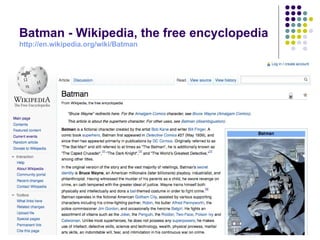
Batman - Wikipedia, the free encyclopedia
http://en.wikipedia.org/wiki/Batman
Citations & References
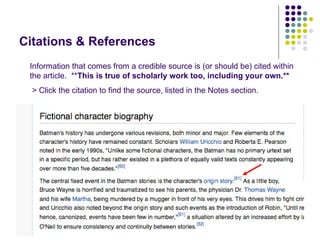
 Information that comes from a credible source is (or should be) cited within
 the article. **This is true of scholarly work too, including your own.**
  > Click the citation to find the source, listed in the Notes section.
Citations & References
Books & other offline sources
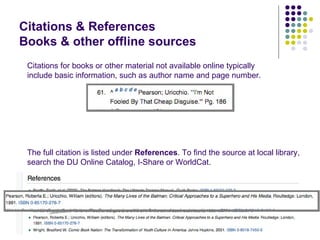
 Citations for books or other material not available online typically
 include basic information, such as author name and page number.


 The full citation is listed under References. To find the source at local library,
 search the DU Online Catalog, I-Share or WorldCat.
Citations & References
Websites & online sources
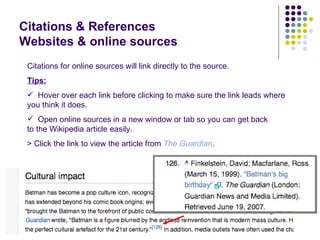
 Citations for online sources will link directly to the source.
 Tips:
  Hover over each link before clicking to make sure the link leads where
 you think it does.
  Open online sources in a new window or tab so you can get back
 to the Wikipedia article easily.
 > Click the link to view the article from The Guardian.
Evaluating Sources
Evaluating Sources

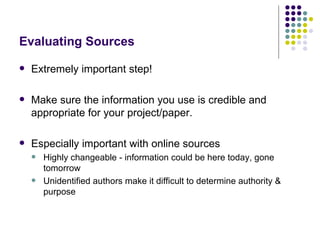
   Extremely important step!

   Make sure the information you use is credible and
    appropriate for your project/paper.

   Especially important with online sources
       Highly changeable - information could be here today, gone
        tomorrow
       Unidentified authors make it difficult to determine authority &
        purpose
Evaluating Sources
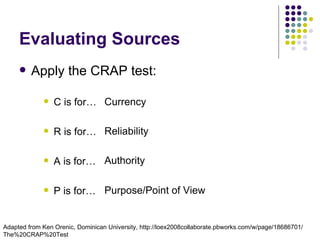
        Apply the CRAP test:

                C is for… Currency

                R is for… Reliability

                A is for… Authority

                P is for… Purpose/Point of View


Adapted from Ken Orenic, Dominican University, http://loex2008collaborate.pbworks.com/w/page/18686701/
The%20CRAP%20Test
Now it’s your turn!
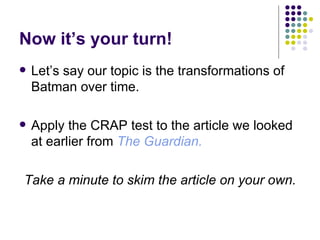
   Let’s say our topic is the transformations of
    Batman over time.

   Apply the CRAP test to the article we looked
    at earlier from The Guardian.

Take a minute to skim the article on your own.
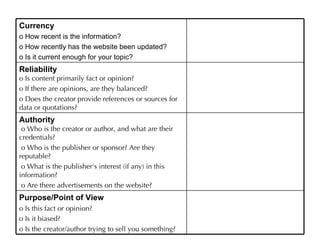
Currency
o How recent is the information?
o How recently has the website been updated?
o Is it current enough for your topic?
Reliability
o Is content primarily fact or opinion? 
o If there are opinions, are they balanced?
o Does the creator provide references or sources for
data or quotations?
Authority
 o Who is the creator or author, and what are their
credentials?
 o Who is the publisher or sponsor? Are they
reputable?
 o What is the publisher's interest (if any) in this
information?
 o Are there advertisements on the website?
Purpose/Point of View
o Is this fact or opinion?
o Is it biased?
o Is the creator/author trying to sell you something?
Discussion

   Would you include this resource in the
    annotated bibliography?

   Why or why not?

Library User Instruction - Wikipedia Presentation

  • 1.
    Using Wikipedia to Begin Research Christina Janiczek LIS 764: Fall 2011 Instruction Session
  • 2.
    Agenda  Look at Wikipedia article about a fictional hero  Use the citations & references to find resources  Evaluate resources using the CRAP test  Class activity - Apply the CRAP test to a website
  • 3.
    Citations & References Wikipediaand beyond  You can use this research strategy for just about any source in which information is cited:  Scholarly articles  Your textbook  Websites, etc.  Looking at reference lists and bibliographies is an easy way to start exploring the existing literature on a topic.
  • 4.
    Batman - Wikipedia,the free encyclopedia http://en.wikipedia.org/wiki/Batman
  • 5.
    Citations & References Information that comes from a credible source is (or should be) cited within the article. **This is true of scholarly work too, including your own.** > Click the citation to find the source, listed in the Notes section.
  • 6.
    Citations & References Books& other offline sources Citations for books or other material not available online typically include basic information, such as author name and page number. The full citation is listed under References. To find the source at local library, search the DU Online Catalog, I-Share or WorldCat.
  • 7.
    Citations & References Websites& online sources Citations for online sources will link directly to the source. Tips:  Hover over each link before clicking to make sure the link leads where you think it does.  Open online sources in a new window or tab so you can get back to the Wikipedia article easily. > Click the link to view the article from The Guardian.
  • 8.
  • 9.
    Evaluating Sources  Extremely important step!  Make sure the information you use is credible and appropriate for your project/paper.  Especially important with online sources  Highly changeable - information could be here today, gone tomorrow  Unidentified authors make it difficult to determine authority & purpose
  • 10.
    Evaluating Sources  Apply the CRAP test:  C is for… Currency  R is for… Reliability  A is for… Authority  P is for… Purpose/Point of View Adapted from Ken Orenic, Dominican University, http://loex2008collaborate.pbworks.com/w/page/18686701/ The%20CRAP%20Test
  • 11.
    Now it’s yourturn!  Let’s say our topic is the transformations of Batman over time.  Apply the CRAP test to the article we looked at earlier from The Guardian. Take a minute to skim the article on your own.
  • 12.
    Currency o How recentis the information? o How recently has the website been updated? o Is it current enough for your topic? Reliability o Is content primarily fact or opinion?  o If there are opinions, are they balanced? o Does the creator provide references or sources for data or quotations? Authority  o Who is the creator or author, and what are their credentials?  o Who is the publisher or sponsor? Are they reputable?  o What is the publisher's interest (if any) in this information?  o Are there advertisements on the website? Purpose/Point of View o Is this fact or opinion? o Is it biased? o Is the creator/author trying to sell you something?
  • 13.
    Discussion  Would you include this resource in the annotated bibliography?  Why or why not?

Editor's Notes

  • #5 Click link and go to Content > Cultural Impact