Library and
Information Management
Introduction
With the advancement of technology, we have seen
tremendous growth in information technology, internet,
and mobile technologies which adversely affect the
libraries and their operations and services. Web searches
and social media provide a lot of information and thus
they attract more patrons outside the library
environment. As the source for the information has
changed, the librarians should adopt new ways to bring
the information to the doorstep of the patrons.
In this presentation, we will discuss all of it.
Objectives of the Study
The objectives to study are as follows:
1. To study the need for management skills for library
professionals.
2. Description of the needs for management skills.
3. Identification of library professionals for management
skills.
4. To suggest measures for management skills for library
professionals.
Role of Management Skill to increase the
efficiency of Library functioning
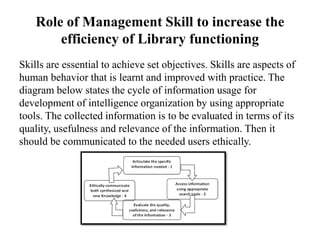
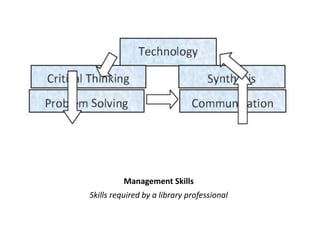
Skills are essential to achieve set objectives. Skills are aspects of
human behavior that is learnt and improved with practice. The
diagram below states the cycle of information usage for
development of intelligence organization by using appropriate
tools. The collected information is to be evaluated in terms of its
quality, usefulness and relevance of the information. Then it
should be communicated to the needed users ethically.
Management Skills needed for Library
Professionals
To grow easily a library professional must posses management skills.
Information technology has changed the concept of library totally so the
library professionals must posses skills as follows:
• Technical
• Communication
• Problem solving
• Critical thinking
• Decision making
• Leadership
• Team building
• Performance
• Time Management
• Motivating Skills
• Presentation Skills
Management Skills
Skills required by a library professional
Role of Librarian in the contemporary
environment
Role of Librarian becomes very vital in modern era. If a librarian
wants to adopt ne technologies, it is very necessary for him to
motivate staff and improve professional skills. They can adopt
SWOT (Strength, Weakness, Opportunities and Threats)
technique. The library staff must be educated to assume greater
responsibilities and to grow into demanding roles.
Categories of Library staff
The categories of staff vary from library to library. There are three basic groups:
1. Professionals: They constitute the top and middle level officers of the library,
holding positions like Director, Chief Librarian, Deputy Librarian, Assistant
Librarian and professional Assistants.
2. Semi Professionals: They give the much-needed support to higher-level work
in libraries. Their designations are technical assistants, library assistants,
catalogers, shelf assistants, etc.
3. Technical staff: Development of Local area network, computer application in
libraries, reprographic services and use of audio-visual material require
sophisticated electronic equipment and machinery handled by specialists.
4. Administrative Staff: Libraries require personnel to perform jobs relating
administrative and financial matters. These include purchase, store cleaning,
budget preparation, accounting, security, etc.
Conclusion
• To minimize the expense and maximize the output,
management skills are must to library professionals.
• Highly flexible and sophisticated man power with soft skills
are to be needed to handle advanced technological tools.
• Librarians may adopt SWOT(Strength, Weakness,
Opportunities and Threats) technique.
• Staff performance can be increased by using motivation.
• Authorities should take care in improving the environmental
and working conditions to the satisfaction of the workers.
References
• Moran, B. B., & Morner, C. J. (2017). Library and information
center management. ABC-CLIO.
• Choo, C. W. (2002). Information management for the
intelligent organization: the art of scanning the environment.
Information Today, Inc..
• Jones, W. (2007). Personal information management. Annual
review of information science and technology, 41(1), 453-504.
• Prytherch, R. (2016). Harrod's librarians' glossary and
reference book: a directory of over 10,200 terms,
organizations, projects and acronyms in the areas of
information management, library science, publishing and
archive management. Routledge.
Thank You

Library management skills

  • 1.
  • 2.
    Introduction With the advancementof technology, we have seen tremendous growth in information technology, internet, and mobile technologies which adversely affect the libraries and their operations and services. Web searches and social media provide a lot of information and thus they attract more patrons outside the library environment. As the source for the information has changed, the librarians should adopt new ways to bring the information to the doorstep of the patrons. In this presentation, we will discuss all of it.
  • 3.
    Objectives of theStudy The objectives to study are as follows: 1. To study the need for management skills for library professionals. 2. Description of the needs for management skills. 3. Identification of library professionals for management skills. 4. To suggest measures for management skills for library professionals.
  • 4.
    Role of ManagementSkill to increase the efficiency of Library functioning Skills are essential to achieve set objectives. Skills are aspects of human behavior that is learnt and improved with practice. The diagram below states the cycle of information usage for development of intelligence organization by using appropriate tools. The collected information is to be evaluated in terms of its quality, usefulness and relevance of the information. Then it should be communicated to the needed users ethically.
  • 5.
    Management Skills neededfor Library Professionals To grow easily a library professional must posses management skills. Information technology has changed the concept of library totally so the library professionals must posses skills as follows: • Technical • Communication • Problem solving • Critical thinking • Decision making • Leadership • Team building • Performance • Time Management • Motivating Skills • Presentation Skills
  • 6.
    Management Skills Skills requiredby a library professional
  • 7.
    Role of Librarianin the contemporary environment Role of Librarian becomes very vital in modern era. If a librarian wants to adopt ne technologies, it is very necessary for him to motivate staff and improve professional skills. They can adopt SWOT (Strength, Weakness, Opportunities and Threats) technique. The library staff must be educated to assume greater responsibilities and to grow into demanding roles.
  • 8.
    Categories of Librarystaff The categories of staff vary from library to library. There are three basic groups: 1. Professionals: They constitute the top and middle level officers of the library, holding positions like Director, Chief Librarian, Deputy Librarian, Assistant Librarian and professional Assistants. 2. Semi Professionals: They give the much-needed support to higher-level work in libraries. Their designations are technical assistants, library assistants, catalogers, shelf assistants, etc. 3. Technical staff: Development of Local area network, computer application in libraries, reprographic services and use of audio-visual material require sophisticated electronic equipment and machinery handled by specialists. 4. Administrative Staff: Libraries require personnel to perform jobs relating administrative and financial matters. These include purchase, store cleaning, budget preparation, accounting, security, etc.
  • 9.
    Conclusion • To minimizethe expense and maximize the output, management skills are must to library professionals. • Highly flexible and sophisticated man power with soft skills are to be needed to handle advanced technological tools. • Librarians may adopt SWOT(Strength, Weakness, Opportunities and Threats) technique. • Staff performance can be increased by using motivation. • Authorities should take care in improving the environmental and working conditions to the satisfaction of the workers.
  • 10.
    References • Moran, B.B., & Morner, C. J. (2017). Library and information center management. ABC-CLIO. • Choo, C. W. (2002). Information management for the intelligent organization: the art of scanning the environment. Information Today, Inc.. • Jones, W. (2007). Personal information management. Annual review of information science and technology, 41(1), 453-504. • Prytherch, R. (2016). Harrod's librarians' glossary and reference book: a directory of over 10,200 terms, organizations, projects and acronyms in the areas of information management, library science, publishing and archive management. Routledge.
  • 11.