LIBERATE YOUR LEARNERS
Michelle Ockers
@michelleockershttps://s3-us-west-
1.amazonaws.com/photos.snapwi.re/Week+14/SW_PaulFilitchkin3.jp
g
Your L&D team?
Source: http://www.sam-solutions.us/blog/how-to-develop-software-when-your-team-is-too-busy
Your people?
http://tineller.me/gallery/just-train-me/
What you wish they would do?
Keeping up with speed of business?
My context
Systems Capability
How it began
Source: http://20somethingfinance.com/2011-flexible-spending-account-fsa-changes/
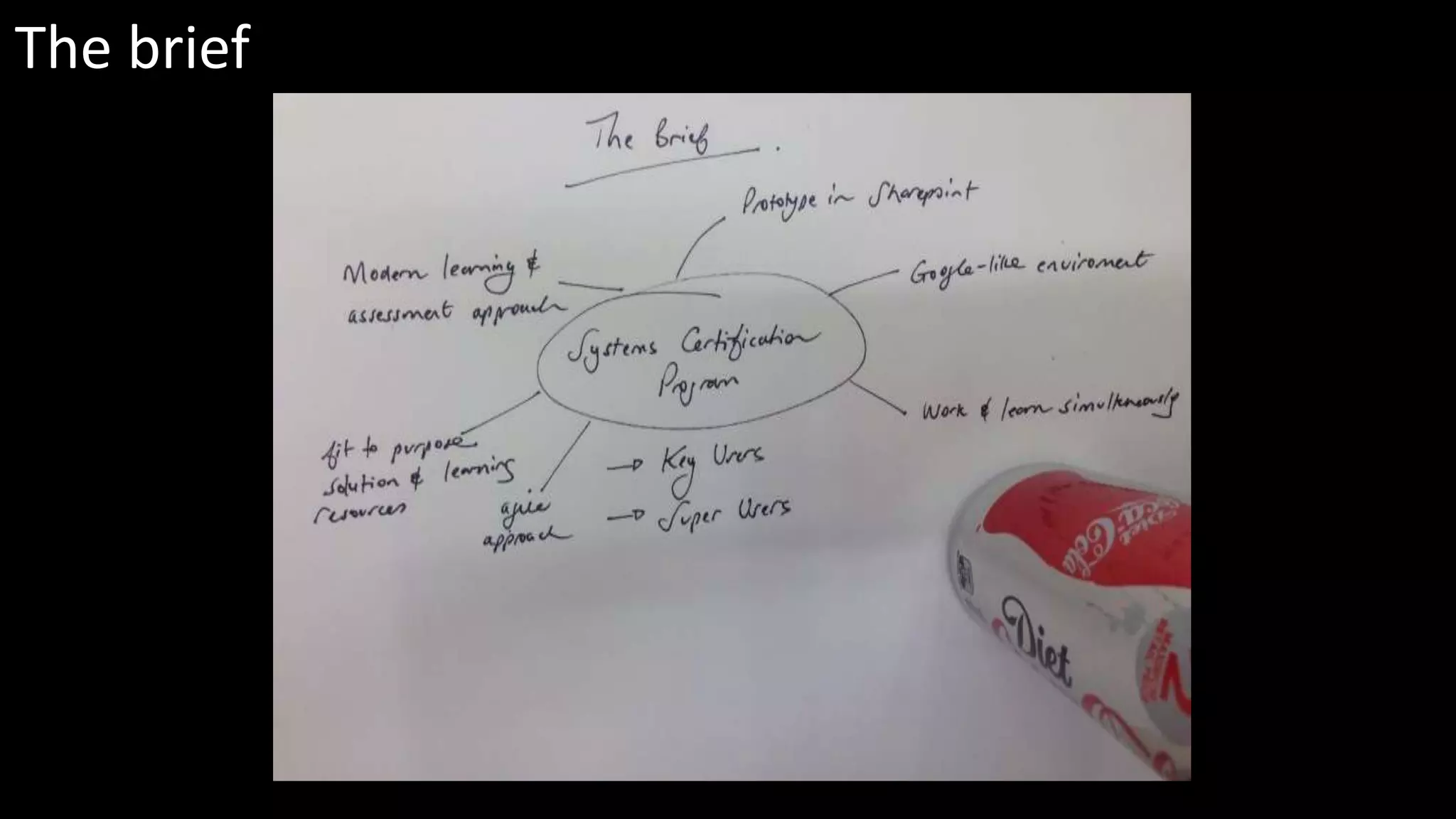
The brief
The prototype
Systems
Systems
Systems
Systems
SAP Hub
Maximo Hub
ActivPlant Hub
Come along on 28 Nov to see the CCA team present on
#SAP #master data at the SAP User Group in Sydney –
alongside Staples and Kimberly-Clark
http://www.saug.com.au/communities/event/207/master
-data-strategy-overview-from-staples-coca-cola-amatil-
and-kimberly-clark
Really productive #syrup room #SAP best practice session
today with Key users from every State. We mapped out a
streamlined process that you can view at the link below.
Change request raised and with IS for assessment. Thanks
@[JulieCox] for great facilitation!
https://ccamatil1.sharepoint.com/sites/AustraliaSCSyste
ms/SitePages/SyrupRoomSAP.aspx
Supply Chain Systems
Matrix
Super User & Key User
Directory
Knowledge Bites
SC Multi-Media Library
Syrup Room
Optimisation
Maximo Mobile Project
A platform is not enough
+ =
Conditioning – could this be true?
Why isn’t IT training
me?
Here you go!
http://smallville.wikia.com/wiki/Kara_Kenthttp://tineller.me/gallery/just-train-me/
There’s something in this….
Permission to be free
Work Connect and Learn
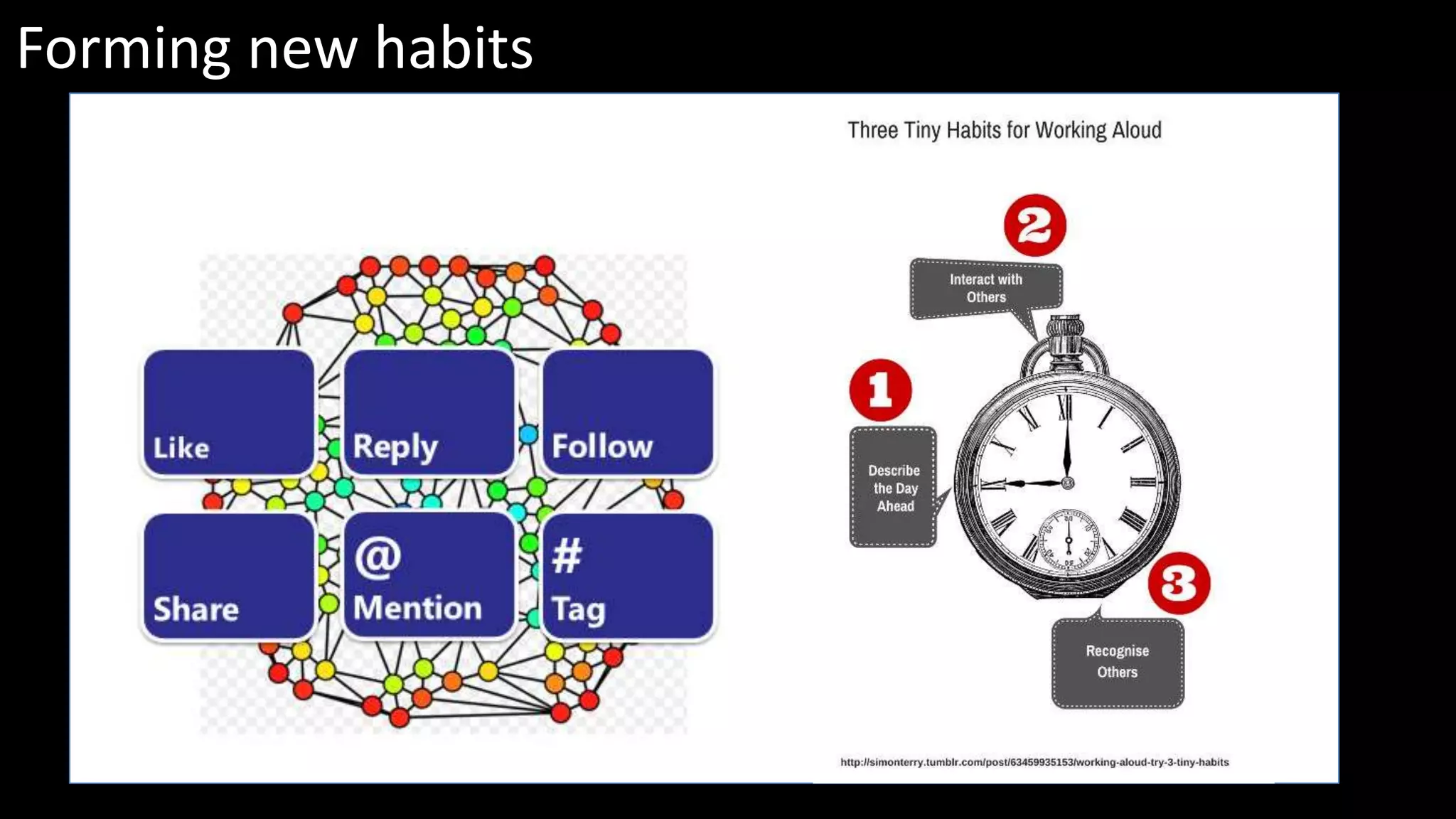
Forming new habits
More than training & eLearning
http://c4lpt.co.uk/litw-results/
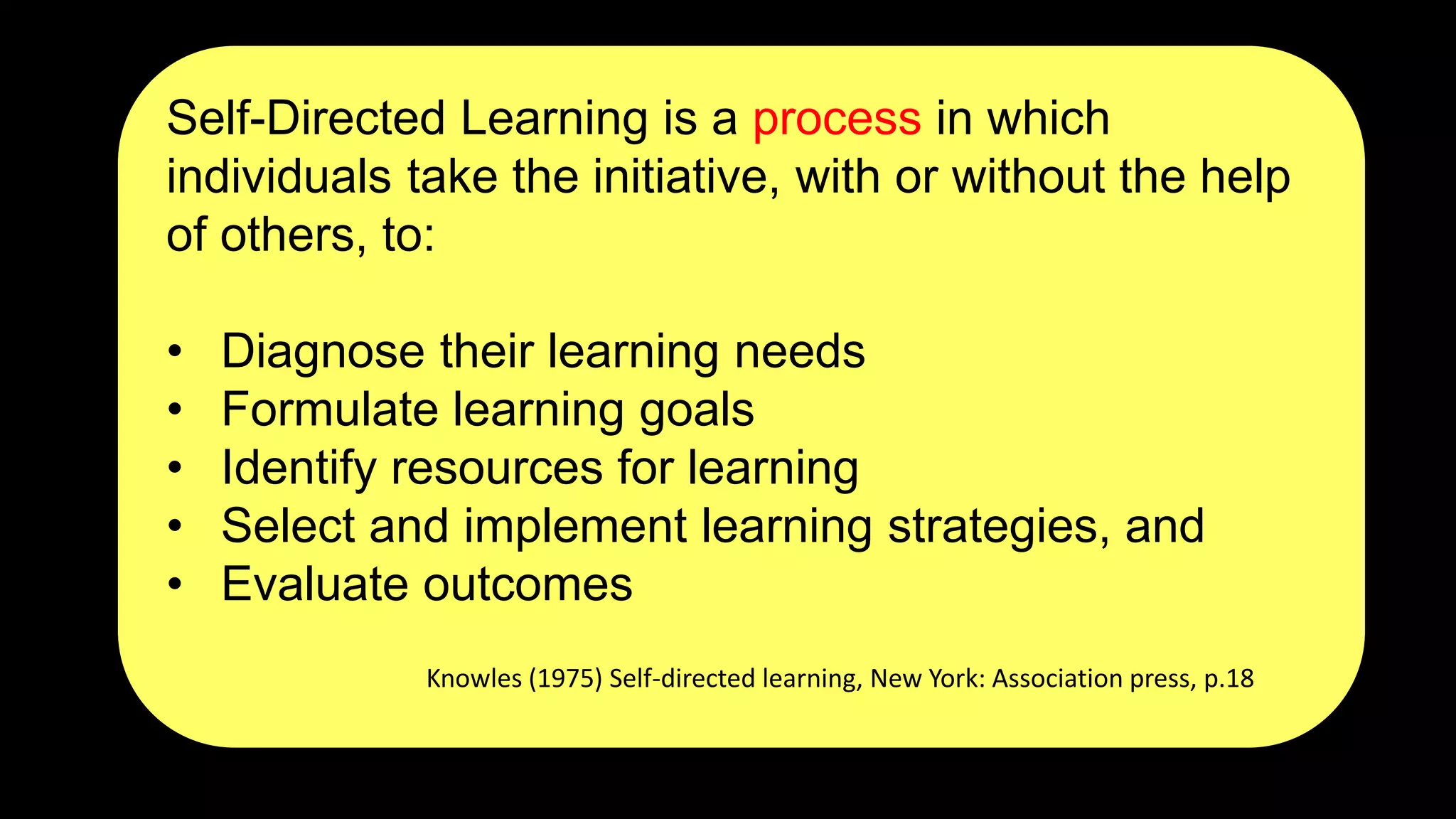
Self-Directed Learning is a process in which
individuals take the initiative, with or without the help
of others, to:
• Diagnose their learning needs
• Formulate learning goals
• Identify resources for learning
• Select and implement learning strategies, and
• Evaluate outcomes
Knowles (1975) Self-directed learning, New York: Association press, p.18
G
A
M
E
Goal
Action
Monitor
Evaluate & Extend
A process for self-directed learning
Source of GAME process - http://www.slideshare.net/pjimison/selfdirected-learning-23482363?related=1
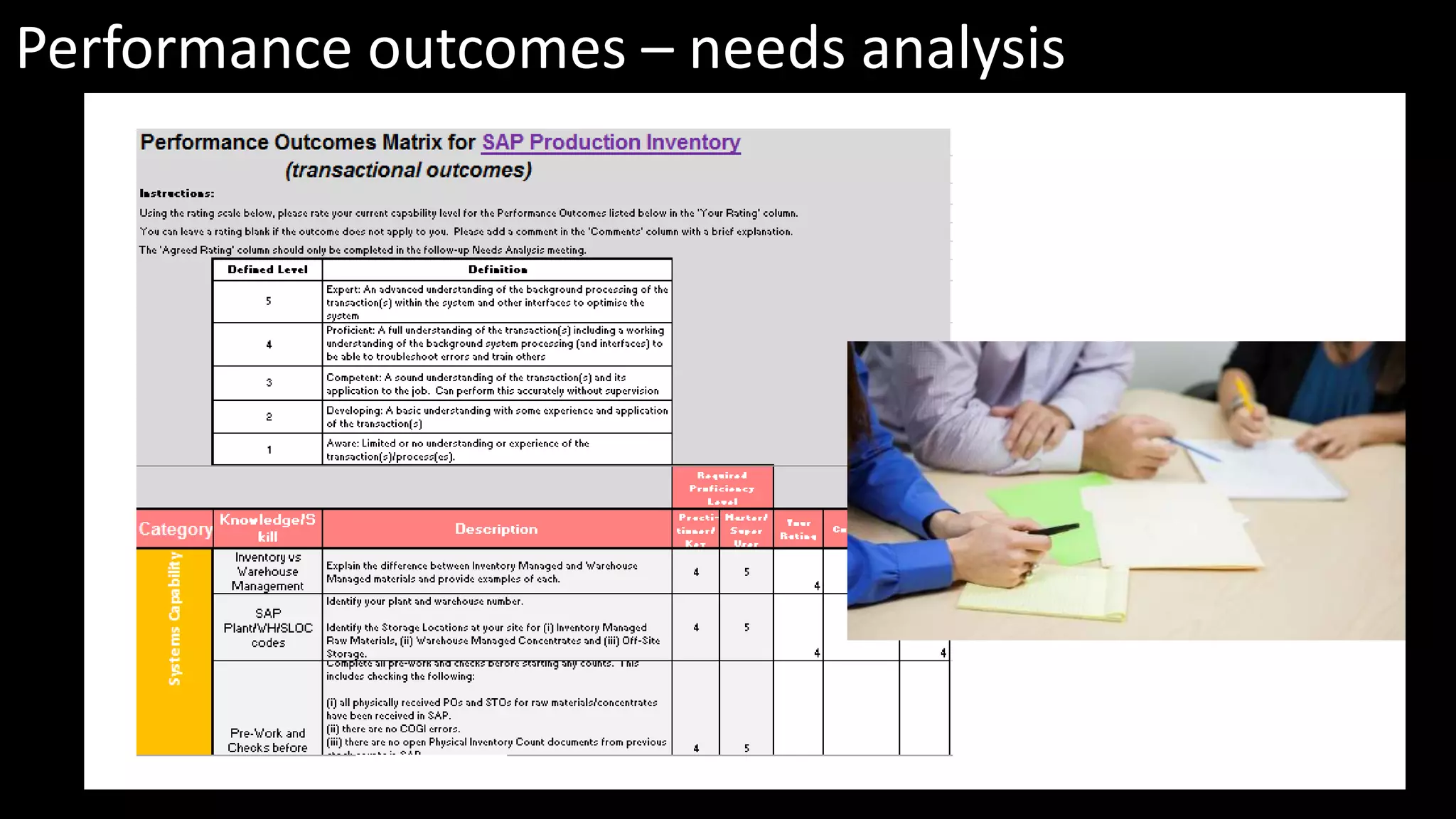
Performance outcomes – needs analysis
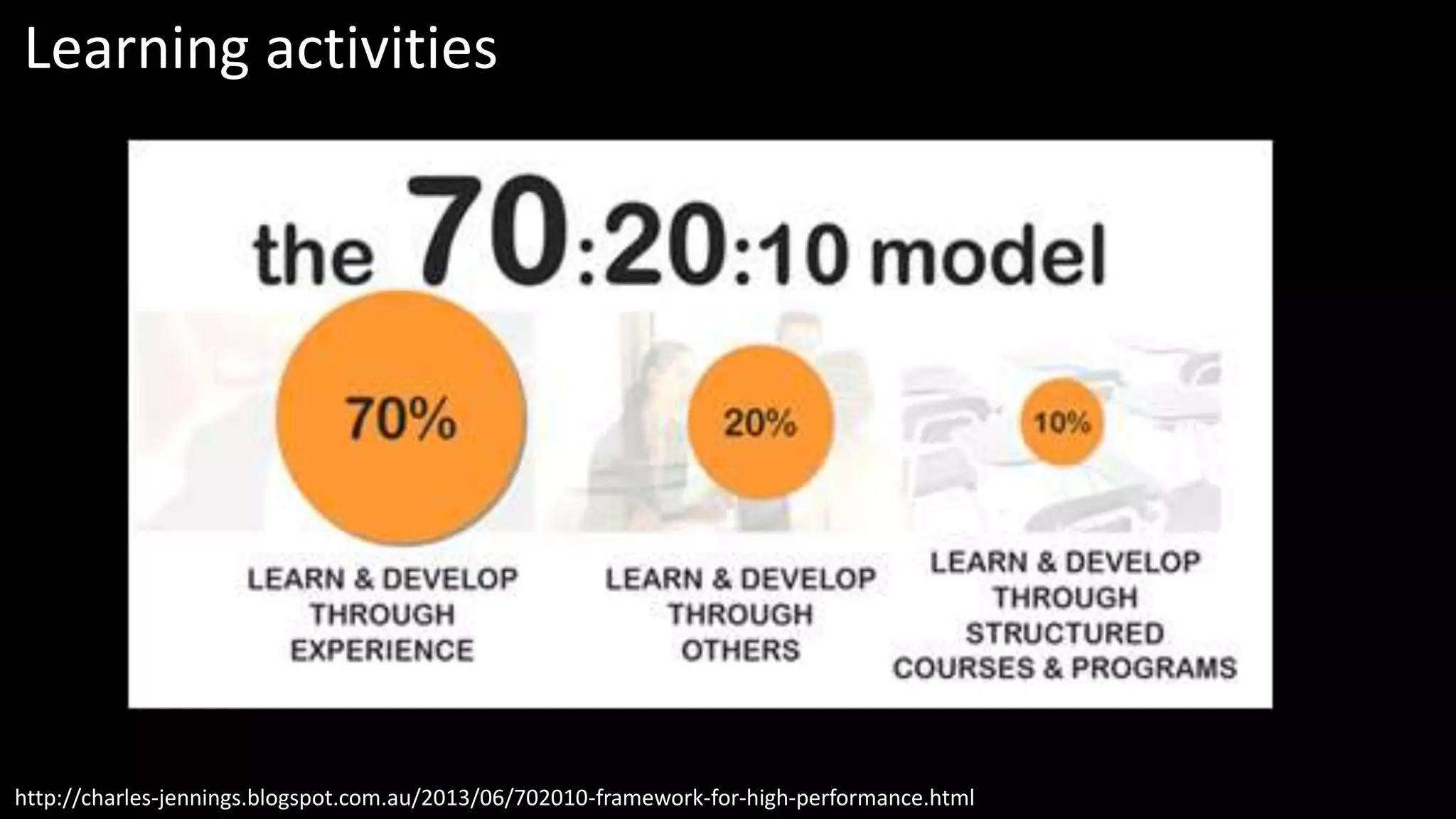
Learning activities
http://charles-jennings.blogspot.com.au/2013/06/702010-framework-for-high-performance.html
Weekly
M Monitor
http://www.bestlegalpractices.com/social-media-success-in-10-minutes-a-day/
What?
So What?
Now What?
Monthly
E Evaluate & Extend
http://baneofyourresistance.com/2013/11/22/no-time-to-write-really/
 Goal-setting
 Identify learning activities
& resources
 Self-organisation
 Time management
 Critical reflection
Skills are required
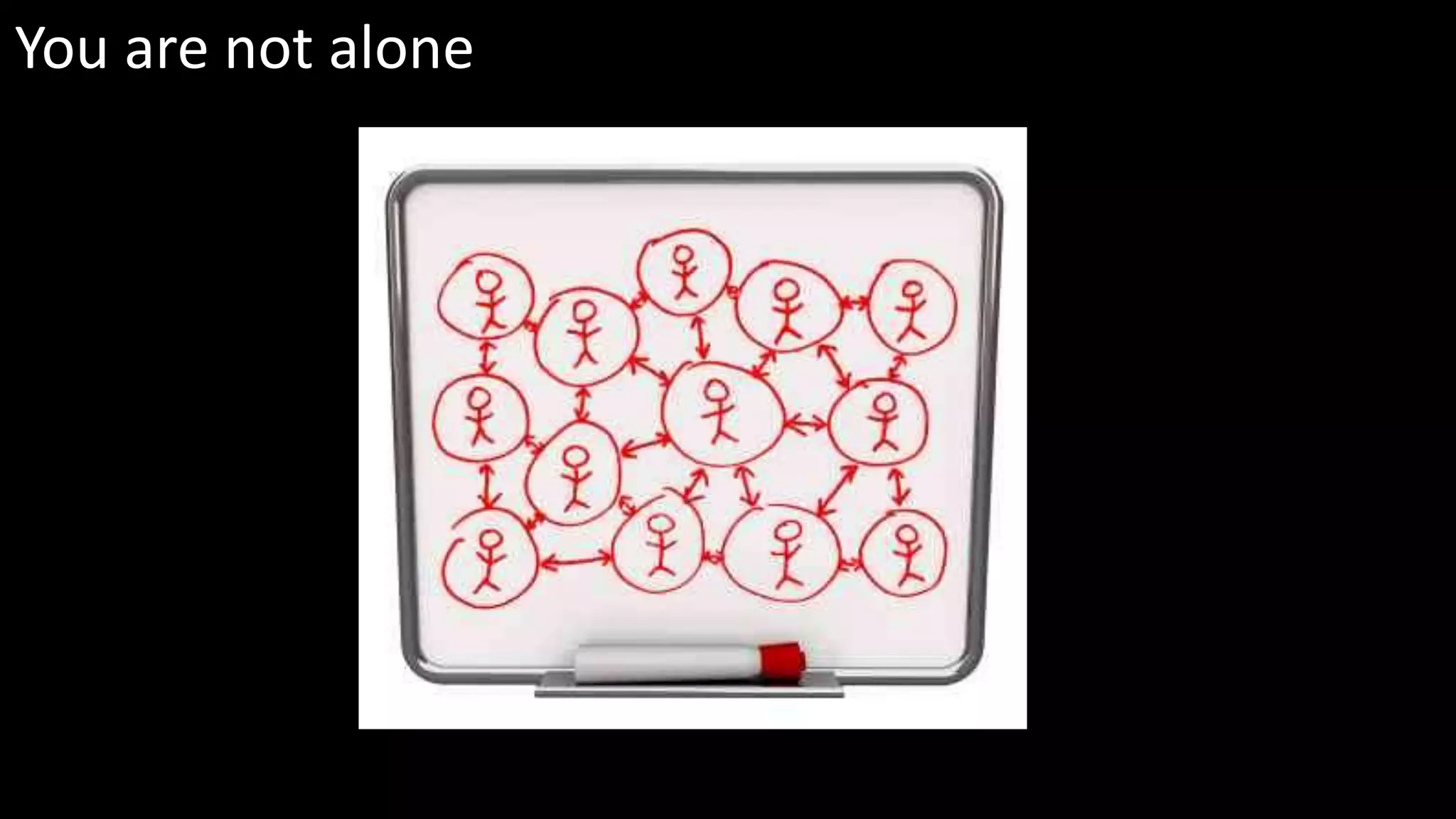
You are not alone
Learning coaches
http://www.zazzle.com.au/school+sports+coach+womens+clothing
What Next for us?
Going slow to go fast
Self-Directed Learning Readiness Scale
www.lpasdlrs.com
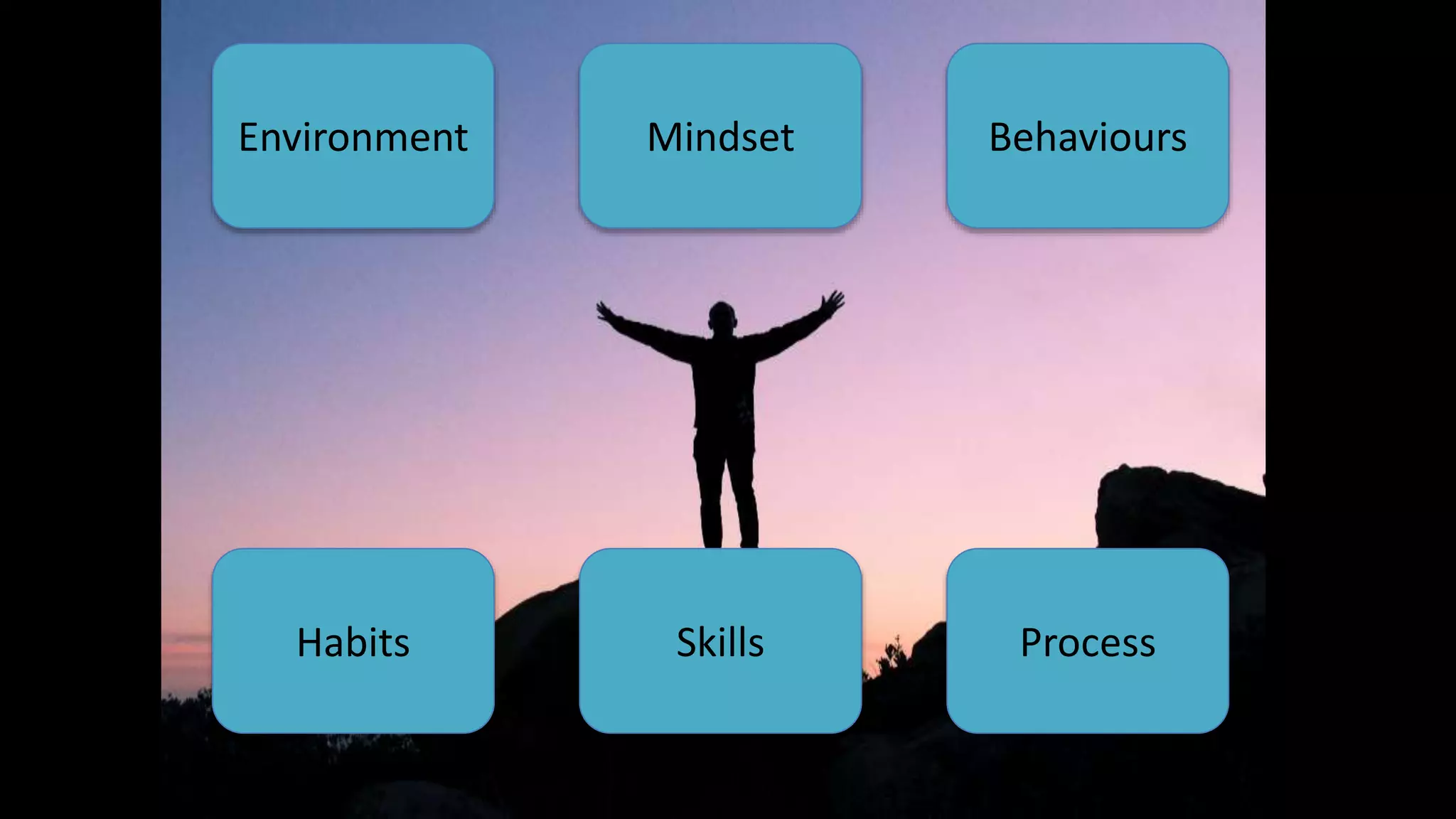
Environment Mindset Behaviours
Habits Skills Process
@michelleockers
michelleockers
www.michelleockers.com
Questions?

Liberate your learners

Editor's Notes

  • #3 Ever feel like your L&D team has too many balls in the air, is trying to juggle too many priorities.
  • #4 Have you ever heard the complaint or excuse “but no-one has trained me.”
  • #5 Do you ever wish people in your organisation would take more initiative and responsibility for their own learning? Without waiting for someone else to ‘train them’, thus alleviating some of the pressure on small L&D teams with tight budgets and too many priorities?
  • #6 Do you have difficulty keeping up with the pace of change in business? Keeping up with the need for new knowledge and skills? As Charles Jennings would ask, “Can you organisation learn at the speed of business?”
  • #7  Perhaps you share some of these challenges with me, and my organisation. My role is to develop technical capability in Supply Chain at Coca-Cola Amatil. Challenges such as these are driving a range of initiatives to shift how people learn. One of these is to empower and enable more effective self-directed learning.
  • #8 One area we are focussing on this year is capability in use of computer systems and associated processes in manufacturing and maintenance. We have started with our Super Users and Key Users (around 40 people across Australia), using an internally developed certification program to lift performance. This will have a knock-on impact to performance of End Users and overall business performance. Strategies within this program include performance analysis, Communities of Practice, performance support, and user-generated content. Ultimately the key to this program is self-directed learning. So, we are using this program to figure out how to liberate our learners – how to enable them to purposefully take charge of their own learning and to support each other to learn. And also to figuring out what that means for those of us who work in L&D.
  • #9 During 2014 there’d been some restructuring in Supply Chain which had resulted in a 10% cut in our permanent head count. We lost some people who were Go To people for key business systems. We knew that our IT department would be shrinking in the coming year. For too long Supply Chain had not been masters of their own destiny in regard to our systems capability. It was October, time for annual planning. A senior manager, Bill, came to me to talk about systems capability. His team had reviewed current state of our systems. Bill has strong commercial acumen. When he focuses on something you can almost see it being pulled apart and Bill figuring out how to to put it back together so it works better. He can also be a bit like a coiled spring – as he focuses in on something there’s an intense energy that builds around that thing, attracting others to his vision and resources to his plan.
  • #10 Bill wanted the Academy, which I lead, to come up with an approach to address business continuity risk associated with the people in our Super User and Key User roles. He’d seen some of the work we’d started doing in knowledge sharing in our Maintenance & Engineering areas and was enthusiastic that we do something really “modern”. He talked about creating a Google-like environment where people could tap into resources and each other. He talked about people learning fluidly as they worked. The word agile was mentioned more than once. He asked for a strategy that he could present to the Senior Management Team within a week. I got working on this with one of my team members, Justine and we duly sat down the following Thursday with the obligatory PowerPoint presentation. Well, said Bill, this is headed in the right direction, but we need to make it more compelling so that the SMT buys in – so that we get the commitment and resources to make it happen. I’m giving you 24 hours to build a prototype of the Google-like environment.
  • #11 That was a challenge. But we did it. And Bill was delighted with what he saw. The energy in the coiled spring released and he bounced out of the room with the prototype ready to sell the overall approach to the SMT. This left Justine and I to look at each other with a mixture of excitement and a tinge of concern about what had been set in motion.
  • #12 Because delivering on this kind of vision is easier said than done. And we knew that just because this ‘Google like environment’ built, people wouldn’t just come and play. Particularly if the game was new to them and they weren’t sure of the rules. Even if we told them the rules, this wouldn’t be enough to make it happen. But what would we need to tackle?
  • #13 In November I came across the idea of learned helplessness in learning via blog posts from Mark Britz and Nick Leffler, people in my Personal Learning Network. In a 2011 post Mark argues that the power of formal learning lies on its pervasiveness.  We are "trained" at school to the idea that learning only happens when someone is teaching. And this conditioning continues with classroom training and eLearning in the workplace. Learning is controlled by others. Nick also suggests that we have forgotten how to explore due to formal learning. He tells a story of his days as a computer tech in a school where people would ask him how to do some thing rather than figure it out for themselves.   This idea of conditioning creating learned helplessness aroused my curiousity and I wonder whether it was really true – both generally, and specifically whether it was at play in my organisation.
  • #14 It wasn’t long before I had an ‘aha’ moment on this question – in a way that left me, well, a little embarrassed. I regard myself as a strong self-directed learner and was proud of the online Personal Learning Network I had created. However, my view of myself was about to be shaken. There were a couple of things from the prototype that I didn’t know how to build in SharePoint– one was a discussion forum, and the other was a site for knowledge sharing which used features that I had not seen used within CCA, although I’d seen them elsewhere. I floated a few questions past our IT department, but didn’t find their replies very helpful – particularly the one where they said that custom development was not allowed. I put off making a start on figuring out how to set these things up. I caught myself complaining that IT were not at all helpful and wondering aloud (probably a touch too loudly) why they weren’t training me. Enter the hero of this story – Helen Blunden. Helen, from Activate Learning Solutions was working with us on establishment of a community of practice for our Maintenance & Engineering teams. While I was sitting a little paralysed she was hooking into learning about SharePoint. It wasn’t long before she started sending me links to how to guides, online discussions and videos showing how to do what we wanted.
  • #15 I could see that there was something in the idea of the workplace setting potentially conditioning people to expect to be trained rather than actively seeking to address their own learning needs, and that mindset was a part of what we needed to address.
  • #16 I have since discussed conditioning and mindset with our Super Users and Key Users so that they can look out for it in themselves. I have also given them explicit permission to open the cage and be free as learners – just in case any of them needed it. Imagine for a moment what you might do if you had been inside a cage that you didn’t even know existed, dependent on someone else for survival – for the occasional scrap of food and water. Then suddenly someone pointed out the bars to you, opened the door and asked you to go find food yourself. What would you do? Some of you may spread your wings and soar. Others may walk tentatively out of the cage, but stay close by. Some would remain sitting on the perch inside the cage, not sure what to do. Awareness and permission are a step in the right direction, but it’s not just mindset we need to address to liberate our learners.
  • #17 Behaviours, skills and learning processes also need to be address. We can’t just tell them to go forth and take charge of their own learning. We have to support them. Here is where our guided social learning program, Work Connect and Learn comes in. We conduct this program over a period of five weeks using a weekly one hour webinar with pre and post webinar activities. The activities which use resources curated from the internet, discussions in online forums and use of other collaboration tools.
  • #18 Early in the program we introduce skills for connecting with others and building a network, and collaborating with others, no matter where they are. We ask them to start building a daily habit of applying these behaviours and working out loud. Some of you may recognise the Three Tiny Habits poster from Simon Terry, which has been a clear, easy to use tool to help people to start to create habits around these new behaviours. Each week we check how people are going building these habits and what value they are seeing in them.
  • #19 In week 4 of the program we explicitly address Self-Directed learning. We start by exploring how people learn in the modern workplace. Some of you may have seen, or even participated in, Jane Hart’s Learning in the Workplace survey where she asks participants to rank a list of learning methods from 1-10 based on the impact or value of that learning method. We replicated this survey internally with our Systems group and compared the results with the global survey. 3 of the top 4 results were the same – knowledge sharing within your team, general conversations and meetings, and networks and communities. I do wonder if we had run this survey before we started the Work Connect and Learn program rather than three weeks into it whether the results would have been different. The key point made through this survey is that modern workplace learning is more than training and eLearning, and that in face learning from instruction through courses – either online or face to face – is really a small part of how we learn.
  • #20 Having discussed mindset, behaviours and habits we then moved on to process. Malcolm Knowles defines self-directed learning as a process – one in which the individual takes initiative, with or without the help of others, for their own learning. I pointed out to our Super Users and Key Users that they had been asked to perform this role (which, by the way, is not their primary role but an add-on) based in part on their initiative and ability to learn. We had also confirmed through discussion during the webinar that they were already learning as they worked. However, there was an opportunity for them to get more purposeful and effective in how they managed their own learning by applying a simple process.
  • #21 We introduced them to a four step process represented by the acronym ‘GAME’. We walked through each step of the GAME process and discussed ideas for what and how they could do things at each step.
  • #22 Early in the year we had conducted an individual needs analysis with each Super User and Key User to baseline their current knowledge and skill against a series of performance outcomes. This meant that each person had a very clear picture of where their development opportunities were. We had asked them to use this analysis to identify and prioritise their development goals, to document these in their Individual Development Plan.
  • #23 As a group we brainstormed practical ideas for learning activities across the 702010 framework.
  • #24 We suggested that they take 10 minutes every week to look at their Individual Development Plan, check what they had done in the previous week, and identify and plan learning activities in the coming week.
  • #25 We also suggested that once a month they take 15 minutes to evaluate their progress against the performance outcomes from the Needs Analysis as well as the effectiveness of their learning strategies and activities. We gave them three questions to use for this reflection – What, So What, Now What.
  • #26 Of course, there are some skills required to effectively manage your own learning. These include goal setting, identifying learning activities & resources, organising yourself and managing your time, and reflecting on your progress and learning process. Perhaps some of the group weren’t strong in all of these skills.
  • #27 So we made sure they knew they were not alone. We discussed other people they could use to support their learning in a range of ways. These included pairing up with a learning buddy from the group, their manager who could help them in a variety of ways including accessing learning opportunities in the workplace, and their local Capability manager or Academy team who could act as learning coaches.
  • #28 Of course, the people in our Capability roles need to be comfortable with being learning coaches. This is an expansion of their role – beyond designing structured learning programs, creating and driving training plans. So, this is an ongoing discussion we are having in our Capability Community about our role in enabling self-directed learning.
  • #29 Even those who are positive about this change in their role do sometimes feel uncomfortable with it. More than once I’ve had people in the Capability Team say to me “but we’re not moving fast enough with this program” or “our Super Users and Key Users are too busy to create content”. I assure them that this is a long term game, that we are shifting our learning culture and initially we may need to go slow to go fast.
  • #30 One final tool I want to mention is the Self-Directed Learning Readiness diagnostic which is available online. It helps to identify an individual’s readiness for Self-Directed learning and we are using it to help identify which people in our group may benefit from some additional support with managing their own learning. I took the survey, curious to see how ready I really was for Self-Directed Learning given the way I had complained about IT not training me on SharePoint. I was greatly relieved to find that I rated in the 90th percentile and my faith in myself to manage my own learning and sense of credibility to help liberate learners in my organisation was restored. Note: In order to determine the content of the SDLRS, a three-round Delphi survey of authorities on self-direction was done. Of the 20 persons asked to participate in the survey, 14 agreed. The participants were: Drs. Herbert A. Alf, B. Frank Brown, Edward G. Buffie, Arthur W. Chickering, Patricia M. Coolican,Gerald T. Gleason, Winslow R. Hatch, Cyril O. Houle (first two rounds only), Malcolm S. Knowles, Wilbert J. McKeachie, Barry R. Morstain, Mary M. Thompson, Allen Tough, and Morris Weitman.The Delphi survey involved the listing and rating of characteristics which the authorities considered important for self-direction in learning, including attitudes, abilities, and personality characteristics. Characteristics emerging from the Delphi survey with a median rating of desirable, necessary, or essential for self-direction in learning were used as a basis for the construction of items for the SDLRS. A detailed description of the Delphi process and of the original developmental work on the Self-Directed Learning Readiness Scale is described in Dr. Guglielmino's dissertation, referenced on the website www.lpasdlrs.com
  • #31 In summary, here is the list of factors we are addressing in order to liberate our learners. Environment Mindset Behaviours Habits Skills Process
  • #32 I do blog about my work and Personal Knowledge Management so if you are interested in hearing more please read my blog or follow me on Twitter. Do we have time for questions?