LEARNING
TARGETS:
Identify thecorrect and faulty
parallelism, types, and functions. (A)
Use the correct parallelism in sharing
ideas. (M)
Create a story that has correct
parallelism. (T)
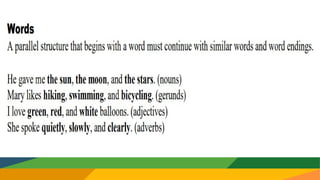
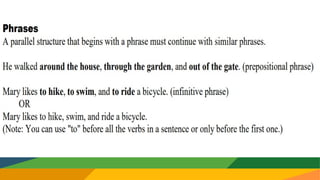
• Refers totwo or more words,
phrases, clauses, or sentences
that have similar grammatical form
or structure.
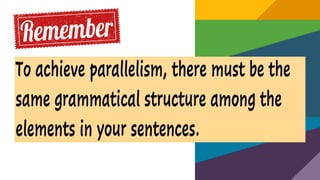
• They have the same pattern and
rhythm, which pertains to how words
are arranged in a sentence.
• It adds up to the cohesion of a
sentence or paragraph.
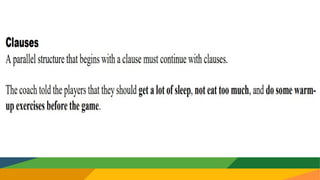
• creates asense of rhythm and balance in writing by
using the same grammatical structure to express equal
ideas
• improves the consistency and clarity of any piece of
writing
• aim to maintain similar structures in your writing to
avoid grammatical errors and to enhance your
writing style
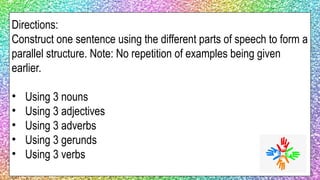
Directions:
Construct one sentenceusing the different parts of speech to form a
parallel structure. Note: No repetition of examples being given
earlier.
• Using 3 nouns
• Using 3 adjectives
• Using 3 adverbs
• Using 3 gerunds
• Using 3 verbs
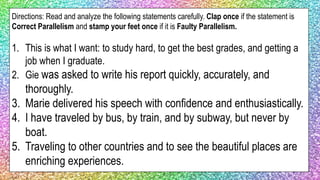
Directions: Read andanalyze the following statements carefully. Clap once if the statement is
Correct Parallelism and stamp your feet once if it is Faulty Parallelism.
1. This is what I want: to study hard, to get the best grades, and getting a
job when I graduate.
2. Gie was asked to write his report quickly, accurately, and
thoroughly.
3. Marie delivered his speech with confidence and enthusiastically.
4. I have traveled by bus, by train, and by subway, but never by
boat.
5. Traveling to other countries and to see the beautiful places are
enriching experiences.
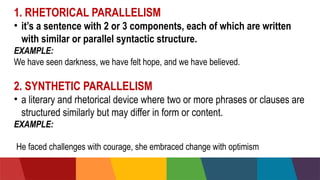
1. RHETORICAL PARALLELISM
•it’s a sentence with 2 or 3 components, each of which are written
with similar or parallel syntactic structure.
EXAMPLE:
We have seen darkness, we have felt hope, and we have believed.
2. SYNTHETIC PARALLELISM
• a literary and rhetorical device where two or more phrases or clauses are
structured similarly but may differ in form or content.
EXAMPLE:He faced challenges with courage, she embraced change
with
He faced challenges with courage, she embraced change with optimism..
32.
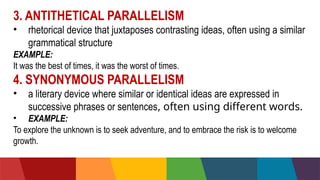
3. ANTITHETICAL PARALLELISM
•rhetorical device that juxtaposes contrasting ideas, often using a similar
grammatical structure
EXAMPLE:
It was the best of times, it was the worst of times.
4. SYNONYMOUS PARALLELISM
• a literary device where similar or identical ideas are expressed in
successive phrases or sentences, often using different words.
• EXAMPLE:
To explore the unknown is to seek adventure, and to embrace the risk is to welcome
growth.