Names and Formulas for Ionic Compounds
Lesson 3
Focus Question What are the names and formulas of ionic compounds?
New Vocabulary
formula unit
monatomic ion
polyatomic ion
oxyanion
Recall
An ionic compound is made up of ions
arranged in a repeating pattern.
Ionic compound
It has both cations and anions
positively charged ion (Cation) Ex: sodium ion Na+
negatively charged ion (Anion) Ex: Chloride Cl-
Ions
monatomic ion
is a one-atom ion
polyatomic ions
ions made up of more
than one atom
monatomic ion
• A monatomic ion is a one-atom ion, such as Mg2+
or Br–
.
Transition metals, which are in groups 3 through 12, and metals in groups 13 and 14 are
not included in Table 7 because they can form several different positive ions.
• The table below
gives the charges
of common
monatomic ions
according to their
location on the
periodic table.
• Polyatomic ions are ions made up of more than one atom.
• A polyatomic ion acts as an individual ion in a compound and its charge
applies to the entire group of atoms.
• Each polyatomic ion acts as a single unit and has one charge.
Nitrate ion
(NO3
–
)
Sulfate ion
(SO4
2–
)
The structure of
common
polyatomic ions
Examples:
Polyatomic ion
Table 9 list the
formulas and
charges of
common
polyatomic ions
• An oxyanion is a polyatomic
ion composed of an element,
usually a nonmetal, bonded
to one or more oxygen
atoms.
• More than one oxyanion
exists for some nonmetals,
such as nitrogen and sulfur.
Oxyanion
The name of an oxyanion
ends with “–ate” or “-ite”
Oxyanion
a) The -ite ending indicates one less oxygen atom than
the -ate ending. However, the ending does not tell you
the actual number of oxygen atoms in the ion
b) Hypo- indicates one oxygen less than -ite.
c) Per- indicates one oxygen more than -ate.
d) Adding Hydrogen to the name decreases the charge by
one.
Formula Name Formula Name
Ethanoate (acetate) CO3
2–
CN–
Peroxide
Hydroxide CrO4
2–
MnO4
–
Sulfite
Nitrite SO4
2–
NO3
–
bromate ion
Hypochlorite IO3
-
ClO2
–
Phosphite
Chlorate PO4
3–
ClO4
–
Ammonium ion
Based on the ion type, Ionic Compounds can be:
Binary ionic compounds
are composed of positively
charged monatomic ions of a
metal and negatively charged
monatomic ions of a nonmetal.
Polyatomic Ionic
Compounds
ionic compounds that
contain polyatomic ions
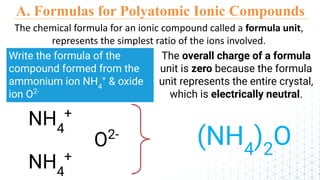
A. Formulas for Polyatomic Ionic Compounds
Write the formula of the
compound formed from the
ammonium ion NH4
+
& oxide
ion O2-
The chemical formula for an ionic compound called a formula unit,
represents the simplest ratio of the ions involved.
The overall charge of a formula
unit is zero because the formula
unit represents the entire crystal,
which is electrically neutral.
NH4
+
NH4
+
O2- (NH4
)2
O
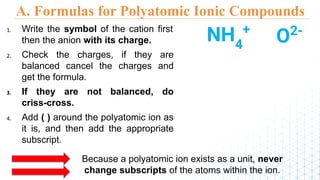
1. Write the symbol of the cation first
then the anion with its charge.
2. Check the charges, if they are
balanced cancel the charges and
get the formula.
3. If they are not balanced, do
criss-cross.
4. Add ( ) around the polyatomic ion as
it is, and then add the appropriate
subscript.
Because a polyatomic ion exists as a unit, never
change subscripts of the atoms within the ion.
NH4
+
O2-
A. Formulas for Polyatomic Ionic Compounds
Formula for a Polyatomic Ionic Compound
Problem
A compound formed by calcium ions and phosphate ions is often used in
fertilizers. Write the compound’s formula.
PO4
3-
Ca2+
Ca3
(PO4
)2
Solve Additional Practice, B.P. 185
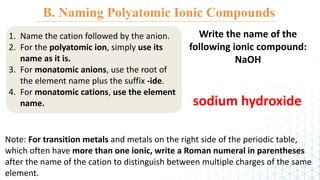
B. Naming Polyatomic Ionic Compounds
1. Name the cation followed by the anion.
2. For the polyatomic ion, simply use its
name as it is.
3. For monatomic anions, use the root of
the element name plus the suffix -ide.
4. For monatomic cations, use the element
name.
Write the name of the
following ionic compound:
NaOH
sodium hydroxide
Note: For transition metals and metals on the right side of the periodic table,
which often have more than one ionic, write a Roman numeral in parentheses
after the name of the cation to distinguish between multiple charges of the same
element.
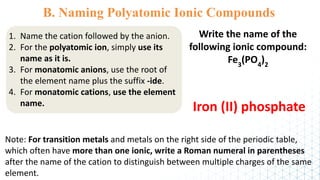
B. Naming Polyatomic Ionic Compounds
1. Name the cation followed by the anion.
2. For the polyatomic ion, simply use its
name as it is.
3. For monatomic anions, use the root of
the element name plus the suffix -ide.
4. For monatomic cations, use the element
name.
Write the name of the
following ionic compound:
Fe3
(PO4
)2
Iron (II) phosphate
Note: For transition metals and metals on the right side of the periodic table,
which often have more than one ionic, write a Roman numeral in parentheses
after the name of the cation to distinguish between multiple charges of the same
element.
Solve the Worksheet
Lesson_3_Names_and_Formulas_for_Ionic_Compounds_SLIDES.pdf

Lesson_3_Names_and_Formulas_for_Ionic_Compounds_SLIDES.pdf

  • 1.
    Names and Formulasfor Ionic Compounds Lesson 3
  • 2.
    Focus Question Whatare the names and formulas of ionic compounds? New Vocabulary formula unit monatomic ion polyatomic ion oxyanion
  • 3.
  • 4.
    An ionic compoundis made up of ions arranged in a repeating pattern. Ionic compound It has both cations and anions positively charged ion (Cation) Ex: sodium ion Na+ negatively charged ion (Anion) Ex: Chloride Cl-
  • 5.
    Ions monatomic ion is aone-atom ion polyatomic ions ions made up of more than one atom
  • 6.
    monatomic ion • Amonatomic ion is a one-atom ion, such as Mg2+ or Br– . Transition metals, which are in groups 3 through 12, and metals in groups 13 and 14 are not included in Table 7 because they can form several different positive ions. • The table below gives the charges of common monatomic ions according to their location on the periodic table.
  • 7.
    • Polyatomic ionsare ions made up of more than one atom. • A polyatomic ion acts as an individual ion in a compound and its charge applies to the entire group of atoms. • Each polyatomic ion acts as a single unit and has one charge. Nitrate ion (NO3 – ) Sulfate ion (SO4 2– ) The structure of common polyatomic ions Examples: Polyatomic ion
  • 8.
    Table 9 listthe formulas and charges of common polyatomic ions
  • 9.
    • An oxyanionis a polyatomic ion composed of an element, usually a nonmetal, bonded to one or more oxygen atoms. • More than one oxyanion exists for some nonmetals, such as nitrogen and sulfur. Oxyanion The name of an oxyanion ends with “–ate” or “-ite”
  • 10.
    Oxyanion a) The -iteending indicates one less oxygen atom than the -ate ending. However, the ending does not tell you the actual number of oxygen atoms in the ion b) Hypo- indicates one oxygen less than -ite. c) Per- indicates one oxygen more than -ate. d) Adding Hydrogen to the name decreases the charge by one.
  • 11.
    Formula Name FormulaName Ethanoate (acetate) CO3 2– CN– Peroxide Hydroxide CrO4 2– MnO4 – Sulfite Nitrite SO4 2– NO3 – bromate ion Hypochlorite IO3 - ClO2 – Phosphite Chlorate PO4 3– ClO4 – Ammonium ion
  • 12.
    Based on theion type, Ionic Compounds can be: Binary ionic compounds are composed of positively charged monatomic ions of a metal and negatively charged monatomic ions of a nonmetal. Polyatomic Ionic Compounds ionic compounds that contain polyatomic ions
  • 13.
    A. Formulas forPolyatomic Ionic Compounds Write the formula of the compound formed from the ammonium ion NH4 + & oxide ion O2- The chemical formula for an ionic compound called a formula unit, represents the simplest ratio of the ions involved. The overall charge of a formula unit is zero because the formula unit represents the entire crystal, which is electrically neutral. NH4 + NH4 + O2- (NH4 )2 O
  • 14.
    1. Write thesymbol of the cation first then the anion with its charge. 2. Check the charges, if they are balanced cancel the charges and get the formula. 3. If they are not balanced, do criss-cross. 4. Add ( ) around the polyatomic ion as it is, and then add the appropriate subscript. Because a polyatomic ion exists as a unit, never change subscripts of the atoms within the ion. NH4 + O2- A. Formulas for Polyatomic Ionic Compounds
  • 15.
    Formula for aPolyatomic Ionic Compound Problem A compound formed by calcium ions and phosphate ions is often used in fertilizers. Write the compound’s formula. PO4 3- Ca2+ Ca3 (PO4 )2
  • 16.
  • 17.
    B. Naming PolyatomicIonic Compounds 1. Name the cation followed by the anion. 2. For the polyatomic ion, simply use its name as it is. 3. For monatomic anions, use the root of the element name plus the suffix -ide. 4. For monatomic cations, use the element name. Write the name of the following ionic compound: NaOH sodium hydroxide Note: For transition metals and metals on the right side of the periodic table, which often have more than one ionic, write a Roman numeral in parentheses after the name of the cation to distinguish between multiple charges of the same element.
  • 18.
    B. Naming PolyatomicIonic Compounds 1. Name the cation followed by the anion. 2. For the polyatomic ion, simply use its name as it is. 3. For monatomic anions, use the root of the element name plus the suffix -ide. 4. For monatomic cations, use the element name. Write the name of the following ionic compound: Fe3 (PO4 )2 Iron (II) phosphate Note: For transition metals and metals on the right side of the periodic table, which often have more than one ionic, write a Roman numeral in parentheses after the name of the cation to distinguish between multiple charges of the same element.
  • 19.