LESSON PLAN
(ELECTRICITY)
FEB 20,2017
MONDAY
I. OBJECTIVES: At the end of the lesson, 85% of the students should be
able to:
A) define electric circuit.
B) recognize the two types of electric circuit.
C) connect/assemble the actual electric circuit.
D) value the importance of each essential parts of electric
circuit.
II. LEARNING TASK
A. SUBJECT MATTER: Electric Circuit
B. CONCEPT/IDEAS: Electric Circuit, path of an electric current. The
term is usually taken to mean a continuous path composed of
conductors and conducting devices.
C. REFERENCES: Electrical installation and maintenance k12 learning
module
Industrial Arts for Secondary Education ( Exploratory)
Basic Electricity Second Edition (Handbook)
Encarta Encyclopedia (2007 Edition)
Encarta Dictionary (2007 Edition)
D. MATERIALS: Cartolina, Pentelpen, Chalk, PDX wire, switch, junction
box, electrical tape, side cutter, long nose pliers, combination pliers,
lamp holder, illustration boad.
VALUE FOCUS: Awareness of students about Electric Circuit.
III. PROCEDURE:
A. PRE-ACTIVITY
I. PRAYER
II. REVIEW
QUESTIONS:
What are the sources of electricity?
A source of electricity which is formed from natural matter
such oil, and natural gas?
A source of electricity that comes from the force of a
moving air?
TEACHER’S ACTIVITY
“Now, we know already where did the electricity came
from. But the question is, how it is distributed to every
consumer?
B. ACTIVITY PROPER
I. PRESENTATION OF LESSON:
TEACHER’S ACTIVITY
“TODAY, we’re going to talk about electric circuit. What is
electric circuit?
II. UNLOCKING OF DIFFICULTIES:
TEACHER’S ACTIVITY
2.
“The Encarta Dictionarydefines Circuit as a Circular path or
a route.”
III. DISCUSSION
ELECTRIC CIRCUIT
O A complete path where electricity flows from the source
to the load.
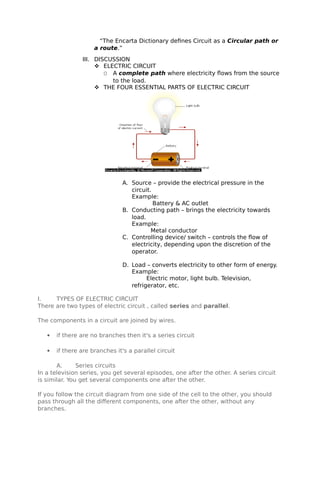
THE FOUR ESSENTIAL PARTS OF ELECTRIC CIRCUIT
A. Source – provide the electrical pressure in the
circuit.
Example:
Battery & AC outlet
B. Conducting path – brings the electricity towards
load.
Example:
Metal conductor
C. Controlling device/ switch – controls the flow of
electricity, depending upon the discretion of the
operator.
D. Load – converts electricity to other form of energy.
Example:
Electric motor, light bulb. Television,
refrigerator, etc.
I. TYPES OF ELECTRIC CIRCUIT
There are two types of electric circuit , called series and parallel.
The components in a circuit are joined by wires.
if there are no branches then it's a series circuit
if there are branches it's a parallel circuit
A. Series circuits
In a television series, you get several episodes, one after the other. A series circuit
is similar. You get several components one after the other.
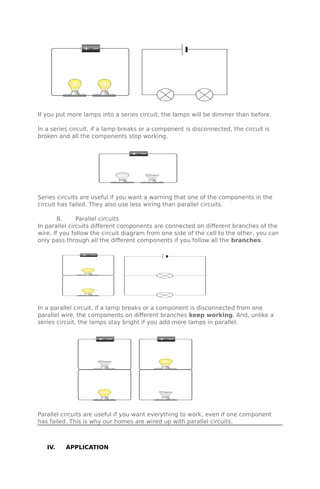
If you follow the circuit diagram from one side of the cell to the other, you should
pass through all the different components, one after the other, without any
branches.
3.
If you putmore lamps into a series circuit, the lamps will be dimmer than before.
In a series circuit, if a lamp breaks or a component is disconnected, the circuit is
broken and all the components stop working.
Series circuits are useful if you want a warning that one of the components in the
circuit has failed. They also use less wiring than parallel circuits.
B. Parallel circuits
In parallel circuits different components are connected on different branches of the
wire. If you follow the circuit diagram from one side of the cell to the other, you can
only pass through all the different components if you follow all the branches.
In a parallel circuit, if a lamp breaks or a component is disconnected from one
parallel wire, the components on different branches keep working. And, unlike a
series circuit, the lamps stay bright if you add more lamps in parallel.
Parallel circuits are useful if you want everything to work, even if one component
has failed. This is why our homes are wired up with parallel circuits.
IV. APPLICATION
4.
TEACHER’S ACTIVITY
Provided withmaterials. Let the students assemble the four (4)
essential parts of electric circuit. Instructions and safety rules must be discussed
before the activity starts. The performance will be judge using the following criteria.
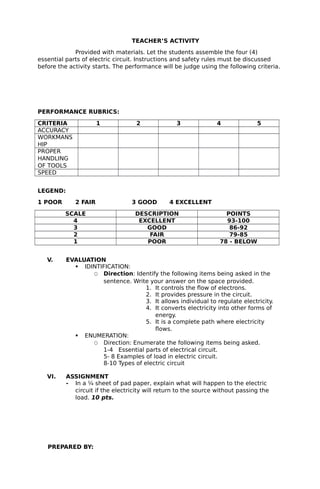
PERFORMANCE RUBRICS:
CRITERIA 1 2 3 4 5
ACCURACY
WORKMANS
HIP
PROPER
HANDLING
OF TOOLS
SPEED
LEGEND:
1 POOR 2 FAIR 3 GOOD 4 EXCELLENT
SCALE DESCRIPTION POINTS
4 EXCELLENT 93-100
3 GOOD 86-92
2 FAIR 79-85
1 POOR 78 - BELOW
V. EVALUATION
IDINTIFICATION:
O Direction: Identify the following items being asked in the
sentence. Write your answer on the space provided.
1. It controls the flow of electrons.
2. It provides pressure in the circuit.
3. It allows individual to regulate electricity.
4. It converts electricity into other forms of
energy.
5. It is a complete path where electricity
flows.
ENUMERATION:
O Direction: Enumerate the following items being asked.
1-4 Essential parts of electrical circuit.
5- 8 Examples of load in electric circuit.
8-10 Types of electric circuit
VI. ASSIGNMENT
- In a ¼ sheet of pad paper, explain what will happen to the electric
circuit if the electricity will return to the source without passing the
load. 10 pts.
PREPARED BY:




![[Deck] What's New in Spark-Iceberg Integration via DSV2.pptx](https://cdn.slidesharecdn.com/ss_thumbnails/deckwhatsnewinspark-icebergintegrationviadsv2-260210005337-25955b12-thumbnail.jpg?width=640&height=640&fit=bounds)


