“
University of Zakho
Faculty of Sciences
Department of Physic
1st
Stage Morning
Subject:
Electric Circuits
Prepared by:
Sozan Hishyar
Supervisor:
Dr.Dindar S.Bari
2022 - 2023
Overview
• Introduction
• Parts of Circuits
• Types of circuits
• Series Circuits
• Parallel Circuits
Introduction
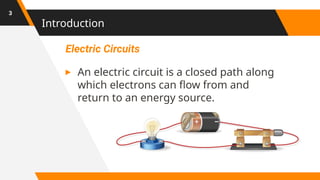
▸ An electric circuit is a closed path along
which electrons can flow from and
return to an energy source.
Electric Circuits
3
Parts of
circuits
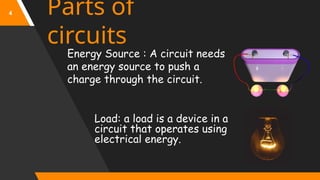
Energy Source : A circuit needs
an energy source to push a
charge through the circuit.
4
Load: a load is a device in a
circuit that operates using
electrical energy.
Parts of
circuits
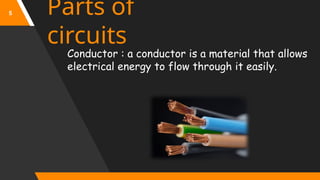
Conductor : a conductor is a material that allows
electrical energy to flow through it easily.
5
Parts of
circuits
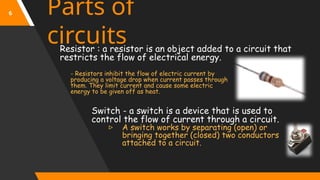
Switch - a switch is a device that is used to
control the flow of current through a circuit.
▹ A switch works by separating (open) or
bringing together (closed) two conductors
attached to a circuit.
6
Resistor : a resistor is an object added to a circuit that
restricts the flow of electrical energy.
- Resistors inhibit the flow of electric current by
producing a voltage drop when current passes through
them. They limit current and cause some electric
energy to be given off as heat.
Types of circuits
/
7
1 •Series circuits
2 •Parallel circiuts
1. Series Circuits
▸ In a series circuit, the loads are set
up in a series, or line, that requires
the current to flow through one load
before passing through the next.
8
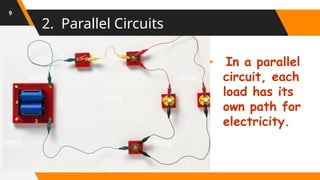
2. Parallel Circuits
▸ In a parallel
circuit, each
load has its
own path for
electricity.
9
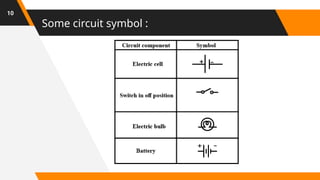
Some circuit symbol :
.
10
11
THANKS!
Any questions?
▸ [1] C. K. Tse, “Circuit theory of power f actor correction in
switchingconverters,”Int. J. Circuit Theory Appl., vol. 31, no. 2, pp. 157– 198,
Mar./Apr. 2003
▸ [2] O. Dranga, C. K. Tse, and H. C. H. IU, “Bifurcation behavior of a power
factor correction boost converter,”Int. J. Bifurcation Chaos Appl. Sci. Eng., vol.
13, no. 10, pp. 3107 – 3144, 2003.
▸ [3] M. Orabi and T. Ninomiya, “Nonlinear dynamics and stability analysis of
boost power factor correction
converter,” IEEE Trans. Ind. Electron., vol. 50, no. 6, pp.1116 -1125, Oct. 2003.
▸ [4] S. Parui and S. Banerjee, “Bifurcation due to transition from continuous
conduction mode to discontinuous conduction mode in the boost
converter,”IEEETrans. Circuits Syst. I, Fundam. Theory Appl., vol. 50, no. 11, pp.
1464 – 1469, Nov.2003.
▸ [5] S. C. Wong, C. K. Tse, and K. C. Tam, “Intermittent chaotic operation
inswitching power converter,” Int. J. Bifurcation Chaos, vol. 14, no. 8, pp.
Refernces : .
12

Electric Circuits educationprogramselectronics.pptx

  • 1.
    “ University of Zakho Facultyof Sciences Department of Physic 1st Stage Morning Subject: Electric Circuits Prepared by: Sozan Hishyar Supervisor: Dr.Dindar S.Bari 2022 - 2023
  • 2.
    Overview • Introduction • Partsof Circuits • Types of circuits • Series Circuits • Parallel Circuits
  • 3.
    Introduction ▸ An electriccircuit is a closed path along which electrons can flow from and return to an energy source. Electric Circuits 3
  • 4.
    Parts of circuits Energy Source: A circuit needs an energy source to push a charge through the circuit. 4 Load: a load is a device in a circuit that operates using electrical energy.
  • 5.
    Parts of circuits Conductor :a conductor is a material that allows electrical energy to flow through it easily. 5
  • 6.
    Parts of circuits Switch -a switch is a device that is used to control the flow of current through a circuit. ▹ A switch works by separating (open) or bringing together (closed) two conductors attached to a circuit. 6 Resistor : a resistor is an object added to a circuit that restricts the flow of electrical energy. - Resistors inhibit the flow of electric current by producing a voltage drop when current passes through them. They limit current and cause some electric energy to be given off as heat.
  • 7.
    Types of circuits / 7 1•Series circuits 2 •Parallel circiuts
  • 8.
    1. Series Circuits ▸In a series circuit, the loads are set up in a series, or line, that requires the current to flow through one load before passing through the next. 8
  • 9.
    2. Parallel Circuits ▸In a parallel circuit, each load has its own path for electricity. 9
  • 10.
  • 11.
  • 12.
    ▸ [1] C.K. Tse, “Circuit theory of power f actor correction in switchingconverters,”Int. J. Circuit Theory Appl., vol. 31, no. 2, pp. 157– 198, Mar./Apr. 2003 ▸ [2] O. Dranga, C. K. Tse, and H. C. H. IU, “Bifurcation behavior of a power factor correction boost converter,”Int. J. Bifurcation Chaos Appl. Sci. Eng., vol. 13, no. 10, pp. 3107 – 3144, 2003. ▸ [3] M. Orabi and T. Ninomiya, “Nonlinear dynamics and stability analysis of boost power factor correction converter,” IEEE Trans. Ind. Electron., vol. 50, no. 6, pp.1116 -1125, Oct. 2003. ▸ [4] S. Parui and S. Banerjee, “Bifurcation due to transition from continuous conduction mode to discontinuous conduction mode in the boost converter,”IEEETrans. Circuits Syst. I, Fundam. Theory Appl., vol. 50, no. 11, pp. 1464 – 1469, Nov.2003. ▸ [5] S. C. Wong, C. K. Tse, and K. C. Tam, “Intermittent chaotic operation inswitching power converter,” Int. J. Bifurcation Chaos, vol. 14, no. 8, pp. Refernces : . 12