Lesson Plan #1

BOOK: Over To You 1 (Longman)
COURSE: 1st or 2nd Year at a secondary school.
LEVEL: Elementary
COMMUNICATIVE GOAL: Describing animals: physical features and abilities
GRAMMAR FOCUS: ‘Can’: affirmative and negative forms
VOCABULARY FOCUS: Animals; animal parts: ‘beak’; ‘pouch’; ‘tusk’; ‘wing’; etc.
RECYCLED LANGUAGE: Simple Present. ‘Have got’ / ‘has got’: affirmative,
interrogative and negative forms


ACTIVATION:                                                         time allotted: 8’ /
10’
Aim of the activation: To introduce the topic of the text which will be used
during the Clarification stage. To recycle vocabulary from previous knowledge.

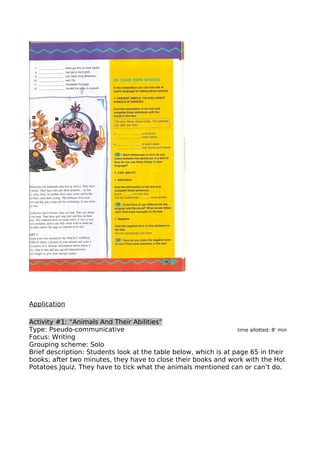
Students open their books at page 61. I ask them to pay attention to the square
on top left with fifteen names of animals. Once they take a look at these words,
I ask them if they know the name of (some of / all of) these animals in Spanish.
After listening to their answers, I show students the pictures of different animal
parts, which are numbered on the right (‘1: wing’; ‘2: trunk’; ‘3: pouch’; etc.), I
make them guess which animal they belong to and ask them to match these
pictures to the animals named in the square.
COMPREHENSION AND CLARIFICATION:                                  time allotted: 20’


After reading the following text they have at pages 62 and 63 in their books,
I ask questions to try to elicit the use of ‘can’ to express ‘ability’ and some
vocabulary related to animals and their physical features. I copy the examples
elicited on the board.
For example:
Me: What are Emus?
Ss: (expected answer) They are birds!
Me: Yes! They are! How do you know? Is it in the text?
Ss: Yes! Acá dice ‘Emus are birds’
Me: Good! And are these birds big or small? (gestures if necessary)
Ss: Big!
Me: Right! How do you know?
Ss: Porque acá dice: ‘They are about two metres tall’
Me: Ok! And do they move fast or slowly? (again gestures might be used)
Ss: Fast! Acá dice: ‘They can run very fast’!
Me: Good! Emus are big birds and they can run fast! Do you see a picture of an
emu in the book?
Ss: Yes! (they show me the picture – the expected answer would be ‘letter c’)
Application

Activity #1: “Animals And Their Abilities”
Type: Pseudo-communicative                                        time allotted: 8’ min
Focus: Writing
Grouping scheme: Solo
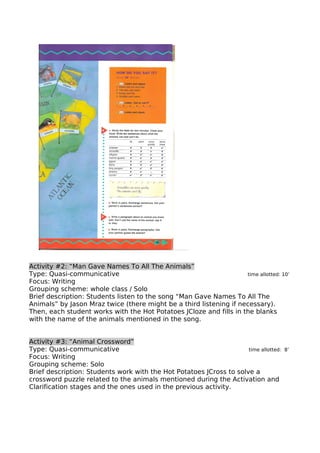
Brief description: Students look at the table below, which is at page 65 in their
books; after two minutes, they have to close their books and work with the Hot
Potatoes Jquiz. They have to tick what the animals mentioned can or can’t do.
Activity #2: “Man Gave Names To All The Animals”
Type: Quasi-communicative                                           time allotted: 10’
Focus: Writing
Grouping scheme: whole class / Solo
Brief description: Students listen to the song “Man Gave Names To All The
Animals” by Jason Mraz twice (there might be a third listening if necessary).
Then, each student works with the Hot Potatoes JCloze and fills in the blanks
with the name of the animals mentioned in the song.


Activity #3: “Animal Crossword”
Type: Quasi-communicative                                            time allotted:   8’
Focus: Writing
Grouping scheme: Solo
Brief description: Students work with the Hot Potatoes JCross to solve a
crossword puzzle related to the animals mentioned during the Activation and
Clarification stages and the ones used in the previous activity.
Activity #4: “Animal Parts”
Type: Pseudo-communicative                                          time allotted:   5’
Focus: Writing
Grouping scheme: Solo
Brief description: Students work with the Hot potatoes JMatch to practise the
vocabulary on animal parts they have at page 61 in their books. They have to
match words and phrases from two different columns in order to make simple
meaningful sentences.


Activity #5: “Jumbled Sentences”
Type: Pseudo-communicative                                           time allotted: 8’
Focus: Writing
Grouping scheme: Solo
Brief description: Students work with the Hot Potatoes JMix to unjumble a series
of sentences related to the information given during the Clarification stage


REFLECTION
Tick the sentences which are expressing abilities

   1-   Emus have got long legs
   2-   Turtles can swim very well
   3-   Alligators can’t climb trees
   4-   Sharks have got fins
   5-   The fire salamander can move quickly

Lesson plan

  • 1.
    Lesson Plan #1 BOOK:Over To You 1 (Longman) COURSE: 1st or 2nd Year at a secondary school. LEVEL: Elementary COMMUNICATIVE GOAL: Describing animals: physical features and abilities GRAMMAR FOCUS: ‘Can’: affirmative and negative forms VOCABULARY FOCUS: Animals; animal parts: ‘beak’; ‘pouch’; ‘tusk’; ‘wing’; etc. RECYCLED LANGUAGE: Simple Present. ‘Have got’ / ‘has got’: affirmative, interrogative and negative forms ACTIVATION: time allotted: 8’ / 10’ Aim of the activation: To introduce the topic of the text which will be used during the Clarification stage. To recycle vocabulary from previous knowledge. Students open their books at page 61. I ask them to pay attention to the square on top left with fifteen names of animals. Once they take a look at these words, I ask them if they know the name of (some of / all of) these animals in Spanish. After listening to their answers, I show students the pictures of different animal parts, which are numbered on the right (‘1: wing’; ‘2: trunk’; ‘3: pouch’; etc.), I make them guess which animal they belong to and ask them to match these pictures to the animals named in the square.
  • 2.
    COMPREHENSION AND CLARIFICATION: time allotted: 20’ After reading the following text they have at pages 62 and 63 in their books, I ask questions to try to elicit the use of ‘can’ to express ‘ability’ and some vocabulary related to animals and their physical features. I copy the examples elicited on the board. For example: Me: What are Emus? Ss: (expected answer) They are birds! Me: Yes! They are! How do you know? Is it in the text? Ss: Yes! Acá dice ‘Emus are birds’ Me: Good! And are these birds big or small? (gestures if necessary) Ss: Big! Me: Right! How do you know? Ss: Porque acá dice: ‘They are about two metres tall’ Me: Ok! And do they move fast or slowly? (again gestures might be used) Ss: Fast! Acá dice: ‘They can run very fast’! Me: Good! Emus are big birds and they can run fast! Do you see a picture of an emu in the book? Ss: Yes! (they show me the picture – the expected answer would be ‘letter c’)
  • 3.
    Application Activity #1: “AnimalsAnd Their Abilities” Type: Pseudo-communicative time allotted: 8’ min Focus: Writing Grouping scheme: Solo Brief description: Students look at the table below, which is at page 65 in their books; after two minutes, they have to close their books and work with the Hot Potatoes Jquiz. They have to tick what the animals mentioned can or can’t do.
  • 4.
    Activity #2: “ManGave Names To All The Animals” Type: Quasi-communicative time allotted: 10’ Focus: Writing Grouping scheme: whole class / Solo Brief description: Students listen to the song “Man Gave Names To All The Animals” by Jason Mraz twice (there might be a third listening if necessary). Then, each student works with the Hot Potatoes JCloze and fills in the blanks with the name of the animals mentioned in the song. Activity #3: “Animal Crossword” Type: Quasi-communicative time allotted: 8’ Focus: Writing Grouping scheme: Solo Brief description: Students work with the Hot Potatoes JCross to solve a crossword puzzle related to the animals mentioned during the Activation and Clarification stages and the ones used in the previous activity.
  • 5.
    Activity #4: “AnimalParts” Type: Pseudo-communicative time allotted: 5’ Focus: Writing Grouping scheme: Solo Brief description: Students work with the Hot potatoes JMatch to practise the vocabulary on animal parts they have at page 61 in their books. They have to match words and phrases from two different columns in order to make simple meaningful sentences. Activity #5: “Jumbled Sentences” Type: Pseudo-communicative time allotted: 8’ Focus: Writing Grouping scheme: Solo Brief description: Students work with the Hot Potatoes JMix to unjumble a series of sentences related to the information given during the Clarification stage REFLECTION Tick the sentences which are expressing abilities 1- Emus have got long legs 2- Turtles can swim very well 3- Alligators can’t climb trees 4- Sharks have got fins 5- The fire salamander can move quickly