Q1.Name one thingabout the weather that you
think has changed over the last few years.
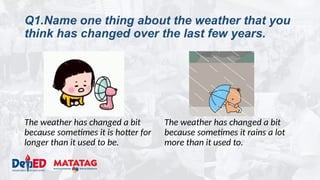
The weather has changed a bit
because sometimes it is hotter for
longer than it used to be.
The weather has changed a bit
because sometimes it rains a lot
more than it used to.
4.
Q2. What sortof problems have been
caused by a change in the weather pattern?
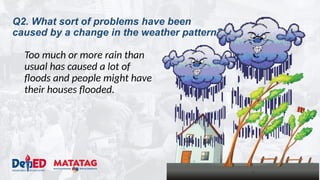
Too much or more rain than
usual has caused a lot of
floods and people might have
their houses flooded.
5.
Q3. What doyou think the scientists
mean when they say the change in the
climate in the Philippines is caused by
global warming?
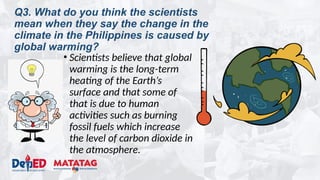
• Scientists believe that global
warming is the long-term
heating of the Earth’s
surface and that some of
that is due to human
activities such as burning
fossil fuels which increase
the level of carbon dioxide in
the atmosphere.
Lesson Purpose andIntention
● Explain to the students that this
lesson is about reading scientific
texts and how important reading is
for learning and when answering
questions.
The lesson is about climate change.
We want to be sure we know and
understand about predicting the
effect of changes to the abiotic
factors on the ecosystem.
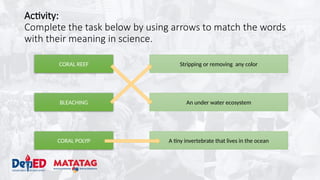
Activity:
Complete the taskbelow by using arrows to match the words
with their meaning in science.
CORAL REEF
BLEACHING
CORAL POLYP
Stripping or removing any color
A tiny invertebrate that lives in the ocean
An under water ecosystem
Climate change –a prediction
Australian government scientists are working on the
protection and restoration of the magnificent Great Barrier
Reef. They predict that further global warming that increases
the temperature of the oceans, even to a very small degree,
will result in bleaching of vast quantities of the reef. As well as
this, any further run-off from polluted rivers that smother the
corals, preventing light from reaching them will cause further
damage to some areas of the reef.
• Reference: “From tiny coral polyps grew a marvel: Australia’s Great Barrier Reef. Could it all come
tumbling down?” Jennifer S. Holland. A senior writer for the National Geographic magazine.
12.
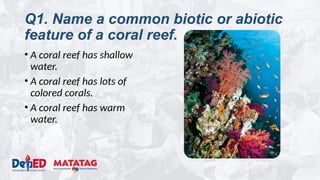
Q1. Name acommon biotic or abiotic
feature of a coral reef.
• A coral reef has shallow
water.
• A coral reef has lots of
colored corals.
• A coral reef has warm
water.
13.
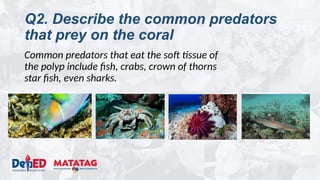
Q2. Describe thecommon predators
that prey on the coral
Common predators that eat the soft tissue of
the polyp include fish, crabs, crown of thorns
star fish, even sharks.
14.
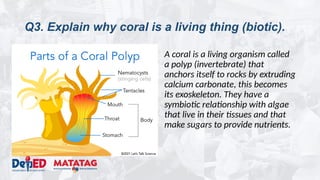
Q3. Explain whycoral is a living thing (biotic).
A coral is a living organism called
a polyp (invertebrate) that
anchors itself to rocks by extruding
calcium carbonate, this becomes
its exoskeleton. They have a
symbiotic relationship with algae
that live in their tissues and that
make sugars to provide nutrients.
15.
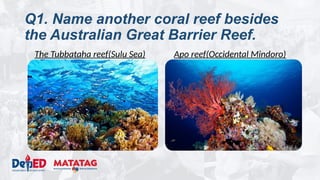
Q1. Name anothercoral reef besides
the Australian Great Barrier Reef.
The Tubbataha reef(Sulu Sea) Apo reef(Occidental Mindoro)
16.
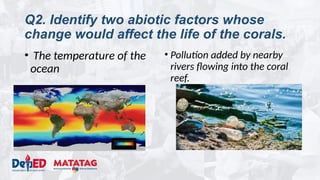
Q2. Identify twoabiotic factors whose
change would affect the life of the corals.
• The temperature of the
ocean
• Pollution added by nearby
rivers flowing into the coral
reef.
17.
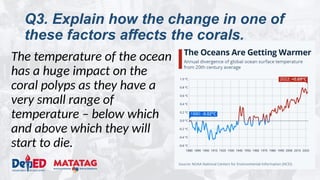
Q3. Explain howthe change in one of
these factors affects the corals.
The temperature of the ocean
has a huge impact on the
coral polyps as they have a
very small range of
temperature – below which
and above which they will
start to die.
18.
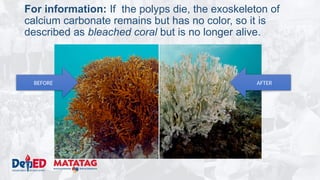
For information: Ifthe polyps die, the exoskeleton of
calcium carbonate remains but has no color, so it is
described as bleached coral but is no longer alive.
BEFORE AFTER
19.
Q1. Did youfind the
questions in component 4C
more difficult than the
questions in 4B? Or was
there one question harder
than all the rest? If so, which
one?
20.
Q2. Has thislesson helped
you to know and or
understand the effects of
climate change on a
Philippine ecosystem? If so,
how?
Editor's Notes
#2 Short overview or review
Can you name one of the important components/parts of a scientific investigation
#3 ▪ Ask students to write down their answer in the space provided on their worksheet. Q1.
▪ Ask students to volunteer to read out their answers, giving positive feedback. Read out a sample answer for all students to listen to and write down. This may come from one of the students or from the sample answer.
#7 We want to be sure we know and understand about fair testing.
#10 Refer students to the main lesson stimulus and read out the text.
Ask students to reads the text to themselves.







![Polymer [ बहुलक ] Chemistry Notes PDF - Irfanullah Mehar - JJ Sir Chemistry.pdf](https://cdn.slidesharecdn.com/ss_thumbnails/polymerchemistrynotespdf-irfanullahmehar-jjsirchemistry-260210172118-3f9b37f7-thumbnail.jpg?width=640&height=640&fit=bounds)


