LESSON 4
RESEARCH ESSAY
Reading Assignment: Dodge’s “Johnson county Dreamin’”
(page 186) and “The Jilting of Katherine Anne Porter” (page
183)
Writing Assignments:
1. Write a paragraph summarizing each Dodge article
2. Write a four paragraph Research Essay (see below).
One part of this lesson is to review one of the basic elements of
expository writing, the essay. In this lesson the Research Essay
will be studied. A Research Essay is a form of writing in which
a personal opinion is expressed about a subject. Review the
enclosed outline and sample of a Research Essay. After
reviewing this material, please submit a four paragraph
Research Essay on a famous painting, monument or statue.
Check the COMPOSITION WRITING AIDS before writing this
paper.
KEYS TO WRITING THE RESEARCH ESSAY
OVERALL DESIGN
INTRODUCTORY PARAGRAPH: Subject with the issue
followed by the Who, What, When, Where, and Why on Subject
+ Thesis w/Main Points
BODY PARAGRAPH: Full discussion of 1st Main Point
w/Specific Example at least 3 sentences long
BODY PARAGRAPH: Full discussion of 2nd Main Point
w/Specific Example at least 3 sentences long
CONCLUSION: Summarize the key elements of the essay and
add any other relevant information
THE INTRODUCTORY PARAGRAPH:
The introductory paragraph for the Research Essay opens with
subject of the essay followed by the issue. Next is the thesis
followed by the paper’s main points
Below are 2 sample thesis statements:
ISSUE with the SUBJECT: Giving to the Cancer Society of
America
OPINION: should be discouraged because
MAIN POINTS: only 1% of the proceeds go to cancer patients
and the society is a scam
SUBJECT: Attending Six Flags’ Fright Night
OPINION: is good because
MAIN POINTS: the haunted house is remarkable and the
Halloween show is exceptionally entertaining
THE FIRST BODY PARAGRAPH:
The first body paragraph of a Classification Essay has 2
elements: a full discussion of the 1st main point so that the
reader understands the issue followed by a 3 sentences long
SPECIFIC example/illustration which illuminates the 1st main
point. This body paragraph must end with citation (see example
below).
THE SECOND BODY PARAGRAPH:
The second body paragraph of a Classification Essay has 2
elements: a full discussion of the 2nd main point so that the
reader understands the issue followed by a 3 sentences long
SPECIFIC example/illustration which illuminates the 2nd main
point. This body paragraph must end with citation (see example
below).
THE CONCLUSION:
Summarize the key elements of the essay and add any other
relevant information
Lee Bee
English 1301
Lesson 4
October 22, 201?
Men in Rock
Mount Rushmore is a well-known iconic and patriotic
monument in the Black Hills of South Dakota that has been
visited by Americans for generations. Located at 13000 South
Dakota Highway 244, Keystone, SD 57751, the Mount
Rushmore National Memorial was the brainchild of South
Dakota historian Doane Robinson who conceived the idea in
1923 to commemorate important individuals in American
history. In 1924, Robinson persuaded sculptor Gutzon Borglum
to take on the massive project and Borglum spent the rest of his
life creating the gigantic granite heads of four American
presidents who in turn represent four crucial eras of American
history. The 60-foot heads are of George Washington (1732–
1799), Thomas Jefferson (1743–1826), Theodore Roosevelt
(1858–1919), and Abraham Lincoln (1809–1865). Visiting the
Mount Rushmore National Memorial should be encouraged
because it helps Americans understand American history and
appreciate Borglum’s extraordinary achievement.
American history is highlighted in this colossal rock formation.
The most prominent head is that of George Washington who is
honored for his crucial leadership in the American Revolution
and as the 1st President of the United States. Thomas Jefferson
is rightly next to Washington for his role in authoring the
Declaration of Independence and serving as the third President.
Abraham Lincoln holds the prominent position on the right side
of the monument for saving the Union through the Civil War.
And finally, Theodore Roosevelt is included among the other
greats for his role in protecting America’s priceless natural
treasures during the Progressive Era. These rocks have become
one of the most popular tourist destinations in the United
States. Doane Robinson wanted them to promote South Dakota
tourism and his wish has certainly come true. “Doane’s tourism
plan worked. Nearly three million people visit Mount Rushmore
each year. And its popularity never seems to decrease” (Trex).
When tourists come to visit this Shrine of Democracy in South
Dakota, they rarely pause to contemplate the enormous
contribution of its sculptor Gutzon Borglum. Borglum was the
child of Danish polygamist Mormon immigrants and his father
was a country doctor in Nebraska. In 1923 Borglum started
work on a Confederate memorial on Stone Mountain near
Atlanta. It was to show huge images of Robert E. Lee, Jefferson
Davis, and 'Stonewall' Jackson. Eventually Borglum came into
conflict with the Confederate Memorial officials so he
destroyed his models and left to start on the Mount Rushmore
project. Beginning his work on Mount Rushmore in 1925, he
continued to work on the monument when weather permitted
until his death in 1941. A small inkling of Borglum’s struggle
on this project may be seen in the following citation. “Borglum
started blasting rock in 1927. Federal financing in 1929 helped,
but the sculpture was still a financial drain. When asked in 1940
about the cost, Borglum said ‘Call up Cheops and ask him how
much his pyramid cost, and what he paid the creator — an
inferior work to Mt. Rushmore’” (Peters).
On July 23, 1962 the first television satellite broadcast was
made from the United States to Europe. The first image of that
initial broadcast was of a Lakota Sioux man standing in front of
Mount Rushmore. Nothing could better demonstrate how much
this monument is seen as representing America. Along with the
Statue of Liberty in New York and the Washington Monument
and Lincoln Memorial in Washington, DC, Mount Rushmore
holds a special almost mystical place in the hearts of
Americans. It inspires patriotism and causes reflection on what
America is and will become. With millions of visitors every
year, Mount Rushmore promises to continue thrilling American
throughout the ages until the images are finally worn down by
time.
Works Cited
Peters, Chris. “The Omaha Boy Who Went On To Sculpt Mt.
Rushmore.” Omaha World Herald. October 9, 2009.Trex, Ethan.
“11 Essential Talking Points for Mount Rushmore Enthusiasts.”
Mental
Floss. January 14, 2016.
Unit IV Color Key:
-level number and explanation
Running head: SAFETY FIRST 1
Safety First: Open Carry Firearms on Higher Education
Campuses in Arizona
Student Name
Columbia Southern University
APA header: Note that the title is in capital letters and prefaced
by the words “Running head.” The page number is also
included.
Full title of the paper with the major words beginning with a
capital letter
The student’s first and last name
Name of the institution, which will always be “Columbia
Southern University”
SAFETY FIRST 2
Safety First: Open Carry Firearms on Higher Education
Campuses in Arizona
Much has been made in the past few years about gun restrictions
in the U.S. Proponents
of gun regulation are in a constant state of lobbying for state
and federal bills that restrict access
to firearms, whether that takes the form of more extensive
background checks on potential gun
owners or longer waiting periods before guns may be sold to
individuals. On the other side, the
National Rifle Association (NRA) and other like-minded
individuals advocate for looser
restrictions on the sale and carrying of firearms. For these
supporters of pro-gun legislation,
owning and carrying guns is a fundamental right—even a civil
right. While this national debate
continues to loom over the hot topic of guns, there are breaking
news stories, especially within
the last few months, that bring this fundamental debate to the
threshold of our nations colleges,
high schools, even elementary schools. Seung-Hui Cho’s
massacre at Virginia Tech (April 16,
2007) is perhaps one of the more infamous school shootings, but
there are others that are perhaps
more difficult to remember, like the deaths of 27 killed at Sandy
Hook Elementary School in
Newton, Connecticut (December 14, 2012) (CNN, 2015).
Shootings like these in educational
settings have drawn attention from both anti-gun proponents and
pro-gun lobbyists, and the State
of Arizona is no exception to this firestorm. The Arizona State
legislature has proposed SB 1474,
a gun bill that will allow students and faculty to carry guns on
the campus grounds of its three
state-funded universities. Supporters of the bill claim that
Arizona is an open carry state, and
those rights should not be restricted simply because the carrier
crosses the border of a college
campus. Those against the bill assert that guns have no place in
education and that those who
support the bill are only after their own election-year agendas.
While the Second Amendment
should be upheld, the educational learning environment should
be protected;
Full title presented again at the top of the page
Para 1: Introduction
Sentence 1 (S1): Amanda introduces the main topic (gun
control) in a generalized manner; this sentence also introduces
the con side of the controversy
S2 &3: Follows S1 by introducing the position of the pro side;
again, Amanda is general, focusing on the larger controversy
S4: Amanda begins to narrow the scope of the project by
pointing towards a specific debate within the larger controversy
of gun control: gun control in educational settings.
S5: Specific examples from the news. Note that these are
examples of school shootings with which most people are
familiar. This grounds the project to what is at stake in making
arguments about this topic.
S6: Amanda again narrows the scope of the project by moving
from gun control in educational settings to this debate as it
takes place in a specific location: Arizona.
S7: In this sentence, the writer introduces the specific topic of
the project: the controversy around SB1474.
S8 & 9: Following the same order from above (con first, then
pro), Amanda presents the sides of the controversy by
introducing each specific position.
S10: Amanda presents her thesis statement. She responds to the
controversy by crafting a thesis statement that simultaneously
agrees and disagrees.
Jason.Davis
Line
SAFETY FIRST 3
therefore, SB 1474 is a detrimental and dangerous bill that has
the potential to change the
university campus culture in Arizona state universities.
The Literature Review
In order to better understanding the origins of SB1474 and the
controversy that surrounds
it, the history of gun violence in school settings must be taken
into account; therefore, a brief
look at some of the events of the past few decades is presented.
Further, this review will examine
in greater detail the positions of the two sides of the
controversy, beginning with the pro-SB1474
side, which is in favor of allowing open carry on all Arizona
state-funded campuses. Then the
position of those against SB1474 will be presented; again, this
con side is arguing for Arizona
campuses to remain as they are now: a place without firearms.
A Brief Look at Gun Violence in Schools
The topic of gun control in educational environments exploded
in 1999 when Eric Harris
and Dylan Klebold walked into a virtually unknown high school
in Littleton, CO, and killed
twelve students and one teacher (Gibbs and Roche, 1999).
Questions of how such events could
occur and concerns about the violence of which teens and young
adults are capable became the
concern of pressured administrators and horrified parents in big
cities and small towns alike. A
string of school gun-centered violence followed over the next
few years. Perhaps most striking
though was the way in which this one incident changed the
culture of America: clear backpacks,
more metal detectors, and (of course) fear. Cloud (1999) points
out some of the extreme, “zero
tolerance” actions taken by schools shortly following the
Columbine shootings:
A seven-year-old boy in Cahokia, Ill., is suspended for having a
nail clipper at school. A
10th-grader at Surry County High School in Virginia is booted
for having blue-dyed hair.
Shortened version of the title in the header and the page number
on each page
Para 2: Preface of the Literature Review
Para 3: Brief History
First-level heading: All major sections of the paper will be first-
level, including The Literature Review, Body, and Conclusion.
You may choose to mark the Introduction, but it is typicall y not
done because the title of the paper stands for the heading level.
Note that the title is centered and bold with sentence-case
capitalization.
Note how Amanda prefaces the LR by giving the reader an idea
of what will be included. You might also note that the
paragraph is written in passive voice so that she can avoid using
personal pronouns such as “I.”
This is a second-level heading. It is left-hand justified and bold.
All major words are capitalized. This tells the reader that this
next section is a division of the first-level heading that is
directly above.
This citation is in APA. It shows the authors and year of
publication. This sentence is a paraphrase of Gibbs and Roche.
The reader can look at the references page to find the original
document.
Amanda has made a mistake: Only the ampersand (&) should be
used in a parenthetical citation.
Here is another way to include a parenthetical citation. Amanda
has incorporated the author’s name into the sentence. Note that
the year of publication is presented after the author, but there is
no citation at the end of the sentence because the information is
already presented at the beginning.
This quotation is called a “block.” If a quotation is over 40
words long, then you must “block” it by removing the quotation
marks and indenting the entire quotation 1/2” from the left-hand
margin. If this quotation would have been from a print text, then
the page number would have been included at the end of the
sentence, but it was an electronic source.
Elizabeth.MacWhinnie
Typewritten Text
Elizabeth.MacWhinnie
Typewritten Text
Elizabeth.MacWhinnie
Typewritten Text
Elizabeth.MacWhinnie
Typewritten Text
SAFETY FIRST 4
A Minnesota high school nixes a yearbook photo of an Army
enlistee in the senior class
because it shows her sitting atop a cannon outside a Veterans of
Foreign Wars post.
Far from the exception, these actions considered these many
years later seem unreasonable, even
in a post-9/11 world filled with uncertainty.
The Argument for Open Carry Everywhere in Arizona
However, in Arizona, the newly proposed SB 1474 would not
seek to disarm students; on
the contrary, the bill would allow students the right to
concealed carry on state-funded university
campuses. Proponents of the bill assert that such a measure is
long over due. According to an
NRA poster that were taped to message boards all over The
University of Arizona campus,
“[s]elf-defense is one of the most fundamental rights of every
human being.” Further, the poster
states that the NRA has worked diligently over the past 25 years
to expand the right of open
carry: the NRA has been “working for passage of fair Right-to-
Carry laws, expansion of carry
reciprocity between the states and the elimination of many ‘no-
carry’ zones that only affect the
law-abiding.” For the NRA, one of the major private-public
backers of the SB 1474, the
restriction of concealed carry on college campuses is an
infringement on these basic rights. The
flyer goes on to state the following:
Those who oppose campus carry [of firearms] argue that
educational institutions should
be treated differently, based on emotional claims that places of
higher learning are
somehow exempt from real-world violence. But the truth is,
despite current prohibitions
on legally carrying on campuses, crimes already occur on
campus, and the right to self-
defense from those violent acts should be respected. (NRA,
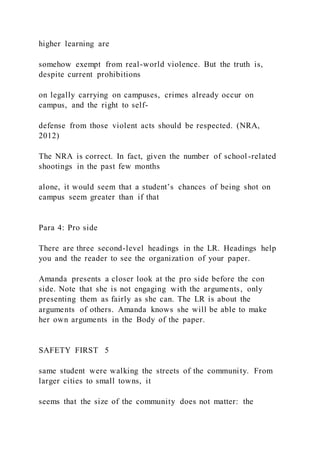
2012)
The NRA is correct. In fact, given the number of school-related
shootings in the past few months
alone, it would seem that a student’s chances of being shot on
campus seem greater than if that
Para 4: Pro side
There are three second-level headings in the LR. Headings help
you and the reader to see the organization of your paper.
Amanda presents a closer look at the pro side before the con
side. Note that she is not engaging with the arguments, only
presenting them as fairly as she can. The LR is about the
arguments of others. Amanda knows she will be able to make
her own arguments in the Body of the paper.
SAFETY FIRST 5
same student were walking the streets of the community. From
larger cities to small towns, it
seems that the size of the community does not matter: the
violence of a shooting can occur
anywhere. However, even with this fact floating in the backs of
students’ minds, students must
still attend classes and while it would seem obvious that
lawmakers on both sides want student
safety, they just see the means to that safety from different
sides of the same coin.
The Case for Campuses as Unique
Eugene Sander (2012), the Interim President of the University
of Arizona, released the
following statement about SB 1474: “I have been a gun owner
for all my adult life, and am fully
supportive of the right to own a gun. However, having faculty,
staff or students bringing
weapons into classrooms and other campus activities will do
nothing to make our campus safer.”
While Sander does not go into detail about what this newly
proposed bill does have to do with,
he makes his case on the basis that 50,000 students, staff, and
faculty attend the campus daily,
along with over 20,000 visitors annually. For Sander (2015), the
educational environment is a
“unique atmosphere that is dependent on open and vigorous
debate. Introducing guns into
classrooms would dramatically and negatively impact the ability
to engage in constructive
dialogue.” In other words, even if the NRA does not believe that
the university is a unique
atmosphere, as Sander and others do, then there is still a
possibility that introducing the right to
carry concealed weapons on campus might lead to a change to
the very culture of the university.
While Arizona lawmakers continue to debate the merits of
SB1474, the public debate
grows, as this issue concerns both public safety and citizens’
rights. Because the three state
universities in Arizona are publically funded, the debate about
allowing open carry is very much
a concern held by the communities in which these universities
reside. Those who are in favor of
the change to an open carry status on university campuses wish
(a) for the open carry laws of the
Para 5: Con side
This citation is correct. Amanda did not have to include the
author’s first name, but it is fine to do so the first time that
the author’s name is mentioned.
Amanda
has made a
mistake.
Each time
an author is
included,
the year of
publication
must
follow. So
this should
read as
follows:
“While
Sander
(2012)…”
Amanda
has made a
mistake.
The actual
year of the
publication
is 2012. Be
careful
about
editing for
errors like
this in your
own paper.
Para 6: LR
Conclusion
S1&2:
Amanda
creates a topic
sentence that
encapsulates
the concern of
the
controversy,
and she
includes a
second
sentence to
increase
understanding.
S3: Amanda
summarizes
the two main
arguments of
the pro side,
which favors
the passing of
SB1474.
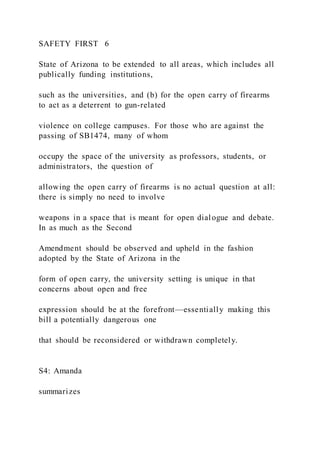
SAFETY FIRST 6
State of Arizona to be extended to all areas, which includes all
publically funding institutions,
such as the universities, and (b) for the open carry of firearms
to act as a deterrent to gun-related
violence on college campuses. For those who are against the
passing of SB1474, many of whom
occupy the space of the university as professors, students, or
administrators, the question of
allowing the open carry of firearms is no actual question at all:
there is simply no need to involve
weapons in a space that is meant for open dialogue and debate.
In as much as the Second
Amendment should be observed and upheld in the fashion
adopted by the State of Arizona in the
form of open carry, the university setting is unique in that
concerns about open and free
expression should be at the forefront—essentially making this
bill a potentially dangerous one
that should be reconsidered or withdrawn completely.
S4: Amanda
summarizes
the main
argument of
the con side,
those who are
against the
passing of
SB1474.
S5: Amanda
reiterates her
own position
by reasserting
her thesis
statement.
Note that the
thesis
statement is
slightly
different than
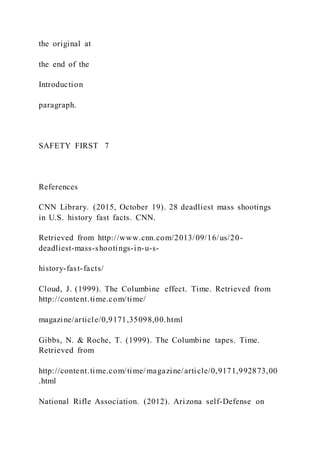
the original at
the end of the
Introduction
paragraph.
SAFETY FIRST 7
References
CNN Library. (2015, October 19). 28 deadliest mass shootings
in U.S. history fast facts. CNN.
Retrieved from http://www.cnn.com/2013/09/16/us/20-
deadliest-mass-shootings-in-u-s-
history-fast-facts/
Cloud, J. (1999). The Columbine effect. Time. Retrieved from
http://content.time.com/time/
magazine/article/0,9171,35098,00.html
Gibbs, N. & Roche, T. (1999). The Columbine tapes. Time.
Retrieved from
http://content.time.com/time/magazine/article/0,9171,992873,00
.html
National Rifle Association. (2012). Arizona self-Defense on
campus [Flyer]. NRA: Author.
Sander, Eugene. (2012, March 20). UA President opposes
campus guns bill. KGUN-TV.
Retrieved from http://www.kgun9.com
An APA list of references should be
labeled “References,” NOT “Works
Cited” or “Bibliography.”
The last
name is
presented
first; then the
first name
and middle
(if present) is
included as
initials. An
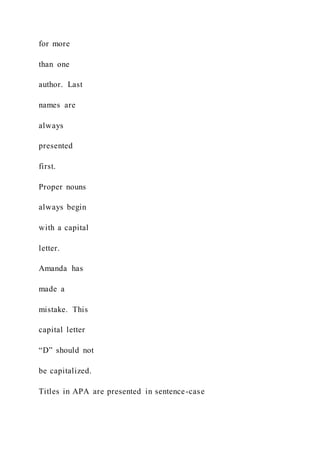
ampersand
(&) is used
for more
than one
author. Last
names are
always
presented
first.
Proper nouns
always begin
with a capital
letter.
Amanda has
made a
mistake. This
capital letter
“D” should not
be capitalized.
Titles in APA are presented in sentence-case
capitalization, meaning that only the first
word or any proper noun should begin with a
capital letter.
Amanda has
made a
mistake by
including the
full name of
the author
here.
Untitled
COMPOSITION WRITING AIDS
1. Do not use 1st person pronouns (e.g. I,me, we, us, our, etc.)
2. Write out all contractions (do not instead of don't) and
acronyms (e.g. Dallas Independent School District instead of
DISD the first time used)
3. Do not use the word "YOU," "YOUR," "TODAY," "NOW,"
"HERE," or "AROUND" and remember the word "CANNOT" is
one word.
4. Never use a cliché without quotations marks (e.g. "Last but
not least")
5. Do not start a sentence with the word "THERE" or “THAT
6. When using a quote, all periods and commas go inside
quotation marks
7. Open the1st sentence of the Introductory Paragraph with the
Subject of the paper
8. Each pronoun must agree with its antecedent in number
(People will buy cookies if they like them/Sally will eat her hot
dog)
9. Never end of sentence with a preposition (e.g. in, to, at, on,
etc.)
10. Never start two sentences with the same word in a paragraph
11. Never use a particular pronoun or personal name more than
twice in a paragraph and make sure any person's name includes
the first and last name and location of the person
12. Five W s (WHO/WHAT/WHEN/WHERE/WHY) of the
Subject must be present in the Introductory Paragraph (The
WHO always includes the person's first and last name and the
WHERE requires a specific address)
13. Each Body Paragraph should have at least one specific
anecdote/brief story/example/illustration at least 3 sentences
long at the end of the paragraph
14. All proper nouns must be capitalized (e.g. Ramada, Buick or
MVC)
15. All titles should be original, clever, and/or humorous.
Please use a Title Page only in a Research Paper.
16. All papers must be single-spaced, typed or printed with
paragraphs at least 6 sentences long (except for a Research
Paper which is double-spaced).

LESSON 4RESEARCH ESSAYReading Assignment Dodge’s Johnso

  • 1.
    LESSON 4 RESEARCH ESSAY ReadingAssignment: Dodge’s “Johnson county Dreamin’” (page 186) and “The Jilting of Katherine Anne Porter” (page 183) Writing Assignments: 1. Write a paragraph summarizing each Dodge article 2. Write a four paragraph Research Essay (see below). One part of this lesson is to review one of the basic elements of expository writing, the essay. In this lesson the Research Essay will be studied. A Research Essay is a form of writing in which a personal opinion is expressed about a subject. Review the enclosed outline and sample of a Research Essay. After reviewing this material, please submit a four paragraph Research Essay on a famous painting, monument or statue. Check the COMPOSITION WRITING AIDS before writing this paper. KEYS TO WRITING THE RESEARCH ESSAY OVERALL DESIGN INTRODUCTORY PARAGRAPH: Subject with the issue followed by the Who, What, When, Where, and Why on Subject + Thesis w/Main Points BODY PARAGRAPH: Full discussion of 1st Main Point w/Specific Example at least 3 sentences long BODY PARAGRAPH: Full discussion of 2nd Main Point
  • 2.
    w/Specific Example atleast 3 sentences long CONCLUSION: Summarize the key elements of the essay and add any other relevant information THE INTRODUCTORY PARAGRAPH: The introductory paragraph for the Research Essay opens with subject of the essay followed by the issue. Next is the thesis followed by the paper’s main points Below are 2 sample thesis statements: ISSUE with the SUBJECT: Giving to the Cancer Society of America OPINION: should be discouraged because MAIN POINTS: only 1% of the proceeds go to cancer patients and the society is a scam SUBJECT: Attending Six Flags’ Fright Night OPINION: is good because MAIN POINTS: the haunted house is remarkable and the Halloween show is exceptionally entertaining THE FIRST BODY PARAGRAPH: The first body paragraph of a Classification Essay has 2 elements: a full discussion of the 1st main point so that the reader understands the issue followed by a 3 sentences long
  • 3.
    SPECIFIC example/illustration whichilluminates the 1st main point. This body paragraph must end with citation (see example below). THE SECOND BODY PARAGRAPH: The second body paragraph of a Classification Essay has 2 elements: a full discussion of the 2nd main point so that the reader understands the issue followed by a 3 sentences long SPECIFIC example/illustration which illuminates the 2nd main point. This body paragraph must end with citation (see example below). THE CONCLUSION: Summarize the key elements of the essay and add any other relevant information Lee Bee English 1301 Lesson 4 October 22, 201? Men in Rock Mount Rushmore is a well-known iconic and patriotic monument in the Black Hills of South Dakota that has been
  • 4.
    visited by Americansfor generations. Located at 13000 South Dakota Highway 244, Keystone, SD 57751, the Mount Rushmore National Memorial was the brainchild of South Dakota historian Doane Robinson who conceived the idea in 1923 to commemorate important individuals in American history. In 1924, Robinson persuaded sculptor Gutzon Borglum to take on the massive project and Borglum spent the rest of his life creating the gigantic granite heads of four American presidents who in turn represent four crucial eras of American history. The 60-foot heads are of George Washington (1732– 1799), Thomas Jefferson (1743–1826), Theodore Roosevelt (1858–1919), and Abraham Lincoln (1809–1865). Visiting the Mount Rushmore National Memorial should be encouraged because it helps Americans understand American history and appreciate Borglum’s extraordinary achievement. American history is highlighted in this colossal rock formation. The most prominent head is that of George Washington who is honored for his crucial leadership in the American Revolution and as the 1st President of the United States. Thomas Jefferson is rightly next to Washington for his role in authoring the Declaration of Independence and serving as the third President. Abraham Lincoln holds the prominent position on the right side of the monument for saving the Union through the Civil War. And finally, Theodore Roosevelt is included among the other greats for his role in protecting America’s priceless natural treasures during the Progressive Era. These rocks have become one of the most popular tourist destinations in the United States. Doane Robinson wanted them to promote South Dakota tourism and his wish has certainly come true. “Doane’s tourism plan worked. Nearly three million people visit Mount Rushmore each year. And its popularity never seems to decrease” (Trex). When tourists come to visit this Shrine of Democracy in South Dakota, they rarely pause to contemplate the enormous contribution of its sculptor Gutzon Borglum. Borglum was the
  • 5.
    child of Danishpolygamist Mormon immigrants and his father was a country doctor in Nebraska. In 1923 Borglum started work on a Confederate memorial on Stone Mountain near Atlanta. It was to show huge images of Robert E. Lee, Jefferson Davis, and 'Stonewall' Jackson. Eventually Borglum came into conflict with the Confederate Memorial officials so he destroyed his models and left to start on the Mount Rushmore project. Beginning his work on Mount Rushmore in 1925, he continued to work on the monument when weather permitted until his death in 1941. A small inkling of Borglum’s struggle on this project may be seen in the following citation. “Borglum started blasting rock in 1927. Federal financing in 1929 helped, but the sculpture was still a financial drain. When asked in 1940 about the cost, Borglum said ‘Call up Cheops and ask him how much his pyramid cost, and what he paid the creator — an inferior work to Mt. Rushmore’” (Peters). On July 23, 1962 the first television satellite broadcast was made from the United States to Europe. The first image of that initial broadcast was of a Lakota Sioux man standing in front of Mount Rushmore. Nothing could better demonstrate how much this monument is seen as representing America. Along with the Statue of Liberty in New York and the Washington Monument and Lincoln Memorial in Washington, DC, Mount Rushmore holds a special almost mystical place in the hearts of Americans. It inspires patriotism and causes reflection on what America is and will become. With millions of visitors every year, Mount Rushmore promises to continue thrilling American throughout the ages until the images are finally worn down by time. Works Cited Peters, Chris. “The Omaha Boy Who Went On To Sculpt Mt. Rushmore.” Omaha World Herald. October 9, 2009.Trex, Ethan. “11 Essential Talking Points for Mount Rushmore Enthusiasts.”
  • 6.
    Mental Floss. January 14,2016. Unit IV Color Key: -level number and explanation Running head: SAFETY FIRST 1 Safety First: Open Carry Firearms on Higher Education Campuses in Arizona Student Name Columbia Southern University APA header: Note that the title is in capital letters and prefaced by the words “Running head.” The page number is also included. Full title of the paper with the major words beginning with a capital letter
  • 7.
    The student’s firstand last name Name of the institution, which will always be “Columbia Southern University” SAFETY FIRST 2 Safety First: Open Carry Firearms on Higher Education Campuses in Arizona Much has been made in the past few years about gun restrictions in the U.S. Proponents of gun regulation are in a constant state of lobbying for state and federal bills that restrict access to firearms, whether that takes the form of more extensive background checks on potential gun owners or longer waiting periods before guns may be sold to individuals. On the other side, the National Rifle Association (NRA) and other like-minded individuals advocate for looser restrictions on the sale and carrying of firearms. For these supporters of pro-gun legislation, owning and carrying guns is a fundamental right—even a civil right. While this national debate continues to loom over the hot topic of guns, there are breaking news stories, especially within the last few months, that bring this fundamental debate to the
  • 8.
    threshold of ournations colleges, high schools, even elementary schools. Seung-Hui Cho’s massacre at Virginia Tech (April 16, 2007) is perhaps one of the more infamous school shootings, but there are others that are perhaps more difficult to remember, like the deaths of 27 killed at Sandy Hook Elementary School in Newton, Connecticut (December 14, 2012) (CNN, 2015). Shootings like these in educational settings have drawn attention from both anti-gun proponents and pro-gun lobbyists, and the State of Arizona is no exception to this firestorm. The Arizona State legislature has proposed SB 1474, a gun bill that will allow students and faculty to carry guns on the campus grounds of its three state-funded universities. Supporters of the bill claim that Arizona is an open carry state, and those rights should not be restricted simply because the carrier crosses the border of a college campus. Those against the bill assert that guns have no place in education and that those who support the bill are only after their own election-year agendas. While the Second Amendment should be upheld, the educational learning environment should
  • 9.
    be protected; Full titlepresented again at the top of the page Para 1: Introduction Sentence 1 (S1): Amanda introduces the main topic (gun control) in a generalized manner; this sentence also introduces the con side of the controversy S2 &3: Follows S1 by introducing the position of the pro side; again, Amanda is general, focusing on the larger controversy S4: Amanda begins to narrow the scope of the project by pointing towards a specific debate within the larger controversy of gun control: gun control in educational settings. S5: Specific examples from the news. Note that these are examples of school shootings with which most people are familiar. This grounds the project to what is at stake in making arguments about this topic. S6: Amanda again narrows the scope of the project by moving from gun control in educational settings to this debate as it takes place in a specific location: Arizona. S7: In this sentence, the writer introduces the specific topic of the project: the controversy around SB1474. S8 & 9: Following the same order from above (con first, then pro), Amanda presents the sides of the controversy by introducing each specific position. S10: Amanda presents her thesis statement. She responds to the controversy by crafting a thesis statement that simultaneously
  • 10.
    agrees and disagrees. Jason.Davis Line SAFETYFIRST 3 therefore, SB 1474 is a detrimental and dangerous bill that has the potential to change the university campus culture in Arizona state universities. The Literature Review In order to better understanding the origins of SB1474 and the controversy that surrounds it, the history of gun violence in school settings must be taken into account; therefore, a brief look at some of the events of the past few decades is presented. Further, this review will examine in greater detail the positions of the two sides of the controversy, beginning with the pro-SB1474 side, which is in favor of allowing open carry on all Arizona state-funded campuses. Then the position of those against SB1474 will be presented; again, this con side is arguing for Arizona campuses to remain as they are now: a place without firearms. A Brief Look at Gun Violence in Schools
  • 11.
    The topic ofgun control in educational environments exploded in 1999 when Eric Harris and Dylan Klebold walked into a virtually unknown high school in Littleton, CO, and killed twelve students and one teacher (Gibbs and Roche, 1999). Questions of how such events could occur and concerns about the violence of which teens and young adults are capable became the concern of pressured administrators and horrified parents in big cities and small towns alike. A string of school gun-centered violence followed over the next few years. Perhaps most striking though was the way in which this one incident changed the culture of America: clear backpacks, more metal detectors, and (of course) fear. Cloud (1999) points out some of the extreme, “zero tolerance” actions taken by schools shortly following the Columbine shootings: A seven-year-old boy in Cahokia, Ill., is suspended for having a nail clipper at school. A 10th-grader at Surry County High School in Virginia is booted for having blue-dyed hair. Shortened version of the title in the header and the page number
  • 12.
    on each page Para2: Preface of the Literature Review Para 3: Brief History First-level heading: All major sections of the paper will be first- level, including The Literature Review, Body, and Conclusion. You may choose to mark the Introduction, but it is typicall y not done because the title of the paper stands for the heading level. Note that the title is centered and bold with sentence-case capitalization. Note how Amanda prefaces the LR by giving the reader an idea of what will be included. You might also note that the paragraph is written in passive voice so that she can avoid using personal pronouns such as “I.” This is a second-level heading. It is left-hand justified and bold. All major words are capitalized. This tells the reader that this next section is a division of the first-level heading that is directly above. This citation is in APA. It shows the authors and year of publication. This sentence is a paraphrase of Gibbs and Roche. The reader can look at the references page to find the original document. Amanda has made a mistake: Only the ampersand (&) should be used in a parenthetical citation. Here is another way to include a parenthetical citation. Amanda has incorporated the author’s name into the sentence. Note that the year of publication is presented after the author, but there is no citation at the end of the sentence because the information is already presented at the beginning.
  • 13.
    This quotation iscalled a “block.” If a quotation is over 40 words long, then you must “block” it by removing the quotation marks and indenting the entire quotation 1/2” from the left-hand margin. If this quotation would have been from a print text, then the page number would have been included at the end of the sentence, but it was an electronic source. Elizabeth.MacWhinnie Typewritten Text Elizabeth.MacWhinnie Typewritten Text Elizabeth.MacWhinnie Typewritten Text Elizabeth.MacWhinnie Typewritten Text SAFETY FIRST 4 A Minnesota high school nixes a yearbook photo of an Army enlistee in the senior class because it shows her sitting atop a cannon outside a Veterans of Foreign Wars post. Far from the exception, these actions considered these many years later seem unreasonable, even in a post-9/11 world filled with uncertainty. The Argument for Open Carry Everywhere in Arizona
  • 14.
    However, in Arizona,the newly proposed SB 1474 would not seek to disarm students; on the contrary, the bill would allow students the right to concealed carry on state-funded university campuses. Proponents of the bill assert that such a measure is long over due. According to an NRA poster that were taped to message boards all over The University of Arizona campus, “[s]elf-defense is one of the most fundamental rights of every human being.” Further, the poster states that the NRA has worked diligently over the past 25 years to expand the right of open carry: the NRA has been “working for passage of fair Right-to- Carry laws, expansion of carry reciprocity between the states and the elimination of many ‘no- carry’ zones that only affect the law-abiding.” For the NRA, one of the major private-public backers of the SB 1474, the restriction of concealed carry on college campuses is an infringement on these basic rights. The flyer goes on to state the following: Those who oppose campus carry [of firearms] argue that educational institutions should be treated differently, based on emotional claims that places of
  • 15.
    higher learning are somehowexempt from real-world violence. But the truth is, despite current prohibitions on legally carrying on campuses, crimes already occur on campus, and the right to self- defense from those violent acts should be respected. (NRA, 2012) The NRA is correct. In fact, given the number of school-related shootings in the past few months alone, it would seem that a student’s chances of being shot on campus seem greater than if that Para 4: Pro side There are three second-level headings in the LR. Headings help you and the reader to see the organization of your paper. Amanda presents a closer look at the pro side before the con side. Note that she is not engaging with the arguments, only presenting them as fairly as she can. The LR is about the arguments of others. Amanda knows she will be able to make her own arguments in the Body of the paper. SAFETY FIRST 5 same student were walking the streets of the community. From larger cities to small towns, it seems that the size of the community does not matter: the
  • 16.
    violence of ashooting can occur anywhere. However, even with this fact floating in the backs of students’ minds, students must still attend classes and while it would seem obvious that lawmakers on both sides want student safety, they just see the means to that safety from different sides of the same coin. The Case for Campuses as Unique Eugene Sander (2012), the Interim President of the University of Arizona, released the following statement about SB 1474: “I have been a gun owner for all my adult life, and am fully supportive of the right to own a gun. However, having faculty, staff or students bringing weapons into classrooms and other campus activities will do nothing to make our campus safer.” While Sander does not go into detail about what this newly proposed bill does have to do with, he makes his case on the basis that 50,000 students, staff, and faculty attend the campus daily, along with over 20,000 visitors annually. For Sander (2015), the educational environment is a “unique atmosphere that is dependent on open and vigorous debate. Introducing guns into
  • 17.
    classrooms would dramaticallyand negatively impact the ability to engage in constructive dialogue.” In other words, even if the NRA does not believe that the university is a unique atmosphere, as Sander and others do, then there is still a possibility that introducing the right to carry concealed weapons on campus might lead to a change to the very culture of the university. While Arizona lawmakers continue to debate the merits of SB1474, the public debate grows, as this issue concerns both public safety and citizens’ rights. Because the three state universities in Arizona are publically funded, the debate about allowing open carry is very much a concern held by the communities in which these universities reside. Those who are in favor of the change to an open carry status on university campuses wish (a) for the open carry laws of the Para 5: Con side This citation is correct. Amanda did not have to include the author’s first name, but it is fine to do so the first time that the author’s name is mentioned.
  • 18.
    Amanda has made a mistake. Eachtime an author is included, the year of publication must follow. So this should read as follows: “While Sander (2012)…” Amanda has made a
  • 19.
    mistake. The actual year ofthe publication is 2012. Be careful about editing for errors like this in your own paper. Para 6: LR Conclusion S1&2: Amanda creates a topic sentence that encapsulates
  • 20.
    the concern of the controversy, andshe includes a second sentence to increase understanding. S3: Amanda summarizes the two main arguments of the pro side, which favors the passing of SB1474.
  • 21.
    SAFETY FIRST 6 Stateof Arizona to be extended to all areas, which includes all publically funding institutions, such as the universities, and (b) for the open carry of firearms to act as a deterrent to gun-related violence on college campuses. For those who are against the passing of SB1474, many of whom occupy the space of the university as professors, students, or administrators, the question of allowing the open carry of firearms is no actual question at all: there is simply no need to involve weapons in a space that is meant for open dialogue and debate. In as much as the Second Amendment should be observed and upheld in the fashion adopted by the State of Arizona in the form of open carry, the university setting is unique in that concerns about open and free expression should be at the forefront—essentially making this bill a potentially dangerous one that should be reconsidered or withdrawn completely. S4: Amanda summarizes
  • 22.
    the main argument of thecon side, those who are against the passing of SB1474. S5: Amanda reiterates her own position by reasserting her thesis statement. Note that the thesis statement is slightly different than
  • 23.
    the original at theend of the Introduction paragraph. SAFETY FIRST 7 References CNN Library. (2015, October 19). 28 deadliest mass shootings in U.S. history fast facts. CNN. Retrieved from http://www.cnn.com/2013/09/16/us/20- deadliest-mass-shootings-in-u-s- history-fast-facts/ Cloud, J. (1999). The Columbine effect. Time. Retrieved from http://content.time.com/time/ magazine/article/0,9171,35098,00.html Gibbs, N. & Roche, T. (1999). The Columbine tapes. Time. Retrieved from http://content.time.com/time/magazine/article/0,9171,992873,00 .html National Rifle Association. (2012). Arizona self-Defense on
  • 24.
    campus [Flyer]. NRA:Author. Sander, Eugene. (2012, March 20). UA President opposes campus guns bill. KGUN-TV. Retrieved from http://www.kgun9.com An APA list of references should be labeled “References,” NOT “Works Cited” or “Bibliography.” The last name is presented first; then the first name and middle (if present) is included as initials. An ampersand (&) is used
  • 25.
    for more than one author.Last names are always presented first. Proper nouns always begin with a capital letter. Amanda has made a mistake. This capital letter “D” should not be capitalized. Titles in APA are presented in sentence-case
  • 26.
    capitalization, meaning thatonly the first word or any proper noun should begin with a capital letter. Amanda has made a mistake by including the full name of the author here. Untitled COMPOSITION WRITING AIDS 1. Do not use 1st person pronouns (e.g. I,me, we, us, our, etc.) 2. Write out all contractions (do not instead of don't) and acronyms (e.g. Dallas Independent School District instead of DISD the first time used) 3. Do not use the word "YOU," "YOUR," "TODAY," "NOW," "HERE," or "AROUND" and remember the word "CANNOT" is one word. 4. Never use a cliché without quotations marks (e.g. "Last but not least") 5. Do not start a sentence with the word "THERE" or “THAT 6. When using a quote, all periods and commas go inside quotation marks
  • 27.
    7. Open the1stsentence of the Introductory Paragraph with the Subject of the paper 8. Each pronoun must agree with its antecedent in number (People will buy cookies if they like them/Sally will eat her hot dog) 9. Never end of sentence with a preposition (e.g. in, to, at, on, etc.) 10. Never start two sentences with the same word in a paragraph 11. Never use a particular pronoun or personal name more than twice in a paragraph and make sure any person's name includes the first and last name and location of the person 12. Five W s (WHO/WHAT/WHEN/WHERE/WHY) of the Subject must be present in the Introductory Paragraph (The WHO always includes the person's first and last name and the WHERE requires a specific address) 13. Each Body Paragraph should have at least one specific anecdote/brief story/example/illustration at least 3 sentences long at the end of the paragraph 14. All proper nouns must be capitalized (e.g. Ramada, Buick or MVC) 15. All titles should be original, clever, and/or humorous. Please use a Title Page only in a Research Paper. 16. All papers must be single-spaced, typed or printed with paragraphs at least 6 sentences long (except for a Research Paper which is double-spaced).