LESSON 2
APPROACHES/ DIMENSION OF
GLOBALIZATION
JUN NAVARRO ATIBURCIO, CHRA​
Instructor
Globalization is an on- going procedure that
encompasses interconnectedness changes in the
economic, cultural, social, and political domains of
society. As a process, it involves the ever-
increasing amalgamation of these aspects between
nations, regions, communities, and even seemingly
isolated places.
3
TERMS
IN ECONOMIC TERMS- globalization refers to the expansion of capitalism to
include all places around the world into one globally integrated economic system.
Explanation: a free trade agreement from one borders to another, its all about
having an agreement for the goods and services underlying to the economy of
one nation.
IN CULTURAL TERM- it refers to the global spread and integration of ideas, values,
norms, behaviors, and ways of life/ Explanation: the interconnectedness and
interdependence of one nation to another its about the arising issues that affecte
the culture of one nation.
IN POLITICAL TERM- it refers to the development of forms of governance that
operate at the global scale, whose policies and rules cooperative nations are
expected to abide. Explanation just so you know when a president go to meet the
other nation with the president they are having a meeting towards the
development of their countries, how they will help each other to achieve the one
goal and that is to make their economy progressive. Hindi lang sila nakikipulong
for the friendship of their country but it’s a deep talk that provide them benefits,
its kind of benchmarking.
These three core aspects of globalization are fueled by technological
development. DO YOU AGREE CLASS? WHY DO YOU SAY SO? Yes, it is because of
the global integration of communication technologies and the global distribution
of media where this really are the powerful tool now. RIGHT?
ECONOMIC GLOBALIZATION
This approach focuses on the idea that there is a growing economic
interdependence among the states depicting the free flowing of goods
and services across borders, sharing of technical skills and talents and
integrating economies. The common themes of economic globalization
are:
* Global economic integration
* increasing international economic activity;
* growing economic interconnectedness and interdependence
of national economies; increasing sensitivity of local key economic
variables to the mentioned changes at a regional and global level;
* rising global markets
* increased international mobility of goods, capital, and labor;
* rapid expansion and growing influence of transnational
corporations;
MAIKKAT TO!
Tarif is a tax to be paid
6
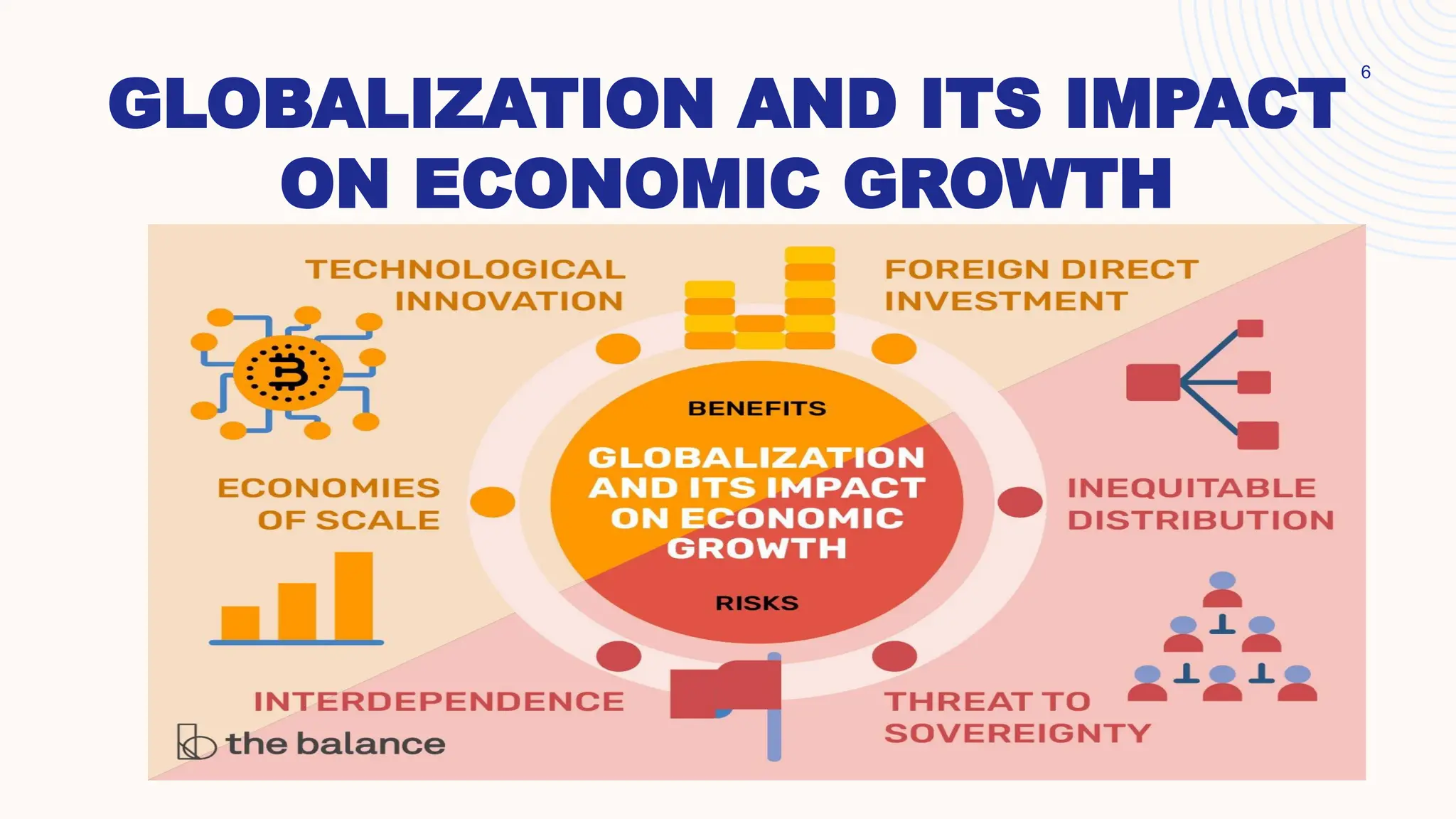
GLOBALIZATION AND ITS IMPACT
ON ECONOMIC GROWTH
POLITICAL GLOBALIZATION
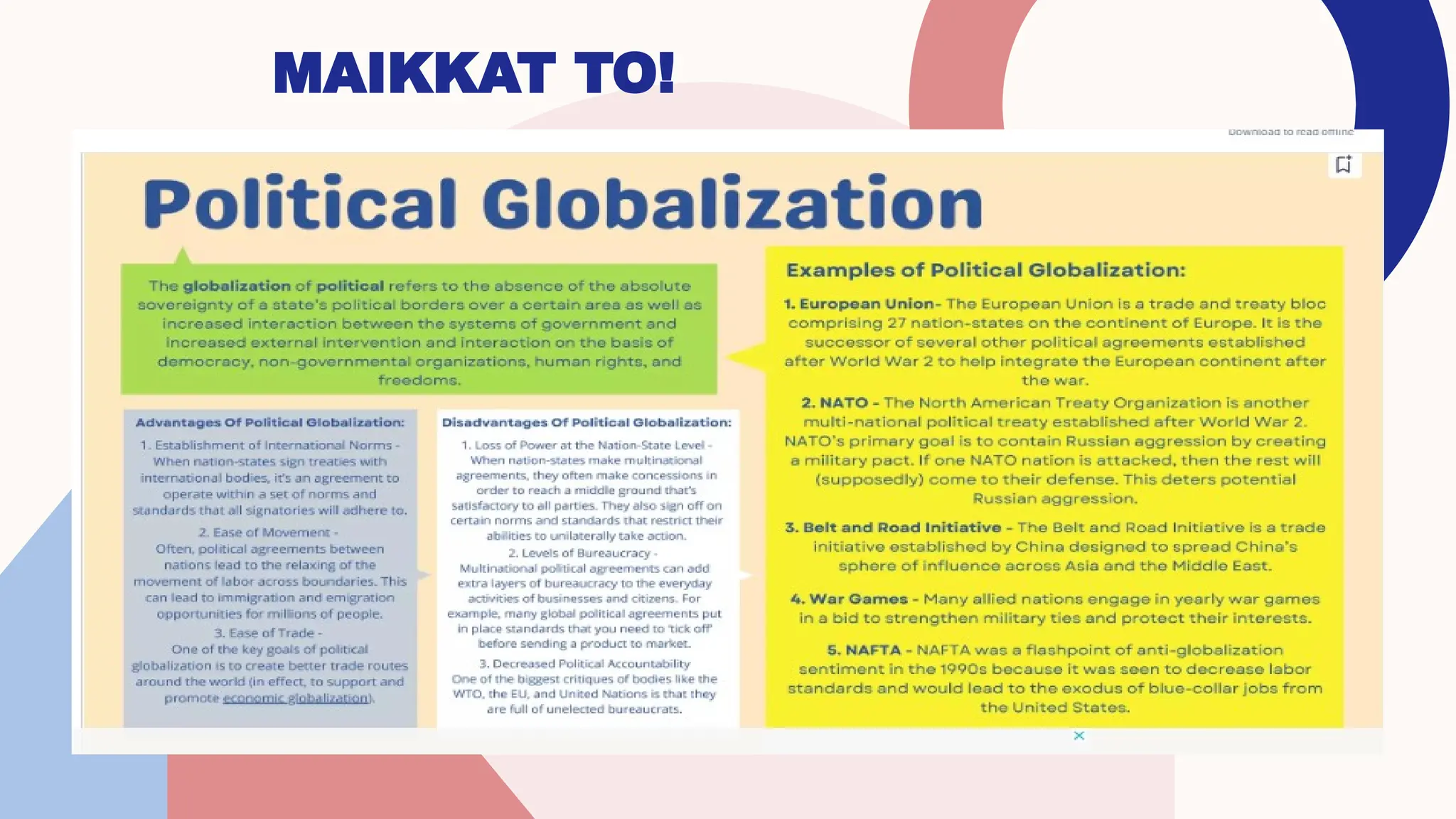
This approach explains the dynamic role of states in
advancing “intergovernmentalism”.
Intergovernmentalism is a term in political science
with two meanings. The first refer to a theory of
regional integration originally proposed by Stanley
Hoffman; the second treats states and the national
government as the primary factors for integration.
This approach also connotes the growing influence
of global governance as well as the establishment of
a major institutions, such as the United Nation (UN),
World Trade Organization (WTO) , Association of
MAIKKAT TO!
CULTURAL GLOBALIZATION
This approach refers to the transmission of ideas,
meanings, and values around the globe in such a
way as to spread and deepen social relations. This
process is characterized by the common
consumption of cultures that have been spread by
the internet, popular culture media, and
international travel. Cultural globalization involves
the development of shared norms and knowledge
with which people associate their individual and
collective cultural identities. This brings increasing
interconnectedness among different populations and
MAIKKAT TO
13
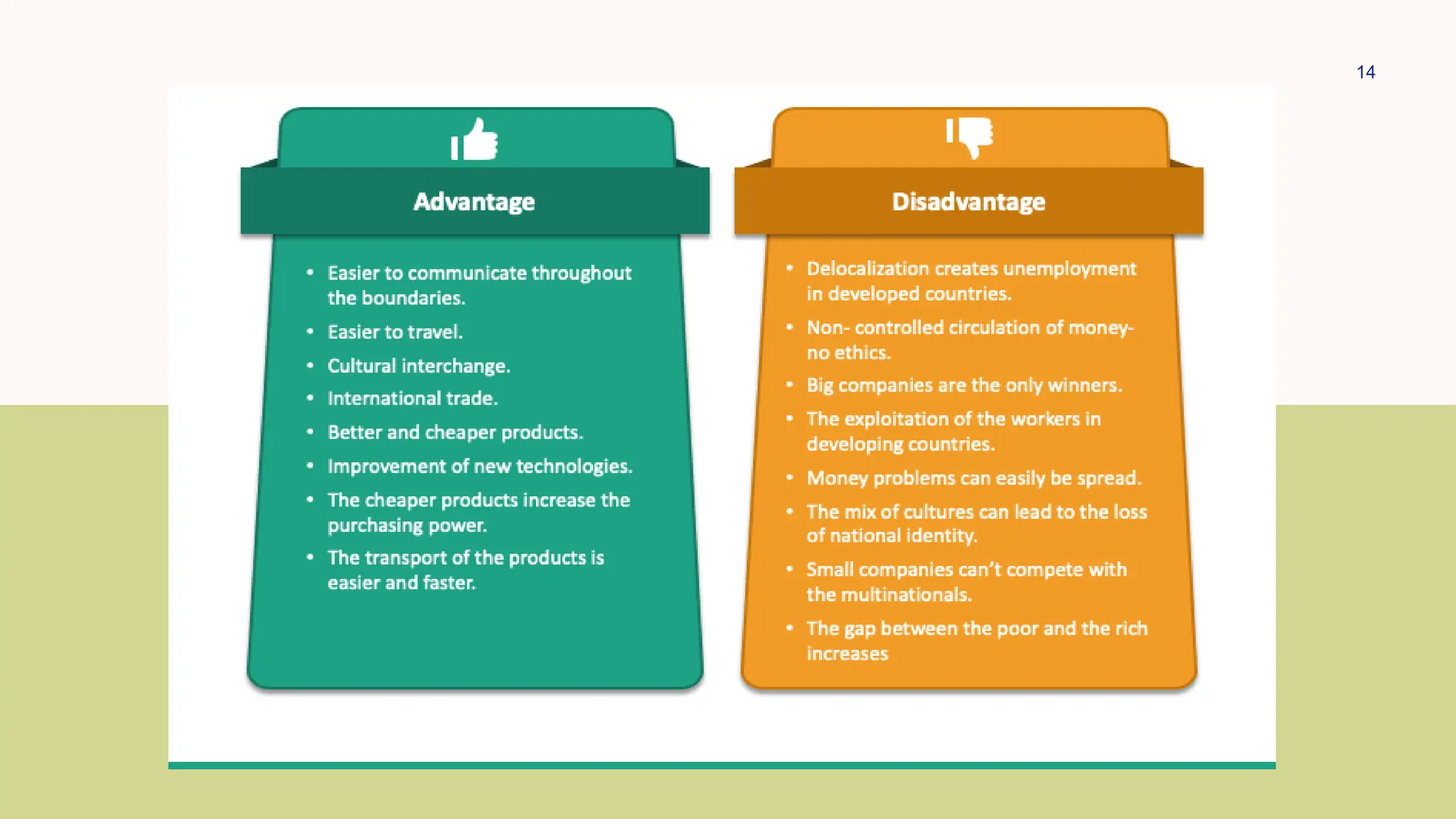
ADVANTAGES AND
DISADVANTAGES OF
GLOBALIZATION
14
15
STAGES OF
GLOBALIZATION
16
17
LESSON 3
ORIGIN AND HISTORY OF
GLOBALIZATION
MAIKKAT TO!
19
20
PHASES OF GLOBALIZATION
PHASE 1: ARCHAIC
GLOBALIZATION
PHASE 2: PROTO- GLOBALIZATION
• This period existed during the
Hellenistic Age, when
commercialized urban centers
where concentrated around the
alliance of Greek culture over a wide
range that stretched from India to
Spain with such cities as Alexandria,
Athens, and Antioch at its center.
• Explanation globalization describes
the relationships between
communities and states and how
they were created by the
geographical spread of ideas and
social norms at both local and
regional levels.
• Was characterized by the rise of man
time European empires, first the
Portuguese and Spanish empires,
and eventually the Dutch and
European empires. Explanation early
modern globalization is a period of
the history of globalization roughly
spanning the years between 1600
and 1800,
21
PHASES OF GLOBALIZATION
PHASE 3: MODERN GLOBALIZATION
• The 19th
century witnessed the dawn
of globalization approaching its
modern form. Industrialization
allowed cheap production of
household items using economies of
scale, while rapid population growth
created sustained demand for
commodities.
• Explanation means the speedup of
movements and exchanges (of
human beings, goods, and services,
capital, technologies or cultural
practices) all over the planet.
• To wrap the three phases
Globalization 1.0 involved the
globalization of countries,
Globalization 2.0 involved the
globalization of companies and
Globalization 3.0 involves the
globalization of individuals.
THANK YOU

LESSON 2: APPROACHES/ DIMENSION OF GLOBALIZATION

  • 1.
    LESSON 2 APPROACHES/ DIMENSIONOF GLOBALIZATION JUN NAVARRO ATIBURCIO, CHRA​ Instructor
  • 2.
    Globalization is anon- going procedure that encompasses interconnectedness changes in the economic, cultural, social, and political domains of society. As a process, it involves the ever- increasing amalgamation of these aspects between nations, regions, communities, and even seemingly isolated places.
  • 3.
    3 TERMS IN ECONOMIC TERMS-globalization refers to the expansion of capitalism to include all places around the world into one globally integrated economic system. Explanation: a free trade agreement from one borders to another, its all about having an agreement for the goods and services underlying to the economy of one nation. IN CULTURAL TERM- it refers to the global spread and integration of ideas, values, norms, behaviors, and ways of life/ Explanation: the interconnectedness and interdependence of one nation to another its about the arising issues that affecte the culture of one nation. IN POLITICAL TERM- it refers to the development of forms of governance that operate at the global scale, whose policies and rules cooperative nations are expected to abide. Explanation just so you know when a president go to meet the other nation with the president they are having a meeting towards the development of their countries, how they will help each other to achieve the one goal and that is to make their economy progressive. Hindi lang sila nakikipulong for the friendship of their country but it’s a deep talk that provide them benefits, its kind of benchmarking. These three core aspects of globalization are fueled by technological development. DO YOU AGREE CLASS? WHY DO YOU SAY SO? Yes, it is because of the global integration of communication technologies and the global distribution of media where this really are the powerful tool now. RIGHT?
  • 4.
    ECONOMIC GLOBALIZATION This approachfocuses on the idea that there is a growing economic interdependence among the states depicting the free flowing of goods and services across borders, sharing of technical skills and talents and integrating economies. The common themes of economic globalization are: * Global economic integration * increasing international economic activity; * growing economic interconnectedness and interdependence of national economies; increasing sensitivity of local key economic variables to the mentioned changes at a regional and global level; * rising global markets * increased international mobility of goods, capital, and labor; * rapid expansion and growing influence of transnational corporations;
  • 5.
    MAIKKAT TO! Tarif isa tax to be paid
  • 6.
    6 GLOBALIZATION AND ITSIMPACT ON ECONOMIC GROWTH
  • 7.
    POLITICAL GLOBALIZATION This approachexplains the dynamic role of states in advancing “intergovernmentalism”. Intergovernmentalism is a term in political science with two meanings. The first refer to a theory of regional integration originally proposed by Stanley Hoffman; the second treats states and the national government as the primary factors for integration. This approach also connotes the growing influence of global governance as well as the establishment of a major institutions, such as the United Nation (UN), World Trade Organization (WTO) , Association of
  • 8.
  • 9.
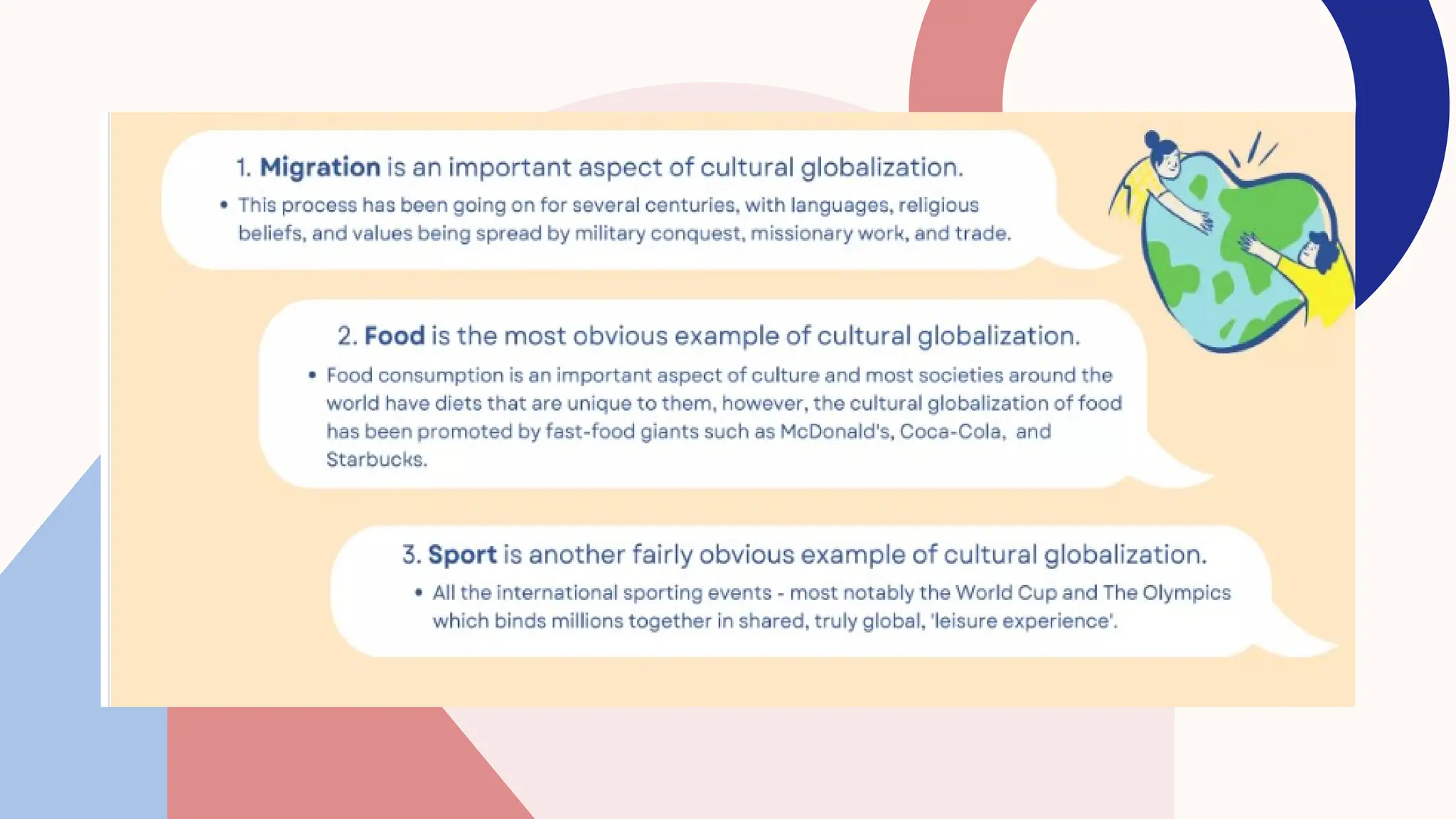
    CULTURAL GLOBALIZATION This approachrefers to the transmission of ideas, meanings, and values around the globe in such a way as to spread and deepen social relations. This process is characterized by the common consumption of cultures that have been spread by the internet, popular culture media, and international travel. Cultural globalization involves the development of shared norms and knowledge with which people associate their individual and collective cultural identities. This brings increasing interconnectedness among different populations and
  • 11.
  • 13.
  • 14.
  • 15.
  • 16.
  • 17.
    17 LESSON 3 ORIGIN ANDHISTORY OF GLOBALIZATION
  • 18.
  • 19.
  • 20.
    20 PHASES OF GLOBALIZATION PHASE1: ARCHAIC GLOBALIZATION PHASE 2: PROTO- GLOBALIZATION • This period existed during the Hellenistic Age, when commercialized urban centers where concentrated around the alliance of Greek culture over a wide range that stretched from India to Spain with such cities as Alexandria, Athens, and Antioch at its center. • Explanation globalization describes the relationships between communities and states and how they were created by the geographical spread of ideas and social norms at both local and regional levels. • Was characterized by the rise of man time European empires, first the Portuguese and Spanish empires, and eventually the Dutch and European empires. Explanation early modern globalization is a period of the history of globalization roughly spanning the years between 1600 and 1800,
  • 21.
    21 PHASES OF GLOBALIZATION PHASE3: MODERN GLOBALIZATION • The 19th century witnessed the dawn of globalization approaching its modern form. Industrialization allowed cheap production of household items using economies of scale, while rapid population growth created sustained demand for commodities. • Explanation means the speedup of movements and exchanges (of human beings, goods, and services, capital, technologies or cultural practices) all over the planet. • To wrap the three phases Globalization 1.0 involved the globalization of countries, Globalization 2.0 involved the globalization of companies and Globalization 3.0 involves the globalization of individuals.
  • 22.