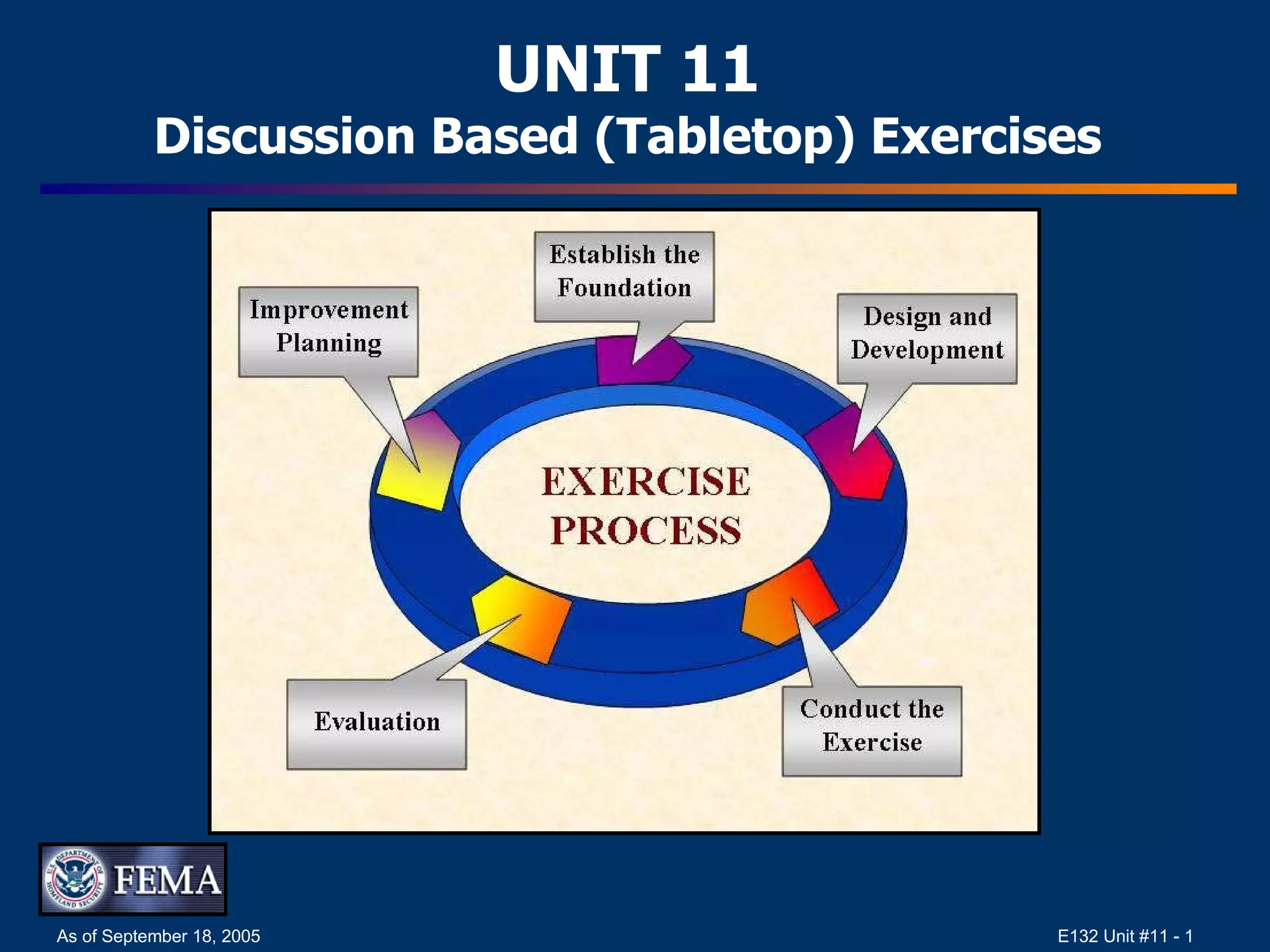

UNIT 11 Discussion Based (Tabletop) Exercises
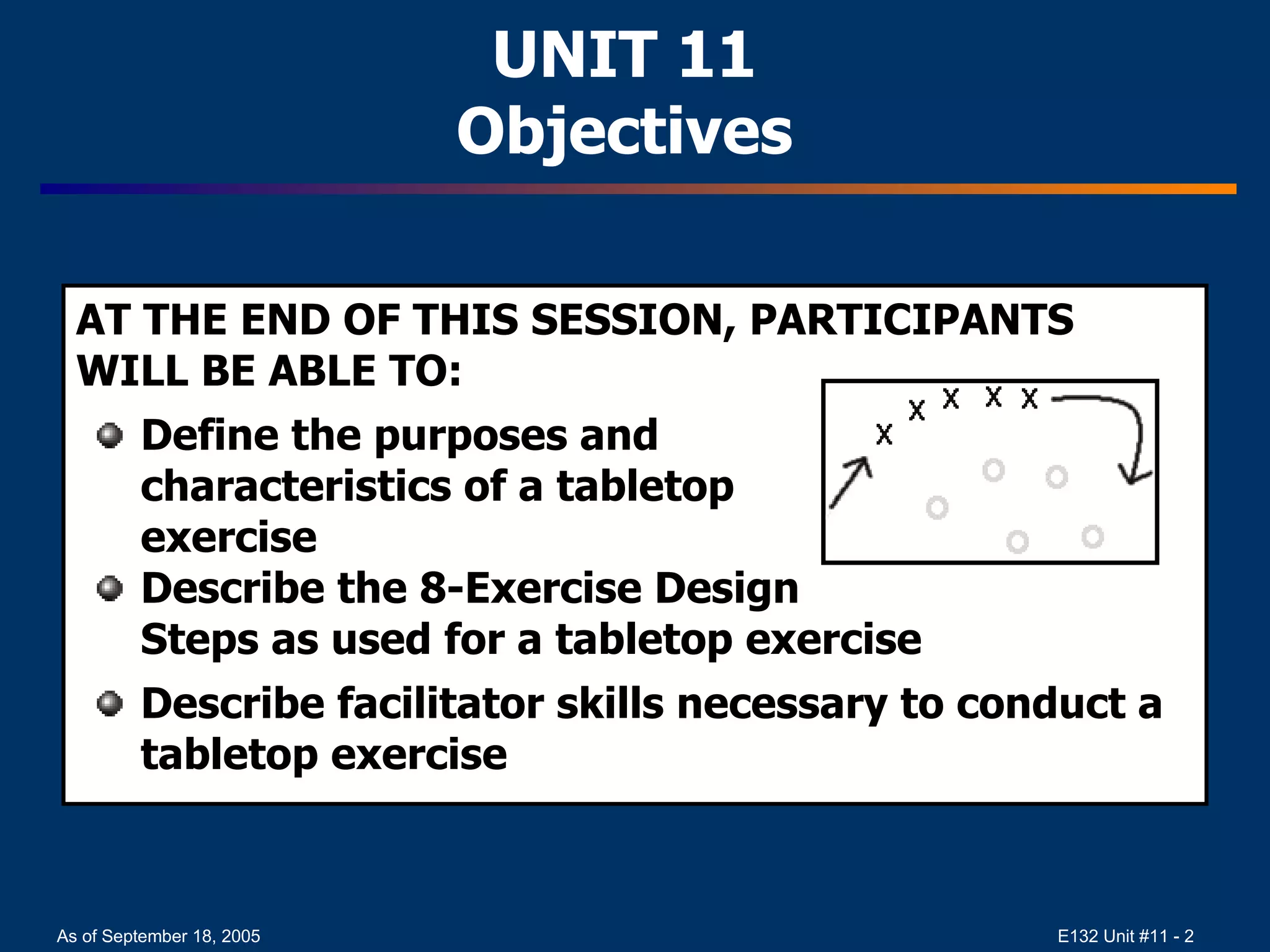
UNIT 11 Objectives AT THE END OF THIS SESSION, PARTICIPANTS WILL BE ABLE TO:  Define the purposes and  characteristics of a tabletop  exercise Describe the 8-Exercise Design  Steps as used for a tabletop exercise  Describe facilitator skills necessary to conduct a tabletop exercise
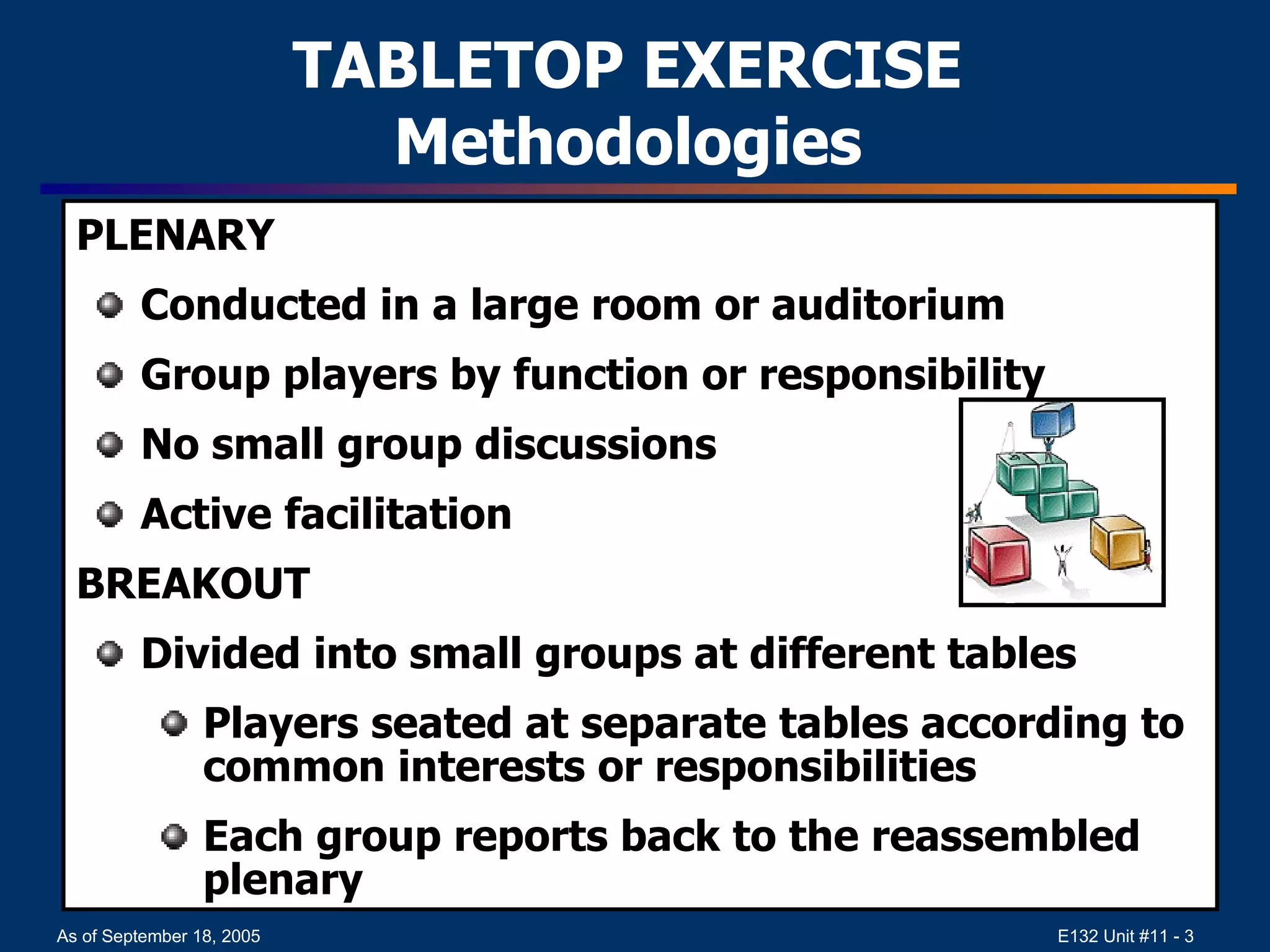
TABLETOP EXERCISE Methodologies PLENARY  Conducted in a large room or auditorium Group players by function or responsibility No small group discussions Active facilitation BREAKOUT Divided into small groups at different tables  Players seated at separate tables according to common interests or responsibilities Each group reports back to the reassembled plenary
TABLETOP EXERCISE Categories Basic – The complete scenario is provided to the players and remains constant Advanced - Scenario advances through delivery of pre-scripted messages from the beginning to the end
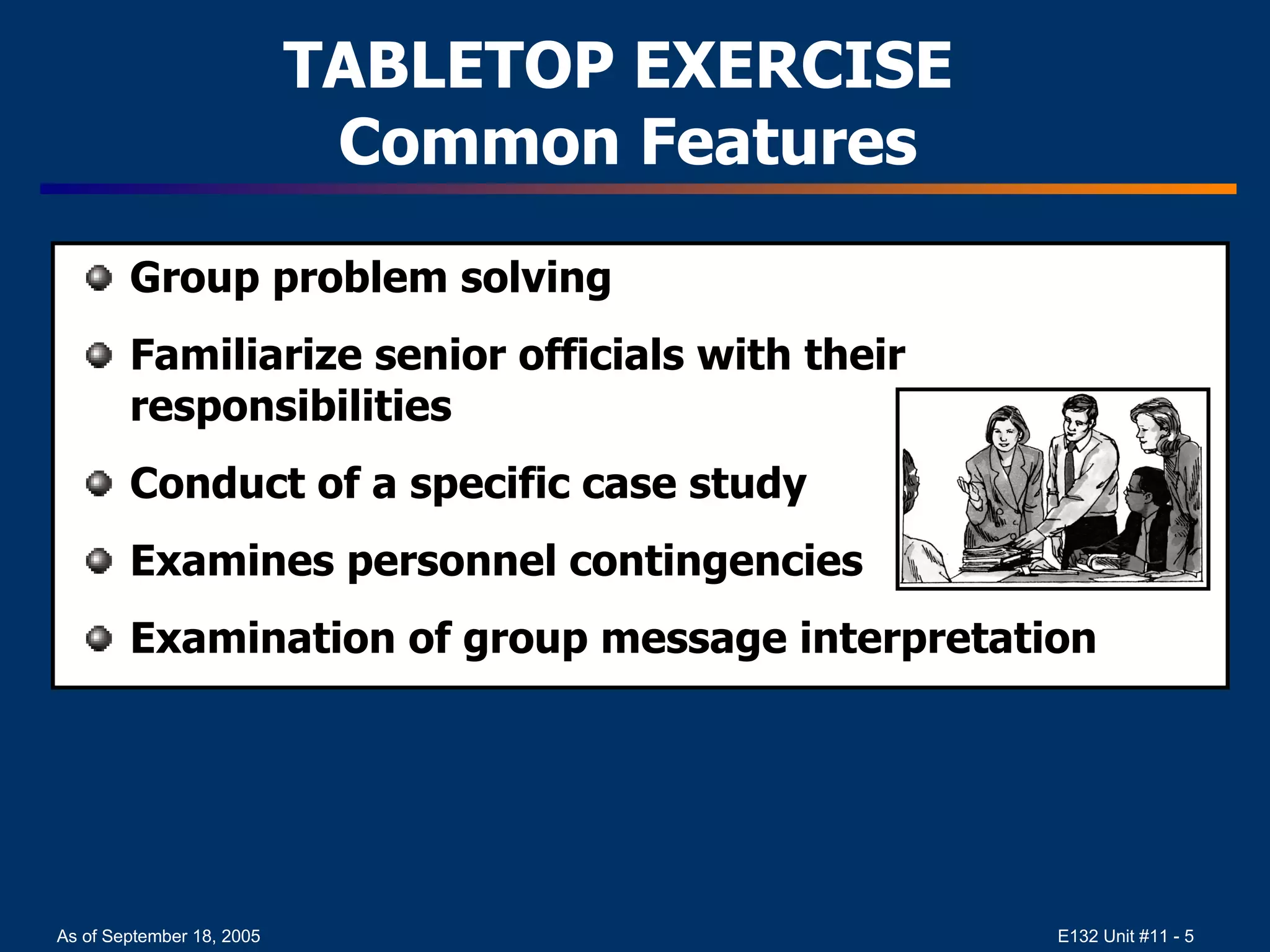
TABLETOP EXERCISE  Common Features Group problem solving Familiarize senior officials with their responsibilities Conduct of a specific case study Examines personnel contingencies Examination of group message interpretation
Participation in information sharing Assessment of interagency coordination Achievement of limited or  specific objectives Preparation for a more complex  exercise TABLETOP EXERCISE  Common Features
TABLETOP EXERCISES Informal discussion to evaluate, clarify or resolve questions of coordination & integration Facilitated group discussion/ problem solving Narrative, messages, or  problem statements used to  drive discussion
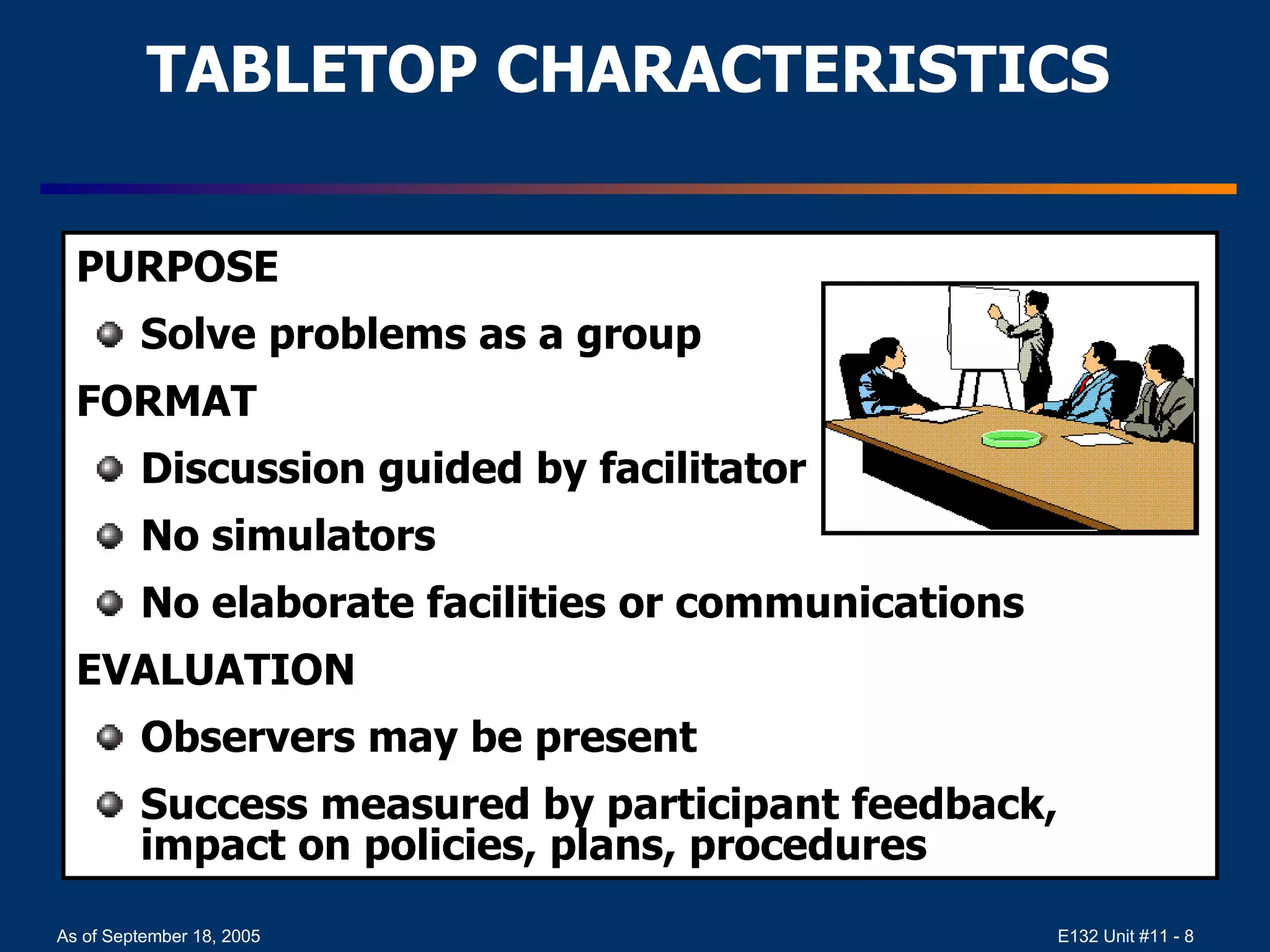
TABLETOP CHARACTERISTICS PURPOSE Solve problems as a group  FORMAT  Discussion guided by facilitator No simulators No elaborate facilities or communications EVALUATION Observers may be present Success measured by participant feedback, impact on policies, plans, procedures
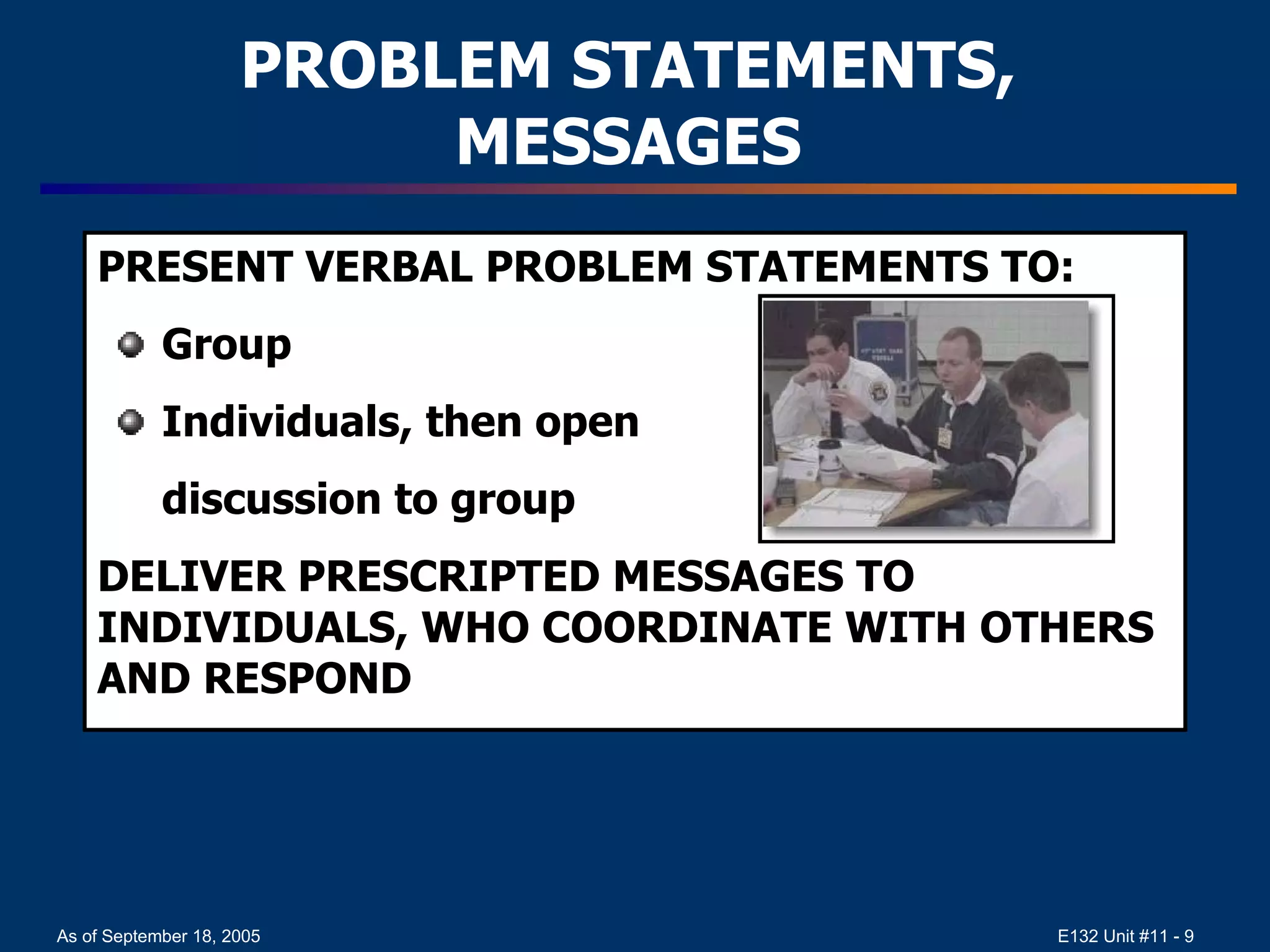
PROBLEM STATEMENTS, MESSAGES PRESENT VERBAL PROBLEM STATEMENTS TO: Group Individuals, then open  discussion to group DELIVER PRESCRIPTED MESSAGES TO INDIVIDUALS, WHO COORDINATE WITH OTHERS AND RESPOND
DESIGNING A TABLETOP EXERCISE Use 8 step process, job aids Steps 5-8 are simplified: Only partially simulated Little scripting No simulators Informal evaluation
8 DESIGN STEPS 1.  Needs Assessment 2.  Scope 3.  Purpose statement 4.  Objectives 5.  Narrative 6.  Major events/minor events 7.  Expected Actions 8.  Messages
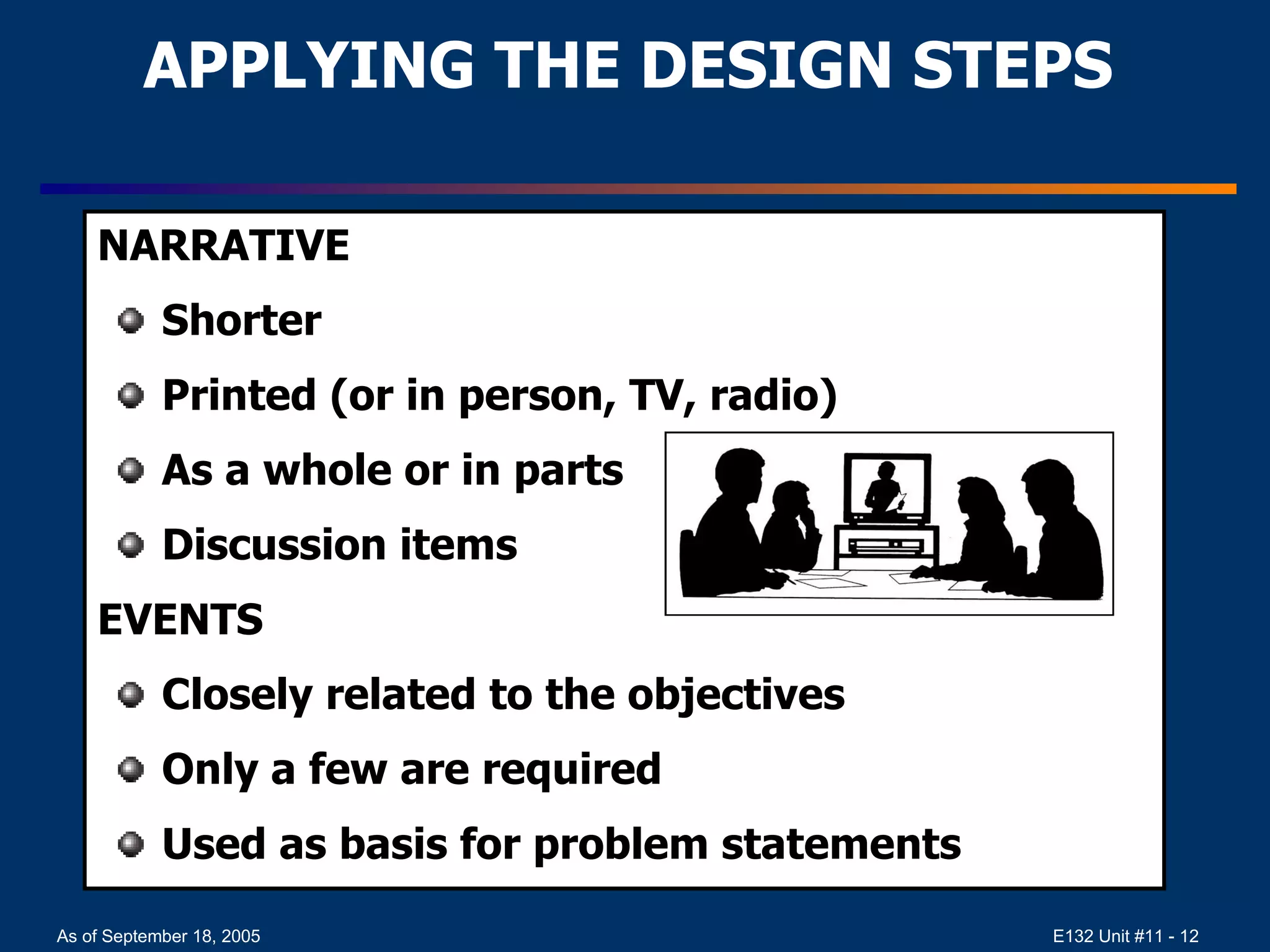
APPLYING THE DESIGN STEPS NARRATIVE  Shorter Printed (or in person, TV, radio) As a whole or in parts Discussion items EVENTS Closely related to the objectives Only a few are required Used as basis for problem statements
APPLYING THE DESIGN STEPS EXPECTED ACTIONS List serves as a basis for developing problem statements and messages “Actions” may be discussion that leads to change MESSAGES A few may suffice May relate to major or  detailed events
FACILITIES AND MATERIALS Operations Center or Conference Facility Materials: Emergency plans Maps Other references
KEY ACTIONS Set the stage Involve everyone Focus on in-depth problem solving
FACILITATING THE EXERCISE STRATEGIES FOR SETTING THE STAGE Welcome Briefing Narrative Ice breaker
FACILITATING THE EXERCISE STRATEGIES FOR INVOLVING EVERYONE Organize messages Encourage Elicit - do not provide - solutions Eye contact Positive  Reinforcement Redirect if necessary
UNIT SUMMARY Reviewed how a tabletop exercise works  Discussed facilitation guidelines  Examined how the eight design steps are applied to tabletop exercises Developed problem statements and messages
QUESTIONS?

Discussion Based Exercises

  • 1.
    UNIT 11 DiscussionBased (Tabletop) Exercises
  • 2.
    UNIT 11 ObjectivesAT THE END OF THIS SESSION, PARTICIPANTS WILL BE ABLE TO:  Define the purposes and characteristics of a tabletop exercise Describe the 8-Exercise Design Steps as used for a tabletop exercise Describe facilitator skills necessary to conduct a tabletop exercise
  • 3.
    TABLETOP EXERCISE MethodologiesPLENARY Conducted in a large room or auditorium Group players by function or responsibility No small group discussions Active facilitation BREAKOUT Divided into small groups at different tables Players seated at separate tables according to common interests or responsibilities Each group reports back to the reassembled plenary
  • 4.
    TABLETOP EXERCISE CategoriesBasic – The complete scenario is provided to the players and remains constant Advanced - Scenario advances through delivery of pre-scripted messages from the beginning to the end
  • 5.
    TABLETOP EXERCISE Common Features Group problem solving Familiarize senior officials with their responsibilities Conduct of a specific case study Examines personnel contingencies Examination of group message interpretation
  • 6.
    Participation in informationsharing Assessment of interagency coordination Achievement of limited or specific objectives Preparation for a more complex exercise TABLETOP EXERCISE Common Features
  • 7.
    TABLETOP EXERCISES Informaldiscussion to evaluate, clarify or resolve questions of coordination & integration Facilitated group discussion/ problem solving Narrative, messages, or problem statements used to drive discussion
  • 8.
    TABLETOP CHARACTERISTICS PURPOSESolve problems as a group FORMAT Discussion guided by facilitator No simulators No elaborate facilities or communications EVALUATION Observers may be present Success measured by participant feedback, impact on policies, plans, procedures
  • 9.
    PROBLEM STATEMENTS, MESSAGESPRESENT VERBAL PROBLEM STATEMENTS TO: Group Individuals, then open discussion to group DELIVER PRESCRIPTED MESSAGES TO INDIVIDUALS, WHO COORDINATE WITH OTHERS AND RESPOND
  • 10.
    DESIGNING A TABLETOPEXERCISE Use 8 step process, job aids Steps 5-8 are simplified: Only partially simulated Little scripting No simulators Informal evaluation
  • 11.
    8 DESIGN STEPS1. Needs Assessment 2. Scope 3. Purpose statement 4. Objectives 5. Narrative 6. Major events/minor events 7. Expected Actions 8. Messages
  • 12.
    APPLYING THE DESIGNSTEPS NARRATIVE Shorter Printed (or in person, TV, radio) As a whole or in parts Discussion items EVENTS Closely related to the objectives Only a few are required Used as basis for problem statements
  • 13.
    APPLYING THE DESIGNSTEPS EXPECTED ACTIONS List serves as a basis for developing problem statements and messages “Actions” may be discussion that leads to change MESSAGES A few may suffice May relate to major or detailed events
  • 14.
    FACILITIES AND MATERIALSOperations Center or Conference Facility Materials: Emergency plans Maps Other references
  • 15.
    KEY ACTIONS Setthe stage Involve everyone Focus on in-depth problem solving
  • 16.
    FACILITATING THE EXERCISESTRATEGIES FOR SETTING THE STAGE Welcome Briefing Narrative Ice breaker
  • 17.
    FACILITATING THE EXERCISESTRATEGIES FOR INVOLVING EVERYONE Organize messages Encourage Elicit - do not provide - solutions Eye contact Positive Reinforcement Redirect if necessary
  • 18.
    UNIT SUMMARY Reviewedhow a tabletop exercise works Discussed facilitation guidelines Examined how the eight design steps are applied to tabletop exercises Developed problem statements and messages
  • 19.