Form a groupwith five members each. Take turns
answering the questions below. Answer the
following honestly.
1. How many times have you checked your phone this morning?
2. How many status updates have you posted in Facebook or Twitter
today?
3. Did you use the internet for an hour after you woke up this
morning?
4. Did you follow a celebrity via his/her social media account?
-A study ofcomputers as data processing tools. It
introduces students to the fundamental of using
computer systems in an internet environment.
ICT (INFORMATION AND
COMMUNICATION
TECHNOLOGY
5.
ICT in thePhilippines
• Philippines is dub as the “ICT Hub of Asia” because of huge
growth of ICT-related jobs, one of which is BPO (Business
Process Outsourcing).
• ICT Department in the Philippines is responsible for the
planning, development and promotion of the country’s
information and communications technology (ICT) agenda
in support of national development.
6.
COMPUTER
- An electronicdevice for storing and processing data,
typically in binary form, according to instructions
given to it in a variable program.
INTERNET
-Is the global system of interconnected computer
networks that uses the internet protocol suite
(TCIP/IP) to link billions of devices worldwide.
7.
WORLD WIDE WEB
-Aninformation system on the internet that allows documents to
be connected to other documents by hypertext links, enabling the
user to search for information by moving from one document to
another.
-An information space where documents and other web resources
are identified by URLs, interlinked by hypertext links, and can be
accessed via the Internet.
-Invented by Tim-Berners Lee
8.
WEB PAGES
-Web pageis a hypertext document connected to the World Wide
Web. It is a document that is suitable for the World Wide Web.
The different online platforms of World Wide Web
Web 1.0
Web 2.0
Web 3.0
9.
WEB 1.0
-Refers tothe first stage in the World Wide Web, which was
entirely made up of the Web pages connected by hyperlinks.
WEB 2.0
-Is the evolution of Web 1.0 by adding dynamic pages. The user is
able to see a website differently than others.
-Allow users to interact with the page; instead of just reading the
page, the user may be able to comment or create user account.
10.
WEB 3.0
-This platformis all about semantic web.
-Aims to have machines (or servers) understand the user’s
preferences to be able to deliver web content.
STATIC WEB PAGE
-Is known as a flat page or stationary age in the sense that the
page is “as is” and cannot be manipulated by the user. The content
is also the same for all users that is referred to as Web 1.0.
11.
DYNAMIC WEB PAGE
-Web2.0 is the evolution of web 1.0 by adding dynamic web
pages. The user is able to see website differently than other e.g.
social networking sites, wikis, video sharing sites.
Features of Web 2.0
• Folksonomy *User Participation
• Rich User Experience
• Long Tail
• Software as a services
• Mass Participation
12.
Folksonomy
- Allows userto categorized and classify information using freely
chosen keywords e. g. tagging by FB, Twitter, use tags that start
with the sign #, referred as hashtag.
Rich User Experience
-Content is dynamic and is responsive to user’s input
Rich User Experience
-the owner of the website is not the only one who is able to put
content. Others are able to place a content of their own by means
of comments, reviews and evaluation.
13.
Long Tail
-Services thatare offered on demand rather than on a one-time
purchase. This is synonymous to subscribing to a data plan that
charges you for the amount of time you spent in the Internet.
Software as a services
-Users will be subscribe to a software only when needed rather
than purchasing them e.g. Google docs used to create and edit
word processing and spreadsheet.
Convergence
-Is the synergyof technological advancements to
work on a similar goal or task. For example,
besides using your personal computer to create
word documents, you can now use your
smartphones.
17.
Social Media
-Is awebsite, application, or online channel that
enables web users to create, co-create, discuss,
modify, and exchange user generated content.
18.
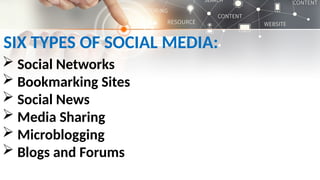
SIX TYPES OFSOCIAL MEDIA:
Social Networks
Bookmarking Sites
Social News
Media Sharing
Microblogging
Blogs and Forums
19.
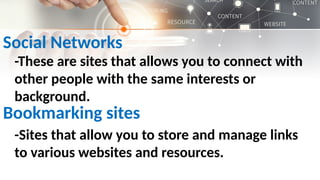
Social Networks
-These aresites that allows you to connect with
other people with the same interests or
background.
Bookmarking sites
-Sites that allow you to store and manage links
to various websites and resources.
20.
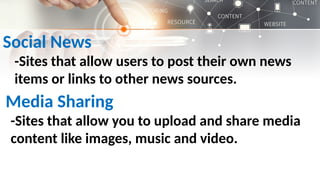
Social News
-Sites thatallow users to post their own news
items or links to other news sources.
Media Sharing
-Sites that allow you to upload and share media
content like images, music and video.
21.
Microblogging
-Focus on shortupdates from the user. Those
that subscribed to the user will be able to
receive these updates.
Blogs and Forum
-Allow user to post their content. Other users
are able to comment on the said topic.
22.
Mobile Technologies
-The popularityof smartphones and tablets has
taken a major rise over the years. This is largely
because of the devices capability to do the tasks
that were originally found in PCs.
23.
Mobile OS
IOS –use in apple devices such as iPhone and
iPad.
Android – an open source OS developed by
Google. Being open source means mobile phone
companies use this OS for free.
24.
Blackberry OS –use in blackberry devices.
Windows Phone OS – A closed source and
proprietary operating system developed by
Microsoft.
Symbian – The original smartphone OS. Used by
Nokia devices.
25.
WebOS – Originallyused in smartphone; now in
smart TVs.
Windows Mobile – developed by Microsoft for
smartphones and pocket PCs.
26.
Assistive Media
-Is anon-profit service designed to help people
who have visual and reading impairments.
Cloud Computing
-Distributed computing on internet or delivery
of computing service over the internet.