1
Copyright ©2016 Cengage Learning. All Rights Reserved. May not be scanned, copied or duplicated, or posted to a publicly acce ssible website, in whole or in part. MIS5 | CH3
Database Systems
LEARNING OUTCOMES
2
Copyright ©2016 Cengage Learning. All Rights Reserved. May not be scanned, copied or duplicated, or posted to a publicly acce ssible website, in whole or in part.
MIS6
| CH3
1 Define a database and a database
management system
2 Explain logical database design and the
relational database model
3 Define the components of a database
management system
4 Summarize recent trends in database
design and use
3
Copyright ©2016 Cengage Learning. All Rights Reserved. May not be scanned, copied or duplicated, or posted to a publicly acce ssible website, in whole or in part. MIS5 | CH3
Databases
• Database
• Collection of related data that is stored in a
central location or in multiple locations
• Data hierarchy: Structure and organization
of data involving fields, records, and files
Advantages of Databases
• More information from
same data
• Shared data
• Balancing conflicts
among users
• Controlled redundancy
• Consistency
• Integrity
• Security
• Increased productivity
• Data independence
5
Copyright ©2016 Cengage Learning. All Rights Reserved. May not be scanned, copied or duplicated, or posted to a publicly acce ssible website, in whole or in part. MIS5 | CH3
Disadvantages of Databases
• Increased size
• Increased complexity
• More expensive personnel
• Increased impact of failure
• Difficulty of recovery
• Cost
• Especially server and mainframe systems
6
Copyright ©2016 Cengage Learning. All Rights Reserved. May not be scanned, copied or duplicated, or posted to a publicly acce ssible website, in whole or in part. MIS5 | CH3
Types of Data in a Database
• Internal
• Collected from within an organization
• Stored in the organization’s internal databases
• External
• Comes from a variety of resources
• Stored in a data warehouse
Database Access
DATABASE
PROGRAM
USER
INTERFACE
8
Copyright ©2016 Cengage Learning. All Rights Reserved. May not be scanned, copied or duplicated, or posted to a publicly acce ssible website, in whole or in part. MIS5 | CH3
What is a Database Management System?
• Database management system (DBMS)
• Specific type of software for creating, storing,
organizing, maintaining, and accessing data
from a database
• Makes using databases more efficient
• Examples of DBMS: Microsoft Access, DB2,
Oracle Database, Microsoft SQL Server, MYSQL
etc
9
Copyright ©2016 Cengage Learning. All Rights Reserved. May not be scanned, copied or duplicated, or posted to a publicly acce ssible website, in whole or in part. MIS5 | CH3
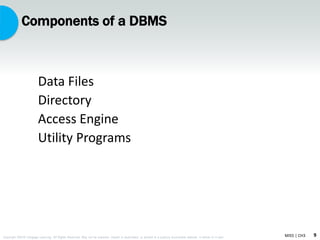
Components of a DBMS
Data Files
Directory
Access Engine
Utility Programs
10
Copyright ©2016 Cengage Learning. All Rights Reserved. May not be scanned, copied or duplicated, or posted to a publicly acce ssible website, in whole or in part. MIS5 | CH3
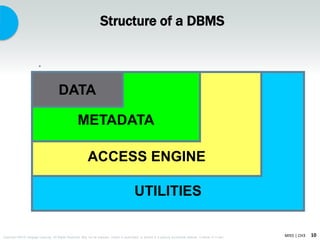
Structure of a DBMS
.
UTILITIES
ACCESS ENGINE
METADATA
DATA
11
Copyright ©2016 Cengage Learning. All Rights Reserved. May not be scanned, copied or duplicated, or posted to a publicly acce ssible website, in whole or in part. MIS5 | CH3
Metadata
“Data about data”
Description of fields
Display and format instructions
Structure of files and tables
Security and access rules
Triggers and operational rules
12
Copyright ©2016 Cengage Learning. All Rights Reserved. May not be scanned, copied or duplicated, or posted to a publicly acce ssible website, in whole or in part. MIS5 | CH3
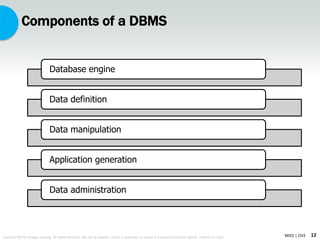
Components of a DBMS
Database engine
Data definition
Data manipulation
Application generation
Data administration
13
Copyright ©2016 Cengage Learning. All Rights Reserved. May not be scanned, copied or duplicated, or posted to a publicly acce ssible website, in whole or in part. MIS5 | CH3
Database Engine
• Heart of DBMS software
• Responsible for data storage, manipulation,
and retrieval
• Converts logical requests from users into
their physical equivalents
• By interacting with other components of the
DBMS
14
Copyright ©2016 Cengage Learning. All Rights Reserved. May not be scanned, copied or duplicated, or posted to a publicly acce ssible website, in whole or in part. MIS5 | CH3
Data Definition
• Creates and maintains the data dictionary
• Defines the structure of files in a database
• Makes changes to a database’s structure
• Adding and deleting fields
• Changing field size and data type
15
Copyright ©2016 Cengage Learning. All Rights Reserved. May not be scanned, copied or duplicated, or posted to a publicly acce ssible website, in whole or in part. MIS5 | CH3
Data Manipulation
• Used to add, delete, modify, and retrieve
records from a database
• Uses a query language
• Structured Query Language (SQL)
- Standard fourth-generation query language
that consists of several keywords specifying
actions to take
• Query by example (QBE)
- Involves requesting data from a database by
constructing a statement formed by query
forms
16
Copyright ©2016 Cengage Learning. All Rights Reserved. May not be scanned, copied or duplicated, or posted to a publicly acce ssible website, in whole or in part. MIS5 | CH3
Application Generation
• Designs elements of an application using a
database
• Data entry screens
• Interactive menus
• Interfaces with other programming languages
17
Copyright ©2016 Cengage Learning. All Rights Reserved. May not be scanned, copied or duplicated, or posted to a publicly acce ssible website, in whole or in part. MIS5 | CH3
Data Administration
• Used for the tasks backup and recovery,
security, and change management
• Used to determine who has permission to
perform certain functions
• Summarized as create, read, update, and
delete (CRUD)
18
Copyright ©2016 Cengage Learning. All Rights Reserved. May not be scanned, copied or duplicated, or posted to a publicly acce ssible website, in whole or in part. MIS5 | CH3
Data Administration
• Database administrator (DBA)
• Handles database design and management
- Setting up database
- Establishing security measures to determine
users’ access rights
- Developing recovery procedures when data is
lost or corrupted
- Evaluating database performance
- Adding and fine-tuning database functions
19
Copyright ©2016 Cengage Learning. All Rights Reserved. May not be scanned, copied or duplicated, or posted to a publicly acce ssible website, in whole or in part. MIS5 | CH3
Objectives of the DBMS Approach
• Data definition capabilities
• Querying and reporting
• Data independence
• Multiple views
• Multiple users
20
Copyright ©2016 Cengage Learning. All Rights Reserved. May not be scanned, copied or duplicated, or posted to a publicly acce ssible website, in whole or in part. MIS5 | CH3
Exhibit Interaction Between the User, DBMS
and Database
21
Copyright ©2016 Cengage Learning. All Rights Reserved. May not be scanned, copied or duplicated, or posted to a publicly acce ssible website, in whole or in part. MIS5 | CH3
Methods for Accessing Files
• Sequential access file structure
• Records are organized and processed in
numerical or sequential order
• Organized based on a primary key
- Social Security numbers or account numbers
• Used for backup and archive files as they rarely
need updating
22
Copyright ©2016 Cengage Learning. All Rights Reserved. May not be scanned, copied or duplicated, or posted to a publicly acce ssible website, in whole or in part. MIS5 | CH3
Methods for Accessing Files
• Random access file structure
• Records can be accessed in any order
irrespective of the physical locations in storage
media
• Fast and very effective when a small number of
records need to be processed daily or weekly
• Records are stored on magnetic tapes
23
Copyright ©2016 Cengage Learning. All Rights Reserved. May not be scanned, copied or duplicated, or posted to a publicly acce ssible website, in whole or in part. MIS5 | CH3
Methods for Accessing Files
• Indexed sequential access method (ISAM)
• Records are accessed sequentially or randomly
depending on the number being accessed
- Random access is used for a small number
- Sequential access is used for a large number
• Uses an index structure and has two parts
- Indexed value
- Pointer to the disk location of the record
matching the indexed value
DATABASE SYSTEM LIFE CYCLE
STAGE PROCESS MODEL DATA MODEL
Initialization Report Report
Feasibility Report
High Level DFD
Process Analysis
(Business Chart)
High Level E/R Diagram
Requirements
General
DFD
High Level Dictionary
Top Down E/R
File Specifications
Requirements
Logical
DFD
Data Dictionary
File Specifications
Process Logic
Bottom Up E/R
Action Diagrams
System Design Structure Charts
Module IPO Specification
Screen/Report Layouts
Cleanup
Volume/Usage Analysis
Physical Schema
Index/Record Specs
Coding/Testing Test Plan
Logs and Documentation
Code
Implementation Installation Plan Population Plan
25
Copyright ©2016 Cengage Learning. All Rights Reserved. May not be scanned, copied or duplicated, or posted to a publicly acce ssible website, in whole or in part. MIS5 | CH3
Logical Database Design
• Physical view
• Involves how data is stored on and retrieved
from storage media
- Hard disks, magnetic tapes, or CDs
• Logical view
• Involves how information appears to users and
how it can be organized and retrieved
• Includes more than one logical view of data,
depending on the user
26
Copyright ©2016 Cengage Learning. All Rights Reserved. May not be scanned, copied or duplicated, or posted to a publicly acce ssible website, in whole or in part. MIS5 | CH3
Logical Database Design
• Data model
• Determines how data is created, represented,
organized, and maintained
• Contains
- Data structure
- Operations
- Integrity rules
• Hierarchical model
• Relationships between records form a treelike
structure
27
Copyright ©2016 Cengage Learning. All Rights Reserved. May not be scanned, copied or duplicated, or posted to a publicly acce ssible website, in whole or in part. MIS5 | CH3
Exhibit 3.3 A Hierarchical Model
28
Copyright ©2016 Cengage Learning. All Rights Reserved. May not be scanned, copied or duplicated, or posted to a publicly acce ssible website, in whole or in part. MIS5 | CH3
Logical Database Design
• Network model
• Similar to the hierarchical model but records are
organized differently
• Includes multiple parent and child records
29
Copyright ©2016 Cengage Learning. All Rights Reserved. May not be scanned, copied or duplicated, or posted to a publicly acce ssible website, in whole or in part. MIS5 | CH3
Exhibit 3.4 A Network Model
30
Copyright ©2016 Cengage Learning. All Rights Reserved. May not be scanned, copied or duplicated, or posted to a publicly acce ssible website, in whole or in part. MIS5 | CH3
Relational Model
• Uses a two-dimensional table of rows and
columns of data
• Rows are records
• Columns are fields
• Data dictionary: Stores definitions
• Data types for fields, default values, and
validation rules for data in each field
31
Copyright ©2016 Cengage Learning. All Rights Reserved. May not be scanned, copied or duplicated, or posted to a publicly acce ssible website, in whole or in part. MIS5 | CH3
Relational Model
• Primary key
• Uniquely identifies every record in a relational
database
• Foreign key
• Field in a relational table that matches the
primary key column of another table
• Used to cross-reference tables
32
Copyright ©2016 Cengage Learning. All Rights Reserved. May not be scanned, copied or duplicated, or posted to a publicly acce ssible website, in whole or in part. MIS5 | CH3
Relational Database Terminology
• Entity
• Person, place, thing or event about which we
wish to keep data
• Attribute
• property of an entity
• Relationship
• an association among entities (entity records)
33
Copyright ©2016 Cengage Learning. All Rights Reserved. May not be scanned, copied or duplicated, or posted to a publicly acce ssible website, in whole or in part. MIS5 | CH3
Relational Model
• Normalization
• Improves database efficiency by eliminating
redundant data
- Ensures that only related data is stored in a
table
• Goes through different stages from first normal
form (1NF) to fifth normal form (5NF)
34
Copyright ©2016 Cengage Learning. All Rights Reserved. May not be scanned, copied or duplicated, or posted to a publicly acce ssible website, in whole or in part. MIS5 | CH3
Relational Model
• Retrieves data from tables using operations
that pick and combine data from one or
more tables
• Select
• Project
• Join
• Intersection
• Union
• Difference
36
Copyright ©2016 Cengage Learning. All Rights Reserved. May not be scanned, copied or duplicated, or posted to a publicly acce ssible website, in whole or in part. MIS5 | CH3
Recent Trends in Database Design and Use
• Data-driven website
• Interface to a database
• Retrieves data and allows users to enter data
• Improves access to information
• Gives users more current information from a
variety of data sources
37
Copyright ©2016 Cengage Learning. All Rights Reserved. May not be scanned, copied or duplicated, or posted to a publicly acce ssible website, in whole or in part. MIS5 | CH3
Recent Trends in Database Design and Use
• Distributed database: Stores data on
multiple servers throughout an organization
• Approaches to setting up a DDBMS
• Fragmentation: Addresses how tables are
divided among multiple locations
• Replication: Each site stores a copy of the data
in the organization’s database
• Allocation: Combines fragmentation and
replication, with each site storing the data used
most often
38
Copyright ©2016 Cengage Learning. All Rights Reserved. May not be scanned, copied or duplicated, or posted to a publicly acce ssible website, in whole or in part. MIS5 | CH3
Recent Trends in Database Design and Use
• Object-oriented database: Single object
contains data and their relationships
• Object consists of attributes and methods that
can be performed on the object’s data
• Encapsulation: Grouping objects along with
their attributes and methods into a single unit
• Inheritance: New objects can be created faster
and easily by entering new data in attributes

Lesson 1 Databases.ppt

  • 1.
    1 Copyright ©2016 CengageLearning. All Rights Reserved. May not be scanned, copied or duplicated, or posted to a publicly acce ssible website, in whole or in part. MIS5 | CH3 Database Systems
  • 2.
    LEARNING OUTCOMES 2 Copyright ©2016Cengage Learning. All Rights Reserved. May not be scanned, copied or duplicated, or posted to a publicly acce ssible website, in whole or in part. MIS6 | CH3 1 Define a database and a database management system 2 Explain logical database design and the relational database model 3 Define the components of a database management system 4 Summarize recent trends in database design and use
  • 3.
    3 Copyright ©2016 CengageLearning. All Rights Reserved. May not be scanned, copied or duplicated, or posted to a publicly acce ssible website, in whole or in part. MIS5 | CH3 Databases • Database • Collection of related data that is stored in a central location or in multiple locations • Data hierarchy: Structure and organization of data involving fields, records, and files
  • 4.
    Advantages of Databases •More information from same data • Shared data • Balancing conflicts among users • Controlled redundancy • Consistency • Integrity • Security • Increased productivity • Data independence
  • 5.
    5 Copyright ©2016 CengageLearning. All Rights Reserved. May not be scanned, copied or duplicated, or posted to a publicly acce ssible website, in whole or in part. MIS5 | CH3 Disadvantages of Databases • Increased size • Increased complexity • More expensive personnel • Increased impact of failure • Difficulty of recovery • Cost • Especially server and mainframe systems
  • 6.
    6 Copyright ©2016 CengageLearning. All Rights Reserved. May not be scanned, copied or duplicated, or posted to a publicly acce ssible website, in whole or in part. MIS5 | CH3 Types of Data in a Database • Internal • Collected from within an organization • Stored in the organization’s internal databases • External • Comes from a variety of resources • Stored in a data warehouse
  • 7.
  • 8.
    8 Copyright ©2016 CengageLearning. All Rights Reserved. May not be scanned, copied or duplicated, or posted to a publicly acce ssible website, in whole or in part. MIS5 | CH3 What is a Database Management System? • Database management system (DBMS) • Specific type of software for creating, storing, organizing, maintaining, and accessing data from a database • Makes using databases more efficient • Examples of DBMS: Microsoft Access, DB2, Oracle Database, Microsoft SQL Server, MYSQL etc
  • 9.
    9 Copyright ©2016 CengageLearning. All Rights Reserved. May not be scanned, copied or duplicated, or posted to a publicly acce ssible website, in whole or in part. MIS5 | CH3 Components of a DBMS Data Files Directory Access Engine Utility Programs
  • 10.
    10 Copyright ©2016 CengageLearning. All Rights Reserved. May not be scanned, copied or duplicated, or posted to a publicly acce ssible website, in whole or in part. MIS5 | CH3 Structure of a DBMS . UTILITIES ACCESS ENGINE METADATA DATA
  • 11.
    11 Copyright ©2016 CengageLearning. All Rights Reserved. May not be scanned, copied or duplicated, or posted to a publicly acce ssible website, in whole or in part. MIS5 | CH3 Metadata “Data about data” Description of fields Display and format instructions Structure of files and tables Security and access rules Triggers and operational rules
  • 12.
    12 Copyright ©2016 CengageLearning. All Rights Reserved. May not be scanned, copied or duplicated, or posted to a publicly acce ssible website, in whole or in part. MIS5 | CH3 Components of a DBMS Database engine Data definition Data manipulation Application generation Data administration
  • 13.
    13 Copyright ©2016 CengageLearning. All Rights Reserved. May not be scanned, copied or duplicated, or posted to a publicly acce ssible website, in whole or in part. MIS5 | CH3 Database Engine • Heart of DBMS software • Responsible for data storage, manipulation, and retrieval • Converts logical requests from users into their physical equivalents • By interacting with other components of the DBMS
  • 14.
    14 Copyright ©2016 CengageLearning. All Rights Reserved. May not be scanned, copied or duplicated, or posted to a publicly acce ssible website, in whole or in part. MIS5 | CH3 Data Definition • Creates and maintains the data dictionary • Defines the structure of files in a database • Makes changes to a database’s structure • Adding and deleting fields • Changing field size and data type
  • 15.
    15 Copyright ©2016 CengageLearning. All Rights Reserved. May not be scanned, copied or duplicated, or posted to a publicly acce ssible website, in whole or in part. MIS5 | CH3 Data Manipulation • Used to add, delete, modify, and retrieve records from a database • Uses a query language • Structured Query Language (SQL) - Standard fourth-generation query language that consists of several keywords specifying actions to take • Query by example (QBE) - Involves requesting data from a database by constructing a statement formed by query forms
  • 16.
    16 Copyright ©2016 CengageLearning. All Rights Reserved. May not be scanned, copied or duplicated, or posted to a publicly acce ssible website, in whole or in part. MIS5 | CH3 Application Generation • Designs elements of an application using a database • Data entry screens • Interactive menus • Interfaces with other programming languages
  • 17.
    17 Copyright ©2016 CengageLearning. All Rights Reserved. May not be scanned, copied or duplicated, or posted to a publicly acce ssible website, in whole or in part. MIS5 | CH3 Data Administration • Used for the tasks backup and recovery, security, and change management • Used to determine who has permission to perform certain functions • Summarized as create, read, update, and delete (CRUD)
  • 18.
    18 Copyright ©2016 CengageLearning. All Rights Reserved. May not be scanned, copied or duplicated, or posted to a publicly acce ssible website, in whole or in part. MIS5 | CH3 Data Administration • Database administrator (DBA) • Handles database design and management - Setting up database - Establishing security measures to determine users’ access rights - Developing recovery procedures when data is lost or corrupted - Evaluating database performance - Adding and fine-tuning database functions
  • 19.
    19 Copyright ©2016 CengageLearning. All Rights Reserved. May not be scanned, copied or duplicated, or posted to a publicly acce ssible website, in whole or in part. MIS5 | CH3 Objectives of the DBMS Approach • Data definition capabilities • Querying and reporting • Data independence • Multiple views • Multiple users
  • 20.
    20 Copyright ©2016 CengageLearning. All Rights Reserved. May not be scanned, copied or duplicated, or posted to a publicly acce ssible website, in whole or in part. MIS5 | CH3 Exhibit Interaction Between the User, DBMS and Database
  • 21.
    21 Copyright ©2016 CengageLearning. All Rights Reserved. May not be scanned, copied or duplicated, or posted to a publicly acce ssible website, in whole or in part. MIS5 | CH3 Methods for Accessing Files • Sequential access file structure • Records are organized and processed in numerical or sequential order • Organized based on a primary key - Social Security numbers or account numbers • Used for backup and archive files as they rarely need updating
  • 22.
    22 Copyright ©2016 CengageLearning. All Rights Reserved. May not be scanned, copied or duplicated, or posted to a publicly acce ssible website, in whole or in part. MIS5 | CH3 Methods for Accessing Files • Random access file structure • Records can be accessed in any order irrespective of the physical locations in storage media • Fast and very effective when a small number of records need to be processed daily or weekly • Records are stored on magnetic tapes
  • 23.
    23 Copyright ©2016 CengageLearning. All Rights Reserved. May not be scanned, copied or duplicated, or posted to a publicly acce ssible website, in whole or in part. MIS5 | CH3 Methods for Accessing Files • Indexed sequential access method (ISAM) • Records are accessed sequentially or randomly depending on the number being accessed - Random access is used for a small number - Sequential access is used for a large number • Uses an index structure and has two parts - Indexed value - Pointer to the disk location of the record matching the indexed value
  • 24.
    DATABASE SYSTEM LIFECYCLE STAGE PROCESS MODEL DATA MODEL Initialization Report Report Feasibility Report High Level DFD Process Analysis (Business Chart) High Level E/R Diagram Requirements General DFD High Level Dictionary Top Down E/R File Specifications Requirements Logical DFD Data Dictionary File Specifications Process Logic Bottom Up E/R Action Diagrams System Design Structure Charts Module IPO Specification Screen/Report Layouts Cleanup Volume/Usage Analysis Physical Schema Index/Record Specs Coding/Testing Test Plan Logs and Documentation Code Implementation Installation Plan Population Plan
  • 25.
    25 Copyright ©2016 CengageLearning. All Rights Reserved. May not be scanned, copied or duplicated, or posted to a publicly acce ssible website, in whole or in part. MIS5 | CH3 Logical Database Design • Physical view • Involves how data is stored on and retrieved from storage media - Hard disks, magnetic tapes, or CDs • Logical view • Involves how information appears to users and how it can be organized and retrieved • Includes more than one logical view of data, depending on the user
  • 26.
    26 Copyright ©2016 CengageLearning. All Rights Reserved. May not be scanned, copied or duplicated, or posted to a publicly acce ssible website, in whole or in part. MIS5 | CH3 Logical Database Design • Data model • Determines how data is created, represented, organized, and maintained • Contains - Data structure - Operations - Integrity rules • Hierarchical model • Relationships between records form a treelike structure
  • 27.
    27 Copyright ©2016 CengageLearning. All Rights Reserved. May not be scanned, copied or duplicated, or posted to a publicly acce ssible website, in whole or in part. MIS5 | CH3 Exhibit 3.3 A Hierarchical Model
  • 28.
    28 Copyright ©2016 CengageLearning. All Rights Reserved. May not be scanned, copied or duplicated, or posted to a publicly acce ssible website, in whole or in part. MIS5 | CH3 Logical Database Design • Network model • Similar to the hierarchical model but records are organized differently • Includes multiple parent and child records
  • 29.
    29 Copyright ©2016 CengageLearning. All Rights Reserved. May not be scanned, copied or duplicated, or posted to a publicly acce ssible website, in whole or in part. MIS5 | CH3 Exhibit 3.4 A Network Model
  • 30.
    30 Copyright ©2016 CengageLearning. All Rights Reserved. May not be scanned, copied or duplicated, or posted to a publicly acce ssible website, in whole or in part. MIS5 | CH3 Relational Model • Uses a two-dimensional table of rows and columns of data • Rows are records • Columns are fields • Data dictionary: Stores definitions • Data types for fields, default values, and validation rules for data in each field
  • 31.
    31 Copyright ©2016 CengageLearning. All Rights Reserved. May not be scanned, copied or duplicated, or posted to a publicly acce ssible website, in whole or in part. MIS5 | CH3 Relational Model • Primary key • Uniquely identifies every record in a relational database • Foreign key • Field in a relational table that matches the primary key column of another table • Used to cross-reference tables
  • 32.
    32 Copyright ©2016 CengageLearning. All Rights Reserved. May not be scanned, copied or duplicated, or posted to a publicly acce ssible website, in whole or in part. MIS5 | CH3 Relational Database Terminology • Entity • Person, place, thing or event about which we wish to keep data • Attribute • property of an entity • Relationship • an association among entities (entity records)
  • 33.
    33 Copyright ©2016 CengageLearning. All Rights Reserved. May not be scanned, copied or duplicated, or posted to a publicly acce ssible website, in whole or in part. MIS5 | CH3 Relational Model • Normalization • Improves database efficiency by eliminating redundant data - Ensures that only related data is stored in a table • Goes through different stages from first normal form (1NF) to fifth normal form (5NF)
  • 34.
    34 Copyright ©2016 CengageLearning. All Rights Reserved. May not be scanned, copied or duplicated, or posted to a publicly acce ssible website, in whole or in part. MIS5 | CH3 Relational Model • Retrieves data from tables using operations that pick and combine data from one or more tables • Select • Project • Join • Intersection • Union • Difference
  • 35.
    36 Copyright ©2016 CengageLearning. All Rights Reserved. May not be scanned, copied or duplicated, or posted to a publicly acce ssible website, in whole or in part. MIS5 | CH3 Recent Trends in Database Design and Use • Data-driven website • Interface to a database • Retrieves data and allows users to enter data • Improves access to information • Gives users more current information from a variety of data sources
  • 36.
    37 Copyright ©2016 CengageLearning. All Rights Reserved. May not be scanned, copied or duplicated, or posted to a publicly acce ssible website, in whole or in part. MIS5 | CH3 Recent Trends in Database Design and Use • Distributed database: Stores data on multiple servers throughout an organization • Approaches to setting up a DDBMS • Fragmentation: Addresses how tables are divided among multiple locations • Replication: Each site stores a copy of the data in the organization’s database • Allocation: Combines fragmentation and replication, with each site storing the data used most often
  • 37.
    38 Copyright ©2016 CengageLearning. All Rights Reserved. May not be scanned, copied or duplicated, or posted to a publicly acce ssible website, in whole or in part. MIS5 | CH3 Recent Trends in Database Design and Use • Object-oriented database: Single object contains data and their relationships • Object consists of attributes and methods that can be performed on the object’s data • Encapsulation: Grouping objects along with their attributes and methods into a single unit • Inheritance: New objects can be created faster and easily by entering new data in attributes