Les nouveautés ASP.NET 5
avec Visual Studio 2015
Agenda
• Where we are coming from? / Where are we now?
• What’s the motivations for the changes?
• Deep-dive into how the new pieces work together
• What’s .NET Core
• MVC 6
• New Javascript/NodeJS framework integration
Where we’re coming from Web-wise
• Standards takes years to develop.
• Every website is dynamic but only from the server side.
• JavaScript is a mess. Each vendors do their own things
• Some new browsers pops up but the development cycle is VERY long
Where we’re now Web-wise
• More and more emphasis on web standard
• More emphasis on real-time software (chat, games, live results in
sports, etc.)
• More and more evergreen browsers pushing the latest technology in
the hands of grandma
Where we’re coming from Technology-wise
• Browsers releasing one version every 3-6 months or longer
• Each company have their own servers/farms and manage them as
they want
• Huge app servers with lots of services that all depends on what’s
installed on the server
• Biggest tech hit of all time: Flash.
Where we are now Technology-wise
• Browsers are almost all “evergreen” (self-updating with no “real”
versions). New features are coming in every months.
• More and more company builds on the cloud and new ideas can
sprout from start-up to massively scaling applications faster than they
ever did.
• Micro-services are now a thing and come pre-packaged with their
own dependencies. Can also be shipped with Docker/etc.
• Flash is dead. Even where it was the leader (video player), it failed
and has been replaced by a web standard.
Where we’re coming from .NET-wise
• Monolithic framework
• Everything enabled but switched off (or on) by default
• Must know the defaults
• WebForms
Where we are now .NET-wise
• Modular framework
• Nothing but the skeleton is there. Everything must be added in.
• Defaults are set per modules and are easily discoverable.
• MVC, WebAPI, SignalR, Azure
Motivations (why does it need changing?)
• Faster and more efficient application
• Open source contributions
• Shippable framework with the application
• Modular
• Faster Development Cycle
• Choose your editors and tools
• Cross-Platform
Motivation – Agility
• Faster development cycle
• Features shipped as packages
• Framework shipped with application
• Allows :
• Easier bug fix (updating a nuget package)
• Same code runs in dev/prod (don’t depend on the server runtime)
• Developers opt-in to new features that break things
Motivation – Fast
• Runtime Performance
• Faster startup times
• Lower memory/higher density (more apps can fit on the same server)
• Modular, opt-in features
• Need a raw socket? You got it. Need MVC routing and features? You can get it.
• Development productivity and low friction
• Edit code and Refresh
• Change to code can just be refreshed in the browser
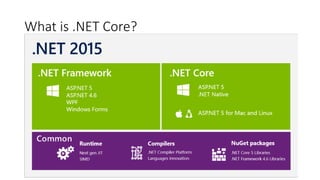
What is .NET Core?
.NET Core is Command Line friendly
• dnvm => .NET Version Manager
• Manage the different version of the .NET Core and downloads the runtime to
execute them
• dnu => .NET Development Utility
• Package management of the .NET Core world
• dnx => .NET Execution Environment
• Entry point for your application if not self-hosted.
.NET Core is at the heart of Visual Studio
• Nothing Visual Studio do (functionally) can’t be done with command
line
• Package restore in VS2015?
• dnu restore
• CTRL-F5?
• dnx . web (now dnx web)
• F5 (debug)?
• Yeah… no.
Enough slides, Demos!
Questions?

Les nouveautés ASP.NET 5 avec Visual Studio 2015

  • 1.
    Les nouveautés ASP.NET5 avec Visual Studio 2015
  • 2.
    Agenda • Where weare coming from? / Where are we now? • What’s the motivations for the changes? • Deep-dive into how the new pieces work together • What’s .NET Core • MVC 6 • New Javascript/NodeJS framework integration
  • 3.
    Where we’re comingfrom Web-wise • Standards takes years to develop. • Every website is dynamic but only from the server side. • JavaScript is a mess. Each vendors do their own things • Some new browsers pops up but the development cycle is VERY long
  • 4.
    Where we’re nowWeb-wise • More and more emphasis on web standard • More emphasis on real-time software (chat, games, live results in sports, etc.) • More and more evergreen browsers pushing the latest technology in the hands of grandma
  • 5.
    Where we’re comingfrom Technology-wise • Browsers releasing one version every 3-6 months or longer • Each company have their own servers/farms and manage them as they want • Huge app servers with lots of services that all depends on what’s installed on the server • Biggest tech hit of all time: Flash.
  • 6.
    Where we arenow Technology-wise • Browsers are almost all “evergreen” (self-updating with no “real” versions). New features are coming in every months. • More and more company builds on the cloud and new ideas can sprout from start-up to massively scaling applications faster than they ever did. • Micro-services are now a thing and come pre-packaged with their own dependencies. Can also be shipped with Docker/etc. • Flash is dead. Even where it was the leader (video player), it failed and has been replaced by a web standard.
  • 7.
    Where we’re comingfrom .NET-wise • Monolithic framework • Everything enabled but switched off (or on) by default • Must know the defaults • WebForms
  • 8.
    Where we arenow .NET-wise • Modular framework • Nothing but the skeleton is there. Everything must be added in. • Defaults are set per modules and are easily discoverable. • MVC, WebAPI, SignalR, Azure
  • 9.
    Motivations (why doesit need changing?) • Faster and more efficient application • Open source contributions • Shippable framework with the application • Modular • Faster Development Cycle • Choose your editors and tools • Cross-Platform
  • 10.
    Motivation – Agility •Faster development cycle • Features shipped as packages • Framework shipped with application • Allows : • Easier bug fix (updating a nuget package) • Same code runs in dev/prod (don’t depend on the server runtime) • Developers opt-in to new features that break things
  • 11.
    Motivation – Fast •Runtime Performance • Faster startup times • Lower memory/higher density (more apps can fit on the same server) • Modular, opt-in features • Need a raw socket? You got it. Need MVC routing and features? You can get it. • Development productivity and low friction • Edit code and Refresh • Change to code can just be refreshed in the browser
  • 12.
  • 13.
    .NET Core isCommand Line friendly • dnvm => .NET Version Manager • Manage the different version of the .NET Core and downloads the runtime to execute them • dnu => .NET Development Utility • Package management of the .NET Core world • dnx => .NET Execution Environment • Entry point for your application if not self-hosted.
  • 14.
    .NET Core isat the heart of Visual Studio • Nothing Visual Studio do (functionally) can’t be done with command line • Package restore in VS2015? • dnu restore • CTRL-F5? • dnx . web (now dnx web) • F5 (debug)? • Yeah… no.
  • 15.
  • 16.