Outline
USGBC
LEED
 Certification Levels for LEED-NC
 LEED NC Credit Categories
 Credit Structure
 Credits and Points
 Certification under LEED-NC
 Sustainable site development.
 Water savings.
 Energy efficiency.
 Materials selection.
 Indoor environmental quality.
EGBC
A Case Study
Leading with LEED
 High Performance Building Benefits
 Costs vs. Benefits
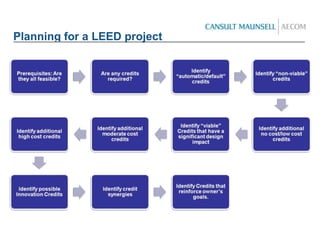
 Planning for a LEED project
 LEED Certification Process
Tools and Resources
United States Green
Building Council (USGBC)
USGBC
• USGBC: United States Green Building Council.
• The USGBC was founded in 1993.
• Non-profit organization based in Washington,
DC.
• Consensus driven.
• The council’s vision is that all buildings will
achieve sustainability within a generation.
• To realize this vision, USGBC developed the
LEED rating system, which has proven to be a
primary driver of the green building movement.
LEED Green Building
Rating System™
LEED Green Building Rating System™
• The Leadership in Energy and
Environmental Design (LEED)
Green Building Rating System™
is the nationally and internationally accepted benchmark for the
design, construction, and operation of high performance green
buildings in the US.
• Was introduced in 2000.
• LEED is a voluntary standards and certification program, and was
developed to promote leadership in the building industry by
providing an objective, verifiable definition of “green.”
•LEED promotes a whole-building approach to
sustainability by recognizing performance in five
key areas of human and environmental health: :
•Sustainable site development.
•Water savings.
•Energy efficiency.
•Materials selection.
•Indoor environmental quality.
LEED Green Building Rating System™
– First product: LEED-NC
– Pilot projects certified just 6 years ago Current
rating systems:
– LEED-NC: New construction and major renovation
(now Version 2.2)
– LEED-EB: Existing building operations
– LEED-CS: Core and shell projects
– LEED-CI: Commercial interiors
– LEED-H: Homes, now in Pilot
– Application Guides for Retail, Multiple
Buildings/Campus Projects
LEED Green Building Rating System™
In the works:
– LEED 3.0
– LEED-ND: Neighborhood development
– Application Guides for Health Care, Laboratories, Schools (K-12)
LEED Green Building Rating System™
Platinum (52 + points)
Gold (39-51 points)
Silver (33-38 points)
Certified (26- 32 points)
Total Points = 69
Certification Levels for LEED-NC
Document prerequisites & points for the facility in 6 categories:
LEED NC Credit Categories
Categories weights
LEED NC Credit Categories
Credits
For Each Credit, the rating
system identifies the intent,
requirements, technologies
or strategies to achieve
each credit
Points:
The number of possible
points for each credit which
are granted based on the
achieved requirement(s)
Credits and Points
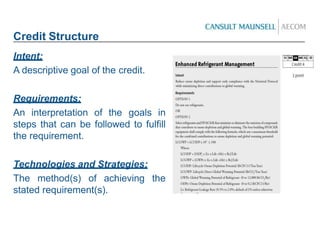
Intent:
A descriptive goal of the credit.
Requirements:
An interpretation of the goals in
steps that can be followed to fulfill
the requirement.
Technologies and Strategies:
The method(s) of achieving the
stated requirement(s).
Credit Structure
Certification under LEED-NC
LEED NC: Sustainable Sites
• Sustainability is a characteristic of a process or
state that can be maintained at a certain level
indefinitely. For planet earth, it is thus the intent
to provide the best outcomes for the human and
natural environments both now and into the
indefinite future.
• Sustainable use is the "use of resources at a
rate which will meet the needs of the present
without impairing the ability of future
generations to meet their needs.“
Jason Kent, 2007.
• Key Targets:
1. Energy Use
2. Material Use
3. Waste Production
4. Water Use
5. Air Quality
Sustainable Practices
LEED NC: Sustainable Sites
Credit Points
Prerequisite: Construction Activity Pollution Prevention -
Credit 1: Site Selection 1
Credit 2: Development Density & Community connectivity 1
Credit 3: Brownfield Redevelopment 1
Credit 4: Alternative Transportation 1-4
Credit 5: Reduced Site Disturbance 1-2
Credit 6: Stormwater Design 1-2
Credit 7: Heat Island Reduction 1-2
Credit 8: Light Pollution Reduction 1
Certification under LEED-NC
LEED NC: Water Efficiency
Credit
Credit 1: Water Efficient Landscaping
Credit 2: Innovative Wastewater Technologies
Credit 3: Water Use Reduction
Points
1-2
1
1-2
Certification under LEED-NC
LEED NC: Energy &Atmosphere
LEED NC: Energy & Atmosphere
Points
-
-
-
Credit
Prerequisite 1: Fundamental Building Energy Systems
Commissioning
Prerequisite 2: Minimum Energy Performance
Prerequisite 3: Fundamental Refrigerant Management
Credit 1: Optimize Energy Performance
Credit 2: On-Site Renewable Energy
1-10
1-3
Credit 3: Enhanced Commissioning 1
Credit 4: Enhanced Refrigerant Management
1
Credit 5: Measurement and Verification 1
Credit 6: Green Power 1
Certification under LEED-NC
LEED NC: Materials and Resources
Credit Points
Prerequisite: Storage & Collection of Recyclables -
Credit 1: Building Reuse 1-3
Credit 2: Construction Waste Management 1-2
Credit 3: Materials Reuse 1-2
Credit 4: Recycled Content 1-2
Credit 5: Local/Regional Materials 1-2
Credit 6: Rapidly Renewable Materials 1
Credit 7: Certified Wood 1
Certification under LEED-NC
LEED NC: Indoor Environmental Quality
Points
-
-
Credit
Prerequisite 1: Minimum IAQ Performance
Prerequisite 2: Environmental Tobacco Smoke (ETS) Control
Credit 1: Outdoor Air Delivery Monitoring
Credit 2: Increase Ventilation
Credit 3: Construction IAQ Management
Credit 4: Low-Emitting Materials
Credit 5: Indoor Chemical and Pollutant Source Control
Credit 6: Controllability of Systems
Credit 7: Thermal Comfort
Credit 8: Daylighting and Views
1
1
1-2
1-4
1
1-2
1-2
1-2
Certification under LEED-NC
LEED NC: Innovation & Design Process
Credit
Credit 1: LEED Innovation Credits
Credit 2: LEED Accredited Professional
Points
1-4
1
A Case Study
HEARST TOWER – BUILDING GREEN
Emirates Green Building
Council (EGBC)
•Officially launched at a one-day event on 4 February in the Grand
Hyatt Hotel, Dubai. (AME INFO)
•Rating system is currently being finalized by (EGBC). It is
expected to be an adaptation of the US system, taking into
consideration the Indian LEED system, but adapted to fully
consider the environmental conditions in the UAE. (MEP ME)
•Started organizing workshops to introduce LEED certification to
the local market.
Emirates Green Building Council (EGBC)
Projects in the UAE:
•Wafi City (First in M.E. – GOLD)
•Farm Fresh LLC
•Pacific Controls (Platinum)
•ABN AMRO DOZ Interior
(Maunsell)
Emirates Green Building Council (EGBC)
www.emiratesgbc.org
Emirates Green Building Council (EGBC)
Leading with LEED
Architects
Building
Owners
Planners
Federal,
Local,
and State
Governments
Utility
Managers
Nonprofit Leaders
Engineers
Building
Tenants
Property
Managers
Product
Manufacturers
Interior
Designers
Code
Officials
Landscape
Architects
Financial
Planners
Bottom line for owner and/or tenant
– Improve Occupant Productivity
– Improve Occupant Health
– Reduce Operating Costs
– Improve Resale/Occupancy
– Attract Employees
Community
– Use Existing Infrastructure
– Preserve Green Space
High Performance Building Benefits
Environmental
– Enhance/protect ecosystems and biodiversity
– Reduce greenhouse gas emissions
– Improve air & water quality
– Reduce solid waste
– Conserve natural resources/promote use of
renewable resources
High Performance Building Benefits
Operations: Salaries,
Equipment, Supplies,
Chemicals, Etc.
Utility Costs
Construction Capital
Architectural
& Engineering
Design
Programming &
Planning
Basis of Design
Costs vs. Benefits
Mission:
Capital E is a premier provider
of strategic consulting,
technology assessment and
deployment, and advisory
services to firms and investors
in the clean energy industry.
Costs vs. Benefits
Planning for a LEED project
LEED Certification Process
Tools and Resources
Tools and Resources
• U.S. Green Building Council Website
• Accessing the online database of USGBC
• Sustainability Tool
• Life Cycle Costing – eVALUator
• Whole Building Design Guide
• Local Digital Library
• The USGBC web site contains information on the Council and the LEEDTM
Rating System, including reference materials and the current LEEDTM Rating
System. You can also find:
• LEED Letter templates
• Credit Interpretation Requests and Rulings
• Summary of LEED Documentation Requirements
• FAQ sheet
• LEED developments and product drafts
• USGBC monthly newsletter
• Recommended books, newsletters, etc.
• Extensive relevant website links including for codes and standards, case
studies, initiatives, analysis tools, funding, LCA/LCC, media, etc.
• Green building case studies
• Economic analyses
U.S. Green Building Council (http://www.usgbc.org)
https://www.usgbc.org/ Click here
Accessing the online database
password: anas123
Sustainability Tool
“A practical how-to-tool that assists in
implementing the sustainable building
policy. Integrated Design Tools and best
practice information are sorted by project
type, click the icons and move through
each step to get the information that you
need”
http://www2.ci.seattle.wa.us/Implement/
Life Cycle Costing - eVALUator
eVALUator is an easy-to-use Windows™-based program that
calculates the lifecycle benefits of investments that improve
building design. It analyzes the financial benefits from buildings
that reduce energy cost, raise employee productivity, and
enhance tenant satisfaction.
http://www.energydesignresources.com/resource/131/
Whole Building Design Guide
EPA's Environmentally Preferable Purchasing Program is
responsible for providing information to federal agencies to
assist them in practicing environmentally preferable purchasing
(EPP). Because construction and renovation of buildings
constitutes a large share of federal expenditures and may
involve significant environmental impact, EPA has a special
interest in providing tools to promote environmentally preferable
purchasing during these activities.
http://www.wbdg.org/design/greenspec.php
Local Digital Library
• LEED for New Construction v2.2 Registered
Project Checklist (excel file).
• The LEED-NC v2.2 Reference Guide.
• LEED Certification Exam Notes
LEED for New Construction v2.2
Registered Project Checklist
Y es ? No
Sustainable Sites 14 Points
Required
1
1
1
1
1
1
1
1
1
1
1
1
1
1
Credit 1.1 Water Efficient Landscaping, Reduce by 50%
Credit 1.2 Water Efficient Landscaping, No Potable Use or No Irrigation
Credit 2 Innovative Wastewater Technologies Credit
3.1 Water Use Reduction, 20% Reduction Credit 3.2
Water Use Reduction, 30% Reduction
1
1
1
1
1
Energy & Atmosphere 17 Points
Project Name:
Project Address:
Y Prereq 1
Credit 1
Credit 2
Credit 3
Construction Activity Pollution Prevention
Site Selection
Development Density & Community Connectivity
Brownfield Redevelopment
Credit 4.1 Alternative Transportation, Public Transportation Access
Credit 4.2 Alternative Transportation, Bicycle Storage & Changing Rooms Credit
4.3 Alternative Transportation, Low-Emitting & Fuel-Efficient Vehicles Credit 4.4
Alternative Transportation, Parking Capacity
Credit 5.1 Site Development, Protect or Restore Habitat
Credit 5.2 Site Development, Maximize Open Space Credit
6.1 Stormwater Design, Quantity Control
Credit 6.2 Stormwater Design, Quality Control
Credit 7.1 Heat Island Effect, Non-Roof
Credit 7.2 Heat Island Effect, Roof Credit 8
Light Pollution Reduction
Y es ? No
Water Efficiency 5 Points
Y
Y
Y
Prereq 1 Fundamental Commissioning of the Building Energy Systems
Prereq 2 Minimum Energy Performance
Prereq 3 Fundamental Refrigerant Management
Required
Required
Required
Credit 1 Optimize Energy Performance 1 to 10
10.5% New Buildings or 3.5% Existing Building Renovations 1
14% New Buildings or 7% Existing Building Renovations 2
17.5% New Buildings or 10.5% Existing Building Renovations 3
21% New Buildings or 14% Existing Building Renovations 4
24.5% New Buildings or 17.5% Existing Building Renovations 5
28% New Buildings or 21% Existing Building Renovations 6
31.5% New Buildings or 24.5% Existing Building Renovations 7
35% New Buildings or 28% Existing Building Renovations 8
38.5% New Buildings or 31.5% Existing Building Renovations 9
42% New Buildings or 35% Existing Building Renovations 10
Credit 2 On-Site Renewable Energy 1to 3
2.5% Renewable Energy 1
7.5% Renewable Energy 2
12.5% Renewable Energy 3
Credit 3 Enhanced Commissioning 1
Credit 4 Enhanced Refrigerant Management 1
Credit 5 Measurement & Verification 1
*Note for E Ac1: All LEED for New Constructio n pro jects registered after June 26th
, 2007 are required to achieve at least two (2) points under
EAc1.
Questions
References
http://www.usgbc.org
http://www.enermodal.com
http://www.emiratesgbc.org
New Construction Version 2.2 Reference Guide.
LEED for New Construction and Major Renovations –
Technical Review Workshop Reference Notes.
The World of Green Building: Transforming Our Built
Environment, Ann J. Olsen
LEED for Municipalities: An Overview and Guidelines for
Implementation.

Leed

  • 2.
    Outline USGBC LEED  Certification Levelsfor LEED-NC  LEED NC Credit Categories  Credit Structure  Credits and Points  Certification under LEED-NC  Sustainable site development.  Water savings.  Energy efficiency.  Materials selection.  Indoor environmental quality. EGBC A Case Study Leading with LEED  High Performance Building Benefits  Costs vs. Benefits  Planning for a LEED project  LEED Certification Process Tools and Resources
  • 3.
  • 4.
    USGBC • USGBC: UnitedStates Green Building Council. • The USGBC was founded in 1993. • Non-profit organization based in Washington, DC. • Consensus driven. • The council’s vision is that all buildings will achieve sustainability within a generation. • To realize this vision, USGBC developed the LEED rating system, which has proven to be a primary driver of the green building movement.
  • 5.
  • 6.
    LEED Green BuildingRating System™ • The Leadership in Energy and Environmental Design (LEED) Green Building Rating System™ is the nationally and internationally accepted benchmark for the design, construction, and operation of high performance green buildings in the US. • Was introduced in 2000. • LEED is a voluntary standards and certification program, and was developed to promote leadership in the building industry by providing an objective, verifiable definition of “green.”
  • 7.
    •LEED promotes awhole-building approach to sustainability by recognizing performance in five key areas of human and environmental health: : •Sustainable site development. •Water savings. •Energy efficiency. •Materials selection. •Indoor environmental quality. LEED Green Building Rating System™
  • 8.
    – First product:LEED-NC – Pilot projects certified just 6 years ago Current rating systems: – LEED-NC: New construction and major renovation (now Version 2.2) – LEED-EB: Existing building operations – LEED-CS: Core and shell projects – LEED-CI: Commercial interiors – LEED-H: Homes, now in Pilot – Application Guides for Retail, Multiple Buildings/Campus Projects LEED Green Building Rating System™
  • 9.
    In the works: –LEED 3.0 – LEED-ND: Neighborhood development – Application Guides for Health Care, Laboratories, Schools (K-12) LEED Green Building Rating System™
  • 10.
    Platinum (52 +points) Gold (39-51 points) Silver (33-38 points) Certified (26- 32 points) Total Points = 69 Certification Levels for LEED-NC
  • 11.
    Document prerequisites &points for the facility in 6 categories: LEED NC Credit Categories
  • 12.
    Categories weights LEED NCCredit Categories
  • 13.
    Credits For Each Credit,the rating system identifies the intent, requirements, technologies or strategies to achieve each credit Points: The number of possible points for each credit which are granted based on the achieved requirement(s) Credits and Points
  • 14.
    Intent: A descriptive goalof the credit. Requirements: An interpretation of the goals in steps that can be followed to fulfill the requirement. Technologies and Strategies: The method(s) of achieving the stated requirement(s). Credit Structure
  • 15.
  • 16.
  • 17.
    Certification under LEED-NC LEEDNC: Sustainable Sites
  • 18.
    • Sustainability isa characteristic of a process or state that can be maintained at a certain level indefinitely. For planet earth, it is thus the intent to provide the best outcomes for the human and natural environments both now and into the indefinite future. • Sustainable use is the "use of resources at a rate which will meet the needs of the present without impairing the ability of future generations to meet their needs.“ Jason Kent, 2007. • Key Targets: 1. Energy Use 2. Material Use 3. Waste Production 4. Water Use 5. Air Quality Sustainable Practices
  • 19.
    LEED NC: SustainableSites Credit Points Prerequisite: Construction Activity Pollution Prevention - Credit 1: Site Selection 1 Credit 2: Development Density & Community connectivity 1 Credit 3: Brownfield Redevelopment 1 Credit 4: Alternative Transportation 1-4 Credit 5: Reduced Site Disturbance 1-2 Credit 6: Stormwater Design 1-2 Credit 7: Heat Island Reduction 1-2 Credit 8: Light Pollution Reduction 1
  • 20.
  • 21.
    LEED NC: WaterEfficiency Credit Credit 1: Water Efficient Landscaping Credit 2: Innovative Wastewater Technologies Credit 3: Water Use Reduction Points 1-2 1 1-2
  • 22.
    Certification under LEED-NC LEEDNC: Energy &Atmosphere
  • 23.
    LEED NC: Energy& Atmosphere Points - - - Credit Prerequisite 1: Fundamental Building Energy Systems Commissioning Prerequisite 2: Minimum Energy Performance Prerequisite 3: Fundamental Refrigerant Management Credit 1: Optimize Energy Performance Credit 2: On-Site Renewable Energy 1-10 1-3 Credit 3: Enhanced Commissioning 1 Credit 4: Enhanced Refrigerant Management 1 Credit 5: Measurement and Verification 1 Credit 6: Green Power 1
  • 24.
    Certification under LEED-NC LEEDNC: Materials and Resources
  • 25.
    LEED NC: Materialsand Resources Credit Points Prerequisite: Storage & Collection of Recyclables - Credit 1: Building Reuse 1-3 Credit 2: Construction Waste Management 1-2 Credit 3: Materials Reuse 1-2 Credit 4: Recycled Content 1-2 Credit 5: Local/Regional Materials 1-2 Credit 6: Rapidly Renewable Materials 1 Credit 7: Certified Wood 1
  • 26.
    Certification under LEED-NC LEEDNC: Indoor Environmental Quality
  • 27.
    LEED NC: IndoorEnvironmental Quality Points - - Credit Prerequisite 1: Minimum IAQ Performance Prerequisite 2: Environmental Tobacco Smoke (ETS) Control Credit 1: Outdoor Air Delivery Monitoring Credit 2: Increase Ventilation Credit 3: Construction IAQ Management Credit 4: Low-Emitting Materials Credit 5: Indoor Chemical and Pollutant Source Control Credit 6: Controllability of Systems Credit 7: Thermal Comfort Credit 8: Daylighting and Views 1 1 1-2 1-4 1 1-2 1-2 1-2
  • 28.
    Certification under LEED-NC LEEDNC: Innovation & Design Process
  • 29.
    LEED NC: Innovation& Design Process Credit Credit 1: LEED Innovation Credits Credit 2: LEED Accredited Professional Points 1-4 1
  • 30.
    A Case Study HEARSTTOWER – BUILDING GREEN
  • 31.
  • 32.
    •Officially launched ata one-day event on 4 February in the Grand Hyatt Hotel, Dubai. (AME INFO) •Rating system is currently being finalized by (EGBC). It is expected to be an adaptation of the US system, taking into consideration the Indian LEED system, but adapted to fully consider the environmental conditions in the UAE. (MEP ME) •Started organizing workshops to introduce LEED certification to the local market. Emirates Green Building Council (EGBC)
  • 33.
    Projects in theUAE: •Wafi City (First in M.E. – GOLD) •Farm Fresh LLC •Pacific Controls (Platinum) •ABN AMRO DOZ Interior (Maunsell) Emirates Green Building Council (EGBC)
  • 34.
  • 35.
  • 36.
  • 37.
    Bottom line forowner and/or tenant – Improve Occupant Productivity – Improve Occupant Health – Reduce Operating Costs – Improve Resale/Occupancy – Attract Employees Community – Use Existing Infrastructure – Preserve Green Space High Performance Building Benefits
  • 38.
    Environmental – Enhance/protect ecosystemsand biodiversity – Reduce greenhouse gas emissions – Improve air & water quality – Reduce solid waste – Conserve natural resources/promote use of renewable resources High Performance Building Benefits
  • 39.
    Operations: Salaries, Equipment, Supplies, Chemicals,Etc. Utility Costs Construction Capital Architectural & Engineering Design Programming & Planning Basis of Design Costs vs. Benefits
  • 40.
    Mission: Capital E isa premier provider of strategic consulting, technology assessment and deployment, and advisory services to firms and investors in the clean energy industry. Costs vs. Benefits
  • 41.
    Planning for aLEED project
  • 42.
  • 43.
  • 44.
    Tools and Resources •U.S. Green Building Council Website • Accessing the online database of USGBC • Sustainability Tool • Life Cycle Costing – eVALUator • Whole Building Design Guide • Local Digital Library
  • 45.
    • The USGBCweb site contains information on the Council and the LEEDTM Rating System, including reference materials and the current LEEDTM Rating System. You can also find: • LEED Letter templates • Credit Interpretation Requests and Rulings • Summary of LEED Documentation Requirements • FAQ sheet • LEED developments and product drafts • USGBC monthly newsletter • Recommended books, newsletters, etc. • Extensive relevant website links including for codes and standards, case studies, initiatives, analysis tools, funding, LCA/LCC, media, etc. • Green building case studies • Economic analyses U.S. Green Building Council (http://www.usgbc.org)
  • 46.
  • 47.
    Accessing the onlinedatabase password: anas123
  • 48.
    Sustainability Tool “A practicalhow-to-tool that assists in implementing the sustainable building policy. Integrated Design Tools and best practice information are sorted by project type, click the icons and move through each step to get the information that you need” http://www2.ci.seattle.wa.us/Implement/
  • 49.
    Life Cycle Costing- eVALUator eVALUator is an easy-to-use Windows™-based program that calculates the lifecycle benefits of investments that improve building design. It analyzes the financial benefits from buildings that reduce energy cost, raise employee productivity, and enhance tenant satisfaction. http://www.energydesignresources.com/resource/131/
  • 50.
    Whole Building DesignGuide EPA's Environmentally Preferable Purchasing Program is responsible for providing information to federal agencies to assist them in practicing environmentally preferable purchasing (EPP). Because construction and renovation of buildings constitutes a large share of federal expenditures and may involve significant environmental impact, EPA has a special interest in providing tools to promote environmentally preferable purchasing during these activities. http://www.wbdg.org/design/greenspec.php
  • 51.
    Local Digital Library •LEED for New Construction v2.2 Registered Project Checklist (excel file). • The LEED-NC v2.2 Reference Guide. • LEED Certification Exam Notes LEED for New Construction v2.2 Registered Project Checklist Y es ? No Sustainable Sites 14 Points Required 1 1 1 1 1 1 1 1 1 1 1 1 1 1 Credit 1.1 Water Efficient Landscaping, Reduce by 50% Credit 1.2 Water Efficient Landscaping, No Potable Use or No Irrigation Credit 2 Innovative Wastewater Technologies Credit 3.1 Water Use Reduction, 20% Reduction Credit 3.2 Water Use Reduction, 30% Reduction 1 1 1 1 1 Energy & Atmosphere 17 Points Project Name: Project Address: Y Prereq 1 Credit 1 Credit 2 Credit 3 Construction Activity Pollution Prevention Site Selection Development Density & Community Connectivity Brownfield Redevelopment Credit 4.1 Alternative Transportation, Public Transportation Access Credit 4.2 Alternative Transportation, Bicycle Storage & Changing Rooms Credit 4.3 Alternative Transportation, Low-Emitting & Fuel-Efficient Vehicles Credit 4.4 Alternative Transportation, Parking Capacity Credit 5.1 Site Development, Protect or Restore Habitat Credit 5.2 Site Development, Maximize Open Space Credit 6.1 Stormwater Design, Quantity Control Credit 6.2 Stormwater Design, Quality Control Credit 7.1 Heat Island Effect, Non-Roof Credit 7.2 Heat Island Effect, Roof Credit 8 Light Pollution Reduction Y es ? No Water Efficiency 5 Points Y Y Y Prereq 1 Fundamental Commissioning of the Building Energy Systems Prereq 2 Minimum Energy Performance Prereq 3 Fundamental Refrigerant Management Required Required Required Credit 1 Optimize Energy Performance 1 to 10 10.5% New Buildings or 3.5% Existing Building Renovations 1 14% New Buildings or 7% Existing Building Renovations 2 17.5% New Buildings or 10.5% Existing Building Renovations 3 21% New Buildings or 14% Existing Building Renovations 4 24.5% New Buildings or 17.5% Existing Building Renovations 5 28% New Buildings or 21% Existing Building Renovations 6 31.5% New Buildings or 24.5% Existing Building Renovations 7 35% New Buildings or 28% Existing Building Renovations 8 38.5% New Buildings or 31.5% Existing Building Renovations 9 42% New Buildings or 35% Existing Building Renovations 10 Credit 2 On-Site Renewable Energy 1to 3 2.5% Renewable Energy 1 7.5% Renewable Energy 2 12.5% Renewable Energy 3 Credit 3 Enhanced Commissioning 1 Credit 4 Enhanced Refrigerant Management 1 Credit 5 Measurement & Verification 1 *Note for E Ac1: All LEED for New Constructio n pro jects registered after June 26th , 2007 are required to achieve at least two (2) points under EAc1.
  • 52.
  • 53.
    References http://www.usgbc.org http://www.enermodal.com http://www.emiratesgbc.org New Construction Version2.2 Reference Guide. LEED for New Construction and Major Renovations – Technical Review Workshop Reference Notes. The World of Green Building: Transforming Our Built Environment, Ann J. Olsen LEED for Municipalities: An Overview and Guidelines for Implementation.