Transcription, Translation &
Protein Synthesis
Do you remember what proteins
are made of ?
• Hundreds of Amino Acids link
together to make one Protein
• There are 20 types of amino acids, some
we can make, and some we can’t
• There are infinite combinations of amino
acids
• Can be hundreds or thousands monomers
long
These long chains are called polypeptide chains
Protein Synthesis
• Protein synthesis is the process in which a cell
makes protein based on the message
contained within its DNA.
• However:
– DNA is only found in the nucleus
– Proteins are only made outside the nucleus – in
the cytoplasm.
• Houston, we have a problem.
Protein Synthesis
• How do the many different messages within
the DNA molecule get to the many ribosomes
outside the nucleus?
• A molecular cousin of DNA – RNA – is used to
carry these messages.
Ribonucleic Acids (RNA)
• The job of RNA (ribonucleic acid) is to carry
messages from the DNA (in the nucleus) to the
ribosomes (in the cytoplasm).
• There are three types of RNA:
1. mRNA – carries a message from the DNA to the
cytoplasm
2. tRNA – transports amino acids to the mRNA to make a
protein
3. rRNA – make up ribosomes, which make protein.
Ribonucleic Acids (RNA)
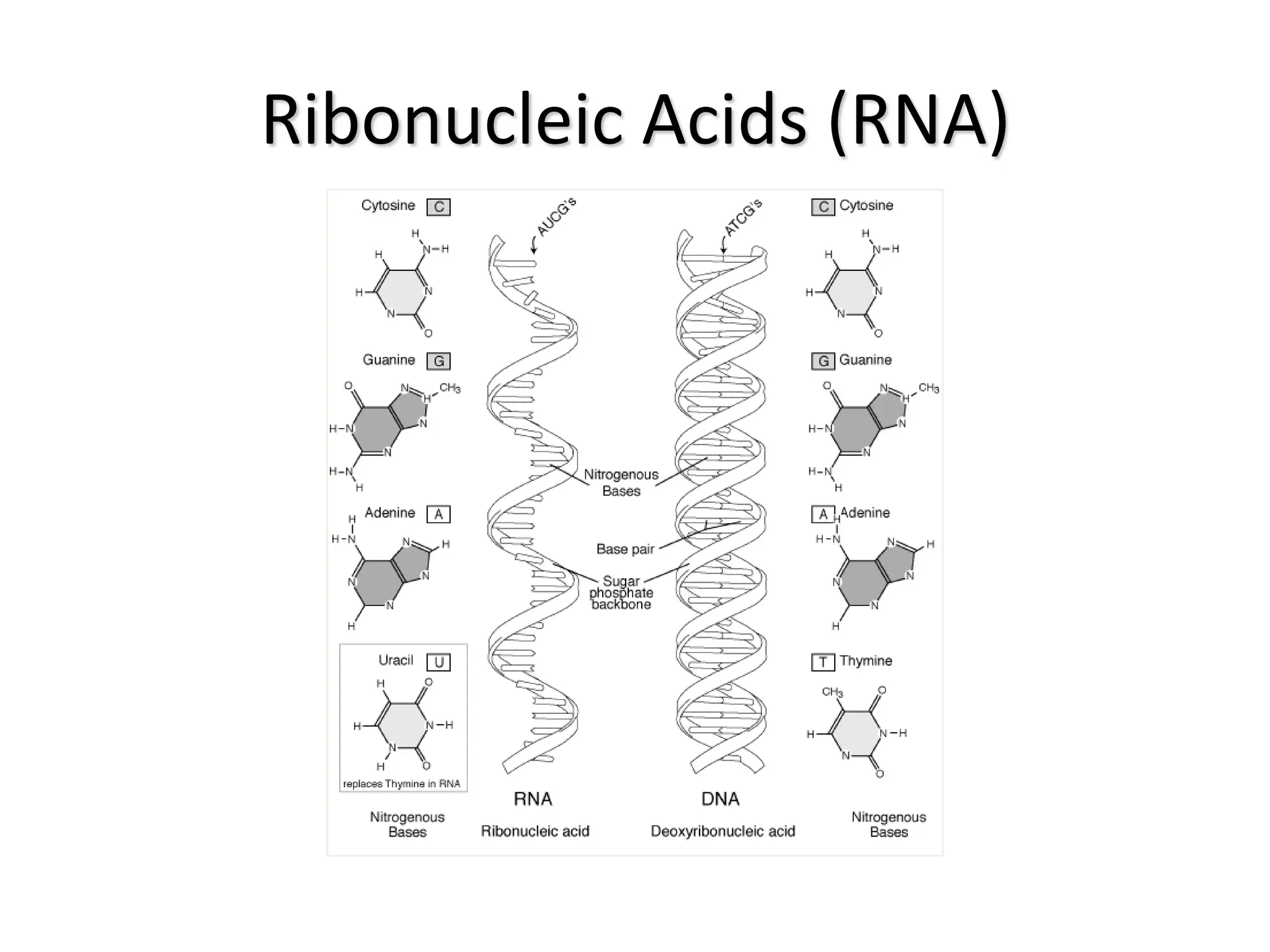
• RNA is almost exactly like DNA, except:
– Contains a ribose sugar, instead of a deoxyribose
sugar (hence the name…)
– Contains uracil instead of thymine.
– RNA is single-stranded, not double-stranded
(usually…)
Ribonucleic Acids (RNA)
Protein Synthesis
• Occurs in TWO steps:
1.Transcription – the genetic information from a
strand of DNA is copied into a strand of mRNA
2.Translation – the mRNA, with the help of the
ribosome, forms a chain of amino acids
(eventually forming a protein) based on the
information contained on the mRNA.
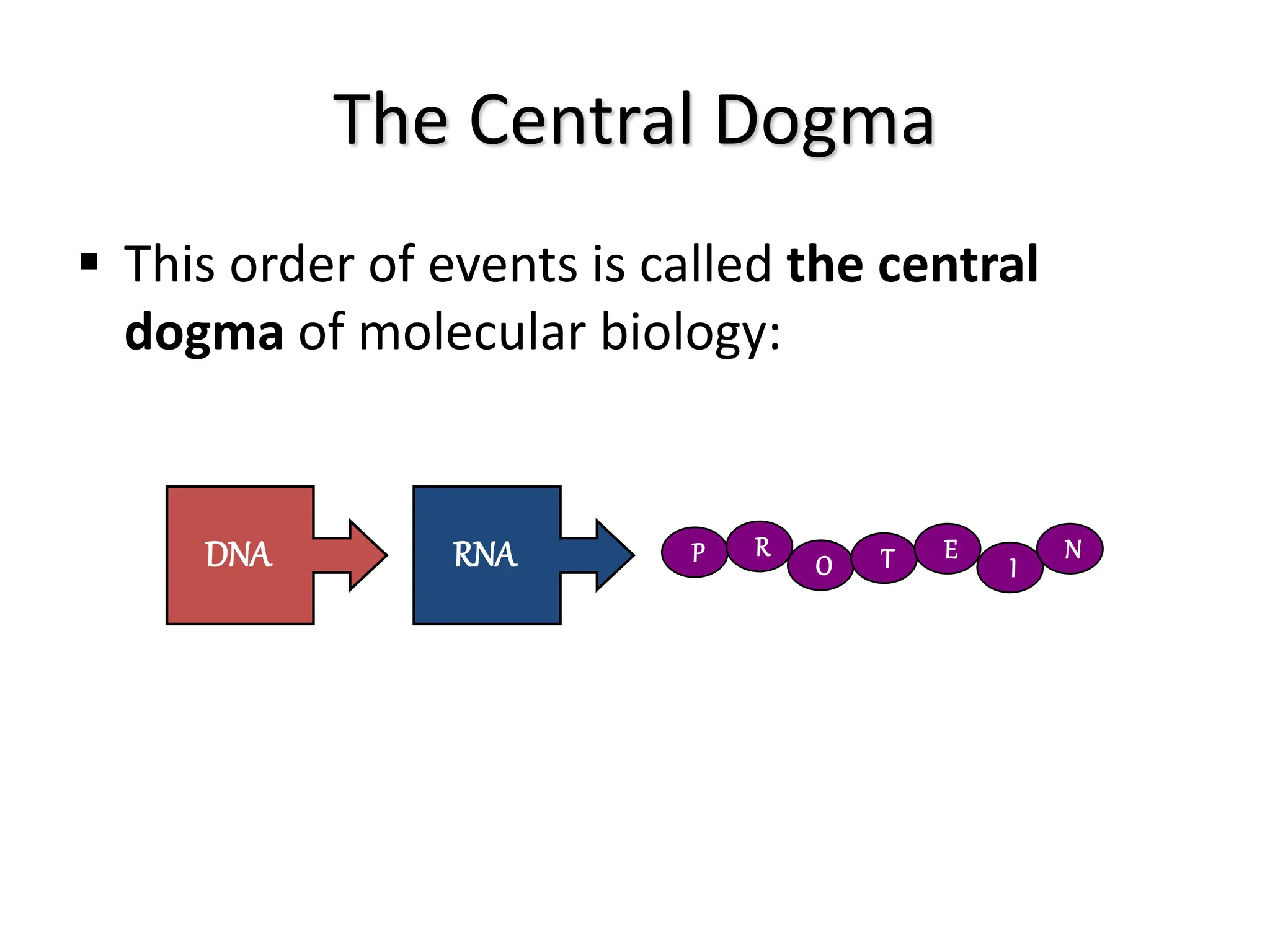
The Central Dogma
 This order of events is called the central
dogma of molecular biology:
DNA RNA P R
O T E
I
N
Step One: Transcription
1. DNA unzips: enzymes split apart base pairs and
unwind the DNA double helix.
2. Bases pair up: Free nucleotides in the cell find their
complementary bases along the new strands with
the help of RNA polymerase. What will be
different??
3. New backbone formed: The sugar-phosphate
backbone is assembled to complete the RNA
strand, and separates from the DNA strand.
Step One: Transcription
 Watch this simplified animation:
http://www.stolaf.edu/people/giannini/flashani
mat/molgenetics/transcription.swf
 Watch the more complex animation!
 http://www-
class.unl.edu/biochem/gp2/m_biology/animat
ion/gene/gene_a2.html
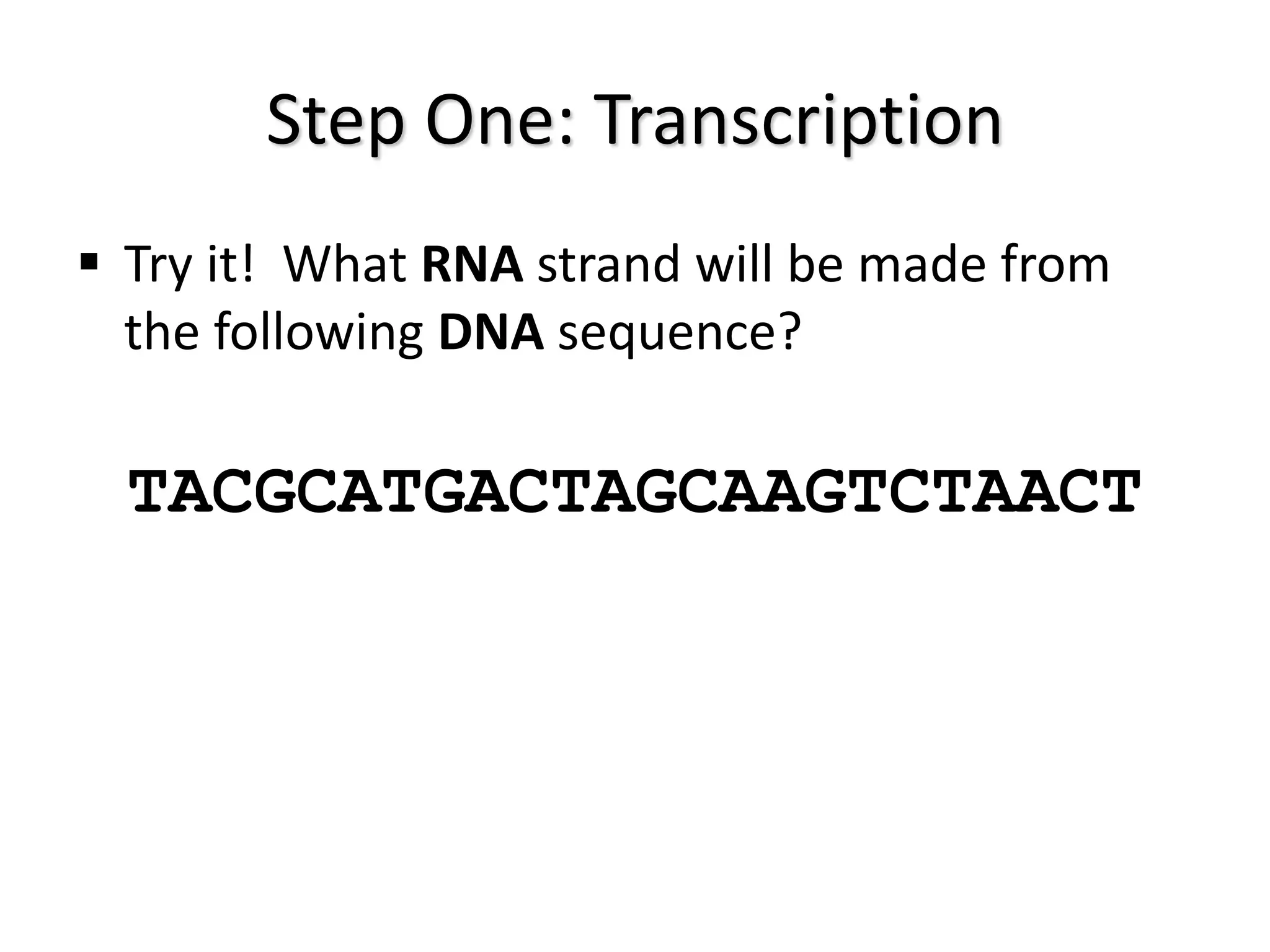
Step One: Transcription
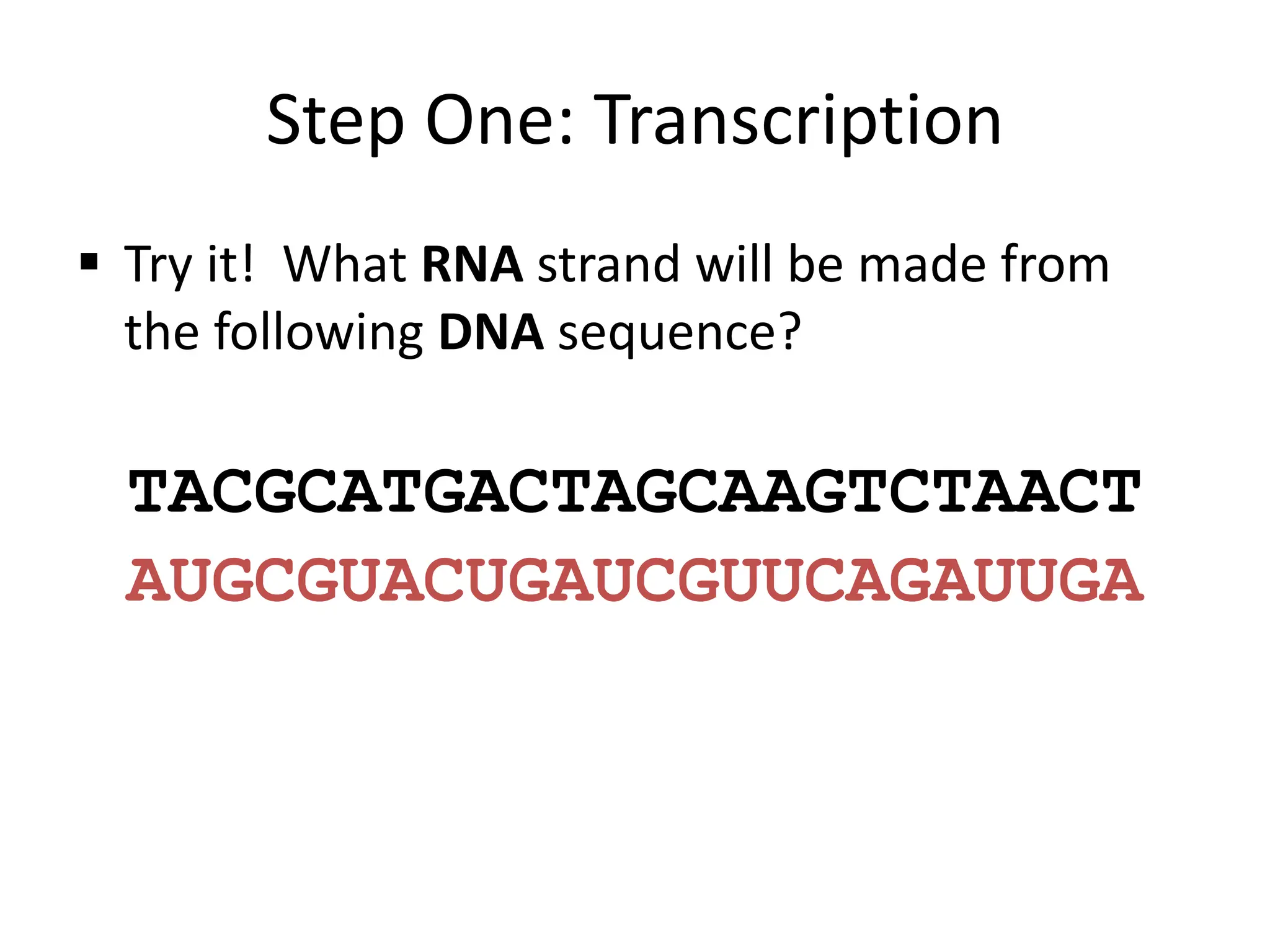
 Try it! What RNA strand will be made from
the following DNA sequence?
TACGCATGACTAGCAAGTCTAACT
Step One: Transcription
 Try it! What RNA strand will be made from
the following DNA sequence?
TACGCATGACTAGCAAGTCTAACT
AUGCGUACUGAUCGUUCAGAUUGA
Step 1½: RNA Editing
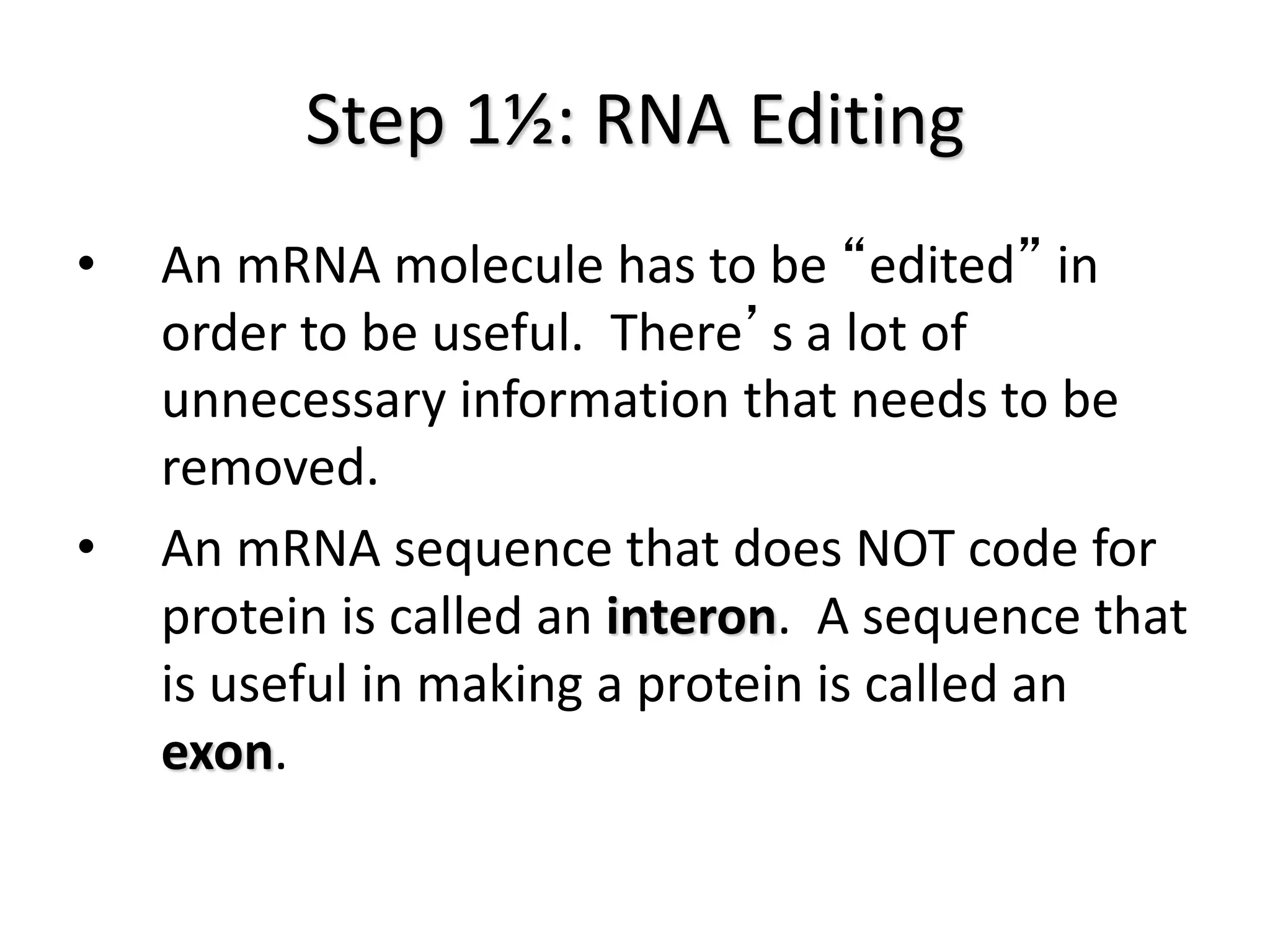
• An mRNA molecule has to be “edited” in
order to be useful. There’s a lot of
unnecessary information that needs to be
removed.
• An mRNA sequence that does NOT code for
protein is called an interon. A sequence that
is useful in making a protein is called an
exon.
Step 1½: RNA Editing
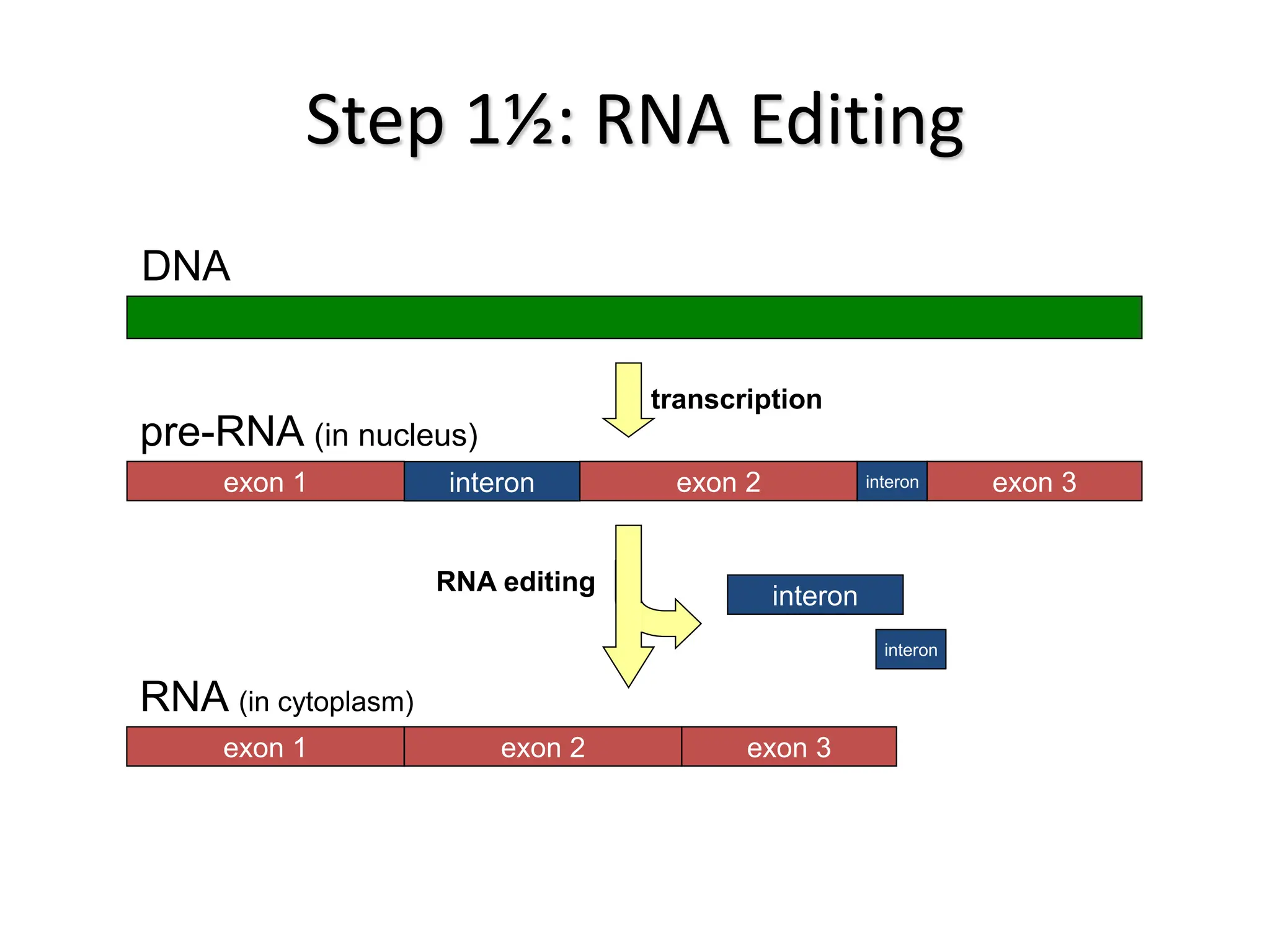
DNA
exon 1 interon exon 2 interon exon 3
pre-RNA (in nucleus)
exon 1 exon 2 exon 3
RNA (in cytoplasm)
transcription
interon
interon
RNA editing
Step Two: Translation “to decode or
decipher the meaning of”
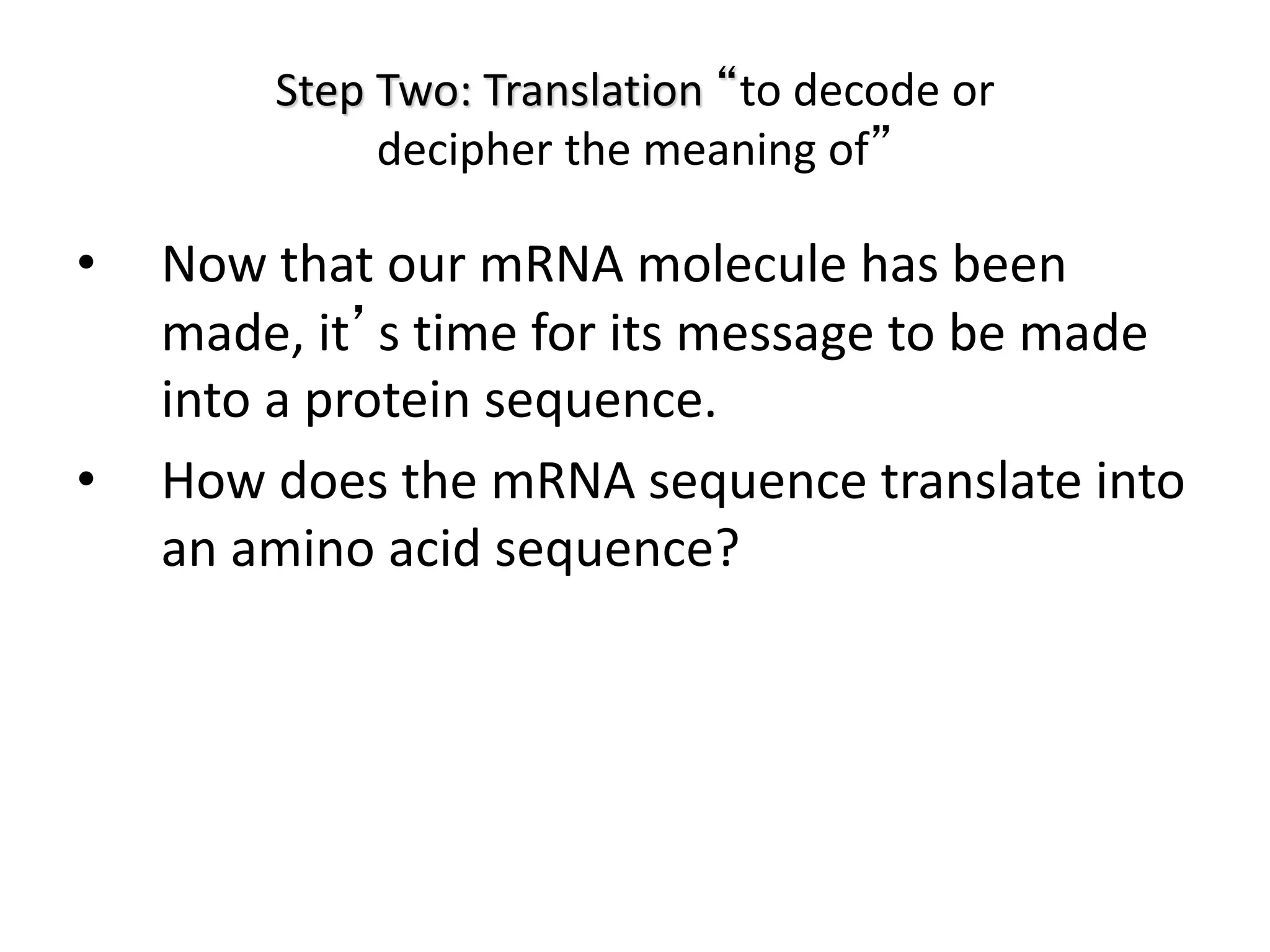
• Now that our mRNA molecule has been
made, it’s time for its message to be made
into a protein sequence.
• How does the mRNA sequence translate into
an amino acid sequence?
Step Two: Translation
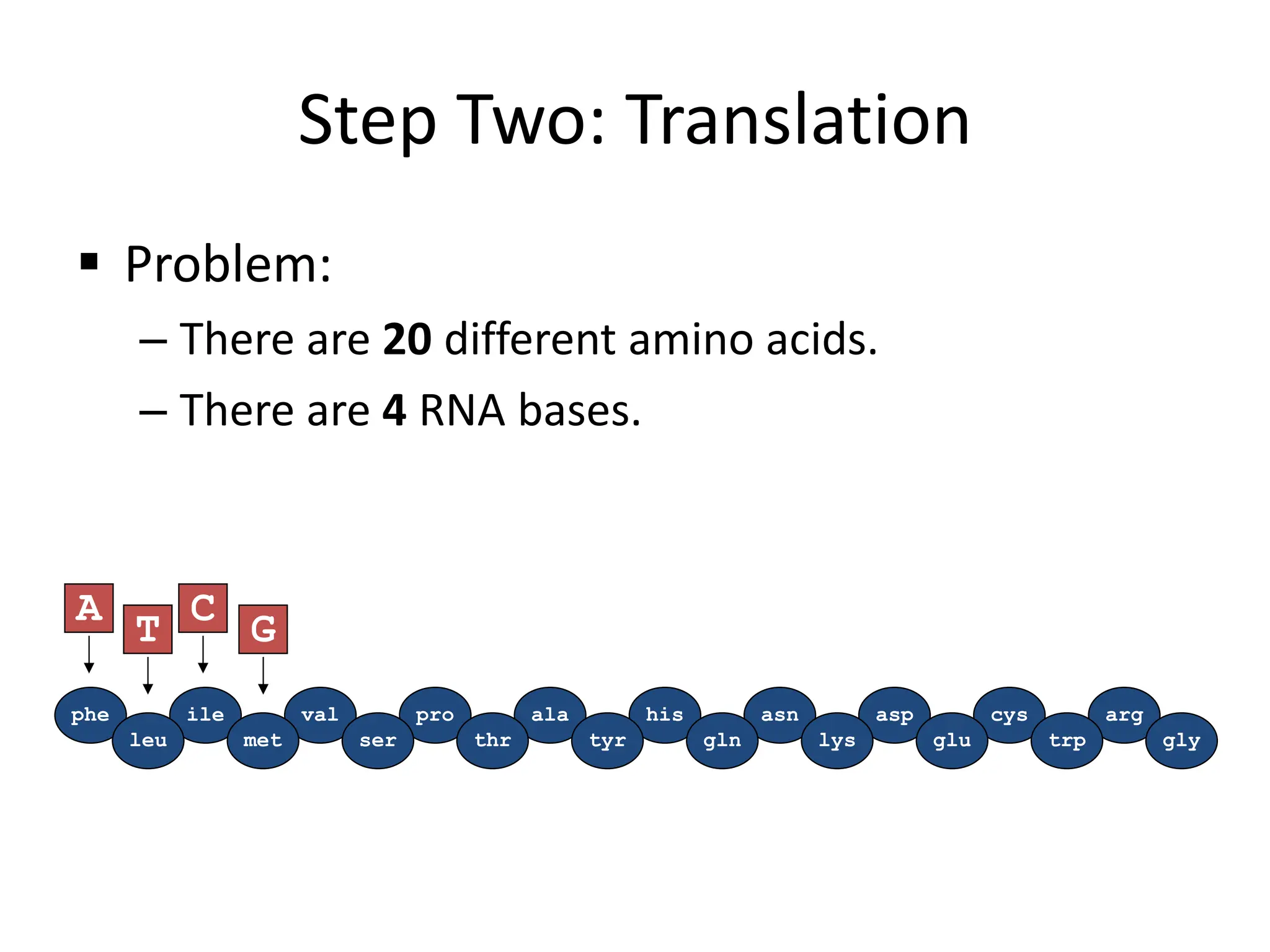
 Problem:
– There are 20 different amino acids.
– There are 4 RNA bases.
phe ile val pro ala his asn asp cys arg
leu met ser thr tyr gln lys glu trp gly
A
T
C
G
Step Two: Translation
 Watch this simplified animation:
http://www.stolaf.edu/people/giannini/flashani
mat/molgenetics/translation.swf
 Watch the more complex animation!
 http://www-
class.unl.edu/biochem/gp2/m_biology/animat
ion/gene/gene_a3.html
Step Two: Translation
1. So how do you exactly go about determining
what protein your cells are going to make?
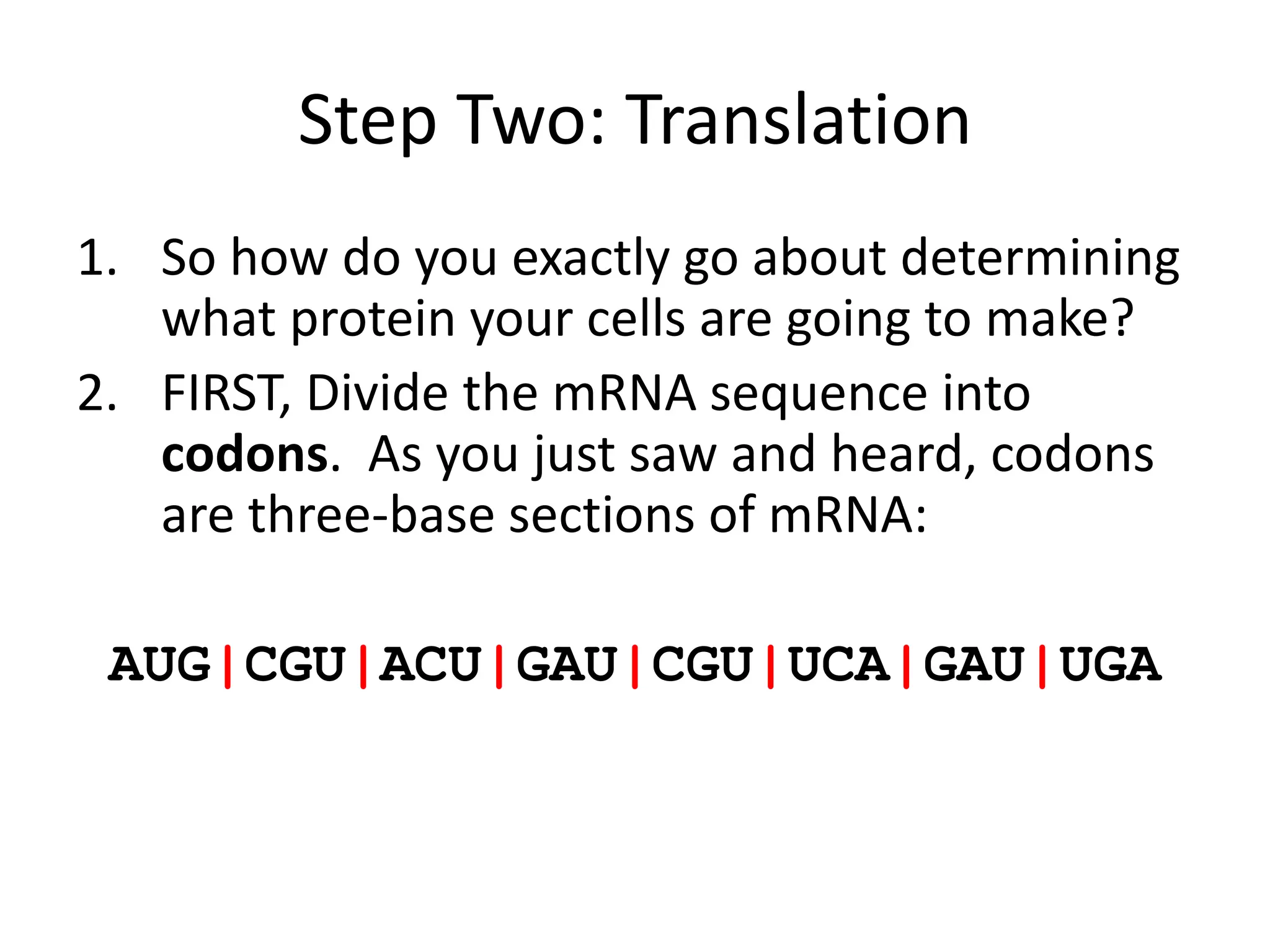
2. FIRST, Divide the mRNA sequence into
codons. As you just saw and heard, codons
are three-base sections of mRNA:
AUG|CGU|ACU|GAU|CGU|UCA|GAU|UGA
Step Two: Translation
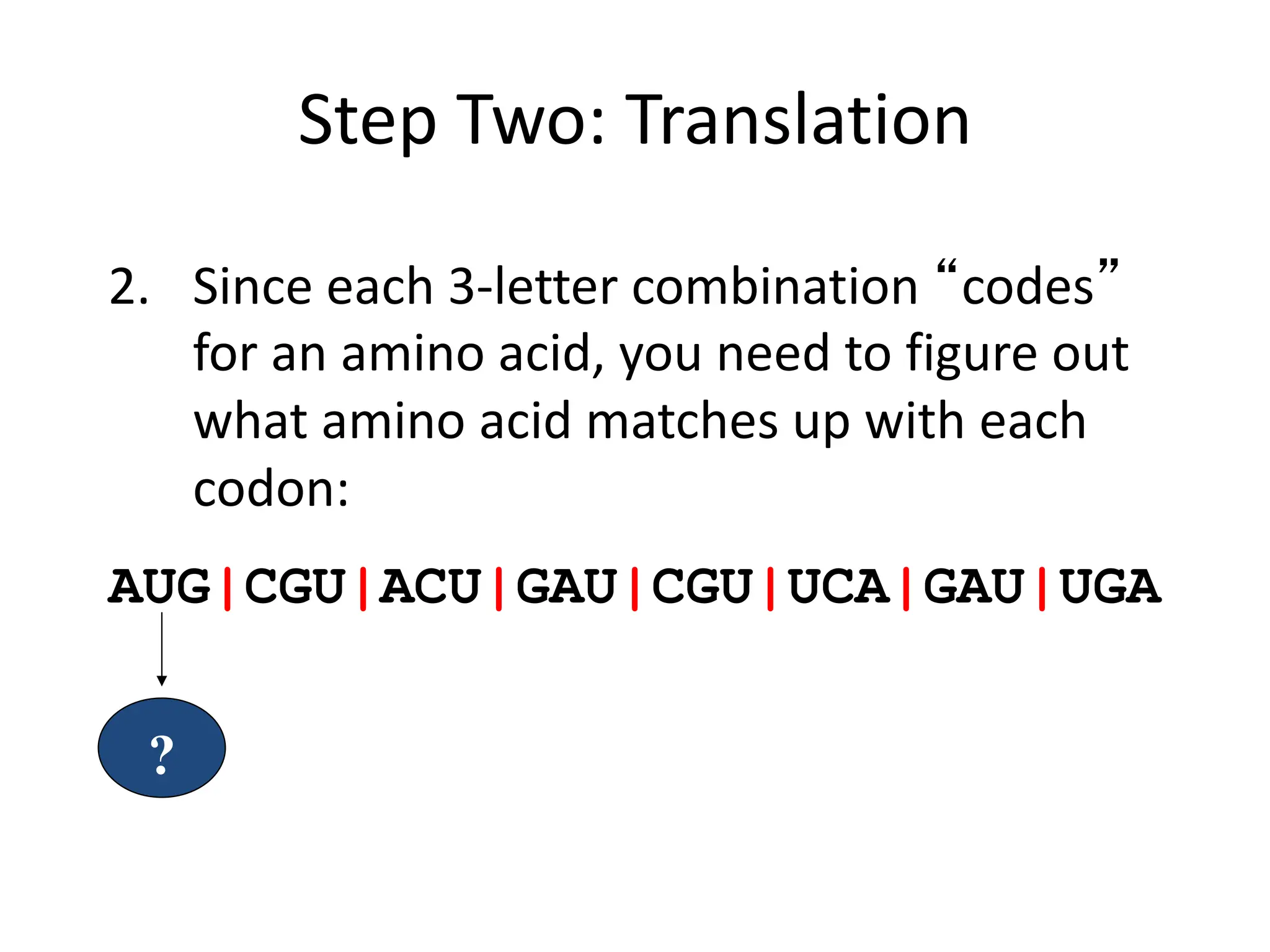
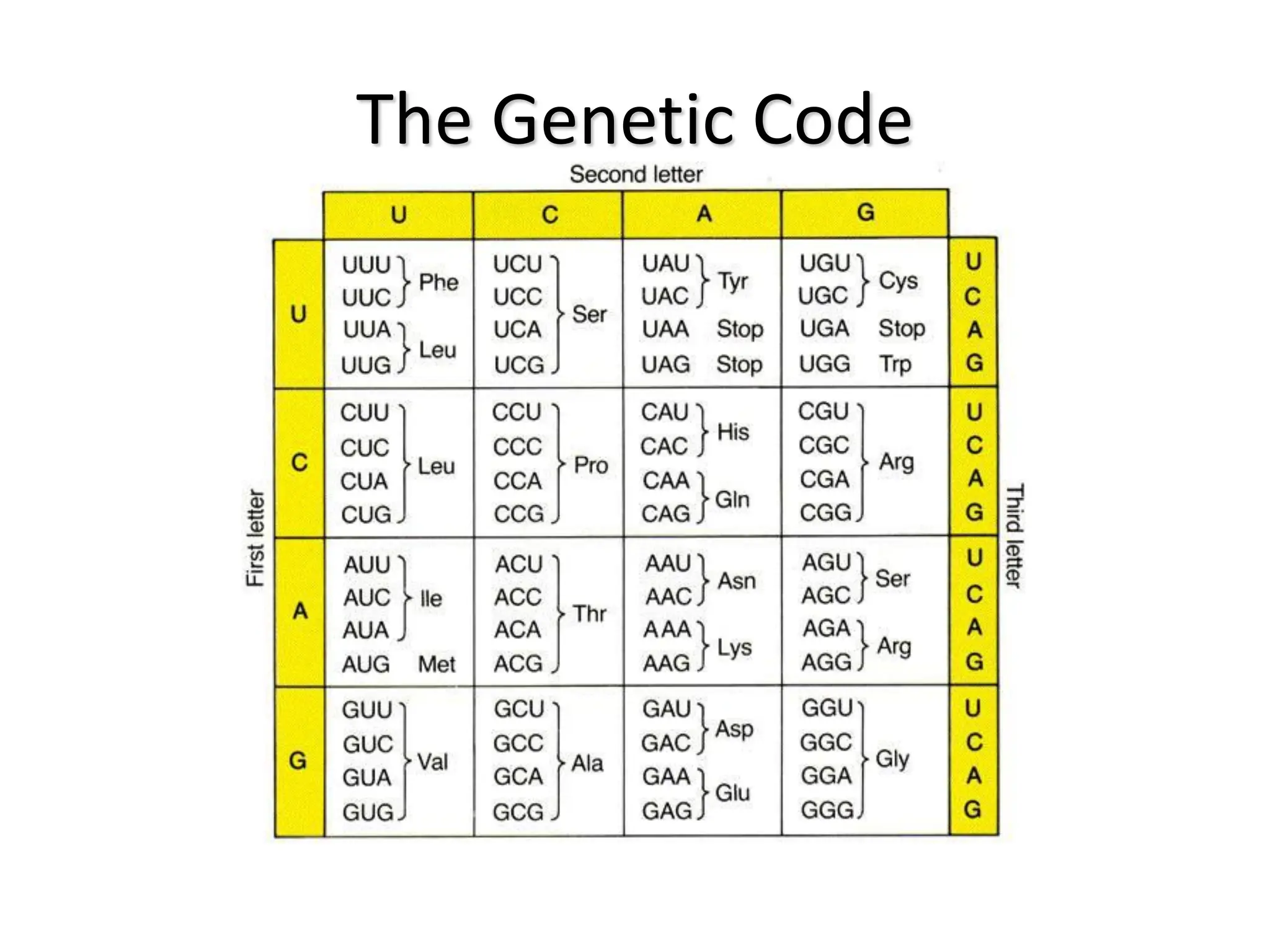
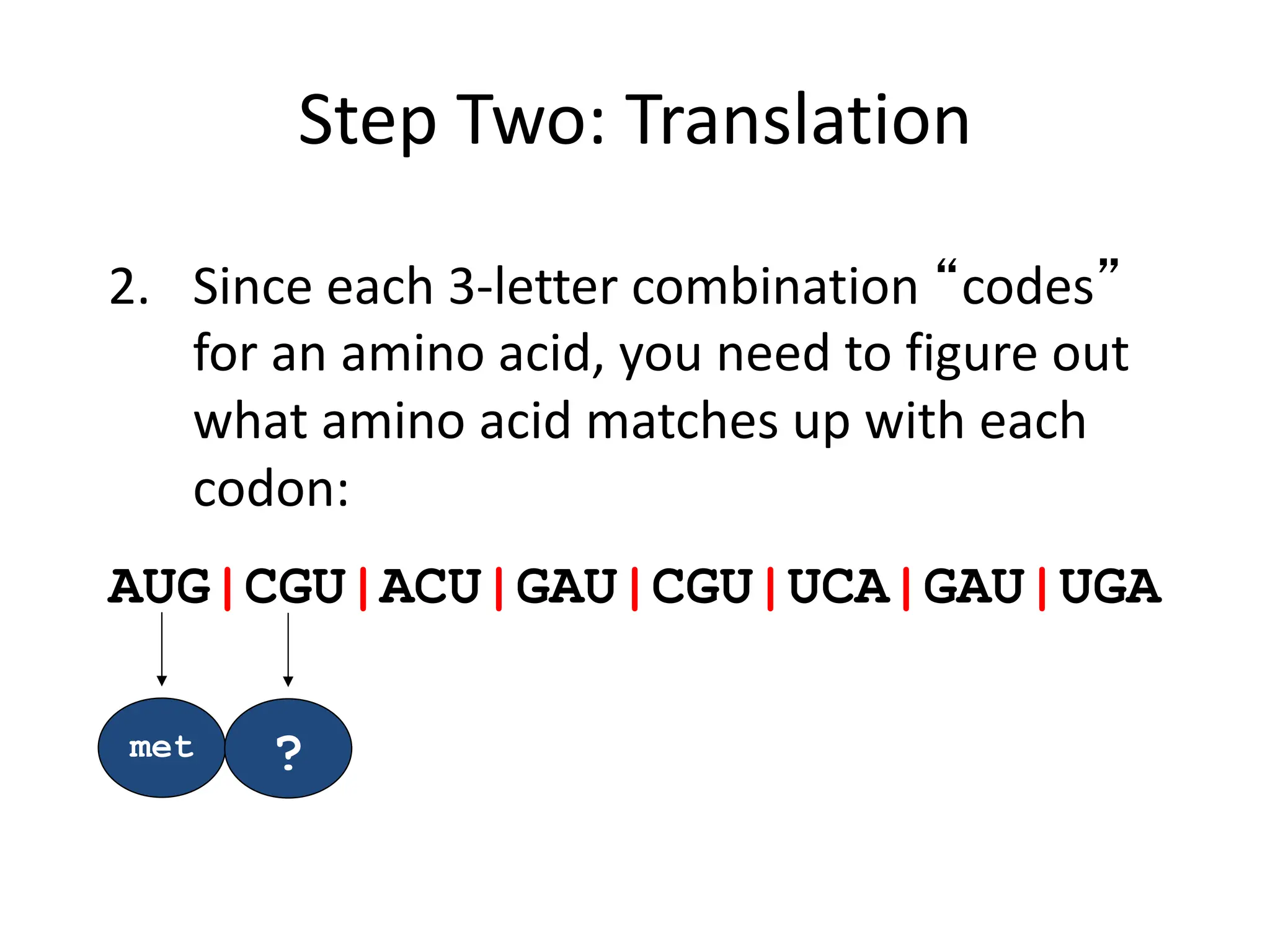
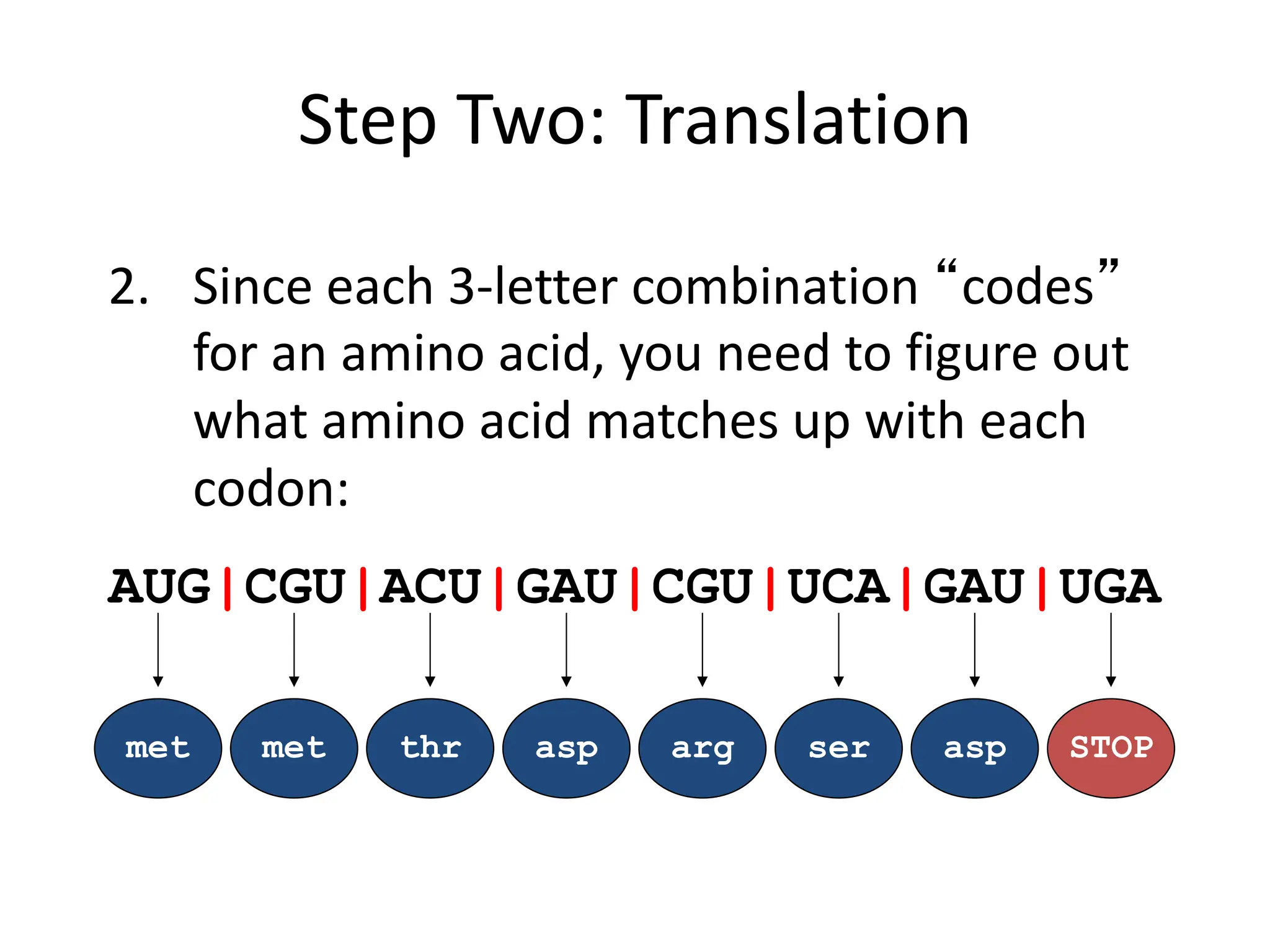
2. Since each 3-letter combination “codes”
for an amino acid, you need to figure out
what amino acid matches up with each
codon:
?
AUG|CGU|ACU|GAU|CGU|UCA|GAU|UGA
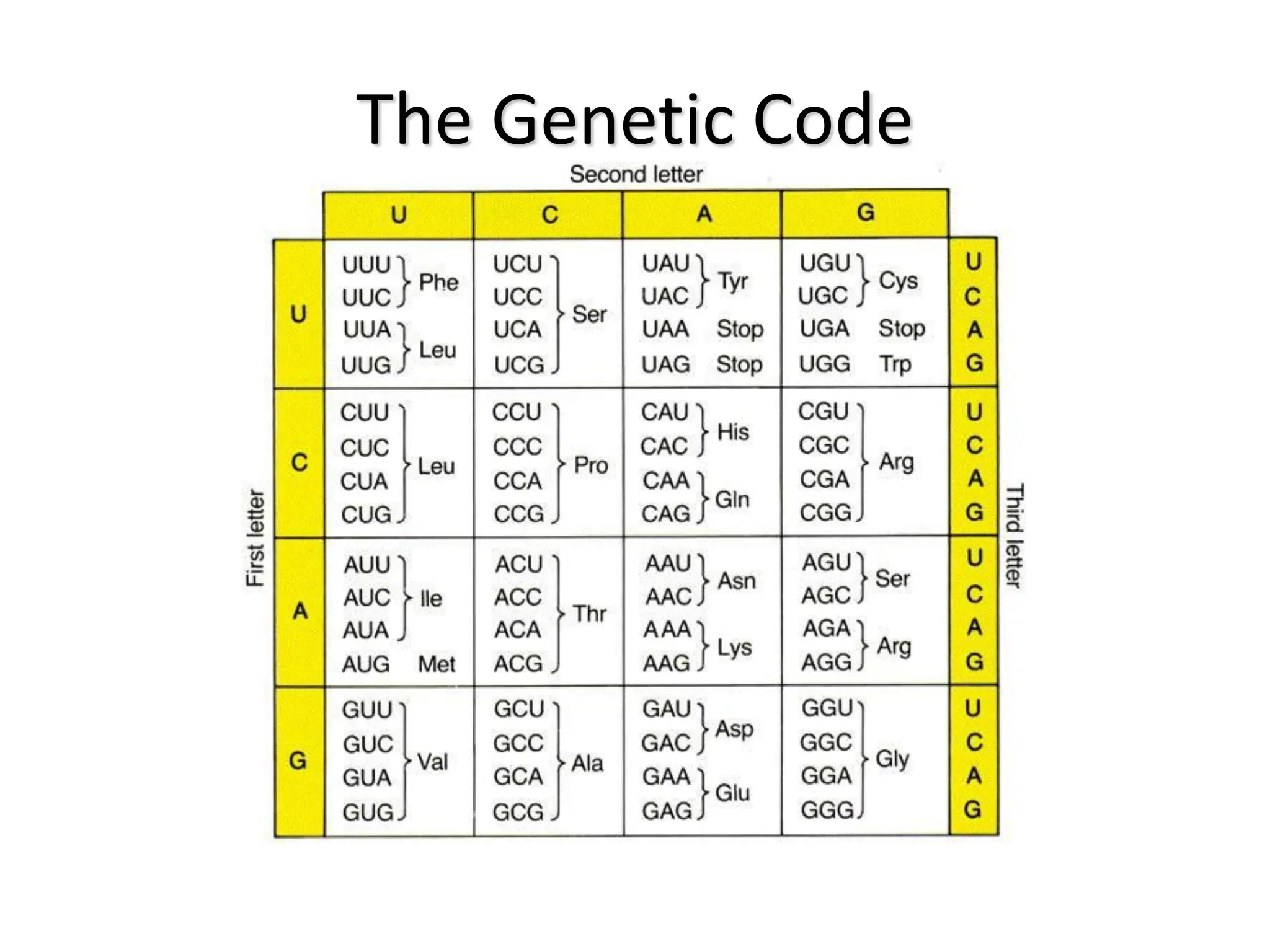
The Genetic Code
Step Two: Translation
2. Since each 3-letter combination “codes”
for an amino acid, you need to figure out
what amino acid matches up with each
codon:
met
AUG|CGU|ACU|GAU|CGU|UCA|GAU|UGA
?
The Genetic Code
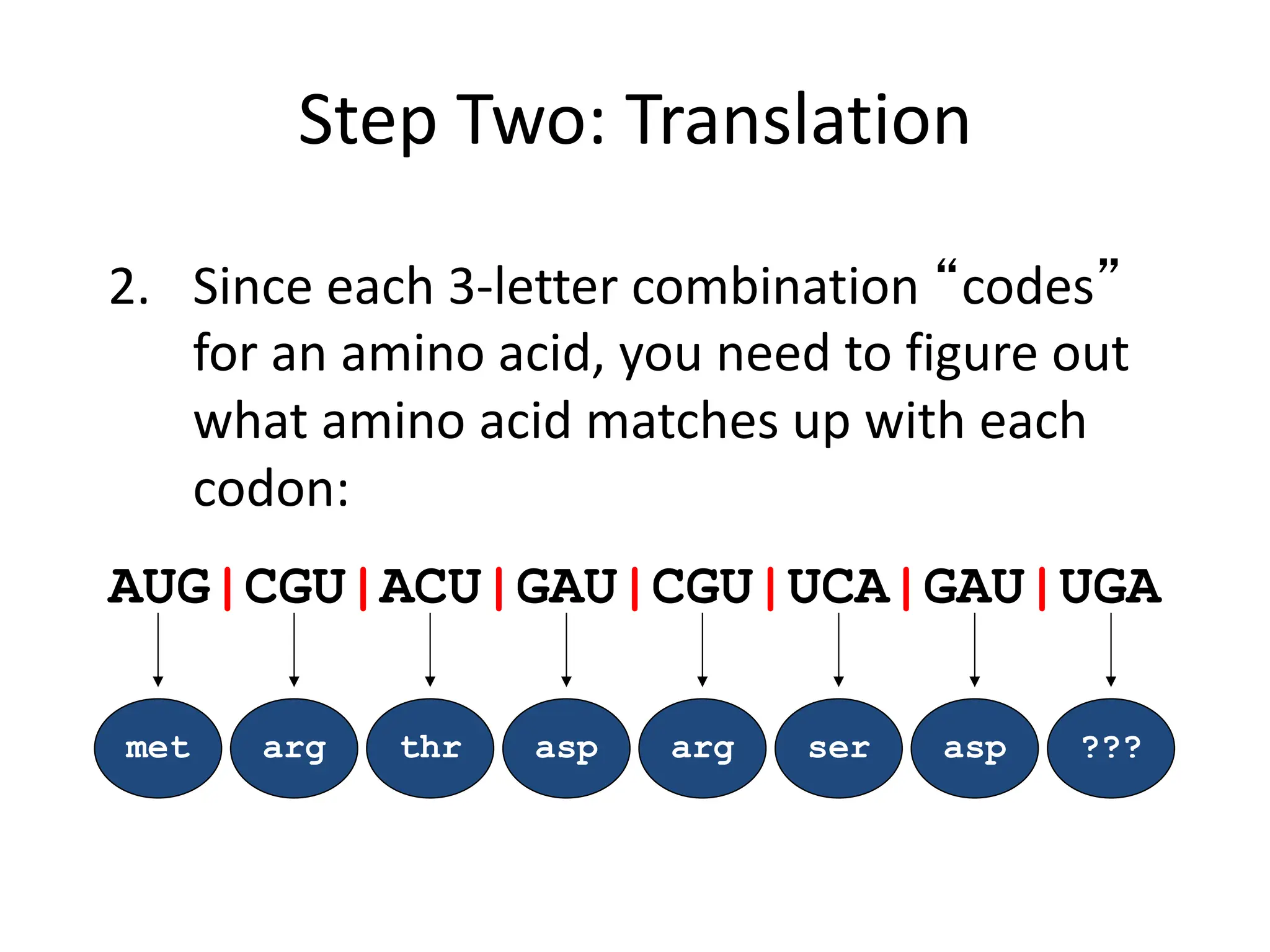
Step Two: Translation
2. Since each 3-letter combination “codes”
for an amino acid, you need to figure out
what amino acid matches up with each
codon:
met
AUG|CGU|ACU|GAU|CGU|UCA|GAU|UGA
asp ???
arg thr asp arg ser
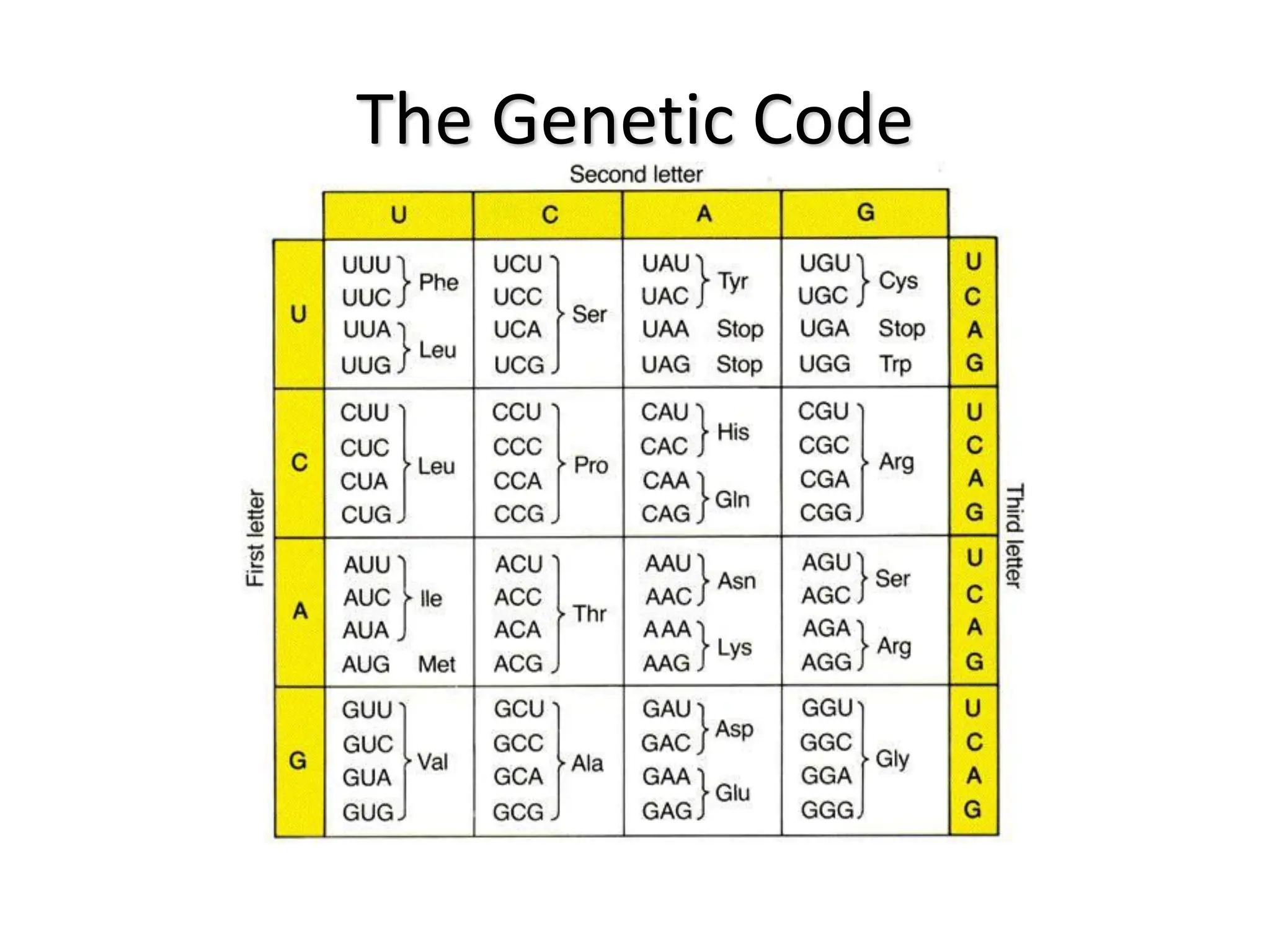
The Genetic Code
Step Two: Translation
2. Since each 3-letter combination “codes”
for an amino acid, you need to figure out
what amino acid matches up with each
codon:
met
AUG|CGU|ACU|GAU|CGU|UCA|GAU|UGA
asp STOP
met thr asp arg ser
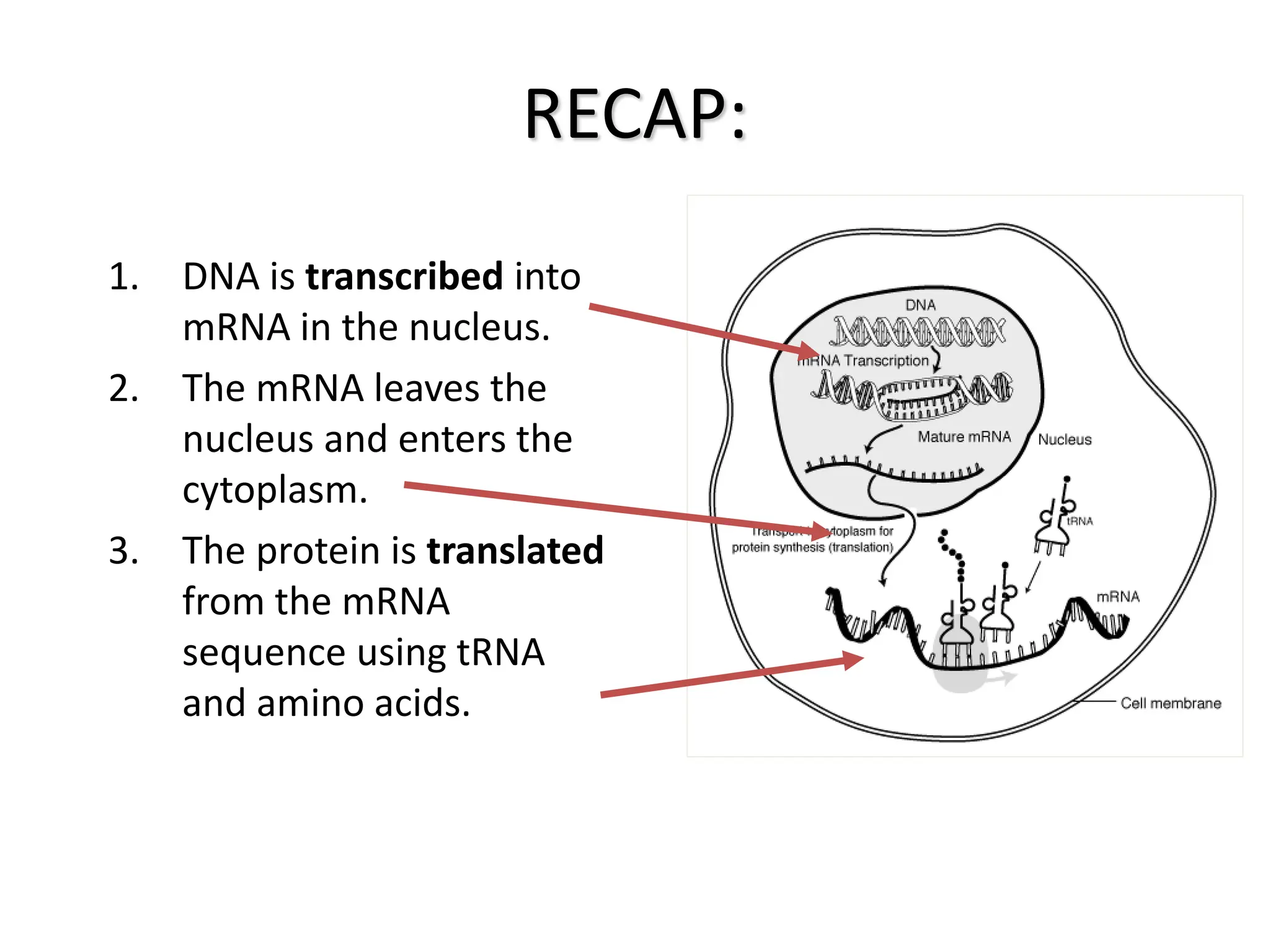
RECAP:
1. DNA is transcribed into
mRNA in the nucleus.
2. The mRNA leaves the
nucleus and enters the
cytoplasm.
3. The protein is translated
from the mRNA
sequence using tRNA
and amino acids.

lecture_transcription and translation.pdf

  • 1.
  • 2.
    Do you rememberwhat proteins are made of ? • Hundreds of Amino Acids link together to make one Protein • There are 20 types of amino acids, some we can make, and some we can’t • There are infinite combinations of amino acids • Can be hundreds or thousands monomers long These long chains are called polypeptide chains
  • 3.
    Protein Synthesis • Proteinsynthesis is the process in which a cell makes protein based on the message contained within its DNA. • However: – DNA is only found in the nucleus – Proteins are only made outside the nucleus – in the cytoplasm. • Houston, we have a problem.
  • 4.
    Protein Synthesis • Howdo the many different messages within the DNA molecule get to the many ribosomes outside the nucleus? • A molecular cousin of DNA – RNA – is used to carry these messages.
  • 5.
    Ribonucleic Acids (RNA) •The job of RNA (ribonucleic acid) is to carry messages from the DNA (in the nucleus) to the ribosomes (in the cytoplasm). • There are three types of RNA: 1. mRNA – carries a message from the DNA to the cytoplasm 2. tRNA – transports amino acids to the mRNA to make a protein 3. rRNA – make up ribosomes, which make protein.
  • 6.
    Ribonucleic Acids (RNA) •RNA is almost exactly like DNA, except: – Contains a ribose sugar, instead of a deoxyribose sugar (hence the name…) – Contains uracil instead of thymine. – RNA is single-stranded, not double-stranded (usually…)
  • 7.
  • 8.
    Protein Synthesis • Occursin TWO steps: 1.Transcription – the genetic information from a strand of DNA is copied into a strand of mRNA 2.Translation – the mRNA, with the help of the ribosome, forms a chain of amino acids (eventually forming a protein) based on the information contained on the mRNA.
  • 9.
    The Central Dogma This order of events is called the central dogma of molecular biology: DNA RNA P R O T E I N
  • 10.
    Step One: Transcription 1.DNA unzips: enzymes split apart base pairs and unwind the DNA double helix. 2. Bases pair up: Free nucleotides in the cell find their complementary bases along the new strands with the help of RNA polymerase. What will be different?? 3. New backbone formed: The sugar-phosphate backbone is assembled to complete the RNA strand, and separates from the DNA strand.
  • 11.
    Step One: Transcription Watch this simplified animation: http://www.stolaf.edu/people/giannini/flashani mat/molgenetics/transcription.swf  Watch the more complex animation!  http://www- class.unl.edu/biochem/gp2/m_biology/animat ion/gene/gene_a2.html
  • 12.
    Step One: Transcription Try it! What RNA strand will be made from the following DNA sequence? TACGCATGACTAGCAAGTCTAACT
  • 13.
    Step One: Transcription Try it! What RNA strand will be made from the following DNA sequence? TACGCATGACTAGCAAGTCTAACT AUGCGUACUGAUCGUUCAGAUUGA
  • 14.
    Step 1½: RNAEditing • An mRNA molecule has to be “edited” in order to be useful. There’s a lot of unnecessary information that needs to be removed. • An mRNA sequence that does NOT code for protein is called an interon. A sequence that is useful in making a protein is called an exon.
  • 15.
    Step 1½: RNAEditing DNA exon 1 interon exon 2 interon exon 3 pre-RNA (in nucleus) exon 1 exon 2 exon 3 RNA (in cytoplasm) transcription interon interon RNA editing
  • 16.
    Step Two: Translation“to decode or decipher the meaning of” • Now that our mRNA molecule has been made, it’s time for its message to be made into a protein sequence. • How does the mRNA sequence translate into an amino acid sequence?
  • 17.
    Step Two: Translation Problem: – There are 20 different amino acids. – There are 4 RNA bases. phe ile val pro ala his asn asp cys arg leu met ser thr tyr gln lys glu trp gly A T C G
  • 18.
    Step Two: Translation Watch this simplified animation: http://www.stolaf.edu/people/giannini/flashani mat/molgenetics/translation.swf  Watch the more complex animation!  http://www- class.unl.edu/biochem/gp2/m_biology/animat ion/gene/gene_a3.html
  • 19.
    Step Two: Translation 1.So how do you exactly go about determining what protein your cells are going to make? 2. FIRST, Divide the mRNA sequence into codons. As you just saw and heard, codons are three-base sections of mRNA: AUG|CGU|ACU|GAU|CGU|UCA|GAU|UGA
  • 20.
    Step Two: Translation 2.Since each 3-letter combination “codes” for an amino acid, you need to figure out what amino acid matches up with each codon: ? AUG|CGU|ACU|GAU|CGU|UCA|GAU|UGA
  • 21.
  • 22.
    Step Two: Translation 2.Since each 3-letter combination “codes” for an amino acid, you need to figure out what amino acid matches up with each codon: met AUG|CGU|ACU|GAU|CGU|UCA|GAU|UGA ?
  • 23.
  • 24.
    Step Two: Translation 2.Since each 3-letter combination “codes” for an amino acid, you need to figure out what amino acid matches up with each codon: met AUG|CGU|ACU|GAU|CGU|UCA|GAU|UGA asp ??? arg thr asp arg ser
  • 25.
  • 26.
    Step Two: Translation 2.Since each 3-letter combination “codes” for an amino acid, you need to figure out what amino acid matches up with each codon: met AUG|CGU|ACU|GAU|CGU|UCA|GAU|UGA asp STOP met thr asp arg ser
  • 27.
    RECAP: 1. DNA istranscribed into mRNA in the nucleus. 2. The mRNA leaves the nucleus and enters the cytoplasm. 3. The protein is translated from the mRNA sequence using tRNA and amino acids.