How Computers RepresentData
• All symbols, pictures or words must be reduced
to a string of binary digits.
• A binary digit is called a bit and represents either
a 0 or a 1.
• These are the only digits in the binary or base 2,
number system used by computers.
• A string of eight bits used to store one number or
character in a computer system is called a byte
(see Figure 0.2).
3.
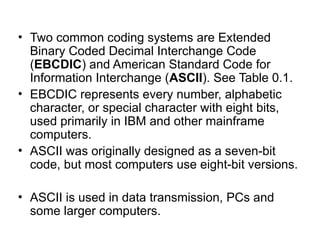
• Two commoncoding systems are Extended
Binary Coded Decimal Interchange Code
(EBCDIC) and American Standard Code for
Information Interchange (ASCII). See Table 0.1.
• EBCDIC represents every number, alphabetic
character, or special character with eight bits,
used primarily in IBM and other mainframe
computers.
• ASCII was originally designed as a seven-bit
code, but most computers use eight-bit versions.
• ASCII is used in data transmission, PCs and
some larger computers.
4.
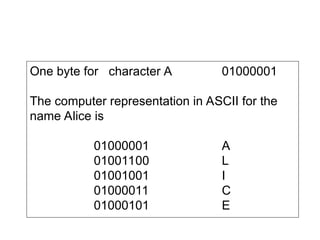
One byte forcharacter A 01000001
The computer representation in ASCII for the
name Alice is
01000001 A
01001100 L
01001001 I
01000011 C
01000101 E
5.
• To representthe numbers 0 through 9 and
the letters a through z and A through Z,
computer designers have created coding
systems consisting of several hundred
standard codes.
• In one code, for instance, the binary
number 01000001 stands for the letter A.
Counting system
Thereare three kinds of people in the world:
those who can count, and those who can not.
- Unknown Wisdom
Today’s class
Numbering system
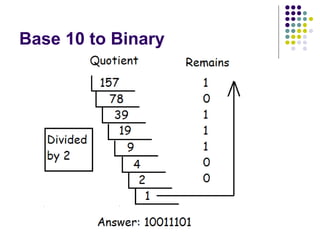
Conversion between 10 based and 2 based
numbering system.
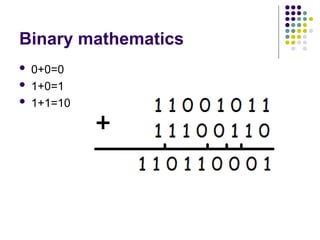
Binary Mathematics.
Quiz
8.
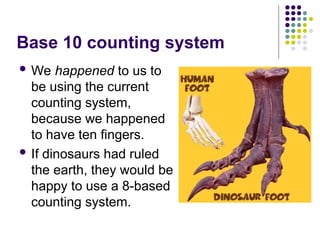
Base 10 countingsystem
We happened to us to
be using the current
counting system,
because we happened
to have ten fingers.
If dinosaurs had ruled
the earth, they would be
happy to use a 8-based
counting system.
9.
Base 2 countingsystem
Base 8 counting system
Base 16 counting system
Base 10 counting system
10.
Base 10 (Decimalnumbers)
What does 157 mean?
157 = 1 x 100 + 5 x 10 + 7 x 1
= 1 x 10²
+ 5 x 101
+ 7 x 100
11.
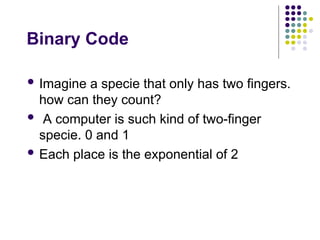
Binary Code
Imaginea specie that only has two fingers.
how can they count?
A computer is such kind of two-finger
specie. 0 and 1
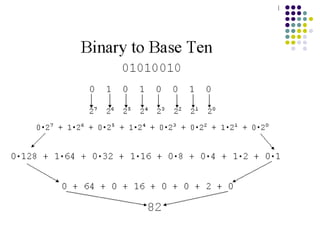
Each place is the exponential of 2
12.
Base 10 vsBase 2
Base 10
157
157 = 1 x 100 + 5 x 10 + 7 x 1
= 1 x 10²
+ 5 x 101
+ 7 x 100
Base 2
1011 = 1 x 23
+ 0 x 22
+ 1 x 21
+ 1 x 20
1011 = 1 x 8 + 0 x 4 + 1 x 2 + 1 x 1
Hexadecimal (base 16)
Binary code is too long in representation. Hex
is much shorter.
Converting a binary number to a Hex number
is relatively easy
Every 4 bit can convert to a Hex
Problem: we are short of numbers
A-10 B-11 C-12 D-13 E-14 F-15
18.
Wisdom said
Thereare 10 kinds of people in the world,
those who use binary counting system, and
those who don’t.
19.
Quiz
No Calculators!!!!
Convert binary code to Decimal number.
10110101 (Bin)
Convert Decimal number to binary code
186 (Dec)
Add these two binary numbers
10101101+11011100=?






![Lecture_1_-_Computer_Basics[1]. Computer engineering skills](https://cdn.slidesharecdn.com/ss_thumbnails/lecture1-computerbasics1-250602073309-35fbba6b-thumbnail.jpg?width=640&height=640&fit=bounds)
![Lecture_1_-_Computer_Basics[1]. Skills in computer programming](https://cdn.slidesharecdn.com/ss_thumbnails/lecture1-computerbasics1-250602073114-bb8c81e7-thumbnail.jpg?width=640&height=640&fit=bounds)
![Lecture_2_-_Looking_Inside_the_CPU[1].ppt](https://cdn.slidesharecdn.com/ss_thumbnails/lecture2-lookinginsidethecpu1-250528091117-adfe95d0-thumbnail.jpg?width=640&height=640&fit=bounds)


