Introduction:
IoT Networking- Part I
Industry 4.0 and Industrial Internet of Things 1
Dr. Sudip Misra
Professor
Department of Computer Science and Engineering
Indian Institute of Technology Kharagpur
Email: smisra@sit.iitkgp.ernet.in
Website: http://cse.iitkgp.ac.in/~smisra/
Research Lab: cse.iitkgp.ac.in/~smisra/swan/
Introduction
Industry 4.0 and Industrial Internet of Things 2
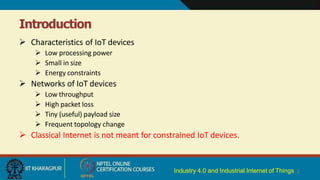
 Characteristics of IoT devices
 Low processing power
 Small in size
 Energy constraints
 Networks of IoT devices
 Low throughput
 High packet loss
 Tiny (useful) payload size
 Frequent topology change
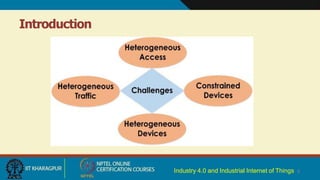
 Classical Internet is not meant for constrained IoT devices.
Introduction
Industry 4.0 and Industrial Internet of Things 3
Introduction
4
Introduction to Internet of Things
 Analogy
 Roots - Communication Protocol and device
technologies
 Trunk- Architectural Reference Model (ARM)
 Leaves – IoT Applications
 Goal
 To select a minimal set of roots and propose a
potential trunk that enables the creation of a
maximal set of the leaves.
Source: FhG, I. M. L., et al. "Internet of things-architecture iot-a deliverable d1. 3–updated reference model for iot v1. 5."
Enabling Classical Internet for IoTDevices
Industry 4.0 and Industrial Internet of Things5
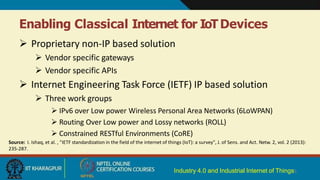
 Proprietary non-IP based solution
 Vendor specific gateways
 Vendor specific APIs
 Internet Engineering Task Force (IETF) IP based solution
 Three work groups
 IPv6 over Low power Wireless Personal Area Networks (6LoWPAN)
 Routing Over Low power and Lossy networks (ROLL)
 Constrained RESTful Environments (CoRE)
Source: I. Ishaq, et al. , "IETF standardization in the field of the internet of things (IoT): a survey", J. of Sens. and Act. Netw. 2, vol. 2 (2013):
235-287.
Proprietary non-IPbased solution
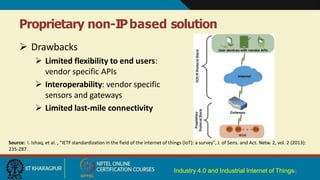
 Drawbacks
 Limited flexibility to end users:
vendor specific APIs
 Interoperability: vendor specific
sensors and gateways
 Limited last-mile connectivity
Source: I. Ishaq, et al. , "IETF standardization in the field of the internet of things (IoT): a survey", J. of Sens. and Act. Netw. 2, vol. 2 (2013):
235-287.
Industry 4.0 and Industrial Internet of Things6
IETFIPbased solution
Industry 4.0 and Industrial Internet of Things7
 Three work groups
 IPv6 over Low power Wireless Personal Area Networks (6LoWPAN)
 By header compression and encapsulation it allows IPv6 packets to transmit
and receive over IEEE 802.15.4 based networks.
 Routing Over Low power and Lossy networks (ROLL)
 New routing protocol optimized for saving storage and energy.
 Constrained RESTful Environments (CoRE)
 Extend the Integration of the IoT devices from network to service level.
Constrained RESTful Environments (CoRE)
Industry 4.0 and Industrial Internet of Things8
CoRE
Industry 4.0 and Industrial Internet of Things9
 Provides a platform for applications meant for constrained
IoT devices.
 This framework views sensor and actuator resources as
web resources.
 The framework is limited to applications which
 Monitor basic sensors
 Supervise actuators
 CoAP includes a mechanism for service discovery.
CoRE: Service Discovery
Industry 4.0 and Industrial Internet of Things10
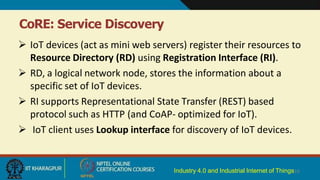
 IoT devices (act as mini web servers) register their resources to
Resource Directory (RD) using Registration Interface (RI).
 RD, a logical network node, stores the information about a
specific set of IoT devices.
 RI supports Representational State Transfer (REST) based
protocol such as HTTP (and CoAP- optimized for IoT).
 IoT client uses Lookup interface for discovery of IoT devices.
IoTNetwork QoS
Industry 4.0 and Industrial Internet of Things11
IoTNetwork QoS
Industry 4.0 and Industrial Internet of Things12
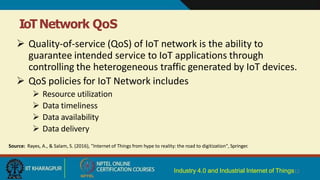
 Quality-of-service (QoS) of IoT network is the ability to
guarantee intended service to IoT applications through
controlling the heterogeneous traffic generated by IoT devices.
 QoS policies for IoT Network includes
 Resource utilization
 Data timeliness
 Data availability
 Data delivery
Source: Rayes, A., & Salam, S. (2016), "Internet of Things from hype to reality: the road to digitization", Springer.
Resource utilization
Industry 4.0 and Industrial Internet of Things13
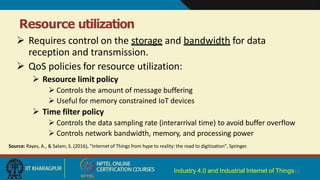
 Requires control on the storage and bandwidth for data
reception and transmission.
 QoS policies for resource utilization:
 Resource limit policy
 Controls the amount of message buffering
 Useful for memory constrained IoT devices
 Time filter policy
 Controls the data sampling rate (interarrival time) to avoid buffer overflow
 Controls network bandwidth, memory, and processing power
Source: Rayes, A., & Salam, S. (2016), "Internet of Things from hype to reality: the road to digitization", Springer.
Data timeliness
Industry 4.0 and Industrial Internet of Things14
 Measure of the freshness of particular information at the receiver end
 Important in case of healthcare, industrial and military applications
 Data timeliness policies for IoT network include
 Deadline policy
 Provides maximum interarrival time of data
 Drops the stale data; notify the missed deadline to the application end
 Latency budget policy
 Latency budget is the maximum time difference between the data transmission
and reception from source end to the receiver end.
 Provides priority to applications having higher urgency
Source: Rayes, A., & Salam, S. (2016), "Internet of Things from hype to reality: the road to digitization", Springer.
Data availability
Industry 4.0 and Industrial Internet of Things15
 Measure of the amount of valid data provided by the sender/producer to
receiver/consumer
 QoS policies for data availability in IoT network include
 Durability policy
 Controls the degree of data persistence transmitted by the sender
 Data persistence ensures the availability of the data to the receiver even
after sender is unavailable
 Lifespan policy
 Controls the duration for which transmitted data is valid
 History policy
 Controls the number of previous data instances available for the receiver.
Source: Rayes, A., & Salam, S. (2016), "Internet of Things from hype to reality: the road to digitization", Springer.
Data delivery
Industry 4.0 and Industrial Internet of Things16
 Measure of successful reception of reliable data from sender
to receiver
 QoS policies for data delivery include
 Reliability policy
 Controls the reliability level associated with the data distribution
 Transport priority
 Allows transmission of data according to its priority level
Source: Rayes, A., & Salam, S. (2016), "Internet of Things from hype to reality: the road to digitization", Springer.
17
Introduction to Internet of Things

lecture4week1iotnetworkingpart1-190114153249.pptx

  • 1.
    Introduction: IoT Networking- PartI Industry 4.0 and Industrial Internet of Things 1 Dr. Sudip Misra Professor Department of Computer Science and Engineering Indian Institute of Technology Kharagpur Email: smisra@sit.iitkgp.ernet.in Website: http://cse.iitkgp.ac.in/~smisra/ Research Lab: cse.iitkgp.ac.in/~smisra/swan/
  • 2.
    Introduction Industry 4.0 andIndustrial Internet of Things 2  Characteristics of IoT devices  Low processing power  Small in size  Energy constraints  Networks of IoT devices  Low throughput  High packet loss  Tiny (useful) payload size  Frequent topology change  Classical Internet is not meant for constrained IoT devices.
  • 3.
    Introduction Industry 4.0 andIndustrial Internet of Things 3
  • 4.
    Introduction 4 Introduction to Internetof Things  Analogy  Roots - Communication Protocol and device technologies  Trunk- Architectural Reference Model (ARM)  Leaves – IoT Applications  Goal  To select a minimal set of roots and propose a potential trunk that enables the creation of a maximal set of the leaves. Source: FhG, I. M. L., et al. "Internet of things-architecture iot-a deliverable d1. 3–updated reference model for iot v1. 5."
  • 5.
    Enabling Classical Internetfor IoTDevices Industry 4.0 and Industrial Internet of Things5  Proprietary non-IP based solution  Vendor specific gateways  Vendor specific APIs  Internet Engineering Task Force (IETF) IP based solution  Three work groups  IPv6 over Low power Wireless Personal Area Networks (6LoWPAN)  Routing Over Low power and Lossy networks (ROLL)  Constrained RESTful Environments (CoRE) Source: I. Ishaq, et al. , "IETF standardization in the field of the internet of things (IoT): a survey", J. of Sens. and Act. Netw. 2, vol. 2 (2013): 235-287.
  • 6.
    Proprietary non-IPbased solution Drawbacks  Limited flexibility to end users: vendor specific APIs  Interoperability: vendor specific sensors and gateways  Limited last-mile connectivity Source: I. Ishaq, et al. , "IETF standardization in the field of the internet of things (IoT): a survey", J. of Sens. and Act. Netw. 2, vol. 2 (2013): 235-287. Industry 4.0 and Industrial Internet of Things6
  • 7.
    IETFIPbased solution Industry 4.0and Industrial Internet of Things7  Three work groups  IPv6 over Low power Wireless Personal Area Networks (6LoWPAN)  By header compression and encapsulation it allows IPv6 packets to transmit and receive over IEEE 802.15.4 based networks.  Routing Over Low power and Lossy networks (ROLL)  New routing protocol optimized for saving storage and energy.  Constrained RESTful Environments (CoRE)  Extend the Integration of the IoT devices from network to service level.
  • 8.
    Constrained RESTful Environments(CoRE) Industry 4.0 and Industrial Internet of Things8
  • 9.
    CoRE Industry 4.0 andIndustrial Internet of Things9  Provides a platform for applications meant for constrained IoT devices.  This framework views sensor and actuator resources as web resources.  The framework is limited to applications which  Monitor basic sensors  Supervise actuators  CoAP includes a mechanism for service discovery.
  • 10.
    CoRE: Service Discovery Industry4.0 and Industrial Internet of Things10  IoT devices (act as mini web servers) register their resources to Resource Directory (RD) using Registration Interface (RI).  RD, a logical network node, stores the information about a specific set of IoT devices.  RI supports Representational State Transfer (REST) based protocol such as HTTP (and CoAP- optimized for IoT).  IoT client uses Lookup interface for discovery of IoT devices.
  • 11.
    IoTNetwork QoS Industry 4.0and Industrial Internet of Things11
  • 12.
    IoTNetwork QoS Industry 4.0and Industrial Internet of Things12  Quality-of-service (QoS) of IoT network is the ability to guarantee intended service to IoT applications through controlling the heterogeneous traffic generated by IoT devices.  QoS policies for IoT Network includes  Resource utilization  Data timeliness  Data availability  Data delivery Source: Rayes, A., & Salam, S. (2016), "Internet of Things from hype to reality: the road to digitization", Springer.
  • 13.
    Resource utilization Industry 4.0and Industrial Internet of Things13  Requires control on the storage and bandwidth for data reception and transmission.  QoS policies for resource utilization:  Resource limit policy  Controls the amount of message buffering  Useful for memory constrained IoT devices  Time filter policy  Controls the data sampling rate (interarrival time) to avoid buffer overflow  Controls network bandwidth, memory, and processing power Source: Rayes, A., & Salam, S. (2016), "Internet of Things from hype to reality: the road to digitization", Springer.
  • 14.
    Data timeliness Industry 4.0and Industrial Internet of Things14  Measure of the freshness of particular information at the receiver end  Important in case of healthcare, industrial and military applications  Data timeliness policies for IoT network include  Deadline policy  Provides maximum interarrival time of data  Drops the stale data; notify the missed deadline to the application end  Latency budget policy  Latency budget is the maximum time difference between the data transmission and reception from source end to the receiver end.  Provides priority to applications having higher urgency Source: Rayes, A., & Salam, S. (2016), "Internet of Things from hype to reality: the road to digitization", Springer.
  • 15.
    Data availability Industry 4.0and Industrial Internet of Things15  Measure of the amount of valid data provided by the sender/producer to receiver/consumer  QoS policies for data availability in IoT network include  Durability policy  Controls the degree of data persistence transmitted by the sender  Data persistence ensures the availability of the data to the receiver even after sender is unavailable  Lifespan policy  Controls the duration for which transmitted data is valid  History policy  Controls the number of previous data instances available for the receiver. Source: Rayes, A., & Salam, S. (2016), "Internet of Things from hype to reality: the road to digitization", Springer.
  • 16.
    Data delivery Industry 4.0and Industrial Internet of Things16  Measure of successful reception of reliable data from sender to receiver  QoS policies for data delivery include  Reliability policy  Controls the reliability level associated with the data distribution  Transport priority  Allows transmission of data according to its priority level Source: Rayes, A., & Salam, S. (2016), "Internet of Things from hype to reality: the road to digitization", Springer.
  • 17.