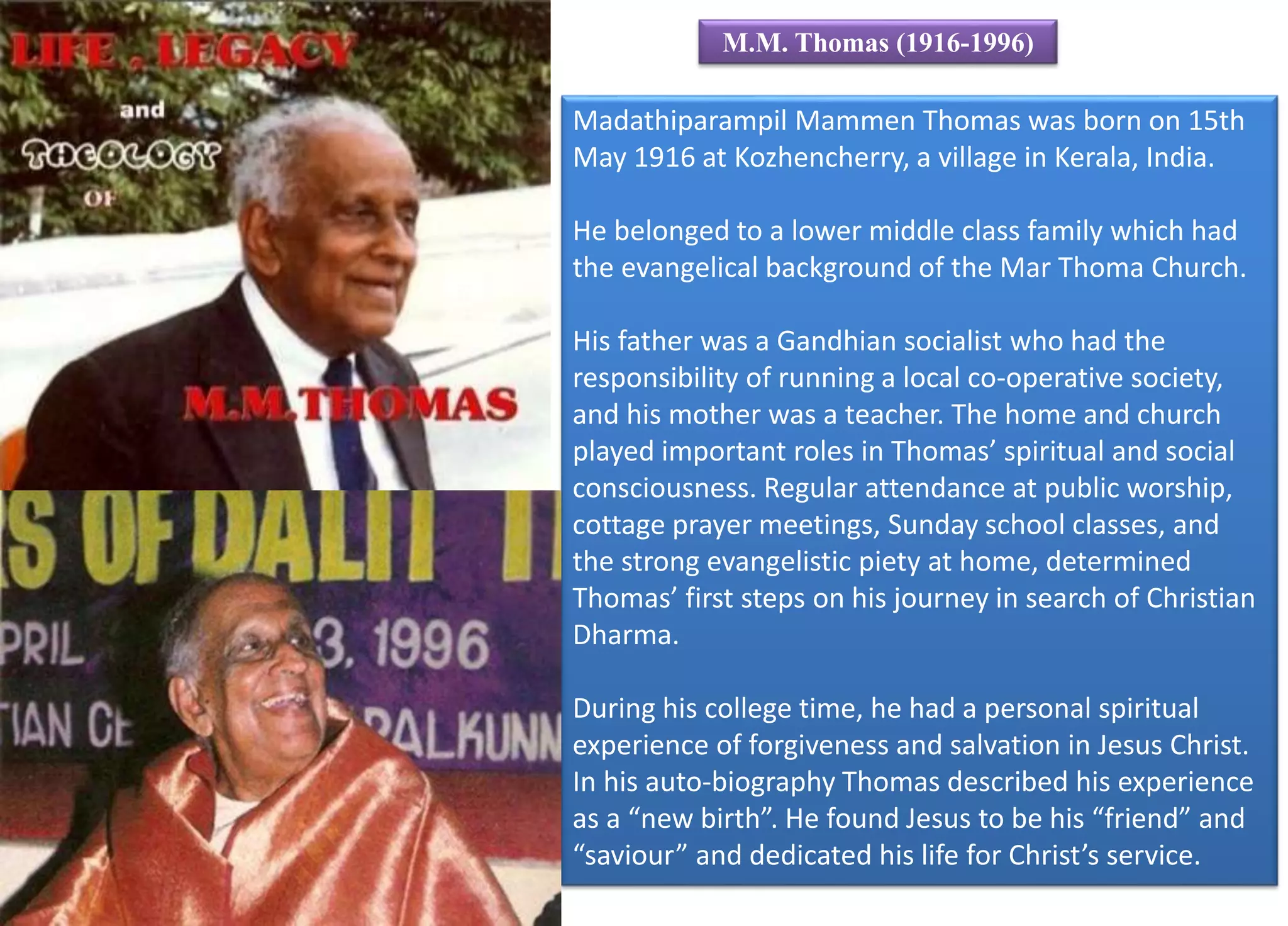
Madathiparampil Mammen Thomas was born on 15th
May 1916 at Kozhencherry, a village in Kerala, India.
He belonged to a lower middle class family which had
the evangelical background of the Mar Thoma Church.
His father was a Gandhian socialist who had the
responsibility of running a local co-operative society,
and his mother was a teacher. The home and church
played important roles in Thomas’ spiritual and social
consciousness. Regular attendance at public worship,
cottage prayer meetings, Sunday school classes, and
the strong evangelistic piety at home, determined
Thomas’ first steps on his journey in search of Christian
Dharma.
During his college time, he had a personal spiritual
experience of forgiveness and salvation in Jesus Christ.
In his auto-biography Thomas described his experience
as a “new birth”. He found Jesus to be his “friend” and
“saviour” and dedicated his life for Christ’s service.
M.M. Thomas (1916-1996)
He actively participated in socio-political aspect of the nation.
He was one of the prominent Christian personalities to
oppose the emergency in 1975-77 and organized various
movements to oppose it.
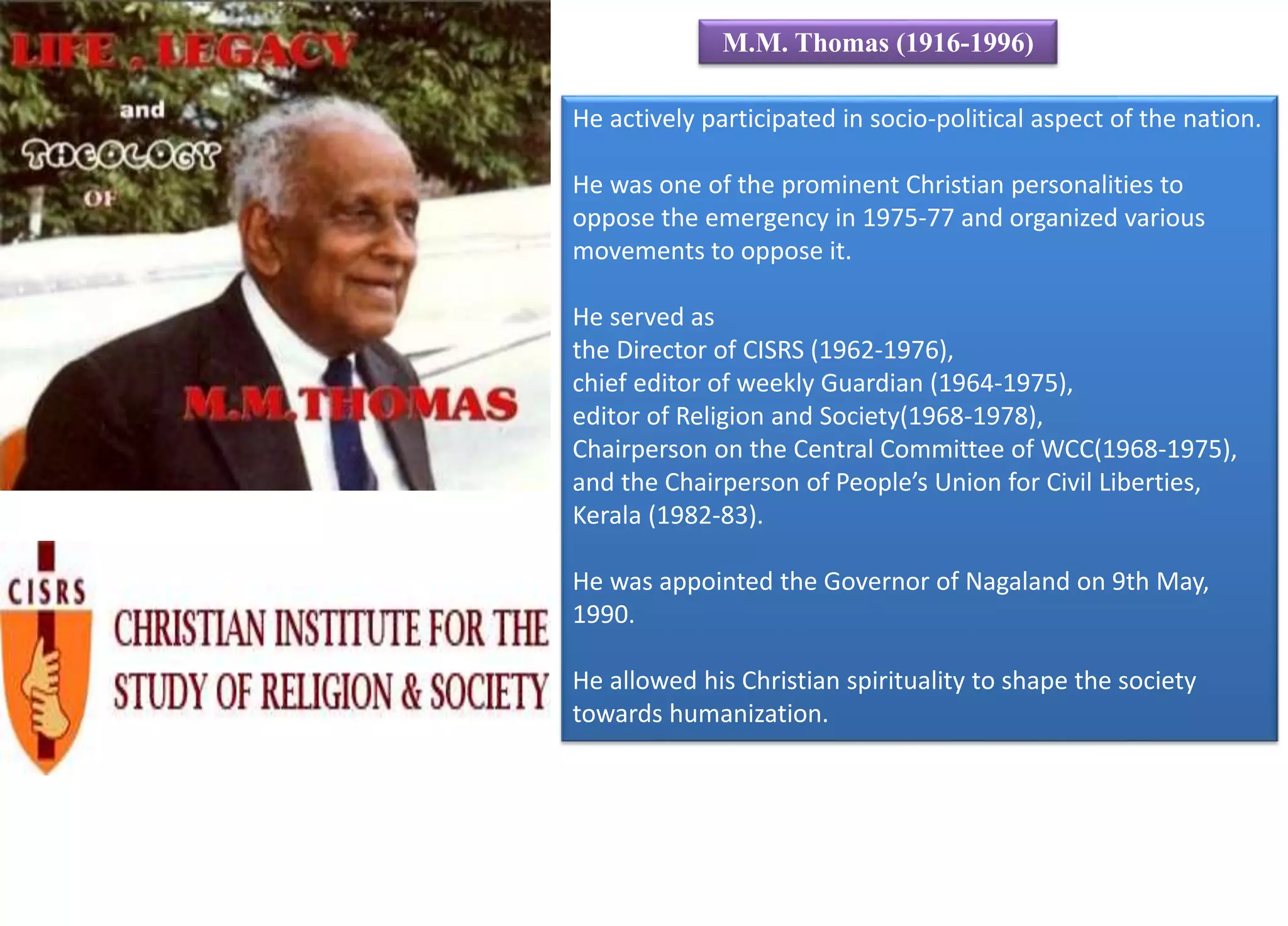
He served as
the Director of CISRS (1962-1976),
chief editor of weekly Guardian (1964-1975),
editor of Religion and Society(1968-1978),
Chairperson on the Central Committee of WCC(1968-1975),
and the Chairperson of People’s Union for Civil Liberties,
Kerala (1982-83).
He was appointed the Governor of Nagaland on 9th May,
1990.
He allowed his Christian spirituality to shape the society
towards humanization.
M.M. Thomas (1916-1996)
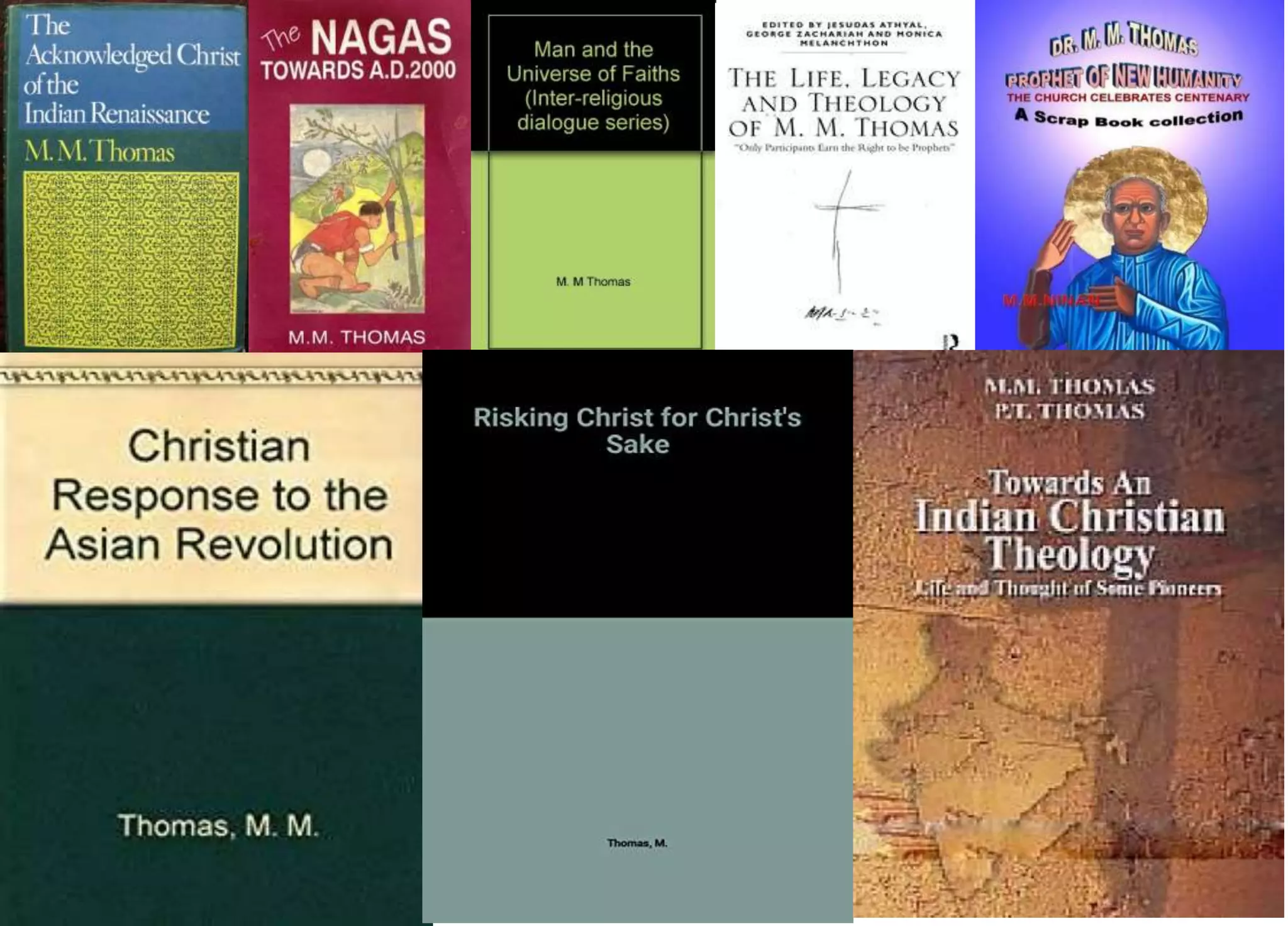
His writings consist of
The Christian Response to the Asian Revolution (1966),
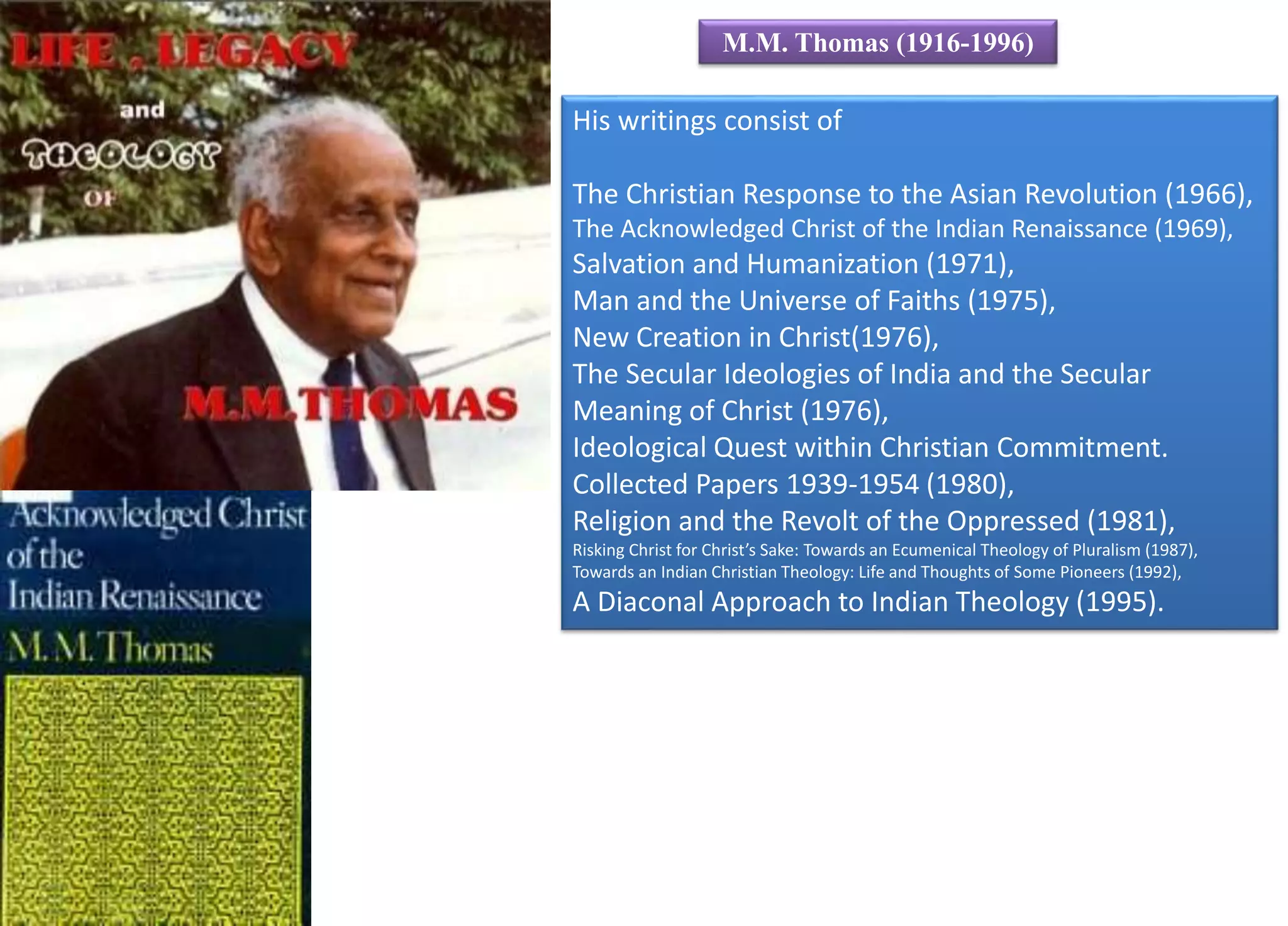
The Acknowledged Christ of the Indian Renaissance (1969),
Salvation and Humanization (1971),
Man and the Universe of Faiths (1975),
New Creation in Christ(1976),
The Secular Ideologies of India and the Secular
Meaning of Christ (1976),
Ideological Quest within Christian Commitment.
Collected Papers 1939-1954 (1980),
Religion and the Revolt of the Oppressed (1981),
Risking Christ for Christ’s Sake: Towards an Ecumenical Theology of Pluralism (1987),
Towards an Indian Christian Theology: Life and Thoughts of Some Pioneers (1992),
A Diaconal Approach to Indian Theology (1995).
M.M. Thomas (1916-1996)
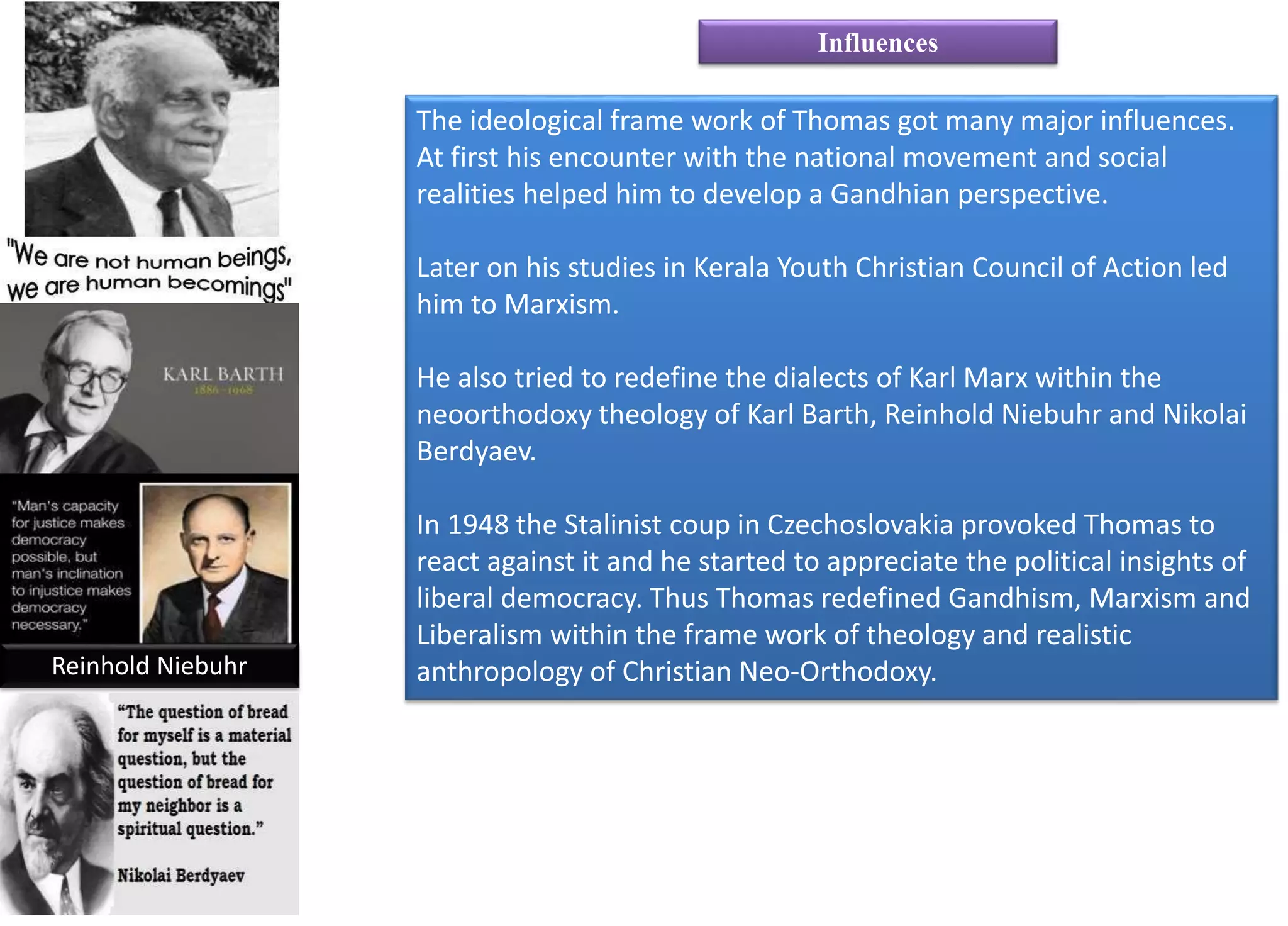
The ideological frame work of Thomas got many major influences.
At first his encounter with the national movement and social
realities helped him to develop a Gandhian perspective.
Later on his studies in Kerala Youth Christian Council of Action led
him to Marxism.
He also tried to redefine the dialects of Karl Marx within the
neoorthodoxy theology of Karl Barth, Reinhold Niebuhr and Nikolai
Berdyaev.
In 1948 the Stalinist coup in Czechoslovakia provoked Thomas to
react against it and he started to appreciate the political insights of
liberal democracy. Thus Thomas redefined Gandhism, Marxism and
Liberalism within the frame work of theology and realistic
anthropology of Christian Neo-Orthodoxy.
Influences
Reinhold Niebuhr
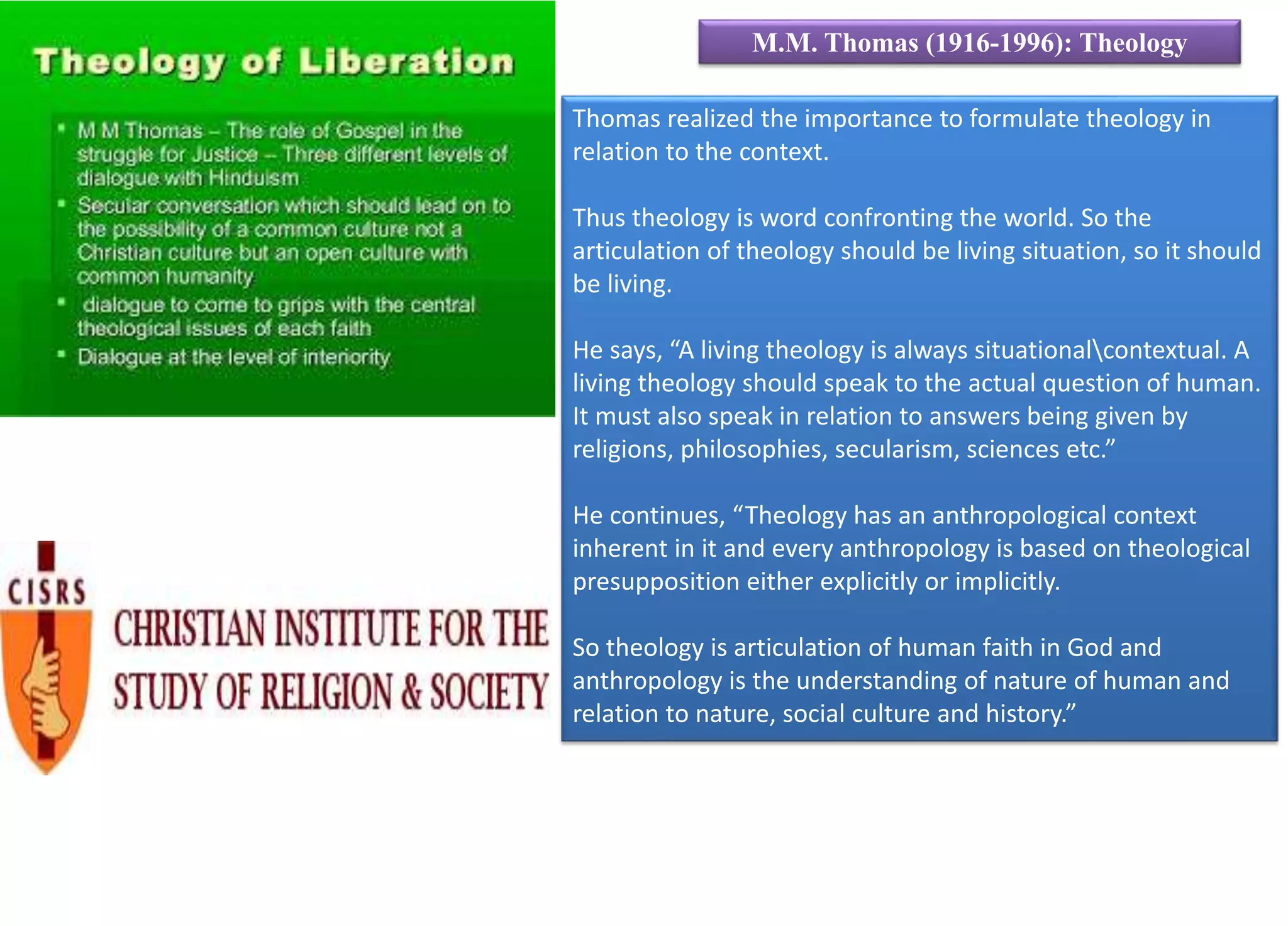
Thomas realized the importance to formulate theology in
relation to the context.
Thus theology is word confronting the world. So the
articulation of theology should be living situation, so it should
be living.
He says, “A living theology is always situationalcontextual. A
living theology should speak to the actual question of human.
It must also speak in relation to answers being given by
religions, philosophies, secularism, sciences etc.”
He continues, “Theology has an anthropological context
inherent in it and every anthropology is based on theological
presupposition either explicitly or implicitly.
So theology is articulation of human faith in God and
anthropology is the understanding of nature of human and
relation to nature, social culture and history.”
M.M. Thomas (1916-1996): Theology
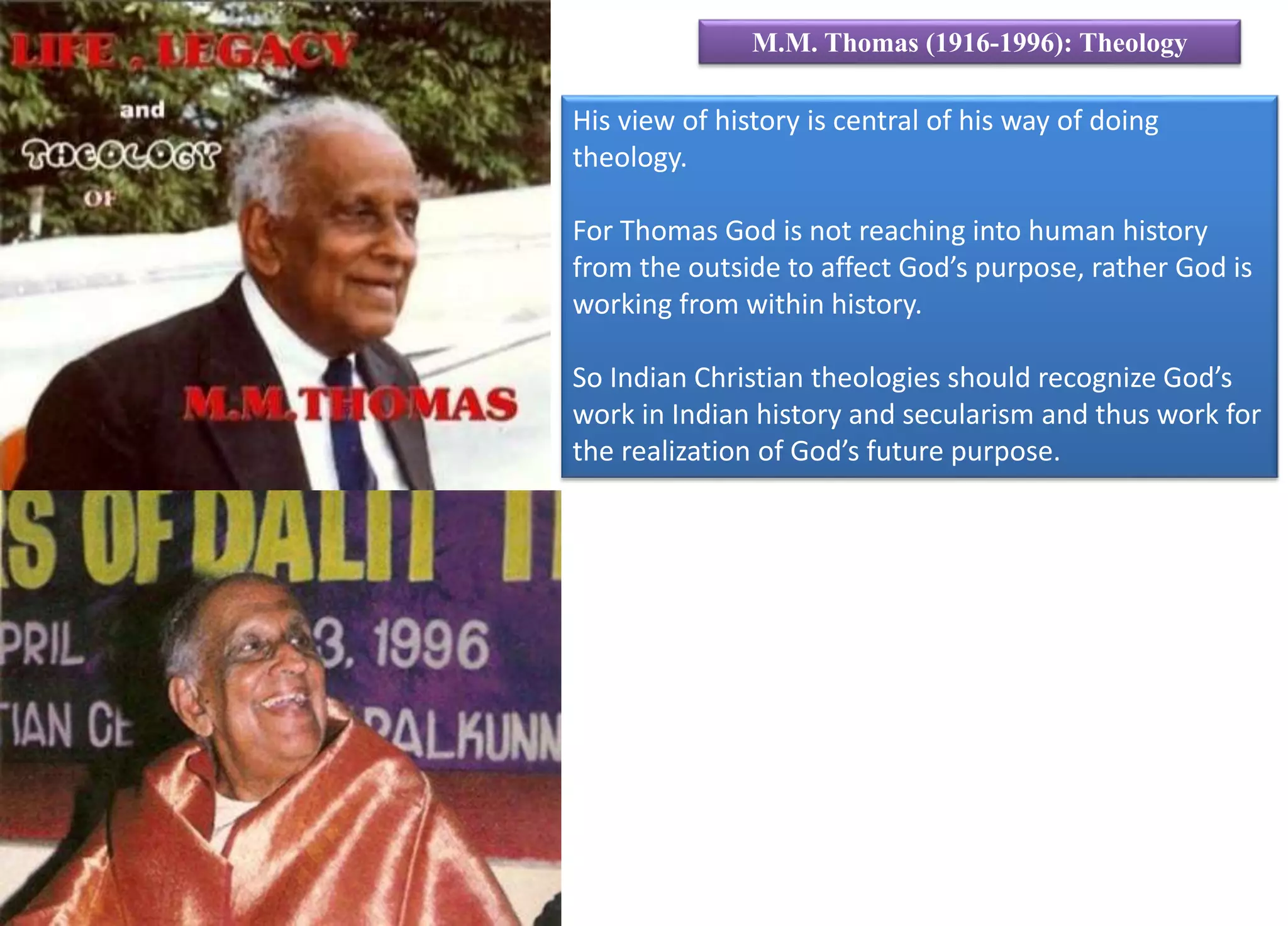
His view of history is central of his way of doing
theology.
For Thomas God is not reaching into human history
from the outside to affect God’s purpose, rather God is
working from within history.
So Indian Christian theologies should recognize God’s
work in Indian history and secularism and thus work for
the realization of God’s future purpose.
M.M. Thomas (1916-1996): Theology
Indian Christian Theologians like K.C. Sen, Chenchaiah,
Chakkarai, and P.D. Devanandan understood Christ as
the bearer of New Humanity.
Thomas builds his Christological understanding on this
foundation and thus salvation in Christ signifies Christ as
the bearer of a new community. Salvation will lead one
to be part of a new community i.e. in Christ.
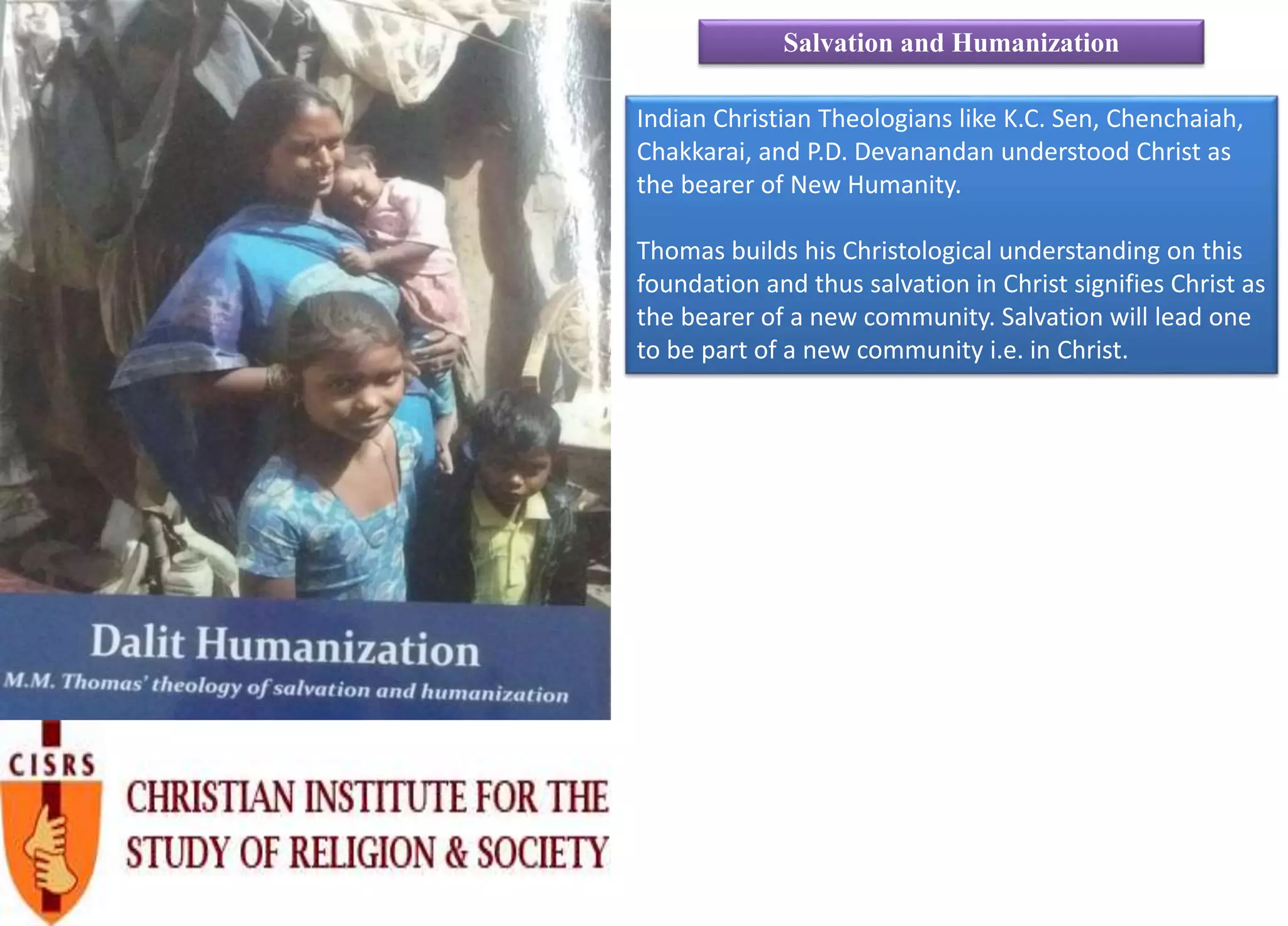
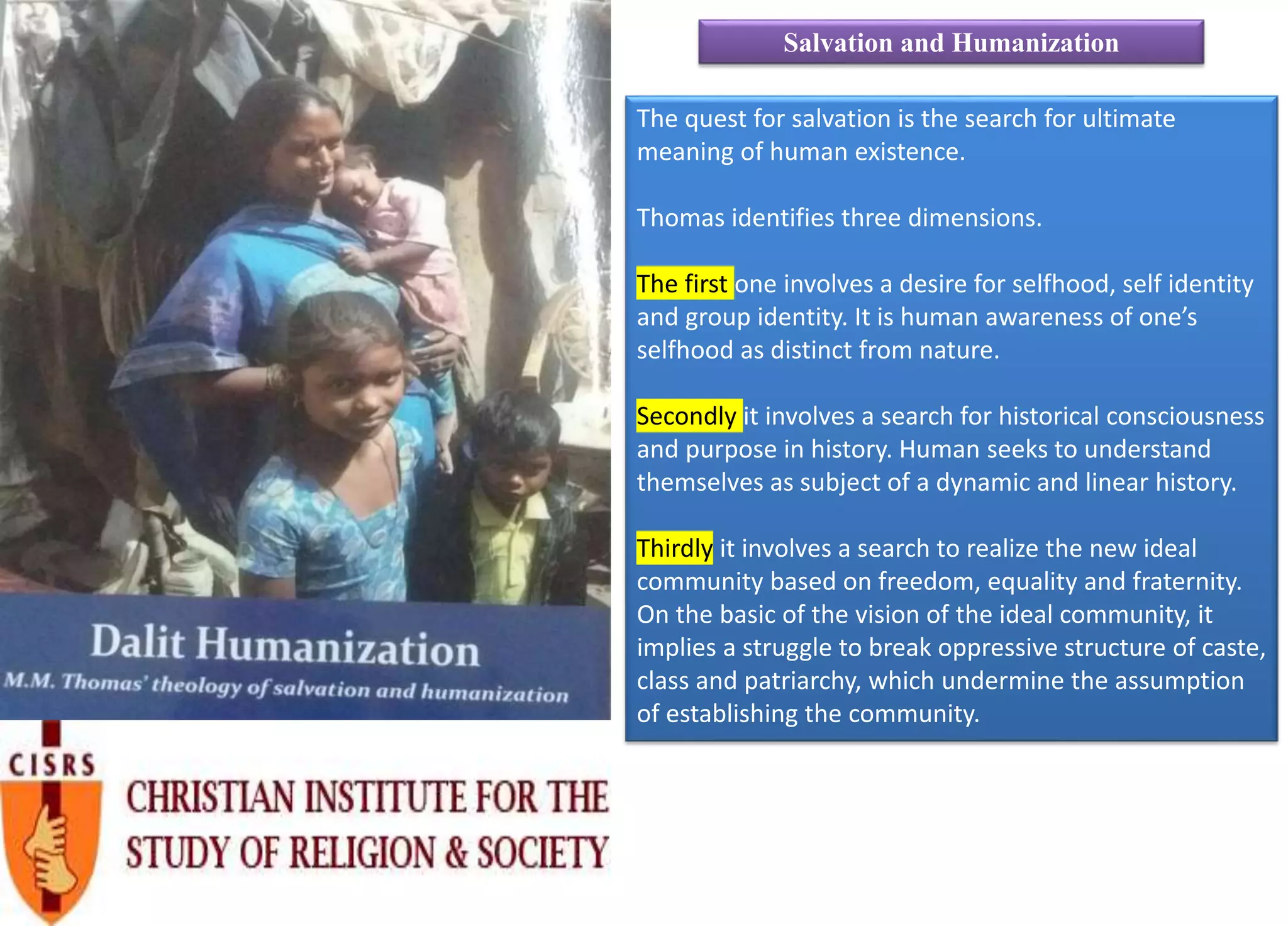
Salvation and Humanization
The quest for salvation is the search for ultimate
meaning of human existence.
Thomas identifies three dimensions.
The first one involves a desire for selfhood, self identity
and group identity. It is human awareness of one’s
selfhood as distinct from nature.
Secondly it involves a search for historical consciousness
and purpose in history. Human seeks to understand
themselves as subject of a dynamic and linear history.
Thirdly it involves a search to realize the new ideal
community based on freedom, equality and fraternity.
On the basic of the vision of the ideal community, it
implies a struggle to break oppressive structure of caste,
class and patriarchy, which undermine the assumption
of establishing the community.
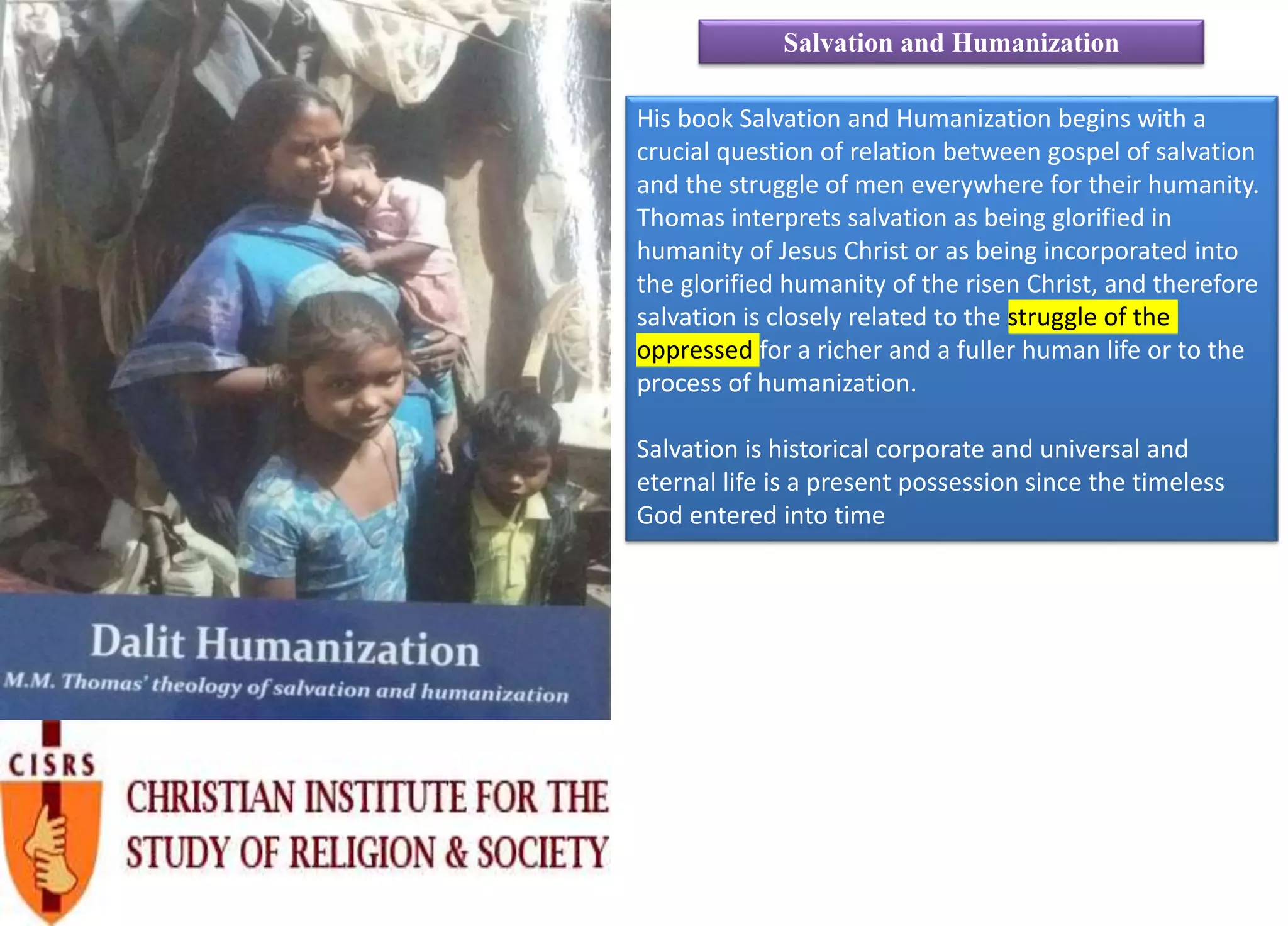
Salvation and Humanization
His book Salvation and Humanization begins with a
crucial question of relation between gospel of salvation
and the struggle of men everywhere for their humanity.
Thomas interprets salvation as being glorified in
humanity of Jesus Christ or as being incorporated into
the glorified humanity of the risen Christ, and therefore
salvation is closely related to the struggle of the
oppressed for a richer and a fuller human life or to the
process of humanization.
Salvation is historical corporate and universal and
eternal life is a present possession since the timeless
God entered into time
Salvation and Humanization
The prophetic tradition in the O.T. has helped the shift
from ceremonial purity to righteousness and justice in
historical existence of Israel.
Thomas emphasis the need of prophetic tradition of
O.T.
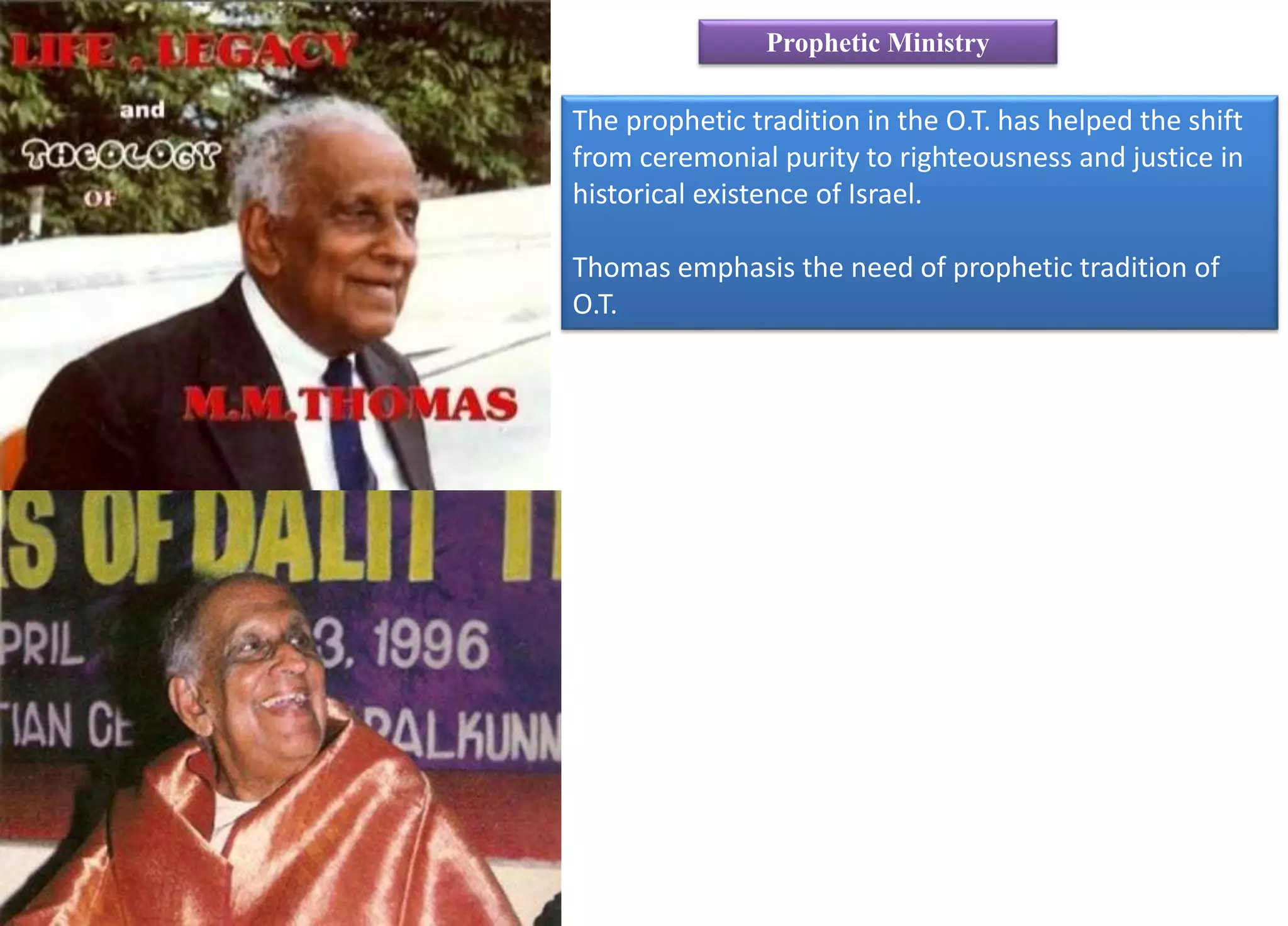
Prophetic Ministry
He was an exceptional layperson of deep theological insight
and social concern. He made struggle for the humanization as
the cornerstone of his theology. His theology can be
summarized as Humanization: humanizing the dehumanized
and peopling the depeopled.
His Christ, the cosmic Lord of history is not much related to
the mystery of divine, but rather to the historical plane, the
struggle for equality, justice and peace. Abraham Stephen
views that Thomas’ approach to the practical realm of Christ
centered syncretism is very idealistic one and does not take
enough care of the concrete reality
Thomas put faith alongside rationality. Reason is not
independent of ultimate faith commitments; it is the way we
try to order our understanding of things in the light of what
we believe and this belief is our ultimate faith commitment.
You cannot put light alongside the things which light enables
you to see. It is not certain that the rational, moral and social
goals are common to those who have different faith
commitments; some may be, but not all.
M.M. Thomas (1916-1996): Evaluation
His theology was a crisis/issue oriented theology. He
developed his theology at the time of crisis faced by
Asian Christians and thus it was a social response to
Asian issues and situation. His concept of humanism
itself is a safe path between tradition and modernism.
He struggles to balance the liberal theology of Christ-
centered syncretism on the one hand and the
theological conservatism of Lordship of Christ over
other religious on the other hand, which seems to be
an ‘inclusive-exclusive’ position.
M.M. Thomas (1916-1996): Evaluation

Lecture: M.M. Thomas (1916-1996)-PPS

  • 2.
    Madathiparampil Mammen Thomaswas born on 15th May 1916 at Kozhencherry, a village in Kerala, India. He belonged to a lower middle class family which had the evangelical background of the Mar Thoma Church. His father was a Gandhian socialist who had the responsibility of running a local co-operative society, and his mother was a teacher. The home and church played important roles in Thomas’ spiritual and social consciousness. Regular attendance at public worship, cottage prayer meetings, Sunday school classes, and the strong evangelistic piety at home, determined Thomas’ first steps on his journey in search of Christian Dharma. During his college time, he had a personal spiritual experience of forgiveness and salvation in Jesus Christ. In his auto-biography Thomas described his experience as a “new birth”. He found Jesus to be his “friend” and “saviour” and dedicated his life for Christ’s service. M.M. Thomas (1916-1996)
  • 3.
    He actively participatedin socio-political aspect of the nation. He was one of the prominent Christian personalities to oppose the emergency in 1975-77 and organized various movements to oppose it. He served as the Director of CISRS (1962-1976), chief editor of weekly Guardian (1964-1975), editor of Religion and Society(1968-1978), Chairperson on the Central Committee of WCC(1968-1975), and the Chairperson of People’s Union for Civil Liberties, Kerala (1982-83). He was appointed the Governor of Nagaland on 9th May, 1990. He allowed his Christian spirituality to shape the society towards humanization. M.M. Thomas (1916-1996)
  • 4.
    His writings consistof The Christian Response to the Asian Revolution (1966), The Acknowledged Christ of the Indian Renaissance (1969), Salvation and Humanization (1971), Man and the Universe of Faiths (1975), New Creation in Christ(1976), The Secular Ideologies of India and the Secular Meaning of Christ (1976), Ideological Quest within Christian Commitment. Collected Papers 1939-1954 (1980), Religion and the Revolt of the Oppressed (1981), Risking Christ for Christ’s Sake: Towards an Ecumenical Theology of Pluralism (1987), Towards an Indian Christian Theology: Life and Thoughts of Some Pioneers (1992), A Diaconal Approach to Indian Theology (1995). M.M. Thomas (1916-1996)
  • 6.
    The ideological framework of Thomas got many major influences. At first his encounter with the national movement and social realities helped him to develop a Gandhian perspective. Later on his studies in Kerala Youth Christian Council of Action led him to Marxism. He also tried to redefine the dialects of Karl Marx within the neoorthodoxy theology of Karl Barth, Reinhold Niebuhr and Nikolai Berdyaev. In 1948 the Stalinist coup in Czechoslovakia provoked Thomas to react against it and he started to appreciate the political insights of liberal democracy. Thus Thomas redefined Gandhism, Marxism and Liberalism within the frame work of theology and realistic anthropology of Christian Neo-Orthodoxy. Influences Reinhold Niebuhr
  • 7.
    Thomas realized theimportance to formulate theology in relation to the context. Thus theology is word confronting the world. So the articulation of theology should be living situation, so it should be living. He says, “A living theology is always situationalcontextual. A living theology should speak to the actual question of human. It must also speak in relation to answers being given by religions, philosophies, secularism, sciences etc.” He continues, “Theology has an anthropological context inherent in it and every anthropology is based on theological presupposition either explicitly or implicitly. So theology is articulation of human faith in God and anthropology is the understanding of nature of human and relation to nature, social culture and history.” M.M. Thomas (1916-1996): Theology
  • 8.
    His view ofhistory is central of his way of doing theology. For Thomas God is not reaching into human history from the outside to affect God’s purpose, rather God is working from within history. So Indian Christian theologies should recognize God’s work in Indian history and secularism and thus work for the realization of God’s future purpose. M.M. Thomas (1916-1996): Theology
  • 9.
    Indian Christian Theologianslike K.C. Sen, Chenchaiah, Chakkarai, and P.D. Devanandan understood Christ as the bearer of New Humanity. Thomas builds his Christological understanding on this foundation and thus salvation in Christ signifies Christ as the bearer of a new community. Salvation will lead one to be part of a new community i.e. in Christ. Salvation and Humanization
  • 10.
    The quest forsalvation is the search for ultimate meaning of human existence. Thomas identifies three dimensions. The first one involves a desire for selfhood, self identity and group identity. It is human awareness of one’s selfhood as distinct from nature. Secondly it involves a search for historical consciousness and purpose in history. Human seeks to understand themselves as subject of a dynamic and linear history. Thirdly it involves a search to realize the new ideal community based on freedom, equality and fraternity. On the basic of the vision of the ideal community, it implies a struggle to break oppressive structure of caste, class and patriarchy, which undermine the assumption of establishing the community. Salvation and Humanization
  • 11.
    His book Salvationand Humanization begins with a crucial question of relation between gospel of salvation and the struggle of men everywhere for their humanity. Thomas interprets salvation as being glorified in humanity of Jesus Christ or as being incorporated into the glorified humanity of the risen Christ, and therefore salvation is closely related to the struggle of the oppressed for a richer and a fuller human life or to the process of humanization. Salvation is historical corporate and universal and eternal life is a present possession since the timeless God entered into time Salvation and Humanization
  • 12.
    The prophetic traditionin the O.T. has helped the shift from ceremonial purity to righteousness and justice in historical existence of Israel. Thomas emphasis the need of prophetic tradition of O.T. Prophetic Ministry
  • 13.
    He was anexceptional layperson of deep theological insight and social concern. He made struggle for the humanization as the cornerstone of his theology. His theology can be summarized as Humanization: humanizing the dehumanized and peopling the depeopled. His Christ, the cosmic Lord of history is not much related to the mystery of divine, but rather to the historical plane, the struggle for equality, justice and peace. Abraham Stephen views that Thomas’ approach to the practical realm of Christ centered syncretism is very idealistic one and does not take enough care of the concrete reality Thomas put faith alongside rationality. Reason is not independent of ultimate faith commitments; it is the way we try to order our understanding of things in the light of what we believe and this belief is our ultimate faith commitment. You cannot put light alongside the things which light enables you to see. It is not certain that the rational, moral and social goals are common to those who have different faith commitments; some may be, but not all. M.M. Thomas (1916-1996): Evaluation
  • 14.
    His theology wasa crisis/issue oriented theology. He developed his theology at the time of crisis faced by Asian Christians and thus it was a social response to Asian issues and situation. His concept of humanism itself is a safe path between tradition and modernism. He struggles to balance the liberal theology of Christ- centered syncretism on the one hand and the theological conservatism of Lordship of Christ over other religious on the other hand, which seems to be an ‘inclusive-exclusive’ position. M.M. Thomas (1916-1996): Evaluation