Old Houses of Jordan (1)
University of Jordan Year
2015/2016
Summer Semester
Arch. Dania Abdel-Aziz
4/6/2022 1
Arch. Dania Abdel-Aziz/ Lecture 8
Contents
• King Abdullah Palace, Ma'an Railroad Station, Ma'an.
• Municipality Building, Salt.
• Darat Al-Funun Complex.
4/6/2022 Arch. Dania Abdel-Aziz/ Lecture 8 2
4/6/2022 Arch. Dania Abdel-Aziz/ Lecture 8 3
King Abdullah Palace,
Ma'an Railroad Station, Ma'an
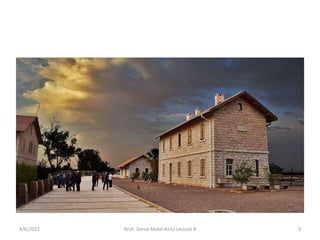
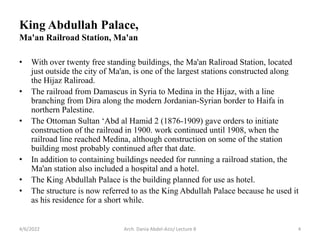
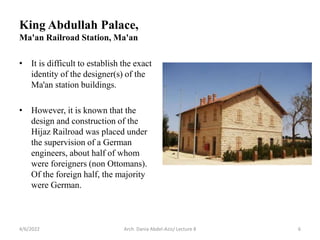
• With over twenty free standing buildings, the Ma'an Raliroad Station, located
just outside the city of Ma'an, is one of the largest stations constructed along
the Hijaz Raliroad.
• The railroad from Damascus in Syria to Medina in the Hijaz, with a line
branching from Dira along the modern Jordanian-Syrian border to Haifa in
northern Palestine.
• The Ottoman Sultan ‘Abd al Hamid 2 (1876-1909) gave orders to initiate
construction of the railroad in 1900. work continued until 1908, when the
railroad line reached Medina, although construction on some of the station
building most probably continued after that date.
• In addition to containing buildings needed for running a railroad station, the
Ma'an station also included a hospital and a hotel.
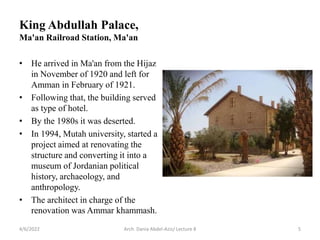
• The King Abdullah Palace is the building planned for use as hotel.
• The structure is now referred to as the King Abdullah Palace because he used it
as his residence for a short while.
4/6/2022 4
Arch. Dania Abdel-Aziz/ Lecture 8
• He arrived in Ma'an from the Hijaz
in November of 1920 and left for
Amman in February of 1921.
• Following that, the building served
as type of hotel.
• By the 1980s it was deserted.
• In 1994, Mutah university, started a
project aimed at renovating the
structure and converting it into a
museum of Jordanian political
history, archaeology, and
anthropology.
• The architect in charge of the
renovation was Ammar khammash.
4/6/2022 Arch. Dania Abdel-Aziz/ Lecture 8 5
King Abdullah Palace,
Ma'an Railroad Station, Ma'an
• It is difficult to establish the exact
identity of the designer(s) of the
Ma'an station buildings.
• However, it is known that the
design and construction of the
Hijaz Railroad was placed under
the supervision of a German
engineers, about half of whom
were foreigners (non Ottomans).
Of the foreign half, the majority
were German.
4/6/2022 Arch. Dania Abdel-Aziz/ Lecture 8 6
King Abdullah Palace,
Ma'an Railroad Station, Ma'an
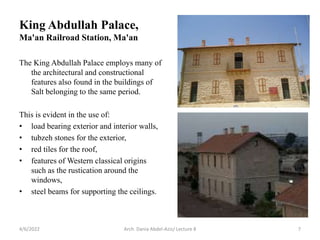
The King Abdullah Palace employs many of
the architectural and constructional
features also found in the buildings of
Salt belonging to the same period.
This is evident in the use of:
• load bearing exterior and interior walls,
• tubzeh stones for the exterior,
• red tiles for the roof,
• features of Western classical origins
such as the rustication around the
windows,
• steel beams for supporting the ceilings.
4/6/2022 Arch. Dania Abdel-Aziz/ Lecture 8 7
King Abdullah Palace,
Ma'an Railroad Station, Ma'an
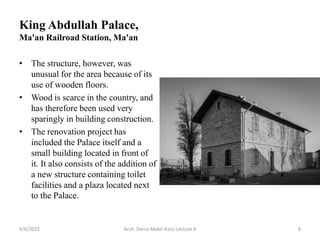
• The structure, however, was
unusual for the area because of its
use of wooden floors.
• Wood is scarce in the country, and
has therefore been used very
sparingly in building construction.
• The renovation project has
included the Palace itself and a
small building located in front of
it. It also consists of the addition of
a new structure containing toilet
facilities and a plaza located next
to the Palace.
4/6/2022 Arch. Dania Abdel-Aziz/ Lecture 8 8
King Abdullah Palace,
Ma'an Railroad Station, Ma'an
MUNICIPALITY BUILDING,
SALT
4/6/2022 Arch. Dania Abdel-Aziz/ Lecture 8 9
Municipality Building,
Salt
• This house, located in the central district of Salt.
• It was built by “Ala al-din Tuqan (11827-1944).
• Tuqan was born in Nablus but moved to Salt at an early age. During the
late-1920s, he moved to Amman where he occupied a number of important
public positions.
• In 1929, he was elected to Jordan's first Legislative Council and was
appointed as head of the department of Antiquities (then a ministerial
position). Between 1933 and 1937, he served as Mayor of Amman.
4/6/2022 10
Arch. Dania Abdel-Aziz/ Lecture 8
Municipality Building,
Salt
• The designer and dates of construction on the house are unknown.
• However, it is believed that the house was constructed over two –or
possibly three-phases.
• The first phase dates to about 1900-1905, and the ground floor of the house
is believed to belong to this phase.
• Its also believed that the section containing service and storage areas, and
located to the southeast of the main structure, was built during the same
period.
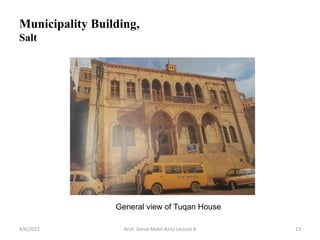
• The second phase dates to 1910 -1915, and the first floor and the porticoed
balcony located in front of the ground floor are believed to belong to this
phase.
• However, since the carvings on the capitals of the balcony columns differ
in quality and character from the carvings found on the remaining parts of
the buildings front façade, it is possible that the balcony was built between
these two phases.
4/6/2022 11
Arch. Dania Abdel-Aziz/ Lecture 8
4/6/2022 Arch. Dania Abdel-Aziz/ Lecture 8 12
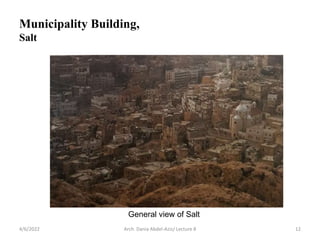
General view of Salt
Municipality Building,
Salt
4/6/2022 Arch. Dania Abdel-Aziz/ Lecture 8 13
General view of Tuqan House
Municipality Building,
Salt
• After Ala al-Din Tuqan left Salt, the house was rented out.
• Its tenants included Sudqi al-QASSEM, who held an administrative
position (Qa”im-maqam) in salt during the 1930s.
• The house was later used as a school until the mid-1980s when it was
deserted.
• In 1989, the Municipality of Salt and the Salt Development Corporation (A
Private-sector, non-profit organization which aims at improving the city on
the architectural, urban, social, and economic levels) decided to buy the
house and renovate it.
• The Tuqan family sold the house to them for a symbolic price, and
renovation work was carried out between 1991 and 1992.
• Since the completion of the renovation, the structure has served as offices
for administrative departments of the Salt municipality.
• The architects in charge of the restoration were Talib al-Rifai, Ismail
Tahhan, and Zahir Bushnaq.
4/6/2022 Arch. Dania Abdel-Aziz/ Lecture 8 14
Municipality Building,
Salt
4/6/2022 Arch. Dania Abdel-Aziz/ Lecture 8 15
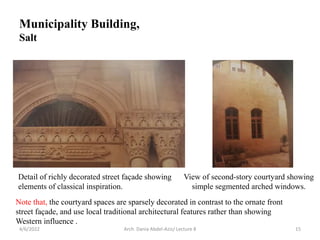
View of second-story courtyard showing
simple segmented arched windows.
Detail of richly decorated street façade showing
elements of classical inspiration.
Note that, the courtyard spaces are sparsely decorated in contrast to the ornate front
street façade, and use local traditional architectural features rather than showing
Western influence .
Municipality Building,
Salt
4/6/2022 Arch. Dania Abdel-Aziz/ Lecture 8 16
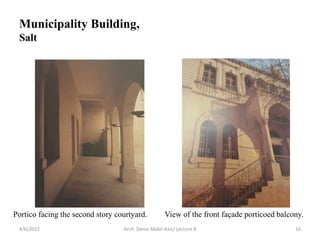
View of the front façade porticoed balcony.
Portico facing the second story courtyard.
Municipality Building,
Salt
4/6/2022 Arch. Dania Abdel-Aziz/ Lecture 8 17
• The house is located along one of Salts major streets and on a sloping site.
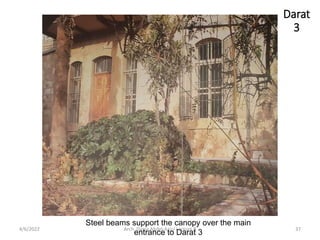
It is an urban structure which only presents one façade to the outside world,
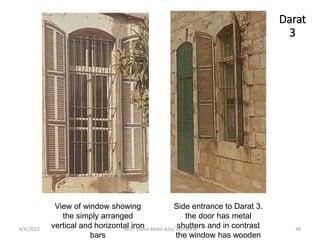
the street façade, but merges with adjacent structures from the other sides.
• Its open spaces consist of small courtyards located within the boundaries of
the structure rather than a garden surrounding the structure.
• In the sense, it differs from the other houses presented in this study which
are free-standing structures surrounded by a garden.
• The ground floor of the house is built into the slope of the site and provides
a platform on which the larger first floor sits. The service quarters are
located on the same levels as the first floor.
Municipality Building,
Salt
• The house holds a very important position in the development of early-
twentieth-century architecture in Transjordan. This large residential
structure, with its symmetrical façade, monumental porticoed balcony and
elaborate classizing stonework, is one of the more significant structures
built in the what was then the areas major urban center.
• Also, the two primary phases of construction for the house show the
transition that took place in the region during that period from the use of
traditional to modern construction techniques.
• The earlier part of the house has unpolished and roughly-cut stone floors,
and its ceiling consist of barrel and groin vaults made of rubble stone
covered with stucco plastering. In contrast, the later part of the house has
terrazzo floors with colored patterns, and its ceiling consist of steel beams
supporting reinforced concrete slabs.
4/6/2022 Arch. Dania Abdel-Aziz/ Lecture 8 18
Municipality Building,
Salt
DARAT AL-FUNUN COMPLEX
4/6/2022 Arch. Dania Abdel-Aziz/ Lecture 8 19
Darat Al-Funun Complex
4/6/2022 20
Arch. Dania Abdel-Aziz/ Lecture 8
Darat Al-Funun Complex
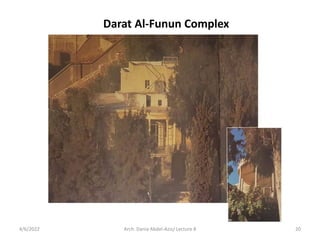
• Three houses are located in luweibdeh (primarly as a middle class area).
• It is much smaller than Jabal Amman. This is partly because its growth was
blocked by the valleys from the north and south, and by the compounds of
the army and security forces in the Abdali area from the west
• The three houses comprising the Darat al-funun complex are among the
more interesting houses built in Jordan during the period under
consideration.
• Darat al-funun is part of the Abdul Hameed Shoman foundation, a non-
profit cultural foundation established by the Arab bank, and named after
the founder of the bank.
• Darat Al-Funun is primarily concerned with promoting the visual arts, and
its activities include acquiring works of art, organizing exhibitions, holding
workshops for artists, and administering multi-media library for printed
materials, slides, and videos.
4/6/2022 21
Arch. Dania Abdel-Aziz/ Lecture 8
• The Darat Al-Funun complex is unique among the older houses of Amman
in that its site includes more than one house, and because one architect,
Ammar Khammash, renovated its three houses.
• Together, the houses occupy most of a city block which is defined by
streets from three sides and a public stair from the fourth. Such stairs are
common in the older parts of Amman and serve to provide pedestrian
connections between the downtown district and the surrounding hills .
• Initially Darat Al-Funun only included Darat 1 (also known as the Humud
House ). Later on, Darat 2 (also known as Abdo House 1) was purchased
and renovated, and Darat 3 (also known as Abdo House 2) the last to be
added to the complex.
• Most of the walls separating the three houses have been removed, and
they now share the same grounds.
• The complex also includes the restored ruins of a byzantine church.
4/6/2022 22
Arch. Dania Abdel-Aziz/ Lecture 8
Darat Al-Funun Complex
Darat 1
• Darat 1 is the largest of the three houses.
• It was built by Nimr Abdullah al-Humud, an important figure in Jordanian
public life, and a member of one of Salt’s major families.
• Although the house’s exact date of construction is unknown, it can be said
that it was probably built around 1920.
• Al-Humud rented the house, and its best-known (and probably first )
tenant was lieutenant-colonel Fredreick Peake (Peake Pasha ), the founder
of the Jordanian Army, and the most important British official residing in
Jordan during the 1920s and 1930s.
4/6/2022 23
Arch. Dania Abdel-Aziz/ Lecture 8
Darat 1
• Following that, the house served as a residence for British officers and an
army officer’s club.
• After the Arabization of the Jordanian army in 1956, the British army left
the house and it was rented out as a residence and later as a school.
• It was deserted during the late 1970s.
• In 1992, the Shoman foundation bought the house to renovate it as the
Darat Al-Funun building.
• Renovation works was completed in 1993.
4/6/2022 24
Arch. Dania Abdel-Aziz/ Lecture 8
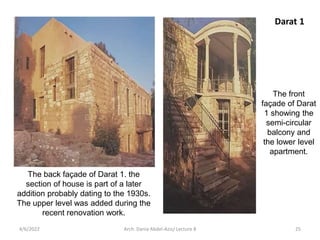
The back façade of Darat 1. the
section of house is part of a later
addition probably dating to the 1930s.
The upper level was added during the
recent renovation work.
The front
façade of Darat
1 showing the
semi-circular
balcony and
the lower level
apartment.
Darat 1
4/6/2022 25
Arch. Dania Abdel-Aziz/ Lecture 8
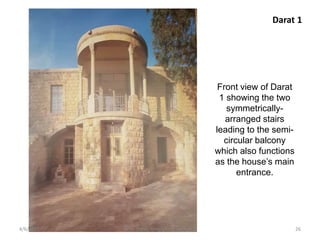
Front view of Darat
1 showing the two
symmetrically-
arranged stairs
leading to the semi-
circular balcony
which also functions
as the house’s main
entrance.
Darat 1
4/6/2022 26
Arch. Dania Abdel-Aziz/ Lecture 8
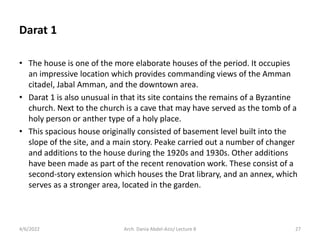
• The house is one of the more elaborate houses of the period. It occupies
an impressive location which provides commanding views of the Amman
citadel, Jabal Amman, and the downtown area.
• Darat 1 is also unusual in that its site contains the remains of a Byzantine
church. Next to the church is a cave that may have served as the tomb of a
holy person or anther type of a holy place.
• This spacious house originally consisted of basement level built into the
slope of the site, and a main story. Peake carried out a number of changer
and additions to the house during the 1920s and 1930s. Other additions
have been made as part of the recent renovation work. These consist of a
second-story extension which houses the Drat library, and an annex, which
serves as a stronger area, located in the garden.
4/6/2022 27
Arch. Dania Abdel-Aziz/ Lecture 8
Darat 1
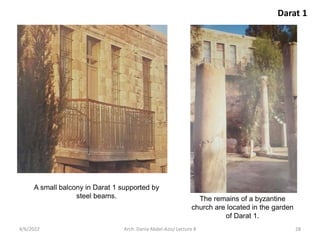
The remains of a byzantine
church are located in the garden
of Darat 1.
A small balcony in Darat 1 supported by
steel beams.
Darat 1
4/6/2022 28
Arch. Dania Abdel-Aziz/ Lecture 8
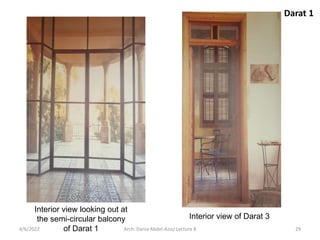
Interior view of Darat 3
Interior view looking out at
the semi-circular balcony
of Darat 1
Darat 1
4/6/2022 29
Arch. Dania Abdel-Aziz/ Lecture 8
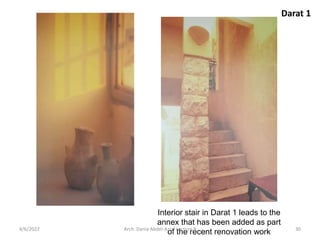
Interior stair in Darat 1 leads to the
annex that has been added as part
of the recent renovation work
Darat 1
4/6/2022 30
Arch. Dania Abdel-Aziz/ Lecture 8
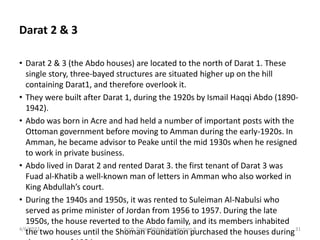
Darat 2 & 3
• Darat 2 & 3 (the Abdo houses) are located to the north of Darat 1. These
single story, three-bayed structures are situated higher up on the hill
containing Darat1, and therefore overlook it.
• They were built after Darat 1, during the 1920s by Ismail Haqqi Abdo (1890-
1942).
• Abdo was born in Acre and had held a number of important posts with the
Ottoman government before moving to Amman during the early-1920s. In
Amman, he became advisor to Peake until the mid 1930s when he resigned
to work in private business.
• Abdo lived in Darat 2 and rented Darat 3. the first tenant of Darat 3 was
Fuad al-Khatib a well-known man of letters in Amman who also worked in
King Abdullah’s court.
• During the 1940s and 1950s, it was rented to Suleiman Al-Nabulsi who
served as prime minister of Jordan from 1956 to 1957. During the late
1950s, the house reverted to the Abdo family, and its members inhabited
the two houses until the Shoman Foundation purchased the houses during
4/6/2022 31
Arch. Dania Abdel-Aziz/ Lecture 8
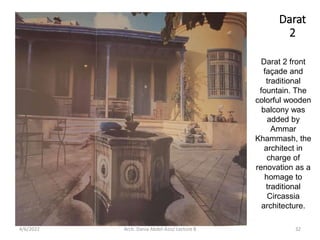
Darat 2 front
façade and
traditional
fountain. The
colorful wooden
balcony was
added by
Ammar
Khammash, the
architect in
charge of
renovation as a
homage to
traditional
Circassia
architecture.
Darat
2
4/6/2022 32
Arch. Dania Abdel-Aziz/ Lecture 8
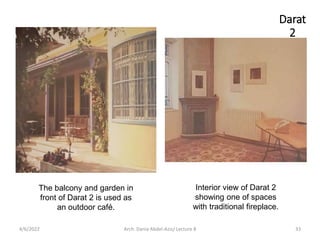
The balcony and garden in
front of Darat 2 is used as
an outdoor café.
Interior view of Darat 2
showing one of spaces
with traditional fireplace.
Darat
2
4/6/2022 33
Arch. Dania Abdel-Aziz/ Lecture 8
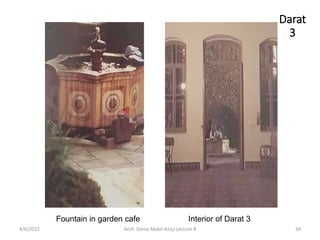
Fountain in garden cafe Interior of Darat 3
Darat
3
4/6/2022 34
Arch. Dania Abdel-Aziz/ Lecture 8
• Architecturally, the two houses are relatively simple in character. As with
Darat 1, an addition consisting of a number of rooms was made to Darat 3,
probably during the late 1930s.
• Another addition, consisting of one room, has been made to Darat 3 as
part of the renovation work.
• Unlike the other structures considered in this study, the exterior surfaces of
Darat 2 consist of painted concrete, rather than stone blocks.
• Also, the architect in charge of the renovation, Ammar Khammash, has
further constructed the house from the other houses of the Darat by the
addition of a colored wooden balcony, inspired from Circassia wood
architecture, in front of the house’s main entrance.
4/6/2022 35
Arch. Dania Abdel-Aziz/ Lecture 8
Darat 2 & 3
• Darat 1 currently includes exhibition spaces, studios, offices, and a library.
• Darat 2 contains exhibition spaces and offices.
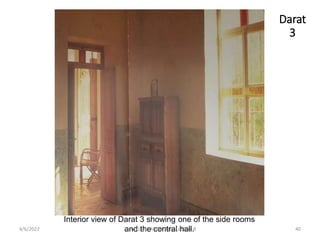
• Darat 3 contains studio spaces and a residence for out-of-town guests of
the Darat.
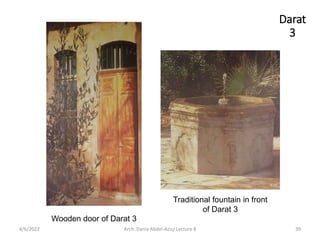
• A small outdoor café is located in front of Darat 2, around a small fountain.
Such fountains were very common in the houses of Amman from that
period, and a similar fountain is also found in front of Darat 3 .
4/6/2022 Arch. Dania Abdel-Aziz/ Lecture 8 36
Darat Al-Funun Complex
Steel beams support the canopy over the main
entrance to Darat 3
Darat
3
4/6/2022 37
Arch. Dania Abdel-Aziz/ Lecture 8
Side entrance to Darat 3.
the door has metal
shutters and in contrast
the window has wooden
View of window showing
the simply arranged
vertical and horizontal iron
bars
Darat
3
4/6/2022 38
Arch. Dania Abdel-Aziz/ Lecture 8
Traditional fountain in front
of Darat 3
Wooden door of Darat 3
Darat
3
4/6/2022 39
Arch. Dania Abdel-Aziz/ Lecture 8
Interior view of Darat 3 showing one of the side rooms
and the central hall.
Darat
3
4/6/2022 40
Arch. Dania Abdel-Aziz/ Lecture 8
References
Old houses of Jordan, Amman (1920-1950), TURAB.
4/6/2022 Arch. Dania Abdel-Aziz/ Lecture 8 41

Lecture 8: old houses of Jordan 1

  • 1.
    Old Houses ofJordan (1) University of Jordan Year 2015/2016 Summer Semester Arch. Dania Abdel-Aziz 4/6/2022 1 Arch. Dania Abdel-Aziz/ Lecture 8
  • 2.
    Contents • King AbdullahPalace, Ma'an Railroad Station, Ma'an. • Municipality Building, Salt. • Darat Al-Funun Complex. 4/6/2022 Arch. Dania Abdel-Aziz/ Lecture 8 2
  • 3.
    4/6/2022 Arch. DaniaAbdel-Aziz/ Lecture 8 3
  • 4.
    King Abdullah Palace, Ma'anRailroad Station, Ma'an • With over twenty free standing buildings, the Ma'an Raliroad Station, located just outside the city of Ma'an, is one of the largest stations constructed along the Hijaz Raliroad. • The railroad from Damascus in Syria to Medina in the Hijaz, with a line branching from Dira along the modern Jordanian-Syrian border to Haifa in northern Palestine. • The Ottoman Sultan ‘Abd al Hamid 2 (1876-1909) gave orders to initiate construction of the railroad in 1900. work continued until 1908, when the railroad line reached Medina, although construction on some of the station building most probably continued after that date. • In addition to containing buildings needed for running a railroad station, the Ma'an station also included a hospital and a hotel. • The King Abdullah Palace is the building planned for use as hotel. • The structure is now referred to as the King Abdullah Palace because he used it as his residence for a short while. 4/6/2022 4 Arch. Dania Abdel-Aziz/ Lecture 8
  • 5.
    • He arrivedin Ma'an from the Hijaz in November of 1920 and left for Amman in February of 1921. • Following that, the building served as type of hotel. • By the 1980s it was deserted. • In 1994, Mutah university, started a project aimed at renovating the structure and converting it into a museum of Jordanian political history, archaeology, and anthropology. • The architect in charge of the renovation was Ammar khammash. 4/6/2022 Arch. Dania Abdel-Aziz/ Lecture 8 5 King Abdullah Palace, Ma'an Railroad Station, Ma'an
  • 6.
    • It isdifficult to establish the exact identity of the designer(s) of the Ma'an station buildings. • However, it is known that the design and construction of the Hijaz Railroad was placed under the supervision of a German engineers, about half of whom were foreigners (non Ottomans). Of the foreign half, the majority were German. 4/6/2022 Arch. Dania Abdel-Aziz/ Lecture 8 6 King Abdullah Palace, Ma'an Railroad Station, Ma'an
  • 7.
    The King AbdullahPalace employs many of the architectural and constructional features also found in the buildings of Salt belonging to the same period. This is evident in the use of: • load bearing exterior and interior walls, • tubzeh stones for the exterior, • red tiles for the roof, • features of Western classical origins such as the rustication around the windows, • steel beams for supporting the ceilings. 4/6/2022 Arch. Dania Abdel-Aziz/ Lecture 8 7 King Abdullah Palace, Ma'an Railroad Station, Ma'an
  • 8.
    • The structure,however, was unusual for the area because of its use of wooden floors. • Wood is scarce in the country, and has therefore been used very sparingly in building construction. • The renovation project has included the Palace itself and a small building located in front of it. It also consists of the addition of a new structure containing toilet facilities and a plaza located next to the Palace. 4/6/2022 Arch. Dania Abdel-Aziz/ Lecture 8 8 King Abdullah Palace, Ma'an Railroad Station, Ma'an
  • 9.
    MUNICIPALITY BUILDING, SALT 4/6/2022 Arch.Dania Abdel-Aziz/ Lecture 8 9
  • 10.
    Municipality Building, Salt • Thishouse, located in the central district of Salt. • It was built by “Ala al-din Tuqan (11827-1944). • Tuqan was born in Nablus but moved to Salt at an early age. During the late-1920s, he moved to Amman where he occupied a number of important public positions. • In 1929, he was elected to Jordan's first Legislative Council and was appointed as head of the department of Antiquities (then a ministerial position). Between 1933 and 1937, he served as Mayor of Amman. 4/6/2022 10 Arch. Dania Abdel-Aziz/ Lecture 8
  • 11.
    Municipality Building, Salt • Thedesigner and dates of construction on the house are unknown. • However, it is believed that the house was constructed over two –or possibly three-phases. • The first phase dates to about 1900-1905, and the ground floor of the house is believed to belong to this phase. • Its also believed that the section containing service and storage areas, and located to the southeast of the main structure, was built during the same period. • The second phase dates to 1910 -1915, and the first floor and the porticoed balcony located in front of the ground floor are believed to belong to this phase. • However, since the carvings on the capitals of the balcony columns differ in quality and character from the carvings found on the remaining parts of the buildings front façade, it is possible that the balcony was built between these two phases. 4/6/2022 11 Arch. Dania Abdel-Aziz/ Lecture 8
  • 12.
    4/6/2022 Arch. DaniaAbdel-Aziz/ Lecture 8 12 General view of Salt Municipality Building, Salt
  • 13.
    4/6/2022 Arch. DaniaAbdel-Aziz/ Lecture 8 13 General view of Tuqan House Municipality Building, Salt
  • 14.
    • After Alaal-Din Tuqan left Salt, the house was rented out. • Its tenants included Sudqi al-QASSEM, who held an administrative position (Qa”im-maqam) in salt during the 1930s. • The house was later used as a school until the mid-1980s when it was deserted. • In 1989, the Municipality of Salt and the Salt Development Corporation (A Private-sector, non-profit organization which aims at improving the city on the architectural, urban, social, and economic levels) decided to buy the house and renovate it. • The Tuqan family sold the house to them for a symbolic price, and renovation work was carried out between 1991 and 1992. • Since the completion of the renovation, the structure has served as offices for administrative departments of the Salt municipality. • The architects in charge of the restoration were Talib al-Rifai, Ismail Tahhan, and Zahir Bushnaq. 4/6/2022 Arch. Dania Abdel-Aziz/ Lecture 8 14 Municipality Building, Salt
  • 15.
    4/6/2022 Arch. DaniaAbdel-Aziz/ Lecture 8 15 View of second-story courtyard showing simple segmented arched windows. Detail of richly decorated street façade showing elements of classical inspiration. Note that, the courtyard spaces are sparsely decorated in contrast to the ornate front street façade, and use local traditional architectural features rather than showing Western influence . Municipality Building, Salt
  • 16.
    4/6/2022 Arch. DaniaAbdel-Aziz/ Lecture 8 16 View of the front façade porticoed balcony. Portico facing the second story courtyard. Municipality Building, Salt
  • 17.
    4/6/2022 Arch. DaniaAbdel-Aziz/ Lecture 8 17 • The house is located along one of Salts major streets and on a sloping site. It is an urban structure which only presents one façade to the outside world, the street façade, but merges with adjacent structures from the other sides. • Its open spaces consist of small courtyards located within the boundaries of the structure rather than a garden surrounding the structure. • In the sense, it differs from the other houses presented in this study which are free-standing structures surrounded by a garden. • The ground floor of the house is built into the slope of the site and provides a platform on which the larger first floor sits. The service quarters are located on the same levels as the first floor. Municipality Building, Salt
  • 18.
    • The households a very important position in the development of early- twentieth-century architecture in Transjordan. This large residential structure, with its symmetrical façade, monumental porticoed balcony and elaborate classizing stonework, is one of the more significant structures built in the what was then the areas major urban center. • Also, the two primary phases of construction for the house show the transition that took place in the region during that period from the use of traditional to modern construction techniques. • The earlier part of the house has unpolished and roughly-cut stone floors, and its ceiling consist of barrel and groin vaults made of rubble stone covered with stucco plastering. In contrast, the later part of the house has terrazzo floors with colored patterns, and its ceiling consist of steel beams supporting reinforced concrete slabs. 4/6/2022 Arch. Dania Abdel-Aziz/ Lecture 8 18 Municipality Building, Salt
  • 19.
    DARAT AL-FUNUN COMPLEX 4/6/2022Arch. Dania Abdel-Aziz/ Lecture 8 19
  • 20.
    Darat Al-Funun Complex 4/6/202220 Arch. Dania Abdel-Aziz/ Lecture 8
  • 21.
    Darat Al-Funun Complex •Three houses are located in luweibdeh (primarly as a middle class area). • It is much smaller than Jabal Amman. This is partly because its growth was blocked by the valleys from the north and south, and by the compounds of the army and security forces in the Abdali area from the west • The three houses comprising the Darat al-funun complex are among the more interesting houses built in Jordan during the period under consideration. • Darat al-funun is part of the Abdul Hameed Shoman foundation, a non- profit cultural foundation established by the Arab bank, and named after the founder of the bank. • Darat Al-Funun is primarily concerned with promoting the visual arts, and its activities include acquiring works of art, organizing exhibitions, holding workshops for artists, and administering multi-media library for printed materials, slides, and videos. 4/6/2022 21 Arch. Dania Abdel-Aziz/ Lecture 8
  • 22.
    • The DaratAl-Funun complex is unique among the older houses of Amman in that its site includes more than one house, and because one architect, Ammar Khammash, renovated its three houses. • Together, the houses occupy most of a city block which is defined by streets from three sides and a public stair from the fourth. Such stairs are common in the older parts of Amman and serve to provide pedestrian connections between the downtown district and the surrounding hills . • Initially Darat Al-Funun only included Darat 1 (also known as the Humud House ). Later on, Darat 2 (also known as Abdo House 1) was purchased and renovated, and Darat 3 (also known as Abdo House 2) the last to be added to the complex. • Most of the walls separating the three houses have been removed, and they now share the same grounds. • The complex also includes the restored ruins of a byzantine church. 4/6/2022 22 Arch. Dania Abdel-Aziz/ Lecture 8 Darat Al-Funun Complex
  • 23.
    Darat 1 • Darat1 is the largest of the three houses. • It was built by Nimr Abdullah al-Humud, an important figure in Jordanian public life, and a member of one of Salt’s major families. • Although the house’s exact date of construction is unknown, it can be said that it was probably built around 1920. • Al-Humud rented the house, and its best-known (and probably first ) tenant was lieutenant-colonel Fredreick Peake (Peake Pasha ), the founder of the Jordanian Army, and the most important British official residing in Jordan during the 1920s and 1930s. 4/6/2022 23 Arch. Dania Abdel-Aziz/ Lecture 8
  • 24.
    Darat 1 • Followingthat, the house served as a residence for British officers and an army officer’s club. • After the Arabization of the Jordanian army in 1956, the British army left the house and it was rented out as a residence and later as a school. • It was deserted during the late 1970s. • In 1992, the Shoman foundation bought the house to renovate it as the Darat Al-Funun building. • Renovation works was completed in 1993. 4/6/2022 24 Arch. Dania Abdel-Aziz/ Lecture 8
  • 25.
    The back façadeof Darat 1. the section of house is part of a later addition probably dating to the 1930s. The upper level was added during the recent renovation work. The front façade of Darat 1 showing the semi-circular balcony and the lower level apartment. Darat 1 4/6/2022 25 Arch. Dania Abdel-Aziz/ Lecture 8
  • 26.
    Front view ofDarat 1 showing the two symmetrically- arranged stairs leading to the semi- circular balcony which also functions as the house’s main entrance. Darat 1 4/6/2022 26 Arch. Dania Abdel-Aziz/ Lecture 8
  • 27.
    • The houseis one of the more elaborate houses of the period. It occupies an impressive location which provides commanding views of the Amman citadel, Jabal Amman, and the downtown area. • Darat 1 is also unusual in that its site contains the remains of a Byzantine church. Next to the church is a cave that may have served as the tomb of a holy person or anther type of a holy place. • This spacious house originally consisted of basement level built into the slope of the site, and a main story. Peake carried out a number of changer and additions to the house during the 1920s and 1930s. Other additions have been made as part of the recent renovation work. These consist of a second-story extension which houses the Drat library, and an annex, which serves as a stronger area, located in the garden. 4/6/2022 27 Arch. Dania Abdel-Aziz/ Lecture 8 Darat 1
  • 28.
    The remains ofa byzantine church are located in the garden of Darat 1. A small balcony in Darat 1 supported by steel beams. Darat 1 4/6/2022 28 Arch. Dania Abdel-Aziz/ Lecture 8
  • 29.
    Interior view ofDarat 3 Interior view looking out at the semi-circular balcony of Darat 1 Darat 1 4/6/2022 29 Arch. Dania Abdel-Aziz/ Lecture 8
  • 30.
    Interior stair inDarat 1 leads to the annex that has been added as part of the recent renovation work Darat 1 4/6/2022 30 Arch. Dania Abdel-Aziz/ Lecture 8
  • 31.
    Darat 2 &3 • Darat 2 & 3 (the Abdo houses) are located to the north of Darat 1. These single story, three-bayed structures are situated higher up on the hill containing Darat1, and therefore overlook it. • They were built after Darat 1, during the 1920s by Ismail Haqqi Abdo (1890- 1942). • Abdo was born in Acre and had held a number of important posts with the Ottoman government before moving to Amman during the early-1920s. In Amman, he became advisor to Peake until the mid 1930s when he resigned to work in private business. • Abdo lived in Darat 2 and rented Darat 3. the first tenant of Darat 3 was Fuad al-Khatib a well-known man of letters in Amman who also worked in King Abdullah’s court. • During the 1940s and 1950s, it was rented to Suleiman Al-Nabulsi who served as prime minister of Jordan from 1956 to 1957. During the late 1950s, the house reverted to the Abdo family, and its members inhabited the two houses until the Shoman Foundation purchased the houses during 4/6/2022 31 Arch. Dania Abdel-Aziz/ Lecture 8
  • 32.
    Darat 2 front façadeand traditional fountain. The colorful wooden balcony was added by Ammar Khammash, the architect in charge of renovation as a homage to traditional Circassia architecture. Darat 2 4/6/2022 32 Arch. Dania Abdel-Aziz/ Lecture 8
  • 33.
    The balcony andgarden in front of Darat 2 is used as an outdoor café. Interior view of Darat 2 showing one of spaces with traditional fireplace. Darat 2 4/6/2022 33 Arch. Dania Abdel-Aziz/ Lecture 8
  • 34.
    Fountain in gardencafe Interior of Darat 3 Darat 3 4/6/2022 34 Arch. Dania Abdel-Aziz/ Lecture 8
  • 35.
    • Architecturally, thetwo houses are relatively simple in character. As with Darat 1, an addition consisting of a number of rooms was made to Darat 3, probably during the late 1930s. • Another addition, consisting of one room, has been made to Darat 3 as part of the renovation work. • Unlike the other structures considered in this study, the exterior surfaces of Darat 2 consist of painted concrete, rather than stone blocks. • Also, the architect in charge of the renovation, Ammar Khammash, has further constructed the house from the other houses of the Darat by the addition of a colored wooden balcony, inspired from Circassia wood architecture, in front of the house’s main entrance. 4/6/2022 35 Arch. Dania Abdel-Aziz/ Lecture 8 Darat 2 & 3
  • 36.
    • Darat 1currently includes exhibition spaces, studios, offices, and a library. • Darat 2 contains exhibition spaces and offices. • Darat 3 contains studio spaces and a residence for out-of-town guests of the Darat. • A small outdoor café is located in front of Darat 2, around a small fountain. Such fountains were very common in the houses of Amman from that period, and a similar fountain is also found in front of Darat 3 . 4/6/2022 Arch. Dania Abdel-Aziz/ Lecture 8 36 Darat Al-Funun Complex
  • 37.
    Steel beams supportthe canopy over the main entrance to Darat 3 Darat 3 4/6/2022 37 Arch. Dania Abdel-Aziz/ Lecture 8
  • 38.
    Side entrance toDarat 3. the door has metal shutters and in contrast the window has wooden View of window showing the simply arranged vertical and horizontal iron bars Darat 3 4/6/2022 38 Arch. Dania Abdel-Aziz/ Lecture 8
  • 39.
    Traditional fountain infront of Darat 3 Wooden door of Darat 3 Darat 3 4/6/2022 39 Arch. Dania Abdel-Aziz/ Lecture 8
  • 40.
    Interior view ofDarat 3 showing one of the side rooms and the central hall. Darat 3 4/6/2022 40 Arch. Dania Abdel-Aziz/ Lecture 8
  • 41.
    References Old houses ofJordan, Amman (1920-1950), TURAB. 4/6/2022 Arch. Dania Abdel-Aziz/ Lecture 8 41