THE HAND AND WRIST
REGION
Kiryowa Haruna Muhmood
12/10/20 1
kiryowa
APPROACH/OBJECTIVES
• Definition of the hand.
• Osteology of the bones of the hand
• The dorsum
• The palm
• The anatomical spaces
• Applied anatomy
• Spaces of the hand
• Congenital anomalies
12/10/20 2
LECTURE NOTES BY DR . IBINGIRA
Introduction
• The hand is the region of the upper limb
distal to the wrist joint
• Most of the functions of the upper limb
depend on the integrity of the hand
• It is important in locomotion, grasping,
feeding and defence.
• It is subdivided into the wrist, metacarpus
and the digits
• It has an anterior surface(the palm) and a
dorsal surface(the dorsum)
10/9/18 3
kiryowa
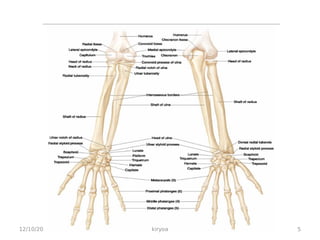
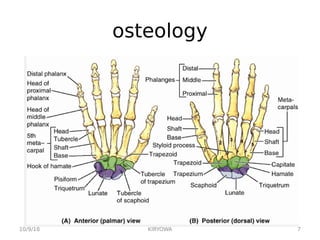
Osteology of the hand
Has 3 groups of bones:
 8 carpal bones
 5 metacarpals(1-5) i.e bones
of the metacarpus
 14 Phalanges - bones of the
digits- thumb has 2 and rest
have 3
10/9/18 kiryowa 4
12/10/20 5
kiryoa
• The hand is a mechanical and sensory
tool
• Many of the features of the upper limb
are designed to facilitate positioning
the hand in space
• It is required to perform a versatile
range of movement extending from
– A firm grasp needed to carry heavy bags
– Precision gripping as in holding a pencil
12/10/20 6
kiryowa
osteology
10/9/18 7
KIRYOWA
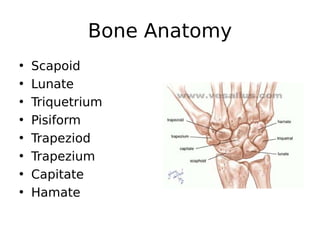
Bone Anatomy
• Scapoid
• Lunate
• Triquetrium
• Pisiform
• Trapeziod
• Trapezium
• Capitate
• Hamate
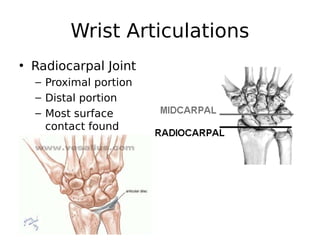
Wrist Articulations
• Radiocarpal Joint
– Proximal portion
– Distal portion
– Most surface
contact found
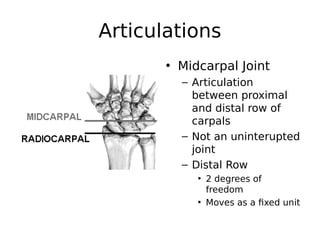
Articulations
• Midcarpal Joint
– Articulation
between proximal
and distal row of
carpals
– Not an uninterupted
joint
– Distal Row
• 2 degrees of
freedom
• Moves as a fixed unit
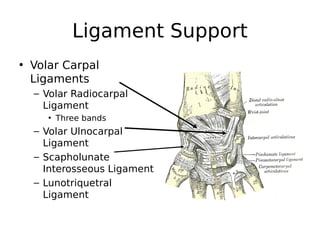
Ligament Support
• Volar Carpal
Ligaments
– Volar Radiocarpal
Ligament
• Three bands
– Volar Ulnocarpal
Ligament
– Scapholunate
Interosseous Ligament
– Lunotriquetral
Ligament
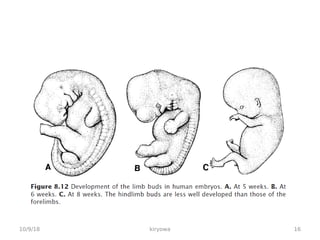
• Limb buds become visible as out
pocketing from the ventrolateral body wall
at the end of 4th week of development.
• Initially they consist of a mesenchyme core
derived from the somatic layer of lateral
plate mesoderm that will form the bones
and connective tissue of the limb covered
by a layer of cuboidal ectoderm
• Mesenchyme refers to loosely organized
embryonic tissue regardless of origin.
Embroyology of the hand
• Mesenchyme signals ectoderm at the distal
border of the limp to thicken and form the
apical ectoderm ridge(AER)
• AER in return exerts an inductive
influence on the underlying mesenchyme
adjacent to AER to remain as a population
of undifferentiated rapidly proliferating
cells the progress zone.
• Whereas cells located further away from
the influence of the AER begin to
differentiate into cartilage and muscle.
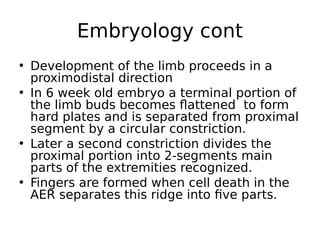
Embryology cont
• Development of the limb proceeds in a
proximodistal direction
• In 6 week old embryo a terminal portion of
the limb buds becomes flattened to form
hard plates and is separated from proximal
segment by a circular constriction.
• Later a second constriction divides the
proximal portion into 2-segments main
parts of the extremities recognized.
• Fingers are formed when cell death in the
AER separates this ridge into five parts.
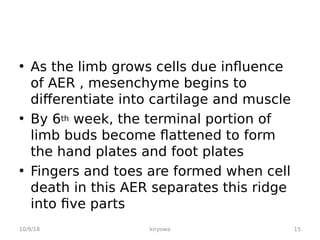
Embryology cont
• As the limb grows cells due influence
of AER , mesenchyme begins to
differentiate into cartilage and muscle
• By 6th week, the terminal portion of
limb buds become flattened to form
the hand plates and foot plates
• Fingers and toes are formed when cell
death in this AER separates this ridge
into five parts
10/9/18 15
kiryowa
10/9/18 16
kiryowa
• Primary ossication centres are present in
shafts of long bones by 12th week
• At birth, diaphysis or shaft is usually
completely ossified but the two ends, the
epiphyses are still cartilaginous
• The carpus is all cartilaginous by birth. The
capitate ossifies first(1st year) and the
pisiform ossifies last (10th year) and the
others ossify in sequence according to their
size and the whole carpus except pisiform
by 7th year
10/9/18 17
kiryowa
• The shafts of metacarpals and
phalanges ossify in utero
• Secondary ossification centres
develop at bases of all phalanges
and the thumb metacarpal ;
metacarpals of 2nd,3rd,4th and 5th
digits develop secondary centres at
their heads
10/9/18 18
kiryowa
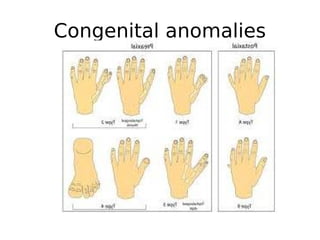
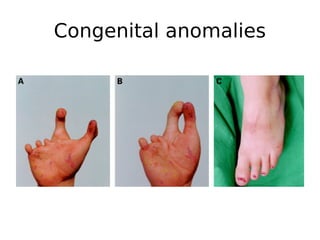
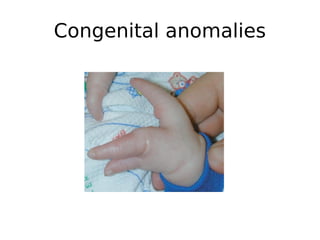
Congenital anomalies
• Macrodactyly or local gigantism;
Macrodactyly or local gigantism;
commonly affecting the thumb and
index finger
index finger
• Floating thumb. The metacarpal bone
Floating thumb. The metacarpal bone
of the thumb is absent, but the
phalanges are present.
• Brachydactyly due to defects of the
Brachydactyly due to defects of the
phalanges
phalanges
• Partial syndactyly
Partial syndactyly
10/9/18 kiryowa 19
• Positioning of the limbs along the
craniocaudal axis in the flank regions of the
embryo is regulated by the HOX genes
expressed along this axis.
• These homeobox genes are expressed in
over lapping patterns from head to tail with
some having more cranial limits than others.
• E.g. cranial limit of expression of HOXB8 is
at the cranial border of the fore limb and
misexpression of this gene alters the position
of these limbs.
Molecular Regulation Of limb
Development
• Once positioning along the craniocaudal axis
is determined growth must be regulated along
the proximodistal, anteroposterior and dorso
ventral axes.
• Limb out growth which occurs first is initiated
by FGF-10 secreted by lateral plate
mesoderm cells.
• Once out growth is initiated bone
morphogenetic proteins (BMPS) expressed in
ventral ectoderm induce formation of the AER
by signaling through the homobox gene MSX 2
Regulation cont
Expression of radical fringe(a homologue
of Drosophila fringe) in the dorsal half of
the limb ectoderm restricts the location
of the AER to the distal tip of the limbs
.This gene induces expression of ser-2 a
homologue of drosophila serrate at the
border between cells expressing radical
fringe and those that are not.
It is at this border that the AER is
established.
Regulation cont
• Anteroposterior axis of the limb is
regulated by the zone of polarizing
activity (ZPA) a cluster of cells at the
posterior border of the limb near the
flank .
• These cells produce retinoic acid(vitamin
A which initiates expression of sorie
hedgehog (SHH) a secreted factor that
regulates the anteroposterior axis.
Regulation cont
• Deformities by development
suppression,agenesis
• By development arrest: hypoplasia
• By developmental aberrations
• Dysplastic conditions.
• Polyglandular dystrophy
• Contractures(nuerogenic or
amniotic).
Congenital malformation and
classification.
• Congenital defects of the fore arm
bones
• Lobster claw hand
• Hemi-melia
Deformity by development
suppression
• Syndactyly
• Sym-phalangism – fusion of
interphalangeal joints
Development by arrest
• Brachy-dactyly
• Chondro-dystrophy
• Fusion of carpal bones
Dysplastic condition
• Polydactily
• Macrodactly
• Arachnodactyly- one of the abnormal
length and thinness of the fingers
resembling spider legs.
Poly glandular dystrophy
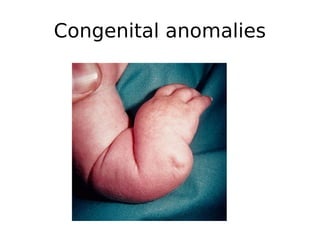
Congenital anomalies
radial club hand - Shortcut.lnk
Congenital anomalies
GROSS
ANATOMY
12/10/20 kiryowa 33
Surface Anatomy
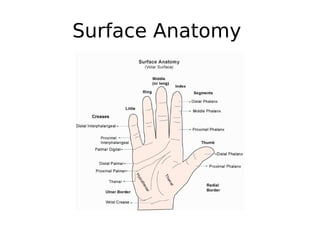
• The skin of the palm is thick and hairless,
characterized by flexure creases (the lines of
the palm) and the papillary ridges or
fingerprints, which occupy the whole of the
flexor surface.
• Sweat glands are present in large numbers.
• Palmaris brevis is a small muscle that arises
from the flexor retinaculum and palmar
aponeurosis and is inserted into the skin of the
palm.
• Its function is to corrugate the skin at the base
of the hypothener eminence and so improve
the grip of the palm in holding a rounded object.
The skin of the palm
• Of the wrist and palm is thickened to
form
flexor retinaculum and the palmar
aponeurosis.
Deep fascia
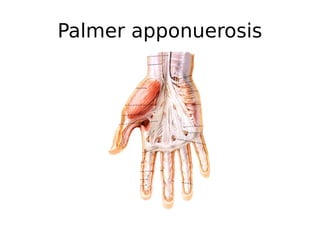
• The palmar aponeurosis is triangular and occupies
the central area of the palm.
• The apex of the palmar aponeurosis is attached to
the distal border of the flexor retinaculum and
receives the insertion of the Palmaris longus
tendon.
• The base of the aponeurosis divides at the bases
of the fingers into four slips.
• Each slip divides into two bands one passing
superficially to the skin and the other passing
deeply to the root of the fingers ,here each deep
band divides into two which diverge around the
flexor tendons and finally fuse with the fibrous
flexor sheath and the deep transverse ligaments
The palmar aponeurosis
• The medial and lateral borders of the
palmar aponeurosis are continuous with
the inner deep fascia covering the
hypothenar and thenar muscle. From each
of these border, fibrous septa pass
posterioly into the palm and take part in
the formation of the palmar fascial spaces.
• The function of the palmar aponeurosis is
to give firm attachment to the overlying
skin and so improve the grip and to protect
the underlying tendons.
Palmar aponeurosis cont
Palmer apponuerosis
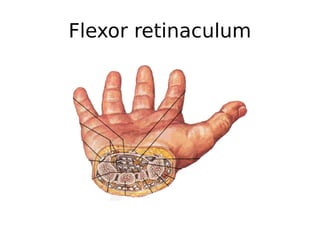
• Is thickening of deep fascia
• Holds long flexor tendons at the wrist
• Stretches across the front of the wrist
• Converts the concave anterior surface of
the hand into osteofascial tunnel, the
carpal tunnel
• The tunnel is for passage of the median
nerve and the flexor of the thumb and
fingers.
Flexor Retinaculum
Flexor retinaculum
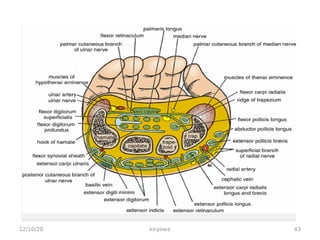
From medial to lateral…..
• Flexor capi ulnaris tendon(as it inserts on
the pisiform bone)
• Ulnar nerve: lateral to pisiform bone
• Ulnar artery; lateral to ulna
• Palmar cutaneous branch of ulnar nerve
• Palmaris longus tendon(if present)
• Palmar cutaneous branch of median
nerve.
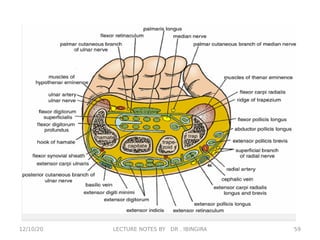
Structures that pass superficial
to flexor retinaculum
12/10/20 43
kiryowa
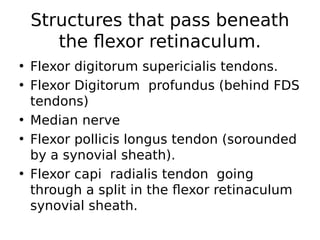
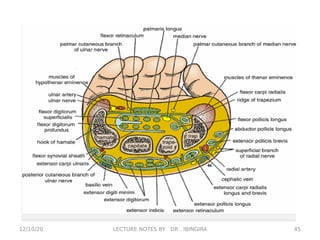
• Flexor digitorum supericialis tendons.
• Flexor Digitorum profundus (behind FDS
tendons)
• Median nerve
• Flexor pollicis longus tendon (sorounded
by a synovial sheath).
• Flexor capi radialis tendon going
through a split in the flexor retinaculum
synovial sheath.
Structures that pass beneath
the flexor retinaculum.
12/10/20 45
LECTURE NOTES BY DR . IBINGIRA
• The anterior surface of each finger from the
head of metacarpal to the base of the distal
phalanx is provided with a strong fibrous
sheath that is attached to the sides of the
phalanges.
• The proximal end of fibrous sheath is open
,whereas the distal end of the sheath is closed
and is attached to the base of the distal
phalanx.
• The sheath, together with the anterior
surfaces of the phalanges and the
interphalangeal joints ,forms a blind tunnel in
which the flexor tendons of the finger lie.
Fibrous Flexor sheaths
• In the thumb the osteofibrous tunnel
contains the tendon of the flexor pollicis
longus .
• In the case of the four medial fingers ,the
tunnel is occupied by the tendons of the
flexor digitorum superficialis and
profundus.
• The fibrous sheath is thick over the
phalanges but thin and lax over the joints.
Flexor sheath cont
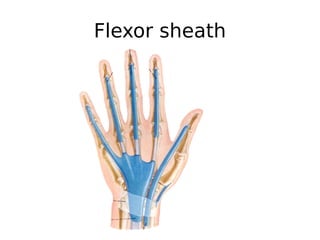
• Tendons of the flexor digitorum superficialis
and profundus muscles invaginate a
common synovial sheath from lateral side
• Medial part extends distally without
interruption on the tendons of little fingers
• Lateral part of the sheath stops abruptly on
the middle of the palm and the distal ends
of the long flexor tendons of the index
,middle and the ring fingers acquire digital
synovial sheaths as they enter the fingers
Synovial Flexor sheaths.
• Flexor pollicis longus tendon has its own synovial
sheath that passes into the thumb
• These sheath allow the long tendons to move
smoothly with a minimum of friction beneath the
flexor retinaculum and the fibrous flexor sheaths.
• Synovial sheath of flexor pollicis longus
communicates with the common synovial sheath
of the superficialis and profundus in 50% of
subjects.
• Vincular longer and brevia are small vascula folds
of synovial membrane that connect the tendons
to the anterior surface of the phalanges, convey
blood vessels to tendons.
Flexor sheath cont
Flexor sheath
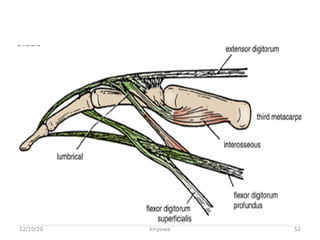
• Each tendon of flexor digitorum superficialis enters
the fibrous flexor sheath opposite the proximal
phalanx .
• Divides into two halves which pass around the
profundus tendon and meet on its deep or posterior
surface where partial decussation of the fibers take
place
• The superficialis tendon having united again divides
almost at once into further slips which are attached
to bones of middle phalanx
• Each tendon of the flexor digitorum profundus having
passed through the divisions of superficialis tendon
• Inserted into the anterior surface of the of the base
of distal phalanx
Insertion of the long flexor
tendons
12/10/20 52
kiryowa
THE DORSUM
• The skin of the dorsum unlike the palm is
thin and freely mobile over underlying
tendons
• There is usually little subcutaneous fat
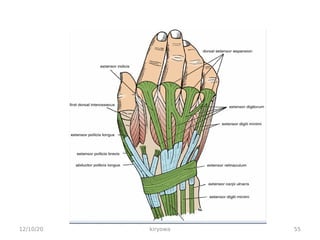
• Long extensor tendons
– The 4 tendons of extensor digitorum(ED)
pass under the extensor retinaculum, on the
dorsum the ED tendon to index finger is
accompanied by the tendon of extensor
indicis
12/10/20 53
kiryowa
– The ED tendon to the little finger is
accompanied by the double tendon of
extensor digiti minimi
– The ED tendons of little, ring and middle
fingers are connected to each other by a
fibrous slips
– On the posterior surface of each finger the
extensor tendon spreads to form a dorsal
digital expansion
– Tendons of APL,EPB and EPL proceed to insert
into the thumb
12/10/20 54
kiryowa
12/10/20 55
kiryowa
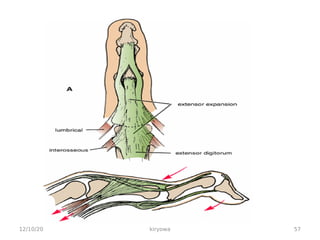
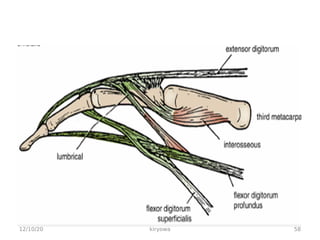
Extensor expansion
• This expansion is triangular shaped
and its apex splits into 3 parts:
– The middle slip attaches to base of
middle phalanx
– The two lateral slips converge to attach
to base of distal phalanx
– The base of the expansion receives the
appropriate interossei and lumbricals
12/10/20 56
LECTURE NOTES BY DR . IBINGIRA
12/10/20 57
kiryowa
12/10/20 58
kiryowa
12/10/20 59
LECTURE NOTES BY DR . IBINGIRA
muscles of
the hand
12/10/20 kiryowa 60
• 4 lumbricals
• Eight interossei.
• 4 short muscles of the thumb
• 3 short muscles of the little finger.
Small muscles of the hand
12/10/20 62
kiryowa
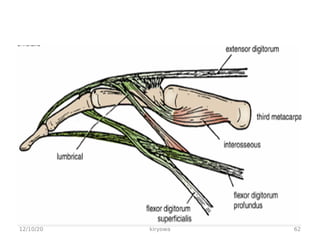
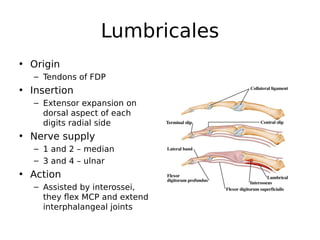
Lumbricales
• Origin
– Tendons of FDP
• Insertion
– Extensor expansion on
dorsal aspect of each
digits radial side
• Nerve supply
– 1 and 2 – median
– 3 and 4 – ulnar
• Action
– Assisted by interossei,
they flex MCP and extend
interphalangeal joints
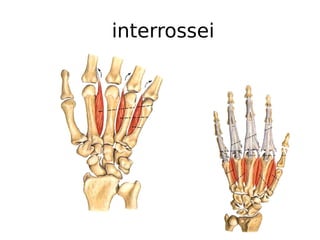
interrossei
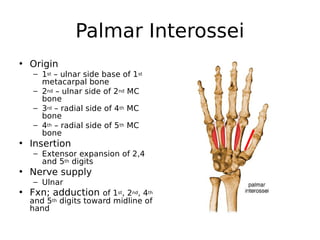
Palmar Interossei
• Origin
– 1st – ulnar side base of 1st
metacarpal bone
– 2nd – ulnar side of 2nd MC
bone
– 3rd – radial side of 4th MC
bone
– 4th – radial side of 5th MC
bone
• Insertion
– Extensor expansion of 2,4
and 5th digits
• Nerve supply
– Ulnar
• Fxn; adduction of 1st, 2nd, 4th
and 5th digits toward midline of
hand
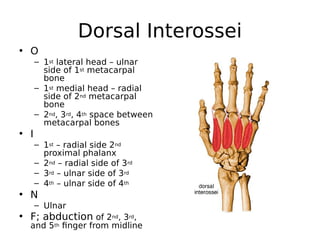
Dorsal Interossei
• O
– 1st lateral head – ulnar
side of 1st metacarpal
bone
– 1st medial head – radial
side of 2nd metacarpal
bone
– 2nd, 3rd, 4th space between
metacarpal bones
• I
– 1st – radial side 2nd
proximal phalanx
– 2nd – radial side of 3rd
– 3rd – ulnar side of 3rd
– 4th – ulnar side of 4th
• N
– Ulnar
• F; abduction of 2nd, 3rd,
and 5th finger from midline
Thenar Muscles
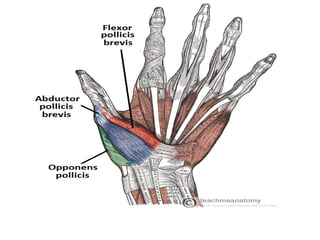
• The thenar muscles are three short
muscles located at the base of the
thumb. The muscle bellies produce a
bulge, known as the thenar
eminence. They are responsible for
the fine movements of the thumb.
• The median nerve innervates all the
thenar muscles.
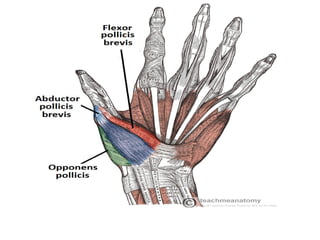
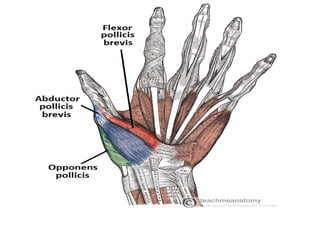
Opponens Pollicis
the largest of the thenar muscles, and lies
underneath the other two.
 Origin: the tubercle of the trapezium, and
the associated flexor retinaculum.
 Insertion: lateral margin of the metacarpal of
the thumb.
 Actions: Opposes the thumb, by medially
rotating and flexing the metacarpal on the
trapezium.
 Innervation: Median nerve.
12/10/20 kiryowa 68
Abductor Pollicis Brevis
This muscle is found anteriorly to the
opponens pollicis and proximal to the
flexor pollicis brevis.
 Origin; from the tubercles of the
scaphoid and trapezium, and from the
associated flexor retinaculum.
 Insertion; lateral side of proximal
phalanx.
 Actions: Abducts the thumb.
 Innervation: Median nerve.
Flexor Pollicis Brevis
The most distal of the thenar muscles.
 Origin: from the tubercle of the trapezium
and from the associated flexor retinaculum.
 Insertion: base of the proximal phalanx of
the thumb.
 Actions: Flexes the MCP joint of the thumb.
 Innervation: Median nerve.
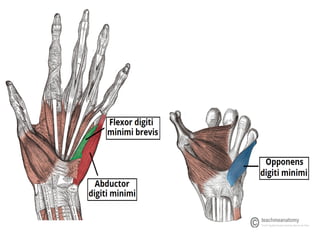
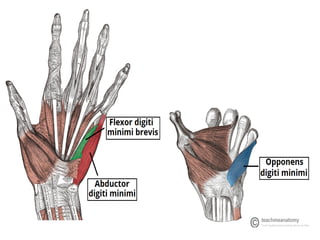
The hypothenar muscles
• These make up the hypothenar
muscles, a smaller eminence on the
medial side of the palm, at the base
of the little finger. These muscles are
very similar to the thenar muscles in
both name and organisation.
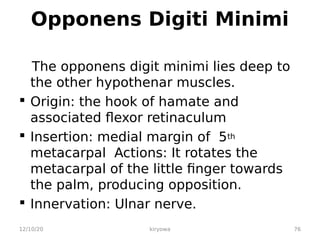
Opponens Digiti Minimi
The opponens digit minimi lies deep to
the other hypothenar muscles.
 Origin: the hook of hamate and
associated flexor retinaculum
 Insertion: medial margin of 5th
metacarpal Actions: It rotates the
metacarpal of the little finger towards
the palm, producing opposition.
 Innervation: Ulnar nerve.
12/10/20 kiryowa 76
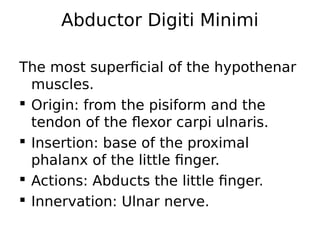
Abductor Digiti Minimi
The most superficial of the hypothenar
muscles.
 Origin: from the pisiform and the
tendon of the flexor carpi ulnaris.
 Insertion: base of the proximal
phalanx of the little finger.
 Actions: Abducts the little finger.
 Innervation: Ulnar nerve.
Flexor Digiti Minimi Brevis
This muscles lies laterally to the abductor
digiti minimi.
 Origin: from the hook of hamata and
adjacent flexor retinaculum
 Insertion:the base of the proximal phalanx
of the little finger.
 Actions: Flexes the MCP joint of the little
finger.
 Innervation: Ulnar Nerve.
Nerve supply
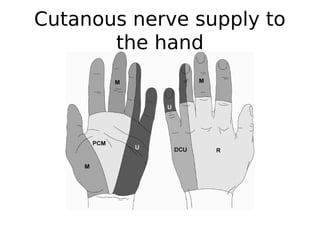
• Sensory nerve supply to the skin on the
dorsum is derived from the superficial
branch of radial nerve and posterior
cutaneous branch of ulnar nerve
– Superficial branch of radial nerve winds
around the radius deep to brachioradialis
and supplies lat 2/3 of dorsum and divides
into dorsal digital nerves that supply the
thumb, index, middle and lat side of ring
finger(lat 3 1/2)
12/10/20 80
kiryowa
-Post cutaneous branch of the ulnar nerve winds
around the ulna deep to flexor carpi ulnaris
tendon extends over the extensor digitorum to
supply the medial 1/3 of the dorsum. It also
supplies medial side of the ring finger and sides
of little finger(medial 11/2 fingers)
NB. Dorsal digital branches of radial and ulnar
nerves donot extend beyond the proximal
phalanx. The reminder of the dorsum of each
finger receives its nerve supply from palmar
digital branches
12/10/20 81
kiryowa
Cutanous nerve supply to
the hand
Blood supply
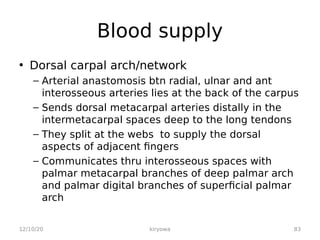
• Dorsal carpal arch/network
– Arterial anastomosis btn radial, ulnar and ant
interosseous arteries lies at the back of the carpus
– Sends dorsal metacarpal arteries distally in the
intermetacarpal spaces deep to the long tendons
– They split at the webs to supply the dorsal
aspects of adjacent fingers
– Communicates thru interosseous spaces with
palmar metacarpal branches of deep palmar arch
and palmar digital branches of superficial palmar
arch
12/10/20 83
kiryowa
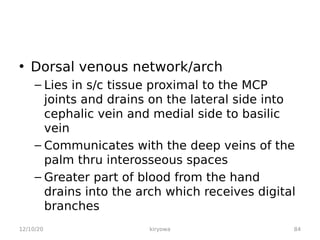
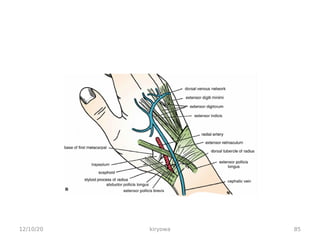
• Dorsal venous network/arch
– Lies in s/c tissue proximal to the MCP
joints and drains on the lateral side into
cephalic vein and medial side to basilic
vein
– Communicates with the deep veins of the
palm thru interosseous spaces
– Greater part of blood from the hand
drains into the arch which receives digital
branches
12/10/20 84
kiryowa
12/10/20 85
kiryowa
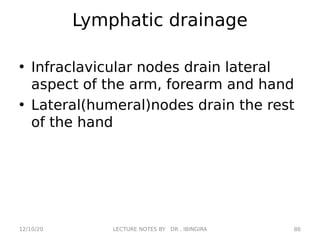
Lymphatic drainage
• Infraclavicular nodes drain lateral
aspect of the arm, forearm and hand
• Lateral(humeral)nodes drain the rest
of the hand
12/10/20 86
LECTURE NOTES BY DR . IBINGIRA
The spaces of the hand
• superficial pulp spaces of the
superficial pulp spaces of the
fingers
fingers
• synovial tendon sheaths of the
synovial tendon sheaths of the
2
2nd
nd
, 3
, 3rd
rd
, 4
, 4th
th
fingers
fingers
• the ulna bursa
the ulna bursa
• the radial bursa[ FPL]
the radial bursa[ FPL]
• the mid palmar space
the mid palmar space
• the thenar space
the thenar space
12/10/20 87
kiryowa
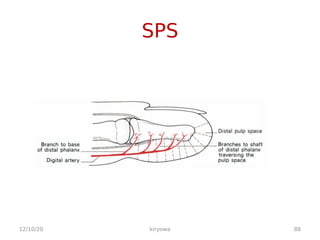
SPS
12/10/20 88
kiryowa
BURSAE
The synovial
The synovial
sheaths of the flexor
tendons of the hand—the
Radial[FPL] and ulnar
bursae[ little finger.
track proximally deep to
the flexor retinaculum
and provide a potential
pathway of infection into
the forearm. In many
cases these bursae
cases these bursae
communicate.
communicate.
12/10/20 89
LECTURE NOTES BY DR . IBINGIRA
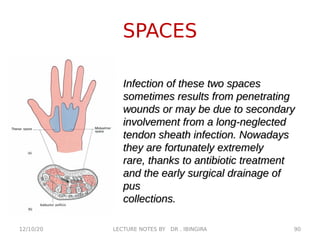
SPACES
Infection of these two spaces
sometimes results from penetrating
wounds or may be due to secondary
involvement from a long-neglected
tendon sheath infection. Nowadays
they are fortunately extremely
rare, thanks to antibiotic treatment
and the early surgical drainage of
pus
pus
collections.
collections.
12/10/20 90
LECTURE NOTES BY DR . IBINGIRA
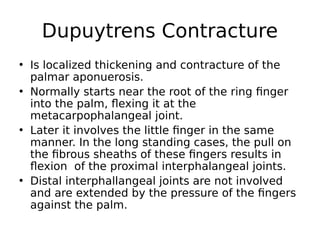
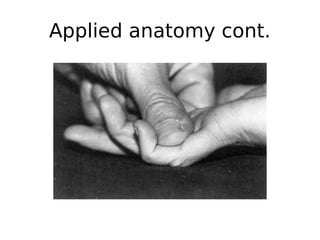
• Is localized thickening and contracture of the
palmar aponuerosis.
• Normally starts near the root of the ring finger
into the palm, flexing it at the
metacarpophalangeal joint.
• Later it involves the little finger in the same
manner. In the long standing cases, the pull on
the fibrous sheaths of these fingers results in
flexion of the proximal interphalangeal joints.
• Distal interphallangeal joints are not involved
and are extended by the pressure of the fingers
against the palm.
Dupuytrens Contracture
Applied anatomy cont.
• Is an infection of a synovial sheath
sheath
• Commonly results from the
introduction of bacteria into a sheath
through a penetrating wound .
• Infection of a digital sheath results in
distension of the sheath with pus, the
finger is held semi flexed and is
swollen.
Tenosynovitis
• Pulp space of fingers is a closed facial
compartment situated in front of the
terminal phalanx of each finger. Occurs
most often in the thumb and index
finger.
• Bacteria usually introduced by a prick
• Pressure in pulp space rises quickly in
inflammation because the space is sub
divided by numerous small
compartments by fibrous septa
Pulp-space infection
• Fracture line usually goes through the
narrowest part.
• Blood supply is through its proximal
and distal ends, although the blood
supply is occasionally confined to its
distal end.
• If the latter occurs the proximal
fragment is deprived of blood supply
and a vascular necrosis occurs.
Fracture of scaphoid bone
MORE
• Dermatoglyphics e.g simian crease.
Dermatoglyphics e.g simian crease.
wrist creases[proximal, middle, distal],
palmar creases[radial longitudinal,
proximal transverse, distal transverse,
digital creases,
digital creases,
• Thumb has 2 creases
Thumb has 2 creases
• Skin ridges- unique pattern, hence
Skin ridges- unique pattern, hence
finger prints.
finger prints.
• Reduce slippage when grasping.
Reduce slippage when grasping.
12/10/20 96
kiryowa
MORE
• Lacerations of palmar arches.
Lacerations of palmar arches.
it may be necessary to compress the
brachial artery and its branches proximal
to the elbow.
to the elbow.
• Carpal tunnel syndrome- paraesthesia,
Carpal tunnel syndrome- paraesthesia,
hypoesthesia or anaesthesia in the lateral
3 ½ digits. Centre is unaffected.
Recurrent branch, motor to thenar[APB,
Opponens p are affected.
Carpal tunnel release. Where is the incision.
12/10/20 97
kiryowa
Trauma
• Wrist laceration, the median nerve is injured
Wrist laceration, the median nerve is injured
.
.
• Recurrent branch lies subcutaneously.
Recurrent branch lies subcutaneously.
• Ulna canal syndrome- between the pisiform
Ulna canal syndrome- between the pisiform
and the hook of H.[pisohamate ligament.
• Compression of the ulna nerve-
Compression of the ulna nerve-
hypoesthesia,
hypoesthesia,
• Weakness of the intrinsic muscles , clawing
Weakness of the intrinsic muscles , clawing
of the 4
of the 4th
th and 5
and 5th
th fingers. Ability to flex is not
fingers. Ability to flex is not
affected.
affected.
12/10/20 98
kiryowa
Handlebar neuropathy
• Riding long distances on a bicycle,
Riding long distances on a bicycle,
pressure on the hook of Hamate.
• Radial nerve injury, at the arm
Radial nerve injury, at the arm
causes a wrist drop.
12/10/20 99
kiryowa
Fractures
• Scaphoid- fall on the palm, abducted
Scaphoid- fall on the palm, abducted
hand. AVN
hand. AVN
• Fracture of Hamate, non union due to
Fracture of Hamate, non union due to
traction ulna nerve and artery are
close.
close.
• Fracture of the meta-carpals- stable, 1
Fracture of the meta-carpals- stable, 1st
st
is alone, 5
is alone, 5th
th can lead to a boxer’s
can lead to a boxer’s
fracture.
fracture.
• Fracture of phalanges, need careful re-
Fracture of phalanges, need careful re-
alignment.
alignment.
• Peri lunate dislocation of the carpus.
Peri lunate dislocation of the carpus.
12/10/20 100
LECTURE NOTES BY DR . IBINGIRA
others
• Bennett's fracture is a fracture of the
Bennett's fracture is a fracture of the
base of the metacarpal of the thumb
caused when violence is applied
along the long axis of the thumb or
the thumb is forcefully abducted. The
fracture is oblique and enters the
carpometacarpal joint of the thumb,
causing joint instability.
12/10/20 101
kiryowa
ASB
• The anatomic snuffbox is a term
The anatomic snuffbox is a term
commonly used to describe a
triangular skin depression on the
lateral side of the wrist that is
bounded medially by the tendon of
the extensor pollicis longus and
laterally by the tendons of the
abductor pollicis longus and extensor
pollicis brevis
pollicis brevis
12/10/20 102
kiryowa
more
• Mallet Finger
Mallet Finger
• Avulsion of the insertion of one of the
Avulsion of the insertion of one of the
extensor tendons into the distal
phalanges can occur if the distal
phalanx is forcibly flexed when the
extensor tendon is taut.
12/10/20 103
kiryowa
Boutonnière Deformity
• The deformity results from flexing of
The deformity results from flexing of
the proximal interphalangeal joint
and hyperextension of the distal
interphalangeal joint. This injury can
result from direct end-on trauma to
the finger, direct trauma over the
back of the proximal interphalangeal
joint, or laceration of the dorsum of
the finger
the finger
12/10/20 104
kiryowa
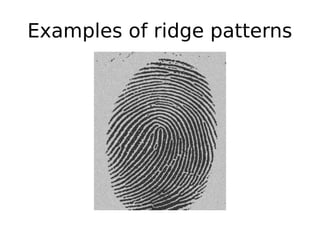
• The palm of the hand has papillary ridges
called finger prints.
• Finger prints are used to identify an
unknown victim, witness or suspect and
most importantly as links and matches
between a suspect and crime.
• Prints can substantiate or disprove the story
of a victim or witness by locating their prints
where they said they were.
Legal aspects of the hand
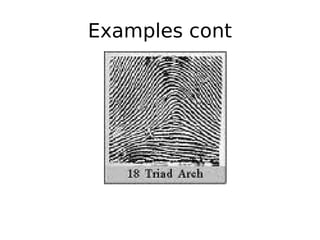
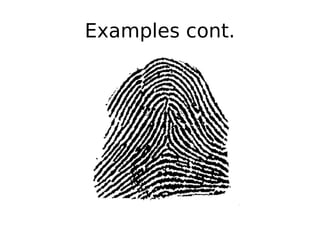
• Arches-African ancestry
• Loops –European ancestry
• Whorls-Asians/Orientals
Classification of ridge
patterns
Examples of ridge patterns
Examples cont
Examples cont.
• A variety of powders are used in dusting for
prints ,many containing aluminium or carbon
• This finely crushed powder is gently applied
to a surface and the minute particles of
powder cling to the print residue , making it
visible to the human eye.
• These prints are then lifted using adhesive
tape.
• The information obtained is compared with
countries finger Data bases which may have
been taken for a number reasons.
Powder and tape
• Is sprayed or swabbed onto surface
• Ninhydrin reacts with amino acids in the prints
forming a purple or pink compound.
• Prints are most commonly made or made in
• 1.Plastic-impressions left in soft material like
wax, paint
• 2.Visible-made by blood ,dirt, ink or grease.
• 3.Latent-normally invisible and must be
developed before they can be seen and
photographed.
Ninhydrin
• Fracture of one finger-up to 1,750 pounds
• Severe dislocation of thumb-3,000 pounds
• Amputation of little finger-5,850 pounds
• Severe injury to ring or middle finger-7,750p.
• Loss of index finger up to 9,000 pounds.
• Loss of the thumb-18,500 pounds.
• Records of hand injury from family Doctor or
hospital are used when making compensation
claims.
Typical Hand Injury
Compensation Amounts.

lecture 6b THE HAND Dr.kiryowa (1).pdf

  • 1.
    THE HAND ANDWRIST REGION Kiryowa Haruna Muhmood 12/10/20 1 kiryowa
  • 2.
    APPROACH/OBJECTIVES • Definition ofthe hand. • Osteology of the bones of the hand • The dorsum • The palm • The anatomical spaces • Applied anatomy • Spaces of the hand • Congenital anomalies 12/10/20 2 LECTURE NOTES BY DR . IBINGIRA
  • 3.
    Introduction • The handis the region of the upper limb distal to the wrist joint • Most of the functions of the upper limb depend on the integrity of the hand • It is important in locomotion, grasping, feeding and defence. • It is subdivided into the wrist, metacarpus and the digits • It has an anterior surface(the palm) and a dorsal surface(the dorsum) 10/9/18 3 kiryowa
  • 4.
    Osteology of thehand Has 3 groups of bones:  8 carpal bones  5 metacarpals(1-5) i.e bones of the metacarpus  14 Phalanges - bones of the digits- thumb has 2 and rest have 3 10/9/18 kiryowa 4
  • 5.
  • 6.
    • The handis a mechanical and sensory tool • Many of the features of the upper limb are designed to facilitate positioning the hand in space • It is required to perform a versatile range of movement extending from – A firm grasp needed to carry heavy bags – Precision gripping as in holding a pencil 12/10/20 6 kiryowa
  • 7.
  • 8.
    Bone Anatomy • Scapoid •Lunate • Triquetrium • Pisiform • Trapeziod • Trapezium • Capitate • Hamate
  • 9.
    Wrist Articulations • RadiocarpalJoint – Proximal portion – Distal portion – Most surface contact found
  • 10.
    Articulations • Midcarpal Joint –Articulation between proximal and distal row of carpals – Not an uninterupted joint – Distal Row • 2 degrees of freedom • Moves as a fixed unit
  • 11.
    Ligament Support • VolarCarpal Ligaments – Volar Radiocarpal Ligament • Three bands – Volar Ulnocarpal Ligament – Scapholunate Interosseous Ligament – Lunotriquetral Ligament
  • 12.
    • Limb budsbecome visible as out pocketing from the ventrolateral body wall at the end of 4th week of development. • Initially they consist of a mesenchyme core derived from the somatic layer of lateral plate mesoderm that will form the bones and connective tissue of the limb covered by a layer of cuboidal ectoderm • Mesenchyme refers to loosely organized embryonic tissue regardless of origin. Embroyology of the hand
  • 13.
    • Mesenchyme signalsectoderm at the distal border of the limp to thicken and form the apical ectoderm ridge(AER) • AER in return exerts an inductive influence on the underlying mesenchyme adjacent to AER to remain as a population of undifferentiated rapidly proliferating cells the progress zone. • Whereas cells located further away from the influence of the AER begin to differentiate into cartilage and muscle. Embryology cont
  • 14.
    • Development ofthe limb proceeds in a proximodistal direction • In 6 week old embryo a terminal portion of the limb buds becomes flattened to form hard plates and is separated from proximal segment by a circular constriction. • Later a second constriction divides the proximal portion into 2-segments main parts of the extremities recognized. • Fingers are formed when cell death in the AER separates this ridge into five parts. Embryology cont
  • 15.
    • As thelimb grows cells due influence of AER , mesenchyme begins to differentiate into cartilage and muscle • By 6th week, the terminal portion of limb buds become flattened to form the hand plates and foot plates • Fingers and toes are formed when cell death in this AER separates this ridge into five parts 10/9/18 15 kiryowa
  • 16.
  • 17.
    • Primary ossicationcentres are present in shafts of long bones by 12th week • At birth, diaphysis or shaft is usually completely ossified but the two ends, the epiphyses are still cartilaginous • The carpus is all cartilaginous by birth. The capitate ossifies first(1st year) and the pisiform ossifies last (10th year) and the others ossify in sequence according to their size and the whole carpus except pisiform by 7th year 10/9/18 17 kiryowa
  • 18.
    • The shaftsof metacarpals and phalanges ossify in utero • Secondary ossification centres develop at bases of all phalanges and the thumb metacarpal ; metacarpals of 2nd,3rd,4th and 5th digits develop secondary centres at their heads 10/9/18 18 kiryowa
  • 19.
    Congenital anomalies • Macrodactylyor local gigantism; Macrodactyly or local gigantism; commonly affecting the thumb and commonly affecting the thumb and index finger index finger • Floating thumb. The metacarpal bone Floating thumb. The metacarpal bone of the thumb is absent, but the of the thumb is absent, but the phalanges are present. phalanges are present. • Brachydactyly due to defects of the Brachydactyly due to defects of the phalanges phalanges • Partial syndactyly Partial syndactyly 10/9/18 kiryowa 19
  • 20.
    • Positioning ofthe limbs along the craniocaudal axis in the flank regions of the embryo is regulated by the HOX genes expressed along this axis. • These homeobox genes are expressed in over lapping patterns from head to tail with some having more cranial limits than others. • E.g. cranial limit of expression of HOXB8 is at the cranial border of the fore limb and misexpression of this gene alters the position of these limbs. Molecular Regulation Of limb Development
  • 21.
    • Once positioningalong the craniocaudal axis is determined growth must be regulated along the proximodistal, anteroposterior and dorso ventral axes. • Limb out growth which occurs first is initiated by FGF-10 secreted by lateral plate mesoderm cells. • Once out growth is initiated bone morphogenetic proteins (BMPS) expressed in ventral ectoderm induce formation of the AER by signaling through the homobox gene MSX 2 Regulation cont
  • 22.
    Expression of radicalfringe(a homologue of Drosophila fringe) in the dorsal half of the limb ectoderm restricts the location of the AER to the distal tip of the limbs .This gene induces expression of ser-2 a homologue of drosophila serrate at the border between cells expressing radical fringe and those that are not. It is at this border that the AER is established. Regulation cont
  • 23.
    • Anteroposterior axisof the limb is regulated by the zone of polarizing activity (ZPA) a cluster of cells at the posterior border of the limb near the flank . • These cells produce retinoic acid(vitamin A which initiates expression of sorie hedgehog (SHH) a secreted factor that regulates the anteroposterior axis. Regulation cont
  • 24.
    • Deformities bydevelopment suppression,agenesis • By development arrest: hypoplasia • By developmental aberrations • Dysplastic conditions. • Polyglandular dystrophy • Contractures(nuerogenic or amniotic). Congenital malformation and classification.
  • 25.
    • Congenital defectsof the fore arm bones • Lobster claw hand • Hemi-melia Deformity by development suppression
  • 26.
    • Syndactyly • Sym-phalangism– fusion of interphalangeal joints Development by arrest
  • 27.
    • Brachy-dactyly • Chondro-dystrophy •Fusion of carpal bones Dysplastic condition
  • 28.
    • Polydactily • Macrodactly •Arachnodactyly- one of the abnormal length and thinness of the fingers resembling spider legs. Poly glandular dystrophy
  • 29.
    Congenital anomalies radial clubhand - Shortcut.lnk radial club hand - Shortcut.lnk
  • 30.
  • 31.
  • 32.
  • 33.
  • 34.
  • 35.
    • The skinof the palm is thick and hairless, characterized by flexure creases (the lines of the palm) and the papillary ridges or fingerprints, which occupy the whole of the flexor surface. • Sweat glands are present in large numbers. • Palmaris brevis is a small muscle that arises from the flexor retinaculum and palmar aponeurosis and is inserted into the skin of the palm. • Its function is to corrugate the skin at the base of the hypothener eminence and so improve the grip of the palm in holding a rounded object. The skin of the palm
  • 36.
    • Of thewrist and palm is thickened to form flexor retinaculum and the palmar aponeurosis. Deep fascia
  • 37.
    • The palmaraponeurosis is triangular and occupies the central area of the palm. • The apex of the palmar aponeurosis is attached to the distal border of the flexor retinaculum and receives the insertion of the Palmaris longus tendon. • The base of the aponeurosis divides at the bases of the fingers into four slips. • Each slip divides into two bands one passing superficially to the skin and the other passing deeply to the root of the fingers ,here each deep band divides into two which diverge around the flexor tendons and finally fuse with the fibrous flexor sheath and the deep transverse ligaments The palmar aponeurosis
  • 38.
    • The medialand lateral borders of the palmar aponeurosis are continuous with the inner deep fascia covering the hypothenar and thenar muscle. From each of these border, fibrous septa pass posterioly into the palm and take part in the formation of the palmar fascial spaces. • The function of the palmar aponeurosis is to give firm attachment to the overlying skin and so improve the grip and to protect the underlying tendons. Palmar aponeurosis cont
  • 39.
  • 40.
    • Is thickeningof deep fascia • Holds long flexor tendons at the wrist • Stretches across the front of the wrist • Converts the concave anterior surface of the hand into osteofascial tunnel, the carpal tunnel • The tunnel is for passage of the median nerve and the flexor of the thumb and fingers. Flexor Retinaculum
  • 41.
  • 42.
    From medial tolateral….. • Flexor capi ulnaris tendon(as it inserts on the pisiform bone) • Ulnar nerve: lateral to pisiform bone • Ulnar artery; lateral to ulna • Palmar cutaneous branch of ulnar nerve • Palmaris longus tendon(if present) • Palmar cutaneous branch of median nerve. Structures that pass superficial to flexor retinaculum
  • 43.
  • 44.
    • Flexor digitorumsupericialis tendons. • Flexor Digitorum profundus (behind FDS tendons) • Median nerve • Flexor pollicis longus tendon (sorounded by a synovial sheath). • Flexor capi radialis tendon going through a split in the flexor retinaculum synovial sheath. Structures that pass beneath the flexor retinaculum.
  • 45.
    12/10/20 45 LECTURE NOTESBY DR . IBINGIRA
  • 46.
    • The anteriorsurface of each finger from the head of metacarpal to the base of the distal phalanx is provided with a strong fibrous sheath that is attached to the sides of the phalanges. • The proximal end of fibrous sheath is open ,whereas the distal end of the sheath is closed and is attached to the base of the distal phalanx. • The sheath, together with the anterior surfaces of the phalanges and the interphalangeal joints ,forms a blind tunnel in which the flexor tendons of the finger lie. Fibrous Flexor sheaths
  • 47.
    • In thethumb the osteofibrous tunnel contains the tendon of the flexor pollicis longus . • In the case of the four medial fingers ,the tunnel is occupied by the tendons of the flexor digitorum superficialis and profundus. • The fibrous sheath is thick over the phalanges but thin and lax over the joints. Flexor sheath cont
  • 48.
    • Tendons ofthe flexor digitorum superficialis and profundus muscles invaginate a common synovial sheath from lateral side • Medial part extends distally without interruption on the tendons of little fingers • Lateral part of the sheath stops abruptly on the middle of the palm and the distal ends of the long flexor tendons of the index ,middle and the ring fingers acquire digital synovial sheaths as they enter the fingers Synovial Flexor sheaths.
  • 49.
    • Flexor pollicislongus tendon has its own synovial sheath that passes into the thumb • These sheath allow the long tendons to move smoothly with a minimum of friction beneath the flexor retinaculum and the fibrous flexor sheaths. • Synovial sheath of flexor pollicis longus communicates with the common synovial sheath of the superficialis and profundus in 50% of subjects. • Vincular longer and brevia are small vascula folds of synovial membrane that connect the tendons to the anterior surface of the phalanges, convey blood vessels to tendons. Flexor sheath cont
  • 50.
  • 51.
    • Each tendonof flexor digitorum superficialis enters the fibrous flexor sheath opposite the proximal phalanx . • Divides into two halves which pass around the profundus tendon and meet on its deep or posterior surface where partial decussation of the fibers take place • The superficialis tendon having united again divides almost at once into further slips which are attached to bones of middle phalanx • Each tendon of the flexor digitorum profundus having passed through the divisions of superficialis tendon • Inserted into the anterior surface of the of the base of distal phalanx Insertion of the long flexor tendons
  • 52.
  • 53.
    THE DORSUM • Theskin of the dorsum unlike the palm is thin and freely mobile over underlying tendons • There is usually little subcutaneous fat • Long extensor tendons – The 4 tendons of extensor digitorum(ED) pass under the extensor retinaculum, on the dorsum the ED tendon to index finger is accompanied by the tendon of extensor indicis 12/10/20 53 kiryowa
  • 54.
    – The EDtendon to the little finger is accompanied by the double tendon of extensor digiti minimi – The ED tendons of little, ring and middle fingers are connected to each other by a fibrous slips – On the posterior surface of each finger the extensor tendon spreads to form a dorsal digital expansion – Tendons of APL,EPB and EPL proceed to insert into the thumb 12/10/20 54 kiryowa
  • 55.
  • 56.
    Extensor expansion • Thisexpansion is triangular shaped and its apex splits into 3 parts: – The middle slip attaches to base of middle phalanx – The two lateral slips converge to attach to base of distal phalanx – The base of the expansion receives the appropriate interossei and lumbricals 12/10/20 56 LECTURE NOTES BY DR . IBINGIRA
  • 57.
  • 58.
  • 59.
    12/10/20 59 LECTURE NOTESBY DR . IBINGIRA
  • 60.
  • 61.
    • 4 lumbricals •Eight interossei. • 4 short muscles of the thumb • 3 short muscles of the little finger. Small muscles of the hand
  • 62.
  • 63.
    Lumbricales • Origin – Tendonsof FDP • Insertion – Extensor expansion on dorsal aspect of each digits radial side • Nerve supply – 1 and 2 – median – 3 and 4 – ulnar • Action – Assisted by interossei, they flex MCP and extend interphalangeal joints
  • 64.
  • 65.
    Palmar Interossei • Origin –1st – ulnar side base of 1st metacarpal bone – 2nd – ulnar side of 2nd MC bone – 3rd – radial side of 4th MC bone – 4th – radial side of 5th MC bone • Insertion – Extensor expansion of 2,4 and 5th digits • Nerve supply – Ulnar • Fxn; adduction of 1st, 2nd, 4th and 5th digits toward midline of hand
  • 66.
    Dorsal Interossei • O –1st lateral head – ulnar side of 1st metacarpal bone – 1st medial head – radial side of 2nd metacarpal bone – 2nd, 3rd, 4th space between metacarpal bones • I – 1st – radial side 2nd proximal phalanx – 2nd – radial side of 3rd – 3rd – ulnar side of 3rd – 4th – ulnar side of 4th • N – Ulnar • F; abduction of 2nd, 3rd, and 5th finger from midline
  • 67.
    Thenar Muscles • Thethenar muscles are three short muscles located at the base of the thumb. The muscle bellies produce a bulge, known as the thenar eminence. They are responsible for the fine movements of the thumb. • The median nerve innervates all the thenar muscles.
  • 68.
    Opponens Pollicis the largestof the thenar muscles, and lies underneath the other two.  Origin: the tubercle of the trapezium, and the associated flexor retinaculum.  Insertion: lateral margin of the metacarpal of the thumb.  Actions: Opposes the thumb, by medially rotating and flexing the metacarpal on the trapezium.  Innervation: Median nerve. 12/10/20 kiryowa 68
  • 70.
    Abductor Pollicis Brevis Thismuscle is found anteriorly to the opponens pollicis and proximal to the flexor pollicis brevis.  Origin; from the tubercles of the scaphoid and trapezium, and from the associated flexor retinaculum.  Insertion; lateral side of proximal phalanx.  Actions: Abducts the thumb.  Innervation: Median nerve.
  • 72.
    Flexor Pollicis Brevis Themost distal of the thenar muscles.  Origin: from the tubercle of the trapezium and from the associated flexor retinaculum.  Insertion: base of the proximal phalanx of the thumb.  Actions: Flexes the MCP joint of the thumb.  Innervation: Median nerve.
  • 74.
    The hypothenar muscles •These make up the hypothenar muscles, a smaller eminence on the medial side of the palm, at the base of the little finger. These muscles are very similar to the thenar muscles in both name and organisation.
  • 76.
    Opponens Digiti Minimi Theopponens digit minimi lies deep to the other hypothenar muscles.  Origin: the hook of hamate and associated flexor retinaculum  Insertion: medial margin of 5th metacarpal Actions: It rotates the metacarpal of the little finger towards the palm, producing opposition.  Innervation: Ulnar nerve. 12/10/20 kiryowa 76
  • 78.
    Abductor Digiti Minimi Themost superficial of the hypothenar muscles.  Origin: from the pisiform and the tendon of the flexor carpi ulnaris.  Insertion: base of the proximal phalanx of the little finger.  Actions: Abducts the little finger.  Innervation: Ulnar nerve.
  • 79.
    Flexor Digiti MinimiBrevis This muscles lies laterally to the abductor digiti minimi.  Origin: from the hook of hamata and adjacent flexor retinaculum  Insertion:the base of the proximal phalanx of the little finger.  Actions: Flexes the MCP joint of the little finger.  Innervation: Ulnar Nerve.
  • 80.
    Nerve supply • Sensorynerve supply to the skin on the dorsum is derived from the superficial branch of radial nerve and posterior cutaneous branch of ulnar nerve – Superficial branch of radial nerve winds around the radius deep to brachioradialis and supplies lat 2/3 of dorsum and divides into dorsal digital nerves that supply the thumb, index, middle and lat side of ring finger(lat 3 1/2) 12/10/20 80 kiryowa
  • 81.
    -Post cutaneous branchof the ulnar nerve winds around the ulna deep to flexor carpi ulnaris tendon extends over the extensor digitorum to supply the medial 1/3 of the dorsum. It also supplies medial side of the ring finger and sides of little finger(medial 11/2 fingers) NB. Dorsal digital branches of radial and ulnar nerves donot extend beyond the proximal phalanx. The reminder of the dorsum of each finger receives its nerve supply from palmar digital branches 12/10/20 81 kiryowa
  • 82.
  • 83.
    Blood supply • Dorsalcarpal arch/network – Arterial anastomosis btn radial, ulnar and ant interosseous arteries lies at the back of the carpus – Sends dorsal metacarpal arteries distally in the intermetacarpal spaces deep to the long tendons – They split at the webs to supply the dorsal aspects of adjacent fingers – Communicates thru interosseous spaces with palmar metacarpal branches of deep palmar arch and palmar digital branches of superficial palmar arch 12/10/20 83 kiryowa
  • 84.
    • Dorsal venousnetwork/arch – Lies in s/c tissue proximal to the MCP joints and drains on the lateral side into cephalic vein and medial side to basilic vein – Communicates with the deep veins of the palm thru interosseous spaces – Greater part of blood from the hand drains into the arch which receives digital branches 12/10/20 84 kiryowa
  • 85.
  • 86.
    Lymphatic drainage • Infraclavicularnodes drain lateral aspect of the arm, forearm and hand • Lateral(humeral)nodes drain the rest of the hand 12/10/20 86 LECTURE NOTES BY DR . IBINGIRA
  • 87.
    The spaces ofthe hand • superficial pulp spaces of the superficial pulp spaces of the fingers fingers • synovial tendon sheaths of the synovial tendon sheaths of the 2 2nd nd , 3 , 3rd rd , 4 , 4th th fingers fingers • the ulna bursa the ulna bursa • the radial bursa[ FPL] the radial bursa[ FPL] • the mid palmar space the mid palmar space • the thenar space the thenar space 12/10/20 87 kiryowa
  • 88.
  • 89.
    BURSAE The synovial The synovial sheathsof the flexor sheaths of the flexor tendons of the hand—the tendons of the hand—the Radial[FPL] and ulnar Radial[FPL] and ulnar bursae[ little finger. bursae[ little finger. track proximally deep to track proximally deep to the flexor retinaculum the flexor retinaculum and provide a potential and provide a potential pathway of infection into pathway of infection into the forearm. In many the forearm. In many cases these bursae cases these bursae communicate. communicate. 12/10/20 89 LECTURE NOTES BY DR . IBINGIRA
  • 90.
    SPACES Infection of thesetwo spaces Infection of these two spaces sometimes results from penetrating sometimes results from penetrating wounds or may be due to secondary wounds or may be due to secondary involvement from a long-neglected involvement from a long-neglected tendon sheath infection. Nowadays tendon sheath infection. Nowadays they are fortunately extremely they are fortunately extremely rare, thanks to antibiotic treatment rare, thanks to antibiotic treatment and the early surgical drainage of and the early surgical drainage of pus pus collections. collections. 12/10/20 90 LECTURE NOTES BY DR . IBINGIRA
  • 91.
    • Is localizedthickening and contracture of the palmar aponuerosis. • Normally starts near the root of the ring finger into the palm, flexing it at the metacarpophalangeal joint. • Later it involves the little finger in the same manner. In the long standing cases, the pull on the fibrous sheaths of these fingers results in flexion of the proximal interphalangeal joints. • Distal interphallangeal joints are not involved and are extended by the pressure of the fingers against the palm. Dupuytrens Contracture
  • 92.
  • 93.
    • Is aninfection of a synovial sheath sheath • Commonly results from the introduction of bacteria into a sheath through a penetrating wound . • Infection of a digital sheath results in distension of the sheath with pus, the finger is held semi flexed and is swollen. Tenosynovitis
  • 94.
    • Pulp spaceof fingers is a closed facial compartment situated in front of the terminal phalanx of each finger. Occurs most often in the thumb and index finger. • Bacteria usually introduced by a prick • Pressure in pulp space rises quickly in inflammation because the space is sub divided by numerous small compartments by fibrous septa Pulp-space infection
  • 95.
    • Fracture lineusually goes through the narrowest part. • Blood supply is through its proximal and distal ends, although the blood supply is occasionally confined to its distal end. • If the latter occurs the proximal fragment is deprived of blood supply and a vascular necrosis occurs. Fracture of scaphoid bone
  • 96.
    MORE • Dermatoglyphics e.gsimian crease. Dermatoglyphics e.g simian crease. wrist creases[proximal, middle, distal], wrist creases[proximal, middle, distal], palmar creases[radial longitudinal, palmar creases[radial longitudinal, proximal transverse, distal transverse, proximal transverse, distal transverse, digital creases, digital creases, • Thumb has 2 creases Thumb has 2 creases • Skin ridges- unique pattern, hence Skin ridges- unique pattern, hence finger prints. finger prints. • Reduce slippage when grasping. Reduce slippage when grasping. 12/10/20 96 kiryowa
  • 97.
    MORE • Lacerations ofpalmar arches. Lacerations of palmar arches. it may be necessary to compress the it may be necessary to compress the brachial artery and its branches proximal brachial artery and its branches proximal to the elbow. to the elbow. • Carpal tunnel syndrome- paraesthesia, Carpal tunnel syndrome- paraesthesia, hypoesthesia or anaesthesia in the lateral hypoesthesia or anaesthesia in the lateral 3 ½ digits. Centre is unaffected. 3 ½ digits. Centre is unaffected. Recurrent branch, motor to thenar[APB, Recurrent branch, motor to thenar[APB, Opponens p are affected. Opponens p are affected. Carpal tunnel release. Where is the incision. Carpal tunnel release. Where is the incision. 12/10/20 97 kiryowa
  • 98.
    Trauma • Wrist laceration,the median nerve is injured Wrist laceration, the median nerve is injured . . • Recurrent branch lies subcutaneously. Recurrent branch lies subcutaneously. • Ulna canal syndrome- between the pisiform Ulna canal syndrome- between the pisiform and the hook of H.[pisohamate ligament. and the hook of H.[pisohamate ligament. • Compression of the ulna nerve- Compression of the ulna nerve- hypoesthesia, hypoesthesia, • Weakness of the intrinsic muscles , clawing Weakness of the intrinsic muscles , clawing of the 4 of the 4th th and 5 and 5th th fingers. Ability to flex is not fingers. Ability to flex is not affected. affected. 12/10/20 98 kiryowa
  • 99.
    Handlebar neuropathy • Ridinglong distances on a bicycle, Riding long distances on a bicycle, pressure on the hook of Hamate. pressure on the hook of Hamate. • Radial nerve injury, at the arm Radial nerve injury, at the arm causes a wrist drop. causes a wrist drop. 12/10/20 99 kiryowa
  • 100.
    Fractures • Scaphoid- fallon the palm, abducted Scaphoid- fall on the palm, abducted hand. AVN hand. AVN • Fracture of Hamate, non union due to Fracture of Hamate, non union due to traction ulna nerve and artery are traction ulna nerve and artery are close. close. • Fracture of the meta-carpals- stable, 1 Fracture of the meta-carpals- stable, 1st st is alone, 5 is alone, 5th th can lead to a boxer’s can lead to a boxer’s fracture. fracture. • Fracture of phalanges, need careful re- Fracture of phalanges, need careful re- alignment. alignment. • Peri lunate dislocation of the carpus. Peri lunate dislocation of the carpus. 12/10/20 100 LECTURE NOTES BY DR . IBINGIRA
  • 101.
    others • Bennett's fractureis a fracture of the Bennett's fracture is a fracture of the base of the metacarpal of the thumb base of the metacarpal of the thumb caused when violence is applied caused when violence is applied along the long axis of the thumb or along the long axis of the thumb or the thumb is forcefully abducted. The the thumb is forcefully abducted. The fracture is oblique and enters the fracture is oblique and enters the carpometacarpal joint of the thumb, carpometacarpal joint of the thumb, causing joint instability. causing joint instability. 12/10/20 101 kiryowa
  • 102.
    ASB • The anatomicsnuffbox is a term The anatomic snuffbox is a term commonly used to describe a commonly used to describe a triangular skin depression on the triangular skin depression on the lateral side of the wrist that is lateral side of the wrist that is bounded medially by the tendon of bounded medially by the tendon of the extensor pollicis longus and the extensor pollicis longus and laterally by the tendons of the laterally by the tendons of the abductor pollicis longus and extensor abductor pollicis longus and extensor pollicis brevis pollicis brevis 12/10/20 102 kiryowa
  • 103.
    more • Mallet Finger MalletFinger • Avulsion of the insertion of one of the Avulsion of the insertion of one of the extensor tendons into the distal extensor tendons into the distal phalanges can occur if the distal phalanges can occur if the distal phalanx is forcibly flexed when the phalanx is forcibly flexed when the extensor tendon is taut. extensor tendon is taut. 12/10/20 103 kiryowa
  • 104.
    Boutonnière Deformity • Thedeformity results from flexing of The deformity results from flexing of the proximal interphalangeal joint the proximal interphalangeal joint and hyperextension of the distal and hyperextension of the distal interphalangeal joint. This injury can interphalangeal joint. This injury can result from direct end-on trauma to result from direct end-on trauma to the finger, direct trauma over the the finger, direct trauma over the back of the proximal interphalangeal back of the proximal interphalangeal joint, or laceration of the dorsum of joint, or laceration of the dorsum of the finger the finger 12/10/20 104 kiryowa
  • 105.
    • The palmof the hand has papillary ridges called finger prints. • Finger prints are used to identify an unknown victim, witness or suspect and most importantly as links and matches between a suspect and crime. • Prints can substantiate or disprove the story of a victim or witness by locating their prints where they said they were. Legal aspects of the hand
  • 106.
    • Arches-African ancestry •Loops –European ancestry • Whorls-Asians/Orientals Classification of ridge patterns
  • 107.
  • 108.
  • 109.
  • 110.
    • A varietyof powders are used in dusting for prints ,many containing aluminium or carbon • This finely crushed powder is gently applied to a surface and the minute particles of powder cling to the print residue , making it visible to the human eye. • These prints are then lifted using adhesive tape. • The information obtained is compared with countries finger Data bases which may have been taken for a number reasons. Powder and tape
  • 111.
    • Is sprayedor swabbed onto surface • Ninhydrin reacts with amino acids in the prints forming a purple or pink compound. • Prints are most commonly made or made in • 1.Plastic-impressions left in soft material like wax, paint • 2.Visible-made by blood ,dirt, ink or grease. • 3.Latent-normally invisible and must be developed before they can be seen and photographed. Ninhydrin
  • 112.
    • Fracture ofone finger-up to 1,750 pounds • Severe dislocation of thumb-3,000 pounds • Amputation of little finger-5,850 pounds • Severe injury to ring or middle finger-7,750p. • Loss of index finger up to 9,000 pounds. • Loss of the thumb-18,500 pounds. • Records of hand injury from family Doctor or hospital are used when making compensation claims. Typical Hand Injury Compensation Amounts.