Topical Antimicrobials
1
2
Topical Antimicrobials
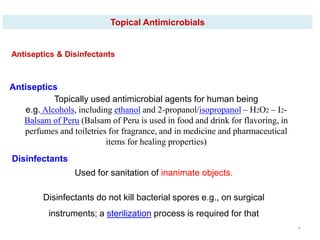
Antiseptics
Antiseptics & Disinfectants
Topically used antimicrobial agents for human being
e.g. Alcohols, including ethanol and 2-propanol/isopropanol – H2O2 – I2-
Balsam of Peru (Balsam of Peru is used in food and drink for flavoring, in
perfumes and toiletries for fragrance, and in medicine and pharmaceutical
items for healing properties)
Used for sanitation of inanimate objects.
Disinfectants do not kill bacterial spores e.g., on surgical
instruments; a sterilization process is required for that
Disinfectants
3
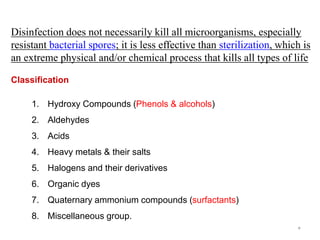
1. Hydroxy Compounds (Phenols & alcohols)
2. Aldehydes
3. Acids
4. Heavy metals & their salts
5. Halogens and their derivatives
6. Organic dyes
7. Quaternary ammonium compounds (surfactants)
8. Miscellaneous group.
Disinfection does not necessarily kill all microorganisms, especially
resistant bacterial spores; it is less effective than sterilization, which is
an extreme physical and/or chemical process that kills all types of life
Classification
4
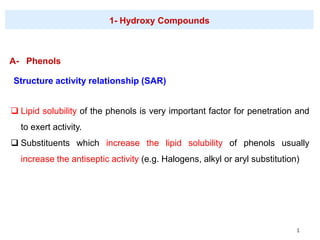
A- Phenols
1- Hydroxy Compounds
Structure activity relationship (SAR)
❑ Lipid solubility of the phenols is very important factor for penetration and
to exert activity.
❑ Substituents which increase the lipid solubility of phenols usually
increase the antiseptic activity (e.g. Halogens, alkyl or aryl substitution)
5
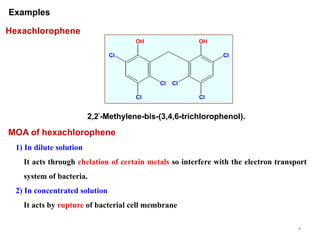
Hexachlorophene
OH OH
Cl
Cl
Cl
Cl
Cl Cl
Examples
1) In dilute solution
It acts through chelation of certain metals so interfere with the electron transport
system of bacteria.
2) In concentrated solution
It acts by rupture of bacterial cell membrane
2,2’-Methylene-bis-(3,4,6-trichlorophenol).
MOA of hexachlorophene
6
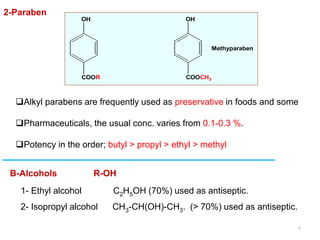
2-Paraben
OH
COOR
OH
COOCH3
Methyparaben
❑Alkyl parabens are frequently used as preservative in foods and some
❑Pharmaceuticals, the usual conc. varies from 0.1-0.3 %.
❑Potency in the order; butyl > propyl > ethyl > methyl
B-Alcohols R-OH
1- Ethyl alcohol C2H5OH (70%) used as antiseptic.
2- Isopropyl alcohol CH3-CH(OH)-CH3. (> 70%) used as antiseptic.
7
2- Paraformaldehyde (CH2O)n.
II- Aldehydes
1- Formaldehyde HCHO
It is used in sterilization in drug company to give aseptic areas
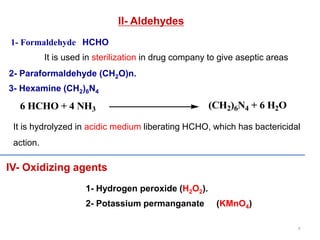
3- Hexamine (CH2)6N4
6 HCHO + 4 NH3 (CH2)6N4 + 6 H2O
It is hydrolyzed in acidic medium liberating HCHO, which has bactericidal
action.
IV- Oxidizing agents
1- Hydrogen peroxide (H2O2).
2- Potassium permanganate (KMnO4)
8
N
CH CH2 I2
O
n
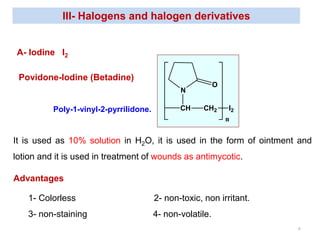
Povidone-Iodine (Betadine)
Poly-1-vinyl-2-pyrrilidone.
It is used as 10% solution in H2O, it is used in the form of ointment and
lotion and it is used in treatment of wounds as antimycotic.
1- Colorless 2- non-toxic, non irritant.
3- non-staining 4- non-volatile.
Advantages
III- Halogens and halogen derivatives
A- Iodine I2
9
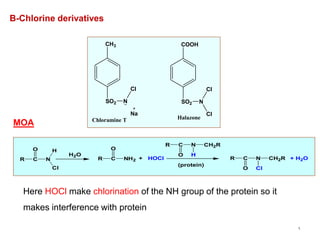
B-Chlorine derivatives
CH3
SO2 N
Cl
Na
COOH
SO2 N
Cl
Cl
Chloramine T Halazone
MOA
R C
O
N
H
Cl
H2O
R C
O
NH2 + HOCl
(protein)
R C N
O Cl
CH2R
R C N
O H
CH2R
+ H2O
Here HOCl make chlorination of the NH group of the protein so it
makes interference with protein
10
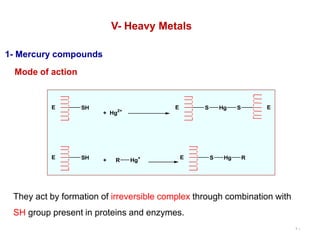
Mode of action
V- Heavy Metals
1- Mercury compounds
SH
E
+ Hg2+
S
E Hg S E
SH
E + R Hg+ S
E Hg R
They act by formation of irreversible complex through combination with
SH group present in proteins and enzymes.
11
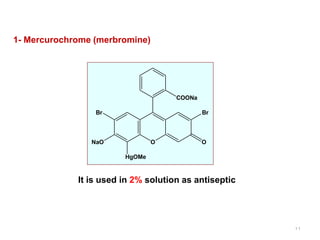
1- Mercurochrome (merbromine)
O
Br
NaO
COONa
O
Br
HgOMe
It is used in 2% solution as antiseptic
12
It was used in 1% conc. as a prophylactic against gonococcal neonatal
conjunctivitis
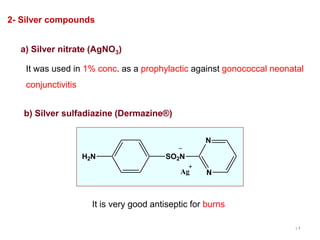
2- Silver compounds
a) Silver nitrate (AgNO3)
b) Silver sulfadiazine (Dermazine®)
H2N SO2N
N
N
Ag
It is very good antiseptic for burns
13
VI- Quaternary ammonium compounds
Surface-active agents are organic molecules that possess polar heads and
lipophilic tails.
1- Anchor their polar heads onto microbial cell wall by electrostatic interaction and
ionic bond formation with cell wall constituents.
2- The lipophilic tails interact with microbial lipid membrane, create a hole →leak
out of cytoplasmic content.
3- Bacteriolysis occurs and bactericidal activity is obtained.
MOA:
Surfactants are active against: gram +ve, gram –ve bacteria, pathogenic fungi
and protozoa
14
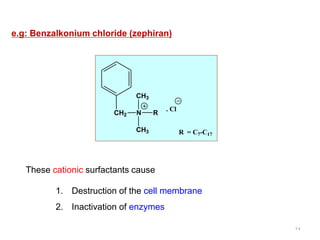
e.g: Benzalkonium chloride (zephiran)
CH2 N
CH3
CH3
R
. Cl
R = C7-C17
1. Destruction of the cell membrane
2. Inactivation of enzymes
These cationic surfactants cause
15
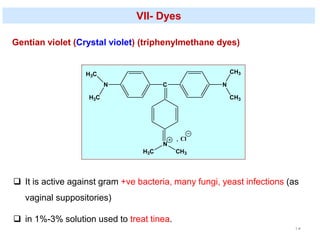
Gentian violet (Crystal violet) (triphenylmethane dyes)
VII- Dyes
N C
N
H3C CH3
Cl
.
N
H3C
H3C
CH3
CH3
❑ It is active against gram +ve bacteria, many fungi, yeast infections (as
vaginal suppositories)
❑ in 1%-3% solution used to treat tinea.
16
IX- Miscellaneous compounds
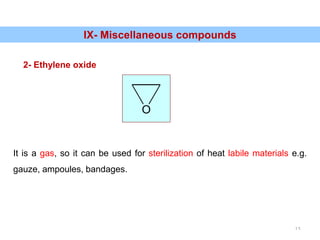
2- Ethylene oxide
O
It is a gas, so it can be used for sterilization of heat labile materials e.g.
gauze, ampoules, bandages.
Thymol-based disinfectant
Thymol, a phenolic chemical found in thyme, can be as effective as
an intermediate level disinfectant .Thyme essential oils have
bacteriostatic activity against a variety of microorganisms
including E. coli and S. aureus.
Non-chemical
Ultraviolet germicidal irradiation is the use of high-intensity
shortwave ultraviolet light for disinfecting smooth surfaces such as
dental tools.
17
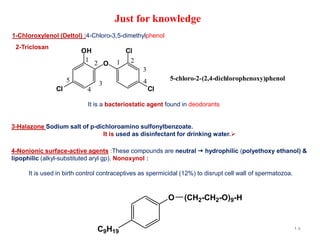
Just for knowledge
18
1-Chloroxylenol (Dettol) :4-Chloro-3,5-dimethylphenol
O
Cl
Cl
Cl
OH
5-chloro-2-(2,4-dichlorophenoxy)phenol
1 2
3
4
5
1 2
3
4
It is a bacteriostatic agent found in deodorants
2-Triclosan
3-Halazone Sodium salt of p-dichloroamino sulfonylbenzoate.
➢
It is used as disinfectant for drinking water.
4-Nonionic surface-active agents :These compounds are neutral  hydrophilic (polyethoxy ethanol) &
lipophilic (alkyl-substituted aryl gp). Nonoxynol :
It is used in birth control contraceptives as spermicidal (12%) to disrupt cell wall of spermatozoa.
O
C9H19
(CH2-CH2-O)9-H

Lecture 6- Topical Antimicrobials.pdf

  • 1.
  • 2.
    2 Topical Antimicrobials Antiseptics Antiseptics &Disinfectants Topically used antimicrobial agents for human being e.g. Alcohols, including ethanol and 2-propanol/isopropanol – H2O2 – I2- Balsam of Peru (Balsam of Peru is used in food and drink for flavoring, in perfumes and toiletries for fragrance, and in medicine and pharmaceutical items for healing properties) Used for sanitation of inanimate objects. Disinfectants do not kill bacterial spores e.g., on surgical instruments; a sterilization process is required for that Disinfectants
  • 3.
    3 1. Hydroxy Compounds(Phenols & alcohols) 2. Aldehydes 3. Acids 4. Heavy metals & their salts 5. Halogens and their derivatives 6. Organic dyes 7. Quaternary ammonium compounds (surfactants) 8. Miscellaneous group. Disinfection does not necessarily kill all microorganisms, especially resistant bacterial spores; it is less effective than sterilization, which is an extreme physical and/or chemical process that kills all types of life Classification
  • 4.
    4 A- Phenols 1- HydroxyCompounds Structure activity relationship (SAR) ❑ Lipid solubility of the phenols is very important factor for penetration and to exert activity. ❑ Substituents which increase the lipid solubility of phenols usually increase the antiseptic activity (e.g. Halogens, alkyl or aryl substitution)
  • 5.
    5 Hexachlorophene OH OH Cl Cl Cl Cl Cl Cl Examples 1)In dilute solution It acts through chelation of certain metals so interfere with the electron transport system of bacteria. 2) In concentrated solution It acts by rupture of bacterial cell membrane 2,2’-Methylene-bis-(3,4,6-trichlorophenol). MOA of hexachlorophene
  • 6.
    6 2-Paraben OH COOR OH COOCH3 Methyparaben ❑Alkyl parabens arefrequently used as preservative in foods and some ❑Pharmaceuticals, the usual conc. varies from 0.1-0.3 %. ❑Potency in the order; butyl > propyl > ethyl > methyl B-Alcohols R-OH 1- Ethyl alcohol C2H5OH (70%) used as antiseptic. 2- Isopropyl alcohol CH3-CH(OH)-CH3. (> 70%) used as antiseptic.
  • 7.
    7 2- Paraformaldehyde (CH2O)n. II-Aldehydes 1- Formaldehyde HCHO It is used in sterilization in drug company to give aseptic areas 3- Hexamine (CH2)6N4 6 HCHO + 4 NH3 (CH2)6N4 + 6 H2O It is hydrolyzed in acidic medium liberating HCHO, which has bactericidal action. IV- Oxidizing agents 1- Hydrogen peroxide (H2O2). 2- Potassium permanganate (KMnO4)
  • 8.
    8 N CH CH2 I2 O n Povidone-Iodine(Betadine) Poly-1-vinyl-2-pyrrilidone. It is used as 10% solution in H2O, it is used in the form of ointment and lotion and it is used in treatment of wounds as antimycotic. 1- Colorless 2- non-toxic, non irritant. 3- non-staining 4- non-volatile. Advantages III- Halogens and halogen derivatives A- Iodine I2
  • 9.
    9 B-Chlorine derivatives CH3 SO2 N Cl Na COOH SO2N Cl Cl Chloramine T Halazone MOA R C O N H Cl H2O R C O NH2 + HOCl (protein) R C N O Cl CH2R R C N O H CH2R + H2O Here HOCl make chlorination of the NH group of the protein so it makes interference with protein
  • 10.
    10 Mode of action V-Heavy Metals 1- Mercury compounds SH E + Hg2+ S E Hg S E SH E + R Hg+ S E Hg R They act by formation of irreversible complex through combination with SH group present in proteins and enzymes.
  • 11.
  • 12.
    12 It was usedin 1% conc. as a prophylactic against gonococcal neonatal conjunctivitis 2- Silver compounds a) Silver nitrate (AgNO3) b) Silver sulfadiazine (Dermazine®) H2N SO2N N N Ag It is very good antiseptic for burns
  • 13.
    13 VI- Quaternary ammoniumcompounds Surface-active agents are organic molecules that possess polar heads and lipophilic tails. 1- Anchor their polar heads onto microbial cell wall by electrostatic interaction and ionic bond formation with cell wall constituents. 2- The lipophilic tails interact with microbial lipid membrane, create a hole →leak out of cytoplasmic content. 3- Bacteriolysis occurs and bactericidal activity is obtained. MOA: Surfactants are active against: gram +ve, gram –ve bacteria, pathogenic fungi and protozoa
  • 14.
    14 e.g: Benzalkonium chloride(zephiran) CH2 N CH3 CH3 R . Cl R = C7-C17 1. Destruction of the cell membrane 2. Inactivation of enzymes These cationic surfactants cause
  • 15.
    15 Gentian violet (Crystalviolet) (triphenylmethane dyes) VII- Dyes N C N H3C CH3 Cl . N H3C H3C CH3 CH3 ❑ It is active against gram +ve bacteria, many fungi, yeast infections (as vaginal suppositories) ❑ in 1%-3% solution used to treat tinea.
  • 16.
    16 IX- Miscellaneous compounds 2-Ethylene oxide O It is a gas, so it can be used for sterilization of heat labile materials e.g. gauze, ampoules, bandages.
  • 17.
    Thymol-based disinfectant Thymol, aphenolic chemical found in thyme, can be as effective as an intermediate level disinfectant .Thyme essential oils have bacteriostatic activity against a variety of microorganisms including E. coli and S. aureus. Non-chemical Ultraviolet germicidal irradiation is the use of high-intensity shortwave ultraviolet light for disinfecting smooth surfaces such as dental tools. 17
  • 18.
    Just for knowledge 18 1-Chloroxylenol(Dettol) :4-Chloro-3,5-dimethylphenol O Cl Cl Cl OH 5-chloro-2-(2,4-dichlorophenoxy)phenol 1 2 3 4 5 1 2 3 4 It is a bacteriostatic agent found in deodorants 2-Triclosan 3-Halazone Sodium salt of p-dichloroamino sulfonylbenzoate. ➢ It is used as disinfectant for drinking water. 4-Nonionic surface-active agents :These compounds are neutral  hydrophilic (polyethoxy ethanol) & lipophilic (alkyl-substituted aryl gp). Nonoxynol : It is used in birth control contraceptives as spermicidal (12%) to disrupt cell wall of spermatozoa. O C9H19 (CH2-CH2-O)9-H