Sally Floyd and Van Jacobson
         “Random Early Detection
          Gateway for Congestion
               Avoidance” "
               TON, 1993
11 September 2009
   CS5229, Semester 1 2009/10
   1
Router’s "
              Queue Management 


11 September 2009
   CS5229, Semester 1 2009/10
   2
Manages sharing of "
                      (i) buffer space"
                       (ii) bandwidth


11 September 2009
       CS5229, Semester 1 2009/10
   3
Q1: Which packet to drop "
               (and when to drop) ?


11 September 2009
   CS5229, Semester 1 2009/10
   4
Q2: Which packet to send next?


11 September 2009
   CS5229, Semester 1 2009/10
   5
FIFO + Drop Tail


11 September 2009
   CS5229, Semester 1 2009/10
   6
Keep a single queue


11 September 2009
   CS5229, Semester 1 2009/10
   7
Drop what/when? "
                     Drop arriving packets "
                      when queue is full


11 September 2009
        CS5229, Semester 1 2009/10
   8
Send what? "
                     Send the packet at "
                       head of queue


11 September 2009
       CS5229, Semester 1 2009/10
   9
Round Robin


11 September 2009
     CS5229, Semester 1 2009/10
   10
One queue per flow


11 September 2009
   CS5229, Semester 1 2009/10
   11
Drop what/when? !
            Drop arriving packets from "
             flow i when queue i is full


11 September 2009
   CS5229, Semester 1 2009/10
   12
Send what? "
  Each flow takes turn -- send the
 packet at the head of the queues in
      a round robin manner.


11 September 2009
   CS5229, Semester 1 2009/10
   13
Advantages of "
                FIFO and Drop Tail


11 September 2009
   CS5229, Semester 1 2009/10
   14
Simple to implement


11 September 2009
       CS5229, Semester 1 2009/10
   15
Scale well"
             (no per-connection states)


11 September 2009
   CS5229, Semester 1 2009/10
   16
Reduce delay for a bursty
                   connection"
                    (e.g. VoIP)


11 September 2009
   CS5229, Semester 1 2009/10
   17
Problems with "
                FIFO and Drop Tail


11 September 2009
   CS5229, Semester 1 2009/10
   18
Problem 1!
              Bias against bursty traffic"

      burstiness increases chances that the queue will
                         overflow


11 September 2009
   CS5229, Semester 1 2009/10
         19
Problem 2!
                 Global synchronization"

     connections reduce their windows simultaneously,
                    lowering utilization.            

11 September 2009
     CS5229, Semester 1 2009/10
       20
Problem 3!
                            Queue size"

                     higher bandwidth needs longer "
                        queue, increasing delay. "
                     TCP tries to keep the queue full.    
11 September 2009
          CS5229, Semester 1 2009/10
       21
Problem 4!
                     No isolation against "
                     unresponsive flows


11 September 2009
       CS5229, Semester 1 2009/10
   22
Random Drop


11 September 2009
     CS5229, Semester 1 2009/10
   23
Keep a single queue


11 September 2009
       CS5229, Semester 1 2009/10
   24
Drop what/when? "
           Drop random packet in the queue "
                  when queue is full


11 September 2009
   CS5229, Semester 1 2009/10
   25
Send what? "
                     Send the packet at "
                       head of queue


11 September 2009
       CS5229, Semester 1 2009/10
   26
No bias against bursty traffic -- "
   bursty arrival causes random packets to
   be dropped.


11 September 2009
   CS5229, Semester 1 2009/10
   27
Flows with higher rate occupy
   more buffer spaces, have higher
   chance to be dropped.


11 September 2009
   CS5229, Semester 1 2009/10
   28
Signal flows that is congesting the
   network to slow down.


11 September 2009
   CS5229, Semester 1 2009/10
   29
Random drop recovers from
   congestion (full queue) by
   dropping packets. 


11 September 2009
   CS5229, Semester 1 2009/10
   30
Early Random Drop


11 September 2009
   CS5229, Semester 1 2009/10
   31
Drop what/when? "
       Drop arriving packet randomly
        when queue is longer than a
                  threshold


11 September 2009
   CS5229, Semester 1 2009/10
   32
Early random drop avoids
   congestion (full queue) by
   dropping packets before queue is
   full. 


11 September 2009
   CS5229, Semester 1 2009/10
   33
RED"
      Random Early Detection


11 September 2009
   CS5229, Semester 1 2009/10
   34
Drop what/when? !
    Drop arriving packet randomly
     when average queue length "
        is above a threshold

11 September 2009
   CS5229, Semester 1 2009/10
   35
Differences: Use average queue
 length instead of instantaneous
     length to absorb transient
            congestion.

11 September 2009
   CS5229, Semester 1 2009/10
   36
Differences: Dropping probability
changes dynamically depending
        on queue length.


11 September 2009
   CS5229, Semester 1 2009/10
   37
Dropping Probability


     1


                                                    Average Queue Length
11 September 2009
         CS5229, Semester 1 2009/10
                     38
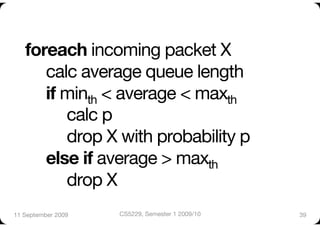
foreach incoming packet X"
     
calc average queue length"
     
if minth < average < maxth"
     
 
calc p "
     
 
drop X with probability p"
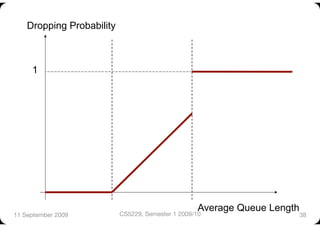
     
else if average > maxth"
     
 
drop X
11 September 2009
   CS5229, Semester 1 2009/10
   39
(Instead of dropping packets, we
   can also mark a packet to indicate
   congestion)


11 September 2009
   CS5229, Semester 1 2009/10
   40
How to calculate average queue
   length?"

   How to calculate drop probability?"

   How to set thresholds?

11 September 2009
   CS5229, Semester 1 2009/10
   41
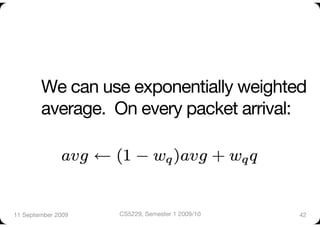
We can use exponentially weighted
        average. On every packet arrival:


11 September 2009
   CS5229, Semester 1 2009/10
   42
Large wq : A burst of packets will
    cause avg to increase too fast, hit
    the max threshold"

    Small wq : avg increases too slowly
    and we are unable to detect initial
    stage of congestions.
11 September 2009
   CS5229, Semester 1 2009/10
   43
11 September 2009
   CS5229, Semester 1 2009/10
   44
11 September 2009
   CS5229, Semester 1 2009/10
   45
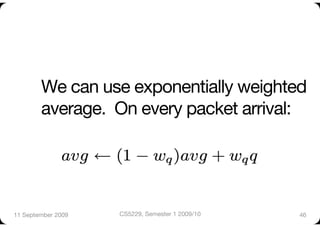
We can use exponentially weighted
        average. On every packet arrival:


11 September 2009
   CS5229, Semester 1 2009/10
   46
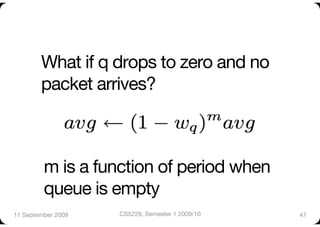
What if q drops to zero and no
        packet arrives?


         m is a function of period when
         queue is empty
11 September 2009
   CS5229, Semester 1 2009/10
   47
How to calculate average queue
   length?"

   How to calculate drop probability"

   How to set thresholds?

11 September 2009
   CS5229, Semester 1 2009/10
   48
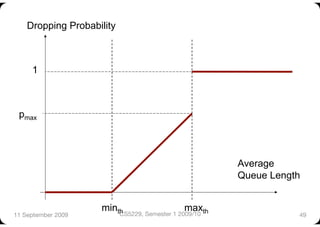
Dropping Probability


     1


 pmax


                                                         Average
                                                         Queue Length


                     minth                      maxth
11 September 2009
         CS5229, Semester 1 2009/10
              49
11 September 2009
   CS5229, Semester 1 2009/10
   50
11 September 2009
   CS5229, Semester 1 2009/10
   51
How to calculate average queue
   length?"

   How to calculate drop probability?"

   How to set thresholds?

11 September 2009
   CS5229, Semester 1 2009/10
   52
maxth - minth should be sufficiently"
   large otherwise average queue size
   can oscillate beyond maxth"
   “need more research” for optimal
   value.

11 September 2009
   CS5229, Semester 1 2009/10
   53
Advantages of RED


11 September 2009
   CS5229, Semester 1 2009/10
   54
No bias against bursty flows"
            Less global synchronization"
           Control average queue length


11 September 2009
   CS5229, Semester 1 2009/10
   55
RED does not deal with
                      unresponsive flows


11 September 2009
        CS5229, Semester 1 2009/10
   56
ns-2 demo


11 September 2009
    CS5229, Semester 1 2009/10
   57
Variations of RED


11 September 2009
   CS5229, Semester 1 2009/10
   58
RED biases against flow with small
              packet size 


11 September 2009
   CS5229, Semester 1 2009/10
   59
We can fix this by weighting drop
         probability to packet size


11 September 2009
   CS5229, Semester 1 2009/10
   60
A router can keep one queue per
       flow and apply RED to each one.


11 September 2009
   CS5229, Semester 1 2009/10
   61
Drop probability can be weighted
           with the priority of the flow.


11 September 2009
   CS5229, Semester 1 2009/10
   62
This is known as WRED and is
   implemented in some Cisco routers.


11 September 2009
   CS5229, Semester 1 2009/10
   63
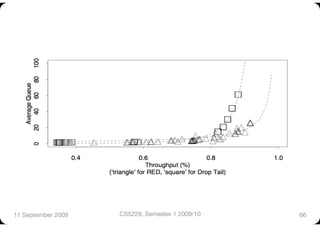
Simulation"
                      Results

11 September 2009
     CS5229, Semester 1 2009/10
   64
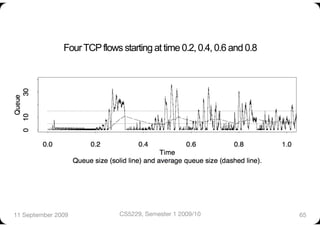
Four TCP flows starting at time 0.2, 0.4, 0.6 and 0.8


11 September 2009
            CS5229, Semester 1 2009/10
              65
11 September 2009
   CS5229, Semester 1 2009/10
   66
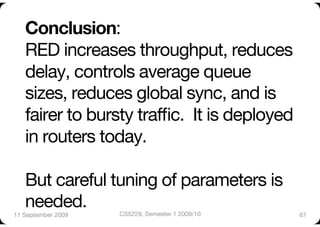
Conclusion:"
   RED increases throughput, reduces
   delay, controls average queue
   sizes, reduces global sync, and is
   fairer to bursty traffic. It is deployed
   in routers today."

   But careful tuning of parameters is
   needed. 
         CS5229, Semester 1 2009/10
11 September 2009
                                 67

Lecture 5: RED

  • 1.
    Sally Floyd andVan Jacobson “Random Early Detection Gateway for Congestion Avoidance” " TON, 1993 11 September 2009 CS5229, Semester 1 2009/10 1
  • 2.
    Router’s " Queue Management 11 September 2009 CS5229, Semester 1 2009/10 2
  • 3.
    Manages sharing of" (i) buffer space" (ii) bandwidth 11 September 2009 CS5229, Semester 1 2009/10 3
  • 4.
    Q1: Which packetto drop " (and when to drop) ? 11 September 2009 CS5229, Semester 1 2009/10 4
  • 5.
    Q2: Which packetto send next? 11 September 2009 CS5229, Semester 1 2009/10 5
  • 6.
    FIFO + DropTail 11 September 2009 CS5229, Semester 1 2009/10 6
  • 7.
    Keep a singlequeue 11 September 2009 CS5229, Semester 1 2009/10 7
  • 8.
    Drop what/when? " Drop arriving packets " when queue is full 11 September 2009 CS5229, Semester 1 2009/10 8
  • 9.
    Send what? " Send the packet at " head of queue 11 September 2009 CS5229, Semester 1 2009/10 9
  • 10.
    Round Robin 11 September2009 CS5229, Semester 1 2009/10 10
  • 11.
    One queue perflow 11 September 2009 CS5229, Semester 1 2009/10 11
  • 12.
    Drop what/when? ! Drop arriving packets from " flow i when queue i is full 11 September 2009 CS5229, Semester 1 2009/10 12
  • 13.
    Send what? " Each flow takes turn -- send the packet at the head of the queues in a round robin manner. 11 September 2009 CS5229, Semester 1 2009/10 13
  • 14.
    Advantages of " FIFO and Drop Tail 11 September 2009 CS5229, Semester 1 2009/10 14
  • 15.
    Simple to implement 11September 2009 CS5229, Semester 1 2009/10 15
  • 16.
    Scale well" (no per-connection states) 11 September 2009 CS5229, Semester 1 2009/10 16
  • 17.
    Reduce delay fora bursty connection" (e.g. VoIP) 11 September 2009 CS5229, Semester 1 2009/10 17
  • 18.
    Problems with " FIFO and Drop Tail 11 September 2009 CS5229, Semester 1 2009/10 18
  • 19.
    Problem 1! Bias against bursty traffic" burstiness increases chances that the queue will overflow 11 September 2009 CS5229, Semester 1 2009/10 19
  • 20.
    Problem 2! Global synchronization" connections reduce their windows simultaneously, lowering utilization. 11 September 2009 CS5229, Semester 1 2009/10 20
  • 21.
    Problem 3! Queue size" higher bandwidth needs longer " queue, increasing delay. " TCP tries to keep the queue full. 11 September 2009 CS5229, Semester 1 2009/10 21
  • 22.
    Problem 4! No isolation against " unresponsive flows 11 September 2009 CS5229, Semester 1 2009/10 22
  • 23.
    Random Drop 11 September2009 CS5229, Semester 1 2009/10 23
  • 24.
    Keep a singlequeue 11 September 2009 CS5229, Semester 1 2009/10 24
  • 25.
    Drop what/when? " Drop random packet in the queue " when queue is full 11 September 2009 CS5229, Semester 1 2009/10 25
  • 26.
    Send what? " Send the packet at " head of queue 11 September 2009 CS5229, Semester 1 2009/10 26
  • 27.
    No bias againstbursty traffic -- " bursty arrival causes random packets to be dropped. 11 September 2009 CS5229, Semester 1 2009/10 27
  • 28.
    Flows with higherrate occupy more buffer spaces, have higher chance to be dropped. 11 September 2009 CS5229, Semester 1 2009/10 28
  • 29.
    Signal flows thatis congesting the network to slow down. 11 September 2009 CS5229, Semester 1 2009/10 29
  • 30.
    Random drop recoversfrom congestion (full queue) by dropping packets. 11 September 2009 CS5229, Semester 1 2009/10 30
  • 31.
    Early Random Drop 11September 2009 CS5229, Semester 1 2009/10 31
  • 32.
    Drop what/when? " Drop arriving packet randomly when queue is longer than a threshold 11 September 2009 CS5229, Semester 1 2009/10 32
  • 33.
    Early random dropavoids congestion (full queue) by dropping packets before queue is full. 11 September 2009 CS5229, Semester 1 2009/10 33
  • 34.
    RED" Random Early Detection 11 September 2009 CS5229, Semester 1 2009/10 34
  • 35.
    Drop what/when? ! Drop arriving packet randomly when average queue length " is above a threshold 11 September 2009 CS5229, Semester 1 2009/10 35
  • 36.
    Differences: Use averagequeue length instead of instantaneous length to absorb transient congestion. 11 September 2009 CS5229, Semester 1 2009/10 36
  • 37.
    Differences: Dropping probability changesdynamically depending on queue length. 11 September 2009 CS5229, Semester 1 2009/10 37
  • 38.
    Dropping Probability 1 Average Queue Length 11 September 2009 CS5229, Semester 1 2009/10 38
  • 39.
    foreach incoming packetX" calc average queue length" if minth < average < maxth" calc p " drop X with probability p" else if average > maxth" drop X 11 September 2009 CS5229, Semester 1 2009/10 39
  • 40.
    (Instead of droppingpackets, we can also mark a packet to indicate congestion) 11 September 2009 CS5229, Semester 1 2009/10 40
  • 41.
    How to calculateaverage queue length?" How to calculate drop probability?" How to set thresholds? 11 September 2009 CS5229, Semester 1 2009/10 41
  • 42.
    We can useexponentially weighted average. On every packet arrival: 11 September 2009 CS5229, Semester 1 2009/10 42
  • 43.
    Large wq :A burst of packets will cause avg to increase too fast, hit the max threshold" Small wq : avg increases too slowly and we are unable to detect initial stage of congestions. 11 September 2009 CS5229, Semester 1 2009/10 43
  • 44.
    11 September 2009 CS5229, Semester 1 2009/10 44
  • 45.
    11 September 2009 CS5229, Semester 1 2009/10 45
  • 46.
    We can useexponentially weighted average. On every packet arrival: 11 September 2009 CS5229, Semester 1 2009/10 46
  • 47.
    What if qdrops to zero and no packet arrives? m is a function of period when queue is empty 11 September 2009 CS5229, Semester 1 2009/10 47
  • 48.
    How to calculateaverage queue length?" How to calculate drop probability" How to set thresholds? 11 September 2009 CS5229, Semester 1 2009/10 48
  • 49.
    Dropping Probability 1 pmax Average Queue Length minth maxth 11 September 2009 CS5229, Semester 1 2009/10 49
  • 50.
    11 September 2009 CS5229, Semester 1 2009/10 50
  • 51.
    11 September 2009 CS5229, Semester 1 2009/10 51
  • 52.
    How to calculateaverage queue length?" How to calculate drop probability?" How to set thresholds? 11 September 2009 CS5229, Semester 1 2009/10 52
  • 53.
    maxth - minthshould be sufficiently" large otherwise average queue size can oscillate beyond maxth" “need more research” for optimal value. 11 September 2009 CS5229, Semester 1 2009/10 53
  • 54.
    Advantages of RED 11September 2009 CS5229, Semester 1 2009/10 54
  • 55.
    No bias againstbursty flows" Less global synchronization" Control average queue length 11 September 2009 CS5229, Semester 1 2009/10 55
  • 56.
    RED does notdeal with unresponsive flows 11 September 2009 CS5229, Semester 1 2009/10 56
  • 57.
    ns-2 demo 11 September2009 CS5229, Semester 1 2009/10 57
  • 58.
    Variations of RED 11September 2009 CS5229, Semester 1 2009/10 58
  • 59.
    RED biases againstflow with small packet size 11 September 2009 CS5229, Semester 1 2009/10 59
  • 60.
    We can fixthis by weighting drop probability to packet size 11 September 2009 CS5229, Semester 1 2009/10 60
  • 61.
    A router cankeep one queue per flow and apply RED to each one. 11 September 2009 CS5229, Semester 1 2009/10 61
  • 62.
    Drop probability canbe weighted with the priority of the flow. 11 September 2009 CS5229, Semester 1 2009/10 62
  • 63.
    This is knownas WRED and is implemented in some Cisco routers. 11 September 2009 CS5229, Semester 1 2009/10 63
  • 64.
    Simulation" Results 11 September 2009 CS5229, Semester 1 2009/10 64
  • 65.
    Four TCP flowsstarting at time 0.2, 0.4, 0.6 and 0.8 11 September 2009 CS5229, Semester 1 2009/10 65
  • 66.
    11 September 2009 CS5229, Semester 1 2009/10 66
  • 67.
    Conclusion:" RED increases throughput, reduces delay, controls average queue sizes, reduces global sync, and is fairer to bursty traffic. It is deployed in routers today." But careful tuning of parameters is needed. CS5229, Semester 1 2009/10 11 September 2009 67