Introduction toIntroduction to
Computer Science IIComputer Science II
COSC 1320/6305
Lecture 5:Lecture 5: InheritanceInheritance
(Chapter 7)(Chapter 7)
7-2Copyright © 2010 Pearson Addison-Wesley. All rights reserved.
Introduction to Inheritance
• Inheritance is one of the main techniques of object-oriented
programming (OOP)
• Using this technique, a very general form of a class is first
defined and compiled, and then more specialized versions
of the class are defined by adding instance variables and
methods
– The specialized classes are said to inherit the methods and
instance variables of the general class
7-3Copyright © 2010 Pearson Addison-Wesley. All rights reserved.
Introduction to Inheritance
• Inheritance is the process by which a new class is created from
another class
– The new class is called a derived class
– The original class is called the base class
• A derived class automatically has all the instance variables and
methods that the base class has, and it can have additional methods
and/or instance variables as well
• Inheritance is especially advantageous because it allows code to be
reused, without having to copy it into the definitions of the derived
classes
7-4Copyright © 2010 Pearson Addison-Wesley. All rights reserved.
7-5Copyright © 2010 Pearson Addison-Wesley. All rights reserved.
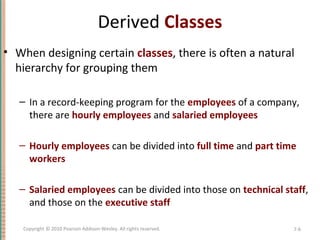
Derived Classes
• When designing certain classes, there is often a natural
hierarchy for grouping them
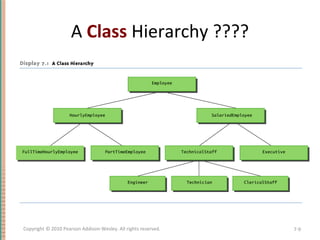
– In a record-keeping program for the employees of a company,
there are hourly employees and salaried employees
– Hourly employees can be divided into full time and part time
workers
– Salaried employees can be divided into those on technical staff,
and those on the executive staff
7-6Copyright © 2010 Pearson Addison-Wesley. All rights reserved.
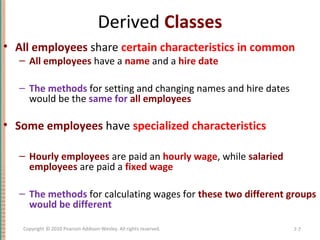
Derived Classes
• All employees share certain characteristics in common
– All employees have a name and a hire date
– The methods for setting and changing names and hire dates
would be the same for all employees
• Some employees have specialized characteristics
– Hourly employees are paid an hourly wage, while salaried
employees are paid a fixed wage
– The methods for calculating wages for these two different groups
would be different
7-7Copyright © 2010 Pearson Addison-Wesley. All rights reserved.
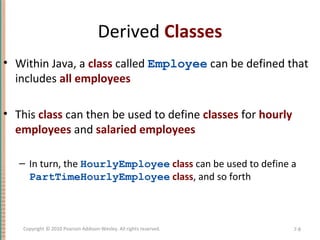
Derived Classes
• Within Java, a class called Employee can be defined that
includes all employees
• This class can then be used to define classes for hourly
employees and salaried employees
– In turn, the HourlyEmployee class can be used to define a
PartTimeHourlyEmployee class, and so forth
7-8Copyright © 2010 Pearson Addison-Wesley. All rights reserved.
A Class Hierarchy ????
7-9Copyright © 2010 Pearson Addison-Wesley. All rights reserved.
7-10Copyright © 2010 Pearson Addison-Wesley. All rights reserved.
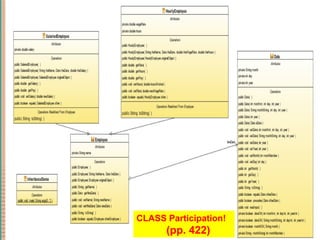
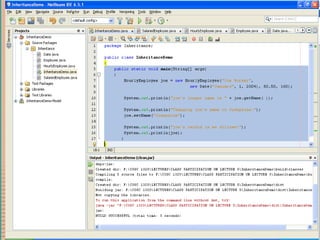
CLASS Participation!
(pp. 422)
7-11Copyright © 2010 Pearson Addison-Wesley. All rights reserved.
7-12Copyright © 2010 Pearson Addison-Wesley. All rights reserved.
Derived Classes
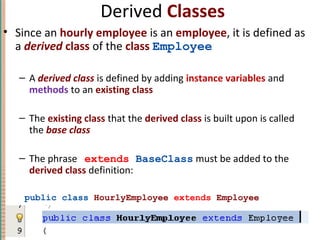
• Since an hourly employee is an employee, it is defined as
a derived class of the class Employee
– A derived class is defined by adding instance variables and
methods to an existing class
– The existing class that the derived class is built upon is called
the base class
– The phrase extends BaseClass must be added to the
derived class definition:
public class HourlyEmployee extends Employee
7-13Copyright © 2010 Pearson Addison-Wesley. All rights reserved.
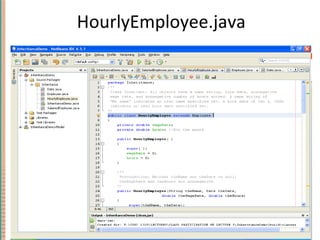
HourlyEmployee.java
7-14Copyright © 2010 Pearson Addison-Wesley. All rights reserved.
Derived Classes
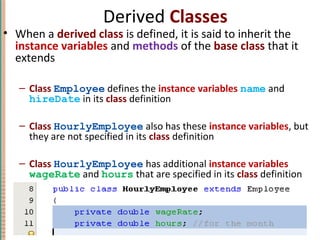
• When a derived class is defined, it is said to inherit the
instance variables and methods of the base class that it
extends
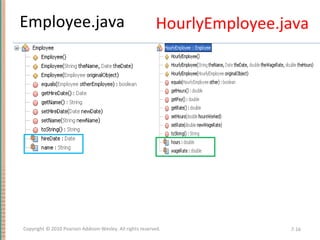
– Class Employee defines the instance variables name and
hireDate in its class definition
– Class HourlyEmployee also has these instance variables, but
they are not specified in its class definition
– Class HourlyEmployee has additional instance variables
wageRate and hours that are specified in its class definition
7-15Copyright © 2010 Pearson Addison-Wesley. All rights reserved.
HourlyEmployee.java
7-16Copyright © 2010 Pearson Addison-Wesley. All rights reserved.
Employee.java
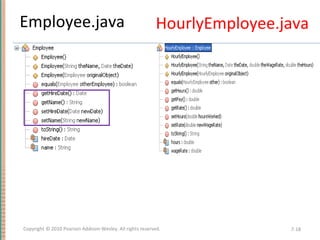
Derived Classes
• Just as it inherits the instance variables of the class
Employee, the class HourlyEmployee inherits all of its
methods as well
– The class HourlyEmployee inherits the methods getName,
getHireDate, setName, and setHireDate from the class
Employee
– Any object of the class HourlyEmployee can invoke one of
these methods, just like any other method
7-17Copyright © 2010 Pearson Addison-Wesley. All rights reserved.
HourlyEmployee.java
7-18Copyright © 2010 Pearson Addison-Wesley. All rights reserved.
Employee.java
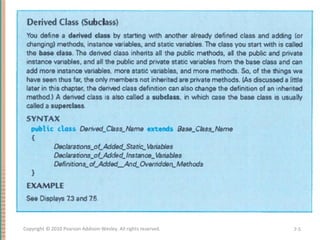
Derived Class (Subclass)
• A derived class, also called a subclass, is defined by
starting with another already defined class, called a base
class or superclass, and adding (and/or changing)
methods, instance variables, and static variables
– The derived class inherits all the public methods, all the public
and private instance variables, and all the public and private
static variables from the base class
– The derived class can add more instance variables, static
variables, and/or methods
7-19Copyright © 2010 Pearson Addison-Wesley. All rights reserved.
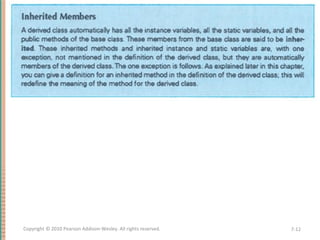
Inherited Members
• A derived class automatically has all the instance variables,
all the static variables, and all the public methods of the
base class
– Members from the base class are said to be inherited
• Definitions for the inherited variables and methods do not
appear in the derived class
– The code is reused without having to explicitly copy it, unless the
creator of the derived class redefines one or more of the base
class methods
7-20Copyright © 2010 Pearson Addison-Wesley. All rights reserved.
7-21Copyright © 2010 Pearson Addison-Wesley. All rights reserved.
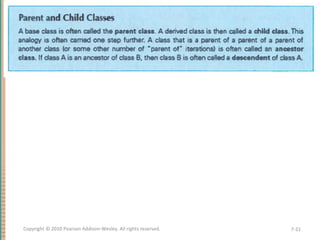
Parent and Child Classes
• A base class is often called the parent class
– A derived class is then called a child class
• These relationships are often extended such that a class
that is a parent of a parent . . . of another class is called an
ancestor class
– If class A is an ancestor of class B, then class B can be called a
descendent of class A
7-22Copyright © 2010 Pearson Addison-Wesley. All rights reserved.
7-23Copyright © 2010 Pearson Addison-Wesley. All rights reserved.
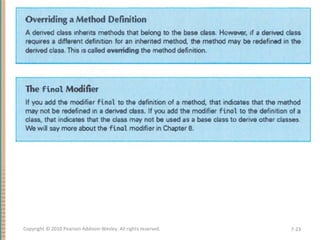
Overriding a Method Definition
• Although a derived class inherits methods from
the base class, it can change or override an
inherited method if necessary
– In order to override a method definition, a new
definition of the method is simply placed in the class
definition, just like any other method that is added to
the derived class
7-24Copyright © 2010 Pearson Addison-Wesley. All rights reserved.
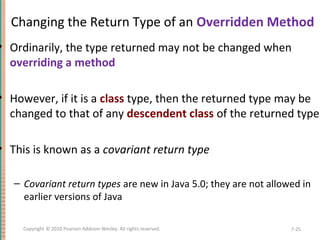
Changing the Return Type of an Overridden Method
• Ordinarily, the type returned may not be changed when
overriding a method
• However, if it is a class type, then the returned type may be
changed to that of any descendent class of the returned type
• This is known as a covariant return type
– Covariant return types are new in Java 5.0; they are not allowed in
earlier versions of Java
7-25Copyright © 2010 Pearson Addison-Wesley. All rights reserved.
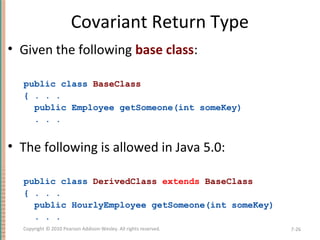
Covariant Return Type
• Given the following base class:
public class BaseClass
{ . . .
public Employee getSomeone(int someKey)
. . .
• The following is allowed in Java 5.0:
public class DerivedClass extends BaseClass
{ . . .
public HourlyEmployee getSomeone(int someKey)
. . .
7-26Copyright © 2010 Pearson Addison-Wesley. All rights reserved.
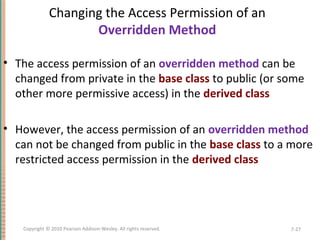
Changing the Access Permission of an
Overridden Method
• The access permission of an overridden method can be
changed from private in the base class to public (or some
other more permissive access) in the derived class
• However, the access permission of an overridden method
can not be changed from public in the base class to a more
restricted access permission in the derived class
7-27Copyright © 2010 Pearson Addison-Wesley. All rights reserved.
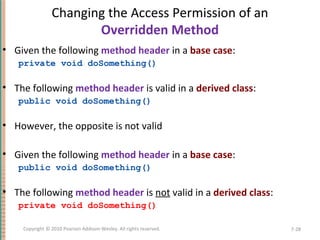
Changing the Access Permission of an
Overridden Method
• Given the following method header in a base case:
private void doSomething()
• The following method header is valid in a derived class:
public void doSomething()
• However, the opposite is not valid
• Given the following method header in a base case:
public void doSomething()
• The following method header is not valid in a derived class:
private void doSomething()
7-28Copyright © 2010 Pearson Addison-Wesley. All rights reserved.
Pitfall: Overriding Versus Overloading
• Do not confuse overriding a method in a derived class with
overloading a method name
– When a method is overridden, the new method definition given
in the derived class has the exact same number and types of
parameters as in the base class
– When a method in a derived class has a different signature from
the method in the base class, that is overloading
– Note that when the derived class overloads the original method,
it still inherits the original method from the base class as well
7-29Copyright © 2010 Pearson Addison-Wesley. All rights reserved.
The final Modifier
• If the modifier final is placed before the definition
of a method, then that method may not be
redefined in a derived class
• It the modifier final is placed before the definition
of a class, then that class may not be used as a base
class to derive other classes
7-30Copyright © 2010 Pearson Addison-Wesley. All rights reserved.
7-31Copyright © 2010 Pearson Addison-Wesley. All rights reserved.
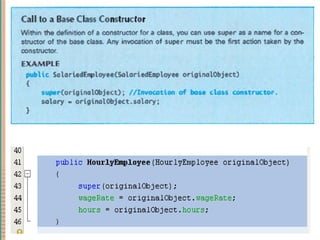
The super Constructor
• A derived class uses a constructor from the base class to initialize all
the data inherited from the base class
– In order to invoke a constructor from the base class, it uses a special syntax:
public derivedClass(int p1, int p2, double p3)
{
super(p1, p2);
instanceVariable = p3;
}
– In the above example, super(p1, p2); is a call to the base class constructor
7-32Copyright © 2010 Pearson Addison-Wesley. All rights reserved.
The super Constructor
• A call to the base class constructor can never use the name
of the base class, but uses the keyword super instead
• A call to super must always be the first action taken in a
constructor definition
• An instance variable cannot be used as an argument to
super
7-33Copyright © 2010 Pearson Addison-Wesley. All rights reserved.
The super Constructor
• If a derived class constructor does not include an
invocation of super, then the no-argument constructor of
the base class will automatically be invoked
– This can result in an error if the base class has not defined a no-
argument constructor
• Since the inherited instance variables should be initialized,
and the base class constructor is designed to do that, then
an explicit call to super should always be used
7-34Copyright © 2010 Pearson Addison-Wesley. All rights reserved.
7-35Copyright © 2010 Pearson Addison-Wesley. All rights reserved.
The this Constructor
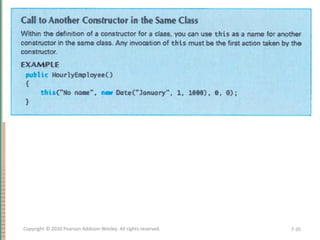
• Within the definition of a constructor for a class, this can
be used as a name for invoking another constructor in the
same class
– The same restrictions on how to use a call to super apply to the
this constructor
• If it is necessary to include a call to both super and this,
the call using this must be made first, and then the
constructor that is called must call super as its first action
7-36Copyright © 2010 Pearson Addison-Wesley. All rights reserved.
The this Constructor
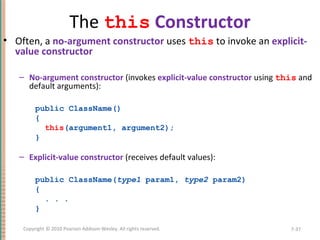
• Often, a no-argument constructor uses this to invoke an explicit-
value constructor
– No-argument constructor (invokes explicit-value constructor using this and
default arguments):
public ClassName()
{
this(argument1, argument2);
}
– Explicit-value constructor (receives default values):
public ClassName(type1 param1, type2 param2)
{
. . .
}
7-37Copyright © 2010 Pearson Addison-Wesley. All rights reserved.
The this Constructor
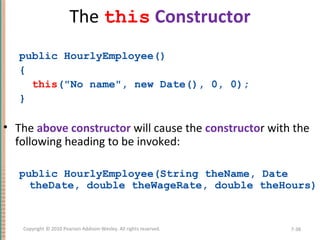
public HourlyEmployee()
{
this("No name", new Date(), 0, 0);
}
• The above constructor will cause the constructor with the
following heading to be invoked:
public HourlyEmployee(String theName, Date
theDate, double theWageRate, double theHours)
7-38Copyright © 2010 Pearson Addison-Wesley. All rights reserved.
7-39Copyright © 2010 Pearson Addison-Wesley. All rights reserved.
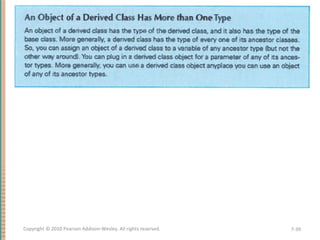
Tip: An Object of a Derived Class Has More than
One Type
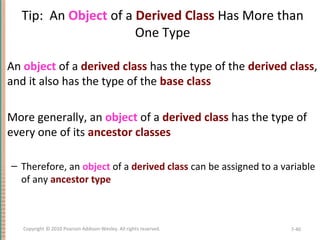
An object of a derived class has the type of the derived class,
and it also has the type of the base class
More generally, an object of a derived class has the type of
every one of its ancestor classes
– Therefore, an object of a derived class can be assigned to a variable
of any ancestor type
7-40Copyright © 2010 Pearson Addison-Wesley. All rights reserved.
Tip: An Object of a Derived Class Has More than
One Type
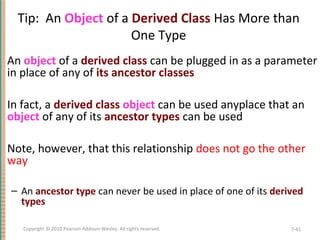
An object of a derived class can be plugged in as a parameter
in place of any of its ancestor classes
In fact, a derived class object can be used anyplace that an
object of any of its ancestor types can be used
Note, however, that this relationship does not go the other
way
– An ancestor type can never be used in place of one of its derived
types
7-41Copyright © 2010 Pearson Addison-Wesley. All rights reserved.
Pitfall: The Terms "Subclass" and "Superclass"
• The terms subclass and superclass are sometimes mistakenly
reversed
– A superclass or base class is more general and inclusive, but less
complex
– A subclass or derived class is more specialized, less inclusive, and
more complex
• As more instance variables and methods are added, the number of objects
that can satisfy the class definition becomes more restricted
7-42Copyright © 2010 Pearson Addison-Wesley. All rights reserved.
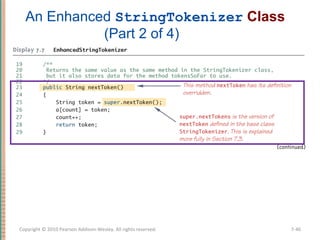
An Enhanced StringTokenizer Class
• Thanks to inheritance, most of the standard Java library
classes can be enhanced by defining a derived class with
additional methods
• For example, the StringTokenizer class enables all
the tokens in a string to be generated one time
– However, sometimes it would be nice to be able to cycle through
the tokens a second or third time
7-43Copyright © 2010 Pearson Addison-Wesley. All rights reserved.
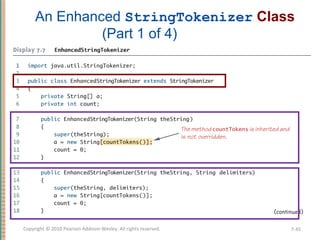
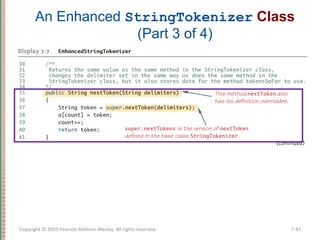
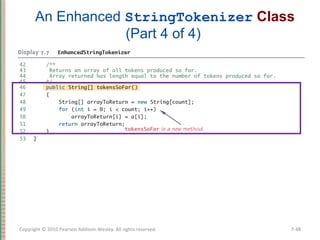
An Enhanced StringTokenizer Class
• This can be made possible by creating a derived class:
– For example, EnhancedStringTokenizer can inherit the useful
behavior of StringTokenizer
– It inherits the countTokens method unchanged
• The new behavior can be modeled by adding new methods, and/or
overriding existing methods
– A new method, tokensSoFar, is added
– While an existing method, nextToken, is overriden
7-44Copyright © 2010 Pearson Addison-Wesley. All rights reserved.
7-45Copyright © 2010 Pearson Addison-Wesley. All rights reserved.
An Enhanced StringTokenizer Class
(Part 1 of 4)
An Enhanced StringTokenizer Class
(Part 2 of 4)
7-46Copyright © 2010 Pearson Addison-Wesley. All rights reserved.
An Enhanced StringTokenizer Class
(Part 3 of 4)
7-47Copyright © 2010 Pearson Addison-Wesley. All rights reserved.
An Enhanced StringTokenizer Class
(Part 4 of 4)
7-48Copyright © 2010 Pearson Addison-Wesley. All rights reserved.
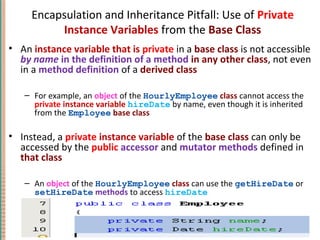
Encapsulation and Inheritance Pitfall: Use of Private
Instance Variables from the Base Class
• An instance variable that is private in a base class is not accessible
by name in the definition of a method in any other class, not even
in a method definition of a derived class
– For example, an object of the HourlyEmployee class cannot access the
private instance variable hireDate by name, even though it is inherited
from the Employee base class
• Instead, a private instance variable of the base class can only be
accessed by the public accessor and mutator methods defined in
that class
– An object of the HourlyEmployee class can use the getHireDate or
setHireDate methods to access hireDate
7-49Copyright © 2010 Pearson Addison-Wesley. All rights reserved.
Encapsulation and Inheritance Pitfall: Use of Private
Instance Variables from the Base Class
• If private instance variables of a class were accessible in
method definitions of a derived class, then anytime
someone wanted to access a private instance variable, they
would only need to create a derived class, and access it in a
method of that class
– This would allow private instance variables to be changed by
mistake or in inappropriate ways (for example, by not using the
base type's accessor and mutator methods only)
7-50Copyright © 2010 Pearson Addison-Wesley. All rights reserved.
Pitfall: Private Methods Are Effectively Not
Inherited
• The private methods of the base class are like private variables in
terms of not being directly available
• However, a private method is completely unavailable, unless invoked
indirectly
– This is possible only if an object of a derived class invokes a public method of
the base class that happens to invoke the private method
• This should not be a problem because private methods should just be
used as helping methods
– If a method is not just a helping method, then it should be public, not private
7-51Copyright © 2010 Pearson Addison-Wesley. All rights reserved.
7-52Copyright © 2010 Pearson Addison-Wesley. All rights reserved.
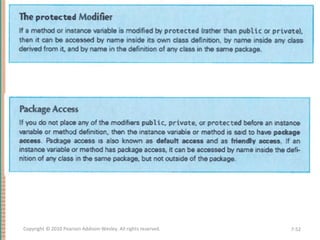
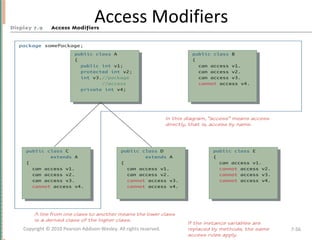
Protected and Package Access
• If a method or instance variable is modified by protected (rather
than public or private), then it can be accessed by name
– Inside its own class definition
– Inside any class derived from it
– In the definition of any class in the same package
• The protected modifier provides very weak protection compared
to the private modifier
– It allows direct access to any programmer who defines a suitable derived class
– Therefore, instance variables should normally not be marked protected
7-53Copyright © 2010 Pearson Addison-Wesley. All rights reserved.
Protected and Package Access
• An instance variable or method definition that is not
preceded with a modifier has package access
– Package access is also known as default or friendly access
• Instance variables or methods having package access can be
accessed by name inside the definition of any class in the
same package
– However, neither can be accessed outside the package
7-54Copyright © 2010 Pearson Addison-Wesley. All rights reserved.
Protected and Package Access
• Note that package access is more restricted than
protected
– Package access gives more control to the programmer
defining the classes
– Whoever controls the package directory (or folder)
controls the package access
7-55Copyright © 2010 Pearson Addison-Wesley. All rights reserved.
Access Modifiers
7-56Copyright © 2010 Pearson Addison-Wesley. All rights reserved.
Pitfall: Forgetting About the Default Package
• When considering package access, do not forget the default
package
– All classes in the current directory (not belonging to some other
package) belong to an unnamed package called the default
package
• If a class in the current directory is not in any other
package, then it is in the default package
– If an instance variable or method has package access, it can be
accessed by name in the definition of any other class in the
default package
7-57Copyright © 2010 Pearson Addison-Wesley. All rights reserved.
Pitfall: A Restriction on Protected Access
If a class B is derived from class A, and class A has a protected
instance variable n, but the classes A and B are in different
packages, then the following is true:
– A method in class B can access n by name (n is inherited from class A)
– A method in class B can create a local object of itself, which can acces
n by name (again, n is inherited from class A)
7-58Copyright © 2010 Pearson Addison-Wesley. All rights reserved.
Pitfall: A Restriction on Protected Access
• However, if a method in class B creates an object of class A, it can not
access n by name
– A class knows about its own inherited variables and methods
– However, it cannot directly access any instance variable or method of an
ancestor class unless they are public
– Therefore, B can access n whenever it is used as an instance variable of B, but B
cannot access n when it is used as an instance variable of A
• This is true if A and B are not in the same package
– If they were in the same package there would be no problem, because
protected access implies package access
7-59Copyright © 2010 Pearson Addison-Wesley. All rights reserved.
Tip: "Is a" Versus "Has a"
• A derived class demonstrates an "is a" relationship between
it and its base class
– Forming an "is a" relationship is one way to make a more complex
class out of a simpler class
– For example, an HourlyEmployee "is an" Employee
– HourlyEmployee is a more complex class compared to the
more general Employee class
7-60Copyright © 2010 Pearson Addison-Wesley. All rights reserved.
Tip: "Is a" Versus "Has a"
• Another way to make a more complex class out of a simpler
class is through a "has a" relationship
– This type of relationship, called composition, occurs when a class
contains an instance variable of a class type
– The Employee class contains an instance variable, hireDate, of
the class Date, so therefore, an Employee "has a" Date
7-61Copyright © 2010 Pearson Addison-Wesley. All rights reserved.
Tip: "Is a" Versus "Has a"
• Both kinds of relationships are commonly used to
create complex classes, often within the same class
– Since HourlyEmployee is a derived class of
Employee, and contains an instance variable of class
Date, then HourlyEmployee "is an" Employee and
"has a" Date
7-62Copyright © 2010 Pearson Addison-Wesley. All rights reserved.
Tip: Static Variables Are Inherited
• Static variables in a base class are inherited by any
of its derived classes
• The modifiers public, private, and
protected, and package access have the same
meaning for static variables as they do for instance
variables
7-63Copyright © 2010 Pearson Addison-Wesley. All rights reserved.
7-64Copyright © 2010 Pearson Addison-Wesley. All rights reserved.
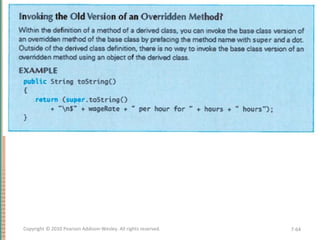
Access to a Redefined Base Method
• Within the definition of a method of a derived class, the base class
version of an overridden method of the base class can still be invoked
– Simply preface the method name with super and a dot
public String toString()
{
return (super.toString() + "$" + wageRate);
}
• However, using an object of the derived class outside of its class
definition, there is no way to invoke the base class version of an
overridden method
7-65Copyright © 2010 Pearson Addison-Wesley. All rights reserved.
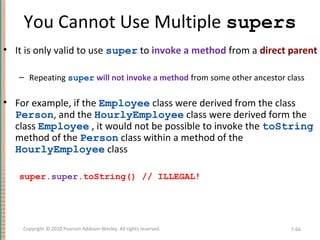
You Cannot Use Multiple supers
• It is only valid to use super to invoke a method from a direct parent
– Repeating super will not invoke a method from some other ancestor class
• For example, if the Employee class were derived from the class
Person, and the HourlyEmployee class were derived form the
class Employee , it would not be possible to invoke the toString
method of the Person class within a method of the
HourlyEmployee class
super.super.toString() // ILLEGAL!
7-66Copyright © 2010 Pearson Addison-Wesley. All rights reserved.
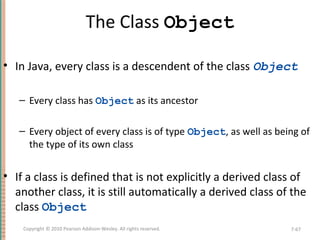
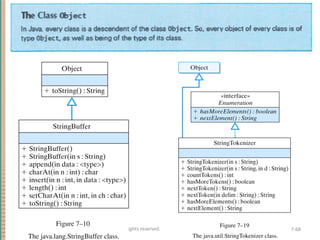
The Class Object
• In Java, every class is a descendent of the class Object
– Every class has Object as its ancestor
– Every object of every class is of type Object, as well as being of
the type of its own class
• If a class is defined that is not explicitly a derived class of
another class, it is still automatically a derived class of the
class Object
7-67Copyright © 2010 Pearson Addison-Wesley. All rights reserved.
7-68Copyright © 2010 Pearson Addison-Wesley. All rights reserved.
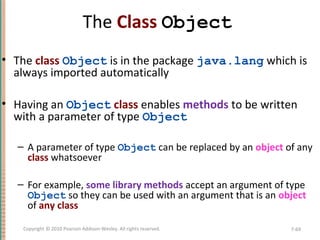
The Class Object
• The class Object is in the package java.lang which is
always imported automatically
• Having an Object class enables methods to be written
with a parameter of type Object
– A parameter of type Object can be replaced by an object of any
class whatsoever
– For example, some library methods accept an argument of type
Object so they can be used with an argument that is an object
of any class
7-69Copyright © 2010 Pearson Addison-Wesley. All rights reserved.
The Class Object
The class Object has some methods that every Java class inherits
– For example, the equals and toString methods
Every object inherits these methods from some ancestor class
– Either the class Object itself, or a class that itself inherited these methods
(ultimately) from the class Object
However, these inherited methods should be overridden with definitions
more appropriate to a given class
– Some Java library classes assume that every class has its own version of such
methods
7-70Copyright © 2010 Pearson Addison-Wesley. All rights reserved.
The Right Way to Define equals
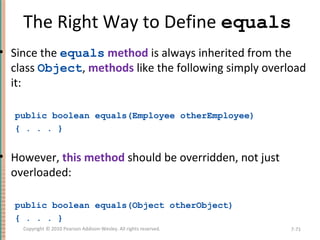
• Since the equals method is always inherited from the
class Object, methods like the following simply overload
it:
public boolean equals(Employee otherEmployee)
{ . . . }
• However, this method should be overridden, not just
overloaded:
public boolean equals(Object otherObject)
{ . . . }
7-71Copyright © 2010 Pearson Addison-Wesley. All rights reserved.
The Right Way to Define equals
• The overridden version of equals must meet the
following conditions
– The parameter otherObject of type Object must be type
cast to the given class (e.g., Employee)
– However, the new method should only do this if otherObject
really is an object of that class, and if otherObject is not equal
to null
– Finally, it should compare each of the instance variables of both
objects
7-72Copyright © 2010 Pearson Addison-Wesley. All rights reserved.
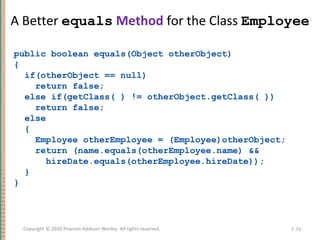
A Better equals Method for the Class Employee
public boolean equals(Object otherObject)
{
if(otherObject == null)
return false;
else if(getClass( ) != otherObject.getClass( ))
return false;
else
{
Employee otherEmployee = (Employee)otherObject;
return (name.equals(otherEmployee.name) &&
hireDate.equals(otherEmployee.hireDate));
}
}
7-73Copyright © 2010 Pearson Addison-Wesley. All rights reserved.
7-74Copyright © 2010 Pearson Addison-Wesley. All rights reserved.
Tip: getClass Versus instanceof
• Many authors suggest using the instanceof operator in the
definition of equals
– Instead of the getClass() method
• The instanceof operator will return true if the object being
tested is a member of the class for which it is being tested
– However, it will return true if it is a descendent of that class as well
• It is possible (and especially disturbing), for the equals method to
behave inconsistently given this scenario
7-75Copyright © 2010 Pearson Addison-Wesley. All rights reserved.
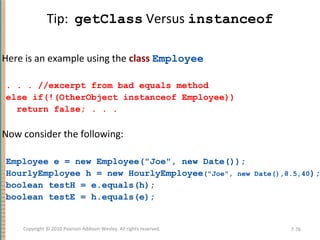
Tip: getClass Versus instanceof
Here is an example using the class Employee
. . . //excerpt from bad equals method
else if(!(OtherObject instanceof Employee))
return false; . . .
Now consider the following:
Employee e = new Employee("Joe", new Date());
HourlyEmployee h = new HourlyEmployee("Joe", new Date(),8.5,40);
boolean testH = e.equals(h);
boolean testE = h.equals(e);
7-76Copyright © 2010 Pearson Addison-Wesley. All rights reserved.
Tip: getClass Versus instanceof
• testH will be true, because h is an Employee with the
same name and hire date as e
• However, testE will be false, because e is not an
HourlyEmployee, and cannot be compared to h
• Note that this problem would not occur if the
getClass() method were used instead, as in the
previous equals method example
7-77Copyright © 2010 Pearson Addison-Wesley. All rights reserved.
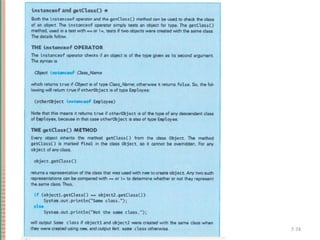
instanceof and getClass
• Both the instanceof operator and the getClass()
method can be used to check the class of an object
• However, the getClass() method is more exact
– The instanceof operator simply tests the class of an object
– The getClass() method used in a test with == or != tests if
two objects were created with the same class
7-78Copyright © 2010 Pearson Addison-Wesley. All rights reserved.
The instanceof Operator
• The instanceof operator checks if an object is
of the type given as its second argument
Object instanceof ClassName
– This will return true if Object is of type ClassName,
and otherwise return false
– Note that this means it will return true if Object is
the type of any descendent class of ClassName
7-79Copyright © 2010 Pearson Addison-Wesley. All rights reserved.
The getClass() Method
• Every object inherits the same getClass() method
from the Object class
– This method is marked final, so it cannot be overridden
• An invocation of getClass() on an object returns a
representation only of the class that was used with new to
create the object
– The results of any two such invocations can be compared with ==
or != to determine whether or not they represent the exact
same class
(object1.getClass() == object2.getClass())
7-80Copyright © 2010 Pearson Addison-Wesley. All rights reserved.

Lecture 5 inheritance

  • 1.
    Introduction toIntroduction to ComputerScience IIComputer Science II COSC 1320/6305 Lecture 5:Lecture 5: InheritanceInheritance (Chapter 7)(Chapter 7)
  • 2.
    7-2Copyright © 2010Pearson Addison-Wesley. All rights reserved.
  • 3.
    Introduction to Inheritance •Inheritance is one of the main techniques of object-oriented programming (OOP) • Using this technique, a very general form of a class is first defined and compiled, and then more specialized versions of the class are defined by adding instance variables and methods – The specialized classes are said to inherit the methods and instance variables of the general class 7-3Copyright © 2010 Pearson Addison-Wesley. All rights reserved.
  • 4.
    Introduction to Inheritance •Inheritance is the process by which a new class is created from another class – The new class is called a derived class – The original class is called the base class • A derived class automatically has all the instance variables and methods that the base class has, and it can have additional methods and/or instance variables as well • Inheritance is especially advantageous because it allows code to be reused, without having to copy it into the definitions of the derived classes 7-4Copyright © 2010 Pearson Addison-Wesley. All rights reserved.
  • 5.
    7-5Copyright © 2010Pearson Addison-Wesley. All rights reserved.
  • 6.
    Derived Classes • Whendesigning certain classes, there is often a natural hierarchy for grouping them – In a record-keeping program for the employees of a company, there are hourly employees and salaried employees – Hourly employees can be divided into full time and part time workers – Salaried employees can be divided into those on technical staff, and those on the executive staff 7-6Copyright © 2010 Pearson Addison-Wesley. All rights reserved.
  • 7.
    Derived Classes • Allemployees share certain characteristics in common – All employees have a name and a hire date – The methods for setting and changing names and hire dates would be the same for all employees • Some employees have specialized characteristics – Hourly employees are paid an hourly wage, while salaried employees are paid a fixed wage – The methods for calculating wages for these two different groups would be different 7-7Copyright © 2010 Pearson Addison-Wesley. All rights reserved.
  • 8.
    Derived Classes • WithinJava, a class called Employee can be defined that includes all employees • This class can then be used to define classes for hourly employees and salaried employees – In turn, the HourlyEmployee class can be used to define a PartTimeHourlyEmployee class, and so forth 7-8Copyright © 2010 Pearson Addison-Wesley. All rights reserved.
  • 9.
    A Class Hierarchy???? 7-9Copyright © 2010 Pearson Addison-Wesley. All rights reserved.
  • 10.
    7-10Copyright © 2010Pearson Addison-Wesley. All rights reserved. CLASS Participation! (pp. 422)
  • 11.
    7-11Copyright © 2010Pearson Addison-Wesley. All rights reserved.
  • 12.
    7-12Copyright © 2010Pearson Addison-Wesley. All rights reserved.
  • 13.
    Derived Classes • Sincean hourly employee is an employee, it is defined as a derived class of the class Employee – A derived class is defined by adding instance variables and methods to an existing class – The existing class that the derived class is built upon is called the base class – The phrase extends BaseClass must be added to the derived class definition: public class HourlyEmployee extends Employee 7-13Copyright © 2010 Pearson Addison-Wesley. All rights reserved.
  • 14.
    HourlyEmployee.java 7-14Copyright © 2010Pearson Addison-Wesley. All rights reserved.
  • 15.
    Derived Classes • Whena derived class is defined, it is said to inherit the instance variables and methods of the base class that it extends – Class Employee defines the instance variables name and hireDate in its class definition – Class HourlyEmployee also has these instance variables, but they are not specified in its class definition – Class HourlyEmployee has additional instance variables wageRate and hours that are specified in its class definition 7-15Copyright © 2010 Pearson Addison-Wesley. All rights reserved.
  • 16.
    HourlyEmployee.java 7-16Copyright © 2010Pearson Addison-Wesley. All rights reserved. Employee.java
  • 17.
    Derived Classes • Justas it inherits the instance variables of the class Employee, the class HourlyEmployee inherits all of its methods as well – The class HourlyEmployee inherits the methods getName, getHireDate, setName, and setHireDate from the class Employee – Any object of the class HourlyEmployee can invoke one of these methods, just like any other method 7-17Copyright © 2010 Pearson Addison-Wesley. All rights reserved.
  • 18.
    HourlyEmployee.java 7-18Copyright © 2010Pearson Addison-Wesley. All rights reserved. Employee.java
  • 19.
    Derived Class (Subclass) •A derived class, also called a subclass, is defined by starting with another already defined class, called a base class or superclass, and adding (and/or changing) methods, instance variables, and static variables – The derived class inherits all the public methods, all the public and private instance variables, and all the public and private static variables from the base class – The derived class can add more instance variables, static variables, and/or methods 7-19Copyright © 2010 Pearson Addison-Wesley. All rights reserved.
  • 20.
    Inherited Members • Aderived class automatically has all the instance variables, all the static variables, and all the public methods of the base class – Members from the base class are said to be inherited • Definitions for the inherited variables and methods do not appear in the derived class – The code is reused without having to explicitly copy it, unless the creator of the derived class redefines one or more of the base class methods 7-20Copyright © 2010 Pearson Addison-Wesley. All rights reserved.
  • 21.
    7-21Copyright © 2010Pearson Addison-Wesley. All rights reserved.
  • 22.
    Parent and ChildClasses • A base class is often called the parent class – A derived class is then called a child class • These relationships are often extended such that a class that is a parent of a parent . . . of another class is called an ancestor class – If class A is an ancestor of class B, then class B can be called a descendent of class A 7-22Copyright © 2010 Pearson Addison-Wesley. All rights reserved.
  • 23.
    7-23Copyright © 2010Pearson Addison-Wesley. All rights reserved.
  • 24.
    Overriding a MethodDefinition • Although a derived class inherits methods from the base class, it can change or override an inherited method if necessary – In order to override a method definition, a new definition of the method is simply placed in the class definition, just like any other method that is added to the derived class 7-24Copyright © 2010 Pearson Addison-Wesley. All rights reserved.
  • 25.
    Changing the ReturnType of an Overridden Method • Ordinarily, the type returned may not be changed when overriding a method • However, if it is a class type, then the returned type may be changed to that of any descendent class of the returned type • This is known as a covariant return type – Covariant return types are new in Java 5.0; they are not allowed in earlier versions of Java 7-25Copyright © 2010 Pearson Addison-Wesley. All rights reserved.
  • 26.
    Covariant Return Type •Given the following base class: public class BaseClass { . . . public Employee getSomeone(int someKey) . . . • The following is allowed in Java 5.0: public class DerivedClass extends BaseClass { . . . public HourlyEmployee getSomeone(int someKey) . . . 7-26Copyright © 2010 Pearson Addison-Wesley. All rights reserved.
  • 27.
    Changing the AccessPermission of an Overridden Method • The access permission of an overridden method can be changed from private in the base class to public (or some other more permissive access) in the derived class • However, the access permission of an overridden method can not be changed from public in the base class to a more restricted access permission in the derived class 7-27Copyright © 2010 Pearson Addison-Wesley. All rights reserved.
  • 28.
    Changing the AccessPermission of an Overridden Method • Given the following method header in a base case: private void doSomething() • The following method header is valid in a derived class: public void doSomething() • However, the opposite is not valid • Given the following method header in a base case: public void doSomething() • The following method header is not valid in a derived class: private void doSomething() 7-28Copyright © 2010 Pearson Addison-Wesley. All rights reserved.
  • 29.
    Pitfall: Overriding VersusOverloading • Do not confuse overriding a method in a derived class with overloading a method name – When a method is overridden, the new method definition given in the derived class has the exact same number and types of parameters as in the base class – When a method in a derived class has a different signature from the method in the base class, that is overloading – Note that when the derived class overloads the original method, it still inherits the original method from the base class as well 7-29Copyright © 2010 Pearson Addison-Wesley. All rights reserved.
  • 30.
    The final Modifier •If the modifier final is placed before the definition of a method, then that method may not be redefined in a derived class • It the modifier final is placed before the definition of a class, then that class may not be used as a base class to derive other classes 7-30Copyright © 2010 Pearson Addison-Wesley. All rights reserved.
  • 31.
    7-31Copyright © 2010Pearson Addison-Wesley. All rights reserved.
  • 32.
    The super Constructor •A derived class uses a constructor from the base class to initialize all the data inherited from the base class – In order to invoke a constructor from the base class, it uses a special syntax: public derivedClass(int p1, int p2, double p3) { super(p1, p2); instanceVariable = p3; } – In the above example, super(p1, p2); is a call to the base class constructor 7-32Copyright © 2010 Pearson Addison-Wesley. All rights reserved.
  • 33.
    The super Constructor •A call to the base class constructor can never use the name of the base class, but uses the keyword super instead • A call to super must always be the first action taken in a constructor definition • An instance variable cannot be used as an argument to super 7-33Copyright © 2010 Pearson Addison-Wesley. All rights reserved.
  • 34.
    The super Constructor •If a derived class constructor does not include an invocation of super, then the no-argument constructor of the base class will automatically be invoked – This can result in an error if the base class has not defined a no- argument constructor • Since the inherited instance variables should be initialized, and the base class constructor is designed to do that, then an explicit call to super should always be used 7-34Copyright © 2010 Pearson Addison-Wesley. All rights reserved.
  • 35.
    7-35Copyright © 2010Pearson Addison-Wesley. All rights reserved.
  • 36.
    The this Constructor •Within the definition of a constructor for a class, this can be used as a name for invoking another constructor in the same class – The same restrictions on how to use a call to super apply to the this constructor • If it is necessary to include a call to both super and this, the call using this must be made first, and then the constructor that is called must call super as its first action 7-36Copyright © 2010 Pearson Addison-Wesley. All rights reserved.
  • 37.
    The this Constructor •Often, a no-argument constructor uses this to invoke an explicit- value constructor – No-argument constructor (invokes explicit-value constructor using this and default arguments): public ClassName() { this(argument1, argument2); } – Explicit-value constructor (receives default values): public ClassName(type1 param1, type2 param2) { . . . } 7-37Copyright © 2010 Pearson Addison-Wesley. All rights reserved.
  • 38.
    The this Constructor publicHourlyEmployee() { this("No name", new Date(), 0, 0); } • The above constructor will cause the constructor with the following heading to be invoked: public HourlyEmployee(String theName, Date theDate, double theWageRate, double theHours) 7-38Copyright © 2010 Pearson Addison-Wesley. All rights reserved.
  • 39.
    7-39Copyright © 2010Pearson Addison-Wesley. All rights reserved.
  • 40.
    Tip: An Objectof a Derived Class Has More than One Type An object of a derived class has the type of the derived class, and it also has the type of the base class More generally, an object of a derived class has the type of every one of its ancestor classes – Therefore, an object of a derived class can be assigned to a variable of any ancestor type 7-40Copyright © 2010 Pearson Addison-Wesley. All rights reserved.
  • 41.
    Tip: An Objectof a Derived Class Has More than One Type An object of a derived class can be plugged in as a parameter in place of any of its ancestor classes In fact, a derived class object can be used anyplace that an object of any of its ancestor types can be used Note, however, that this relationship does not go the other way – An ancestor type can never be used in place of one of its derived types 7-41Copyright © 2010 Pearson Addison-Wesley. All rights reserved.
  • 42.
    Pitfall: The Terms"Subclass" and "Superclass" • The terms subclass and superclass are sometimes mistakenly reversed – A superclass or base class is more general and inclusive, but less complex – A subclass or derived class is more specialized, less inclusive, and more complex • As more instance variables and methods are added, the number of objects that can satisfy the class definition becomes more restricted 7-42Copyright © 2010 Pearson Addison-Wesley. All rights reserved.
  • 43.
    An Enhanced StringTokenizerClass • Thanks to inheritance, most of the standard Java library classes can be enhanced by defining a derived class with additional methods • For example, the StringTokenizer class enables all the tokens in a string to be generated one time – However, sometimes it would be nice to be able to cycle through the tokens a second or third time 7-43Copyright © 2010 Pearson Addison-Wesley. All rights reserved.
  • 44.
    An Enhanced StringTokenizerClass • This can be made possible by creating a derived class: – For example, EnhancedStringTokenizer can inherit the useful behavior of StringTokenizer – It inherits the countTokens method unchanged • The new behavior can be modeled by adding new methods, and/or overriding existing methods – A new method, tokensSoFar, is added – While an existing method, nextToken, is overriden 7-44Copyright © 2010 Pearson Addison-Wesley. All rights reserved.
  • 45.
    7-45Copyright © 2010Pearson Addison-Wesley. All rights reserved. An Enhanced StringTokenizer Class (Part 1 of 4)
  • 46.
    An Enhanced StringTokenizerClass (Part 2 of 4) 7-46Copyright © 2010 Pearson Addison-Wesley. All rights reserved.
  • 47.
    An Enhanced StringTokenizerClass (Part 3 of 4) 7-47Copyright © 2010 Pearson Addison-Wesley. All rights reserved.
  • 48.
    An Enhanced StringTokenizerClass (Part 4 of 4) 7-48Copyright © 2010 Pearson Addison-Wesley. All rights reserved.
  • 49.
    Encapsulation and InheritancePitfall: Use of Private Instance Variables from the Base Class • An instance variable that is private in a base class is not accessible by name in the definition of a method in any other class, not even in a method definition of a derived class – For example, an object of the HourlyEmployee class cannot access the private instance variable hireDate by name, even though it is inherited from the Employee base class • Instead, a private instance variable of the base class can only be accessed by the public accessor and mutator methods defined in that class – An object of the HourlyEmployee class can use the getHireDate or setHireDate methods to access hireDate 7-49Copyright © 2010 Pearson Addison-Wesley. All rights reserved.
  • 50.
    Encapsulation and InheritancePitfall: Use of Private Instance Variables from the Base Class • If private instance variables of a class were accessible in method definitions of a derived class, then anytime someone wanted to access a private instance variable, they would only need to create a derived class, and access it in a method of that class – This would allow private instance variables to be changed by mistake or in inappropriate ways (for example, by not using the base type's accessor and mutator methods only) 7-50Copyright © 2010 Pearson Addison-Wesley. All rights reserved.
  • 51.
    Pitfall: Private MethodsAre Effectively Not Inherited • The private methods of the base class are like private variables in terms of not being directly available • However, a private method is completely unavailable, unless invoked indirectly – This is possible only if an object of a derived class invokes a public method of the base class that happens to invoke the private method • This should not be a problem because private methods should just be used as helping methods – If a method is not just a helping method, then it should be public, not private 7-51Copyright © 2010 Pearson Addison-Wesley. All rights reserved.
  • 52.
    7-52Copyright © 2010Pearson Addison-Wesley. All rights reserved.
  • 53.
    Protected and PackageAccess • If a method or instance variable is modified by protected (rather than public or private), then it can be accessed by name – Inside its own class definition – Inside any class derived from it – In the definition of any class in the same package • The protected modifier provides very weak protection compared to the private modifier – It allows direct access to any programmer who defines a suitable derived class – Therefore, instance variables should normally not be marked protected 7-53Copyright © 2010 Pearson Addison-Wesley. All rights reserved.
  • 54.
    Protected and PackageAccess • An instance variable or method definition that is not preceded with a modifier has package access – Package access is also known as default or friendly access • Instance variables or methods having package access can be accessed by name inside the definition of any class in the same package – However, neither can be accessed outside the package 7-54Copyright © 2010 Pearson Addison-Wesley. All rights reserved.
  • 55.
    Protected and PackageAccess • Note that package access is more restricted than protected – Package access gives more control to the programmer defining the classes – Whoever controls the package directory (or folder) controls the package access 7-55Copyright © 2010 Pearson Addison-Wesley. All rights reserved.
  • 56.
    Access Modifiers 7-56Copyright ©2010 Pearson Addison-Wesley. All rights reserved.
  • 57.
    Pitfall: Forgetting Aboutthe Default Package • When considering package access, do not forget the default package – All classes in the current directory (not belonging to some other package) belong to an unnamed package called the default package • If a class in the current directory is not in any other package, then it is in the default package – If an instance variable or method has package access, it can be accessed by name in the definition of any other class in the default package 7-57Copyright © 2010 Pearson Addison-Wesley. All rights reserved.
  • 58.
    Pitfall: A Restrictionon Protected Access If a class B is derived from class A, and class A has a protected instance variable n, but the classes A and B are in different packages, then the following is true: – A method in class B can access n by name (n is inherited from class A) – A method in class B can create a local object of itself, which can acces n by name (again, n is inherited from class A) 7-58Copyright © 2010 Pearson Addison-Wesley. All rights reserved.
  • 59.
    Pitfall: A Restrictionon Protected Access • However, if a method in class B creates an object of class A, it can not access n by name – A class knows about its own inherited variables and methods – However, it cannot directly access any instance variable or method of an ancestor class unless they are public – Therefore, B can access n whenever it is used as an instance variable of B, but B cannot access n when it is used as an instance variable of A • This is true if A and B are not in the same package – If they were in the same package there would be no problem, because protected access implies package access 7-59Copyright © 2010 Pearson Addison-Wesley. All rights reserved.
  • 60.
    Tip: "Is a"Versus "Has a" • A derived class demonstrates an "is a" relationship between it and its base class – Forming an "is a" relationship is one way to make a more complex class out of a simpler class – For example, an HourlyEmployee "is an" Employee – HourlyEmployee is a more complex class compared to the more general Employee class 7-60Copyright © 2010 Pearson Addison-Wesley. All rights reserved.
  • 61.
    Tip: "Is a"Versus "Has a" • Another way to make a more complex class out of a simpler class is through a "has a" relationship – This type of relationship, called composition, occurs when a class contains an instance variable of a class type – The Employee class contains an instance variable, hireDate, of the class Date, so therefore, an Employee "has a" Date 7-61Copyright © 2010 Pearson Addison-Wesley. All rights reserved.
  • 62.
    Tip: "Is a"Versus "Has a" • Both kinds of relationships are commonly used to create complex classes, often within the same class – Since HourlyEmployee is a derived class of Employee, and contains an instance variable of class Date, then HourlyEmployee "is an" Employee and "has a" Date 7-62Copyright © 2010 Pearson Addison-Wesley. All rights reserved.
  • 63.
    Tip: Static VariablesAre Inherited • Static variables in a base class are inherited by any of its derived classes • The modifiers public, private, and protected, and package access have the same meaning for static variables as they do for instance variables 7-63Copyright © 2010 Pearson Addison-Wesley. All rights reserved.
  • 64.
    7-64Copyright © 2010Pearson Addison-Wesley. All rights reserved.
  • 65.
    Access to aRedefined Base Method • Within the definition of a method of a derived class, the base class version of an overridden method of the base class can still be invoked – Simply preface the method name with super and a dot public String toString() { return (super.toString() + "$" + wageRate); } • However, using an object of the derived class outside of its class definition, there is no way to invoke the base class version of an overridden method 7-65Copyright © 2010 Pearson Addison-Wesley. All rights reserved.
  • 66.
    You Cannot UseMultiple supers • It is only valid to use super to invoke a method from a direct parent – Repeating super will not invoke a method from some other ancestor class • For example, if the Employee class were derived from the class Person, and the HourlyEmployee class were derived form the class Employee , it would not be possible to invoke the toString method of the Person class within a method of the HourlyEmployee class super.super.toString() // ILLEGAL! 7-66Copyright © 2010 Pearson Addison-Wesley. All rights reserved.
  • 67.
    The Class Object •In Java, every class is a descendent of the class Object – Every class has Object as its ancestor – Every object of every class is of type Object, as well as being of the type of its own class • If a class is defined that is not explicitly a derived class of another class, it is still automatically a derived class of the class Object 7-67Copyright © 2010 Pearson Addison-Wesley. All rights reserved.
  • 68.
    7-68Copyright © 2010Pearson Addison-Wesley. All rights reserved.
  • 69.
    The Class Object •The class Object is in the package java.lang which is always imported automatically • Having an Object class enables methods to be written with a parameter of type Object – A parameter of type Object can be replaced by an object of any class whatsoever – For example, some library methods accept an argument of type Object so they can be used with an argument that is an object of any class 7-69Copyright © 2010 Pearson Addison-Wesley. All rights reserved.
  • 70.
    The Class Object Theclass Object has some methods that every Java class inherits – For example, the equals and toString methods Every object inherits these methods from some ancestor class – Either the class Object itself, or a class that itself inherited these methods (ultimately) from the class Object However, these inherited methods should be overridden with definitions more appropriate to a given class – Some Java library classes assume that every class has its own version of such methods 7-70Copyright © 2010 Pearson Addison-Wesley. All rights reserved.
  • 71.
    The Right Wayto Define equals • Since the equals method is always inherited from the class Object, methods like the following simply overload it: public boolean equals(Employee otherEmployee) { . . . } • However, this method should be overridden, not just overloaded: public boolean equals(Object otherObject) { . . . } 7-71Copyright © 2010 Pearson Addison-Wesley. All rights reserved.
  • 72.
    The Right Wayto Define equals • The overridden version of equals must meet the following conditions – The parameter otherObject of type Object must be type cast to the given class (e.g., Employee) – However, the new method should only do this if otherObject really is an object of that class, and if otherObject is not equal to null – Finally, it should compare each of the instance variables of both objects 7-72Copyright © 2010 Pearson Addison-Wesley. All rights reserved.
  • 73.
    A Better equalsMethod for the Class Employee public boolean equals(Object otherObject) { if(otherObject == null) return false; else if(getClass( ) != otherObject.getClass( )) return false; else { Employee otherEmployee = (Employee)otherObject; return (name.equals(otherEmployee.name) && hireDate.equals(otherEmployee.hireDate)); } } 7-73Copyright © 2010 Pearson Addison-Wesley. All rights reserved.
  • 74.
    7-74Copyright © 2010Pearson Addison-Wesley. All rights reserved.
  • 75.
    Tip: getClass Versusinstanceof • Many authors suggest using the instanceof operator in the definition of equals – Instead of the getClass() method • The instanceof operator will return true if the object being tested is a member of the class for which it is being tested – However, it will return true if it is a descendent of that class as well • It is possible (and especially disturbing), for the equals method to behave inconsistently given this scenario 7-75Copyright © 2010 Pearson Addison-Wesley. All rights reserved.
  • 76.
    Tip: getClass Versusinstanceof Here is an example using the class Employee . . . //excerpt from bad equals method else if(!(OtherObject instanceof Employee)) return false; . . . Now consider the following: Employee e = new Employee("Joe", new Date()); HourlyEmployee h = new HourlyEmployee("Joe", new Date(),8.5,40); boolean testH = e.equals(h); boolean testE = h.equals(e); 7-76Copyright © 2010 Pearson Addison-Wesley. All rights reserved.
  • 77.
    Tip: getClass Versusinstanceof • testH will be true, because h is an Employee with the same name and hire date as e • However, testE will be false, because e is not an HourlyEmployee, and cannot be compared to h • Note that this problem would not occur if the getClass() method were used instead, as in the previous equals method example 7-77Copyright © 2010 Pearson Addison-Wesley. All rights reserved.
  • 78.
    instanceof and getClass •Both the instanceof operator and the getClass() method can be used to check the class of an object • However, the getClass() method is more exact – The instanceof operator simply tests the class of an object – The getClass() method used in a test with == or != tests if two objects were created with the same class 7-78Copyright © 2010 Pearson Addison-Wesley. All rights reserved.
  • 79.
    The instanceof Operator •The instanceof operator checks if an object is of the type given as its second argument Object instanceof ClassName – This will return true if Object is of type ClassName, and otherwise return false – Note that this means it will return true if Object is the type of any descendent class of ClassName 7-79Copyright © 2010 Pearson Addison-Wesley. All rights reserved.
  • 80.
    The getClass() Method •Every object inherits the same getClass() method from the Object class – This method is marked final, so it cannot be overridden • An invocation of getClass() on an object returns a representation only of the class that was used with new to create the object – The results of any two such invocations can be compared with == or != to determine whether or not they represent the exact same class (object1.getClass() == object2.getClass()) 7-80Copyright © 2010 Pearson Addison-Wesley. All rights reserved.