Chapter 8
Inheritance
© 2004 Pearson Addison-Wesley. All rights reserved 8-2
Inheritance
• Inheritance is a fundamental object-oriented
design technique used to create and organize
reusable classes
• Chapter 8 focuses on:
 deriving new classes from existing classes
 the protected modifier
 creating class hierarchies
 abstract classes
 indirect visibility of inherited members
 designing for inheritance
 the GUI component class hierarchy
 extending listener adapter classes
 the Timer class
© 2004 Pearson Addison-Wesley. All rights reserved 8-3
Outline
Creating Subclasses
Overriding Methods
Class Hierarchies
Inheritance and Visibility
Designing for Inheritance
Inheritance and GUIs
The Timer Class
© 2004 Pearson Addison-Wesley. All rights reserved 8-4
Inheritance
• Inheritance allows a software developer to derive a
new class from an existing one
• The existing class is called the parent class, or
superclass, or base class
• The derived class is called the child class or
subclass
• As the name implies, the child inherits
characteristics of the parent
• That is, the child class inherits the methods and
data defined by the parent class
© 2004 Pearson Addison-Wesley. All rights reserved 8-5
Inheritance
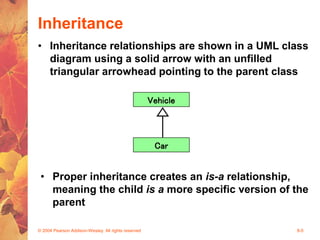
• Inheritance relationships are shown in a UML class
diagram using a solid arrow with an unfilled
triangular arrowhead pointing to the parent class
Vehicle
Car
• Proper inheritance creates an is-a relationship,
meaning the child is a more specific version of the
parent
© 2004 Pearson Addison-Wesley. All rights reserved 8-6
Inheritance
• A programmer can tailor a derived class as needed
by adding new variables or methods, or by
modifying the inherited ones
• Software reuse is a fundamental benefit of
inheritance
• By using existing software components to create
new ones, we capitalize on all the effort that went
into the design, implementation, and testing of the
existing software
© 2004 Pearson Addison-Wesley. All rights reserved 8-7
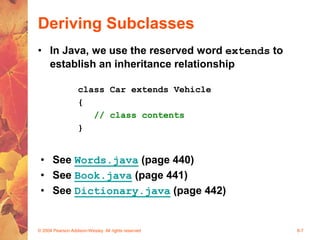
Deriving Subclasses
• In Java, we use the reserved word extends to
establish an inheritance relationship
• See Words.java (page 440)
• See Book.java (page 441)
• See Dictionary.java (page 442)
class Car extends Vehicle
{
// class contents
}
© 2004 Pearson Addison-Wesley. All rights reserved 8-8
The protected Modifier
• Visibility modifiers affect the way that class
members can be used in a child class
• Variables and methods declared with private
visibility cannot be referenced by name in a child
class
• They can be referenced in the child class if they
are declared with public visibility -- but public
variables violate the principle of encapsulation
• There is a third visibility modifier that helps in
inheritance situations: protected
© 2004 Pearson Addison-Wesley. All rights reserved 8-9
The protected Modifier
• The protected modifier allows a child class to
reference a variable or method directly in the child
class
• It provides more encapsulation than public
visibility, but is not as tightly encapsulated as
private visibility
• A protected variable is visible to any class in the
same package as the parent class
• The details of all Java modifiers are discussed in
Appendix E
• Protected variables and methods can be shown
with a # symbol preceding them in UML diagrams
© 2004 Pearson Addison-Wesley. All rights reserved 8-10
Class Diagram for Words
Book
# pages : int
+ pageMessage() : void
Dictionary
- definitions : int
+ definitionMessage() : void
Words
+ main (args : String[]) : void
© 2004 Pearson Addison-Wesley. All rights reserved 8-11
The super Reference
• Constructors are not inherited, even though they
have public visibility
• Yet we often want to use the parent's constructor
to set up the "parent's part" of the object
• The super reference can be used to refer to the
parent class, and often is used to invoke the
parent's constructor
• See Words2.java (page 445)
• See Book2.java (page 446)
• See Dictionary2.java (page 447)
© 2004 Pearson Addison-Wesley. All rights reserved 8-12
The super Reference
• A child’s constructor is responsible for calling the
parent’s constructor
• The first line of a child’s constructor should use
the super reference to call the parent’s
constructor
• The super reference can also be used to reference
other variables and methods defined in the
parent’s class
© 2004 Pearson Addison-Wesley. All rights reserved 8-13
Multiple Inheritance
• Java supports single inheritance, meaning that a
derived class can have only one parent class
• Multiple inheritance allows a class to be derived
from two or more classes, inheriting the members
of all parents
• Collisions, such as the same variable name in two
parents, have to be resolved
• Java does not support multiple inheritance
• In most cases, the use of interfaces gives us
aspects of multiple inheritance without the
overhead
© 2004 Pearson Addison-Wesley. All rights reserved 8-14
Outline
Creating Subclasses
Overriding Methods
Class Hierarchies
Inheritance and Visibility
Designing for Inheritance
Inheritance and GUIs
The Timer Class
© 2004 Pearson Addison-Wesley. All rights reserved 8-15
Overriding Methods
• A child class can override the definition of an
inherited method in favor of its own
• The new method must have the same signature as
the parent's method, but can have a different body
• The type of the object executing the method
determines which version of the method is
invoked
• See Messages.java (page 450)
• See Thought.java (page 451)
• See Advice.java (page 452)
© 2004 Pearson Addison-Wesley. All rights reserved 8-16
Overriding
• A method in the parent class can be invoked
explicitly using the super reference
• If a method is declared with the final modifier, it
cannot be overridden
• The concept of overriding can be applied to data
and is called shadowing variables
• Shadowing variables should be avoided because it
tends to cause unnecessarily confusing code
© 2004 Pearson Addison-Wesley. All rights reserved 8-17
Overloading vs. Overriding
• Overloading deals with multiple methods with the
same name in the same class, but with different
signatures
• Overriding deals with two methods, one in a parent
class and one in a child class, that have the same
signature
• Overloading lets you define a similar operation in
different ways for different parameters
• Overriding lets you define a similar operation in
different ways for different object types
© 2004 Pearson Addison-Wesley. All rights reserved 8-18
Outline
Creating Subclasses
Overriding Methods
Class Hierarchies
Inheritance and Visibility
Designing for Inheritance
Inheritance and GUIs
The Timer Class
© 2004 Pearson Addison-Wesley. All rights reserved 8-19
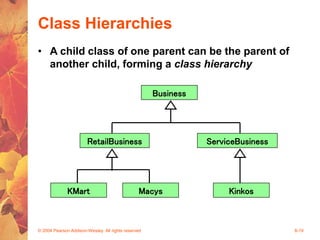
Class Hierarchies
• A child class of one parent can be the parent of
another child, forming a class hierarchy
Business
KMart Macys
ServiceBusiness
Kinkos
RetailBusiness
© 2004 Pearson Addison-Wesley. All rights reserved 8-20
Class Hierarchies
• Two children of the same parent are called siblings
• Common features should be put as high in the
hierarchy as is reasonable
• An inherited member is passed continually down
the line
• Therefore, a child class inherits from all its
ancestor classes
• There is no single class hierarchy that is
appropriate for all situations
© 2004 Pearson Addison-Wesley. All rights reserved 8-21
The Object Class
• A class called Object is defined in the java.lang
package of the Java standard class library
• All classes are derived from the Object class
• If a class is not explicitly defined to be the child of
an existing class, it is assumed to be the child of
the Object class
• Therefore, the Object class is the ultimate root of
all class hierarchies
© 2004 Pearson Addison-Wesley. All rights reserved 8-22
The Object Class
• The Object class contains a few useful methods,
which are inherited by all classes
• For example, the toString method is defined in
the Object class
• Every time we define the toString method, we
are actually overriding an inherited definition
• The toString method in the Object class is
defined to return a string that contains the name of
the object’s class along with some other
information
© 2004 Pearson Addison-Wesley. All rights reserved 8-23
The Object Class
• The equals method of the Object class returns
true if two references are aliases
• We can override equals in any class to define
equality in some more appropriate way
• As we've seen, the String class defines the
equals method to return true if two String
objects contain the same characters
• The designers of the String class have
overridden the equals method inherited from
Object in favor of a more useful version
© 2004 Pearson Addison-Wesley. All rights reserved 8-24
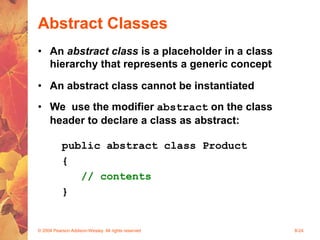
Abstract Classes
• An abstract class is a placeholder in a class
hierarchy that represents a generic concept
• An abstract class cannot be instantiated
• We use the modifier abstract on the class
header to declare a class as abstract:
public abstract class Product
{
// contents
}
© 2004 Pearson Addison-Wesley. All rights reserved 8-25
Abstract Classes
• An abstract class often contains abstract methods
with no definitions (like an interface)
• Unlike an interface, the abstract modifier must be
applied to each abstract method
• Also, an abstract class typically contains non-
abstract methods with full definitions
• A class declared as abstract does not have to
contain abstract methods -- simply declaring it as
abstract makes it so
© 2004 Pearson Addison-Wesley. All rights reserved 8-26
Abstract Classes
• The child of an abstract class must override the
abstract methods of the parent, or it too will be
considered abstract
• An abstract method cannot be defined as final or
static
• The use of abstract classes is an important
element of software design – it allows us to
establish common elements in a hierarchy that are
too generic to instantiate
© 2004 Pearson Addison-Wesley. All rights reserved 8-27
Interface Hierarchies
• Inheritance can be applied to interfaces as well as
classes
• That is, one interface can be derived from another
interface
• The child interface inherits all abstract methods of
the parent
• A class implementing the child interface must
define all methods from both the ancestor and
child interfaces
• Note that class hierarchies and interface
hierarchies are distinct (they do not overlap)
© 2004 Pearson Addison-Wesley. All rights reserved 8-28
Outline
Creating Subclasses
Overriding Methods
Class Hierarchies
Inheritance and Visibility
Designing for Inheritance
Inheritance and GUIs
The Timer Class
© 2004 Pearson Addison-Wesley. All rights reserved 8-29
Visibility Revisited
• It's important to understand one subtle issue
related to inheritance and visibility
• All variables and methods of a parent class, even
private members, are inherited by its children
• As we've mentioned, private members cannot be
referenced by name in the child class
• However, private members inherited by child
classes exist and can be referenced indirectly
© 2004 Pearson Addison-Wesley. All rights reserved 8-30
Visibility Revisited
• Because the parent can refer to the private
member, the child can reference it indirectly using
its parent's methods
• The super reference can be used to refer to the
parent class, even if no object of the parent exists
• See FoodAnalyzer.java (page 459)
• See FoodItem.java (page 460)
• See Pizza.java (page 461)
© 2004 Pearson Addison-Wesley. All rights reserved 8-31
Outline
Creating Subclasses
Overriding Methods
Class Hierarchies
Inheritance and Visibility
Designing for Inheritance
Inheritance and GUIs
The Timer Class
© 2004 Pearson Addison-Wesley. All rights reserved 8-32
Designing for Inheritance
• As we've discussed, taking the time to create a
good software design reaps long-term benefits
• Inheritance issues are an important part of an
object-oriented design
• Properly designed inheritance relationships can
contribute greatly to the elegance, maintainabilty,
and reuse of the software
• Let's summarize some of the issues regarding
inheritance that relate to a good software design
© 2004 Pearson Addison-Wesley. All rights reserved 8-33
Inheritance Design Issues
• Every derivation should be an is-a relationship
• Think about the potential future of a class
hierarchy, and design classes to be reusable and
flexible
• Find common characteristics of classes and push
them as high in the class hierarchy as appropriate
• Override methods as appropriate to tailor or
change the functionality of a child
• Add new variables to children, but don't redefine
(shadow) inherited variables
© 2004 Pearson Addison-Wesley. All rights reserved 8-34
Inheritance Design Issues
• Allow each class to manage its own data; use the
super reference to invoke the parent's constructor
to set up its data
• Even if there are no current uses for them,
override general methods such as toString and
equals with appropriate definitions
• Use abstract classes to represent general
concepts that lower classes have in common
• Use visibility modifiers carefully to provide needed
access without violating encapsulation
© 2004 Pearson Addison-Wesley. All rights reserved 8-35
Restricting Inheritance
• The final modifier can be used to curtail
inheritance
• If the final modifier is applied to a method, then
that method cannot be overridden in any
descendent classes
• If the final modifier is applied to an entire class,
then that class cannot be used to derive any
children at all
 Thus, an abstract class cannot be declared as final
• These are key design decisions, establishing that
a method or class should be used as is
© 2004 Pearson Addison-Wesley. All rights reserved 8-36
Outline
Creating Subclasses
Overriding Methods
Class Hierarchies
Inheritance and Visibility
Designing for Inheritance
Inheritance and GUIs
The Timer Class
© 2004 Pearson Addison-Wesley. All rights reserved 8-37
The Component Class Hierarchy
• The Java classes that define GUI components are
part of a class hierarchy
• Swing GUI components typically are derived from
the JComponent class which is derived from the
Container class which is derived from the
Component class
• Many Swing components can serve as (limited)
containers, because they are derived from the
Container class
• For example, a JLabel object can contain an
ImageIcon
© 2004 Pearson Addison-Wesley. All rights reserved 8-38
The Component Class Hierarchy
• An applet is a good example of inheritance
• Recall that when we define an applet, we extend
the Applet class or the JApplet class
• The Applet and JApplet classes already handle
all the details about applet creation and execution,
including:
 interaction with a Web browser
 accepting applet parameters through HTML
 enforcing security restrictions
© 2004 Pearson Addison-Wesley. All rights reserved 8-39
The Component Class Hierarchy
• Our applet classes only have to deal with issues
that specifically relate to what our particular applet
will do
• When we define paintComponent method of an
applet, we are actually overriding a method
defined originally in the JComponent class and
inherited by the JApplet class
© 2004 Pearson Addison-Wesley. All rights reserved 8-40
Event Adapter Classes
• Inheritance also gives us a alternate technique for
creating listener classes
• We've seen that listener classes can be created by
implementing a particular interface, such as
MouseListener
• We can also create a listener class by extending
an event adapter class
• Each listener interface that has more than one
method has a corresponding adapter class, such
as the MouseAdapter class
© 2004 Pearson Addison-Wesley. All rights reserved 8-41
Event Adapter Classes
• Each adapter class implements the corresponding
listener and provides empty method definitions
• When you derive a listener class from an adapter
class, you only need to override the event
methods that pertain to the program
• Empty definitions for unused event methods do
not need to be defined because they are provided
via inheritance
• See OffCenter.java (page 466)
• See OffCenterPanel.java (page 467)
© 2004 Pearson Addison-Wesley. All rights reserved 8-42
Outline
Creating Subclasses
Overriding Methods
Class Hierarchies
Inheritance and Visibility
Designing for Inheritance
Inheritance and GUIs
The Timer Class
© 2004 Pearson Addison-Wesley. All rights reserved 8-43
The Timer Class
• The Timer class of the javax.swing package is a
GUI component, but it has no visual representation
• A Timer object generates an action event at
specified intervals
• Timers can be used to manage any events that are
based on a timed interval, such as an animation
• To create the illusion of movement, we use a timer
to change the scene after an appropriate delay
© 2004 Pearson Addison-Wesley. All rights reserved 8-44
The Timer Class
• The start and stop methods of the Timer class
start and stop the timer
• The delay can be set using the Timer constructor
or using the setDelay method
• See Rebound.java (page 471)
• See ReboundPanel.java (page 472)
© 2004 Pearson Addison-Wesley. All rights reserved 8-45
Summary
• Chapter 8 focused on:
 deriving new classes from existing classes
 the protected modifier
 creating class hierarchies
 abstract classes
 indirect visibility of inherited members
 designing for inheritance
 the GUI component class hierarchy
 extending listener adapter classes
 the Timer class

Chapter08 - Inheritance.ppt

  • 1.
  • 2.
    © 2004 PearsonAddison-Wesley. All rights reserved 8-2 Inheritance • Inheritance is a fundamental object-oriented design technique used to create and organize reusable classes • Chapter 8 focuses on:  deriving new classes from existing classes  the protected modifier  creating class hierarchies  abstract classes  indirect visibility of inherited members  designing for inheritance  the GUI component class hierarchy  extending listener adapter classes  the Timer class
  • 3.
    © 2004 PearsonAddison-Wesley. All rights reserved 8-3 Outline Creating Subclasses Overriding Methods Class Hierarchies Inheritance and Visibility Designing for Inheritance Inheritance and GUIs The Timer Class
  • 4.
    © 2004 PearsonAddison-Wesley. All rights reserved 8-4 Inheritance • Inheritance allows a software developer to derive a new class from an existing one • The existing class is called the parent class, or superclass, or base class • The derived class is called the child class or subclass • As the name implies, the child inherits characteristics of the parent • That is, the child class inherits the methods and data defined by the parent class
  • 5.
    © 2004 PearsonAddison-Wesley. All rights reserved 8-5 Inheritance • Inheritance relationships are shown in a UML class diagram using a solid arrow with an unfilled triangular arrowhead pointing to the parent class Vehicle Car • Proper inheritance creates an is-a relationship, meaning the child is a more specific version of the parent
  • 6.
    © 2004 PearsonAddison-Wesley. All rights reserved 8-6 Inheritance • A programmer can tailor a derived class as needed by adding new variables or methods, or by modifying the inherited ones • Software reuse is a fundamental benefit of inheritance • By using existing software components to create new ones, we capitalize on all the effort that went into the design, implementation, and testing of the existing software
  • 7.
    © 2004 PearsonAddison-Wesley. All rights reserved 8-7 Deriving Subclasses • In Java, we use the reserved word extends to establish an inheritance relationship • See Words.java (page 440) • See Book.java (page 441) • See Dictionary.java (page 442) class Car extends Vehicle { // class contents }
  • 8.
    © 2004 PearsonAddison-Wesley. All rights reserved 8-8 The protected Modifier • Visibility modifiers affect the way that class members can be used in a child class • Variables and methods declared with private visibility cannot be referenced by name in a child class • They can be referenced in the child class if they are declared with public visibility -- but public variables violate the principle of encapsulation • There is a third visibility modifier that helps in inheritance situations: protected
  • 9.
    © 2004 PearsonAddison-Wesley. All rights reserved 8-9 The protected Modifier • The protected modifier allows a child class to reference a variable or method directly in the child class • It provides more encapsulation than public visibility, but is not as tightly encapsulated as private visibility • A protected variable is visible to any class in the same package as the parent class • The details of all Java modifiers are discussed in Appendix E • Protected variables and methods can be shown with a # symbol preceding them in UML diagrams
  • 10.
    © 2004 PearsonAddison-Wesley. All rights reserved 8-10 Class Diagram for Words Book # pages : int + pageMessage() : void Dictionary - definitions : int + definitionMessage() : void Words + main (args : String[]) : void
  • 11.
    © 2004 PearsonAddison-Wesley. All rights reserved 8-11 The super Reference • Constructors are not inherited, even though they have public visibility • Yet we often want to use the parent's constructor to set up the "parent's part" of the object • The super reference can be used to refer to the parent class, and often is used to invoke the parent's constructor • See Words2.java (page 445) • See Book2.java (page 446) • See Dictionary2.java (page 447)
  • 12.
    © 2004 PearsonAddison-Wesley. All rights reserved 8-12 The super Reference • A child’s constructor is responsible for calling the parent’s constructor • The first line of a child’s constructor should use the super reference to call the parent’s constructor • The super reference can also be used to reference other variables and methods defined in the parent’s class
  • 13.
    © 2004 PearsonAddison-Wesley. All rights reserved 8-13 Multiple Inheritance • Java supports single inheritance, meaning that a derived class can have only one parent class • Multiple inheritance allows a class to be derived from two or more classes, inheriting the members of all parents • Collisions, such as the same variable name in two parents, have to be resolved • Java does not support multiple inheritance • In most cases, the use of interfaces gives us aspects of multiple inheritance without the overhead
  • 14.
    © 2004 PearsonAddison-Wesley. All rights reserved 8-14 Outline Creating Subclasses Overriding Methods Class Hierarchies Inheritance and Visibility Designing for Inheritance Inheritance and GUIs The Timer Class
  • 15.
    © 2004 PearsonAddison-Wesley. All rights reserved 8-15 Overriding Methods • A child class can override the definition of an inherited method in favor of its own • The new method must have the same signature as the parent's method, but can have a different body • The type of the object executing the method determines which version of the method is invoked • See Messages.java (page 450) • See Thought.java (page 451) • See Advice.java (page 452)
  • 16.
    © 2004 PearsonAddison-Wesley. All rights reserved 8-16 Overriding • A method in the parent class can be invoked explicitly using the super reference • If a method is declared with the final modifier, it cannot be overridden • The concept of overriding can be applied to data and is called shadowing variables • Shadowing variables should be avoided because it tends to cause unnecessarily confusing code
  • 17.
    © 2004 PearsonAddison-Wesley. All rights reserved 8-17 Overloading vs. Overriding • Overloading deals with multiple methods with the same name in the same class, but with different signatures • Overriding deals with two methods, one in a parent class and one in a child class, that have the same signature • Overloading lets you define a similar operation in different ways for different parameters • Overriding lets you define a similar operation in different ways for different object types
  • 18.
    © 2004 PearsonAddison-Wesley. All rights reserved 8-18 Outline Creating Subclasses Overriding Methods Class Hierarchies Inheritance and Visibility Designing for Inheritance Inheritance and GUIs The Timer Class
  • 19.
    © 2004 PearsonAddison-Wesley. All rights reserved 8-19 Class Hierarchies • A child class of one parent can be the parent of another child, forming a class hierarchy Business KMart Macys ServiceBusiness Kinkos RetailBusiness
  • 20.
    © 2004 PearsonAddison-Wesley. All rights reserved 8-20 Class Hierarchies • Two children of the same parent are called siblings • Common features should be put as high in the hierarchy as is reasonable • An inherited member is passed continually down the line • Therefore, a child class inherits from all its ancestor classes • There is no single class hierarchy that is appropriate for all situations
  • 21.
    © 2004 PearsonAddison-Wesley. All rights reserved 8-21 The Object Class • A class called Object is defined in the java.lang package of the Java standard class library • All classes are derived from the Object class • If a class is not explicitly defined to be the child of an existing class, it is assumed to be the child of the Object class • Therefore, the Object class is the ultimate root of all class hierarchies
  • 22.
    © 2004 PearsonAddison-Wesley. All rights reserved 8-22 The Object Class • The Object class contains a few useful methods, which are inherited by all classes • For example, the toString method is defined in the Object class • Every time we define the toString method, we are actually overriding an inherited definition • The toString method in the Object class is defined to return a string that contains the name of the object’s class along with some other information
  • 23.
    © 2004 PearsonAddison-Wesley. All rights reserved 8-23 The Object Class • The equals method of the Object class returns true if two references are aliases • We can override equals in any class to define equality in some more appropriate way • As we've seen, the String class defines the equals method to return true if two String objects contain the same characters • The designers of the String class have overridden the equals method inherited from Object in favor of a more useful version
  • 24.
    © 2004 PearsonAddison-Wesley. All rights reserved 8-24 Abstract Classes • An abstract class is a placeholder in a class hierarchy that represents a generic concept • An abstract class cannot be instantiated • We use the modifier abstract on the class header to declare a class as abstract: public abstract class Product { // contents }
  • 25.
    © 2004 PearsonAddison-Wesley. All rights reserved 8-25 Abstract Classes • An abstract class often contains abstract methods with no definitions (like an interface) • Unlike an interface, the abstract modifier must be applied to each abstract method • Also, an abstract class typically contains non- abstract methods with full definitions • A class declared as abstract does not have to contain abstract methods -- simply declaring it as abstract makes it so
  • 26.
    © 2004 PearsonAddison-Wesley. All rights reserved 8-26 Abstract Classes • The child of an abstract class must override the abstract methods of the parent, or it too will be considered abstract • An abstract method cannot be defined as final or static • The use of abstract classes is an important element of software design – it allows us to establish common elements in a hierarchy that are too generic to instantiate
  • 27.
    © 2004 PearsonAddison-Wesley. All rights reserved 8-27 Interface Hierarchies • Inheritance can be applied to interfaces as well as classes • That is, one interface can be derived from another interface • The child interface inherits all abstract methods of the parent • A class implementing the child interface must define all methods from both the ancestor and child interfaces • Note that class hierarchies and interface hierarchies are distinct (they do not overlap)
  • 28.
    © 2004 PearsonAddison-Wesley. All rights reserved 8-28 Outline Creating Subclasses Overriding Methods Class Hierarchies Inheritance and Visibility Designing for Inheritance Inheritance and GUIs The Timer Class
  • 29.
    © 2004 PearsonAddison-Wesley. All rights reserved 8-29 Visibility Revisited • It's important to understand one subtle issue related to inheritance and visibility • All variables and methods of a parent class, even private members, are inherited by its children • As we've mentioned, private members cannot be referenced by name in the child class • However, private members inherited by child classes exist and can be referenced indirectly
  • 30.
    © 2004 PearsonAddison-Wesley. All rights reserved 8-30 Visibility Revisited • Because the parent can refer to the private member, the child can reference it indirectly using its parent's methods • The super reference can be used to refer to the parent class, even if no object of the parent exists • See FoodAnalyzer.java (page 459) • See FoodItem.java (page 460) • See Pizza.java (page 461)
  • 31.
    © 2004 PearsonAddison-Wesley. All rights reserved 8-31 Outline Creating Subclasses Overriding Methods Class Hierarchies Inheritance and Visibility Designing for Inheritance Inheritance and GUIs The Timer Class
  • 32.
    © 2004 PearsonAddison-Wesley. All rights reserved 8-32 Designing for Inheritance • As we've discussed, taking the time to create a good software design reaps long-term benefits • Inheritance issues are an important part of an object-oriented design • Properly designed inheritance relationships can contribute greatly to the elegance, maintainabilty, and reuse of the software • Let's summarize some of the issues regarding inheritance that relate to a good software design
  • 33.
    © 2004 PearsonAddison-Wesley. All rights reserved 8-33 Inheritance Design Issues • Every derivation should be an is-a relationship • Think about the potential future of a class hierarchy, and design classes to be reusable and flexible • Find common characteristics of classes and push them as high in the class hierarchy as appropriate • Override methods as appropriate to tailor or change the functionality of a child • Add new variables to children, but don't redefine (shadow) inherited variables
  • 34.
    © 2004 PearsonAddison-Wesley. All rights reserved 8-34 Inheritance Design Issues • Allow each class to manage its own data; use the super reference to invoke the parent's constructor to set up its data • Even if there are no current uses for them, override general methods such as toString and equals with appropriate definitions • Use abstract classes to represent general concepts that lower classes have in common • Use visibility modifiers carefully to provide needed access without violating encapsulation
  • 35.
    © 2004 PearsonAddison-Wesley. All rights reserved 8-35 Restricting Inheritance • The final modifier can be used to curtail inheritance • If the final modifier is applied to a method, then that method cannot be overridden in any descendent classes • If the final modifier is applied to an entire class, then that class cannot be used to derive any children at all  Thus, an abstract class cannot be declared as final • These are key design decisions, establishing that a method or class should be used as is
  • 36.
    © 2004 PearsonAddison-Wesley. All rights reserved 8-36 Outline Creating Subclasses Overriding Methods Class Hierarchies Inheritance and Visibility Designing for Inheritance Inheritance and GUIs The Timer Class
  • 37.
    © 2004 PearsonAddison-Wesley. All rights reserved 8-37 The Component Class Hierarchy • The Java classes that define GUI components are part of a class hierarchy • Swing GUI components typically are derived from the JComponent class which is derived from the Container class which is derived from the Component class • Many Swing components can serve as (limited) containers, because they are derived from the Container class • For example, a JLabel object can contain an ImageIcon
  • 38.
    © 2004 PearsonAddison-Wesley. All rights reserved 8-38 The Component Class Hierarchy • An applet is a good example of inheritance • Recall that when we define an applet, we extend the Applet class or the JApplet class • The Applet and JApplet classes already handle all the details about applet creation and execution, including:  interaction with a Web browser  accepting applet parameters through HTML  enforcing security restrictions
  • 39.
    © 2004 PearsonAddison-Wesley. All rights reserved 8-39 The Component Class Hierarchy • Our applet classes only have to deal with issues that specifically relate to what our particular applet will do • When we define paintComponent method of an applet, we are actually overriding a method defined originally in the JComponent class and inherited by the JApplet class
  • 40.
    © 2004 PearsonAddison-Wesley. All rights reserved 8-40 Event Adapter Classes • Inheritance also gives us a alternate technique for creating listener classes • We've seen that listener classes can be created by implementing a particular interface, such as MouseListener • We can also create a listener class by extending an event adapter class • Each listener interface that has more than one method has a corresponding adapter class, such as the MouseAdapter class
  • 41.
    © 2004 PearsonAddison-Wesley. All rights reserved 8-41 Event Adapter Classes • Each adapter class implements the corresponding listener and provides empty method definitions • When you derive a listener class from an adapter class, you only need to override the event methods that pertain to the program • Empty definitions for unused event methods do not need to be defined because they are provided via inheritance • See OffCenter.java (page 466) • See OffCenterPanel.java (page 467)
  • 42.
    © 2004 PearsonAddison-Wesley. All rights reserved 8-42 Outline Creating Subclasses Overriding Methods Class Hierarchies Inheritance and Visibility Designing for Inheritance Inheritance and GUIs The Timer Class
  • 43.
    © 2004 PearsonAddison-Wesley. All rights reserved 8-43 The Timer Class • The Timer class of the javax.swing package is a GUI component, but it has no visual representation • A Timer object generates an action event at specified intervals • Timers can be used to manage any events that are based on a timed interval, such as an animation • To create the illusion of movement, we use a timer to change the scene after an appropriate delay
  • 44.
    © 2004 PearsonAddison-Wesley. All rights reserved 8-44 The Timer Class • The start and stop methods of the Timer class start and stop the timer • The delay can be set using the Timer constructor or using the setDelay method • See Rebound.java (page 471) • See ReboundPanel.java (page 472)
  • 45.
    © 2004 PearsonAddison-Wesley. All rights reserved 8-45 Summary • Chapter 8 focused on:  deriving new classes from existing classes  the protected modifier  creating class hierarchies  abstract classes  indirect visibility of inherited members  designing for inheritance  the GUI component class hierarchy  extending listener adapter classes  the Timer class