Scala
Session 5
Muhammad Asif Fayyaz
Course Contents
1. The Basics
2. Getting up to speed
3. Higher-Order functions
4. Classes and Objects
5. Inheritance and Traits
6. Collections
Today’s Session (Classes and Objects)
● Simple Classes and Parameterless Methods
● Properties with Getters and Setters
● Singleton Objects
● Companion Objects
Lets revise a bit what we covered
Higher Order (First Class) Functions
- Scala treat functions as first-class values.
- This means that like any other value, a function can be
passed as a parameter and returned as a result.
- This provides a flexible way to compose programs.
- Functions that take other functions as parameters or
that return functions are called higher order functions
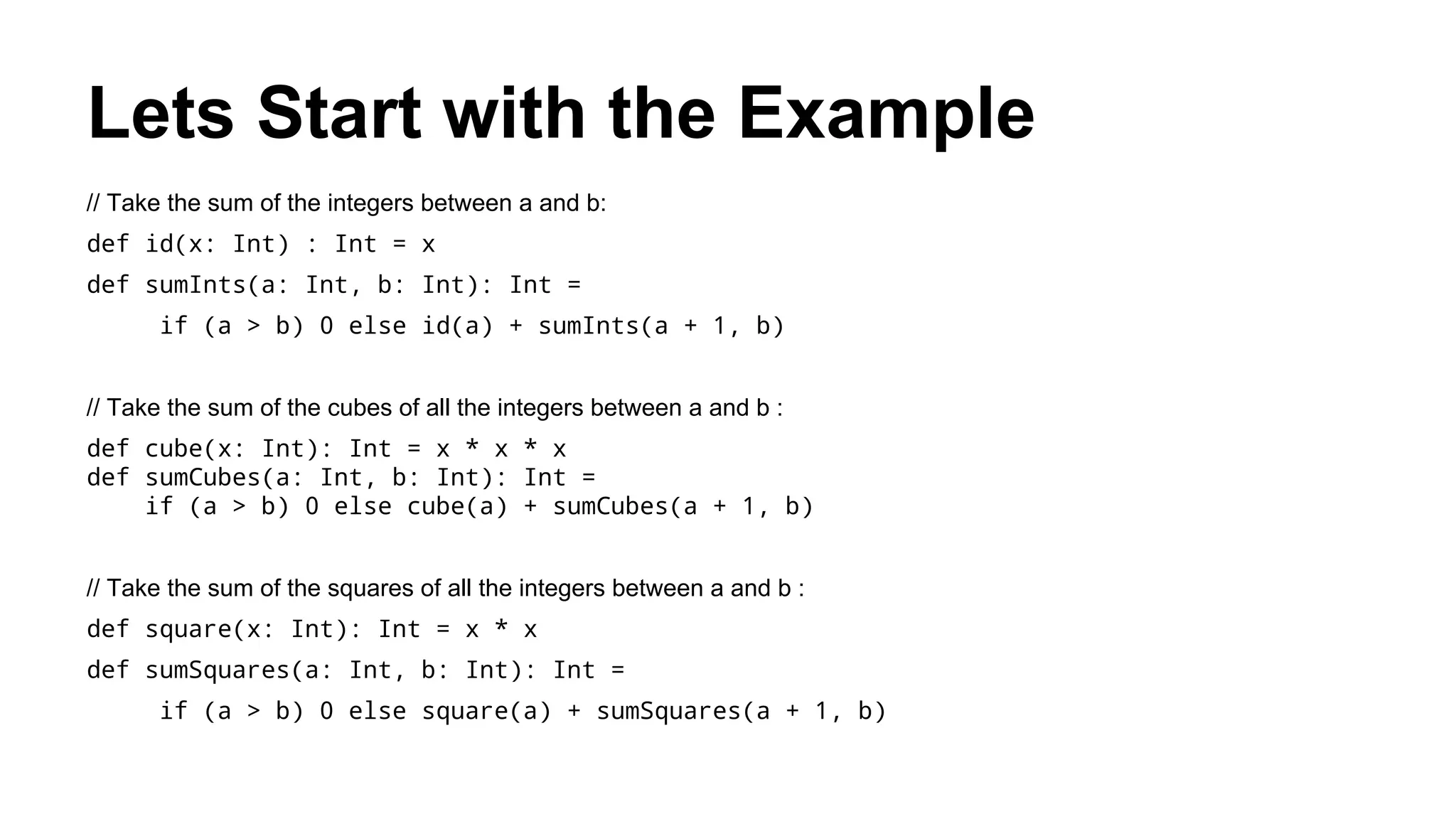
Lets Start with the Example
// Take the sum of the integers between a and b:
def id(x: Int) : Int = x
def sumInts(a: Int, b: Int): Int =
if (a > b) 0 else id(a) + sumInts(a + 1, b)
// Take the sum of the cubes of all the integers between a and b :
def cube(x: Int): Int = x * x * x
def sumCubes(a: Int, b: Int): Int =
if (a > b) 0 else cube(a) + sumCubes(a + 1, b)
// Take the sum of the squares of all the integers between a and b :
def square(x: Int): Int = x * x
def sumSquares(a: Int, b: Int): Int =
if (a > b) 0 else square(a) + sumSquares(a + 1, b)
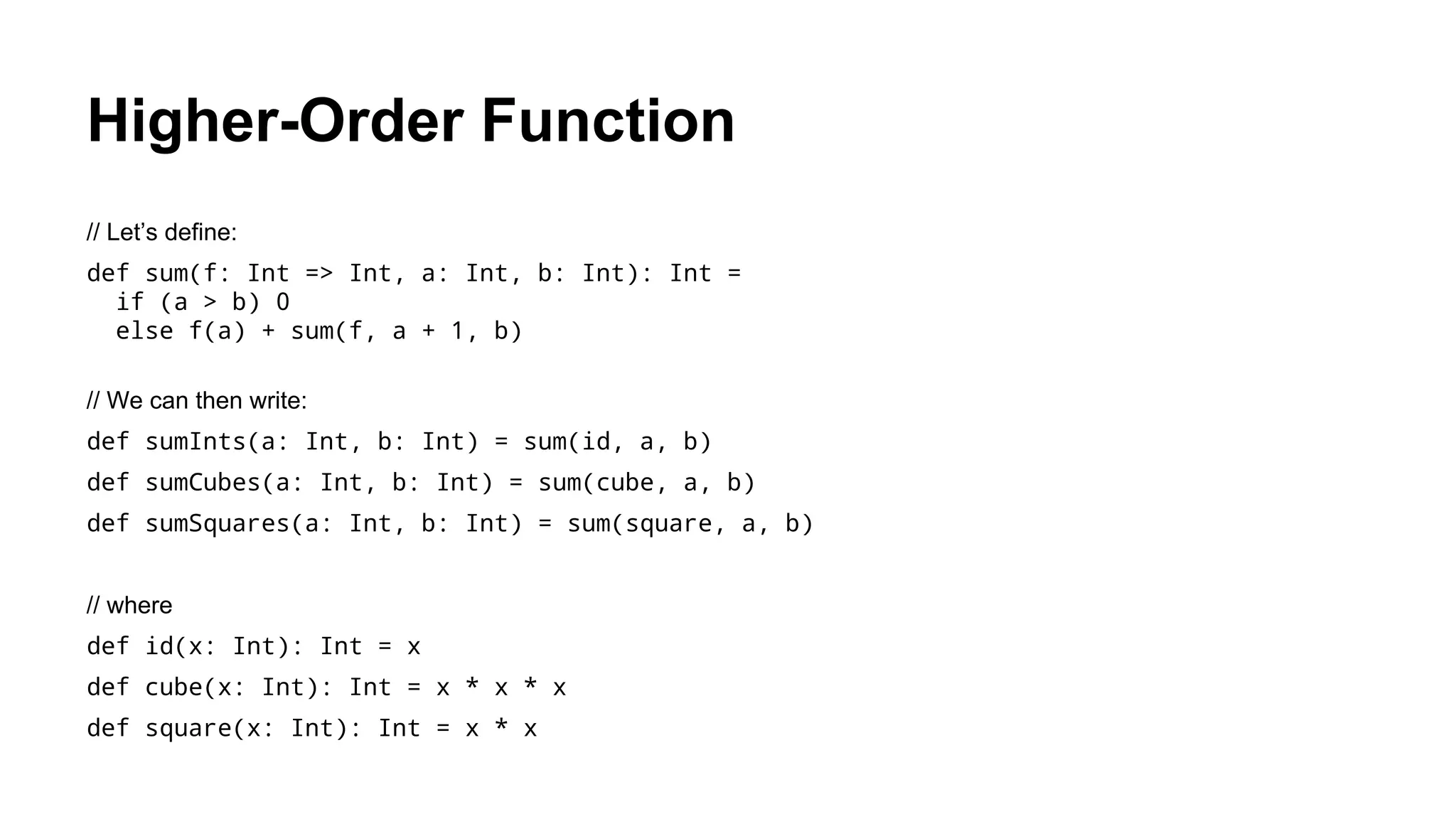
Higher-Order Function
// Let’s define:
def sum(f: Int => Int, a: Int, b: Int): Int =
if (a > b) 0
else f(a) + sum(f, a + 1, b)
// We can then write:
def sumInts(a: Int, b: Int) = sum(id, a, b)
def sumCubes(a: Int, b: Int) = sum(cube, a, b)
def sumSquares(a: Int, b: Int) = sum(square, a, b)
// where
def id(x: Int): Int = x
def cube(x: Int): Int = x * x * x
def square(x: Int): Int = x * x
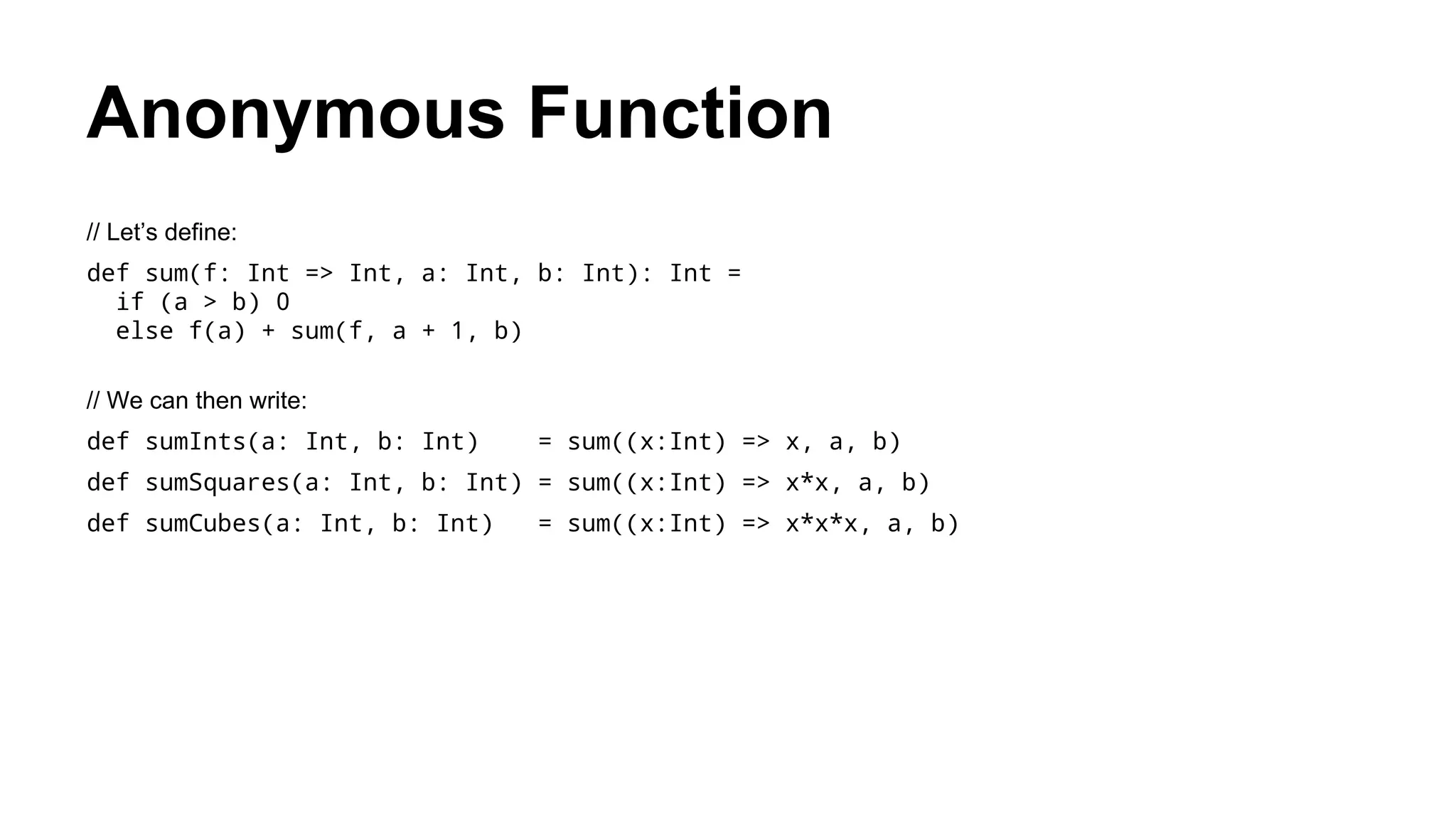
Anonymous Function
// Let’s define:
def sum(f: Int => Int, a: Int, b: Int): Int =
if (a > b) 0
else f(a) + sum(f, a + 1, b)
// We can then write:
def sumInts(a: Int, b: Int) = sum((x:Int) => x, a, b)
def sumSquares(a: Int, b: Int) = sum((x:Int) => x*x, a, b)
def sumCubes(a: Int, b: Int) = sum((x:Int) => x*x*x, a, b)
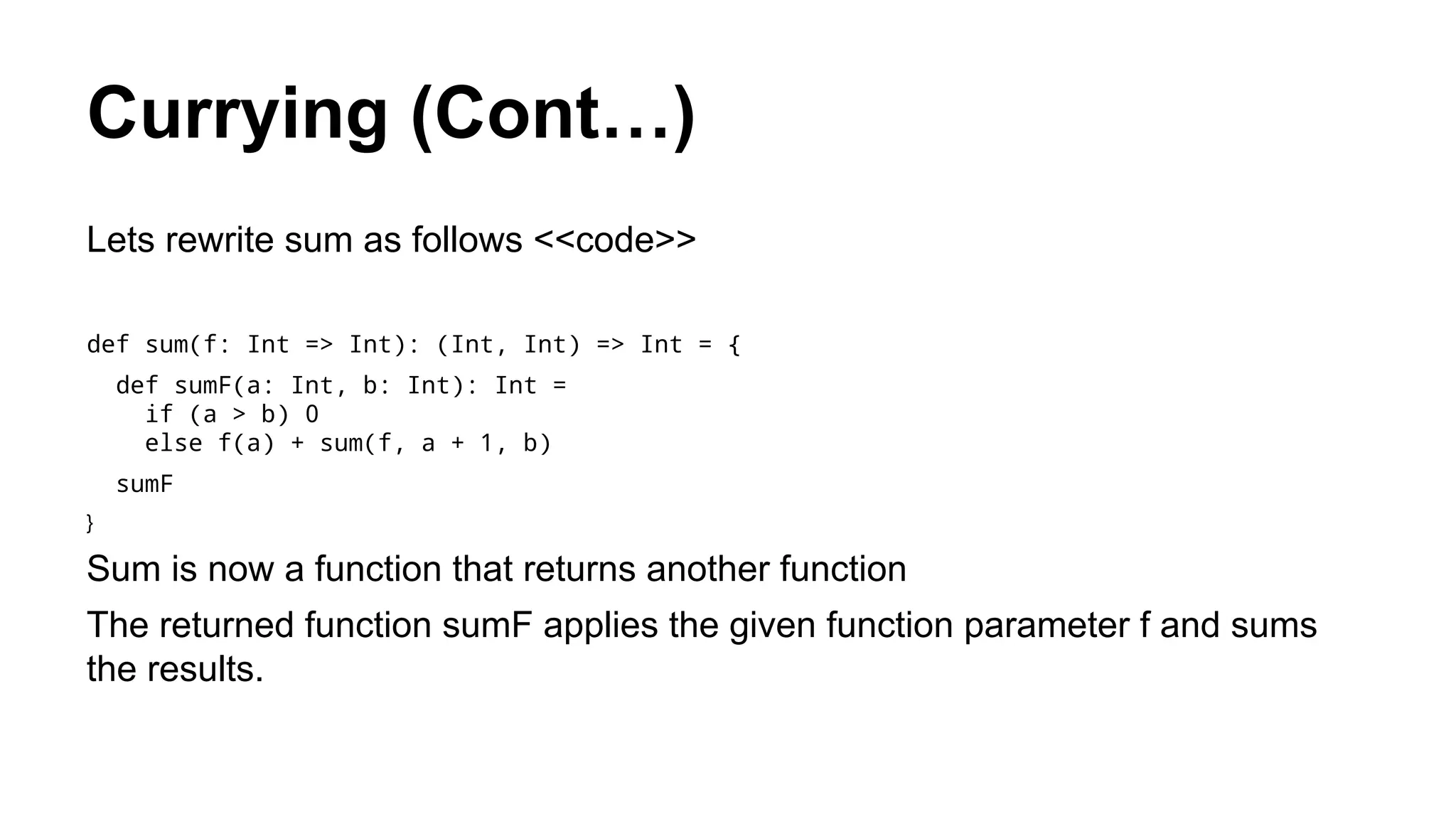
Currying (Cont…)
Lets rewrite sum as follows <<code>>
def sum(f: Int => Int): (Int, Int) => Int = {
def sumF(a: Int, b: Int): Int =
if (a > b) 0
else f(a) + sum(f, a + 1, b)
sumF
}
Sum is now a function that returns another function
The returned function sumF applies the given function parameter f and sums
the results.
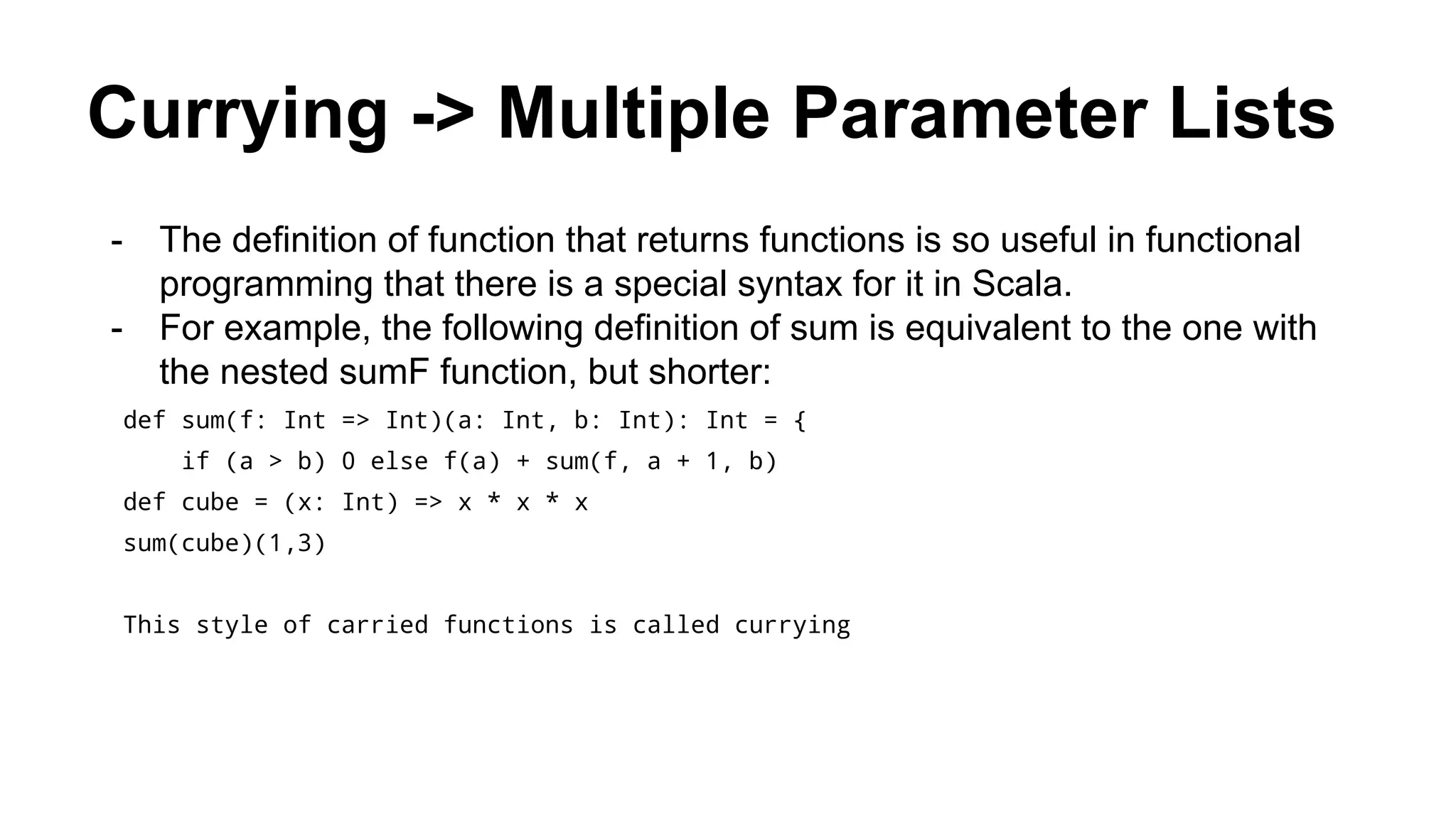
Currying -> Multiple Parameter Lists
- The definition of function that returns functions is so useful in functional
programming that there is a special syntax for it in Scala.
- For example, the following definition of sum is equivalent to the one with
the nested sumF function, but shorter:
def sum(f: Int => Int)(a: Int, b: Int): Int = {
if (a > b) 0 else f(a) + sum(f, a + 1, b)
def cube = (x: Int) => x * x * x
sum(cube)(1,3)
This style of carried functions is called currying
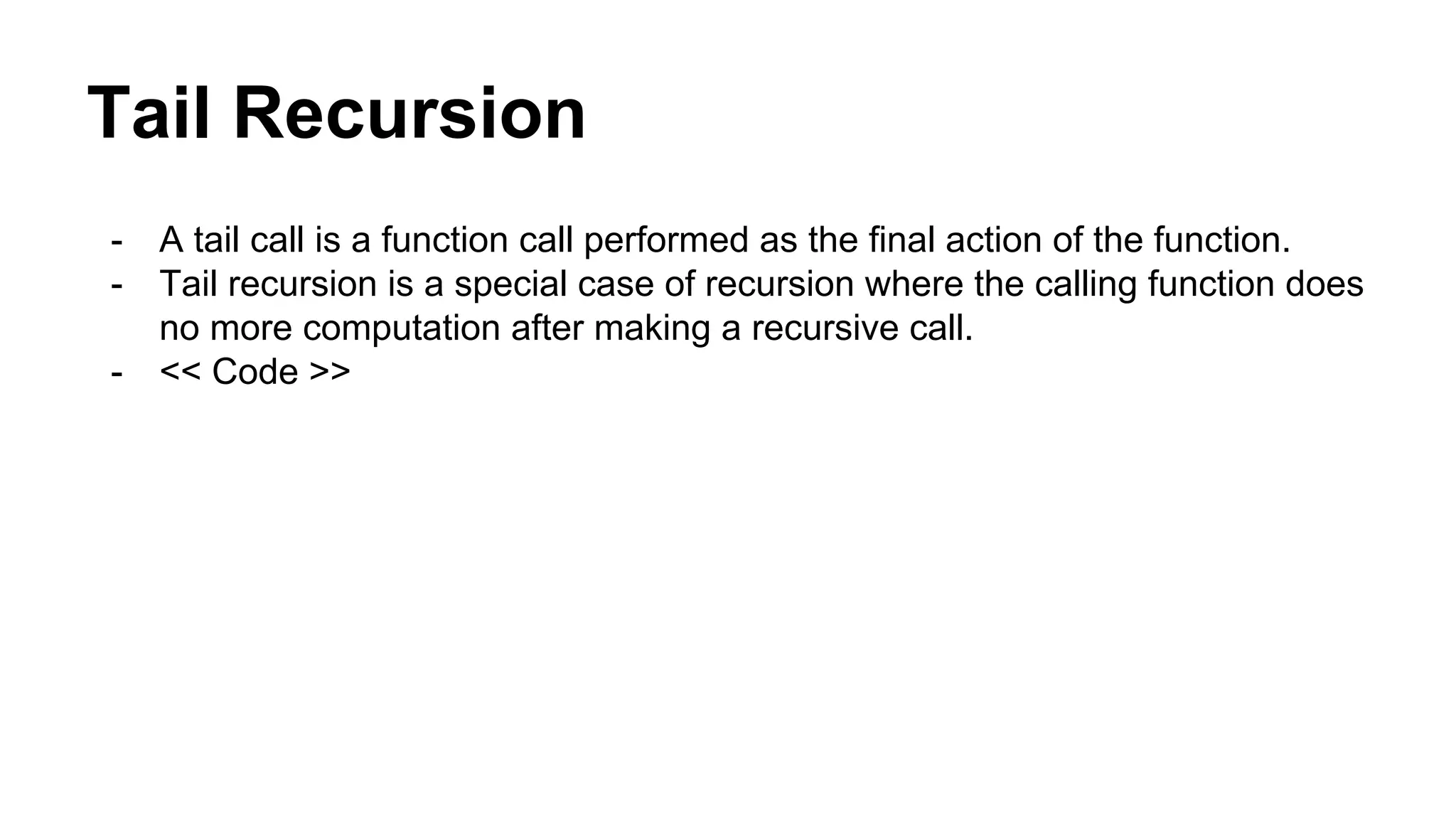
Tail Recursion
- A tail call is a function call performed as the final action of the function.
- Tail recursion is a special case of recursion where the calling function does
no more computation after making a recursive call.
- << Code >>
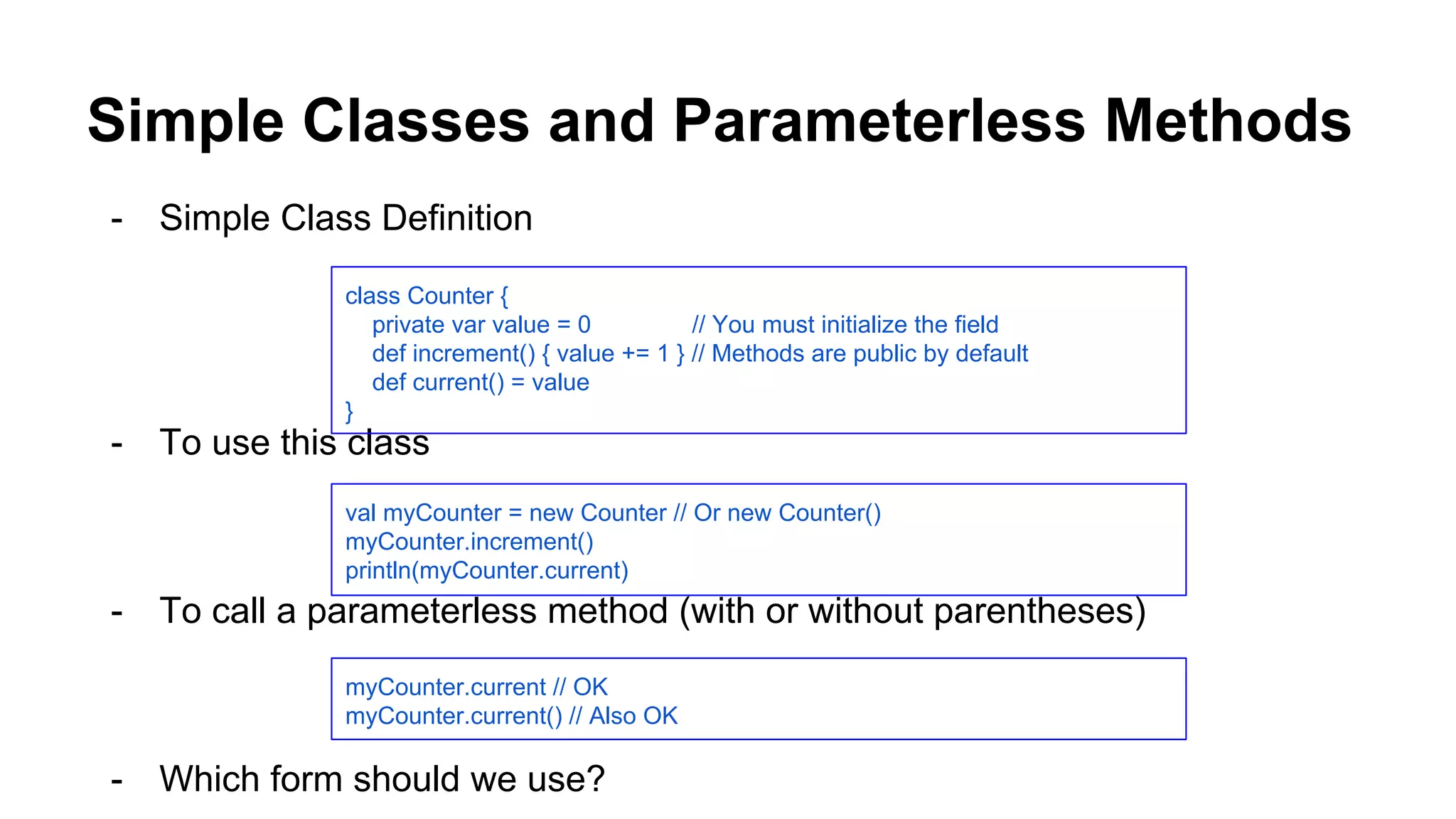
Simple Classes and Parameterless Methods
- Simple Class Definition
- To use this class
- To call a parameterless method (with or without parentheses)
- Which form should we use?
class Counter {
private var value = 0 // You must initialize the field
def increment() { value += 1 } // Methods are public by default
def current() = value
}
val myCounter = new Counter // Or new Counter()
myCounter.increment()
println(myCounter.current)
myCounter.current // OK
myCounter.current() // Also OK
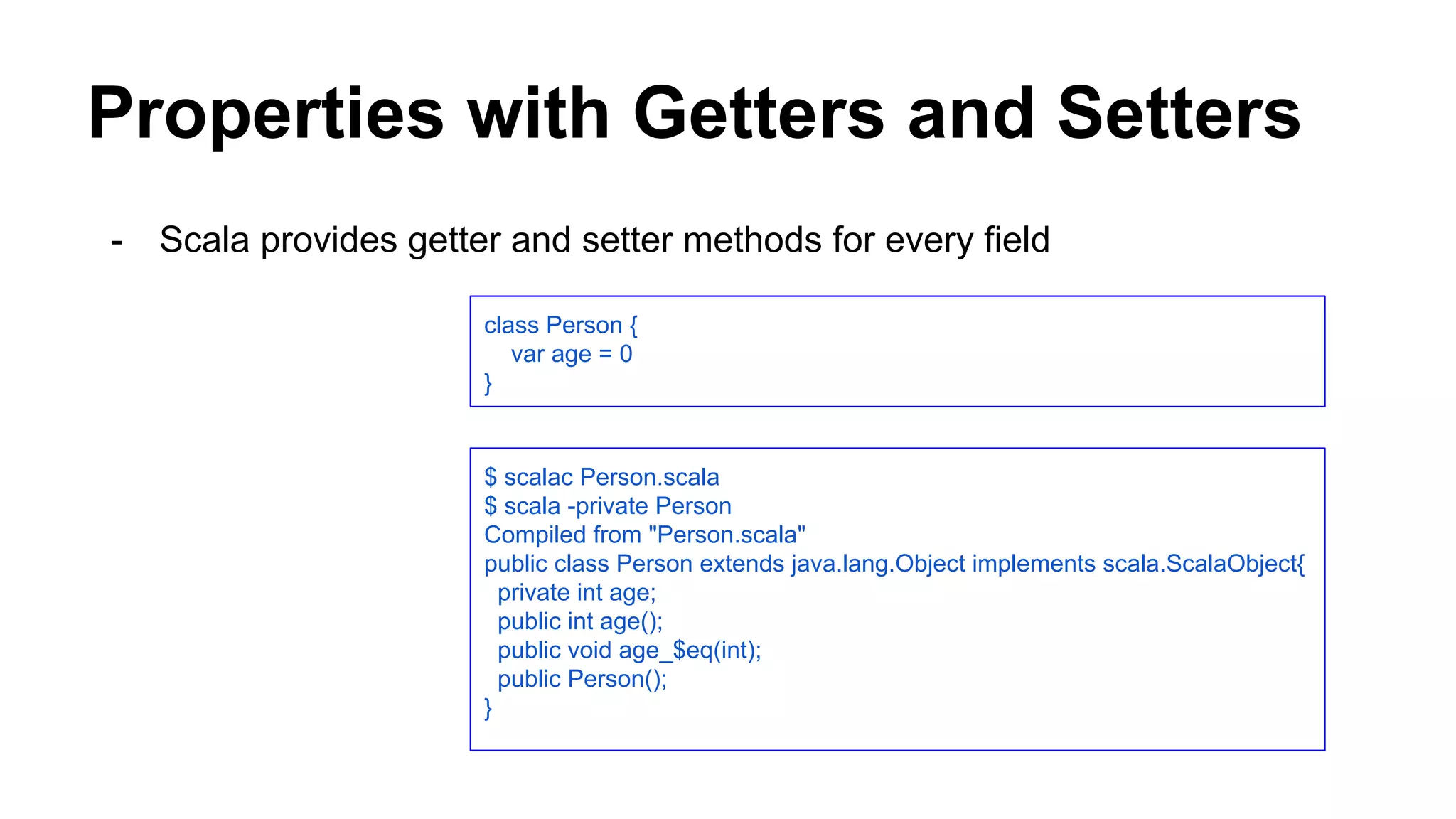
Properties with Getters and Setters
- Scala provides getter and setter methods for every field
class Person {
var age = 0
}
$ scalac Person.scala
$ scala -private Person
Compiled from "Person.scala"
public class Person extends java.lang.Object implements scala.ScalaObject{
private int age;
public int age();
public void age_$eq(int);
public Person();
}
Properties with Getters and Setters
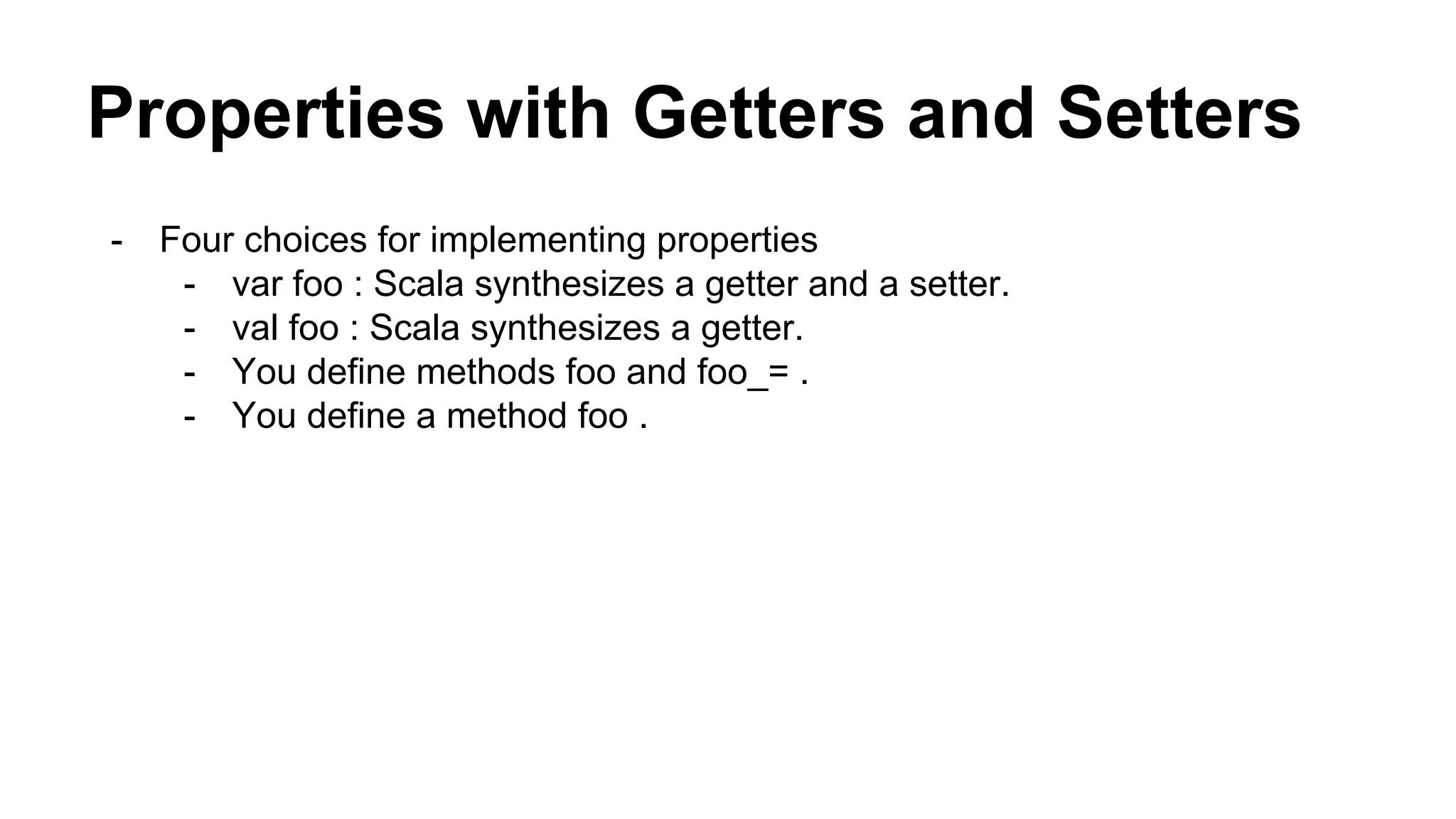
- Four choices for implementing properties
- var foo : Scala synthesizes a getter and a setter.
- val foo : Scala synthesizes a getter.
- You define methods foo and foo_= .
- You define a method foo .
Object-Private Fields
- In Scala (like in Java or C++), a method can access the private fields of all
objects of its class. For Example,
- Scala allows even more severe access restriction with private[this]
qualifier. This field is called object-private field.
class Counter {
private var value = 0
def increment() { value += 1 }
def isLess(other : Counter) = value < other.value
// Can access private field of other object
}
private[this] var value = 0 // Accessing someObject.value is not allowed
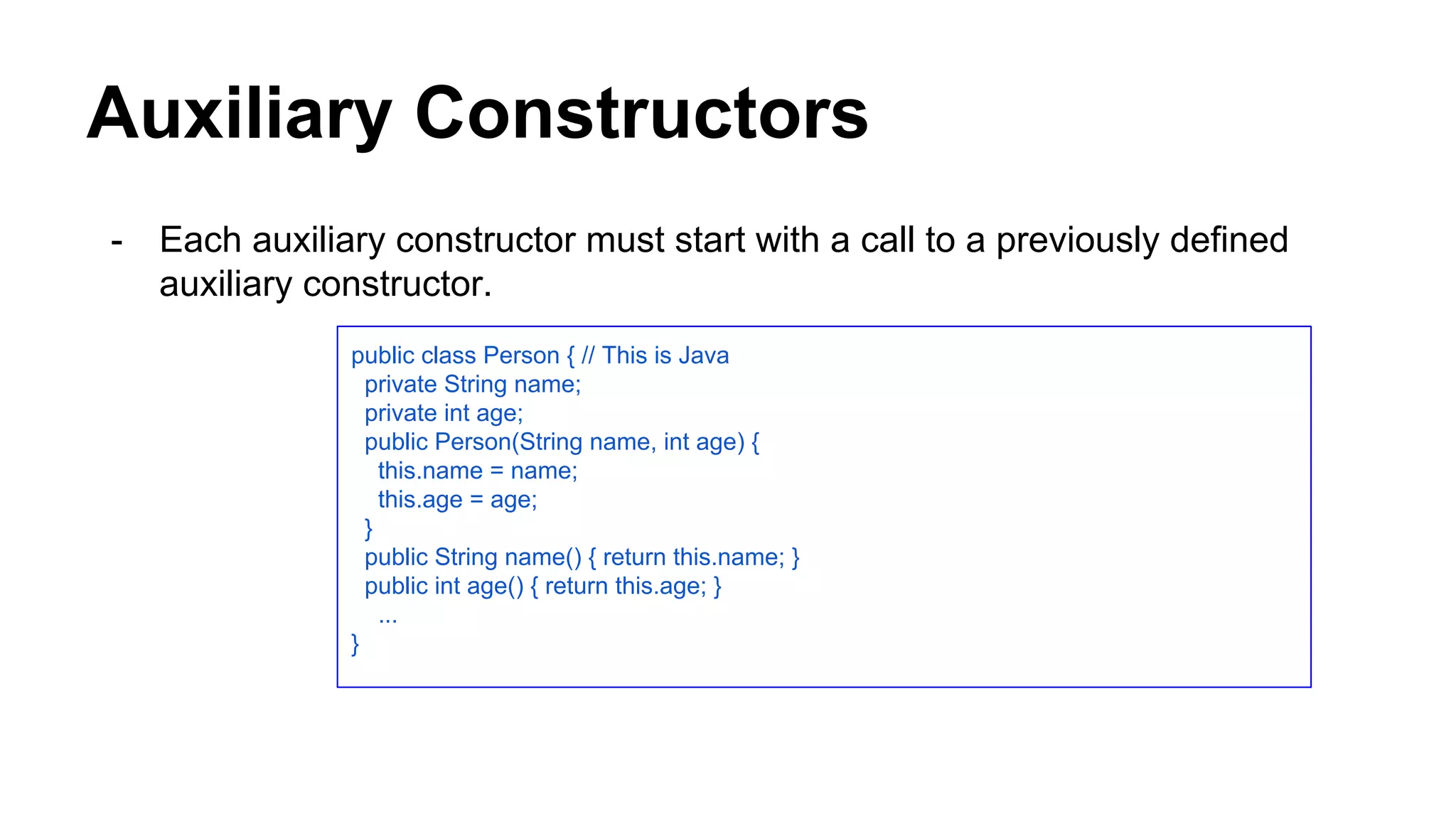
Auxiliary Constructors
- Each auxiliary constructor must start with a call to a previously defined
auxiliary constructor.
public class Person { // This is Java
private String name;
private int age;
public Person(String name, int age) {
this.name = name;
this.age = age;
}
public String name() { return this.name; }
public int age() { return this.age; }
...
}
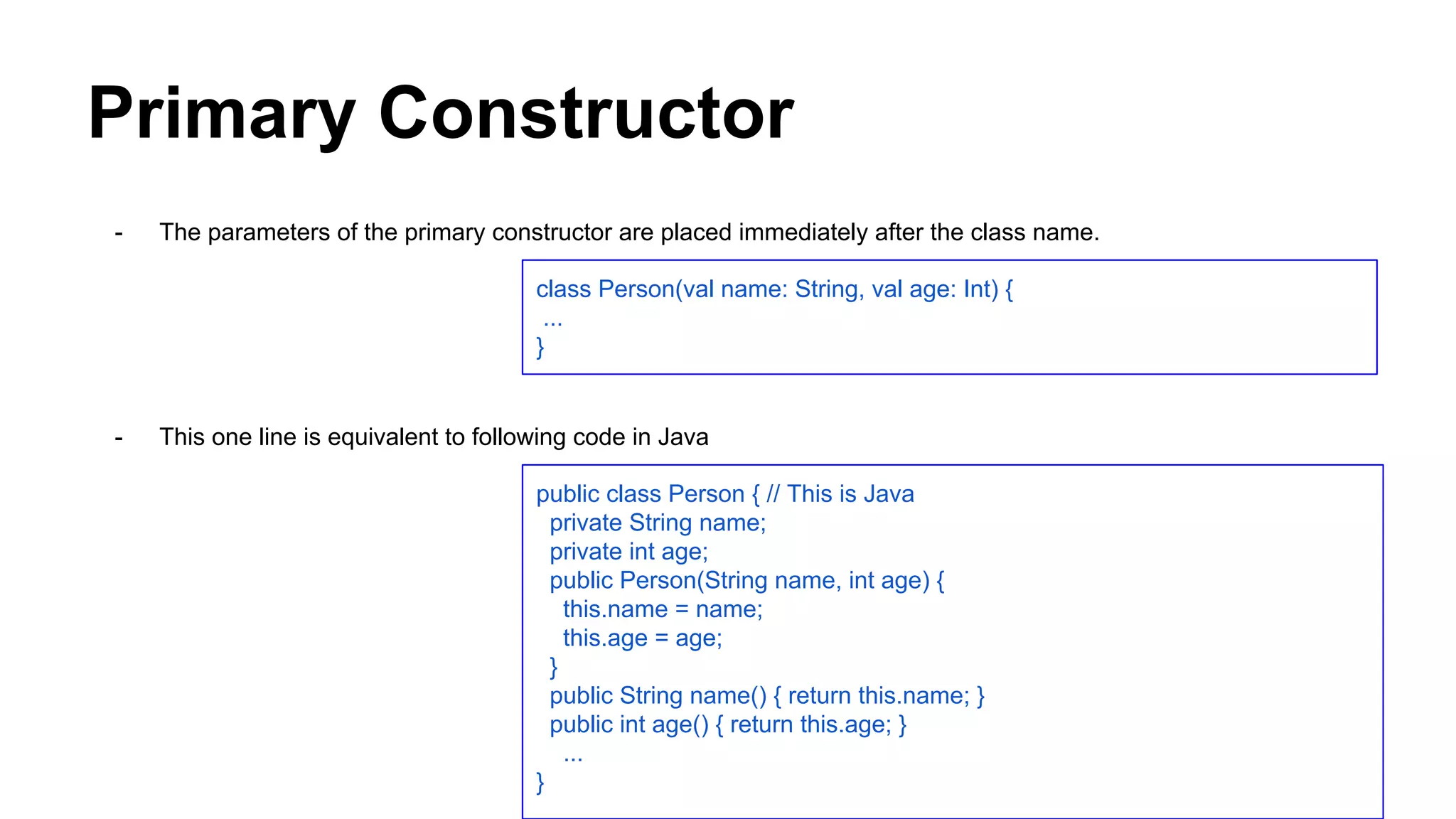
Primary Constructor
- The parameters of the primary constructor are placed immediately after the class name.
- This one line is equivalent to following code in Java
class Person(val name: String, val age: Int) {
...
}
public class Person { // This is Java
private String name;
private int age;
public Person(String name, int age) {
this.name = name;
this.age = age;
}
public String name() { return this.name; }
public int age() { return this.age; }
...
}
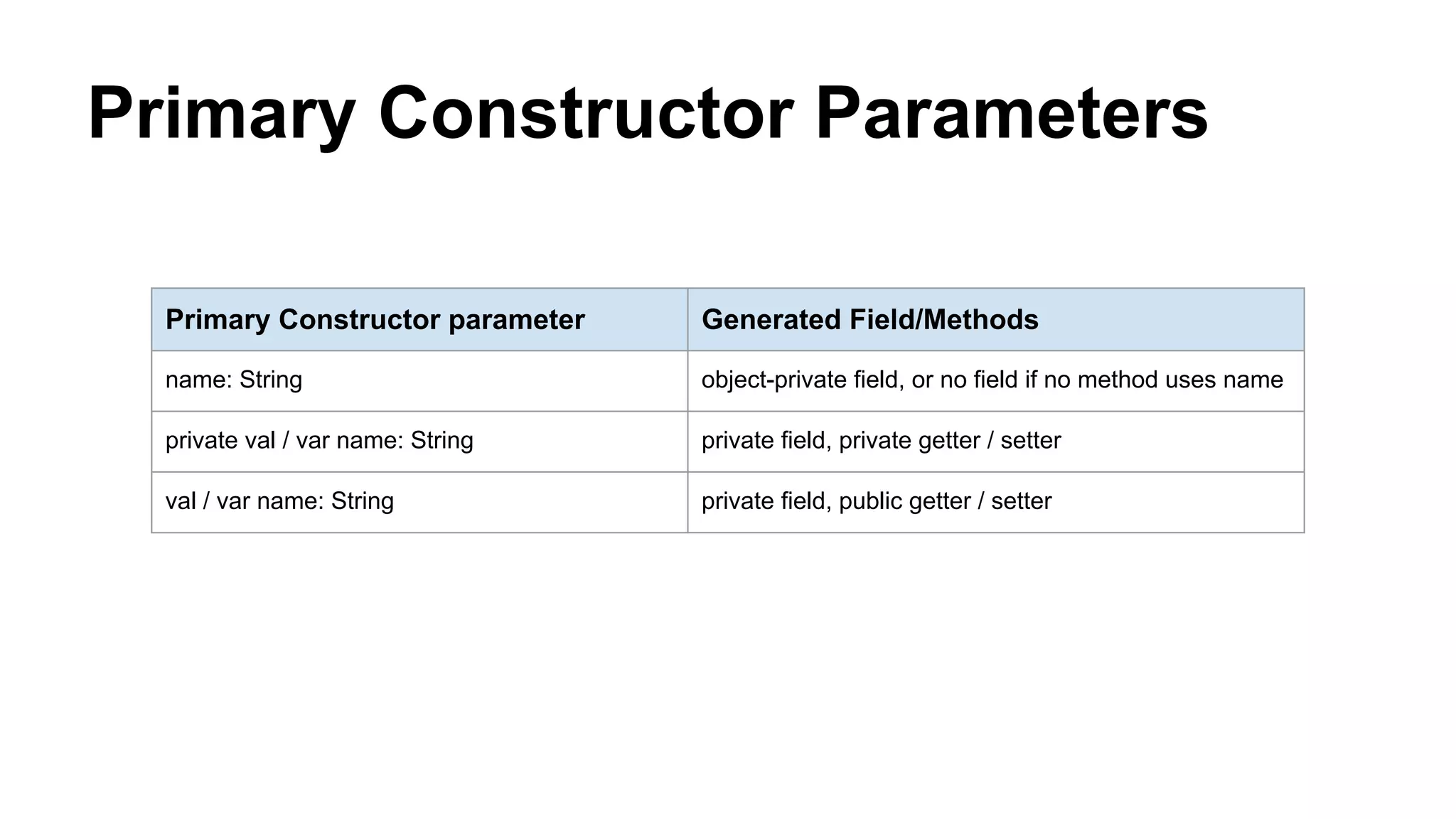
Primary Constructor Parameters
Primary Constructor parameter Generated Field/Methods
name: String object-private field, or no field if no method uses name
private val / var name: String private field, private getter / setter
val / var name: String private field, public getter / setter
Nested Classes
- In Scala, you can nest just about anything inside anything
- functions inside functions
- classes inside other classes
class Network {
class Member(val name: String) {
val contacts = new ArrayBuffer[Member]
}
private val members = new ArrayBuffer[Member]
def join(name: String) = {
val m = new Member(name)
members += m
m
}
}
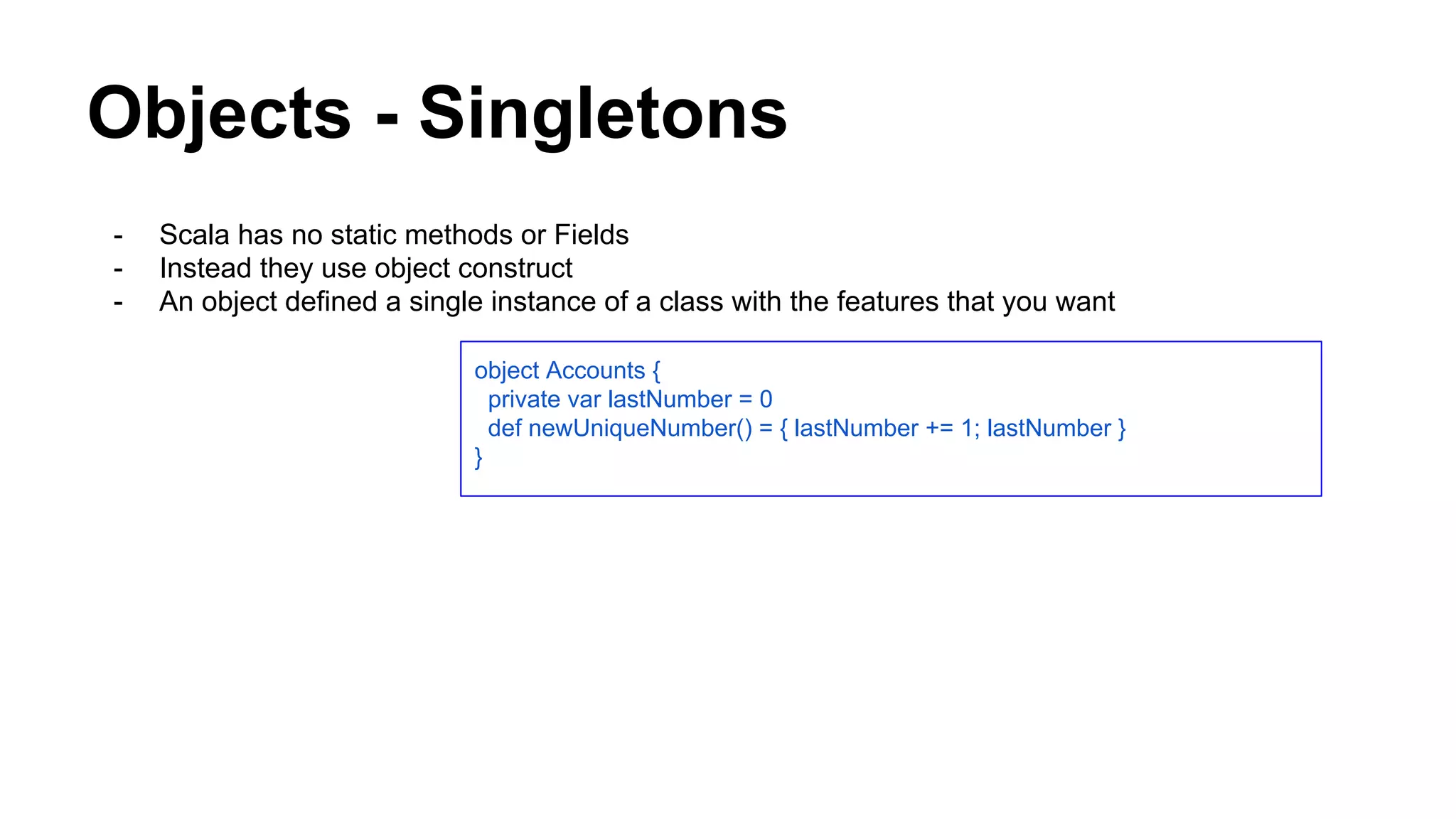
Objects - Singletons
- Scala has no static methods or Fields
- Instead they use object construct
- An object defined a single instance of a class with the features that you want
object Accounts {
private var lastNumber = 0
def newUniqueNumber() = { lastNumber += 1; lastNumber }
}

Lecture 5

  • 1.
  • 2.
    Course Contents 1. TheBasics 2. Getting up to speed 3. Higher-Order functions 4. Classes and Objects 5. Inheritance and Traits 6. Collections
  • 3.
    Today’s Session (Classesand Objects) ● Simple Classes and Parameterless Methods ● Properties with Getters and Setters ● Singleton Objects ● Companion Objects
  • 4.
    Lets revise abit what we covered
  • 5.
    Higher Order (FirstClass) Functions - Scala treat functions as first-class values. - This means that like any other value, a function can be passed as a parameter and returned as a result. - This provides a flexible way to compose programs. - Functions that take other functions as parameters or that return functions are called higher order functions
  • 6.
    Lets Start withthe Example // Take the sum of the integers between a and b: def id(x: Int) : Int = x def sumInts(a: Int, b: Int): Int = if (a > b) 0 else id(a) + sumInts(a + 1, b) // Take the sum of the cubes of all the integers between a and b : def cube(x: Int): Int = x * x * x def sumCubes(a: Int, b: Int): Int = if (a > b) 0 else cube(a) + sumCubes(a + 1, b) // Take the sum of the squares of all the integers between a and b : def square(x: Int): Int = x * x def sumSquares(a: Int, b: Int): Int = if (a > b) 0 else square(a) + sumSquares(a + 1, b)
  • 7.
    Higher-Order Function // Let’sdefine: def sum(f: Int => Int, a: Int, b: Int): Int = if (a > b) 0 else f(a) + sum(f, a + 1, b) // We can then write: def sumInts(a: Int, b: Int) = sum(id, a, b) def sumCubes(a: Int, b: Int) = sum(cube, a, b) def sumSquares(a: Int, b: Int) = sum(square, a, b) // where def id(x: Int): Int = x def cube(x: Int): Int = x * x * x def square(x: Int): Int = x * x
  • 8.
    Anonymous Function // Let’sdefine: def sum(f: Int => Int, a: Int, b: Int): Int = if (a > b) 0 else f(a) + sum(f, a + 1, b) // We can then write: def sumInts(a: Int, b: Int) = sum((x:Int) => x, a, b) def sumSquares(a: Int, b: Int) = sum((x:Int) => x*x, a, b) def sumCubes(a: Int, b: Int) = sum((x:Int) => x*x*x, a, b)
  • 9.
    Currying (Cont…) Lets rewritesum as follows <<code>> def sum(f: Int => Int): (Int, Int) => Int = { def sumF(a: Int, b: Int): Int = if (a > b) 0 else f(a) + sum(f, a + 1, b) sumF } Sum is now a function that returns another function The returned function sumF applies the given function parameter f and sums the results.
  • 10.
    Currying -> MultipleParameter Lists - The definition of function that returns functions is so useful in functional programming that there is a special syntax for it in Scala. - For example, the following definition of sum is equivalent to the one with the nested sumF function, but shorter: def sum(f: Int => Int)(a: Int, b: Int): Int = { if (a > b) 0 else f(a) + sum(f, a + 1, b) def cube = (x: Int) => x * x * x sum(cube)(1,3) This style of carried functions is called currying
  • 11.
    Tail Recursion - Atail call is a function call performed as the final action of the function. - Tail recursion is a special case of recursion where the calling function does no more computation after making a recursive call. - << Code >>
  • 12.
    Simple Classes andParameterless Methods - Simple Class Definition - To use this class - To call a parameterless method (with or without parentheses) - Which form should we use? class Counter { private var value = 0 // You must initialize the field def increment() { value += 1 } // Methods are public by default def current() = value } val myCounter = new Counter // Or new Counter() myCounter.increment() println(myCounter.current) myCounter.current // OK myCounter.current() // Also OK
  • 13.
    Properties with Gettersand Setters - Scala provides getter and setter methods for every field class Person { var age = 0 } $ scalac Person.scala $ scala -private Person Compiled from "Person.scala" public class Person extends java.lang.Object implements scala.ScalaObject{ private int age; public int age(); public void age_$eq(int); public Person(); }
  • 14.
    Properties with Gettersand Setters - Four choices for implementing properties - var foo : Scala synthesizes a getter and a setter. - val foo : Scala synthesizes a getter. - You define methods foo and foo_= . - You define a method foo .
  • 15.
    Object-Private Fields - InScala (like in Java or C++), a method can access the private fields of all objects of its class. For Example, - Scala allows even more severe access restriction with private[this] qualifier. This field is called object-private field. class Counter { private var value = 0 def increment() { value += 1 } def isLess(other : Counter) = value < other.value // Can access private field of other object } private[this] var value = 0 // Accessing someObject.value is not allowed
  • 16.
    Auxiliary Constructors - Eachauxiliary constructor must start with a call to a previously defined auxiliary constructor. public class Person { // This is Java private String name; private int age; public Person(String name, int age) { this.name = name; this.age = age; } public String name() { return this.name; } public int age() { return this.age; } ... }
  • 17.
    Primary Constructor - Theparameters of the primary constructor are placed immediately after the class name. - This one line is equivalent to following code in Java class Person(val name: String, val age: Int) { ... } public class Person { // This is Java private String name; private int age; public Person(String name, int age) { this.name = name; this.age = age; } public String name() { return this.name; } public int age() { return this.age; } ... }
  • 18.
    Primary Constructor Parameters PrimaryConstructor parameter Generated Field/Methods name: String object-private field, or no field if no method uses name private val / var name: String private field, private getter / setter val / var name: String private field, public getter / setter
  • 19.
    Nested Classes - InScala, you can nest just about anything inside anything - functions inside functions - classes inside other classes class Network { class Member(val name: String) { val contacts = new ArrayBuffer[Member] } private val members = new ArrayBuffer[Member] def join(name: String) = { val m = new Member(name) members += m m } }
  • 20.
    Objects - Singletons -Scala has no static methods or Fields - Instead they use object construct - An object defined a single instance of a class with the features that you want object Accounts { private var lastNumber = 0 def newUniqueNumber() = { lastNumber += 1; lastNumber } }