A Gentle Introduction
to Scala and FP
1/50
Hi, I'm Anton!
Functional
programmer
Scala enthusiast
Applications engineer
at Rakuten
@a7emenov
Find me on ,
and
Twitter
Telegram Github
2/50
Agenda
Introduce Scala as a language
Give examples of universal FP constructs
Show benefits of those constructs
Compare Scala to other languages
3/50
What is Scala as
a language?
4/50
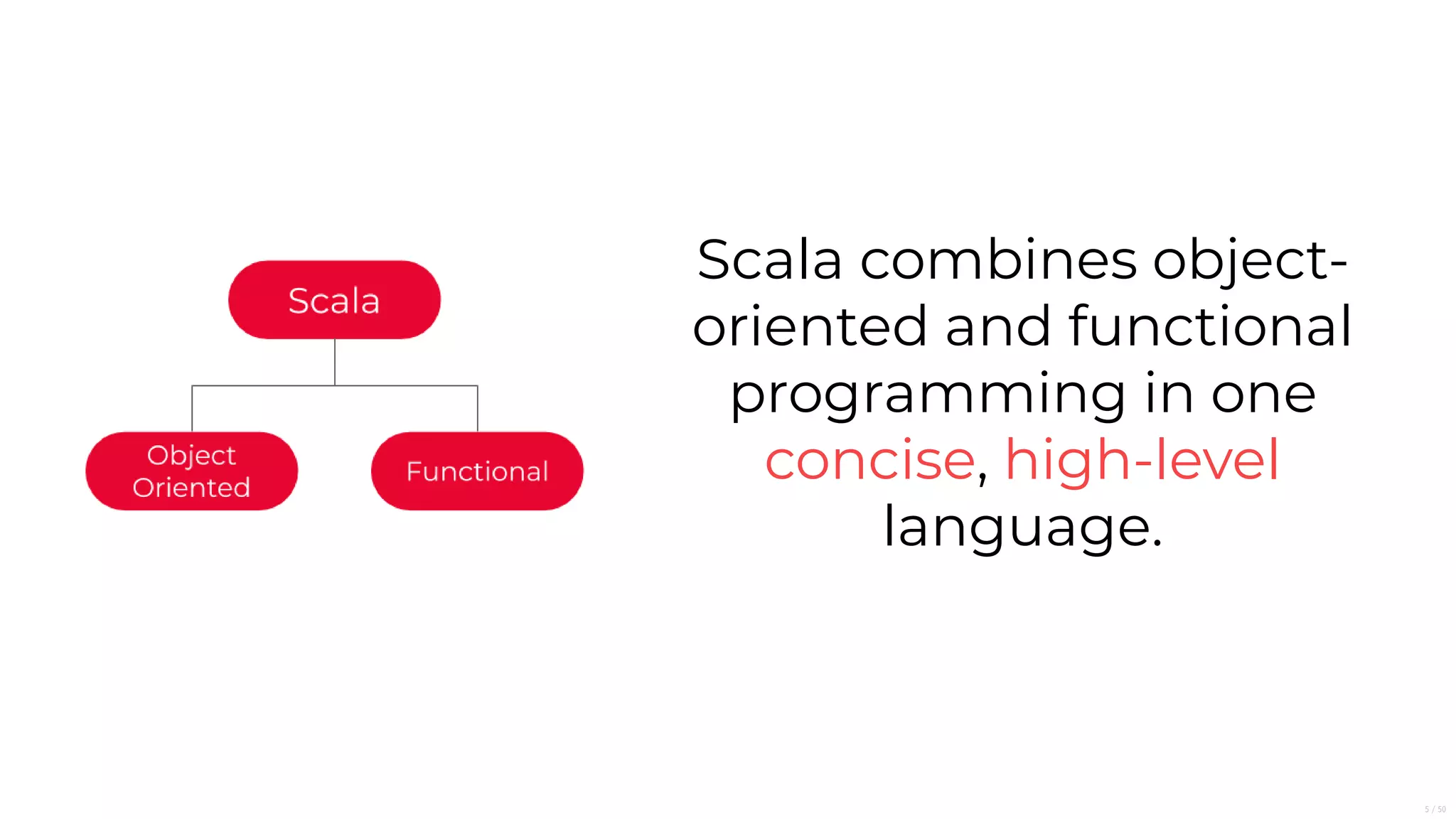
Scala combines object-
oriented and functional
programming in one
concise, high-level
language.
5/50
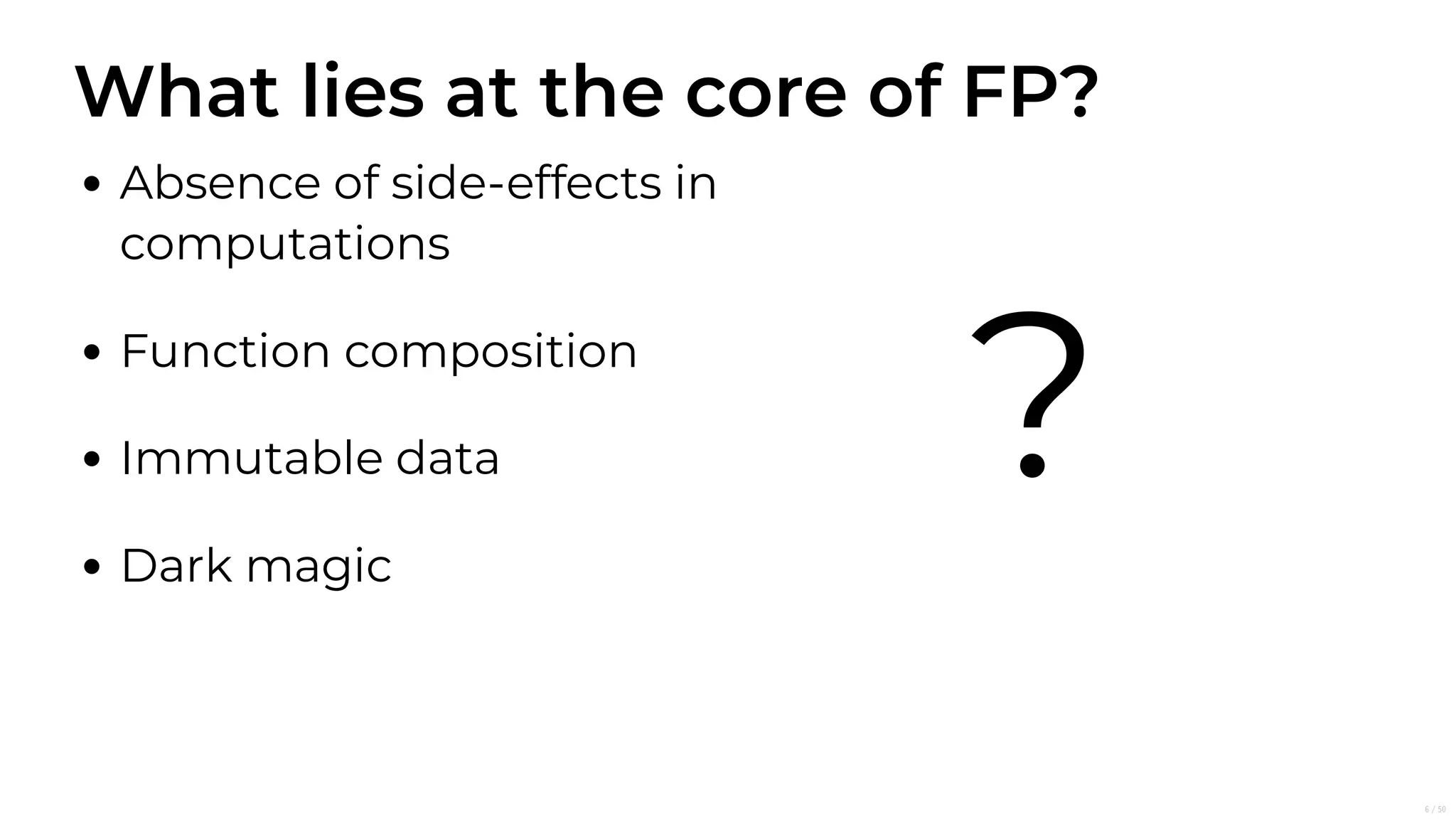
What lies at the core of FP?
6/50
What lies at the core of FP?
Absence of side-effects in
computations
6/50
What lies at the core of FP?
Absence of side-effects in
computations
Function composition
6/50
What lies at the core of FP?
Absence of side-effects in
computations
Function composition
Immutable data
6/50
What lies at the core of FP?
Absence of side-effects in
computations
Function composition
Immutable data
Dark magic
6/50
What lies at the core of FP?
Absence of side-effects in
computations
Function composition
Immutable data
Dark magic
?
6/50
What lies at the core of FP?
Absence of side-effects in
computations
Function composition
Immutable data
Dark magic
All of it
7/50
Functional programming is a
way of solving problems which
centers around combining
side-effect-free constructs in a
declarative manner
8/50
Declarative vs. imperative
Imperative
for (int i = 1; i 5; i ) {
int temp = i * 2;
if (temp < 6) {
System.out.println(temp);
}
}
Declarative
(1 to 5)
.map(_ * 2)
.filter(_ < 6)
.foreach(println)
9/50
Deep dive
FP & Scala
Immutability
Pure functions
Referential transparency
Algebraic data types
Pattern matching
Recursion
10/50
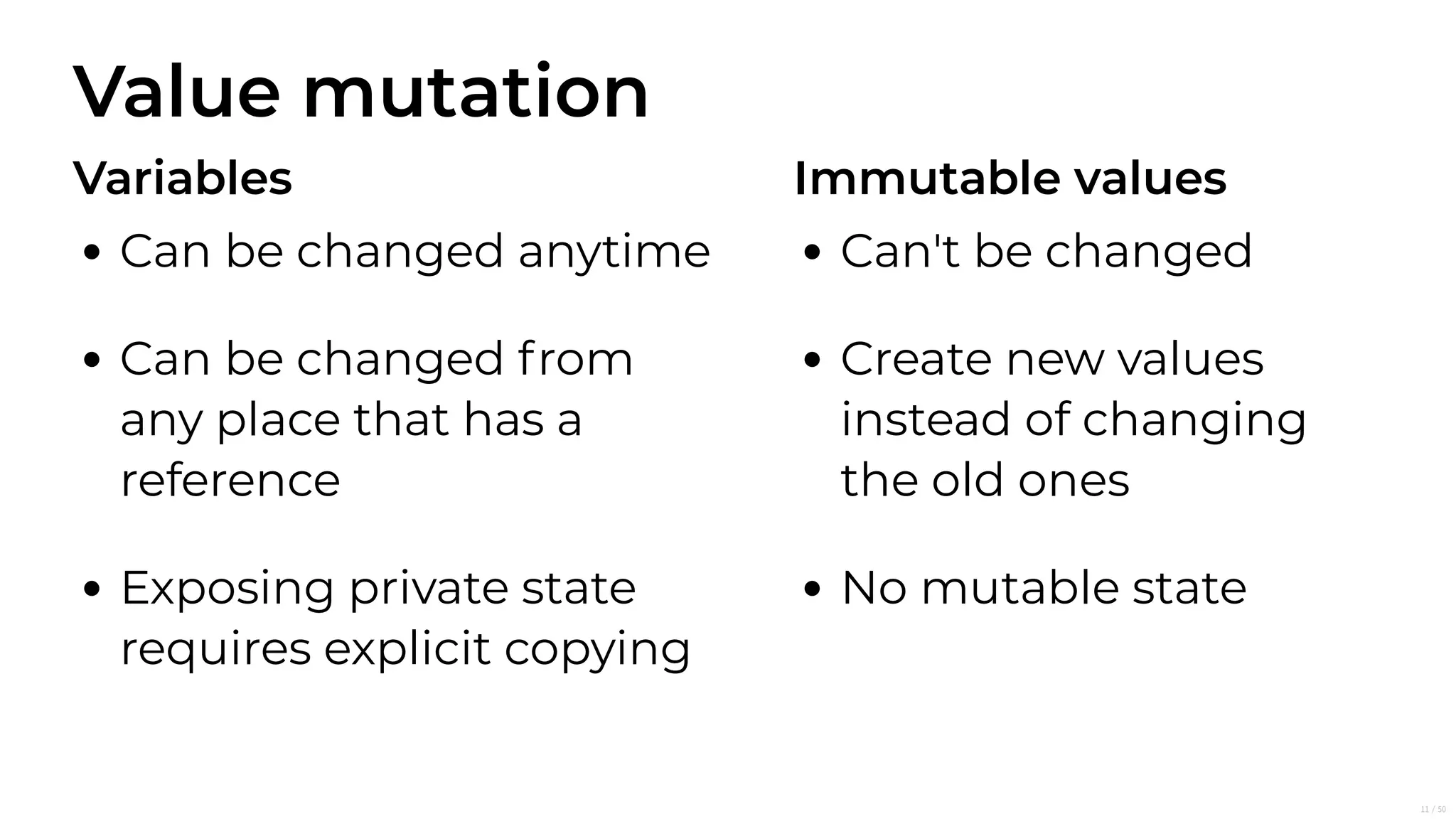
Value mutation
Variables
Can be changed anytime
Can be changed from
any place that has a
reference
Exposing private state
requires explicit copying
Immutable values
Can't be changed
Create new values
instead of changing
the old ones
No mutable state
11/50
Value mutation
Variables Immutable values
12/50
Immutable values
Benefits
Reduce concurrency
issues
No shared mutable
state
Easier local reasoning
Drawbacks
Extra memory allocations
13/50
Pure functions
Side-effect freeSide-effect free - everything that a function does can be
observed in its return value:
TotalTotal - return values for every possible input
DeterministicDeterministic - given same inputs, return same
outputs
Locally scopedLocally scoped - no effect on the state outside of the
function's scope
14/50
Referential transparency
All calls to a function
can be substituted
with its return value
15/50
Referential transparency
Not transparent
def getInt(l: Int, r: Int): Int =
Random.between(l, r)
def increment(x: Int): Int = {
val res = x + 1
destroyTheWorld()
res
}
Transparent
def fact(n: Int): Int = {
var res = 1
var i = 1
while (i n) {
res = res * i
i = i + 1
}
res
}
16/50
Business value with pure functions
How can programs be
useful without any
side-effects?
17/50
Business value with pure functions
Describe side-effecting computations
instead of instantly running them
Combine all side-effects to produce a
single description
Run the resulting computation in the
main method
18/50
Business value with pure functions
def saveValue(key: String, value: Int): IO[Unit] = ?
def getValue(key: String): IO[Option[Int]] = ???
def rateLimit[A](program: IO[A]): IO[A] = ???
val program: IO[Option[Int]] =
ratelimit(
saveValue("key", 1) >> getValue("key")
)
val result: Option[Int] = program.runSyncUnsafe()
19/50
Business value with pure functions
saveValue("key", 1) >> getValue("key")
def saveValue(key: String, value: Int): IO[Unit] = ???
def getValue(key: String): IO[Option[Int]] = ???
def rateLimit[A](program: IO[A]): IO[A] = ???
val program: IO[Option[Int]] =
ratelimit(
)
val result: Option[Int] = program.runSyncUnsafe()
19/50
Business value with pure functions
def rateLimit[A](program: IO[A]): IO[A] = ???
def saveValue(key: String, value: Int): IO[Unit] = ???
def getValue(key: String): IO[Option[Int]] = ???
val program: IO[Option[Int]] =
ratelimit(
saveValue("key", 1) >> getValue("key")
)
val result: Option[Int] = program.runSyncUnsafe()
19/50
Business value with pure functions
val program: IO[Option[Int]] =
ratelimit(
saveValue("key", 1) >> getValue("key")
)
def saveValue(key: String, value: Int): IO[Unit] = ???
def getValue(key: String): IO[Option[Int]] = ???
def rateLimit[A](program: IO[A]): IO[A] = ???
val result: Option[Int] = program.runSyncUnsafe()
19/50
Business value with pure functions
val result: Option[Int] = program.runSyncUnsafe()
def saveValue(key: String, value: Int): IO[Unit] = ???
def getValue(key: String): IO[Option[Int]] = ???
def rateLimit[A](program: IO[A]): IO[A] = ???
val program: IO[Option[Int]] =
ratelimit(
saveValue("key", 1) >> getValue("key")
)
19/50
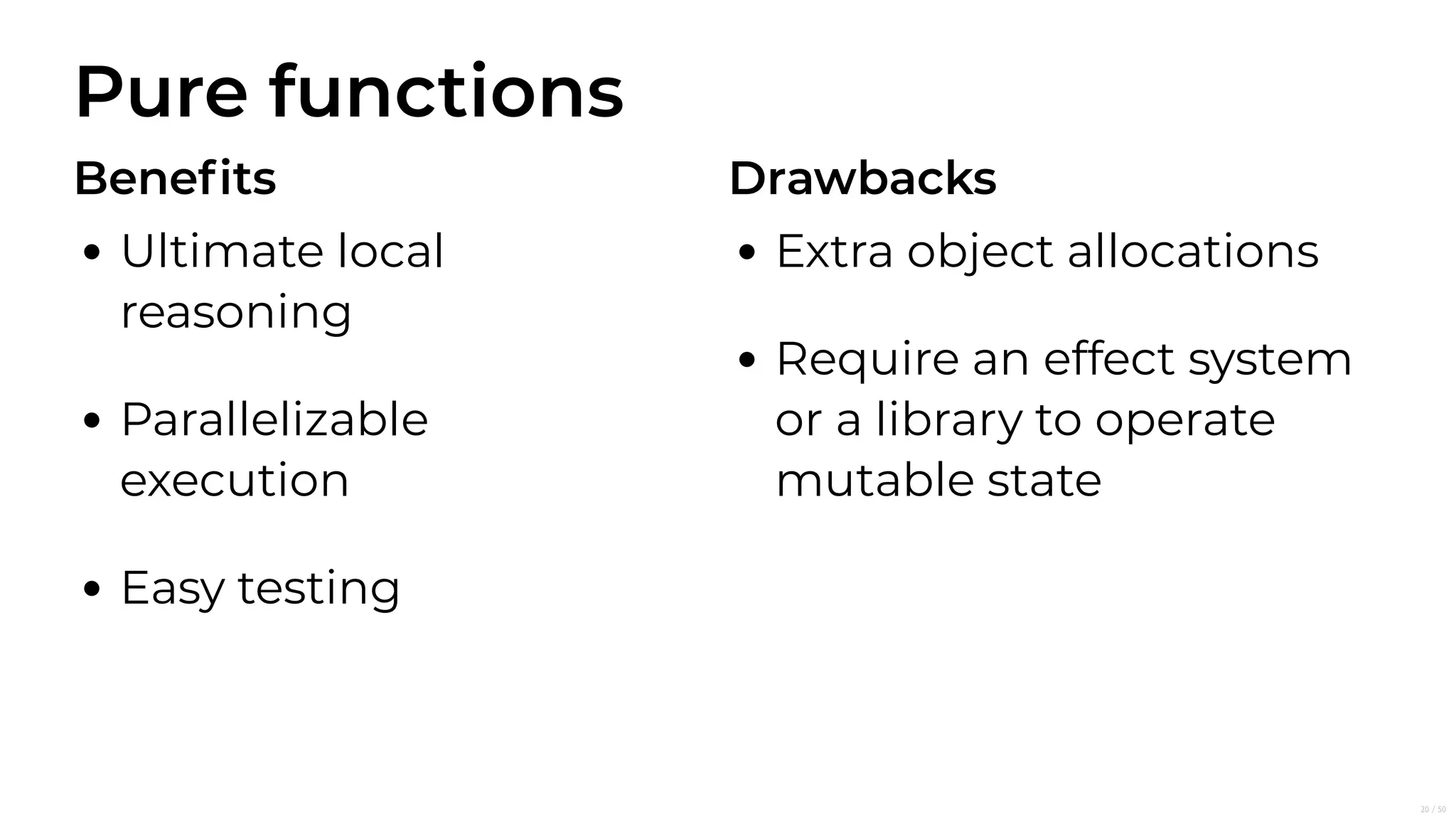
Pure functions
Benefits
Ultimate local
reasoning
Parallelizable
execution
Easy testing
Drawbacks
Extra object allocations
Require an effect system
or a library to operate
mutable state
20/50
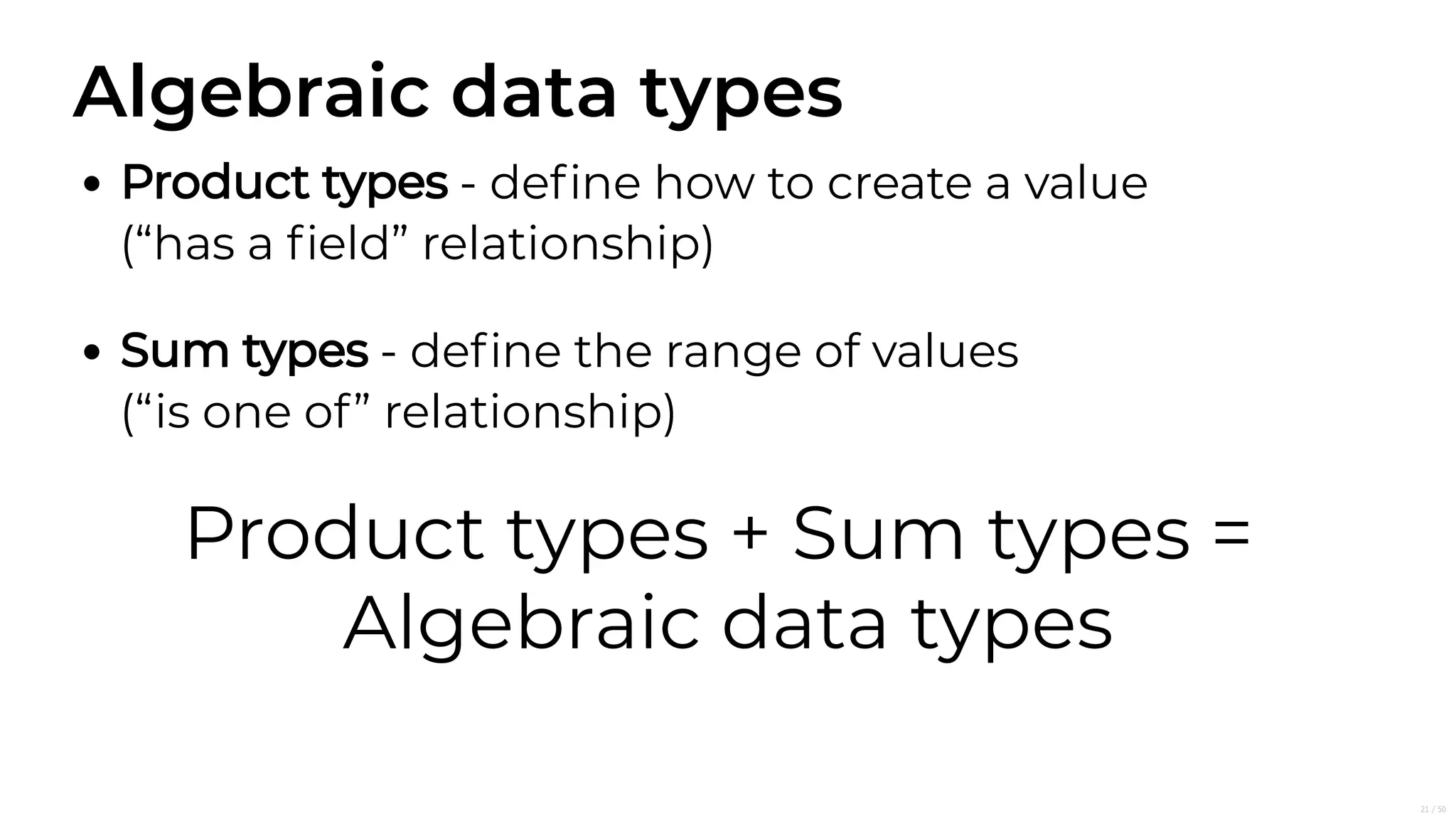
Algebraic data types
Product typesProduct types - define how to create a value
(“has a field” relationship)
Sum typesSum types - define the range of values
(“is one of” relationship)
Product types + Sum types =
Algebraic data types
21/50
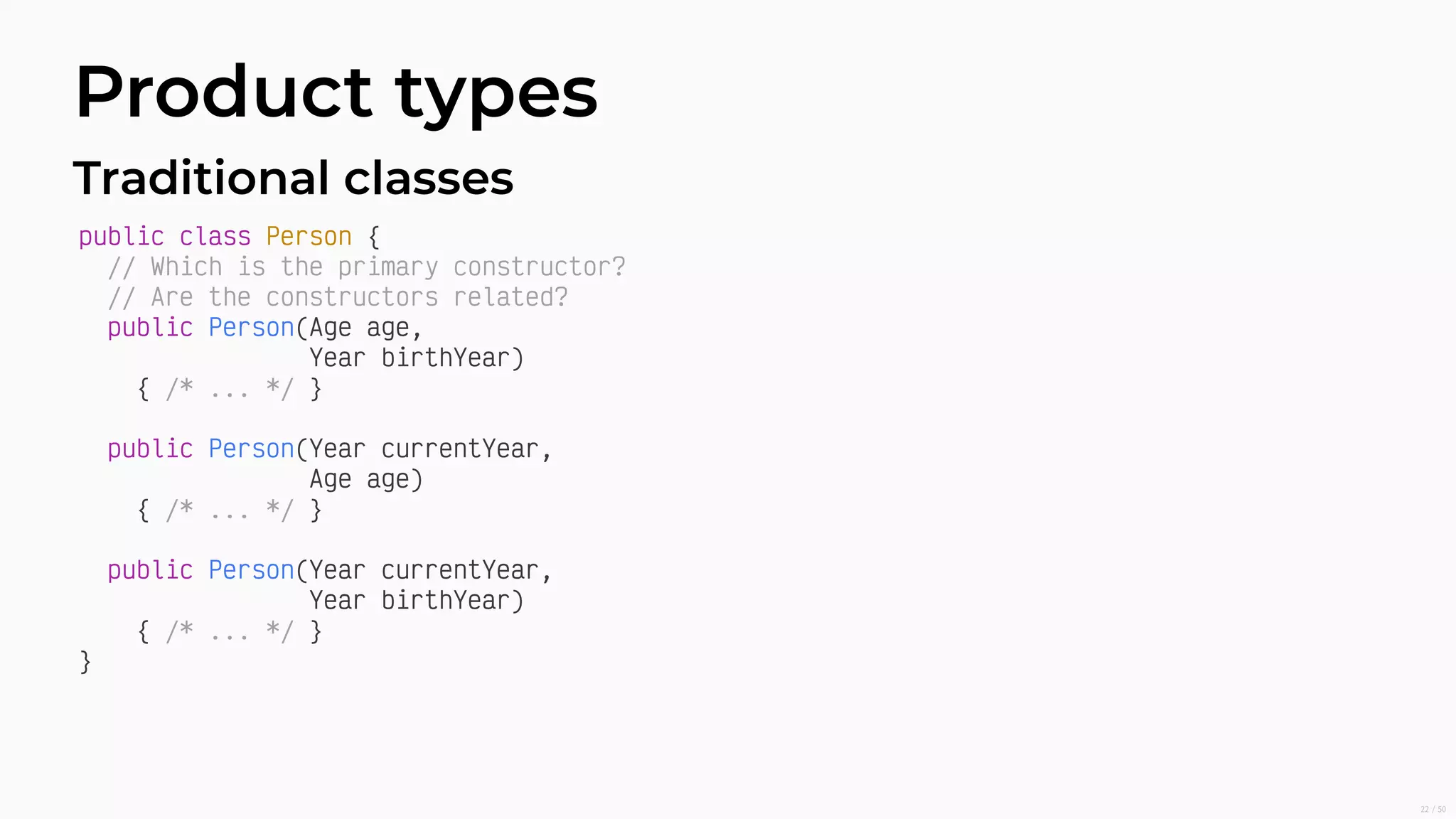
Product types
Traditional classes
public class Person {
// Which is the primary constructor?
// Are the constructors related?
public Person(Age age,
Year birthYear)
{ /* ... */ }
public Person(Year currentYear,
Age age)
{ /* ... */ }
public Person(Year currentYear,
Year birthYear)
{ /* ... */ }
}
22/50
Product types
Traditional classes
public class Person {
// Which is the primary constructor?
// Are the constructors related?
public Person(Age age,
Year birthYear)
{ /* ... */ }
public Person(Year currentYear,
Age age)
{ /* ... */ }
public Person(Year currentYear,
Year birthYear)
{ /* ... */ }
}
Product types
// Primary constructor defines the product
case class Person(age: Age,
birthYear: Year) {
// Supplementary constructors
// must use the primary constructor
def this(currentYear: Year, age: Age)
{ this(age, currentYear - age) }
def this(currentYear: Year, birthYear: Year
{ this(currentYear - birthYear, birthYear
}
22/50
Sum types
Traditional interfaces
public interface User
{ /* Common methods */ }
public class Client implements User
{ /* Client-specific methods */ }
public class Admin implements User
{ /* Admin-specific methods */ }
void process(User user) {
// How can this function reason about a
// possible implementations of User?
}
23/50
Sum types
Traditional interfaces
public interface User
{ /* Common methods */ }
public class Client implements User
{ /* Client-specific methods */ }
public class Admin implements User
{ /* Admin-specific methods */ }
void process(User user) {
// How can this function reason about a
// possible implementations of User?
}
Sum types
// "Sealed" allows the compiler to find
// all descendants of User
sealed trait User
{ /* Common methods */ }
case class Client extends User
{ /* Client-specific methods */ }
case class Admin extends User
{ /* Admin-specific methods */ }
def process(user: User): IO[Unit] = {
// The function now has knowledge that
// there are only 2 options for "user"
}
23/50
Pattern matching
Data construction
sealed trait User
case class Client(email: String
role: String)
extends User
case class Admin(name: String,
scopes: List[String])
extends User
val client: User =
Client("test@email.com", "manager")
val admin: User =
Admin("Jane", List("emails", "orders")
Data deconstruction
def process(u: User): IO[Unit] = u match {
case Client(email, "manager")
logManager(email)
case Admin(name, Nil)
logAdmin(name, "No scopes")
case Admin(name, List("emails"))
logAdmin(name, "Only 'emails' scope")
case Admin(name, scopes)
if scopes.contains("orders")
logAdmin(name, "Has 'orders' scope")
case _
logDefault("Default action")
}
24/50
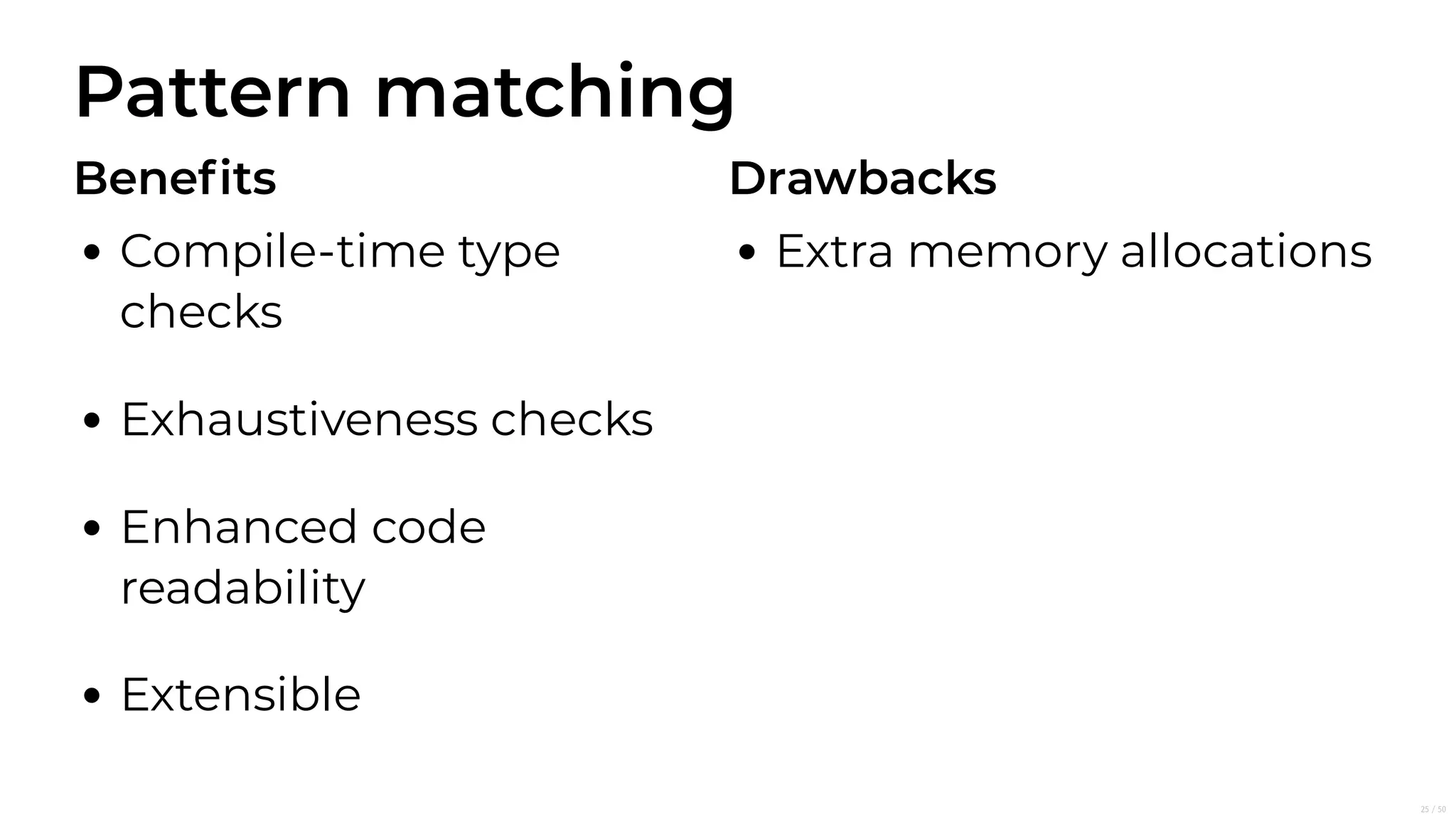
Pattern matching
Benefits
Compile-time type
checks
Exhaustiveness checks
Enhanced code
readability
Extensible
Drawbacks
Extra memory allocations
25/50
Recursion
Declarative
Native mapping to
many real-world
problems
Can be as efficient as a
loop*
import scala.annotation.tailrec
@tailrec
def foldLeft[R](list: List[Int])
(acc: R)
(f: (R, Int) R): R =
list match {
case Nil
acc
case head :: tail
foldLeft(tail)(f(acc, head))(f)
}
// "12345"
foldLeft(List(1, 2, 3, 4, 5))(acc = "") {
(acc, num) acc + num.toString
}
26/50
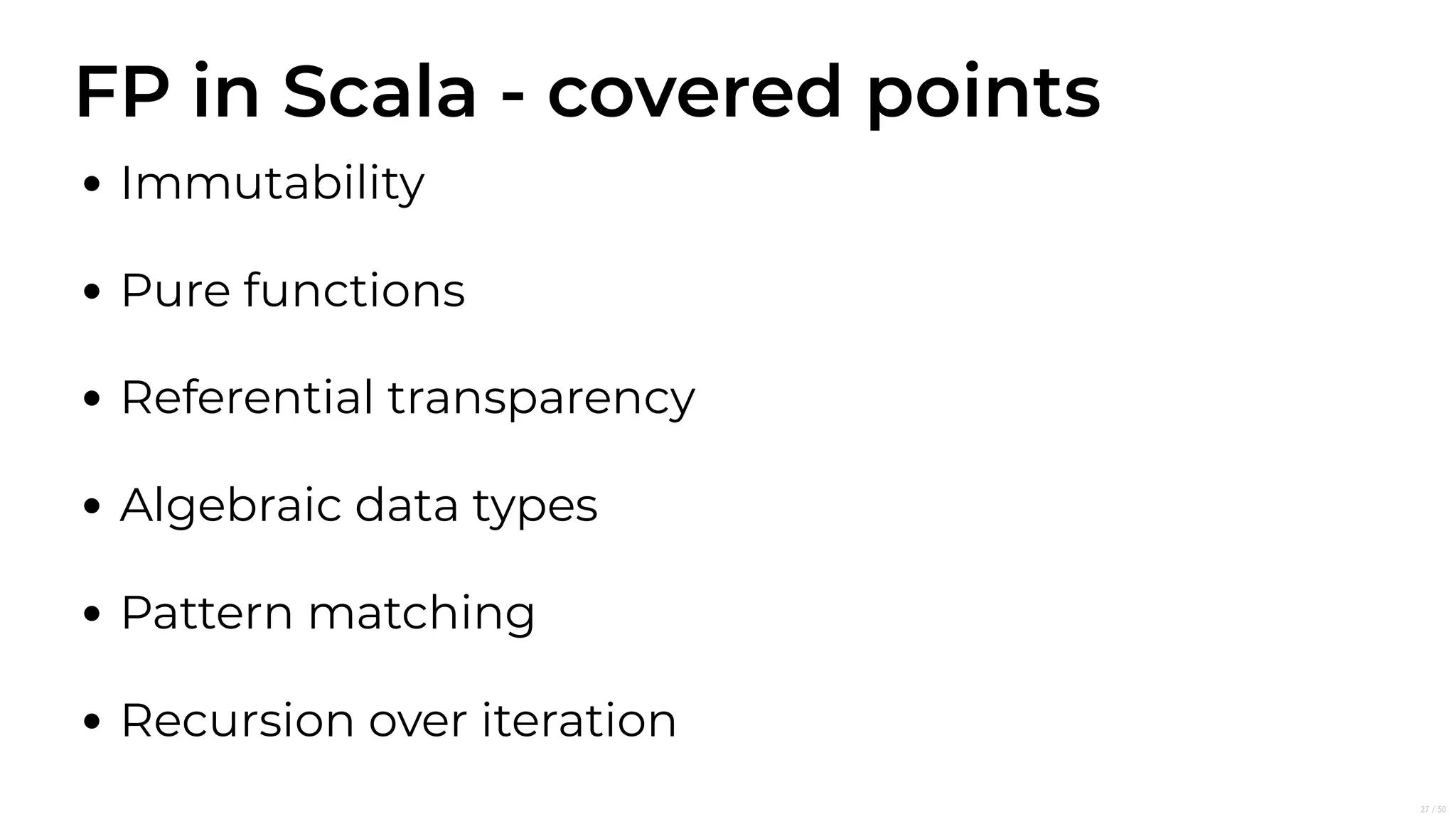
FP in Scala - covered points
Immutability
Pure functions
Referential transparency
Algebraic data types
Pattern matching
Recursion over iteration
27/50
Scala
language
features
Higher-kinded types
For-comprehensions
Implicit values
Syntax extension
Macros
28/50
Higher-kinded types
Simple types:Simple types:
Int, String, User
Unary typeUnary type
constructors:constructors:
List[A], Future[A]
Binary typeBinary type
constructors:constructors:
Either[A, B], Tuple[A, B]
Higher-kinded typesHigher-kinded types:
trait Processor[L[_]] {
def run[A](l: L[A]): Unit
}
val listP = new Processor[List] {
def run[A](l: List[A]): Unit =
l.foreach(println)
}
listP.run(List(1, 2, 3))
listP.run(List("a", "b", "c"))
29/50
For comprehensions
def getProfile(userName: String): Option[Profile] = ???
def getComments(profile: Profile): Option[List[Comment]] = ???
def getBonus(profile: Profile): Option[Int] = ???
val updatedComments = for {
profile getUserProfile("Jack")
comments getComments(profile)
bonus getBonus(profile)
} yield comments.take(10)
.map( .increaseRating(bonus))
30/50
For comprehensions
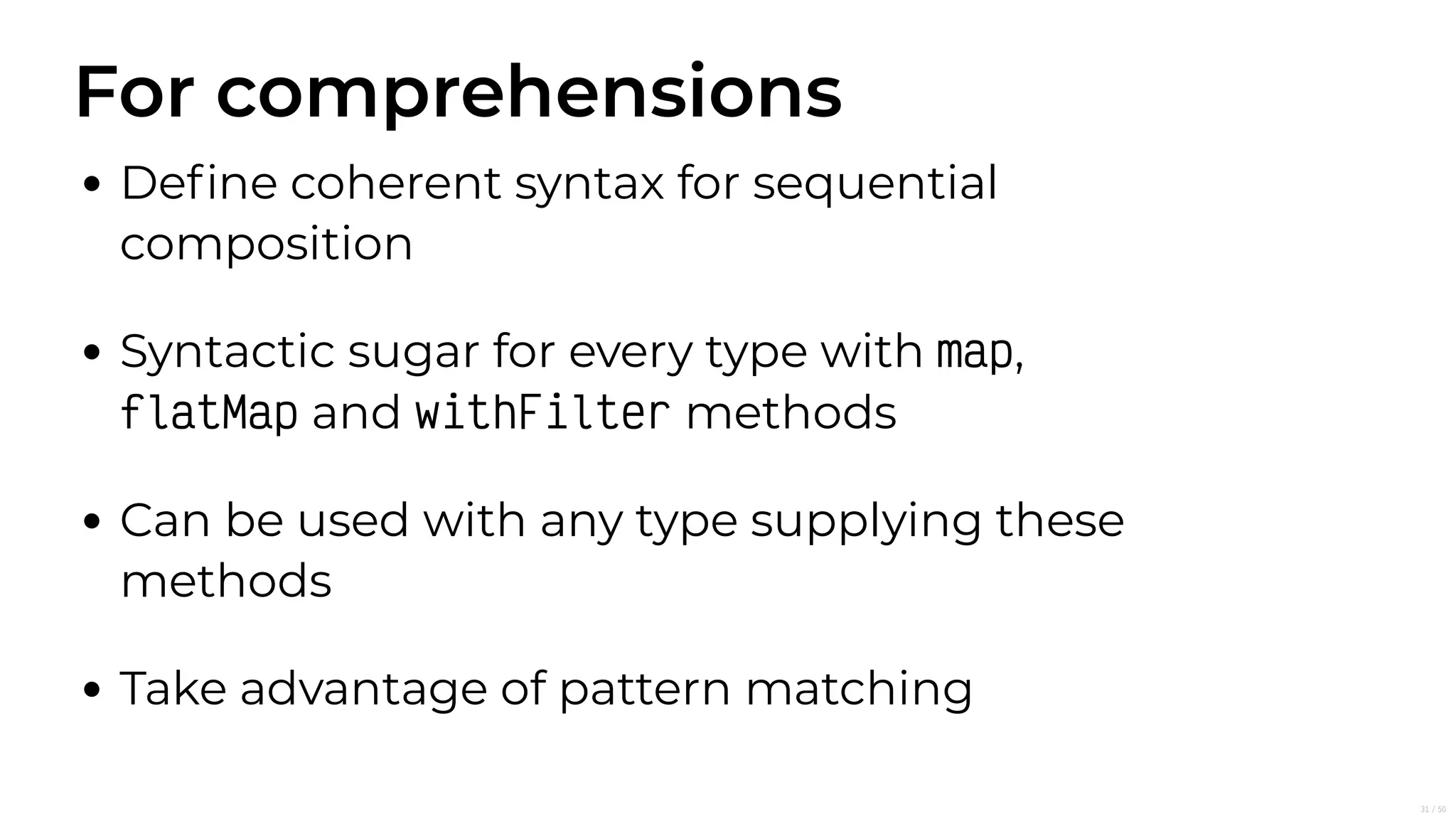
Define coherent syntax for sequential
composition
Syntactic sugar for every type with map,
flatMap and withFilter methods
Can be used with any type supplying these
methods
Take advantage of pattern matching
31/50
Implicit values
Provide automatic
value forwarding
Resolved at compile-
time
Can be derived from
existing context
case class Foo(id: Int)
object Foo {
implicit val o: Ordering[Foo] =
Ordering.by(_.id)
}
def sortFoo(foos: List[Foo])
(implicit o: Ordering[Foo]) =
foos.sorted(o)
sortFoo(
32/50
Syntax extensions
Allow to create ad-hoc
methods for code
reuse and readability
Can be used for types
imported from other
projects/libraries
implicit class StringSyntax
(s: String) {
def filterDigits: String =
s.filter(_.isDigit)
}
// "123"
"1a2b3c".filterDigits
33/50
Macros
Eliminate boilerplate
code
Provide
implementations in
compile time
Allow to extract code
meta data
import io.circe._
import io.circe.generic.semiauto.
case class Foo(a: Int, b: String)
case class Bar(
id: Option[String], foo: Foo
)
val barDecoder: Decoder[Bar] =
deriveDecoder[Foo].map(foo
Bar(id = None, foo = foo)
)
34/50
Scala language - covered points
Higher-kinded types
For-comprehensions
Implicit values
Syntax extensions
Macros
35/50
Scala in
numbers
Development and
adoption rates
Effect on productivity
Performance
36/50
Scala adoption rates
Maintained intense release
schedule for over 15 years
Development of the
language is supported by the
European government and
enterprise investors[1]
As popular as Kotlin for
backend development[2] and
is 20% more widespread
company-wise[3]
1.
2.
3.
bit.ly/2Xr3bnH
bit.ly/2rPlUgW
api.github.com
stackshare.io/scala
37/50
Scala adoption rates
StackOverflow 2019[1] survey claims that
almost 60% of respondents have tried
Scala and are interested in working
with it
Approximately 4% of developers are use
Scala as their main language at work[2]
Source: insights.stackoverflow.com/survey/2019
38/50
Scala and productivity
Source: bit.ly/2qombqM
39/50
Scala’s functional programming style
allows writing 2 times less code[1]
Reading Scala code is 2 times faster on
average[1]
Research data[2] shows that Scala
projects need ~30% less bug fixes
1.
2.
bit.ly/37eiWTH
arxiv.org/pdf/1901.10220.pdf
40/50
Scala's performance
Uses JVM as the main
runtime platform
Can be compiled to a native
binary
Up to 35% performance
increase with GraalVM[1]
Utilizes incremental
compilation for only a few
seconds delay per build
1.
2.
graalvm.org/scala
bit.ly/330Ugue
41/50
Scala is a rapidly developed
language used and supported
by many, that can offer
substantial productivity
benefits while keeping
reasonable performance
42/50
Scala in real
world
Areas of application
Scala vs. Java & Kotlin
Scala vs. Python
Scala vs. Golang
Future prospects
43/50
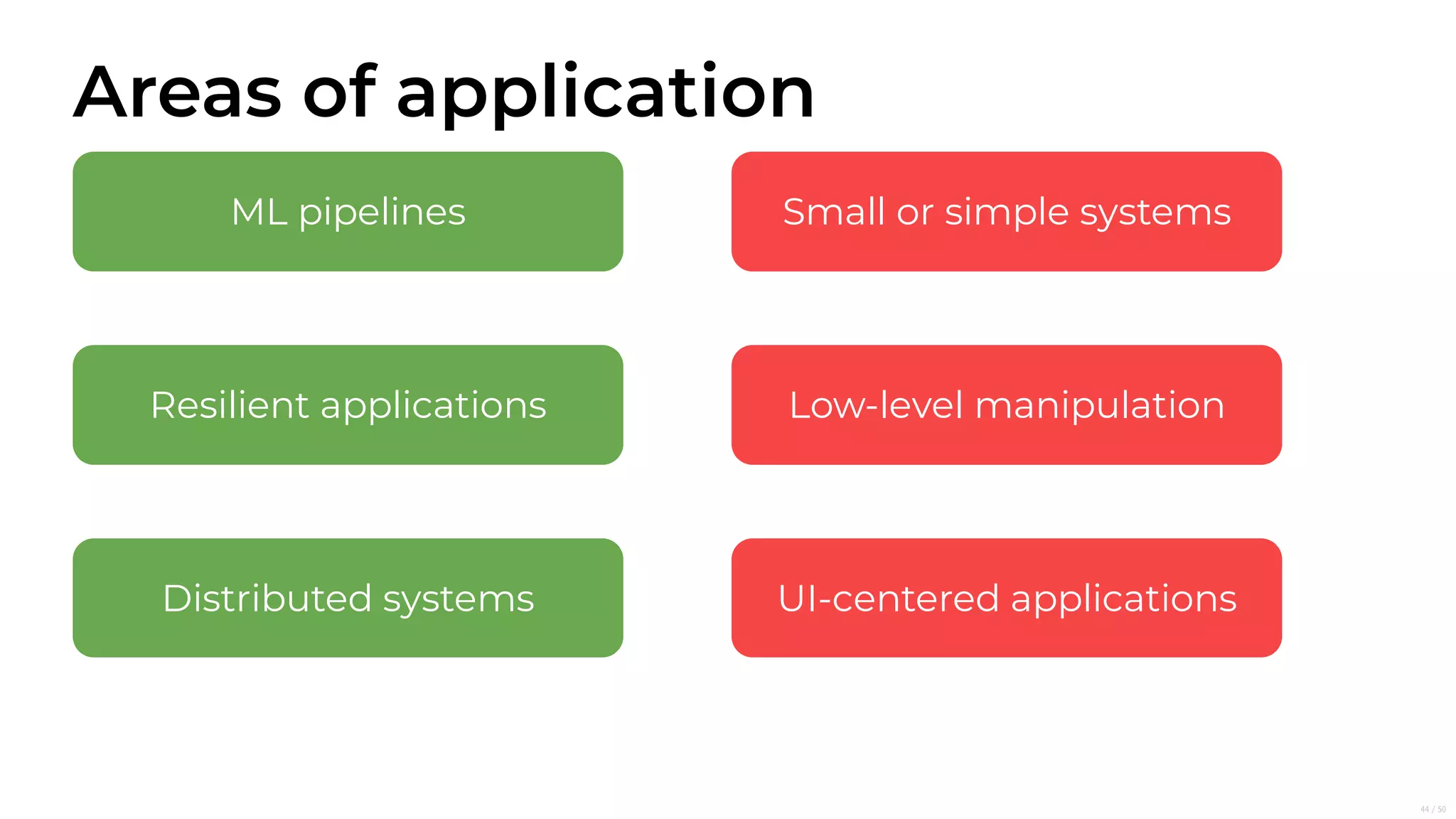
Areas of application
ML pipelines
Resilient applications
Distributed systems
Small or simple systems
Low-level manipulation
UI-centered applications
44/50
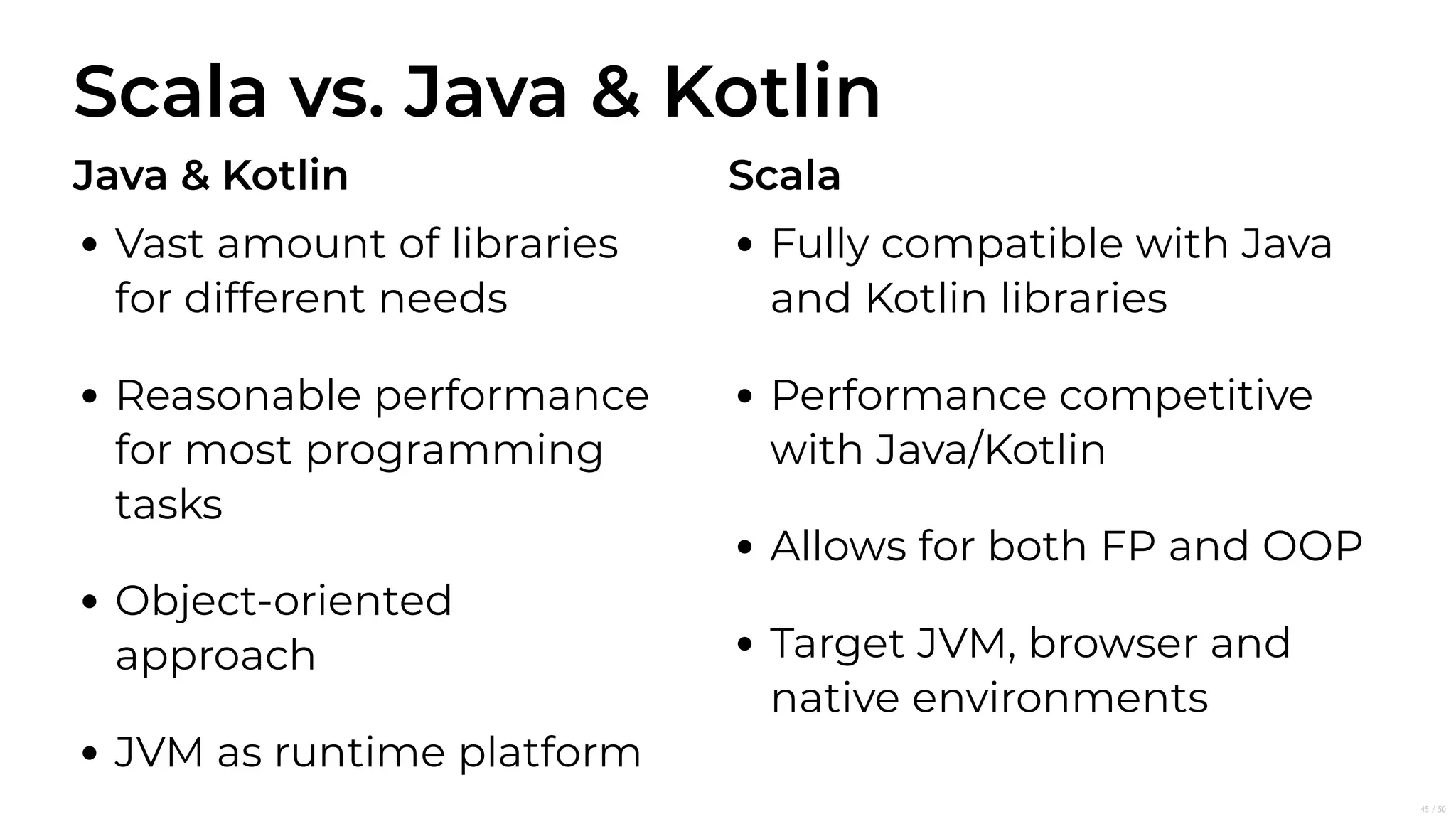
Scala vs. Java & Kotlin
Java & Kotlin
Vast amount of libraries
for different needs
Reasonable performance
for most programming
tasks
Object-oriented
approach
JVM as runtime platform
Scala
Fully compatible with Java
and Kotlin libraries
Performance competitive
with Java/Kotlin
Allows for both FP and OOP
Target JVM, browser and
native environments
45/50
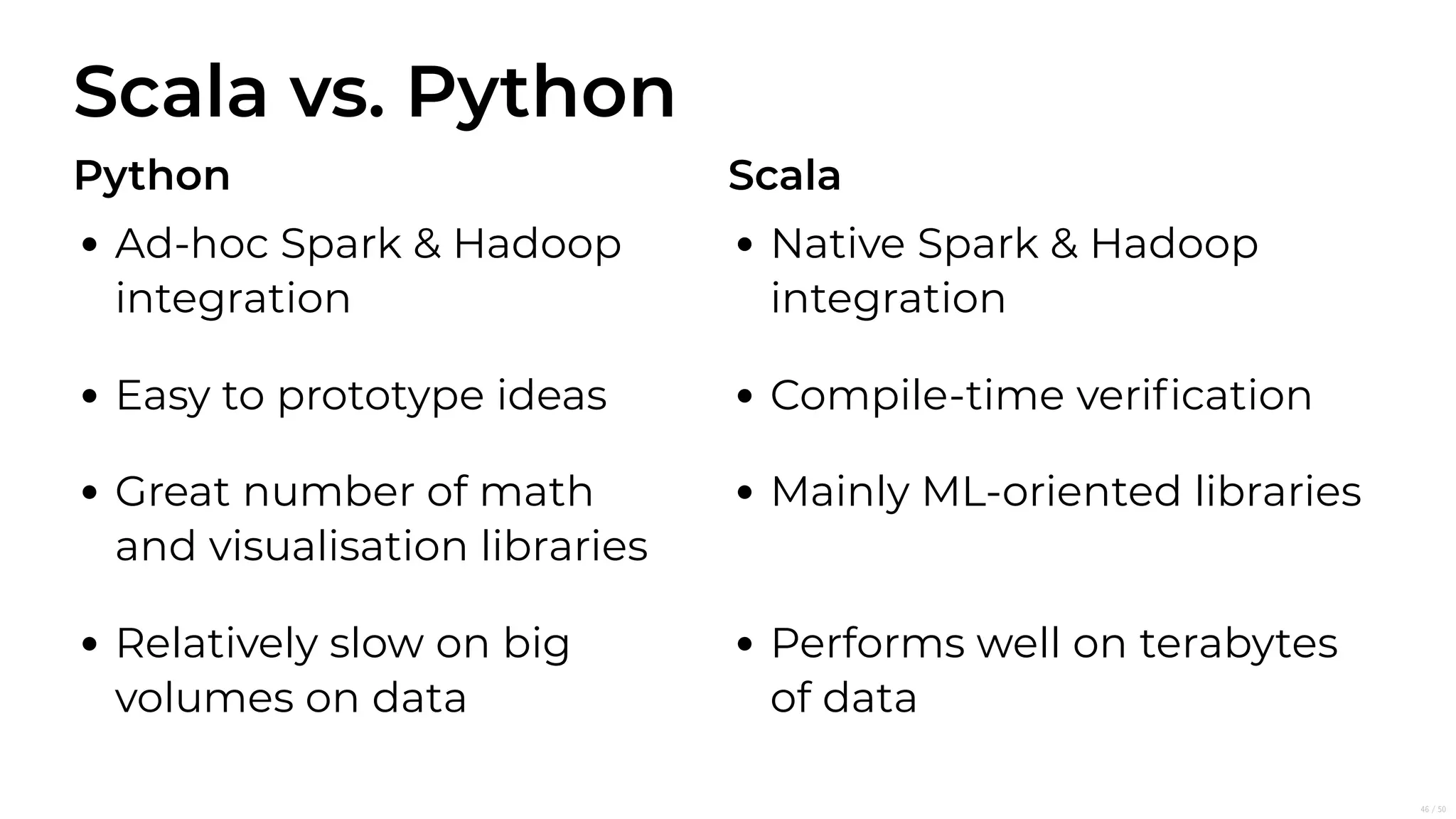
Scala vs. Python
Python
Ad-hoc Spark & Hadoop
integration
Easy to prototype ideas
Great number of math
and visualisation libraries
Relatively slow on big
volumes on data
Scala
Native Spark & Hadoop
integration
Compile-time verification
Mainly ML-oriented libraries
Performs well on terabytes
of data
46/50
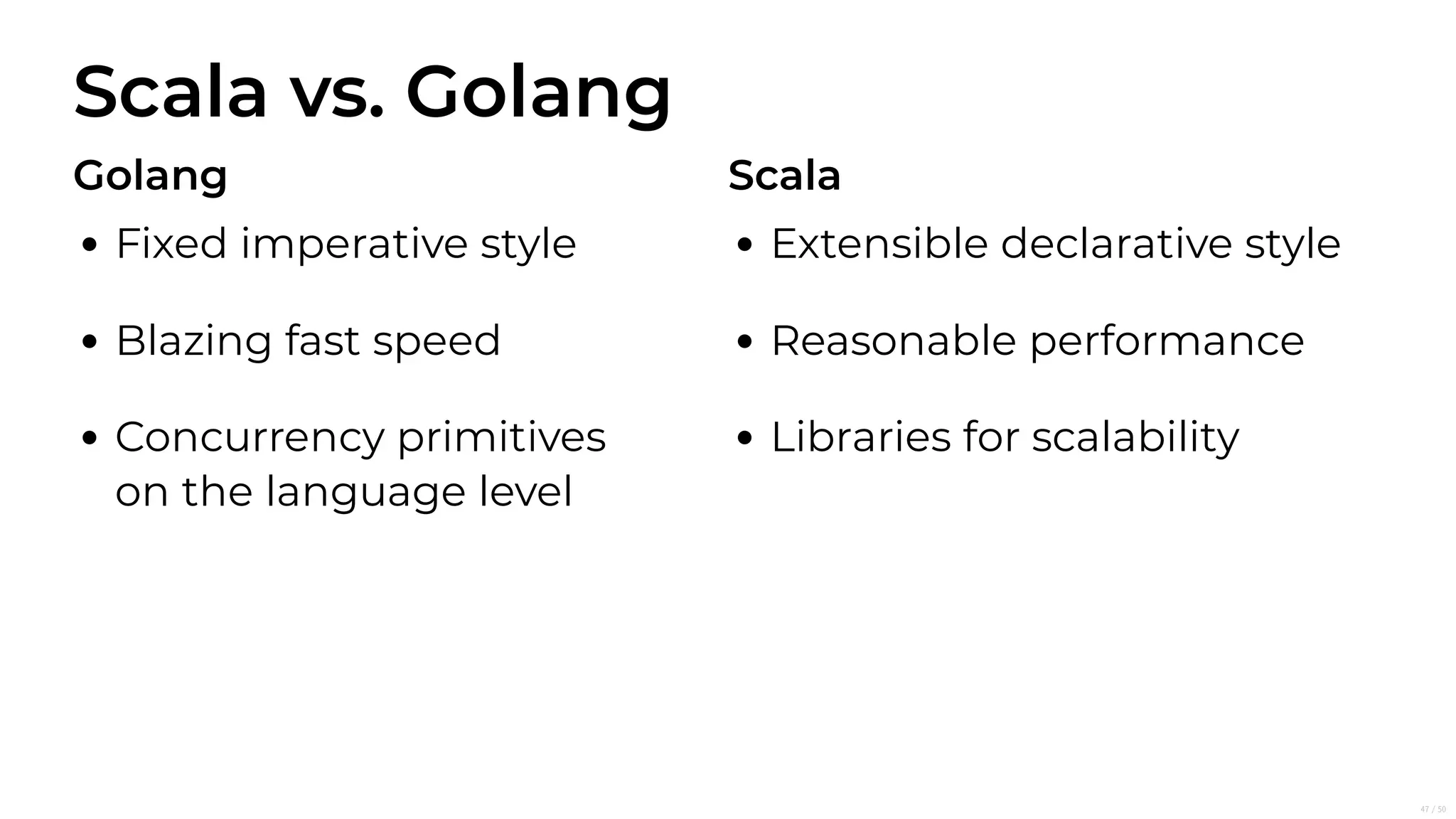
Scala vs. Golang
Golang
Fixed imperative style
Blazing fast speed
Concurrency primitives
on the language level
Scala
Extensible declarative style
Reasonable performance
Libraries for scalability
47/50
Future prospects
Next major version of Scala is
coming at the end of 2020.
Take a look at:
dotty.epfl.ch
48/50
49/50
Thank you for
your
attention!
Any
questions?
@a7emenov
Find me on ,
and
Twitter
Telegram Github
50/50

Gentle Introduction to Scala

  • 1.
    A Gentle Introduction toScala and FP 1/50
  • 2.
    Hi, I'm Anton! Functional programmer Scalaenthusiast Applications engineer at Rakuten @a7emenov Find me on , and Twitter Telegram Github 2/50
  • 3.
    Agenda Introduce Scala asa language Give examples of universal FP constructs Show benefits of those constructs Compare Scala to other languages 3/50
  • 4.
    What is Scalaas a language? 4/50
  • 5.
    Scala combines object- orientedand functional programming in one concise, high-level language. 5/50
  • 6.
    What lies atthe core of FP? 6/50
  • 7.
    What lies atthe core of FP? Absence of side-effects in computations 6/50
  • 8.
    What lies atthe core of FP? Absence of side-effects in computations Function composition 6/50
  • 9.
    What lies atthe core of FP? Absence of side-effects in computations Function composition Immutable data 6/50
  • 10.
    What lies atthe core of FP? Absence of side-effects in computations Function composition Immutable data Dark magic 6/50
  • 11.
    What lies atthe core of FP? Absence of side-effects in computations Function composition Immutable data Dark magic ? 6/50
  • 12.
    What lies atthe core of FP? Absence of side-effects in computations Function composition Immutable data Dark magic All of it 7/50
  • 13.
    Functional programming isa way of solving problems which centers around combining side-effect-free constructs in a declarative manner 8/50
  • 14.
    Declarative vs. imperative Imperative for(int i = 1; i 5; i ) { int temp = i * 2; if (temp < 6) { System.out.println(temp); } } Declarative (1 to 5) .map(_ * 2) .filter(_ < 6) .foreach(println) 9/50
  • 15.
    Deep dive FP &Scala Immutability Pure functions Referential transparency Algebraic data types Pattern matching Recursion 10/50
  • 16.
    Value mutation Variables Can bechanged anytime Can be changed from any place that has a reference Exposing private state requires explicit copying Immutable values Can't be changed Create new values instead of changing the old ones No mutable state 11/50
  • 17.
  • 18.
    Immutable values Benefits Reduce concurrency issues Noshared mutable state Easier local reasoning Drawbacks Extra memory allocations 13/50
  • 19.
    Pure functions Side-effect freeSide-effectfree - everything that a function does can be observed in its return value: TotalTotal - return values for every possible input DeterministicDeterministic - given same inputs, return same outputs Locally scopedLocally scoped - no effect on the state outside of the function's scope 14/50
  • 20.
    Referential transparency All callsto a function can be substituted with its return value 15/50
  • 21.
    Referential transparency Not transparent defgetInt(l: Int, r: Int): Int = Random.between(l, r) def increment(x: Int): Int = { val res = x + 1 destroyTheWorld() res } Transparent def fact(n: Int): Int = { var res = 1 var i = 1 while (i n) { res = res * i i = i + 1 } res } 16/50
  • 22.
    Business value withpure functions How can programs be useful without any side-effects? 17/50
  • 23.
    Business value withpure functions Describe side-effecting computations instead of instantly running them Combine all side-effects to produce a single description Run the resulting computation in the main method 18/50
  • 24.
    Business value withpure functions def saveValue(key: String, value: Int): IO[Unit] = ? def getValue(key: String): IO[Option[Int]] = ??? def rateLimit[A](program: IO[A]): IO[A] = ??? val program: IO[Option[Int]] = ratelimit( saveValue("key", 1) >> getValue("key") ) val result: Option[Int] = program.runSyncUnsafe() 19/50
  • 25.
    Business value withpure functions saveValue("key", 1) >> getValue("key") def saveValue(key: String, value: Int): IO[Unit] = ??? def getValue(key: String): IO[Option[Int]] = ??? def rateLimit[A](program: IO[A]): IO[A] = ??? val program: IO[Option[Int]] = ratelimit( ) val result: Option[Int] = program.runSyncUnsafe() 19/50
  • 26.
    Business value withpure functions def rateLimit[A](program: IO[A]): IO[A] = ??? def saveValue(key: String, value: Int): IO[Unit] = ??? def getValue(key: String): IO[Option[Int]] = ??? val program: IO[Option[Int]] = ratelimit( saveValue("key", 1) >> getValue("key") ) val result: Option[Int] = program.runSyncUnsafe() 19/50
  • 27.
    Business value withpure functions val program: IO[Option[Int]] = ratelimit( saveValue("key", 1) >> getValue("key") ) def saveValue(key: String, value: Int): IO[Unit] = ??? def getValue(key: String): IO[Option[Int]] = ??? def rateLimit[A](program: IO[A]): IO[A] = ??? val result: Option[Int] = program.runSyncUnsafe() 19/50
  • 28.
    Business value withpure functions val result: Option[Int] = program.runSyncUnsafe() def saveValue(key: String, value: Int): IO[Unit] = ??? def getValue(key: String): IO[Option[Int]] = ??? def rateLimit[A](program: IO[A]): IO[A] = ??? val program: IO[Option[Int]] = ratelimit( saveValue("key", 1) >> getValue("key") ) 19/50
  • 29.
    Pure functions Benefits Ultimate local reasoning Parallelizable execution Easytesting Drawbacks Extra object allocations Require an effect system or a library to operate mutable state 20/50
  • 30.
    Algebraic data types ProducttypesProduct types - define how to create a value (“has a field” relationship) Sum typesSum types - define the range of values (“is one of” relationship) Product types + Sum types = Algebraic data types 21/50
  • 31.
    Product types Traditional classes publicclass Person { // Which is the primary constructor? // Are the constructors related? public Person(Age age, Year birthYear) { /* ... */ } public Person(Year currentYear, Age age) { /* ... */ } public Person(Year currentYear, Year birthYear) { /* ... */ } } 22/50
  • 32.
    Product types Traditional classes publicclass Person { // Which is the primary constructor? // Are the constructors related? public Person(Age age, Year birthYear) { /* ... */ } public Person(Year currentYear, Age age) { /* ... */ } public Person(Year currentYear, Year birthYear) { /* ... */ } } Product types // Primary constructor defines the product case class Person(age: Age, birthYear: Year) { // Supplementary constructors // must use the primary constructor def this(currentYear: Year, age: Age) { this(age, currentYear - age) } def this(currentYear: Year, birthYear: Year { this(currentYear - birthYear, birthYear } 22/50
  • 33.
    Sum types Traditional interfaces publicinterface User { /* Common methods */ } public class Client implements User { /* Client-specific methods */ } public class Admin implements User { /* Admin-specific methods */ } void process(User user) { // How can this function reason about a // possible implementations of User? } 23/50
  • 34.
    Sum types Traditional interfaces publicinterface User { /* Common methods */ } public class Client implements User { /* Client-specific methods */ } public class Admin implements User { /* Admin-specific methods */ } void process(User user) { // How can this function reason about a // possible implementations of User? } Sum types // "Sealed" allows the compiler to find // all descendants of User sealed trait User { /* Common methods */ } case class Client extends User { /* Client-specific methods */ } case class Admin extends User { /* Admin-specific methods */ } def process(user: User): IO[Unit] = { // The function now has knowledge that // there are only 2 options for "user" } 23/50
  • 35.
    Pattern matching Data construction sealedtrait User case class Client(email: String role: String) extends User case class Admin(name: String, scopes: List[String]) extends User val client: User = Client("test@email.com", "manager") val admin: User = Admin("Jane", List("emails", "orders") Data deconstruction def process(u: User): IO[Unit] = u match { case Client(email, "manager") logManager(email) case Admin(name, Nil) logAdmin(name, "No scopes") case Admin(name, List("emails")) logAdmin(name, "Only 'emails' scope") case Admin(name, scopes) if scopes.contains("orders") logAdmin(name, "Has 'orders' scope") case _ logDefault("Default action") } 24/50
  • 36.
    Pattern matching Benefits Compile-time type checks Exhaustivenesschecks Enhanced code readability Extensible Drawbacks Extra memory allocations 25/50
  • 37.
    Recursion Declarative Native mapping to manyreal-world problems Can be as efficient as a loop* import scala.annotation.tailrec @tailrec def foldLeft[R](list: List[Int]) (acc: R) (f: (R, Int) R): R = list match { case Nil acc case head :: tail foldLeft(tail)(f(acc, head))(f) } // "12345" foldLeft(List(1, 2, 3, 4, 5))(acc = "") { (acc, num) acc + num.toString } 26/50
  • 38.
    FP in Scala- covered points Immutability Pure functions Referential transparency Algebraic data types Pattern matching Recursion over iteration 27/50
  • 39.
  • 40.
    Higher-kinded types Simple types:Simpletypes: Int, String, User Unary typeUnary type constructors:constructors: List[A], Future[A] Binary typeBinary type constructors:constructors: Either[A, B], Tuple[A, B] Higher-kinded typesHigher-kinded types: trait Processor[L[_]] { def run[A](l: L[A]): Unit } val listP = new Processor[List] { def run[A](l: List[A]): Unit = l.foreach(println) } listP.run(List(1, 2, 3)) listP.run(List("a", "b", "c")) 29/50
  • 41.
    For comprehensions def getProfile(userName:String): Option[Profile] = ??? def getComments(profile: Profile): Option[List[Comment]] = ??? def getBonus(profile: Profile): Option[Int] = ??? val updatedComments = for { profile getUserProfile("Jack") comments getComments(profile) bonus getBonus(profile) } yield comments.take(10) .map( .increaseRating(bonus)) 30/50
  • 42.
    For comprehensions Define coherentsyntax for sequential composition Syntactic sugar for every type with map, flatMap and withFilter methods Can be used with any type supplying these methods Take advantage of pattern matching 31/50
  • 43.
    Implicit values Provide automatic valueforwarding Resolved at compile- time Can be derived from existing context case class Foo(id: Int) object Foo { implicit val o: Ordering[Foo] = Ordering.by(_.id) } def sortFoo(foos: List[Foo]) (implicit o: Ordering[Foo]) = foos.sorted(o) sortFoo( 32/50
  • 44.
    Syntax extensions Allow tocreate ad-hoc methods for code reuse and readability Can be used for types imported from other projects/libraries implicit class StringSyntax (s: String) { def filterDigits: String = s.filter(_.isDigit) } // "123" "1a2b3c".filterDigits 33/50
  • 45.
    Macros Eliminate boilerplate code Provide implementations in compiletime Allow to extract code meta data import io.circe._ import io.circe.generic.semiauto. case class Foo(a: Int, b: String) case class Bar( id: Option[String], foo: Foo ) val barDecoder: Decoder[Bar] = deriveDecoder[Foo].map(foo Bar(id = None, foo = foo) ) 34/50
  • 46.
    Scala language -covered points Higher-kinded types For-comprehensions Implicit values Syntax extensions Macros 35/50
  • 47.
    Scala in numbers Development and adoptionrates Effect on productivity Performance 36/50
  • 48.
    Scala adoption rates Maintainedintense release schedule for over 15 years Development of the language is supported by the European government and enterprise investors[1] As popular as Kotlin for backend development[2] and is 20% more widespread company-wise[3] 1. 2. 3. bit.ly/2Xr3bnH bit.ly/2rPlUgW api.github.com stackshare.io/scala 37/50
  • 49.
    Scala adoption rates StackOverflow2019[1] survey claims that almost 60% of respondents have tried Scala and are interested in working with it Approximately 4% of developers are use Scala as their main language at work[2] Source: insights.stackoverflow.com/survey/2019 38/50
  • 50.
    Scala and productivity Source:bit.ly/2qombqM 39/50
  • 51.
    Scala’s functional programmingstyle allows writing 2 times less code[1] Reading Scala code is 2 times faster on average[1] Research data[2] shows that Scala projects need ~30% less bug fixes 1. 2. bit.ly/37eiWTH arxiv.org/pdf/1901.10220.pdf 40/50
  • 52.
    Scala's performance Uses JVMas the main runtime platform Can be compiled to a native binary Up to 35% performance increase with GraalVM[1] Utilizes incremental compilation for only a few seconds delay per build 1. 2. graalvm.org/scala bit.ly/330Ugue 41/50
  • 53.
    Scala is arapidly developed language used and supported by many, that can offer substantial productivity benefits while keeping reasonable performance 42/50
  • 54.
    Scala in real world Areasof application Scala vs. Java & Kotlin Scala vs. Python Scala vs. Golang Future prospects 43/50
  • 55.
    Areas of application MLpipelines Resilient applications Distributed systems Small or simple systems Low-level manipulation UI-centered applications 44/50
  • 56.
    Scala vs. Java& Kotlin Java & Kotlin Vast amount of libraries for different needs Reasonable performance for most programming tasks Object-oriented approach JVM as runtime platform Scala Fully compatible with Java and Kotlin libraries Performance competitive with Java/Kotlin Allows for both FP and OOP Target JVM, browser and native environments 45/50
  • 57.
    Scala vs. Python Python Ad-hocSpark & Hadoop integration Easy to prototype ideas Great number of math and visualisation libraries Relatively slow on big volumes on data Scala Native Spark & Hadoop integration Compile-time verification Mainly ML-oriented libraries Performs well on terabytes of data 46/50
  • 58.
    Scala vs. Golang Golang Fixedimperative style Blazing fast speed Concurrency primitives on the language level Scala Extensible declarative style Reasonable performance Libraries for scalability 47/50
  • 59.
    Future prospects Next majorversion of Scala is coming at the end of 2020. Take a look at: dotty.epfl.ch 48/50
  • 60.
  • 61.
    Thank you for your attention! Any questions? @a7emenov Findme on , and Twitter Telegram Github 50/50