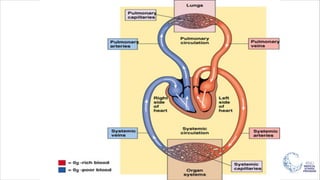
Cardiac Automaticity
Dr. Radwa Mehanna MD PhD
Professor of Medical Physiology
Faculty of Medicine, Alexandria University
Rhythmicity of the Heart
Students’ learning outcomes
At the end of this session, the student will be able to:
1. Characterize the types of cardiac action potentials.
2. Define the ionic basis of cardiac resting, pre and action potentials.
3. Describe the characteristics of the fast- and slow response action potentials.
4. Explain the effect of autonomic innervation on SA node
Properties of the Heart
1- Rhythmicity
2-Conductivity
3- Excitability
4- Contractility
Origin of cardiac stimulation
• The heart is a myogenic organ; it does not need nerve
stimulation to initiate its contraction.
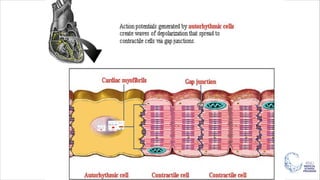
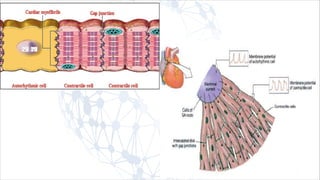
• It contains specialized cells, which discharge spontaneously
(automaticity or rhythmicity)
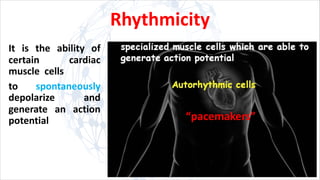
Rhythmicity
It is the ability of
certain cardiac
muscle cells
to spontaneously
depolarize and
generate an action
potential “pacemakers”
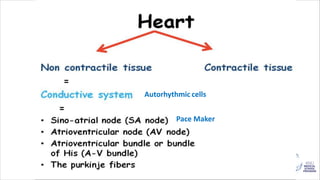
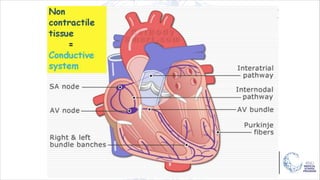
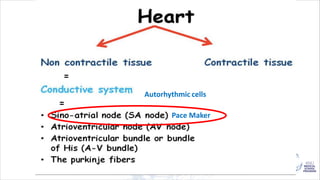
Autorhythmic cells
Pace Maker
Autorhythmic cells
Pace Maker
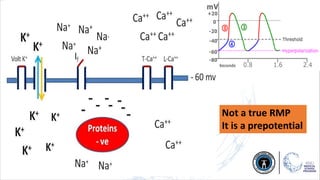
Not a true RMP
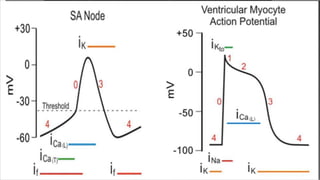
It is a prepotential
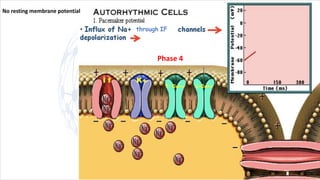
No resting membrane potential
Phase 4
through IF
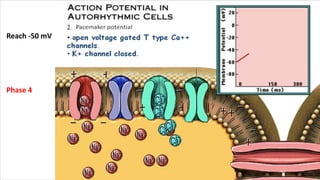
Reach -50 mV
Phase 4
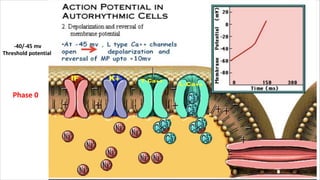
Phase 0
-40/-45 mv
Threshold potential
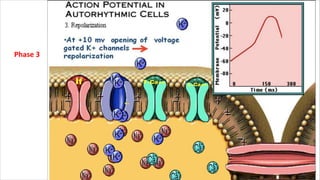
Phase 3
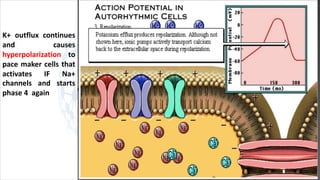
K+ outflux continues
and causes
hyperpolarization to
pace maker cells that
activates IF Na+
channels and starts
phase 4 again
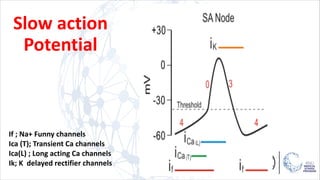
Slow action
Potential
If ; Na+ Funny channels
Ica (T); Transient Ca channels
Ica(L) ; Long acting Ca channels
Ik; K delayed rectifier channels
Autorythmic cells and Prepotential
• They are the most excitable among the myocardial cell
(have less negative potential than the rest).
• They are spontaneously depolarized during the diastole
(relaxation) causing what is called pre-potential or diastolic
depolarization.
• Occurs by the influx of Na through the funny channels then
the Ca++ through T Ca++ channels
• This forms Phase 4 named pre potential
• Thus no RMP but instead there is pre potential
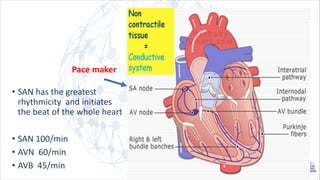
Pace maker
• SAN has the greatest
rhythmicity and initiates
the beat of the whole heart
• SAN 100/min
• AVN 60/min
• AVB 45/min
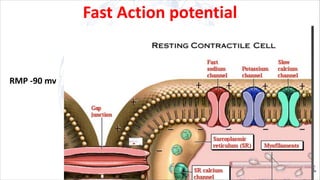
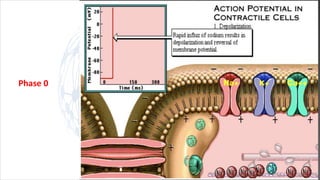
Fast Action potential
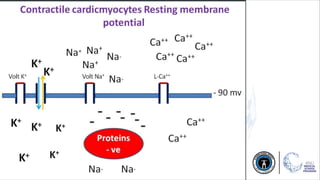
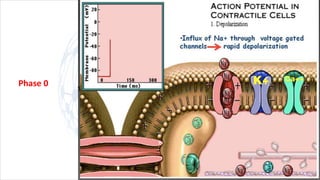
RMP -90 mv
Phase 0
Phase 0
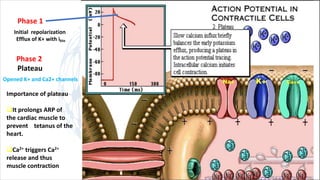
Phase 1
Phase 2
Initial repolarization
Efflux of K+ with ikto
Plateau
Opened K+ and Ca2+ channels
Importance of plateau
qIt prolongs ARP of
the cardiac muscle to
prevent tetanus of the
heart.
qCa2+ triggers Ca2+
release and thus
muscle contraction
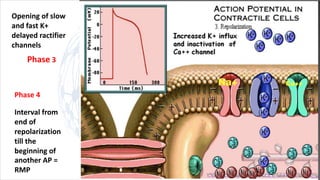
Phase 3
Phase 4
Interval from
end of
repolarization
till the
beginning of
another AP =
RMP
Opening of slow
and fast K+
delayed ractifier
channels
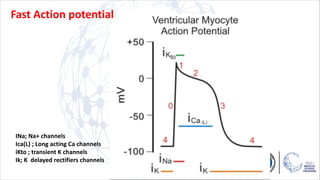
Fast Action potential
INa; Na+ channels
Ica(L) ; Long acting Ca channels
iKto ; transient K channels
Ik; K delayed rectifiers channels
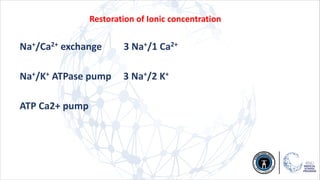
Restoration of Ionic concentration
Na+/Ca2+ exchange 3 Na+/1 Ca2+
Na+/K+ ATPase pump 3 Na+/2 K+
ATP Ca2+ pump
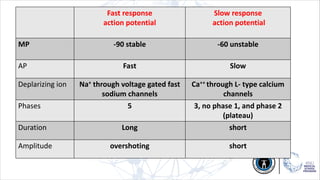
Fast response
action potential
Slow response
action potential
MP -90 stable -60 unstable
AP Fast Slow
Deplarizing ion Na+ through voltage gated fast
sodium channels
Ca++ through L- type calcium
channels
Phases 5 3, no phase 1, and phase 2
(plateau)
Duration Long short
Amplitude overshoting short
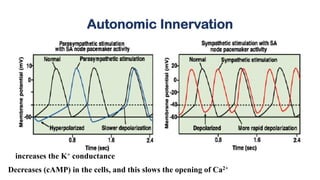
Autonomic Innervation
increases the K+ conductance
Decreases (cAMP) in the cells, and this slows the opening of Ca2+
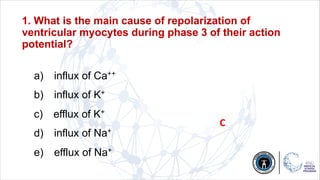
1. What is the main cause of repolarization of
ventricular myocytes during phase 3 of their action
potential?
a) influx of Ca++
b) influx of K+
c) efflux of K+
d) influx of Na+
e) efflux of Na+
C
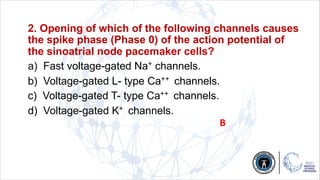
2. Opening of which of the following channels causes
the spike phase (Phase 0) of the action potential of
the sinoatrial node pacemaker cells?
a) Fast voltage-gated Na+ channels.
b) Voltage-gated L- type Ca++ channels.
c) Voltage-gated T- type Ca++ channels.
d) Voltage-gated K+ channels.
B
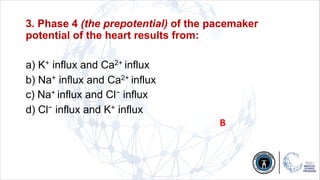
3. Phase 4 (the prepotential) of the pacemaker
potential of the heart results from:
a) K+ influx and Ca2+ influx
b) Na+ influx and Ca2+ influx
c) Na+ influx and Cl− influx
d) Cl− influx and K+ influx
B
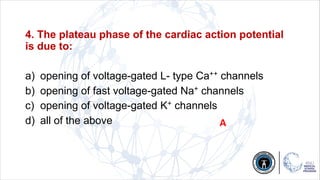
4. The plateau phase of the cardiac action potential
is due to:
a) opening of voltage-gated L- type Ca++ channels
b) opening of fast voltage-gated Na+ channels
c) opening of voltage-gated K+ channels
d) all of the above A
Lecture 4 Introduction and cardiac automaticity (Physiology 1).pdf

Lecture 4 Introduction and cardiac automaticity (Physiology 1).pdf

  • 1.
    Cardiac Automaticity Dr. RadwaMehanna MD PhD Professor of Medical Physiology Faculty of Medicine, Alexandria University Rhythmicity of the Heart
  • 2.
    Students’ learning outcomes Atthe end of this session, the student will be able to: 1. Characterize the types of cardiac action potentials. 2. Define the ionic basis of cardiac resting, pre and action potentials. 3. Describe the characteristics of the fast- and slow response action potentials. 4. Explain the effect of autonomic innervation on SA node
  • 5.
    Properties of theHeart 1- Rhythmicity 2-Conductivity 3- Excitability 4- Contractility
  • 6.
    Origin of cardiacstimulation • The heart is a myogenic organ; it does not need nerve stimulation to initiate its contraction. • It contains specialized cells, which discharge spontaneously (automaticity or rhythmicity)
  • 7.
    Rhythmicity It is theability of certain cardiac muscle cells to spontaneously depolarize and generate an action potential “pacemakers”
  • 8.
  • 10.
  • 12.
    Not a trueRMP It is a prepotential
  • 13.
    No resting membranepotential Phase 4 through IF
  • 14.
  • 15.
  • 16.
  • 17.
    K+ outflux continues andcauses hyperpolarization to pace maker cells that activates IF Na+ channels and starts phase 4 again
  • 18.
    Slow action Potential If ;Na+ Funny channels Ica (T); Transient Ca channels Ica(L) ; Long acting Ca channels Ik; K delayed rectifier channels
  • 19.
    Autorythmic cells andPrepotential • They are the most excitable among the myocardial cell (have less negative potential than the rest). • They are spontaneously depolarized during the diastole (relaxation) causing what is called pre-potential or diastolic depolarization. • Occurs by the influx of Na through the funny channels then the Ca++ through T Ca++ channels • This forms Phase 4 named pre potential • Thus no RMP but instead there is pre potential
  • 20.

    Pace maker • SANhas the greatest rhythmicity and initiates the beat of the whole heart • SAN 100/min • AVN 60/min • AVB 45/min
  • 22.
  • 24.
  • 25.
  • 26.
    Phase 1 Phase 2 Initialrepolarization Efflux of K+ with ikto Plateau Opened K+ and Ca2+ channels Importance of plateau qIt prolongs ARP of the cardiac muscle to prevent tetanus of the heart. qCa2+ triggers Ca2+ release and thus muscle contraction
  • 27.
    Phase 3 Phase 4 Intervalfrom end of repolarization till the beginning of another AP = RMP Opening of slow and fast K+ delayed ractifier channels
  • 28.
    Fast Action potential INa;Na+ channels Ica(L) ; Long acting Ca channels iKto ; transient K channels Ik; K delayed rectifiers channels
  • 29.
    Restoration of Ionicconcentration Na+/Ca2+ exchange 3 Na+/1 Ca2+ Na+/K+ ATPase pump 3 Na+/2 K+ ATP Ca2+ pump
  • 31.
    Fast response action potential Slowresponse action potential MP -90 stable -60 unstable AP Fast Slow Deplarizing ion Na+ through voltage gated fast sodium channels Ca++ through L- type calcium channels Phases 5 3, no phase 1, and phase 2 (plateau) Duration Long short Amplitude overshoting short
  • 32.
    Autonomic Innervation increases theK+ conductance Decreases (cAMP) in the cells, and this slows the opening of Ca2+
  • 33.
    1. What isthe main cause of repolarization of ventricular myocytes during phase 3 of their action potential? a) influx of Ca++ b) influx of K+ c) efflux of K+ d) influx of Na+ e) efflux of Na+ C
  • 34.
    2. Opening ofwhich of the following channels causes the spike phase (Phase 0) of the action potential of the sinoatrial node pacemaker cells? a) Fast voltage-gated Na+ channels. b) Voltage-gated L- type Ca++ channels. c) Voltage-gated T- type Ca++ channels. d) Voltage-gated K+ channels. B
  • 35.
    3. Phase 4(the prepotential) of the pacemaker potential of the heart results from: a) K+ influx and Ca2+ influx b) Na+ influx and Ca2+ influx c) Na+ influx and Cl− influx d) Cl− influx and K+ influx B
  • 36.
    4. The plateauphase of the cardiac action potential is due to: a) opening of voltage-gated L- type Ca++ channels b) opening of fast voltage-gated Na+ channels c) opening of voltage-gated K+ channels d) all of the above A