Download as PDF, PPTX





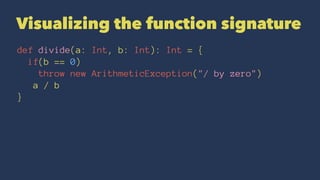
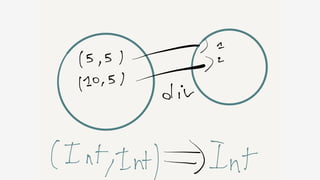
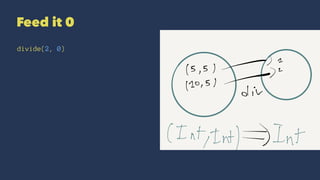
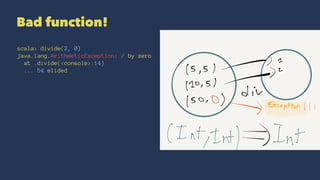
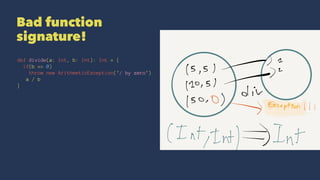
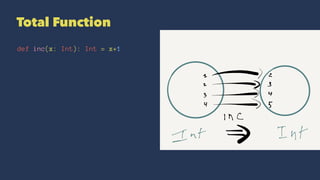
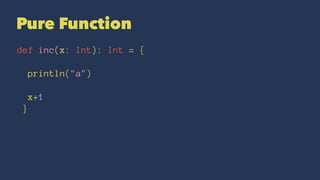
![Convert divide to a total function
case class DivisionError(e: String)
def divide(a: Int, b: Int): Either[DivisionError, Int] = {
if( b == 0) Left(DivisionError("/ by zero"))
Right(a / b)
}](https://image.slidesharecdn.com/finaldraft1-180703103605/85/Scalapeno18-Thinking-Less-with-Scala-20-320.jpg)
![Container[_] types](https://image.slidesharecdn.com/finaldraft1-180703103605/85/Scalapeno18-Thinking-Less-with-Scala-21-320.jpg)
![Option[_]: Returning no value is
possible
def getMiddleName(name: String):
Option[String] = ???](https://image.slidesharecdn.com/finaldraft1-180703103605/85/Scalapeno18-Thinking-Less-with-Scala-22-320.jpg)
![Either[_,_]: Possibility of errors
def divide(a: Int, b: Int):
Either[String, Int] = ???](https://image.slidesharecdn.com/finaldraft1-180703103605/85/Scalapeno18-Thinking-Less-with-Scala-23-320.jpg)
![List[_]: Multiple outputs
def getHosts(mongoUri: String):
List[String] = ???](https://image.slidesharecdn.com/finaldraft1-180703103605/85/Scalapeno18-Thinking-Less-with-Scala-24-320.jpg)
![Future[_]: When?
def loadUser(id: String):
Future[String] = ???](https://image.slidesharecdn.com/finaldraft1-180703103605/85/Scalapeno18-Thinking-Less-with-Scala-25-320.jpg)
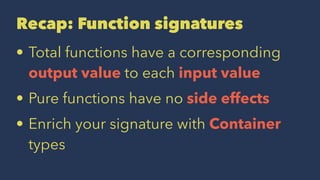

: A = ???](https://image.slidesharecdn.com/finaldraft1-180703103605/85/Scalapeno18-Thinking-Less-with-Scala-30-320.jpg)
: A = a](https://image.slidesharecdn.com/finaldraft1-180703103605/85/Scalapeno18-Thinking-Less-with-Scala-31-320.jpg)
: List[A] = ???](https://image.slidesharecdn.com/finaldraft1-180703103605/85/Scalapeno18-Thinking-Less-with-Scala-32-320.jpg)
: List[A] = {
if(as.isEmpty) Nil
else as.head :: Nil
}
def foo[A](as: List[A]): List[A] = {
if(as.isEmpty) Nil
else as.tail.toList.head :: Nil
}](https://image.slidesharecdn.com/finaldraft1-180703103605/85/Scalapeno18-Thinking-Less-with-Scala-33-320.jpg)
: Int = ???](https://image.slidesharecdn.com/finaldraft1-180703103605/85/Scalapeno18-Thinking-Less-with-Scala-34-320.jpg)
: Int = 1
def foo[A](a: A): Int = 2
def foo[A](a: A): Int = 3
def foo[A](a: A): Int = 4](https://image.slidesharecdn.com/finaldraft1-180703103605/85/Scalapeno18-Thinking-Less-with-Scala-35-320.jpg)





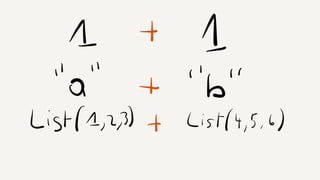
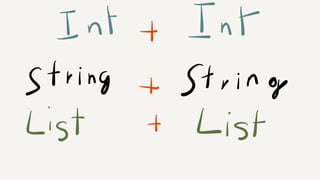
: List[A] = ???](https://image.slidesharecdn.com/finaldraft1-180703103605/85/Scalapeno18-Thinking-Less-with-Scala-53-320.jpg)
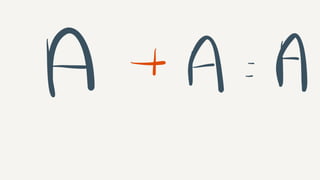
![Extracting to typeclasses
trait Combinable[A] {
def combine(x: A, y: A): A
}](https://image.slidesharecdn.com/finaldraft1-180703103605/85/Scalapeno18-Thinking-Less-with-Scala-55-320.jpg)
![Combinable[Int]
implicit val combineInts =
new Combinable[Int] {
def combine(x: Int, y: Int): Int =
x + y
}](https://image.slidesharecdn.com/finaldraft1-180703103605/85/Scalapeno18-Thinking-Less-with-Scala-57-320.jpg)
![Combinable[String]
implicit val combineStrings =
new Combinable[String] {
def combine(x: String, y: String): String =
x + y
}](https://image.slidesharecdn.com/finaldraft1-180703103605/85/Scalapeno18-Thinking-Less-with-Scala-58-320.jpg)
![Combinable[Foo]
case class Foo(i: Int, s: String)
implicit val combineFoos =
new Combinable[Foo] {
def combine(x: Foo, y: Foo): Foo =
Foo(x.i + y.i , x.s.concat(y.s))
}](https://image.slidesharecdn.com/finaldraft1-180703103605/85/Scalapeno18-Thinking-Less-with-Scala-59-320.jpg)
![Use the instances
scala> implicitly[Combinable[String]].combine("a", "b")
res6: String = ab
scala> implicitly[Combinable[Int]].combine(1, 1)
res7: Int = 2
scala> implicitly[Combinable[Foo]].combine(Foo(1,"a"), Foo(2,"b"))
res8: Foo = Foo(3,ab)](https://image.slidesharecdn.com/finaldraft1-180703103605/85/Scalapeno18-Thinking-Less-with-Scala-60-320.jpg)

![Combinable[A]
trait Combinable[A] {
def combine(x: A, y: A): A
}](https://image.slidesharecdn.com/finaldraft1-180703103605/85/Scalapeno18-Thinking-Less-with-Scala-62-320.jpg)
![Monoid[A]
trait Monoid[A] {
def empty: A
def combine(x: A, y: A): A
}](https://image.slidesharecdn.com/finaldraft1-180703103605/85/Scalapeno18-Thinking-Less-with-Scala-63-320.jpg)

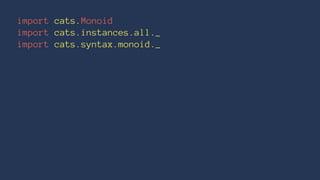
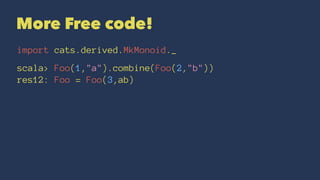
![scala> 1.combine(1)
res9: Int = 2
scala> "a".combine("b")
res10: String = ab
scala> List(1,2,3).combine(List(4,5,6))
res11: List[Int] = List(1, 2, 3, 4, 5, 6)](https://image.slidesharecdn.com/finaldraft1-180703103605/85/Scalapeno18-Thinking-Less-with-Scala-66-320.jpg)
![combineAll is a derived function
trait Monoid[A] {
def empty: A
def combine(x: A, y: A): A
def combineAll(as: List[A]): A =
as.foldLeft(empty)(combine)
}](https://image.slidesharecdn.com/finaldraft1-180703103605/85/Scalapeno18-Thinking-Less-with-Scala-69-320.jpg)
![scala> Monoid[Int].combineAll(List(1,2,3))
res13: Int = 6
scala> Monoid[String].combineAll(List("a","b","c"))
res14: String = abc
scala> Monoid[Foo].combineAll(Set(Foo(1,"a"),Foo(2,"b"),Foo(3,"c")))
res15: Foo = Foo(6,abc)](https://image.slidesharecdn.com/finaldraft1-180703103605/85/Scalapeno18-Thinking-Less-with-Scala-70-320.jpg)
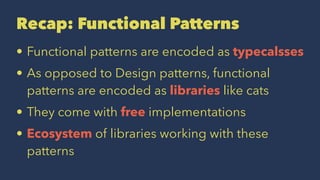
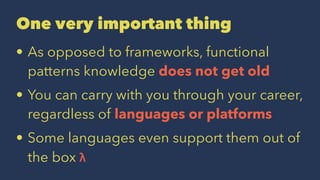
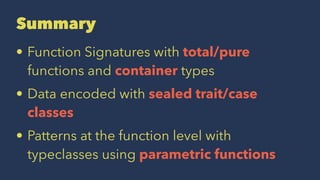




The document discusses functional programming concepts, including function signatures, total and pure functions, and the use of container types to handle errors and multiple outputs. It also covers the encoding of data with sealed traits and case classes, as well as the implementation of functional patterns through type classes and monoids. Overall, it emphasizes the importance of designing functions and data efficiently while leveraging existing patterns and libraries.


