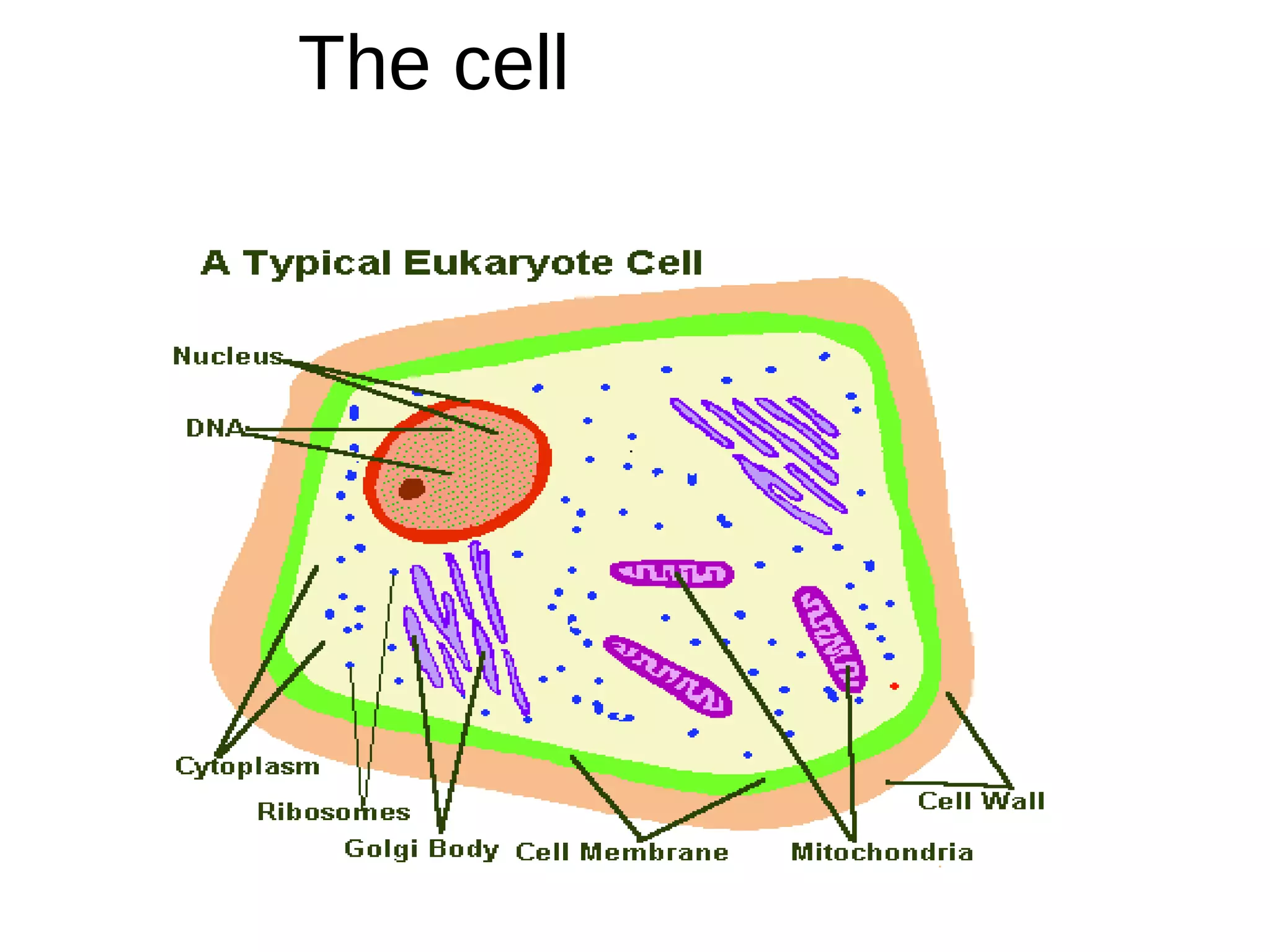
The cell
• It’s the basic, structural and functional unit
of life
• Each cell is capable of performing all the
essential life functions.
• The process by which cells assume
specialized functions and structure is
known as differentiation.
Cell structure
• Cells conform to the same basic structure.
All cells are composed of an external
lining membrane known as the plasma
membrane that serves as an interface
between the internal and external
environment.
• The cell membrane surrounds a number of
organelles that are embedded in a fluid
medium known as the cytoplasm.
The cell membrane
• All cell membranes conform to the same
basic model: the fluid mosaic model.
• The model was proposed by Singer and
Nicholoson in 1970.
The cell membrane
Cell membrane
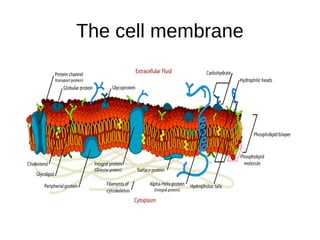
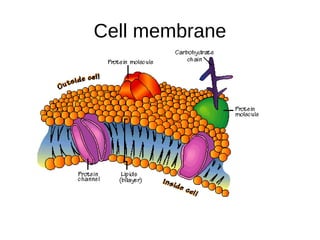
• The cell membrane is made up of a lipid
by layer with a hydrophilic polar end and
a hydrophobic non polar end.
• The hydrophilic end is made up of glycerol
attached to a nitrogenous compound by a
phosphate bond. The nitrogenous cpds
include chlorine, ethanolamine or serine.
They are positively charged. The
phosphate gp is negatively charged.
• The non polar end is made up of two chains of
fatty acids, one of them is straight and saturated
while the other is kinked and non saturated. The
kinked fatty acids increase flexibility and fluidity
• Between the fatty acids is cholesterol molecules
in the ratio of 1:1 with the phospholipids. The
cholesterol prevents close packing and
increases fluidity. They regulate the fluidity and
increase stability of the cell membrane.
Proteins in the cell membrane
• Associated with the cell membrane are
three types of proteins: extrinsic, intrinsic
and transmembrane proteins. These make
up ½ the total mass of the cell membrane.
• Extrinsic proteins are found on the outside
surface, intrinsic on the internal surface of
the cell membrane while transmembrane
proteins traverse the whole thickness of
the cell membrane
• They act as pores for passage of ions
• Associated with the proteins and
phospholipids are carbohydrates forming
glycoproteins and glycolipids.These are
involved in cell recognition, formation of
intracellular adhesions and adsorption of
molecules to the cell surface.
Transport across the cell
membrane
Molecules enter and leave by four means
• Passive diffusion
• Facilitated diffusion
• Active transport
• Bulk transport
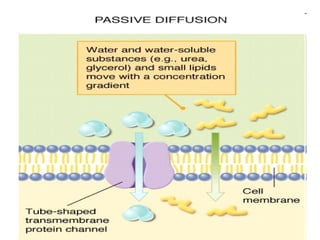
Passive diffusion
• Requires a concentration gradient.
• Doesn’t involve metabolic energy.
• Molecules move from a region of high
concentration gradient to a region of low
concentration gradient across a semi
permeable membrane
• It is for non polar molecules like ethanol,
and polar molecules that are uncharged
like oxygen, carbondioxide, urea
•
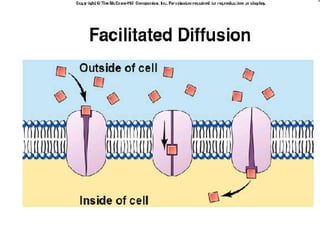
Facilitated diffusion
• Similar to simple diffusion but requies a
carrier protein
• It is for larger hydrophillic molecules like
amino acids, glucose and fatty acids
• The binding to carriers is specific but
reverscible
Active transport
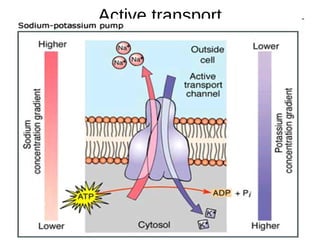
Active transport
• Requires energy in form of ATP
• Occurs against a concentration gradient
• It involves pumps
Bulk transport
• Includes endocytosis and exocytosis
(phagocytosis and pinocytosis)
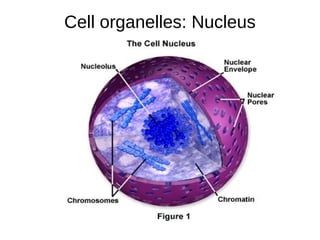
Cell organelles: Nucleus
Nucleus
• Largest of all cell organelles. Has a
nuclear membrane that has pores
• Contains the genetic material of the cell
inform of DNA and
proteins(nucleoproteins). The proteins
include the DNA associated proteins:
histones, and the non DNA associated
proteins.
Nucleoli
• Densely stained structures found inside
the nucleus. They are sites for ribosomal
RNA synthesis.
Endoplasmic reticulum
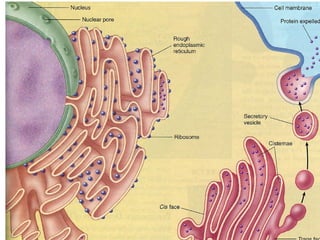
Rough endoplasmic reticulum
• Made up of interconnecting network of tubules,
sacs and vesicles covered by ribosomes
• Sites for synthesis and packaging of proteins
Smooth endoplasmic reticulum:
not covered by ribosomes. Sites for lipid
synthesis, and synthesis of cell membrane.
Golgi apparatus
• Consists of s system of stacked, saucer
shaped cisternae with the concave
surface facing the nucleus
• Involved in intracellular transport by
packaging proteins into vesicles and
releasing them by exocytosis.
Golgi apparatus
Mitochondria
Mitochondria
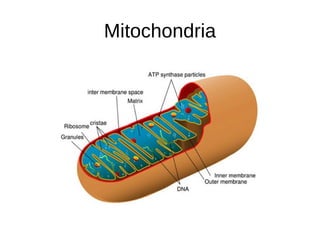
• Cigar shaped highly motile organelles
composed of a smooth outer membrane
and a folded inner membrane (cristae)
• Sites for energy production in the cell
• Tend to be plenty in highly metabolic
tissues like liver and muscle cells.
Lysosomes
Lysosomes
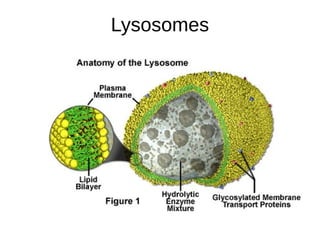
• Oval membrane bound organelles with
numerous enzymes involved in
breakdown of phagocytosed bacteria and
other particles.
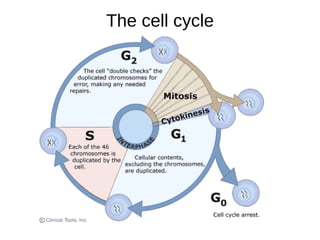
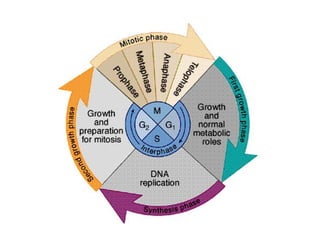
The cell cycle
• Refers to events that occur in a cell’s
lifetime
• The cycle is composed of a dividing phase
(M phase) and a non dividing phase (Inter
phase)
• There are three types of cells according to
the cell cylcle: the continuously dividing
cells that are always dividing e.g skin cells
and cells of digestive system
• The facultative dividers: these live the cell
cycle and enter the Go phase but retain
the ability to divide e.g liver cells
• The terminally differentiated cells: leave
the cell cycle permanently and lose the
ability to divide e.g cells of the nervous
system
The cell cycle
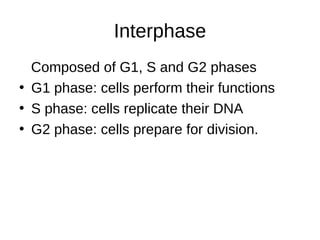
Interphase
Composed of G1, S and G2 phases
• G1 phase: cells perform their functions
• S phase: cells replicate their DNA
• G2 phase: cells prepare for division.
Diviving phase: MITOSIS
Composed of prophase, metaphase,
anaphase and telophase
• Prophase: chromosomes become visible,
initially thread like, but later appear to be
composed of two sister chromatids joined
at centromere, nucleoli disappears,
process ends with disappearence of
nuclear membrane
• Metaphase: chromosomes arrange
themselves at equator of the spindle,
microtubules span from opposite
centrioles, sister chromatids begin
separating and moving towards opposite
poles
• Anaphase: sister chromatids continue
moving towards opposite poles
• Telophase: sister cromatids reach
opposite poles, spindles diappear, nucleoli
and nuclear membrane reappears, cell
membrane divides (cytokinesis) to form
two daughter cells
Importance of cell division
• Repair
• Growth
• reproduction
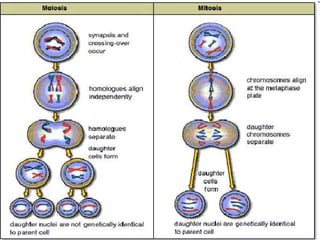
Meiosis
• Occurs in two phases, meoisis one and
two
• Crossing over occurs leading to exchange
of genetic material
• Occurs only in gametes
• Product is four daughter cells with half the
chromosome number of parent cell.
Meiosis
•

Lecture 2aThe cell 1.pdf

  • 1.
  • 2.
    • It’s thebasic, structural and functional unit of life • Each cell is capable of performing all the essential life functions. • The process by which cells assume specialized functions and structure is known as differentiation.
  • 3.
    Cell structure • Cellsconform to the same basic structure. All cells are composed of an external lining membrane known as the plasma membrane that serves as an interface between the internal and external environment. • The cell membrane surrounds a number of organelles that are embedded in a fluid medium known as the cytoplasm.
  • 4.
    The cell membrane •All cell membranes conform to the same basic model: the fluid mosaic model. • The model was proposed by Singer and Nicholoson in 1970.
  • 5.
  • 6.
  • 7.
    • The cellmembrane is made up of a lipid by layer with a hydrophilic polar end and a hydrophobic non polar end. • The hydrophilic end is made up of glycerol attached to a nitrogenous compound by a phosphate bond. The nitrogenous cpds include chlorine, ethanolamine or serine. They are positively charged. The phosphate gp is negatively charged.
  • 8.
    • The nonpolar end is made up of two chains of fatty acids, one of them is straight and saturated while the other is kinked and non saturated. The kinked fatty acids increase flexibility and fluidity • Between the fatty acids is cholesterol molecules in the ratio of 1:1 with the phospholipids. The cholesterol prevents close packing and increases fluidity. They regulate the fluidity and increase stability of the cell membrane.
  • 9.
    Proteins in thecell membrane • Associated with the cell membrane are three types of proteins: extrinsic, intrinsic and transmembrane proteins. These make up ½ the total mass of the cell membrane. • Extrinsic proteins are found on the outside surface, intrinsic on the internal surface of the cell membrane while transmembrane proteins traverse the whole thickness of the cell membrane
  • 10.
    • They actas pores for passage of ions • Associated with the proteins and phospholipids are carbohydrates forming glycoproteins and glycolipids.These are involved in cell recognition, formation of intracellular adhesions and adsorption of molecules to the cell surface.
  • 11.
    Transport across thecell membrane Molecules enter and leave by four means • Passive diffusion • Facilitated diffusion • Active transport • Bulk transport
  • 13.
    Passive diffusion • Requiresa concentration gradient. • Doesn’t involve metabolic energy. • Molecules move from a region of high concentration gradient to a region of low concentration gradient across a semi permeable membrane • It is for non polar molecules like ethanol, and polar molecules that are uncharged like oxygen, carbondioxide, urea
  • 14.
  • 15.
    Facilitated diffusion • Similarto simple diffusion but requies a carrier protein • It is for larger hydrophillic molecules like amino acids, glucose and fatty acids • The binding to carriers is specific but reverscible
  • 16.
  • 17.
    Active transport • Requiresenergy in form of ATP • Occurs against a concentration gradient • It involves pumps
  • 18.
    Bulk transport • Includesendocytosis and exocytosis (phagocytosis and pinocytosis)
  • 19.
  • 20.
    Nucleus • Largest ofall cell organelles. Has a nuclear membrane that has pores • Contains the genetic material of the cell inform of DNA and proteins(nucleoproteins). The proteins include the DNA associated proteins: histones, and the non DNA associated proteins.
  • 21.
    Nucleoli • Densely stainedstructures found inside the nucleus. They are sites for ribosomal RNA synthesis.
  • 22.
    Endoplasmic reticulum Rough endoplasmicreticulum • Made up of interconnecting network of tubules, sacs and vesicles covered by ribosomes • Sites for synthesis and packaging of proteins Smooth endoplasmic reticulum: not covered by ribosomes. Sites for lipid synthesis, and synthesis of cell membrane.
  • 23.
    Golgi apparatus • Consistsof s system of stacked, saucer shaped cisternae with the concave surface facing the nucleus • Involved in intracellular transport by packaging proteins into vesicles and releasing them by exocytosis.
  • 24.
  • 25.
  • 26.
    Mitochondria • Cigar shapedhighly motile organelles composed of a smooth outer membrane and a folded inner membrane (cristae) • Sites for energy production in the cell • Tend to be plenty in highly metabolic tissues like liver and muscle cells.
  • 27.
  • 28.
    Lysosomes • Oval membranebound organelles with numerous enzymes involved in breakdown of phagocytosed bacteria and other particles.
  • 29.
    The cell cycle •Refers to events that occur in a cell’s lifetime • The cycle is composed of a dividing phase (M phase) and a non dividing phase (Inter phase) • There are three types of cells according to the cell cylcle: the continuously dividing cells that are always dividing e.g skin cells and cells of digestive system
  • 30.
    • The facultativedividers: these live the cell cycle and enter the Go phase but retain the ability to divide e.g liver cells • The terminally differentiated cells: leave the cell cycle permanently and lose the ability to divide e.g cells of the nervous system
  • 31.
  • 33.
    Interphase Composed of G1,S and G2 phases • G1 phase: cells perform their functions • S phase: cells replicate their DNA • G2 phase: cells prepare for division.
  • 34.
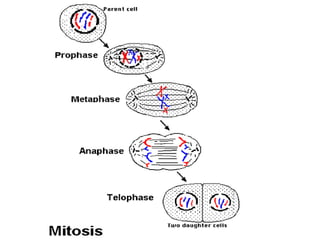
    Diviving phase: MITOSIS Composedof prophase, metaphase, anaphase and telophase • Prophase: chromosomes become visible, initially thread like, but later appear to be composed of two sister chromatids joined at centromere, nucleoli disappears, process ends with disappearence of nuclear membrane
  • 35.
    • Metaphase: chromosomesarrange themselves at equator of the spindle, microtubules span from opposite centrioles, sister chromatids begin separating and moving towards opposite poles
  • 36.
    • Anaphase: sisterchromatids continue moving towards opposite poles • Telophase: sister cromatids reach opposite poles, spindles diappear, nucleoli and nuclear membrane reappears, cell membrane divides (cytokinesis) to form two daughter cells
  • 37.
    Importance of celldivision • Repair • Growth • reproduction
  • 39.
    Meiosis • Occurs intwo phases, meoisis one and two • Crossing over occurs leading to exchange of genetic material • Occurs only in gametes • Product is four daughter cells with half the chromosome number of parent cell.
  • 40.