Volume Confirmations
Part - 2
CMT LEVEL - I
Money Flow Index (Oscillator)
• Money Flow Index is normalized ratio between positive and Negative Money
Flow.
• The MFI indicator is used to track changes in Money Flow as an indication of
changes in a price trend.
• The principle of MFI calculation is a comparison of "positive money flow" to
"negative money flow".
• The same as RSI, the MFI scale is between 0 and 100.
• 14-bar period is the most commonly used period setting for MFI daily chart.
• The Money Flow Index can be interpreted much like the RSI and other volume
based technical indicators by looking at divergences which may signal possible
trend reversal.
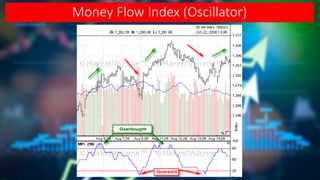
• The same as with RSI, MFI can be used to define overbought/oversold conditions
where a stock (index) is considered "overbought" if the MFI runs above 80 and
"oversold" if MFI drops below 20.
Money Flow Index (Oscillator)
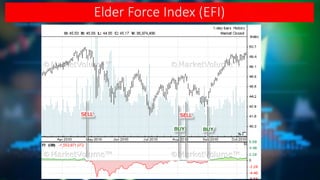
Elder Force Index (EFI)
• Force index is volume based technical indicator measuring efficient
bullish and bearish Money Flow forcing a price change.
• Force Index, developed by Alexander Elder, is used in technical
analysis to recognize bullish and bearish trends as well as define
their strength.
• Force Index oscillates around zero line (center line).
• The negative Force Index's readings are associated with bearish
trend
• The positive Force Index's reading are associated with Bullish trend.
Elder Force Index (EFI)
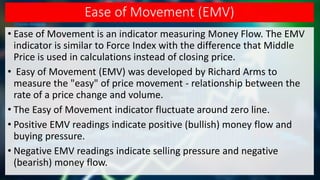
Ease of Movement (EMV)
• Ease of Movement is an indicator measuring Money Flow. The EMV
indicator is similar to Force Index with the difference that Middle
Price is used in calculations instead of closing price.
• Easy of Movement (EMV) was developed by Richard Arms to
measure the "easy" of price movement - relationship between the
rate of a price change and volume.
• The Easy of Movement indicator fluctuate around zero line.
• Positive EMV readings indicate positive (bullish) money flow and
buying pressure.
• Negative EMV readings indicate selling pressure and negative
(bearish) money flow.
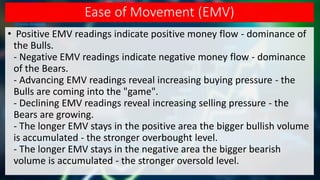
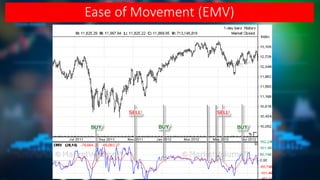
Ease of Movement (EMV)
• Positive EMV readings indicate positive money flow - dominance of
the Bulls.
- Negative EMV readings indicate negative money flow - dominance
of the Bears.
- Advancing EMV readings reveal increasing buying pressure - the
Bulls are coming into the "game".
- Declining EMV readings reveal increasing selling pressure - the
Bears are growing.
- The longer EMV stays in the positive area the bigger bullish volume
is accumulated - the stronger overbought level.
- The longer EMV stays in the negative area the bigger bearish
volume is accumulated - the stronger oversold level.
Ease of Movement (EMV)
Volume Rate of Change
• Volume ROC is an indicator used in technical analysis to evaluate rate of
change in trading volume over specified period of time.
• The Volume Rate of Change (Volume ROC) is identical to the ROC (Rate of
Change) technical indicator that displays the percentage difference
between the current Volume and the volume n-time periods ago.
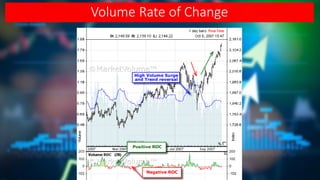
• A high volume ROC indicates volume surges and can be used to define
the overbought/oversold moments that can lead to a trend reversal.
It is good practice to scroll backwards on the chart to the recent past
(several frames back) to look for connections between Volume ROC,
volume surges and the price reversal and try to apply them to the current
market.
It is a good idea to use this indicator in conjunction with other price-
based technical indicators.
Volume Rate of Change

Lecture 20 - Volume Indicator & Oscillator - Part III (B).pdf

  • 1.
  • 2.
    Money Flow Index(Oscillator) • Money Flow Index is normalized ratio between positive and Negative Money Flow. • The MFI indicator is used to track changes in Money Flow as an indication of changes in a price trend. • The principle of MFI calculation is a comparison of "positive money flow" to "negative money flow". • The same as RSI, the MFI scale is between 0 and 100. • 14-bar period is the most commonly used period setting for MFI daily chart. • The Money Flow Index can be interpreted much like the RSI and other volume based technical indicators by looking at divergences which may signal possible trend reversal. • The same as with RSI, MFI can be used to define overbought/oversold conditions where a stock (index) is considered "overbought" if the MFI runs above 80 and "oversold" if MFI drops below 20.
  • 3.
    Money Flow Index(Oscillator)
  • 4.
    Elder Force Index(EFI) • Force index is volume based technical indicator measuring efficient bullish and bearish Money Flow forcing a price change. • Force Index, developed by Alexander Elder, is used in technical analysis to recognize bullish and bearish trends as well as define their strength. • Force Index oscillates around zero line (center line). • The negative Force Index's readings are associated with bearish trend • The positive Force Index's reading are associated with Bullish trend.
  • 5.
  • 6.
    Ease of Movement(EMV) • Ease of Movement is an indicator measuring Money Flow. The EMV indicator is similar to Force Index with the difference that Middle Price is used in calculations instead of closing price. • Easy of Movement (EMV) was developed by Richard Arms to measure the "easy" of price movement - relationship between the rate of a price change and volume. • The Easy of Movement indicator fluctuate around zero line. • Positive EMV readings indicate positive (bullish) money flow and buying pressure. • Negative EMV readings indicate selling pressure and negative (bearish) money flow.
  • 7.
    Ease of Movement(EMV) • Positive EMV readings indicate positive money flow - dominance of the Bulls. - Negative EMV readings indicate negative money flow - dominance of the Bears. - Advancing EMV readings reveal increasing buying pressure - the Bulls are coming into the "game". - Declining EMV readings reveal increasing selling pressure - the Bears are growing. - The longer EMV stays in the positive area the bigger bullish volume is accumulated - the stronger overbought level. - The longer EMV stays in the negative area the bigger bearish volume is accumulated - the stronger oversold level.
  • 8.
  • 9.
    Volume Rate ofChange • Volume ROC is an indicator used in technical analysis to evaluate rate of change in trading volume over specified period of time. • The Volume Rate of Change (Volume ROC) is identical to the ROC (Rate of Change) technical indicator that displays the percentage difference between the current Volume and the volume n-time periods ago. • A high volume ROC indicates volume surges and can be used to define the overbought/oversold moments that can lead to a trend reversal. It is good practice to scroll backwards on the chart to the recent past (several frames back) to look for connections between Volume ROC, volume surges and the price reversal and try to apply them to the current market. It is a good idea to use this indicator in conjunction with other price- based technical indicators.
  • 10.