MODERN PHYSICS 004
LECTURE TWO
ELEMENTS OF MODERN PHYSICS
BLACKBODY RADIATION
**Classical versus Quantum theory of energy**
THE ULTRAVIOLET CATASTROPHE
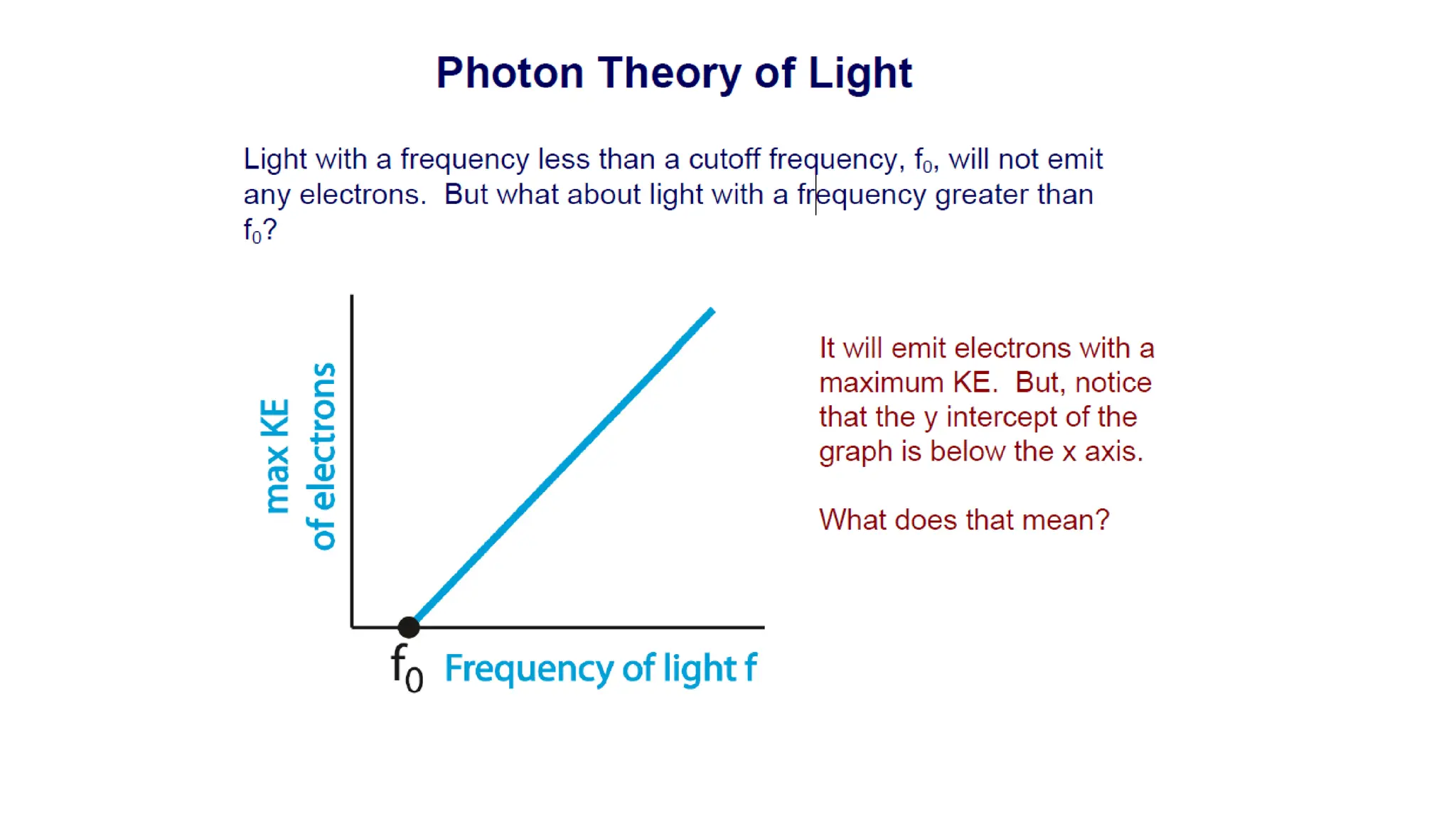
Photoelectric Effect Equation
𝑊 = ℎ𝑓𝑜
Where𝑓𝑜=
threshold
frequency
THERMIONIC EMISSION
Thermionic emission is when a metal will release electrons when it is heated.
This term can be broken down: “Therm-” means that this process relates to heating. “-ionic-” means that this
process relates to charge. “-emission” means that the process will emit something.
BOHR MODEL OF THE ATOM
In his Bohr model suggested that:
- Electrons could only travel in orbits at certain discrete distances from the nucleus with
fixed energies
- They can only gain or lose energy by moving from one energy level to another by
absorbing or emitting electromagnetic radiation with frequency f . The difference in
energy level can be given by Planck’s relation:
∆𝐸 = 𝐸2 − 𝐸1 = ℎ𝑓
THE LIMITATIONS OF BOHR’S ATOMIC MODEL
The Limitations of Bohr’s atomic model are as follows:
It could not explain the atomic spectra of elements having more than one electron.
It could not explain the Zeeman effect when the spectral lines are split into closely
spaced lines under the influence of magnetic field.
It failed to explain the Stark effect when the spectral lines get split into fine lines under
the influence of an electric field.
According to Bohr, the circular orbits of electrons are planar. But modern research
reveals that an electron moves around the nucleus in three-dimensional space.
It does not obey Heisenberg’s uncertainty principle. According to this principle, it is
impossible to determine simultaneously the exact position and momentum of a small
moving particle like an electron with absolute certainty. However, according to Bohr,
electrons move in a well-defined circular orbit.
Bohr’s model could not explain shapes and geometry molecules. It failed to make
correct predictions of large-sized atoms and provided sufficient information only
for smaller atoms
ENERGY LEVELS OF THE ATOM - Definitions
ENERGY LEVELS
The electrons in an atom are trapped because they are attracted to the protons in the nucleus
Their energies are determined by which shell they are in: nearer the nucleus = less energy
INTERACTION OF RADIATION WITH MATTER
APPLICATION OF LASERS
The drilling of holes in the metals becomes easy with these lasers.
Lasers are used for bloodless surgery.
They find application in the military and are used in the target destination system.
Lasers are used to cut glass and quartz
Lasers are used in cancer diagnosis and therapy.
A laser helps in studying the Brownian motion of particles.
Lasers are used to store large amounts of information or data in CD-ROM.
Lasers are used in computer printers
Lasers are used in electronic industries for trimming the components of Integrated Circuits
(ICs).
Lasers are used in cosmetic treatments such as acne treatment, cellulite and hair removal.
FRAUNHOFER LINES
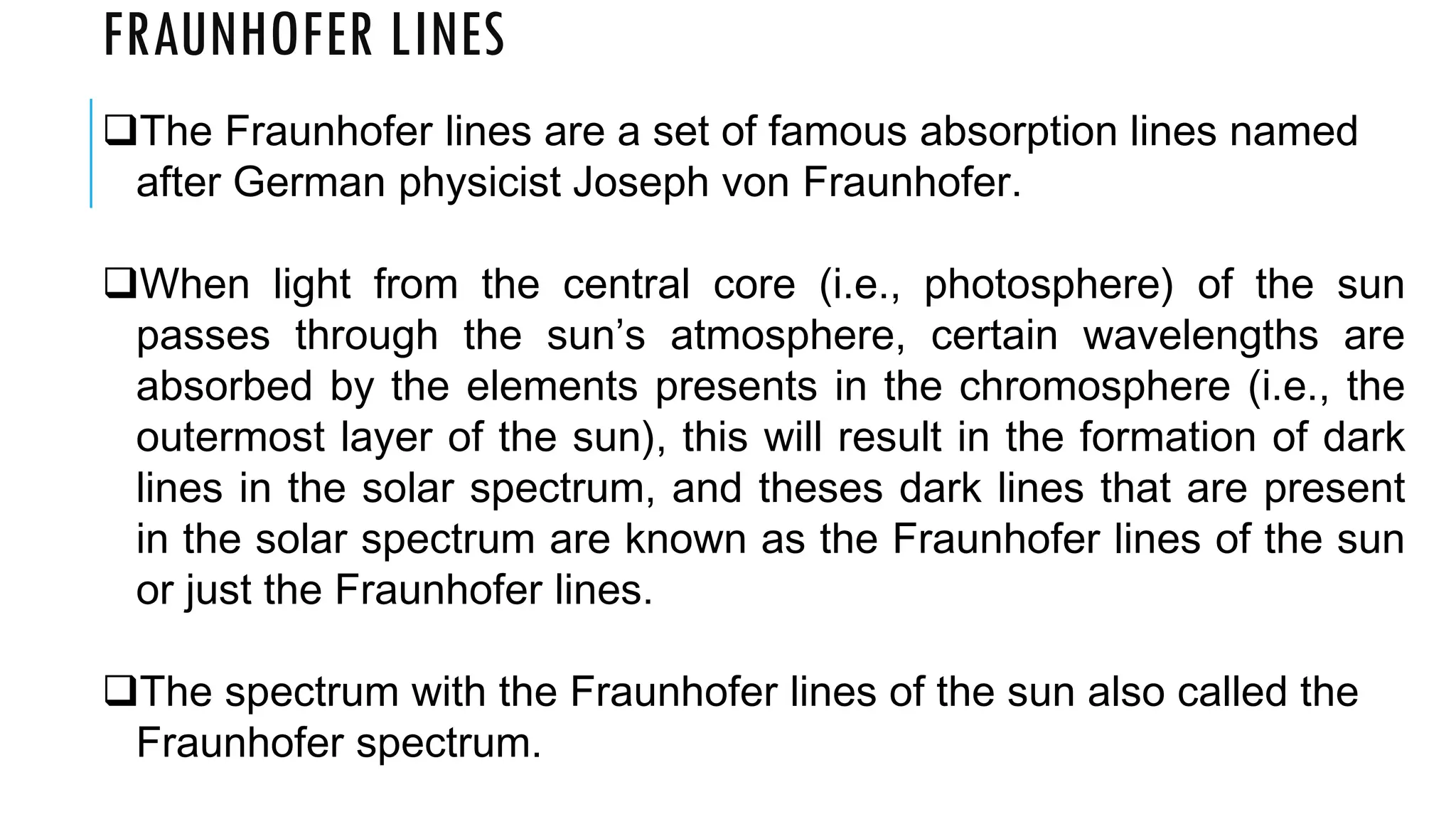
The Fraunhofer lines are a set of famous absorption lines named
after German physicist Joseph von Fraunhofer.
When light from the central core (i.e., photosphere) of the sun
passes through the sun’s atmosphere, certain wavelengths are
absorbed by the elements presents in the chromosphere (i.e., the
outermost layer of the sun), this will result in the formation of dark
lines in the solar spectrum, and theses dark lines that are present
in the solar spectrum are known as the Fraunhofer lines of the sun
or just the Fraunhofer lines.
The spectrum with the Fraunhofer lines of the sun also called the
Fraunhofer spectrum.
PRACTICE QUESTIONS
1. The particle nature of light is demonstrated by A. Photoelectric effect B. Speed of light C. Colours of light D.
Diffraction of light
2. For an electron to be ejected from the surface of a metal, the radiation energy must be ------------------ A.
greater than the work function of the metal B. less than the work function of the metal C. equal to the work
function of the metal D. greater than the rest mass energy of the electron
3. A metal having a work function of 5.76eV is illuminated with a radiation of 7.88eV. The kinetic energy of the
electrons emitted from the metal surface is A. 2.12eV B 1.37eV C. 45.39eV D. 13.64eV
4. An electron in the n = 5 energy level of hydrogen undergoes a transition to the n = 3 energy level. Determine
the wavelength of the photon the atom emits in this process. A. 1.28 x 10⁻⁶ m B. 2.37 x 10⁻⁶ m C. 4.22 x 10⁻⁷ m
D. 3.04 x 10⁻⁶ m
5. (I) The frequency of incident radiation. (II) The intensity of incident radiation. (III) The work function of the metal.
On which of the above parameters does the maximum energy of photoelectrons depend in photoelectricity?
A. (I) and (II) only. B. (I) and (III) only. C. (II) and (III) only. D. (I), (II) and (III).
6. The maximum kinetic energy of the photoelectrons emitted from a metal surface is 0.34eV. If the work function
of the metal is 1.83eV, find the stopping potential. A. 2.17V B. 1.49V C. 1.09V D. 0.34V 45.

Lecture 2 - Elements of Modern physics_MODERN PHYSICS.pdf

  • 1.
  • 2.
  • 3.
  • 4.
    **Classical versus Quantumtheory of energy**
  • 5.
  • 11.
    Photoelectric Effect Equation 𝑊= ℎ𝑓𝑜 Where𝑓𝑜= threshold frequency
  • 19.
    THERMIONIC EMISSION Thermionic emissionis when a metal will release electrons when it is heated. This term can be broken down: “Therm-” means that this process relates to heating. “-ionic-” means that this process relates to charge. “-emission” means that the process will emit something.
  • 20.
    BOHR MODEL OFTHE ATOM In his Bohr model suggested that: - Electrons could only travel in orbits at certain discrete distances from the nucleus with fixed energies - They can only gain or lose energy by moving from one energy level to another by absorbing or emitting electromagnetic radiation with frequency f . The difference in energy level can be given by Planck’s relation: ∆𝐸 = 𝐸2 − 𝐸1 = ℎ𝑓
  • 21.
    THE LIMITATIONS OFBOHR’S ATOMIC MODEL The Limitations of Bohr’s atomic model are as follows: It could not explain the atomic spectra of elements having more than one electron. It could not explain the Zeeman effect when the spectral lines are split into closely spaced lines under the influence of magnetic field. It failed to explain the Stark effect when the spectral lines get split into fine lines under the influence of an electric field. According to Bohr, the circular orbits of electrons are planar. But modern research reveals that an electron moves around the nucleus in three-dimensional space. It does not obey Heisenberg’s uncertainty principle. According to this principle, it is impossible to determine simultaneously the exact position and momentum of a small moving particle like an electron with absolute certainty. However, according to Bohr, electrons move in a well-defined circular orbit. Bohr’s model could not explain shapes and geometry molecules. It failed to make correct predictions of large-sized atoms and provided sufficient information only for smaller atoms
  • 22.
    ENERGY LEVELS OFTHE ATOM - Definitions
  • 23.
    ENERGY LEVELS The electronsin an atom are trapped because they are attracted to the protons in the nucleus Their energies are determined by which shell they are in: nearer the nucleus = less energy
  • 27.
  • 29.
    APPLICATION OF LASERS Thedrilling of holes in the metals becomes easy with these lasers. Lasers are used for bloodless surgery. They find application in the military and are used in the target destination system. Lasers are used to cut glass and quartz Lasers are used in cancer diagnosis and therapy. A laser helps in studying the Brownian motion of particles. Lasers are used to store large amounts of information or data in CD-ROM. Lasers are used in computer printers Lasers are used in electronic industries for trimming the components of Integrated Circuits (ICs). Lasers are used in cosmetic treatments such as acne treatment, cellulite and hair removal.
  • 30.
    FRAUNHOFER LINES The Fraunhoferlines are a set of famous absorption lines named after German physicist Joseph von Fraunhofer. When light from the central core (i.e., photosphere) of the sun passes through the sun’s atmosphere, certain wavelengths are absorbed by the elements presents in the chromosphere (i.e., the outermost layer of the sun), this will result in the formation of dark lines in the solar spectrum, and theses dark lines that are present in the solar spectrum are known as the Fraunhofer lines of the sun or just the Fraunhofer lines. The spectrum with the Fraunhofer lines of the sun also called the Fraunhofer spectrum.
  • 31.
    PRACTICE QUESTIONS 1. Theparticle nature of light is demonstrated by A. Photoelectric effect B. Speed of light C. Colours of light D. Diffraction of light 2. For an electron to be ejected from the surface of a metal, the radiation energy must be ------------------ A. greater than the work function of the metal B. less than the work function of the metal C. equal to the work function of the metal D. greater than the rest mass energy of the electron 3. A metal having a work function of 5.76eV is illuminated with a radiation of 7.88eV. The kinetic energy of the electrons emitted from the metal surface is A. 2.12eV B 1.37eV C. 45.39eV D. 13.64eV 4. An electron in the n = 5 energy level of hydrogen undergoes a transition to the n = 3 energy level. Determine the wavelength of the photon the atom emits in this process. A. 1.28 x 10⁻⁶ m B. 2.37 x 10⁻⁶ m C. 4.22 x 10⁻⁷ m D. 3.04 x 10⁻⁶ m 5. (I) The frequency of incident radiation. (II) The intensity of incident radiation. (III) The work function of the metal. On which of the above parameters does the maximum energy of photoelectrons depend in photoelectricity? A. (I) and (II) only. B. (I) and (III) only. C. (II) and (III) only. D. (I), (II) and (III). 6. The maximum kinetic energy of the photoelectrons emitted from a metal surface is 0.34eV. If the work function of the metal is 1.83eV, find the stopping potential. A. 2.17V B. 1.49V C. 1.09V D. 0.34V 45.