Ahsan AbdullahAhsan Abdullah
11
Data WarehousingData Warehousing
Lecture-11Lecture-11
Multidimensional OLAP (MOLAP)Multidimensional OLAP (MOLAP)
Virtual University of PakistanVirtual University of Pakistan
Ahsan Abdullah
Assoc. Prof. & Head
Center for Agro-Informatics Research
www.nu.edu.pk/cairindex.asp
National University of Computers & Emerging Sciences, Islamabad
Email: ahsan@cluxing.com
Ahsan Abdullah
2
Multidimensional OLAP (MOLAP)Multidimensional OLAP (MOLAP)
Ahsan Abdullah
3
OLAP ImplementationsOLAP Implementations
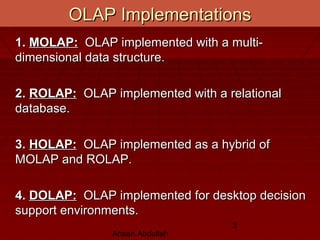
1.1. MOLAP:MOLAP: OLAP implemented with a multi-OLAP implemented with a multi-
dimensional data structure.dimensional data structure.
2.2. ROLAP:ROLAP: OLAP implemented with a relationalOLAP implemented with a relational
database.database.
3.3. HOLAP:HOLAP: OLAP implemented as a hybrid ofOLAP implemented as a hybrid of
MOLAP and ROLAP.MOLAP and ROLAP.
4.4. DOLAP:DOLAP: OLAP implemented for desktop decisionOLAP implemented for desktop decision
support environments.support environments.
Ahsan Abdullah
4
MOLAP ImplementationsMOLAP Implementations
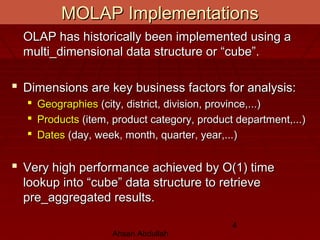
OLAP has historically been implemented using aOLAP has historically been implemented using a
multi_dimensional data structure or “cube”.multi_dimensional data structure or “cube”.
 Dimensions are key business factors for analysis:Dimensions are key business factors for analysis:
 GeographiesGeographies (city, district, division, province,...)(city, district, division, province,...)
 ProductsProducts (item, product category, product department,...)(item, product category, product department,...)
 DatesDates (day, week, month, quarter, year,...)(day, week, month, quarter, year,...)
 Very high performance achieved by O(1) timeVery high performance achieved by O(1) time
lookup into “cube” data structure to retrievelookup into “cube” data structure to retrieve
pre_aggregated results.pre_aggregated results.
Ahsan Abdullah
5
MOLAP ImplementationsMOLAP Implementations
 No standard query language for querying MOLAPNo standard query language for querying MOLAP
- No SQL !No SQL !
 Vendors provide proprietary languages allowingVendors provide proprietary languages allowing
business users to create queries that involve pivots,business users to create queries that involve pivots,
drilling down, or rolling up.drilling down, or rolling up.
- E.g. MDX of MicrosoftE.g. MDX of Microsoft
- Languages generally involve extensive visual (click andLanguages generally involve extensive visual (click and
drag) support.drag) support.
- Application Programming Interface (API)’s also providedApplication Programming Interface (API)’s also provided
for probing the cubes.for probing the cubes.
Ahsan Abdullah
6
Aggregations in MOLAPAggregations in MOLAP
 Sales volume as a function of (i) product, (ii) time,Sales volume as a function of (i) product, (ii) time,
and (iii) geographyand (iii) geography
 A cube structure created to handle this.A cube structure created to handle this.
Dimensions: Product, Geography, Time
Industry
Category
Product
Hierarchical summarization pathsHierarchical summarization paths
Product
G
eog
Time
w1 w2 w3 w4 w5 w6
Milk
Bread
Eggs
Butter
Jam
Juice
N
E
W
S
12
13
45
8
23
10
Province
Division
District
City
Zone
Year
Quarter
Month Week
Day
Ahsan Abdullah
7
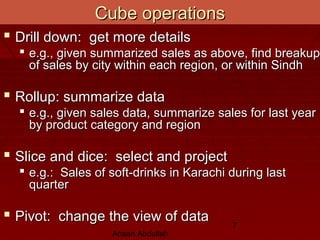
Cube operationsCube operations
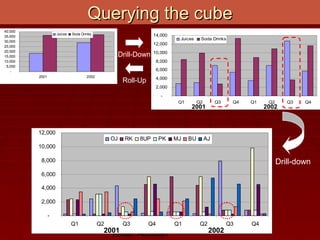
 Drill down: get more detailsDrill down: get more details
 e.g., given summarized sales as above, find breakupe.g., given summarized sales as above, find breakup
of sales by city within each region, or within Sindhof sales by city within each region, or within Sindh
 Rollup: summarize dataRollup: summarize data
 e.g., given sales data, summarize sales for last yeare.g., given sales data, summarize sales for last year
by product category and regionby product category and region
 Slice and dice: select and projectSlice and dice: select and project
 e.g.: Sales of soft-drinks in Karachi during laste.g.: Sales of soft-drinks in Karachi during last
quarterquarter
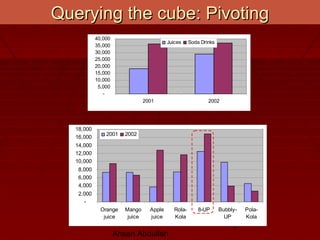
 Pivot: change the view of dataPivot: change the view of data
Ahsan Abdullah
8
Drill-down
-
2,000
4,000
6,000
8,000
10,000
12,000
Q1 Q2 Q3 Q4 Q1 Q2 Q3 Q4
OJ RK 8UP PK MJ BU AJ
2001 2002
Querying the cubeQuerying the cube
-
5,000
10,000
15,000
20,000
25,000
30,000
35,000
40,000
2001 2002
Juices Soda Drinks
-
2,000
4,000
6,000
8,000
10,000
12,000
14,000
Q1 Q2 Q3 Q4 Q1 Q2 Q3 Q4
Juices Soda Drinks
2001 2002
Drill-Down
Roll-Up
Ahsan Abdullah
9
Querying the cube: PivotingQuerying the cube: Pivoting
-
5,000
10,000
15,000
20,000
25,000
30,000
35,000
40,000
2001 2002
Juices Soda Drinks
-
2,000
4,000
6,000
8,000
10,000
12,000
14,000
16,000
18,000
Orange
juice
Mango
juice
Apple
juice
Rola-
Kola
8-UP Bubbly-
UP
Pola-
Kola
2001 2002
Ahsan Abdullah
10
MOLAP evaluationMOLAP evaluation
Advantages of MOLAP:

Instant response (pre-calculated aggregates).

Impossible to ask question without an answer.

Value added functions (ranking, % change).
Ahsan Abdullah
11
MOLAP evaluationMOLAP evaluation
Drawbacks of MOLAP:
 Long load time ( pre-calculating the cube
may take days!).
 Very sparse cube (wastage of space) for
high cardinality (sometimes in small
hundreds). e.g. number of heaters sold in
Jacobabad or Sibi.
Ahsan Abdullah
12
MOLAP Implementation issuesMOLAP Implementation issues
Maintenance issue:Maintenance issue: Every data itemEvery data item
received must be aggregated intoreceived must be aggregated into everyevery cubecube
(assuming “to-date” summaries are(assuming “to-date” summaries are
maintained).maintained). Lot of work.Lot of work.
Storage issue:Storage issue: As dimensions get lessAs dimensions get less
detailed (e.g., year vs. day) cubes get muchdetailed (e.g., year vs. day) cubes get much
smaller, but storage consequences forsmaller, but storage consequences for
building hundreds of cubes can be significant.building hundreds of cubes can be significant.
Lot of space.Lot of space.
Ahsan Abdullah
13
Partitioned CubesPartitioned Cubes
 To overcome the space limitation of MOLAP, the cube isTo overcome the space limitation of MOLAP, the cube is
partitioned.partitioned.
 The divide&conquer cube partitioning approach helpsThe divide&conquer cube partitioning approach helps
alleviate the scalability limitations of MOLAPalleviate the scalability limitations of MOLAP
implementation.implementation.
 One logical cube of data can be spread across multipleOne logical cube of data can be spread across multiple
physical cubes on separate (or same) servers.physical cubes on separate (or same) servers.
 Ideal cube partitioning is completely invisible to endIdeal cube partitioning is completely invisible to end
users.users.
 PerformancePerformance degradation does occursdegradation does occurs in case of a joinin case of a join
across partitioned cubes.across partitioned cubes.
Ahsan Abdullah
14
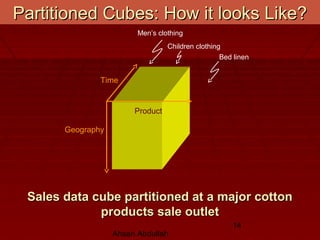
Partitioned Cubes: How it looks Like?Partitioned Cubes: How it looks Like?
Time
Geography
Men’s clothing
Children clothing
Bed linen
Sales data cube partitioned at a major cottonSales data cube partitioned at a major cotton
products sale outletproducts sale outlet
Product
Ahsan Abdullah
15
Virtual CubesVirtual Cubes
Used to query two dissimilar cubes by creating aUsed to query two dissimilar cubes by creating a
third “virtual” cube by a join between two cubes.third “virtual” cube by a join between two cubes.
 Logically similar to a relational view i.e. linking twoLogically similar to a relational view i.e. linking two
(or more) cubes along common dimension(s).(or more) cubes along common dimension(s).
 Biggest advantage is saving in space by eliminatingBiggest advantage is saving in space by eliminating
storage of redundant information.storage of redundant information.
Example:Example: Joining the store cube and the list priceJoining the store cube and the list price
cube along the product dimension, to calculate thecube along the product dimension, to calculate the
sale price without redundant storage of the salesale price without redundant storage of the sale
price data.price data.
Ahsan Abdullah
16
SummarySummary

Lecture 11

  • 1.
    Ahsan AbdullahAhsan Abdullah 11 DataWarehousingData Warehousing Lecture-11Lecture-11 Multidimensional OLAP (MOLAP)Multidimensional OLAP (MOLAP) Virtual University of PakistanVirtual University of Pakistan Ahsan Abdullah Assoc. Prof. & Head Center for Agro-Informatics Research www.nu.edu.pk/cairindex.asp National University of Computers & Emerging Sciences, Islamabad Email: ahsan@cluxing.com
  • 2.
    Ahsan Abdullah 2 Multidimensional OLAP(MOLAP)Multidimensional OLAP (MOLAP)
  • 3.
    Ahsan Abdullah 3 OLAP ImplementationsOLAPImplementations 1.1. MOLAP:MOLAP: OLAP implemented with a multi-OLAP implemented with a multi- dimensional data structure.dimensional data structure. 2.2. ROLAP:ROLAP: OLAP implemented with a relationalOLAP implemented with a relational database.database. 3.3. HOLAP:HOLAP: OLAP implemented as a hybrid ofOLAP implemented as a hybrid of MOLAP and ROLAP.MOLAP and ROLAP. 4.4. DOLAP:DOLAP: OLAP implemented for desktop decisionOLAP implemented for desktop decision support environments.support environments.
  • 4.
    Ahsan Abdullah 4 MOLAP ImplementationsMOLAPImplementations OLAP has historically been implemented using aOLAP has historically been implemented using a multi_dimensional data structure or “cube”.multi_dimensional data structure or “cube”.  Dimensions are key business factors for analysis:Dimensions are key business factors for analysis:  GeographiesGeographies (city, district, division, province,...)(city, district, division, province,...)  ProductsProducts (item, product category, product department,...)(item, product category, product department,...)  DatesDates (day, week, month, quarter, year,...)(day, week, month, quarter, year,...)  Very high performance achieved by O(1) timeVery high performance achieved by O(1) time lookup into “cube” data structure to retrievelookup into “cube” data structure to retrieve pre_aggregated results.pre_aggregated results.
  • 5.
    Ahsan Abdullah 5 MOLAP ImplementationsMOLAPImplementations  No standard query language for querying MOLAPNo standard query language for querying MOLAP - No SQL !No SQL !  Vendors provide proprietary languages allowingVendors provide proprietary languages allowing business users to create queries that involve pivots,business users to create queries that involve pivots, drilling down, or rolling up.drilling down, or rolling up. - E.g. MDX of MicrosoftE.g. MDX of Microsoft - Languages generally involve extensive visual (click andLanguages generally involve extensive visual (click and drag) support.drag) support. - Application Programming Interface (API)’s also providedApplication Programming Interface (API)’s also provided for probing the cubes.for probing the cubes.
  • 6.
    Ahsan Abdullah 6 Aggregations inMOLAPAggregations in MOLAP  Sales volume as a function of (i) product, (ii) time,Sales volume as a function of (i) product, (ii) time, and (iii) geographyand (iii) geography  A cube structure created to handle this.A cube structure created to handle this. Dimensions: Product, Geography, Time Industry Category Product Hierarchical summarization pathsHierarchical summarization paths Product G eog Time w1 w2 w3 w4 w5 w6 Milk Bread Eggs Butter Jam Juice N E W S 12 13 45 8 23 10 Province Division District City Zone Year Quarter Month Week Day
  • 7.
    Ahsan Abdullah 7 Cube operationsCubeoperations  Drill down: get more detailsDrill down: get more details  e.g., given summarized sales as above, find breakupe.g., given summarized sales as above, find breakup of sales by city within each region, or within Sindhof sales by city within each region, or within Sindh  Rollup: summarize dataRollup: summarize data  e.g., given sales data, summarize sales for last yeare.g., given sales data, summarize sales for last year by product category and regionby product category and region  Slice and dice: select and projectSlice and dice: select and project  e.g.: Sales of soft-drinks in Karachi during laste.g.: Sales of soft-drinks in Karachi during last quarterquarter  Pivot: change the view of dataPivot: change the view of data
  • 8.
    Ahsan Abdullah 8 Drill-down - 2,000 4,000 6,000 8,000 10,000 12,000 Q1 Q2Q3 Q4 Q1 Q2 Q3 Q4 OJ RK 8UP PK MJ BU AJ 2001 2002 Querying the cubeQuerying the cube - 5,000 10,000 15,000 20,000 25,000 30,000 35,000 40,000 2001 2002 Juices Soda Drinks - 2,000 4,000 6,000 8,000 10,000 12,000 14,000 Q1 Q2 Q3 Q4 Q1 Q2 Q3 Q4 Juices Soda Drinks 2001 2002 Drill-Down Roll-Up
  • 9.
    Ahsan Abdullah 9 Querying thecube: PivotingQuerying the cube: Pivoting - 5,000 10,000 15,000 20,000 25,000 30,000 35,000 40,000 2001 2002 Juices Soda Drinks - 2,000 4,000 6,000 8,000 10,000 12,000 14,000 16,000 18,000 Orange juice Mango juice Apple juice Rola- Kola 8-UP Bubbly- UP Pola- Kola 2001 2002
  • 10.
    Ahsan Abdullah 10 MOLAP evaluationMOLAPevaluation Advantages of MOLAP:  Instant response (pre-calculated aggregates).  Impossible to ask question without an answer.  Value added functions (ranking, % change).
  • 11.
    Ahsan Abdullah 11 MOLAP evaluationMOLAPevaluation Drawbacks of MOLAP:  Long load time ( pre-calculating the cube may take days!).  Very sparse cube (wastage of space) for high cardinality (sometimes in small hundreds). e.g. number of heaters sold in Jacobabad or Sibi.
  • 12.
    Ahsan Abdullah 12 MOLAP ImplementationissuesMOLAP Implementation issues Maintenance issue:Maintenance issue: Every data itemEvery data item received must be aggregated intoreceived must be aggregated into everyevery cubecube (assuming “to-date” summaries are(assuming “to-date” summaries are maintained).maintained). Lot of work.Lot of work. Storage issue:Storage issue: As dimensions get lessAs dimensions get less detailed (e.g., year vs. day) cubes get muchdetailed (e.g., year vs. day) cubes get much smaller, but storage consequences forsmaller, but storage consequences for building hundreds of cubes can be significant.building hundreds of cubes can be significant. Lot of space.Lot of space.
  • 13.
    Ahsan Abdullah 13 Partitioned CubesPartitionedCubes  To overcome the space limitation of MOLAP, the cube isTo overcome the space limitation of MOLAP, the cube is partitioned.partitioned.  The divide&conquer cube partitioning approach helpsThe divide&conquer cube partitioning approach helps alleviate the scalability limitations of MOLAPalleviate the scalability limitations of MOLAP implementation.implementation.  One logical cube of data can be spread across multipleOne logical cube of data can be spread across multiple physical cubes on separate (or same) servers.physical cubes on separate (or same) servers.  Ideal cube partitioning is completely invisible to endIdeal cube partitioning is completely invisible to end users.users.  PerformancePerformance degradation does occursdegradation does occurs in case of a joinin case of a join across partitioned cubes.across partitioned cubes.
  • 14.
    Ahsan Abdullah 14 Partitioned Cubes:How it looks Like?Partitioned Cubes: How it looks Like? Time Geography Men’s clothing Children clothing Bed linen Sales data cube partitioned at a major cottonSales data cube partitioned at a major cotton products sale outletproducts sale outlet Product
  • 15.
    Ahsan Abdullah 15 Virtual CubesVirtualCubes Used to query two dissimilar cubes by creating aUsed to query two dissimilar cubes by creating a third “virtual” cube by a join between two cubes.third “virtual” cube by a join between two cubes.  Logically similar to a relational view i.e. linking twoLogically similar to a relational view i.e. linking two (or more) cubes along common dimension(s).(or more) cubes along common dimension(s).  Biggest advantage is saving in space by eliminatingBiggest advantage is saving in space by eliminating storage of redundant information.storage of redundant information. Example:Example: Joining the store cube and the list priceJoining the store cube and the list price cube along the product dimension, to calculate thecube along the product dimension, to calculate the sale price without redundant storage of the salesale price without redundant storage of the sale price data.price data.
  • 16.

Editor's Notes

  • #4 <number>
  • #5 <number>
  • #9 <number>
  • #10 <number>
  • #11 <number>
  • #12 <number>
  • #13 <number>
  • #14 <number>
  • #15 <number>
  • #16 <number>