ECE553/653 Neural Networks
Introduction
1
Basic Info
• Meet time: Tuesday/Thursday 2:00 pm – 3:15
pm
• Location: Dooly Memorial 101
• Instructor: Prof. Mingzhe Chen
• Office: Room 413, McArthur Engineering
Building
• Email: mingzhe.chen@miami.edu
• Office hours: Tuesday/Thursday 1:00 pm –
2:00 pm
2
About Me and Lab
• Faculty: Mingzhe Chen
• Research interest:
– Machine learning and artificial intelligence (AI) for
wireless networks,
– Distributed/Federated learning fundamentals,
– Virtual reality over wireless networks,
– Unmanned aerial vehicle over wireless networks,
– Semantic Communications
– Digital Network Twins
3
About Me and Lab
• Current Projects:
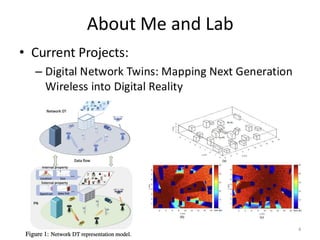
– Digital Network Twins: Mapping Next Generation
Wireless into Digital Reality
4
About Me and Lab
• Current Projects:
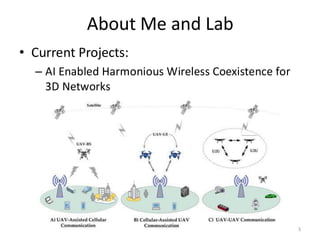
– AI Enabled Harmonious Wireless Coexistence for
3D Networks
5
Basic Info
• Introduce yourself
– Name
– Major
– Why do you select this course?
– What do you want to learn from this course?
6
Textbook and References
• Textbook
– Deep Learning by Ian Goodfellow, Yoshua Bengio,
and Aaron Courville, MIT Press, 2016
– Reinforcement Learning: An Introduction by Sutton
and Barto, MIT Press, 1998
– Machine Learning by Tom Mitchell, McGraw Hill,
1997
– A Course in Machine Learning by Hal Daume III
– Machine Learning Lecture Notes by Andrew Ng
– Machine Learning for Intelligent Systems by Kilian
Weinberger
7
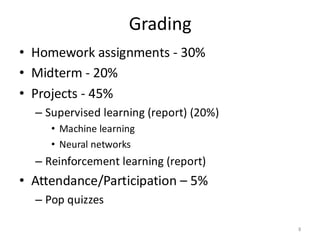
Grading
• Homework assignments - 30%
• Midterm - 20%
• Projects - 45%
– Supervised learning (report) (20%)
• Machine learning
• Neural networks
– Reinforcement learning (report)
• Attendance/Participation – 5%
– Pop quizzes
8
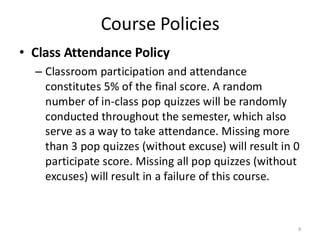
Course Policies
• Class Attendance Policy
– Classroom participation and attendance
constitutes 5% of the final score. A random
number of in-class pop quizzes will be randomly
conducted throughout the semester, which also
serve as a way to take attendance. Missing more
than 3 pop quizzes (without excuse) will result in 0
participate score. Missing all pop quizzes (without
excuses) will result in a failure of this course.
9
Course Policies
• Class Attendance Policy
– If at some point in the semester you cannot
physically attend class sessions due to illness,
injury, quarantine or isolation, or other approved
absence, you must contact the instructor.
Unexcused absences from the classroom may
affect your grade or lead to failing the course.
10
Course Policies
• Academic Ethics
– Academic dishonesty in any form will not be
tolerated. The instructor of this course supports
the University of Miami Honor Code. Cheating,
plagiarism, or other forms of academic dishonesty
in this course is subject to the provisions of the
Honor Code.
11
Course Policies
• Class Recordings
– Students are expressly prohibited from recording any part
of this course. Meetings of this course might be recorded
by the University. Any recordings will be available to
students registered for this class as they are intended to
supplement the classroom experience. Students are
expected to follow appropriate University policies and
maintain the security of passwords used to access
recorded lectures. Recordings may not be reproduced,
shared with those not in the class, or uploaded to other
online environments. If the instructor or a University of
Miami office plans any other uses for the recordings,
beyond this class, students identifiable in the recordings
will be notified to request consent prior to such use.
12
Concepts
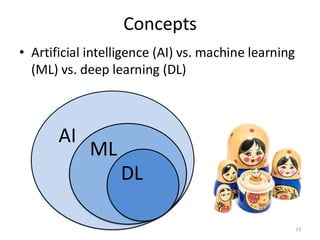
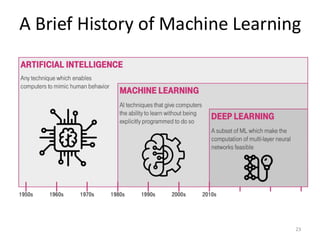
• Artificial intelligence (AI) vs. machine learning
(ML) vs. deep learning (DL)
13
AI
ML
DL
What is Artificial Intelligence ?
• Boring textbook answer
– Intelligence demonstrated by machines –
Wikipedia
• What others say:
– The science and engineering of making computers
behave in ways that, until recently, we thought
required human intelligence. – Andrew Moore,
CMU
14
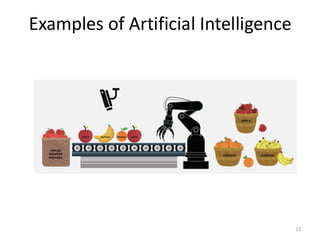
Examples of Artificial Intelligence
15
Examples of Artificial Intelligence
16
Problem Rules Code
Problem
Find a maximum
number
Rules
Sort the number
Code
[1,3,5,4,2] [1,2,3,4,5]
• Programming
Why We Need ML?
17
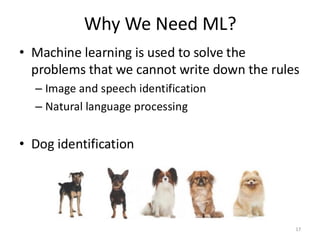
• Machine learning is used to solve the
problems that we cannot write down the rules
– Image and speech identification
– Natural language processing
• Dog identification
What is Machine Learning?
• A favorite
Study of algorithms that improve their performance
at some task with experience
– Tom Mitchell, CMU
18
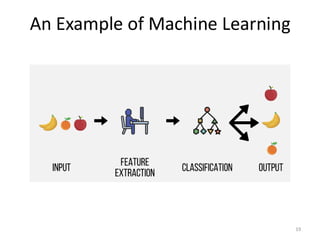
An Example of Machine Learning
19
What is Deep Learning?
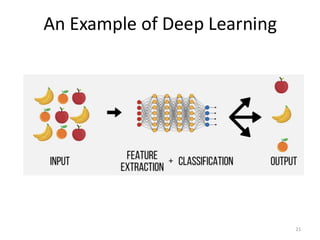
• DL is a newer area of ML
– DL uses multi-layered artificial neural networks to
deliver high accuracy in tasks such as object
detection, speech recognition, language
translation
• The strength of DL
– DL can automatically learn, extract or translate the
features from datasets such as images, video or
text, without needing traditional hand-coded code
or rules
20
An Example of Deep Learning
21
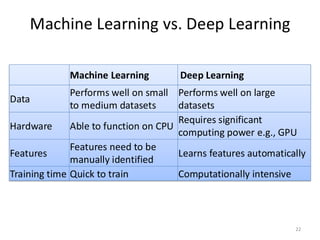
Machine Learning vs. Deep Learning
22
Machine Learning Deep Learning
Data
Performs well on small
to medium datasets
Performs well on large
datasets
Hardware Able to function on CPU
Requires significant
computing power e.g., GPU
Features
Features need to be
manually identified
Learns features automatically
Training time Quick to train Computationally intensive
A Brief History of Machine Learning
23
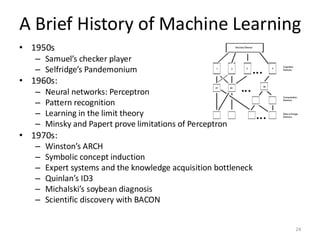
A Brief History of Machine Learning
24
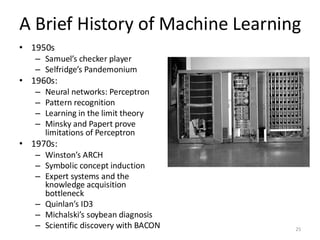
• 1950s
– Samuel’s checker player
– Selfridge’s Pandemonium
• 1960s:
– Neural networks: Perceptron
– Pattern recognition
– Learning in the limit theory
– Minsky and Papert prove limitations of Perceptron
• 1970s:
– Winston’s ARCH
– Symbolic concept induction
– Expert systems and the knowledge acquisition bottleneck
– Quinlan’s ID3
– Michalski’s soybean diagnosis
– Scientific discovery with BACON
A Brief History of Machine Learning
25
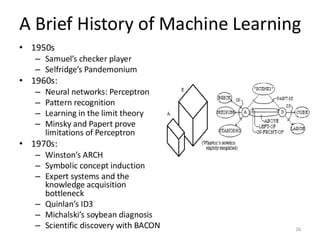
• 1950s
– Samuel’s checker player
– Selfridge’s Pandemonium
• 1960s:
– Neural networks: Perceptron
– Pattern recognition
– Learning in the limit theory
– Minsky and Papert prove
limitations of Perceptron
• 1970s:
– Winston’s ARCH
– Symbolic concept induction
– Expert systems and the
knowledge acquisition
bottleneck
– Quinlan’s ID3
– Michalski’s soybean diagnosis
– Scientific discovery with BACON
A Brief History of Machine Learning
26
• 1950s
– Samuel’s checker player
– Selfridge’s Pandemonium
• 1960s:
– Neural networks: Perceptron
– Pattern recognition
– Learning in the limit theory
– Minsky and Papert prove
limitations of Perceptron
• 1970s:
– Winston’s ARCH
– Symbolic concept induction
– Expert systems and the
knowledge acquisition
bottleneck
– Quinlan’s ID3
– Michalski’s soybean diagnosis
– Scientific discovery with BACON
A Brief History of Machine Learning
27
• 1980s:
– Advanced decision tree and rule learning
– Explanation-based Learning (EBL)
– Learning and planning and problem solving
– Utility problem
– Analogy
– Cognitive architectures
– Resurgence of neural networks (connectionism, backpropagation)
– Valiant’s PAC learning theory
– Focus on experimental methodology
• 1990s:
– Data mining
– Adaptive software agents and web applications
– Text learning
– Reinforcement learning (RL)
– Inductive logic programming (ILP)
– Ensembles: bagging, boosting, and stacking
– Bayes net learning
A Brief History of Machine Learning
28
• 2000s:
– Support vector machines & kernel methods
– Graphical models
– Statistical relational learning
– Transfer learning
– Sequence labeling
– Collective classification and structured outputs
– Computer Systems Applications (Compilers, Debugging, Graphics, Security)
– E-mail management
– Learning in robotics and vision
• 2010s:
– Deep learning systems
– Learning for big data
– Bayesian methods
– Multi-task & lifelong learning
– Applications to vision, speech, social networks, learning to read, etc.
– ???
Neural Networks are taking over!
29
• Neural networks have become one of the
major thrust areas recently in various pattern
recognition, prediction, and analysis problems
• In many problems they have established the
state of the art
– Often exceeding previous benchmarks by large
margins
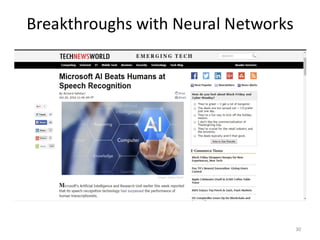
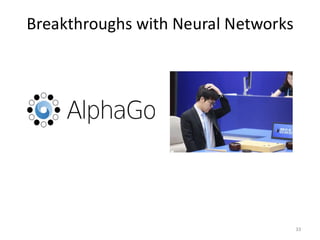
Breakthroughs with Neural Networks
30
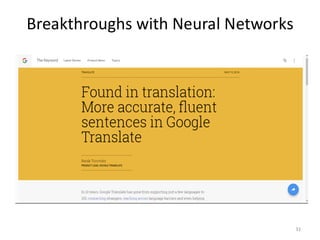
Breakthroughs with Neural Networks
31
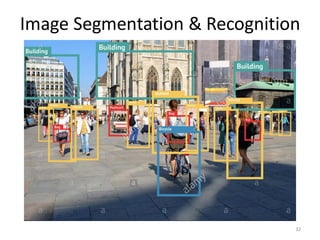
Image Segmentation & Recognition
32
Breakthroughs with Neural Networks
33
Breakthroughs with Neural Networks
34
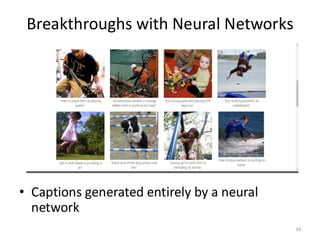
• Captions generated entirely by a neural
network
Breakthroughs with Neural Networks
35
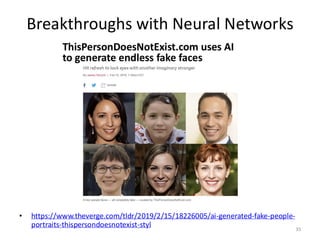
• https://www.theverge.com/tldr/2019/2/15/18226005/ai-generated-fake-people-
portraits-thispersondoesnotexist-styl
What We Will Cover in this Course?
36
• Supervised learning
– Linear regression
– Logistic regression
– Model ensembles
– K-nearest neighbor and decision tree
• Unsupervised learning
– Clustering and K-means
• Reinforcement learning
– Temporal difference learning
– Q learning
– Deep reinforcement learning
– Multi-agent reinforcement learning
What We Will Cover in this Course?
37
• Neural Networks
– Perceptron
– Feedforward neural networks
– Convolutional neural networks
• LeNet-5, AlexNet, ZFNet, VGGNet, ResNet
– Recurrent neural networks
• LSTM, GRU, ESNs
– Graph neural networks
– Generative models
• VAE, GAN
• Advanced deep learning
– federated learning, meta learning, transformer
What is This Class About?
38
• Introduction to machine learning and neural
networks
• Goal:
– After finishing this class, you should be ready to
get started on your first deep learning research
project.
– Programing!
What This Class is NOT?
39
• NOT the target audience:
– People looking to understand latest and greatest
cutting-edge research (e.g., ChatGPT, etc)
• Not the goal:
– Teaching a toolkit. “Intro to TensorFlow/PyTorch”

Lecture 1 neural network covers the basic

  • 1.
  • 2.
    Basic Info • Meettime: Tuesday/Thursday 2:00 pm – 3:15 pm • Location: Dooly Memorial 101 • Instructor: Prof. Mingzhe Chen • Office: Room 413, McArthur Engineering Building • Email: mingzhe.chen@miami.edu • Office hours: Tuesday/Thursday 1:00 pm – 2:00 pm 2
  • 3.
    About Me andLab • Faculty: Mingzhe Chen • Research interest: – Machine learning and artificial intelligence (AI) for wireless networks, – Distributed/Federated learning fundamentals, – Virtual reality over wireless networks, – Unmanned aerial vehicle over wireless networks, – Semantic Communications – Digital Network Twins 3
  • 4.
    About Me andLab • Current Projects: – Digital Network Twins: Mapping Next Generation Wireless into Digital Reality 4
  • 5.
    About Me andLab • Current Projects: – AI Enabled Harmonious Wireless Coexistence for 3D Networks 5
  • 6.
    Basic Info • Introduceyourself – Name – Major – Why do you select this course? – What do you want to learn from this course? 6
  • 7.
    Textbook and References •Textbook – Deep Learning by Ian Goodfellow, Yoshua Bengio, and Aaron Courville, MIT Press, 2016 – Reinforcement Learning: An Introduction by Sutton and Barto, MIT Press, 1998 – Machine Learning by Tom Mitchell, McGraw Hill, 1997 – A Course in Machine Learning by Hal Daume III – Machine Learning Lecture Notes by Andrew Ng – Machine Learning for Intelligent Systems by Kilian Weinberger 7
  • 8.
    Grading • Homework assignments- 30% • Midterm - 20% • Projects - 45% – Supervised learning (report) (20%) • Machine learning • Neural networks – Reinforcement learning (report) • Attendance/Participation – 5% – Pop quizzes 8
  • 9.
    Course Policies • ClassAttendance Policy – Classroom participation and attendance constitutes 5% of the final score. A random number of in-class pop quizzes will be randomly conducted throughout the semester, which also serve as a way to take attendance. Missing more than 3 pop quizzes (without excuse) will result in 0 participate score. Missing all pop quizzes (without excuses) will result in a failure of this course. 9
  • 10.
    Course Policies • ClassAttendance Policy – If at some point in the semester you cannot physically attend class sessions due to illness, injury, quarantine or isolation, or other approved absence, you must contact the instructor. Unexcused absences from the classroom may affect your grade or lead to failing the course. 10
  • 11.
    Course Policies • AcademicEthics – Academic dishonesty in any form will not be tolerated. The instructor of this course supports the University of Miami Honor Code. Cheating, plagiarism, or other forms of academic dishonesty in this course is subject to the provisions of the Honor Code. 11
  • 12.
    Course Policies • ClassRecordings – Students are expressly prohibited from recording any part of this course. Meetings of this course might be recorded by the University. Any recordings will be available to students registered for this class as they are intended to supplement the classroom experience. Students are expected to follow appropriate University policies and maintain the security of passwords used to access recorded lectures. Recordings may not be reproduced, shared with those not in the class, or uploaded to other online environments. If the instructor or a University of Miami office plans any other uses for the recordings, beyond this class, students identifiable in the recordings will be notified to request consent prior to such use. 12
  • 13.
    Concepts • Artificial intelligence(AI) vs. machine learning (ML) vs. deep learning (DL) 13 AI ML DL
  • 14.
    What is ArtificialIntelligence ? • Boring textbook answer – Intelligence demonstrated by machines – Wikipedia • What others say: – The science and engineering of making computers behave in ways that, until recently, we thought required human intelligence. – Andrew Moore, CMU 14
  • 15.
    Examples of ArtificialIntelligence 15
  • 16.
    Examples of ArtificialIntelligence 16 Problem Rules Code Problem Find a maximum number Rules Sort the number Code [1,3,5,4,2] [1,2,3,4,5] • Programming
  • 17.
    Why We NeedML? 17 • Machine learning is used to solve the problems that we cannot write down the rules – Image and speech identification – Natural language processing • Dog identification
  • 18.
    What is MachineLearning? • A favorite Study of algorithms that improve their performance at some task with experience – Tom Mitchell, CMU 18
  • 19.
    An Example ofMachine Learning 19
  • 20.
    What is DeepLearning? • DL is a newer area of ML – DL uses multi-layered artificial neural networks to deliver high accuracy in tasks such as object detection, speech recognition, language translation • The strength of DL – DL can automatically learn, extract or translate the features from datasets such as images, video or text, without needing traditional hand-coded code or rules 20
  • 21.
    An Example ofDeep Learning 21
  • 22.
    Machine Learning vs.Deep Learning 22 Machine Learning Deep Learning Data Performs well on small to medium datasets Performs well on large datasets Hardware Able to function on CPU Requires significant computing power e.g., GPU Features Features need to be manually identified Learns features automatically Training time Quick to train Computationally intensive
  • 23.
    A Brief Historyof Machine Learning 23
  • 24.
    A Brief Historyof Machine Learning 24 • 1950s – Samuel’s checker player – Selfridge’s Pandemonium • 1960s: – Neural networks: Perceptron – Pattern recognition – Learning in the limit theory – Minsky and Papert prove limitations of Perceptron • 1970s: – Winston’s ARCH – Symbolic concept induction – Expert systems and the knowledge acquisition bottleneck – Quinlan’s ID3 – Michalski’s soybean diagnosis – Scientific discovery with BACON
  • 25.
    A Brief Historyof Machine Learning 25 • 1950s – Samuel’s checker player – Selfridge’s Pandemonium • 1960s: – Neural networks: Perceptron – Pattern recognition – Learning in the limit theory – Minsky and Papert prove limitations of Perceptron • 1970s: – Winston’s ARCH – Symbolic concept induction – Expert systems and the knowledge acquisition bottleneck – Quinlan’s ID3 – Michalski’s soybean diagnosis – Scientific discovery with BACON
  • 26.
    A Brief Historyof Machine Learning 26 • 1950s – Samuel’s checker player – Selfridge’s Pandemonium • 1960s: – Neural networks: Perceptron – Pattern recognition – Learning in the limit theory – Minsky and Papert prove limitations of Perceptron • 1970s: – Winston’s ARCH – Symbolic concept induction – Expert systems and the knowledge acquisition bottleneck – Quinlan’s ID3 – Michalski’s soybean diagnosis – Scientific discovery with BACON
  • 27.
    A Brief Historyof Machine Learning 27 • 1980s: – Advanced decision tree and rule learning – Explanation-based Learning (EBL) – Learning and planning and problem solving – Utility problem – Analogy – Cognitive architectures – Resurgence of neural networks (connectionism, backpropagation) – Valiant’s PAC learning theory – Focus on experimental methodology • 1990s: – Data mining – Adaptive software agents and web applications – Text learning – Reinforcement learning (RL) – Inductive logic programming (ILP) – Ensembles: bagging, boosting, and stacking – Bayes net learning
  • 28.
    A Brief Historyof Machine Learning 28 • 2000s: – Support vector machines & kernel methods – Graphical models – Statistical relational learning – Transfer learning – Sequence labeling – Collective classification and structured outputs – Computer Systems Applications (Compilers, Debugging, Graphics, Security) – E-mail management – Learning in robotics and vision • 2010s: – Deep learning systems – Learning for big data – Bayesian methods – Multi-task & lifelong learning – Applications to vision, speech, social networks, learning to read, etc. – ???
  • 29.
    Neural Networks aretaking over! 29 • Neural networks have become one of the major thrust areas recently in various pattern recognition, prediction, and analysis problems • In many problems they have established the state of the art – Often exceeding previous benchmarks by large margins
  • 30.
  • 31.
  • 32.
    Image Segmentation &Recognition 32
  • 33.
  • 34.
    Breakthroughs with NeuralNetworks 34 • Captions generated entirely by a neural network
  • 35.
    Breakthroughs with NeuralNetworks 35 • https://www.theverge.com/tldr/2019/2/15/18226005/ai-generated-fake-people- portraits-thispersondoesnotexist-styl
  • 36.
    What We WillCover in this Course? 36 • Supervised learning – Linear regression – Logistic regression – Model ensembles – K-nearest neighbor and decision tree • Unsupervised learning – Clustering and K-means • Reinforcement learning – Temporal difference learning – Q learning – Deep reinforcement learning – Multi-agent reinforcement learning
  • 37.
    What We WillCover in this Course? 37 • Neural Networks – Perceptron – Feedforward neural networks – Convolutional neural networks • LeNet-5, AlexNet, ZFNet, VGGNet, ResNet – Recurrent neural networks • LSTM, GRU, ESNs – Graph neural networks – Generative models • VAE, GAN • Advanced deep learning – federated learning, meta learning, transformer
  • 38.
    What is ThisClass About? 38 • Introduction to machine learning and neural networks • Goal: – After finishing this class, you should be ready to get started on your first deep learning research project. – Programing!
  • 39.
    What This Classis NOT? 39 • NOT the target audience: – People looking to understand latest and greatest cutting-edge research (e.g., ChatGPT, etc) • Not the goal: – Teaching a toolkit. “Intro to TensorFlow/PyTorch”