1

Louis Wischnewsky

Prof. G. Smith

English 102

December 7, 2011

                                  E e. Cummings: Clamored Order

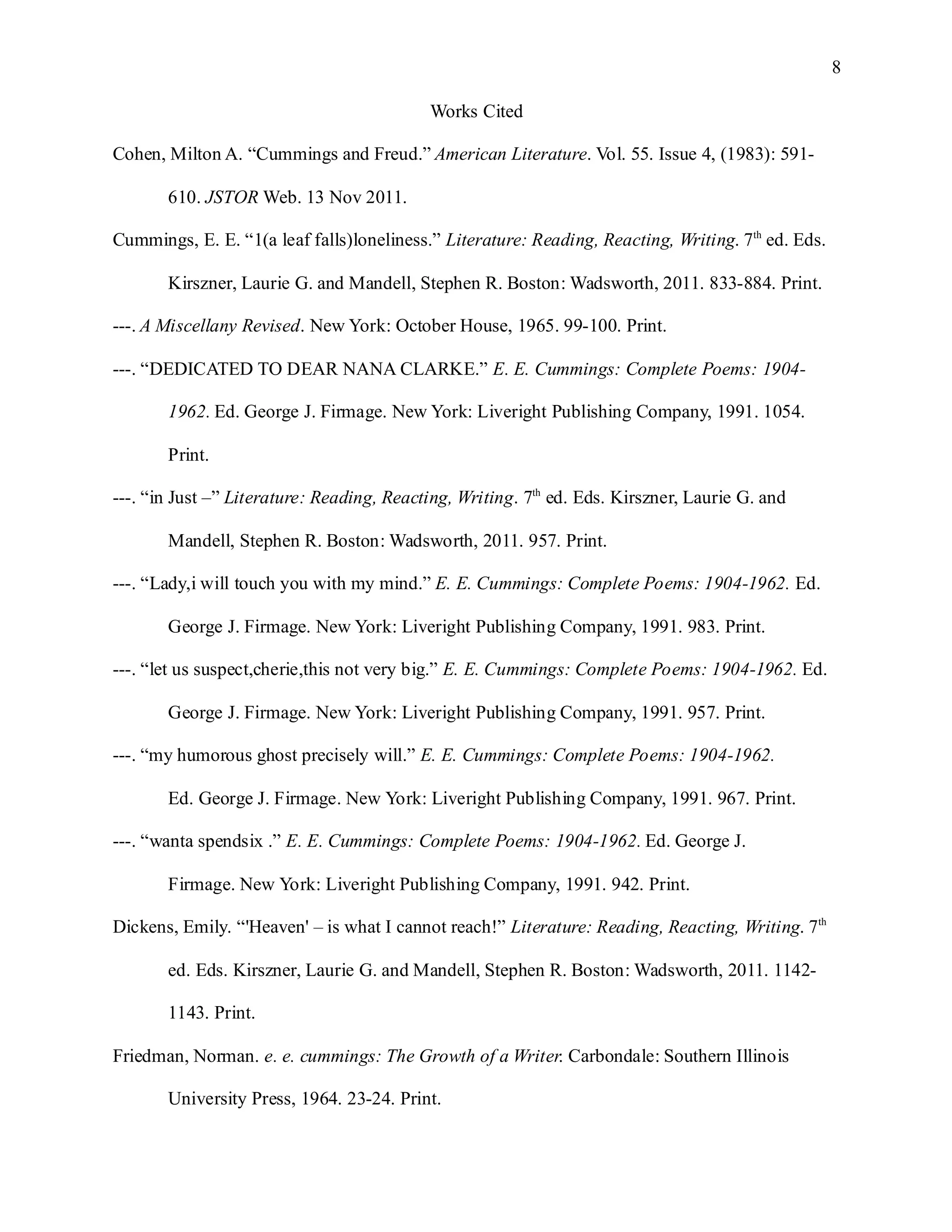
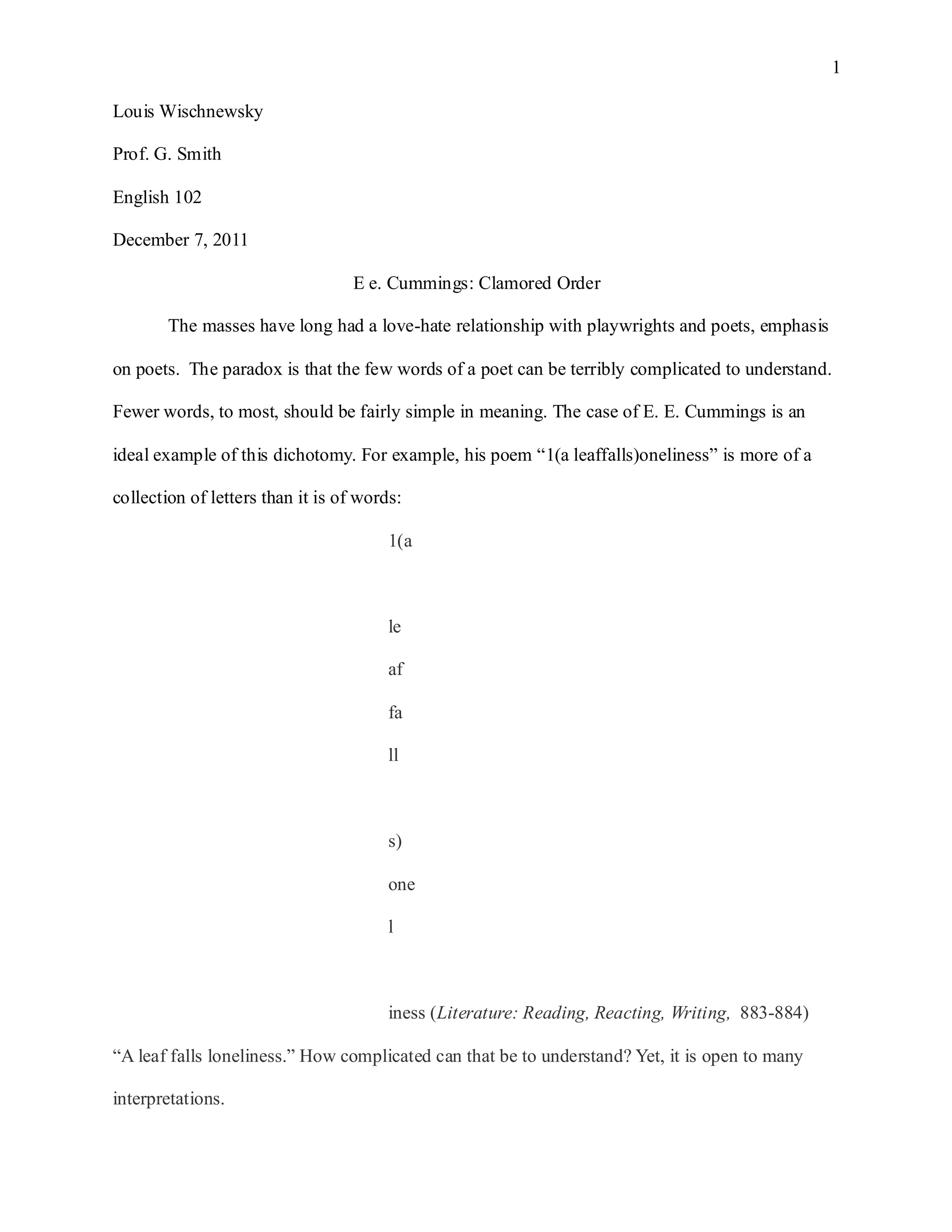
        The masses have long had a love-hate relationship with playwrights and poets, emphasis

on poets. The paradox is that the few words of a poet can be terribly complicated to understand.

Fewer words, to most, should be fairly simple in meaning. The case of E. E. Cummings is an

ideal example of this dichotomy. For example, his poem “1(a leaffalls)oneliness” is more of a

collection of letters than it is of words:

                                        1(a


                                        le

                                        af

                                        fa

                                        ll


                                        s)

                                        one

                                        l


                                        iness (Literature: Reading, Reacting, Writing, 883-884)

“A leaf falls loneliness.” How complicated can that be to understand? Yet, it is open to many

interpretations.
2

       Complicated or not, Cummings certainly had a significant impact upon literature,

particularly poetry. He brought an entirely new concept to visual poetry. In doing so, he

accomplished what some noteworthy predecessors were unable to do: force the reader to engage

the poem as if he were the speaker himself. Mimicking Cummings, it is hard to garner the same

esteem because it is easy to miss Cummings' point: it is not what you read, but how you say it.

Sadly, though, his powerful way of affecting the visual arrangement of words is mostly what

Cummings is famous for, even though that is just a small part of his overall plethora of literature.

These aspects of the poet bring out two different things to consider when trying to know what

influenced Cummings. Already mentioned is the inspiration for why he created a new form of

visual poetry. What, though, influenced his actual subjects? Four different periods or events in

his life answer that question.

       Looking pre-Cummings, yes, “concrete” or visual (also called emblem poetry) – poems

whose words are arranged in shapes – had been around for a long time (Kirszner and Mandel,

801,1007-1008). For example, long before Cummings, George Herbert created a visual poem

with “Easter Wings” (1008). “Randomly arranged words,” however, are a distinctive Cummings

trademark (see poem in opening paragraph). Herbert's poem was revolutionary in that it created a

visual image. It did not, however, cause the reader to think with varied emotion or even varied

pace. Poems like Cummings' “a leaf [...]”, though, does something totally different: it forces the

reader to pause, to second guess what is being read. Is the first character an “L” or a “one?” Who

knows? And that is the point of the poem: to demonstrate to the reader that everyone knows they

are an individual, but what is an individual? Starting and stopping, reflecting on whether the

reader has interpreted what is written, what is history, the poem is a reflection of life: successes

sometimes, failures others. “Easter Egg” questions faith and admits sin while hoping for God's

mercy, but it requires the reader to put himself or herself into the emotion; it requires the reader
3

relate to the speaker. Cummings' poem requires the reader be the speaker, accomplishing the goal

whether the reader wants it to happen or not.

       Punctuation is probably an even larger signature of Cummings. Yet, again, Cummings

was not the first to attempt using punctuation to affect what is being read in the poem. Emily

Dickinson appears to have worked hard at the same goal. Look at how she used hyphens in

“'Heaven' – is what I cannot reach!” to force certain emotions within the reader:

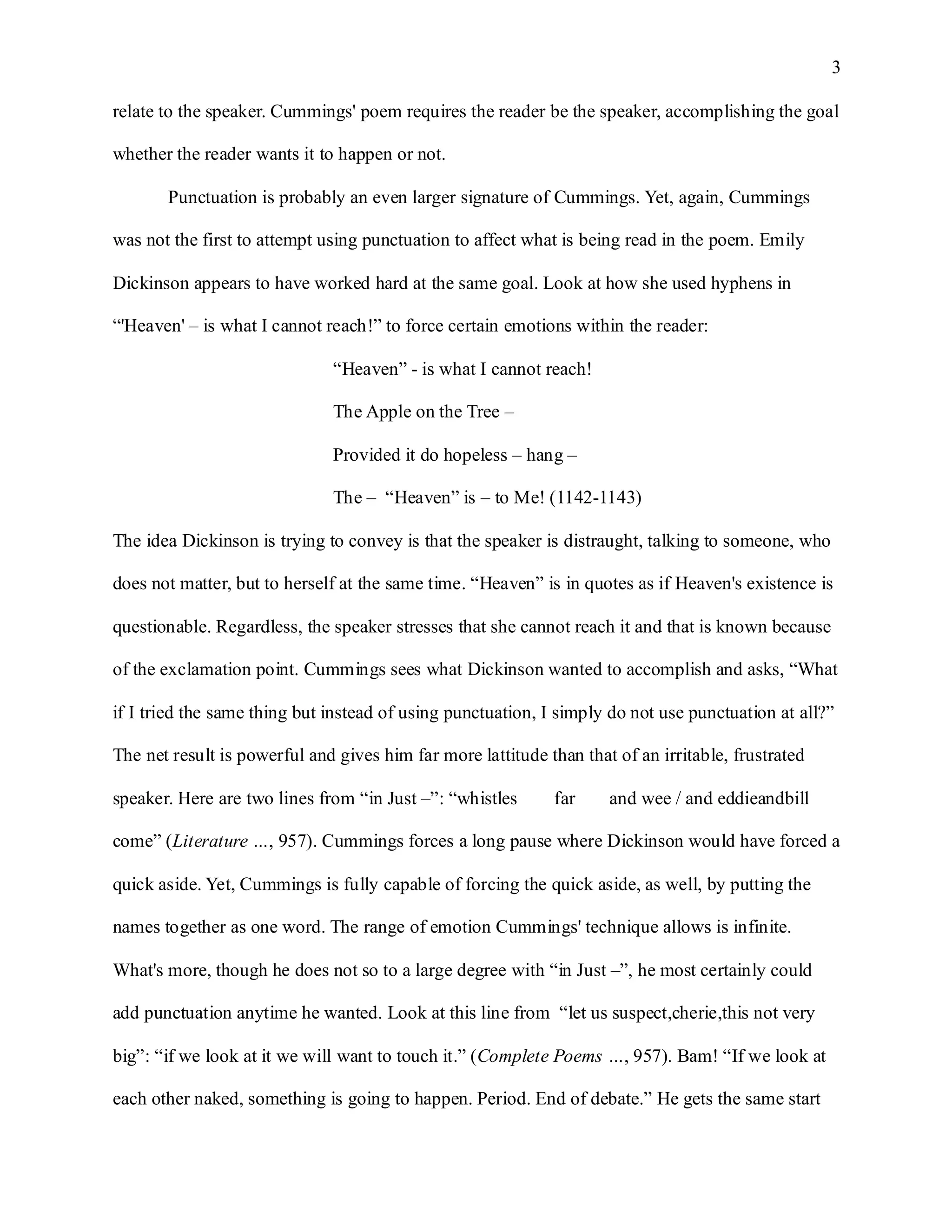
                              “Heaven” - is what I cannot reach!

                              The Apple on the Tree –

                              Provided it do hopeless – hang –

                              The – “Heaven” is – to Me! (1142-1143)

The idea Dickinson is trying to convey is that the speaker is distraught, talking to someone, who

does not matter, but to herself at the same time. “Heaven” is in quotes as if Heaven's existence is

questionable. Regardless, the speaker stresses that she cannot reach it and that is known because

of the exclamation point. Cummings sees what Dickinson wanted to accomplish and asks, “What

if I tried the same thing but instead of using punctuation, I simply do not use punctuation at all?”

The net result is powerful and gives him far more lattitude than that of an irritable, frustrated

speaker. Here are two lines from “in Just –”: “whistles      far     and wee / and eddieandbill

come” (Literature …, 957). Cummings forces a long pause where Dickinson would have forced a

quick aside. Yet, Cummings is fully capable of forcing the quick aside, as well, by putting the

names together as one word. The range of emotion Cummings' technique allows is infinite.

What's more, though he does not so to a large degree with “in Just –”, he most certainly could

add punctuation anytime he wanted. Look at this line from “let us suspect,cherie,this not very

big”: “if we look at it we will want to touch it.” (Complete Poems …, 957). Bam! “If we look at

each other naked, something is going to happen. Period. End of debate.” He gets the same start
4

and sudden stop to the thought Dickinson was forcing in her poem, but Cummings can have the

speaker linger in thought (“whistles far      and wee”) and, yet, says much without saying

anything at all (“if we look at it we will want to touch it.”). Dickinson's technique could not.

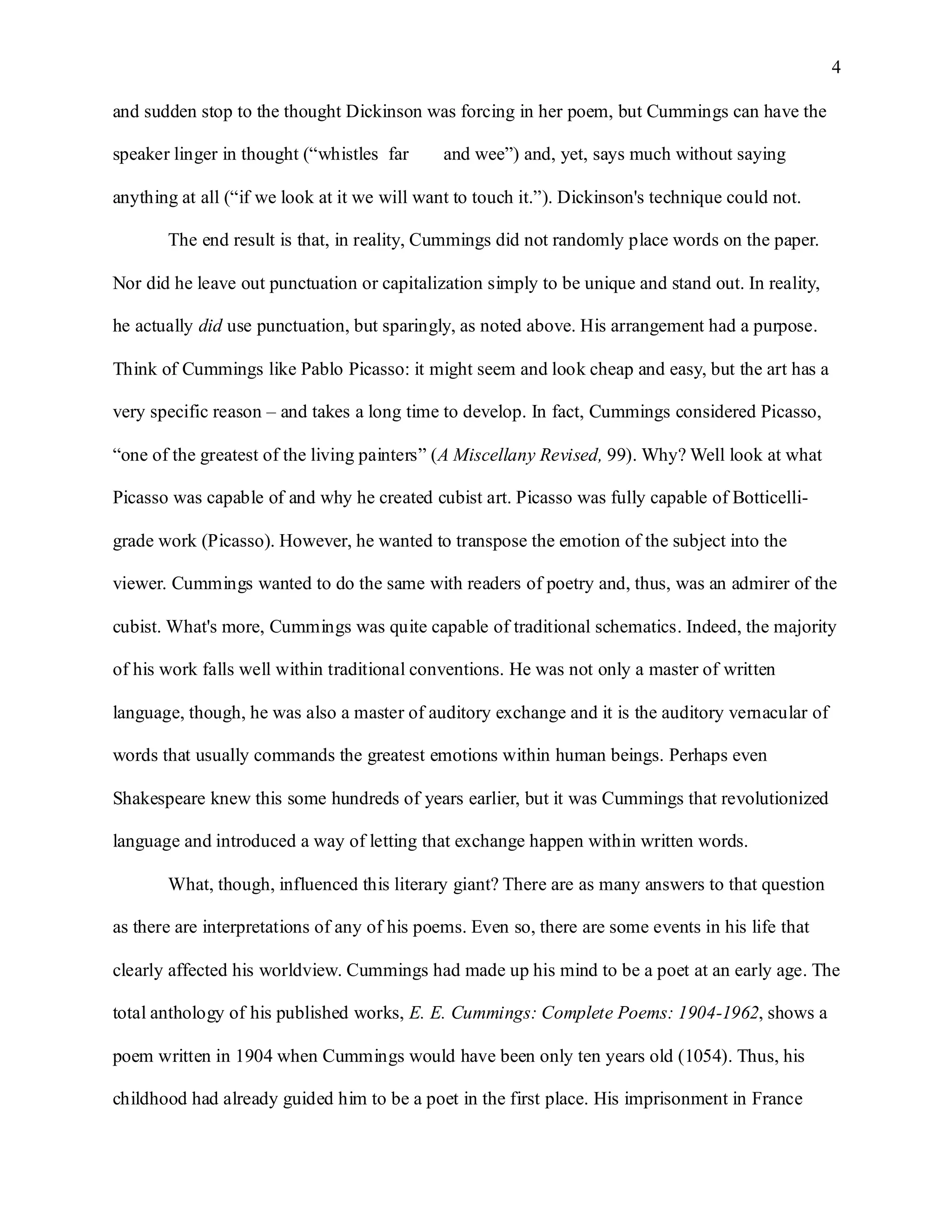
       The end result is that, in reality, Cummings did not randomly place words on the paper.

Nor did he leave out punctuation or capitalization simply to be unique and stand out. In reality,

he actually did use punctuation, but sparingly, as noted above. His arrangement had a purpose.

Think of Cummings like Pablo Picasso: it might seem and look cheap and easy, but the art has a

very specific reason – and takes a long time to develop. In fact, Cummings considered Picasso,

“one of the greatest of the living painters” (A Miscellany Revised, 99). Why? Well look at what

Picasso was capable of and why he created cubist art. Picasso was fully capable of Botticelli-

grade work (Picasso). However, he wanted to transpose the emotion of the subject into the

viewer. Cummings wanted to do the same with readers of poetry and, thus, was an admirer of the

cubist. What's more, Cummings was quite capable of traditional schematics. Indeed, the majority

of his work falls well within traditional conventions. He was not only a master of written

language, though, he was also a master of auditory exchange and it is the auditory vernacular of

words that usually commands the greatest emotions within human beings. Perhaps even

Shakespeare knew this some hundreds of years earlier, but it was Cummings that revolutionized

language and introduced a way of letting that exchange happen within written words.

       What, though, influenced this literary giant? There are as many answers to that question

as there are interpretations of any of his poems. Even so, there are some events in his life that

clearly affected his worldview. Cummings had made up his mind to be a poet at an early age. The

total anthology of his published works, E. E. Cummings: Complete Poems: 1904-1962, shows a

poem written in 1904 when Cummings would have been only ten years old (1054). Thus, his

childhood had already guided him to be a poet in the first place. His imprisonment in France
5

after the first world war was an influence, as well, motivating him to write “[in] a rather clumsy

and inadequate way” - but not so much in his poetry; The Enormous Room, is the reflection upon

that internment (Friedman, 23-24). As Eleanor Sickels explained, like many liberal bohemians of

the day, Cummings was initially interested in the ideal of egalitarian communism (229-232).

However, the Russian, or anti-Russian, influence was well after his most famous subject,

eroticism, had become his forte and made him a, in true Cummings fashion, reluctantly eager

capitalist (229-236). So while Cummings' adventures across the pond were influential, they were

hardly foundations of his motivations.

       Rather, according to Milton A. Cohen, Cummings had a profound affinity toward Freud

and his theories. Freudian influence on the poet is largely unknown, particularly Cummings'

poetry from the late 1910s and early 1920s (592). In fact, a claim that Freudian influence upon

Cummings during that period is profound would be dead on. To begin with, Cummings was

unique among bohemian Modernists in that he not only accepted Freudian theory, Cummings

actually incorporated, or attempted to, into his life (591).

       The evidence is blatant: not only do Cummings' works from that period have a greater

frequency, and more intense elicit references than other periods of his life, there was the Elaine

Orr affair that only amplified his misconception of what Freud was saying. Cummings figured,

with his own interpretation of Freud, that Orr's pregnancy was her problem, not his. His reaction,

denial that he sired the child, reflects more of a lack of initial self-confidence in the theory. Here

was Scofield Thayer, the poet's college mentor, introducing and promoting Freudian philosophy

on Cummings' young mind but when “Jack Death” came knocking, suddenly Thayer is not a

Freudian practitioner (592, 594-595). Neither was Orr, whom Cummings surely thought was a

Freud disciple, as well.

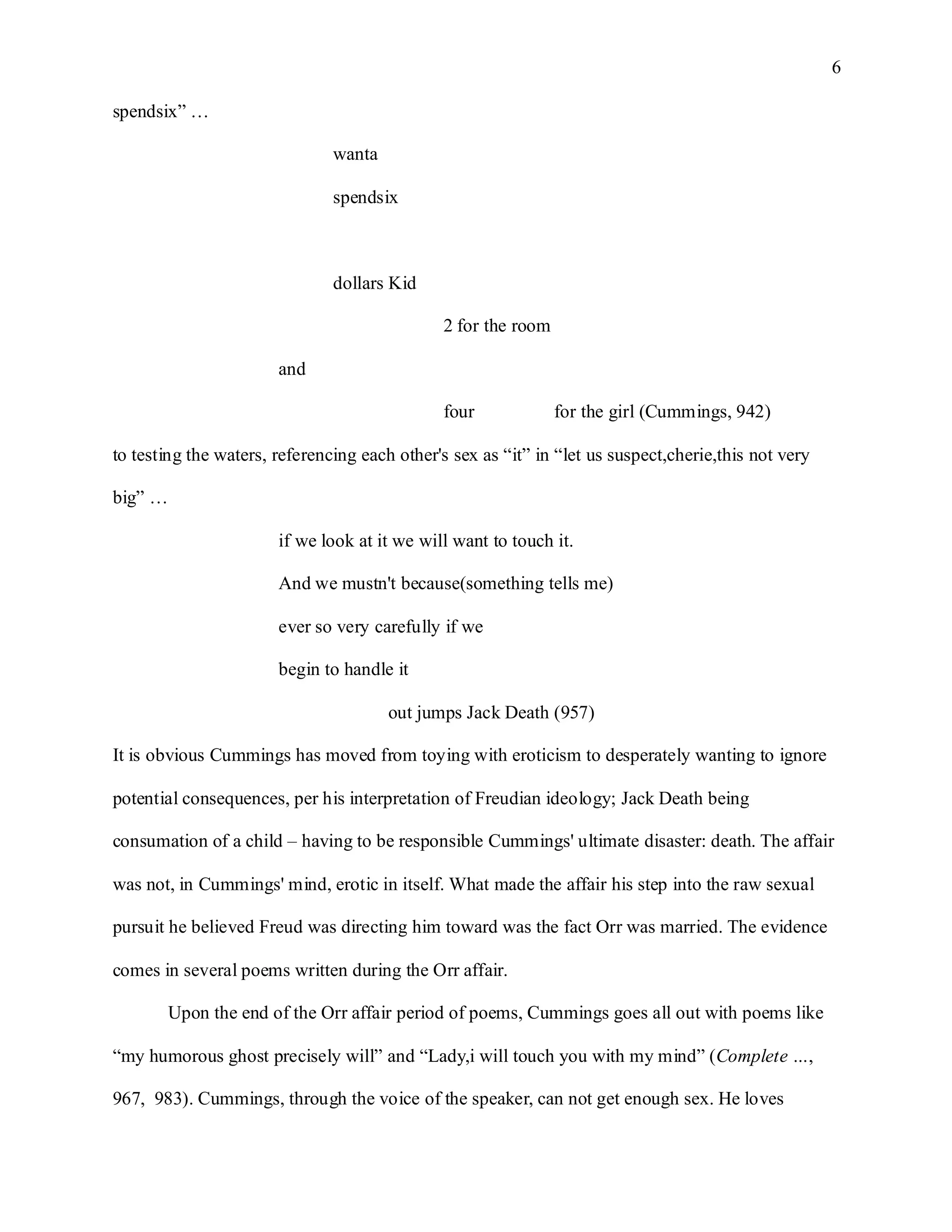
       The end result is a transition from obvious suggestion, prior to the affair, in “wanta
6

spendsix” …

                               wanta

                               spendsix


                               dollars Kid

                                              2 for the room

                       and

                                              four             for the girl (Cummings, 942)

to testing the waters, referencing each other's sex as “it” in “let us suspect,cherie,this not very

big” …

                       if we look at it we will want to touch it.

                       And we mustn't because(something tells me)

                       ever so very carefully if we

                       begin to handle it

                                       out jumps Jack Death (957)

It is obvious Cummings has moved from toying with eroticism to desperately wanting to ignore

potential consequences, per his interpretation of Freudian ideology; Jack Death being

consumation of a child – having to be responsible Cummings' ultimate disaster: death. The affair

was not, in Cummings' mind, erotic in itself. What made the affair his step into the raw sexual

pursuit he believed Freud was directing him toward was the fact Orr was married. The evidence

comes in several poems written during the Orr affair.

       Upon the end of the Orr affair period of poems, Cummings goes all out with poems like

“my humorous ghost precisely will” and “Lady,i will touch you with my mind” (Complete …,

967, 983). Cummings, through the voice of the speaker, can not get enough sex. He loves
7

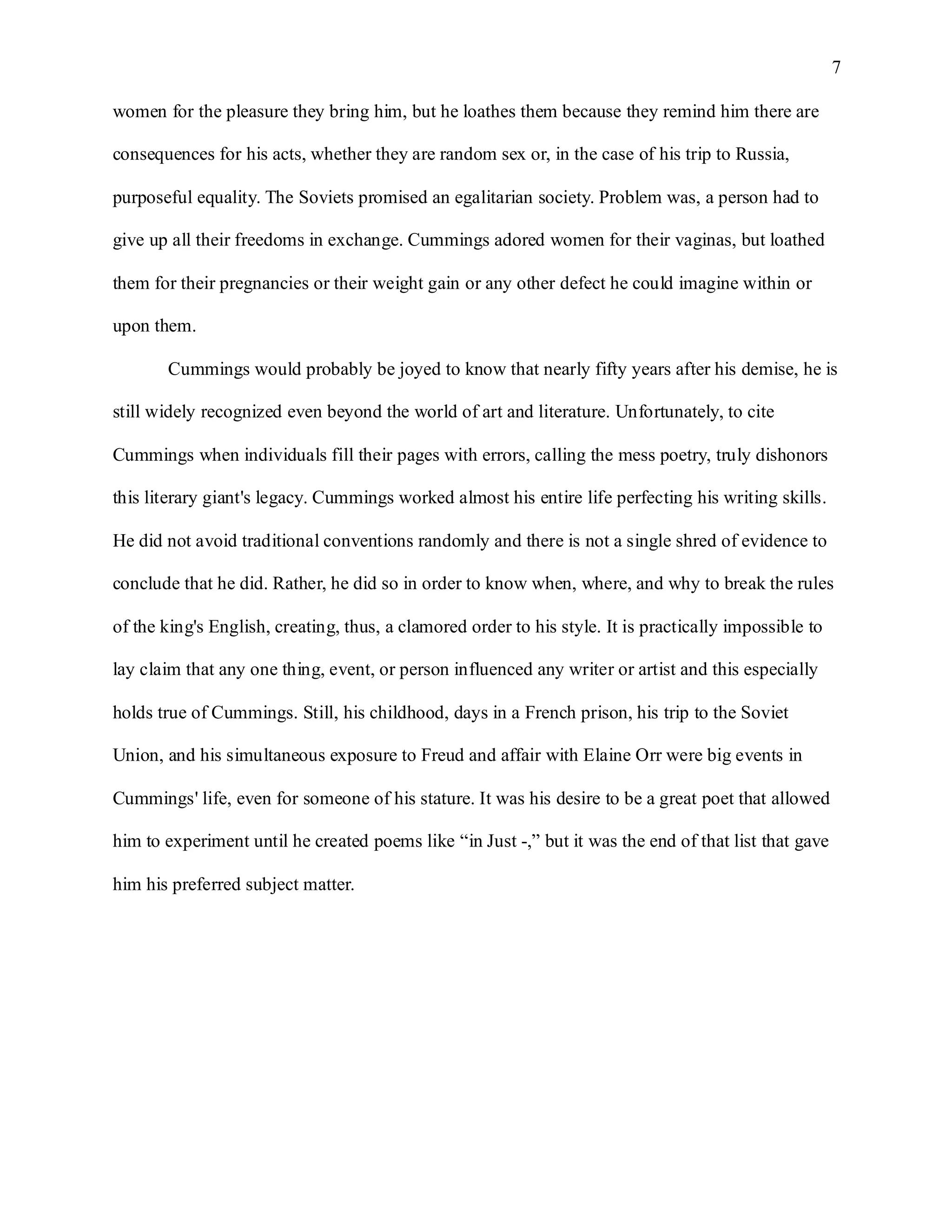
women for the pleasure they bring him, but he loathes them because they remind him there are

consequences for his acts, whether they are random sex or, in the case of his trip to Russia,

purposeful equality. The Soviets promised an egalitarian society. Problem was, a person had to

give up all their freedoms in exchange. Cummings adored women for their vaginas, but loathed

them for their pregnancies or their weight gain or any other defect he could imagine within or

upon them.

       Cummings would probably be joyed to know that nearly fifty years after his demise, he is

still widely recognized even beyond the world of art and literature. Unfortunately, to cite

Cummings when individuals fill their pages with errors, calling the mess poetry, truly dishonors

this literary giant's legacy. Cummings worked almost his entire life perfecting his writing skills.

He did not avoid traditional conventions randomly and there is not a single shred of evidence to

conclude that he did. Rather, he did so in order to know when, where, and why to break the rules

of the king's English, creating, thus, a clamored order to his style. It is practically impossible to

lay claim that any one thing, event, or person influenced any writer or artist and this especially

holds true of Cummings. Still, his childhood, days in a French prison, his trip to the Soviet

Union, and his simultaneous exposure to Freud and affair with Elaine Orr were big events in

Cummings' life, even for someone of his stature. It was his desire to be a great poet that allowed

him to experiment until he created poems like “in Just -,” but it was the end of that list that gave

him his preferred subject matter.
8

                                           Works Cited

Cohen, Milton A. “Cummings and Freud.” American Literature. Vol. 55. Issue 4, (1983): 591-

       610. JSTOR Web. 13 Nov 2011.

Cummings, E. E. “1(a leaf falls)loneliness.” Literature: Reading, Reacting, Writing. 7th ed. Eds.

       Kirszner, Laurie G. and Mandell, Stephen R. Boston: Wadsworth, 2011. 833-884. Print.

---. A Miscellany Revised. New York: October House, 1965. 99-100. Print.

---. “DEDICATED TO DEAR NANA CLARKE.” E. E. Cummings: Complete Poems: 1904-

       1962. Ed. George J. Firmage. New York: Liveright Publishing Company, 1991. 1054.

       Print.

---. “in Just –” Literature: Reading, Reacting, Writing. 7th ed. Eds. Kirszner, Laurie G. and

       Mandell, Stephen R. Boston: Wadsworth, 2011. 957. Print.

---. “Lady,i will touch you with my mind.” E. E. Cummings: Complete Poems: 1904-1962. Ed.

       George J. Firmage. New York: Liveright Publishing Company, 1991. 983. Print.

---. “let us suspect,cherie,this not very big.” E. E. Cummings: Complete Poems: 1904-1962. Ed.

       George J. Firmage. New York: Liveright Publishing Company, 1991. 957. Print.

---. “my humorous ghost precisely will.” E. E. Cummings: Complete Poems: 1904-1962.

       Ed. George J. Firmage. New York: Liveright Publishing Company, 1991. 967. Print.

---. “wanta spendsix .” E. E. Cummings: Complete Poems: 1904-1962. Ed. George J.

       Firmage. New York: Liveright Publishing Company, 1991. 942. Print.

Dickens, Emily. “'Heaven' – is what I cannot reach!” Literature: Reading, Reacting, Writing. 7th

       ed. Eds. Kirszner, Laurie G. and Mandell, Stephen R. Boston: Wadsworth, 2011. 1142-

       1143. Print.

Friedman, Norman. e. e. cummings: The Growth of a Writer. Carbondale: Southern Illinois

       University Press, 1964. 23-24. Print.
9

Herbert, George. “Easter Wings.” Literature: Reading, Reacting, Writing. 7th ed. Eds. Kirszner,

       Laurie G. and Mandell, Stephen R. Boston: Wadsworth, 2011. 1008. Print.

Kirszner, Laurie G. and Mandell, Stephen R. Literature: Reading, Reacting, Writing. 7th ed.

       Boston: Wadsworth, 2011. 801, 1007-1008. Print.

Sickels, Eleanor M. “The Unworld of E. E. Cummings.” American Literature. Vol. 26. Issue 2,

       1954: 223-238. Online.

Picasso, Pablo. First Communion. 1896. Museo Picasso, Barcelona, Spain. ABCGallery.com.

       Web. 06 Dec 2011.

Ee Cummings: Clamored Order

  • 1.
    1 Louis Wischnewsky Prof. G.Smith English 102 December 7, 2011 E e. Cummings: Clamored Order The masses have long had a love-hate relationship with playwrights and poets, emphasis on poets. The paradox is that the few words of a poet can be terribly complicated to understand. Fewer words, to most, should be fairly simple in meaning. The case of E. E. Cummings is an ideal example of this dichotomy. For example, his poem “1(a leaffalls)oneliness” is more of a collection of letters than it is of words: 1(a le af fa ll s) one l iness (Literature: Reading, Reacting, Writing, 883-884) “A leaf falls loneliness.” How complicated can that be to understand? Yet, it is open to many interpretations.
  • 2.
    2 Complicated or not, Cummings certainly had a significant impact upon literature, particularly poetry. He brought an entirely new concept to visual poetry. In doing so, he accomplished what some noteworthy predecessors were unable to do: force the reader to engage the poem as if he were the speaker himself. Mimicking Cummings, it is hard to garner the same esteem because it is easy to miss Cummings' point: it is not what you read, but how you say it. Sadly, though, his powerful way of affecting the visual arrangement of words is mostly what Cummings is famous for, even though that is just a small part of his overall plethora of literature. These aspects of the poet bring out two different things to consider when trying to know what influenced Cummings. Already mentioned is the inspiration for why he created a new form of visual poetry. What, though, influenced his actual subjects? Four different periods or events in his life answer that question. Looking pre-Cummings, yes, “concrete” or visual (also called emblem poetry) – poems whose words are arranged in shapes – had been around for a long time (Kirszner and Mandel, 801,1007-1008). For example, long before Cummings, George Herbert created a visual poem with “Easter Wings” (1008). “Randomly arranged words,” however, are a distinctive Cummings trademark (see poem in opening paragraph). Herbert's poem was revolutionary in that it created a visual image. It did not, however, cause the reader to think with varied emotion or even varied pace. Poems like Cummings' “a leaf [...]”, though, does something totally different: it forces the reader to pause, to second guess what is being read. Is the first character an “L” or a “one?” Who knows? And that is the point of the poem: to demonstrate to the reader that everyone knows they are an individual, but what is an individual? Starting and stopping, reflecting on whether the reader has interpreted what is written, what is history, the poem is a reflection of life: successes sometimes, failures others. “Easter Egg” questions faith and admits sin while hoping for God's mercy, but it requires the reader to put himself or herself into the emotion; it requires the reader
  • 3.
    3 relate to thespeaker. Cummings' poem requires the reader be the speaker, accomplishing the goal whether the reader wants it to happen or not. Punctuation is probably an even larger signature of Cummings. Yet, again, Cummings was not the first to attempt using punctuation to affect what is being read in the poem. Emily Dickinson appears to have worked hard at the same goal. Look at how she used hyphens in “'Heaven' – is what I cannot reach!” to force certain emotions within the reader: “Heaven” - is what I cannot reach! The Apple on the Tree – Provided it do hopeless – hang – The – “Heaven” is – to Me! (1142-1143) The idea Dickinson is trying to convey is that the speaker is distraught, talking to someone, who does not matter, but to herself at the same time. “Heaven” is in quotes as if Heaven's existence is questionable. Regardless, the speaker stresses that she cannot reach it and that is known because of the exclamation point. Cummings sees what Dickinson wanted to accomplish and asks, “What if I tried the same thing but instead of using punctuation, I simply do not use punctuation at all?” The net result is powerful and gives him far more lattitude than that of an irritable, frustrated speaker. Here are two lines from “in Just –”: “whistles far and wee / and eddieandbill come” (Literature …, 957). Cummings forces a long pause where Dickinson would have forced a quick aside. Yet, Cummings is fully capable of forcing the quick aside, as well, by putting the names together as one word. The range of emotion Cummings' technique allows is infinite. What's more, though he does not so to a large degree with “in Just –”, he most certainly could add punctuation anytime he wanted. Look at this line from “let us suspect,cherie,this not very big”: “if we look at it we will want to touch it.” (Complete Poems …, 957). Bam! “If we look at each other naked, something is going to happen. Period. End of debate.” He gets the same start
  • 4.
    4 and sudden stopto the thought Dickinson was forcing in her poem, but Cummings can have the speaker linger in thought (“whistles far and wee”) and, yet, says much without saying anything at all (“if we look at it we will want to touch it.”). Dickinson's technique could not. The end result is that, in reality, Cummings did not randomly place words on the paper. Nor did he leave out punctuation or capitalization simply to be unique and stand out. In reality, he actually did use punctuation, but sparingly, as noted above. His arrangement had a purpose. Think of Cummings like Pablo Picasso: it might seem and look cheap and easy, but the art has a very specific reason – and takes a long time to develop. In fact, Cummings considered Picasso, “one of the greatest of the living painters” (A Miscellany Revised, 99). Why? Well look at what Picasso was capable of and why he created cubist art. Picasso was fully capable of Botticelli- grade work (Picasso). However, he wanted to transpose the emotion of the subject into the viewer. Cummings wanted to do the same with readers of poetry and, thus, was an admirer of the cubist. What's more, Cummings was quite capable of traditional schematics. Indeed, the majority of his work falls well within traditional conventions. He was not only a master of written language, though, he was also a master of auditory exchange and it is the auditory vernacular of words that usually commands the greatest emotions within human beings. Perhaps even Shakespeare knew this some hundreds of years earlier, but it was Cummings that revolutionized language and introduced a way of letting that exchange happen within written words. What, though, influenced this literary giant? There are as many answers to that question as there are interpretations of any of his poems. Even so, there are some events in his life that clearly affected his worldview. Cummings had made up his mind to be a poet at an early age. The total anthology of his published works, E. E. Cummings: Complete Poems: 1904-1962, shows a poem written in 1904 when Cummings would have been only ten years old (1054). Thus, his childhood had already guided him to be a poet in the first place. His imprisonment in France
  • 5.
    5 after the firstworld war was an influence, as well, motivating him to write “[in] a rather clumsy and inadequate way” - but not so much in his poetry; The Enormous Room, is the reflection upon that internment (Friedman, 23-24). As Eleanor Sickels explained, like many liberal bohemians of the day, Cummings was initially interested in the ideal of egalitarian communism (229-232). However, the Russian, or anti-Russian, influence was well after his most famous subject, eroticism, had become his forte and made him a, in true Cummings fashion, reluctantly eager capitalist (229-236). So while Cummings' adventures across the pond were influential, they were hardly foundations of his motivations. Rather, according to Milton A. Cohen, Cummings had a profound affinity toward Freud and his theories. Freudian influence on the poet is largely unknown, particularly Cummings' poetry from the late 1910s and early 1920s (592). In fact, a claim that Freudian influence upon Cummings during that period is profound would be dead on. To begin with, Cummings was unique among bohemian Modernists in that he not only accepted Freudian theory, Cummings actually incorporated, or attempted to, into his life (591). The evidence is blatant: not only do Cummings' works from that period have a greater frequency, and more intense elicit references than other periods of his life, there was the Elaine Orr affair that only amplified his misconception of what Freud was saying. Cummings figured, with his own interpretation of Freud, that Orr's pregnancy was her problem, not his. His reaction, denial that he sired the child, reflects more of a lack of initial self-confidence in the theory. Here was Scofield Thayer, the poet's college mentor, introducing and promoting Freudian philosophy on Cummings' young mind but when “Jack Death” came knocking, suddenly Thayer is not a Freudian practitioner (592, 594-595). Neither was Orr, whom Cummings surely thought was a Freud disciple, as well. The end result is a transition from obvious suggestion, prior to the affair, in “wanta
  • 6.
    6 spendsix” … wanta spendsix dollars Kid 2 for the room and four for the girl (Cummings, 942) to testing the waters, referencing each other's sex as “it” in “let us suspect,cherie,this not very big” … if we look at it we will want to touch it. And we mustn't because(something tells me) ever so very carefully if we begin to handle it out jumps Jack Death (957) It is obvious Cummings has moved from toying with eroticism to desperately wanting to ignore potential consequences, per his interpretation of Freudian ideology; Jack Death being consumation of a child – having to be responsible Cummings' ultimate disaster: death. The affair was not, in Cummings' mind, erotic in itself. What made the affair his step into the raw sexual pursuit he believed Freud was directing him toward was the fact Orr was married. The evidence comes in several poems written during the Orr affair. Upon the end of the Orr affair period of poems, Cummings goes all out with poems like “my humorous ghost precisely will” and “Lady,i will touch you with my mind” (Complete …, 967, 983). Cummings, through the voice of the speaker, can not get enough sex. He loves
  • 7.
    7 women for thepleasure they bring him, but he loathes them because they remind him there are consequences for his acts, whether they are random sex or, in the case of his trip to Russia, purposeful equality. The Soviets promised an egalitarian society. Problem was, a person had to give up all their freedoms in exchange. Cummings adored women for their vaginas, but loathed them for their pregnancies or their weight gain or any other defect he could imagine within or upon them. Cummings would probably be joyed to know that nearly fifty years after his demise, he is still widely recognized even beyond the world of art and literature. Unfortunately, to cite Cummings when individuals fill their pages with errors, calling the mess poetry, truly dishonors this literary giant's legacy. Cummings worked almost his entire life perfecting his writing skills. He did not avoid traditional conventions randomly and there is not a single shred of evidence to conclude that he did. Rather, he did so in order to know when, where, and why to break the rules of the king's English, creating, thus, a clamored order to his style. It is practically impossible to lay claim that any one thing, event, or person influenced any writer or artist and this especially holds true of Cummings. Still, his childhood, days in a French prison, his trip to the Soviet Union, and his simultaneous exposure to Freud and affair with Elaine Orr were big events in Cummings' life, even for someone of his stature. It was his desire to be a great poet that allowed him to experiment until he created poems like “in Just -,” but it was the end of that list that gave him his preferred subject matter.
  • 8.
    8 Works Cited Cohen, Milton A. “Cummings and Freud.” American Literature. Vol. 55. Issue 4, (1983): 591- 610. JSTOR Web. 13 Nov 2011. Cummings, E. E. “1(a leaf falls)loneliness.” Literature: Reading, Reacting, Writing. 7th ed. Eds. Kirszner, Laurie G. and Mandell, Stephen R. Boston: Wadsworth, 2011. 833-884. Print. ---. A Miscellany Revised. New York: October House, 1965. 99-100. Print. ---. “DEDICATED TO DEAR NANA CLARKE.” E. E. Cummings: Complete Poems: 1904- 1962. Ed. George J. Firmage. New York: Liveright Publishing Company, 1991. 1054. Print. ---. “in Just –” Literature: Reading, Reacting, Writing. 7th ed. Eds. Kirszner, Laurie G. and Mandell, Stephen R. Boston: Wadsworth, 2011. 957. Print. ---. “Lady,i will touch you with my mind.” E. E. Cummings: Complete Poems: 1904-1962. Ed. George J. Firmage. New York: Liveright Publishing Company, 1991. 983. Print. ---. “let us suspect,cherie,this not very big.” E. E. Cummings: Complete Poems: 1904-1962. Ed. George J. Firmage. New York: Liveright Publishing Company, 1991. 957. Print. ---. “my humorous ghost precisely will.” E. E. Cummings: Complete Poems: 1904-1962. Ed. George J. Firmage. New York: Liveright Publishing Company, 1991. 967. Print. ---. “wanta spendsix .” E. E. Cummings: Complete Poems: 1904-1962. Ed. George J. Firmage. New York: Liveright Publishing Company, 1991. 942. Print. Dickens, Emily. “'Heaven' – is what I cannot reach!” Literature: Reading, Reacting, Writing. 7th ed. Eds. Kirszner, Laurie G. and Mandell, Stephen R. Boston: Wadsworth, 2011. 1142- 1143. Print. Friedman, Norman. e. e. cummings: The Growth of a Writer. Carbondale: Southern Illinois University Press, 1964. 23-24. Print.
  • 9.
    9 Herbert, George. “EasterWings.” Literature: Reading, Reacting, Writing. 7th ed. Eds. Kirszner, Laurie G. and Mandell, Stephen R. Boston: Wadsworth, 2011. 1008. Print. Kirszner, Laurie G. and Mandell, Stephen R. Literature: Reading, Reacting, Writing. 7th ed. Boston: Wadsworth, 2011. 801, 1007-1008. Print. Sickels, Eleanor M. “The Unworld of E. E. Cummings.” American Literature. Vol. 26. Issue 2, 1954: 223-238. Online. Picasso, Pablo. First Communion. 1896. Museo Picasso, Barcelona, Spain. ABCGallery.com. Web. 06 Dec 2011.