Intellectual Property Rights, Patent Act
1970, Patent System & Copy Rights in
India
(An Overview)
Dr. M. K. Karnwal
Assoc. Professor, Genetics & Plant Breeding
G.B. Pant Univ. of Agri. & Tech., Pantnagar
WIPO: Genesis of IPR
 The World Intellectual Property Organization (WIPO) is one of the
specialized agency of the United Nations.
 WIPO was created in 14th July, 1967 "to encourage creative activity, to
promote the protection of intellectual property throughout the world.
 WIPO was formally created by the Convention Establishing the World
Intellectual Property Organization, which entered into force on April 26,
1970. Under Article 3 of this Convention.
 WIPO seeks to "promote the protection of intellectual property throughout
the world.“
Genesis
Genesis:
World Trade Organization is an International Organization which
moniters and enforces the governing rules for global trade.
The WTO was established in 1995 and came in to force on January, 1,
1995 and fully replaced the GATT (General Agreement on Tariffs and
Trade) secretarients.
And as on today > 150 contries of the world are the member of this
International Organization.
Head Quarter of WTO is situated at Geneva, Switzerland.
WTO: Genesis of IPR
TRIPS (Trade Related Aspects of Intellectual Property Rights)
The Agreement on Trade Related Aspects of Intellectual Property Rights
(TRIPS) is an international agreement administered by the World Trade
Organization (WTO)
------ Sets down minimum standards for many forms of intellectual
property (IP) regulation as applied to nationals.
It was negotiated at the end of the Uruguay Round of the General
Agreement on Tariffs and Trade (GATT) in 1994.
The TRIPS agreement introduced intellectual property law into the
international trading system for the first time and remains the most
comprehensive international agreement on intellectual property to date.
WTO: Genesis of IPR (TRIPS)
TRIPS requires member states to provide strong protection for intellectual
property rights.
For eg. under TRIPS:
•Copyright terms must extend to 50 years after the death of the author.(Art. 12
and 14)
•Computer programs must be regarded as "literary works" under copyright law
and receive the same terms of protection.
•Patents must be granted for "inventions" in all "fields of technology"
provided they meet all other patentability requirements (although exceptions
for certain public interests are allowed (Art. 27.2 and 27.3) and must be
enforceable for at least 20 years (Art 33).
The Requirements of TRIPS
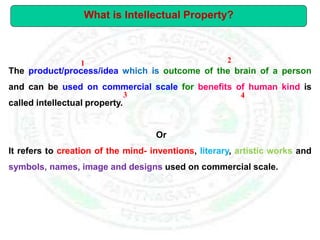
The product/process/idea which is outcome of the brain of a person
and can be used on commercial scale for benefits of human kind is
called intellectual property.
Or
It refers to creation of the mind- inventions, literary, artistic works and
symbols, names, image and designs used on commercial scale.
What is Intellectual Property?
1 2
3 4
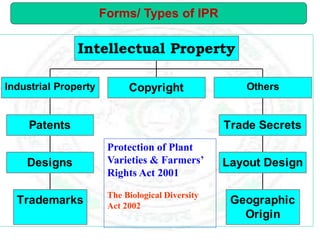
Forms/ Types of IPR
Trademarks
Designs
Patents
Industrial Property Copyright
Geographic
Origin
Layout Design
Trade Secrets
Others
Intellectual Property
Protection of Plant
Varieties & Farmers’
Rights Act 2001
The Biological Diversity
Act 2002
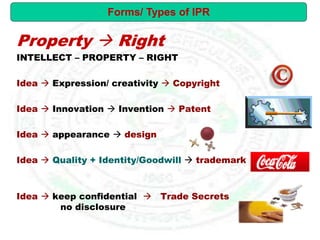
Property  Right
INTELLECT – PROPERTY – RIGHT
Idea  Expression/ creativity  Copyright
Idea  Innovation  Invention  Patent
Idea  appearance  design
Idea  Quality + Identity/Goodwill  trademark
Idea  keep confidential  Trade Secrets
no disclosure
Forms/ Types of IPR
• The rights which are granted to the inventor by any Authority for
its sui generis work or intellectual property are known as
intellectual property right.
• They usually give the creator an exclusive right over the use of
his/her creations for a certain period of time.
What are Intellectual Rights?
What rights a Patent confers on the Patentee ?
(A) If the Patent is for a product:
The right to prevent others from:
 Making
Using
Offering for Sale
Selling
Importing the patented product
(B) If the Patent is for a process:
The right to prevent others from:
 Using the process
Offering for Sale the product using the process
Importing the product using the process
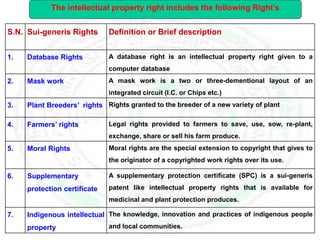
S.N. Sui-generis Rights Definition or Brief description
1. Database Rights A database right is an intellectual property right given to a
computer database
2. Mask work A mask work is a two or three-dementional layout of an
integrated circuit (I.C. or Chips etc.)
3. Plant Breeders’ rights Rights granted to the breeder of a new variety of plant
4. Farmers’ rights Legal rights provided to farmers to save, use, sow, re-plant,
exchange, share or sell his farm produce.
5. Moral Rights Moral rights are the special extension to copyright that gives to
the originator of a copyrighted work rights over its use.
6. Supplementary
protection certificate
A supplementary protection certificate (SPC) is a sui-generis
patent like intellectual property rights that is available for
medicinal and plant protection produces.
7. Indigenous intellectual
property
The knowledge, innovation and practices of indigenous people
and local communities.
The intellectual property right includes the following Right’s
All IPRs apply to new and original
knowledge and not to what is
already known (mainly old
knowledge).
Public domain knowledge cannot be
protected (patented) unless
modified/ improved.
Thumb Rule of Patent
 Novelty
 Utility (Usefulness, industrial applicability)
Non-obviousness (Inventiveness)
Discovery vs. Invention:
• Discovery: Disclosure of something already in existence but not
known so far.
• Invention: An act to be done which results in:
o New product, new result or new process
o New combination for producing an old product
or old result
Patentability Criteria
PATENT:
The Patent Act, 1970.The act was last amended in Year 2005.
COPYRIGHTS:
The Copyrights Act 1957 as amended in 1983, 1984, 1992, 1994,
and 1999 and the Copyright Rules, 1958.
DESIGN:
The Design Act, 1911.
A new design Act 2000 has been enacted superseding the earlier
Design Act 1911.
TRADE MARK:
The Trade and Merchandise Marks Act 1958.
A new trademarks Act 1999 has been enacted superseding the
earlier trade and Merchandise Mark Act 1958.
Forms of Protection In India
LAYOUT DESIGN OF INTEGRATED CIRCUITS:
The semiconductor integrated circuit’s layout-design Act 2000.
GEOGRAPHICAL INDICATION:
The Geographical Indication of goods (Registration and
protection) Act 1999.
TRADE SECRET (PROTECTION OF UNDISCLOSED INFORMATION):
No exclusive legislation exists but the matter would be
generally covered under the Contract Act 1872.
Forms of Protection In India
• Indian Patent law fully TRIPS compliant.
• Product patent allowed in respect of food, drugs and medicine,
Agrochemicals, inter-metallic compounds or product of chemical
reaction including biotechnological, biochemical and microbiological
origin.
• The life of patent is 20 years
• Compulsory licensing
• Rules on filing fees – on number of pages basis
• Pre-grant and post-grant opposition
• Fast track grant of patent
• For patent filing outside – first filing of patent in India
Indian Patents Act, 1970 amendment 2005
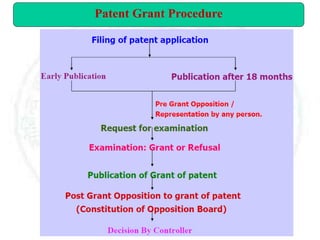
Patent Grant Procedure
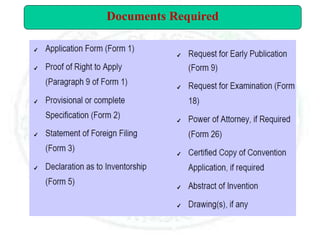
Documents Required
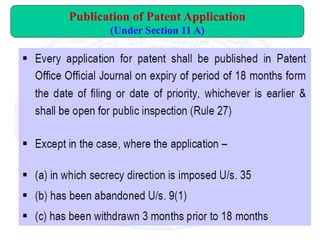
Publication of Patent Application
(Under Section 11 A)
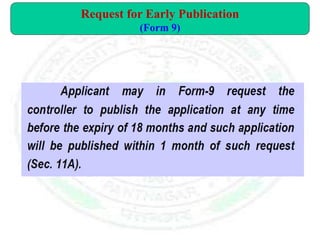
Request for Early Publication
(Form 9)
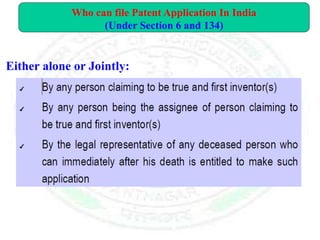
Who can file Patent Application In India
(Under Section 6 and 134)
Either alone or Jointly:
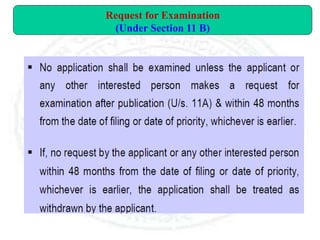
Request for Examination
(Under Section 11 B)
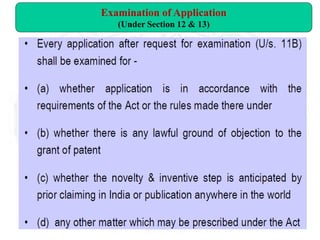
Examination of Application
(Under Section 12 & 13)
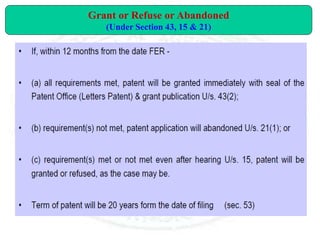
Grant or Refuse or Abandoned
(Under Section 43, 15 & 21)
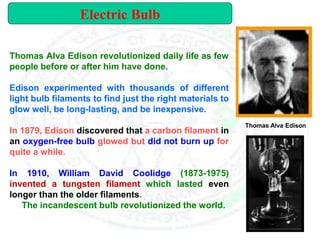
Thomas Alva Edison revolutionized daily life as few
people before or after him have done.
Edison experimented with thousands of different
light bulb filaments to find just the right materials to
glow well, be long-lasting, and be inexpensive.
In 1879, Edison discovered that a carbon filament in
an oxygen-free bulb glowed but did not burn up for
quite a while.
In 1910, William David Coolidge (1873-1975)
invented a tungsten filament which lasted even
longer than the older filaments.
The incandescent bulb revolutionized the world.
Thomas Alva Edison
Electric Bulb
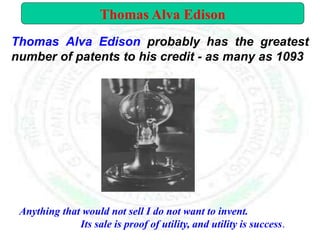
Thomas Alva Edison probably has the greatest
number of patents to his credit - as many as 1093
Anything that would not sell I do not want to invent.
Its sale is proof of utility, and utility is success.
Thomas Alva Edison
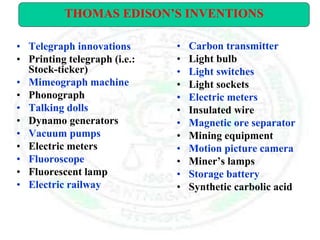
• Telegraph innovations
• Printing telegraph (i.e.:
Stock-ticker)
• Mimeograph machine
• Phonograph
• Talking dolls
• Dynamo generators
• Vacuum pumps
• Electric meters
• Fluoroscope
• Fluorescent lamp
• Electric railway
• Carbon transmitter
• Light bulb
• Light switches
• Light sockets
• Electric meters
• Insulated wire
• Magnetic ore separator
• Mining equipment
• Motion picture camera
• Miner’s lamps
• Storage battery
• Synthetic carbolic acid
THOMAS EDISON’S INVENTIONS
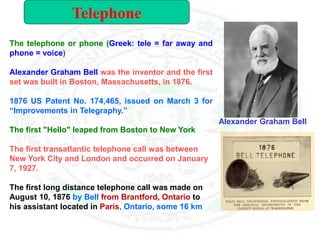
The telephone or phone (Greek: tele = far away and
phone = voice)
Alexander Graham Bell was the inventor and the first
set was built in Boston, Massachusetts, in 1876.
1876 US Patent No. 174,465, issued on March 3 for
“Improvements in Telegraphy.”
The first "Hello" leaped from Boston to New York
The first transatlantic telephone call was between
New York City and London and occurred on January
7, 1927.
The first long distance telephone call was made on
August 10, 1876 by Bell from Brantford, Ontario to
his assistant located in Paris, Ontario, some 16 km
Alexander Graham Bell
Telephone
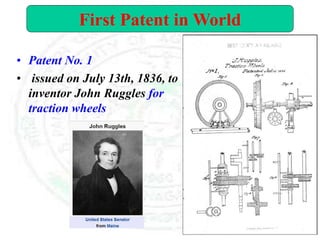
• Patent No. 1
• issued on July 13th, 1836, to
inventor John Ruggles for
traction wheels
First Patent in World
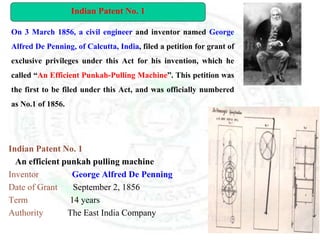
Indian Patent No. 1
An efficient punkah pulling machine
Inventor George Alfred De Penning
Date of Grant September 2, 1856
Term 14 years
Authority The East India Company
On 3 March 1856, a civil engineer and inventor named George
Alfred De Penning, of Calcutta, India, filed a petition for grant of
exclusive privileges under this Act for his invention, which he
called “An Efficient Punkah-Pulling Machine”. This petition was
the first to be filed under this Act, and was officially numbered
as No.1 of 1856.
Indian Patent No. 1
frivolous, against natural laws
injurious to public health, amoral
discovery of
– scientific principle, abstract theory
– - new property, new use of known substance
substances obtained by mere admixture of existing
components
mere arrangement, rearrangement or duplication of known
devices
Non-Patentable Invention
 A method of agriculture or horticulture - non-patentable
 Any process for medical, surgical, curative, prophylactic or other
treatment of human beings and animals – non patentable
 To make plants free from diseases or to increase their economic
value or that of their products –patentable
 An invention which in effect is traditional knowledge
– non patentable
Are you aware?
 In India living plants or animals or human beings are non patentable
 Modified animals are patentable in USA, Japan, Korea, Hungary and
South Africa
 Plant varieties can be patented in some countries – USA; TRIPs also
permit plant patents
 In India for protection of plant varieties - PPV&FR Act 2001 has
been passed
 In India from May 2003 genetically modified microorganisms can be
patented but inventor has to deposit the strain in recognized
depository
Are you aware?
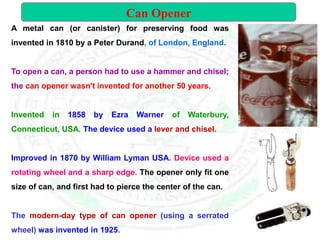
A metal can (or canister) for preserving food was
invented in 1810 by a Peter Durand, of London, England.
To open a can, a person had to use a hammer and chisel;
the can opener wasn't invented for another 50 years.
Invented in 1858 by Ezra Warner of Waterbury,
Connecticut, USA. The device used a lever and chisel.
Improved in 1870 by William Lyman USA. Device used a
rotating wheel and a sharp edge. The opener only fit one
size of can, and first had to pierce the center of the can.
The modern-day type of can opener (using a serrated
wheel) was invented in 1925.
Can Opener
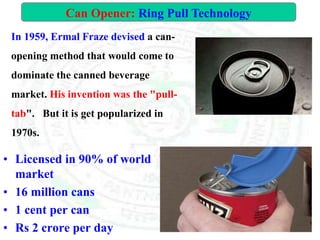
• Licensed in 90% of world
market
• 16 million cans
• 1 cent per can
• Rs 2 crore per day
Can Opener: Ring Pull Technology
In 1959, Ermal Fraze devised a can-
opening method that would come to
dominate the canned beverage
market. His invention was the "pull-
tab". But it is get popularized in
1970s.
• Only Complex Inventions are patentable : ?
– Patent for safety pin was issued on 10-04-1849 to
Walter Hunt (160 years ago)
– Patent for needle of sewing machine granted in 1854
• Age : ?
– Youngest girl to get a patent was four-year-old girl
from Houston, Texas, for an aid for grasping round
knobs.
– Six year old boy (Robert Patch) granted Patent for
toy truck (1963)
Myth
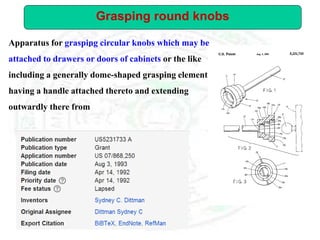
Apparatus for grasping circular knobs which may be
attached to drawers or doors of cabinets or the like
including a generally dome-shaped grasping element
having a handle attached thereto and extending
outwardly there from
.
Grasping round knobs
• Only R & D Institutes can file patents: ?
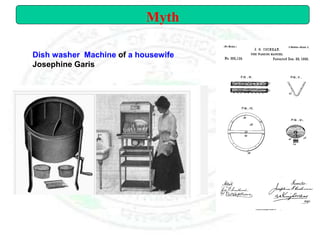
– Patent for dish washer Machine issued to a housewife Josephine Garis
on 28-12-1886
– Mark Twain the famous poet got three patents for his inventions
• An adjustable strap to tighten shirts (1871)
• A self pasting scrap book (1873)
• A history game 1885
– First traffic signal patent issued to a son of slave Garrett Morgan in 1923
• Publishing is more important than Patenting ?
– Once published novelty is lost. File First , then send for publication.
Myth
Dish washer Machine of a housewife
Josephine Garis
Myth
Yoga per se cannot be patented
Till date USPTO has granted
• 134 patents on yoga accessories
• 150 yoga related copyrights
• 2,315 yoga trademarks
Yoga
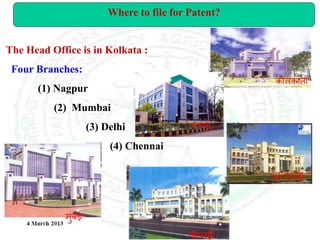
The Head Office is in Kolkata :
Four Branches:
(1) Nagpur
(2) Mumbai
(3) Delhi
(4) Chennai
Where to file for Patent?
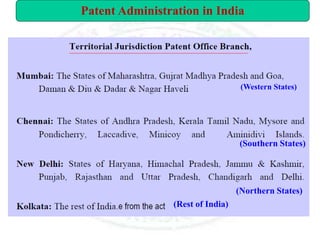
(Northern States)
(Southern States)
(Western States)
(Rest of India)
Patent Administration in India
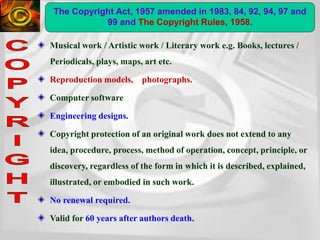
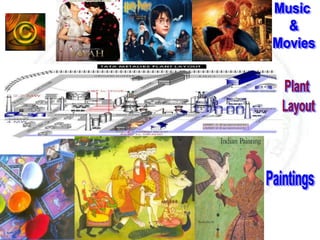
Musical work / Artistic work / Literary work e.g. Books, lectures /
Periodicals, plays, maps, art etc.
Reproduction models, photographs.
Computer software
Engineering designs.
Copyright protection of an original work does not extend to any
idea, procedure, process, method of operation, concept, principle, or
discovery, regardless of the form in which it is described, explained,
illustrated, or embodied in such work.
No renewal required.
Valid for 60 years after authors death.
The Copyright Act, 1957 amended in 1983, 84, 92, 94, 97 and
99 and The Copyright Rules, 1958.
• Literary work – Tables, compilations, computer programs, encyclopedias
(expression of thought and not the expression itself)
• Artistic work – drawings, maps, diagrams, plans, charts, engravings etc.
• Musical work – Any combination of melody and harmony – printed and
reduced to the written format, or produced or reproduced graphically
• Dramatic work – recitation pieces, choreography, mime
• Sound recording
• Choreographic films
• Computer software – relevant data, programs, manuals, papers and
printouts, together with magnetic tapes and discs
Scope of copyright
IT Act 2000 – protection of computer software
• What rights does Copyright protect?
– Exclusive right to use or authorize use of works
• Reproduce
• Distribute
• Indian Copyright Act 1957 amended in 1997
Publicly perform /communicate to public
Make visual or sound recording
Translation
Adaptation
Rental / Resale Right in computer programme,
cinematograph films and sound recording.
Copyrights & Related Rights:
 No Official Procedures
 Protected as soon as original work created
 Registration optional, but advisable
– Copyright registry in New Delhi
– Application in Form IV (in triplicate)
 Prescribed fee
– literary dramatic, musical and artistic work – Rs 50/
– Sound recording –Rs 400/
– Cinematograph film –Rs 600/
How is copyright regulated ?
 Term of protection
– 60 years from end of year of death of author
– 60 years from end of year of first publication of sound
recording / cinematograph film
 International Protection
– Berne Convention
– Universal Copyright Convention
– Phonograms Convention
– WTO / TRIPS
How is copyright regulated ?
• Dabang – Jhandu Balm
• Sholay V/s Vodafone - ringtones
Cash Studies
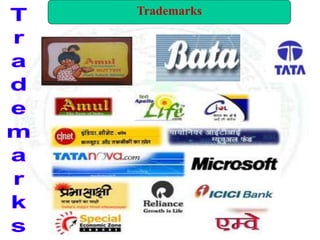
Trademarks
• It identifies the product and its origin.
• It identifies its quality based on the track record of the owner.
• It advertises the product, as the trademark represents the
product
• It creates an image of the product in the minds of consumers
and prospective consumer of such goods
• Trademark Act 1999 – 10 years
Trademark - Functions
• SONY, Bajaj, Intel, Nescafe
• Visual symbol, a word, a design or a label that
identifies an item with its source
• Non-descriptive entity that stands for quality and
reliability
• Trademark should be distinctive but not deceptive
Trademark
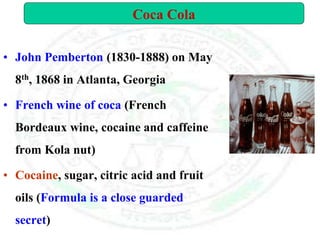
• John Pemberton (1830-1888) on May
8th, 1868 in Atlanta, Georgia
• French wine of coca (French
Bordeaux wine, cocaine and caffeine
from Kola nut)
• Cocaine, sugar, citric acid and fruit
oils (Formula is a close guarded
secret)
Coca Cola
• Estimates of the value of some of the world’s most
famous trademarks
• Coca Cola 72 billion $
• Microsoft 70 billion $
• IBM 53 billion $
Value of Trademarks/ Brand
• Given for compliance with defined standards but not
confined to any membership
• Given by Certification authority
– Woolmark – registered trade certification mark-
-Denotes products are 100% new wool
AGMARK, ISI, FPO, ISO, etc.
Certification Marks
• A service mark is any word, name, symbol,
device or any combination:
used or intended to be used
in commerce to identify and distinguish the
services of one provider from another and
to indicate the source of the services
• LIC, SBI, PNB, UTI, etc.
Service Marks
• Lakme v/s Like-me
• Colgate v/s Collegiate
• CNN (Cable News Network) v/s CNN (Cam News
Network Today) – Court restrained from
publishing, selling, marketing, advertising any
magazine or providing news services in any format
whatsoever under the plaintiff’s trade mark CNN
Examples of trade marks infringement
• FANTA vs FACTA (The Coca Cola Company / Dwarkadhish
Khandelwal Trading as Mewar Soda Water factory)
-Rs 5.0 lacs and costs of proceedings
• SAFAL vs SAKAL (Mother Dairy Fruit and Vegetable Pvt Ltd/
Green Village Agros Pvt Ltd)
Rs 5.0 lacs and costs of proceedings
• TATA sons V/s Durga Scale Company using the name A-ONE
TATA
Rs 2 lakhs as damages and restrained from using 
the word TATA)
Cash Studies
• Mahindra and Mahindra wins the case against
Portfolio Brains LLC of US
– mahindralogistics.com
• Jennifer Lopez Vs Jeremiah Tieman
– jenniferlopez.net and jenniferlopez.org
– sbi.com
– www.arunjaitley.com
Cyber squatting cases
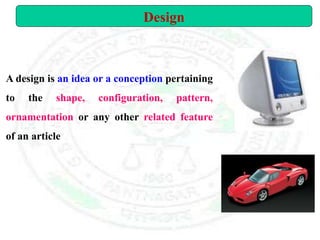
A design is an idea or a conception pertaining
to the shape, configuration, pattern,
ornamentation or any other related feature
of an article
Design
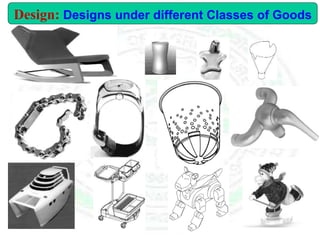
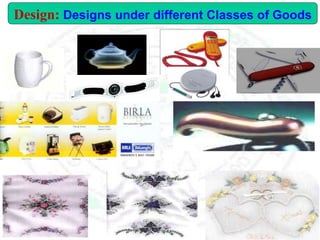
Design: Designs under different Classes of Goods
• Designs Act 1911 amended in 2000 –
-Controller General of Patents, Designs and Trademarks
• Designs are protected by registration. The certificate of
registration is for 10 years
• Designs which are functional are not registerable.
Design registrations
• When it is new or original and previously unpublished in
India
• Registerable even if already known, is applied to a new article
• A combination of previously known designs if it produces a
new visual appeal.
Conditions for Design Registration
• Oldest practiced form of IPR
• In India no separate law for trade secrets.
• Civil laws concerning employment and general
contracts, criminal and commercial law provisions.
Trade secrets
No exclusive legislation exists but the matter would be
generally covered under the Contract Act 1872.
If a trade secret is cracked by any improper method, then
can the infringer be punished?
Trade secrets are embodied in undisclosed
information.
If any improper method is used to obtain a competitor's
trade secret it is an infringement and is subject to
injunctions and damages.
Trade secrets
Term 10 Years from date of filing
Rights conferred
1. Exclusive right to the use of the layout - design
2. Obtain relief in respect of infringement.
IC Layout-Design
The semiconductor integrated circuit’s layout-design Act 2000
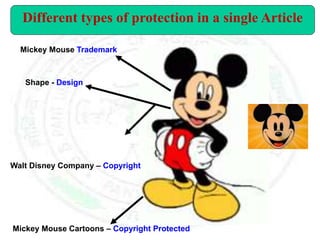
Mickey Mouse Trademark
Shape - Design
Walt Disney Company – Copyright
Mickey Mouse Cartoons – Copyright Protected
Different types of protection in a single Article
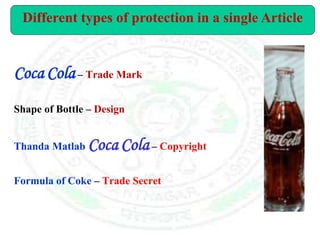
Coca Cola– Trade Mark
Shape of Bottle – Design
Thanda Matlab Coca Cola– Copyright
Formula of Coke – Trade Secret
Different types of protection in a single Article
Thanks
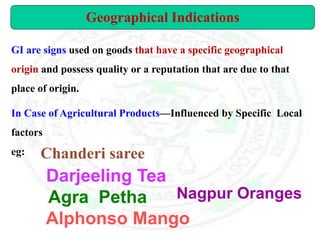
Geographical Indications
GI are signs used on goods that have a specific geographical
origin and possess quality or a reputation that are due to that
place of origin.
In Case of Agricultural Products—Influenced by Specific Local
factors
eg:
Nagpur Oranges
Agra Petha
Alphonso Mango
Darjeeling Tea
Chanderi saree
• Goods – means Agricultural, natural or manufactured goods as originating,
or manufactured in the territory of a country, region or locality in that
territory
----- where a given quality, reputation or other characteristics of such goods
is essentially attributable to its geographical origin
• Indication: It means any name, geographical or figurative representation or
any combination of them conveying or suggesting the geographical origin of
goods to which it belongs
Geographical Indications
• Geographical Indications of Goods (Registration and Protection) Act,
1999
• GI registry Office is in Chennai –
 Controller General of Patents, Designs and Trademark shall be
the Registrar of GI.
The Geographical Indication Registry
Guna Complex, Annexe 1
First Floor, No. 443, Anna Salai
Teynampet, Chennai – 600 018
WIPO office in Geneva
Geographical Indication: Protection
• Any association of persons or of producers or any organization or
authority established by or under the law representing the interest of
producers of goods can file an application
• A properly protected GI will give protection in domestic and
international market.
• Registry –Two parts
– Part A – Particulars relating to registered GI
– Part B – Particulars of registered authorized users
Geographical Indication: Who can Apply?
Darjeeling (Word) Darjeeling (Legal)
Kangra Tea Coorg Change
Mysore Betel Leaf Nanjangud Banana
Palakkadan Matta Rice Malabar Pepper
Allahabad Surkha Tellicherry Pepper
Mysore Jasmine Udupi Jasmine
Hadagali Jasmine
Alleppey Green Cardamom
Coorg Green Cardamom
Navara-The Grain of Kerala
Geographical Indications: Agriculture Goods
Pochampally Ikat Salem Fabric
Chanderi Saree Muga Silk
Solapur Chaddar Mysore Silk
Solapur Terry Towel Kota Doria
Chamba Rumal Kashmir Pashmina
Kancheepuram Silk Kullu shawl
Kashmir Sozani Craft Tirupati ladoos
Kotpad Handloom Fabric
Mysore Traditional Paintings
Madhubani Paintings
Geographical Indications:
Manufactured and Processed Goods
 Alleppey Coir
 Payyannur Pavithra Ring
 Chnnapatna toys and dolls
 Screw pine crafts of Kerala
 Thanjavur Art Plate
 Mysore Sandal Soap
 Mysore Rosewood Inlay
 Aranmula Kannadi (Metal mirror)
 Blue Pottery of Jaipur
 Sikki Grass Products of Bihar
 Poddar Diamond (Jewellery)
 PISCO (Alcoholic beverage)
Geographical Indications:
Manufactured and Processed Goods
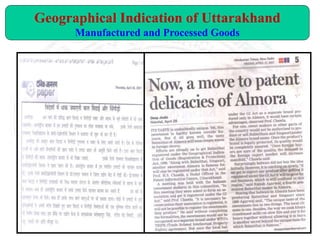
Geographical Indication of Uttarakhand
Manufactured and Processed Goods
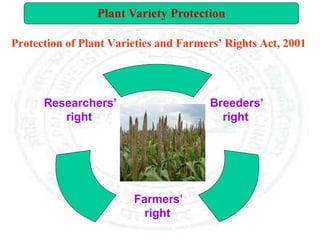
Protection of Plant Varieties and Farmers’ Rights Act, 2001
Breeders’
right
Farmers’
right
Researchers’
right
Plant Variety Protection
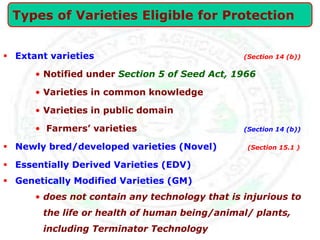
 Extant varieties (Section 14 (b))
• Notified under Section 5 of Seed Act, 1966
• Varieties in common knowledge
• Varieties in public domain
• Farmers’ varieties (Section 14 (b))
 Newly bred/developed varieties (Novel) (Section 15.1 )
 Essentially Derived Varieties (EDV)
 Genetically Modified Varieties (GM)
• does not contain any technology that is injurious to
the life or health of human being/animal/ plants,
including Terminator Technology
Types of Varieties Eligible for Protection
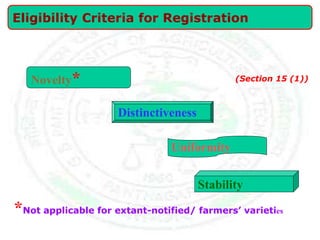
Novelty*
Distinctiveness
Uniformity
Stability
*Not applicable for extant-notified/ farmers’ varieties
Eligibility Criteria for Registration
(Section 15 (1))
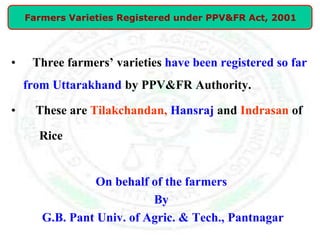
• Three farmers’ varieties have been registered so far
from Uttarakhand by PPV&FR Authority.
• These are Tilakchandan, Hansraj and Indrasan of
Rice
On behalf of the farmers
By
G.B. Pant Univ. of Agric. & Tech., Pantnagar
Farmers Varieties Registered under PPV&FR Act, 2001
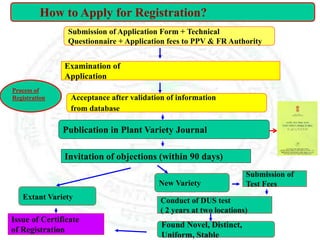
Submission of Application Form + Technical
Questionnaire + Application fees to PPV & FR Authority
Acceptance after validation of information
from database
Extant Variety
New Variety
Issue of Certificate
of Registration
Conduct of DUS test
( 2 years at two locations)
Found Novel, Distinct,
Uniform, Stable
Examination of
Application
Submission of
Test Fees
How to Apply for Registration?
Publication in Plant Variety Journal
Invitation of objections (within 90 days)
Process of
Registration
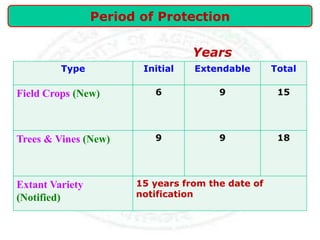
Type Initial Extendable Total
Field Crops (New) 6 9 15
Trees & Vines (New) 9 9 18
Extant Variety
(Notified)
15 years from the date of
notification
Years
Period of Protection
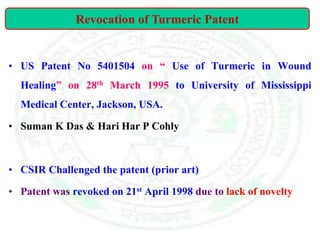
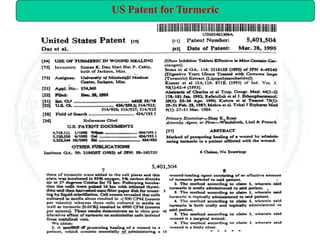
• US Patent No 5401504 on “ Use of Turmeric in Wound
Healing” on 28th March 1995 to University of Mississippi
Medical Center, Jackson, USA.
• Suman K Das & Hari Har P Cohly
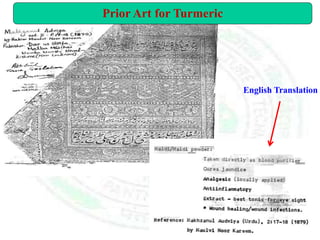
• CSIR Challenged the patent (prior art)
• Patent was revoked on 21st April 1998 due to lack of novelty
Revocation of Turmeric Patent
US Patent for Turmeric
Prior Art for Turmeric
English Translation
• Extract for fungal and pest diseases
• Oil- Cure for cold, flu, malaria, skin diseases
• Patent granted -14th Sept., 1994 – EPO (No. 436,527) W.R. Grace
Co. & USDA
• A method of controlling fungi on plants through hydrophobically
extracted neem oil
• Opposition filed by RFSTE (Dr. Vandana Shiva), EU Parliament’s
Green Party and the International Federation of Organic
Agriculture Movements
• The patent was revoked on 10 May, 2000 on the basis of lack of
novelty and public prior use in India
Revocation of Neem (Azadirachta indica )Patent
Leadership
– determined by Knowledge
What about wealth?
– To convert knowledge into wealth
KNOWLEDGE IS NON CONSUMPTIVE
Creative Mind: to get much more Knowledge
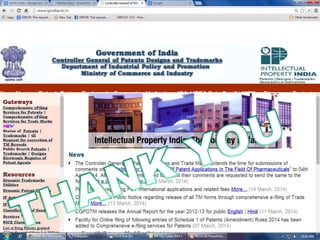
• www.ipindia.nic.in – Indian patent search
• www.pk2id.delhi.nic.in – Online access of Indian patents
• www.indianpatents.org.in – Patent Office
• www.uspto.gov – US patents & Trademarks
• www.ep.espacenet.com – European patent database
• www.patents.ibm.com – US & EPO patents
• www.library.ubc.ca/patscan- Canadian patents
• http://pctgazette.wipo.int – PCT applications since 1998
• www.jiansuo.com – Chinese patents (entirely in
Chinese language)
Websites for Patent Searches
Lect 1.2  Intellectual property rights an overview

Lect 1.2 Intellectual property rights an overview

  • 1.
    Intellectual Property Rights,Patent Act 1970, Patent System & Copy Rights in India (An Overview) Dr. M. K. Karnwal Assoc. Professor, Genetics & Plant Breeding G.B. Pant Univ. of Agri. & Tech., Pantnagar
  • 2.
    WIPO: Genesis ofIPR  The World Intellectual Property Organization (WIPO) is one of the specialized agency of the United Nations.  WIPO was created in 14th July, 1967 "to encourage creative activity, to promote the protection of intellectual property throughout the world.  WIPO was formally created by the Convention Establishing the World Intellectual Property Organization, which entered into force on April 26, 1970. Under Article 3 of this Convention.  WIPO seeks to "promote the protection of intellectual property throughout the world.“ Genesis
  • 3.
    Genesis: World Trade Organizationis an International Organization which moniters and enforces the governing rules for global trade. The WTO was established in 1995 and came in to force on January, 1, 1995 and fully replaced the GATT (General Agreement on Tariffs and Trade) secretarients. And as on today > 150 contries of the world are the member of this International Organization. Head Quarter of WTO is situated at Geneva, Switzerland. WTO: Genesis of IPR
  • 4.
    TRIPS (Trade RelatedAspects of Intellectual Property Rights) The Agreement on Trade Related Aspects of Intellectual Property Rights (TRIPS) is an international agreement administered by the World Trade Organization (WTO) ------ Sets down minimum standards for many forms of intellectual property (IP) regulation as applied to nationals. It was negotiated at the end of the Uruguay Round of the General Agreement on Tariffs and Trade (GATT) in 1994. The TRIPS agreement introduced intellectual property law into the international trading system for the first time and remains the most comprehensive international agreement on intellectual property to date. WTO: Genesis of IPR (TRIPS)
  • 5.
    TRIPS requires memberstates to provide strong protection for intellectual property rights. For eg. under TRIPS: •Copyright terms must extend to 50 years after the death of the author.(Art. 12 and 14) •Computer programs must be regarded as "literary works" under copyright law and receive the same terms of protection. •Patents must be granted for "inventions" in all "fields of technology" provided they meet all other patentability requirements (although exceptions for certain public interests are allowed (Art. 27.2 and 27.3) and must be enforceable for at least 20 years (Art 33). The Requirements of TRIPS
  • 6.
    The product/process/idea whichis outcome of the brain of a person and can be used on commercial scale for benefits of human kind is called intellectual property. Or It refers to creation of the mind- inventions, literary, artistic works and symbols, names, image and designs used on commercial scale. What is Intellectual Property? 1 2 3 4
  • 7.
    Forms/ Types ofIPR Trademarks Designs Patents Industrial Property Copyright Geographic Origin Layout Design Trade Secrets Others Intellectual Property Protection of Plant Varieties & Farmers’ Rights Act 2001 The Biological Diversity Act 2002
  • 8.
    Property  Right INTELLECT– PROPERTY – RIGHT Idea  Expression/ creativity  Copyright Idea  Innovation  Invention  Patent Idea  appearance  design Idea  Quality + Identity/Goodwill  trademark Idea  keep confidential  Trade Secrets no disclosure Forms/ Types of IPR
  • 9.
    • The rightswhich are granted to the inventor by any Authority for its sui generis work or intellectual property are known as intellectual property right. • They usually give the creator an exclusive right over the use of his/her creations for a certain period of time. What are Intellectual Rights?
  • 10.
    What rights aPatent confers on the Patentee ? (A) If the Patent is for a product: The right to prevent others from:  Making Using Offering for Sale Selling Importing the patented product (B) If the Patent is for a process: The right to prevent others from:  Using the process Offering for Sale the product using the process Importing the product using the process
  • 11.
    S.N. Sui-generis RightsDefinition or Brief description 1. Database Rights A database right is an intellectual property right given to a computer database 2. Mask work A mask work is a two or three-dementional layout of an integrated circuit (I.C. or Chips etc.) 3. Plant Breeders’ rights Rights granted to the breeder of a new variety of plant 4. Farmers’ rights Legal rights provided to farmers to save, use, sow, re-plant, exchange, share or sell his farm produce. 5. Moral Rights Moral rights are the special extension to copyright that gives to the originator of a copyrighted work rights over its use. 6. Supplementary protection certificate A supplementary protection certificate (SPC) is a sui-generis patent like intellectual property rights that is available for medicinal and plant protection produces. 7. Indigenous intellectual property The knowledge, innovation and practices of indigenous people and local communities. The intellectual property right includes the following Right’s
  • 12.
    All IPRs applyto new and original knowledge and not to what is already known (mainly old knowledge). Public domain knowledge cannot be protected (patented) unless modified/ improved. Thumb Rule of Patent
  • 13.
     Novelty  Utility(Usefulness, industrial applicability) Non-obviousness (Inventiveness) Discovery vs. Invention: • Discovery: Disclosure of something already in existence but not known so far. • Invention: An act to be done which results in: o New product, new result or new process o New combination for producing an old product or old result Patentability Criteria
  • 14.
    PATENT: The Patent Act,1970.The act was last amended in Year 2005. COPYRIGHTS: The Copyrights Act 1957 as amended in 1983, 1984, 1992, 1994, and 1999 and the Copyright Rules, 1958. DESIGN: The Design Act, 1911. A new design Act 2000 has been enacted superseding the earlier Design Act 1911. TRADE MARK: The Trade and Merchandise Marks Act 1958. A new trademarks Act 1999 has been enacted superseding the earlier trade and Merchandise Mark Act 1958. Forms of Protection In India
  • 15.
    LAYOUT DESIGN OFINTEGRATED CIRCUITS: The semiconductor integrated circuit’s layout-design Act 2000. GEOGRAPHICAL INDICATION: The Geographical Indication of goods (Registration and protection) Act 1999. TRADE SECRET (PROTECTION OF UNDISCLOSED INFORMATION): No exclusive legislation exists but the matter would be generally covered under the Contract Act 1872. Forms of Protection In India
  • 16.
    • Indian Patentlaw fully TRIPS compliant. • Product patent allowed in respect of food, drugs and medicine, Agrochemicals, inter-metallic compounds or product of chemical reaction including biotechnological, biochemical and microbiological origin. • The life of patent is 20 years • Compulsory licensing • Rules on filing fees – on number of pages basis • Pre-grant and post-grant opposition • Fast track grant of patent • For patent filing outside – first filing of patent in India Indian Patents Act, 1970 amendment 2005
  • 17.
  • 18.
  • 19.
    Publication of PatentApplication (Under Section 11 A)
  • 20.
    Request for EarlyPublication (Form 9)
  • 21.
    Who can filePatent Application In India (Under Section 6 and 134) Either alone or Jointly:
  • 22.
  • 23.
  • 24.
    Grant or Refuseor Abandoned (Under Section 43, 15 & 21)
  • 25.
    Thomas Alva Edisonrevolutionized daily life as few people before or after him have done. Edison experimented with thousands of different light bulb filaments to find just the right materials to glow well, be long-lasting, and be inexpensive. In 1879, Edison discovered that a carbon filament in an oxygen-free bulb glowed but did not burn up for quite a while. In 1910, William David Coolidge (1873-1975) invented a tungsten filament which lasted even longer than the older filaments. The incandescent bulb revolutionized the world. Thomas Alva Edison Electric Bulb
  • 26.
    Thomas Alva Edisonprobably has the greatest number of patents to his credit - as many as 1093 Anything that would not sell I do not want to invent. Its sale is proof of utility, and utility is success. Thomas Alva Edison
  • 27.
    • Telegraph innovations •Printing telegraph (i.e.: Stock-ticker) • Mimeograph machine • Phonograph • Talking dolls • Dynamo generators • Vacuum pumps • Electric meters • Fluoroscope • Fluorescent lamp • Electric railway • Carbon transmitter • Light bulb • Light switches • Light sockets • Electric meters • Insulated wire • Magnetic ore separator • Mining equipment • Motion picture camera • Miner’s lamps • Storage battery • Synthetic carbolic acid THOMAS EDISON’S INVENTIONS
  • 28.
    The telephone orphone (Greek: tele = far away and phone = voice) Alexander Graham Bell was the inventor and the first set was built in Boston, Massachusetts, in 1876. 1876 US Patent No. 174,465, issued on March 3 for “Improvements in Telegraphy.” The first "Hello" leaped from Boston to New York The first transatlantic telephone call was between New York City and London and occurred on January 7, 1927. The first long distance telephone call was made on August 10, 1876 by Bell from Brantford, Ontario to his assistant located in Paris, Ontario, some 16 km Alexander Graham Bell Telephone
  • 29.
    • Patent No.1 • issued on July 13th, 1836, to inventor John Ruggles for traction wheels First Patent in World
  • 30.
    Indian Patent No.1 An efficient punkah pulling machine Inventor George Alfred De Penning Date of Grant September 2, 1856 Term 14 years Authority The East India Company On 3 March 1856, a civil engineer and inventor named George Alfred De Penning, of Calcutta, India, filed a petition for grant of exclusive privileges under this Act for his invention, which he called “An Efficient Punkah-Pulling Machine”. This petition was the first to be filed under this Act, and was officially numbered as No.1 of 1856. Indian Patent No. 1
  • 31.
    frivolous, against naturallaws injurious to public health, amoral discovery of – scientific principle, abstract theory – - new property, new use of known substance substances obtained by mere admixture of existing components mere arrangement, rearrangement or duplication of known devices Non-Patentable Invention
  • 32.
     A methodof agriculture or horticulture - non-patentable  Any process for medical, surgical, curative, prophylactic or other treatment of human beings and animals – non patentable  To make plants free from diseases or to increase their economic value or that of their products –patentable  An invention which in effect is traditional knowledge – non patentable Are you aware?
  • 33.
     In Indialiving plants or animals or human beings are non patentable  Modified animals are patentable in USA, Japan, Korea, Hungary and South Africa  Plant varieties can be patented in some countries – USA; TRIPs also permit plant patents  In India for protection of plant varieties - PPV&FR Act 2001 has been passed  In India from May 2003 genetically modified microorganisms can be patented but inventor has to deposit the strain in recognized depository Are you aware?
  • 34.
    A metal can(or canister) for preserving food was invented in 1810 by a Peter Durand, of London, England. To open a can, a person had to use a hammer and chisel; the can opener wasn't invented for another 50 years. Invented in 1858 by Ezra Warner of Waterbury, Connecticut, USA. The device used a lever and chisel. Improved in 1870 by William Lyman USA. Device used a rotating wheel and a sharp edge. The opener only fit one size of can, and first had to pierce the center of the can. The modern-day type of can opener (using a serrated wheel) was invented in 1925. Can Opener
  • 35.
    • Licensed in90% of world market • 16 million cans • 1 cent per can • Rs 2 crore per day Can Opener: Ring Pull Technology In 1959, Ermal Fraze devised a can- opening method that would come to dominate the canned beverage market. His invention was the "pull- tab". But it is get popularized in 1970s.
  • 36.
    • Only ComplexInventions are patentable : ? – Patent for safety pin was issued on 10-04-1849 to Walter Hunt (160 years ago) – Patent for needle of sewing machine granted in 1854 • Age : ? – Youngest girl to get a patent was four-year-old girl from Houston, Texas, for an aid for grasping round knobs. – Six year old boy (Robert Patch) granted Patent for toy truck (1963) Myth
  • 37.
    Apparatus for graspingcircular knobs which may be attached to drawers or doors of cabinets or the like including a generally dome-shaped grasping element having a handle attached thereto and extending outwardly there from . Grasping round knobs
  • 38.
    • Only R& D Institutes can file patents: ? – Patent for dish washer Machine issued to a housewife Josephine Garis on 28-12-1886 – Mark Twain the famous poet got three patents for his inventions • An adjustable strap to tighten shirts (1871) • A self pasting scrap book (1873) • A history game 1885 – First traffic signal patent issued to a son of slave Garrett Morgan in 1923 • Publishing is more important than Patenting ? – Once published novelty is lost. File First , then send for publication. Myth
  • 39.
    Dish washer Machineof a housewife Josephine Garis Myth
  • 40.
    Yoga per secannot be patented Till date USPTO has granted • 134 patents on yoga accessories • 150 yoga related copyrights • 2,315 yoga trademarks Yoga
  • 41.
    The Head Officeis in Kolkata : Four Branches: (1) Nagpur (2) Mumbai (3) Delhi (4) Chennai Where to file for Patent?
  • 42.
    (Northern States) (Southern States) (WesternStates) (Rest of India) Patent Administration in India
  • 43.
    Musical work /Artistic work / Literary work e.g. Books, lectures / Periodicals, plays, maps, art etc. Reproduction models, photographs. Computer software Engineering designs. Copyright protection of an original work does not extend to any idea, procedure, process, method of operation, concept, principle, or discovery, regardless of the form in which it is described, explained, illustrated, or embodied in such work. No renewal required. Valid for 60 years after authors death. The Copyright Act, 1957 amended in 1983, 84, 92, 94, 97 and 99 and The Copyright Rules, 1958.
  • 45.
    • Literary work– Tables, compilations, computer programs, encyclopedias (expression of thought and not the expression itself) • Artistic work – drawings, maps, diagrams, plans, charts, engravings etc. • Musical work – Any combination of melody and harmony – printed and reduced to the written format, or produced or reproduced graphically • Dramatic work – recitation pieces, choreography, mime • Sound recording • Choreographic films • Computer software – relevant data, programs, manuals, papers and printouts, together with magnetic tapes and discs Scope of copyright
  • 46.
    IT Act 2000– protection of computer software • What rights does Copyright protect? – Exclusive right to use or authorize use of works • Reproduce • Distribute • Indian Copyright Act 1957 amended in 1997 Publicly perform /communicate to public Make visual or sound recording Translation Adaptation Rental / Resale Right in computer programme, cinematograph films and sound recording. Copyrights & Related Rights:
  • 47.
     No OfficialProcedures  Protected as soon as original work created  Registration optional, but advisable – Copyright registry in New Delhi – Application in Form IV (in triplicate)  Prescribed fee – literary dramatic, musical and artistic work – Rs 50/ – Sound recording –Rs 400/ – Cinematograph film –Rs 600/ How is copyright regulated ?
  • 48.
     Term ofprotection – 60 years from end of year of death of author – 60 years from end of year of first publication of sound recording / cinematograph film  International Protection – Berne Convention – Universal Copyright Convention – Phonograms Convention – WTO / TRIPS How is copyright regulated ?
  • 49.
    • Dabang –Jhandu Balm • Sholay V/s Vodafone - ringtones Cash Studies
  • 51.
  • 52.
    • It identifiesthe product and its origin. • It identifies its quality based on the track record of the owner. • It advertises the product, as the trademark represents the product • It creates an image of the product in the minds of consumers and prospective consumer of such goods • Trademark Act 1999 – 10 years Trademark - Functions
  • 53.
    • SONY, Bajaj,Intel, Nescafe • Visual symbol, a word, a design or a label that identifies an item with its source • Non-descriptive entity that stands for quality and reliability • Trademark should be distinctive but not deceptive Trademark
  • 54.
    • John Pemberton(1830-1888) on May 8th, 1868 in Atlanta, Georgia • French wine of coca (French Bordeaux wine, cocaine and caffeine from Kola nut) • Cocaine, sugar, citric acid and fruit oils (Formula is a close guarded secret) Coca Cola
  • 55.
    • Estimates ofthe value of some of the world’s most famous trademarks • Coca Cola 72 billion $ • Microsoft 70 billion $ • IBM 53 billion $ Value of Trademarks/ Brand
  • 56.
    • Given forcompliance with defined standards but not confined to any membership • Given by Certification authority – Woolmark – registered trade certification mark- -Denotes products are 100% new wool AGMARK, ISI, FPO, ISO, etc. Certification Marks
  • 57.
    • A servicemark is any word, name, symbol, device or any combination: used or intended to be used in commerce to identify and distinguish the services of one provider from another and to indicate the source of the services • LIC, SBI, PNB, UTI, etc. Service Marks
  • 58.
    • Lakme v/sLike-me • Colgate v/s Collegiate • CNN (Cable News Network) v/s CNN (Cam News Network Today) – Court restrained from publishing, selling, marketing, advertising any magazine or providing news services in any format whatsoever under the plaintiff’s trade mark CNN Examples of trade marks infringement
  • 59.
    • FANTA vsFACTA (The Coca Cola Company / Dwarkadhish Khandelwal Trading as Mewar Soda Water factory) -Rs 5.0 lacs and costs of proceedings • SAFAL vs SAKAL (Mother Dairy Fruit and Vegetable Pvt Ltd/ Green Village Agros Pvt Ltd) Rs 5.0 lacs and costs of proceedings • TATA sons V/s Durga Scale Company using the name A-ONE TATA Rs 2 lakhs as damages and restrained from using the word TATA) Cash Studies
  • 60.
    • Mahindra andMahindra wins the case against Portfolio Brains LLC of US – mahindralogistics.com • Jennifer Lopez Vs Jeremiah Tieman – jenniferlopez.net and jenniferlopez.org – sbi.com – www.arunjaitley.com Cyber squatting cases
  • 61.
    A design isan idea or a conception pertaining to the shape, configuration, pattern, ornamentation or any other related feature of an article Design
  • 62.
    Design: Designs underdifferent Classes of Goods
  • 63.
    Design: Designs underdifferent Classes of Goods
  • 64.
    • Designs Act1911 amended in 2000 – -Controller General of Patents, Designs and Trademarks • Designs are protected by registration. The certificate of registration is for 10 years • Designs which are functional are not registerable. Design registrations
  • 65.
    • When itis new or original and previously unpublished in India • Registerable even if already known, is applied to a new article • A combination of previously known designs if it produces a new visual appeal. Conditions for Design Registration
  • 66.
    • Oldest practicedform of IPR • In India no separate law for trade secrets. • Civil laws concerning employment and general contracts, criminal and commercial law provisions. Trade secrets No exclusive legislation exists but the matter would be generally covered under the Contract Act 1872.
  • 67.
    If a tradesecret is cracked by any improper method, then can the infringer be punished? Trade secrets are embodied in undisclosed information. If any improper method is used to obtain a competitor's trade secret it is an infringement and is subject to injunctions and damages. Trade secrets
  • 68.
    Term 10 Yearsfrom date of filing Rights conferred 1. Exclusive right to the use of the layout - design 2. Obtain relief in respect of infringement. IC Layout-Design The semiconductor integrated circuit’s layout-design Act 2000
  • 69.
    Mickey Mouse Trademark Shape- Design Walt Disney Company – Copyright Mickey Mouse Cartoons – Copyright Protected Different types of protection in a single Article
  • 70.
    Coca Cola– TradeMark Shape of Bottle – Design Thanda Matlab Coca Cola– Copyright Formula of Coke – Trade Secret Different types of protection in a single Article
  • 71.
  • 72.
    Geographical Indications GI aresigns used on goods that have a specific geographical origin and possess quality or a reputation that are due to that place of origin. In Case of Agricultural Products—Influenced by Specific Local factors eg: Nagpur Oranges Agra Petha Alphonso Mango Darjeeling Tea Chanderi saree
  • 73.
    • Goods –means Agricultural, natural or manufactured goods as originating, or manufactured in the territory of a country, region or locality in that territory ----- where a given quality, reputation or other characteristics of such goods is essentially attributable to its geographical origin • Indication: It means any name, geographical or figurative representation or any combination of them conveying or suggesting the geographical origin of goods to which it belongs Geographical Indications
  • 74.
    • Geographical Indicationsof Goods (Registration and Protection) Act, 1999 • GI registry Office is in Chennai –  Controller General of Patents, Designs and Trademark shall be the Registrar of GI. The Geographical Indication Registry Guna Complex, Annexe 1 First Floor, No. 443, Anna Salai Teynampet, Chennai – 600 018 WIPO office in Geneva Geographical Indication: Protection
  • 75.
    • Any associationof persons or of producers or any organization or authority established by or under the law representing the interest of producers of goods can file an application • A properly protected GI will give protection in domestic and international market. • Registry –Two parts – Part A – Particulars relating to registered GI – Part B – Particulars of registered authorized users Geographical Indication: Who can Apply?
  • 76.
    Darjeeling (Word) Darjeeling(Legal) Kangra Tea Coorg Change Mysore Betel Leaf Nanjangud Banana Palakkadan Matta Rice Malabar Pepper Allahabad Surkha Tellicherry Pepper Mysore Jasmine Udupi Jasmine Hadagali Jasmine Alleppey Green Cardamom Coorg Green Cardamom Navara-The Grain of Kerala Geographical Indications: Agriculture Goods
  • 77.
    Pochampally Ikat SalemFabric Chanderi Saree Muga Silk Solapur Chaddar Mysore Silk Solapur Terry Towel Kota Doria Chamba Rumal Kashmir Pashmina Kancheepuram Silk Kullu shawl Kashmir Sozani Craft Tirupati ladoos Kotpad Handloom Fabric Mysore Traditional Paintings Madhubani Paintings Geographical Indications: Manufactured and Processed Goods
  • 78.
     Alleppey Coir Payyannur Pavithra Ring  Chnnapatna toys and dolls  Screw pine crafts of Kerala  Thanjavur Art Plate  Mysore Sandal Soap  Mysore Rosewood Inlay  Aranmula Kannadi (Metal mirror)  Blue Pottery of Jaipur  Sikki Grass Products of Bihar  Poddar Diamond (Jewellery)  PISCO (Alcoholic beverage) Geographical Indications: Manufactured and Processed Goods
  • 79.
    Geographical Indication ofUttarakhand Manufactured and Processed Goods
  • 80.
    Protection of PlantVarieties and Farmers’ Rights Act, 2001 Breeders’ right Farmers’ right Researchers’ right Plant Variety Protection
  • 81.
     Extant varieties(Section 14 (b)) • Notified under Section 5 of Seed Act, 1966 • Varieties in common knowledge • Varieties in public domain • Farmers’ varieties (Section 14 (b))  Newly bred/developed varieties (Novel) (Section 15.1 )  Essentially Derived Varieties (EDV)  Genetically Modified Varieties (GM) • does not contain any technology that is injurious to the life or health of human being/animal/ plants, including Terminator Technology Types of Varieties Eligible for Protection
  • 82.
    Novelty* Distinctiveness Uniformity Stability *Not applicable forextant-notified/ farmers’ varieties Eligibility Criteria for Registration (Section 15 (1))
  • 83.
    • Three farmers’varieties have been registered so far from Uttarakhand by PPV&FR Authority. • These are Tilakchandan, Hansraj and Indrasan of Rice On behalf of the farmers By G.B. Pant Univ. of Agric. & Tech., Pantnagar Farmers Varieties Registered under PPV&FR Act, 2001
  • 84.
    Submission of ApplicationForm + Technical Questionnaire + Application fees to PPV & FR Authority Acceptance after validation of information from database Extant Variety New Variety Issue of Certificate of Registration Conduct of DUS test ( 2 years at two locations) Found Novel, Distinct, Uniform, Stable Examination of Application Submission of Test Fees How to Apply for Registration? Publication in Plant Variety Journal Invitation of objections (within 90 days) Process of Registration
  • 85.
    Type Initial ExtendableTotal Field Crops (New) 6 9 15 Trees & Vines (New) 9 9 18 Extant Variety (Notified) 15 years from the date of notification Years Period of Protection
  • 86.
    • US PatentNo 5401504 on “ Use of Turmeric in Wound Healing” on 28th March 1995 to University of Mississippi Medical Center, Jackson, USA. • Suman K Das & Hari Har P Cohly • CSIR Challenged the patent (prior art) • Patent was revoked on 21st April 1998 due to lack of novelty Revocation of Turmeric Patent
  • 87.
    US Patent forTurmeric
  • 88.
    Prior Art forTurmeric English Translation
  • 89.
    • Extract forfungal and pest diseases • Oil- Cure for cold, flu, malaria, skin diseases • Patent granted -14th Sept., 1994 – EPO (No. 436,527) W.R. Grace Co. & USDA • A method of controlling fungi on plants through hydrophobically extracted neem oil • Opposition filed by RFSTE (Dr. Vandana Shiva), EU Parliament’s Green Party and the International Federation of Organic Agriculture Movements • The patent was revoked on 10 May, 2000 on the basis of lack of novelty and public prior use in India Revocation of Neem (Azadirachta indica )Patent
  • 90.
    Leadership – determined byKnowledge What about wealth? – To convert knowledge into wealth KNOWLEDGE IS NON CONSUMPTIVE Creative Mind: to get much more Knowledge
  • 91.
    • www.ipindia.nic.in –Indian patent search • www.pk2id.delhi.nic.in – Online access of Indian patents • www.indianpatents.org.in – Patent Office • www.uspto.gov – US patents & Trademarks • www.ep.espacenet.com – European patent database • www.patents.ibm.com – US & EPO patents • www.library.ubc.ca/patscan- Canadian patents • http://pctgazette.wipo.int – PCT applications since 1998 • www.jiansuo.com – Chinese patents (entirely in Chinese language) Websites for Patent Searches