Absolute C++ 6thEdition Savitch Solutions
Manual pdf download
https://testbankdeal.com/product/absolute-c-6th-edition-savitch-
solutions-manual/
Download more testbank from https://testbankdeal.com
2.
Instant digital products(PDF, ePub, MOBI) available
Download now and explore formats that suit you...
Absolute C++ 6th Edition Savitch Test Bank
https://testbankdeal.com/product/absolute-c-6th-edition-savitch-test-
bank/
testbankdeal.com
Absolute C++ 5th Edition Savitch Solutions Manual
https://testbankdeal.com/product/absolute-c-5th-edition-savitch-
solutions-manual/
testbankdeal.com
Absolute C++ 5th Edition Savitch Test Bank
https://testbankdeal.com/product/absolute-c-5th-edition-savitch-test-
bank/
testbankdeal.com
Principles of Accounting 5th Edition Smart Test Bank
https://testbankdeal.com/product/principles-of-accounting-5th-edition-
smart-test-bank/
testbankdeal.com
3.
Operations and SupplyChain Management The Core 4th
Edition Jacobs Test Bank
https://testbankdeal.com/product/operations-and-supply-chain-
management-the-core-4th-edition-jacobs-test-bank/
testbankdeal.com
Ethics Theory and Contemporary Issues 8th Edition
MacKinnon Solutions Manual
https://testbankdeal.com/product/ethics-theory-and-contemporary-
issues-8th-edition-mackinnon-solutions-manual/
testbankdeal.com
Statistics for Managers Using Microsoft Excel 7th Edition
Levine Test Bank
https://testbankdeal.com/product/statistics-for-managers-using-
microsoft-excel-7th-edition-levine-test-bank/
testbankdeal.com
Engineering Fundamentals An Introduction to Engineering SI
Edition 5th Edition Moaveni Test Bank
https://testbankdeal.com/product/engineering-fundamentals-an-
introduction-to-engineering-si-edition-5th-edition-moaveni-test-bank/
testbankdeal.com
Organizational Behaviour Concepts Controversies
Applications Canadian 8th Edition Langton Test Bank
https://testbankdeal.com/product/organizational-behaviour-concepts-
controversies-applications-canadian-8th-edition-langton-test-bank/
testbankdeal.com
4.
Organizational Behavior 18thEdition Robbins Test Bank
https://testbankdeal.com/product/organizational-behavior-18th-edition-
robbins-test-bank/
testbankdeal.com
REFERENCES FOR GENERALREADING
Admiralty (1910), Benedict, Chapter XXXV.
Carriers, Wheeler, Chapters I-III.
Admiralty, Hughes, Chapters VIII and XVI.
Collisions at Sea, Marsden (1904), Chapter VII.
Limitation of Liability, Van Santvoord, 1887.
Rebecca-Ware (Fed. Cas. No. 11,629).
Trans. Co. v. Wright, 13 Wall. 104.
Benefactor, 103 U. S. 247.
Scotland, 105 U. S. 24.
City of Norwich, 118 U. S. 468.
O'Brien v. Miller, 168 U. S. 287.
La Bourgogne, 210 U. S. 95.
Richardson v. Harmon, 222 U. S. 96.
Pendleton v. Benner Line, 246 U. S. 353.
[17] Liability does not extend to parts of a tow having no motive power of their own
when attached to a tug whose faulty navigation caused a collision even though the
damage resulted from the impact of the tow and the tug itself did not physically come
into collision at all, and this is so notwithstanding the tug belongs to the same owner.
Liverpool &c. Navigation Co. v. Brooklyn Eastern Dist. Terminal, U. S. Advance Sheets,
1919-20, 85, decided by the Supreme Court December 8, 1919.
[18] Justice Holmes in Liverpool, etc., Navigation Co. v. Brooklyn Eastern Dist.
Terminal (supra).
42.
CHAPTER IX
MARITIME LIENS
1.How Created.— In general and within the limits hereinafter
mentioned, every service rendered to a ship and every injury done
by a ship, creates a maritime lien upon her for the benefit of the
individual who did the work or suffered the wrong.
Those who furnish supplies or fuel or provisions, or make repairs,
or render services, as well as the members of the crew and officers
(except the master) acquire such liens for the collection of the
amounts due them. A like right or privilege accrues for the damage
done through negligence on the part of the ship resulting in damage
to persons or property, as by collision or injury to cargo. So these
liens are divided into two classes, those ex contractu (arising out of
agreements, express or implied) and those ex delicto (arising out of
wrongs or torts).
The authority of the master to obligate the ship so that a lien
arises has been discussed under the title "Master."
The managing owner, ship's husband, master or any person to
whom the management of the vessel at port of supply is entrusted
may by ordering supplies, repairs, render the vessel liable to a
maritime lien. If the master be drunk or disabled and another person
is discharging his duties and is in effect for the time being master of
the ship, such person may create a valid lien. Thus it has been held
that the vessel is bound for supplies ordered by the mate acting
during the illness of the master. The vessel is also bound for supplies
furnished on the order of any member of the ship's company and
with the master's knowledge and acquiescence. It is customary in
the administration of a large modern ship for the head of each
department, e.g., the steward, chief engineer, to order supplies and
43.
for these thevessel is responsible, but only on the theory that the
purchases are made with the master's authority, and if the person
contracting the obligation has acted in excess of the powers
delegated to him by the master, the ship will not be bound. It is
incumbent on the person furnishing goods to a vessel to inquire into
the authority of the individual ordering the same. Moreover, if the
goods ordered are greatly in excess of the vessel's needs, it is
incumbent upon the supplier to know that fact and if the goods
ordered, even by the master personally, are greatly in excess of the
vessel's needs the ship will not be bound.
A maritime lien attaches to the offending ship only, and not to her
cargo (except for unpaid freight) and this is true even though the
cargo belonged to the owner of the offending ship. As was said by
Mr. Justice Brown in the case of the Bristol, 29 Fed. 867:
The cargo, except for the collection of the freight due, cannot be held for the
faults of the ship. There being no lien beyond freight due, no proceeding in rem
lies against the cargo for damages by collision, if the freight be paid, whether the
cargo belongs to the owner of the offending vessel or not; and, if arrested, the
cargo must be released upon the payment of the freight due.
A maritime lien, being essentially a remedy against the vessel,
may attach even in a case in which the owners are not personally
responsible; as for instance, where a state pilot, in charge of a ship
under a state statute which renders his employment compulsory,
negligently brought the ship into collision, she was subjected to a
lien for the damage done, although the pilot was in no sense the
agent of the owners, and no personal liability rested upon them. The
China, 7 Wall. 53.
The lien attaches only by virtue of contracts or torts which are
wholly maritime in their nature. It is frequently difficult to determine
the nature of a contract or tort. Thus persons digging ice and snow
from around a vessel on a beach, and about to be launched did not
acquire a maritime lien because the service was performed on shore.
Whereas persons who floated a vessel which had been carried far
ashore were held to have performed a maritime service and to be
entitled to a lien. In a case in which a vessel communicated fire to a
44.
wharf to whichshe was made fast, it was held that the tort was not
maritime, whereas, had she been in the stream and had
communicated fire to another vessel in the stream, the tort would
have been maritime and would have given rise to a maritime lien
(Hough v. Trans. Co., 3 Wall. 20). Conversely a tort having its
inception on land and completed on shipboard will give rise to a lien.
As for example where a man working on board ship was injured by a
piece of lumber thrown through a chute by a man working on a
wharf. (Herman v. Mill Co., 69 Fed. 646).
A lien arises in favor of the owners or temporary owners of a
vessel upon cargo actually on board for unpaid freight and for
demurrage. This is the only case in which possession of the security
is essential to the existence of a maritime lien. If the cargo is
removed from the ship the maritime lien is lost. In this class of cases
suit to enforce the lien should be instituted before the cargo is
discharged.
2. Essential Value.— The essential value of these liens lies in
the right they give to have the ship arrested and sold by a court of
admiralty for their satisfaction, and in the speed and security with
which the remedy can be applied. The vessel is arrested immediately
upon the filing of the libel, before the liability is proven or the case
tried, and may not leave port without giving bond to secure the
claim (see Chapter XVII, Admiralty Remedies).
3. Independent of Notice or Possession.— They do not
depend upon notice or recording or possession and do not in any
way resemble a mortgage. They are, in fact, an actual property in
the ship, created as soon as the service is rendered or the wrong
suffered (Yankee Blade, 19 How. 82).
4. Secret.— As these liens do not depend upon notice or record,
they are essentially secret in their nature and even purchase of the
ship, in good faith and for value, will not be protected against them
(The Marjorie, 151 Fed. 183).
45.
5. Diligence Required.—On the other hand the law requires the
lienor to be diligent in enforcing his lien so that third parties may not
be unduly prejudiced thereby. If he is not diligent, the court will hold
him guilty of laches and the lien may become stale as against all
parties other than the owner.
6. Rules of Diligence.— There are no hard and fast rules
defining diligence or the limit after which a lien becomes stale.
Under the general maritime law, the voyage was the test; liens
which accrued on one voyage were required to be enforced before
another voyage was made or they became stale as to those of the
latter. In deep-sea navigation, where the voyages are prolonged, this
rule still obtains. On the Great Lakes, where the trips or voyages are
comparatively short, and navigation is closed by the winters, the
season of navigation is the rule. Liens not enforced during the
season or the following winter will be postponed to those of the later
season. In New York harbor, the local conditions have resulted in a
forty-day rule; in Virginia, under somewhat different conditions, a
one-year rule has appeared. The safe method is to be prompt and
diligent in collecting liens against a ship; delay is always dangerous
and there may be no other financial responsibility. This course is also
for the best interests of the shipowner; interest and costs
accumulate rapidly where the liens are enforced by the courts.
In the case of the Marjorie, 151 Fed. 183, above cited, a private
yacht was libeled in Baltimore on account of coal furnished her in
Norfolk nearly a year previously. She spent that time voyaging up
and down the coast, putting in at various ports and when libeled had
been laid up for the winter. She had not been in Norfolk subsequent
to the occasion on which the coal was furnished. About six months
after the coal was furnished she was sold to a new owner, who,
finding no lien on record against her, paid the full purchase price.
The Court held:
As commercial enterprise would be vexatiously incommoded and the free
circulation and disposal of vessels prevented if such liens, which are not required
by law to be made manifest by public registration, were allowed to lie dormant for
an indefinite period, the courts have uniformly held, where the rights of bona fide
46.
purchasers will beinjuriously affected if it is allowed to prevail, that the lien is lost
if there has been long delay, and there has been reasonable opportunity to enforce
it. The diligence required is usually measured by the opportunity of enforcement.
In nearly all of the cases where the courts have held the lien to be lost and where
there has been change of possession, there has been unreasonable delay on the
part of the creditor in availing himself of the opportunities of enforcing his lien.
* * * * *
In the case under consideration the libel was filed within less than a year. The
yacht had been sailing from port to port, and never came within the jurisdiction of
the port where the supplies were furnished. The claim was a small one and hardly
justified the employment of a detective to follow her wanderings. The lien was
asserted as soon as the yacht was found.... The law is well settled that liens of this
nature must be sustained if there has been reasonable diligence in asserting them.
A long line of decisions shows that a delay of a year in circumstances such as are
disclosed by the testimony is not unreasonable, and to lay down any other rule
would tend to unsettle the law and to disturb the credit which in the interest of
commerce must be extended to ships for supplies when away from their home
ports to enable them to continue their voyages, a credit only given upon the faith
that they have a lien upon the ship.
7. Recording Liens on "Preferred Mortgage" Vessels.— The
Merchant Marine Act of 1920 (Sec. 30, Subsection G. See Appendix),
provides that any one claiming a lien on an American ship which is
subject to a "preferred mortgage" as defined in that Act (see
Chapter X, infra) may record a notice of his lien with the Collector of
Customs at the port of documentation, and upon the discharge of
the indebtedness, shall file a certificate to that effect. A lienor who
has recorded his lien is entitled to notice of any proceeding for the
foreclosure of a preferred mortgage. This provision is intended to
enable the lienor to come in and protect his interest.
8. Limited to Movable Things.— These liens arise only upon
movable things engaged in commerce and navigation. They cannot
exist in anything which is fixed and immovable and not the subject
of maritime commerce or navigation. Thus they will subsist in
vessels, rafts and cargoes but not upon a bridge or a ship totally out
of commission (Rock Island Bridge, 6 Wall. 213; Pulaski, 33 Fed.
47.
383). The lienhas been sustained against a dredge. (Atlantic, 53
Fed. 607).
9. Priorities.— Important priorities exist among maritime liens
and these are adjusted when the ship is sold in admiralty to satisfy
her debts. The purchaser at an admiralty sale, as elsewhere stated,
takes the ship free of all existing liens; the proceeds of the sale are
distributed among the lienors according to their priorities, after
deducting costs and expenses.
Liens for torts take precedence over all prior liens, and the later
lien for tort will be preferred to an earlier if there has been an
absence of diligence in enforcing it. The John G. Stevens, 170 U. S.
113, is the leading case on the priority of liens against the offending
vessel for torts committed by her. Mr. Justice Gray held:
But the question we have to deal with is whether the lien for damages by the
collision is to be preferred to the lien for supplies furnished before the collision.
* * * * *
The collision, as soon as it takes place, creates, as security for the damages, a
maritime lien or privilege, jus in re, a proprietary interest in the offending ship,
and which, when enforced by admiralty process in rem, relates back to the time of
the collision. The offending ship is considered as herself the wrongdoer, and is
herself bound to make compensation for the wrong done. The owner of the
injured vessel is entitled to proceed in rem against the offender, without regard to
the question who may be her owners, or to the division, the nature, or the extent
of their interests in her. With the relations of the owners of those interests, as
among themselves, the owner of the injured vessel has no concern. All the
interests existing at the time of the collision in the offending vessel, whether by
way of part ownership, of mortgage, of bottomry bond, or of other maritime liens
for repairs or supplies, arising out of contract with the owners or agents of the
vessel, are parts of the vessel herself, and as such are bound by and responsible
for her wrongful acts. Any one who had furnished necessary supplies to the vessel
before the collision, and had thereby acquired, under our law, a maritime lien or
privilege in the vessel herself, was, as was said in The Bold Buccleugh [7 Moore
P. C. 267] before cited, of the holder of an earlier bottomry bond, under the law of
England, "so to speak, a part owner in interest at the date of the collision and the
ship in which he and others were interested was liable to its value at that date for
the injury done without reference to his claim [7 Moore P. C. 285]."
48.
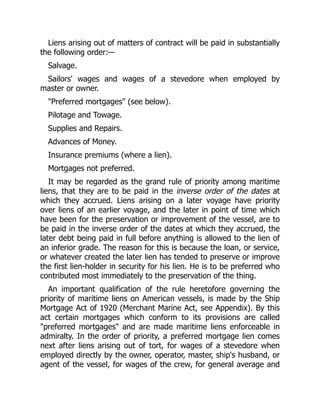
Liens arising outof matters of contract will be paid in substantially
the following order:—
Salvage.
Sailors' wages and wages of a stevedore when employed by
master or owner.
"Preferred mortgages" (see below).
Pilotage and Towage.
Supplies and Repairs.
Advances of Money.
Insurance premiums (where a lien).
Mortgages not preferred.
It may be regarded as the grand rule of priority among maritime
liens, that they are to be paid in the inverse order of the dates at
which they accrued. Liens arising on a later voyage have priority
over liens of an earlier voyage, and the later in point of time which
have been for the preservation or improvement of the vessel, are to
be paid in the inverse order of the dates at which they accrued, the
later debt being paid in full before anything is allowed to the lien of
an inferior grade. The reason for this is because the loan, or service,
or whatever created the later lien has tended to preserve or improve
the first lien-holder in security for his lien. He is to be preferred who
contributed most immediately to the preservation of the thing.
An important qualification of the rule heretofore governing the
priority of maritime liens on American vessels, is made by the Ship
Mortgage Act of 1920 (Merchant Marine Act, see Appendix). By this
act certain mortgages which conform to its provisions are called
"preferred mortgages" and are made maritime liens enforceable in
admiralty. In the order of priority, a preferred mortgage lien comes
next after liens arising out of tort, for wages of a stevedore when
employed directly by the owner, operator, master, ship's husband, or
agent of the vessel, for wages of the crew, for general average and
49.
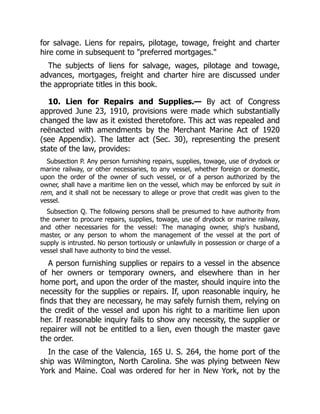
for salvage. Liensfor repairs, pilotage, towage, freight and charter
hire come in subsequent to "preferred mortgages."
The subjects of liens for salvage, wages, pilotage and towage,
advances, mortgages, freight and charter hire are discussed under
the appropriate titles in this book.
10. Lien for Repairs and Supplies.— By act of Congress
approved June 23, 1910, provisions were made which substantially
changed the law as it existed theretofore. This act was repealed and
reënacted with amendments by the Merchant Marine Act of 1920
(see Appendix). The latter act (Sec. 30), representing the present
state of the law, provides:
Subsection P. Any person furnishing repairs, supplies, towage, use of drydock or
marine railway, or other necessaries, to any vessel, whether foreign or domestic,
upon the order of the owner of such vessel, or of a person authorized by the
owner, shall have a maritime lien on the vessel, which may be enforced by suit in
rem, and it shall not be necessary to allege or prove that credit was given to the
vessel.
Subsection Q. The following persons shall be presumed to have authority from
the owner to procure repairs, supplies, towage, use of drydock or marine railway,
and other necessaries for the vessel: The managing owner, ship's husband,
master, or any person to whom the management of the vessel at the port of
supply is intrusted. No person tortiously or unlawfully in possession or charge of a
vessel shall have authority to bind the vessel.
A person furnishing supplies or repairs to a vessel in the absence
of her owners or temporary owners, and elsewhere than in her
home port, and upon the order of the master, should inquire into the
necessity for the supplies or repairs. If, upon reasonable inquiry, he
finds that they are necessary, he may safely furnish them, relying on
the credit of the vessel and upon his right to a maritime lien upon
her. If reasonable inquiry fails to show any necessity, the supplier or
repairer will not be entitled to a lien, even though the master gave
the order.
In the case of the Valencia, 165 U. S. 264, the home port of the
ship was Wilmington, North Carolina. She was plying between New
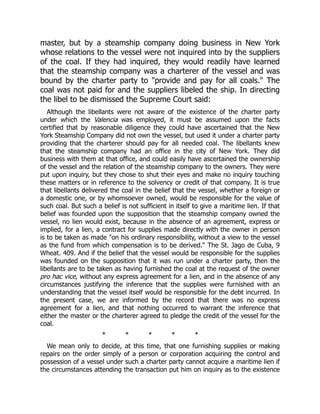
York and Maine. Coal was ordered for her in New York, not by the
50.
master, but bya steamship company doing business in New York
whose relations to the vessel were not inquired into by the suppliers
of the coal. If they had inquired, they would readily have learned
that the steamship company was a charterer of the vessel and was
bound by the charter party to "provide and pay for all coals." The
coal was not paid for and the suppliers libeled the ship. In directing
the libel to be dismissed the Supreme Court said:
Although the libellants were not aware of the existence of the charter party
under which the Valencia was employed, it must be assumed upon the facts
certified that by reasonable diligence they could have ascertained that the New
York Steamship Company did not own the vessel, but used it under a charter party
providing that the charterer should pay for all needed coal. The libellants knew
that the steamship company had an office in the city of New York. They did
business with them at that office, and could easily have ascertained the ownership
of the vessel and the relation of the steamship company to the owners. They were
put upon inquiry, but they chose to shut their eyes and make no inquiry touching
these matters or in reference to the solvency or credit of that company. It is true
that libellants delivered the coal in the belief that the vessel, whether a foreign or
a domestic one, or by whomsoever owned, would be responsible for the value of
such coal. But such a belief is not sufficient in itself to give a maritime lien. If that
belief was founded upon the supposition that the steamship company owned the
vessel, no lien would exist, because in the absence of an agreement, express or
implied, for a lien, a contract for supplies made directly with the owner in person
is to be taken as made "on his ordinary responsibility, without a view to the vessel
as the fund from which compensation is to be derived." The St. Jago de Cuba, 9
Wheat. 409. And if the belief that the vessel would be responsible for the supplies
was founded on the supposition that it was run under a charter party, then the
libellants are to be taken as having furnished the coal at the request of the owner
pro hac vice, without any express agreement for a lien, and in the absence of any
circumstances justifying the inference that the supplies were furnished with an
understanding that the vessel itself would be responsible for the debt incurred. In
the present case, we are informed by the record that there was no express
agreement for a lien, and that nothing occurred to warrant the inference that
either the master or the charterer agreed to pledge the credit of the vessel for the
coal.
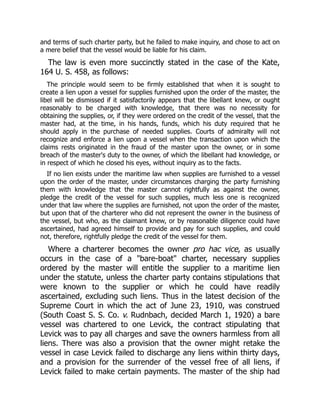
* * * * *
We mean only to decide, at this time, that one furnishing supplies or making
repairs on the order simply of a person or corporation acquiring the control and
possession of a vessel under such a charter party cannot acquire a maritime lien if
the circumstances attending the transaction put him on inquiry as to the existence
51.
and terms ofsuch charter party, but he failed to make inquiry, and chose to act on
a mere belief that the vessel would be liable for his claim.
The law is even more succinctly stated in the case of the Kate,
164 U. S. 458, as follows:
The principle would seem to be firmly established that when it is sought to
create a lien upon a vessel for supplies furnished upon the order of the master, the
libel will be dismissed if it satisfactorily appears that the libellant knew, or ought
reasonably to be charged with knowledge, that there was no necessity for
obtaining the supplies, or, if they were ordered on the credit of the vessel, that the
master had, at the time, in his hands, funds, which his duty required that he
should apply in the purchase of needed supplies. Courts of admiralty will not
recognize and enforce a lien upon a vessel when the transaction upon which the
claims rests originated in the fraud of the master upon the owner, or in some
breach of the master's duty to the owner, of which the libellant had knowledge, or
in respect of which he closed his eyes, without inquiry as to the facts.
If no lien exists under the maritime law when supplies are furnished to a vessel
upon the order of the master, under circumstances charging the party furnishing
them with knowledge that the master cannot rightfully as against the owner,
pledge the credit of the vessel for such supplies, much less one is recognized
under that law where the supplies are furnished, not upon the order of the master,
but upon that of the charterer who did not represent the owner in the business of
the vessel, but who, as the claimant knew, or by reasonable diligence could have
ascertained, had agreed himself to provide and pay for such supplies, and could
not, therefore, rightfully pledge the credit of the vessel for them.
Where a charterer becomes the owner pro hac vice, as usually
occurs in the case of a "bare-boat" charter, necessary supplies
ordered by the master will entitle the supplier to a maritime lien
under the statute, unless the charter party contains stipulations that
were known to the supplier or which he could have readily
ascertained, excluding such liens. Thus in the latest decision of the
Supreme Court in which the act of June 23, 1910, was construed
(South Coast S. S. Co. v. Rudnbach, decided March 1, 1920) a bare
vessel was chartered to one Levick, the contract stipulating that
Levick was to pay all charges and save the owners harmless from all
liens. There was also a provision that the owner might retake the
vessel in case Levick failed to discharge any liens within thirty days,
and a provision for the surrender of the vessel free of all liens, if
Levick failed to make certain payments. The master of the ship had
52.
been appointed bythe owner, but was under Levick's orders. When
the supplies were ordered representatives of the owners warned the
supplier that the steamer was under charter and that he must not
furnish supplies on the credit of the vessel. He disregarded the
warning and furnished the supplies and libeled the vessel for his lien.
The Court upheld his right to the lien, holding that the warning of
the owner was ineffectual because the charterer had become the
owner pro hac vice, the master being his agent and not that of the
owner, and that:
Unless the charter excluded the master's power the owner could not forbid its
use. The charter-party recognizes that liens may be imposed by the charterer and
allow to stand for less than a month, and there seems to be no sufficient reason
for supposing the words not to refer to all the ordinary maritime liens recognized
by the law. The statute had given a lien for supplies in a domestic port, and
therefore had made that one of these ordinary liens. Therefore the charterer was
assumed to have power to authorize the master to impose a lien in a domestic
port, and if the assumption expressed in words was not equivalent to a grant of
power, at least it cannot be taken to have excluded it. There was nothing from
which the furnisher could have ascertained that the master did not have power to
bind the ship.
11. Not Sole Remedy.— The reader will not be misled into
supposing that the absence of a right to a maritime lien means that
the debt is uncollectible by legal process. While the admiralty court
is closed to the creditor if there be no right to a maritime lien, he
has the same remedy as any other creditor by a suit at law to
recover the debt or damage from the debtor, or person liable, i.e.,
the owner, the temporary owner, or the person who ordered the
goods or did the damage as the case may be. Such a remedy lacks
the peculiar advantages of the maritime lien (§ 2 supra, this
chapter). There may also be special remedies open to him under
state statutes (but see § 13, this chapter).
12. How Divested.— Maritime items are only completely
divested by payment or by an admiralty sale. Laches—that is to say
delay or sloth—on the part of the lienor may prevent their
enforcement against the rights of subsequent lienors or purchasers
53.
for value ingood faith, but the ship is really only absolutely free
from them when she has passed through a sale in proceedings in
rem—that is, a suit against the ship. This transfers all claims to the
proceeds in the registry of the court and passes a clear title to the
purchaser. The Garland, 16 Fed. 283, is illustrative; she had sunk a
yacht in the Detroit River with great loss of life; her business was
that of a ferry between Detroit, Michigan, and Windsor, Ontario, and
her value was about $20,000; libels were filed against her in Detroit
on account of the collision and she was then arrested in Windsor, by
process from the Maritime Court of Ontario, for a coal bill of $36.30;
that court sold her in accordance with the usual admiralty practice.
She then resumed her business and was arrested under the Detroit
libels. These were dismissed by the United States court because all
liens had been divested by the admiralty sale in Ontario and such
sales are good throughout the world. No other sales, judicial or
otherwise, have this effect since they convey only the title of the
owner in the thing and not the thing itself. Maritime liens, therefore,
are not divested or affected by the foreclosure of a mortgage, or a
sheriff's sale on execution, or a receiver's sale, or any other form of
conveyance of an owner's title. Nor are they divested by a writ of
execution issued out of a court of common law, nor postponed to
such execution. This has been held, even where the execution was
in favor of the government.
13. State Liens.— For many years there was an open question in
the maritime law of the United States as to the status of liens which
arose in the home port of the vessel and numerous conflicting
decisions were made by the courts. The effect was that in all cases
of liens arising out of contract, like supplies and repairs, the question
of upon whose credit the work was done and the supplies furnished
became very important; where the transaction was in the home port,
there was a presumption that it was on the personal credit of the
owner and no lien was allowed; and the theory of home port
became extended to include the entire State in which the owner
resided. Thereupon all of the states interested in maritime affairs
enacted statutes providing for liens upon vessels, both maritime and
54.
nonmaritime in theirnature, and a sort of admiralty proceeding
against the ship to enforce them; the procedure portions of these
statutes were generally held void as interfering with the exclusive
jurisdiction in rem of the Federal courts, but the liens which they
created, if maritime in their nature, were usually enforced. By the
act of Congress of June 23, 1910 (as amended and reënacted by the
Merchant Marine Act of 1920, see Appendix), relating to liens on
vessel for repairs, towage supplies or other necessaries, it was
declared unnecessary to allege or prove that credit had been given
the vessel and also provided that the Act shall supersede the
provisions of all state statutes conferring liens on vessels so far as
they purport to create rights in rem, that is to say, rights against the
vessel herself. It is yet unsettled whether those of a nonmaritime
class survive, as in the case of the lien for shipbuilding which, not
being regarded by the admiralty as maritime, has been enforceable
under the state statutes.
14. Builders' and Mechanics' Liens.— These may arise upon a
ship under the provision of local statutes and be entirely enforceable
so long as they do not come into conflict with maritime liens and the
exclusive jurisdiction of the admiralty. So, also, a lienor may assert
his common-law right to retain possession of the ship until payment
is made. This depends entirely on possession and cannot be
enforced by judicial proceedings, although it may be recognized by
the court when it arrests the vessel on other accounts.
15. Foreign Liens.— Maritime liens often depend on the law of
the place in which the obligation is incurred and also upon the law of
the ship's flag. In other words, inquiry must frequently be made
whether the local law gives a lien, whether the law under which the
ship sails gives the master power to create the lien, and whether the
country in which the suit is commenced has the legal machinery to
enforce the lien. There is no doubt about our own admiralty courts
having adequate jurisdiction and equipment to enforce any maritime
lien which exists by the law of a foreign country. Its enforcement is a
matter of comity and not of right when the parties are foreigners.
55.
Thus the maritimelien for collision will generally be enforced
wherever the offending ship may be seized, irrespective of the place
where the collision occurred. That lien exists by virtue of the general
maritime law. On the other hand, there may be a closer question in
regard to the lien for supplies. They may be furnished in a port of a
country whose laws do not provide such a maritime lien but only
give a remedy by attachment of the ship. The tendency of the
weight of authority is to enforce such liens in the courts of this
country whenever they exist by virtue of the general maritime law,
even if they could not be enforced in the courts of the country where
they arose. Possibly this gives a foreigner an advantage here over
what he would have at home, but this is not really material.
56.
16. Enforcement ofLiens.— This is discussed in Chapter XVII,
Admiralty Remedies.
REFERENCES FOR GENERAL READING
Admiralty, Hughes, Chapter XVII.
Admiralty Liens of Material Men, IX American Law Review, 654.
Features of Admiralty Liens, XVI American Law Review, 193.
Maritime Liens, 4 Law Quarterly Review, 379.
Priorities among Maritime Liens, II University Law Review, 122.
The DeSmet, 10 Fed. 483 (excellent annotation).
Lottawanna, 21 Wall. 558.
John G. Stevens, 170 U. S. 113.
57.
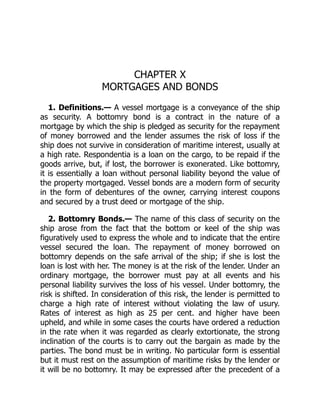
CHAPTER X
MORTGAGES ANDBONDS
1. Definitions.— A vessel mortgage is a conveyance of the ship
as security. A bottomry bond is a contract in the nature of a
mortgage by which the ship is pledged as security for the repayment
of money borrowed and the lender assumes the risk of loss if the
ship does not survive in consideration of maritime interest, usually at
a high rate. Respondentia is a loan on the cargo, to be repaid if the
goods arrive, but, if lost, the borrower is exonerated. Like bottomry,
it is essentially a loan without personal liability beyond the value of
the property mortgaged. Vessel bonds are a modern form of security
in the form of debentures of the owner, carrying interest coupons
and secured by a trust deed or mortgage of the ship.
2. Bottomry Bonds.— The name of this class of security on the
ship arose from the fact that the bottom or keel of the ship was
figuratively used to express the whole and to indicate that the entire
vessel secured the loan. The repayment of money borrowed on
bottomry depends on the safe arrival of the ship; if she is lost the
loan is lost with her. The money is at the risk of the lender. Under an
ordinary mortgage, the borrower must pay at all events and his
personal liability survives the loss of his vessel. Under bottomry, the
risk is shifted. In consideration of this risk, the lender is permitted to
charge a high rate of interest without violating the law of usury.
Rates of interest as high as 25 per cent. and higher have been
upheld, and while in some cases the courts have ordered a reduction
in the rate when it was regarded as clearly extortionate, the strong
inclination of the courts is to carry out the bargain as made by the
parties. The bond must be in writing. No particular form is essential
but it must rest on the assumption of maritime risks by the lender or
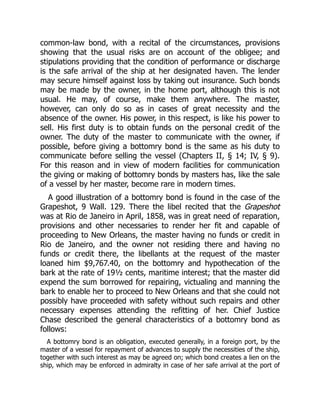
it will be no bottomry. It may be expressed after the precedent of a
58.
common-law bond, witha recital of the circumstances, provisions
showing that the usual risks are on account of the obligee; and
stipulations providing that the condition of performance or discharge
is the safe arrival of the ship at her designated haven. The lender
may secure himself against loss by taking out insurance. Such bonds
may be made by the owner, in the home port, although this is not
usual. He may, of course, make them anywhere. The master,
however, can only do so as in cases of great necessity and the
absence of the owner. His power, in this respect, is like his power to
sell. His first duty is to obtain funds on the personal credit of the
owner. The duty of the master to communicate with the owner, if
possible, before giving a bottomry bond is the same as his duty to
communicate before selling the vessel (Chapters II, § 14; IV, § 9).
For this reason and in view of modern facilities for communication
the giving or making of bottomry bonds by masters has, like the sale
of a vessel by her master, become rare in modern times.
A good illustration of a bottomry bond is found in the case of the
Grapeshot, 9 Wall. 129. There the libel recited that the Grapeshot
was at Rio de Janeiro in April, 1858, was in great need of reparation,
provisions and other necessaries to render her fit and capable of
proceeding to New Orleans, the master having no funds or credit in
Rio de Janeiro, and the owner not residing there and having no
funds or credit there, the libellants at the request of the master
loaned him $9,767.40, on the bottomry and hypothecation of the
bark at the rate of 19½ cents, maritime interest; that the master did
expend the sum borrowed for repairing, victualing and manning the
bark to enable her to proceed to New Orleans and that she could not
possibly have proceeded with safety without such repairs and other
necessary expenses attending the refitting of her. Chief Justice
Chase described the general characteristics of a bottomry bond as
follows:
A bottomry bond is an obligation, executed generally, in a foreign port, by the
master of a vessel for repayment of advances to supply the necessities of the ship,
together with such interest as may be agreed on; which bond creates a lien on the
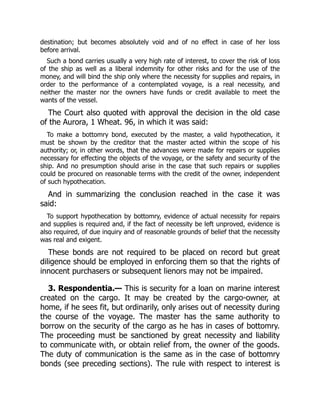
ship, which may be enforced in admiralty in case of her safe arrival at the port of
59.
destination; but becomesabsolutely void and of no effect in case of her loss
before arrival.
Such a bond carries usually a very high rate of interest, to cover the risk of loss
of the ship as well as a liberal indemnity for other risks and for the use of the
money, and will bind the ship only where the necessity for supplies and repairs, in
order to the performance of a contemplated voyage, is a real necessity, and
neither the master nor the owners have funds or credit available to meet the
wants of the vessel.
The Court also quoted with approval the decision in the old case
of the Aurora, 1 Wheat. 96, in which it was said:
To make a bottomry bond, executed by the master, a valid hypothecation, it
must be shown by the creditor that the master acted within the scope of his
authority; or, in other words, that the advances were made for repairs or supplies
necessary for effecting the objects of the voyage, or the safety and security of the
ship. And no presumption should arise in the case that such repairs or supplies
could be procured on reasonable terms with the credit of the owner, independent
of such hypothecation.
And in summarizing the conclusion reached in the case it was
said:
To support hypothecation by bottomry, evidence of actual necessity for repairs
and supplies is required and, if the fact of necessity be left unproved, evidence is
also required, of due inquiry and of reasonable grounds of belief that the necessity
was real and exigent.
These bonds are not required to be placed on record but great
diligence should be employed in enforcing them so that the rights of
innocent purchasers or subsequent lienors may not be impaired.
3. Respondentia.— This is security for a loan on marine interest
created on the cargo. It may be created by the cargo-owner, at
home, if he sees fit, but ordinarily, only arises out of necessity during
the course of the voyage. The master has the same authority to
borrow on the security of the cargo as he has in cases of bottomry.
The proceeding must be sanctioned by great necessity and liability
to communicate with, or obtain relief from, the owner of the goods.
The duty of communication is the same as in the case of bottomry
bonds (see preceding sections). The rule with respect to interest is
60.
the same asthat governing bottomry bonds. The instrument may be
in any form which expresses the facts and conditions; an ordinary
bill of sale may be used or the form of a bottomry bond. The
instrument is not required to be recorded.
The case of Ins. Co. v. Gossler, 6 Otto 645, contains an example of
a bond, which was both bottomry and respondentia. The bark
Frances en route from Java to Boston with a cargo of sugar
encountered a hurricane which compelled the master to cut away
her mast to save the vessel and put into Singapore for repairs.
Destitute of funds and without credit, the master executed a bond
with maritime interest at 27½ per cent., secured upon the boat,
cargo and freight. When nearing the completion of her voyage the
bark was cast away on the shore of Cape Cod. She could not be
salved as an intact vessel, but was sold as a wreck and subsequently
broken up by the purchaser in order to make use of the parts of her.
Some of her cargo was saved. The Court held that the salvaged
portion of the cargo and the wreck as she lay on the beach must
respond to the obligation of the bond, saying that nothing but an
utter annihilation of the thing hypothecated would discharge the
borrower on bottomry, the rule being that the property saved,
whatever it may be in amount, continues subject to hypothecation.
Unless the ship be actually destroyed and the loss to the owners absolute, it is
not an utter loss within the meaning of such a contract. If the ship still exists,
although in such a state of damage as to be constructively totally lost, within the
meaning of a policy of insurance; ... she is not utterly lost within the meaning of
that phrase in the contract of hypothecation.
Thus, the doctrine of "constructive total loss," which is important
in the law of marine insurance, has no application to bottomry. It is
customary in bottomry and respondentia bonds to insert a clause
reserving to the lender, in case of utter loss, any average that may
be secured upon all salvage recoverable.
4. Necessity for Advances.— The lender of money on a
bottomry bond is under obligation to satisfy himself that the supplies
or refitment for which the money is borrowed are necessarily
61.
required by thevessel. The act of June 23, 1910 (discussed in § 9 of
preceding chapter), apparently has no application to money
advanced on bottomry bonds and certainly has no application to
respondentia bonds. If the actual need for the advance sought to be
secured by the bottomry or respondential bond does not exist, the
bond will not constitute a lien upon the vessel or cargo.
5. Mortgages.— These are species of chattel mortgages. The
ship is a chattel or personal property, for many purposes. Prior to
June 5, 1920, these mortgages were not recognized as maritime
transactions. The Merchant Marine Act of that date makes radical
changes in the law governing ship mortgages. The new provisions
are to be found in Section 30, which is to be cited, independently of
the rest of the statute, as the "Ship Mortgage Act, 1920," and is
printed in full with the rest of the Merchant Marine Act in the
Appendix.
6. Are Mortgages Maritime Contracts?— An ordinary
mortgage upon a vessel, whether made to secure the purchase
money or to obtain funds for general purposes, is not a maritime
contract. This is the rule in this country, as announced by the
Supreme Court in the J. E. Rumbell, 148 U. S. 1, although it is
different under the general maritime law in other countries.
Accordingly, courts of admiralty in the United States, have no
jurisdiction of a libel to foreclose a mortgage or to enforce title or
right to possession under it. If, however, the ship has been sold
under admiralty process, and there are proceeds in the registry after
satisfying maritime liens, the court will pay over the surplus, to a
mortgagee in preference to the owner or general creditors.
The Ship Mortgage Act (supra) makes a sweeping exception to the
foregoing rule in cases of American vessels where the mortgagee is
an American citizen and where the parties fulfill certain formalities
required by the Act and discussed in the next section. The Act
provides that these mortgages shall be known as "preferred
mortgages" and confers upon the courts of admiralty exclusive
62.
jurisdiction to foreclosethem. There has yet been no judicial
interpretation of this Act. Some doubt may be entertained whether it
is within the power of Congress to convert ship mortgages into
maritime contracts; that is to say, can Congress take a transaction,
which has always been regarded as wholly foreign to the admiralty
and confer upon it a maritime quality? The decision of this point is of
the utmost importance and will be awaited with the greatest concern
by every one interested in ships and shipping.
7. When Postponed to Other Liens.— An ordinary vessel
mortgage is a very inferior grade of security because it is
subordinate to all maritime liens and has only a qualified and
dubious standing in the only courts which enforce them. One who
advances money to a ship or her owner on mortgage is bound to
know that the ship navigates on credit, and must continue to
accumulate liens in order to earn freight, and that she may be
pledged for bottomry or incur liability for torts. He is therefore
postponed to sailors' wages, salvage, towage, advances, bottomry,
general average, repairs, supplies, collision, personal injury, damage
to cargo, breach of contract, penalties, and liens created by local law
which the admiralty will enforce.
Here again the Ship Mortgage Act, 1920, makes a radical change
in the case of "preferred mortgages" given upon American vessels to
secure American investors. The Act makes the lien of a "preferred
mortgage" inferior to liens of prior date and liens for damages
arising out of tort, for wages of stevedores when employed directly
by the owner, operator, master, ship's husband, or agent of the
vessel, for wages of crew, general average and salvage, including
contract salvage; but superior to all other liens, such for example as
repairs, supplies, towage, pilotage, etc.
8. Form.— No particular form is essential to a vessel mortgage
except that the requisites of the Federal Statutes in regard to
recording and conveyance must be observed if it is to be placed on
record in the office of a collector of customs. They require that every
63.
instrument in thenature of a bill of sale or other conveyance or
incumbrance of any ship or vessel, shall be duly acknowledged
before a notary public or other officer authorized to take
acknowledgments of deeds (7 U. S. Comp. St. §§ 7778, 7779). It
should contain a copy of the last certificate of registration or
enrollment. Government blank mortgages can usually be obtained at
the custom house and are preferred, although any instrument
following their general form will be sufficient. A bill of sale may be
used, although absolute in its terms, and the fact that it is only
security can be shown by parole.
Trust-deeds or mortgages securing issues of bonds are in general
use where large amounts are involved. These forms are very
elaborate and resemble railroad mortgages in their elaborate details.
In all vessel mortgages, important provisions are those in regard to
the insurance, the amount of liens which the ship may incur, the
waters which she may navigate, and the rights of the mortgagee on
default. It is desirable to provide for contingencies, as far as
possible, by clear and definite agreements in the instruments.
To entitle a mortgage of an American vessel to an American
mortgagee to the status of a "preferred mortgage" under the Ship
Mortgage Act, 1920, giving its lien the superiority described in the
preceding section, it is necessary that it should be recorded; that an
affidavit be filed at the time of recordation to the effect that the
mortgage is made in good faith and without design to hinder, delay
or defraud any existing or future creditor of the mortgagor or any
lienor; and that there be endorsed upon the ship's documents the
names of the mortgagor and mortgagee, the time and date of the
endorsement; the amount and date of the maturity of the mortgage.
The formalities to be observed in the creation of "preferred
mortgages" are described in detail in the Act which is printed in full
in the Appendix and should be observed with scrupulous exactness.
9. Recording.— No mortgage of any vessel of the United States
is valid against third parties unless it is duly recorded in the office of
the collector of customs where such vessel is registered or enrolled.




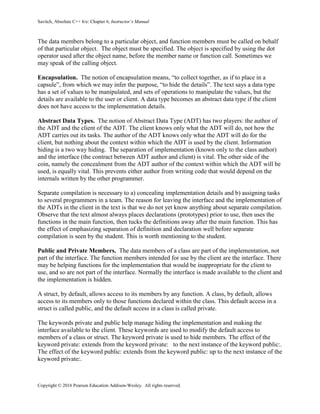
![Savitch, Absolute C++ 6/e: Chapter 6, Instructor’s Manual
Copyright © 2016 Pearson Education Addison-Wesley. All rights reserved.
// 90 or more A
// 80 or more B
// 70 or more C
// 60 or more D
// less than 60, F
//
// Read a student's scores,
// output record: scores + numeric average + assigned letter grade
//
// Use a struct to contain student record.
struct StudentRecord
{
int studentNumber;
double quiz1;
double quiz2;
double midterm;
double final;
double average;
char grade;
};
//prompts for input for one student, sets the
//structure variable members.
void input(StudentRecord& student);
//calculates the numeric average and letter grade.
void computeGrade(StudentRecord& student);
//outputs the student record.
void output(const StudentRecord student);
int main()
{
StudentRecord student[CLASS_SIZE];
for(int i = 0; i < CLASS_SIZE; i++)
input(student[i]);
// Enclosing block fixes VC++ "for" loop control defined outside loop
{ for(int i = 0; i < CLASS_SIZE; i++)
{
computeGrade(student[i]);
output(student[i]);
cout << endl;
}
}
return 0;
}
void input(StudentRecord &student)
{
cout << "enter the student number: ";
cin >> student.studentNumber;
cout << student.studentNumber << endl;
cout << "enter two 10 point quizes" << endl;
cin >> student.quiz1 >> student.quiz2;](https://image.slidesharecdn.com/10353-250416110735-573f4fe5/85/Absolute-C-6th-Edition-Savitch-Solutions-Manual-11-320.jpg)
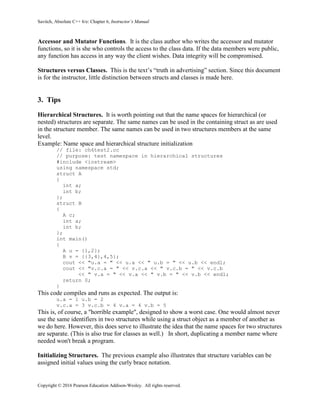
![Savitch, Absolute C++ 6/e: Chapter 6, Instructor’s Manual
Copyright © 2016 Pearson Education Addison-Wesley. All rights reserved.
cout << student.quiz1 << " " << student.quiz2 << endl;
cout << "enter the midterm and final exam grades."
<< "These are 100 point testsn";
cin >> student.midterm >> student.final;
cout << student.midterm << " " << student.final
<< endl << endl;
}
void computeGrade(StudentRecord& student)
{
// Of grade, final counts 50%, midterm 25%, quizes25%
double quizAvg= (student.quiz1 + student.quiz2)/2.0;
double quizAvgNormalized = quizAvg * 10;
student.average = student.final * 0.5 +
student.midterm * 0.25 +
quizAvgNormalized * 0.25;
char letterGrade[]= "FFFFFFDCBAA";
int index = static_cast<int>(student.average/10);
if(index < 0 || 10 <= index)
{
cout << "Bad numeric grade encountered: "
<< student.average << endl
<< " Aborting.n";
abort();
}
student.grade = letterGrade[index];
}
void output(const StudentRecord student)
{
cout << "The record for student number: "
<< student.studentNumber << endl
<< "The quiz grades are: "
<< student.quiz1 << " " << student.quiz2
<< endl
<< "The midterm and exam grades are: "
<< student.midterm << " " << student.final
<< endl
<< "The numeric average is: " << student.average
<< endl
<< "and the letter grade assigned is "
<< student.grade
<< endl;
}
Data for the test run:
1 7 10 90 95
2 9 8 90 80
3 7 8 70 80
4 5 8 50 70
5 4 0 40 35
Command line command to execute the text run:](https://image.slidesharecdn.com/10353-250416110735-573f4fe5/85/Absolute-C-6th-Edition-Savitch-Solutions-Manual-12-320.jpg)
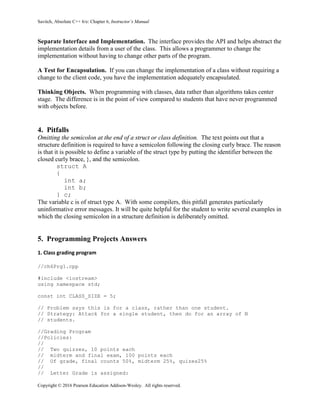
![Savitch, Absolute C++ 6/e: Chapter 6, Instructor’s Manual
Copyright © 2016 Pearson Education Addison-Wesley. All rights reserved.
string getName();
int getScore();
private:
string name;
int score;
};
void Player::setName(string newname)
{
name = newname;
}
void Player::setScore(int newscore)
{
score = newscore;
}
string Player::getName()
{
return name;
}
int Player::getScore()
{
return score;
}
void getHighScores(Player players[]);
void sort(Player players[], int numberUsed);
void swapValues(Player& v1, Player& v2);
int indexOfLargest(Player players[], int startIndex, int numberUsed);
int main( )
{
Player players[100];
getHighScores(players);
// Output the top 3
for (int i = 0; i < 3; i++)
{
cout << players[i].getName() <<
" " << players[i].getScore() << endl;
}
return 0;
}
// Assumes that the array is large enough to
// hold the input data.
void getHighScores(Player players[])
{
int numScores = 0;](https://image.slidesharecdn.com/10353-250416110735-573f4fe5/85/Absolute-C-6th-Edition-Savitch-Solutions-Manual-36-320.jpg)
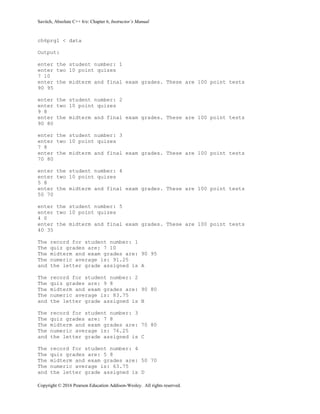
![Savitch, Absolute C++ 6/e: Chapter 6, Instructor’s Manual
Copyright © 2016 Pearson Education Addison-Wesley. All rights reserved.
string curname;
int curscore;
fstream inputStream;
inputStream.open("scores.txt");
while (inputStream >> curname)
{
inputStream >> curscore;
players[numScores].setScore(curscore);
players[numScores].setName(curname);
numScores++;
}
sort(players, numScores);
}
void sort(Player players[], int numberUsed)
{
int indexOfNextLargest;
for (int index = 0; index < numberUsed - 1; index++)
{
indexOfNextLargest =
indexOfLargest(players, index, numberUsed);
swapValues(players[index], players[indexOfNextLargest]);
}
}
void swapValues(Player& v1, Player& v2)
{
Player temp;
temp = v1;
v1 = v2;
v2 = temp;
}
int indexOfLargest(Player players[], int startIndex, int numberUsed)
{
int max = players[startIndex].getScore(),
indexOfMax = startIndex;
for (int index = startIndex + 1; index < numberUsed; index++)
if (players[index].getScore() > max)
{
max = players[index].getScore();
indexOfMax = index;
}
return indexOfMax;
}](https://image.slidesharecdn.com/10353-250416110735-573f4fe5/85/Absolute-C-6th-Edition-Savitch-Solutions-Manual-37-320.jpg)
![Savitch, Absolute C++ 6/e: Chapter 6, Instructor’s Manual
Copyright © 2016 Pearson Education Addison-Wesley. All rights reserved.
12. Box of Produce
Your Community Supported Agriculture (CSA) farm delivers a box of fresh fruits and
vegetables to your house once a week. For this Programming Project, define the class
BoxOfProduce that contains exactly three bundles of fruits or vegetables. You can represent
the fruits or vegetables as an array of type string. Add accessor and mutator functions to get
or set the fruits or vegetables stored in the array. Also write an output function that displays
the complete contents of the box on the console.
Next write a main function that creates a BoxOfProduce with three items randomly selected
from this list:
Broccoli
Tomato
Kiwi
Kale
Tomatillo
This list should be stored in a text file that is read in by your program. For now you can assume
that the list contains exactly five types of fruits or vegetables.
Don't worry if your program randomly selects duplicate produce for the three items. Next, the
main function should display the contents of the box and allow the user to substitute any one of
the five possible fruits or vegetables for any of the fruits or vegetables selected for the box.
After the user is done with substitutions output the final contents of the box to be delivered.
#include <iostream>
#include <fstream>
#include <string>
#include <cstdlib>
using namespace std;
// Max number of bundles in a box
const int MAX_BUNDLES = 100;
class BoxOfProduce
{
private:
int numBundles;
string bundle[MAX_BUNDLES];
public:
void initialize();
void addBundle(string b);
string getBundle(int index);
void setBundle(string b, int index);
string boxContents();
};
// This is better done in a constructor but
// that topic has not been covered yet
void BoxOfProduce::initialize()](https://image.slidesharecdn.com/10353-250416110735-573f4fe5/85/Absolute-C-6th-Edition-Savitch-Solutions-Manual-38-320.jpg)
![Savitch, Absolute C++ 6/e: Chapter 6, Instructor’s Manual
Copyright © 2016 Pearson Education Addison-Wesley. All rights reserved.
{
numBundles = 0;
}
void BoxOfProduce::addBundle(string b)
{
if (numBundles < MAX_BUNDLES)
{
bundle[numBundles] = b;
numBundles++;
}
}
string BoxOfProduce::getBundle(int index)
{
if ((index >=0) && (index < MAX_BUNDLES))
return bundle[index];
else
return "";
}
void BoxOfProduce::setBundle(string b, int index)
{
if ((index >=0) && (index < MAX_BUNDLES))
bundle[index] = b;
}
// '0'+i+1 converted to a char is an ASCII digit, converted to a string
// stringstream is another way to convert an int to a string
string BoxOfProduce::boxContents()
{
string s = "The box contains: ";
for (int i = 0; i < numBundles; i++)
s = s + " (" + char('0'+i+1) + ")" + bundle[i];
return s;
}
int main()
{
// Create a Box
BoxOfProduce box;
box.initialize();
// Initialize the random number generator
srand(time(NULL));
// Pick three random numbers from 0 to 4 for the 5 possible food
choices
int num1, num2, num3;
num1 = rand() % 5;
num2 = rand() % 5;
num3 = rand() % 5;
int lineRead = 0;
ifstream inputStream;
inputStream.open("produce.txt");](https://image.slidesharecdn.com/10353-250416110735-573f4fe5/85/Absolute-C-6th-Edition-Savitch-Solutions-Manual-39-320.jpg)

![REFERENCES FOR GENERAL READING
Admiralty (1910), Benedict, Chapter XXXV.
Carriers, Wheeler, Chapters I-III.
Admiralty, Hughes, Chapters VIII and XVI.
Collisions at Sea, Marsden (1904), Chapter VII.
Limitation of Liability, Van Santvoord, 1887.
Rebecca-Ware (Fed. Cas. No. 11,629).
Trans. Co. v. Wright, 13 Wall. 104.
Benefactor, 103 U. S. 247.
Scotland, 105 U. S. 24.
City of Norwich, 118 U. S. 468.
O'Brien v. Miller, 168 U. S. 287.
La Bourgogne, 210 U. S. 95.
Richardson v. Harmon, 222 U. S. 96.
Pendleton v. Benner Line, 246 U. S. 353.
[17] Liability does not extend to parts of a tow having no motive power of their own
when attached to a tug whose faulty navigation caused a collision even though the
damage resulted from the impact of the tow and the tug itself did not physically come
into collision at all, and this is so notwithstanding the tug belongs to the same owner.
Liverpool &c. Navigation Co. v. Brooklyn Eastern Dist. Terminal, U. S. Advance Sheets,
1919-20, 85, decided by the Supreme Court December 8, 1919.
[18] Justice Holmes in Liverpool, etc., Navigation Co. v. Brooklyn Eastern Dist.
Terminal (supra).](https://image.slidesharecdn.com/10353-250416110735-573f4fe5/85/Absolute-C-6th-Edition-Savitch-Solutions-Manual-41-320.jpg)
![383). The lien has been sustained against a dredge. (Atlantic, 53
Fed. 607).
9. Priorities.— Important priorities exist among maritime liens
and these are adjusted when the ship is sold in admiralty to satisfy
her debts. The purchaser at an admiralty sale, as elsewhere stated,
takes the ship free of all existing liens; the proceeds of the sale are
distributed among the lienors according to their priorities, after
deducting costs and expenses.
Liens for torts take precedence over all prior liens, and the later
lien for tort will be preferred to an earlier if there has been an
absence of diligence in enforcing it. The John G. Stevens, 170 U. S.
113, is the leading case on the priority of liens against the offending
vessel for torts committed by her. Mr. Justice Gray held:
But the question we have to deal with is whether the lien for damages by the
collision is to be preferred to the lien for supplies furnished before the collision.
* * * * *
The collision, as soon as it takes place, creates, as security for the damages, a
maritime lien or privilege, jus in re, a proprietary interest in the offending ship,
and which, when enforced by admiralty process in rem, relates back to the time of
the collision. The offending ship is considered as herself the wrongdoer, and is
herself bound to make compensation for the wrong done. The owner of the
injured vessel is entitled to proceed in rem against the offender, without regard to
the question who may be her owners, or to the division, the nature, or the extent
of their interests in her. With the relations of the owners of those interests, as
among themselves, the owner of the injured vessel has no concern. All the
interests existing at the time of the collision in the offending vessel, whether by
way of part ownership, of mortgage, of bottomry bond, or of other maritime liens
for repairs or supplies, arising out of contract with the owners or agents of the
vessel, are parts of the vessel herself, and as such are bound by and responsible
for her wrongful acts. Any one who had furnished necessary supplies to the vessel
before the collision, and had thereby acquired, under our law, a maritime lien or
privilege in the vessel herself, was, as was said in The Bold Buccleugh [7 Moore
P. C. 267] before cited, of the holder of an earlier bottomry bond, under the law of
England, "so to speak, a part owner in interest at the date of the collision and the
ship in which he and others were interested was liable to its value at that date for
the injury done without reference to his claim [7 Moore P. C. 285]."](https://image.slidesharecdn.com/10353-250416110735-573f4fe5/85/Absolute-C-6th-Edition-Savitch-Solutions-Manual-47-320.jpg)