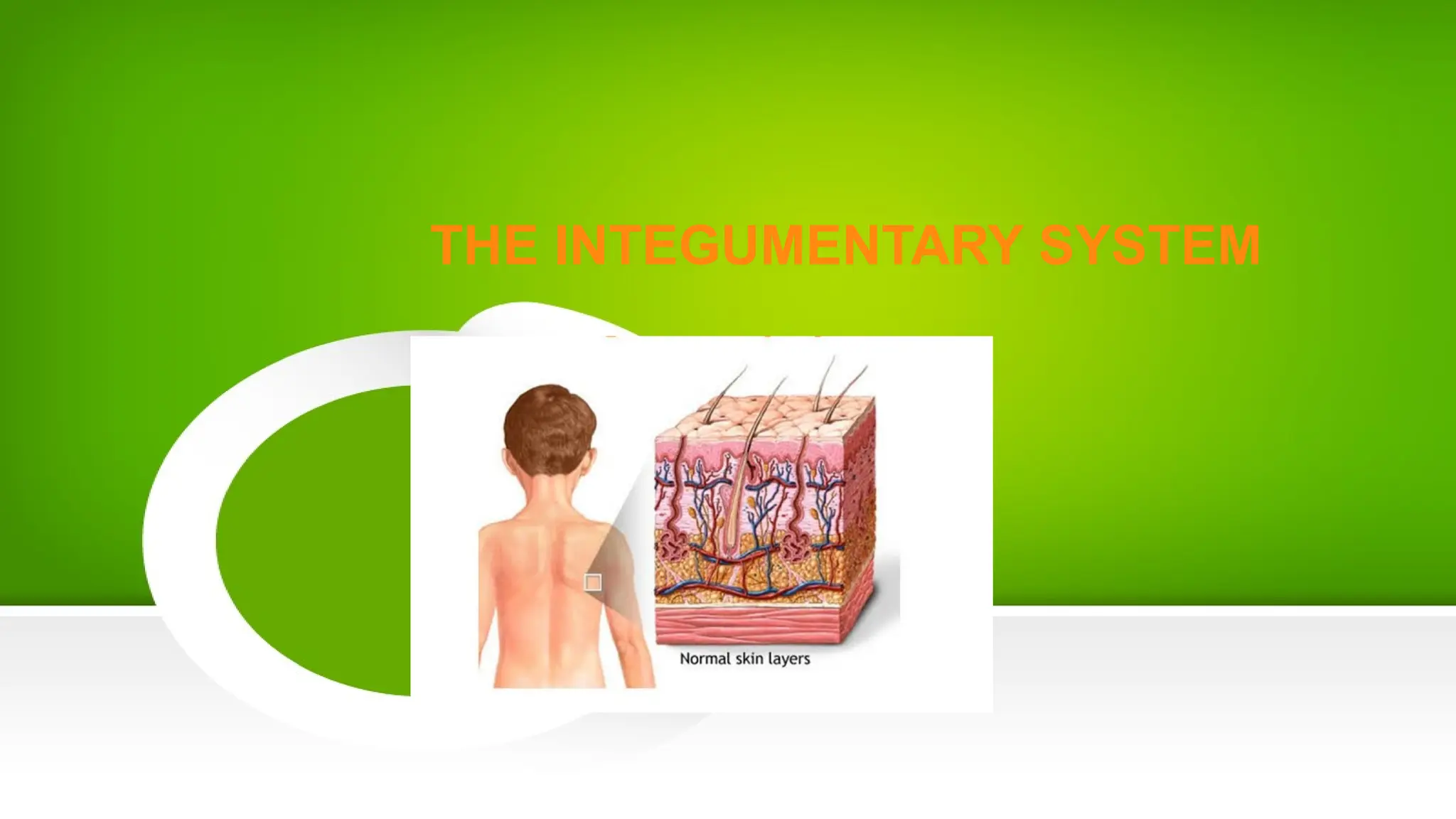
THE INTEGUMENTARY SYSTEM
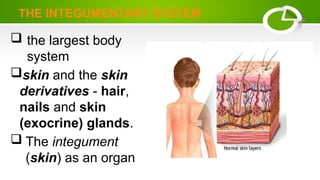
 the largest body
system
skin and the skin
derivatives - hair,
nails and skin
(exocrine) glands.
 The integument
(skin) as an organ
THE INTEGUMENTARY SYSTEM
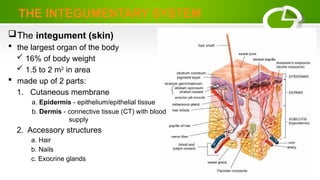
The integument (skin)
 the largest organ of the body
 16% of body weight
 1.5 to 2 m2
in area
 made up of 2 parts:
1. Cutaneous membrane
a. Epidermis - epithelium/epithelial tissue
b. Dermis - connective tissue (CT) with blood
supply
2. Accessory structures
a. Hair
b. Nails
c. Exocrine glands
Functions of the Integumentary System
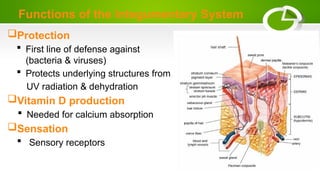
Protection
 First line of defense against
(bacteria & viruses)
 Protects underlying structures from
UV radiation & dehydration
Vitamin D production
 Needed for calcium absorption
Sensation
 Sensory receptors
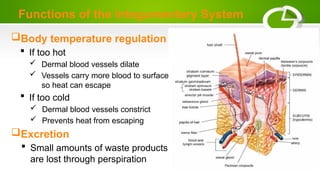
Body temperature regulation
 If too hot
 Dermal blood vessels dilate
 Vessels carry more blood to surface
so heat can escape
 If too cold
 Dermal blood vessels constrict
 Prevents heat from escaping
Excretion
 Small amounts of waste products
are lost through perspiration
Functions of the Integumentary System
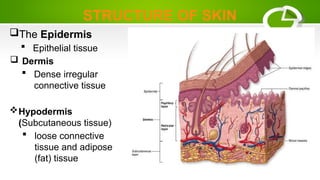
STRUCTURE OF SKIN
The Epidermis
 Epithelial tissue
 Dermis
 Dense irregular
connective tissue
Hypodermis
(Subcutaneous tissue)
 loose connective
tissue and adipose
(fat) tissue
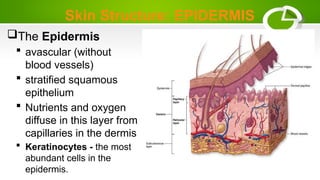
Skin Structure: EPIDERMIS
The Epidermis
 avascular (without
blood vessels)
 stratified squamous
epithelium
 Nutrients and oxygen
diffuse in this layer from
capillaries in the dermis
 Keratinocytes - the most
abundant cells in the
epidermis.
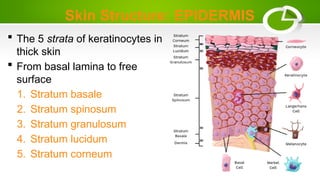
Skin Structure: EPIDERMIS
 The 5 strata of keratinocytes in
thick skin
 From basal lamina to free
surface
1. Stratum basale
2. Stratum spinosum
3. Stratum granulosum
4. Stratum lucidum
5. Stratum corneum
Skin Structure: EPIDERMIS
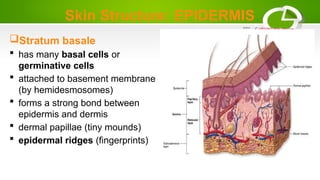
Stratum basale
 has many basal cells or
germinative cells
 attached to basement membrane
(by hemidesmosomes)
 forms a strong bond between
epidermis and dermis
 dermal papillae (tiny mounds)
 epidermal ridges (fingerprints)
Skin Structure: EPIDERMIS
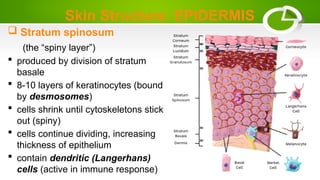
 Stratum spinosum
(the “spiny layer”)
 produced by division of stratum
basale
 8-10 layers of keratinocytes (bound
by desmosomes)
 cells shrink until cytoskeletons stick
out (spiny)
 cells continue dividing, increasing
thickness of epithelium
 contain dendritic (Langerhans)
cells (active in immune response)
Skin Structure: EPIDERMIS
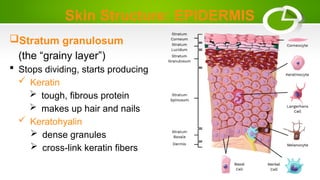
Stratum granulosum
(the “grainy layer”)
 Stops dividing, starts producing
 Keratin
 tough, fibrous protein
 makes up hair and nails
 Keratohyalin
 dense granules
 cross-link keratin fibers
Skin Structure: EPIDERMIS
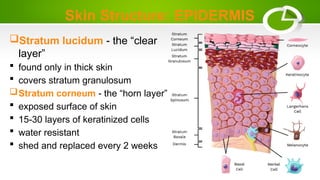
Stratum lucidum - the “clear
layer”
 found only in thick skin
 covers stratum granulosum
Stratum corneum - the “horn layer”
 exposed surface of skin
 15-30 layers of keratinized cells
 water resistant
 shed and replaced every 2 weeks
Skin Structure: EPIDERMIS
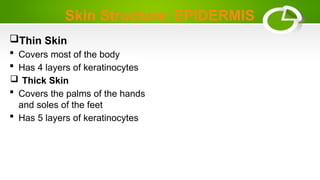
Thin Skin
 Covers most of the body
 Has 4 layers of keratinocytes
 Thick Skin
 Covers the palms of the hands
and soles of the feet
 Has 5 layers of keratinocytes
Skin Structure: DERMIS
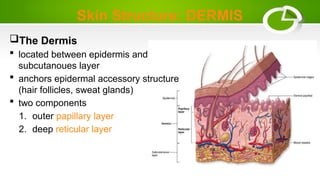
The Dermis
 located between epidermis and
subcutanoues layer
 anchors epidermal accessory structure
(hair follicles, sweat glands)
 two components
1. outer papillary layer
2. deep reticular layer
Skin Structure: DERMIS
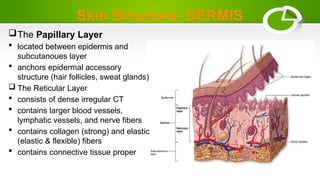
The Papillary Layer
 located between epidermis and
subcutanoues layer
 anchors epidermal accessory
structure (hair follicles, sweat glands)
 The Reticular Layer
 consists of dense irregular CT
 contains larger blood vessels,
lymphatic vessels, and nerve fibers
 contains collagen (strong) and elastic
(elastic & flexible) fibers
 contains connective tissue proper
DERMATITIS
An inflammation of the papillary
layer.
Caused by:
 infection, radiation, mechanical irritation
or chemicals (e.g. poison ivy)
Characterized by itch or pain
Burns (Skin)
• Tissue damage caused by heat, electricity, radiation,
chemicals
• Main threat: loss of fluids (dehydration, electrolyte
imbalance)
• Kidney failure, circulatory shock
• Treatment: replace fluids via IV
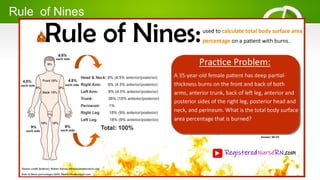
• Rule of Nines: estimating extent of burns
• Divide body into 11 areas
• Each part is 9% of total body area +1% genital region
Rule of Nines
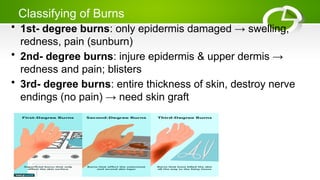
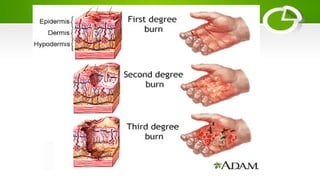
Classifying of Burns
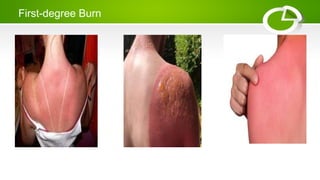
• 1st- degree burns: only epidermis damaged → swelling,
redness, pain (sunburn)
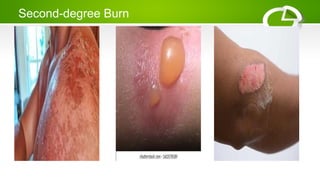
• 2nd- degree burns: injure epidermis & upper dermis →
redness and pain; blisters
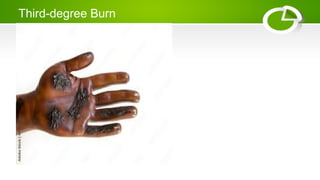
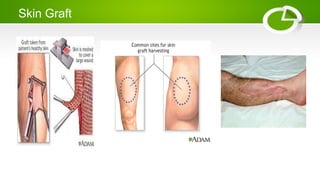
• 3rd- degree burns: entire thickness of skin, destroy nerve
endings (no pain) → need skin graft
First-degree Burn
Second-degree Burn
Third-degree Burn
Critical Burn
• >25% of body with 2nd degree burns
• >10% of body with 3rd degree burns
• 3rd degree burns on face, hands, feet
• Face: swelling of respiratory passages → suffocation
• Joints: scar tissue formation limits mobility
Skin Graft
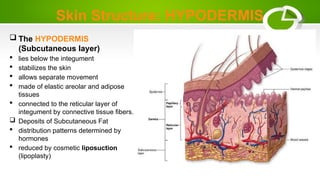
Skin Structure: HYPODERMIS
 The HYPODERMIS
(Subcutaneous layer)
 lies below the integument
 stabilizes the skin
 allows separate movement
 made of elastic areolar and adipose
tissues
 connected to the reticular layer of
integument by connective tissue fibers.
 Deposits of Subcutaneous Fat
 distribution patterns determined by
hormones
 reduced by cosmetic liposuction
(lipoplasty)
Skin Structure
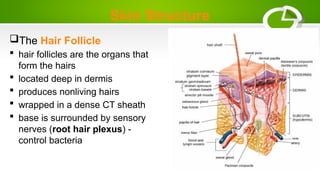
The Hair Follicle
 hair follicles are the organs that
form the hairs
 located deep in dermis
 produces nonliving hairs
 wrapped in a dense CT sheath
 base is surrounded by sensory
nerves (root hair plexus) -
control bacteria
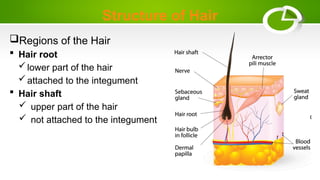
Structure of Hair
Regions of the Hair
 Hair root
lower part of the hair
attached to the integument
 Hair shaft
 upper part of the hair
 not attached to the integument
Hair Function
Head
 UV protection
 cushion from trauma
 insulation
 Nostrils, Ear canals and Eyelashes
 prevent entry of foreign material
 Root hair plexus
 sensory nerves at base of hair follicle that detect slight
movement of hair
 Arrector pili muscle
 attached to every hair follicle
 contract to stand hair perpendicular to skin surface
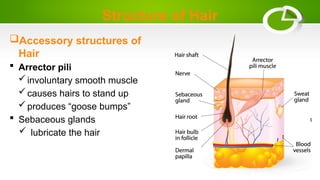
Structure of Hair
Accessory structures of
Hair
 Arrector pili
involuntary smooth muscle
causes hairs to stand up
produces “goose bumps”
 Sebaceous glands
 lubricate the hair
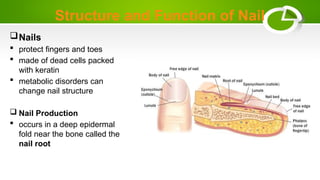
Structure and Function of Nail
Nails
 protect fingers and toes
 made of dead cells packed
with keratin
 metabolic disorders can
change nail structure
 Nail Production
 occurs in a deep epidermal
fold near the bone called the
nail root
- End -

LEC2 THE INTEGUMENTARY SYSTEM_Skin&.pptx

  • 1.
  • 2.
    THE INTEGUMENTARY SYSTEM the largest body system skin and the skin derivatives - hair, nails and skin (exocrine) glands.  The integument (skin) as an organ
  • 3.
    THE INTEGUMENTARY SYSTEM Theintegument (skin)  the largest organ of the body  16% of body weight  1.5 to 2 m2 in area  made up of 2 parts: 1. Cutaneous membrane a. Epidermis - epithelium/epithelial tissue b. Dermis - connective tissue (CT) with blood supply 2. Accessory structures a. Hair b. Nails c. Exocrine glands
  • 4.
    Functions of theIntegumentary System Protection  First line of defense against (bacteria & viruses)  Protects underlying structures from UV radiation & dehydration Vitamin D production  Needed for calcium absorption Sensation  Sensory receptors
  • 5.
    Body temperature regulation If too hot  Dermal blood vessels dilate  Vessels carry more blood to surface so heat can escape  If too cold  Dermal blood vessels constrict  Prevents heat from escaping Excretion  Small amounts of waste products are lost through perspiration Functions of the Integumentary System
  • 6.
    STRUCTURE OF SKIN TheEpidermis  Epithelial tissue  Dermis  Dense irregular connective tissue Hypodermis (Subcutaneous tissue)  loose connective tissue and adipose (fat) tissue
  • 7.
    Skin Structure: EPIDERMIS TheEpidermis  avascular (without blood vessels)  stratified squamous epithelium  Nutrients and oxygen diffuse in this layer from capillaries in the dermis  Keratinocytes - the most abundant cells in the epidermis.
  • 8.
    Skin Structure: EPIDERMIS The 5 strata of keratinocytes in thick skin  From basal lamina to free surface 1. Stratum basale 2. Stratum spinosum 3. Stratum granulosum 4. Stratum lucidum 5. Stratum corneum
  • 9.
    Skin Structure: EPIDERMIS Stratumbasale  has many basal cells or germinative cells  attached to basement membrane (by hemidesmosomes)  forms a strong bond between epidermis and dermis  dermal papillae (tiny mounds)  epidermal ridges (fingerprints)
  • 10.
    Skin Structure: EPIDERMIS Stratum spinosum (the “spiny layer”)  produced by division of stratum basale  8-10 layers of keratinocytes (bound by desmosomes)  cells shrink until cytoskeletons stick out (spiny)  cells continue dividing, increasing thickness of epithelium  contain dendritic (Langerhans) cells (active in immune response)
  • 11.
    Skin Structure: EPIDERMIS Stratumgranulosum (the “grainy layer”)  Stops dividing, starts producing  Keratin  tough, fibrous protein  makes up hair and nails  Keratohyalin  dense granules  cross-link keratin fibers
  • 12.
    Skin Structure: EPIDERMIS Stratumlucidum - the “clear layer”  found only in thick skin  covers stratum granulosum Stratum corneum - the “horn layer”  exposed surface of skin  15-30 layers of keratinized cells  water resistant  shed and replaced every 2 weeks
  • 13.
    Skin Structure: EPIDERMIS ThinSkin  Covers most of the body  Has 4 layers of keratinocytes  Thick Skin  Covers the palms of the hands and soles of the feet  Has 5 layers of keratinocytes
  • 14.
    Skin Structure: DERMIS TheDermis  located between epidermis and subcutanoues layer  anchors epidermal accessory structure (hair follicles, sweat glands)  two components 1. outer papillary layer 2. deep reticular layer
  • 15.
    Skin Structure: DERMIS ThePapillary Layer  located between epidermis and subcutanoues layer  anchors epidermal accessory structure (hair follicles, sweat glands)  The Reticular Layer  consists of dense irregular CT  contains larger blood vessels, lymphatic vessels, and nerve fibers  contains collagen (strong) and elastic (elastic & flexible) fibers  contains connective tissue proper
  • 16.
    DERMATITIS An inflammation ofthe papillary layer. Caused by:  infection, radiation, mechanical irritation or chemicals (e.g. poison ivy) Characterized by itch or pain
  • 17.
    Burns (Skin) • Tissuedamage caused by heat, electricity, radiation, chemicals • Main threat: loss of fluids (dehydration, electrolyte imbalance) • Kidney failure, circulatory shock • Treatment: replace fluids via IV • Rule of Nines: estimating extent of burns • Divide body into 11 areas • Each part is 9% of total body area +1% genital region
  • 18.
  • 19.
    Classifying of Burns •1st- degree burns: only epidermis damaged → swelling, redness, pain (sunburn) • 2nd- degree burns: injure epidermis & upper dermis → redness and pain; blisters • 3rd- degree burns: entire thickness of skin, destroy nerve endings (no pain) → need skin graft
  • 21.
  • 22.
  • 23.
  • 24.
    Critical Burn • >25%of body with 2nd degree burns • >10% of body with 3rd degree burns • 3rd degree burns on face, hands, feet • Face: swelling of respiratory passages → suffocation • Joints: scar tissue formation limits mobility
  • 25.
  • 26.
    Skin Structure: HYPODERMIS The HYPODERMIS (Subcutaneous layer)  lies below the integument  stabilizes the skin  allows separate movement  made of elastic areolar and adipose tissues  connected to the reticular layer of integument by connective tissue fibers.  Deposits of Subcutaneous Fat  distribution patterns determined by hormones  reduced by cosmetic liposuction (lipoplasty)
  • 27.
    Skin Structure The HairFollicle  hair follicles are the organs that form the hairs  located deep in dermis  produces nonliving hairs  wrapped in a dense CT sheath  base is surrounded by sensory nerves (root hair plexus) - control bacteria
  • 28.
    Structure of Hair Regionsof the Hair  Hair root lower part of the hair attached to the integument  Hair shaft  upper part of the hair  not attached to the integument
  • 29.
    Hair Function Head  UVprotection  cushion from trauma  insulation  Nostrils, Ear canals and Eyelashes  prevent entry of foreign material  Root hair plexus  sensory nerves at base of hair follicle that detect slight movement of hair  Arrector pili muscle  attached to every hair follicle  contract to stand hair perpendicular to skin surface
  • 30.
    Structure of Hair Accessorystructures of Hair  Arrector pili involuntary smooth muscle causes hairs to stand up produces “goose bumps”  Sebaceous glands  lubricate the hair
  • 31.
    Structure and Functionof Nail Nails  protect fingers and toes  made of dead cells packed with keratin  metabolic disorders can change nail structure  Nail Production  occurs in a deep epidermal fold near the bone called the nail root
  • 32.

Editor's Notes

  • #6 Understanding how the skin can function in these many ways starts with understanding the structure of the 3 layers of skin.