Analog & Digital Electronics
Course No: PH-218
Lec-5: Bipolar Junction Transistor (BJT)
Course Instructors:
 Dr. A. P. VAJPEYI
Department of Physics,
Indian Institute of Technology Guwahati, India 1
Bipolar Junction Transistor (BJT)
 Beside diodes, the most popular semiconductor devices is transistors. Eg:
Bipolar Junction Transistor (BJT)
 Few most important applications of transistor are: as an amplifier as an
oscillator and as a switch
 Amplification can make weak signal strong in general, provide function
called Gain
2
called Gain
 BJT is bipolar because both holes (+) and electrons (-) will take part in the
current flow through the device
– N-type regions contains free electrons (negative carriers)
– P-type regions contains free holes (positive carriers)
Bipolar Junction Transistor (BJT)
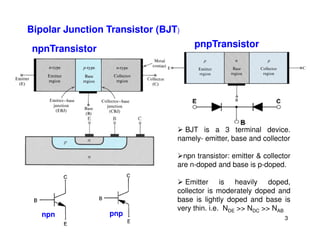
npnTransistor pnpTransistor
 BJT is a 3 terminal device.
namely- emitter, base and collector
npn transistor: emitter  collector
are n-doped and base is p-doped.
 Emitter is heavily doped,
collector is moderately doped and
base is lightly doped and base is
very thin. i.e. NDE  NDC  NAB
npn pnp
3
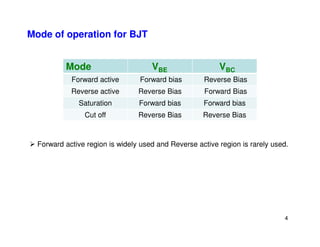
Mode of operation for BJT
Mode VBE VBC
Forward active Forward bias Reverse Bias
Reverse active Reverse Bias Forward Bias
Saturation Forward bias Forward bias
Cut off Reverse Bias Reverse Bias
 Forward active region is widely used and Reverse active region is rarely used.
4
Different configuration of BJT
Common base configuration
Common emitter configuration
Non-inverting voltage amplifier circuit
5
Common emitter configuration
Common collector configuration
This type of configuration is commonly
known as a Voltage Follower or Emitter
Follower circuit.
Non-inverting voltage amplifier circuit
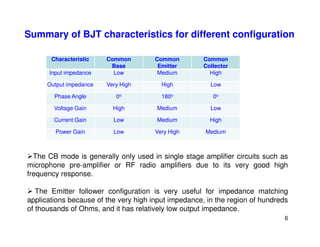
Characteristic Common
Base
Common
Emitter
Common
Collector
Input impedance Low Medium High
Output impedance Very High High Low
Phase Angle 0o 180o 0o
Voltage Gain High Medium Low
Current Gain Low Medium High
Summary of BJT characteristics for different configuration
6
Power Gain Low Very High Medium
The CB mode is generally only used in single stage amplifier circuits such as
microphone pre-amplifier or RF radio amplifiers due to its very good high
frequency response.
 The Emitter follower configuration is very useful for impedance matching
applications because of the very high input impedance, in the region of hundreds
of thousands of Ohms, and it has relatively low output impedance.
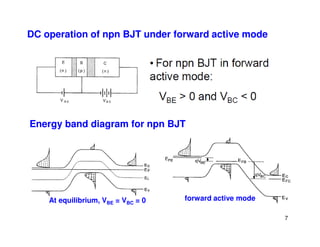
DC operation of npn BJT under forward active mode
Energy band diagram for npn BJT
forward active mode
At equilibrium, VBE = VBC = 0
Energy band diagram for npn BJT
7
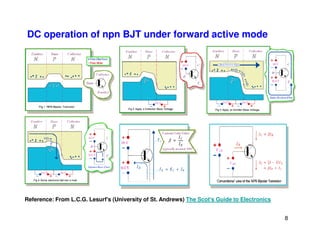
DC operation of npn BJT under forward active mode
8
Reference: From L.C.G. Lesurf's (University of St. Andrews) The Scot's Guide to Electronics
1 2
3
4
E-field
DC operation of npn BJT under forward active mode
1 . Forward bias of EBJ causes electrons to diffuse from emitter into base.
 2. As base region is very thin, the majority of these electrons diffuse to the
edge of the depletion region of CBJ, and then are swept to the collector by the
electric field of the reverse-biased CBJ.
 3. A small fraction of these electrons recombine with the holes in base region.
 4. Holes are injected from base to emitter region. (4)  (1).
9
 The two-carrier flow from [(1) and (4)] forms the emitter current (IE).
DC operation of npn BJT under forward active mode
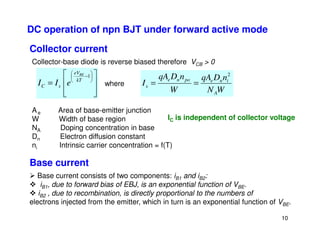
Collector current








=






−1
kT
eV
s
C
BE
e
I
I
W
N
n
D
qA
W
n
D
qA
I
A
i
n
e
po
n
e
s
2
=
=
Collector-base diode is reverse biased therefore VCB  0
where
Ae Area of base-emitter junction
W Width of base region IC is independent of collector voltage
10
NA Doping concentration in base
Dn Electron diffusion constant
ni Intrinsic carrier concentration = f(T)
Base current
 Base current consists of two components: iB1 and iB2:
 iB1, due to forward bias of EBJ, is an exponential function of VBE.
 iB2 , due to recombination, is directly proportional to the numbers of
electrons injected from the emitter, which in turn is an exponential function of VBE.
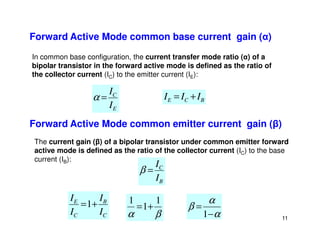
Forward Active Mode common base current gain (α)
In common base configuration, the current transfer mode ratio (α) of a
bipolar transistor in the forward active mode is defined as the ratio of
the collector current (IC) to the emitter current (IE):
E
C
I
I
=
α B
C
E I
I
I +
=
Forward Active Mode common emitter current gain (β)
11
C
B
C
E
I
I
I
I
+
=1
β
α
1
1
1
+
=
α
α
β
−
=
1
Forward Active Mode common emitter current gain (β)
The current gain (β) of a bipolar transistor under common emitter forward
active mode is defined as the ratio of the collector current (IC) to the base
current (IB):
B
C
I
I
=
β
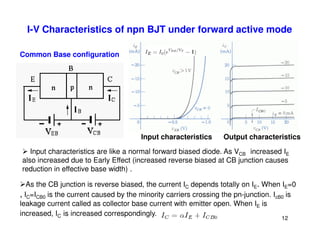
I-V Characteristics of npn BJT under forward active mode
Common Base configuration
12
Input characteristics Output characteristics
 Input characteristics are like a normal forward biased diode. As VCB increased IE
also increased due to Early Effect (increased reverse biased at CB junction causes
reduction in effective base width) .
As the CB junction is reverse biased, the current IC depends totally on IE. When IE=0
, IC=ICB0 is the current caused by the minority carriers crossing the pn-junction. IcB0 is
leakage current called as collector base current with emitter open. When IE is
increased, IC is increased correspondingly.

Lec-5.pdf

  • 1.
    Analog & DigitalElectronics Course No: PH-218 Lec-5: Bipolar Junction Transistor (BJT) Course Instructors: Dr. A. P. VAJPEYI Department of Physics, Indian Institute of Technology Guwahati, India 1
  • 2.
    Bipolar Junction Transistor(BJT) Beside diodes, the most popular semiconductor devices is transistors. Eg: Bipolar Junction Transistor (BJT) Few most important applications of transistor are: as an amplifier as an oscillator and as a switch Amplification can make weak signal strong in general, provide function called Gain 2 called Gain BJT is bipolar because both holes (+) and electrons (-) will take part in the current flow through the device – N-type regions contains free electrons (negative carriers) – P-type regions contains free holes (positive carriers)
  • 3.
    Bipolar Junction Transistor(BJT) npnTransistor pnpTransistor BJT is a 3 terminal device. namely- emitter, base and collector npn transistor: emitter collector are n-doped and base is p-doped. Emitter is heavily doped, collector is moderately doped and base is lightly doped and base is very thin. i.e. NDE NDC NAB npn pnp 3
  • 4.
    Mode of operationfor BJT Mode VBE VBC Forward active Forward bias Reverse Bias Reverse active Reverse Bias Forward Bias Saturation Forward bias Forward bias Cut off Reverse Bias Reverse Bias Forward active region is widely used and Reverse active region is rarely used. 4
  • 5.
    Different configuration ofBJT Common base configuration Common emitter configuration Non-inverting voltage amplifier circuit 5 Common emitter configuration Common collector configuration This type of configuration is commonly known as a Voltage Follower or Emitter Follower circuit. Non-inverting voltage amplifier circuit
  • 6.
    Characteristic Common Base Common Emitter Common Collector Input impedanceLow Medium High Output impedance Very High High Low Phase Angle 0o 180o 0o Voltage Gain High Medium Low Current Gain Low Medium High Summary of BJT characteristics for different configuration 6 Power Gain Low Very High Medium The CB mode is generally only used in single stage amplifier circuits such as microphone pre-amplifier or RF radio amplifiers due to its very good high frequency response. The Emitter follower configuration is very useful for impedance matching applications because of the very high input impedance, in the region of hundreds of thousands of Ohms, and it has relatively low output impedance.
  • 7.
    DC operation ofnpn BJT under forward active mode Energy band diagram for npn BJT forward active mode At equilibrium, VBE = VBC = 0 Energy band diagram for npn BJT 7
  • 8.
    DC operation ofnpn BJT under forward active mode 8 Reference: From L.C.G. Lesurf's (University of St. Andrews) The Scot's Guide to Electronics
  • 9.
    1 2 3 4 E-field DC operationof npn BJT under forward active mode 1 . Forward bias of EBJ causes electrons to diffuse from emitter into base. 2. As base region is very thin, the majority of these electrons diffuse to the edge of the depletion region of CBJ, and then are swept to the collector by the electric field of the reverse-biased CBJ. 3. A small fraction of these electrons recombine with the holes in base region. 4. Holes are injected from base to emitter region. (4) (1). 9 The two-carrier flow from [(1) and (4)] forms the emitter current (IE).
  • 10.
    DC operation ofnpn BJT under forward active mode Collector current         =       −1 kT eV s C BE e I I W N n D qA W n D qA I A i n e po n e s 2 = = Collector-base diode is reverse biased therefore VCB 0 where Ae Area of base-emitter junction W Width of base region IC is independent of collector voltage 10 NA Doping concentration in base Dn Electron diffusion constant ni Intrinsic carrier concentration = f(T) Base current Base current consists of two components: iB1 and iB2: iB1, due to forward bias of EBJ, is an exponential function of VBE. iB2 , due to recombination, is directly proportional to the numbers of electrons injected from the emitter, which in turn is an exponential function of VBE.
  • 11.
    Forward Active Modecommon base current gain (α) In common base configuration, the current transfer mode ratio (α) of a bipolar transistor in the forward active mode is defined as the ratio of the collector current (IC) to the emitter current (IE): E C I I = α B C E I I I + = Forward Active Mode common emitter current gain (β) 11 C B C E I I I I + =1 β α 1 1 1 + = α α β − = 1 Forward Active Mode common emitter current gain (β) The current gain (β) of a bipolar transistor under common emitter forward active mode is defined as the ratio of the collector current (IC) to the base current (IB): B C I I = β
  • 12.
    I-V Characteristics ofnpn BJT under forward active mode Common Base configuration 12 Input characteristics Output characteristics Input characteristics are like a normal forward biased diode. As VCB increased IE also increased due to Early Effect (increased reverse biased at CB junction causes reduction in effective base width) . As the CB junction is reverse biased, the current IC depends totally on IE. When IE=0 , IC=ICB0 is the current caused by the minority carriers crossing the pn-junction. IcB0 is leakage current called as collector base current with emitter open. When IE is increased, IC is increased correspondingly.