CODE OF ETHICS
CODEOF ETHICS
• All students must come to class on time
All students must come to class on time
(Attendance will be taken in first 5 to 10 mins)
(Attendance will be taken in first 5 to 10 mins)
• Students should remain attentive during class and
Students should remain attentive during class and
avoid use of Mobile phone, Laptops or any gadgets
avoid use of Mobile phone, Laptops or any gadgets
• Respect faculty and staff through actions and
Respect faculty and staff through actions and
speech
speech
• Class participation is encouraged
Class participation is encouraged
2
3.
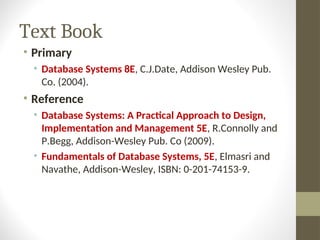
Text Book
• Primary
•Database Systems 8E, C.J.Date, Addison Wesley Pub.
Co. (2004).
• Reference
• Database Systems: A Practical Approach to Design,
Implementation and Management 5E, R.Connolly and
P.Begg, Addison-Wesley Pub. Co (2009).
• Fundamentals of Database Systems, 5E, Elmasri and
Navathe, Addison-Wesley, ISBN: 0-201-74153-9.
4.
Sequence [Todays Agenda]
Contentof Lecture
•Basic Database Concepts (Definitions)
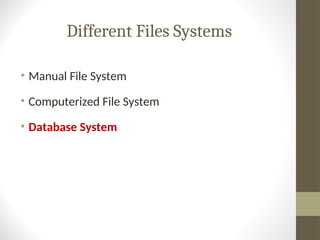
•Different File Systems
•Database and its Advantages
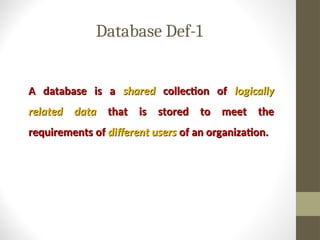
Database Def-1
A databaseis a
A database is a shared
shared collection of
collection of logically
logically
related data
related data that is stored to meet the
that is stored to meet the
requirements of
requirements of different users
different users of an organization.
of an organization.
7.
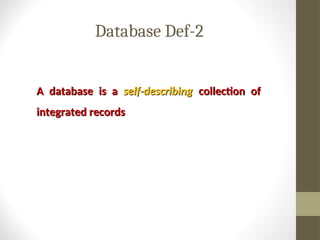
Database Def-2
A databaseis a
A database is a self-describing
self-describing collection of
collection of
integrated records
integrated records
8.
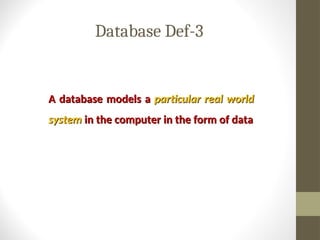
Database Def-3
A databasemodels a
A database models a particular real world
particular real world
system
system in the computer in the form of data
in the computer in the form of data
9.
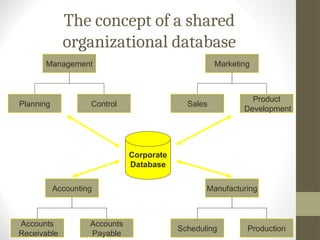
The concept ofa shared
organizational database
Accounting
Accounts
Payable
Accounts
Receivable
Management
Control
Planning
Manufacturing
Production
Scheduling
Marketing
Product
Development
Sales
Corporate
Database
10.
A bit ofHistory
• Computer initially used for computational/
Computer initially used for computational/
engineering purposes.
engineering purposes.
• Commercial applications introduced File Processing
Commercial applications introduced File Processing
System.
System.
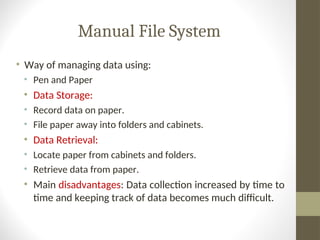
Manual File System
•Way of managing data using:
• Pen and Paper
• Data Storage:
• Record data on paper.
• File paper away into folders and cabinets.
• Data Retrieval:
• Locate paper from cabinets and folders.
• Retrieve data from paper.
• Main disadvantages: Data collection increased by time to
time and keeping track of data becomes much difficult.
13.
Computerized File Processing
System
Acollection of programs that perform services for
A collection of programs that perform services for
the end-users such as production of reports
the end-users such as production of reports
14.
Computerized File Processing
System
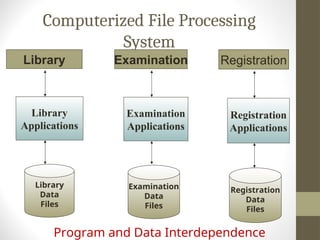
Programand Data Interdependence
Registration
Applications
Registration
Data
Files
Registration
Examination
Applications
Examination
Data
Files
Examination
Library
Applications
Library
Data
Files
Library
15.
Computerized File Processing
System
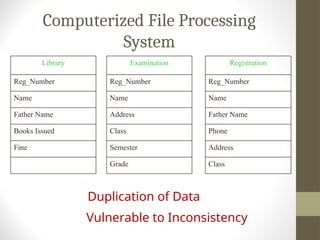
Fine
BooksIssued
Father Name
Name
Reg_Number
Library
Grade
Semester
Class
Address
Name
Reg_Number
Examination
Class
Address
Phone
Father Name
Name
Reg_Number
Registration
Duplication of Data
Vulnerable to Inconsistency
16.
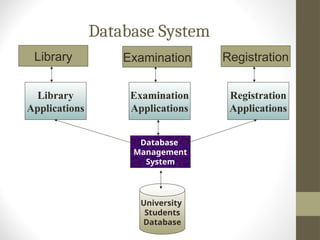
Database System
A databasesystem is a relationship between stored
A database system is a relationship between stored
data, a database, users and the hardware or operating
data, a database, users and the hardware or operating
system used for the storage.
system used for the storage.
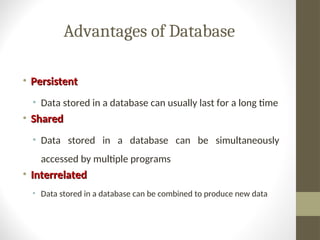
Advantages of Database
•Persistent
Persistent
• Data stored in a database can usually last for a long time
• Shared
Shared
• Data stored in a database can be simultaneously
accessed by multiple programs
• Interrelated
Interrelated
• Data stored in a database can be combined to produce new data
![Sequence [Todays Agenda]
Content of Lecture
•Basic Database Concepts (Definitions)
•Different File Systems
•Database and its Advantages](https://image.slidesharecdn.com/lec1database-250326041509-6e33f9a5/85/Lec-1-Database-Management-system-for-education-ppt-4-320.jpg)