INTRODUCTION TO COMPUTER
APPLICATIONS
LEC# 1
Course code: IT-101
Credit hours: 3.0
Text Book: Introduction toComputers by Peter Norton
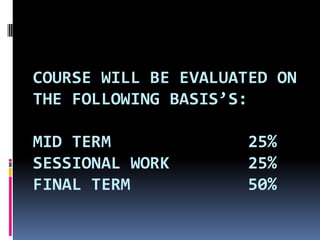
COURSE WILL BE EVALUATED ON
THE FOLLOWING BASIS’S:
MID TERM 25%
SESSIONAL WORK 25%
FINAL TERM 50%
What is Computer?
▪ An electronic machine that get the data as
input, process it and give us information as
output, and store it.
▪ Data
▪ Input
▪ Process
▪ Out put
▪ Information
▪ Storage
ADVANTAGES OF COMPUTERS
▪ High Accuracy
▪ Superior Speed of Operation
▪ Large Storage Capacity
▪ User-friendly Features
▪ Portability
▪ Platform independence
▪ Economical in the long term
Types of Computer
▪ Computers are classified in a variety of ways
depending upon the principles of working,
construction, size and applications.
 Analog Computers
 DigitalComputers
ANALOG COMPUTERS
▪ The computers that process analog signals
are known as Analog Computers.The analog
signal is a continuous signal.
 For example, sine wave is an analog signal.
▪ The analog quantities are based on decimal
number systems.
 Examples ofAnalog computers are theABACUS
etc.
DIGITAL COMPUTERS
▪ Computers that process digital signals are
known as Digital Computers.The Digital
signal is a discrete signal with two states 0
and 1.
▪ In practice, the digital computers are used
and not analog.
 Examples personal computers, supercomputers,
mainframe computers etc.
Computers for Individual Users
▪ Personal Computer
 PC is the term referred to the computer that is
designed for use by a single person.
 PCs are also called microcontrollersbecause these
are smaller when comparedto mainframes and
minicomputers.
 The term ‘PC’ is frequently used to refer to
desktop computers.Although PCs are used by
individuals, they can also be used in computer
networks.
Desktop Computer
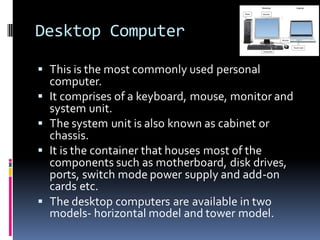
▪ This is the most commonly used personal
computer.
▪ It comprises of a keyboard, mouse, monitor and
system unit.
▪ The system unit is also known as cabinet or
chassis.
▪ It is the container that houses most of the
components such as motherboard, disk drives,
ports, switch mode power supply and add-on
cards etc.
▪ The desktop computers are available in two
models- horizontal model and tower model.
Workstations
▪ It is a specialized, single user computer.
▪ It has more power and features than a
standard desktop Pc.
▪ Mostly used by scientists, engineers etc.
▪ They have high resolution large screens.
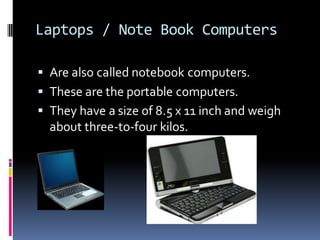
Laptops / Note Book Computers
▪ Are also called notebook computers.
▪ These are the portable computers.
▪ They have a size of 8.5 x 11 inch and weigh
about three-to-four kilos.
Tablet PCs.
▪ It is newer development in portable, full
featured computers.
▪ They are lighter than normal note book
computer.
▪ Can accept input from a pen like device called
stylus.
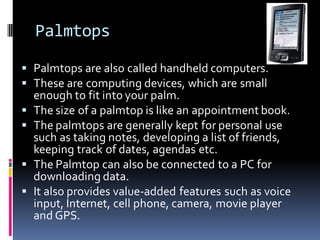
Palmtops
▪ Palmtops are also called handheld computers.
▪ These are computing devices, which are small
enough to fit into your palm.
▪ The size of a palmtop is like an appointment book.
▪ The palmtops are generally kept for personal use
such as taking notes, developing a list of friends,
keeping track of dates, agendas etc.
▪ The Palmtop can also be connected to a PC for
downloading data.
▪ It also provides value-added features such as voice
input, Internet, cell phone, camera, movie player
and GPS.
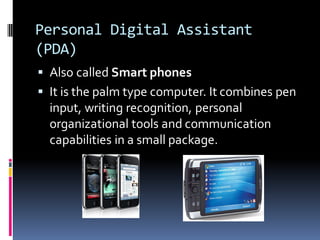
Personal Digital Assistant
(PDA)
▪ Also called Smart phones
▪ It is the palm type computer. It combines pen
input, writing recognition, personal
organizational tools and communication
capabilities in a small package.
THE END

LEC 1 1.pdf

  • 1.
    INTRODUCTION TO COMPUTER APPLICATIONS LEC#1 Course code: IT-101 Credit hours: 3.0 Text Book: Introduction toComputers by Peter Norton
  • 2.
    COURSE WILL BEEVALUATED ON THE FOLLOWING BASIS’S: MID TERM 25% SESSIONAL WORK 25% FINAL TERM 50%
  • 3.
    What is Computer? ▪An electronic machine that get the data as input, process it and give us information as output, and store it. ▪ Data ▪ Input ▪ Process ▪ Out put ▪ Information ▪ Storage
  • 4.
    ADVANTAGES OF COMPUTERS ▪High Accuracy ▪ Superior Speed of Operation ▪ Large Storage Capacity ▪ User-friendly Features ▪ Portability ▪ Platform independence ▪ Economical in the long term
  • 5.
    Types of Computer ▪Computers are classified in a variety of ways depending upon the principles of working, construction, size and applications.  Analog Computers  DigitalComputers
  • 6.
    ANALOG COMPUTERS ▪ Thecomputers that process analog signals are known as Analog Computers.The analog signal is a continuous signal.  For example, sine wave is an analog signal. ▪ The analog quantities are based on decimal number systems.  Examples ofAnalog computers are theABACUS etc.
  • 7.
    DIGITAL COMPUTERS ▪ Computersthat process digital signals are known as Digital Computers.The Digital signal is a discrete signal with two states 0 and 1. ▪ In practice, the digital computers are used and not analog.  Examples personal computers, supercomputers, mainframe computers etc.
  • 8.
    Computers for IndividualUsers ▪ Personal Computer  PC is the term referred to the computer that is designed for use by a single person.  PCs are also called microcontrollersbecause these are smaller when comparedto mainframes and minicomputers.  The term ‘PC’ is frequently used to refer to desktop computers.Although PCs are used by individuals, they can also be used in computer networks.
  • 9.
    Desktop Computer ▪ Thisis the most commonly used personal computer. ▪ It comprises of a keyboard, mouse, monitor and system unit. ▪ The system unit is also known as cabinet or chassis. ▪ It is the container that houses most of the components such as motherboard, disk drives, ports, switch mode power supply and add-on cards etc. ▪ The desktop computers are available in two models- horizontal model and tower model.
  • 10.
    Workstations ▪ It isa specialized, single user computer. ▪ It has more power and features than a standard desktop Pc. ▪ Mostly used by scientists, engineers etc. ▪ They have high resolution large screens.
  • 11.
    Laptops / NoteBook Computers ▪ Are also called notebook computers. ▪ These are the portable computers. ▪ They have a size of 8.5 x 11 inch and weigh about three-to-four kilos.
  • 12.
    Tablet PCs. ▪ Itis newer development in portable, full featured computers. ▪ They are lighter than normal note book computer. ▪ Can accept input from a pen like device called stylus.
  • 13.
    Palmtops ▪ Palmtops arealso called handheld computers. ▪ These are computing devices, which are small enough to fit into your palm. ▪ The size of a palmtop is like an appointment book. ▪ The palmtops are generally kept for personal use such as taking notes, developing a list of friends, keeping track of dates, agendas etc. ▪ The Palmtop can also be connected to a PC for downloading data. ▪ It also provides value-added features such as voice input, Internet, cell phone, camera, movie player and GPS.
  • 14.
    Personal Digital Assistant (PDA) ▪Also called Smart phones ▪ It is the palm type computer. It combines pen input, writing recognition, personal organizational tools and communication capabilities in a small package.
  • 15.