Advanced VLSI Design: 2023-24
Lecture 5
Static Timing Analysis
ELECTRICAL ELECTRONICS COMMUNICATION INSTRUMENTATION
By Dr. Sanjay Vidhyadharan
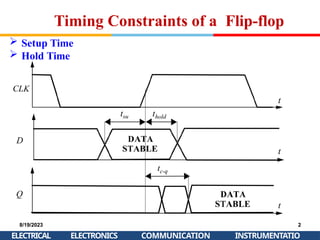
Timing Constraints of a Flip-flop
8/19/2023
ELECTRICAL
2
INSTRUMENTATIO
ELECTRONICS COMMUNICATION
 Setup Time
 Hold Time
Clock Skew and Jitter
8/19/2023
ELECTRICAL
3
INSTRUMENTATIO
ELECTRONICS COMMUNICATION
Clock skew (sometimes called timing skew) is a phenomenon in synchronous digital
circuit systems (such as computer systems) in which the same sourced clock signal arrives
at different components at different times. Cause : Wires , Buffers etc
Clock Jitter: Sometimes some external sources like noise, voltage variations may cause
to disrupt the natural periodicity or frequency of the clock. This deviation from the natural
location of the clock is termed to be clock jitter.
Clock Uncertainty = Clock Jitter + Clock Skew
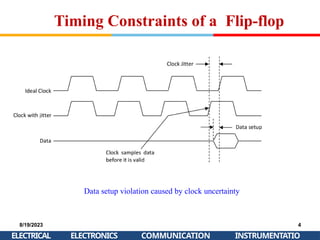
Timing Constraints of a Flip-flop
Data setup violation caused by clock uncertainty
8/19/2023
ELECTRICAL
4
INSTRUMENTATIO
ELECTRONICS COMMUNICATION
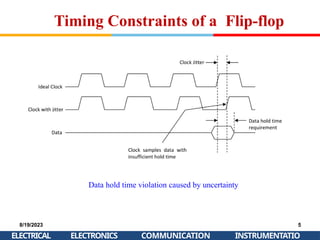
Timing Constraints of a Flip-flop
Data hold time violation caused by uncertainty
8/19/2023
ELECTRICAL
5
INSTRUMENTATIO
ELECTRONICS COMMUNICATION
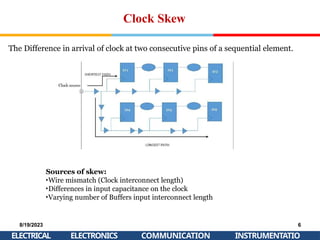
Clock Skew
The Difference in arrival of clock at two consecutive pins of a sequential element.
Sources of skew:
•Wire mismatch (Clock interconnect length)
•Differences in input capacitance on the clock
•Varying number of Buffers input interconnect length
8/19/2023
ELECTRICAL
6
INSTRUMENTATIO
ELECTRONICS COMMUNICATION
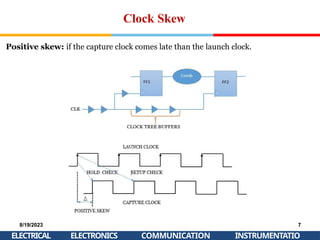
Clock Skew
Positive skew: if the capture clock comes late than the launch clock.
8/19/2023
ELECTRICAL
7
INSTRUMENTATIO
ELECTRONICS COMMUNICATION
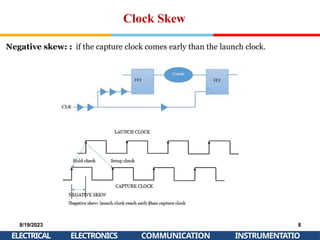
Clock Skew
Negative skew: : if the capture clock comes early than the launch clock.
8/19/2023
ELECTRICAL
8
INSTRUMENTATIO
ELECTRONICS COMMUNICATION
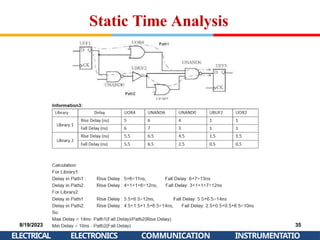
Static Time Analysis
8/19/2023
ELECTRICAL
9
INSTRUMENTATIO
ELECTRONICS COMMUNICATION
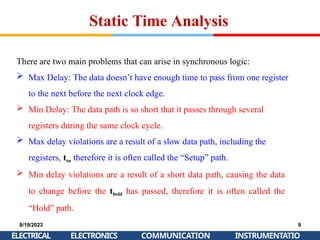
There are two main problems that can arise in synchronous logic:
 Max Delay: The data doesn’t have enough time to pass from one register
to the next before the next clock edge.
 Min Delay: The data path is so short that it passes through several
registers during the same clock cycle.
 Max delay violations are a result of a slow data path, including the
registers, tsu therefore it is often called the “Setup” path.
 Min delay violations are a result of a short data path, causing the data
to change before the thold has passed, therefore it is often called the
“Hold” path.
Static Time Analysis
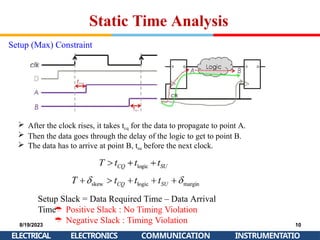
Setup (Max) Constraint
 After the clock rises, it takes tcq for the data to propagate to point A.
 Then the data goes through the delay of the logic to get to point B.
 The data has to arrive at point B, tsu before the next clock.
Setup Slack = Data Required Time – Data Arrival
Time


Positive Slack : No Timing Violation
Negative Slack : Timing Violation
8/19/2023
ELECTRICAL
10
INSTRUMENTATIO
ELECTRONICS COMMUNICATION
Static Time Analysis
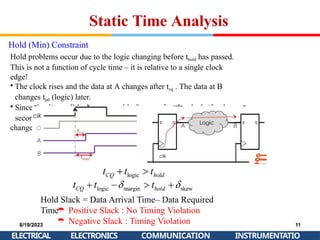
Hold (Min) Constraint
Hold problems occur due to the logic changing before thold has passed.
This is not a function of cycle time – it is relative to a single clock
edge!
• The clock rises and the data at A changes after tcq . The data at B
changes tpd (logic) later.
• Since the data at B had to stay stable for thold after the clock (for the
second register), the
change at B has to be at least thold after the clock edge.
Hold Slack = Data Arrival Time– Data Required
Time


Positive Slack : No Timing Violation
Negative Slack : Timing Violation
8/19/2023
ELECTRICAL
11
INSTRUMENTATIO
ELECTRONICS COMMUNICATION
8/19/2023 12
Static Time Analysis
ELECTRICAL ELECTRONICS COMMUNICATION INSTRUMENTATION
8/19/2023 13
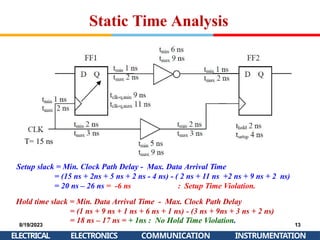
= 18 ns – 17 ns = + 1ns : No Hold Time Violation.
ELECTRICAL ELECTRONICS COMMUNICATION INSTRUMENTATION
T= 15 ns
Setup slack = Min. Clock Path Delay - Max. Data Arrival Time
= (15 ns + 2ns + 5 ns + 2 ns - 4 ns) - ( 2 ns + 11 ns +2 ns + 9 ns + 2 ns)
= 20 ns – 26 ns = -6 ns : Setup Time Violation.
Hold time slack = Min. Data Arrival Time - Max. Clock Path Delay
= (1 ns + 9 ns + 1 ns + 6 ns + 1 ns) - (3 ns + 9ns + 3 ns + 2 ns)
Static Time Analysis
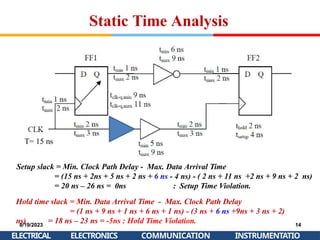
T= 15 ns
Setup slack = Min. Clock Path Delay - Max. Data Arrival Time
= (15 ns + 2ns + 5 ns + 2 ns + 6 ns - 4 ns) - ( 2 ns + 11 ns +2 ns + 9 ns + 2 ns)
= 20 ns – 26 ns = 0ns : Setup Time Violation.
Hold time slack = Min. Data Arrival Time - Max. Clock Path Delay
= (1 ns + 9 ns + 1 ns + 6 ns + 1 ns) - (3 ns + 6 ns +9ns + 3 ns + 2)
ns) = 18 ns – 23 ns = -5ns : Hold Time Violation.
Static Time Analysis
8/19/2023
ELECTRICAL
14
INSTRUMENTATIO
ELECTRONICS COMMUNICATION
Timing Constraints of a Sequential Circuit
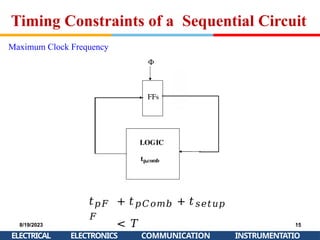
Maximum Clock Frequency
𝑡𝑝𝐹
𝐹
8/19/2023
ELECTRICAL
15
INSTRUMENTATIO
ELECTRONICS COMMUNICATION
+ 𝑡𝑝𝐶𝑜𝑚𝑏 + 𝑡𝑠𝑒𝑡𝑢𝑝
< 𝑇
Static Time Analysis
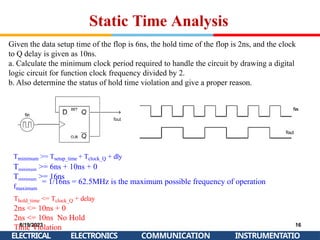
Given the data setup time of the flop is 6ns, the hold time of the flop is 2ns, and the clock
to Q delay is given as 10ns.
a. Calculate the minimum clock period required to handle the circuit by drawing a digital
logic circuit for function clock frequency divided by 2.
b. Also determine the status of hold time violation and give a proper reason.
Tminimum >= Tsetup_time + Tclock_Q + dly
Tminimum >= 6ns + 10ns + 0
Tminimum >= 16ns
8/19/2023
ELECTRICAL
16
INSTRUMENTATIO
ELECTRONICS COMMUNICATION
fmaximum
= 1/16ns = 62.5MHz is the maximum possible frequency of operation
Thold_time <= Tclock_Q + delay
2ns <= 10ns + 0
2ns <= 10ns No Hold
Time Violation
Static Time Analysis
8/19/2023
ELECTRICAL
17
INSTRUMENTATIO
ELECTRONICS COMMUNICATION
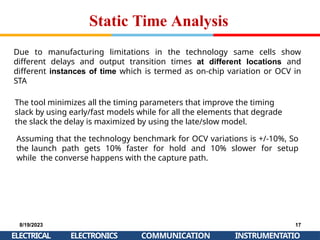
Due to manufacturing limitations in the technology same cells show
different delays and output transition times at different locations and
different instances of time which is termed as on-chip variation or OCV in
STA
The tool minimizes all the timing parameters that improve the timing
slack by using early/fast models while for all the elements that degrade
the slack the delay is maximized by using the late/slow model.
Assuming that the technology benchmark for OCV variations is +/-10%, So
the launch path gets 10% faster for hold and 10% slower for setup
while the converse happens with the capture path.
Static Time Analysis
𝑆𝑒𝑡𝑢𝑝 𝑆𝑙𝑎𝑐𝑘 = [100 𝑇
+
10
− 10 𝐶1
𝐶1 + 30 𝐵1 − 𝐵3 −
30(𝑡𝑠𝑒𝑡𝑢𝑝)]
+ 10 𝐴1+ 50 FF1 + 20
G1 = 20 ps
𝐻𝑜𝑙𝑑 𝑆𝑙𝑎𝑐𝑘 = [10 𝐶1 + 10 𝐴1 + 50
𝐹𝐹1 + 20(𝐺1)]
− 10 𝐶1 + 30 𝐵1 − 𝐵3
+ 20(𝑡ℎ𝑜𝑙𝑑) =
30 ps
8/19/2023
ELECTRICAL
18
INSTRUMENTATIO
ELECTRONICS COMMUNICATION
𝑇 =
100 𝑝𝑠
Static Time Analysis
𝑆𝑒𝑡𝑢𝑝 𝑆𝑙𝑎𝑐𝑘 =
{100 𝑇
+
10 𝐶1 + 30 𝐵1 − 𝐵3 ∗ 0.9 −30 𝑡𝑠𝑒𝑡𝑢𝑝 }
− 10 𝐶1+ 10 𝐴1 + 50 FF1 +
20 G1 ∗ 1.1 = ⋯ … . .
On chip
− variation (OCV) 𝑒𝑔. 10% 𝐿𝑎𝑡𝑒 −
10% 𝐸𝑎𝑟𝑙𝑦
𝐻𝑜𝑙𝑑 𝑆𝑙𝑎𝑐𝑘 = {[10 𝐶1 + 10 𝐴1 + 50 𝐹𝐹1
+ 20(𝐺1)] ∗ 0.9}
−{ 10 𝐶1 + 30 𝐵1 − 𝐵3 ] ∗ 1.1 +
20(𝑡ℎ𝑜𝑙𝑑) } = ⋯ . . ps
8/19/2023
ELECTRICAL
19
INSTRUMENTATIO
ELECTRONICS COMMUNICATION
Static Time Analysis
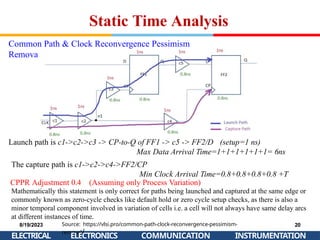
Common Path & Clock Reconvergence Pessimism
Removal
Launch path is c1->c2->c3 -> CP-to-Q of FF1 -> c5 -> FF2/D (setup=1 ns)
Source: https://vlsi.pro/common-path-clock-reconvergence-pessimism-
removal/
8/19/2023
ELECTRICAL
20
ELECTRONICS COMMUNICATION INSTRUMENTATION
Max Data Arrival Time=1+1+1+1+1+1= 6ns
The capture path is c1->c2->c4->FF2/CP
Min Clock Arrival Time=0.8+0.8+0.8+0.8 +T
CPPR Adjustment 0.4 (Assuming only Process Variation)
Mathematically this statement is only correct for paths being launched and captured at the same edge or
commonly known as zero-cycle checks like default hold or zero cycle setup checks, as there is also a
minor temporal component involved in variation of cells i.e. a cell will not always have same delay arcs
at different instances of time.
Static Time Analysis
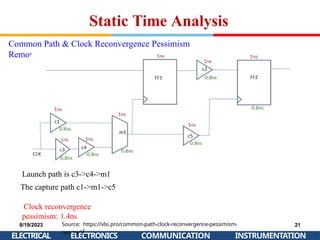
Common Path & Clock Reconvergence Pessimism
Removal
Launch path is c3->c4->m1
The capture path c1->m1->c5
Clock reconvergence
pessimism: 1.4ns
Source: https://vlsi.pro/common-path-clock-reconvergence-pessimism-
removal/
8/19/2023
ELECTRICAL
21
ELECTRONICS COMMUNICATION INSTRUMENTATION
Static Time Analysis
8/19/2023
ELECTRICAL
22
INSTRUMENTATIO
ELECTRONICS COMMUNICATION
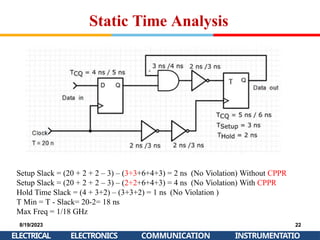
Setup Slack = (20 + 2 + 2 – 3) – (3+3+6+4+3) = 2 ns (No Violation) Without CPPR
Setup Slack = (20 + 2 + 2 – 3) – (2+2+6+4+3) = 4 ns (No Violation) With CPPR
Hold Time Slack = (4 + 3+2) – (3+3+2) = 1 ns (No Violation )
T Min = T - Slack= 20-2= 18 ns
Max Freq = 1/18 GHz
Timing ARCS
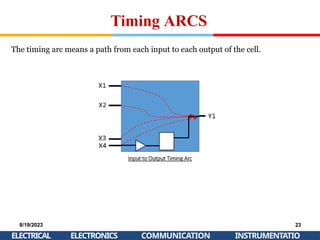
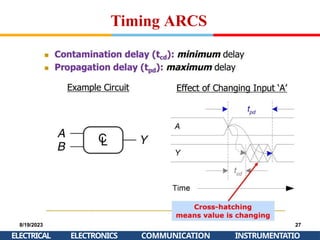
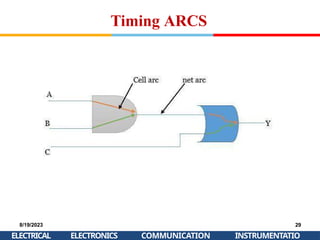
The timing arc means a path from each input to each output of the cell.
8/19/2023
ELECTRICAL
23
INSTRUMENTATIO
ELECTRONICS COMMUNICATION
Timing ARCS
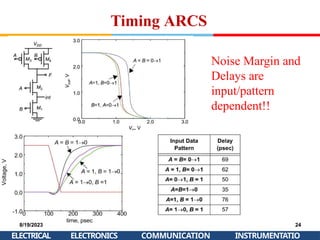
Noise Margin and
Delays are
input/pattern
dependent!!
8/19/2023
ELECTRICAL
24
INSTRUMENTATIO
ELECTRONICS COMMUNICATION
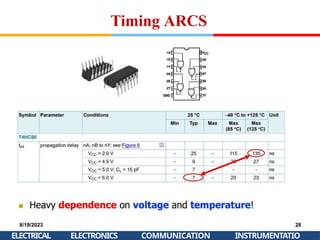
Timing ARCS
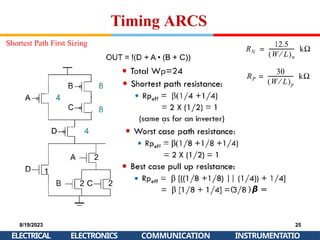
( )𝞫 =
0.75
Shortest Path First Sizing
8/19/2023
ELECTRICAL
25
INSTRUMENTATIO
ELECTRONICS COMMUNICATION
Timing ARCS
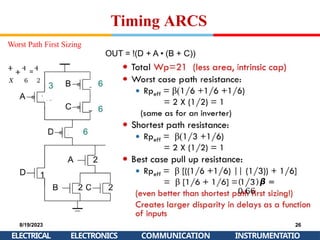
( )𝞫 =
0.66
Worst Path First Sizing
1
+
1
=
1
𝑋 6 2
8/19/2023
ELECTRICAL
26
INSTRUMENTATIO
ELECTRONICS COMMUNICATION
Timing ARCS
8/19/2023
ELECTRICAL
27
INSTRUMENTATIO
ELECTRONICS COMMUNICATION
Timing ARCS
8/19/2023
ELECTRICAL
28
INSTRUMENTATIO
ELECTRONICS COMMUNICATION
Timing ARCS
8/19/2023
ELECTRICAL
29
INSTRUMENTATIO
ELECTRONICS COMMUNICATION
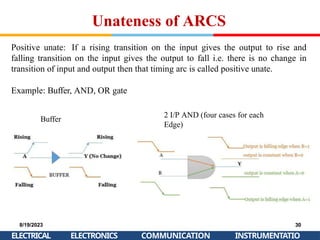
Unateness of ARCS
Positive unate: If a rising transition on the input gives the output to rise and
falling transition on the input gives the output to fall i.e. there is no change in
transition of input and output then that timing arc is called positive unate.
Example: Buffer, AND, OR gate
Buffer
2 I/P AND (four cases for each
Edge)
8/19/2023
ELECTRICAL
30
INSTRUMENTATIO
ELECTRONICS COMMUNICATION
Unateness of ARCS
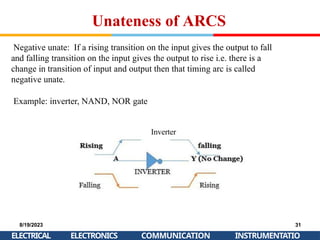
Negative unate: If a rising transition on the input gives the output to fall
and falling transition on the input gives the output to rise i.e. there is a
change in transition of input and output then that timing arc is called
negative unate.
Example: inverter, NAND, NOR gate
Inverter
8/19/2023
ELECTRICAL
31
INSTRUMENTATIO
ELECTRONICS COMMUNICATION
Unateness of ARCS
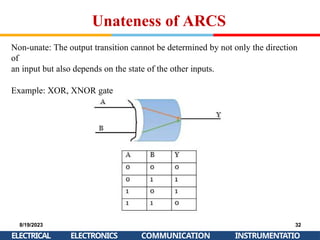
Non-unate: The output transition cannot be determined by not only the direction
of
an input but also depends on the state of the other inputs.
Example: XOR, XNOR gate
8/19/2023
ELECTRICAL
32
INSTRUMENTATIO
ELECTRONICS COMMUNICATION
Static Time Analysis
8/19/2023
ELECTRICAL
33
INSTRUMENTATIO
ELECTRONICS COMMUNICATION
Static Time Analysis
8/19/2023
ELECTRICAL
34
INSTRUMENTATIO
ELECTRONICS COMMUNICATION
Static Time Analysis
8/19/2023
ELECTRICAL
35
INSTRUMENTATIO
ELECTRONICS COMMUNICATION
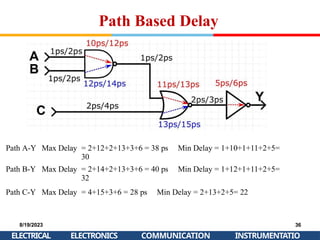
Path Based Delay
8/19/2023
ELECTRICAL
36
INSTRUMENTATIO
ELECTRONICS COMMUNICATION
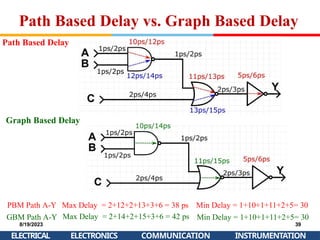
Path A-Y Max Delay = 2+12+2+13+3+6 = 38 ps Min Delay = 1+10+1+11+2+5=
30
Path B-Y Max Delay = 2+14+2+13+3+6 = 40 ps Min Delay = 1+12+1+11+2+5=
32
Path C-Y Max Delay = 4+15+3+6 = 28 ps Min Delay = 2+13+2+5= 22
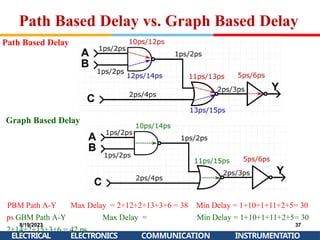
Path Based Delay vs. Graph Based Delay
PBM Path A-Y Max Delay = 2+12+2+13+3+6 = 38
ps GBM Path A-Y Max Delay =
2+14+2+15+3+6 = 42 ps
Min Delay = 1+10+1+11+2+5= 30
Path Based Delay
Graph Based Delay
8/19/2023
ELECTRICAL
37
INSTRUMENTATIO
ELECTRONICS COMMUNICATION
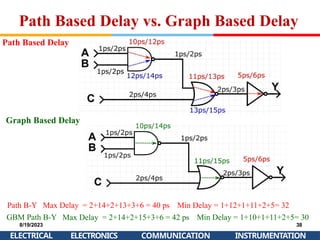
Path Based Delay vs. Graph Based Delay
Path B-Y Max Delay = 2+14+2+13+3+6 = 40 ps Min Delay = 1+12+1+11+2+5= 32
Path Based Delay
Graph Based Delay
GBM Path B-Y
8/19/2023
ELECTRICAL
Max Delay = 2+14+2+15+3+6 = 42 ps Min Delay = 1+10+1+11+2+5= 30
38
ELECTRONICS COMMUNICATION INSTRUMENTATION
PBM Path A-Y Max Delay = 2+12+2+13+3+6 = 38 ps Min Delay = 1+10+1+11+2+5= 30
GBM Path A-Y
8/19/2023
Max Delay = 2+14+2+15+3+6 = 42 ps Min Delay = 1+10+1+11+2+5= 30
39
Path Based Delay vs. Graph Based Delay
Path Based Delay
Graph Based Delay
ELECTRICAL ELECTRONICS COMMUNICATION INSTRUMENTATION
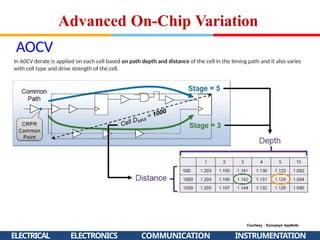
AOCV
In A0CV derate is applied on each cell based on path depth and distance of the cell in the timing path and it also varies
with cell type and drive strength of the cell.
Courtesy : Synopsys AppNote
ELECTRICAL ELECTRONICS COMMUNICATION INSTRUMENTATION
Advanced On-Chip Variation
Limitations of AOCV
ELECTRICAL ELECTRONICS COMMUNICATION INSTRUMENTATION
• The AOCV's distance and depth-based derate factor works well for
technology nodes over 40 nm, but we still need to make it better for
nodes below that.
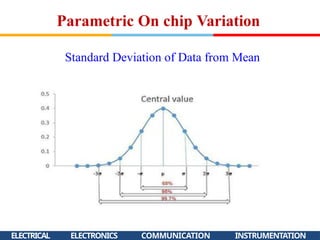
• POCV models timing as true statistical distributions
–Delay/Transition/Constraint variation modeling
• In technology nodes 20nm and below, POCV is particularly efficient.
Advanced On-Chip Variation
POCV
ELECTRICAL ELECTRONICS COMMUNICATION INSTRUMENTATION
• In POCV instead of applying the specific derate factor to a cell, cell delay is calculated based
on delay variation (σ) of the cell.
• In other words, the instance delay is parameterized as a function of this
random variable.
Parametric On chip Variation
Standard Deviation of Data from Mean
Parametric On chip Variation
ELECTRICAL ELECTRONICS COMMUNICATION INSTRUMENTATION
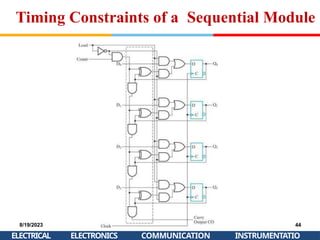
Timing Constraints of a Sequential Module
8/19/2023
ELECTRICAL
44
INSTRUMENTATIO
ELECTRONICS COMMUNICATION
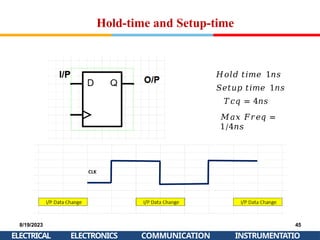
Hold-time and Setup-time
𝐻𝑜𝑙𝑑 𝑡𝑖𝑚𝑒 1𝑛𝑠
𝑆𝑒𝑡𝑢𝑝 𝑡𝑖𝑚𝑒 1𝑛𝑠
𝑇𝑐𝑞 = 4𝑛𝑠
𝑀𝑎𝑥 𝐹𝑟𝑒𝑞 =
1/4𝑛𝑠
8/19/2023
ELECTRICAL
45
INSTRUMENTATIO
ELECTRONICS COMMUNICATION
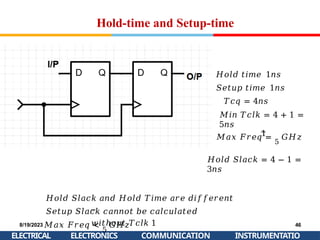
Hold-time and Setup-time
𝐻𝑜𝑙𝑑 𝑡𝑖𝑚𝑒 1𝑛𝑠
𝑆𝑒𝑡𝑢𝑝 𝑡𝑖𝑚𝑒 1𝑛𝑠
𝑇𝑐𝑞 = 4𝑛𝑠
𝑀𝑖𝑛 𝑇𝑐𝑙𝑘 = 4 + 1 =
5𝑛𝑠
1
𝑀𝑎𝑥 𝐹𝑟𝑒𝑞 =
5
𝐺𝐻𝑧
𝐻𝑜𝑙𝑑 𝑆𝑙𝑎𝑐𝑘 = 4 − 1 =
3𝑛𝑠
𝐻𝑜𝑙𝑑 𝑆𝑙𝑎𝑐𝑘 𝑎𝑛𝑑 𝐻𝑜𝑙𝑑 𝑇𝑖𝑚𝑒 𝑎𝑟𝑒 𝑑𝑖𝑓𝑓𝑒𝑟𝑒𝑛𝑡
𝑆𝑒𝑡𝑢𝑝 𝑆𝑙𝑎𝑐𝑘 𝑐𝑎𝑛𝑛𝑜𝑡 𝑏𝑒 𝑐𝑎𝑙𝑐𝑢𝑙𝑎𝑡𝑒𝑑
𝑤𝑖𝑡ℎ𝑜𝑢𝑡 𝑇𝑐𝑙𝑘 1
𝑀𝑎𝑥 𝐹𝑟𝑒𝑞 <
5
𝐺𝐻𝑧
8/19/2023
ELECTRICAL
46
INSTRUMENTATIO
ELECTRONICS COMMUNICATION
Hold-time and Setup-time
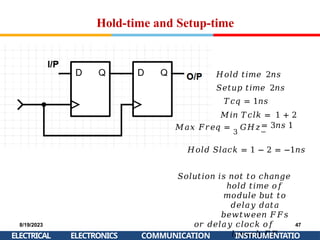
𝐻𝑜𝑙𝑑 𝑡𝑖𝑚𝑒 2𝑛𝑠
𝑆𝑒𝑡𝑢𝑝 𝑡𝑖𝑚𝑒 2𝑛𝑠
𝑇𝑐𝑞 = 1𝑛𝑠
𝑀𝑖𝑛 𝑇𝑐𝑙𝑘 = 1 + 2
= 3𝑛𝑠 1
𝑀𝑎𝑥 𝐹𝑟𝑒𝑞 =
3
𝐺𝐻𝑧
𝐻𝑜𝑙𝑑 𝑆𝑙𝑎𝑐𝑘 = 1 − 2 = −1𝑛𝑠
𝑆𝑜𝑙𝑢𝑡𝑖𝑜𝑛 𝑖𝑠 𝑛𝑜𝑡 𝑡𝑜 𝑐ℎ𝑎𝑛𝑔𝑒
ℎ𝑜𝑙𝑑 𝑡𝑖𝑚𝑒 𝑜𝑓
𝑚𝑜𝑑𝑢𝑙𝑒 𝑏𝑢𝑡 𝑡𝑜
𝑑𝑒𝑙𝑎𝑦 𝑑𝑎𝑡𝑎
𝑏𝑒𝑤𝑡𝑤𝑒𝑒𝑛 𝐹𝐹𝑠
𝑜𝑟 𝑑𝑒𝑙𝑎𝑦 𝑐𝑙𝑜𝑐𝑘 𝑜𝑓
𝑙𝑎𝑢𝑛𝑐ℎ 𝐹𝐹
8/19/2023
ELECTRICAL
47
INSTRUMENTATIO
ELECTRONICS COMMUNICATION
Hold-time and Setup-time
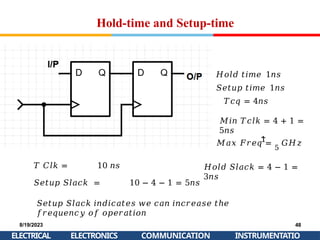
𝑇 𝐶𝑙𝑘 = 10 𝑛𝑠
𝑆𝑒𝑡𝑢𝑝 𝑆𝑙𝑎𝑐𝑘 = 10 − 4 − 1 = 5𝑛𝑠
𝑆𝑒𝑡𝑢𝑝 𝑆𝑙𝑎𝑐𝑘 𝑖𝑛𝑑𝑖𝑐𝑎𝑡𝑒𝑠 𝑤𝑒 𝑐𝑎𝑛 𝑖𝑛𝑐𝑟𝑒𝑎𝑠𝑒 𝑡ℎ𝑒
𝑓𝑟𝑒𝑞𝑢𝑒𝑛𝑐𝑦 𝑜𝑓 𝑜𝑝𝑒𝑟𝑎𝑡𝑖𝑜𝑛
8/19/2023
ELECTRICAL
48
INSTRUMENTATIO
ELECTRONICS COMMUNICATION
𝐻𝑜𝑙𝑑 𝑡𝑖𝑚𝑒 1𝑛𝑠
𝑆𝑒𝑡𝑢𝑝 𝑡𝑖𝑚𝑒 1𝑛𝑠
𝑇𝑐𝑞 = 4𝑛𝑠
𝑀𝑖𝑛 𝑇𝑐𝑙𝑘 = 4 + 1 =
5𝑛𝑠
1
𝑀𝑎𝑥 𝐹𝑟𝑒𝑞 =
5
𝐺𝐻𝑧
𝐻𝑜𝑙𝑑 𝑆𝑙𝑎𝑐𝑘 = 4 − 1 =
3𝑛𝑠
Hold-time and Setup-time
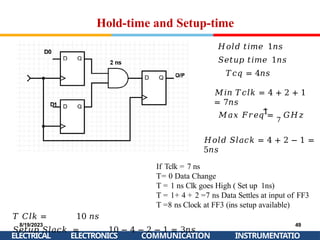
𝐻𝑜𝑙𝑑 𝑡𝑖𝑚𝑒 1𝑛𝑠
𝑆𝑒𝑡𝑢𝑝 𝑡𝑖𝑚𝑒 1𝑛𝑠
𝑇𝑐𝑞 = 4𝑛𝑠
𝑀𝑖𝑛 𝑇𝑐𝑙𝑘 = 4 + 2 + 1
= 7𝑛𝑠
1
𝑀𝑎𝑥 𝐹𝑟𝑒𝑞 =
7
𝐺𝐻𝑧
𝐻𝑜𝑙𝑑 𝑆𝑙𝑎𝑐𝑘 = 4 + 2 − 1 =
5𝑛𝑠
If Tclk = 7 ns
T= 0 Data Change
T = 1 ns Clk goes High ( Set up 1ns)
T = 1+ 4 + 2 =7 ns Data Settles at input of FF3
T =8 ns Clock at FF3 (ins setup available)
𝑇 𝐶𝑙𝑘 = 10 𝑛𝑠
𝑆𝑒𝑡𝑢𝑝 𝑆𝑙𝑎𝑐𝑘 = 10 − 4 − 2 − 1 = 3𝑛𝑠
8/19/2023
ELECTRICAL
49
INSTRUMENTATIO
ELECTRONICS COMMUNICATION
Hold-time and Setup-time
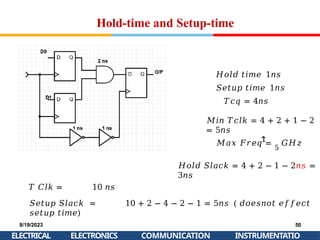
𝐻𝑜𝑙𝑑 𝑡𝑖𝑚𝑒 1𝑛𝑠
𝑆𝑒𝑡𝑢𝑝 𝑡𝑖𝑚𝑒 1𝑛𝑠
𝑇𝑐𝑞 = 4𝑛𝑠
𝑀𝑖𝑛 𝑇𝑐𝑙𝑘 = 4 + 2 + 1 − 2
= 5𝑛𝑠
1
𝑀𝑎𝑥 𝐹𝑟𝑒𝑞 =
5
𝐺𝐻𝑧
𝐻𝑜𝑙𝑑 𝑆𝑙𝑎𝑐𝑘 = 4 + 2 − 1 − 2𝑛𝑠 =
3𝑛𝑠
𝑇 𝐶𝑙𝑘 = 10 𝑛𝑠
𝑆𝑒𝑡𝑢𝑝 𝑆𝑙𝑎𝑐𝑘 = 10 + 2 − 4 − 2 − 1 = 5𝑛𝑠 ( 𝑑𝑜𝑒𝑠𝑛𝑜𝑡 𝑒𝑓𝑓𝑒𝑐𝑡
𝑠𝑒𝑡𝑢𝑝 𝑡𝑖𝑚𝑒)
8/19/2023
ELECTRICAL
50
INSTRUMENTATIO
ELECTRONICS COMMUNICATION
Hold-time and Setup-time
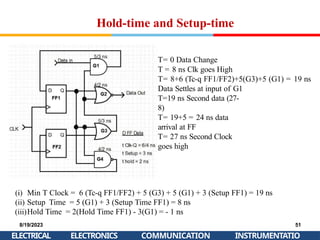
(i) Min T Clock = 6 (Tc-q FF1/FF2) + 5 (G3) + 5 (G1) + 3 (Setup FF1) = 19 ns
(ii) Setup Time = 5 (G1) + 3 (Setup Time FF1) = 8 ns
(iii)Hold Time = 2(Hold Time FF1) - 3(G1) = - 1 ns
8/19/2023
ELECTRICAL
51
INSTRUMENTATIO
ELECTRONICS COMMUNICATION
T= 0 Data Change
T = 8 ns Clk goes High
T= 8+6 (Tc-q FF1/FF2)+5(G3)+5 (G1) = 19 ns
Data Settles at input of G1
T=19 ns Second data (27-
8)
T= 19+5 = 24 ns data
arrival at FF
T= 27 ns Second Clock
goes high
Thank you
8/19/2023
ELECTRICAL
52
INSTRUMENTATIO
ELECTRONICS COMMUNICATION

Lec-05_Static timing analysis digital vlsi design

  • 1.
    Advanced VLSI Design:2023-24 Lecture 5 Static Timing Analysis ELECTRICAL ELECTRONICS COMMUNICATION INSTRUMENTATION By Dr. Sanjay Vidhyadharan
  • 2.
    Timing Constraints ofa Flip-flop 8/19/2023 ELECTRICAL 2 INSTRUMENTATIO ELECTRONICS COMMUNICATION  Setup Time  Hold Time
  • 3.
    Clock Skew andJitter 8/19/2023 ELECTRICAL 3 INSTRUMENTATIO ELECTRONICS COMMUNICATION Clock skew (sometimes called timing skew) is a phenomenon in synchronous digital circuit systems (such as computer systems) in which the same sourced clock signal arrives at different components at different times. Cause : Wires , Buffers etc Clock Jitter: Sometimes some external sources like noise, voltage variations may cause to disrupt the natural periodicity or frequency of the clock. This deviation from the natural location of the clock is termed to be clock jitter. Clock Uncertainty = Clock Jitter + Clock Skew
  • 4.
    Timing Constraints ofa Flip-flop Data setup violation caused by clock uncertainty 8/19/2023 ELECTRICAL 4 INSTRUMENTATIO ELECTRONICS COMMUNICATION
  • 5.
    Timing Constraints ofa Flip-flop Data hold time violation caused by uncertainty 8/19/2023 ELECTRICAL 5 INSTRUMENTATIO ELECTRONICS COMMUNICATION
  • 6.
    Clock Skew The Differencein arrival of clock at two consecutive pins of a sequential element. Sources of skew: •Wire mismatch (Clock interconnect length) •Differences in input capacitance on the clock •Varying number of Buffers input interconnect length 8/19/2023 ELECTRICAL 6 INSTRUMENTATIO ELECTRONICS COMMUNICATION
  • 7.
    Clock Skew Positive skew:if the capture clock comes late than the launch clock. 8/19/2023 ELECTRICAL 7 INSTRUMENTATIO ELECTRONICS COMMUNICATION
  • 8.
    Clock Skew Negative skew:: if the capture clock comes early than the launch clock. 8/19/2023 ELECTRICAL 8 INSTRUMENTATIO ELECTRONICS COMMUNICATION
  • 9.
    Static Time Analysis 8/19/2023 ELECTRICAL 9 INSTRUMENTATIO ELECTRONICSCOMMUNICATION There are two main problems that can arise in synchronous logic:  Max Delay: The data doesn’t have enough time to pass from one register to the next before the next clock edge.  Min Delay: The data path is so short that it passes through several registers during the same clock cycle.  Max delay violations are a result of a slow data path, including the registers, tsu therefore it is often called the “Setup” path.  Min delay violations are a result of a short data path, causing the data to change before the thold has passed, therefore it is often called the “Hold” path.
  • 10.
    Static Time Analysis Setup(Max) Constraint  After the clock rises, it takes tcq for the data to propagate to point A.  Then the data goes through the delay of the logic to get to point B.  The data has to arrive at point B, tsu before the next clock. Setup Slack = Data Required Time – Data Arrival Time   Positive Slack : No Timing Violation Negative Slack : Timing Violation 8/19/2023 ELECTRICAL 10 INSTRUMENTATIO ELECTRONICS COMMUNICATION
  • 11.
    Static Time Analysis Hold(Min) Constraint Hold problems occur due to the logic changing before thold has passed. This is not a function of cycle time – it is relative to a single clock edge! • The clock rises and the data at A changes after tcq . The data at B changes tpd (logic) later. • Since the data at B had to stay stable for thold after the clock (for the second register), the change at B has to be at least thold after the clock edge. Hold Slack = Data Arrival Time– Data Required Time   Positive Slack : No Timing Violation Negative Slack : Timing Violation 8/19/2023 ELECTRICAL 11 INSTRUMENTATIO ELECTRONICS COMMUNICATION
  • 12.
    8/19/2023 12 Static TimeAnalysis ELECTRICAL ELECTRONICS COMMUNICATION INSTRUMENTATION
  • 13.
    8/19/2023 13 = 18ns – 17 ns = + 1ns : No Hold Time Violation. ELECTRICAL ELECTRONICS COMMUNICATION INSTRUMENTATION T= 15 ns Setup slack = Min. Clock Path Delay - Max. Data Arrival Time = (15 ns + 2ns + 5 ns + 2 ns - 4 ns) - ( 2 ns + 11 ns +2 ns + 9 ns + 2 ns) = 20 ns – 26 ns = -6 ns : Setup Time Violation. Hold time slack = Min. Data Arrival Time - Max. Clock Path Delay = (1 ns + 9 ns + 1 ns + 6 ns + 1 ns) - (3 ns + 9ns + 3 ns + 2 ns) Static Time Analysis
  • 14.
    T= 15 ns Setupslack = Min. Clock Path Delay - Max. Data Arrival Time = (15 ns + 2ns + 5 ns + 2 ns + 6 ns - 4 ns) - ( 2 ns + 11 ns +2 ns + 9 ns + 2 ns) = 20 ns – 26 ns = 0ns : Setup Time Violation. Hold time slack = Min. Data Arrival Time - Max. Clock Path Delay = (1 ns + 9 ns + 1 ns + 6 ns + 1 ns) - (3 ns + 6 ns +9ns + 3 ns + 2) ns) = 18 ns – 23 ns = -5ns : Hold Time Violation. Static Time Analysis 8/19/2023 ELECTRICAL 14 INSTRUMENTATIO ELECTRONICS COMMUNICATION
  • 15.
    Timing Constraints ofa Sequential Circuit Maximum Clock Frequency 𝑡𝑝𝐹 𝐹 8/19/2023 ELECTRICAL 15 INSTRUMENTATIO ELECTRONICS COMMUNICATION + 𝑡𝑝𝐶𝑜𝑚𝑏 + 𝑡𝑠𝑒𝑡𝑢𝑝 < 𝑇
  • 16.
    Static Time Analysis Giventhe data setup time of the flop is 6ns, the hold time of the flop is 2ns, and the clock to Q delay is given as 10ns. a. Calculate the minimum clock period required to handle the circuit by drawing a digital logic circuit for function clock frequency divided by 2. b. Also determine the status of hold time violation and give a proper reason. Tminimum >= Tsetup_time + Tclock_Q + dly Tminimum >= 6ns + 10ns + 0 Tminimum >= 16ns 8/19/2023 ELECTRICAL 16 INSTRUMENTATIO ELECTRONICS COMMUNICATION fmaximum = 1/16ns = 62.5MHz is the maximum possible frequency of operation Thold_time <= Tclock_Q + delay 2ns <= 10ns + 0 2ns <= 10ns No Hold Time Violation
  • 17.
    Static Time Analysis 8/19/2023 ELECTRICAL 17 INSTRUMENTATIO ELECTRONICSCOMMUNICATION Due to manufacturing limitations in the technology same cells show different delays and output transition times at different locations and different instances of time which is termed as on-chip variation or OCV in STA The tool minimizes all the timing parameters that improve the timing slack by using early/fast models while for all the elements that degrade the slack the delay is maximized by using the late/slow model. Assuming that the technology benchmark for OCV variations is +/-10%, So the launch path gets 10% faster for hold and 10% slower for setup while the converse happens with the capture path.
  • 18.
    Static Time Analysis 𝑆𝑒𝑡𝑢𝑝𝑆𝑙𝑎𝑐𝑘 = [100 𝑇 + 10 − 10 𝐶1 𝐶1 + 30 𝐵1 − 𝐵3 − 30(𝑡𝑠𝑒𝑡𝑢𝑝)] + 10 𝐴1+ 50 FF1 + 20 G1 = 20 ps 𝐻𝑜𝑙𝑑 𝑆𝑙𝑎𝑐𝑘 = [10 𝐶1 + 10 𝐴1 + 50 𝐹𝐹1 + 20(𝐺1)] − 10 𝐶1 + 30 𝐵1 − 𝐵3 + 20(𝑡ℎ𝑜𝑙𝑑) = 30 ps 8/19/2023 ELECTRICAL 18 INSTRUMENTATIO ELECTRONICS COMMUNICATION 𝑇 = 100 𝑝𝑠
  • 19.
    Static Time Analysis 𝑆𝑒𝑡𝑢𝑝𝑆𝑙𝑎𝑐𝑘 = {100 𝑇 + 10 𝐶1 + 30 𝐵1 − 𝐵3 ∗ 0.9 −30 𝑡𝑠𝑒𝑡𝑢𝑝 } − 10 𝐶1+ 10 𝐴1 + 50 FF1 + 20 G1 ∗ 1.1 = ⋯ … . . On chip − variation (OCV) 𝑒𝑔. 10% 𝐿𝑎𝑡𝑒 − 10% 𝐸𝑎𝑟𝑙𝑦 𝐻𝑜𝑙𝑑 𝑆𝑙𝑎𝑐𝑘 = {[10 𝐶1 + 10 𝐴1 + 50 𝐹𝐹1 + 20(𝐺1)] ∗ 0.9} −{ 10 𝐶1 + 30 𝐵1 − 𝐵3 ] ∗ 1.1 + 20(𝑡ℎ𝑜𝑙𝑑) } = ⋯ . . ps 8/19/2023 ELECTRICAL 19 INSTRUMENTATIO ELECTRONICS COMMUNICATION
  • 20.
    Static Time Analysis CommonPath & Clock Reconvergence Pessimism Removal Launch path is c1->c2->c3 -> CP-to-Q of FF1 -> c5 -> FF2/D (setup=1 ns) Source: https://vlsi.pro/common-path-clock-reconvergence-pessimism- removal/ 8/19/2023 ELECTRICAL 20 ELECTRONICS COMMUNICATION INSTRUMENTATION Max Data Arrival Time=1+1+1+1+1+1= 6ns The capture path is c1->c2->c4->FF2/CP Min Clock Arrival Time=0.8+0.8+0.8+0.8 +T CPPR Adjustment 0.4 (Assuming only Process Variation) Mathematically this statement is only correct for paths being launched and captured at the same edge or commonly known as zero-cycle checks like default hold or zero cycle setup checks, as there is also a minor temporal component involved in variation of cells i.e. a cell will not always have same delay arcs at different instances of time.
  • 21.
    Static Time Analysis CommonPath & Clock Reconvergence Pessimism Removal Launch path is c3->c4->m1 The capture path c1->m1->c5 Clock reconvergence pessimism: 1.4ns Source: https://vlsi.pro/common-path-clock-reconvergence-pessimism- removal/ 8/19/2023 ELECTRICAL 21 ELECTRONICS COMMUNICATION INSTRUMENTATION
  • 22.
    Static Time Analysis 8/19/2023 ELECTRICAL 22 INSTRUMENTATIO ELECTRONICSCOMMUNICATION Setup Slack = (20 + 2 + 2 – 3) – (3+3+6+4+3) = 2 ns (No Violation) Without CPPR Setup Slack = (20 + 2 + 2 – 3) – (2+2+6+4+3) = 4 ns (No Violation) With CPPR Hold Time Slack = (4 + 3+2) – (3+3+2) = 1 ns (No Violation ) T Min = T - Slack= 20-2= 18 ns Max Freq = 1/18 GHz
  • 23.
    Timing ARCS The timingarc means a path from each input to each output of the cell. 8/19/2023 ELECTRICAL 23 INSTRUMENTATIO ELECTRONICS COMMUNICATION
  • 24.
    Timing ARCS Noise Marginand Delays are input/pattern dependent!! 8/19/2023 ELECTRICAL 24 INSTRUMENTATIO ELECTRONICS COMMUNICATION
  • 25.
    Timing ARCS ( )𝞫= 0.75 Shortest Path First Sizing 8/19/2023 ELECTRICAL 25 INSTRUMENTATIO ELECTRONICS COMMUNICATION
  • 26.
    Timing ARCS ( )𝞫= 0.66 Worst Path First Sizing 1 + 1 = 1 𝑋 6 2 8/19/2023 ELECTRICAL 26 INSTRUMENTATIO ELECTRONICS COMMUNICATION
  • 27.
  • 28.
  • 29.
  • 30.
    Unateness of ARCS Positiveunate: If a rising transition on the input gives the output to rise and falling transition on the input gives the output to fall i.e. there is no change in transition of input and output then that timing arc is called positive unate. Example: Buffer, AND, OR gate Buffer 2 I/P AND (four cases for each Edge) 8/19/2023 ELECTRICAL 30 INSTRUMENTATIO ELECTRONICS COMMUNICATION
  • 31.
    Unateness of ARCS Negativeunate: If a rising transition on the input gives the output to fall and falling transition on the input gives the output to rise i.e. there is a change in transition of input and output then that timing arc is called negative unate. Example: inverter, NAND, NOR gate Inverter 8/19/2023 ELECTRICAL 31 INSTRUMENTATIO ELECTRONICS COMMUNICATION
  • 32.
    Unateness of ARCS Non-unate:The output transition cannot be determined by not only the direction of an input but also depends on the state of the other inputs. Example: XOR, XNOR gate 8/19/2023 ELECTRICAL 32 INSTRUMENTATIO ELECTRONICS COMMUNICATION
  • 33.
  • 34.
  • 35.
  • 36.
    Path Based Delay 8/19/2023 ELECTRICAL 36 INSTRUMENTATIO ELECTRONICSCOMMUNICATION Path A-Y Max Delay = 2+12+2+13+3+6 = 38 ps Min Delay = 1+10+1+11+2+5= 30 Path B-Y Max Delay = 2+14+2+13+3+6 = 40 ps Min Delay = 1+12+1+11+2+5= 32 Path C-Y Max Delay = 4+15+3+6 = 28 ps Min Delay = 2+13+2+5= 22
  • 37.
    Path Based Delayvs. Graph Based Delay PBM Path A-Y Max Delay = 2+12+2+13+3+6 = 38 ps GBM Path A-Y Max Delay = 2+14+2+15+3+6 = 42 ps Min Delay = 1+10+1+11+2+5= 30 Min Delay = 1+10+1+11+2+5= 30 Path Based Delay Graph Based Delay 8/19/2023 ELECTRICAL 37 INSTRUMENTATIO ELECTRONICS COMMUNICATION
  • 38.
    Path Based Delayvs. Graph Based Delay Path B-Y Max Delay = 2+14+2+13+3+6 = 40 ps Min Delay = 1+12+1+11+2+5= 32 Path Based Delay Graph Based Delay GBM Path B-Y 8/19/2023 ELECTRICAL Max Delay = 2+14+2+15+3+6 = 42 ps Min Delay = 1+10+1+11+2+5= 30 38 ELECTRONICS COMMUNICATION INSTRUMENTATION
  • 39.
    PBM Path A-YMax Delay = 2+12+2+13+3+6 = 38 ps Min Delay = 1+10+1+11+2+5= 30 GBM Path A-Y 8/19/2023 Max Delay = 2+14+2+15+3+6 = 42 ps Min Delay = 1+10+1+11+2+5= 30 39 Path Based Delay vs. Graph Based Delay Path Based Delay Graph Based Delay ELECTRICAL ELECTRONICS COMMUNICATION INSTRUMENTATION
  • 40.
    AOCV In A0CV derateis applied on each cell based on path depth and distance of the cell in the timing path and it also varies with cell type and drive strength of the cell. Courtesy : Synopsys AppNote ELECTRICAL ELECTRONICS COMMUNICATION INSTRUMENTATION Advanced On-Chip Variation
  • 41.
    Limitations of AOCV ELECTRICALELECTRONICS COMMUNICATION INSTRUMENTATION • The AOCV's distance and depth-based derate factor works well for technology nodes over 40 nm, but we still need to make it better for nodes below that. • POCV models timing as true statistical distributions –Delay/Transition/Constraint variation modeling • In technology nodes 20nm and below, POCV is particularly efficient. Advanced On-Chip Variation
  • 42.
    POCV ELECTRICAL ELECTRONICS COMMUNICATIONINSTRUMENTATION • In POCV instead of applying the specific derate factor to a cell, cell delay is calculated based on delay variation (σ) of the cell. • In other words, the instance delay is parameterized as a function of this random variable. Parametric On chip Variation
  • 43.
    Standard Deviation ofData from Mean Parametric On chip Variation ELECTRICAL ELECTRONICS COMMUNICATION INSTRUMENTATION
  • 44.
    Timing Constraints ofa Sequential Module 8/19/2023 ELECTRICAL 44 INSTRUMENTATIO ELECTRONICS COMMUNICATION
  • 45.
    Hold-time and Setup-time 𝐻𝑜𝑙𝑑𝑡𝑖𝑚𝑒 1𝑛𝑠 𝑆𝑒𝑡𝑢𝑝 𝑡𝑖𝑚𝑒 1𝑛𝑠 𝑇𝑐𝑞 = 4𝑛𝑠 𝑀𝑎𝑥 𝐹𝑟𝑒𝑞 = 1/4𝑛𝑠 8/19/2023 ELECTRICAL 45 INSTRUMENTATIO ELECTRONICS COMMUNICATION
  • 46.
    Hold-time and Setup-time 𝐻𝑜𝑙𝑑𝑡𝑖𝑚𝑒 1𝑛𝑠 𝑆𝑒𝑡𝑢𝑝 𝑡𝑖𝑚𝑒 1𝑛𝑠 𝑇𝑐𝑞 = 4𝑛𝑠 𝑀𝑖𝑛 𝑇𝑐𝑙𝑘 = 4 + 1 = 5𝑛𝑠 1 𝑀𝑎𝑥 𝐹𝑟𝑒𝑞 = 5 𝐺𝐻𝑧 𝐻𝑜𝑙𝑑 𝑆𝑙𝑎𝑐𝑘 = 4 − 1 = 3𝑛𝑠 𝐻𝑜𝑙𝑑 𝑆𝑙𝑎𝑐𝑘 𝑎𝑛𝑑 𝐻𝑜𝑙𝑑 𝑇𝑖𝑚𝑒 𝑎𝑟𝑒 𝑑𝑖𝑓𝑓𝑒𝑟𝑒𝑛𝑡 𝑆𝑒𝑡𝑢𝑝 𝑆𝑙𝑎𝑐𝑘 𝑐𝑎𝑛𝑛𝑜𝑡 𝑏𝑒 𝑐𝑎𝑙𝑐𝑢𝑙𝑎𝑡𝑒𝑑 𝑤𝑖𝑡ℎ𝑜𝑢𝑡 𝑇𝑐𝑙𝑘 1 𝑀𝑎𝑥 𝐹𝑟𝑒𝑞 < 5 𝐺𝐻𝑧 8/19/2023 ELECTRICAL 46 INSTRUMENTATIO ELECTRONICS COMMUNICATION
  • 47.
    Hold-time and Setup-time 𝐻𝑜𝑙𝑑𝑡𝑖𝑚𝑒 2𝑛𝑠 𝑆𝑒𝑡𝑢𝑝 𝑡𝑖𝑚𝑒 2𝑛𝑠 𝑇𝑐𝑞 = 1𝑛𝑠 𝑀𝑖𝑛 𝑇𝑐𝑙𝑘 = 1 + 2 = 3𝑛𝑠 1 𝑀𝑎𝑥 𝐹𝑟𝑒𝑞 = 3 𝐺𝐻𝑧 𝐻𝑜𝑙𝑑 𝑆𝑙𝑎𝑐𝑘 = 1 − 2 = −1𝑛𝑠 𝑆𝑜𝑙𝑢𝑡𝑖𝑜𝑛 𝑖𝑠 𝑛𝑜𝑡 𝑡𝑜 𝑐ℎ𝑎𝑛𝑔𝑒 ℎ𝑜𝑙𝑑 𝑡𝑖𝑚𝑒 𝑜𝑓 𝑚𝑜𝑑𝑢𝑙𝑒 𝑏𝑢𝑡 𝑡𝑜 𝑑𝑒𝑙𝑎𝑦 𝑑𝑎𝑡𝑎 𝑏𝑒𝑤𝑡𝑤𝑒𝑒𝑛 𝐹𝐹𝑠 𝑜𝑟 𝑑𝑒𝑙𝑎𝑦 𝑐𝑙𝑜𝑐𝑘 𝑜𝑓 𝑙𝑎𝑢𝑛𝑐ℎ 𝐹𝐹 8/19/2023 ELECTRICAL 47 INSTRUMENTATIO ELECTRONICS COMMUNICATION
  • 48.
    Hold-time and Setup-time 𝑇𝐶𝑙𝑘 = 10 𝑛𝑠 𝑆𝑒𝑡𝑢𝑝 𝑆𝑙𝑎𝑐𝑘 = 10 − 4 − 1 = 5𝑛𝑠 𝑆𝑒𝑡𝑢𝑝 𝑆𝑙𝑎𝑐𝑘 𝑖𝑛𝑑𝑖𝑐𝑎𝑡𝑒𝑠 𝑤𝑒 𝑐𝑎𝑛 𝑖𝑛𝑐𝑟𝑒𝑎𝑠𝑒 𝑡ℎ𝑒 𝑓𝑟𝑒𝑞𝑢𝑒𝑛𝑐𝑦 𝑜𝑓 𝑜𝑝𝑒𝑟𝑎𝑡𝑖𝑜𝑛 8/19/2023 ELECTRICAL 48 INSTRUMENTATIO ELECTRONICS COMMUNICATION 𝐻𝑜𝑙𝑑 𝑡𝑖𝑚𝑒 1𝑛𝑠 𝑆𝑒𝑡𝑢𝑝 𝑡𝑖𝑚𝑒 1𝑛𝑠 𝑇𝑐𝑞 = 4𝑛𝑠 𝑀𝑖𝑛 𝑇𝑐𝑙𝑘 = 4 + 1 = 5𝑛𝑠 1 𝑀𝑎𝑥 𝐹𝑟𝑒𝑞 = 5 𝐺𝐻𝑧 𝐻𝑜𝑙𝑑 𝑆𝑙𝑎𝑐𝑘 = 4 − 1 = 3𝑛𝑠
  • 49.
    Hold-time and Setup-time 𝐻𝑜𝑙𝑑𝑡𝑖𝑚𝑒 1𝑛𝑠 𝑆𝑒𝑡𝑢𝑝 𝑡𝑖𝑚𝑒 1𝑛𝑠 𝑇𝑐𝑞 = 4𝑛𝑠 𝑀𝑖𝑛 𝑇𝑐𝑙𝑘 = 4 + 2 + 1 = 7𝑛𝑠 1 𝑀𝑎𝑥 𝐹𝑟𝑒𝑞 = 7 𝐺𝐻𝑧 𝐻𝑜𝑙𝑑 𝑆𝑙𝑎𝑐𝑘 = 4 + 2 − 1 = 5𝑛𝑠 If Tclk = 7 ns T= 0 Data Change T = 1 ns Clk goes High ( Set up 1ns) T = 1+ 4 + 2 =7 ns Data Settles at input of FF3 T =8 ns Clock at FF3 (ins setup available) 𝑇 𝐶𝑙𝑘 = 10 𝑛𝑠 𝑆𝑒𝑡𝑢𝑝 𝑆𝑙𝑎𝑐𝑘 = 10 − 4 − 2 − 1 = 3𝑛𝑠 8/19/2023 ELECTRICAL 49 INSTRUMENTATIO ELECTRONICS COMMUNICATION
  • 50.
    Hold-time and Setup-time 𝐻𝑜𝑙𝑑𝑡𝑖𝑚𝑒 1𝑛𝑠 𝑆𝑒𝑡𝑢𝑝 𝑡𝑖𝑚𝑒 1𝑛𝑠 𝑇𝑐𝑞 = 4𝑛𝑠 𝑀𝑖𝑛 𝑇𝑐𝑙𝑘 = 4 + 2 + 1 − 2 = 5𝑛𝑠 1 𝑀𝑎𝑥 𝐹𝑟𝑒𝑞 = 5 𝐺𝐻𝑧 𝐻𝑜𝑙𝑑 𝑆𝑙𝑎𝑐𝑘 = 4 + 2 − 1 − 2𝑛𝑠 = 3𝑛𝑠 𝑇 𝐶𝑙𝑘 = 10 𝑛𝑠 𝑆𝑒𝑡𝑢𝑝 𝑆𝑙𝑎𝑐𝑘 = 10 + 2 − 4 − 2 − 1 = 5𝑛𝑠 ( 𝑑𝑜𝑒𝑠𝑛𝑜𝑡 𝑒𝑓𝑓𝑒𝑐𝑡 𝑠𝑒𝑡𝑢𝑝 𝑡𝑖𝑚𝑒) 8/19/2023 ELECTRICAL 50 INSTRUMENTATIO ELECTRONICS COMMUNICATION
  • 51.
    Hold-time and Setup-time (i)Min T Clock = 6 (Tc-q FF1/FF2) + 5 (G3) + 5 (G1) + 3 (Setup FF1) = 19 ns (ii) Setup Time = 5 (G1) + 3 (Setup Time FF1) = 8 ns (iii)Hold Time = 2(Hold Time FF1) - 3(G1) = - 1 ns 8/19/2023 ELECTRICAL 51 INSTRUMENTATIO ELECTRONICS COMMUNICATION T= 0 Data Change T = 8 ns Clk goes High T= 8+6 (Tc-q FF1/FF2)+5(G3)+5 (G1) = 19 ns Data Settles at input of G1 T=19 ns Second data (27- 8) T= 19+5 = 24 ns data arrival at FF T= 27 ns Second Clock goes high
  • 52.