Team 5
Anuja Narwal
Akanksha
Simran Sharma
Harpreet Singh
Parampreet Kaur
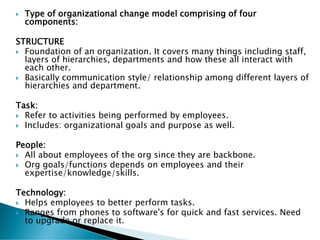
 Type of organizational change model comprising of four
components:
STRUCTURE
 Foundation of an organization. It covers many things including staff,
layers of hierarchies, departments and how these all interact with
each other.
 Basically communication style/ relationship among different layers of
hierarchies and department.
Task:
 Refer to activities being performed by employees.
 Includes: organizational goals and purpose as well.
People:
 All about employees of the org since they are backbone.
 Org goals/functions depends on employees and their
expertise/knowledge/skills.
Technology:
 Helps employees to better perform tasks.
 Ranges from phones to software's for quick and fast services. Need
to upgrade or replace it.
 In early 1960s an American Professor Harlod J. Leavitt
presented a model which explains organizational change.
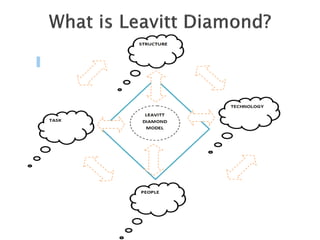
 Revolves around four components of organizational change
and these elements are: structure, task, technology and
people.
 These four elements are interconnected and interdependent.
 Professor placed these elements in a square shape to reflect
the mutual connection among all of these.
 This square shape looks like a diamond and that is why it is
widely known as Leavitt’s Diamond Model.
 For doing early analysis of change in an
organization- to provide initial path to have a
better understanding.
 Easy to use and accessible by everyone.
 Very popular with IT based tech companies/
industry.
 Since it doesn't take into account external
environment/factors of organization.
 Scope limited to tech based companies and
doesn't address issue of org change for all
the companies.
 Only provides analysis and doesn't show
pathway of change.
 Step 1: Laying off an employee.. (people)
 Step 2: Change in structure with one less person
on the team (structure)
 Step 3: Work load increased with additional task
of the laid off person (task)
 Step 4: Work needs to be done in scheduled time,
need to make adjustments as remaining
employees need to work harder and external help
of system / technology (Technology)
Leavitts Diamond.pdf

Leavitts Diamond.pdf

  • 1.
    Team 5 Anuja Narwal Akanksha SimranSharma Harpreet Singh Parampreet Kaur
  • 2.
     Type oforganizational change model comprising of four components: STRUCTURE  Foundation of an organization. It covers many things including staff, layers of hierarchies, departments and how these all interact with each other.  Basically communication style/ relationship among different layers of hierarchies and department. Task:  Refer to activities being performed by employees.  Includes: organizational goals and purpose as well. People:  All about employees of the org since they are backbone.  Org goals/functions depends on employees and their expertise/knowledge/skills. Technology:  Helps employees to better perform tasks.  Ranges from phones to software's for quick and fast services. Need to upgrade or replace it.
  • 4.
     In early1960s an American Professor Harlod J. Leavitt presented a model which explains organizational change.  Revolves around four components of organizational change and these elements are: structure, task, technology and people.  These four elements are interconnected and interdependent.  Professor placed these elements in a square shape to reflect the mutual connection among all of these.  This square shape looks like a diamond and that is why it is widely known as Leavitt’s Diamond Model.
  • 5.
     For doingearly analysis of change in an organization- to provide initial path to have a better understanding.  Easy to use and accessible by everyone.  Very popular with IT based tech companies/ industry.
  • 6.
     Since itdoesn't take into account external environment/factors of organization.  Scope limited to tech based companies and doesn't address issue of org change for all the companies.  Only provides analysis and doesn't show pathway of change.
  • 7.
     Step 1:Laying off an employee.. (people)  Step 2: Change in structure with one less person on the team (structure)  Step 3: Work load increased with additional task of the laid off person (task)  Step 4: Work needs to be done in scheduled time, need to make adjustments as remaining employees need to work harder and external help of system / technology (Technology)