Pam MorganGorgas Library
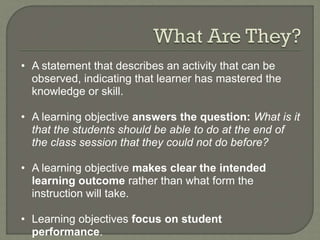
A statement that describes an activity that can be observed, indicating that learner has mastered the knowledge or skill.
A learning objective answers the question:What is it that the students should be able to do at the end of the class session that they could not do before?
A learning objective makes clear the intended learning outcome rather than what form the instruction will take.
Learning objectives focus on student performance.   Can help with assessment process
Helps students understand expectations
Helps instructor plan instruction (especially if you only have 50 minutes!)Goals are broad statements that state general learning outcomes.
Objectives are very specific, short term measurable and observable.
Goals broadly describe an activity to be accomplished, while objectives identify tasks that must be completed to reach the goal. Goal: Students will know how to use Academic Search Premier
Objective: Using the library homepage, students will be able to find the link to Academic Search Premier.
Objective: Using preselected keywords, students will construct a database search in Academic Search Premier.
Objective: On a database record with no full-text, students will be able to use the article linker to determine whether full text of the article exists elsewhere.Per Maryellen Allen: “Learning outcome is more of a goal”
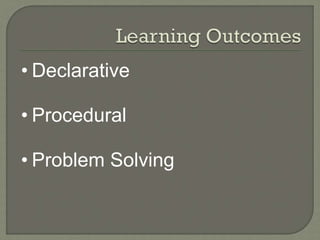
Idea is to turn something abstract into something that can be measuredDeclarative
Procedural
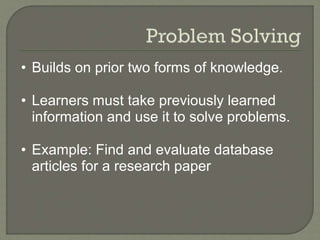
Problem SolvingKnowledge that can be stated and goes beyond memorization.
Example: Describe the difference between scholarly and popular journals
Example: Describe the role of an abstract

Learning objectives for librarians