Learning Disabilities Theoretical And Research
Issues Keogh download
https://ebookbell.com/product/learning-disabilities-theoretical-
and-research-issues-keogh-11654398
Explore and download more ebooks at ebookbell.com
Here are some recommended products that we believe you will be
interested in. You can click the link to download.
Learning Disabilities Jeffrey P Bakken Festus E Obiakor Anthony F
Rotatori
https://ebookbell.com/product/learning-disabilities-jeffrey-p-bakken-
festus-e-obiakor-anthony-f-rotatori-51254214
Learning Disabilities A Medical Dictionary Bibliography And Annotated
Research Guide To Internet References Icon Health Publications
https://ebookbell.com/product/learning-disabilities-a-medical-
dictionary-bibliography-and-annotated-research-guide-to-internet-
references-icon-health-publications-2191296
Learning Disabilities In Older Adolescents And Adults Clinical Utility
Of The Neuropsychological Perspective 1st Edition Lynda J Katz
https://ebookbell.com/product/learning-disabilities-in-older-
adolescents-and-adults-clinical-utility-of-the-neuropsychological-
perspective-1st-edition-lynda-j-katz-2406576
Learning Disabilities And Challenging Behaviors Using The Building
Blocks Model To Guide Intervention And Classroom Management 3rd Nancy
Mather
https://ebookbell.com/product/learning-disabilities-and-challenging-
behaviors-using-the-building-blocks-model-to-guide-intervention-and-
classroom-management-3rd-nancy-mather-38506032
Learning Disabilities Wichian Ed Sittiprapaporn
https://ebookbell.com/product/learning-disabilities-wichian-ed-
sittiprapaporn-4103788
Learning Disabilities Sourcebook 4th Edition Sandra J Judd
https://ebookbell.com/product/learning-disabilities-sourcebook-4th-
edition-sandra-j-judd-4769492
Learning Disabilities Peggy Parks
https://ebookbell.com/product/learning-disabilities-peggy-
parks-5079668
Learning Disabilities Second Edition From Identification To
Intervention Jack M Fletcher
https://ebookbell.com/product/learning-disabilities-second-edition-
from-identification-to-intervention-jack-m-fletcher-10046336
Learning Disabilities Sourcebook 6th Edition Angela L Williams
https://ebookbell.com/product/learning-disabilities-sourcebook-6th-
edition-angela-l-williams-10955270
Learning Disabilities:
Theoretical and Research Issues
LEARNING
DISABILITIES:
Theoretical and Research
Issues
Edited by
H . L e e S w a n s o n
U n i v e r s i t y o f B r i t i s h C o l u m b i a
B a r b a r a K e o g h
U n i v e r s i t y o f C a l i f o r n i a , L o s A n g e l e s
Routledge
Taylor & Francis Group
NEW YORK AND LONDON
R
O
UT
L
E
D
G
E
First Published by
Lawrence Erlbaum Associates, Inc., Publishers
10 Industrial Avenue
Mahwah, New Jersey 07430
Transferred to Digital Printing 2009 by Routledge
270 Madison Avenue New York, NY 10016
2 Park Square Milton Park, Abingdon Oxon OX14 4RN
Copyright © 1990 by Lawrence Erlbaum Associates, Inc.
All rights reserved. No part of this book may be reproduced in
any form, by photostat, microform, retrieval system, or any other
means without the prior written permission of the publisher.
Library of Congress Cataloging-in-Publication Data
II Keogh, Barbara
89-37575
CIP
Publisher’s Note
The publisher has gone to great lengths to ensure the quality of this reprint
but points out that some imperfections in the original may be apparent.
Learning disabilities : theoretical and research issues / edited by
H.L. Swanson, Barbara Keogh,
p. cm.
“ The incentive for this text was the result of a 1988 conference
sponsored by the International Academy for Research in Learning
Disabilities, held at the University of California, Los Angeles
-Pref.
Includes bibliographical references.
ISBN 0-8058-0392-0
1. Learning disabilities— Congresses. I. Swanson, H. Lee, 1947– .
K. III. International Academy for Research in Learning Disabilities.
LC4704.L413 1990
371.9— dc20
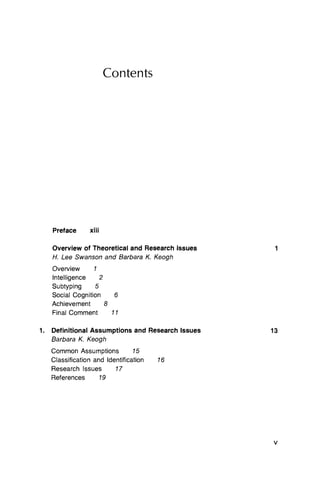
Contents
Preface xiii
Overview of Theoretical and Research Issues
H. Lee Swanson and Barbara K. Keogh
Overview 1
Intelligence 2
Subtyping 5
Social Cognition 6
Achievement 8
Final Comment 11
Definitional Assumptions and Research Issues
Barbara K Keogh
Common Assumptions 15
Classification and Identification 16
Research Issues 17
References 19
1
1. 13
V
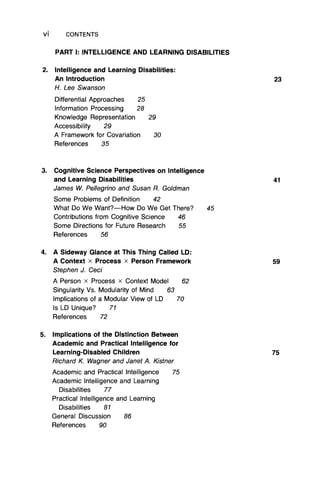
Vi CONTENTS
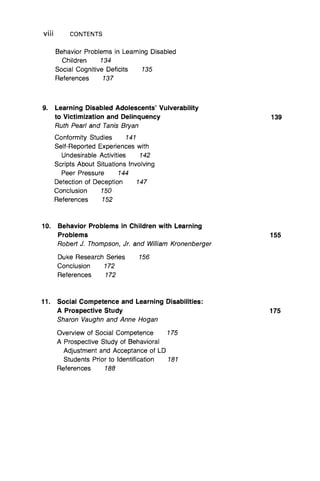
2. Intelligence and Learning Disabilities:
An Introduction
H. Lee Swanson
Differential Approaches 25
Information Processing 28
Knowledge Representation 29
Accessibility 29
A Framework for Covariation 30
References 35
PART I: INTELLIGENCE AND LEARNING DISABILITIES
3. Cognitive Science Perspectives on Intelligence
and Learning Disabilities
James W. Pellegrino and Susan R. Goldman
Some Problems of Definition 42
What Do We Want?— How Do We Get There? 45
Contributions from Cognitive Science 46
Some Directions for Future Research 55
References 56
4. A Sideway Glance at This Thing Called LD:
A Context x Process x Person Framework
Stephen J. Ceci
A Person x Process x Context Model 62
Singularity Vs. Modularity of Mind 63
Implications of a Modular View of LD 70
Is LD Unique? 71
References 72
5. Implications of the Distinction Between
Academic and Practical Intelligence for
Learning-Disabled Children
Richard K. Wagner and Janet A. Kistner
Academic and Practical Intelligence 75
Academic Intelligence and Learning
Disabilities 77
Practical Intelligence and Learning
Disabilities 81
General Discussion 86
References 90
23
41
59
75
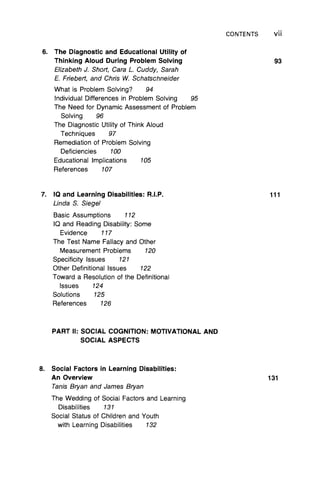
CONTENTS Vii
6. The Diagnostic and Educational Utility of
Thinking Aloud During Problem Solving
Elizabeth J. Short, Cara L. Cuddy, Sarah
E. Friebert, and Chris W. Schatschneider
What is Problem Solving? 94
Individual Differences in Problem Solving 95
The Need for Dynamic Assessment of Problem
Solving 96
The Diagnostic Utility of Think Aloud
Techniques 97
Remediation of Problem Solving
Deficiencies 100
Educational Implications 105
References 107
93
7. IQ and Learning Disabilities: R.I.P.
Linda S. Siegel
Basic Assumptions 112
IQ and Reading Disability: Some
Evidence 117
The Test Name Fallacy and Other
Measurement Problems 120
Specificity Issues 121
Other Definitional Issues 122
Toward a Resolution of the Definitional
Issues 124
Solutions 125
References 126
111
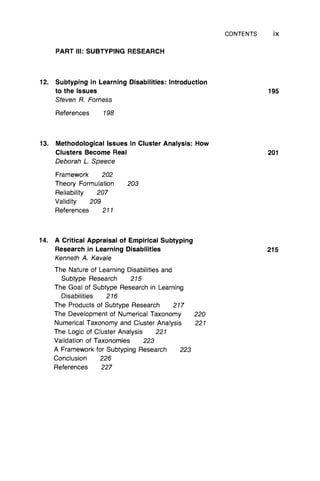
PART II: SOCIAL COGNITION: MOTIVATIONAL AND
SOCIAL ASPECTS
8. Social Factors in Learning Disabilities:
An Overview
Tanis Bryan and James Bryan
The Wedding of Social Factors and Learning
Disabilities 131
Social Status of Children and Youth
with Learning Disabilities 132
131
V iii CONTENTS
Behavior Problems in Learning Disabled
Children 134
Social Cognitive Deficits 135
References 137
9. Learning Disabled Adolescents’ Vulverability
to Victimization and Delinquency 139
Ruth Pearl and Tanis Bryan
Conformity Studies 141
Self-Reported Experiences with
Undesirable Activities 142
Scripts About Situations Involving
Peer Pressure 144
Detection of Deception 147
Conclusion 150
References 152
10. Behavior Problems in Children with Learning
Problems 155
Robert J. Thompson, Jr. and William Kronenberger
Duke Research Series 156
Conclusion 172
References 172
11. Social Competence and Learning Disabilities:
A Prospective Study 175
Sharon Vaughn and Anne Hogan
Overview of Social Competence 175
A Prospective Study of Behavioral
Adjustment and Acceptance of LD
Students Prior to Identification 181
References 188
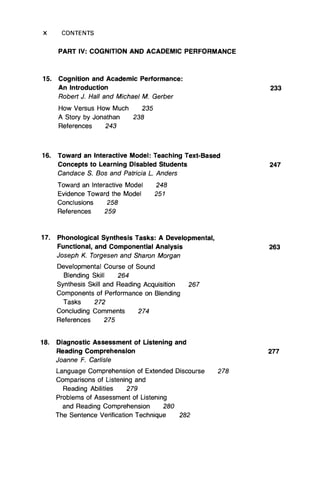
CONTENTS ix
PART III: SUBTYPING RESEARCH
12. Subtyping in Learning Disabilities: Introduction
to the Issues 195
Steven R. Forness
References 198
13. Methodological Issues in Cluster Analysis: How
Clusters Become Real 201
Deborah L Speece
Framework 202
Theory Formulation 203
Reliability 207
Validity 209
References 211
14. A Critical Appraisal of Empirical Subtyping
Research in Learning Disabilities 215
Kenneth A. Kavale
The Nature of Learning Disabilities and
Subtype Research 215
The Goal of Subtype Research in Learning
Disabilities 216
The Products of Subtype Research 217
The Development of Numerical Taxonomy 220
Numerical Taxonomy and Cluster Analysis 221
The Logic of Cluster Analysis 221
Validation of Taxonomies 223
A Framework for Subtyping Research 223
Conclusion 226
References 227
X CONTENTS
PART IV: COGNITION AND ACADEMIC PERFORMANCE
15. Cognition and Academic Performance:
An Introduction 233
Robert J. Hall and Michael M. Gerber
How Versus How Much 235
A Story by Jonathan 238
References 243
16. Toward an Interactive Model: Teaching Text-Based
Concepts to Learning Disabled Students 247
Candace S. Bos and Patricia L Anders
Toward an Interactive Model 248
Evidence Toward the Model 251
Conclusions 258
References 259
17. Phonological Synthesis Tasks: A Developmental,
Functional, and Componential Analysis 263
Joseph K. Torgesen and Sharon Morgan
Developmental Course of Sound
Blending Skill 264
Synthesis Skill and Reading Acquisition 267
Components of Performance on Blending
Tasks 272
Concluding Comments 274
References 275
18. Diagnostic Assessment of Listening and
Reading Comprehension 277
Joanne F. Carlisle
Language Comprehension of Extended Discourse 278
Comparisons of Listening and
Reading Abilities 279
Problems of Assessment of Listening
and Reading Comprehension 280
The Sentence Verification Technique 282
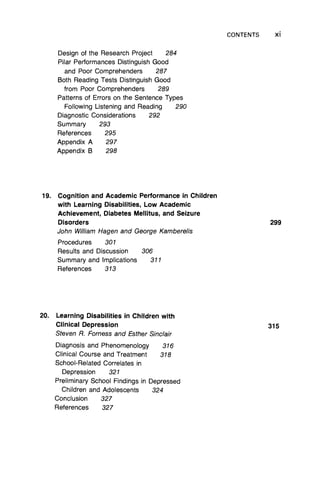
CONTENTS Xi
Design of the Research Project 284
Pilar Performances Distinguish Good
and Poor Comprehenders 287
Both Reading Tests Distinguish Good
from Poor Comprehenders 289
Patterns of Errors on the Sentence Types
Following Listening and Reading 290
Diagnostic Considerations 292
Summary 293
References 295
Appendix A 297
Appendix B 298
19. Cognition and Academic Performance in Children
with Learning Disabilities, Low Academic
Achievement, Diabetes Mellitus, and Seizure
Disorders
John William Hagen and George Kamberelis
Procedures 301
Results and Discussion 306
Summary and Implications 311
References 313
20. Learning Disabilities in Children with
Clinical Depression
Steven R. Forness and Esther Sinclair
Diagnosis and Phenomenology 316
Clinical Course and Treatment 318
School-Related Correlates in
Depression 321
Preliminary School Findings in Depressed
Children and Adolescents 324
Conclusion 327
References 327
299
315
x ii CONTENTS
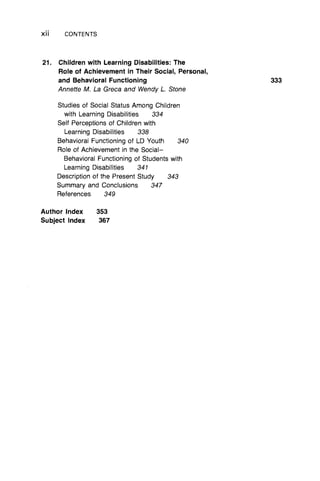
21. Children with Learning Disabilities: The
Role of Achievement in Their Social, Personal,
and Behavioral Functioning
Annette M. La Greca and Wendy L Stone
Studies of Social Status Among Children
with Learning Disabilities 334
Self Perceptions of Children with
Learning Disabilities 338
Behavioral Functioning of LD Youth 340
Role of Achievement in the Social–
Behavioral Functioning of Students with
Learning Disabilities 341
Description of the Present Study 343
Summary and Conclusions 347
References 349
Author Index 353
Subject Index 367
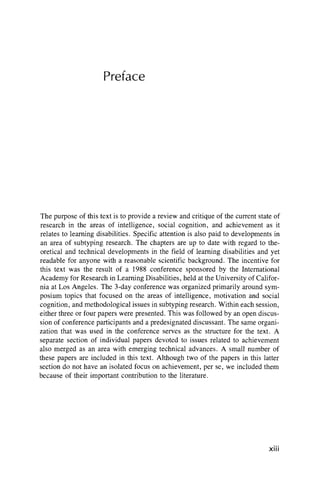
Preface
The purpose of this text is to provide a review and critique of the current state of
research in the areas of intelligence, social cognition, and achievement as it
relates to learning disabilities. Specific attention is also paid to developments in
an area of subtyping research. The chapters are up to date with regard to the-
oretical and technical developments in the field of learning disabilities and yet
readable for anyone with a reasonable scientific background. The incentive for
this text was the result of a 1988 conference sponsored by the International
Academy for Research in Learning Disabilities, held at the University of Califor-
nia at Los Angeles. The 3-day conference was organized primarily around sym-
posium topics that focused on the areas of intelligence, motivation and social
cognition, and methodological issues in subtyping research. Within each session,
either three or four papers were presented. This was followed by an open discus-
sion of conference participants and a predesignated discussant. The same organi-
zation that was used in the conference serves as the structure for the text. A
separate section of individual papers devoted to issues related to achievement
also merged as an area with emerging technical advances. A small number of
these papers are included in this text. Although two of the papers in this latter
section do not have an isolated focus on achievement, per se, we included them
because of their important contribution to the literature.
xiii
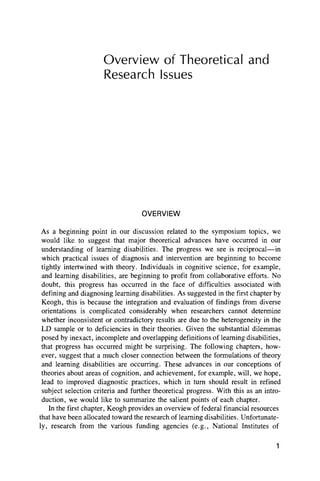
Overview of Theoretical and
Research Issues
OVERVIEW
As a beginning point in our discussion related to the symposium topics, we
would like to suggest that major theoretical advances have occurred in our
understanding of learning disabilities. The progress we see is reciprocal— in
which practical issues of diagnosis and intervention are beginning to become
tightly intertwined with theory. Individuals in cognitive science, for example,
and learning disabilities, are beginning to profit from collaborative efforts. No
doubt, this progress has occurred in the face of difficulties associated with
defining and diagnosing learning disabilities. As suggested in the first chapter by
Keogh, this is because the integration and evaluation of findings from diverse
orientations is complicated considerably when researchers cannot determine
whether inconsistent or contradictory results are due to the heterogeneity in the
LD sample or to deficiencies in their theories. Given the substantial dilemmas
posed by inexact, incomplete and overlapping definitions of learning disabilities,
that progress has occurred might be surprising. The following chapters, how-
ever, suggest that a much closer connection between the formulations of theory
and learning disabilities are occurring. These advances in our conceptions of
theories about areas of cognition, and achievement, for example, will, we hope,
lead to improved diagnostic practices, which in turn should result in refined
subject selection criteria and further theoretical progress. With this as an intro-
duction, we would like to summarize the salient points of each chapter.
In the first chapter, Keogh provides an overview of federal financial resources
that have been allocated toward the research of learning disabilities. Unfortunate-
ly, research from the various funding agencies (e.g., National Institutes of
1
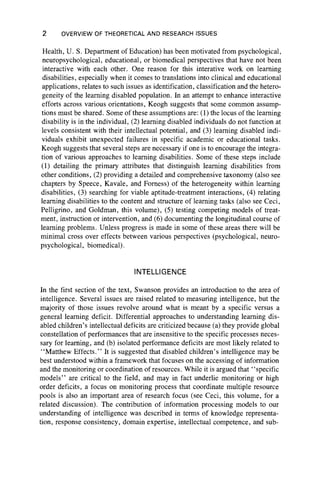
2 OVERVIEW OF THEORETICAL AND RESEARCH ISSUES
Health, U. S. Department of Education) has been motivated from psychological,
neuropsychological, educational, or biomedical perspectives that have not been
interactive with each other. One reason for this interative work on learning
disabilities, especially when it comes to translations into clinical and educational
applications, relates to such issues as identification, classification and the hetero-
geneity of the learning disabled population. In an attempt to enhance interactive
efforts across various orientations, Keogh suggests that some common assump-
tions must be shared. Some of these assumptions are: (1) the locus of the learning
disability is in the individual, (2) learning disabled individuals do not function at
levels consistent with their intellectual potential, and (3) learning disabled indi-
viduals exhibit unexpected failures in specific academic or educational tasks.
Keogh suggests that several steps are necessary if one is to encourage the integra-
tion of various approaches to learning disabilities. Some of these steps include
(1) detailing the primary attributes that distinguish learning disabilities from
other conditions, (2) providing a detailed and comprehensive taxonomy (also see
chapters by Speece, Kavale, and Fomess) of the heterogeneity within learning
disabilities, (3) searching for viable aptitude-treatment interactions, (4) relating
learning disabilities to the content and structure of learning tasks (also see Ceci,
Pelligrino, and Goldman, this volume), (5) testing competing models of treat-
ment, instruction or intervention, and (6) documenting the longitudinal course of
learning problems. Unless progress is made in some of these areas there will be
minimal cross over effects between various perspectives (psychological, neuro-
psychological, biomedical).
INTELLIGENCE
In the first section of the text, Swanson provides an introduction to the area of
intelligence. Several issues are raised related to measuring intelligence, but the
majority of those issues revolve around what is meant by a specific versus a
general learning deficit. Differential approaches to understanding learning dis-
abled children’s intellectual deficits are criticized because (a) they provide global
constellation of performances that are insensitive to the specific processes neces-
sary for learning, and (b) isolated performance deficits are most likely related to
“ Matthew Effects.” It is suggested that disabled children’s intelligence may be
best understood within a framework that focuses on the accessing of information
and the monitoring or coordination of resources. While it is argued that “ specific
models” are critical to the field, and may in fact underlie monitoring or high
order deficits, a focus on monitoring process that coordinate multiple resource
pools is also an important area of research focus (see Ceci, this volume, for a
related discussion). The contribution of information processing models to our
understanding of intelligence was described in terms of knowledge representa-
tion, response consistency, domain expertise, intellectual competence, and sub-
OVERVIEW OF THEORETICAL AND RESEARCH ISSUES 3
tle processing differences. Consistent with Keogh’s discussion in Chapter 1, it is
noted that integrative and reciprocal work is beginning to occur between re-
searchers in the areas of intelligence and learning disabilities. The aims of the
following 4 chapters on intelligence details the direction to this reciprocal
process.
Pellegrino and Goldman provide an excellent discussion related to our under-
standing of learning disabilities and intelligence by directing our attention to the
notion of cognitive competence. They begin by suggesting that the link of learn-
ing disabilities to the construct of intelligence is confusing. For example, on the
surface the relationship between intelligence and learning disabilities seems re-
lated because they are linked into diagnostic practices and operational defini-
tions. However, if one defines intelligence as the ability to learn, intelligence
does not seem like a construct that would attach itself to children who are
deficient in their ability to learn. This conceptual problem is redressed by consid-
ering the fact that intelligence is more than what a test measures; intelligence is
composed of many elements that involve processes and content. Unfortunately,
modem theories of intelligence, as they relate to learning disabilities, are vague
and have yet to be translated into operational testing practices. Further, our tests
of intelligence do not emanate from theories of intelligence and cognition and our
current tests of achievement do not incorporate theories on the development of
domain expertise (see chapter by Hall and Gerber, this volume, for a related
discussion). Pellegrino and Goldman’s chapter provides several suggestions
about how cognitive theories of intelligence can enhance our understanding of
learning disabilities. One way this can be done is to test the learner in terms of
the processes they will need for learning. Thus, an analysis of cognitive compe-
tence would include a precise analytic description of what is to be learned. These
descriptions would include a description of (a) the initial state of the learner in
terms of their domain specific knowledge, (b) the conditions that foster the
acquisition of competence (e.g., specific abilities and strategies), and (c) the
assessment of the effects of instructional implementation.
Ceci takes a slightly different view of the problems of relating learning dis-
abilities to the construct of intelligence. He focuses on the advantages of a
multiple resource model. He begins his discussion with an overview of the
processes that characterize intellectual behavior. He views the process used by
various ability groups as comparable, but individual differences exist in terms of
the efficiency to which they are used. To appreciate this position one must make
a contrast to traditional models. It has been traditional to think of learning
disabilities in terms of aptitude by x process interactions. That is, LD students
are characterized in terms of the capabilities they bring to a task, as well as the
processes that are evoked to perform the task. Ceci argues, however, that these
two factors do not appear in a vacuum, but rely on an informational and moti-
vational context. Another traditional position has been to think of intelligence as
a single resource pool that permeates all abilities and that a deviation or break-
4 OVERVIEW OF THEORETICAL AND RESEARCH ISSUES
down is manifested into some underlying process that supports it. This position
assumes that intelligence represents a common resource pool that underpins and
energizes all purposeful behavior. Thus, when a child has an uneven profile,
(e.g., deficit in reading or math), as with the learning disabled, but average
intelligence, it is assumed that relevant processing cites are blocking accesses to
a general pool of resources. Ceci argues, however, that it may be appropriate to
view intelligence as analogous to a modular computational device which is made
up of independent processing systems. This modular view suggests that there are
many independent processing centers and thus the profile variations we see in LD
children reflect problems attributed to independent resource pools. The implica-
tions of the modular view is that variations in knowledge about a particular
domain influence performance independent of the overall IQ. He suggests that
many children, because of biological constraints or because they lack certain
information requirements, do not process information effectively. This ineffec-
tive processing cannot be described in terms of general intelligence, but rather in
terms of the efficiency in which there are mental processes from a particular pool
of resources that are used.
Richard Wagner and Janet Kistner focus on two types of intelligence:
academic intelligence, which are intercorrelated competencies required for suc-
cess in formal situations (of which IQ tests are indirect measures), and practical
intelligence, which is a tacit knowledge or informal know-how. Of particular
interest is their development of the practical knowledge in which they focus on
two areas:
1. Achievement-related beliefs or informal theories about one’s abilities.
2. How to informally do academic tasks— via some type of improvisation.
The authors tackle a major and messy paradox in the field of learning dis-
abilities captured in the following quote: “ A specific learning disability is related
to some generalized deficits.” To address this paradox, they pose several ques-
tions. They ask first, “ Is academic intelligence at the heart of poor academic
performance in LD children?” The authors make the case that disabled readers
perform poorly on tasks that are not directly related to specific deficits. They also
address the flip side of the question: Does poor academic performance of LD
children result in deficits in academic IQ? The answer is yes—one who profits
from educational experience will enhance general cognitive abilities. That is, the
primary problem (reading) has an influence on academic intelligence. (Dr. Siegel
may agree since IQ is only indirectly related to academic intelligence.) In short,
LD children have deficits in intelligence and this conclusion runs counter to our
general assumptions that IQ is normal and difficulties occur in some specialized
academic areas.
In the area of practical intelligence, the authors ask, “ Are deficits in practical
intelligence responsible for poor academic performance?” The authors provide
evidence that normative deficits related to achievement related beliefs and strat-
OVERVIEW OF THEORETICAL AND RESEARCH ISSUES 5
egies are related to LD student’s academic performance. The literature suggests
that strategies for acquiring specific academic intelligence may differ between
ability groups thus placing demands on LD children’s academic performance.
There is the flip side of the question. “ Is the impaired academic performance
the result of deficits in practical intelligence?” Yes, repeated failures and mal-
adaptive achievement related beliefs leads to demands on practical intelligence.
In short, the questions posed by the authors are all affirmative suggesting that a
reciprocal relationship exists between achievement and academic and practical
intelligence.
As an introduction to the chapter by Short, Cuddy, Friebert, and
Schatschneider, it is important to note that problem solving is probably one of the
most important constructs of intelligence. As stated by Short et al., problem
solving appears to be a skill critical to both academic and social success. Despite
this fact, problem solving measures are seldom used to assess LD children’s
functioning. For example, placement of LD children into special programs tradi-
tionally rely on IQ tests, even though the relationship between IQ measures and
problem solving is questionable. Learning disabled children are characterized as
not only being less efficient in problem solving, but are less flexible in their
selection of strategies than their NLD counterparts. Short et al., report findings
that suggest that LD samples differ in IQ. This finding is of interest in itself, in
that the IQ measures are low for LD’s, but their results also suggest a deficit in
LD kids in a fundamental component of intelligence—problem solving. Their
study is important in terms of the implications related to individual differences to
instructions that influence problem solving, as well as supporting the generality
of IQ deficits in LD children.
Dr. Siegel presents some striking data which address the question of whether
IQ scores are irrelevant to an analysis of reading difficulty. She presents evi-
dence suggesting that variations in IQ within ability groups are not adequate
predictors of performance measures. Thus, low IQ scores do not necessarily
mean a reading problem and high IQ scores within reading ability groups does
not necessarily mean better readers. The implications of her findings are quite
clear: There is little support for the argument that differences on any IQ level
may require different types of remediation. Another interesting aspect of her data
was that reading samples appear to be rather homogeneous groups (e.g., in terms
of language and memory skill) when defined by word recognition difficulty. This
latter finding is of particular interest when one considers the heterogeneity issue
that emerges in a number of chapters in this volume.
SUBTYPING
The major purpose of subtype research is to reduce heterogeneous sample of LD
youngsters into homogeneous subgroups. While this goal seems rather straight-
forward there are, according to Fomess, two major problems (a) measures or
6 OVERVIEW OF THEORETICAL AND RESEARCH ISSUES
variables used to subtype are unreliable, and fail to account for a significant
amount of the variance, and (b) most subgroups have little predictive power to
external measures. Further and most importantly, Fomess has suggested that the
subgrouping enterprise has not resulted in substantiated classroom applications.
In terms of the methodological issues related to subtyping, the chapter by
Speece is both astute and directive in terms of application to future subtype
research. Some vexing issues noted by Speece related to cluster analysis tech-
niques are theory formulation, problems regarding subject definition, number of
subjects required for cluster analysis, selection of variables, defining how sub-
jects are similar or dissimilar, what is normal performance, and questions about
the reliability of clusters. The issues may be classified according to theory and
validity. For example, in terms of theory formulation, Speece indicates that
subtype research has not been theory driven, thus, a comprehensive system of
identification is unlikely. Not only is there a problem related to definition, one
does not know how many subjects to include in a cluster analysis. Further, we
still have not agreed upon methodology for determining the absolute number of
clusters. There are notable differences in clustering procedures and the means by
which those procedures can be reliably evaluated.
Kavale views LD subtyping research as multivariate in nature in which the
aim is not one of dividing the population along a single dimension. Rather, the
classification in LD is aimed at identifying subgroups along a variety of dimen-
sions that may be used to describe the heterogenous nature of LD. There are
some negative aspects to this kind of subtype research. For example, Kavale has
noted that LD subtype research has produced subtypes that are directed by the
measures used, rather than producing new concepts. Further, one-third of the
subjects classified as LD show no major deficits and therefore cannot be gener-
alized to the entire LD population. In addition, the subtypes that are produced are
rather gross categorizations (Kavale call this a macrotaxonomy) and what now is
required is a refinement at a microlevel. Kavale presents a framework of subtyp-
ing research in which the first goal is to form categories on the basis of common
attributes. He suggests researchers involved in the subtyping research should
pool their efforts into producing a single classification scheme for the field of
LD. This upward classification would unify what appears to be independent
subtyping research that produces more heterogeneity in the population than ap-
pears necessary.
SOCIAL COGNITION
Bryan and Bryan’s excellent analysis on the chapters on social cognition indi-
cated a number of interesting insights. First, the field is becoming more sophisti-
cated in focusing on the interpersonal aspects of learning disabilities. Thompson
and Kronenberger’s chapter, focuses on the area of emotional disturbances,
OVERVIEW OF THEORETICAL AND RESEARCH ISSUES 7
Vaughn and Hagan’s chapter and Pearl and Bryan’s chapter focus on social
cognitive skills. Second, there is a need for more complex models of social status
than has occurred in the previous literature. The limitations of previous models is
partly related to the use of multiple indices of social status, as well as the limited
parameters related to social cognition. Bryan and Bryan suggest from their
analysis that the existing data base provides strong support for continued research
on the social factors in learning disabilities.
Pearl and Bryan provide a provocative chapter on the vulnerability of learning
disabled adolescents. As in the Vaughn and Hogan chapter, learning disabled
students are viewed as being less liked by their peers and suffering from social
cognitive deficits. Thus, they suffer social rejection and isolation. In addition,
linguistic and pragmatic limitations lessens their ability to deal effectively in
social situations. For example, problems in language comprehension make it
difficult for them to fend off invitations to engage in socially inappropriate
behaviors. Thus, one would expect an overrepresentation of learning disabilities
among delinquent youth. To test the notion that LD students are vulnerable to
delinquency and victimization, several studies are reviewed. The conclusions of
these studies were that (a) conformity is related to the peers they perceive to be
friends, (b) learning students are vulnerable to being participants in undesirable
activity, (c) learning disabled students do not appear to have different assump-
tions about going along with a peer’s request to engage in undesirable behavior,
and (d) learning disabled students are less able to determine deceptive state-
ments. These findings suggest that learning disabled students are more vulnera-
ble than nondisabled students to engage in inappropriate behaviors. Data also
suggest that learning disabled students seem to lack the knowledge and skills that
protect them from being victimized by an ostensible friendly peer.
Thompson and Kronenberger suggest that the study of behavior problems in
learning disabled students has been hampered by an absence of an empirically
identified classification system. Progress in identifying children with specific
types of behavior patterns has been made along two lines of research: peer
nominations, and parent and teacher checklists. Both types of research have
extended the delineation of behavior problems in children with learning prob-
lems. Results have suggested that children with educational problems have high-
er levels of behavior problems when compared to controls, but the various
subtypes of children with educational problems share similar behavior problems.
For example, most types of studies indicate that there is some degree of person-
ality and conduct problems. Children with learning disabilities demonstrate high-
er levels of behavior problems than normal control children, but differences
between LD and mentally retarded children are mixed. One important area of
work has focused on children’s behavior problems in the context of chronic
developmental and medical problems. Thompson and Kronenberger reported in
their research that:
8 OVERVIEW OF THEORETICAL AND RESEARCH ISSUES
1. preschool children who are at risk for developmental problems are also at
risk for behavioral problems,
2. clinic referred children who have poor school performance have a high
frequency of behavior problems,
3. there is little difference in the behavior problems across LD and mildly
retarded children or other children with poor school performance, and
4. children perceived competency and family support have a mediating influ-
ence on behavior problems.
Consistent with some points of Bryan and Bryan, Sharon Vaughn and Anne
Hogan have indicated that the area of social competence has remained an illusive
research area. They define social competence as including four areas: positive
relations with others, appropriate social cognition, absence of maladaptive be-
haviors, and effective social behaviors. Based on their analysis, they found, for
example, that high risk children in kindergarten, later identified as learning
disabled, have lower peer acceptance rating when compared to controls. Two
possible hypotheses can be used to interpret the existing literature: one which
views social competence as reflective of academic functioning, the other as a
correlate of academic functioning. The results appear to support the latter. Learn-
ing disabled children display problems in all four areas of social competence.
They were more frequently rejected, less accepted, and received lower overall
rating by their peers. They also tend to have inaccurate perceptions of academic
success and peer perceptions.
ACHIEVEMENT
Hall and Gerber provide an excellent introduction to the area of cognition and
academic performance. They characterize achievement in terms of cognitive
competence (also see Pelligrino and Goldman, this volume). That is, achieve-
ment should not only reflect the correctness of performance, but also how perfor-
mance comes to be “ initiated, sustained, and completed by the learner." The
basic premise of their chapter is that student errors are often systematic and the
analysis of those errors provides diagnostic information that is specific to an
academic domain. Hall and Gerber provide an overview of what they consider to
be the advantages and limitation in the measurement of achievement. Some of
the advantages relate to the documentation of child progress. For example,
standardized tests are often used to determine a child’s academic strengths and
weaknesses and to establish whether performance in one or more academic areas
warrants recommendation for remedial services. The limitations of achievement
testing is that the results have little or no impact on instruction. In analyzing this
comment, the authors analyze the roles of the school psychologist and the teach­
OVERVIEW OF THEORETICAL AND RESEARCH ISSUES 9
er. With specific reference to the teacher, they indicate that teachers must be able
to generate models of efficient problem solving for all tasks to be taught. This
problem-solving model allows for the creation of specific correction subroutines
and general instruction plans that can accommodate incomplete skill develop-
ment. The authors complete their chapter by demonstrating how competence is
better understood by mapping performance to domain specific indicators of
processing.
Bos and Anders provide initial support for an interactive model for teaching
text-based concepts. Although strides have been made in learning strategy in-
struction, there has been a growing concern that such research must be broadened
to content area subjects. While much of the learning strategies research has been
based on cognitive training models, Bos and Anders call for a closer inspection
of teaching strategies that emanate from schema theory, psycholinguistic, and
concept models of the reading process. Schema are data structures that provide
an organizational framework in which new information can be integrated. In-
structional principles from this orientation include procedures that develop rela-
tionships between and among existing and new concepts. Psycholinguistic mod-
els of reading provide a focus on comprehension and the student’s ability to
strategically access graphophonic, syntactic, and semantic subsystems. Concep-
tual learning can be viewed as a subset of schema theory in which emphasis is
placed on instruction that explicates a concept. The authors focus on the interac-
tive nature of learning by centering on the dialogue of the teacher and student in
sharing their prior knowledge about key concepts. To test the model, the authors
focused on vocabulary instruction and compared one model (semantic feature
analysis— a procedure that encourages students to predict and confirm text-based
meanings and relationships among vocabulary words) and a dictionary method
(write definition from dictionary). The results of their study lead to an initial
support of the interactive model.
Reading comprehension ability is probably one of the most important academ-
ic skills to be mastered by LD youngsters. Joanne Carlisle discusses one tech-
nique, the sentence verification method, as a basis for understanding comprehen-
sion difficulties. The author contrasted other means of assessment but views the
sentence verification task (SVT) as a means of tapping language comprehension
abilities without requiring the use of sophisticated reasoning skills. A research
project was devised that utilized the SVT as a means for separating children with
low and high reading ability. The procedure was successful in the areas of
reading, listening, and word recognition. The importance of this procedure is its
ability to measure the level of language comprehension.
To read efficiently requires skills in phonological syntheses. For example, to
make sense of the alphabetic system of writing, a child must have an awareness
that words are composed of separate, reusable phonemic segments. Further,
beginning to read involves blending activities. If children have difficulty acquir-
ing blending skills during reading instruction, their initial progress in learning to
10 OVERVIEW OF THEORETICAL AND RESEARCH ISSUES
read will be delayed. Given the importance of sound blending, Torgesen and
Morgan address three issues related to phonological coding: the developmental
course of sound blending, the relationship between attainment of sound blending
and reading skills, and, the component skills that contribute to good performance
on blending tasks. Their analysis of the literature suggest that sound blending
(synthesis skills) improves gradually during most periods from preschool to later
elementary grades, except for the period between the end of kindergarten and
mid to latter 1st grade. During this period, there is an accelerated growth pattern.
Sound blending, as measured by auditory blending tasks is related to proficiency
in reading acquisition. Consistent with Siegel’s analysis, Torgesen and Morgan
view phonological coding tasks as largely independent of general measures of
verbal intellectual ability. One possible component that underlies individual
differences in phonological synthesis is phonological awareness. Thus, Torgesen
raises the question of whether a distinction between phonological synthesis and
“ awareness” is useful. The distinction is useful to the extent to which blending
enables readers to decode and awareness is represented as a rather inert form of
knowledge.
Hagen and Kamberelis present a cognitive-social developmental model of
learning disabilities which cuts across several diagnostic categories. A dimen-
sional approach is advocated. The first dimension includes the diagnostic groups
of learning disabilities, low academic achievement with no discernible learning
disability, diabetes mellitus, and seizure disorders. The second dimension in-
cludes elements that cut across diagnostic factors such as etiology, intellectual
and cognitive abilities, academic performance, motivation, self-concept, family
environment, and socioeconomic status. The third dimension is the developmen-
tal level of the child. Their model is a functional, developmental characterization
of strengths and weaknesses across cognitive, behavioral, and social variables.
When their data were analyzed utilizing the dimensional approach, there were a
number of similarities across diagnostic categories. For example, children with
seizure disorders and children with learning disabilities were similar in aptitude,
achievement, information processing, and self-esteem. These findings corrobo-
rate with recent work on the relationship between motivation, attribution, and
academic achievement. The implication for the field of learning disabilities is
that cognitive deficits are not entities in and of themselves. They are an integral
part of the environmental and cultural context (see the chapter by Ceci).
Although the chapter by Forness and Sinclair appears out of context for this
section of the text, there can be no doubt that depression as an emotional disorder
can occur with learning disabilities. Fomess and Sinclair provide a succinct
analysis of the diagnostic and symptomatic patterns related to diagnosis. As with
most diagnoses, the prevalence of the diagnosis depends on the choice of diag-
nostic criteria and instrumentation. Regardless, special education populations
tend to have a higher prevalence of depression. Although the link between
learning disabilities and depression is not clear, the preliminary data by Forness
OVERVIEW OF THEORETICAL AND RESEARCH ISSUES 11
and Sinclair suggest some relationship. Future research will determine whether
depression results from learning disabilities, is related to the onset of learning
disabilities, or some combination of factors.
La Greca and Stone focus on the role of achievement on the social, personal,
and behavioral functioning of children with learning disabilities. Their chapter
highlights several conceptual issues and methodological concerns that have af-
fected our understanding of learning disabilities. In particular, they discuss the
tendency of investigators to confound LD social status with academic achieve-
ment. They also raise the issue about whether the social, personal, and behav-
ioral difficulties that are reported among LD students are primarily explained by
low academic achievement. In a comprehensive review of a study, they assess
whether LD/NLD differences in social functioning are largely accounted for by
achievement differences. In the preliminary analysis of the results they suggest
that boys and girls in LD groups receive lower peer rating of acceptance than
their same-sex NLD counterparts. When attempts were made, however, to re-
strict the NLD sample to students whose achievement is within the same range as
the LD student, they found that the NLD group was more competent on a variety
of social and behavioral measures. Thus, they argue that poor achievement alone
does not appear to be an adequate explanation for the peer relationship problems
that characterize LD students. On the other hand, the authors admit that it is not
clear which factors do underlie LD/NLD social status differences. As they have
highlighted in their chapter, significant proportions of LD students are either
neglected or rejected, and there is good reason to believe that the correlates of
these two peer status problems are quite different. The authors suggest the
possibility that achievement may play a mediating role in social status, but its
status will not be understood until we begin to examine subtypes of LD students
(this point is also made in the chapters of Keogh, Speece, Kavale).
FINAL COMMENT
We wish to thank all presenters who participated in the conference. A number of
individuals presented papers, but their chapters were not included because of
page constraints, as well as the fact that their papers were not part of the topical
areas represented by the symposium. This selection process in no way discounts
the significance of these presentations since many of those papers will be pub-
lished in reputable journals and texts.
H. Lee Swanson
Barbara K. Keogh
Definitional Assumptions and
Research Issues
Barbara K. Keogh
University o f California, Los Angeles
Learning disabilities represent a major educational/clinical enterprise and a sub-
stantive topic of scientific inquiry. Each is supported by extensive human and
financial resources. According to the U.S. Department of Education’s Ninth
Annual Report to Congress, in 1985-86 almost 5% of school children nationally
were identified as learning disabled and received special educational services.
This figure is in contrast to the next most prevalent categories of handicap,
speech impairment (2.86%) and mental retardation (1.86%). It should be empha-
sized that learning disabilities is the only handicapping condition that increased
in prevalence over a 10-year period, the percentages of children identified and
served growing from 1.79% in 1976 to 4.73% in 1986.
Mandates in PL 94-142 have resulted in a proliferation of programs, increased
demands for trained personnel, and a heavy financial demand on school districts.
Following the passage of PL 94-142 in 1975, financial expenditures for special
education rose at a rate of 14% annually, a figure almost twice that for regular
education (Stark, 1982). In the 1981 Rand Corporation study of the costs of
special education, Kakalik, Furry, Thomas, and Carney (1981) reported that the
cost of educating a learning disabled child averaged $2875 above that already
expended for regular education, and they anticipated increasing additional costs
in subsequent years. Based on both prevalence and costs, it is clear that special
education in general, and learning disabilities in specific, represent practical
educational problems of major importance.
Concern for learning disabilities as a topic of scientific study is evidenced also
in the proliferation of published studies and in increased research support from
funding agencies. In 1986 the National Institutes of Health and the U. S. Depart-
ment of Education allocated over $40,000,000 to learning disabilities specific
13
1
14 KEOGH
research and over $103,000,000 to learning disabilities related research (In-
teragency Committee on Learning Disabilities, 1987). This support covered a
diverse range of topics, e.g. cognitive phenotypes in familial dyslexics, brain
mechanisms in learning and memory, brain imaging, auditory and attentional
functions, developmental agraphia, and dyslexia.
With some exceptions, research funded by the Department of Education has
been directed at applied problems, at programmatic, organizational, and policy
concerns (Interagency Committee Report, 1987). Topics addressed in recent
years include identification, classification, and placement procedures, adherence
to PL 94-142 requirements, prevalence of handicapping conditions, barriers to
service, and policy related to the Regular Education Initiative. These are impor-
tant questions, given the number of individuals with learning problems. How-
ever, policy and programmatic research sheds limited light on etiological and
functional aspects of learning disabilities. Clearly both “ basic” and “ applied”
efforts involving a number of disciplines are necessary if we are to understand
learning disabilities and what to do about them. Somewhat paradoxically, it is
the need for input from different disciplines that leads to inconsistencies and
confusions. Findings from different perspectives do not necessarily translate
well, and too often research efforts are parallel rather than integrated. Interven-
tion techniques based on biomedical or neuropsychological models may lack
validity within an educational context, and educationally important data may
have little relevance for research on specific cognitive processing functions.
It should not surprise us that educational, psychological, and biomedical
approaches to learning disabilities are often parallel rather than integrated, nor
should we necessarily view this as a negative. As with other conditions that lack
clear definition, our understanding of learning disabilities is both plagued and
enhanced by the diversity of perspectives and by the range of indicators or
symptoms presented by individuals identified as learning disabled. Historically,
the search has been for a unified condition and a single encompassing definition.
This has lead to long and often heated arguments, and to definitions that are so
broad they do not differentiate among conditions or to definitions that are so
narrow they lack coverage. Indeed, few operational definitions meet the Blash-
field and Draguns (1976) criteria of reliability, coverage, descriptive validity,
and predictive validity. The problem is partly because we do not deal with a
single condition or syndrome, nor is there a single etiology. Reviewing the array
of conditions or symptoms that have been used to describe learning disabilities, it
is logical to argue for a multiple rather than a single syndrome approach.
If learning disabilities are viewed as a set of related but partially independent
conditions with a number of possible etiologies, we can put aside the futile
search for a single condition and respond in orderly fashion to a range of prob-
lems. Recognition that the term, learning disabilities, refers to a heterogeneous
set of conditions or problems allows us to deal with a diversity of symptoms or
attributes and the educational or clinical responses to them. The multiple syn-
drome approach is not novel, and there is increasing consensus that the diversity
1. DEFINITIONAL ASSUMPTIONS AND RESEARCH ISSUES 15
in any group of learning disabled individuals is not due just to errors in identifica-
tion and classification, but rather represents real and legitimate variation. Part of
the conceptual task is to impose order on the variation, and part of the applied
task is to link differentiated and powerful clinical/educational responses.
COMMON ASSUMPTIONS
It should be emphasized that there are some commonly held assumptions which
cut across the array of attributes associated with learning disabilities and which
bring some consensus to the various conceptualizations or definitions. First, it is
assumed that a learning disability is locused in the individual. The most prevalent
early inference was that a learning disability was a direct consequence of neu-
rological damage or central nervous system pathology, a view based primarily on
clinical reports of medically diagnosed patients. The notion of minimal brain
dysfunction, an extrapolation of the neural damage hypothesis, received major
impetus from the work of Strauss, Kephart, Lehtinen, and their coworkers, and
was explicitly tied to learning disabilities by Cruickshank (see Doris, 1986 for
review). This tradition has been expanded and developed by work in the neuro-
sciences and neuropsychology which has focused on identification of brain-
behavior links (see Knights & Bakker, 1976; Obrzut & Hynd, 1986; and School
Psychology Review, Volume 10, 1981). Recent work derived primarily from
information processing paradigms also implicates a range of within-individual
problems (Swanson, 1988) but emphasizes functional processing problems rather
than structural ones. Despite differences in the nature of the causal hypotheses,
however, the assumption of an individually based problem is fundamental, and
leads to the incorporation of the troublesome “ exclusionary criteria” (e.g.,
social or economic disadvantage, lack of educational opportunity) in most
definitions.
A second common assumption is that learning disabled individuals do not
function at levels consistent with their intellectual potential. The aptitude-
achievement discrepancy has been operationalized with different formulae and
different measures (see Cone & Wilson, 1981; Reynolds, 1984-1985). The dis-
crepancy model has been analyzed, supported, and criticized, and a number of
investigators have described inconsistencies in decision making related to the
method of assessment, the formulae, or the statistics applied (Shepard, 1980,
1983; Ysseldyke, Algozzine, Richey, & Graden, 1982). There is also disagree-
ment as to what and how much constitute a meaningful discrepancy. A large
literature addresses these problems (see Learning Disabilities Research, Volume
3, number 1, 1987). However, the notion of a discrepancy between aptitude and
achievement continues to be fundamental to most definitions of learning dis-
abilities, and is one of the indicators that presumably differentiates learning
disabled individuals from slow learners or retarded learners.
16 KEOGH
A third assumption has to do with specificity (Stanovich, 1986). Broadly
stated, it is argued that learning disabled individuals exhibit unexpected failures
in certain, but not all, academic or educational tasks (e.g., reading, arithmetic,
spelling). Stanovich (1986) notes that the assumption of specificity ". " . is a
necessary concomitant to the idea of a learning disability, because violation of
the assumption undermines the utility of the label” (p. 232). If depressed perfor-
mance or achievement were evident in all academic areas, the individual would
more likely be considered a slow learner, mildly retarded, or lacking in moti-
vation. A number of causal hypotheses have been proposed to explain the specif-
ic failure, most inferring some links between neural or cognitive functions and
the demands of particular academic tasks. Thus, we might expect a specific
deficit in short-term memory to present problems for certain kinds of tasks but
not in others; similarly, we would expect short-term memory deficits to have
different consequences than deficits in elaborative coding. The notion of speci-
ficity provides a way of differentiating the learning disabled poor achiever from
other groups of poor achievers. It also provides direction for identification of
qualitatively different types of learning disabilities.
CLASSIFICATION AND IDENTIFICATION
Critics quite rightly challenge both the conceptualizations and the operational
definitions that have guided both researched practice in learning disabilities.
Yet, lack of agreement is not necessarily bad; indeed premature consensus might
lead to narrow and inequitable inferences. It is possible, too, that the challenges
have been based on inappropriate evidence. A good deal of the controversy about
definition relates to imprecise measurement and inadequate clinical/educational
practices used to identify individuals as learning disabled. Definitions are de-
rived or inferred from identified groups. The consequence is that the concep-
tualization of learning disabilities has been confused with the operational data of
assessment. Too often classification and identification issues have been con-
founded, leading to faulty inferences and improper generalizations (Keogh,
1987). Farnham-Diggory (1986) summarized the research catch 22: “We are
trying to find out what’s wrong with children whom we won’t be able to accu-
rately identify until after we know what’s wrong with them.” (p. 155).
Closely related, there are possible and reasonable differences in definitional
and operational criteria as a function of the purposes of classification (Keogh,
1983). Definitional criteria for delivery of services and for research on particular
neuropsychological processes are quite different. Thus, we should expect some
subject differences when identification is made for research or for clinical pur-
poses, or when research is directed at different aspects of learning disabilities.
These differences do not negate the validity of the problem condition. Indeed, a
growing literature documents the reality of learning disabilities while at the same
1. DEFINITIONAL ASSUMPTIONS AND RESEARCH ISSUES 17
time acknowledging the inconsistencies and ambiguities that characterize the
condition.
RESEARCH ISSUES
Looking to the future, several steps are necessary if we are to understand learning
disabilities as a personal and educational problem. Many of these are addressed
in subsequent chapters in this volume.
First, the primary criterial attributes which distinguish learning disabilities
from other problem conditions must be specified and agreed upon. Critics have
argued that learning disabled children are no different from slow learners or
mildly retarded individuals. If so, there is no need for detailed diagnostic assess-
ment or specialized instructional programs. Establishment of the validity and
independence of the condition, thus, is a major and important challenge.
Second, it is necessary to organize and order the diversity captured in the
learning disabilities rubric. The first point dealt with interproblem charac-
teristics, the second with intraproblem attributes. A number of efforts toward
organization have been attempted and many are currently in progress (McKin-
ney, 1988). These efforts may well lead to an accepted taxonomy of learning
disabilities which could improve diagnostic precision and clarify research
findings.
The need for a detailed and comprehensive taxonomy or organization of the
heterogeneity within learning disabilities is also apparent when applications to
interventions are considered. Thus, a third consideration relates to the search for
aptitude-treatment interactions. Historically this search has proved disappointing
(Cronbach & Snow, 1977) but the effort seems promising in learning disabilities.
Swanson (1988) has argued that past efforts have failed because of imprecisely
defined and poorly operationalized psychological processes, nonspecific and
inappropriate treatment strategies, and weak statistical analyses. If it is possible
to specify legitimate and meaningful subgroups of learning disabilities, then it is
possible to develop and test appropriate and powerful educational and clinical
responses. It is clear that the aptitude-treatment interaction model is not effective
for learning disabilities broadly defined, but rather, must be based on the specifi-
cation of coherent and theoretically sound subgroups.
Fourth, and closely related, understanding learning disabilities requires un-
derstanding of the content and organization or structure of the tasks to be learned.
From this perspective, learning disabilities do not exist in a vacuum, but rather
are specific to particular demands or learnings, and are contextually based. Thus,
disabilities in reading may differ from disabilities in mathematics, not just be-
cause the individuals differ in perceptual or cognitive abilities, but because the
demands of the tasks differ. Even if we were able to agree upon precise sampling
criteria, thus ensuring homogeneity of subjects, we should expect different ex­
18 KEOGH
pressions of problems as a function of the constraints in the learning tasks
themselves. This perspective mandates research on the demands and constraints
inherent in the content of schooling, including social and affective accomplish-
ments. It also moves us beyond the historical notion of an exclusive in-child
deficit (e.g. visual perceptual or auditory perceptual problems) as the basis of
learning disabilities.
A fifth consideration relates to practice and concerns the need to test compet-
ing models. The literature on learning disabilities is filled with descriptions of
particular programs and treatments. Many claim success, although the evidence
in support is often limited in power and lacking in generalization. While many
approaches claim some success, the relative success of programs is unknown.
There are few reported efforts to compare program effectiveness or to test com-
peting hypotheses about diagnosis or treatment. This question is of interest from
a theoretical perspective, as comparative analyses may shed light on the nature of
various subconditions subsumed by learning disabilities. The issue is important
on a practical level given the extensive human and financial resources which go
into clinical decision making and treatment. There is an incredible array of
diagnostic techniques and treatment programs designed to remediate learning
disabilities. Yet, we are uncertain if the time and cost of particular approaches
lead to more insightful diagnosis and more powerful remediation than other
simpler and less detailed efforts. As example, it is reasonable to ask if strategy
training programs are more efficacious than applied behavioral techniques, if
vision training is more effective than direct remedial instruction. Clinical experi-
ence suggests that almost any treatment or intervention has an effect, that some
intervention is better than no intervention. However, global and unspecified
effectiveness is not enough, from both theoretical and applied perspectives. The
relative effectiveness of competing programs requires test.
Finally, there is increasing consensus that learning disabilities are expressed
across a wide age range, and that problems are not limited to school age children.
There is, however, little longitudinal evidence to document the developmental
course of learning problems, and the mechanisms and dynamics which influence
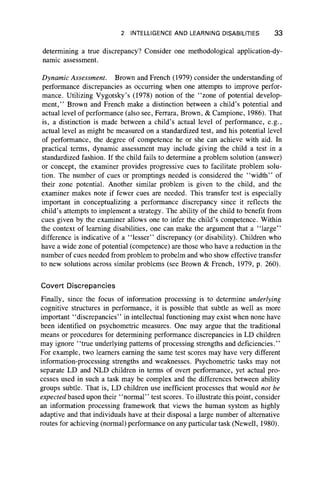
their expression are unspecified. Unraveling the developmental issues will neces-
sitate consideration of both individual and contextual variables, and will also
require the test of models from different disciplines.
ACKNOWLEDGMENTS
All correspondence should be sent to: Barbara K. Keogh, Ph.D., Graduate
School of Education, 122 Moore Hall, UCLA, Los Angeles, CA, 90024. Prepa-
ration of this chapter was supported in part by the National Institute of Child
Health and Human Development under a grant to the Socio-behavioral Group of
the Mental Retardation Research Center, UCLA.
1. DEFINITIONAL ASSUMPTIONS AND RESEARCH ISSUES 19
REFERENCES
Blashfield, R. K., & Draguns, J. G. (1976). Evaluative criteria for psychiatric classification.
Journal o f Abnormal Psychology, 85 (2), 140-150.
Cone, T. E ., & Wilson, L. R. (1981) Quantifying a severe discrepancy: A critical analysis Learning
Disability Quarterly, 4 (4), 359-371.
Cronbach, L. J., & Snow, R. E. (1977). Aptitudes and instructional methods. New York:
Irvington.
Doris, J. (1986). Learning disabilities. In S. J. Ceci (ed.), Handbook o f cognitive, social, and
neurological aspects o f learning disabilities, Volume 1 (pp. 3-54). Hillsdale, NJ: Lawrence
Erlbaum Associates.
Interagency Committee on Learning Disabilities. A report to the U.S. Congress (1987) .
Famham-Diggory, S. (1986). Time, now, for a little serious complexity. In S. J. Ceci (Ed.),
Handbook o f cognitive, social and neurological aspects of learning disabilities. Hillsdale, NJ:
Lawerence Erlbaum Associates.
Kakalik, J. S., Furry, W. S., Thomas, M. A., & Carney, M. F. (1981) . The cost of special
education. Santa Monica, CA: The Rand Corporation.
Keogh, B. K. (1983) . Classification, compliance, and confusion. Journal o f Learning Disabilities,
16(1), 25.
Keogh, B. K. (1987) . Learning disabilities: In defense of a construct. Learning Disability Re-
search, 3 (1), 4 -9.
Keogh, B. K. (1988). Diversity in search of order. In M. Wang, M. Reynolds, & H. Walberg
(Eds.), Handbook o f special education research and practice, Vol. 2. Oxford, England: Per-
gamon Press.
Knights, R. M., & Bakker, D. J. (Eds.). (1976). The neuropsychology o f learning disorders.
Baltimore, MD: University Park Press.
Learning Disabilities Research (1987), 3 (1), 10-63.
McKinney, J. D. (1988). Research on conceptually and empirically derived subtypes of specific
learning disabilities. In M. Wang, M. Reynolds, & H. Walberg (Eds.), Handbook o f special
education research and practice. Oxford, England: Pergamon Press.
Obrzut, J. E., & Hynd, G. W. (Eds.). 1986). C hildneurospychology, Volumes 1 & 2. Orlando, FL:
Academic Press.
Reynolds, C. R. (1984-1985). Critical measurement issues in learning disabilities. The Journal of
Special Education, 18 (4), 451-476.
School Psychology Review. (1981). Volume 10.
Shepard, L. (1980). An evaluation of the regression discrepancy method for identifying children
with learning disabilities. The Journal o f Special Education, 14 (1), 79-91.
Shepard, L. A. (1983). The role of measurement in educational policy: Lessons from the identifica-
tion of learning disabilities. Educational Measurement: Issues and Practice, 2 (3), 4 -8 .
Stanovich, K. (1986). New beginning, old problems. In S. J. Ceci (Ed.), Handbook of cognitive,
social, and neurological aspects o f learning disabilities, Volume 1 (pp. 3-54). Hillsdale, NJ:
Lawrence Erlbaum Associates.
Stark, J. H. (1982). Tragic choices in special education: The effects of scarce resources on the
implementation of Pub. L 94-142. Connecticut Law Review, 14 (47), 477-493.
Swanson, H. L. (1988). Comments, counter comments, and new thoughts. Journal o f Learning
Disabilities, 21 (5), 289-298.
United State Department of Education (1987). Ninth Annual Report to Congress.
Ysseldyke, J. E., Algozzine, B., Richey, L., & Graden, J. (1982). Declaring students eligible for
disability services: Why bother with the data? Learning Disability Quarterly, 5 (1), 37-43.
I
21
INTELLIGENCE AND
LEARNING DISABILITIES
Intelligence and Learning
Disabilities: An Introduction
H. Lee Swanson
University o f Northern Colorado
A causal review of the research relating learning disabilities to intelligence
indicates that the field has been plagued by vague conceptualizations and a lack
of clear theoretical foundation (e.g., Farnham-Diggary, 1986). One approach to
enhance conceptual clarity is to examine theoretical principles related to cog-
nitive explanations of intelligence and to identify points of overlap with the field
of LD (e.g., Day & Borkowski; 1987; Sternberg, 1987). The chapters in the next
section offer an extension of current models of intelligence and add definitional
clarity to our understanding of LD. These advances cover such topics as domain
specific knowledge (Pellegrino and Goldman, Chapter 3), multiple resource
models (Ceci, Chapter 4, & Short, Cuddy, Friebert, and Schatschneider, Chapter
6), practical intelligence and student attributions (Wagner and Kistner, Chapter
5, and IQ scores, Siegel, Chapter 7) to intellectual functioning of learning
disabled students.
In order to provide an introduction to the difficulties in relating what we know
about intelligence to learning disabilities,let us first focus on how one concep-
tualizes learning disabilities. The traditional account of learning disabilities is
one that suggests there is a deficit in intellectual performance, but this deficit
depresses only a limited aspect of contextually appropriate behavior. Tradi-
tionally, this depression of contextually appropriate behavior is described in
terms of a discrepancy between some aspect of academic performance and intel-
lectual behavior (e.g., Brown et al., 1986; Forness, Sinclair, & Guthrie, 1983).
So, for example, a child may be identified as learning disabled if he or she
displays reading performance 2 or more years below grade level, but neverthe-
less tests in the overall average IQ range. While this conception seems like one
that would easily lend itself to operationalization there are immense conceptual
23
2
24 SWANSON
problems with such an approach (see Kavale, 1987; Kavale & Forness, 1985,
Siegel, Chapter 6 for a review).
To begin with, the term learning disabilities itself is somewhat of a misnomer,
especially if one attempts to distinguish the learning disabled from other excep-
tional children, such as the mentally retarded (also see Sternberg, 1987, for a
related discussion). For example, the difference between the learning disabled
and the mentally retarded cannot be adequately described in terms of mentality or
learning (or in terms of retardation or disabilities for that matter). Rather, the
distinction between LD children and the mentally retarded is in terms of the
generality of their performance deficit (see Stanovich, 1986; Sternberg, 1987;
for a related discussion). Unfortunately, the generality of these performance
deficits are also not easy to distinguish or conceptualize. For example, which
aspects of learning disabilities are general to all or almost all environments, and
which are limited to more specific environmental situations (see Wagner and
Kistner, Chapter 5 for a related discussion)? In addition, how does one concep-
tualize a learning disability outside of the classroom context? We can, of course,
skirt around these issues by focusing on contextual behavior (i.e., behavior in the
classroom). However, even if the researcher limits him or herself to the study of
the classroom context, several perplexing issues emerge. For example, what
constitutes intelligent behavior when LD children’s specific intellectual deficits
are on tasks highly correlated with successful classroom functioning? Further,
how can these children’s intellectual functioning be specific when they perform
poorly on a multitude of cognitive tasks? Answers to these fundamental ques-
tions in the literature are unclear. In fact, because of some of the aforementioned
conceptual ambiguities, some researchers have begun to question the utility of
intelligence (as measured by IQ tests) as an appropriate construct for the field of
learning disabilities (e.g., Stanovich, 1986; Siegel, Chapter 7).
Assuming for a moment that the aforementioned issues can be put aside, one
obvious strategy to begin operationalizing learning disabled children’s intellec-
tual functioning would be to combine all the relevant dimensions of their adap-
tive and nonadaptive behavior (for example, classroom functioning) into an
overall test or index. No doubt, such a test would be somewhat arbitrary in the
items selected, but in principle it might provide some device to separate LD from
NLD children. Of course, this ideal is unattainable since many of the relevant
dimensions of LD children’s behavior, such as poor strategy use (e.g., Bauer &
Emhert, 1984; Borkowski, Johnston & Reid, 1987) or metacognitive deficien-
cies, (e.g., Palincsar & Brown, 1987) are not standardized or even identified.
Further, the poor adapting characteristics of the LD child would have to include
not only measures of vocabulary, analogical reasoning, social judgments, and
general information, but also creativity, flexibility, the learning of wit, and
common sense. These later characteristics exhibit themselves only in practical or
unique situations, and others cannot be evaluated except by observing this child
over an extended period of time. Thus, the researcher is seemingly left with two
2 INTELLIGENCE AND LEARNING DISABILITIES 25
possibilities in an attempt to conceptualize and ultimately assess the intellectual
functioning of learning disabled students: to forget about measuring intelligence
altogether (e.g., Siegel, Chapter 7) or to measure it inadequately. In relation to
civil rights, economics, and social bias concerning who gets labeled LD (e.g.,
Shephard & Smith, 1983; Shephard, Smith, & Voijer, 1983; also see Ceci,
Chapter 4), much could be said for the first alternative, but for various reasons
the field has adopted the second. Because the second alternative characterizes the
field of learning disabilities, it is critical that theoretical models of intelligence
direct such practices. The position considered here is to direct the measurement
of LD students’ intelligence in terms of theoretical models based on cognitive
science.
DIFFERENTIAL APPROACHES
Until recently, the measurement of LD children’s intelligence has been pre-
dominately characterized by differential or psychometric approaches. Differen-
tial approaches are based on the assumption that latent sources of individual
differences are related to mathematically derived factors (e.g., simultaneous and
successive factors on the Kaufman ABC-test, verbal and performance factors on
the WISC-R). While interpretations of factor analysis are equivocal (e.g., see
Carroll, 1983), the goal of such procedures is to isolate global constellations of
LD children’s functioning. In a practical sense, this approach assumes that
standardized intelligence tests assess individual differences along some con-
tinuum, and that the test items reflect some meaningful construct; otherwise, the
test would be of little interest or value as a descriptive and/or predictive instru-
ment. An important goal of the differential orientation is the accurate prediction
of task performance. This is an important goal (however, see Pellegrino and
Goldman, Chapter 3) in that appropriate placement of LD children constitutes a
serious problem in public school assessment procedures (Shephard & Smith,
1983). Unfortunately for the field of learning disabilities, the differential ap-
proach tends to focus on a relatively narrow range of predictors, of which only
the products of performance are measured (e.g., a battery of tests are given such
as the WISC-R, and scores are recorded). In addition, the focus on such product
(i.e., test-score) information, derived from measures of narrowly defined ap-
titudes (e.g., school success), are questionable (e.g., Messick, 1984). For exam-
ple, rarely have the data from traditional psychometric products accounted for
adequate amounts of variation in criterion-task performance (e.g., McCall,
1977). Further, children identified as learning disabled, via psychometric pro-
cedures, often may not be reliably distinguished from other low-achieving chil-
dren (e.g., Kavale & Fomess, 1984; Shephard, Smith, & Voijer, 1983; Yssel-
dyke, Thurlow, Graden, Wesson, Deno, & Algozzine, 1983). More importantly,
there is some emerging data based that suggests that such an approach has
26 SWANSON
difficulty (a) defining the mental processes necessary for effective learning, (b)
identifying subprocesses required on school tests as well as global processes
required for school learning, and (c) providing a link between cognitive-instruc-
tional theory and educational practices (see Wagner & Sternberg, 1984 for a
review).
Perhaps, the most serious limitation of the differential approach, at least in
terms of operationalizing the term learning disabilities, is that such an orientation
obscures the specific learning disability we are trying to find (see Stanovich,
1986 for a related discussion). For example, several reviews (e.g., Brown &
Campione, 1986; Stanovich, 1986; Ysseldyke et al., 1983) have suggested the
LD children perform less well than nondisabled students on a multitude of
psychometric measures. Recognizing this, practitioners to date (e.g., see
Ysseldyke et al., 1983) focus on a differential deficit; that is, a greater deficit in
one or more subtests than in others. Unfortunately, poor subtest performance
does not necessarily represent a differential deficit in ability. It may instead
reflect learning disabled children’s generalized performance deficits (Stanovich,
1986, refers to these as “ Matthew effects” ), coupled with the fact that one or a
combination of the subtest items better measure these generalized deficits than
others. Thus, low scores on various test items cannot be interpreted as indicating
a “ specific” learning disability. In support of the earlier inferences, two argu-
ments are brought to bear.
First, while these factor analyses indicate general abilities needed on these
tests, they have not provided insight into LD students intellectual functioning.
One reason for this state of affairs is that much of what may be called intelligent
behavior is organized into problem-solving skills or cognitive strategies which
are, in turn, composed of subskills and substrategies (see Chase & Ericsson,
1981; Borkowski, 1985; Borkowski, Carr, & Pressley, 1987; Greeno, Riley, &
Gelman, 1984; Rozin, 1976; Simon, 1981; also see Short et al., Chapter 6).
Therefore, the intellectual factors derived from psychometric measures are con-
structed from interrelated cognitive skills. The implication for understanding LD
students’ intellectual functioning is that much of their cognitive behavior reflects
their ability to access various cognitive subroutines as well as apply strategies to
an increasing range of tasks. Thus, an understanding of how LD children strate-
gically access to tasks as related resources in integral to any theoretical, as well
as practical, explanation of learning disabilities (see Ceci, Chapter 4; Brown &
Campione, 1986; Palincsar & Brown, 1987; Pressley, Johnson, & Symons, 1987
for a review).
Second, psychometric research may be misdirected in its focus on specific
psychological deficits. The assumption of many of these studies (standardized or
curriculum related) is that specific, independent, and identifiable clusters of
skills or abilities are involved in LD children’s learning impairment (e.g., read-
ing, math). However, even if such skills are identified, it may be argued that
such skills do not represent isolated difficulties in specific skills or processes, but
2 INTELLIGENCE AND LEARNING DISABILITIES 27
may reflect high-order cognitive difficulties that influence the coordination and
monitoring of these processes. That is, several studies in the last few years have
indicated that disabled children have difficulties on a number of general or global
mental activities (see Stanovich, 1986; for a discussion related to the conceptual
ambiguities related to these findings).
In support of this assumption, the research resource monitoring may be sum-
marized as follows: LD children experience difficulty with such self-regulatory
mechanisms as checking, planning, testing, revising, and evaluating during an
attempt to learn or solve problems (e.g., Bos & Filip, 1982; Brown & Palinscar,
1982, 1988; Butkowsky & Willows, 1980; Palincsar & Brown, 1984, 1987;
Pressley & Levin, 1987; Wong, 1978, 1979, 1982; Wong, Wong, Perry, &
Sawatsky, 1986). Such children perform poorly on a variety of tasks that require
the use of general control processes or strategies for solution (e.g., Bauer &
Emhert, 1984; Dallego & Moeley, 1980; Deshler, Alley, Warner, & Schumaker,
1981; Englert, Raphael, Anderson, Anthony, Fear, & Gregg, in press; Gamer &
Reis, 1981). Under some conditions, well designed strategy training improves
performance (e.g., Borkowski, Weyhing, & Carr, 1988; Duffy et al., 1986,
1987; Gelzheiser, 1984; Graham, 1985; Graves, 1986; Hallahan, Lloyd,
Kosiewica, Kaufman, & Graves, 1979; Malamoth, 1979; Hasselbom & Korkel,
1986; Leon & Pepe, 1983; Torgesen, Murphy, & Ivey, 1979; Short & Ryan,
1984; Wong & Jones, 1982), while at other times some general cognitive con-
straints prevent the effective use of control processes (e.g., Baker, Ceci, &
Herrmann, 1987; Shankweiler et al., 1979; Swanson, 1984b, 1987; Wong,
Wong, & Foth, 1977; see Cooney & Swanson, 1988 for a review). However,
when training of information processing components includes self-evaluation
(e.g., predicting outcomes, organizing strategies, using various forms of trial
and error), and attributions are related to effective strategy use (Licht, 1983;
Licht, Kistner, Ozkaragoz, Shapiro, & Clausen, 1985; Oka & Paris, 1987; Pearl,
Bryan, & Herzog, 1985) subprocesses are automatized (see Samuels, 1987;
Pellegrino & Goldman, 1987; Kolligian & Sternberg, 1987; however, see
Cheng, 1985), and training attempts are successful (e.g., Borkowski et al., 1988;
Englert et al., in press; Graves, 1986; McLoone, Scruggs, & Mastropieri, &
Zucker, 1986; Meichenbaum, 1982; Palinscar & Brown, 1984; Torgesen et al.,
1979; Worden & Nakamura, 1983; Schumaker, Deschler, Alley, Warner, &
Denton, 1982; Scruggs, Mastropieri, & Levin, 1987; Short & Ryan, 1984; Wong
& Sawatsky, 1984).
Thus, research that primarily focuses on isolated deficiencies may not ade-
quately capture the integrative or higher-order nature of LD children’s intellec-
tual and academic functioning (Stanovich, 1986). That is, learning disabilities
may be the result of a unique coordination of multiple processes that include high
order (as well as low order) activities rather than a specific type of processing
deficiency isolated to a particular academic domain (see Ceci, Chapter 4 for a
related discussion).
28 SWANSON
It is not the intent of the foregoing comments to suggest that the differential or
domain-specific models of LD be abandoned, but rather put into perspective.
While the " notion of specificity" is a critical assumption to the field of learning
disabilities (Stanovich, 1986; e.g., a localized deficiency can be treated effec-
tively if diagnosed properly), this orientation has generated too many competing
hypotheses. Further, even if a specific deficit is isolated the problem is pervasive
over time in its influence on cognition and the acquisition of knowledge. Without
denying a specific etiology of LD, there are both theoretical and practical bene-
fits on high-order processes when one attempts to understand such children’s
intellectual functioning (also see Paris & Oka, in press, for a related discussion).
In sum, previous intellectual frameworks on LD children’s intellectual func-
tioning may be rather limited, at least in the general sense because they fail to
incorporate the research on LD children’s general cognitive-monitoring abilities.
The position suggested here is that additional theories must be considered in
order to elaborate and mutually compliment current psychometric approaches in
understanding LD students’ intellectual functioning.
INFORMATION PROCESSING
In response to the previous limitations of research on learning disabilities and
intelligence, the subsequent chapters attempt to sketch some major concepts that
seem particularly relevant to our understanding of LD (also see Spear & Stern-
berg, 1987). The majority of these concepts are couched within the information-
processing framework. Such a framework assumes that three general compo-
nents underlie intellectual functioning:
(a).a constraint or structural component, akin to the hardware of a computer,
which defines that parameter within which information can be processed at a
particular stage (e.g., sensory storage, short-term memory, long-term memory),
(b) a control or strategy component, akin to the software of a computer
system, which describes the operations of the various stages; and
(c) an executive process, by which the learner’s activities (e.g., strategies) are
overseen and monitored (see Campione, Brown, & Ferrara, 1982; for a related
discussion).
It is assumed that the flow of information occurs in stages, and each stage
operates on the information available to it. Thus, at a global level, information-
processing theory consists of stages and components (see Campione, Brown, &
Ferrara, 1982; Sternberg, 1984, for review). The role I see for information
processing theories is not to overthrow differential models but to provide a more
comprehensive and elaborate understanding of learning disabilities. I now delin­
eate some applications of such a model.
2 INTELLIGENCE AND LEARNING DISABILITIES 29
KNOWLEDGE REPRESENTATION
One major contribution of information-processing theory to the understanding of
intelligence is its focus on knowledge representation (Pellegrino & Goldman,
Chapter 3). A knowledge representation may be defined as how a person
organizes relationships among concepts. As Messick (1984) points out, knowl-
edge representations are how we relate and organize information—how we un-
derstand information. As knowledge representations develop in children, it goes
beyond the representation of simple facts to include complex systems of multiple
relationships that are organized for interpretation and action.
In terms of a theoretical framework, several researchers (e.g., Anderson
1982, 1983) have described knowledge representations as having both a de-
clarative and procedural form. Declarative knowledge is a network of facts
represented as propositions, such as a series of facts about math or history.
Procedural knowledge is a series of rules or principles that directs knowledge
(Pellegrino & Goldman, Chapter 3). For novice learners in a particular domain
(e.g., reading), acquired knowledge always starts out in the declarative form
and, by means of general problem-solving abilities, is applied interpretatively.
That is, the new learner relies on cues, prompts, verbal rehearsal, and other
strategies to make factual information more understandable. However, with ex-
perience and practice in an academic domain, declarative knowledge (i.e., the
reliance on facts) becomes replaced by procedures or specific cognitive routines
that carry the function of knowledge with them.
ACCESSIBILITY
A second application related to how LD children represent knowledge (e.g.,
either declaratively or procedurally), is related to the accessibility of knowledge
(Short et al., Chapter 6). Accessibility refers to the notion that the information
necessary for task performance resides within the child. Some children are able
to access this information flexibly, that is, a particular behavior is not delimited
to a constrained set of circumstances (Campione, Brown, Ferrara, Jones, &
Steinberg, 1985). In addition, some children are “ aware” of these processes and
are able to consciously describe and discuss their own cognitive activities that
allow them to access information. Currently, a number of researchers in the field
of learning disabilities have converged on the notion that learning disabled chil-
dren’s ability to access knowledge remains inert, unless they are explicitly
prompted to use certain cognitive strategies (e.g., see Ferrara, Brown, & Camp-
ione, 1986 for a review). For example, LD children may be taught to (a) organize
lists of pictures and words in common categories, (b) rehearse the category
names during learning and (c) use the names as retrieval cues at the time of the
test (e.g., see Cooney & Swanson, 1987 for a review). The data suggest that
when LD children are explicitly encouraged to use such strategies on some tasks,
30 SWANSON
their performance improves and thus the discrepancy between the general intel-
lectual ability and contextually related deficits is lessened.
Based on these assumptions related to knowledge representation and ac-
cessibility, what insights are to be gleaned to enhance our understanding of some
of the intellectual deficits noted in LD children and how can such insight compli-
ment differential models of LD? I suggest three possibilities. These areas focus
on discrepancies between general intellectual functioning and the depressions in
certain isolated contextual behaviors, (e.g., the typical discrepancies between IQ
and achievement).
A FRAMEWORK FOR COVARIATION
First, a focus on knowledge representations provides a basis for explaining
covariation (response consistency or discrepancies) in intellectual test perfor-
mance. Messick (1983, 1984) has recently argued that a major problem of test
scores interpretation is in our accounting of response consistency. That is, the
cognitive abilities of learning disabled children are not accurately revealed from
standardized tests because of the tests inability to reliability account for variance.
A medical analogue may explicate this idea. When we take a person’s tem-
perature and find that it is 103 F, we can reasonably assume that there is
something discrepant in our expectation, because 103 F is much higher than
98.6, the expected temperature. From a medical perspective, the determination
of the discrepancy (i.e., difference between expected and actual behavior) is not
a difficult problem. However, in the psychological and educational domain the
determination of a discrepancy between the actual and expected score is more
difficult since the education instrument is subject to variation across time, set-
ting, versions of the test, and so on. By contrast, variations across medical
“ tests,” for example, thermometers, are minimal. The point is that the LD
child’s performance on intelligence tests cannot be interpreted atface value (see
Siegel, Chapter 7 for a related discussion). The variance in performance across
various measures emerge because the measures are not perfectly reliable (as well
as not perfectly correlated), and, thus some factions of the child’s performance
arise wholly or in part by chance (Bereiter, 1963, Chapman & Chapman, 1973;
Thorndike, 1972).
One possible framework of explaining this covariation is to focus on the
interaction between two forms of knowledge (Pellegrino & Goldman, Chapter
3). As stated earlier, one form of knowledge, the declarative form, focuses on
facts (as possibly measured by intelligence tests). While the other form, pro­
cedural knowledge, represents how the child encodes knowledge as rules or
procedures, not as an enumeration of the entire data base of facts. For example,
the missed facts on a series of tests which LD students are having difficulty may
reflect errors in declarative knowledge. However, to understand the discrepancy
2 INTELLIGENCE AND LEARNING DISABILITIES 31
between tests, however, one must determine the rules that give rise to these
errors. That is, the information processing perspective focuses on an array of
rules that may account for the observed errors in child performance within or
between standardized tests. My point is that one may argue that the covariations
across various intellectual and achievement measures are not necessarily due to
inadequate knowledge (i.e., declarative knowledge), as much as they are to
inadequate or inappropriate assembly of control processes and/or ineffective
mobilization or organization of complex relevant abilities (i.e., procedural
knowledge). Of course, performance on certain subtests of intelligence measures
in which LD children do not meet expectation includes a variety of acquired
specific skills, such as the acquisition of mathematical facts. As Richard Snow
(1980) states however, “ achievement is as much an organizationfunction as it is
an acquisition function.” Thus, what a LD student does on various tests embrac-
es processes that are reflective of the transition between declarative and pro-
cedural forms of knowledge. Further, these processes are applied to various
subject matter in order to interpret, remember, visualize, transform, evaluate,
and think, both convergently and divergently about material.
To avoid, however, a post-hoc theorizing of the reasons why covariation
(discrepanies) occurs across various intellectual measures for LD students,
efforts need to be made toward restructuring current assessment instruments.
This does not mean making intelligence tests used to determine LD children
discrepancies progressively more difficult at low and intermediate levels, but
rather one must construct test items that are sensitive to processes operative with
the various forms of knowledge representations. One direct means to accomplish
this is to fashion tests that capture the development of expertise in a particular
domain (see Pellegrino & Goldman, Chapter 3; Ceci, Chapter 4; Short et al.,
Chapter 6).
Domain Expertise
Several studies are available that allow us to characterize, albeit tentatively,
some of the complexities of developed knowledge that constitute the power of
expertise (e.g., Chi, Feltovich, & Glaser, 1981; Messick, 1983; Pellegrino &
Goldman, Chapter 3). It appears from recent work that experts (non LD’s in this
case) not only know more than novices (i.e., LD’s) and have a vastly richer store
of relevant knowledge in long-term memory (i.e., declarative knowledge), but
they also structure and continually restructure their procedural knowledge in
more complex ways. In particular, experts construct complex representations
that combine some of the dimensions and simpler schemes used by novices into
integrated functional patterns, while at the same time discarding as redundant or
irrelevant some other dimensions that novices attend to. The challenge for as-
sessing the performance discrepancies in LD children is to fashion assessment
tasks that capture the functional dimensions of developing competence or exper-
32 SWANSON
tise. These dimensions go beyond the traditional standard test measures of per-
formance accuracy, speed and fluency in an academic domain, to include the
measurement of the restructuring, fine tuning and the automatization of cognitive
processes.
Determining Intellectual Competence
Second, a focus on knowledge accessibility would refine our understanding of
performance discrepancies between competency and performance. The assess-
ment of competence indicates what the child knows and can do under ideal
circumstances, whereas performance refers to what may be done under existing
circumstances. Competence embraces a child’s knowledge representation,
whereas performance subsumes the processes of accessing and utilizing those
structures and a host of effective, motivational, attentional, and stylistic factors
that influence the ultimate response (Wagner & Kistner, Chapter 5). Thus, a LD
student’s competence (in terms of IQ or achievement-performance) might not be
revealed in test performance because of the personal or circumstantial factors that
affect behavior (Wagner & Kistner, Chapter 5).
Enhancing Access. In support of the above assumption, let us consider the
earlier research by Ann Brown and her colleagues on the use of complex study
strategies by children. In one seminal study by Brown and Smiley (1978),
subjects from grades 5 to 12 were asked to learn passages approximately 400
words long. Each passage was read by the subject and then they were asked to
recall the main ideas. After recall, the subjects were told they had some time to
restudy the passage and they “ could undertake any activity they wished to
improve their recall” (Brown & Smiley, 1978, p. 1080). Only 6% of the 5th
graders took notes spontaneously, compared to 12% and 50% of the junior and
senior high school students. Older subjects also underlined more often than
younger ones. Findings such as these on the developmental use of strategies has
been generalized to the field of learning disabilities in which it is assumed that
such children follow the same patterns as younger children (e.g., Cooney &
Swanson, 1987). Learning disabled children are less likely to underline critical
information in a passage, categorize information, suggest strategies for com-
prehending and remembering information, and so on, when compared to non-
disabled children matched on IQ. However, the fact that LD children have
normal intelligence means that they learn some information fairly well. Thus, a
conceptual issue to be contended with is why then are there so many discrepan-
cies, as noted in the literature, on how LD children perform compared to what
other information suggests that they are capable of doing? From a cognitive
perspective, I have argued that the problem is one of accessing an organized
knowledge system rather than a “ true” discrepancy in performance. If this is the
case, what do methodology information processing frameworks have to offer for
2 INTELLIGENCE AND LEARNING DISABILITIES 33
determining a true discrepancy? Consider one methodological application-dy-
namic assessment.
Dynamic Assessment. Brown and French (1979) consider the understanding of
performance discrepancies as occurring when one attempts to improve perfor-
mance. Utilizing Vygotsky’s (1978) notion of the “ zone of potential develop-
ment,” Brown and French make a distinction between a child’s potential and
actual level of performance (also see, Ferrara, Brown, & Campione, 1986). That
is, a distinction is made between a child’s actual level of performance, e.g.,
actual level as might be measured on a standardized test, and his potential level
of performance, the degree of competence he or she can achieve with aid. In
practical terms, dynamic assessment may include giving the child a test in a
standardized fashion. If the child fails to determine a problem solution (answer)
or concept, the examiner provides progressive cues to facilitate problem solu-
tion. The number of cues or promptings needed is considered the “ width” of
their zone potential. Another similar problem is given to the child, and the
examiner makes note if fewer cues are needed. This transfer test is especially
important in conceptualizing a performance discrepancy since it reflects the
child’s attempts to implement a strategy. The ability of the child to benefit from
cues given by the examiner allows one to infer the child’s competence. Within
the context of learning disabilities, one can make the argument that a “ large”
difference is indicative of a “ lesser” discrepancy (or disability). Children who
have a wide zone of potential (competence) are those who have a reduction in the
number of cues needed from problem to probelm and who show effective transfer
to new solutions across similar problems (see Brown & French, 1979, p. 260).
Covert Discrepancies
Finally, since the focus of information processing is to determine underlying
cognitive structures in performance, it is possible that subtle as well as more
important “ discrepancies” in intellectual functioning may exist when none have
been identified on psychometric measures. One may argue that the traditional
means or procedures for determining performance discrepancies in LD children
may ignore “ true underlying patterns of processing strengths and deficiencies.”
For example, two learners earning the same test scores may have very different
information-processing strengths and weaknesses. Psychometric tasks may not
separate LD and NLD children in terms of overt performance, yet actual pro-
cesses used in such a task may be complex and the differences between ability
groups subtle. That is, LD children use inefficient processes that would not be
expected based upon their “ normal” test scores. To illustrate this point, consider
an information processing framework that views the human system as highly
adaptive and that individuals have at their disposal a large number of alternative
routes for achieving (normal) performance on any particular task (Newell, 1980).
34 SWANSON
Now suppose the LD and NLD child’s task is to remember a short list of visually
presented nouns that are orthographically and phonemically distinct. Some of
these children might use primarily phonemic or semantic information, others
might remember the global shapes of words and their referents, and still others
might use a combination of strategies, yet the final levels of performance to
obtain similar levels of performance are due to different processing strategies and
hence subsets of resources that are quite distinct.
A recent study of learning disabled children’s intellectual functioning (Swan-
son, 1988) illustrates the above point. The assumption tested was that learning
disabled children do not rely on the same mental component processes as non-
disabled children on subtests of the WISC-R in which their overt performance is
comparable to NLD children. The results suggested that the two groups varied in
the algorithms and heuristics used to solve the problems, even though task
performance and the total number of mental processes used were comparable.
Thus, clear discrepancies exist between ability groups in the means by which
they access information.
Summary and Implications
In summary, I have sketched, and the following four chapters sketch, some ways
that information-processing theory make application to the study of intelligence
in LD disabled children. For example, I have suggested one way is to provide a
framework for explaining covariation in test performance, another is to focus on
competence rather than performance and finally to help us uncover processing
discrepancies when overt performance is comparable to their normal counter-
parts. My own bias (Swanson, 1984a) is that proficient intellectual functioning
reflects selecting from a repertoire of strategies (monitoring function) a plan of
action (strategy) relevant to the problem. In addition, an intellectually proficient
student must have the necessary information (knowledge base) and knowledge of
cognitive resources (metacognition) to be able to transfer and efficiently refine
(strategy abstraction) his or her learning processes. By inference, it is possible
that LD children fail to integrate all these cognitive activities into one complex
act for successful task performance on some isolated tasks (e.g., reading). There-
fore, a learning disability may not be simply a deficiency in certain cognitive
area or skill, per se but may also reflect some monitoring difficulties (as well as
the poor automatization of skills, see Kolligian and Sternberg, 1987) of the
cognitive components involved in information processing.
As a summary point in my discussion about intelligence, I would like to
suggest that if theoretical advances are to continue to occur in our understanding
of intelligence and learning disabilities, the progress must be reciprocal— in
which practical issues of diagnosis and intervention are tightly entwined with
theoretical insights about intelligence and learning disabilities. In this reciprocal
process, research in both the areas of intelligence and learning disabilities profit
2 INTELLIGENCE AND LEARNING DISABILITIES 35
from collaborative efforts. The aim of the following chapters is to provide
direction to this reciprocal process.
REFERENCES
Anderson, J. R. (1982). Acquisition of cognitive skill. Psychological Review, 89, 369-406.
Anderson, J. R. (1983). The architecture o f cognition. Cambridge, MA: Harvard University Press.
Baker, J. G., Ceci, S. J., & Hermann, N. D. (1987). Semantic structure and processing: Implica-
tions for the learning disabled child. In H. L. Swanson (Ed.), Memory and learning disabilities
(pp. 83-110). Greenwich, CT: JAI Press.
Bauer, R. H., & Emhert, J. (1984). Information processing in reading-disabled and nondisabled
children. Journal o f Experimental Child Psychology, 37, 271-281.
Bereiter, C. (1963). Some persistent dilemmas in the measurement of change. In C. A. Harris
(Ed.), Problems in measuring change. Madison: University of Wisconsin Press.
Borkowski, J. G. (1985). Signs of intelligence: Strategy generalization and metacognition. In S.
Yussen (Ed.), The growth o f reflection in children (pp. 105-144). Orlando, FL: Academic Press.
Borkowski, J. G., Carr, M ., & Pressley, M. (1987). “ Spontaneous” strategy use: Perspectives
from metacognitive theory. Intelligence, 11, 61-75.
Borkowski, J. G., Johnston, M. B., & Reid, M. K. (1987). Metacognition, motivation, and con-
trolled performance. In S. J. Ceci (Ed.), Handbook o f cognitive, social and neuropsychological
aspects o f learning disabilities (pp. 147-174). Hillsdale, NJ: Lawrence Erlbaum Associates.
Borkowski, J. G., Weyhing, R. S., & Carr, M. (1988). Effects of attributional retraining on
strategy-based reading comprehension in learning-disabled students. Journal of Educational
Psychology, 80, 46-53.
Bos, C., & Filip, D. (1982). Comprehension monitoring skills in learning disabled and average
students. Topics in Learning and Learning Disabilities, 2, 79-85.
Brown, A. L., Campione, J. C. (1986). Psychological theory and the study of learning disabilities.
American Psychologist, 41, 1059-1068.
Brown, A., & French, L. (1979). The zone of potential development: Implications for intelligence
in the year 2000. Intelligence, 4, 255-273.
Brown, A., & Palinscar, A. (1982). Inducing strategic learning from texts by means of informed,
self-control training. Topics in Learning and Learning Disabilities, 2, 1-18.
Brown, A. L., & Palincsar, A. S. (1988). Reciprocal teaching of comprehension strategies: A
natural history of one program for enhancing learning. In J. Borkowski & J. P. Das (Eds.),
Intelligence and cognition in special children: Comparative studies of giftedness, mental retarda-
tion, and learning disabilities. Norwood, NJ: Ablex.
Brown, A., & Smiley, S. (1978). The development of strategies for studying texts. Child Develop-
ment, 49, 1076-1088.
Brown, L. et al., Council for Learning Disabilities (1986). Use of discrepancy formulas in the
identification of learning disabled individuals. Learning Disability Quarterly, 9, 245.
Butkowsky, I. S., & Willows, D. M. (1980). Cognitive-motivational characteristics of children
varying in reading ability: Evidence for learned helplessness in poor readers. Journal of Educa-
tional Psychology, 72, 408-422.
Campione, J. C ., Brown, A. L ., & Ferrara, R. A. (1982). Mental retardation and intelligence. In R.
J. Sternberg (Ed.), Handbook of human intelligence (pp. 392-473). New York: Cambridge
University Press.
Campione, J. C., Brown, A. L., Ferrara, R. A., Jones, R. S., & Steinberg, E. (1985). Breakdown
in flexible use of information: Intelligence-related differences in transfer following equivalent
learning performance. Intelligence, 9, 297-315.
Other documents randomly have
different content
PLEASE READ THIS BEFORE YOU DISTRIBUTE OR USE THIS WORK
To protect the Project Gutenberg™ mission of promoting the
free distribution of electronic works, by using or distributing this
work (or any other work associated in any way with the phrase
“Project Gutenberg”), you agree to comply with all the terms of
the Full Project Gutenberg™ License available with this file or
online at www.gutenberg.org/license.
Section 1. General Terms of Use and
Redistributing Project Gutenberg™
electronic works
1.A. By reading or using any part of this Project Gutenberg™
electronic work, you indicate that you have read, understand,
agree to and accept all the terms of this license and intellectual
property (trademark/copyright) agreement. If you do not agree
to abide by all the terms of this agreement, you must cease
using and return or destroy all copies of Project Gutenberg™
electronic works in your possession. If you paid a fee for
obtaining a copy of or access to a Project Gutenberg™
electronic work and you do not agree to be bound by the terms
of this agreement, you may obtain a refund from the person or
entity to whom you paid the fee as set forth in paragraph 1.E.8.
1.B. “Project Gutenberg” is a registered trademark. It may only
be used on or associated in any way with an electronic work by
people who agree to be bound by the terms of this agreement.
There are a few things that you can do with most Project
Gutenberg™ electronic works even without complying with the
full terms of this agreement. See paragraph 1.C below. There
are a lot of things you can do with Project Gutenberg™
electronic works if you follow the terms of this agreement and
help preserve free future access to Project Gutenberg™
electronic works. See paragraph 1.E below.
1.C. The Project Gutenberg Literary Archive Foundation (“the
Foundation” or PGLAF), owns a compilation copyright in the
collection of Project Gutenberg™ electronic works. Nearly all the
individual works in the collection are in the public domain in the
United States. If an individual work is unprotected by copyright
law in the United States and you are located in the United
States, we do not claim a right to prevent you from copying,
distributing, performing, displaying or creating derivative works
based on the work as long as all references to Project
Gutenberg are removed. Of course, we hope that you will
support the Project Gutenberg™ mission of promoting free
access to electronic works by freely sharing Project Gutenberg™
works in compliance with the terms of this agreement for
keeping the Project Gutenberg™ name associated with the
work. You can easily comply with the terms of this agreement
by keeping this work in the same format with its attached full
Project Gutenberg™ License when you share it without charge
with others.
1.D. The copyright laws of the place where you are located also
govern what you can do with this work. Copyright laws in most
countries are in a constant state of change. If you are outside
the United States, check the laws of your country in addition to
the terms of this agreement before downloading, copying,
displaying, performing, distributing or creating derivative works
based on this work or any other Project Gutenberg™ work. The
Foundation makes no representations concerning the copyright
status of any work in any country other than the United States.
1.E. Unless you have removed all references to Project
Gutenberg:
1.E.1. The following sentence, with active links to, or other
immediate access to, the full Project Gutenberg™ License must
appear prominently whenever any copy of a Project
Gutenberg™ work (any work on which the phrase “Project
Gutenberg” appears, or with which the phrase “Project
Gutenberg” is associated) is accessed, displayed, performed,
viewed, copied or distributed:
This eBook is for the use of anyone anywhere in the United
States and most other parts of the world at no cost and
with almost no restrictions whatsoever. You may copy it,
give it away or re-use it under the terms of the Project
Gutenberg License included with this eBook or online at
www.gutenberg.org. If you are not located in the United
States, you will have to check the laws of the country
where you are located before using this eBook.
1.E.2. If an individual Project Gutenberg™ electronic work is
derived from texts not protected by U.S. copyright law (does not
contain a notice indicating that it is posted with permission of
the copyright holder), the work can be copied and distributed to
anyone in the United States without paying any fees or charges.
If you are redistributing or providing access to a work with the
phrase “Project Gutenberg” associated with or appearing on the
work, you must comply either with the requirements of
paragraphs 1.E.1 through 1.E.7 or obtain permission for the use
of the work and the Project Gutenberg™ trademark as set forth
in paragraphs 1.E.8 or 1.E.9.
1.E.3. If an individual Project Gutenberg™ electronic work is
posted with the permission of the copyright holder, your use and
distribution must comply with both paragraphs 1.E.1 through
1.E.7 and any additional terms imposed by the copyright holder.
Additional terms will be linked to the Project Gutenberg™
License for all works posted with the permission of the copyright
holder found at the beginning of this work.
1.E.4. Do not unlink or detach or remove the full Project
Gutenberg™ License terms from this work, or any files
containing a part of this work or any other work associated with
Project Gutenberg™.
1.E.5. Do not copy, display, perform, distribute or redistribute
this electronic work, or any part of this electronic work, without
prominently displaying the sentence set forth in paragraph 1.E.1
with active links or immediate access to the full terms of the
Project Gutenberg™ License.
1.E.6. You may convert to and distribute this work in any binary,
compressed, marked up, nonproprietary or proprietary form,
including any word processing or hypertext form. However, if
you provide access to or distribute copies of a Project
Gutenberg™ work in a format other than “Plain Vanilla ASCII” or
other format used in the official version posted on the official
Project Gutenberg™ website (www.gutenberg.org), you must,
at no additional cost, fee or expense to the user, provide a copy,
a means of exporting a copy, or a means of obtaining a copy
upon request, of the work in its original “Plain Vanilla ASCII” or
other form. Any alternate format must include the full Project
Gutenberg™ License as specified in paragraph 1.E.1.
1.E.7. Do not charge a fee for access to, viewing, displaying,
performing, copying or distributing any Project Gutenberg™
works unless you comply with paragraph 1.E.8 or 1.E.9.
1.E.8. You may charge a reasonable fee for copies of or
providing access to or distributing Project Gutenberg™
electronic works provided that:
• You pay a royalty fee of 20% of the gross profits you
derive from the use of Project Gutenberg™ works
calculated using the method you already use to calculate
your applicable taxes. The fee is owed to the owner of
the Project Gutenberg™ trademark, but he has agreed to
donate royalties under this paragraph to the Project
Gutenberg Literary Archive Foundation. Royalty payments
must be paid within 60 days following each date on
which you prepare (or are legally required to prepare)
your periodic tax returns. Royalty payments should be
clearly marked as such and sent to the Project Gutenberg
Literary Archive Foundation at the address specified in
Section 4, “Information about donations to the Project
Gutenberg Literary Archive Foundation.”
• You provide a full refund of any money paid by a user
who notifies you in writing (or by e-mail) within 30 days
of receipt that s/he does not agree to the terms of the
full Project Gutenberg™ License. You must require such a
user to return or destroy all copies of the works
possessed in a physical medium and discontinue all use
of and all access to other copies of Project Gutenberg™
works.
• You provide, in accordance with paragraph 1.F.3, a full
refund of any money paid for a work or a replacement
copy, if a defect in the electronic work is discovered and
reported to you within 90 days of receipt of the work.
• You comply with all other terms of this agreement for
free distribution of Project Gutenberg™ works.
1.E.9. If you wish to charge a fee or distribute a Project
Gutenberg™ electronic work or group of works on different
terms than are set forth in this agreement, you must obtain
permission in writing from the Project Gutenberg Literary
Archive Foundation, the manager of the Project Gutenberg™
trademark. Contact the Foundation as set forth in Section 3
below.
1.F.
1.F.1. Project Gutenberg volunteers and employees expend
considerable effort to identify, do copyright research on,
transcribe and proofread works not protected by U.S. copyright
law in creating the Project Gutenberg™ collection. Despite these
efforts, Project Gutenberg™ electronic works, and the medium
on which they may be stored, may contain “Defects,” such as,
but not limited to, incomplete, inaccurate or corrupt data,
transcription errors, a copyright or other intellectual property
infringement, a defective or damaged disk or other medium, a
computer virus, or computer codes that damage or cannot be
read by your equipment.
1.F.2. LIMITED WARRANTY, DISCLAIMER OF DAMAGES - Except
for the “Right of Replacement or Refund” described in
paragraph 1.F.3, the Project Gutenberg Literary Archive
Foundation, the owner of the Project Gutenberg™ trademark,
and any other party distributing a Project Gutenberg™ electronic
work under this agreement, disclaim all liability to you for
damages, costs and expenses, including legal fees. YOU AGREE
THAT YOU HAVE NO REMEDIES FOR NEGLIGENCE, STRICT
LIABILITY, BREACH OF WARRANTY OR BREACH OF CONTRACT
EXCEPT THOSE PROVIDED IN PARAGRAPH 1.F.3. YOU AGREE
THAT THE FOUNDATION, THE TRADEMARK OWNER, AND ANY
DISTRIBUTOR UNDER THIS AGREEMENT WILL NOT BE LIABLE
TO YOU FOR ACTUAL, DIRECT, INDIRECT, CONSEQUENTIAL,
PUNITIVE OR INCIDENTAL DAMAGES EVEN IF YOU GIVE
NOTICE OF THE POSSIBILITY OF SUCH DAMAGE.
1.F.3. LIMITED RIGHT OF REPLACEMENT OR REFUND - If you
discover a defect in this electronic work within 90 days of
receiving it, you can receive a refund of the money (if any) you
paid for it by sending a written explanation to the person you
received the work from. If you received the work on a physical
medium, you must return the medium with your written
explanation. The person or entity that provided you with the
defective work may elect to provide a replacement copy in lieu
of a refund. If you received the work electronically, the person
or entity providing it to you may choose to give you a second
opportunity to receive the work electronically in lieu of a refund.
If the second copy is also defective, you may demand a refund
in writing without further opportunities to fix the problem.
1.F.4. Except for the limited right of replacement or refund set
forth in paragraph 1.F.3, this work is provided to you ‘AS-IS’,
WITH NO OTHER WARRANTIES OF ANY KIND, EXPRESS OR
IMPLIED, INCLUDING BUT NOT LIMITED TO WARRANTIES OF
MERCHANTABILITY OR FITNESS FOR ANY PURPOSE.
1.F.5. Some states do not allow disclaimers of certain implied
warranties or the exclusion or limitation of certain types of
damages. If any disclaimer or limitation set forth in this
agreement violates the law of the state applicable to this
agreement, the agreement shall be interpreted to make the
maximum disclaimer or limitation permitted by the applicable
state law. The invalidity or unenforceability of any provision of
this agreement shall not void the remaining provisions.
1.F.6. INDEMNITY - You agree to indemnify and hold the
Foundation, the trademark owner, any agent or employee of the
Foundation, anyone providing copies of Project Gutenberg™
electronic works in accordance with this agreement, and any
volunteers associated with the production, promotion and
distribution of Project Gutenberg™ electronic works, harmless
from all liability, costs and expenses, including legal fees, that
arise directly or indirectly from any of the following which you
do or cause to occur: (a) distribution of this or any Project
Gutenberg™ work, (b) alteration, modification, or additions or
deletions to any Project Gutenberg™ work, and (c) any Defect
you cause.
Section 2. Information about the Mission
of Project Gutenberg™
Project Gutenberg™ is synonymous with the free distribution of
electronic works in formats readable by the widest variety of
computers including obsolete, old, middle-aged and new
computers. It exists because of the efforts of hundreds of
volunteers and donations from people in all walks of life.
Volunteers and financial support to provide volunteers with the
assistance they need are critical to reaching Project
Gutenberg™’s goals and ensuring that the Project Gutenberg™
collection will remain freely available for generations to come. In
2001, the Project Gutenberg Literary Archive Foundation was
created to provide a secure and permanent future for Project
Gutenberg™ and future generations. To learn more about the
Project Gutenberg Literary Archive Foundation and how your
efforts and donations can help, see Sections 3 and 4 and the
Foundation information page at www.gutenberg.org.
Section 3. Information about the Project
Gutenberg Literary Archive Foundation
The Project Gutenberg Literary Archive Foundation is a non-
profit 501(c)(3) educational corporation organized under the
laws of the state of Mississippi and granted tax exempt status
by the Internal Revenue Service. The Foundation’s EIN or
federal tax identification number is 64-6221541. Contributions
to the Project Gutenberg Literary Archive Foundation are tax
deductible to the full extent permitted by U.S. federal laws and
your state’s laws.
The Foundation’s business office is located at 809 North 1500
West, Salt Lake City, UT 84116, (801) 596-1887. Email contact
links and up to date contact information can be found at the
Foundation’s website and official page at
www.gutenberg.org/contact
Section 4. Information about Donations to
the Project Gutenberg Literary Archive
Foundation
Project Gutenberg™ depends upon and cannot survive without
widespread public support and donations to carry out its mission
of increasing the number of public domain and licensed works
that can be freely distributed in machine-readable form
accessible by the widest array of equipment including outdated
equipment. Many small donations ($1 to $5,000) are particularly
important to maintaining tax exempt status with the IRS.
The Foundation is committed to complying with the laws
regulating charities and charitable donations in all 50 states of
the United States. Compliance requirements are not uniform
and it takes a considerable effort, much paperwork and many
fees to meet and keep up with these requirements. We do not
solicit donations in locations where we have not received written
confirmation of compliance. To SEND DONATIONS or determine
the status of compliance for any particular state visit
www.gutenberg.org/donate.
While we cannot and do not solicit contributions from states
where we have not met the solicitation requirements, we know
of no prohibition against accepting unsolicited donations from
donors in such states who approach us with offers to donate.
International donations are gratefully accepted, but we cannot
make any statements concerning tax treatment of donations
received from outside the United States. U.S. laws alone swamp
our small staff.
Please check the Project Gutenberg web pages for current
donation methods and addresses. Donations are accepted in a
number of other ways including checks, online payments and
credit card donations. To donate, please visit:
www.gutenberg.org/donate.
Section 5. General Information About
Project Gutenberg™ electronic works
Professor Michael S. Hart was the originator of the Project
Gutenberg™ concept of a library of electronic works that could
be freely shared with anyone. For forty years, he produced and
distributed Project Gutenberg™ eBooks with only a loose
network of volunteer support.
Project Gutenberg™ eBooks are often created from several
printed editions, all of which are confirmed as not protected by
copyright in the U.S. unless a copyright notice is included. Thus,
we do not necessarily keep eBooks in compliance with any
particular paper edition.
Most people start at our website which has the main PG search
facility: www.gutenberg.org.
This website includes information about Project Gutenberg™,
including how to make donations to the Project Gutenberg
Literary Archive Foundation, how to help produce our new
eBooks, and how to subscribe to our email newsletter to hear
about new eBooks.
Welcome to our website – the perfect destination for book lovers and
knowledge seekers. We believe that every book holds a new world,
offering opportunities for learning, discovery, and personal growth.
That’s why we are dedicated to bringing you a diverse collection of
books, ranging from classic literature and specialized publications to
self-development guides and children's books.
More than just a book-buying platform, we strive to be a bridge
connecting you with timeless cultural and intellectual values. With an
elegant, user-friendly interface and a smart search system, you can
quickly find the books that best suit your interests. Additionally,
our special promotions and home delivery services help you save time
and fully enjoy the joy of reading.
Join us on a journey of knowledge exploration, passion nurturing, and
personal growth every day!
ebookbell.com

Learning Disabilities Theoretical And Research Issues Keogh

  • 1.
    Learning Disabilities TheoreticalAnd Research Issues Keogh download https://ebookbell.com/product/learning-disabilities-theoretical- and-research-issues-keogh-11654398 Explore and download more ebooks at ebookbell.com
  • 2.
    Here are somerecommended products that we believe you will be interested in. You can click the link to download. Learning Disabilities Jeffrey P Bakken Festus E Obiakor Anthony F Rotatori https://ebookbell.com/product/learning-disabilities-jeffrey-p-bakken- festus-e-obiakor-anthony-f-rotatori-51254214 Learning Disabilities A Medical Dictionary Bibliography And Annotated Research Guide To Internet References Icon Health Publications https://ebookbell.com/product/learning-disabilities-a-medical- dictionary-bibliography-and-annotated-research-guide-to-internet- references-icon-health-publications-2191296 Learning Disabilities In Older Adolescents And Adults Clinical Utility Of The Neuropsychological Perspective 1st Edition Lynda J Katz https://ebookbell.com/product/learning-disabilities-in-older- adolescents-and-adults-clinical-utility-of-the-neuropsychological- perspective-1st-edition-lynda-j-katz-2406576 Learning Disabilities And Challenging Behaviors Using The Building Blocks Model To Guide Intervention And Classroom Management 3rd Nancy Mather https://ebookbell.com/product/learning-disabilities-and-challenging- behaviors-using-the-building-blocks-model-to-guide-intervention-and- classroom-management-3rd-nancy-mather-38506032
  • 3.
    Learning Disabilities WichianEd Sittiprapaporn https://ebookbell.com/product/learning-disabilities-wichian-ed- sittiprapaporn-4103788 Learning Disabilities Sourcebook 4th Edition Sandra J Judd https://ebookbell.com/product/learning-disabilities-sourcebook-4th- edition-sandra-j-judd-4769492 Learning Disabilities Peggy Parks https://ebookbell.com/product/learning-disabilities-peggy- parks-5079668 Learning Disabilities Second Edition From Identification To Intervention Jack M Fletcher https://ebookbell.com/product/learning-disabilities-second-edition- from-identification-to-intervention-jack-m-fletcher-10046336 Learning Disabilities Sourcebook 6th Edition Angela L Williams https://ebookbell.com/product/learning-disabilities-sourcebook-6th- edition-angela-l-williams-10955270

  • 6.
  • 8.
    LEARNING DISABILITIES: Theoretical and Research Issues Editedby H . L e e S w a n s o n U n i v e r s i t y o f B r i t i s h C o l u m b i a B a r b a r a K e o g h U n i v e r s i t y o f C a l i f o r n i a , L o s A n g e l e s Routledge Taylor & Francis Group NEW YORK AND LONDON R O UT L E D G E
  • 9.
    First Published by LawrenceErlbaum Associates, Inc., Publishers 10 Industrial Avenue Mahwah, New Jersey 07430 Transferred to Digital Printing 2009 by Routledge 270 Madison Avenue New York, NY 10016 2 Park Square Milton Park, Abingdon Oxon OX14 4RN Copyright © 1990 by Lawrence Erlbaum Associates, Inc. All rights reserved. No part of this book may be reproduced in any form, by photostat, microform, retrieval system, or any other means without the prior written permission of the publisher. Library of Congress Cataloging-in-Publication Data II Keogh, Barbara 89-37575 CIP Publisher’s Note The publisher has gone to great lengths to ensure the quality of this reprint but points out that some imperfections in the original may be apparent. Learning disabilities : theoretical and research issues / edited by H.L. Swanson, Barbara Keogh, p. cm. “ The incentive for this text was the result of a 1988 conference sponsored by the International Academy for Research in Learning Disabilities, held at the University of California, Los Angeles -Pref. Includes bibliographical references. ISBN 0-8058-0392-0 1. Learning disabilities— Congresses. I. Swanson, H. Lee, 1947– . K. III. International Academy for Research in Learning Disabilities. LC4704.L413 1990 371.9— dc20
  • 10.
    Contents Preface xiii Overview ofTheoretical and Research Issues H. Lee Swanson and Barbara K. Keogh Overview 1 Intelligence 2 Subtyping 5 Social Cognition 6 Achievement 8 Final Comment 11 Definitional Assumptions and Research Issues Barbara K Keogh Common Assumptions 15 Classification and Identification 16 Research Issues 17 References 19 1 1. 13 V
  • 11.
    Vi CONTENTS 2. Intelligenceand Learning Disabilities: An Introduction H. Lee Swanson Differential Approaches 25 Information Processing 28 Knowledge Representation 29 Accessibility 29 A Framework for Covariation 30 References 35 PART I: INTELLIGENCE AND LEARNING DISABILITIES 3. Cognitive Science Perspectives on Intelligence and Learning Disabilities James W. Pellegrino and Susan R. Goldman Some Problems of Definition 42 What Do We Want?— How Do We Get There? 45 Contributions from Cognitive Science 46 Some Directions for Future Research 55 References 56 4. A Sideway Glance at This Thing Called LD: A Context x Process x Person Framework Stephen J. Ceci A Person x Process x Context Model 62 Singularity Vs. Modularity of Mind 63 Implications of a Modular View of LD 70 Is LD Unique? 71 References 72 5. Implications of the Distinction Between Academic and Practical Intelligence for Learning-Disabled Children Richard K. Wagner and Janet A. Kistner Academic and Practical Intelligence 75 Academic Intelligence and Learning Disabilities 77 Practical Intelligence and Learning Disabilities 81 General Discussion 86 References 90 23 41 59 75
  • 12.
    CONTENTS Vii 6. TheDiagnostic and Educational Utility of Thinking Aloud During Problem Solving Elizabeth J. Short, Cara L. Cuddy, Sarah E. Friebert, and Chris W. Schatschneider What is Problem Solving? 94 Individual Differences in Problem Solving 95 The Need for Dynamic Assessment of Problem Solving 96 The Diagnostic Utility of Think Aloud Techniques 97 Remediation of Problem Solving Deficiencies 100 Educational Implications 105 References 107 93 7. IQ and Learning Disabilities: R.I.P. Linda S. Siegel Basic Assumptions 112 IQ and Reading Disability: Some Evidence 117 The Test Name Fallacy and Other Measurement Problems 120 Specificity Issues 121 Other Definitional Issues 122 Toward a Resolution of the Definitional Issues 124 Solutions 125 References 126 111 PART II: SOCIAL COGNITION: MOTIVATIONAL AND SOCIAL ASPECTS 8. Social Factors in Learning Disabilities: An Overview Tanis Bryan and James Bryan The Wedding of Social Factors and Learning Disabilities 131 Social Status of Children and Youth with Learning Disabilities 132 131
  • 13.
    V iii CONTENTS BehaviorProblems in Learning Disabled Children 134 Social Cognitive Deficits 135 References 137 9. Learning Disabled Adolescents’ Vulverability to Victimization and Delinquency 139 Ruth Pearl and Tanis Bryan Conformity Studies 141 Self-Reported Experiences with Undesirable Activities 142 Scripts About Situations Involving Peer Pressure 144 Detection of Deception 147 Conclusion 150 References 152 10. Behavior Problems in Children with Learning Problems 155 Robert J. Thompson, Jr. and William Kronenberger Duke Research Series 156 Conclusion 172 References 172 11. Social Competence and Learning Disabilities: A Prospective Study 175 Sharon Vaughn and Anne Hogan Overview of Social Competence 175 A Prospective Study of Behavioral Adjustment and Acceptance of LD Students Prior to Identification 181 References 188
  • 14.
    CONTENTS ix PART III:SUBTYPING RESEARCH 12. Subtyping in Learning Disabilities: Introduction to the Issues 195 Steven R. Forness References 198 13. Methodological Issues in Cluster Analysis: How Clusters Become Real 201 Deborah L Speece Framework 202 Theory Formulation 203 Reliability 207 Validity 209 References 211 14. A Critical Appraisal of Empirical Subtyping Research in Learning Disabilities 215 Kenneth A. Kavale The Nature of Learning Disabilities and Subtype Research 215 The Goal of Subtype Research in Learning Disabilities 216 The Products of Subtype Research 217 The Development of Numerical Taxonomy 220 Numerical Taxonomy and Cluster Analysis 221 The Logic of Cluster Analysis 221 Validation of Taxonomies 223 A Framework for Subtyping Research 223 Conclusion 226 References 227
  • 15.
    X CONTENTS PART IV:COGNITION AND ACADEMIC PERFORMANCE 15. Cognition and Academic Performance: An Introduction 233 Robert J. Hall and Michael M. Gerber How Versus How Much 235 A Story by Jonathan 238 References 243 16. Toward an Interactive Model: Teaching Text-Based Concepts to Learning Disabled Students 247 Candace S. Bos and Patricia L Anders Toward an Interactive Model 248 Evidence Toward the Model 251 Conclusions 258 References 259 17. Phonological Synthesis Tasks: A Developmental, Functional, and Componential Analysis 263 Joseph K. Torgesen and Sharon Morgan Developmental Course of Sound Blending Skill 264 Synthesis Skill and Reading Acquisition 267 Components of Performance on Blending Tasks 272 Concluding Comments 274 References 275 18. Diagnostic Assessment of Listening and Reading Comprehension 277 Joanne F. Carlisle Language Comprehension of Extended Discourse 278 Comparisons of Listening and Reading Abilities 279 Problems of Assessment of Listening and Reading Comprehension 280 The Sentence Verification Technique 282
  • 16.
    CONTENTS Xi Design ofthe Research Project 284 Pilar Performances Distinguish Good and Poor Comprehenders 287 Both Reading Tests Distinguish Good from Poor Comprehenders 289 Patterns of Errors on the Sentence Types Following Listening and Reading 290 Diagnostic Considerations 292 Summary 293 References 295 Appendix A 297 Appendix B 298 19. Cognition and Academic Performance in Children with Learning Disabilities, Low Academic Achievement, Diabetes Mellitus, and Seizure Disorders John William Hagen and George Kamberelis Procedures 301 Results and Discussion 306 Summary and Implications 311 References 313 20. Learning Disabilities in Children with Clinical Depression Steven R. Forness and Esther Sinclair Diagnosis and Phenomenology 316 Clinical Course and Treatment 318 School-Related Correlates in Depression 321 Preliminary School Findings in Depressed Children and Adolescents 324 Conclusion 327 References 327 299 315
  • 17.
    x ii CONTENTS 21.Children with Learning Disabilities: The Role of Achievement in Their Social, Personal, and Behavioral Functioning Annette M. La Greca and Wendy L Stone Studies of Social Status Among Children with Learning Disabilities 334 Self Perceptions of Children with Learning Disabilities 338 Behavioral Functioning of LD Youth 340 Role of Achievement in the Social– Behavioral Functioning of Students with Learning Disabilities 341 Description of the Present Study 343 Summary and Conclusions 347 References 349 Author Index 353 Subject Index 367
  • 18.
    Preface The purpose ofthis text is to provide a review and critique of the current state of research in the areas of intelligence, social cognition, and achievement as it relates to learning disabilities. Specific attention is also paid to developments in an area of subtyping research. The chapters are up to date with regard to the- oretical and technical developments in the field of learning disabilities and yet readable for anyone with a reasonable scientific background. The incentive for this text was the result of a 1988 conference sponsored by the International Academy for Research in Learning Disabilities, held at the University of Califor- nia at Los Angeles. The 3-day conference was organized primarily around sym- posium topics that focused on the areas of intelligence, motivation and social cognition, and methodological issues in subtyping research. Within each session, either three or four papers were presented. This was followed by an open discus- sion of conference participants and a predesignated discussant. The same organi- zation that was used in the conference serves as the structure for the text. A separate section of individual papers devoted to issues related to achievement also merged as an area with emerging technical advances. A small number of these papers are included in this text. Although two of the papers in this latter section do not have an isolated focus on achievement, per se, we included them because of their important contribution to the literature. xiii
  • 20.
    Overview of Theoreticaland Research Issues OVERVIEW As a beginning point in our discussion related to the symposium topics, we would like to suggest that major theoretical advances have occurred in our understanding of learning disabilities. The progress we see is reciprocal— in which practical issues of diagnosis and intervention are beginning to become tightly intertwined with theory. Individuals in cognitive science, for example, and learning disabilities, are beginning to profit from collaborative efforts. No doubt, this progress has occurred in the face of difficulties associated with defining and diagnosing learning disabilities. As suggested in the first chapter by Keogh, this is because the integration and evaluation of findings from diverse orientations is complicated considerably when researchers cannot determine whether inconsistent or contradictory results are due to the heterogeneity in the LD sample or to deficiencies in their theories. Given the substantial dilemmas posed by inexact, incomplete and overlapping definitions of learning disabilities, that progress has occurred might be surprising. The following chapters, how- ever, suggest that a much closer connection between the formulations of theory and learning disabilities are occurring. These advances in our conceptions of theories about areas of cognition, and achievement, for example, will, we hope, lead to improved diagnostic practices, which in turn should result in refined subject selection criteria and further theoretical progress. With this as an intro- duction, we would like to summarize the salient points of each chapter. In the first chapter, Keogh provides an overview of federal financial resources that have been allocated toward the research of learning disabilities. Unfortunate- ly, research from the various funding agencies (e.g., National Institutes of 1
  • 21.
    2 OVERVIEW OFTHEORETICAL AND RESEARCH ISSUES Health, U. S. Department of Education) has been motivated from psychological, neuropsychological, educational, or biomedical perspectives that have not been interactive with each other. One reason for this interative work on learning disabilities, especially when it comes to translations into clinical and educational applications, relates to such issues as identification, classification and the hetero- geneity of the learning disabled population. In an attempt to enhance interactive efforts across various orientations, Keogh suggests that some common assump- tions must be shared. Some of these assumptions are: (1) the locus of the learning disability is in the individual, (2) learning disabled individuals do not function at levels consistent with their intellectual potential, and (3) learning disabled indi- viduals exhibit unexpected failures in specific academic or educational tasks. Keogh suggests that several steps are necessary if one is to encourage the integra- tion of various approaches to learning disabilities. Some of these steps include (1) detailing the primary attributes that distinguish learning disabilities from other conditions, (2) providing a detailed and comprehensive taxonomy (also see chapters by Speece, Kavale, and Fomess) of the heterogeneity within learning disabilities, (3) searching for viable aptitude-treatment interactions, (4) relating learning disabilities to the content and structure of learning tasks (also see Ceci, Pelligrino, and Goldman, this volume), (5) testing competing models of treat- ment, instruction or intervention, and (6) documenting the longitudinal course of learning problems. Unless progress is made in some of these areas there will be minimal cross over effects between various perspectives (psychological, neuro- psychological, biomedical). INTELLIGENCE In the first section of the text, Swanson provides an introduction to the area of intelligence. Several issues are raised related to measuring intelligence, but the majority of those issues revolve around what is meant by a specific versus a general learning deficit. Differential approaches to understanding learning dis- abled children’s intellectual deficits are criticized because (a) they provide global constellation of performances that are insensitive to the specific processes neces- sary for learning, and (b) isolated performance deficits are most likely related to “ Matthew Effects.” It is suggested that disabled children’s intelligence may be best understood within a framework that focuses on the accessing of information and the monitoring or coordination of resources. While it is argued that “ specific models” are critical to the field, and may in fact underlie monitoring or high order deficits, a focus on monitoring process that coordinate multiple resource pools is also an important area of research focus (see Ceci, this volume, for a related discussion). The contribution of information processing models to our understanding of intelligence was described in terms of knowledge representa- tion, response consistency, domain expertise, intellectual competence, and sub-
  • 22.
    OVERVIEW OF THEORETICALAND RESEARCH ISSUES 3 tle processing differences. Consistent with Keogh’s discussion in Chapter 1, it is noted that integrative and reciprocal work is beginning to occur between re- searchers in the areas of intelligence and learning disabilities. The aims of the following 4 chapters on intelligence details the direction to this reciprocal process. Pellegrino and Goldman provide an excellent discussion related to our under- standing of learning disabilities and intelligence by directing our attention to the notion of cognitive competence. They begin by suggesting that the link of learn- ing disabilities to the construct of intelligence is confusing. For example, on the surface the relationship between intelligence and learning disabilities seems re- lated because they are linked into diagnostic practices and operational defini- tions. However, if one defines intelligence as the ability to learn, intelligence does not seem like a construct that would attach itself to children who are deficient in their ability to learn. This conceptual problem is redressed by consid- ering the fact that intelligence is more than what a test measures; intelligence is composed of many elements that involve processes and content. Unfortunately, modem theories of intelligence, as they relate to learning disabilities, are vague and have yet to be translated into operational testing practices. Further, our tests of intelligence do not emanate from theories of intelligence and cognition and our current tests of achievement do not incorporate theories on the development of domain expertise (see chapter by Hall and Gerber, this volume, for a related discussion). Pellegrino and Goldman’s chapter provides several suggestions about how cognitive theories of intelligence can enhance our understanding of learning disabilities. One way this can be done is to test the learner in terms of the processes they will need for learning. Thus, an analysis of cognitive compe- tence would include a precise analytic description of what is to be learned. These descriptions would include a description of (a) the initial state of the learner in terms of their domain specific knowledge, (b) the conditions that foster the acquisition of competence (e.g., specific abilities and strategies), and (c) the assessment of the effects of instructional implementation. Ceci takes a slightly different view of the problems of relating learning dis- abilities to the construct of intelligence. He focuses on the advantages of a multiple resource model. He begins his discussion with an overview of the processes that characterize intellectual behavior. He views the process used by various ability groups as comparable, but individual differences exist in terms of the efficiency to which they are used. To appreciate this position one must make a contrast to traditional models. It has been traditional to think of learning disabilities in terms of aptitude by x process interactions. That is, LD students are characterized in terms of the capabilities they bring to a task, as well as the processes that are evoked to perform the task. Ceci argues, however, that these two factors do not appear in a vacuum, but rely on an informational and moti- vational context. Another traditional position has been to think of intelligence as a single resource pool that permeates all abilities and that a deviation or break-
  • 23.
    4 OVERVIEW OFTHEORETICAL AND RESEARCH ISSUES down is manifested into some underlying process that supports it. This position assumes that intelligence represents a common resource pool that underpins and energizes all purposeful behavior. Thus, when a child has an uneven profile, (e.g., deficit in reading or math), as with the learning disabled, but average intelligence, it is assumed that relevant processing cites are blocking accesses to a general pool of resources. Ceci argues, however, that it may be appropriate to view intelligence as analogous to a modular computational device which is made up of independent processing systems. This modular view suggests that there are many independent processing centers and thus the profile variations we see in LD children reflect problems attributed to independent resource pools. The implica- tions of the modular view is that variations in knowledge about a particular domain influence performance independent of the overall IQ. He suggests that many children, because of biological constraints or because they lack certain information requirements, do not process information effectively. This ineffec- tive processing cannot be described in terms of general intelligence, but rather in terms of the efficiency in which there are mental processes from a particular pool of resources that are used. Richard Wagner and Janet Kistner focus on two types of intelligence: academic intelligence, which are intercorrelated competencies required for suc- cess in formal situations (of which IQ tests are indirect measures), and practical intelligence, which is a tacit knowledge or informal know-how. Of particular interest is their development of the practical knowledge in which they focus on two areas: 1. Achievement-related beliefs or informal theories about one’s abilities. 2. How to informally do academic tasks— via some type of improvisation. The authors tackle a major and messy paradox in the field of learning dis- abilities captured in the following quote: “ A specific learning disability is related to some generalized deficits.” To address this paradox, they pose several ques- tions. They ask first, “ Is academic intelligence at the heart of poor academic performance in LD children?” The authors make the case that disabled readers perform poorly on tasks that are not directly related to specific deficits. They also address the flip side of the question: Does poor academic performance of LD children result in deficits in academic IQ? The answer is yes—one who profits from educational experience will enhance general cognitive abilities. That is, the primary problem (reading) has an influence on academic intelligence. (Dr. Siegel may agree since IQ is only indirectly related to academic intelligence.) In short, LD children have deficits in intelligence and this conclusion runs counter to our general assumptions that IQ is normal and difficulties occur in some specialized academic areas. In the area of practical intelligence, the authors ask, “ Are deficits in practical intelligence responsible for poor academic performance?” The authors provide evidence that normative deficits related to achievement related beliefs and strat-
  • 24.
    OVERVIEW OF THEORETICALAND RESEARCH ISSUES 5 egies are related to LD student’s academic performance. The literature suggests that strategies for acquiring specific academic intelligence may differ between ability groups thus placing demands on LD children’s academic performance. There is the flip side of the question. “ Is the impaired academic performance the result of deficits in practical intelligence?” Yes, repeated failures and mal- adaptive achievement related beliefs leads to demands on practical intelligence. In short, the questions posed by the authors are all affirmative suggesting that a reciprocal relationship exists between achievement and academic and practical intelligence. As an introduction to the chapter by Short, Cuddy, Friebert, and Schatschneider, it is important to note that problem solving is probably one of the most important constructs of intelligence. As stated by Short et al., problem solving appears to be a skill critical to both academic and social success. Despite this fact, problem solving measures are seldom used to assess LD children’s functioning. For example, placement of LD children into special programs tradi- tionally rely on IQ tests, even though the relationship between IQ measures and problem solving is questionable. Learning disabled children are characterized as not only being less efficient in problem solving, but are less flexible in their selection of strategies than their NLD counterparts. Short et al., report findings that suggest that LD samples differ in IQ. This finding is of interest in itself, in that the IQ measures are low for LD’s, but their results also suggest a deficit in LD kids in a fundamental component of intelligence—problem solving. Their study is important in terms of the implications related to individual differences to instructions that influence problem solving, as well as supporting the generality of IQ deficits in LD children. Dr. Siegel presents some striking data which address the question of whether IQ scores are irrelevant to an analysis of reading difficulty. She presents evi- dence suggesting that variations in IQ within ability groups are not adequate predictors of performance measures. Thus, low IQ scores do not necessarily mean a reading problem and high IQ scores within reading ability groups does not necessarily mean better readers. The implications of her findings are quite clear: There is little support for the argument that differences on any IQ level may require different types of remediation. Another interesting aspect of her data was that reading samples appear to be rather homogeneous groups (e.g., in terms of language and memory skill) when defined by word recognition difficulty. This latter finding is of particular interest when one considers the heterogeneity issue that emerges in a number of chapters in this volume. SUBTYPING The major purpose of subtype research is to reduce heterogeneous sample of LD youngsters into homogeneous subgroups. While this goal seems rather straight- forward there are, according to Fomess, two major problems (a) measures or
  • 25.
    6 OVERVIEW OFTHEORETICAL AND RESEARCH ISSUES variables used to subtype are unreliable, and fail to account for a significant amount of the variance, and (b) most subgroups have little predictive power to external measures. Further and most importantly, Fomess has suggested that the subgrouping enterprise has not resulted in substantiated classroom applications. In terms of the methodological issues related to subtyping, the chapter by Speece is both astute and directive in terms of application to future subtype research. Some vexing issues noted by Speece related to cluster analysis tech- niques are theory formulation, problems regarding subject definition, number of subjects required for cluster analysis, selection of variables, defining how sub- jects are similar or dissimilar, what is normal performance, and questions about the reliability of clusters. The issues may be classified according to theory and validity. For example, in terms of theory formulation, Speece indicates that subtype research has not been theory driven, thus, a comprehensive system of identification is unlikely. Not only is there a problem related to definition, one does not know how many subjects to include in a cluster analysis. Further, we still have not agreed upon methodology for determining the absolute number of clusters. There are notable differences in clustering procedures and the means by which those procedures can be reliably evaluated. Kavale views LD subtyping research as multivariate in nature in which the aim is not one of dividing the population along a single dimension. Rather, the classification in LD is aimed at identifying subgroups along a variety of dimen- sions that may be used to describe the heterogenous nature of LD. There are some negative aspects to this kind of subtype research. For example, Kavale has noted that LD subtype research has produced subtypes that are directed by the measures used, rather than producing new concepts. Further, one-third of the subjects classified as LD show no major deficits and therefore cannot be gener- alized to the entire LD population. In addition, the subtypes that are produced are rather gross categorizations (Kavale call this a macrotaxonomy) and what now is required is a refinement at a microlevel. Kavale presents a framework of subtyp- ing research in which the first goal is to form categories on the basis of common attributes. He suggests researchers involved in the subtyping research should pool their efforts into producing a single classification scheme for the field of LD. This upward classification would unify what appears to be independent subtyping research that produces more heterogeneity in the population than ap- pears necessary. SOCIAL COGNITION Bryan and Bryan’s excellent analysis on the chapters on social cognition indi- cated a number of interesting insights. First, the field is becoming more sophisti- cated in focusing on the interpersonal aspects of learning disabilities. Thompson and Kronenberger’s chapter, focuses on the area of emotional disturbances,
  • 26.
    OVERVIEW OF THEORETICALAND RESEARCH ISSUES 7 Vaughn and Hagan’s chapter and Pearl and Bryan’s chapter focus on social cognitive skills. Second, there is a need for more complex models of social status than has occurred in the previous literature. The limitations of previous models is partly related to the use of multiple indices of social status, as well as the limited parameters related to social cognition. Bryan and Bryan suggest from their analysis that the existing data base provides strong support for continued research on the social factors in learning disabilities. Pearl and Bryan provide a provocative chapter on the vulnerability of learning disabled adolescents. As in the Vaughn and Hogan chapter, learning disabled students are viewed as being less liked by their peers and suffering from social cognitive deficits. Thus, they suffer social rejection and isolation. In addition, linguistic and pragmatic limitations lessens their ability to deal effectively in social situations. For example, problems in language comprehension make it difficult for them to fend off invitations to engage in socially inappropriate behaviors. Thus, one would expect an overrepresentation of learning disabilities among delinquent youth. To test the notion that LD students are vulnerable to delinquency and victimization, several studies are reviewed. The conclusions of these studies were that (a) conformity is related to the peers they perceive to be friends, (b) learning students are vulnerable to being participants in undesirable activity, (c) learning disabled students do not appear to have different assump- tions about going along with a peer’s request to engage in undesirable behavior, and (d) learning disabled students are less able to determine deceptive state- ments. These findings suggest that learning disabled students are more vulnera- ble than nondisabled students to engage in inappropriate behaviors. Data also suggest that learning disabled students seem to lack the knowledge and skills that protect them from being victimized by an ostensible friendly peer. Thompson and Kronenberger suggest that the study of behavior problems in learning disabled students has been hampered by an absence of an empirically identified classification system. Progress in identifying children with specific types of behavior patterns has been made along two lines of research: peer nominations, and parent and teacher checklists. Both types of research have extended the delineation of behavior problems in children with learning prob- lems. Results have suggested that children with educational problems have high- er levels of behavior problems when compared to controls, but the various subtypes of children with educational problems share similar behavior problems. For example, most types of studies indicate that there is some degree of person- ality and conduct problems. Children with learning disabilities demonstrate high- er levels of behavior problems than normal control children, but differences between LD and mentally retarded children are mixed. One important area of work has focused on children’s behavior problems in the context of chronic developmental and medical problems. Thompson and Kronenberger reported in their research that:
  • 27.
    8 OVERVIEW OFTHEORETICAL AND RESEARCH ISSUES 1. preschool children who are at risk for developmental problems are also at risk for behavioral problems, 2. clinic referred children who have poor school performance have a high frequency of behavior problems, 3. there is little difference in the behavior problems across LD and mildly retarded children or other children with poor school performance, and 4. children perceived competency and family support have a mediating influ- ence on behavior problems. Consistent with some points of Bryan and Bryan, Sharon Vaughn and Anne Hogan have indicated that the area of social competence has remained an illusive research area. They define social competence as including four areas: positive relations with others, appropriate social cognition, absence of maladaptive be- haviors, and effective social behaviors. Based on their analysis, they found, for example, that high risk children in kindergarten, later identified as learning disabled, have lower peer acceptance rating when compared to controls. Two possible hypotheses can be used to interpret the existing literature: one which views social competence as reflective of academic functioning, the other as a correlate of academic functioning. The results appear to support the latter. Learn- ing disabled children display problems in all four areas of social competence. They were more frequently rejected, less accepted, and received lower overall rating by their peers. They also tend to have inaccurate perceptions of academic success and peer perceptions. ACHIEVEMENT Hall and Gerber provide an excellent introduction to the area of cognition and academic performance. They characterize achievement in terms of cognitive competence (also see Pelligrino and Goldman, this volume). That is, achieve- ment should not only reflect the correctness of performance, but also how perfor- mance comes to be “ initiated, sustained, and completed by the learner." The basic premise of their chapter is that student errors are often systematic and the analysis of those errors provides diagnostic information that is specific to an academic domain. Hall and Gerber provide an overview of what they consider to be the advantages and limitation in the measurement of achievement. Some of the advantages relate to the documentation of child progress. For example, standardized tests are often used to determine a child’s academic strengths and weaknesses and to establish whether performance in one or more academic areas warrants recommendation for remedial services. The limitations of achievement testing is that the results have little or no impact on instruction. In analyzing this comment, the authors analyze the roles of the school psychologist and the teach­
  • 28.
    OVERVIEW OF THEORETICALAND RESEARCH ISSUES 9 er. With specific reference to the teacher, they indicate that teachers must be able to generate models of efficient problem solving for all tasks to be taught. This problem-solving model allows for the creation of specific correction subroutines and general instruction plans that can accommodate incomplete skill develop- ment. The authors complete their chapter by demonstrating how competence is better understood by mapping performance to domain specific indicators of processing. Bos and Anders provide initial support for an interactive model for teaching text-based concepts. Although strides have been made in learning strategy in- struction, there has been a growing concern that such research must be broadened to content area subjects. While much of the learning strategies research has been based on cognitive training models, Bos and Anders call for a closer inspection of teaching strategies that emanate from schema theory, psycholinguistic, and concept models of the reading process. Schema are data structures that provide an organizational framework in which new information can be integrated. In- structional principles from this orientation include procedures that develop rela- tionships between and among existing and new concepts. Psycholinguistic mod- els of reading provide a focus on comprehension and the student’s ability to strategically access graphophonic, syntactic, and semantic subsystems. Concep- tual learning can be viewed as a subset of schema theory in which emphasis is placed on instruction that explicates a concept. The authors focus on the interac- tive nature of learning by centering on the dialogue of the teacher and student in sharing their prior knowledge about key concepts. To test the model, the authors focused on vocabulary instruction and compared one model (semantic feature analysis— a procedure that encourages students to predict and confirm text-based meanings and relationships among vocabulary words) and a dictionary method (write definition from dictionary). The results of their study lead to an initial support of the interactive model. Reading comprehension ability is probably one of the most important academ- ic skills to be mastered by LD youngsters. Joanne Carlisle discusses one tech- nique, the sentence verification method, as a basis for understanding comprehen- sion difficulties. The author contrasted other means of assessment but views the sentence verification task (SVT) as a means of tapping language comprehension abilities without requiring the use of sophisticated reasoning skills. A research project was devised that utilized the SVT as a means for separating children with low and high reading ability. The procedure was successful in the areas of reading, listening, and word recognition. The importance of this procedure is its ability to measure the level of language comprehension. To read efficiently requires skills in phonological syntheses. For example, to make sense of the alphabetic system of writing, a child must have an awareness that words are composed of separate, reusable phonemic segments. Further, beginning to read involves blending activities. If children have difficulty acquir- ing blending skills during reading instruction, their initial progress in learning to
  • 29.
    10 OVERVIEW OFTHEORETICAL AND RESEARCH ISSUES read will be delayed. Given the importance of sound blending, Torgesen and Morgan address three issues related to phonological coding: the developmental course of sound blending, the relationship between attainment of sound blending and reading skills, and, the component skills that contribute to good performance on blending tasks. Their analysis of the literature suggest that sound blending (synthesis skills) improves gradually during most periods from preschool to later elementary grades, except for the period between the end of kindergarten and mid to latter 1st grade. During this period, there is an accelerated growth pattern. Sound blending, as measured by auditory blending tasks is related to proficiency in reading acquisition. Consistent with Siegel’s analysis, Torgesen and Morgan view phonological coding tasks as largely independent of general measures of verbal intellectual ability. One possible component that underlies individual differences in phonological synthesis is phonological awareness. Thus, Torgesen raises the question of whether a distinction between phonological synthesis and “ awareness” is useful. The distinction is useful to the extent to which blending enables readers to decode and awareness is represented as a rather inert form of knowledge. Hagen and Kamberelis present a cognitive-social developmental model of learning disabilities which cuts across several diagnostic categories. A dimen- sional approach is advocated. The first dimension includes the diagnostic groups of learning disabilities, low academic achievement with no discernible learning disability, diabetes mellitus, and seizure disorders. The second dimension in- cludes elements that cut across diagnostic factors such as etiology, intellectual and cognitive abilities, academic performance, motivation, self-concept, family environment, and socioeconomic status. The third dimension is the developmen- tal level of the child. Their model is a functional, developmental characterization of strengths and weaknesses across cognitive, behavioral, and social variables. When their data were analyzed utilizing the dimensional approach, there were a number of similarities across diagnostic categories. For example, children with seizure disorders and children with learning disabilities were similar in aptitude, achievement, information processing, and self-esteem. These findings corrobo- rate with recent work on the relationship between motivation, attribution, and academic achievement. The implication for the field of learning disabilities is that cognitive deficits are not entities in and of themselves. They are an integral part of the environmental and cultural context (see the chapter by Ceci). Although the chapter by Forness and Sinclair appears out of context for this section of the text, there can be no doubt that depression as an emotional disorder can occur with learning disabilities. Fomess and Sinclair provide a succinct analysis of the diagnostic and symptomatic patterns related to diagnosis. As with most diagnoses, the prevalence of the diagnosis depends on the choice of diag- nostic criteria and instrumentation. Regardless, special education populations tend to have a higher prevalence of depression. Although the link between learning disabilities and depression is not clear, the preliminary data by Forness
  • 30.
    OVERVIEW OF THEORETICALAND RESEARCH ISSUES 11 and Sinclair suggest some relationship. Future research will determine whether depression results from learning disabilities, is related to the onset of learning disabilities, or some combination of factors. La Greca and Stone focus on the role of achievement on the social, personal, and behavioral functioning of children with learning disabilities. Their chapter highlights several conceptual issues and methodological concerns that have af- fected our understanding of learning disabilities. In particular, they discuss the tendency of investigators to confound LD social status with academic achieve- ment. They also raise the issue about whether the social, personal, and behav- ioral difficulties that are reported among LD students are primarily explained by low academic achievement. In a comprehensive review of a study, they assess whether LD/NLD differences in social functioning are largely accounted for by achievement differences. In the preliminary analysis of the results they suggest that boys and girls in LD groups receive lower peer rating of acceptance than their same-sex NLD counterparts. When attempts were made, however, to re- strict the NLD sample to students whose achievement is within the same range as the LD student, they found that the NLD group was more competent on a variety of social and behavioral measures. Thus, they argue that poor achievement alone does not appear to be an adequate explanation for the peer relationship problems that characterize LD students. On the other hand, the authors admit that it is not clear which factors do underlie LD/NLD social status differences. As they have highlighted in their chapter, significant proportions of LD students are either neglected or rejected, and there is good reason to believe that the correlates of these two peer status problems are quite different. The authors suggest the possibility that achievement may play a mediating role in social status, but its status will not be understood until we begin to examine subtypes of LD students (this point is also made in the chapters of Keogh, Speece, Kavale). FINAL COMMENT We wish to thank all presenters who participated in the conference. A number of individuals presented papers, but their chapters were not included because of page constraints, as well as the fact that their papers were not part of the topical areas represented by the symposium. This selection process in no way discounts the significance of these presentations since many of those papers will be pub- lished in reputable journals and texts. H. Lee Swanson Barbara K. Keogh
  • 32.
    Definitional Assumptions and ResearchIssues Barbara K. Keogh University o f California, Los Angeles Learning disabilities represent a major educational/clinical enterprise and a sub- stantive topic of scientific inquiry. Each is supported by extensive human and financial resources. According to the U.S. Department of Education’s Ninth Annual Report to Congress, in 1985-86 almost 5% of school children nationally were identified as learning disabled and received special educational services. This figure is in contrast to the next most prevalent categories of handicap, speech impairment (2.86%) and mental retardation (1.86%). It should be empha- sized that learning disabilities is the only handicapping condition that increased in prevalence over a 10-year period, the percentages of children identified and served growing from 1.79% in 1976 to 4.73% in 1986. Mandates in PL 94-142 have resulted in a proliferation of programs, increased demands for trained personnel, and a heavy financial demand on school districts. Following the passage of PL 94-142 in 1975, financial expenditures for special education rose at a rate of 14% annually, a figure almost twice that for regular education (Stark, 1982). In the 1981 Rand Corporation study of the costs of special education, Kakalik, Furry, Thomas, and Carney (1981) reported that the cost of educating a learning disabled child averaged $2875 above that already expended for regular education, and they anticipated increasing additional costs in subsequent years. Based on both prevalence and costs, it is clear that special education in general, and learning disabilities in specific, represent practical educational problems of major importance. Concern for learning disabilities as a topic of scientific study is evidenced also in the proliferation of published studies and in increased research support from funding agencies. In 1986 the National Institutes of Health and the U. S. Depart- ment of Education allocated over $40,000,000 to learning disabilities specific 13 1
  • 33.
    14 KEOGH research andover $103,000,000 to learning disabilities related research (In- teragency Committee on Learning Disabilities, 1987). This support covered a diverse range of topics, e.g. cognitive phenotypes in familial dyslexics, brain mechanisms in learning and memory, brain imaging, auditory and attentional functions, developmental agraphia, and dyslexia. With some exceptions, research funded by the Department of Education has been directed at applied problems, at programmatic, organizational, and policy concerns (Interagency Committee Report, 1987). Topics addressed in recent years include identification, classification, and placement procedures, adherence to PL 94-142 requirements, prevalence of handicapping conditions, barriers to service, and policy related to the Regular Education Initiative. These are impor- tant questions, given the number of individuals with learning problems. How- ever, policy and programmatic research sheds limited light on etiological and functional aspects of learning disabilities. Clearly both “ basic” and “ applied” efforts involving a number of disciplines are necessary if we are to understand learning disabilities and what to do about them. Somewhat paradoxically, it is the need for input from different disciplines that leads to inconsistencies and confusions. Findings from different perspectives do not necessarily translate well, and too often research efforts are parallel rather than integrated. Interven- tion techniques based on biomedical or neuropsychological models may lack validity within an educational context, and educationally important data may have little relevance for research on specific cognitive processing functions. It should not surprise us that educational, psychological, and biomedical approaches to learning disabilities are often parallel rather than integrated, nor should we necessarily view this as a negative. As with other conditions that lack clear definition, our understanding of learning disabilities is both plagued and enhanced by the diversity of perspectives and by the range of indicators or symptoms presented by individuals identified as learning disabled. Historically, the search has been for a unified condition and a single encompassing definition. This has lead to long and often heated arguments, and to definitions that are so broad they do not differentiate among conditions or to definitions that are so narrow they lack coverage. Indeed, few operational definitions meet the Blash- field and Draguns (1976) criteria of reliability, coverage, descriptive validity, and predictive validity. The problem is partly because we do not deal with a single condition or syndrome, nor is there a single etiology. Reviewing the array of conditions or symptoms that have been used to describe learning disabilities, it is logical to argue for a multiple rather than a single syndrome approach. If learning disabilities are viewed as a set of related but partially independent conditions with a number of possible etiologies, we can put aside the futile search for a single condition and respond in orderly fashion to a range of prob- lems. Recognition that the term, learning disabilities, refers to a heterogeneous set of conditions or problems allows us to deal with a diversity of symptoms or attributes and the educational or clinical responses to them. The multiple syn- drome approach is not novel, and there is increasing consensus that the diversity
  • 34.
    1. DEFINITIONAL ASSUMPTIONSAND RESEARCH ISSUES 15 in any group of learning disabled individuals is not due just to errors in identifica- tion and classification, but rather represents real and legitimate variation. Part of the conceptual task is to impose order on the variation, and part of the applied task is to link differentiated and powerful clinical/educational responses. COMMON ASSUMPTIONS It should be emphasized that there are some commonly held assumptions which cut across the array of attributes associated with learning disabilities and which bring some consensus to the various conceptualizations or definitions. First, it is assumed that a learning disability is locused in the individual. The most prevalent early inference was that a learning disability was a direct consequence of neu- rological damage or central nervous system pathology, a view based primarily on clinical reports of medically diagnosed patients. The notion of minimal brain dysfunction, an extrapolation of the neural damage hypothesis, received major impetus from the work of Strauss, Kephart, Lehtinen, and their coworkers, and was explicitly tied to learning disabilities by Cruickshank (see Doris, 1986 for review). This tradition has been expanded and developed by work in the neuro- sciences and neuropsychology which has focused on identification of brain- behavior links (see Knights & Bakker, 1976; Obrzut & Hynd, 1986; and School Psychology Review, Volume 10, 1981). Recent work derived primarily from information processing paradigms also implicates a range of within-individual problems (Swanson, 1988) but emphasizes functional processing problems rather than structural ones. Despite differences in the nature of the causal hypotheses, however, the assumption of an individually based problem is fundamental, and leads to the incorporation of the troublesome “ exclusionary criteria” (e.g., social or economic disadvantage, lack of educational opportunity) in most definitions. A second common assumption is that learning disabled individuals do not function at levels consistent with their intellectual potential. The aptitude- achievement discrepancy has been operationalized with different formulae and different measures (see Cone & Wilson, 1981; Reynolds, 1984-1985). The dis- crepancy model has been analyzed, supported, and criticized, and a number of investigators have described inconsistencies in decision making related to the method of assessment, the formulae, or the statistics applied (Shepard, 1980, 1983; Ysseldyke, Algozzine, Richey, & Graden, 1982). There is also disagree- ment as to what and how much constitute a meaningful discrepancy. A large literature addresses these problems (see Learning Disabilities Research, Volume 3, number 1, 1987). However, the notion of a discrepancy between aptitude and achievement continues to be fundamental to most definitions of learning dis- abilities, and is one of the indicators that presumably differentiates learning disabled individuals from slow learners or retarded learners.
  • 35.
    16 KEOGH A thirdassumption has to do with specificity (Stanovich, 1986). Broadly stated, it is argued that learning disabled individuals exhibit unexpected failures in certain, but not all, academic or educational tasks (e.g., reading, arithmetic, spelling). Stanovich (1986) notes that the assumption of specificity ". " . is a necessary concomitant to the idea of a learning disability, because violation of the assumption undermines the utility of the label” (p. 232). If depressed perfor- mance or achievement were evident in all academic areas, the individual would more likely be considered a slow learner, mildly retarded, or lacking in moti- vation. A number of causal hypotheses have been proposed to explain the specif- ic failure, most inferring some links between neural or cognitive functions and the demands of particular academic tasks. Thus, we might expect a specific deficit in short-term memory to present problems for certain kinds of tasks but not in others; similarly, we would expect short-term memory deficits to have different consequences than deficits in elaborative coding. The notion of speci- ficity provides a way of differentiating the learning disabled poor achiever from other groups of poor achievers. It also provides direction for identification of qualitatively different types of learning disabilities. CLASSIFICATION AND IDENTIFICATION Critics quite rightly challenge both the conceptualizations and the operational definitions that have guided both researched practice in learning disabilities. Yet, lack of agreement is not necessarily bad; indeed premature consensus might lead to narrow and inequitable inferences. It is possible, too, that the challenges have been based on inappropriate evidence. A good deal of the controversy about definition relates to imprecise measurement and inadequate clinical/educational practices used to identify individuals as learning disabled. Definitions are de- rived or inferred from identified groups. The consequence is that the concep- tualization of learning disabilities has been confused with the operational data of assessment. Too often classification and identification issues have been con- founded, leading to faulty inferences and improper generalizations (Keogh, 1987). Farnham-Diggory (1986) summarized the research catch 22: “We are trying to find out what’s wrong with children whom we won’t be able to accu- rately identify until after we know what’s wrong with them.” (p. 155). Closely related, there are possible and reasonable differences in definitional and operational criteria as a function of the purposes of classification (Keogh, 1983). Definitional criteria for delivery of services and for research on particular neuropsychological processes are quite different. Thus, we should expect some subject differences when identification is made for research or for clinical pur- poses, or when research is directed at different aspects of learning disabilities. These differences do not negate the validity of the problem condition. Indeed, a growing literature documents the reality of learning disabilities while at the same
  • 36.
    1. DEFINITIONAL ASSUMPTIONSAND RESEARCH ISSUES 17 time acknowledging the inconsistencies and ambiguities that characterize the condition. RESEARCH ISSUES Looking to the future, several steps are necessary if we are to understand learning disabilities as a personal and educational problem. Many of these are addressed in subsequent chapters in this volume. First, the primary criterial attributes which distinguish learning disabilities from other problem conditions must be specified and agreed upon. Critics have argued that learning disabled children are no different from slow learners or mildly retarded individuals. If so, there is no need for detailed diagnostic assess- ment or specialized instructional programs. Establishment of the validity and independence of the condition, thus, is a major and important challenge. Second, it is necessary to organize and order the diversity captured in the learning disabilities rubric. The first point dealt with interproblem charac- teristics, the second with intraproblem attributes. A number of efforts toward organization have been attempted and many are currently in progress (McKin- ney, 1988). These efforts may well lead to an accepted taxonomy of learning disabilities which could improve diagnostic precision and clarify research findings. The need for a detailed and comprehensive taxonomy or organization of the heterogeneity within learning disabilities is also apparent when applications to interventions are considered. Thus, a third consideration relates to the search for aptitude-treatment interactions. Historically this search has proved disappointing (Cronbach & Snow, 1977) but the effort seems promising in learning disabilities. Swanson (1988) has argued that past efforts have failed because of imprecisely defined and poorly operationalized psychological processes, nonspecific and inappropriate treatment strategies, and weak statistical analyses. If it is possible to specify legitimate and meaningful subgroups of learning disabilities, then it is possible to develop and test appropriate and powerful educational and clinical responses. It is clear that the aptitude-treatment interaction model is not effective for learning disabilities broadly defined, but rather, must be based on the specifi- cation of coherent and theoretically sound subgroups. Fourth, and closely related, understanding learning disabilities requires un- derstanding of the content and organization or structure of the tasks to be learned. From this perspective, learning disabilities do not exist in a vacuum, but rather are specific to particular demands or learnings, and are contextually based. Thus, disabilities in reading may differ from disabilities in mathematics, not just be- cause the individuals differ in perceptual or cognitive abilities, but because the demands of the tasks differ. Even if we were able to agree upon precise sampling criteria, thus ensuring homogeneity of subjects, we should expect different ex­
  • 37.
    18 KEOGH pressions ofproblems as a function of the constraints in the learning tasks themselves. This perspective mandates research on the demands and constraints inherent in the content of schooling, including social and affective accomplish- ments. It also moves us beyond the historical notion of an exclusive in-child deficit (e.g. visual perceptual or auditory perceptual problems) as the basis of learning disabilities. A fifth consideration relates to practice and concerns the need to test compet- ing models. The literature on learning disabilities is filled with descriptions of particular programs and treatments. Many claim success, although the evidence in support is often limited in power and lacking in generalization. While many approaches claim some success, the relative success of programs is unknown. There are few reported efforts to compare program effectiveness or to test com- peting hypotheses about diagnosis or treatment. This question is of interest from a theoretical perspective, as comparative analyses may shed light on the nature of various subconditions subsumed by learning disabilities. The issue is important on a practical level given the extensive human and financial resources which go into clinical decision making and treatment. There is an incredible array of diagnostic techniques and treatment programs designed to remediate learning disabilities. Yet, we are uncertain if the time and cost of particular approaches lead to more insightful diagnosis and more powerful remediation than other simpler and less detailed efforts. As example, it is reasonable to ask if strategy training programs are more efficacious than applied behavioral techniques, if vision training is more effective than direct remedial instruction. Clinical experi- ence suggests that almost any treatment or intervention has an effect, that some intervention is better than no intervention. However, global and unspecified effectiveness is not enough, from both theoretical and applied perspectives. The relative effectiveness of competing programs requires test. Finally, there is increasing consensus that learning disabilities are expressed across a wide age range, and that problems are not limited to school age children. There is, however, little longitudinal evidence to document the developmental course of learning problems, and the mechanisms and dynamics which influence their expression are unspecified. Unraveling the developmental issues will neces- sitate consideration of both individual and contextual variables, and will also require the test of models from different disciplines. ACKNOWLEDGMENTS All correspondence should be sent to: Barbara K. Keogh, Ph.D., Graduate School of Education, 122 Moore Hall, UCLA, Los Angeles, CA, 90024. Prepa- ration of this chapter was supported in part by the National Institute of Child Health and Human Development under a grant to the Socio-behavioral Group of the Mental Retardation Research Center, UCLA.
  • 38.
    1. DEFINITIONAL ASSUMPTIONSAND RESEARCH ISSUES 19 REFERENCES Blashfield, R. K., & Draguns, J. G. (1976). Evaluative criteria for psychiatric classification. Journal o f Abnormal Psychology, 85 (2), 140-150. Cone, T. E ., & Wilson, L. R. (1981) Quantifying a severe discrepancy: A critical analysis Learning Disability Quarterly, 4 (4), 359-371. Cronbach, L. J., & Snow, R. E. (1977). Aptitudes and instructional methods. New York: Irvington. Doris, J. (1986). Learning disabilities. In S. J. Ceci (ed.), Handbook o f cognitive, social, and neurological aspects o f learning disabilities, Volume 1 (pp. 3-54). Hillsdale, NJ: Lawrence Erlbaum Associates. Interagency Committee on Learning Disabilities. A report to the U.S. Congress (1987) . Famham-Diggory, S. (1986). Time, now, for a little serious complexity. In S. J. Ceci (Ed.), Handbook o f cognitive, social and neurological aspects of learning disabilities. Hillsdale, NJ: Lawerence Erlbaum Associates. Kakalik, J. S., Furry, W. S., Thomas, M. A., & Carney, M. F. (1981) . The cost of special education. Santa Monica, CA: The Rand Corporation. Keogh, B. K. (1983) . Classification, compliance, and confusion. Journal o f Learning Disabilities, 16(1), 25. Keogh, B. K. (1987) . Learning disabilities: In defense of a construct. Learning Disability Re- search, 3 (1), 4 -9. Keogh, B. K. (1988). Diversity in search of order. In M. Wang, M. Reynolds, & H. Walberg (Eds.), Handbook o f special education research and practice, Vol. 2. Oxford, England: Per- gamon Press. Knights, R. M., & Bakker, D. J. (Eds.). (1976). The neuropsychology o f learning disorders. Baltimore, MD: University Park Press. Learning Disabilities Research (1987), 3 (1), 10-63. McKinney, J. D. (1988). Research on conceptually and empirically derived subtypes of specific learning disabilities. In M. Wang, M. Reynolds, & H. Walberg (Eds.), Handbook o f special education research and practice. Oxford, England: Pergamon Press. Obrzut, J. E., & Hynd, G. W. (Eds.). 1986). C hildneurospychology, Volumes 1 & 2. Orlando, FL: Academic Press. Reynolds, C. R. (1984-1985). Critical measurement issues in learning disabilities. The Journal of Special Education, 18 (4), 451-476. School Psychology Review. (1981). Volume 10. Shepard, L. (1980). An evaluation of the regression discrepancy method for identifying children with learning disabilities. The Journal o f Special Education, 14 (1), 79-91. Shepard, L. A. (1983). The role of measurement in educational policy: Lessons from the identifica- tion of learning disabilities. Educational Measurement: Issues and Practice, 2 (3), 4 -8 . Stanovich, K. (1986). New beginning, old problems. In S. J. Ceci (Ed.), Handbook of cognitive, social, and neurological aspects o f learning disabilities, Volume 1 (pp. 3-54). Hillsdale, NJ: Lawrence Erlbaum Associates. Stark, J. H. (1982). Tragic choices in special education: The effects of scarce resources on the implementation of Pub. L 94-142. Connecticut Law Review, 14 (47), 477-493. Swanson, H. L. (1988). Comments, counter comments, and new thoughts. Journal o f Learning Disabilities, 21 (5), 289-298. United State Department of Education (1987). Ninth Annual Report to Congress. Ysseldyke, J. E., Algozzine, B., Richey, L., & Graden, J. (1982). Declaring students eligible for disability services: Why bother with the data? Learning Disability Quarterly, 5 (1), 37-43.
  • 40.
  • 42.
    Intelligence and Learning Disabilities:An Introduction H. Lee Swanson University o f Northern Colorado A causal review of the research relating learning disabilities to intelligence indicates that the field has been plagued by vague conceptualizations and a lack of clear theoretical foundation (e.g., Farnham-Diggary, 1986). One approach to enhance conceptual clarity is to examine theoretical principles related to cog- nitive explanations of intelligence and to identify points of overlap with the field of LD (e.g., Day & Borkowski; 1987; Sternberg, 1987). The chapters in the next section offer an extension of current models of intelligence and add definitional clarity to our understanding of LD. These advances cover such topics as domain specific knowledge (Pellegrino and Goldman, Chapter 3), multiple resource models (Ceci, Chapter 4, & Short, Cuddy, Friebert, and Schatschneider, Chapter 6), practical intelligence and student attributions (Wagner and Kistner, Chapter 5, and IQ scores, Siegel, Chapter 7) to intellectual functioning of learning disabled students. In order to provide an introduction to the difficulties in relating what we know about intelligence to learning disabilities,let us first focus on how one concep- tualizes learning disabilities. The traditional account of learning disabilities is one that suggests there is a deficit in intellectual performance, but this deficit depresses only a limited aspect of contextually appropriate behavior. Tradi- tionally, this depression of contextually appropriate behavior is described in terms of a discrepancy between some aspect of academic performance and intel- lectual behavior (e.g., Brown et al., 1986; Forness, Sinclair, & Guthrie, 1983). So, for example, a child may be identified as learning disabled if he or she displays reading performance 2 or more years below grade level, but neverthe- less tests in the overall average IQ range. While this conception seems like one that would easily lend itself to operationalization there are immense conceptual 23 2
  • 43.
    24 SWANSON problems withsuch an approach (see Kavale, 1987; Kavale & Forness, 1985, Siegel, Chapter 6 for a review). To begin with, the term learning disabilities itself is somewhat of a misnomer, especially if one attempts to distinguish the learning disabled from other excep- tional children, such as the mentally retarded (also see Sternberg, 1987, for a related discussion). For example, the difference between the learning disabled and the mentally retarded cannot be adequately described in terms of mentality or learning (or in terms of retardation or disabilities for that matter). Rather, the distinction between LD children and the mentally retarded is in terms of the generality of their performance deficit (see Stanovich, 1986; Sternberg, 1987; for a related discussion). Unfortunately, the generality of these performance deficits are also not easy to distinguish or conceptualize. For example, which aspects of learning disabilities are general to all or almost all environments, and which are limited to more specific environmental situations (see Wagner and Kistner, Chapter 5 for a related discussion)? In addition, how does one concep- tualize a learning disability outside of the classroom context? We can, of course, skirt around these issues by focusing on contextual behavior (i.e., behavior in the classroom). However, even if the researcher limits him or herself to the study of the classroom context, several perplexing issues emerge. For example, what constitutes intelligent behavior when LD children’s specific intellectual deficits are on tasks highly correlated with successful classroom functioning? Further, how can these children’s intellectual functioning be specific when they perform poorly on a multitude of cognitive tasks? Answers to these fundamental ques- tions in the literature are unclear. In fact, because of some of the aforementioned conceptual ambiguities, some researchers have begun to question the utility of intelligence (as measured by IQ tests) as an appropriate construct for the field of learning disabilities (e.g., Stanovich, 1986; Siegel, Chapter 7). Assuming for a moment that the aforementioned issues can be put aside, one obvious strategy to begin operationalizing learning disabled children’s intellec- tual functioning would be to combine all the relevant dimensions of their adap- tive and nonadaptive behavior (for example, classroom functioning) into an overall test or index. No doubt, such a test would be somewhat arbitrary in the items selected, but in principle it might provide some device to separate LD from NLD children. Of course, this ideal is unattainable since many of the relevant dimensions of LD children’s behavior, such as poor strategy use (e.g., Bauer & Emhert, 1984; Borkowski, Johnston & Reid, 1987) or metacognitive deficien- cies, (e.g., Palincsar & Brown, 1987) are not standardized or even identified. Further, the poor adapting characteristics of the LD child would have to include not only measures of vocabulary, analogical reasoning, social judgments, and general information, but also creativity, flexibility, the learning of wit, and common sense. These later characteristics exhibit themselves only in practical or unique situations, and others cannot be evaluated except by observing this child over an extended period of time. Thus, the researcher is seemingly left with two
  • 44.
    2 INTELLIGENCE ANDLEARNING DISABILITIES 25 possibilities in an attempt to conceptualize and ultimately assess the intellectual functioning of learning disabled students: to forget about measuring intelligence altogether (e.g., Siegel, Chapter 7) or to measure it inadequately. In relation to civil rights, economics, and social bias concerning who gets labeled LD (e.g., Shephard & Smith, 1983; Shephard, Smith, & Voijer, 1983; also see Ceci, Chapter 4), much could be said for the first alternative, but for various reasons the field has adopted the second. Because the second alternative characterizes the field of learning disabilities, it is critical that theoretical models of intelligence direct such practices. The position considered here is to direct the measurement of LD students’ intelligence in terms of theoretical models based on cognitive science. DIFFERENTIAL APPROACHES Until recently, the measurement of LD children’s intelligence has been pre- dominately characterized by differential or psychometric approaches. Differen- tial approaches are based on the assumption that latent sources of individual differences are related to mathematically derived factors (e.g., simultaneous and successive factors on the Kaufman ABC-test, verbal and performance factors on the WISC-R). While interpretations of factor analysis are equivocal (e.g., see Carroll, 1983), the goal of such procedures is to isolate global constellations of LD children’s functioning. In a practical sense, this approach assumes that standardized intelligence tests assess individual differences along some con- tinuum, and that the test items reflect some meaningful construct; otherwise, the test would be of little interest or value as a descriptive and/or predictive instru- ment. An important goal of the differential orientation is the accurate prediction of task performance. This is an important goal (however, see Pellegrino and Goldman, Chapter 3) in that appropriate placement of LD children constitutes a serious problem in public school assessment procedures (Shephard & Smith, 1983). Unfortunately for the field of learning disabilities, the differential ap- proach tends to focus on a relatively narrow range of predictors, of which only the products of performance are measured (e.g., a battery of tests are given such as the WISC-R, and scores are recorded). In addition, the focus on such product (i.e., test-score) information, derived from measures of narrowly defined ap- titudes (e.g., school success), are questionable (e.g., Messick, 1984). For exam- ple, rarely have the data from traditional psychometric products accounted for adequate amounts of variation in criterion-task performance (e.g., McCall, 1977). Further, children identified as learning disabled, via psychometric pro- cedures, often may not be reliably distinguished from other low-achieving chil- dren (e.g., Kavale & Fomess, 1984; Shephard, Smith, & Voijer, 1983; Yssel- dyke, Thurlow, Graden, Wesson, Deno, & Algozzine, 1983). More importantly, there is some emerging data based that suggests that such an approach has
  • 45.
    26 SWANSON difficulty (a)defining the mental processes necessary for effective learning, (b) identifying subprocesses required on school tests as well as global processes required for school learning, and (c) providing a link between cognitive-instruc- tional theory and educational practices (see Wagner & Sternberg, 1984 for a review). Perhaps, the most serious limitation of the differential approach, at least in terms of operationalizing the term learning disabilities, is that such an orientation obscures the specific learning disability we are trying to find (see Stanovich, 1986 for a related discussion). For example, several reviews (e.g., Brown & Campione, 1986; Stanovich, 1986; Ysseldyke et al., 1983) have suggested the LD children perform less well than nondisabled students on a multitude of psychometric measures. Recognizing this, practitioners to date (e.g., see Ysseldyke et al., 1983) focus on a differential deficit; that is, a greater deficit in one or more subtests than in others. Unfortunately, poor subtest performance does not necessarily represent a differential deficit in ability. It may instead reflect learning disabled children’s generalized performance deficits (Stanovich, 1986, refers to these as “ Matthew effects” ), coupled with the fact that one or a combination of the subtest items better measure these generalized deficits than others. Thus, low scores on various test items cannot be interpreted as indicating a “ specific” learning disability. In support of the earlier inferences, two argu- ments are brought to bear. First, while these factor analyses indicate general abilities needed on these tests, they have not provided insight into LD students intellectual functioning. One reason for this state of affairs is that much of what may be called intelligent behavior is organized into problem-solving skills or cognitive strategies which are, in turn, composed of subskills and substrategies (see Chase & Ericsson, 1981; Borkowski, 1985; Borkowski, Carr, & Pressley, 1987; Greeno, Riley, & Gelman, 1984; Rozin, 1976; Simon, 1981; also see Short et al., Chapter 6). Therefore, the intellectual factors derived from psychometric measures are con- structed from interrelated cognitive skills. The implication for understanding LD students’ intellectual functioning is that much of their cognitive behavior reflects their ability to access various cognitive subroutines as well as apply strategies to an increasing range of tasks. Thus, an understanding of how LD children strate- gically access to tasks as related resources in integral to any theoretical, as well as practical, explanation of learning disabilities (see Ceci, Chapter 4; Brown & Campione, 1986; Palincsar & Brown, 1987; Pressley, Johnson, & Symons, 1987 for a review). Second, psychometric research may be misdirected in its focus on specific psychological deficits. The assumption of many of these studies (standardized or curriculum related) is that specific, independent, and identifiable clusters of skills or abilities are involved in LD children’s learning impairment (e.g., read- ing, math). However, even if such skills are identified, it may be argued that such skills do not represent isolated difficulties in specific skills or processes, but
  • 46.
    2 INTELLIGENCE ANDLEARNING DISABILITIES 27 may reflect high-order cognitive difficulties that influence the coordination and monitoring of these processes. That is, several studies in the last few years have indicated that disabled children have difficulties on a number of general or global mental activities (see Stanovich, 1986; for a discussion related to the conceptual ambiguities related to these findings). In support of this assumption, the research resource monitoring may be sum- marized as follows: LD children experience difficulty with such self-regulatory mechanisms as checking, planning, testing, revising, and evaluating during an attempt to learn or solve problems (e.g., Bos & Filip, 1982; Brown & Palinscar, 1982, 1988; Butkowsky & Willows, 1980; Palincsar & Brown, 1984, 1987; Pressley & Levin, 1987; Wong, 1978, 1979, 1982; Wong, Wong, Perry, & Sawatsky, 1986). Such children perform poorly on a variety of tasks that require the use of general control processes or strategies for solution (e.g., Bauer & Emhert, 1984; Dallego & Moeley, 1980; Deshler, Alley, Warner, & Schumaker, 1981; Englert, Raphael, Anderson, Anthony, Fear, & Gregg, in press; Gamer & Reis, 1981). Under some conditions, well designed strategy training improves performance (e.g., Borkowski, Weyhing, & Carr, 1988; Duffy et al., 1986, 1987; Gelzheiser, 1984; Graham, 1985; Graves, 1986; Hallahan, Lloyd, Kosiewica, Kaufman, & Graves, 1979; Malamoth, 1979; Hasselbom & Korkel, 1986; Leon & Pepe, 1983; Torgesen, Murphy, & Ivey, 1979; Short & Ryan, 1984; Wong & Jones, 1982), while at other times some general cognitive con- straints prevent the effective use of control processes (e.g., Baker, Ceci, & Herrmann, 1987; Shankweiler et al., 1979; Swanson, 1984b, 1987; Wong, Wong, & Foth, 1977; see Cooney & Swanson, 1988 for a review). However, when training of information processing components includes self-evaluation (e.g., predicting outcomes, organizing strategies, using various forms of trial and error), and attributions are related to effective strategy use (Licht, 1983; Licht, Kistner, Ozkaragoz, Shapiro, & Clausen, 1985; Oka & Paris, 1987; Pearl, Bryan, & Herzog, 1985) subprocesses are automatized (see Samuels, 1987; Pellegrino & Goldman, 1987; Kolligian & Sternberg, 1987; however, see Cheng, 1985), and training attempts are successful (e.g., Borkowski et al., 1988; Englert et al., in press; Graves, 1986; McLoone, Scruggs, & Mastropieri, & Zucker, 1986; Meichenbaum, 1982; Palinscar & Brown, 1984; Torgesen et al., 1979; Worden & Nakamura, 1983; Schumaker, Deschler, Alley, Warner, & Denton, 1982; Scruggs, Mastropieri, & Levin, 1987; Short & Ryan, 1984; Wong & Sawatsky, 1984). Thus, research that primarily focuses on isolated deficiencies may not ade- quately capture the integrative or higher-order nature of LD children’s intellec- tual and academic functioning (Stanovich, 1986). That is, learning disabilities may be the result of a unique coordination of multiple processes that include high order (as well as low order) activities rather than a specific type of processing deficiency isolated to a particular academic domain (see Ceci, Chapter 4 for a related discussion).
  • 47.
    28 SWANSON It isnot the intent of the foregoing comments to suggest that the differential or domain-specific models of LD be abandoned, but rather put into perspective. While the " notion of specificity" is a critical assumption to the field of learning disabilities (Stanovich, 1986; e.g., a localized deficiency can be treated effec- tively if diagnosed properly), this orientation has generated too many competing hypotheses. Further, even if a specific deficit is isolated the problem is pervasive over time in its influence on cognition and the acquisition of knowledge. Without denying a specific etiology of LD, there are both theoretical and practical bene- fits on high-order processes when one attempts to understand such children’s intellectual functioning (also see Paris & Oka, in press, for a related discussion). In sum, previous intellectual frameworks on LD children’s intellectual func- tioning may be rather limited, at least in the general sense because they fail to incorporate the research on LD children’s general cognitive-monitoring abilities. The position suggested here is that additional theories must be considered in order to elaborate and mutually compliment current psychometric approaches in understanding LD students’ intellectual functioning. INFORMATION PROCESSING In response to the previous limitations of research on learning disabilities and intelligence, the subsequent chapters attempt to sketch some major concepts that seem particularly relevant to our understanding of LD (also see Spear & Stern- berg, 1987). The majority of these concepts are couched within the information- processing framework. Such a framework assumes that three general compo- nents underlie intellectual functioning: (a).a constraint or structural component, akin to the hardware of a computer, which defines that parameter within which information can be processed at a particular stage (e.g., sensory storage, short-term memory, long-term memory), (b) a control or strategy component, akin to the software of a computer system, which describes the operations of the various stages; and (c) an executive process, by which the learner’s activities (e.g., strategies) are overseen and monitored (see Campione, Brown, & Ferrara, 1982; for a related discussion). It is assumed that the flow of information occurs in stages, and each stage operates on the information available to it. Thus, at a global level, information- processing theory consists of stages and components (see Campione, Brown, & Ferrara, 1982; Sternberg, 1984, for review). The role I see for information processing theories is not to overthrow differential models but to provide a more comprehensive and elaborate understanding of learning disabilities. I now delin­ eate some applications of such a model.
  • 48.
    2 INTELLIGENCE ANDLEARNING DISABILITIES 29 KNOWLEDGE REPRESENTATION One major contribution of information-processing theory to the understanding of intelligence is its focus on knowledge representation (Pellegrino & Goldman, Chapter 3). A knowledge representation may be defined as how a person organizes relationships among concepts. As Messick (1984) points out, knowl- edge representations are how we relate and organize information—how we un- derstand information. As knowledge representations develop in children, it goes beyond the representation of simple facts to include complex systems of multiple relationships that are organized for interpretation and action. In terms of a theoretical framework, several researchers (e.g., Anderson 1982, 1983) have described knowledge representations as having both a de- clarative and procedural form. Declarative knowledge is a network of facts represented as propositions, such as a series of facts about math or history. Procedural knowledge is a series of rules or principles that directs knowledge (Pellegrino & Goldman, Chapter 3). For novice learners in a particular domain (e.g., reading), acquired knowledge always starts out in the declarative form and, by means of general problem-solving abilities, is applied interpretatively. That is, the new learner relies on cues, prompts, verbal rehearsal, and other strategies to make factual information more understandable. However, with ex- perience and practice in an academic domain, declarative knowledge (i.e., the reliance on facts) becomes replaced by procedures or specific cognitive routines that carry the function of knowledge with them. ACCESSIBILITY A second application related to how LD children represent knowledge (e.g., either declaratively or procedurally), is related to the accessibility of knowledge (Short et al., Chapter 6). Accessibility refers to the notion that the information necessary for task performance resides within the child. Some children are able to access this information flexibly, that is, a particular behavior is not delimited to a constrained set of circumstances (Campione, Brown, Ferrara, Jones, & Steinberg, 1985). In addition, some children are “ aware” of these processes and are able to consciously describe and discuss their own cognitive activities that allow them to access information. Currently, a number of researchers in the field of learning disabilities have converged on the notion that learning disabled chil- dren’s ability to access knowledge remains inert, unless they are explicitly prompted to use certain cognitive strategies (e.g., see Ferrara, Brown, & Camp- ione, 1986 for a review). For example, LD children may be taught to (a) organize lists of pictures and words in common categories, (b) rehearse the category names during learning and (c) use the names as retrieval cues at the time of the test (e.g., see Cooney & Swanson, 1987 for a review). The data suggest that when LD children are explicitly encouraged to use such strategies on some tasks,
  • 49.
    30 SWANSON their performanceimproves and thus the discrepancy between the general intel- lectual ability and contextually related deficits is lessened. Based on these assumptions related to knowledge representation and ac- cessibility, what insights are to be gleaned to enhance our understanding of some of the intellectual deficits noted in LD children and how can such insight compli- ment differential models of LD? I suggest three possibilities. These areas focus on discrepancies between general intellectual functioning and the depressions in certain isolated contextual behaviors, (e.g., the typical discrepancies between IQ and achievement). A FRAMEWORK FOR COVARIATION First, a focus on knowledge representations provides a basis for explaining covariation (response consistency or discrepancies) in intellectual test perfor- mance. Messick (1983, 1984) has recently argued that a major problem of test scores interpretation is in our accounting of response consistency. That is, the cognitive abilities of learning disabled children are not accurately revealed from standardized tests because of the tests inability to reliability account for variance. A medical analogue may explicate this idea. When we take a person’s tem- perature and find that it is 103 F, we can reasonably assume that there is something discrepant in our expectation, because 103 F is much higher than 98.6, the expected temperature. From a medical perspective, the determination of the discrepancy (i.e., difference between expected and actual behavior) is not a difficult problem. However, in the psychological and educational domain the determination of a discrepancy between the actual and expected score is more difficult since the education instrument is subject to variation across time, set- ting, versions of the test, and so on. By contrast, variations across medical “ tests,” for example, thermometers, are minimal. The point is that the LD child’s performance on intelligence tests cannot be interpreted atface value (see Siegel, Chapter 7 for a related discussion). The variance in performance across various measures emerge because the measures are not perfectly reliable (as well as not perfectly correlated), and, thus some factions of the child’s performance arise wholly or in part by chance (Bereiter, 1963, Chapman & Chapman, 1973; Thorndike, 1972). One possible framework of explaining this covariation is to focus on the interaction between two forms of knowledge (Pellegrino & Goldman, Chapter 3). As stated earlier, one form of knowledge, the declarative form, focuses on facts (as possibly measured by intelligence tests). While the other form, pro­ cedural knowledge, represents how the child encodes knowledge as rules or procedures, not as an enumeration of the entire data base of facts. For example, the missed facts on a series of tests which LD students are having difficulty may reflect errors in declarative knowledge. However, to understand the discrepancy
  • 50.
    2 INTELLIGENCE ANDLEARNING DISABILITIES 31 between tests, however, one must determine the rules that give rise to these errors. That is, the information processing perspective focuses on an array of rules that may account for the observed errors in child performance within or between standardized tests. My point is that one may argue that the covariations across various intellectual and achievement measures are not necessarily due to inadequate knowledge (i.e., declarative knowledge), as much as they are to inadequate or inappropriate assembly of control processes and/or ineffective mobilization or organization of complex relevant abilities (i.e., procedural knowledge). Of course, performance on certain subtests of intelligence measures in which LD children do not meet expectation includes a variety of acquired specific skills, such as the acquisition of mathematical facts. As Richard Snow (1980) states however, “ achievement is as much an organizationfunction as it is an acquisition function.” Thus, what a LD student does on various tests embrac- es processes that are reflective of the transition between declarative and pro- cedural forms of knowledge. Further, these processes are applied to various subject matter in order to interpret, remember, visualize, transform, evaluate, and think, both convergently and divergently about material. To avoid, however, a post-hoc theorizing of the reasons why covariation (discrepanies) occurs across various intellectual measures for LD students, efforts need to be made toward restructuring current assessment instruments. This does not mean making intelligence tests used to determine LD children discrepancies progressively more difficult at low and intermediate levels, but rather one must construct test items that are sensitive to processes operative with the various forms of knowledge representations. One direct means to accomplish this is to fashion tests that capture the development of expertise in a particular domain (see Pellegrino & Goldman, Chapter 3; Ceci, Chapter 4; Short et al., Chapter 6). Domain Expertise Several studies are available that allow us to characterize, albeit tentatively, some of the complexities of developed knowledge that constitute the power of expertise (e.g., Chi, Feltovich, & Glaser, 1981; Messick, 1983; Pellegrino & Goldman, Chapter 3). It appears from recent work that experts (non LD’s in this case) not only know more than novices (i.e., LD’s) and have a vastly richer store of relevant knowledge in long-term memory (i.e., declarative knowledge), but they also structure and continually restructure their procedural knowledge in more complex ways. In particular, experts construct complex representations that combine some of the dimensions and simpler schemes used by novices into integrated functional patterns, while at the same time discarding as redundant or irrelevant some other dimensions that novices attend to. The challenge for as- sessing the performance discrepancies in LD children is to fashion assessment tasks that capture the functional dimensions of developing competence or exper-
  • 51.
    32 SWANSON tise. Thesedimensions go beyond the traditional standard test measures of per- formance accuracy, speed and fluency in an academic domain, to include the measurement of the restructuring, fine tuning and the automatization of cognitive processes. Determining Intellectual Competence Second, a focus on knowledge accessibility would refine our understanding of performance discrepancies between competency and performance. The assess- ment of competence indicates what the child knows and can do under ideal circumstances, whereas performance refers to what may be done under existing circumstances. Competence embraces a child’s knowledge representation, whereas performance subsumes the processes of accessing and utilizing those structures and a host of effective, motivational, attentional, and stylistic factors that influence the ultimate response (Wagner & Kistner, Chapter 5). Thus, a LD student’s competence (in terms of IQ or achievement-performance) might not be revealed in test performance because of the personal or circumstantial factors that affect behavior (Wagner & Kistner, Chapter 5). Enhancing Access. In support of the above assumption, let us consider the earlier research by Ann Brown and her colleagues on the use of complex study strategies by children. In one seminal study by Brown and Smiley (1978), subjects from grades 5 to 12 were asked to learn passages approximately 400 words long. Each passage was read by the subject and then they were asked to recall the main ideas. After recall, the subjects were told they had some time to restudy the passage and they “ could undertake any activity they wished to improve their recall” (Brown & Smiley, 1978, p. 1080). Only 6% of the 5th graders took notes spontaneously, compared to 12% and 50% of the junior and senior high school students. Older subjects also underlined more often than younger ones. Findings such as these on the developmental use of strategies has been generalized to the field of learning disabilities in which it is assumed that such children follow the same patterns as younger children (e.g., Cooney & Swanson, 1987). Learning disabled children are less likely to underline critical information in a passage, categorize information, suggest strategies for com- prehending and remembering information, and so on, when compared to non- disabled children matched on IQ. However, the fact that LD children have normal intelligence means that they learn some information fairly well. Thus, a conceptual issue to be contended with is why then are there so many discrepan- cies, as noted in the literature, on how LD children perform compared to what other information suggests that they are capable of doing? From a cognitive perspective, I have argued that the problem is one of accessing an organized knowledge system rather than a “ true” discrepancy in performance. If this is the case, what do methodology information processing frameworks have to offer for
  • 52.
    2 INTELLIGENCE ANDLEARNING DISABILITIES 33 determining a true discrepancy? Consider one methodological application-dy- namic assessment. Dynamic Assessment. Brown and French (1979) consider the understanding of performance discrepancies as occurring when one attempts to improve perfor- mance. Utilizing Vygotsky’s (1978) notion of the “ zone of potential develop- ment,” Brown and French make a distinction between a child’s potential and actual level of performance (also see, Ferrara, Brown, & Campione, 1986). That is, a distinction is made between a child’s actual level of performance, e.g., actual level as might be measured on a standardized test, and his potential level of performance, the degree of competence he or she can achieve with aid. In practical terms, dynamic assessment may include giving the child a test in a standardized fashion. If the child fails to determine a problem solution (answer) or concept, the examiner provides progressive cues to facilitate problem solu- tion. The number of cues or promptings needed is considered the “ width” of their zone potential. Another similar problem is given to the child, and the examiner makes note if fewer cues are needed. This transfer test is especially important in conceptualizing a performance discrepancy since it reflects the child’s attempts to implement a strategy. The ability of the child to benefit from cues given by the examiner allows one to infer the child’s competence. Within the context of learning disabilities, one can make the argument that a “ large” difference is indicative of a “ lesser” discrepancy (or disability). Children who have a wide zone of potential (competence) are those who have a reduction in the number of cues needed from problem to probelm and who show effective transfer to new solutions across similar problems (see Brown & French, 1979, p. 260). Covert Discrepancies Finally, since the focus of information processing is to determine underlying cognitive structures in performance, it is possible that subtle as well as more important “ discrepancies” in intellectual functioning may exist when none have been identified on psychometric measures. One may argue that the traditional means or procedures for determining performance discrepancies in LD children may ignore “ true underlying patterns of processing strengths and deficiencies.” For example, two learners earning the same test scores may have very different information-processing strengths and weaknesses. Psychometric tasks may not separate LD and NLD children in terms of overt performance, yet actual pro- cesses used in such a task may be complex and the differences between ability groups subtle. That is, LD children use inefficient processes that would not be expected based upon their “ normal” test scores. To illustrate this point, consider an information processing framework that views the human system as highly adaptive and that individuals have at their disposal a large number of alternative routes for achieving (normal) performance on any particular task (Newell, 1980).
  • 53.
    34 SWANSON Now supposethe LD and NLD child’s task is to remember a short list of visually presented nouns that are orthographically and phonemically distinct. Some of these children might use primarily phonemic or semantic information, others might remember the global shapes of words and their referents, and still others might use a combination of strategies, yet the final levels of performance to obtain similar levels of performance are due to different processing strategies and hence subsets of resources that are quite distinct. A recent study of learning disabled children’s intellectual functioning (Swan- son, 1988) illustrates the above point. The assumption tested was that learning disabled children do not rely on the same mental component processes as non- disabled children on subtests of the WISC-R in which their overt performance is comparable to NLD children. The results suggested that the two groups varied in the algorithms and heuristics used to solve the problems, even though task performance and the total number of mental processes used were comparable. Thus, clear discrepancies exist between ability groups in the means by which they access information. Summary and Implications In summary, I have sketched, and the following four chapters sketch, some ways that information-processing theory make application to the study of intelligence in LD disabled children. For example, I have suggested one way is to provide a framework for explaining covariation in test performance, another is to focus on competence rather than performance and finally to help us uncover processing discrepancies when overt performance is comparable to their normal counter- parts. My own bias (Swanson, 1984a) is that proficient intellectual functioning reflects selecting from a repertoire of strategies (monitoring function) a plan of action (strategy) relevant to the problem. In addition, an intellectually proficient student must have the necessary information (knowledge base) and knowledge of cognitive resources (metacognition) to be able to transfer and efficiently refine (strategy abstraction) his or her learning processes. By inference, it is possible that LD children fail to integrate all these cognitive activities into one complex act for successful task performance on some isolated tasks (e.g., reading). There- fore, a learning disability may not be simply a deficiency in certain cognitive area or skill, per se but may also reflect some monitoring difficulties (as well as the poor automatization of skills, see Kolligian and Sternberg, 1987) of the cognitive components involved in information processing. As a summary point in my discussion about intelligence, I would like to suggest that if theoretical advances are to continue to occur in our understanding of intelligence and learning disabilities, the progress must be reciprocal— in which practical issues of diagnosis and intervention are tightly entwined with theoretical insights about intelligence and learning disabilities. In this reciprocal process, research in both the areas of intelligence and learning disabilities profit
  • 54.
    2 INTELLIGENCE ANDLEARNING DISABILITIES 35 from collaborative efforts. The aim of the following chapters is to provide direction to this reciprocal process. REFERENCES Anderson, J. R. (1982). Acquisition of cognitive skill. Psychological Review, 89, 369-406. Anderson, J. R. (1983). The architecture o f cognition. Cambridge, MA: Harvard University Press. Baker, J. G., Ceci, S. J., & Hermann, N. D. (1987). Semantic structure and processing: Implica- tions for the learning disabled child. In H. L. Swanson (Ed.), Memory and learning disabilities (pp. 83-110). Greenwich, CT: JAI Press. Bauer, R. H., & Emhert, J. (1984). Information processing in reading-disabled and nondisabled children. Journal o f Experimental Child Psychology, 37, 271-281. Bereiter, C. (1963). Some persistent dilemmas in the measurement of change. In C. A. Harris (Ed.), Problems in measuring change. Madison: University of Wisconsin Press. Borkowski, J. G. (1985). Signs of intelligence: Strategy generalization and metacognition. In S. Yussen (Ed.), The growth o f reflection in children (pp. 105-144). Orlando, FL: Academic Press. Borkowski, J. G., Carr, M ., & Pressley, M. (1987). “ Spontaneous” strategy use: Perspectives from metacognitive theory. Intelligence, 11, 61-75. Borkowski, J. G., Johnston, M. B., & Reid, M. K. (1987). Metacognition, motivation, and con- trolled performance. In S. J. Ceci (Ed.), Handbook o f cognitive, social and neuropsychological aspects o f learning disabilities (pp. 147-174). Hillsdale, NJ: Lawrence Erlbaum Associates. Borkowski, J. G., Weyhing, R. S., & Carr, M. (1988). Effects of attributional retraining on strategy-based reading comprehension in learning-disabled students. Journal of Educational Psychology, 80, 46-53. Bos, C., & Filip, D. (1982). Comprehension monitoring skills in learning disabled and average students. Topics in Learning and Learning Disabilities, 2, 79-85. Brown, A. L., Campione, J. C. (1986). Psychological theory and the study of learning disabilities. American Psychologist, 41, 1059-1068. Brown, A., & French, L. (1979). The zone of potential development: Implications for intelligence in the year 2000. Intelligence, 4, 255-273. Brown, A., & Palinscar, A. (1982). Inducing strategic learning from texts by means of informed, self-control training. Topics in Learning and Learning Disabilities, 2, 1-18. Brown, A. L., & Palincsar, A. S. (1988). Reciprocal teaching of comprehension strategies: A natural history of one program for enhancing learning. In J. Borkowski & J. P. Das (Eds.), Intelligence and cognition in special children: Comparative studies of giftedness, mental retarda- tion, and learning disabilities. Norwood, NJ: Ablex. Brown, A., & Smiley, S. (1978). The development of strategies for studying texts. Child Develop- ment, 49, 1076-1088. Brown, L. et al., Council for Learning Disabilities (1986). Use of discrepancy formulas in the identification of learning disabled individuals. Learning Disability Quarterly, 9, 245. Butkowsky, I. S., & Willows, D. M. (1980). Cognitive-motivational characteristics of children varying in reading ability: Evidence for learned helplessness in poor readers. Journal of Educa- tional Psychology, 72, 408-422. Campione, J. C ., Brown, A. L ., & Ferrara, R. A. (1982). Mental retardation and intelligence. In R. J. Sternberg (Ed.), Handbook of human intelligence (pp. 392-473). New York: Cambridge University Press. Campione, J. C., Brown, A. L., Ferrara, R. A., Jones, R. S., & Steinberg, E. (1985). Breakdown in flexible use of information: Intelligence-related differences in transfer following equivalent learning performance. Intelligence, 9, 297-315.
  • 55.
    Other documents randomlyhave different content
  • 56.
    PLEASE READ THISBEFORE YOU DISTRIBUTE OR USE THIS WORK To protect the Project Gutenberg™ mission of promoting the free distribution of electronic works, by using or distributing this work (or any other work associated in any way with the phrase “Project Gutenberg”), you agree to comply with all the terms of the Full Project Gutenberg™ License available with this file or online at www.gutenberg.org/license. Section 1. General Terms of Use and Redistributing Project Gutenberg™ electronic works 1.A. By reading or using any part of this Project Gutenberg™ electronic work, you indicate that you have read, understand, agree to and accept all the terms of this license and intellectual property (trademark/copyright) agreement. If you do not agree to abide by all the terms of this agreement, you must cease using and return or destroy all copies of Project Gutenberg™ electronic works in your possession. If you paid a fee for obtaining a copy of or access to a Project Gutenberg™ electronic work and you do not agree to be bound by the terms of this agreement, you may obtain a refund from the person or entity to whom you paid the fee as set forth in paragraph 1.E.8. 1.B. “Project Gutenberg” is a registered trademark. It may only be used on or associated in any way with an electronic work by people who agree to be bound by the terms of this agreement. There are a few things that you can do with most Project Gutenberg™ electronic works even without complying with the full terms of this agreement. See paragraph 1.C below. There are a lot of things you can do with Project Gutenberg™ electronic works if you follow the terms of this agreement and help preserve free future access to Project Gutenberg™ electronic works. See paragraph 1.E below.
  • 57.
    1.C. The ProjectGutenberg Literary Archive Foundation (“the Foundation” or PGLAF), owns a compilation copyright in the collection of Project Gutenberg™ electronic works. Nearly all the individual works in the collection are in the public domain in the United States. If an individual work is unprotected by copyright law in the United States and you are located in the United States, we do not claim a right to prevent you from copying, distributing, performing, displaying or creating derivative works based on the work as long as all references to Project Gutenberg are removed. Of course, we hope that you will support the Project Gutenberg™ mission of promoting free access to electronic works by freely sharing Project Gutenberg™ works in compliance with the terms of this agreement for keeping the Project Gutenberg™ name associated with the work. You can easily comply with the terms of this agreement by keeping this work in the same format with its attached full Project Gutenberg™ License when you share it without charge with others. 1.D. The copyright laws of the place where you are located also govern what you can do with this work. Copyright laws in most countries are in a constant state of change. If you are outside the United States, check the laws of your country in addition to the terms of this agreement before downloading, copying, displaying, performing, distributing or creating derivative works based on this work or any other Project Gutenberg™ work. The Foundation makes no representations concerning the copyright status of any work in any country other than the United States. 1.E. Unless you have removed all references to Project Gutenberg: 1.E.1. The following sentence, with active links to, or other immediate access to, the full Project Gutenberg™ License must appear prominently whenever any copy of a Project Gutenberg™ work (any work on which the phrase “Project
  • 58.
    Gutenberg” appears, orwith which the phrase “Project Gutenberg” is associated) is accessed, displayed, performed, viewed, copied or distributed: This eBook is for the use of anyone anywhere in the United States and most other parts of the world at no cost and with almost no restrictions whatsoever. You may copy it, give it away or re-use it under the terms of the Project Gutenberg License included with this eBook or online at www.gutenberg.org. If you are not located in the United States, you will have to check the laws of the country where you are located before using this eBook. 1.E.2. If an individual Project Gutenberg™ electronic work is derived from texts not protected by U.S. copyright law (does not contain a notice indicating that it is posted with permission of the copyright holder), the work can be copied and distributed to anyone in the United States without paying any fees or charges. If you are redistributing or providing access to a work with the phrase “Project Gutenberg” associated with or appearing on the work, you must comply either with the requirements of paragraphs 1.E.1 through 1.E.7 or obtain permission for the use of the work and the Project Gutenberg™ trademark as set forth in paragraphs 1.E.8 or 1.E.9. 1.E.3. If an individual Project Gutenberg™ electronic work is posted with the permission of the copyright holder, your use and distribution must comply with both paragraphs 1.E.1 through 1.E.7 and any additional terms imposed by the copyright holder. Additional terms will be linked to the Project Gutenberg™ License for all works posted with the permission of the copyright holder found at the beginning of this work. 1.E.4. Do not unlink or detach or remove the full Project Gutenberg™ License terms from this work, or any files
  • 59.
    containing a partof this work or any other work associated with Project Gutenberg™. 1.E.5. Do not copy, display, perform, distribute or redistribute this electronic work, or any part of this electronic work, without prominently displaying the sentence set forth in paragraph 1.E.1 with active links or immediate access to the full terms of the Project Gutenberg™ License. 1.E.6. You may convert to and distribute this work in any binary, compressed, marked up, nonproprietary or proprietary form, including any word processing or hypertext form. However, if you provide access to or distribute copies of a Project Gutenberg™ work in a format other than “Plain Vanilla ASCII” or other format used in the official version posted on the official Project Gutenberg™ website (www.gutenberg.org), you must, at no additional cost, fee or expense to the user, provide a copy, a means of exporting a copy, or a means of obtaining a copy upon request, of the work in its original “Plain Vanilla ASCII” or other form. Any alternate format must include the full Project Gutenberg™ License as specified in paragraph 1.E.1. 1.E.7. Do not charge a fee for access to, viewing, displaying, performing, copying or distributing any Project Gutenberg™ works unless you comply with paragraph 1.E.8 or 1.E.9. 1.E.8. You may charge a reasonable fee for copies of or providing access to or distributing Project Gutenberg™ electronic works provided that: • You pay a royalty fee of 20% of the gross profits you derive from the use of Project Gutenberg™ works calculated using the method you already use to calculate your applicable taxes. The fee is owed to the owner of the Project Gutenberg™ trademark, but he has agreed to donate royalties under this paragraph to the Project
  • 60.
    Gutenberg Literary ArchiveFoundation. Royalty payments must be paid within 60 days following each date on which you prepare (or are legally required to prepare) your periodic tax returns. Royalty payments should be clearly marked as such and sent to the Project Gutenberg Literary Archive Foundation at the address specified in Section 4, “Information about donations to the Project Gutenberg Literary Archive Foundation.” • You provide a full refund of any money paid by a user who notifies you in writing (or by e-mail) within 30 days of receipt that s/he does not agree to the terms of the full Project Gutenberg™ License. You must require such a user to return or destroy all copies of the works possessed in a physical medium and discontinue all use of and all access to other copies of Project Gutenberg™ works. • You provide, in accordance with paragraph 1.F.3, a full refund of any money paid for a work or a replacement copy, if a defect in the electronic work is discovered and reported to you within 90 days of receipt of the work. • You comply with all other terms of this agreement for free distribution of Project Gutenberg™ works. 1.E.9. If you wish to charge a fee or distribute a Project Gutenberg™ electronic work or group of works on different terms than are set forth in this agreement, you must obtain permission in writing from the Project Gutenberg Literary Archive Foundation, the manager of the Project Gutenberg™ trademark. Contact the Foundation as set forth in Section 3 below. 1.F.
  • 61.
    1.F.1. Project Gutenbergvolunteers and employees expend considerable effort to identify, do copyright research on, transcribe and proofread works not protected by U.S. copyright law in creating the Project Gutenberg™ collection. Despite these efforts, Project Gutenberg™ electronic works, and the medium on which they may be stored, may contain “Defects,” such as, but not limited to, incomplete, inaccurate or corrupt data, transcription errors, a copyright or other intellectual property infringement, a defective or damaged disk or other medium, a computer virus, or computer codes that damage or cannot be read by your equipment. 1.F.2. LIMITED WARRANTY, DISCLAIMER OF DAMAGES - Except for the “Right of Replacement or Refund” described in paragraph 1.F.3, the Project Gutenberg Literary Archive Foundation, the owner of the Project Gutenberg™ trademark, and any other party distributing a Project Gutenberg™ electronic work under this agreement, disclaim all liability to you for damages, costs and expenses, including legal fees. YOU AGREE THAT YOU HAVE NO REMEDIES FOR NEGLIGENCE, STRICT LIABILITY, BREACH OF WARRANTY OR BREACH OF CONTRACT EXCEPT THOSE PROVIDED IN PARAGRAPH 1.F.3. YOU AGREE THAT THE FOUNDATION, THE TRADEMARK OWNER, AND ANY DISTRIBUTOR UNDER THIS AGREEMENT WILL NOT BE LIABLE TO YOU FOR ACTUAL, DIRECT, INDIRECT, CONSEQUENTIAL, PUNITIVE OR INCIDENTAL DAMAGES EVEN IF YOU GIVE NOTICE OF THE POSSIBILITY OF SUCH DAMAGE. 1.F.3. LIMITED RIGHT OF REPLACEMENT OR REFUND - If you discover a defect in this electronic work within 90 days of receiving it, you can receive a refund of the money (if any) you paid for it by sending a written explanation to the person you received the work from. If you received the work on a physical medium, you must return the medium with your written explanation. The person or entity that provided you with the defective work may elect to provide a replacement copy in lieu
  • 62.
    of a refund.If you received the work electronically, the person or entity providing it to you may choose to give you a second opportunity to receive the work electronically in lieu of a refund. If the second copy is also defective, you may demand a refund in writing without further opportunities to fix the problem. 1.F.4. Except for the limited right of replacement or refund set forth in paragraph 1.F.3, this work is provided to you ‘AS-IS’, WITH NO OTHER WARRANTIES OF ANY KIND, EXPRESS OR IMPLIED, INCLUDING BUT NOT LIMITED TO WARRANTIES OF MERCHANTABILITY OR FITNESS FOR ANY PURPOSE. 1.F.5. Some states do not allow disclaimers of certain implied warranties or the exclusion or limitation of certain types of damages. If any disclaimer or limitation set forth in this agreement violates the law of the state applicable to this agreement, the agreement shall be interpreted to make the maximum disclaimer or limitation permitted by the applicable state law. The invalidity or unenforceability of any provision of this agreement shall not void the remaining provisions. 1.F.6. INDEMNITY - You agree to indemnify and hold the Foundation, the trademark owner, any agent or employee of the Foundation, anyone providing copies of Project Gutenberg™ electronic works in accordance with this agreement, and any volunteers associated with the production, promotion and distribution of Project Gutenberg™ electronic works, harmless from all liability, costs and expenses, including legal fees, that arise directly or indirectly from any of the following which you do or cause to occur: (a) distribution of this or any Project Gutenberg™ work, (b) alteration, modification, or additions or deletions to any Project Gutenberg™ work, and (c) any Defect you cause.
  • 63.
    Section 2. Informationabout the Mission of Project Gutenberg™ Project Gutenberg™ is synonymous with the free distribution of electronic works in formats readable by the widest variety of computers including obsolete, old, middle-aged and new computers. It exists because of the efforts of hundreds of volunteers and donations from people in all walks of life. Volunteers and financial support to provide volunteers with the assistance they need are critical to reaching Project Gutenberg™’s goals and ensuring that the Project Gutenberg™ collection will remain freely available for generations to come. In 2001, the Project Gutenberg Literary Archive Foundation was created to provide a secure and permanent future for Project Gutenberg™ and future generations. To learn more about the Project Gutenberg Literary Archive Foundation and how your efforts and donations can help, see Sections 3 and 4 and the Foundation information page at www.gutenberg.org. Section 3. Information about the Project Gutenberg Literary Archive Foundation The Project Gutenberg Literary Archive Foundation is a non- profit 501(c)(3) educational corporation organized under the laws of the state of Mississippi and granted tax exempt status by the Internal Revenue Service. The Foundation’s EIN or federal tax identification number is 64-6221541. Contributions to the Project Gutenberg Literary Archive Foundation are tax deductible to the full extent permitted by U.S. federal laws and your state’s laws. The Foundation’s business office is located at 809 North 1500 West, Salt Lake City, UT 84116, (801) 596-1887. Email contact
  • 64.
    links and upto date contact information can be found at the Foundation’s website and official page at www.gutenberg.org/contact Section 4. Information about Donations to the Project Gutenberg Literary Archive Foundation Project Gutenberg™ depends upon and cannot survive without widespread public support and donations to carry out its mission of increasing the number of public domain and licensed works that can be freely distributed in machine-readable form accessible by the widest array of equipment including outdated equipment. Many small donations ($1 to $5,000) are particularly important to maintaining tax exempt status with the IRS. The Foundation is committed to complying with the laws regulating charities and charitable donations in all 50 states of the United States. Compliance requirements are not uniform and it takes a considerable effort, much paperwork and many fees to meet and keep up with these requirements. We do not solicit donations in locations where we have not received written confirmation of compliance. To SEND DONATIONS or determine the status of compliance for any particular state visit www.gutenberg.org/donate. While we cannot and do not solicit contributions from states where we have not met the solicitation requirements, we know of no prohibition against accepting unsolicited donations from donors in such states who approach us with offers to donate. International donations are gratefully accepted, but we cannot make any statements concerning tax treatment of donations received from outside the United States. U.S. laws alone swamp our small staff.
  • 65.
    Please check theProject Gutenberg web pages for current donation methods and addresses. Donations are accepted in a number of other ways including checks, online payments and credit card donations. To donate, please visit: www.gutenberg.org/donate. Section 5. General Information About Project Gutenberg™ electronic works Professor Michael S. Hart was the originator of the Project Gutenberg™ concept of a library of electronic works that could be freely shared with anyone. For forty years, he produced and distributed Project Gutenberg™ eBooks with only a loose network of volunteer support. Project Gutenberg™ eBooks are often created from several printed editions, all of which are confirmed as not protected by copyright in the U.S. unless a copyright notice is included. Thus, we do not necessarily keep eBooks in compliance with any particular paper edition. Most people start at our website which has the main PG search facility: www.gutenberg.org. This website includes information about Project Gutenberg™, including how to make donations to the Project Gutenberg Literary Archive Foundation, how to help produce our new eBooks, and how to subscribe to our email newsletter to hear about new eBooks.
  • 66.
    Welcome to ourwebsite – the perfect destination for book lovers and knowledge seekers. We believe that every book holds a new world, offering opportunities for learning, discovery, and personal growth. That’s why we are dedicated to bringing you a diverse collection of books, ranging from classic literature and specialized publications to self-development guides and children's books. More than just a book-buying platform, we strive to be a bridge connecting you with timeless cultural and intellectual values. With an elegant, user-friendly interface and a smart search system, you can quickly find the books that best suit your interests. Additionally, our special promotions and home delivery services help you save time and fully enjoy the joy of reading. Join us on a journey of knowledge exploration, passion nurturing, and personal growth every day! ebookbell.com