Chapter IV:
Students
with
Learning
Disabilities
4.1 Basic
Concepts on
Learning, Mental
Ability and
Learning
Disabilities
The Process of Learning
There are two main concepts in the term
learning disabilities.
1. Describes the learning process
2. Explains the phenomenon about
children who have average or even
above average ability to learn but who
experience difficulties in learning.
What is Learning?
- Learning is the process by which
experience and practice result
in a stable change in the
learner's behavior.
The Stages of Learning
1. The "Knowing" Stage of Learning
A. Acquisition and Reversion-
 Acquisition of knowledge and skills takes place when
the instructional goals and objectives, and skills and
competencies, strategies and materials match the
learning ability of the students.
 Reversion, the content and skills learned earlier are
further strengthened to increase accuracy and
mastery Correct practice drill, review and similar
strategies are used with immediate feedback and
B. Proficiency and Automaticity
 Proficiency and Automaticity are
determined by the strength or
prior learning. When mastery of a
skill or concept is attained, the
learner moves onto the sub-
stages of proficiency and
2. The "Using"Stage of Learning
A. Maintenance
 Maintenance is achieved is achieved
when the student continues to use
the skills thus acquired with
proficiency and automaticity over
time without explicit instruction,
coaching, prompt, help or
B. Generalization
 Once a skill is learned proficiently, it
should be available for use in appropriate
situation. The goal of generalization are.
a. For the learner to recognize a new or
different stimulus as a prompt to apply the
learned skills
b. To use the acquired skills in various
situations, behaviors, setting and time.
3. The "Inventing" Stage of Learning
A. Adaptation
 the student recognizes the need
to apply learned skills in
situations outside the school. He
or she introduces changes or
modifications in the skills and
applies them to meet the new
situation without help or
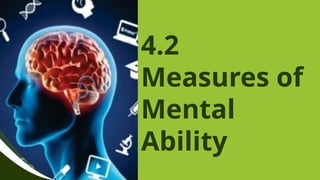
4.2
Measures of
Mental
Ability
Measures of Mental Ability
Another significant concept to
understand in teaching children with
learning disabilities is the level of the
learner's intellectual functioning or
mental ability. Here are some concepts
on mental ability:
Concept 1. Standardized tests of mental
ability measure intellectual functioning
A Standardized mental ability test or IQ test
consists of questions and problem. solving
task assumed to require certain amounts of
intelligence to answer or solve correctly. The
child's performance in intelligence tests is
used to derive a score that represents his or
her overall intelligence.
Concept 2. IQ scores seem to be distributed
throughout the population according to the
normal curve.
To describe how one particular score varies
from the mean or average score, the
population is divided into units called standard
deviations (SD). A standard deviation. is a
mathematical concept that refers to the
amount by which a particular score on a given
tests varies from the mean or average scores
in the norm sample. A person's IQ test score
can be described in terms of how many
Concept 3. Intelligence testing is not an
exact science.
There are many factors or variables that
can affect an individual's IQ score such as,
motivation, the time and location of
administration, and the inconsistency or
bias of the test administrator in scoring
responses that are not precisely covered by
the test manual.
Concept 4. There are children whose IQ
scores fall within the average as well as the
above average of the normal curve who
experience learning difficulties.
Most children with learning difficulties have
average to above average intellectual
functioning. They do not belong to the group
of children with mental retardation but they
cannot learn most of the basic learning
competencies for average children. These
children have learning disabilities.
4.3 Definition
of Learning
Disabilities
Definition of Learning
Disabilities
The American National Joint Committee on Learning
Disabilities (NJCLD) which is composed of several
professional organizations issued the following
definitions in 1989.
 Learning disabilities is a generic term that refers
to a heterogeneous group of disorders manifested
by significant difficulties in the acquisition and
used of listening, speaking reading writing,
reasoning or mathematical abilities. These
disorders are intrinsic to the individuals and
presumed to be due to central nervous system
 Learning disabilities may occur
concomitantly with other handicapping
conditions, learning disabilities is not the
result of these conditions.
The group of disorders is heteregoneous,
that is there is not only one but several
disorders that occur at the same time. No
two learning disabled persons are alike in
The significant difficulties in the acquisition and use
of listening, speaking. reading, writing, reasoning,
or mathematical abilities show inthe child's
performance in the school subjects. These children
cannot learn the regular school subjects like his or
her normal classmates although their mental ability
is average or above average Reading is a subject
where they meet many difficulties
The phenomenon is explained by the factor called
IQ achievement discrepancy. The child does not
learn knowledge and skills in accordance with his or
her potential to learn as measured by standardized
Learning disabilities is intrinsic to the
individual. This means that the causes of
learning disabilities are organic,
biological, genetic or environmental. The
organic and biological factors are traced
to the central nervous system particularly
the brain
4.4 Three
Criteria in
Determining the
Presence of
Learning
Disabilities
1. Severe discrepancy between the
child's potential and actual
achievement. Learning disabilities is
present when mental ability tests and
standardized achievement test results
show discrepancy between general
mental ability and achievement in
school. Evidence of a discrepancy score
or greater than two in intellectual
ability and achievement in one or more
of the following areas:
 Oral expression
 Listening comprehension
 Reading comprehension
 Written expression
 Basic reading skills
 Mathematical calculations
 Reasoning
2. Exclusion or absences of mental
retardation, sensory impairment and
other disabilities.The exclusion criterion
means that the child has significantly
problem that cannot be explained by
mental retardation, sensory impairment
like low vision. blindness, hearing
impairment, emotional disturbance or
lack of opportunity to learn
3. Need for special education
services.Children with learning
disabilities should progress
normally as soon as they receive
effective instruction at a
curricular level that is
appropriate to their current
skills.
4.5 Learning and
Behavior
Characteristics of
Children with
Learning
Disabilities
1. Reading poses the most difficulty among all
the subjects in the curriculum. It may be
recalled that the facets of communication are
listening, speaking, reading and writing
Dyslexia - refers to the disturbance in the
ability to learn in general and the ability to
learn to read in particular.
2. Written language poses severe problems in
one or more of the following areas handwriting,
spelling, composition and writing which is
illegible and slow. Studies (Englert et al., 1987)
show that these children are
 They are not aware of the basic purpose of
writing as an act of communication.
 They approach writing as a test taking task.
3. Spoken Language poses problems on the
mechanical uses of language in syntax or
grammar, semantics or word meaning and
phonology or the breakdown of words into their
components sounds and blending individual
sounds to compose words
Developmental aphasia- is a condition
characterized by loss of speech functions, often,
but not always due to brain injury.
4.Pragmatics or social uses of language poses
on the ability to carry on a conversation.
Children with learning disabilities are found to
be unable to engage in the mutual give and
take in carrying in a conversation.
5. Mathematics problems are recognized as
second to deficiencies in reading. Language
and spelling.
6.These children tend to fail and be
retained in a grade level. The level of
academic achievement tends to
decrease progressively as the grade
level increases.
7. Behavior problems remain
consistent across grade levels both I
school, in community and at home.
4.6 Causes of
Learning
Disabilities
The causes of learning disabilities are
attributed to genetic and environmental
factors. Genetic researches show that
learning disabilities tend to run in
families and heredity is a possible
cause.
4.7 Assessment
of Learning
Disabilities
1.Norm-Referenced Tests- designed to
measure how many of the skills in each
learning area- English, Filipino,
Mathematics, Science and Makabayan-
have been learned or mastered.
2.Processing Information- the
specific perceptual problems are in
visual perception, auditory
perception and visual-motor
coordination.
3. Reference Tests – in specific
subjects such as reading, language and
mathematics are used to determine the
mastery level of a predetermined
criterion that the student should be
capable of achieving.
4.Informal Reading – Inventory
consists of a series of progressively
more difficult sentences and
paragraphs for oral reading.
5. Direct daily measurement- a
useful method of determining
student’s performance in
learning a particular skill.
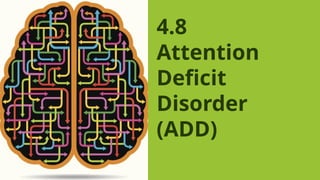
4.8
Attention
Deficit
Disorder
(ADD)
Attention Deficit Disorder (ADD) is a
term used for people who have
excessive difficulties with concentration
without the presence of other ADHD
symptoms such as excessive
impulsiveness or hyperactivity.
The diagnostic criteria:
Often does not give close attention to details or
makes careless mistakes in schoolwork, work,
or other activities.
Often has trouble keeping attention on tasks or
play activities.
Often does not seem to listen when spoken to
directly.
Often has trouble organizing activities.
Educational strategies are always
important for children with ADD. The
awareness of the teachers, cues to
help the child refocus, keeping lessons
as bright and interesting as possible in
short spells of concentration is helpful.
4.9Attentio
n Deficit /
Hyperactivit
y Disorder
(ADHD)
Attention Deficit / Hyperactivity
Disorder (ADHD) is characterized by
patterns of inattention, hyperactivity,
and impulsivity that make it difficult for
people to function in a way that's
deemed "standard" or neurotypical.
ADHD is lifelong.
Treatment
Standard treatments for ADHD
typically involve medication,
education, skills training and
psychological counseling.
CREDITS: This presentation template was created by
Slidesgo, and includes icons by Flaticon, and
infographics & images by Freepik
Thank you
for
Listening

Chapter IV. Students with Learning Disabilities

  • 1.
  • 2.
    4.1 Basic Concepts on Learning,Mental Ability and Learning Disabilities
  • 3.
    The Process ofLearning There are two main concepts in the term learning disabilities. 1. Describes the learning process 2. Explains the phenomenon about children who have average or even above average ability to learn but who experience difficulties in learning.
  • 4.
    What is Learning? -Learning is the process by which experience and practice result in a stable change in the learner's behavior.
  • 5.
    The Stages ofLearning 1. The "Knowing" Stage of Learning A. Acquisition and Reversion-  Acquisition of knowledge and skills takes place when the instructional goals and objectives, and skills and competencies, strategies and materials match the learning ability of the students.  Reversion, the content and skills learned earlier are further strengthened to increase accuracy and mastery Correct practice drill, review and similar strategies are used with immediate feedback and
  • 6.
    B. Proficiency andAutomaticity  Proficiency and Automaticity are determined by the strength or prior learning. When mastery of a skill or concept is attained, the learner moves onto the sub- stages of proficiency and
  • 7.
    2. The "Using"Stageof Learning A. Maintenance  Maintenance is achieved is achieved when the student continues to use the skills thus acquired with proficiency and automaticity over time without explicit instruction, coaching, prompt, help or
  • 8.
    B. Generalization  Oncea skill is learned proficiently, it should be available for use in appropriate situation. The goal of generalization are. a. For the learner to recognize a new or different stimulus as a prompt to apply the learned skills b. To use the acquired skills in various situations, behaviors, setting and time.
  • 9.
    3. The "Inventing"Stage of Learning A. Adaptation  the student recognizes the need to apply learned skills in situations outside the school. He or she introduces changes or modifications in the skills and applies them to meet the new situation without help or
  • 10.
  • 11.
    Measures of MentalAbility Another significant concept to understand in teaching children with learning disabilities is the level of the learner's intellectual functioning or mental ability. Here are some concepts on mental ability:
  • 12.
    Concept 1. Standardizedtests of mental ability measure intellectual functioning A Standardized mental ability test or IQ test consists of questions and problem. solving task assumed to require certain amounts of intelligence to answer or solve correctly. The child's performance in intelligence tests is used to derive a score that represents his or her overall intelligence.
  • 13.
    Concept 2. IQscores seem to be distributed throughout the population according to the normal curve. To describe how one particular score varies from the mean or average score, the population is divided into units called standard deviations (SD). A standard deviation. is a mathematical concept that refers to the amount by which a particular score on a given tests varies from the mean or average scores in the norm sample. A person's IQ test score can be described in terms of how many
  • 14.
    Concept 3. Intelligencetesting is not an exact science. There are many factors or variables that can affect an individual's IQ score such as, motivation, the time and location of administration, and the inconsistency or bias of the test administrator in scoring responses that are not precisely covered by the test manual.
  • 15.
    Concept 4. Thereare children whose IQ scores fall within the average as well as the above average of the normal curve who experience learning difficulties. Most children with learning difficulties have average to above average intellectual functioning. They do not belong to the group of children with mental retardation but they cannot learn most of the basic learning competencies for average children. These children have learning disabilities.
  • 16.
  • 17.
    Definition of Learning Disabilities TheAmerican National Joint Committee on Learning Disabilities (NJCLD) which is composed of several professional organizations issued the following definitions in 1989.  Learning disabilities is a generic term that refers to a heterogeneous group of disorders manifested by significant difficulties in the acquisition and used of listening, speaking reading writing, reasoning or mathematical abilities. These disorders are intrinsic to the individuals and presumed to be due to central nervous system
  • 18.
     Learning disabilitiesmay occur concomitantly with other handicapping conditions, learning disabilities is not the result of these conditions. The group of disorders is heteregoneous, that is there is not only one but several disorders that occur at the same time. No two learning disabled persons are alike in
  • 19.
    The significant difficultiesin the acquisition and use of listening, speaking. reading, writing, reasoning, or mathematical abilities show inthe child's performance in the school subjects. These children cannot learn the regular school subjects like his or her normal classmates although their mental ability is average or above average Reading is a subject where they meet many difficulties The phenomenon is explained by the factor called IQ achievement discrepancy. The child does not learn knowledge and skills in accordance with his or her potential to learn as measured by standardized
  • 20.
    Learning disabilities isintrinsic to the individual. This means that the causes of learning disabilities are organic, biological, genetic or environmental. The organic and biological factors are traced to the central nervous system particularly the brain
  • 21.
    4.4 Three Criteria in Determiningthe Presence of Learning Disabilities
  • 22.
    1. Severe discrepancybetween the child's potential and actual achievement. Learning disabilities is present when mental ability tests and standardized achievement test results show discrepancy between general mental ability and achievement in school. Evidence of a discrepancy score or greater than two in intellectual ability and achievement in one or more of the following areas:
  • 23.
     Oral expression Listening comprehension  Reading comprehension  Written expression  Basic reading skills  Mathematical calculations  Reasoning
  • 24.
    2. Exclusion orabsences of mental retardation, sensory impairment and other disabilities.The exclusion criterion means that the child has significantly problem that cannot be explained by mental retardation, sensory impairment like low vision. blindness, hearing impairment, emotional disturbance or lack of opportunity to learn
  • 25.
    3. Need forspecial education services.Children with learning disabilities should progress normally as soon as they receive effective instruction at a curricular level that is appropriate to their current skills.
  • 26.
    4.5 Learning and Behavior Characteristicsof Children with Learning Disabilities
  • 27.
    1. Reading posesthe most difficulty among all the subjects in the curriculum. It may be recalled that the facets of communication are listening, speaking, reading and writing Dyslexia - refers to the disturbance in the ability to learn in general and the ability to learn to read in particular.
  • 28.
    2. Written languageposes severe problems in one or more of the following areas handwriting, spelling, composition and writing which is illegible and slow. Studies (Englert et al., 1987) show that these children are  They are not aware of the basic purpose of writing as an act of communication.  They approach writing as a test taking task.
  • 29.
    3. Spoken Languageposes problems on the mechanical uses of language in syntax or grammar, semantics or word meaning and phonology or the breakdown of words into their components sounds and blending individual sounds to compose words Developmental aphasia- is a condition characterized by loss of speech functions, often, but not always due to brain injury.
  • 30.
    4.Pragmatics or socialuses of language poses on the ability to carry on a conversation. Children with learning disabilities are found to be unable to engage in the mutual give and take in carrying in a conversation. 5. Mathematics problems are recognized as second to deficiencies in reading. Language and spelling.
  • 31.
    6.These children tendto fail and be retained in a grade level. The level of academic achievement tends to decrease progressively as the grade level increases. 7. Behavior problems remain consistent across grade levels both I school, in community and at home.
  • 32.
  • 33.
    The causes oflearning disabilities are attributed to genetic and environmental factors. Genetic researches show that learning disabilities tend to run in families and heredity is a possible cause.
  • 34.
  • 35.
    1.Norm-Referenced Tests- designedto measure how many of the skills in each learning area- English, Filipino, Mathematics, Science and Makabayan- have been learned or mastered.
  • 36.
    2.Processing Information- the specificperceptual problems are in visual perception, auditory perception and visual-motor coordination.
  • 37.
    3. Reference Tests– in specific subjects such as reading, language and mathematics are used to determine the mastery level of a predetermined criterion that the student should be capable of achieving.
  • 38.
    4.Informal Reading –Inventory consists of a series of progressively more difficult sentences and paragraphs for oral reading.
  • 39.
    5. Direct dailymeasurement- a useful method of determining student’s performance in learning a particular skill.
  • 40.
  • 41.
    Attention Deficit Disorder(ADD) is a term used for people who have excessive difficulties with concentration without the presence of other ADHD symptoms such as excessive impulsiveness or hyperactivity.
  • 42.
    The diagnostic criteria: Oftendoes not give close attention to details or makes careless mistakes in schoolwork, work, or other activities. Often has trouble keeping attention on tasks or play activities. Often does not seem to listen when spoken to directly. Often has trouble organizing activities.
  • 43.
    Educational strategies arealways important for children with ADD. The awareness of the teachers, cues to help the child refocus, keeping lessons as bright and interesting as possible in short spells of concentration is helpful.
  • 44.
  • 45.
    Attention Deficit /Hyperactivity Disorder (ADHD) is characterized by patterns of inattention, hyperactivity, and impulsivity that make it difficult for people to function in a way that's deemed "standard" or neurotypical. ADHD is lifelong.
  • 46.
    Treatment Standard treatments forADHD typically involve medication, education, skills training and psychological counseling.
  • 47.
    CREDITS: This presentationtemplate was created by Slidesgo, and includes icons by Flaticon, and infographics & images by Freepik Thank you for Listening