Learning and Thinking Styles & Emotional Intelligence
1.
Learning and
Thinking Styles
&
Emotional
Intelligenceby
Daniel Goleman
Learning and
Thinking Styles
&
Emotional
Intelligence by
Daniel Goleman
Serticio, Mickyla G. BSED FILIPINO 2A
Serticio, Mickyla G. BSED FILIPINO 2A
2.
One factor thatbrings about student diversity is
thinking/learning styles. Individuals think and
learn in distinct ways. In any group of learners,
there will always be different learning
characteristics, particularly in the learners’
manner of processing information.
3.
Several perspectives aboutlearning-
thinking styles - sensory preferences
and the globalanalytic continuum:
I. Sensory Preferences
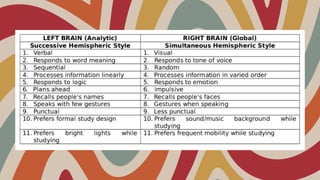
Individuals tend to gravitate toward one
or two types of sensory input and
maintain a dominance in one of the
following types:
4.
A. Visual Learners
Theselearners must see their teacher's actions
and facial expressions to fully understand the
content of a lesson.
Ri Charde further breaks down visual learners into:
a. Visual-iconic
Those who prefer this form of input are more
interested in visual imagery such as film, graphic
displays, or pictures in order to solidify learning.
5.
b. Visual-symbolic
Those whoprefer this form of input feel
comfortable with abstract symbolism
such as mathematical formula or the
written word.
6.
B. Auditory Learners
Theylearn best through verbal lectures,
discussions, talking things through and listening to
what others have to say.
Auditory learners also fall into two categories:
a. The "Listeners"
They remember things said to them and make the
information their own.
7.
b. The "Talkers"
Theyare the ones who prefer to talk and
discuss.
C. Tactile/ Kinesthetic Learners
Tactile/ Kinesthetic persons benefit much from
a hands-on approach, actively exploring the
physical world around them.
8.
II. Global- AnalyticContinuum
A. Analytic
Analytic thinkers tend toward the linear, step-by-step
processeses of learning.
B. Global
Global thinkers lean towards non-linear thought and
tend to see the whole pattern rather than particle
elements.
10.
Daniel Goleman explainsthat emotions can be
studied, and people can be taught how to
understand and manage their own emotions.
11.
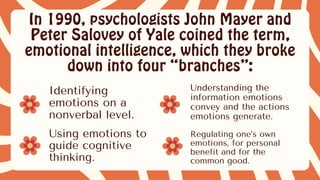
In 1990, psychologistsJohn Mayer and
Peter Salovey of Yale coined the term,
emotional intelligence, which they broke
down into four “branches”:
Identifying
emotions on a
nonverbal level.
Using emotions to
guide cognitive
thinking.
Regulating one’s own
emotions, for personal
benefit and for the
common good.
Understanding the
information emotions
convey and the actions
emotions generate.
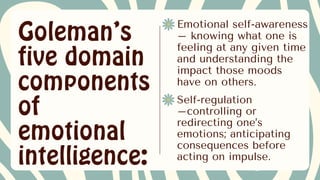
Motivation – utilizingemotional factors
to achieve goals, enjoy the learning
process and persevere in the face of
obstacles.
Empathy – sensing the emotions of
others.
Social skills – managing relationships,
inspiring others and inducing desired
responses from them.
14.
Applications for Educators
TheEQ of children starts developing
long before they ever enter a classroom.
But EQ levels will vary widely, depending
on each child’s home environment.
There are very practical reasons to
promote social and emotional learning
in schools, from kindergarten through
college.
15.
Thus teachers mustbe able to
recognize those children whose
emotional literacy needs a boost.
Teachers should be ready to talk
about feelings in the classroom.